




Abstract
Collaborative organising is known to burn like a rocket: it thrives on intense passion, relationality and creativity but quickly falls into pieces. This article explores the underestimated role of events and their affective atmospheres to sustain collaborative work. Drawing insights from two ethnographic field studies within an open-source software community and a network of impact entrepreneurs, we introduce the notion of ‘polyrhythmic affectivity’ at the core of polycentric governance. It encapsulates how frictional reverberances between three atmospherically experienced affective intensities – togetherness, dissonance and mutuality – are able to maintain emergent yet enduring order. We argue that the collective motivational force of collaborative organising, can be stabilised through a process of ‘affective commoning’ to sustain collaborative atmospheres as shared creative resources.
Introduction
The flexibilisation, virtualisation and mediation of work (Aroles et al., 2021) has spurred new forms of collaborative organising (Adler and Heckscher, 2006), characterised by distributed and collective action (Kornberger, 2022). Within the bounds of formal organisations, self-managed, less-hierarchical teams (Lee and Edmondson, 2017) strive for cross-functional, agile work practices (Junker et al., 2022) typically set in open spatial arrangements (Barth and Blazejewski, 2023). Outside formal organising, online communities (Faraj et al., 2011), open strategy and innovation processes (Harhoff and Lakhani, 2016), peer production (O’Neil et al., 2021), open networks (Majchrzak et al., 2021), as well as incubators, coworking spaces and creative hubs (Gill et al., 2019) have been discussed in light of more autonomous, innovative and plural, maybe even free futures of work (Dahlman et al., 2022).
However, comparably to social and political movements (Vidolov et al., 2023), collaborative organising struggles to maintain durability. It is challenging to reconcile equal participation and scale (Massa and O’Mahony, 2021). Information overload (Lingo, 2023), informal hierarchies, infighting and shirking responsibility can take over in the absence of clear structures (e.g. Freeman, 1972; King and Land, 2018; Reinecke, 2018). In many contexts, collaboration among peers depends on precarious emotional labour (Blagoev et al., 2019; Endrissat and Leclercq-Vandelannoitte, 2021; Gregg and Lodato, 2018), while attachments to charismatic leadership and normative control can lead to exhaustion (Picard and Islam, 2020). Care practices have also proven hard to distribute, resulting in frustration, indecision and burnout (Resch and Steyaert, 2020).
Polycentricity (Ostrom, 2006; Polanyi, 1998) has been proposed as a relational principle to harmonise openness, diversity and adaptability with lasting forms of association and strategic collective action. Polycentric governance is based on multiple, nested decision centres with ‘limited and autonomous prerogatives’ (Aligica and Tarko, 2012: 237), working within a shared set of values and rules (Adler and Heckscher, 2018) to generate order from ‘evolutionary’ processes of experimentation, deliberation and revisability (Shanahan, 2023). A number of scholars examined knowledge and shared situational awareness as core resources in today’s technologically mediated forms of collaborative organising and highlighted how they are polycentrically managed through common information infrastructures (Fjeldstad et al., 2012; Håkonsson et al., 2023). Participants maintain communicative flows, connection and trust, for example, through intertwined dynamics between formalisation and decentralisation (Rozas and Huckle, 2021), distinguishing participation opportunities for core and peripheral members (Massa and O’Mahony, 2021), or providing asynchronous and real-time communication channels (Rhymer, 2023).
Recent contributions to the debate have called for more attention to affective and material dynamics in collaborative organising, expanding the communicative dimension (Ashcraft, 2017; de Vaujany et al., 2021; Fotaki et al., 2017). Affect refers to sensed, pre-cognitive intensities that arise during encounters involving bodies, discourses and materiality. Affective dynamics rapidly span largely unspoken ‘co-subjective circuits of feeling and sensation’ (Fotaki et al., 2017: 4), foregrounding embodied, imitative and contagious aspects of socio-material association. Studies have shown how collaborative organising is lived sensually (Vesala, 2023) in ‘affecto-rhythmic orders’ (Katila et al., 2020), which fuel an ‘economy of encounter’ (Jakonen et al., 2017), where an enticing sense of community and difference coalesces with innovative spaces and technologies to spark creative potentiality (Leclair, 2023). This experiential quality inspires people to engage in collective action and learning (Vitry et al., 2020) but also entails value capture from affective processes (Endrissat and Islam, 2022; Gregg and Lodato, 2018) and self-exploitation fuelled by intense desires (Resch et al., 2021).
An emergent stream of empirical studies has begun to examine how event atmospheres play a crucial role in igniting collaborative affectivity (De Molli et al., 2020; Endrissat and Islam, 2022; Endrissat and Leclercq-Vandelannoitte, 2021) as well as analysing how it falters (Michels and Steyaert, 2017). Nevertheless, there is limited knowledge regarding the sustainable cultivation of atmospheres to nurture enduring forms of collaborative organising (Cox et al., 2010; Ostrom, 2006; Waters-Lynch and Duff, 2021). More situated accounts of the relational and political repercussions of affective processes are required (Marsh and Śliwa, 2022). Hence, at the intersection of collaborative organising, polycentricity and affect, our research question is: How are affective atmospheres generated at events contributing to durable processes of collaborative organising? Empirically, we trace the role of face-to-face events, like conferences, retreats or meetups, for durable collaborative organising. Two complementary multi-year ethnographic case studies in an open source software community and a network of impact entrepreneurs analysed in a process of ‘participatory interpretation’ (De Molli, 2021) enabled us to investigate how affective atmospheres created at those events were entwined with broader organisational dynamics.
The findings of this article highlight an ongoing frictional relationship between three affective intensities: togetherness, dissonance and mutuality, which accounts for the enticing, if often short-lived, quality of collaborative atmospheres. We theorise how polycentric governance is underpinned by polyrhythmic affectivity, occupying a fragile threshold between affecto-rhythmic feedback loops and potentially dominating affects. Our second contribution is to the management of these atmospheric dynamics. While affective resonances can neither be instrumentally grasped nor controlled (De Molli et al., 2020; Michels and Steyaert, 2017), we empirically enrich Waters-Lynch and Duff’s (2021) notion of ‘affective commoning’ as a process of assuming collective response-ability for re-producing, valorising and consuming the co-creative outcomes – products, experiences, learnings, reputations and lifestyles – emanating from the polyrhythmic affectivity.
Next, we develop our conceptual framework around affective atmospheres in collaborative organising, where the nexus of affect, space and materiality has become an essential anchor of individual and collective experience. We then review literature concerned with the durability of collaborative organising, focusing on polycentric governance and the need to study its affective dynamics. Drawing on ethnographic methods, we analyse the ambiguous interplay of three affective intensities circulating through collaborative event atmospheres. Finally, we develop the notion of polyrhythmic affectivity and critically discuss the implications of affective commoning for distributed and collective action.
The atmospherics of collaborative organising
Conceptually, our research focuses on spatialised affects as atmospheres (Anderson, 2009; Beyes and Steyaert, 2012; Böhme, 1993). This perspective entails ‘a rethinking of space as processual, performative, multiple, affective and fluid’ (Gherardi, 2023: 1). Böhme (1993) framed atmospheres as affectively ‘tuned spaces’, operating as a medium through which the vast canvas of the world becomes actionable. We instinctively sense a mood and related ways of being and behaving once we become part of a space, be it a festival (De Molli, 2021), sports event (Edensor, 2015) or art performance (Marsh and Śliwa, 2022; Michels and Steyaert, 2017). Charged with affective intensities as transpersonal and pre-reflexive biochemical processes of entrainment and imitation (Borch, 2010), atmospheres connect bodies and materialities within place-based spheres (Sloterdijk, 2004).
From this vantage point, affective atmospheres are conceptualised as the ‘primary “object” of perception’ (Böhme, 1993: 125), mediating internal (bodily) and external (environmental) worlds. Thibaud (2015) describes atmospheres as a ‘medium’ that enables perception in the first place. People will, for example, experience an alpine panorama differently through misty fog or in bright sunlight: ‘The medium is the intermediate place starting from which an object becomes perceptible, visible, audible’ (Thibaud, 2015: 41). Atmospheres draw bodies, practices and materialities into a composition by involving them in transpersonally transmitted affective circuits (Endrissat and Islam, 2022). As a conceptual tool, this theoretical perspective attunes organisational research to the affective and emotional expressivity of spatial relations. Instead of mapping space as a fixed territory, it invites a stance of wayfinding in between multiple ambiguities (Vitry et al., 2020), attentive to desires and imagination, pauses and disorientation, and historically induced absent-presences in materiality (Beyes and Holt, 2020).
A recent wave of empirical studies on collaborative organising illustrated how once a particular atmosphere becomes habitually dominant, for example, ‘confidence’ in workplace meetings (Vitry et al., 2020), it can linger in the air between bodies and boardrooms, even if actual interactions cautioned against overt confidence. Looking at how start-up teams in an entrepreneurial accelerator were collectively pulled into an ‘upbeat’ mood through music and constant challenges, Katila et al. (2020: 1324) theorised how ‘affecto-rhythmic order [. . .] entails sensory openness to order and submission to ongoing bodily dressage’. Frequently, the sensory politics of spatial relationships unfolds in subtler ways, with individuals yearning to be part of an experience (Philippopoulos-Mihalopoulos, 2016) or becoming attuned to a limited band of perceptive awareness (Beyes et al., 2022) through intercorporeal learning and mutual aesthetic judgements (Willems, 2018). Collaborative atmospheres that successfully motivate contribution flourish through ambiguity – the presence of multiple, overlapping affective intensities, lending the atmosphere an open and incomplete nature, thereby inviting participation, as De Molli et al. (2020) showed in their study of an open-air film festival.
Despite its potency, the atmospheric-affective ‘tone of territories’ (Thibaud, 2015: 44) is ephemeral, pointing to the edges of what can be sensed, anticipated and represented. Affective atmospheres need to be continuously reproduced and are subject to unexpected environmental conditions, like the downpour of rain during a performance (Michels and Steyaert, 2017). Even powerful materiality, such as building architecture, cannot impose atmospheres. Instead, they establish themselves through a process of ‘impregnation’ (Thibaud, 2015: 43) that requires continuous consideration of the users’ habits and various aesthetic codes. In their study of building design, Jørgensen and Holt (2019) emphasise the engagement of architects, both ex-ante as they ‘co-design’ atmospheres with their clients and ex-post as the atmospheres ‘co-evolve’ with the everyday lives of their inhabitants. Organisationally, this marks a shift from planning and controlling to relating and curating (Beyes, 2016), with an attentiveness to unplanned encounters and unanticipated events (Michels and Steyaert, 2017) – highlighting organisational development through joint experimentation and improvisation (Shanahan, 2023).
Crucial to collaborative organising, affective atmospheres can produce an electrifying sense of potentiality and curiosity about which encounters and becomings might be next, ‘manifest[ing] a store of action-potential that mediates the dispositions and agencies potentially enactable’ (Waters-Lynch and Duff, 2021: 390). It has thus been argued that atmosphere, not information, functions as the primary resource for creative knowledge production. Examining the socio-material constitution of creativity through spatialised affects in a fashion design studio, Leclair (2023: 809) details this dynamic as an experience of ‘being in the zone’, attuned to agentic possibilities imbued in the fabrics, constantly experimenting and open to being surprised by ‘absent but felt forces’ (2023: 820). This interplay between palpable sensory-atmospheric experience, encounters and imagination inflects ‘bodies with novel capacities, new modes of interaction, new insights, tendencies or habits, new creative opportunities, a different experience of work’ (Waters-Lynch and Duff, 2021: 390).
In sum, an atmospheric perspective on collaborative organising calls our attention to the (physical and virtual) spaces of work, investigating how they are enveloped in affective climates that emerge in-between distributed socio-material relations but also exceed and structure them. The eager anticipation of surprising encounters, unexpected moods, new relations and co-creative possibilities functions as the fuel of the new economy (Jakonen et al., 2017). Studies highlighted the importance of affective ambiguity and multiplicity, the promises and perils of unintended consequences and unanticipated events, as well as the importance of relating and curating to move between different modes of sensing and feeling (Beyes et al., 2022). The literature has delved into the initiation, composition and utilisation of collaborative atmospheres, yet there remains limited understanding of how they can be sustained to foster regenerative and equitable forms of collaboration.
We will now turn to the relational design principle of polycentricity, which has been suggested to strengthen the durability of collaborative organising and elaborate why its communicative and institutionalist conceptualisation needs to be expanded through an affective register.
Polycentric governance and its affective ecologies
Collaboration (Dillenbourg, 1999) refers to a dynamic, horizontal, cross-functional division of labour, where the modes of working and work environments, as well as the outcomes, evolve and change in co-creative peer processes. Collaborative organising entails less hierarchical (Lee and Edmondson, 2017), self-organised (Massa and O’Mahony, 2021) and networked (Majchrzak et al., 2021) team and community structures aligned by a shared sense of purpose (Adler and Heckscher, 2018; Arvidsson, 2018).
Typically, collaborative forms of organising thrive for a period before experiencing a decline (Cox et al., 2010; Ostrom, 2006; Waters-Lynch and Duff, 2021). Owing to its emergent nature, collaboration entails navigating unclear boundaries, expectations and mandates (Müller, 2018). This situation can lead to frustration and, in the most adverse scenarios, result in a ‘tyranny of structurelessness’ (Freeman, 1972), where informal hierarchies and opaque decision-making processes take hold. Well-established dialogic relationships can help mitigate this ‘iron threat of oligarchy’ (Diefenbach, 2019). However, with growing scale, it becomes increasingly difficult to reconcile participation with indecision (Leach, 2016), core with periphery (Massa and O’Mahony, 2021), cohesion with openness (Farias, 2017a), voluntary contribution with valorisation (Endrissat and Islam, 2022) and passionate involvement with compassionate care (Resch and Steyaert, 2020).
Polanyi’s (1998) notion of polycentricity has been used to address the durability problem in collaborative organising. It challenges economies of scale and central decision making with layered organisational structures – a ‘social system of many decision centres having limited and autonomous prerogatives and operating under an overarching set of rules’ (Aligica and Tarko, 2012: 237). Polanyi was fascinated by the ‘spontaneous order’ of the academic community, where progress emerges from trial and error, people contributing individually and adapting to the decisions of others while sharing a common ideal: the search for truth. Ostrom (2006) further conceptualised polycentric governance following her studies of natural resource communities. Pooled resources can be jointly managed by a network of nested, redundant and mixed institutions operating within a coherent system of rules. Ostrom’s institutional perspective emphasises that participants must view rules as beneficial, accompanied by transparent procedures for democratic decision making, legitimate enforcement and conflict resolution.
Collaborative knowledge production on the Internet led to a stream of research focusing on communication between individual actors and informational affordances to create emergent, self-organised order. Looking at open source software communities (e.g. Shaikh and Henfridsson, 2017), wikis (e.g. Aaltonen and Lanzara, 2015), collaborative art and media production (e.g. Clegg and Burdon, 2021) or open science, innovation and peer funding (e.g. Lingo, 2023), information infrastructures moved to the centre of attention. Effectively managing substantial quantities of knowledge and coordinating a diverse range of participants necessitates using polycentric methods for sharing information, fostering dialogue and experimentation (Fjeldstad et al., 2012). While leadership focuses on digital curation and creative brokering (Lingo, 2023), shared knowledge and situational awareness about problems and opportunities becomes a pooled resource that is collectively owned and available (Håkonsson et al., 2023).
However, next to the role of values, institutions and communication in polycentric governance, it is necessary to address persisting relational problems. The ‘selling out’ to centralised authority and managerialism (Dahlander and O’Mahony, 2011), unspoken power structures and reputational ‘superstar dynamics’ (Schneider, 2022), oppressive gender relations and lack of female participation (Toupin, 2021), as well as overwork and burnout (Reinecke, 2018) call for the study of community, commoning and affect in polycentricity. Today’s diverse forms of collaborative organising share the promise of a creative and purposeful work experience by providing intense aesthetic experiences, expanding emotional repertoires and offering belonging to mutualistic communities without the burden of traditionalist obligations (Vesala, 2023). In light of increasing project-based work, individualisation and restlessness, these dynamics coalesce into precarious affective socialities (Endrissat and Islam, 2022; Endrissat and Leclercq-Vandelannoitte, 2021) caught in a tension between the commodification of relations and entrepreneurial precarity on the one hand and mutual development and communitarian imaginary on the other.
In-person events have proven to be compelling phenomena for studying the affective ecologies of collaboration. They produce affective intensity owing to co-location, bounded temporality and embodied practice. Studies cover a wide range from extraordinary events like awards and celebrations (Pallas et al., 2024) that advance credibility, visibility and critical issues (Khoury et al., 2021) to everyday routines and rituals from which co-discipline and neo-normative control as well as shared work patterns and the emancipatory potential for collective action emerge (Blagoev et al., 2019; Endrissat and Leclercq-Vandelannoitte, 2021; Gregg and Lodato, 2018; Islam and Sferrazzo, 2022). Through staging, materiality and dramaturgy (Cluley, 2022), events generate immediate sensory experiences for aspirational narratives to congeal in a felt sense of being-in-the-world (Mauksch, 2017). Events like tours (de Vaujany et al., 2019) prototype atmospheres for prospective participants and, over time, contribute to crafting organisational style (Bazin and Korica, 2021).
The literature reveals a tension between carefully staged and performed ‘peak experiences’ like hackathons, design sprints or work retreats and mundane rituals such as regular breakfasts and stand-up meetings. The first are designed attempts to circulate and intensify affect through aestheticised spaces, temporal sequencing, as well as practices of encounter, liminality and play (Endrissat and Islam, 2022; Vesala and Tuomivaara, 2018), attuning bodies to an affecto-rhythmic order (Katila et al., 2020), and eventually seeking to capture value from collective-affective processes. The latter are associated with spontaneous self-expression, voluntary contribution and authentic interaction (Blagoev et al., 2019; Endrissat and Leclercq-Vandelannoitte, 2021; Gregg and Lodato, 2018), where communitarian practices, for example, food and music (Keevers and Sykes, 2016) have been shown to render belonging, respect and recognition accessible across differences.
The intense sense of aliveness and potentiality – colloquially referred to as a unique ‘buzz’ or ‘vibe’ – as the essential affective resource of collaborative organising seems to result from the combination of ‘centres of experience’ (see De Molli et al., 2020), where heightened emotionality meets aesthetic dynamism, and mundane occurrences of being heard and seen, practising ‘mutual recognition of difference beyond normative expectations’ (Mandalaki and Fotaki, 2020: 751). It is unclear which affective intensities are being circulated in this context and how different forms of events interact to maintain affective ecologies that reverberate throughout an organisation beyond the embodied immediacy of events. There is still a lack of empirical evidence of how affective intensities facilitate or hinder polycentricity and how they can be collaboratively sustained in a regenerative way. We have thus devised a complementary study of two long-standing collaborative organisations to examine the interplay of affective event atmospheres and durable processes of collaborative organising. We elaborate on the methodological setup in the following section.
Methodological attunement to the messy atmospheric middle
We studied face-to-face events in two long-standing collaborative organisations, the open source software community Drupal (founded in 2001) and the social entrepreneurial network Enspiral (founded in 2010). The dataset was compiled from two broader organisational ethnographies comprising a total of approximately 4.5 years of fieldwork. It includes participant-observational fieldnotes and vignettes, 25 qualitative interviews and more than 500 documents generated by the communities (for an overview, see Table 1).
Overview of case characteristics and data collection.
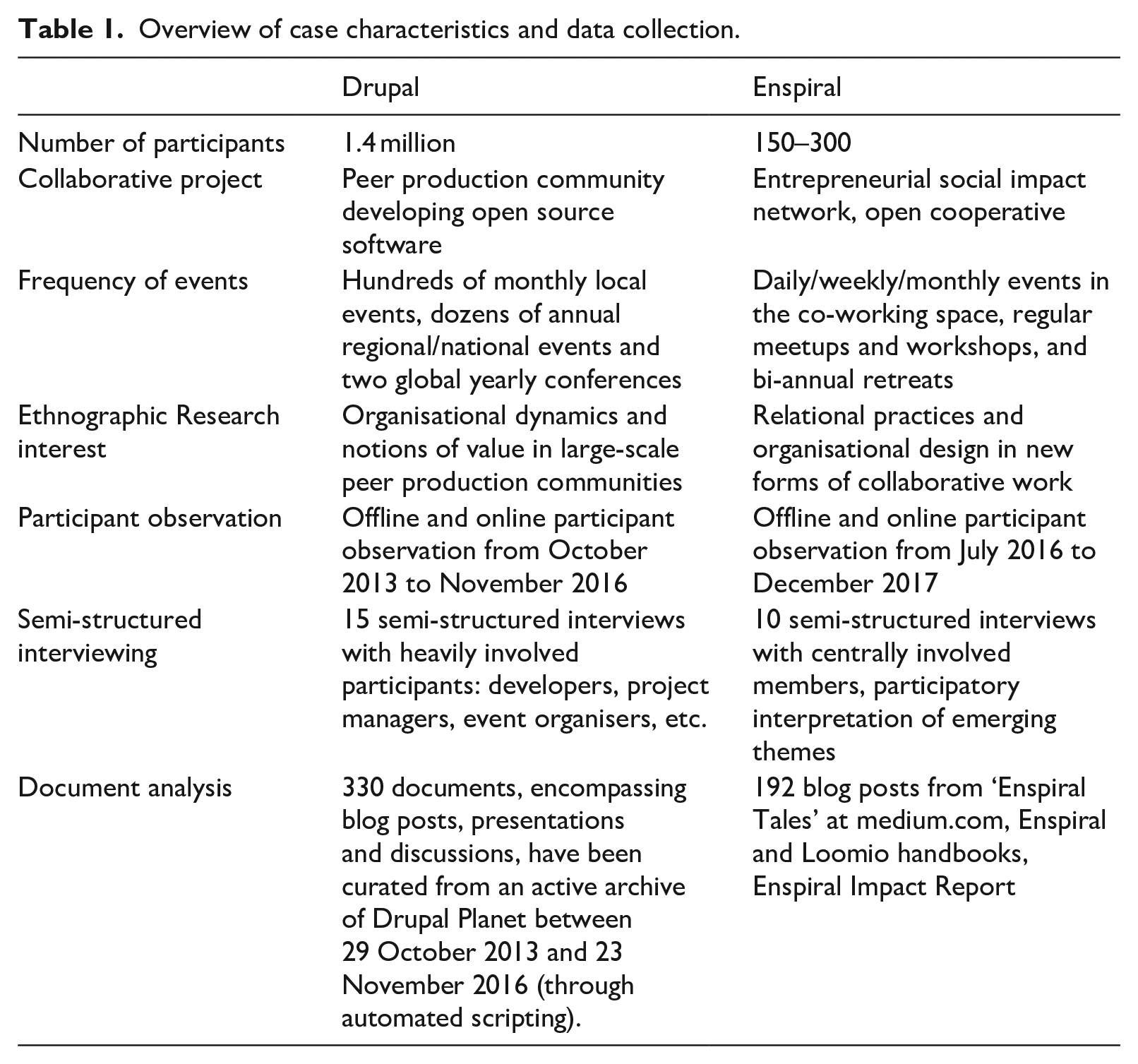
As an open source project, Drupal is developing a platform that powers approximately 1.1% of websites worldwide. 1 The Drupal community started as a small amateur project in 2001 and has since gathered hundreds of thousands of collaborators worldwide. 2 The main motto, ‘come for the software, stay for the community’, is mobilised in a wide range of events, from local informal gatherings to national and global conferences (‘DrupalCamps’ and ‘DrupalCons’). Enspiral is a grassroots social impact network with a fluctuating membership of between 150 and 300 people, enabling ‘more people to work on stuff that matters’. It has been characterised as an ‘open cooperative’ (Pazaitis et al., 2017), a do-it-together incubator in which people practise resource sharing, collaborative decision making and collective ownership. Enspiral is a collection of different ventures, communities, online channels and a coworking space punctuated by regular meetups, working groups and biannual retreats.
After we had independently noticed the importance of events for intensifying collaborative affectivity, we systematically compared and contrasted data from both cases in a series of exchanges and workshops. We retold the stories of our research, focusing on emotionally gripping moments and turning points in the empirical material, which helped us to reflect our affective experiences in the field (De Molli, 2021). We shared fieldnotes, quotes, blog posts and photos, clustering them to scrutinise the mood of these gatherings, the most critical activities, as well as their material composition and values defining the broader environment. Focusing our iteratively emergent data generation and analysis on vulnerable experiences of entangled bodies instead of knowing individuals (Mandalaki et al., 2022) enabled us to trace defining currents in the ‘messy middle’ of a ‘ceaselessly recomposing affective experience’ (Michels and Steyaert, 2017: 100).
Once we had patterned our primary data according to first-order affective-analytical dynamics, we could reappraise our researcher-bodies’ perceptual sensations and feelings in central event episodes. Through juxtaposition with voices from the field, expressing how they joined into atmospheric attunements (Steyaert and Janssens, 2023), we contoured affective qualities and traced how they were produced and related to each other. As embedded and engaged researchers, we inhabited and intensely sensed the relational landscapes of our organisations – we got close to people in the field and what was at stake for them (Leclair, 2023). In the academic environment, our intimate being-with the field inevitably triggered critical reactions concerning our distancing and reflecting ability. While initially irritating, the embodied immersion but incomplete belonging both ‘in the field’ and ‘at home’ repeatedly challenged our aesthetic reasoning concerning our ‘methodology of affectual composition’ (Michels and Steyaert, 2017: 100).
Concepts like ‘atmospheres’, ‘affective rhythms’ and ‘affective commoning’ emerged gradually as interpretative, analytical lenses (Endrissat and Islam, 2022) through abductive reasoning between emergent analysis and relevant literature. During the revision process, our desire for ‘generative theorising’ (Beyes and Holt, 2020: 17), seeking ‘new possibilities of feeling and acting collectively in organisations’, got disrupted by unforeseen and initially disconcerting breaks brought about by the global pandemic and the precarious nature of early-career scholarship. In retrospect, approaching our material ‘with new eyes’ proved helpful in developing a more nuanced analysis through self-reflective awareness of our own affectedness and critical distance to our performative aspirations.
Emergent and formalised events
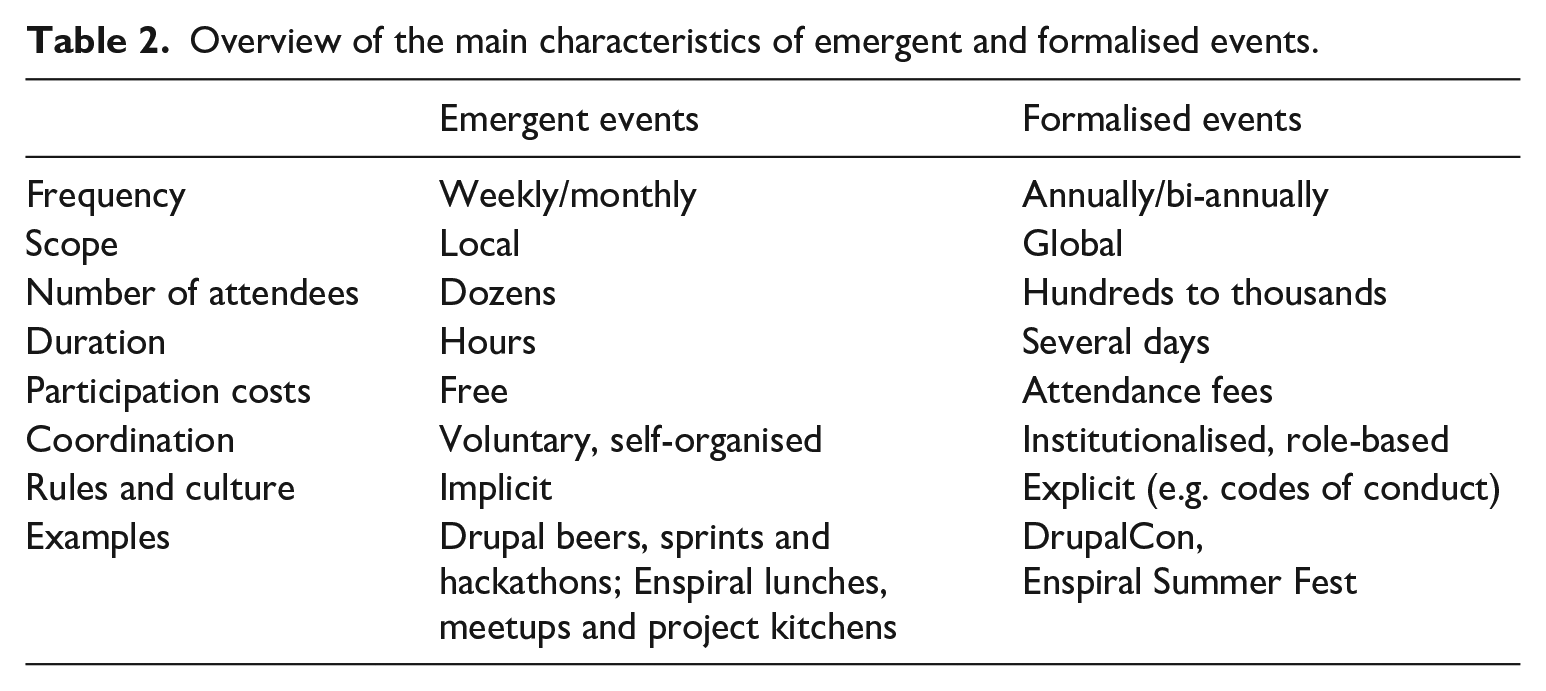
We distinguished two event categories (emergent and formalised), which we subsequently found mirrored, if not explicitly conceptualised, in other empirical studies of collaborative organising (e.g. Blagoev et al., 2019; Endrissat and Islam, 2022; Wilhoit and Kisselburgh, 2015; see De Molli et al., 2020). In the context of emergent events, we have outlined the set of organisational characteristics as follows: these events adhere to a regular schedule (ranging from weekly to monthly), possess a local focus, are arranged in a grassroots manner, rely on voluntary contributions from multiple members and involve a limited number of participants engaging free of charge. They are ‘emergent’ because they are easy to arrange and replicate by volunteers, making them susceptible to frequent evolution, disappearance and reappearance. The cultural rules present in these events are implicit and based on direct participation, representing a fertile environment for a self-organising collaborative ‘do-ocracy’ (Chen, 2016). In Drupal, emergent events include: ‘Drupal Beers’ (unstructured meetings in pubs); ‘Drupal Sprints’ and ‘Hackathons’, focused on giving back to the community; and ‘Drupal Coworking’ events, in which participants meet to work together on their personal Drupal projects. In Enspiral, we observed lunch yoga sessions, hacker meetups to tinker with tech projects, project kitchens held to gather peer feedback on projects and potluck picnics.
The second event type, ‘formalised events’, includes conferences and retreats. For Drupal, formalised events are DrupalCons, annual conferences attended by thousands of participants. These conferences have a global scope and last almost a week. At Enspiral, formalised events are known as Summer Fests and Winter Gatherings – bi-annual, three- to four-day retreats with up to a hundred participants. The events in this second category have a much broader international scope than emergent events, last several days and require the payment of a participation fee. In organisational terms, these events entail an explicit division of labour (e.g. peer-reviewing practices for the selection of presentations in Drupal, a hosting team for Enspiral retreats), the involvement of more formal institutions (e.g. Drupal Association for Drupal, whole network proposals and consent decisions in Enspiral) as well as the definition of explicit rules (e.g. codes of conduct). While these events allow for voluntary contributions and facilitate participatory discussions, such as Open Space workshops, they adhere to an institutionalised planning cycle and a professional logic. Acknowledging the reductionism inherent to all theorising, in the Drupal case, we found a hybrid event series called DrupalCamps, falling between the two categories. DrupalCamps combine practices from formalised events (e.g. peer-reviewing practices) and emergent ones (e.g. more self-organised; evolve or disappear frequently). Table 2, therefore, provides an overview of the characteristics of two event patterns rather than being entirely distinct types.
Overview of the main characteristics of emergent and formalised events.
A note on affective ethnography
Through the lens of new materialism, affect is seen as a ‘relational field of forces’ (Bell and Vachhani, 2020: 684) made up of not-yet consciously experienced, and thus rapidly spreading ‘transindividual’ bodily sensations and reactions, emerging in-between human, non-human and material-discursive encounters (Gherardi, 2023). From this perspective, the world is continuously becoming through relations. Entities do not pre-exist their intra-actions, which, in turn, are conditioned by the embodied immediacy of affect. Paraphrasing Gibbs (2001), our bodies catch feelings as easily as fire. Such ‘a universe of kisses, not stones’ (Rovelli, 2018: 62) foregrounds moments of density, resonance and contagion. Affective intensities cohere distributed and contingent constellations of agentic matter(s) through a qualitative feeling tone (Fotaki et al., 2017).
Gherardi (2019) relates affective ethnography not as a method but as a style of affective attunement with the field, which implies tracing ‘elusive knowledges’ (Toraldo et al., 2018) – aesthetic, embodied and sensible forms of knowing that are typically hard to articulate. Affective ethnography focuses on bodies, which are always tangled up, ‘implod[ing] all the boundaries between ethnographer and other more-than-human subjects, nature and culture’ (Gherardi, 2019: 747). In the patterned and multi-vocal representation of affectively laden experiences (themed ‘findings’), we do not attempt to conceal instances when we were deeply engaged with the virtuous mission of the organisations, times when we felt like awkward outsiders yearning for acceptance, or moments when we struggled to place trust in our affective interpretation of an event. While we traced the movements of affect, we moved things and were moved to become others. With this text, we are crafting a performative analysis that would be otherwise if other researcher-bodies had engaged in this endeavour. We attempted to be reflective of our ‘becoming-with-data’ (Gherardi, 2019) and see this vulnerable openness and taxing in-betweenness as a necessary precondition to understanding the sensed immediacy of organisational life.
Findings: Atmospherics of collaborative events
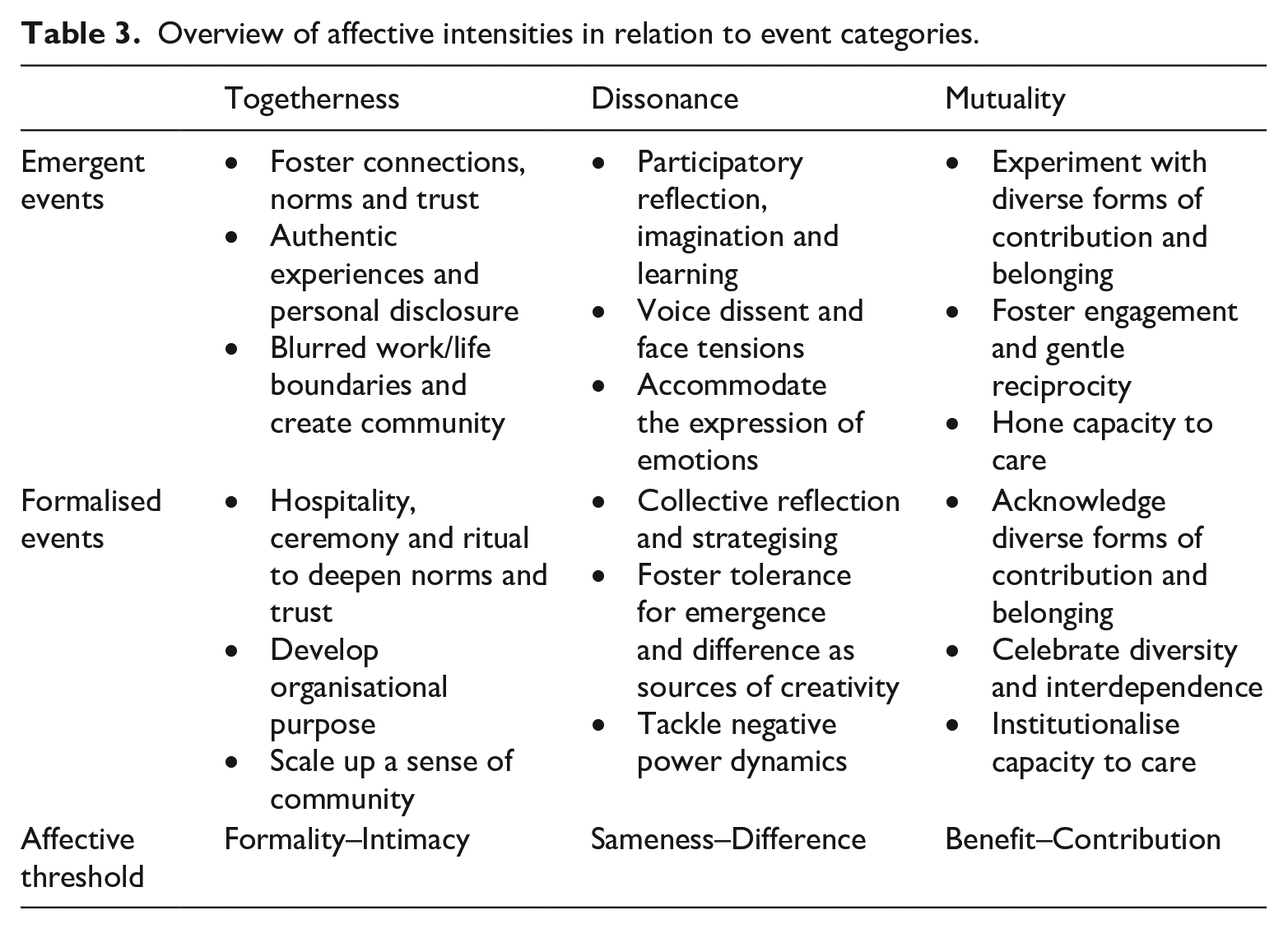
This section shows how our analysis of event atmospheres in two long-standing collaborative communities revealed three interrelating affective intensities: (1) togetherness, (2) dissonance and (3) mutuality. We will illustrate how each of them thrives in a relational tension – (1) formality–intimacy, (2) sameness–difference and (3) benefit–contribution – and how the three intensities play into each other to keep this mesh of frictional, if productive tensions open for the collaborative atmosphere to thrive. The section is organised in two parts. First, an analysis of how this diverse affectivity gains momentum at ‘emergent events’ and second, how it is consolidated and scaled at ‘formalised events’ to foster an environment conducive to self-organisation, collective leadership and peer collaboration (see Table 3).
Overview of affective intensities in relation to event categories.
Emergent events: Arousing affective diversity
While in both cases most daily work routines were coordinated through digital platforms, we observed a variety of informal, self-organised events with a low participation threshold that offered informal opportunities to learn, meet new people and deepen connections. The environment at these events blurred the boundaries between life and work, creating spaces that fostered authentic conversations, interpersonal trust and a sense of community among participants. A Drupal member described how participation in local events like ‘Drupal Beers’, ‘Drupal Show and Tell’ or ‘Drupal Coworking’ transformed his initial understanding of the project as ‘a piece of software’: [Y]ou realise there are people behind the source code, right? And you meet people that can tell you a kind of personal story. [. . .] And then, it stops being something anonymous. It becomes something that’s yours.
Similarly, at Enspiral, people emphasised mundane events like community lunches or lunch yoga sessions as instruments to foster a sense of community. As field researchers, we intimately experienced how such emergent events provided impassioned experiences of having fun, exchanging ideas, sharing personal matters and making friends. At Enspiral’s coworking space, a ‘Space Blitz’ cleaning party evoked a sense of shared achievement and a joyful merger of work and leisure. Birthday celebrations with costumes and live music made people feel recognised and added carnivalesque elements into the everyday. One morning, a cart with fresh turmeric, ginger and lemon tea sparked casual conversations, while a Slack post outlining its health benefits offered collective learning. During a session titled ‘Mental Health and Open Source’ at a small ‘DrupalCamp’, the second author experienced how these emergent events can stir an intense feeling of togetherness grounded in a perception of shared vulnerability and recognition:
We witnessed an account of mental illness and recovery. A Drupalista explained how feeling part of the community helped him through the process. During the coffee break, I observed how this talk, particularly revealing vulnerabilities, opened a venue for reflection. Many participants explained that they have suffered from impostor syndrome. It is something I had experienced myself when entering the community. I realise many of us have felt like impostors, even the so-called ‘rockstars’. (Fieldnotes, Drupal, February 2015)
In this context, an event serves as a platform for personal life storytelling, igniting an intense co-subjective experience of connection and relief through shared vulnerability. The informal ritual of coffee breaks triggered more interpersonal disclosure and reflection among the attendants. Hearing one’s own insecurities echoed in the experience of others can build a sense of mutual understanding and safety, while harsh self-judgement and shame decrease. The casual performance of space within a collaborative setting (a user-generated ‘unconference’) enables individuals to instinctively perceive a sense of warmth and camaraderie that transcends emerging hierarchies, such as the ‘rockstar’ dynamic. This socio-material affective production of togetherness encourages participants to lower their defensive mechanisms, laying the foundations to build closer bonds, exchange ideas and embark on shared projects. However, growing intimacy needs to be balanced with formality. In the above example, the collaborative format provided opportunities to join or propose workshops according to individual skills and interests. It also enabled exchange on current issues and learning about participation opportunities, roles and rules.
It is well documented in the literature (e.g. Freeman, 1972; Massa and O’Mahony, 2021; Reinecke, 2018) that frictions and conflicts are inevitable byproducts of collaborative organising. When people establish less hierarchical practices and initiate multiple, sometimes counteracting projects, they must learn how to make decisions together. They face unintended consequences and must create dependable processes to solve conflicts without immediate recourse to formal authorities. We observed how emergent events can become an arena to face tensions otherwise easily avoided in everyday work life, mitigating the risk that insults and grudges would become the topic of destructive gossip in small circles. In the following episode from a spontaneously organised ‘work-a-thon’ addressing pressing governance issues in the Enspiral network, an emotional outburst uncovered dormant tensions:
A long-standing Enspiral member opted out: ‘I feel like I’m in the wrong room. There are just so many issues of declining responsibility in big groups that I’m not interested in solving right now.’ Another member joined him. [. . .] Both obviously held different expectations for the day. Before lunch, we engaged in an improv exercise to ‘get back into our bodies’ after an intense morning. To me, the atmosphere felt lighter, released and more playful. Everyone was still standing in the room, committing to afternoon working groups, as one member’s voice collapsed. She burst into tears: ‘It’s not your fault, but I feel totally wrong here. Things are overwhelming me; I think I just want to go home.’ Abashed, we finished the round of commitments. Only then did two people hug her. (Vignette, Enspiral, July 2017)
Afterwards, one member criticised Enspiral for hardly addressing emotional issues. ‘Going on with our work while someone has an emotional breakdown. . .,’ he shrugged. In this situation, some participants were fed up with governance inertia in the broader community, while others longed for soft spaces to foster relationships. The discursive framing of the workshop, akin to a ‘hackathon’ – implying joyful experiments to ‘explore possible futures’ through ‘creative, fun work in peer communities’ (Endrissat and Islam, 2022: 1021) – and the casual performance of ‘workshop space’ (held over the weekend in a member’s rustic country house, involving shared cooking, sleepovers, check-ins, improv exercises and a dog), enacted an affective intensity of what we call dissonance. It encouraged people to face lingering tensions. The strict boundary-setting and the emotional eruption were surrounded by a dissonant atmosphere that made it possible to confront discomforts. The affective tone did not suggest concealing or neglecting complicated emotions for fear of repercussions. However, the stern reaction – no halt in the workflow or immediate comfort – shows that affective dissonance and expression of feelings pushed the boundaries of the organisation’s emotional repertoire. Afterwards, the event catalysed reflections on the need to improve a culture of care within the organisation. In the following months, emotional support and peer learning groups, so-called ‘pods’, became a new initiative to address these challenges.
As field researchers, we not only witnessed comparable incidents, but also our bodies were fraught with dissonance during such occasions. This feeling tone questioned the prevailing harmonious ‘we are all happily together in this’ vibe and created a tense, anticipatory environment akin to a collective clenching of jaws. At some events, the air was brimming with the tense anticipation of eruption and the urge to run away as underlying tensions surfaced. On other occasions, dissonance was recurrently re-produced by and producing ‘softer’ forms of reflection, debate and imagination in participatory processes, as we will illustrate in our analysis of formalised events. On the one hand, the affective intensity of dissonance questions the homogeneity of collaborative group experience as playful, happy and entrepreneurial, making space for the expression of discomfort, dissent and difficult emotions. On the other hand, if people accepted the challenge of difference, managing to channel their emotional impulses into respectful debate and treating themselves and others with compassion, dissonance was often followed by a sense of relief and profound aliveness that resulted in a more multi-perspectival understanding of problems. Dissonant intensities in collaborative atmospheres depend on developing skills like listening and empathy, which point to the importance of care as an organisational capacity.
In addition to togetherness and dissonance, the spatial immediacy of emergent events revealed mutuality as a third affective movement that proved vital in preserving collaborative atmospheres. In Drupal, where the dominant form of contribution is software code, emergent events provided alternative ways of contributing value beyond the dominant logic of code (Rozas et al., 2021). This simultaneously enhanced the organisation’s ability to care, develop emotional competence and embrace diversity. The following excerpt from an observation of a local ‘Drupal Code Sprint’ serves as an illustration:
The event facilitator explained alternative ways to contribute to the core [. . .]: ‘A good way to contribute initially is doing issue summaries [https://drupal.org/issue-summaries]. You can find some issues, and following this template, make a summary, so the [core] developer doesn’t have to spend a lot of time reading all these comments.’ [. . .] Several participants eagerly took on some of the longest issues [. . .] Afterwards, when we were having beers in a pub, several participants emphasised how proud they felt to have contributed to Drupal’s core. (Fieldnotes, Drupal, May 2014)
Such ‘creation of issue summaries’, in which hundreds of comments are compiled, is typically carried out by newer members. It is acknowledged as a valuable way to ‘contribute to core’ that also enables newcomers to become familiar with technical processes. The term ‘sprint’ originates in agile methodology, which refers to breaking down complex projects into small iterations to better adapt to user needs. As the fieldnote illustrates, Drupal Code Sprints are convivial events often followed by pub visits. Everyone is invited to improve the quality of the software. These sessions focus on giving back to the community and raising participants’ skill levels through peer learning. For newer members, participation can serve as induction and increase individual reputation, while veteran members can meet friends, mentor newcomers and share what they have learned. This episode illustrates how emergent events reverberated with mutuality, which fostered the emergence, adoption and acknowledgement of various forms of meaningful contribution, engendering a sense of purpose and belonging among peers.
The following Enspiral vignette deepens the analysis of how an ethics of contribution correlates with mutuality. Through such affectivity, people become attuned to reciprocal contributions; different forms of non-quantifiable exchange become conceivable, and business-as-usual expectations for transactional relations are de-normalised. The following ‘accidental’ observation of a ‘hacker meetup’ in Enspiral’s coworking space illustrates how diverse forms of value can be enacted at small, informal events:
It’s evening. I am preparing to jot down the day’s notes on my laptop. A group of people is still hanging out, starting to order vegan burgers. Peripherally, I listen to a guy talking about how he has reduced his workweek to 20 hours. He seems to be seeking approval for his unusual decision. [. . .] Then, the lights are dimmed down. Two people improvise and live-stream experimental electronic music on some homebrewed devices. Others are tinkering with obscure electronics. I stumbled into a hacker meetup. Two participants are having an empathic conversation about how one of them could approach the estrangement from his father. (Fieldnotes, Enspiral, July 2017)
In this after-work episode, hobbyists and makers came together to tinker, chat and learn. They enacted several alternative forms of value creation. First, they were sharing matters of personal concern, food and knowledge. Second, they cared for the emotional needs of others. Third, they were contributing bits and pieces of electronics and sharing tools. The resulting atmosphere of mutuality in the nightly coworking space was cooked up amid the smell of food, club music, chilled conversations, tinkering and soldering. These self-organised meetups created a space to practise a deepening sense of relationality through experimenting with different notions of value. The affective immersion in an atmosphere that feels mutually supportive provided a segue to experience activities, like caring for the emotional needs of other community members, as part of a more diverse economic practice. Passion for a shared interest and a hunger to learn made it easier to contribute without the immediate expectation of receiving something in return. In such a space, reciprocal ties of care, learning, meaningful work and belonging can emerge from the interplay between alternative value practices and affective movements of mutuality. The affective intensity thrives in a tension between generous contribution and individual benefit. While the voluntary input of skills, resources, empathy and time can only be sustained in a non-transactional horizon of expectation, individual benefits in the form of reputation, advice or care within a supportive community did not fall short. In the next section, we sharpen the analysis of the relations between togetherness, dissonance and mutuality as we examine larger, formalised events in the two communities.
Formalised events: Scaling affective diversity
Larger, formalised events, such as DrupalCons and Enspiral Retreats, also created spaces and encounters that produced the atmospheric quality of togetherness. The following vignette depicts the first day of the so-called ‘Enspiral Summer Fest’, an annual four-day event at a rural location that brings together the network for a retreat. It held great significance for participants, who noted that the Summer Fest creates a ‘heartbeat’ that reverberates in the organisation throughout the following months. The following vignette conveys the mood during the first day:
In a welcome ritual, established ‘Enspiral members’ receive newcomers with a song. The two groups form two nested standing circles on a lawn. Newcomers can greet all ‘members’ by slowly moving around clockwise. Soon, the scene turns into an extended series of hugs and small talk. Later, the entire group – about 120 people – assembles inside in a large two-rowed circle of chairs. Everyone born or living in New Zealand is encouraged to move to the centre. An embodied constellation resembling a map emerges as people introduce themselves and their hometowns. [. . .] At the end of a break, one person raises a hand; everyone imitates the gesture, and the chatter quiets down. [. . .] It is evening by now, and people get ready for dinner. One member steps forward. She intricately intones a Māori song as a food blessing. After dinner, we queue up to wash our dishes. In a do-it-together sequence, we plunge our plates into soapy water, remove the foam by swiping them through clean water, and then put them on a rig to dry. (Vignette, Enspiral, February 2017)
The first afternoon and evening of the event are carefully choreographed around a range of introductory rituals and sharing opportunities to alleviate feelings of anxiety and social awkwardness. Workshops and keynotes are sidelined. Instead, singing, hugging, eating and gathering together are carefully curated as a series of participatory activities that radiate a sense of togetherness. This affective intensity increases trust and settles people, translating into fertile soil for deepening relationships. In this context, a frequent emphasis on ‘whole human beings’ and the allocation of ‘home groups’ (groups of five who meet several times to reflect on the event experience) signify the recognition of people beyond their organisational roles. In this example, a connection to place is woven through references to indigenous culture, the exchange of origin stories and gratitude for local and healthy food. The vignette also epitomises how embodied activities, like collective hand signals (e.g. everyone raising a hand to beckon silence) and do-it-together dishwashing, cultivate a feeling of collective care that includes the more-than-human participants in this space like the land, the animals or ancestors.
Besides exemplifying how formalised events can scale togetherness, the Enspiral Summer Fest provides spaces that rhythmically alter between different affective intensities. Here, we illustrate how togetherness and dissonance are coalescing. In his introductory speech, one of the main facilitators framed Summer Fest as an event that thrives on openness to sharing, listening and chance encounters. ‘This is an imperfect event. It is in continuous emergence’, he emphasised. Building on the affective experience of intimacy – being ‘enmeshed in a sublime atmosphere that feels humble, accepting, and settling’, as the first author scribbled in his diary – the facilitator called for participants to be open to new relationships and unexpected experiences. He discursively enacted the co-subjective affective experience of dissonance that was spatially performed in an Open Space session titled ‘Theory of Change’, described in the following fieldnote. In this workshop, an Enspiral member, who had publicly struggled with her motivation to renew her membership in the online channels, facilitated a conversation that revolved around the question: why do we want to be together when we have such different ideas for societal change?
We move through various cascading discussion formats to explore the problem: dyads, breakout groups, whole group circles. The session is held in a geodesic dome-shaped tent modelled after designs by the late architect Buckminster Fuller. People are sitting on beanbags and floor cushions; we are using the tent walls to cluster post-its; there is lots of movement. Supported by graphic facilitation of the two workshop callers and participatory gestures (‘show me on one hand how many minutes you need’, or ‘inaudible clapping through finger-wriggling’), three main personal motivations for joining the community emerge: ‘self-management’, ‘commons’, and ‘helping each other in a tribe’. Aided by the use of metaphors – Enspiral’s ‘north star, vessel, and path’ – the organisation is reaffirmed as ‘content-agnostic’, meaning it is not dedicated to a single cause (e.g. environmental protection). Its purpose is purposefully not spelt out. Enspiral is envisioned as a space where ‘you can be yourself’, a space that thrives on ‘delightful difference’. (Fieldnotes, Enspiral, February 2017)
At the event, a participant expressed a personal frustration to the group, which triggered a strategic co-design workshop. The vignette illustrates how events can provide a platform where people contribute freely to the ongoing cultivation of a shared purpose, leading to emotional experiences of authenticity, belonging and inspiration. The dissonant affect arose from an affectivity of togetherness – an event space that made room for hospitality, ceremony and vulnerability. It created a simultaneously ‘safe and brave’ environment where people felt included and sufficiently comfortable to open themselves to others. The casual movement between idea exchange in dyads, sitting on the floor in circles and standing together in small groups around post-its, resonated with the tent architecture, which evoked ‘strangely familiar, uncanny’ (Beyes and Steyaert, 2012) associations with the revolutionary spirit of the 1960s (Buckminster Fuller’s geodesic domes), and may have served to encourage people to voice personal and controversial visions and values. Furthermore, the participatory facilitation practice ‘Open Space’ fostered tolerance for emergent viewpoints and openness to less-judgemental listening through activities such as collaborative agenda-setting or principles like: ‘Whoever comes is the right person. Whatever happens, is the only thing that could have. Whenever it starts is the right time.’
The affirmation of an open-ended purpose statement focusing on mutual support, collaboration and diversity mitigated the ever-present risk of isolating the community through safety-inducing but uniformising insider/outsider dynamics. The melange between togetherness and dissonance is a crucial affective dynamic in collaborative atmospheres. It repeatedly inspired distancing, critical reflection and confrontation with new and ‘dangerous’ ideas. Similar to Farias’ (2017b: 789) observations, we contend that ‘messiness is valued by participants as a source of creativity’. The affective feedback effect in this example also illustrates how togetherness and dissonance are entwined with the (re-)production of a ‘virtuous potential’ (Arvidsson, 2018: 298) as an imaginary that charges work with purpose and ignites expectations of co-creative encounters – expectations that ‘generated affect as much or more than the encounter itself’ (Endrissat and Islam, 2022: 1042).
Zooming out of such microdynamics, a longitudinal view of the Drupal case shows that formalised events can offer spaces for collective reflection, where people can consider their involvement, identify emerging tensions with peer governance or monitor the community’s health: how are people contributing? How are projects, leaders and newcomers doing? How can less visible contributions be acknowledged? Drupal’s formalised events provided spaces to resolve the dissatisfaction arising at emergent events. For example, we witnessed how they helped tackle the community’s excessive code-centric character. Presentations at DrupalCons functioned as arenas to challenge the shared belief that participants’ most valuable type of contribution is source code. When analysing the peer-reviewed presentations selected over time 3 for DrupalCons, for example, we noticed how the issue ‘health of the community’ gained more visibility and relevance.
The Drupal community began to acknowledge not only its technical and productive side but also its communitarian and reproductive one (Hestenes-Lehnen, 2021). Eventually, these topics resulted in dedicated conference tracks, like ‘Being Human’, 4 where peer-reviewed presentations tackled issues like mental health and well-being, lack of diversity and empathy and communication. Comparably to Enspiral, the affective reverberations of these larger events resonated strongly in the community and set the atmospheric tone for the months following such events. The dissonant flow thus carried on in a ‘Community Working Group’, 5 whose ‘role became much more about training, much more about the capacity of building people’s understanding from another person’s point of view. [. . .] Prevention, rather than reaction’, in the words of a member. Another example is the ‘Drupal Diversity and Inclusion Group’, 6 which introduced a mentorship programme for participants from underrepresented groups.
In both cases, the embodied experience resulting from the affective interplay between togetherness and dissonance generated during events helped the communities face ethical dilemmas resulting from their self-organised, collaborative ways of working. It led to structured initiatives, nourishing greater care, acknowledging emotional labour and creating more openness to diversity (in terms of individual contributions and ideas). The communities learned to monitor their emotional well-being and introduced peer coaching practices as well as conflict resolution mechanisms. The Drupal community elaborated a Code of Conduct, expressing shared values, such as diversity, inclusiveness and self-responsibility, to create a safe and welcoming environment. The document is usually presented during the welcoming sessions at the beginning of each DrupalCon day, and it is also highly visible on the website and physically displayed at the entrance of event venues. It has been used to sanction misogynistic behaviour and to ban people from attending future events.
However, as shown in the previous analysis of emergent events, togetherness and dissonance are insufficient to maintain a thriving collaborative atmosphere. In an informal walking interview during Summer Fest, an Enspiral member explained how participating in the event helps him ‘leave behind the ball of bad feelings’ accumulated throughout regular working life. ‘Working in this relationally dense way is not always easy’, he emphasised. ‘First everything is light and happy, but then you have to share heavy stuff and live through conflicts openly.’ In his view, collaborative organising is very consuming. It tempts people to lose themselves in over-activity. ‘Individual actions can have a real impact quite fast, and some people get hooked on that feeling’, he reflected. In fact, during the field study, we observed how a group of largely female leadership figures slid into burnout owing to the burden of unacknowledged care work (see Resch and Steyaert, 2020).
Our analysis thus highlights the importance of an affective envelopment of mutuality at events, in which participants can discover how diverse forms of contributions generate value. In a blog post, a Drupal member with no coding skills, for instance, explained how participating in a Drupal Camp helped him overcome barriers like impostor syndrome:
Walking in the door, I didn’t feel like a part of the community. I wasn’t sure where I fit in since I wasn’t a developer, designer, or vendor. I wasn’t sure what to expect. [. . .] [After participating in the event] I never got a sense of feeling inferior for lack of experience or an inability to code. We had really engaging and valuable sessions. [. . .] For me, this triggered the idea of giving back to the community in a way that made sense. (Blog post, Drupal, March 2014)
Through this event experience, the participant discovered ways to explain the platform’s value to potential users and conceived the idea to offer recording equipment for subsequent events. The reflection illustrates how an affectively intense experience of mutuality surrounding the discussion, sharing and learning activities inspired new ways of contributing outside the dominant value logic, which favoured people with the ability to code. He felt that his different experiences and skills were valued. An encounter on equal footing became possible, fostering intrinsic motivation and an ethic of generous contribution in various ways.
Similarly, participatory event design at Enspiral’s annual summer retreat offered numerous opportunities to contribute to the main programme or host side activities. As mentioned before, the Open Space method is a facilitation tool through which a conference is planned according to the needs of the participants. It starts with a ‘marketplace’ of workshop ideas, typically a crowd of people sticking and clustering post-its with possible topics. Consequently, the scope of themes was broad, ranging from strategic discussions over improv theatre workshops to project clinics. People offered yoga or singing sessions in the early mornings. In an interview, an Enspiral member described his experience of a ‘nihilist nature walk’:
We weren’t allowed to be positive. Someone else from the group would shoot you down if you did that. I went down and threw rocks in the river, and I remember complaining: ‘I can’t believe I’m paying all this money to throw rocks in a river.’ But I thought it was great.
The activity allowed participants to take themselves and the organisation less seriously – to name failure and frustration in a climate that habitually celebrated success, fun and positivity. The walk generated trust by disclosing mistakes and helped people distance themselves from overly powerful narratives that threatened to decrease the creative scope of the organisation. The spatial composition of bushland and walking, venting and throwing, laughter and shame illustrates the practical entanglement of the three affective intensities we differentiated for analytical clarity. Mutuality was enacted in a distinct spatiotemporal space (sharing mistakes and doubts) and helped to keep productive friction between togetherness and dissonance (creating a shared vulnerable experience while questioning virtuous aspirations). Building on the experience of diverse values and participatory organising, formalised events can attune people’s bodies to a co-subjective sense that psychological and material interdependence is a crucial fundament of collaborative organising. The events we participated in prototyped instances of voluntary contribution, stewardship, caregiving and receiving, which turned the negative connotation of ‘dependence’ on its head. Over time, we observed that feeling structures associated with sustainable mutual need-fulfilment had the potential to develop into an atmospheric quality characterised by gentle reciprocity.
Next, we discuss how the relationship between the three affective intensities creates a polyrhythmic affectivity underlying collaborative atmospheres and relate how events can maintain a tensional threshold for collaborative organising to thrive.
A polyrhythmic affectivity
Drawing on two ethnographic studies of collaborative organising, this article focused on the central role of events in creating increasingly aesthetic, emotional and expressive experiences, acting as catalysts for creative knowledge production (Vesala, 2023). The conceptual lens of affective atmospheres (Anderson, 2009; Böhme, 1993) helped us to analyse how affect and relationality become core drivers of value production (Blagoev et al., 2019; Endrissat and Leclercq-Vandelannoitte, 2021; Gregg and Lodato, 2018). While other articles emphasised how a specific affect becomes dominant and stifling (e.g. ‘confidence’ in workplace meetings) (Vitry et al., 2020), how hackathons intensified narrow affective circuits for value-producing activities (Endrissat and Islam, 2022) or how incubators tempted ‘bodily dressage’, repetitive bodily training to hook a mono-affective ‘upbeat’ order (Katila et al., 2020), our analysis revealed a polyrhythmic affectivity. The events fostered an atmospheric interplay of three main affective intensities, thereby creating spaces for redefining and experimenting with value beyond the dominant transactional logic rooted in a pricing system (Graeber, 2001). Thus, local and diverse forms of value creation arose that were meaningful within the community’s own dynamic framework.
The collaborative atmosphere was in an ongoing process of becoming across various spaces and events, emerging in an interplay between three affective intensities that were mutually dependent on each other to maintain their productive tensions of formality and intimacy (togetherness), sameness and difference (dissonance) and benefit and contribution (mutuality). Our study suggests collaborative atmospheres surge and sink within a complex frictional space in the dynamic territory between opposing relational poles and concurring affects. When one affectivity exceeds its limits or comes to dominate the others, the collaborative atmosphere crumbles. Extreme amplitudes can be seen as ‘thresholds’, where an ‘affect ceases, whereby a new atmosphere is generated, or a previously marginalised atmosphere can grip those bodies’ (Vitry et al., 2020: 280). Atmospheric thresholds, as outlined by Benjamin (1999) in his exploration of the Parisian Arcades (see De Molli et al., 2020), are characterised by ambiguities (in our case, between leisure and labour, diversity and homogeneity, voluntarism and commodification). Thresholds ‘help us to understand how ‘in-betweenness’ is constitutive of atmosphere’ – ‘multiplicities prevail, and a hermetic sealing-off of one space from another is practically unfeasible since multiple spaces are co-present and interact’ (De Molli et al., 2020: 1496).
Our study suggests the notion of polyrhythmic affectivity to the literature on polycentric governance. Polycentricity is based on the idea that emergent order can be created from multiple distributed decision centres mutually adjusting, adapting and collaborating within an overarching set of values and informal commitments (Albareda and Sison, 2020). Different streams of research on natural resource communities (Ostrom, 2006) and collaborative knowledge creation (Fjeldstad et al., 2012) have highlighted the importance of diverse institutions, creating robust rules, monitoring and conflict resolution systems while central resources are shared in common through distributed coordination practices. Many scholars have discussed how pooled information infrastructures are crucial resources to create shared situational awareness about mutual interdependencies (Håkonsson et al., 2023; Patala et al., 2022). This article emphasises that distributed decision centres within such collaborative production ecosystems operate as nested community structures (Adler and Heckscher, 2006) with polyrhythmic atmospheres charged by an entangled web of emergent and formalised events. The affective intensities of togetherness, dissonance and mutuality are circulating in a distributed, polyrhythmic manner, at times competing, at other times complementing and moderating each other. To some extent, the two different event patterns mirror the well-researched polycentric interplay between distributed coordination practices and ecosystem-spanning institutions, displaying a mix of governance mechanisms (Aligica and Tarko, 2012). The event formats maintain a polyrhythmic affective movement, arousing diverse affectivity bottom–up through voluntary contributions and self-organised project structures while formalising top–down through large gatherings that necessitate standardised processes, regulations and roles, all the while permitting a blend of affective intensities (Rozas and Huckle, 2021). Through experimentation, openness to diverse encounters, and mutual adaptation, it becomes possible to maintain a threshold between multiple relational tensions, recharging, tempering and mediating the affective energies at the centre of collaborative atmospheres.
Figure 1 details how regenerative, equitable and lasting collaborative atmospheres continuously struggle to emerge from a threefold threshold and mutual relational dependencies. Togetherness was recurrently performing (and performed through) event activities that created social intimacy and shared purpose. Its spatial diffusion enveloped bodies, materialities and discourses with feelings of belonging, trust and courage to show up authentically and build relationships. Moreover, it was characterised by collective excitement for a virtuous potential (Arvidsson, 2018; Waters-Lynch and Duff, 2021), combining virtue and value in a collaborative narrative to improve the world. This dynamic binds communities and increases openness to unfamiliar, generous and playful encounters. Togetherness flourishes in a tension between formality and intimacy. On the one hand, there is a need for standardised processes and effective teamwork in functional roles, emphasising individual accountability and responsibility for task completion without waiting for approval from authorities. On the other hand, a sense of belonging in a like-minded community of peers, being heard and seen as an authentic personality who feels safe to contribute and fail.
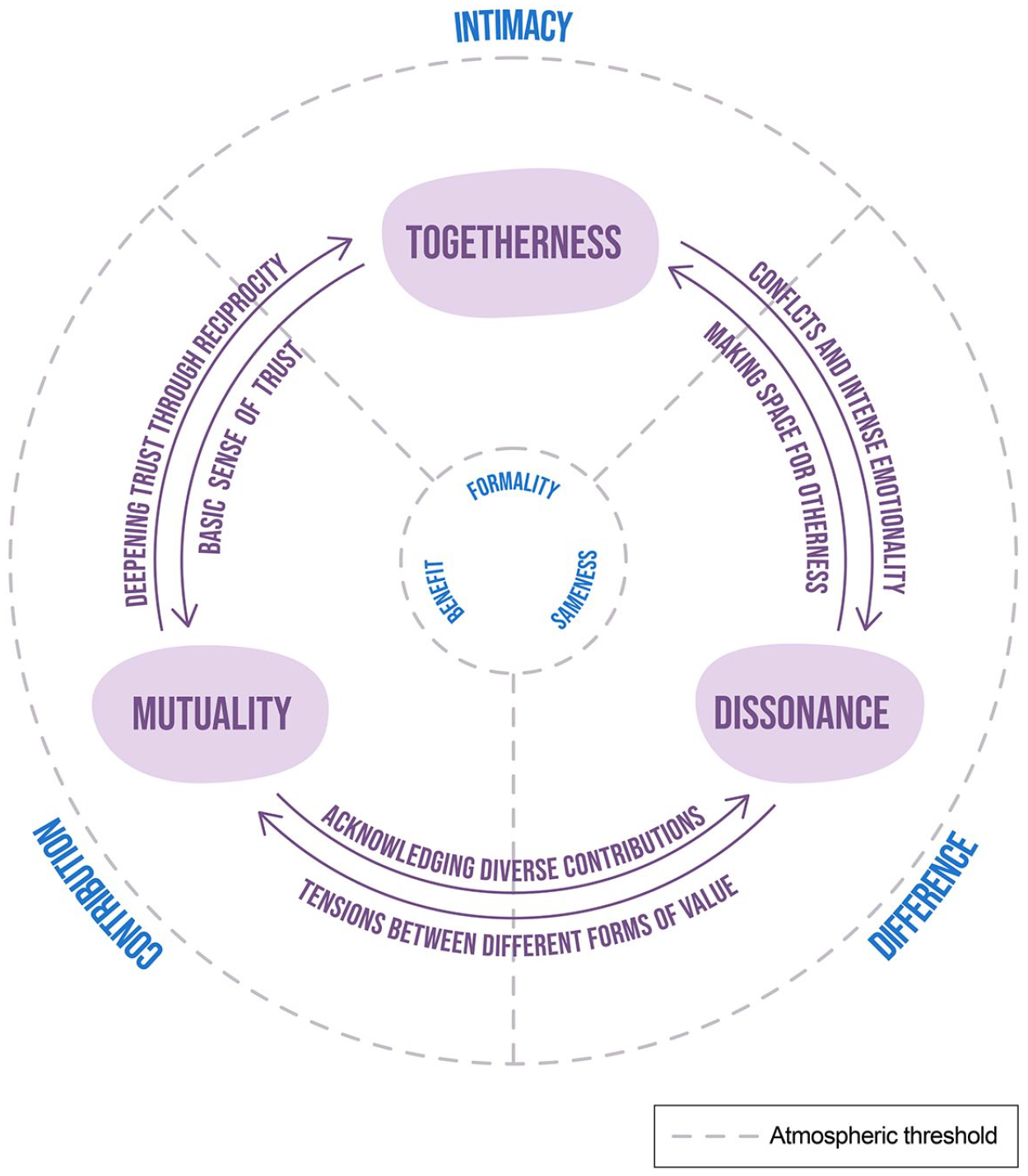
The polyrhythmic affectivity of collaborative atmospheres and its threefold threshold.
Togetherness inevitably produces interpersonal conflicts and intense emotionality that needs to be processed to avoid atmospheric exhaustion. Dissonance facilitated spatial ecologies where people felt safe to show their discomforts, disagree and question norms, allowing marginal perspectives and ways of being into the assemblage. Dissonance vibrated within event spaces and practices when tensions and conflicts erupted, when they were strategically addressed and when events made room to stay with problems, exploring how people were affected differently. Thereby, the dissonant affective intensity, in return, countered the drive to shut down the diversity of embodied experiences implied in togetherness. Collaborative organising faces the paradoxical challenge of fostering a collective identity (Fominaya, 2010; Reinecke, 2018) while developing practices to circumvent groupthink, insider/outsider dynamics and exclusion (Farias, 2017b). The affective intensity of dissonance thus fluctuated between the poles of sameness and difference.
Vidolov et al. (2023) observed similar rhythmic dynamics, examining the durability of political organising through an interplay of affective resonance and dissonance. In their case, a patient community triggered perpetual momentum by working towards ‘a tangible not-yet’, a process in which affective resonance kept people invested. At the same time, dissonance led to political deliberation and organisational transformation. Our findings indicate that such affective oscillations (Resch and Steyaert, 2020) in human and more-than-human encounters tend to spiral towards extreme affective intensities. A looming concern that we noted, for instance, was the prevalence of privileged forms of work (such as coding and entrepreneurship), which triggered ‘superstar’ dynamics (in the case of Drupal) and burnout (in the context of Enspiral).
Comparably to Vesala’s (2023) exploration of togetherness, learning and reflexivity in hybrid collaborative organising, we found three-phased affecto-rhythmic pathways that stabilised collaborative atmospheres. Vesala conceptualises how people – to cope with the transience, stress and emotional labour of hybrid work – move between open, intimate and transitional in-between spaces. First, people established dwelling spaces to affectively inhabit their unstable work environments, creating ‘holding environments’ (Petriglieri and Petriglieri, 2022: 1441) for personal history and imagination. Second, they used these dwelling spaces to withdraw from the demands of the external world, expanding their inner worlds for reflection. Third, in-between spaces (like work retreats) generated overlapping and ambiguous embodied rhythms. Sharing those ambivalent experiences and reflections, then, fostered meaning, creative possibilities and belonging.
Similarly, our analysis highlights a three-phased affective movement that prevents spaces from falling under one affective order. Within the polyrhythmic affectivity of collaborative atmospheres, mutuality confronted individuals with the in-betweenness and multiplicity of various types of experience, skill and contribution, all while challenging them to define value beyond the transactional and quantifiable. This encouraged people to distance themselves from the allure of ‘coding’ and ‘entrepreneurship’, fostering diverse contributions and enabling more varied experiences of self-efficacy and organisational impact. It sensitised bodies to encounters ‘with diverse communities, temporalities and processes’ (Vesala, 2023: 15). Mutuality evolved in the tension between the generous contribution of skills, resources, empathy, care and time and the need to earn a livelihood through commodifying individual benefits from the communitarian fabric (e.g. reputation, networks and products). The affective envelopment facilitated a sustainable fundament to maintain togetherness by deepening trust through increased reciprocal dependability and channelling dissonance by acknowledging less visible forms of labour.
The atmospheric politics of affective commoning
We outlined collaborative atmospheres as intensified ‘affective sociality that coworkers who engage in digital work often seem to “need” as a quasi-resource for their work’ (Endrissat and Leclercq-Vandelannoitte, 2021: 12). The expressive immediacy of events fostered heightened affective experiences through encounters between bodies, materialities and discourses – assembling modes of buzz creation (Mauksch, 2017), which generated ‘the sensation of being lifted collectively by being in the presence of something “larger” than oneself’ (Burø and Koefoed, 2021: 181). They made people ‘feel close to something – something that might be happening’ (Gregg and Lodato, 2018: 177, emphasis in original). In that sense, collaborative atmospheres may not directly effectuate new relationships, identities, co-creation and business opportunities; they are not influencing ‘agencies of bodies but their potential capacities to act’ (Vitry et al., 2020: 279) through what Michels and Steyaert (2017: 98) called ‘moments of potentiality and promise’. Hence, it has been argued that collaborative organising is creating its buzz not primarily from actual relationality but from ‘communal fantasies’ (Resch et al., 2021), ‘combining social recognition, communal unity and capital creation in an affect-generating system’ (Endrissat and Islam, 2022: 1040).
In line with Waters-Lynch and Duff (2021), we contend that collaborative atmospheres can be maintained through ‘affective commoning’. The affective labour to ‘manage’ collaborative environments ‘by fostering interpersonal interactions; by modelling flexibility; by performing occupational enjoyment; and by listening to complaints’ (Gregg and Lodato, 2018: 191) is frequently associated with overwork, emotional strain, unequal gender dynamics and material underappreciation. Hence, neither professional community management nor collective volunteering can prevent a high atmospheric ‘evaporation rate’ (Waters-Lynch and Duff, 2021). Organising affective labour through transactional managerial relations results in collective action problems, including issues like overuse, free-riding and precarity, while volunteering places the responsibility for underappreciated and non-quantifiable yet demanding relational work in the hands of a typically gendered minority. Our study highlighted the importance of a polycentrically organised web of face-to-face events to maintain polyrhythmic collaborative atmospheres. Both institutionalised, partially paid roles and grassroots volunteering were needed to establish multi-layered, nested community structures, where responsibility for maintaining the collaborative atmosphere could be shared instead of relying on individual accountability.
Affective commoning presents a viable alternative since it conceives collaborative and participatory processes of organising as ‘a struggle to perform common livable relations’ (Velicu and García-López, 2018: 55), creating ‘subjectivities of being-in-common’ (García-López et al., 2021: 1205), not just with other human beings, but also with non-human relation-holders of production processes (Singh, 2017). Such organising holds the potential for a ‘relational embodied ethics’ (Mandalaki and Fotaki, 2020: 11), recognising the engagement with shared corporeal concerns as a source for regenerative feedback loops between affect, subjectivity and co-creation. Affective commoning involves processing shared vulnerabilities, problematic social structures and inherent partial blindness about ourselves. Relational quality, emotional maturity and multi-perspectival integration become co-creative sources for successful collaboration. Thus, Leff (2021) calls for more critical (feminist) accounts of how personal histories or ‘social embeddedness’ (Leclair, 2023) link to the formation of atmospheres.
The examination of affective commoning from an organisational and political angle is needed (De Molli et al., 2020). While atmospheres may be hard to control, our bodies intuitively desire to be a part of and get pre-reflectively and contagiously engaged. We still lack knowledge about strategies for disrupting ‘atmospheric glasshouses’ (Philippopoulos-Mihalopoulos, 2016: 159). It is unclear which constellations favour ‘spatial self-management’ (Endrissat and Leclercq-Vandelannoitte, 2021: 12) and changes between different aesthetic codes (De Molli et al., 2020). Our findings suggest that the politics of affective commoning involves organising and learning embodied-relational processes of atmospheric attunement (Steyaert and Janssens, 2023). In Leclair’s (2023: 813) examination of the evolution of creative practice within a fashion studio, she posits that design involves not only ‘the skilled use of tools but the heedful regard for the often-surprising experience of being among fabrics’. The contagious sense of potentiality that constitutes collaborative organising (Arvidsson, 2018; Waters-Lynch and Duff, 2021) is, by analogy, not primarily an outcome of popular co-creation techniques, collaboration applications, carefully designed interiors, technical prowess or virtuous visions. A ‘thick space of possibility’ (Leclair, 2023: 809) emerges in moments of sensuous openness to our own and others’ subtle bodily impulses. It materialises in the heedful regard for the in-between of the spatial constellation by practising to notice with all senses how excitement, playfulness and mutual recognition emerge, as well as how shared uncomfortable, bewildering and disorientating impulses may actualise surprising resonances between us. Atmospheric attunement, distancing and recalibration keep polyrhythmic frictions at play.
Concluding implications
In trying to understand the riddle of durability in collaborative organising, this article traced collaborative event atmospheres that, despite their immaterial and fugitive nature, cause very material relational effects. We pushed the boundaries of polycentric governance by developing an understanding of its affective and intercorporeal foundations. With our notion of polyrhythmic affectivity, we conceptualised how durable collaborative atmospheres frictionally emerge within a threshold of multiple relational ambiguities and mutually dependent affective intensities. We argued that collaborative atmospheres can be seen as a common resource in creative knowledge production, creating a thick space of possibility that needs to be circulated, valorised and consumed in processes of affective commoning. Our findings have immediate implications for collaborative practice, of which three seem most pertinent. First, the reintegration of ‘collaborative community’ (Adler and Heckscher, 2006) and ‘co-creative intimacy’ (Rouse, 2020) into post-industrial organisations – ‘scaling across’ nested networks of peer-based communities instead of ‘scaling up’ hierarchical reporting to foster entrepreneurial and innovative outcomes. Second, seeding a landscape of self-organised events and communities of practice, catering to people with similar disciplinary backgrounds, fostering mutual support, mentoring and learning, or indulging in shared passions outside of work. Third, regular learning conferences and strategic retreats, which incorporate ritualistic, playful and sharing formats to expand the sense of community, deliberate on emerging challenges and acknowledge various forms of contribution. Future research addressing the limitations of this article could explore how event atmospheres are in a recursive relationship with mundane spaces of work in (hybrid) collaboration landscapes. Studies could trace how collaborative social groups and individuals perceive atmospheres differently and examine the ethico-political consequences of these differences. We are also encouraging participatory methodologies, scrutinising affective ecologies together with practitioners by using multimedia and arts-based methods as well as creative writing to further understand the reverberances between space, affect and materiality in collaborative organising.
Footnotes
Acknowledgements
This article is dedicated to the memory of Silke Helfrich and Aleli Alcala, advocates for the promotion of the commons and cooperative practices. Their impactful work continues to inspire our exploration of sustainable, collaborative communities. We also thank Elena Martínez Vicente for her help editing the diagram.
Funding
The authors disclosed receipt of the following financial support for the research, authorship and/or publication of this article: This work was partially supported by the projects P2P Models (ERC-2017-STG, grant no.: 759207), DAOapplications (Spanish Ministry of Science and Innovation, grant no.: PID2021-127956OB-I00), the Schweizerischer Nationalfonds zur Förderung der Wissenschaftlichen Forschung (P1SGP1_171941) and the University of Sydney Business School Collaboration Visit Scheme (2019).
Notes
 ) is a social researcher and computer scientist whose research focuses on the intersection between the technical and social aspects of technology, particularly in the context of the collaborative economy and the future of work. He is currently working as an Assistant Professor at Complutense University of Madrid, Spain. In his latest research, as a research fellow in the context of the EU ERC project P2PModels, he is exploring the potentialities and limitations of blockchain to experiment with alternative models of governance and distribution of value in the platform economy. You can follow David on Twitter @drozas. [ Email: