




Abstract
This article revives the study of light and organization and explores how light, as a generator of organizational atmospheres, is part of organizational life. The study is set in the ruins of the 13th-century Cluny monastery north of Lyon, France, where I combine ethnographic detail, material from old Benedictine rule books, contemporary archaeological excavation data and fictive videographic elements of a monk’s experience of light and work to produce affective montages of light experiences. The result is a collection of montages exhibiting both moments where light guides towards the pure, ideal and divine and moments where the surprising, embodied and neglected emerges. I suggest light as an important atmosphere generator and foreground an interplay between light experiences of both distance-based control and affective reactions that rely on an immersive body. The experiential light interplay oscillates between deliberately idealistic light control and visceral affective daydreaming under monastic light. Methodologically, I propose the technique of affective montage as a poetic approach for the study of light in organizations. Importantly, through a study of light at the Cluny monastery, this article reintroduces light as a central topic to organization research.
Introduction
Being far from a new topic in the study of management and organization, light seems to have momentarily escaped the attention of organization researchers. This is surprising as controlling light is a popular practice in management and organization. Through the use of light, organizations strive for perfect visibility of work tasks, ‘highlight’ strategically crucial targets and create ambiently lit, stress-reducing relaxation areas. Office buildings, where much of management practice takes place, are designed with light in mind so that light experiences at work match the aims of the organization. In management, light is often used in discrete ways and packaged as a ‘natural’, unquestionable part of belonging to a specific work community. Light has become a ubiquitous power tool, invisible as it impacts daily work. In this article I explore the role of light in the organization of work and how light is sometimes controllable but often escapes management attempts, and I ask the research question: How is light both usable and unusable for organizing?
In reintroducing light to our field, I build on foundational developments regarding light and order in society that have emerged in fields to which contemporary organization research is indebted. Early 20th-century studies in light management, both in architecture with architects such as Le Corbusier and in the field of scientific management with early scholars such as Frederick Winslow Taylor and (almost forgotten) Lillian Gilbreth, form an important foundation for research on light and aesthetics in organizations (Guillén, 1997). Writing and designing during a period of rapid industrialization, such theorists saw light control as a technique for removing slack, reducing fatigue and becoming more effective. Light and movement control were a natural part of workplace ergonomics that aimed to perfect the assembly line and improve efficiency. While there are important openings for the study of light in contemporary organization research, such as Connellan’s (2013) study of the psychic power of white and light in architecture, Holt’s collage of double movements of modernist architectural light control by Le Corbusier (Holt, 2018), De Molli, Mengis and van Marrewijk’s (2020) analysis of how projections and illuminations contribute to the aestheticization of hybrid space, and Katila, Kuismin and Valtonen’s (2023) excellent feminist new materialist study of light as an affective force, the enthusiasm, fascination and fixation with light management (how modernists felt about light) have almost disappeared. I argue that, in order to revive the enthusiasm for light in organization research, it is useful to rewind to the sources from which modernists, such as Le Corbusier, became obsessed with studying light, namely, monastic organizations.
Thus, I revisit one of Western Europe’s foundational movements in light and order, Benedictine monastic control, by focusing on the management practices of the Benedictine Cluny monastery, located north of Lyon, France. The Cluny monastery was a significant Benedictine institution during the 10th to 13th centuries and became a centre for Western Christian monastic reform. Benedictine monasteries such as Cluny built much of their organizational life around The Rule of St. Benedict. This rule was written by St. Benedict, the abbot of the Monte Cassino monastery, located southeast of Rome, Italy, around the year 530 CE. The 73-chapter-long book became both a practical guide and an organizational force, a concept that guided the monastic community towards an ideal, stable and modest community in service of moral and spiritual purity. A central aim of The Rule (as it is commonly referred to) was to ensure that monks and nuns remained focused on a structured liturgy in service of the divine. ‘Otiositas inimica est animae’ – ‘Idleness is the enemy of the soul’ (Fry, 1981, p. 69) is a famous dictum from The Rule. One of Cluny’s solutions to counteract idleness was to increase light control. While monastic orders have interpreted The Rule differently, it was the abbots of the Cluniac order who used the natural light at the geographical location just north of Lyon as the guide for monks on their spiritual journey (Sartiaux, 2019, p. 33). The monumental effort to control monks through monastery architecture and by minute-by-minute light-synchronized horariums has led historians to call Cluny ‘The light of the world’ (Wollasch, 2001).
In organization research, organizational atmosphere is a suitable ground into which light can be brought back and the stream helps in understanding how sensory experiences, such as exposure to light, are part of an affective attunement in organizations (Gherardi, 2019). Atmospheres, to which light contributes, are half-things that you can be in and be affected by, but which surprise and escape attempts at representation and control (Böhme, 2017; Jørgensen & Beyes, 2023). Light in atmospheres relies, on the one hand, on a sensing body, enveloped in situations (Jørgensen & Beyes, 2023, p. 8), which invites an experimenting and speculating body (Jørgensen, 2023), and, on the other hand, on a more distant ideal form of light that demands particular behaviour. Such a situationist and in-betweenness ontology (Jørgensen & Beyes, 2023) provides a basis for studying how light is both grasped by and eludes management control. I anchor my study in recent work on organizational atmospheres (De Molli et al., 2020; Leclair, 2023; Marsh & Śliwa, 2022; Michels & Steyaert, 2017; Resch & Rozas, 2024; Steyaert & Janssens, 2023), which, similar to research on organizational space, is sensitive to material and embodied tensions that unsite, estrange and displace experiences (Beyes & Steyaert, 2012, 2013). The theoretical work in organizational atmosphere research on attuning, experimenting and speculating is useful for my study on how light, despite management attempts, reflects away from the surveillance, control and precise illumination that modernist architects such as Le Corbusier so cherished.
To study how monks were immersed in light at the Cluny monastery, I create affective montages of their experiences with light. My montages follow Walter Benjamin’s aesthetic, where I remain attuned to overlooked moments of encountering the Cluny monastery, moments that surprise and reveal subterranean connections, shaking up taken-for-granted (Benjamin, 1973; Mitchell, 1973) assumptions about tranquillizing monastic light. I combine storytelling fragments, ethnographic and historical details, and critical analysis in the process of montage writing (Stewart, 2007). This aesthetic approach embraces a sensitive attunement to space and aims to foreground affectively charged moments (Cnossen, 2023; Michels & Steyaert, 2017) that open contact zones for new modes of knowing (Stewart, 2007, p. 3) that might be missed with more representational methods. My montages include fictional storytelling fragments about a medieval monk, a videography of my experience as a tourist under the light at Cluny, historical fragments from the 6th-century Rule of St. Benedict, 20th-century archaeological excavation data, and reflections on organizational implications. I group these different materials into four montages, titled: CupolaDizzying, HolesDimming, RubbishDisobedience and The QuatrefeuilleDaydreaming.
My study of light at Cluny is a recovery of light as an important topic for organization research and provides novel perspectives to the literature on organizational atmosphere. I suggest light as an important atmosphere generator and foreground an interplay between light experiences that follow both control through ideal form and affective reactions that rely on an immersive body. The experiential interplay oscillates between deliberately naive idealistic light control and visceral affective daydreaming in light. I distinguish two different ideal forms of light control, namely behavioural and allegorical light control. I expand on the notion of enveloping atmospheres (Jørgensen & Beyes, 2023) and the importance of sensing, experimenting and speculating in atmospheric situations (Jørgensen, 2023), and suggest that bodily temptations find low-lit passages for escape, where feeling and desiring bodies make up the material substratum (Latka, 2020) for atmospheric situations. However, the sensing body is not all there is, as light’s relational entanglement drives oscillation between the immersive sensing body and the clean, pure and beautiful monastic Rule. Methodologically, I propose the technique of affective montage as a poetics for the study of light in organizations. Writing through affective montage and combining less frequently used media such as videography (O’Doherty, 2020; Rokka & Hietanen, 2018) with storytelling and ethnographic detail offers a perspective that refuses representation (Beyes & Holt, 2020, p. 16) and has the potential to raise awareness of a plurality of light experiences.
The research article is structured as follows. First, I place the study of light in a historical context by examining several central developments related to light and order. Second, I position my study within the conversation on organizational atmosphere by drawing linkages between organizing through light and the theoretical vocabulary surrounding atmosphere. Third, I provide a brief collage of how previous historians and philosophers have approached monasticism, light and The Rule, and elaborate on my aesthetic approach of writing through montage. Fourth, in the central section of the article, I present four distinct montages that illustrate how light is both usable and unusable for organizing. Finally, in the discussion section, I reflect on the contributions to organizational atmosphere research specifically and organizational research more broadly, and suggest avenues for future research.
Light and Order
Light comes in wavelengths and frequencies and, when it meets human actors, it organizes sense perception. Through reflection and diffraction (Barad, 2007), light reveals a spectrum of colour to us, and as light meets bodies, light waves heat our skin, muscles and joints. The human eye picks up light wavelengths from violet to red, while non-human actors such as bees, birds and snakes are sensitive to ultraviolet and infrared. As waves travelling through space, light is thus both a substance in itself and, at the same time, a force that organizes human experience. The ordering power of light is post-dualist in that cognitive experiences of light are already entangled with sensory light experiences of sight and touch. Light, sight and touch are relationally entangled where light’s materiality and embodiment meet in the form of diffractive interference patterns, patterns that highlight intricate differences in meaning (Barad, 2007). A relational entanglement perspective on light goes beyond a dualist mind/body split of light experience and conceives of light and affect as social and collective phenomena, entangled in a range of materialities. In a monastery, for example, light affects experience through its relation to mosaic windows, cognitive efforts, forest leaves, the dark dormitory, candlelight, the dreaming monks, and so on. Katila et al. (2023) write about natural light as a relational force, where light emerges from intra-actions between human and non-human bodies. Bodies such as kitchens, university windows, mid-November rain, dark cities and computer screens all trigger affective experiences of light. In another example, Beyes (2017) writes about how the light entering through a single square in a window in the Cologne Cathedral could be seen as ‘cool’, yet it is the light’s relation to the mass of other window squares that creates an uncontrollable ‘shimmer, flicker, glow, and glisten inside the gloomy grandeur of the church’ (Beyes, 2017, p. 1477). The gloomy atmosphere of the church shifts with the glass window’s relation to the light of day outside. The constant light shifts create experiences of ‘the alteration of colour in a variable transition of nuances’ (Benjamin, 2011a, p. 211), flicking from one state to the next. Light does not order our experiences on its own but relies on multiple relationalities as a stage for its affective power.
The first human efforts to use light as an ordering power occurred around 400,000 years ago when humans selected bright burning logs from their fires and used them as torches. Since the light source was fire, light at that time was still closely connected to practices such as cooking and heating (Schivelbusch, 1988). After the early use of torches, light was artificially harnessed through gas lamps (ca. 4000 BCE in Mesopotamia) and early wax candles (ca. 500 BCE in Ancient Greece). The spread of the use of wicks in the late Middle Ages, combined with advancing knowledge of combustion during the Renaissance, led to a boom in artificial light production in the 17th century. In the 17th and 18th centuries, Paris, the ‘ville Lumière’, became both the epicentre of the Enlightenment and a symbol of excessive ambition in the control of light. Innovations in light production inspired the lighting of Versailles Park with 24,000 candles in 1688. During this period, the ‘Sun King’, Louis XIV, abolished lanterns on townhouses and introduced street lanterns that hung in the centre of streets, enabling efficient, ‘sun-like’ illumination in Paris. The spread of gas lamps and the eventual invention of electric light in the late 19th century had a transformative effect on the medieval darkness of cities. In Paris, shop fronts, cafés, theatres, department stores, parks, and drawing rooms in homes were all bathed in light. The excitement surrounding electrical light was so great that city lighting towers were planned and exhibited at the International Electricity Exhibition in Paris in 1881, towers that were envisioned to light entire cities and positively influence public morals, safety and order (Schivelbusch, 1988, p. 132).
The interest in the artificial lighting of cities, streets and interiors was part of light-oriented trends in architecture and city planning. While changes in street lighting in the 17th century by Louis XIV were already acts of light policing (Schivelbusch, 1988, p. 87), light control expanded with Haussmann’s designs of the broad Parisian boulevards, that opened areas of continuous disturbances (Benjamin, 2002, p. 121). Open boulevards forced visible strolling, allowed for the efficient movement of troops, and let in sunlight to improve public health, illuminating pedestrian flows that were previously hidden in dark medieval alleys. Public health was the main driver for Haussmann, and he advanced his vision with the Christian symbolism of cross-forming boulevards for central Paris (Holt, 2018, p. 93). Walter Benjamin is critical of Haussmann’s modernization ideals in his analysis of Parisian architecture, describing the ideals as a ‘repression of every individual formation, every organic self-development, a fundamental hatred of all individuality’ (Benjamin, 2002, p. 126).
In the early 20th century, the architect Le Corbusier, frustrated with Haussmann’s weak vision of central Paris, which had slid towards inflexible trophy projects, 1 coupled light control with a machine vision for the design of entire futuristic cities. Light and white control through architecture was Le Corbusier’s obsession (Holt, 2018, p. 91), and he saw much potential in controlling citizens through light planning: ‘Architecture is the masterly, correct and magnificent play of masses brought together in light’ (Le Corbusier, 1927). With a binary, double movement approach to architecture, Le Corbusier saw light as a tool to get rid of the pinched masses, the disturbing noise and unruliness of the everyday, to bring forth an epic order of wealth and cleanliness (Holt, 2018, p. 95). Le Corbusier’s inspiration for organized, precise and efficient living was the monastic cell (Frampton, 2024), and he dreamed of houses as machines for living that would reduce disorder and chaos. Le Corbusier proposed the architectural idea of Plan Voisin, a modernization of the area north of Île de la Cité, which would demolish the medieval meandering alleys and replace the dark, narrow streets with an orthogonal highway grid and symmetrical skyscrapers. Drawings for the Ville Contemporaine and the Ville Radieuse embraced the ideals of authoritarian machine cities and light control, with sunlight exposing the autoroutes and people confined to cells in residential blocks. The utopian/dystopian Plan Voisin, Ville Contemporaine and Ville Radieuse were never built, but the arguably more successful residential block, Unité d’Habitation, also known as Cité Radieuse, is a UNESCO World Heritage Site standing in southern Marseille, and was modelled on monastic light control and monastic gardening practices.
Le Corbusier was also an avid Taylorist. In scientific management, Frederick Winslow Taylor sought to optimize light for efficient work. He experimented with brightness and tones and advocated for intense, cool white roof lighting that reduced shadows to a minimum to eradicate any wrong movement at the steel companies he studied. Taylor’s aim, following an impetus from Roosevelt, was to get rid of ‘awkward, inefficient, or ill-directed movements of men’ (Taylor, 1911, p. 5). ‘Awkward movements’ of workers did not fit Roosevelt’s ambition for national efficiency. Le Corbusier would surely also have been a fan of Gilbreth’s work. With a Taylorist interest in production efficiency, the psychologist and industrial engineer Lillian Gilbreth developed time-and-motion studies in the 1940s. She used photographs and observation to identify body movements that were most suitable for streamlined work. Famously recorded in their publication Fatigue Study: The Elimination of Humanity’s Greatest Unnecessary Waste (Gilbreth & Gilbreth, 1916), Lillian and Frank Gilbreth recorded ergonomic improvements, including optimal light conditions, for fatigue reduction and worker efficiency. Her time-and-motion insights were implemented in assembly and packaging lines and influenced efficient household management and the running of a successful family. The work Cheaper by the Dozen, written by their children Frank B. Gilbreth Jr. and Ernestine Gilbreth Carey, describes the twelve-children family’s ergonomic efficiency principles, which included minute-by-minute time management systems for meal preparation, laundry and schoolwork, principles that instilled a strong physical and cognitive time awareness in the children of the family. Not much different from a Western Christian monastery, the Gilbreths set up a daily family horarium that guided their communal behaviour from dawn until dusk and served their values of efficiency and productivity. Lillian Gilbreth’s workplace ergonomics have had a strong influence on management psychology and industrial management, as well as a lasting impact on parenting and family life.
Given the historical importance of light in both architecture and early 20th-century management, it is surprising that the role of light has not featured more prominently in contemporary organization studies. With the exception of Katila et al.’s (2023) study of natural light as a relational force and Connellan’s (2013) study of whiteness and light in bland and identity-less churches, parliament buildings, and prisons, light as a force that shapes organizing is currently not actively addressed in our field. In today’s organizations, attempts at organizing through light are ubiquitous and are experienced in everything from daylight lamps on office tables to glass-walled office buildings bringing the outside in, to engineered ambiences in hotel lobbies for relaxation. While light design in contemporary workspaces is highly prevalent, light as a force that orders sense perception has momentarily escaped our academic efforts. With a lack of contemporary research on light and organizing, I ask my research questions: How is light both usable and unusable for organizing?
Organizational Atmosphere
It is useful to set the study of light and organizing within the stream of organizational atmosphere research, as this stream provides vocabulary for affective situations of elemental in-betweenness (Jørgensen & Beyes, 2023). The cultural theorist Gernot Böhme (2017) described atmospheres as ‘half-things’ that are ‘out there’: you can enter them in a room, be in them, be affected by them, and be unexpectedly caught by them. While the term ‘atmosphere’ has meteorological origins, referring to the layer of air that envelops and protects the Earth, it was transferred to social situations in the 18th century, where it came to refer to a mood ‘hanging in the air’. Just as nitrogen and oxygen surround the Earth, making a particular form of life possible, atmospheres fill a room and generate particular ‘tuned’ spaces (Böhme, 2017, p. 3). In such spaces, bodies exist within atmospheres and react instinctively through tensions and extensions (Böhme, 2017, p. 17), as atmospheres, unlocalized, visit and haunt the body (Schmitz, 1969). Böhme emphasizes the importance of the relationship between bodies and materiality as central to an aesthetic of atmosphere (Böhme, 2017, p. 17). Bodies are malleable under atmospheres, and as Sloterdijk (2009) notes, atmospheric conditions are what make life possible.
Studying atmospheres requires a sensitivity to spatial surprises that shake taken-for-granted understandings. Through impulsive, embodied attention to situations and by allowing atmospheres to envelop experience (Jørgensen & Beyes, 2023), previously silenced perspectives on spatial experience emerge. Studying atmospheres benefits from a ‘situationist ontology’ (Schmitz, 2014), where the topologies of moments are foregrounded, topologies that often appear multifaceted and plural (Latka, 2020). In being enveloped by atmospheres, the body is captured in never fully tangible spacetimes (Jørgensen & Beyes, 2023), atmospheres as ‘half-things’ wrap around bodies in space, leading to bodily conditions of partially sensing moments of immersion (Jørgensen & Beyes, 2023, p. 8). As Latka (2020) points out, our primary access to atmospheres is through the body, and the felt body is the organ of atmospheric qualities. The felt body is far from passive; as Jørgensen and Beyes (2023) emphasize, atmospheric situations require an acting body that responds to shifts in its surroundings. Building on Schmitz’s situationist ontology, permeable atmospheres constitute a basis for action (Jørgensen & Beyes, 2023, p. 8), where action necessitates affective bodily involvement (Latka, 2020). Being enveloped in atmospheres thus allows for active experimentation and speculation on unknown relationalities that are yet to be sensed, opening up opportunities for continuous exploration and questioning (Jørgensen, 2023).
In organization studies, research on atmospheres is part of the broader exploration of space and spacing in organizing. Like spacing, atmospheres have the potential to unsettle, estrange and displace experiences (Beyes & Steyaert, 2012, 2013), becoming a productive spatial force (Beyes & Michels, 2011) that is experienced socially and through contestation (Beyes & Holt, 2020). Recent work on atmospheres and organization has suggested a focus on experimentation and ‘tuned’ space. In their study of guerrilla concerts, Michels and Steyaert (2017) highlight the potentiality of atmospheres and the importance of the experimental and accidental. De Molli et al. (2020) show how ambiguities, multiplicities and diversities play out in the emergence of atmospheres and describe the influence of experimental aesthetic practices. With an interest in diversity interventions, Steyaert and Janssens (2023) foreground how atmospheric attuning collectively connects embodied differences in contemporary dance. Leclair’s (2023) study of creativity in a designer’s studio aligns with the notion of attuning, proposing that materials, bodies and external influences circulate through affective encounters and prompts. Focusing on community differences, Resch and Rozas (2024) demonstrate how order in atmospheres is maintained through fine-tuned frictional reverberations between atmospheres of togetherness, dissonance and mutuality in the context of an open-source software community and impact entrepreneurs. In a turn toward resistance, Marsh and Śliwa (2022) offer an important contribution by arguing that affective resistance, by for example laughter, operates through affective atmospheres. Together, these studies are helpful for understanding how affectively charged moments drive a tuning into (Cnossen, 2023) organizational atmospheres. These studies provide crucial insights into situations of experimentation within the affective fuzziness and murkiness (Ahmed, 2010, p. 40) of atmosphere. In sum, the atmospheric notions of situation, embodiment and envelopment suggested in organization studies (Jørgensen & Beyes, 2023) provide a suitable foundation for studying how light’s flickering and shimmering power makes up atmosphere. Thus, in this paper, I am using the atmospheric to study how light can be controlled but often slips away, how light is both usable and unusable for organizing.
Writing About Light at the Cluny Monastery
Historical sources on light and order at the Cluny monastery
While an important source for this article is my own visit to the Cluny monastery as a researcher and tourist, my study was heavily influenced by archaeological and historical work. First, I familiarized myself with the work of archaeologists on Cluny’s architecture and ruins to gain a better understanding of how light was used at Cluny. Both historians and archaeologists highlight the role of natural light as one of the main ambitions of the Cluny monastery (Sartiaux, 2019, p. 33). The archaeological excavations at Cluny by Anne Baud and Christian Sapin (2019) provide crucial insights into the physical experience of light, both in the church and the chapter house of Cluny. Baud and Sapin offer remarkable cartographic visualizations of the layouts of dormitories, scriptoriums, church, the chapter house, refectories and lay brothers’ houses, which help in understanding how the workflow was spatially and aesthetically arranged.
Second, I used The Rule of St. Benedict to gain insight into the liturgy that Cluniac monks were expected to follow. The Rule is both a practical guide and a concept, an organizational force, that guided the monks towards a stable, ideal and modest community for spiritual purity. The Rule forms a cornerstone for my analysis of the use of light because, at the Cluny monastery, light was used to force monks to adhere to The Rule. As an ideal form The Rule set a clear direction for the organization of a monastic community (Lawrence, 2005, p. 39). The Rule is a 73-chapter rule book written by St. Benedict of Nursia in the 6th century and the oldest known copy dating from 700 CE and written in unical script is held in the Bodleian library. 2 The Rule directed monks toward liturgical work in service of the divine and the day was to be filled with liturgical duties such as prayer, psalms and reading. There were seven periods of prayer throughout the day: Matins, Prime, Terce, Sext, None, Vespers and Compline (Dohrn-van Rossum, 1996). These seven prayers, known as the canonical hours, are based on The Rule and derived from sequences in the New Testament. While there is variation within the Benedictine order regarding when prayers should take place, The Rule guided monks to rise very early, with some practices, such as Matins, occurring before sunrise. Although the names of the seven prayers resemble modern linear clock time, their temporal placement in medieval times corresponded to the division of cyclical daylight, and liturgical work was synchronized with astronomical observation. Given that the Cluny monastery north of Lyon became the geographical centre for the institutionalization of The Rule’s organizing force through light, the organizing light gained a specific form. As the Benedictine order spread north, the controlling light changed in nature, having a different influence on the monastic communities.
Third, historians’ interpretations of 13th-century life at Cluny (Clark, 2014; Knowles, 1933; Lawrence, 2005) provided valuable perspectives on daily life at the monastery. The work of historians such as Thomas Lawrence and David Knowles traced how life at Cluny unfolded over the centuries and how a strict liturgy developed. Their research offered insights through readings of Cluniac charters and abbots’ correspondence, which shed light on how life at Cluny was organized, and since the charters, dating from the 11th to the 14th centuries, were written in Old French, I relied on historians’ interpretations.
Physically visiting the Cluny monastery
Following an affective ethnography approach, I attuned myself (Gherardi, 2019) to the physical experience of the Cluny monastery during videography production in early summer 2023. The production involved myself and a videography helper camping near the Cluny monastery, spending several long days storyboarding and shooting visual material. Writing fictive fragments for the montages took place in two phases. First, based on my prior knowledge from historical readings, I storyboarded possible locations to be filmed at the site, but given the affective ethnographic approach of this research, specific scenes were not decided before being at Cluny; instead, they were storyboarded both on-site and at the adjacent campsite. The fictional texts of the monk’s daily experiences of light, presented in the analysis section of this article, were drafted as I physically sat in specific sections of the monastery. Second, once the scenes were decided, I used two DSLR cameras to film both monk-perspective movements and researcher-perspective re-enactments while handling the camera. A second camera, operated by the videography helper, captured the researcher, providing valuable transparency to the researcher’s gaze. It is worth taking into consideration that the material was filmed at the peak of natural light in summer; filming in the middle of the winter would have given considerably different results with fewer daylight hours and longer shadows.
Tourist visitors to the Cluny monastery encounter an intriguing mix of 11th-, 12th- and 13th-century archaeological findings, expertly exhibited by the Cluny Museum through augmented reality solutions, juxtaposed with the physical experience of newer 18th-century buildings. The videographic material shot at the monastery combines elements from different centuries to speculate on what monastic life might have been like in the Middle Ages. The shots of the Cluny church and the cupolas showcase constructions from the 13th century, while the chapter house floor tiles depict material from the 11th century. My images imagining the dormitories, corridors and lay brothers’ quarters were filmed in more recent 18th-century buildings and are not representing the original Cluny monastery, but their locations are approximate to where these activities took place in the 13th century.
Writing Light Through Montage
I approach writing about light at the Cluny monastery as the production of a series of montages that convey the unfamiliar, unnoticed and often overlooked experiences of light in different areas of the monastery. My montages are influenced by my readings of previous work on monasteries and light, secondary historical sources on the uses of light at the Cluny monastery, and my physical visits at Cluny.
Following Walter Benjamin’s notion of montage as the ‘ability to capture the infinite, sudden, or subterranean connections of dissimilars’ (Mitchell, 1973), montage writing aims to notice and capture these dissimilars. Historical dissimilars often evade attention as layers of dust, accumulated over time, gradually hide them. Montage writing is attentive to the fleeting, overlooked moments that are not typically mentioned in mainstream history, the smallest of moments that reveal insights into both the past and the present (Benjamin, 1973, p. 200). For Benjamin, such overlooked moments could include mundane reflections of neon signs in puddles of water, sunlight piercing through glass and steel arcades, or an old photograph of a 19th-century Parisian sewer found in a library. He suggested that being cast into a flâneur-like state of mind, where a writer is exposed to and available for provocations and hints of where to stop, observe and film, was helpful for picking up on such moments. Benjamin built his practice of montage on what he observed in the theatre works of Brecht (Benjamin, 1973), particularly how Brecht interrupted and ruptured a context through moments that delivered insightful shocks to the audience. In his montages, Benjamin sought to convey the subterranean connections that triggered new recognitions and understandings of industrial progress. He viewed subterranean connections as crucial to montages, as the unnoticed experiences were key to provoking the primary experience of useful dislocation in modern life (Mitchell, 1973).
Montage writing relies heavily on surfacing the affects experienced during research processes. Kathleen Stewart’s style of affective writing (Stewart, 2007), not far from Benjaminian montage, combines close storytelling fragments, ethnographic and historical details, with critical analysis. Rather than seeking to demystify or uncover truths, Stewart’s text fragments and analysis are speculative, curious and concrete (Stewart, 2007, p. 4), remaining sensitive to how affects may lead the researcher to new modes of knowing (Stewart, 2007, p. 5) by blending anthropological detail with poetic stories. In my research process, I follow Stewart’s style and rely on the surprising contact zones where ethnographic and historical detail intersect with storytelling. It is hard to predict where such contact zones will appear; they may ‘pop up as a dream. Or it shows up in the middle of a derailing. Or in a simple pause’ (Stewart, 2007, p. 12).
In organizational research, Kathleen Stewart’s style of affective writing emerges in the stream of affective ethnography, where the researcher is attuned to and resonates through embodied knowing (Gherardi, 2019), becoming entangled with all the elements of ethnographic practice: discourses, materialities, the researcher’s presence and the practice of writing (Gherardi, 2019, p. 751). Michels and Steyaert’s (2017) article on composing affective atmospheres serves as a useful exemplar of how to remain sensitive to experimental contact zones in the research process, demonstrating how they collect, analyse, present and discuss empirical material as a process of composition filled with affective experiences (Michels & Steyaert, 2017, p. 85). I also rely on writings on attunement for sensing the not-yet-there of atmospheres (Cnossen, 2023). By attuning to space, researchers adopt an epistemology that is critical of an overly visual account of sights and situations, instead riding the affectively charged moments (Cnossen, 2023, p. 515) experienced during the research process.
In this paper, I combine montage writing with videographic methods. Videography has the potential to surprise through non-representational ‘filmic thinking’, creating film–subject–viewer assemblages (O’Doherty, 2020). Like photomontages, videography can trigger a ‘shock of thought’ (Rokka & Hietanen, 2018, p. 114), revealing hidden reflections, underrepresented perspectives, subterranean connections around taken-for-granted grand narratives that may be obscured by mainstream media. Filmic thinking is fluid, playing with elements of movement and duration (Rokka, 2022, p. 32) to convey affects that escape representational vocabularies. The act of filming itself, with decisions on how to record, becomes a form of social science research, producing contextually sensitive life accounts (Miko-Schefzig, Learmonth, & McMurray, 2022). I also draw on Redmalm and Skoglund’s (2024) videoethnographic aesthetic and aim to present a polyvocal videography that attends to the voices of the mystical light, the struggling fictive monk, and my own experience as a visitor.
Four Affective Montages of Light
The following four montages present my analysis of light, order, disorder and escape from control at the Cluny monastery. I combine fictive storytelling fragments from a monk’s perspective, videographic material and historical data to reflect on how light was both used at the monastery and how it escaped managerial control.
Cupola-Dizzying
The bright bell tower, I’ve seen it thousands of times. The light of dawn. The sundial on the quad forces us to keep the horarium throughout the day. Flickers of light from the arcades pace my walk toward the church. I stop just before entering. It’s impossible not to stop. They want us to stop. Stop for the Divine. The light from above, out of reach, directs, demands, inspires, surveils and holds a promise for me. The radiating cupola is almost 30 metres above. The heavens and the shifting shimmers. In the morning light, there’s no doubt about what I need to do. I shiver, dizzied. What am I supposed to find? I long for the soft serenity beyond the wall, the protective darkness of the green maple tree outside, shielding me like a warm blanket. (Fictive fragment by author)
The first scene takes the reader into the light experience of a monk as he enters the main church of the monastery. He was expected to abide by the divine light from above, but the scene also reveals how the monk was, at times, overwhelmed and dizzied by the light-filled arcades and cupolas at Cluny. The production of the scene was triggered by my own surprise, during my visit, at the amount of light in different sections of the monastery. Despite the sometimes cloudy weather, the arcades and cupolas were filled with daylight. Through this scene, I show how, while light at Cluny controlled the monk’s daily routine, the overwhelming light from above also led to feelings of disorientation, excess and doubt.
Archaeologists argue that the arcades around the cloister were designed with columns as slim as possible, allowing for a full play of light (Sartiaux, 2019) on the monks as they made their way toward the church. The Cluny church, like much of Gothic architecture (Lefebvre, 1991, p. 257), was built with a high tower to emphasize the divine light coming from above. Emphasizing light ‘from above’ served as an orientational metaphor, guiding the monks in their search for the divine. The Cluny church features high, narrow windows with pointed tips, further enhancing the monk’s upward orientation, a movement toward the cupola at the apex. Archaeological work on the church’s cupola structure reveals careful masonry, layering multiple thin sheets of limestone to emphasize the reflection of light (Baud & Sapin, 2019, p. 138) entering from the cupola windows at a high level. A remarkable amount of work was dedicated to enhancing the light-reflecting colours of the cupola at such a high elevation. To create the effect of creamy and radiating light (Baud & Sapin, 2019, p. 139), masons applied a seashell mixture. Additionally, the Cluny cupola architecture is unique in that the vaulted constructions at high elevation allowed for two levels of windows adjacent to the cupola. The double windows at this elevation were unique for 13th-century architecture.
There are also traces of how light regulated and disciplined the monks in their daily routine within the chapters of The Rule of St. Benedict. For example, The Rule states that some prayers under the cupola are to be said in darkness before sunrise. Chapter 8 of The Rule is strict on the calculation of how dark and light prayers are to be balanced during the winter seasons, when there is less natural light: In winter, that is from the Kalends of November until Easter, the hour of rising should be calculated so that they will finish the night office at dawn and it will still be dark for a little while. The Rule of St. Benedict. Chapter 8. (Fry, 1981, p. 36)
The monks’ first prayer was completed in darkness, after which they made their way back from the church to the dormitory for a brief rest in the dawn darkness. It is not until later prayers that they prayed in the surveilling light of dawn. The videography scene above shows light in the church a couple of hours after sunrise. Additionally, The Rule emphasizes the importance of prayer in darkness before light, instructing monks to increase their service in darkness on Sundays. Monks are called to rise earlier on Sundays than on other weekdays.
On Sunday, the brothers should get up earlier for the night office. The Rule of St. Benedict. Chapter 11. (Fry, 1981, p. 37)
Indications of the importance of strict light control can also be found in historians’ analyses of Cluny charter documents. Constable (2010), for example, notes that under Abbot Peter the Venerable’s rule, Cluny increased its focus on precise, light-synchronized horarium timing and adherence to liturgy. The timing for the monks was implemented through more accurate daylight analysis. Statute 61 in the charters reads, ‘the sound of the signal which is beaten in the infirmary in the morning’ (Constable, 2010, p. 308), indicating how monks should respond to dawn light. The reference to the use of bells in the morning shows how Cluniacs were precise in using sound signals to synchronize liturgy with the arrival of divine morning light. Knowles (1933) also notes that the early Cluniac monastic reform by St. Hugh in 1080 increased the emphasis on timing and control by almost doubling the liturgical requirements for Cluniac monks (Knowles, 1933). This was in stark contrast to the less solar-timed Cistercian horarium that developed concurrently in other parts of France and Western Europe. Increasing the tasks monks had to complete throughout the day demanded even more precise attention to light at Cluny.
The light-flooded church cupola and the strict task control through natural light likely left the monk feeling pressured, dizzy and at times disoriented. Medieval architects and leaders of Cluny had designed the monastery so that light became the undisputed symbol of the divine, used to control the monks. Yet, my collage in Figure 1 and the attached video also conveys the uncanny and disorienting effects of managing through light.
3
While there was an attempt to regulate behaviour through light, the light at times escaped, undermined and subverted (Beyes, 2017, p. 1469) the logic of the Benedictine rule. I suggest that, instead of being fully controlled by light, the overdose of light from above must have made the monk feel dizzy and disoriented. An experiential interplay between attempted light control and visceral dizzy experience emerges. As a tourist visitor, I was relieved to make field notes in the warm headlamp light under the maple tree at the campsite in the evening (Figure 1). Benjamin also reflected on the dizzying aspects of medieval omnipresent light in his early works: But a light of unearthly intensity up there dazzled the vision and he could recognize nothing clearly in the radiance, although he thought he could see figures inhabiting it, and crystalline cathedrals were ringing from afar in the morning light. (Benjamin, 2011b, p. 20)
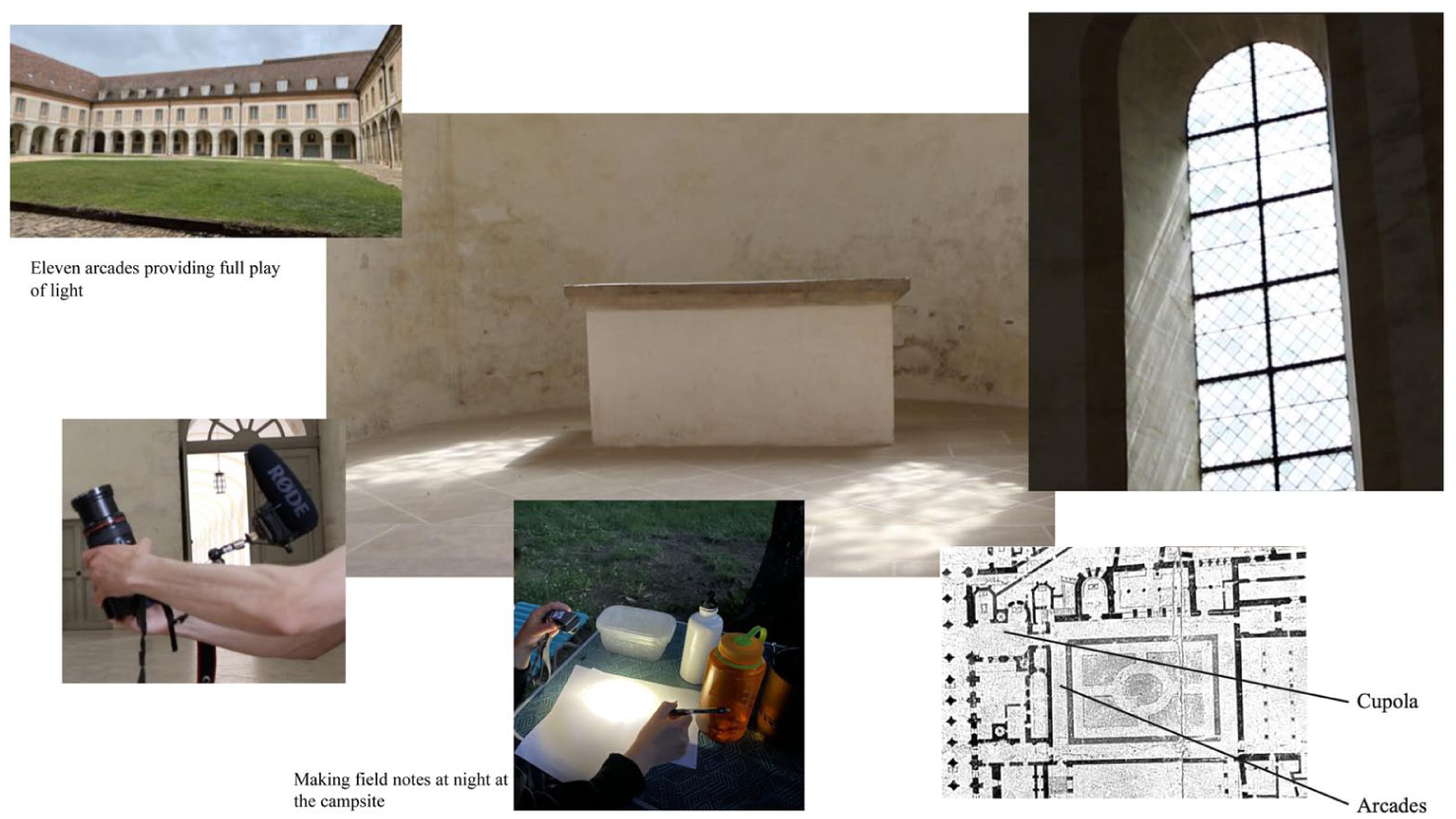
Cupola-Dizzying. All scenes at: https://vimeo.com/1060360772/da39365034.
Holes-Dimming
I’m expected to sleep efficiently. They want me to take a quick rest before the next day’s liturgical tasks. Yet I lie awake in the early hours. These are the few moments I have to myself. Our cell is almost dark. A single candle burns next to the door. The monk sleeping next to the door is responsible for ensuring the candle burns throughout the night. With the light from the candle, we are expected to find our way in the dark dormitory. As the early morning bell tolls, I rise quickly and exit the cell into the dark corridor. We’re asked to make our way towards the light at the end of the corridor. Having slept poorly, I slow down, avoiding the light. I’d rather linger in the darkness a bit longer. My attention drifts, and I gaze at the doors to the other cells. One of the cell doors is broken. I try to look inside, but the cell is too dark. What happened to the brothers sleeping in this cell? (Fictive fragment by author)
During my visit to the Cluny monastery, I found the dark corridor, which I imagine to be a dormitory, on the second day. For some reason, the corridor had been closed off to visitors on the first day. When I entered, I was struck by the intense darkness and the blinding light at the end. Not all sections of the monastery were well-lit, and the space was designed so that practices not directly associated with liturgy were carried out in dimmer lighting. Falling asleep, sleeping and waking were non-liturgical, earthly practices expected to be executed quickly, without lingering. Windows were placed to the east to help monks wake for the second prayer in the morning. For the night office, monks always rose in darkness, and the Matins service had to take place before dawn. The Rule of St. Benedict mentions the luminous contrasts between the dark dormitories and the well-lit churches and chapter houses. The dormitories were lit by a single candle, giving monks the minimal light needed to orient themselves for sleep. With several monks sharing the dormitory, the light from that single candle must have made moving around a challenge. Dressing and washing were designated to other rooms. The fragment from The Rule below also indicates that monks slept clothed and were expected to rise without delay and make their way to the chapter house.
A candle shall always be burning in that same cell until early in the morning. They shall sleep clothed and girded with belts or cords—but not with their knives at their sides, lest they cut themselves in their dreams; and thus the monks will always be ready to rise without delay when the signal is given and quickly present themselves to mutual service. The Rule of St. Benedict. Chapter 22. (Fry, 1981, p. 37)
The chapter in The Rule indicates an awareness that mind-wandering, considered impure, often occurred at night, and to be on the safe side, monks were instructed not to sleep with their knives. The fragment on the issue of dreaming suggests that, despite the Cluny monastery’s attempt to control the monks through light, the world of dreams remained beyond their control.
For the monks, mind-wandering was seen as an enemy to spiritual pursuit, and the importance of avoiding an idle mind is famously described in Chapter 48 of The Rule: Idleness is the enemy of the soul. Therefore brothers should have specified periods for manual labour as well as for prayerful reading. The Rule of St. Benedict. Chapter 48. (Fry, 1981, p. 69)
The monks at Cluny tried to eliminate all risks of an idle mind. By immediately seeing the light at the end of the corridor, I imagine how they were expected to direct their attention to the next liturgical task. The (reenacted) dormitory corridors, depicted in the collage in Figure 2 and in the videography, show the radiating light at the end of the corridor, ordering the monks to quickly make their way towards the winding stairs leading to the church and engage in prayerful reading, where they would be surveilled by the light entering through the openings in the cupola. The light at the end of the corridor asked for movement out of darkness towards the divine light (Sartiaux, 2019, p. 33), and such light-controlled corridors frequently appeared inside the monastery. To minimize mind-wandering, Cluny was designed so that sleeping quarters were in immediate proximity to the church and chapter house. This is the case for many Benedictine monasteries and can be observed in the floor plan reconstructions developed by archaeologist K.J. Conant in 1942, reproduced in Baud and Sapin (2019). At Cluny, the dormitory was located one floor above the chapter house, so the monks only needed to pass through the dormitory corridor and descend a flight of stairs to enter the church or chapter house.
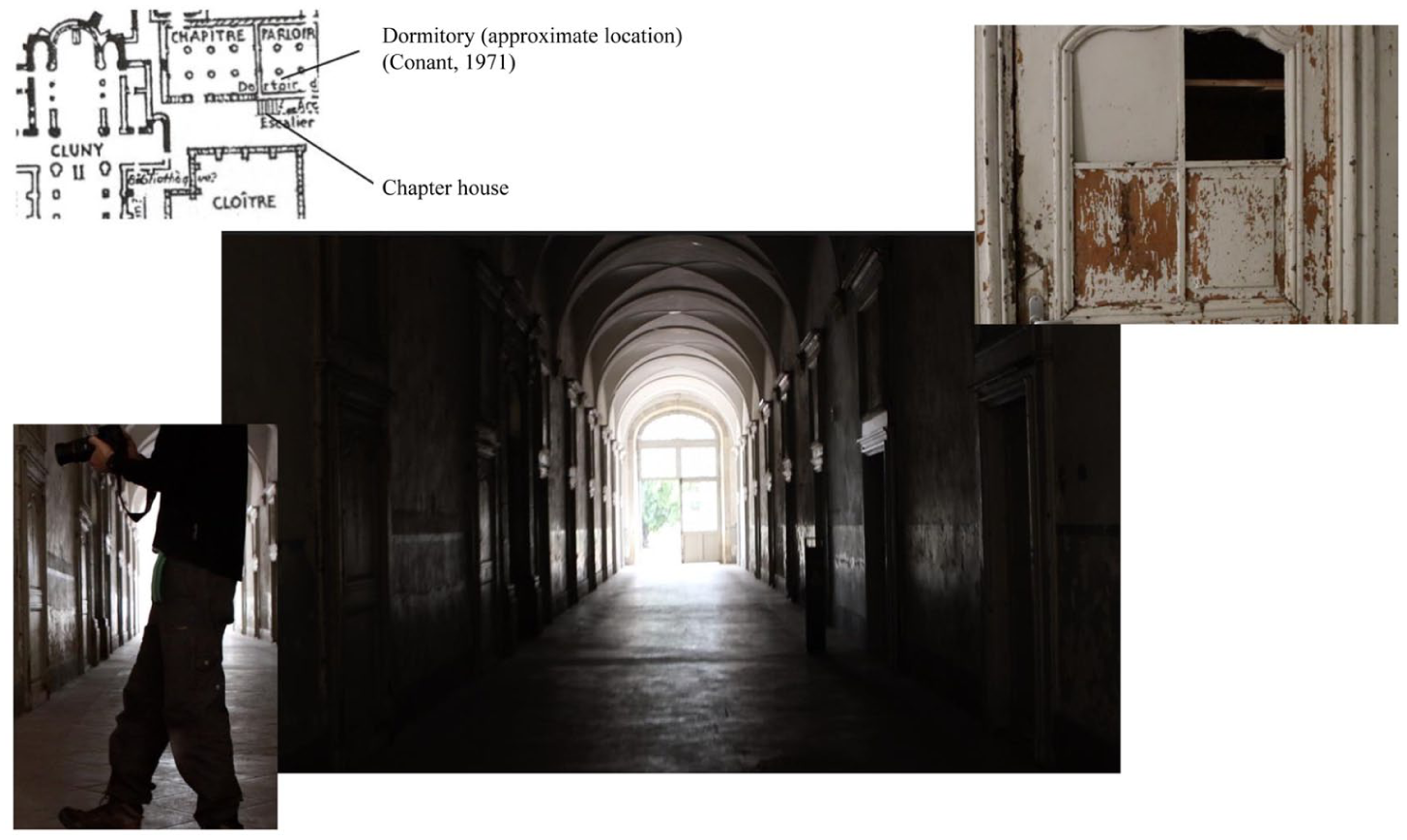
Holes-Dimming. All scenes at: https://vimeo.com/1060360772/da39365034.
Light control at Cluny needed darkness for its full effect. The movement of the monk through the monastery was designed as an allegory for the spiritual journey from darkness to divine light. An experiential interplay between light control and visceral experiences in darkness emerges. The carefully crafted architecture at Cluny used the oscillation between darkness and light to highlight moments of spiritual focus, both in the church and in the chapter house, where monks were expected to give their full attention to the liturgical tasks. Yet, in my fictive fragment, I was sensitive to how light slipped from the grasp of organizational control, and how openings for mind-wandering emerged. In newer 18th-century corridors, I imagined myself as a tired, mind-wandering monk. I re-enacted the experience of waking in the dormitory, making my way through the dark dormitory corridor and entering the church. Yes, the dormitory corridor was dark (even the 18th-century construction, which I used as a proxy for the 13th-century dormitory), and I imagined myself quickly moving toward the well-lit opening, but I felt an urge to stop by the many closed doors. Who was behind this door? Why was one of the doors broken? The dark corridor became a crack where my fictive monk found a moment to escape the liturgical duties and to wonder on earthly matters.
Rubbish-Disobedience
As a lay brother, I came here a year ago to support the monks. We get food and shelter, and I’m relieved to take part in some aspects of the service. We’re expected to live by the same rules as the choir monks, but with less surveillance. Our living quarters are cramped, and at night, we move in darkness. This morning, I make my way to the church for a shorter service. The staircase is narrow and dark. We’re expected to get to our chores quickly and silently, yet we find pockets where we can slip away from control. We have our own sign language, allowing us to evade the controlling Rule. (Fictive fragment by author)
Lay brothers were crucial to Cluny, taking care of much of the manual work such as washing, serving, cooking, working in the fields and attending to horses. They were recruited as adults, unlike the choir monks, who often joined the monastery as children. While the lay brothers were officially monks and participated in parts of the liturgy, they followed a different version of the Cluny liturgy. However, the lay brothers were subject to similar light control as the choir monks, moving from their austere, dark living quarters to the light-flooded Cluny church. Although most of these structures, except for the washroom, have been destroyed, drawings by the archaeologist John Conant give us insight into how they functioned (Conant, 1971). While lay brothers were exposed to light in most areas of the monastery, their own quarters remained darker. The darkness in their quarters, exacerbated by the narrow staircases and corridors, made the cold stone walls feel particularly oppressive. In their cramped living spaces, attention was meant to be focused on sleeping. The dark sleeping quarters and winding staircases encouraged quick transitions to the next chore, discouraging any mind-wandering.
The lay brothers’ quarters often housed three times the number of choir monks (Lawrence, 2005, p. 262), and disobedience must have been a challenge. Since the lay brothers were not under the same strict surveillance as the choir monks, they worked, dined and washed in their own areas. Given their greater freedom from the rigid daily liturgy, it is likely that the lay brothers also found more opportunities for mind-wandering and earthly desires than the choir monks. Figure 3 shows rubbish found in what I fictively re-enacted to be the lay brothers’ staircases. As a tourist visitor, I was surprised to see piles of rubbish left in a dark staircase next to the monastery tour, and I imagined how the lay brothers might have experienced a desire for disobedience, escaping the surveilling light. The focus on light for a pure and disciplined following of the Divine made messiness stand out. Another well-documented form of disobedience with The Rule was the development of sign language (Lawrence, 2005). There is, of course, no mention of sign language in the 6th-century Rule, which clearly dictates the rule of silence: Speaking and teaching are the master’s task; the disciple is to be silent and listen. The Rule of St. Benedict. Chapter 8. (Fry, 1981, p. 31)
Yet, the expectation of total silence under the surveilling light was both impractical and improbable. Figure 3 shows illustrations of the type of sign language that emerged when they could escape light control. An elaborate sign language allowed monks and lay brothers to coordinate monastery logistics (Lawrence, 2005) and even engage in gossip. The two gestures displayed in Figure 3 are likely to have been particularly popular in the darker lay brothers’ quarters and the wine cellar. The first, pounding two fists together, indicated it was time to work. The second, perhaps a secret warning, using a two-finger pinch, signaled that the abbot was about to arrive. These gestures were illustrated at Le Thoronet monastery in the inner courtyard in 2022 and were reenacted by the author.
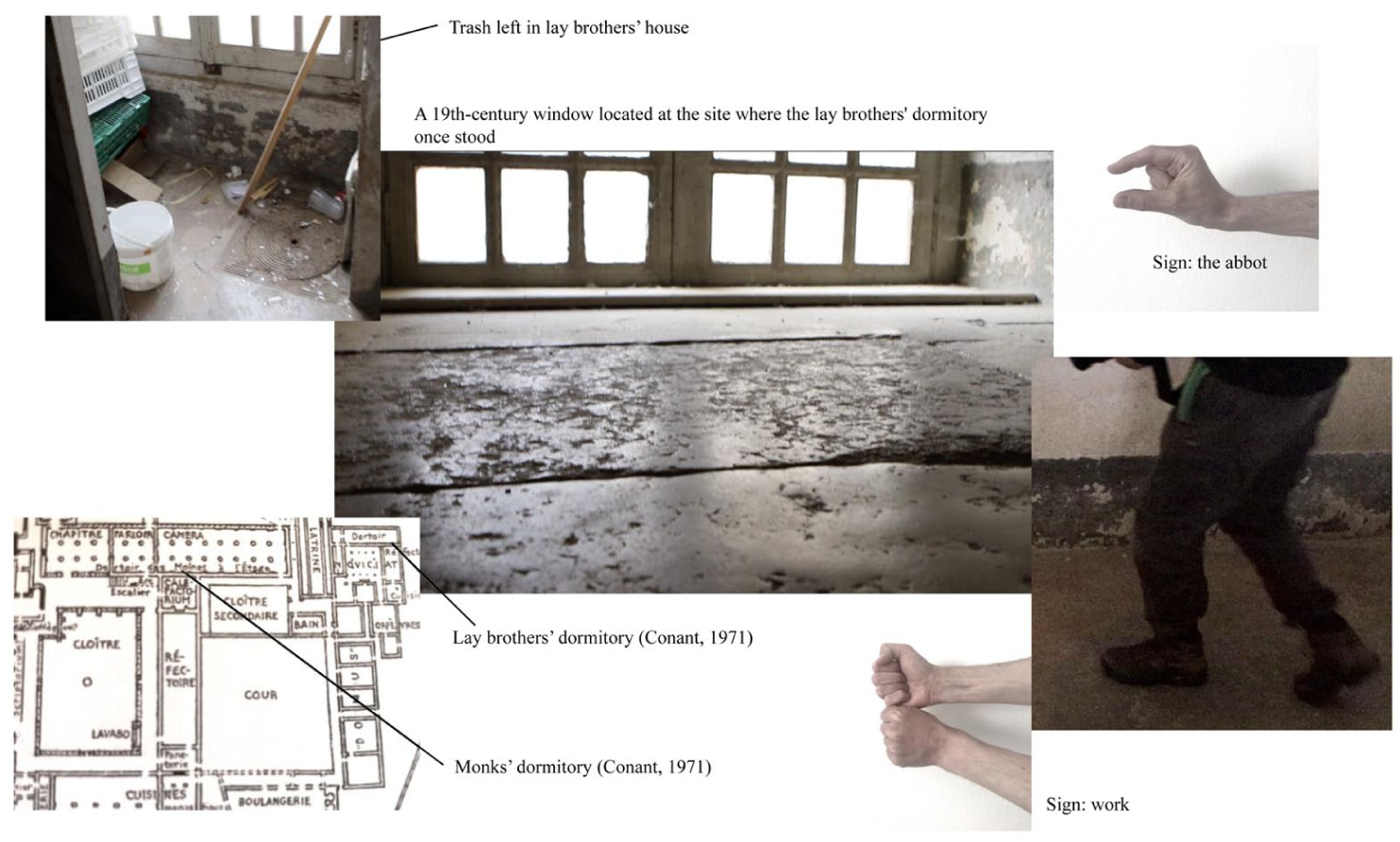
Rubbish-Disobedience. All scenes at: https://vimeo.com/1060360772/da39365034.
The Quatrefeuille-Daydreaming
I’ve done my morning prayers, and now I’m on my way to the daily meeting. We’re forced to sit in the chapter house every day. It’s the same routine: the abbot lists the tasks we’ve failed to complete, failed to read a certain prayer, failed to remain silent, failed to write a text that was ordered. I hope I’m not punished for being late to morning prayer today. Over 200 worried monks are seated in two rows on stone benches. My buttocks freeze against the bench. The light from behind gives us a perfect view of the abbot as he speaks. My gaze drifts. I’d rather be walking in the meadows blossoming beyond the abbey wall. Tired of looking at the abbot, I let my gaze drop to the floor. Picturesque tiles decorated with different quatrefeuille flowers catch my eye. My mind escapes to the yellow fields across the river, and I’m tempted to abandon the monastic rule and camp by the water. (Fictive fragment by author)
In contrast to the dark dormitory, the chapter house was filled with natural light, and the aesthetics of the meeting room were carefully designed to align with the Benedictine spiritual project. Archaeological findings reveal that the Cluny chapter house was flooded with light from seven openings facing east, which looked onto the inner courtyard (Baud & Sapin, 2019, p. 130), providing the room with abundant daylight. Slim columns and broad openings spanned an entire side of the room, allowing light to radiate in from behind the monks. The visual experience of sitting in the chapter house was meticulously planned. The room was constructed to seat around 180 monks at once, a very large gathering for a medieval Christian chapter house. After archaeologists removed around two metres of soil at the end of the 20th century, they discovered stone benches arranged on two levels. Baud and Sapin (2019) note that the bench height was approximately 1.50 m, indicating that the chapter house was designed to seat monks on two levels, offering near-perfect visibility of the lecturing abbot. The elevation of the benches ensured that the seated monks would not cast shadows into the room, as the openings in the wall behind them provided lighting from above the two rows of monks.
While light was used to manage the monks’ attention during chapter house meetings, I speculate that the light falling on the picturesque floor tiles caused minds to drift away from the monastic liturgy. The floor tiles (photographed and displayed in Figure 2 and in the videography) depicted flower motifs such as the Quatrefeuille, Petit Marguerite, and Fleur de Lys. The discovery and categorization of these tile motifs are the result of careful 20th-century archaeological analysis at Cluny (Orgeur, 2019). Flower symbols are part of the medieval ornaments that aimed to merge the natural and the spiritual worlds. There are also variations in how the Quatrefeuille and Petit Marguerite flowers are depicted: Quatrefeuille petals are drawn as smooth or ribbed, while Petit Marguerite petals are circled or set in ribbons (Orgeur, 2019). The floor tiles were placed close to the openings in the wall, directly in front of the seated monks, and were well-lit by the light coming from behind them. It is possible that the natural flower motifs of the Petit Marguerite and Quatrefeuille on the floor tiles raised desires to sense the spring flowers beyond the walls. Given that the austere monastic building was sparsely decorated, the floral representations of the Petit Marguerite and Quatrefeuille brought a touch of natural beauty into the confines of the monastery. In my fictive fragment and attached video (Figure 4), I re-enact how a monk’s experience oscillates between focusing on the well-lit abbot, and daydreaming through the beautiful flower tiles at his feet. The flower motifs, while controlling through religious symbolism, trigger sensations of wonder at the shape of the petals, the colour of the pistils, and the light falling on the leaves.
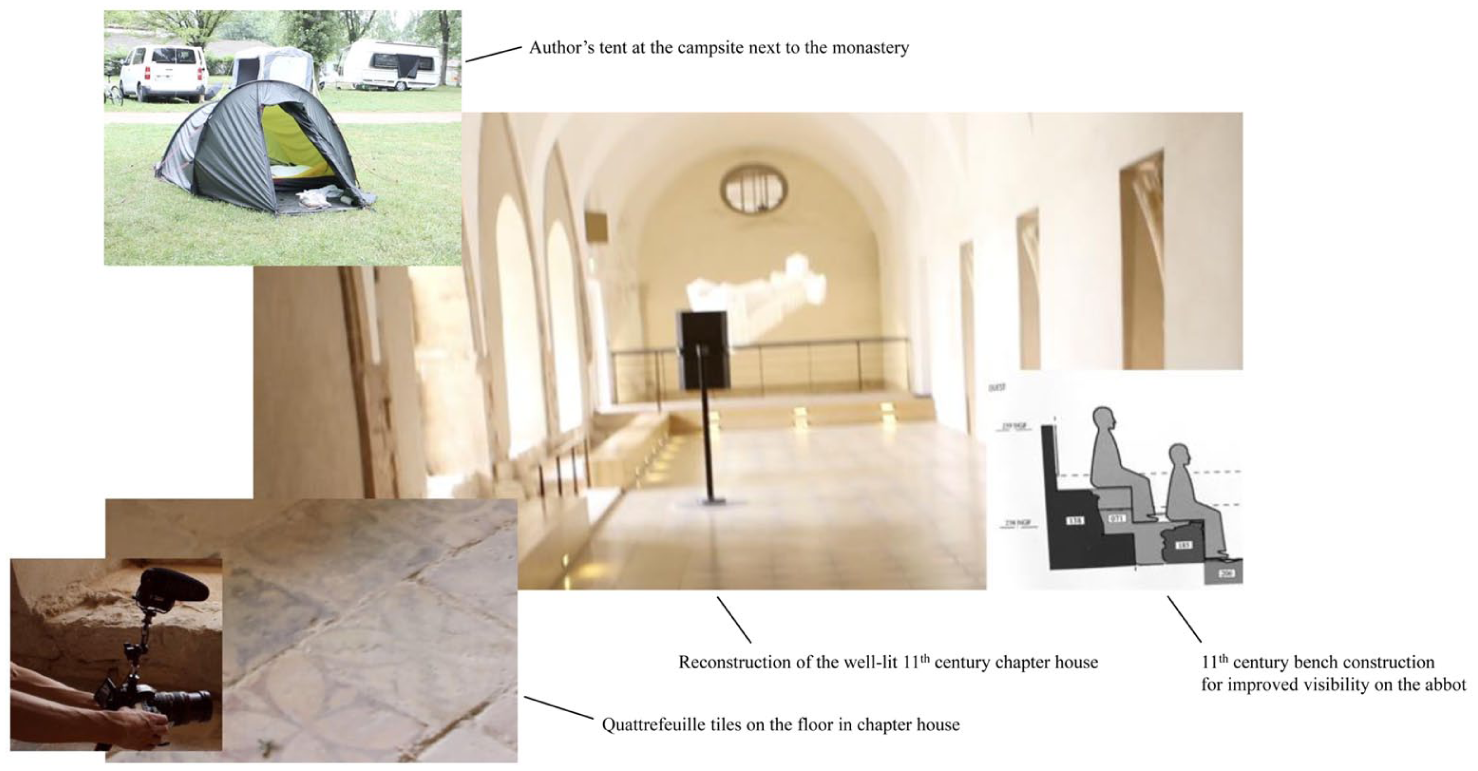
The Quatrefeuille-Daydreaming. Chapter house bench archaeology from Baud and Sapin (2019), credits to Centre d’Études Médiévales d’Auxerre. All scenes at: https://vimeo.com/1060360772/da39365034.
Discussion
Light and organizing
The interplay between using light in management and light slipping away from forceful attempts at control is exemplified through four different affective montages from the Cluny monastery. The first montage, ‘Cupola-Dizzying’, captures how confusion and dizziness are experienced under the dominating light. The second, ‘Holes-Dimming’, illustrates how light and darkness alternate in light control at Cluny, and how a hole in a broken door becomes a dark crack that sends a curious mind on a trajectory filled with questions. The third, ‘Rubbish-Disobedience’, deals with the temptation to disobey when the light looks in another direction. The fourth montage, ‘The Quatrefeuille-Daydreaming’, shows how a tired and wandering mind escapes light control by marvelling at a flower depicted on a floor tile. These four montages mix historical and on-site details with fictive fragments (Stewart, 2007). In each montage, I foreground a surprising moment of contact (Stewart, 2007, p. 12) that shifts my analysis of light control in an unexpected and critical direction. Through the four montages, I approach my research question: How is light both usable and unusable for organizing?
I suggest that light is both usable and unusable, as light becomes an atmosphere generator that influences my fictive monk both by triggering impulsive feelings (experienced) and by controlling through the ideal Rule (designed). As light, like colour, is inherently irreducible to metaphors (Beyes, 2024), I suggest an in-betweenness and interplay between the ideal grounding forms and ordinary affects. This adds to the conversation on organizational atmospheres as ‘half-things’ where atmospheres are both designed and experienced (Jørgensen & Beyes, 2023, p. 2) and introduces light as an important generator of atmospheres. I emphasize a relational view of light that embraces light’s social, collective and materially entangled ontology (Barad, 2007), and advocate an epistemology of experimenting with both immersive and distance-based research strategies for studying light as an atmosphere generator. While the immersive and sensory perspective has gained considerable popularity lately (Beyes, Cnossen, Ashcraft, & Bencherki, 2022), more distance-based approaches, which revive a modernist sincerity and the potentially deliberately naive visions (Holt, 2018, p. 96), become useful companions to immersive perspectives on light.
The result is a collection of arguments suggesting a revival of the old tradition of light and organizing. Reviving modernist light control, without succumbing to the modernist project of experiencing and uncovering truth ‘for real’, is helpful as organization studies can benefit from a critical recognition of some of the organizational obsession for distance-based civic idealism and grounding form of light that both modernists like Le Corbusier and the medieval abbots of Cluny aimed for. Le Corbusier went as far as claiming absurdly to be on a ‘crusade for whitewash’ (Le Corbusier, 1925) that should help everyone in the ‘mastery of yourself’. 4 Le Corbusier, Frederick Winslow Taylor and Lillian Gilbreth’s obsession for light has, in some cases, left contemporary organization on unconscious ‘healthy’, wellness-obsessed light-flooded autopilot. If light control in organizations is left unexamined, light leads to a chronic default setting of ‘white’ lighting of contemporary organizing (Wigley, 1995), where masses simply chime in and support the law of light (Beyes, 2024, pp. 60–61). To give context, my montages foreground two distance-based, modernist forms of light control in detail.
From the modernist perspective of design and control, my montages convey how light drives direct behavioural control of subjects in organizations. Light control can create docile, capable, efficient and compliant bodies (Foucault, 1977, p. 294) that obey rules. In Western Christian monasteries such as Cluny, where The Rule was an organizing force, a concept that monks strove for, light became an essential tool for liturgical adherence and rhythm-keeping. Daylight considerations were often practical, with light used as a signal to time activities such as prayer, sleeping, working, eating and washing. The liturgy required a precise horarium, with many tasks needing to be performed during daylight hours. Inside the monastery, light also directed attention to preferred zones: the light at the end of a dark corridor pulled the monk towards it, the well-lit altar directed the monks’ focus to the front of the church, and the abbot speaking in the chapter house was well-lit so that the monks would pay attention. Le Corbusier’s Cité Radieuse in Marseille is equally filled with behavioural light control with all apartments being white and without internal walls, the library corridor flooded with light from the south-west ambulatory and the minimalist rooftop platform bathing in light‚ demanding that residents focus on mastering their selves and on breathing the healthy air from above. Similarly, Lillian Gilbreth advocated for optimal light settings in packaging and assembly lines (as well as in the running of a family) to control and minimize fatigue levels.
My montages also show how light design operates through allegorical control. Among historians, Cluny is best known for its allegorical use of light (Sartiaux, 2019; Wollasch, 2001). Through advanced masonry techniques and an almost unlimited amount of funds, the abbots of Cluny designed the architecture so that light symbolized the omnipresent, powerful and surveillant Rule. The metaphor of light as a symbol of The Rule contributed to Cluny’s emergence as the European epicentre of Benedictine spiritual service, praised as ‘the light of the world’ (Wollasch, 2001). The vaults, arches, triforiums, clerestory windows and the 75-metre-long nave channelled the moral truth of The Rule through light. The architectural use of vertical light also subjected the monks to a hierarchy in which subordination and service were embodied in the practice of bowing beneath the light streaming from the cupolas of the high church towers. In comparison, while light was not a direct symbol of the Divine in Le Corbusier’s modernist architecture, light, lightness and epic order for Le Corbusier came to symbolize wealth, cleanliness and reasoned integration (Holt, 2018, p. 95). 5 Le Corbusier’s ideal allegorical form was a striving for a utopian, liberating modernity available to all (Frampton, 2024, p. 256), an ideal he felt strongly about and expressed in his last chapter, ‘Architecture or Revolution’, in Vers une architecture (Le Corbusier, 1927). After the Second World War Le Corbusier was able to materialize his ideal in patterns of regional urbanization such as Unité d’habitation in Marseille and the low-rise, high-density Siedlung Halen close to Bern (Frampton, 2024, p. 257). In organization research, allegorical control through light features in Connellan’s (2013) photographic analysis of the surveillant power of whiteness in various institutions and the strong symbolic connotations whiteness carries, Katila et al.’s (2023) foregrounding of how light becomes a powerful cultural element in organizational life, pushing subjects down and drawing them in, and in Beyes’ (2024, pp. 47–66) montage of the colour white in organizations.
Both Cluny’s and Le Corbusier’s obsession with light as a singular binary form guiding from the earthly to the divine, from the bad present to the good future, closes out a sensitivity for accident and messiness of ordinary life, and the inevitable enticements of place that creep in as inhabitants live there (Holt, 2018, p. 97). They wanted to get rid of all the dirty, uncontrollable and unexplainable aspects of life. The binary use of light as a tool to drive inhabitants towards the divine was, of course, destined to fail.
Atmospheric interplay in light
Through my tourist experiences at Cluny, I noticed how light frequently slipped from behavioural control. The light coming through the cupola windows, while grandiose, made my fictive monk feel dizzy. The dark corridor, intended to direct the monk’s attention to the light at the end, caused him to stop and notice the broken door. The light control at Cluny simultaneously generated an atmosphere of divinity, aspiration, uncertainty, confusion and frustration. Light was both usable and unusable for controlling the monk. As I flaneured through the corridors with my camera, I strove to remain open to being under the light and to the fleeting moments where light surprised me. Caught off guard, I found myself enveloped in light, sensing and responding to the flickering light.
Light control envelops a sensing and impulsive subject (Böhme, 2017, p. 17) filled with temptations and desires, which, when pushed through extreme control, like colouring hospitals totally white, starts to feel sick (Beyes, 2024, p. 54). Ironically, strict light control unlocalizes the divine project, opening the door to a desiring and wandering body, a body that focuses on a broken door, rubbish left on the stairs, or life beyond monastic confinement, the attentions and enticements of place allowing the inhabitants to explore their repressed urges (Holt, 2018, p. 97). Through my montages, I show how light becomes unusable as it relies on feeling, visceral (Holt, 2018, p. 97) bodies as a material substratum (Latka, 2020) in atmospheric situations (Schmitz, 2014). The light-generated atmospheres, while intended to control through an aura (Böhme, 2017, p. 19) of spiritual perfection and to create docile, unquestioning bodies (Foucault, 1977), simultaneously become passageways for bodily temptation, temptations that drive agentic, relational and desiring subjectivities (Pérezts & Mandalaki, 2023).
Light shapes experiences both through distant control and the visceral, feeling body, and as an atmosphere generator captures the interplay between rational, pure and clean forms of control and the immersed, sensing and speculating subject (Jørgensen & Beyes, 2023, p. 8). My montages of the wandering monk at the Cluny monastery capture moments of interplay, light atmospheres that oscillate and swing between both immersive experiences and divine control. An atmospheric oscillation between immersive and distance-based approaches is what Holt paints through artists such as Rilke and Poussin (Holt, 2018, p. 208), a hovering through stalling, falling back, stuttering, and reaching anew; a sensitivity towards multiple and unpredictable emotions (Holt, 2018, p. 249). The interplay becomes an impossibility to settle for a single response: not modern ideal cellular form, not postmodern immersive light flickers; but a recognition of opposite poles, as in the poetics of pastorals.
The organizational atmospheres of hovering and oscillating in the in-between often take place in clearings (Holt, 2018, p. 259), that as suspended states, become places of living, gathering, passing through and settling. Atmospherically, such clearings create enveloping spheres (Sloterdijk, 2011) for lived experience, proto forms of judgement, that allow for ordinary possibilities of transformation (Holt, 2018, p. 259). My montages become brief clearings, separate states, where an interplay between distance-based control and visceral immersion allows the monk to play with a naive, impossible possibility of escaping to the blossoming fields. As a future research opening, scholars in organizational atmosphere may look into the aesthetic of metamodern work in the arts and how a metamodern aesthetic may help articulate atmospheric oscillation. Such work oscillates between ‘modern sincerity and postmodern irony’ (Van den Akker, Gibson, & Vermeulen, 2017) and works with a ‘structure of a feeling’ (Vermeulen & Van den Akker, 2010), that like a good pastoral, creates a lived space that captures the continual coming together of things, impervious to designed human will (Holt, 2018, p. 259). Metamodern aesthetics go beyond opaqueness and play explicitly with polarities such as hope and melancholy, naiveté and knowingness, empathy and apathy, unity and plurality, purity and ambiguity, and the divine and profane. Metamodern art shows an awareness of postmodern doubt and is fuelled by modern naiveté, constantly reaching for an impossible possibility (Vermeulen & Van den Akker, 2010, p. 5), a stuttering and reaching anew (Holt, 2018, p. 249). Raoul Eshelman describes such a metamodern poetic form as the revival of suspense, of maintaining separate states, protecting people from direct contact with nature (Sloterdijk, 2011), and allowing affirmative experiences of beauty to unfold – in a Kantian tradition (Eshelman, 2024). 6 Metamodern artists often ‘upcycle’ past styles, conventions and techniques to resignify and redistribute how we sense the present and imagine the future (Van den Akker et al., 2017, p. 10). 7
Through my four montages, I hope to paint a monk who, thrown into an atmospheric oscillation, is deeply dedicated to following the light, but who drifts, escapes and mind-wanders on life beyond monasticism. With buttocks frozen to the stone bench in the chapter house and the light falling through the ambulatories on the Quatrefeuille tile, the monk dreams away to the adjacent fields. Could he, if only for a moment, escape and throw himself into the field of yellow and white blossoms?
Writing organizational atmospheres through affective montage
This article also contributes to organizational atmosphere research by advocating a poetics of affective montage for writing both immersive and distance-based light experiences. A poetic of affective montage relies on delivering insightful shocks to the reader by capturing and assembling previously unnoticed connections of dissimilars (Mitchell, 1973). The notion of the ‘insightful shock’ which surprises, provokes and dislocates the reader is a key characteristic of affective montage. Through affective montages, academic writing can powerfully interrupt and rupture the familiar contexts on which taken-for-granted understandings rely, and propose previously unnoticed experiences of organizational life. Etymologically, montage comes from the Old French verb monter, meaning to ‘mount’, ‘climb’, or ‘assemble’, and for researchers a poetics of affective montage calls for discontinuous writing that stays faithful to assembling what moves us, into scenes. Montages may include screenshots from movies, text snippets, floor plans, paper cuts, on-site photographs, boxes and arrows, and quotes. Writing light through affective montage is strongly situated, as it relies on a sensitivity and tuning in (Cnossen, 2023) to the situated movement of light and how wider temporalities and spaces (Beyes, 2024, p. 212) send researchers on trajectories of new insight. Montages can also be ‘smooth’ (Doel & Clarke, 2007), less shocking, creating experiences that defamiliarize, juxtapose, detour and mount (Beyes, 2024, p. 215); however, the notion of affective montage adopted in this paper relies more fully on rupturing familiar contexts and crafting insightful shocks to the reader. At the monastery, the flickers of light led me to obscure light formations in the gravel, surprising dark alleys, and illuminated flower tiles on the floor. Flaneuring under the church cupola, mosaic windows and light-flooded ambulatories, I strove to remain sensitive to stopping, feeling, writing and pressing the record button on my camera to capture the slightly unruly and unconstrained desires of my fictive monk. Suggesting montage writing as an approach to studying organizational atmosphere builds on organizational research that has adopted a poetic epistemology and an openness to ‘what moves’ in the study of atmosphere. Michels and Steyaert (2017), for example, engage in associational and poetic event reconstructions, Leclair (2023, p. 811) writes through ‘going along’ and ‘feeling with’ materiality, and De Molli et al. (2020, p. 1496) remain sensitive to contextual ‘thresholds’ as zones of transformation.
Future research could explore how affective montage writing remains open and exposed to the unruly aspects of organizing through videographic and sonorous montage. How can our montage thinking become filmic and merge into what O’Doherty (2020) calls a film–subject–viewer assemblage? How can research through montage build on film’s potential as a ‘shock of thought’ (Rokka & Hietanen, 2018, p. 114)? How can filmic elements of duration and movement (Rokka, 2022, p. 32) be further developed to reveal the surprising and intriguing aspects of organizing? De Vaujany suggests that visual approaches and cinematographic narration have the potential to open up the shared memory of our communities (De Vaujany, 2022, p. 543). Also, Redmalm and Skoglund (2024) offer an intriguing perspective on how videographic methods can, through profanation and by playing with inside/outside notions and musical soundtracks, return sacred concepts to the realm of the profane. Videographic montages that work through an oscillation between the sacred and profane realms are intriguing as they might allow organizational researchers to celebrate the mixing of feelings of hope and melancholy, naiveté and knowingness, and purity and ambiguity, an interplay that characterizes metamodern aesthetics in the arts (Vermeulen & Van den Akker, 2010). To conclude, my videography, associated with the figures in this article, is an experiment in how filmic thinking about light may open new research insights into light and organizing.
Conclusion
The Cluniac monastic order can be regarded as an important historical era in which light was harnessed for organizational purposes. With its epicentre north of Lyon, practices of Western Christian light control spread across Western and Northern Europe for hundreds of years, and, as Foucault points out (Foucault, 1977, p. 295) and modernists such as Le Corbusier represented, gained a foothold in institutions such as schools, hospitals, prisons, factories and residential areas. Through the four montages, I hope to revitalize the study of light in organizations, and raise awareness of different forms of light control in organizations and the sensations associated with such control. I hope that this study revitalizes organizing with a sensitivity to the plural affects that arise from light control and a recognition of the bodily reactions to experiencing light in organizations. At best, such attention to light would bring an awareness of how organizational efforts, such as crafting strategies, visions, inclusivity and well-being programmes, are all entangled with light.
Footnotes
Acknowledgements
I would like to thank senior editor Timon Beyes and the three anonymous reviewers for their thoughtful guidance. I would also like to thank the staff at Monuments Nationaux for permission to record at the Cluny monastery. Thanks also to the participants of the Space and Place workshop at Aalto University in 2023 for all the excellent comments. I am very grateful to Heidi Väätänen for on-site videography work.
Funding
The author disclosed receipt of the following financial support for the research, authorship, and/or publication of this article: This research has received funding from the Foundation for Economic Education in Helsinki, Finland
