



Abstract
We investigate organizational members’ crisis sensemaking and construction of responsibility at the peak of a corporate scandal. We focus on those organizational members, who are not directly involved in the scandal but are still affected by it, as they are questioned about their collective and moral responsibility for being members of an organization that has engaged in wrongdoing. Our study is based on interviews with and observations of frontline employees and their managers at Danske Banke—a bank involved in a money laundering scandal of historical magnitude. We propose an antenarrative crisis sensemaking framework that enables us to contribute to the literature on crisis sensemaking in two significant ways. First, we advance existing knowledge on crisis sensemaking by focusing on the less visible, unfinished, fragmented, and polyphonic sensemaking of organizational members during a corporate scandal. Second, we demonstrate that organizational members at the peak of a scandal place responsibility in different timespaces as they construct others’ and their own responsibility both retrospectively and prospectively.
Introduction
Corporate scandals have become commonplace. A range of moral scandals, particularly in the financial sector, has occurred in recent decades. At the peak of such corporate scandals, external stakeholders, the media, customers, politicians, and shareholders often seek to hold companies responsible and assign blame for their wrongdoing. This was particularly true when a European bank, Danske Bank, was accused in 2018 of enabling €200 b worth of money laundering for Russian criminals through its Estonian branch, making it one of the biggest international money laundering scandals in history. Formerly held in high regard, this bank found itself in its worst organizational crisis to date, facing legal charges as well as questions about its moral responsibility. The executive management and official spokespeople were left dealing with questions of moral responsibility for the wrongdoing; even its organizational members not directly involved in the money laundering scandal were held collectively responsible by external stakeholders—not legally but morally. How could they continue working for such an organization?
Research on sensemaking during scandals, crises, and organizational failures has focused on the externally directed managerial narratives of executives management and spokespeople, as they make sense of a situation (Boje et al., 2004; Edwards et al., 2019; Höllerer et al., 2018; Mantere et al., 2013; Rhodes et al., 2010; Whittle and Mueller, 2011, 2016; Whittle et al., 2009; Zilber, 2007). Moreover, research has studied how issues of responsibility are publicly negotiated in public inquiries, annual reports, and email exchanges after a crisis (Boudes and Laroche, 2009; Brown, 2000, 2004; Guimarães and Alves, 2014; Landau and Drori, 2008; Seeger and Sellnow, 2016). These externally directed narratives by spokespeople following organizational wrongdoings are often designed to divert blame, re-establish legitimacy, and give sense to external stakeholders, including the media, shareholders, customers, and politicians (James and Wooten, 2006; Pfarrer et al., 2008; Zavyalova et al., 2012). They are fully fleshed and polished narratives plotted around ‘who did it’ to identify the plausible causes and accountable agents (Guimarães and Alves, 2014).
However, the less visible sensemaking by organizational members, such as managers and employees, during a corporate scandal remains understudied. Thus, we have little insight into how organizational members make sense of a scandal, justify it, and attempt to move forward. At the peak of a scandal, sensemaking is yet to form into finished narratives of ‘what is going on?’ and ‘who is responsible?’. Those not directly involved in wrongdoing still face its consequences, as they are held collectively responsible by outsiders owing to their organizational membership. Moreover, while the executive management or other members legally responsible for wrongdoing typically leave their organization at the peak of a scandal, many organizational members still remain in the organization. This void in the literature is thus problematic, as scandals damage both organizations and their members significantly (Seeger and Sellnow, 2016): in particular, because negative social evaluations by the outside world threaten the identity of the organization as well as its members (Dutton and Dukerich, 1991; Frandsen and Morsing, 2022; Petriglieri, 2011; Petriglieri and Devine, 2016).
This study examines how organizational members make sense of and construct responsibility during the peak of a corporate scandal. To address this research question, we use interviews and observations from Danske Bank at the peak of the money laundering scandal in late 2018 and early 2019. Our rare access to the organization enables us to collect data when the organizational members were still trying to figure out how to make sense of the responsibilities for the scandal. No participant of our study was personally involved in the events leading to the scandal, yet they were held collectively responsible for it in both their work and private lives.
We propose an antenarrative approach to study crisis sensemaking during scandals (Boje et al., 2004). Antenarrative is defined as ‘the fragmented, non-linear, incoherent, collective, unplotted and pre-narrative speculation, a bet’ (Boje, 2001: 1). The antenarrative vocabulary is apt to capture the often messy, patchy, polyphonic, and tentative sensemaking at the peak of a scandal when more established narratives are not yet fully formed and the meaning of ‘what is going on?’ and ‘who is responsible?’ remains in flux. Additionally, the antenarrative approach is particularly valuable to highlight the temporal and spatial constructions of responsibility that take place when organizational members make sense during a scandal and past events and anticipated futures are open to (re)interpretation.
We believe an antenarrative crisis sensemaking approach to understanding employees’ sensemaking at the peak of a corporate scandal is important because research on corporate scandals, thus far, has focused on the public strategy of chief executive officers (CEOs) and spokespeople in response to a scandal (Carberry and King, 2012; James and Wooten, 2006; Pfarrer et al., 2008; Zavyalova et al., 2012). Consequently, research has overlooked that scandals play out on multiple stages at varying degrees of public awareness (De Blic and Lemieux, 2005). We propose that attending to less public stages, such as the sensemaking of organizational members, is important to understand the implications of scandals on those not directly involved in wrongdoing or occupying the media spotlight. This ‘crisis sensemaking’ of organizational members is crucial, as organizations often rely on all members to respond to a corporate scandal for an organization to learn, change, survive, and thrive after a crisis (Brown and Starkey, 2000; Dutton and Dukerich, 1991; Petriglieri, 2011, Petriglieri and Devine, 2016). Thus, how organizational members make sense of collective and individual responsibilities is vital for the organization to recover from the scandal (Miller, 2020).
Our study makes two significant contributions. First, our antenarrative perspective advances the body of knowledge on crisis sensemaking by focusing on the less visible, unfinished, fragmented, and polyphonic sensemaking of organizational members during a corporate scandal. Second, from our antenarrative perspective, we demonstrate how organizational members place responsibility in different timespaces at the peak of a scandal as they construct others’ and their own responsibility both retrospectively and prospectively.
Theoretical framework
Crisis sensemaking during and after scandals
A crisis is a ‘significant, unexpected, nonroutine event or series of events that create high levels of uncertainty and a significant or perceived threat to high priority goals’ (Seeger and Sellnow, 2016: 18–19). A crisis represents moments of collapse in sensemaking (Boudes and Laroche, 2009; Guimarães and Alves, 2014; Nowling and Seeger, 2020). One example of an organizational crisis is a corporate scandal during which everyday life is drastically disrupted and the established ways of making sense of the world break down. Its unanticipated and surprising elements mean that routines and taken-for-granted conventions are interrupted (Seeger and Sellnow, 2016). Weick (1993: 633) describes this as a cosmological breakdown in meaning: ‘A cosmology episode occurs when people suddenly and deeply feel that the universe is no longer a rational, orderly system.’ Such a cosmological breakdown in sensemaking means that the former mundane ways of making sense collapse and the well-established narrative of how the world works is shattered. Mantere et al. (2013) describe such a crisis as a ‘meaning void’.
The literature on crisis sensemaking focuses on how a meaning void is filled and new meanings emerge (Maitlis and Sonenshein, 2010). Such literature primarily studies: (1) how the individuals directly involved in a crisis (e.g. response teams) reconstruct meaning in high-pressure situations (Waller and Uitdewilligen, 2008; Weick, 1993); (2) the sensemaking that takes place in the narratives of spokespeople or official bodies tasked with determining what happened after a crisis using, for example, public inquiry reports (Boudes and Laroche, 2009; Brown, 2004; Maitlis and Sonenshein, 2010) and annual reports (Guimarães and Alves, 2014; Maclean et al., 2014); and (3) the post-inquiry sensemaking after an official body has established its authoritative narrative about what happened (Dwyer et al., 2021; Mueller et al., 2023). The different perspectives suggest that crisis sensemaking is an ongoing and prolonged process. For our study, the second strand on narrative post-crisis sensemaking is particularly important.
Narratives are vital to sensemaking (Boje, 2008; Weick, 1995), particularly during a crisis (Humle and Frandsen, 2016), as meanings are ascribed to the events experienced through storytelling: With narrative, people strive to configure space and time, deploy cohesive devices, reveal the identity of actors and relatedness of actions across scenes. They create themes, plots, and drama. In so doing, narrators make sense of themselves, social situations, and history. (Bamberg and McCabe, 1998: iii)
A crisis might disrupt an established narrative about identity for an organization and its organizational members (Brown et al., 2015; Seeger and Sellnow, 2016) and create an opportunity for learning and self-reflection (Brown and Starkey, 2000; Schrempf-Stirling et al., 2016). However, it is also through ongoing storytelling that individuals are able to position themselves vis-a-vis a crisis and give themselves more or less agentic roles as victims, villains, or heroes (Gabriel, 2000; Riessman, 2008). Thus, storytelling can be central to how we construct and perform identity as individuals and organizations (Cunliffe and Coupland, 2012; Humle and Frandsen, 2016; Humphreys and Brown, 2002).
Seeger and Sellnow (2016) note that in response to the meaning vacuum created by a crisis, numerous stories about responsibility, accountability, guilt, and blame are created. The literature on post-crisis sensemaking is often focused on the narrative plots, competing storylines, and the development of narratives over time in the public sphere. These stories are primarily motivated by the quest to answer the basic questions of who and what caused the crisis to hold the right people responsible (Boudes and Laroche, 2009; Brown, 2000; Guimarães and Alves, 2014). This often involves reducing equivocality and creating an ordered and official narrative of what is often a complex and chaotic event (Boudes and Laroche, 2009). This typically implies negotiations of different stories and struggles over meaning to arrive at an authoritative version of reality and responsibility (Brown, 2004). While this post-crisis sensemaking is primarily retrospective, an important aspect is also to identify lessons learned from a crisis to inform future recommendations for organizational and societal learning. A central question related to the sensemaking of forward-looking responsibility is: ‘How can it be prevented in the future?’ (Boudes and Laroche, 2009; Brown, 2004; Dwyer et al., 2021). Seeger and Sellnow (2016) highlight that, while there is a public interest in learning from a crisis, the public stories by external stakeholders and organizations can be characterized as ‘blame narratives’, as such storytelling is marked by blame games, image repair, and strategically constructed ideas of organizational renewal.
The literature on narrative post-crisis sensemaking provides important insights into what happens after a corporate scandal, especially in the public sphere of an organization. However, this literature does not adequately describe the internal aspects of such a crisis or provide insights into the sensemaking and understanding of responsibility by organizational members at its peak.
Making sense of responsibility during scandals
During scandals, organizational members tell stories to assign responsibility, rights, duties, obligations, and blame (Whittle and Mueller, 2011). Responsibility may include ‘having done something or having failed to do something’ (Whittle and Mueller, 2011: 114). Making sense of responsibility is oriented toward the moral responsibility of others and the moral positioning of oneself. In addition to ‘what is going on?’, a central question related to scandals is ‘who has done it?’ (Zilber, 2007).
Research on organizational wrongdoing often takes a psychological perspective to examine the individual responsibility of those directly involved. Studies focus on the psychological pressure on CEOs as well as the opportunities and rationalizations in which they engage when they violate standards and are responsible for wrongdoing (Schnatterly et al., 2018). Studies also discuss the psychosocial mechanisms of individuals as they mitigate the moral consequences (White et al., 2009) and ways of normalizing misconduct in which ‘denial of responsibility’ is central (Ashforth and Anand, 2003). From a psychological viewpoint, individuals are often seen as moral agents acting more or less autonomously in social and collective contexts (Osofsky et al., 2005).
More philosophical approaches to responsibility point to the centrality of collective responsibility during corporate scandals. Collective responsibility can be defined as ‘the responsibility of a collective entity, e.g., a corporation [. . .] for harm in the world’ (Smiley, 2005: 11) and typically centers less on the causal responsibility and more on the moral responsibility of a collective. While the debates on whether a collective can even be responsible for wrongdoing are ongoing (Gilbert and Priest, 2020; Miller, 2020; Miller and Makela, 2005), the notion of collective responsibility is a pressing issue for any organizational member involved in wrongdoing (Greve et al., 2010). Given their organizational membership, even if they have done nothing wrong, they are likely to face ‘the moral taint’ of the wrongdoing and become ‘dirtied by association’ (May, 1987; Miller, 2020: 13; Räikkä, 1997), as corporate scandals are likely to stigmatize not only an organization but also the individuals working there (Jansson, 2016; Roulet, 2015; Wiesenfeld et al., 2008; Zavyalova et al., 2017). For example, Wiesenfeld et al. (2008) illustrate how the media portray organizations as ‘bad’ and filled with ‘bad people’. In this way, the moral taint of collective responsibility threatens the identity of an organization and its members (Dutton and Dukerich, 1991; Frandsen and Morsing, 2022; Petriglieri, 2011, Petriglieri and Devine, 2016).
This study proposes an antenarrative perspective of sensemaking and responsibility as a new lens through which to study how organizational members make sense of responsibility at the peak of a scandal. While existing literature on responsibility uses psychological and philosophical perspectives on responsibility, the antenarrative perspective we propose offers a distinctive analytical approach to studying responsibility within the context of scandals. Our framework conceives responsibility as a relational and contextually embedded social construct, entwined with the temporal and spatial dimensions of a scandal. It encompasses retrospective reflections on responsibility and prospective consideration of responsibility. Furthermore, the antenarrative perspective encourages exploring the self-reflective questions of ‘who are we?’ and ‘who am I?’ as responsible (or not) in the context of a corporate scandal. In the subsequent sections, we unfold the antenarrative perspective on crisis sensemaking and responsibility.
Antenarrative perspective on crisis sensemaking
Boje’s (2001, 2008) framework of antenarrative storytelling draws our attention to the continuous collective processes of making and negotiating sense through storytelling. Antenarrative storytelling makes room for the speculative, ambivalent, and open-ended nature of making sense, that is, the constant asking ‘what is happening in the flow of experience [. . .] what is going on here?’ (Boje, 2001: 3). It differs from full-blown ‘finished’ and ‘polished’ narratives with a beginning, middle, and end, which hold agreed-upon and fixed meanings of organizational events. Instead, Boje (2001, 2008) argues that sensemaking takes place in the narrative ‘middle’ with an open beginning and open ending. As mentioned earlier, antenarrative is defined as ‘the fragmented, non-linear, incoherent, collective, unplotted and pre-narrative speculation, a bet’ (Boje, 2001: 1). Thus, it has the double meaning of being ‘ante’ before (the agreed upon narrative) and a ‘bet’ on the assumption that there is a narrative to be told. Antenarrative storytelling unfolds through unfinished story performances or ‘living stories’ (Svane et al., 2016), which have not yet emerged as finished narratives.
Antenarrative is prospective (i.e. it occurs before narratives) and captures the vague fragments of sensemaking still unplotted. When events disrupt organized action patterns and ruin the sense of everyday life, the experience of being in the antenarrative middle may become even more apparent. Thrown into a world of disruptive events, organizational members are compelled to take a stand and work out the possible ways to be (Tsoukas, 2017). Sherman and Roberto (2020: 2197) write: ‘The primary focus of sensemaking is providing a plausible reason to act—“what is the story”—and not to identify accurate causes, “what happened.”’ Through storytelling, organizational members label and categorize events in the past to motivate action in the future. Those in a crisis typically experience strong uncertainty, as they cannot rely on past stories of ‘who we are’ and ‘what we do’ and lack a clear vision for the future. Thus, they are likely to construct several tentative storylines of ‘who is responsible’ for the past and the future.
The role played by temporality has an important implication for sensemaking during disruptive events, such as scandals and crises, as people thrown into a situation of uncertainty ‘create their own temporality as a coming together of past, present, and future’ (Heidegger, cited in Hernes and Maitlis, 2010: 31). The open beginning and open ending of antenarrative storytelling point to the uncertainty of the past, present, and future. Organizational members are faced with a constant choice of which lived experiences to recall from the past and fragments to attend to in prospective sensemaking. Therefore, antenarrative sensemaking provides ‘horizons of possibilities’ that form the foundation of possible future actions (Heidegger, cited in Hernes and Maitlis, 2010).
Antenarrative perspective on responsibility during corporate scandals
From an antenarrative perspective, responsibility is tied not only to the question of ‘who has done it?’ but also of ‘what has been done (or not done)?’, ‘how has it been done (or not done)’, and with what intentions. Thus, driven by the questions of who, how, and why, antenarrative plays a key role in piecing together fragments, thereby yielding story plotting that may eventually collapse into an agreed upon consensual moral plot. Hence, multiple tentative moral stories of ‘responsibility’ related to a scandal are presented and negotiated to answer these questions. Antenarrative responsibility is constructed through the storylines we tell when we ascribe meanings to past events in anticipation of future events.
Antenarrative sensemaking adds to our understanding of crisis sensemaking and the construction of responsibility in two ways. First, while prior research on post-crisis sensemaking has focused primarily on actors’ sensemaking of the questions of ‘who?’, ‘what?’, ‘how?’, ‘why?’ and ‘when?’, antenarrative sensemaking highlights that the construction of responsibility is particularly related to ‘when’ and ‘where’. The meaning of events depends on the prior sequence of stories (‘when’ vis-a-vis other events) and the locality (‘where’) (Boje, 2008). Boje, taking inspiration from Bakhtin’s notion of chronotopes, views time and space as inseparable (Bakhtin, 1981; Boje et al., 2016). The concept of chronotopes is derived from the Greek chronos, meaning ‘time’, and topos, meaning ‘place’ (Pedersen, 2009). Thus, time is conceived of as a dimension of space (Bakhtin, 1981). Timespaces constitute a location in the time and space of events, actions, and people and determine how these elements are related in this context. Timespace is an organizing principle in sensemaking (Bakhtin, 1981). Inherent in a timespace is the image of human responsibility. Bakhtin (1981) emphasizes that timespaces determine the extent to which humans are seen as passive spectators reacting to occurring incidents or as answerable and active participants who take action and are responsible.
Second, retrospective responsibility addresses the construction of who bears responsibility for events that have occurred or not occurred in the past. Meanwhile, prospective responsibility involves being responsible for the potential enactment of specific futures through sensemaking and antenarrative betting, as well as for the course to pursue to become or reinforce being ethical moral subjects (Lee, 1990). While existing literature on narrative crisis sensemaking focuses on actors’ interest in retrospectively identifying the lessons learned on what caused a crisis to prevent a similar crisis in the future, the antenarrative perspective emphasizes that forward-looking responsibility is concerned with ‘bringing about a state of affairs which we as a community consider to be better’ (Smiley, 2005: 20). In other words, the antenarrative perspective on responsibility brings forward self-reflexive questions such as ‘who do we want to be in the future?’ as guiding sensemaking in the narrative middle of the crisis. Organizational members may ask themselves what kind of person they want to be or what kind of person they already are and whether they can extend this sense of ethical self into the future and incorporate change (Boje, 2008). Prospective reflexivity during a crisis involves sorting out, betting on, and choosing which path to follow among the several possibilities to ‘move on’ from the crisis while acknowledging that the choice of the path ‘for me’ or ‘for us’ may transform people, organizations, and relationships: ‘Particular possibilities for acting exist at every moment, and these changing possibilities entail a responsibility to intervene in the world’s becoming’ (Barad, 2003: 827). Thus, prospective responsibility is about bringing forth certain futures and worlds that otherwise would not be (Boje, 2008).
Method
Case
In September 2018, it was revealed in an internal report that Danske Bank had potentially been used for money laundering activities. In the following months, the bank and its management were accused of deliberately ignoring illegal transactions, resulting in the CEO and a member of the executive board leaving and a number of employees at Danske Bank’s Estonian branch facing criminal charges for money laundering. 1
This study’s empirical material is based on unique access to the sensemaking of organizational members in Danske Bank as the money laundering scandal unfolded. Research on organizations involved in scandals is rarely conducted using real-time ethnographic material because access to such organizations is restricted. In our case, access to the organization was made possible as the first author of this article was already engaged in a collaborative research project with the bank about cultural change and the establishment of a new identity in the aftermath of a (now relatively minor) organizational crisis in 2013. As the money laundering scandal intensified in the autumn of 2018, it was decided to extend the current research collaboration to focus on the implications of the scandal for financial advisors in their interactions with customers. As frontline employees, bank advisors were seen as vital for maintaining and restoring customers’ trust in the bank and its services. Continuing the research collaboration with this article’s first author, the management saw an opportunity to gain insights into employees’ sensemaking and well-being at this difficult time.
As argued by several organizational ethnographers (Morean, 2009; Ybema et al., 2009), access is negotiated continuously. In our case, the longstanding collaboration meant that the researcher had gained the trust of organizational members, which proved vital not only for access but also for participants’ willingness to share their experiences of the money laundering scandal. 2 Hence, the in-depth knowledge of the organization, its lingo and terminology, its history of previous struggles and success, and its values and culture contributed to building rapport with the participants.
We focus on the period (fall 2018 to spring 2019) immediately after the bank’s own investigation of the money laundering, an internal report had been generated, and the CEO had left. At this point, several public institutions stopped engaging with the bank. As the report and subsequent events caused intense negative media attention, the bank’s image was severely damaged and its stock value fell drastically.
Generating the empirical material
The complete dataset of the 24-month case study includes observations of meetings, strategic documents, news articles, and social media conversations. It also includes the 74 interviews conducted by the first author with financial advisors, managers, executive managers, and the communication director. In addition to visits to company headquarters, interviews were conducted at 14 geographically dispersed locations (retail branches and office buildings). Typically, one manager and five financial advisors were interviewed at each location.
This study’s data analysis focuses on two datasets. The first set consists of observational notes from a 24-hour management kick-off strategy seminar for all branch managers across both the private and the business divisions of the bank. This took place approximately three weeks after the bank published an in-depth report about the money laundering scandal. On the morning of the event, a news story broke that the bank had been involved in a major national fraud. Such news reports, on top of the international money laundering scandal, became the agenda for the seminar. Managers’ collective unfolding of the event included reflexive dialogue to make sense of the situation. The second dataset includes 11 interviews with financial advisors conducted between November 2018 and January 2019. These interviews lasted approximately 1.5 hours each and were recorded and transcribed verbatim. Further notes were taken during and after the interviews.
The interview guide used during the 24-month study consisted of questions on broad themes around: (1) frontline employees’ role as financial advisors; (2) the notion of ‘quality’ in customer interactions; (3) ‘trust’ in customer relationships; (4) the cultural change program; (5) the bank’s image; and (6) employees’ perceptions of the bank. In the interviews conducted at the peak of the scandal, bank advisors mentioned the money laundering case at the beginning, as they were asked to describe their job and what they do. Thus, we developed more interview questions to explore these aspects further: how have you been affected by the case? How do you see the case vis-a-vis the bank’s success? How do you see it vis-a-vis other crises the bank has faced? How is this different? Is it something that you think about during your daily work? In addition, questions about the bank’s image were often raised: how do you think others view the financial sector generally? How do they view Danske Bank? Does the image influence how customers see the bank and if so, how? What reactions do you get when talking to customers? Does the image influence how you see the bank and if so, how? What reactions do you get when you talk to people outside your work, for example, at dinner parties? What do you think of these reactions?
Analytical process
Our analytical process was carried out in several steps. First, initial notes were taken after the interviews to capture immediate interpretations and allow us to compare these with the observational notes made during the strategy meeting. These interpretations allowed us to focus on what was particularly insightful or interesting about our data (Alvesson and Kärreman, 2007). The coexistence of multiple storylines (Boje, 2001; Humle and Pedersen, 2015) was particularly intriguing, as these presented different and often opposing ways of making sense and answering such questions as ‘what is this situation we are in?’, ‘who has done what and why?’, and ‘who is responsible for getting us out of this situation?’.
Second, the empirical material was examined by sorting the data (Rennstam and Wästerfors, 2018) using primary-cycle coding (Tracy, 2019) in NVivo (12). We utilized first-level in-vivo codes for the different themes the participants brought up when discussing the money laundering scandal. However, the themes were rather fragmented and pointed in different directions, reflecting the participants’ sensemaking during the scandal.
Third, to capture this fragmented and polyphonic antenarrative storytelling, we organized our codes into mind maps and found that the themes were related to different questions raised implicitly in participants’ storytelling. These were labeled antenarrative questions and related to ‘what is happening?’, ‘what has happened?’, and ‘what may happen?’. In an antenarrative sense of dwelling in the middle, the participants appeared to be searching for ways of living forward while understanding backward (what happened as well as its consequences for organizational performance and employees’ everyday working life). To capture this ‘messy’ picture, tables and mind maps were used to organize the material in ways that captured the intertwined, collective, and dynamic ways of making sense found in the empirical material.
Fourth, returning to the data, we conducted secondary-cycle coding and recoded the data using focused coding on the question of ‘who is responsible?’ and our catalog of hierarchical codes to reduce the amount of data (Rennstam and Wästerfors, 2018). We recoded the material focusing on different ‘whos’ including ‘the crooks’, ‘the management’, ‘the sector’, ‘the collective we’, and ‘the financial advisors’. The antenarrative questions of ‘where’ and ‘when’ the money laundering happened emerged from our analysis. As this was of particular interest to this step, we focused on the timespace dimension by examining how responsibility was constructed in the present ‘here and now’ by looking back to the past ‘then and there’ in anticipation of a future ‘here and next’. This step added to our understanding of the responsibility of the people populating the multiple coexisting storylines of the money laundering scandal.
Even though the process focused on the steps of ‘common sense coding’ (Müller and Frandsen, 2020), we moved back and forth in an iterative process to simultaneously capture, analyze, and account for the fragmented, polyphonic nature of the antenarrative sensemaking and arrive at a coherent ‘analytical narrative’ that could fit the article format and communicate our main findings.
Findings
What is happening?
Being in the middle: Making sense of the ‘here and now’
Finding themselves at the peak of a scandal, advisors and managers struggle to make sense of the situation. The empirical material illustrates the sensemaking of organizational members in search of meaning as they find themselves thrown into the antenarrative middle of the scandal. The scandal was experienced as a major and serious event disrupting the sense of everydayness in the bank, as explained in the following quotes: It was announced on my day off. I have Wednesday off and I turned on the TV to hear about it. When I heard, I was like, ‘Oh no, this is not happening.’ (Advisor 183) How was this possible? (Advisor 181) When I look back, it is completely crazy. It is such an extreme situation that we are in. (Manager 14)
Some managers in the strategy seminar expressed different expectations about the duration of the scandal, metaphorically referring to the event as a ‘raging storm’. One of the managers expressed the hope that the scandal would pass and the bank could continue as before. Another manager gave the impression of an enduring storm with no end, as illustrated below: When it is stormy, when the wind blows and the storm is raging, it affects customer satisfaction. But when it quietens down and blows over, then we have to get going again. (Manager 14) This is a storm like no one else has experienced before. [. . .] It seems like it is just going on and on. (Manager 11)
The use of temporality and language in these fragments of storytelling illustrates that organizational members did not yet understand the past that led to this state and remained uncertain about the future. Thus, being in the antenarrative middle, the organization is—metaphorically speaking—standing on a threshold. 3 Organizational members attempt to make sense of the ‘here and now’, while looking back to make sense of ‘what has happened’ and looking forward to ‘what may happen’.
Roadblock on the path to being a decent bank
In the antenarrative middle, organizational members expressed concern that the scandal was negatively affecting others’ view of the bank as a proper and decent institution. The scandal was considered to be a threat to the bank’s image, customer satisfaction, and likely to increase customer churn. Both advisors and managers were concerned about maintaining the identity narrative that the organization was a proper and decent bank, both externally and internally. Previous success in narrating such an identity narrative and building the image of a decent bank was disrupted by the scandal and the bank’s values seem to be at stake: This is Danske Bank. All our talk and all our values. This happened in OUR bank. It starts with recognizing that this is our bank. (Manager 14) Yes, it’s a bit like getting slapped in the face, right, because we could just see how it (the image) got better and better and better [. . .]. The customers become more satisfied. Then, you get extra sad when a case like this comes up and you can see, oh no, now we start all over again. (Advisor 181) We are a little afflicted by that [money laundering] case at the moment, right? It really is . . . you feel like you are pushed a little backward [. . .] after all, it was almost an unbelievable comeback or, what to say, way to recoup the bad image [we had] from 2012–13 [. . .] then you get this [case], and then we are kicked back just like that and we have customer churn again, not tremendously, but it can be measured so it’s a bit frustrating. (Advisor 178) And then of course the fact that Danske Bank has always been considered as being very proper; like if there were any rules, then our rules were always a step ahead. So, if there was anything, we were always a tad more conservative, and I think that is some of the old words that has stuck to the bank, which is actually positive. After all, it ensures that people believe in us when we say we do not think it [the bank’s handing of the money laundering] was good enough either. (Advisor 184)
In these quotes, different possible constructions of the past and future are presented by the organizational members as they try to grasp the consequences in the ‘here and now’. In particular, two opposing antenarrative reconstructions of the past and future emerge. In one (Advisors 181 and 178), the scandal has destroyed the positive development toward restoring the bank’s image and the hard work must restart. The other storyline (Advisor 184) offers a more hopeful construction of the past and possible future by referring to the firm’s heritage of having been acknowledged as a proper and conservative bank and by constructing this heritage as a resource available for its future construction.
Coping with collective responsibility
At an individual level, while not directly involved in the scandal, organizational members are faced with questions of their collective moral responsibility if they continue to work for a bank that has engaged in moral wrongdoing like money laundering. This sometimes takes the form of joking; at other times, members are directly asked by close family and friends how they can continue to work for such an organization: Jokes in all guises. [. . .] It could be someone [saying] like, ‘But I guess you also have to go back and do the laundry’, ‘Put on the white wash’, right? (Advisor 181) I have a friend . . . She says, ‘[Eva] . . . how can you navigate all that with the money laundering case? Do you still want to be there?’ I answer, ‘Yes, why wouldn’t I want to be there?’ ‘I just think I would have had enough’, she replies. God! I just had not seen that coming, that people could think about me: why do you want to be at Danske Bank? It knocked me out a little. Of course, I want to be here at Danske Bank, but then I thought, do some of my other colleagues also feel like this? (Advisor 177)
In the interviews, organizational members often attempted to re-evoke the well-rehearsed narrative of being proper and decent. At the same time, they often interrupted themselves, adjusted their stories, or re-emphasized their points because of others’ moral questioning: I am proud of the kind of bank it is, and it is a professional, innovative, and decent bank in Denmark. [. . .] I think we’ve always been decent, but you might want to highlight it now when they’re going on and on about our ethics and morals in Estonia or in the bank there, too. [. . .] We weren’t so nice in the old days and now we have become [nice], it’s just perfect. So now I’m thinking, we’ve always been proper document-wise and maybe I highlight it now because someone says we’re not. (Advisor 180)
In the antenarrative middle, organizational members struggled to comprehend the implications of the scandal. They seemed to ask themselves ‘have we not been a proper bank?’ and ‘are we not a proper bank?’. They also wondered whether they could ever be a proper bank again. Individually and collectively, they sought to form different possible storylines of what was going on ‘here and now’ to try to grasp the severity of the situation, be able to live with the past (the scandal) in the present, and move into the future as a proper and decent bank. While attempting to construct different ‘acceptable’ storylines, the antenarrative questions of ‘what is going on?’, ‘when?’ and ‘where?’ did the money laundering take place, ‘who?’ is responsible for ‘what?’, and ‘what may happen in the future?’ are continuously posed, answered, and reconstructed.
The next subsection focuses on how organizational members make sense of responsibility for the past.
What has happened?
‘Over there and back then’ versus ‘here and now’
Multiple timespaces are simultaneously constructed in organizational members’ sensemaking processes as they propose and negotiate different possible storylines of ‘there and then’ versus ‘here and now’. These timespace constructions play a significant role in meaning ascribed to an event, as various timespaces are used to not only construct ‘what happened, where, and when’ but also serve as a foundation for identifying ‘who is responsible’. One way is by distinguishing between the time and space of ‘back then and over there’ and ‘here and now’: ‘I just distance myself from it because we are in Denmark [. . .] so I distance myself from what happened in the Estonian [branch]. Those who are responsible will have to fix their own mess’ (Advisor 180). This fragment represents a storyline that separates the geographical spaces between Denmark, the country of the headquarters, and the Estonian branch to identify who is responsible for the wrongdoing. The everyday life of the organization is constructed as disrupted by foreign crooks operating in the dark side of organizational life. Referred to as ‘foreigners’, the criminals ‘back then and over there’ seem to be distinguished as outsiders of the bank. They are made responsible for committing the wrongdoing, while Danske Bank’s organizational members are positioned as unfortunate victims. The construction of the opposing roles as villains and victims is exemplified in these two storytelling fragments: Some foreign crooks have tricked the bank somehow. (Advisor 183) Danske Bank has been used as a catalyst, so to speak, but it isn’t [us] who have committed the fraud. We all agree that we should have noticed the problems, but it’s not us, who are, well, the ones who have committed fraud [. . .] we have been abused, you might say, and that is of course annoying. (Advisor 178)
In addition to placing the responsibility for the money laundering on foreign crooks, other fragments point toward assigning responsibility to ‘the sick branch’ in Estonia in contrast to ‘our branch’ (i.e. the headquarters). The organizational space is divided into the different minor spaces and the storytelling fragments set boundaries between these minor spaces, where the criminals are now located in the Estonian branch of Danske Bank—a separate minor space from the organizational members working in the frontline. Thus, in these constructions, the responsibility for the scandal is transferred to a subgroup of criminal employees of Danske Bank who are relegated to a ‘sick branch’ and to ‘those people who were employed there’ rather than a ‘collective we’: . . . and it is those people who were employed there and now, today, have a police report attached to their name and so on. (Advisor 184) Most of them [customers] are like ‘yeah, well that’s not good’, but most of them can distinguish between an advisor of this branch and a sick branch that has now been cut off. (Advisor 185)
Across these fragments, timespaces were applied as a boundary-making device, dividing the criminals and their act of crime from the innocent victims, namely, the bank and advisors, who behave appropriately at work. The advisors seemed driven by attempts to avoid being ‘dirtied by association’ by separating and distancing themselves from the criminals, especially in interactions with customers.
‘Up there’ and ‘out there’ versus ‘down here’
In addition to separating the organizational space into geographical branches, there is a hierarchical separation of spaces, as indicated by the references to ‘down here’, ‘our level’, and ‘up there’ (i.e. the management level). Moreover, these fragments indicate the positioning of the frontline advisors as victims suffering from the consequences of others’ actions elsewhere in the organization. Thus, this spatial demarcation points to ‘the management’ as among those responsible: But, it is a little bit out of our control down here at our level. And that’s also a bit annoying because things are going on in other places or have been going on, and we are left here with contacting our customers. (Advisor 178) It has an influence because everything is just coming top–down. (Advisor 180)
The responsibility of ‘the management’ is central in placing responsibility away from the frontline employees ‘down here’ and instead with the management ‘up there’, another hierarchical ‘place’. ‘The management’ is an abstract label used to signify the CEO and fellow members of the senior management team, who should have reacted in due time and not overlooked the warning signs: The biggest mistake that’s been made is that someone has chosen not to run it through our system because it is obvious that if the small number of customers had been moved into [the IT system], then it would have been easier to control it and keep an eye on it. Because then they would not have been able to act as an intermediary and cheat us a little. (Advisor 184) That it has been possible to do it in the first place is incomprehensible, and [. . .] basically it’s the management’s responsibility. I get disappointed that we have management that [. . .] have closed their eyes or fallen asleep at the wheel or not been aware of what has happened. (Advisor 181)
In these quotes, the management are held responsible for several acts that enabled the fraud to be committed. They are held responsible for their misjudgment and wrong decision making by not reacting to early warnings that something was going on at the Estonian branch or failing to invest in appropriate IT systems that could have flagged the money laundering earlier. This is constructed as a fatal mistake. Had they judged, decided, and acted differently, another past and hence future would have been possible.
Although all the previous fragments address the responsibility of the management, they differ in assessing and constructing ‘why’ the necessary actions were not taken. For instance, Advisor 184 uses a passive formulation pointing toward the criminals first: ‘the biggest mistake that’s been made is that someone has chosen . . .’, while shortly after pointing to the management’s responsibility but still excusing its actions (‘it was necessary to think about costs’). These are vague and cautious formulations positioning ‘the management’ as ‘rational’ yet perhaps not fully competent at the time instead of positioning them as criminals. One of the managers in the strategy meeting positioned himself as outside ‘the management’ (seen as even higher up in the organizational hierarchy) and firmly expressed that ‘the management’ should have reacted in time. However, this was not owing to ‘the illegal intentions of the management’, but rather because the managers were incompetent or did not know better: ‘There is a difference between being criminal and incompetent. No one thinks that the executive management [at the headquarters] has been criminal’ (Manager 14). Hence, the management are positioned not as criminals but as incompetent and naive, as they neglected the early warnings of money laundering taking place.
Constructing responsibility through the spatialization of the wrongdoing is not restricted to inside the multispaced organization but is extended to incorporate the whole sector: But it is not only Danske Bank. After all, it [money laundering] is all the banks. (Advisor 177) This is the way I think about it [money laundering], no matter which bank I might have to switch to, it could happen there, too. (Advisor 187) We would also have liked to be spared, and it is definitely not a case that needs to be repeated. So, in that way, I think much of it is induced by the sector. (Advisor 184)
In these storytelling fragments, the wrongdoing is generalized to the whole sector, making all banks a possible spatial setting for such a scandal to take place. In this way, questions of guilt are made more diffuse and responsibility is distributed across the sector, making the role of Danske Bank’s wrongdoing less devastating or spectacular.
To sum up this section, we identified how a fragmented organizational world emerges and how the various simultaneous timespaces craft different possible storylines, each offering its own constructions on what is going on ‘where and when’ and ‘who is involved in it’ or ‘could be involved’ (e.g. other banks).
What may happen?
In this last section of the analysis, the storytelling fragments are analyzed to examine how organizational members constructed the future to move on from the scandal. We focus on how constructions of the ‘here and now’ reflect the anticipation of the future. The temporal focus moves from ‘who did it?’ to ‘who is responsible for the recovery?’. One often-performed storyline among advisors centered on fragments of continuity, attending to everyday work, and not doing anything differently. This is the storyline of the familiar little world, where the advisors avoided future responsibility and highlighted that they could carry on as if nothing had happened. A second storyline often presented constructed ‘everyone’ as responsible for the organization’s recovery, positing frontline employees as heroes because they were the ones engaging in dialogue with customers to re-establish trust.
Familiar little world—free from responsibility
Unfolding the separation of organizational timespaces, we identify how frontline advisors at times construct their own local space as a specific spatial corner of the world, an idyllic little world where their everyday work takes place.
4
The little world is well functioning and productive owing to its established routines and work practices. The little world of financial advisors is populated by close colleagues, customers, and their immediate managers. It is demarcated with spatial boundaries from the rest of the organization, as exemplified in the previous section. In the little world, frontline advisors were not constructed as responsible for the wrongdoing and could mostly continue their work as usual. Responsibility was placed elsewhere in time and space. Therefore, the ‘innocent us’ appears as a storyline: You see, it is not us who made things go haywire or something. (Advisor 188) It is clear that I do not think I have ever experienced anything that is so . . . I think it has been humiliating in many ways because this is not who I am as a person [. . .] And, it comes as a surprise to us as much as it does to the customers. (Advisor 181) Many of those [customers] who have a history with me, for instance, don’t link me with the [scandal] . . . Some have also stated, ‘Oh, what a pity that you have to listen to all this.’ Some have also taken our side . . . because they realize that it’s something that has happened in a completely different place and we have had nothing to do with it and still we have to bear the brunt of it, right? (Advisor 188)
The location of events, actions, and people in time and space implies that responsibility for the wrongdoing was placed away from the little world. The ‘not us’ construction is explicit in all these quotes and supported by many fragments presented earlier in the analysis. The last two fragments (Advisors 181 and 188) accentuate the construction of the financial advisors as innocent and ‘proper’ (as opposed to criminal or incompetent). They positioned themselves as ‘proper people’ who, based on their longstanding relationship with customers, provided competent advice. These past achievements in customer interactions are used as a resource to sustain the position of innocence and legitimize the self-understanding of the advisor as someone being and behaving responsibly. Thus, the little world emerges as a space in organizational life, which, according to advisors, remains relatively unharmed by or protected from the wrongdoing ‘back then’ and ‘over there’. In dialogue with customers, the scandal is talked about but largely toned down and articulated as irrelevant to them: I still separate what is going on here [the scandal] from my job and the way I can carry out my work and the products we can offer the customers, which I still think is very, very good. (Advisor 187) It [the scandal] has not changed that much; I mean I still tend to my job. There are still things I need to do and do [. . .]. We are very sad about it because even if it [the money laundering] is far away, it still affects our everyday work a lot. (Advisor 177) It is not much fun having to defend something that I myself think is completely incomprehensible [. . .] Is this something I can defend? But then, I think ‘Oh, well, it does not have anything to do with my everyday life.’ (Advisor 183)
Given the financial advisors’ innocence and their well-functioning familiar little world, their everyday life is constructed as relatively unharmed and can be repeated ‘as if this has not happened’ (Advisor 183). Even when fragments suggest that customers inquired about the scandal, which ‘affected our everyday work a lot’ (Advisor 177), the financial advisors attempted to hold on to the storyline of being able to carry on with their work as usual. The advisors inhabiting and actualizing this familiar and idyllic little world are already behaving responsibly in the local customer interactions and can continue working as if nothing has changed: The guidance/counseling we provide down here in this branch is the same as it would have been if this had not happened and some Russian bandits had not tricked the bank somehow. All the time we talk [to the customers] about what is going on here, how it affects you as a customer. If you are not a shareholder, maybe it does not make that much of a difference. (Advisor 183)
Thus, the sensemaking of the nature and responsibility of the event seems to differ in different spaces: the first encompasses the world of the internal organization where the scandal is constructed as major and the second encompasses a frontline space, a little world, of interactions with customers where the scandal is described as minor. When highlighting that the scandal makes little difference to their everyday work and everyday life, the advisors position themselves in a rather passive role free from responsibility for past wrongdoing and for taking actions or making any changes in the future. By minimizing the scandal, they can continue their work in the little world as usual.
‘We’ are responsible for the future
Coexisting with the storyline of the familiar little world in which the frontline advisors are free from future responsibility, another storyline highlights the collective responsibility in the recovery of the organization. The managerial fragments from the strategy seminar collapsed into this storyline, as the managers spoke of a ‘collective we’ responsible for standing up for the bank, for being ambassadors, for reaching out to customers, and for creating a fantastic customer experience to move on from the scandal. These examples illustrate how ‘who is responsible?’ shifts when timespaces change to ‘here and next’ and ‘in the future’: We are in a situation where we have to apologize to the customers, to the society, and to the employees. [. . .] We have to go out there and touch the customers’ [hearts]. We need to reach out to them and give them a fantastic customer experience. (Manager 11) Ambassadorship is important; we need everyone to stand up for the bank. (Manager 12) . . . how do we move on? We dare to talk about it. It is important that we talk about it. It is our responsibility to move on from this and provide a good customer experience every time. (Manager 15)
The use of the verbs ‘have to’ and ‘need’ points to an emerging authoritative and normative narrative making available a certain way to move forward and an actionable guideline for the future. The financial advisors react to the managerial narrative of the ‘collective we’ in two self-positioning ways. Advisor 179 represents the viewpoint that advisors acknowledge their role in being responsible for making improvements. Hence, in these storytelling fragments, the role of the frontline advisors is constructed as that of a hero: It is us who have to make it better because we can talk to the customers after all and can perhaps make a difference. I hope we can do that, but it is super depressing to open the newspaper and then [realize] this has happened and then that has happened. It really is, but we must keep it up. (Advisor 179)
While the above fragment seems to concur with the managerial narrative, the reference to the ‘I’ and ‘self’ in the next fragment accentuates how the managerial narrative at the same time conflicts with the personal integrity of the advisors and how they are struggling to preserve it: It is not always that funny to defend something that I also think was way out of line that it could happen. [. . .] It’s just not okay, right, that you have to support it every time and be understanding and then apologize for it yourself and then try to find a way out of ‘the talk’. (Advisor 183)
This quote illustrates the coexistence of multiple storylines between ‘being the hero’, on the one hand, and struggling to defend the money laundering based on the positioning of ‘us being innocent’, on the other hand. Each storyline creates different possible paths for the future. The focal point of departure is ‘it is not us’, which functions as protection and preservation of the financial advisors’ little world and of their professional identity narrative of being a decent banker; the latter shines through in the fragments presented by Advisor 183.
Model of crisis sensemaking and the construction of responsibility during a scandal
In the previous subsections, we examined, utilizing an antenarrative approach, how organizational members made sense of ‘what is happening?’, ‘what has happened?’, ‘what may happen?’, and ‘who is responsible?’ during the peak of the money laundering scandal at Danske Bank. In this subsection, we present Figure 1, which builds on our analysis to theorize antenarrative crisis sensemaking and the construction of responsibility during the scandal, focusing specifically on those people not directly involved.
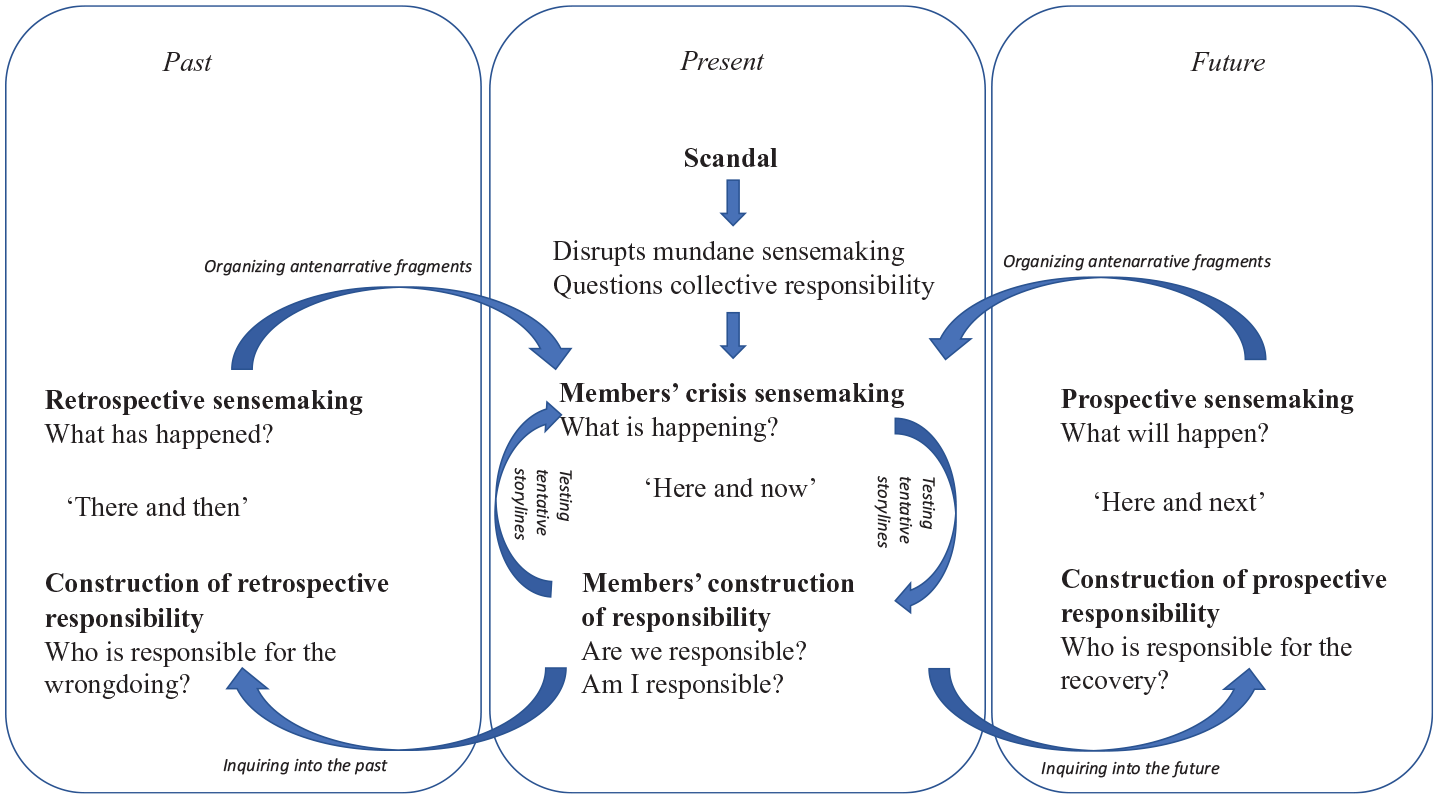
Model of organizational members’ crisis sensemaking and the construction of responsibility during a scandal.
This proposed framework describes crisis sensemaking and the construction of responsibility in response to a corporate scandal that disrupts mundane sensemaking and questions the collective responsibility of an organization and its members. This propels a form of crisis sensemaking toward a threshold where organizational members look both to the past to place responsibility (‘who has done it?’) and to the future (‘who is responsible for an organization’s recovery?’). Members’ construction of responsibility is driven by self-reflective concerns about ‘are we (still) a responsible bank?’ and ‘am I (still) a responsible individual?’. By placing retrospective responsibility in different timespaces, they attempt to avoid being ‘dirtied by association’ with the criminals ‘back then and over there’, construct managerial responsibility ‘up there’ as a mistake, and make guilt a diffuse matter as the wrongdoing may happen elsewhere in the sector ‘out there’.
Thus, the sensemaking of ‘here and now’ is informed by antenarrative fragments that trace ‘what has happened’ and ‘then and there’ in the past and antenarrative fragments of the ‘bet of the future’, namely, the anticipation of ‘what may happen’ ‘here and next’. The tentative storyline of ‘what is happening?’ and ‘who is responsible?’ in the present emerges in the interplay between past and future constructions of responsibility, and these are continuously tested in the present ‘here and now’. The antenarrative fragments are organized and knotted together in relation to their location in time (‘when’) and space (‘where’). Constructions of retrospective responsibility focus on placing responsibility away from the local space of organizational members’ little corner of the organization, while constructions of prospective responsibility for recovery are more ambiguous. One possible storyline is that organizational members are innocent and thus can continue their daily operations as usual. Another is that all organizational members, particularly those working on the frontline, are responsible for the organization’s recovery. Both storylines can coexist during the peak of the scandal; however, such fragmented storytelling may collapse over time into more dominant narratives shared by the organizational members.
In this way, time and space play a significant role in constructing retrospective and prospective responsibility. Hence, members’ tentative storylines narrate different versions of the past and future, while also locating responsibility in different organizational spaces related to organizational divisions and hierarchical levels—or even outside the organization.
Discussion
Based on our study of organizational members’ crisis sensemaking and construction of responsibility during the peak of Danske Bank’s money laundering scandal, we propose a new theoretical perspective, namely, an antenarrative perspective of crisis sensemaking during a crisis (Table 1).
Theoretical perspectives on crisis sensemaking.
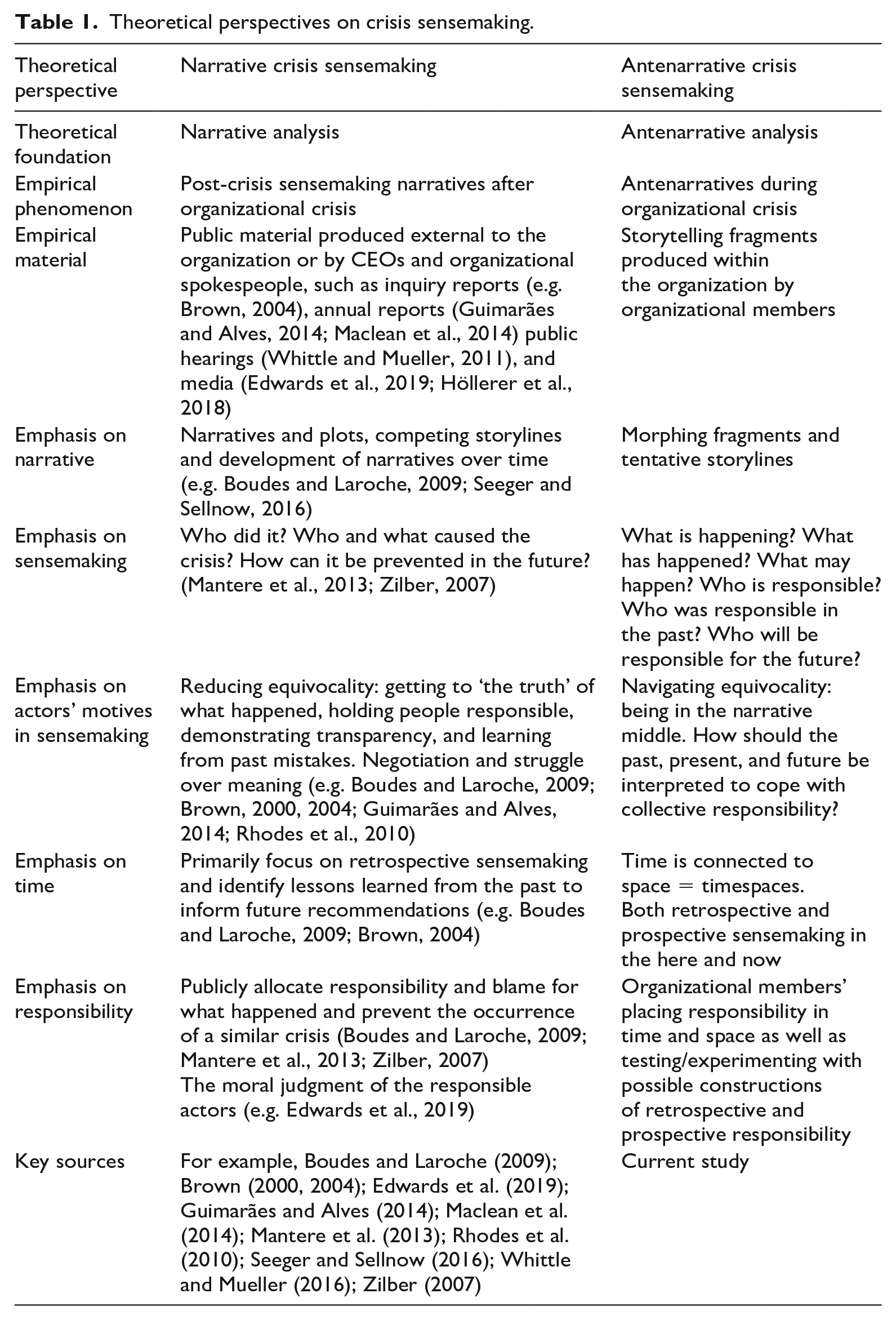
Our antenarrative perspective advances current knowledge on crisis sensemaking and on constructions of responsibility during the peak of a scandal. First, we advance existing knowledge on crisis sensemaking by focusing on the less visible, unfinished, fragmented, and polyphonic sensemaking of organizational members during a corporate scandal. Second, we demonstrate that organizational members at the peak of a scandal place responsibility in different timespaces as they construct others’ and their own responsibility both retrospectively and prospectively.
Antenarrative crisis sensemaking by organizational members during scandals
Research on sensemaking during scandals, crises, and organizational failures has focused on the externally directed, public managerial narratives of CEOs, executives, and spokespeople as they make sense of the situation (Boje et al., 2004; Edwards et al., 2019; Höllerer et al., 2018; Mantere et al., 2013; Rhodes et al., 2010; Whittle and Mueller, 2011, 2016; Whittle et al., 2009; Zilber, 2007). Besides, narrative research on crisis sensemaking has studied how issues of responsibility are negotiated in public inquiries after a crisis (Boudes and Laroche, 2009; Brown, 2000, 2004; Guimarães and Alves, 2014; Landau and Drori, 2008; Seeger and Sellnow, 2016). Narratives are carefully plotted to manage messages of responsibility for the misfortune of the organization or industry. Such narratives become relatively fixed, authoritative, and, over time, well rehearsed, putting forward specific understandings of ‘what is going on here’, ‘why we are in this situation’, and ‘what we are going to do about it’ (Rhodes et al., 2010).
We add to the literature on narrative crisis sensemaking by focusing on the often less visible sensemaking among organizational members (i.e. those not directly involved in wrongdoing) at the peak of a corporate scandal. To examine this form of crisis sensemaking, we propose an antenarrative sensemaking approach inspired by Boje (2001, 2008) and Boje et al. (2004). This perspective focuses on the peak of a scandal when sensemaking is fragmented, tentative, experimental, and contradictory, as organizational members have not yet established finished narratives about what is going on. Hence, they find themselves in the middle of a disruptive scandal, with an open past, present, and future and no definite assignment of responsibility. They are uncertain about ‘what is going on’ and how the scandal will affect their everyday work. The situation can be characterized as ‘ju jade’ (never seen before) instead of ‘dejà vu’ (Weick, 1993; Whittle and Mueller, 2011).
Although based on similar experiences of a corporate scandal, antenarrative sensemaking is characterized by multiple deviating storylines among organizational members, in which the same event is interpreted differently depending on the constructions of the past and future. Paying attention to timespace constructions as the organizing center of sensemaking can highlight the seeking, hesitant, and confused attempts to answer the antenarrative questions of ‘what is going on here?’ when in the middle of it. During crises, organizational members search for meaning using timespace constructions of what happened ‘where and when’ in the past and what may happen ‘where and when’ in the future to understand the present ‘here and now’.
While previous research on narrative sensemaking highlights how CEOs, official spokespersons, media, or public inquiry institutions seek to reduce equivocality and hold people responsible through negotiations and struggles over meaning, the antenarrative perspective adds emphasis on how the equivocality of the narrative middle is navigated by organizational members who seek to cope with outsiders’ critical questions of collective responsibility. Such a moral taint of collective responsibility threatens the identity of both an organization and the individuals working there (Dutton and Dukerich, 1991; Frandsen and Morsing, 2022; Petriglieri, 2011; Petriglieri and Devine, 2016). The antenarrative perspective adds by highlighting the self-reflexive questioning organizational members engage in ‘who are we?’ and ‘who am I?’ as responsible moral selves. Organizational members typically experience a disruption of their collective narrative of ‘who we are’ because of the cosmological breakdown in meaning. Therefore, our analysis shows that the concerns are focused less on ‘who did it’ but more on how to place this scandal in time and space in a way that allows organizational members to protect the collective identity narrative of still being a proper and decent organization despite the scandal and moral wrongdoing.
While we focus on all organizational members and pay little attention to the difference between managers’ and employees’ sensemaking, we do observe that managers are unsurprisingly more inclined to seek narrative closure and establish an authoritative narrative about ‘what is going on?’ and ‘what are we going to do about it?’. During the kick-off meeting, for example, antenarrative sensemaking sometimes collapsed into a narrative, as the managers constructed a ‘collective we’ that must take responsibility for the scandal. Such a ‘collective we’ is common in scandals, as managers distribute blame and responsibility (Whittle and Mueller, 2011) and mobilize all organizational members to take action to help the organization recover—even if they are not directly involved. Our data generated at the peak of the scandal show that the managerial storyline coexisted with other storylines of responsibility; however, we may speculate that by pursuing the same storyline repeatedly, the managers were attempting to reach narrative closure to delineate the moral obligations of organizational members and influence their sensemaking (Rhodes et al., 2010; Svane and Frandsen, 2023).
Future research could use longitudinal empirical data to illustrate which antenarrative fragments can be pieced together and by whom to produce an authoritative version of the story of ‘what happened?’ and ‘what may happen?’, or ‘what will need to happen as a result?’. Additionally, such studies could include the role of power in the dynamic interplay between different, perhaps competing, storylines on crisis sensemaking and responsibility.
Antenarrative sensemaking perspective of responsibility
The literature on narrative crisis sensemaking focuses on identifying the accountable agents and plausible causes of organizational crises, failures, and scandals in the aftermath (Boudes and Laroche, 2009; Brown, 2000, 2004; Edwards et al., 2019; Guimarães and Alves, 2014; Landau and Drori, 2008; Mantere et al., 2013; Rhodes et al., 2010; Seeger and Sellnow, 2016; Whittle and Mueller, 2011, 2016; Whittle et al., 2009; Zilber, 2007). Our antenarrative sensemaking perspective adds to this literature on responsibility during organizational crises, specifically corporate scandals, by examining the many possible constructions of retrospective and prospective responsibility at the peak of a scandal. While the post-crisis sensemaking literature points to the centrality of ‘who is responsible’ (Boudes and Laroche, 2009; Mantere et al., 2013; Zilber, 2007), we propose that responsibility is tied not only to ‘who has done it’ retrospectively but also to the ‘where’ and ‘when’ of the responsibility of past wrongdoing and future recovery. In doing so, we also add to the recent interest in prospective constructions of responsibility (Dwyer et al., 2021).
In the case study of Danske Bank, we observe that organizational members experimented with different constructions of responsibility moved around in time and space: ‘back then’ and ‘now’ and ‘over there’ (Estonian branch), ‘here’ (local little world), ‘up there’ (top management) and ‘down here’ (frontline employees), and ‘out there’ (the sector). Thus, the antenarrative analysis highlights that events must be constructed as occurring ‘here and now’ for agency to be given or taken. We find that the fragmented construction of the organizational space serves to downplay and minimize the disruptive sense of a crisis as members create their own little world free from the responsibility of the scandal.
As part of antenarrative crisis sensemaking at the peak of a scandal, organizational members test different storylines and cast actors in different roles to highlight responsibility for past events and the future potential recovery of an organization. The role and position of the involved actors change and shift in different contextual timespaces. Responsibility is constructed by drawing on the tentative storylines of the ‘past’ and ‘future’ (time) as well as what happens ‘here’ related to ‘us’ and ‘there’ related to ‘them’ (space). These tentative storylines create an emerging timespace construction of ‘who’ is responsible for ‘what’, ‘when’, and ‘where’. Thus, the antenarrative knotting and piecing together constitutes the foundation for constructing retrospective and prospective responsibility.
Subsequently, we find that different ‘whos’ are responsible for different ‘whats’: the criminals were made responsible for the money laundering, ‘the management’ for overlooking the early warning signs and not taking action, and the ‘collective we’ for providing excellent customer service and standing up for the bank in the future. Both the ‘who is responsible’ and the ‘what are they responsible for’ shift according to the timespace of the storytelling, the ‘when’ and ‘where’. In particular, the financial advisors pushed the responsibility for the organizational wrongdoing out of their little world and placed it in another timespace than their ‘here and now’ to maintain and continue a collective identity narrative of still being a decent bank and decent organizational members. By doing so they minimize retrospective responsibility for the wrongdoing yet maintain agency to change to recover from the money laundering scandal.
Our study focuses on organizational members’ sensemaking during the peak of a corporate scandal, namely, before more finalized narratives emplot the events of the wrongdoing. However, links can be drawn between our findings and other studies that have examined blame narratives after a crisis. One key strategy for responding to blame narratives is victimage (Seeger and Sellnow, 2016). For example, Whittle and Mueller’s (2016) study of bankers’ moral storytelling after the global financial crisis finds that they accounted for their role by positioning themselves as victims and by using discursive strategies of ‘externalization’ where actions and events were portrayed as beyond their control. They also point out that the bankers often described the events with reference to natural disasters such as tsunamis, which concurs with our case when the management described the crisis as being in a ‘storm’. We also follow Mantere et al. (2013) by paralleling the ‘Zeitgeist’ strategy under which entrepreneurs of failed businesses place responsibility in time and place by distinguishing between behaviors ‘back then’ and ‘here and now’ as well as draw upon the ‘out there’ strategy of pointing to the sector, thus reducing individual responsibility. The demarcation of ‘back then’ as different from ‘here and now’ is also visible in more recent scandals. For example, CEO Mark Zuckerberg apologized for the Cambridge Analytica scandal by stating ‘I’m sorry we didn’t do more at the time. We’re now taking steps to ensure this doesn’t happen again’ (McKenzie, 2018).
Our antenarrative framework further adds to narrative crisis sensemaking, and especially to the emerging interest in sensemaking of prospective responsibility (Dwyer et al., 2021), by highlighting how constructions of retrospective and prospective responsibility meet in the ‘here’ and ‘now’. To take responsibility for an organization’s future recovery, organizational members position themselves not only as innocent (vis-a-vis the past) but also as helpers (vis-a-vis the future). For example, the blame-free ‘here and now’ constructed by the financial advisors of Danske Bank coexisted with other constructions of ‘here and now’ where responsibility was accepted and apologies were given, as this was seen as necessary for organizational recovery and the re-establishment of trust. The collective ‘we’ were positioned with agency and responsibility, not for the money laundering itself but rather for redeeming the organization’s present and future. As such, antenarrative crisis sensemaking centers on not only retrospective responsibility as the narrative post-crisis perspective but also—and just as important—prospective responsibility for recovering from a crisis.
Future research could address the implication of conflicting tentative storylines for organizing in general, particularly during corporate scandals when polyphonic dialogue inside (and outside) an organization on matters of responsibility is vital. Furthermore, future research could investigate the temporal relationship between retrospective and prospective responsibility as well as the spatial fragmentation of responsibility. Studies are also needed on how different temporal and spatial constructions link the past, present, and future in various ways to encounter, interact, coexist, conflict, and interweave in the antenarrative center of organizing meaning and crafting stories and narratives.
Boundary conditions and transferability of insights
While transferring insights from a single case always warrants caution (Lincoln and Guba, 1985), the case study of Danske Bank can be characterized as both an extreme case (owing to the scandal’s magnitude) and a typical case of crisis sensemaking at the peak of an organizational scandal. Gaining access to an organization in crisis, particularly a public kind such as a corporate scandal is rare, which makes it difficult to compare and contrast our findings with those of other cases. Even so, we highlight three important points.
First, our findings focus on managers and frontline employees working in the bank’s retail divisions; no participant, to the best of our knowledge, was involved in the actual wrongdoing. Future research, if data become available, could focus on crisis sensemaking during a corporate scandal in which wrongdoing is a more integral part of their work practices by, for example, focusing on the engineers of the VW emission scandal or scandals related to mis-selling practices in the financial sector. In such cases, placing responsibility in different timespaces is likely to play out differently than in our case.
Second, our findings are based on observations of loyal and committed managers and employees who strongly identify with the organization. As such, we find that they were inclined to make sense of the scandal in a way that maintained this strong identification and positioned the bank as a ‘decent bank’ and, by implication, themselves as ‘decent individuals’. If the employees were less loyal, they might have been less inclined to ‘stand up’ for the organization and instead considered resisting or even quitting their jobs. Thus, subsequent work could add to our understanding of antenarrative crisis sensemaking by studying employees and managers who disidentify with the organization as a result of the scandal.
Third, we focus less on counter-stories (Frandsen et al., 2016; Svane, 2020) in response to the management sensegiving of the scandal. In our case, senior managers were preoccupied with the external management of the scandal, including dealing with the press, customers, legal authorities, the government, and the general public, whereas internal communication centered on asking frontline employees to re-establish customers’ trust to recover from the scandal. Based on studies by Brown and Humphrey (2003) and Gabriel (2012), we anticipated we would encounter more explicit counter-narratives to the managerial sensegiving; however, we did not. Future research, however, may add to our understanding of crisis sensemaking during scandals by documenting how constructions of responsibility during scandals are entangled with organizational power struggles and counter-stories.
In summary, future work is required to research antenarrative sensemaking during the peak of an organizational crisis such as a corporate scandal to shed more light on the nuances of the antenarrative constructions of responsibility.
Footnotes
Acknowledgements
We would like to thank the participating bank, their management, and the frontline employees who participated in our study. We are grateful for the funding from Handelsbankens forskningsstiftelser (project no. P19-0099) and The Swedish Research Council (project no. 2019-03122). In addition, we would like to thank our editor Jean-Pascal Gond and the anonymous reviewers for engaging with our research in insightful, encouraging, and constructive ways throughout the review process.
Funding
The authors disclosed receipt of the following financial support for the research, authorship, and/or publication of this article: Handelsbankens forskningsstiftelser project no. P19-0099; Vetenskabsrådet project no. 2019-03122.
