



Abstract
How do prevailing economic relations enable non-capitalist forms of alternative organising? Through an ethnographic case study of a free food store, I illustrate how an alternative organisational form emerges through the entanglement of diverse economic practices. By tracing the journey of the surplus food, I argue that the use value of food and labour plays a crucial role in mediating alternative economic, symbolic and political relations. Furthermore, the relationality of diverse economic practices reveals a non-capitalist parasitic alternative organising sustained by/for the community. This study contributes to the literature on alternative organising by introducing use value as a theoretical tool to untangle the intricate relationship between capitalist and non-capitalist economic practices from a critical political economy perspective.
Keywords
Introduction
Against the hegemony of for-profit managerial firms as the study object bounded with commodity-based market relations (Chen and Chen, 2021; Janssens and Zanoni, 2021; Reedy and Learmonth, 2009), there is a growing literature on alternative organisations (Parker et al., 2014b; Schiller-Merkens, 2022). This literature can be categorised into the alterity of values/principles in organising (Parker et al., 2014a), democratic political governance relations (King and Land, 2018) and/or their combination with different forms of ownership and profit-distribution models (Chen and Chen, 2021; Cheney et al., 2014; Kociatkiewicz et al., 2021). While such studies document the diversity of alternative organisations within the cracks and gaps of capitalist relations (Parker et al., 2014b), there are also attempts to position and categorise alternative organisations within the broader social relations (Just et al., 2021; Parker and Parker, 2017; Zanoni, 2020) based on whether they align, oppose or substitute to a market economy (Jonas, 2013). However, we lack a theoretical opening to study alternative organisations in relation to the entangled economic practices. Alternative organisations are not isolated islands within the larger economy as they are inevitably and inherently related to diverse capitalist and non-capitalist practices accommodating contradictions and tensions (Del Fa and Vásquez, 2020; Vidaillet and Bousalham, 2020; Zanoni et al., 2017). To shed light on the relationality of alternative organisations and untangle the complexity of non-capitalist organising within and beyond capitalist relations, this study brings a ‘critical political economy’ perspective with a focus on value relations (Prichard and Mir, 2010).
In this study, value is taken as a relational economic concept that fundamentally differs from signifying the ethical/political terms (e.g. values, beliefs, principles); however, the two are also interrelated. While the value as an economic relationship mediates our exchange and social relations in a given context, our values, beliefs and principles as a set of ethical frameworks guide us within these social relations as subjects (Harvie and Milburn, 2010). Value then becomes the material analytical entry point to unravel the complexity of the alternative organising in which the values play a role in accommodating religious beliefs, constructing identities and meaning making. Therefore, this study brings a refreshing perspective to think differently about value, value relations and organising in a diverse economies setting.
My study is based on a free food store 1 registered as a charity in the Manawatu region, Aotearoa New Zealand. It presents a challenging case to address the relationality of alternative organising since it operates through capitalist and non-capitalist economic practices. The store primarily relies on the surplus food coming out of capitalist production relations, has minimal wage relations and hosts non-market practices such as the use of non-commodified (volunteer) labour, non-monetary exchange relations and creates a community through giving free food. At the same time, like food banks, it is part of a complex and contradictory economic system (Caraher and Furey, 2018). While it rescues food waste and meets the needs of people, it paradoxically relies on and supports the same system that normalises food poverty and band-aid charity solutions (Dey and Humphries, 2015; Watson, 2019: 81). However, community initiatives like the free food store are also capable of ‘socially useful production and doing’ (Chatterton and Pusey, 2020: 41–42) by diverging ‘(intentionally or not) from private accumulation of monetary value, market competition, and the commodification of essentials and life itself’ (Schmid, 2021). Hence, my research question is: how are non-capitalist value relations organised in a non-profit community organisation, and how do they function to sustain the community within and beyond capitalist relations?
I engage with three strands of literature: alternative organisations (Jonas, 2013; Parker et al., 2014a), value relations and organising from a critical political economy perspective (Pitts, 2021; Prichard, 2016) and diverse economies framework (Gibson-Graham, 1996; Gibson-Graham and Dombroski, 2020). While the diverse economies framework helps me highlight the interaction and coexistence of capitalist and non-capitalist practices without prioritising one over the other (Healy, 2009), value relations offer a theoretical intervention. This intervention can help untangle the complex relationality of alternative organising. By following the journey of food methodologically (Appadurai, 1988; Marcus, 1995), I demonstrate how alternative value relations emerge at the free food store within a ‘highly varied and dynamic ecology of economic practice in which elements interact and combine to produce the outcomes we see in the world’ (Peredo and McLean, 2020: 818). My study brings forth the mediation of use value – ‘the usefulness of a thing’ (Marx, 1990: 126) in satisfying needs and wants – constituting alternative economic, symbolic and political relations against the background of contested socio-economic tensions embedded into a diverse economic context (Gibson-Graham, 2006; Mirosa et al., 2016). The findings indicate how capitalist relations enable a non-capitalist parasitic alternative organisational form.
This study makes a theoretical contribution to the alternative organisation literature by introducing ‘value relations’ as a critical political economy framework. It argues that the material basis of organisational relations can be explained through the concept of ‘use value’ and its mediation. Understanding the relationality of alterity within broader social relations makes it possible to uncover the complex web of inter-relationships between capitalist and non-capitalist practices, cultural values and material practices, and food poverty and abundance. By examining the constituted economic, symbolic, and political relations, value relations offer a conceptual language to analytically study and untangle the contested nature of alternative organising within and beyond capitalist relations.
Alternative organisations within and beyond capitalist relations
The literature on alternative organisations sheds light on values/principles (Parker et al., 2014a), democratic practices (Daskalaki et al., 2019; Reedy et al., 2016; Sutherland et al., 2014) and collective/Indigenous/common ownership models (Atzeni, 2012; Cheney et al., 2014; Fournier, 2013; Kociatkiewicz et al., 2021; Mika et al., 2019; Peredo and Chrisman, 2006). While these characteristics contribute to inspirational experiments in organising cultural values, political practices and profit distribution differently, locating ‘alternative-ness’ within and beyond the prevailing capitalist practices is still an ongoing theoretical puzzle (Del Fa and Vásquez, 2020; Parker et al., 2014a; Vidaillet and Bousalham, 2020). Therefore, there is a recent growing interest to theorise alternative organisations through their relationality with key actors in society (Barin Cruz et al., 2017), their transformative potential of dominant institutions (Just et al., 2021; Zanoni, 2020) and their processes and struggles to depart from the status quo of capitalist relations (Dahlman et al., 2022).
Jonas (2013) also argues that our theoretical abstractions about alternatives should be based on a relational conceptualisation and their evolving processes instead of fixing them in opposition to the mainstream/capitalist. Given the diverse, contingent and context-dependent characteristics of alternative organisations, their ‘properties arise relationally out from interactions with other (e.g. mainstream capitalist and state) processes, relations and territories’ (2013: 28–29). Based on this relationality, there are three types of alternative organisations (2013: 33–34).
Alternative additional organisations: they are aligned with capitalist principles that rely on market practices and exchange relations and offer choices alongside mainstream organisations (e.g. credit unions). While they operate within the commodity market relations, these organisations may prioritise alternative principles such as autonomy and responsibility (Parker et al., 2014a), alternative ownership models and profit distribution schemes such as cooperative organising (Cheney et al., 2014). Organisational scholars analyse the tensions between these (progressive) characteristics and the pressures of market relations (Mondon-Navazo et al., 2022; Pansera and Rizzi, 2020).
Oppositional alternative organisations: they lean towards radical practices, seek autonomy from the state and follow non-market practices to challenge the mainstream (e.g. time banks). Social solidarity clinics (Kokkinidis and Checchi, 2023), commons-based organising (Fournier, 2013) and prefigurative community organisations (Schiller-Merkens, 2022) can be counted as some examples from the alternative organising literature. Scholars mainly focus on the transformative potential of (radical) economic practices, the expansion of alternatives to capitalist relations and the emerging organisational challenges.
Alternative substitute organisations: they are considered a last resort and coping mechanism for meeting needs at the local level. At the same time, they may not have a purpose for being an alternative to the dominant (economic) practices. They rely on sharing or gift economies, have cooperative labour relations and host alternative value relations as in the cases of intentional communal organisations (Pitzer et al., 2014) and community kitchens (Willatt, 2018). As explained below, the free food store can also be considered a perfect example of an alternative substitute organisation.
Building on the notion of relationality, I argue for a critical political economy perspective that goes beyond the simplistic dichotomy of capitalist/mainstream versus non-capitalist/alternative (Chen and Chen, 2021). By focusing on ‘exchange relations and questions of value’, this approach focuses on the material economic side of (alternative) organising as a source of explanation, critique and transformation within broader social relations (Prichard and Mir, 2010: 511). Therefore, critical political economy provides a framework to comprehend the interplay between non-capitalist and capitalist economic practices and how these practices shape and structure our organisational relations on a material level. Through a range of examples, scholars have explored how new possibilities for labour, property and social relations emerge in alternative organisations. For instance, Watson’s (2020) analysis of a community-supported agriculture cooperative reveals how such spaces decoupled from the dominant capitalist logic can mitigate the experience of work alienation. Peredo and McLean (2020) highlight the potential of common property-based organisations, such as community land trusts and worker cooperatives, to decommodify land and labour and support livelihoods. Drawing on open-source communities and creative urban scenes, Arvidsson (2009) suggests that positive affective bonds and friendship (philia) can be sources of value that sustain these communities and mediate social relations rather than the dominant market logic and competition.
My analysis follows this tradition of critical political economy that locates organising within broader social relations and tensions. Specifically, I introduce the mediation of use value in the context of an alternative substitute organisation, which provides a theoretical framework for revealing the coexisting and interacting relations between capitalist and non-capitalist practices.
Use value and value relations as a theoretical intervention within the multiplicity of economic practices
In a commodity-based economy dominated by for-profit managerial firms, value is a relation established through the labour we put in to produce a commodity that others will use to satisfy their social needs (Pitts, 2021). This creates an immaterial and invisible relationship often hidden during the production process (Harvey, 2014: 26). Commodities have two forms of value: use value and exchange value. Use value refers to the usefulness of the commodity and how it satisfies our needs. For example, a house can serve multiple functions and have various qualitative values, such as being a shelter or a place of social reproduction. Exchange value, on the other hand, emerges when commodities are exchanged in the market. This is the moment when commodities are validated and given value through each other. For instance, two kilograms of apples are equivalent to two meters of linen, which we exchange for their respective use values. The possibility of such an exchange relies on the condition that both commodities have the same value but in a different form (neither apple nor linen). Regardless of the form of the commodities, they have an exchange value expressed in another form, such as price (Marx, 1990: 127). As a result, exchange value has a quantitative uniformity, represented by money as the universal equivalent to facilitate the exchange of commodities in the market (Pitts, 2021: 40).
The imperative of capital accumulation has led to a commodity-based economy that values everything in terms of its exchange value (i.e. price) in the market, often neglecting other values and value relations that may be essential (Harvey, 2014; Peredo and McLean, 2020). This mediation of exchange value leads to particular capitalist value relations that shape how we produce, consume and live, influencing our understanding of life and our own subjectivities. For example, by selling our labour as a commodity in the labour market, we become part of the production relations and produce surplus value through our labour – the additional economic value beyond the required subsistence to reproduce labour that the owners of the means of production appropriate. Our subjectivity as labourers, consumers and/or stakeholders is defined in relation to our participation in economic practices driven by capital accumulation.
However, the economy cannot be reduced to capitalist practices alone, which Gibson-Graham (2006) calls ‘capital-o-centricism’. This discourse relegates non-capitalist economic processes to the margins, obscuring their importance and potential to offer alternative ways of organising economic life. To move beyond this framework, Gibson-Graham (2020) advocates for ‘reading for difference’, which reveals the coexistence of a multitude of economic practices and the complex interrelationships between capitalist and non-capitalist practices (Peredo and McLean, 2020). Non-capitalist practices, such as household relations, child-raising, non-commodified labour, cooperative organising and gift-giving, already exist alongside capitalist practices to meet the diverse needs of communities. These practices sustain life by attending to material, social, cultural, spiritual and emotional needs (McKinnon, 2020: 116). However, this coexistence is not without tensions and contradictions. For example, domestic labour, a non-capitalist practice, is often intertwined with capitalist practices and can contribute to capitalist accumulation. As a result, the line between capitalist and non-capitalist relations is not clear-cut, and their interactions are entangled.
The entanglement of economic practices also includes multiple non-capitalist economic formations that prioritise use value and mediate social relations, such as barter, gift-giving and donations (Humphrey and Hugh-Jones, 1992; Rehn, 2014). These formations facilitate alternative value and exchange relations, giving rise to different rules, practices, relations, meanings and subjectivities (Arvidsson, 2009; Prichard, 2016). For example, in the case of gift-giving, the gift-giver may not seem to gain anything materially, but there are associated economic, symbolic and political relations that maintain reciprocity and harmony within the mutual relationship (Graeber, 2001; Mauss, 1990). These relations can also have broader social implications and contribute to the well-being of society as a whole. In this case, an alternative motive, giving, is emphasised as a source of wealth (Malinowski, 2002) that serves social functions such as demonstrating prestige, status or power in an alternative social and economic setting (Appadurai, 1988).
Within the entanglement of economic practices, diverse labour and exchange relations can be harnessed to meet community needs. For example, volunteering can be a non-commodified form of labour that is compensated in various ways, including cash exchanges, material goods, meals, appreciation, pride or a sense of self-worth (McKinnon, 2020: 121). Engaging with diverse economic practices using our labour can result in the emergence and transformation of various economic subject positions, such as waged workers, unpaid family caregivers and volunteers, which have the potential to empower communities to (re)configure social and political relations (Gibson-Graham, 2006; Healy et al., 2020). Thus, with an alternative set of assumptions and economic practices (Gibson-Graham, 1996), use value has a performative impact, creating different meanings and value relations for those involved (Marcus, 1995).
The relations mediated by use value signify diverse meanings for different individuals and can be categorised accordingly. They may take the form of economic relations, involving the material gain, exchange and/or redistribution of resources; symbolic relations, which relate to cultural, moral and/or normative positions, such as values, principles and assumptions; or political relations, which pertain to power dynamics and the (in)capacity of actors (Appadurai, 1988; Levy et al., 2016). Examining these value relations makes the entanglement of capitalist and non-capitalist economic practices visible.
The free food store as an alternative substitute organisation is an interesting case for analysing the relationality of alternative organisations through value relations. Therefore, it becomes possible to uncover what makes the free food store and what kind of (alternative) relations, practices and meanings emerge while still being dependent on and located amid capitalist relations. Then, how are non-capitalist value relations organised in a non-profit community organisation, and how do they function to sustain the community within and beyond capitalist relations?
Method
The free food store: An alternative substitute organisation
The free food store has operated at the heart of the North Island of Aotearoa New Zealand since 2011. It seems like a striking contradiction that people have food access issues in a country (Johnson, 2018) that ‘is a major food and beverage exporter, with the industry accounting for 46% of all goods and services exports’ (MBIE, 2022). A survey in Aotearoa New Zealand showed that 17.2% of families could not buy food (Collins, 2014), whereas over 224,000 tonnes and 103,000 tonnes of food waste were generated by households and industry, respectively (Reynolds et al., 2016).
The vision of the free food store is ‘to be a community that won’t let anyone go hungry’, which problematises food poverty, while its mission is to ‘rescue surplus food and help those in need’, which implies a social missionary role. The Director (also founder) is in charge of communicating with stakeholders, acting as a spokesperson, finding further funding for the operation, networking and, more importantly, providing moral and ideological leadership. She is a member of and accountable to the charity board. The presence of the board is hardly felt since the volunteers primarily interact with the Store Manager, and the Director may be out doing her own work. The Store Manager is in charge of arranging the workload, weekly schedules for the volunteers and daily operation of the store. He opens and closes the store and is the contact person during the day for occasional food donations or food delivery to other community organisations. The Director and Manager are paid part-time, making their contribution to the organisation 50% unpaid. Volunteers, who provide free labour, have a diverse profile, including Pākehā (New Zealanders of European descent), Māori, international residents, disabled, students, academics, retired, unemployed and community workers. Some volunteers used to be customers and vice versa. Currently, the free food store hosts around 100 volunteers and is visited by approximately 250 people daily.
Various groups in the community have praised the free food store. For instance, with the support of the city council, it had access to a new building, and the cost of fitting it out, around NZ$100,000, was covered by donations and support from numerous businesses and community members (news article). Local political figures visit the free food store and promote volunteering to the community (news article). Additionally, the free food aims to create awareness about food waste in the community through activities such as documentary screening and cooking with rescued food.
Many businesses, including local cafes, donate surplus food to the free food store, but the bulk comes from local branches of national retailers and distributors. Either they donate food daily owing to expiry date conditions or occasionally based on non-marketable but edible food products owing to mislabelling or quality issues. The food is usually collected by the free food store van and in volunteers’ cars, or bulk donations may be made by the business trucks (when kilograms of yoghurt or dips become surplus). Fresh vegetables and fruits may be available from community gardens or donated by individuals occasionally.
The rescued food has no market exchange value and begins its journey in the store only with its use value. After arrival, food belongs to the free food store to be given with unconditional love. These terms (i.e. unconditional giving, unconditional love) can be seen on stickers at the free food store and in its organisational documents, representing the spirituality linked with the Director. The donated food needs to be packaged or divided into small amounts by the volunteers so that more people can get more variety of food. Small loaves of bread are bundled, muffin packs are opened to be served individually, and tea bags are grouped. This process also involves blackening the barcodes of packaged foods to prevent returns or resale. While the Manager coordinates the operational side of the store, as a part of maintenance, some volunteers pick up food, some organise it and others clean the free food store and get things sorted for the evening shift, during which another group of volunteers assist customers. After waiting in the queue outside the store, customers can choose and pick the food they want once they enter the store. At the end of the day, after the amount of food items is recorded for each customer, the exchange process ends, and the food belongs to a diverse group of customers, including families, young couples, students, homeless people and the elderly, to be taken back home (if they have one). If there is still bread and some other food to be distributed, other local organisations are involved in picking up the leftover food from the free food store.
Data collection
My research is designed as an ethnographic case study at the organisational level (Thomas, 2015) to engage deeply with the organisational practices, meanings and context at the free food store. I volunteered for eight months to be part of the daily routines and practices structured around food surplus so that I could make sense of what it means to organise a free store amid capitalist relations. Since ‘much of the intriguing “mystery” of organisational life is hidden in the ordinary exchanges of ordinary people on an ordinary sort of day’ (Ybema et al., 2009: 1), I engaged with this ordinary-ness of daily practices and focused on unravelling value relations. I worked one day per week for two shifts (between 11 a.m. and 6 p.m.), picking up food from retailers or community gardens, arranging shelves and aisles, packaging foods and cleaning, as well as attending special days such as volunteer nights, movie screenings and the birthday of the free food store. As a part of my volunteer role, when the store was open for the customers, with a rotation, I welcomed the customers at the door, helped them get cold or warm food, and recorded the food items for simple accounting purposes before they exited the store on different days. Overall, this equalled approximately 190 hours of participant observation in the field.
To reveal non-capitalist value relations in the free food store, I followed the journey of the food from its donation/gathering to the store’s exit; this approach also provided me to set boundaries for the level of analysis (Thomas, 2015: 21). While the global food system focuses on short-term profits over the qualitative characteristics and use value of food (Elmes, 2018: 1054–1055), it is critical to keep in mind the central role food plays as part of subsistence for the communities, which helps better address the role of use value in mediating relations, compared with other modes of exchange. Hence, food not only plays an essential role in creating meanings and social formations but also becomes a critical entry point for analysing and understanding the organised world driven by capitalist relations (Pina e Cunha et al., 2008). Therefore, as argued by Marcus (1995), following food as a thing analytically and methodologically through an ethnographic approach helped me construct the links between the use value of food and labouring practices interwoven around the surplus food (see Figure 1). In other words, by following the surplus food, I traced how use value acts as a mediator between actors, practices and meanings against the backdrop of a non-capitalist organisational setting.
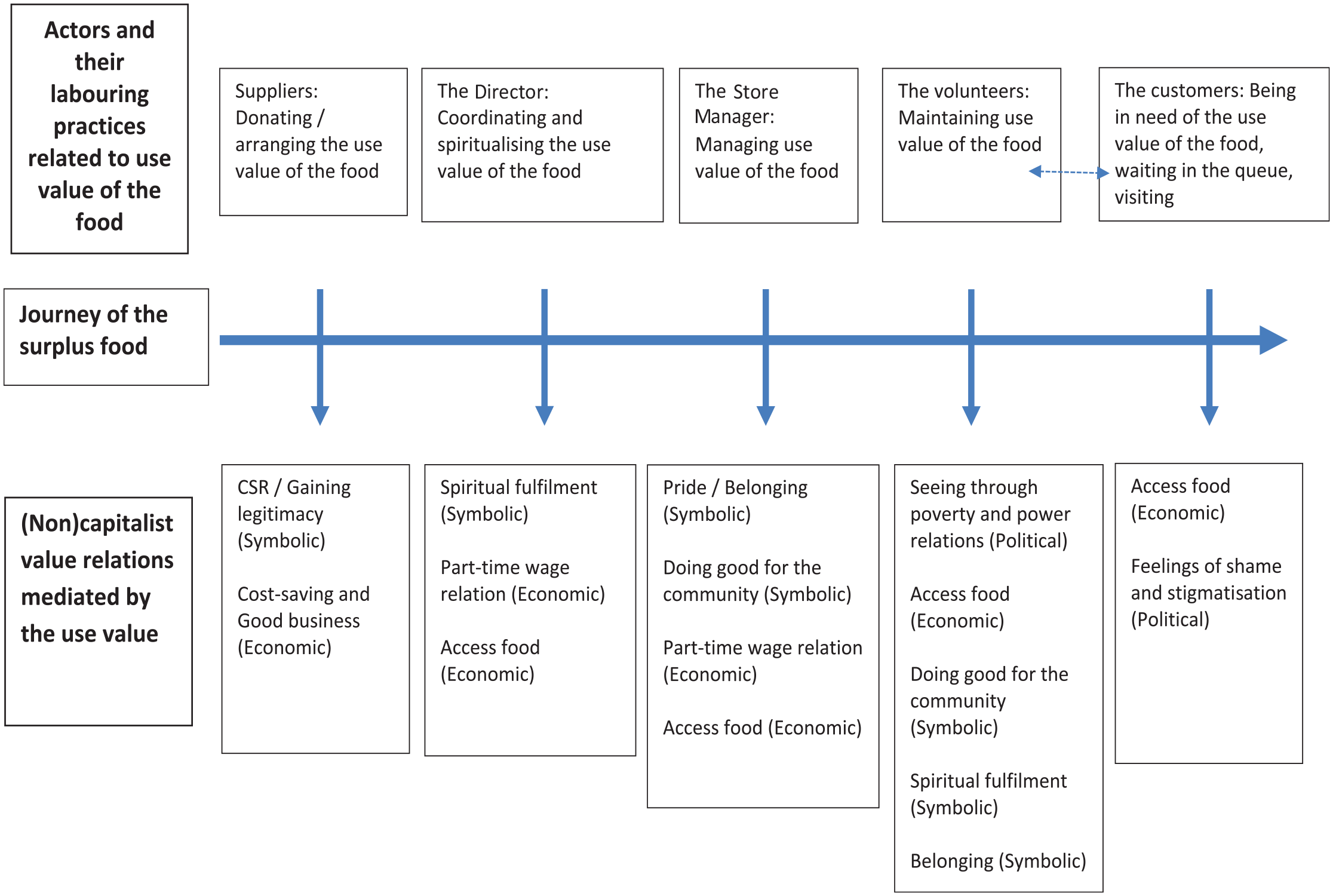
(Non-)capitalist value relations through the journey of the surplus food at the free food store.
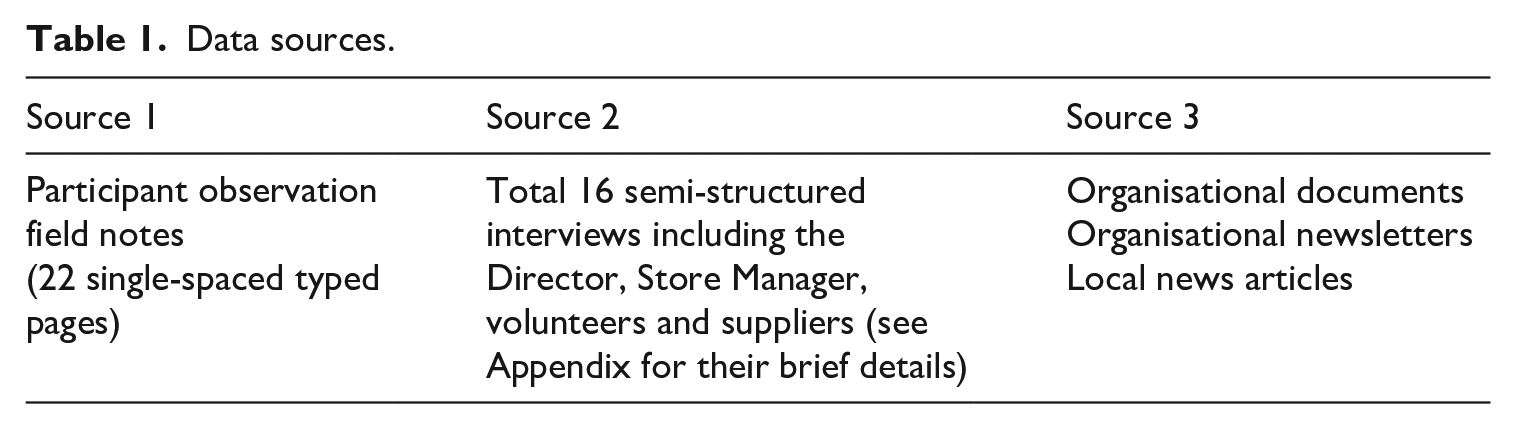
I rely on three different sources of data – field notes, interviews and secondary material such as organisational documents and news articles (see Table 1). I kept a diary of my daily observations (during work breaks and evenings) as well as from attending several formal and informal gatherings. My second data source is interviews with 10 volunteers from different age groups and experience levels at the free food store. Notably, some volunteers were also customers who provided views from different sides. 2 During the interviews, I asked questions to understand how the volunteers make sense of the free food store, their daily practices, their perception of food surplus and social relations at the free food store, and their motivation for becoming a volunteer. I also had the opportunity to interview the Director, the Store Manager of the free food store and three leading retailers who donate food regularly to the free food store. My final data source is secondary materials about the free food store, such as organisational documents, newsletters and published news articles in local newspapers to see how it communicates to its stakeholders and relates to its own community. 3
Data sources.
Data analysis
Following Timmermans and Tavory (2012: 180), I benefited from abductive reasoning. I maintained a dialogue between my empirical findings and the available theoretical frameworks to explain social phenomena so that I could develop my own theoretical repertoire. The more I engaged with the free food store and gathered data, the more possibilities emerged to explain the social complexity around the free food store. Given the continuous questioning about the reason of the existence of the free food store as a puzzling setting (i.e. non-capitalist, non-monetised, non-commodified organisational space amid capitalist dynamics), I focused on ‘reading for difference’ (Gibson-Graham, 2020) and the mediation of use value emerged as a key aspect to engage with the empirical context.
The significance of use value in my analysis was pivotal, as the empirical reality observed within organisational practices and discussions at the free food store revolved not around food prices, monetary transactions, profit calculations, accumulation or competition. These terms are associated with exchange value, which facilitates the exchange of commodities. In contrast, the organisation’s focus rested on surplus food, fulfilling needs, aiding the community and ‘doing good’. These aspects are related to the non-commodified facets of exchange relationships and ‘socially useful practices’ (Eskelinen, 2020). This material and discursive alterity manifested empirically through day-to-day practices and narratives prompted me to think about the alternative economic relationships that made such organising feasible. Consequently, use value emerged as the theoretical and analytical basis, serving as the focal point for empirically making sense of the free food store.
Through iterative reading and re-reading of my field notes along with the interview transcripts, first, I took the primacy of the empirical world (Van Maanen et al., 2007: 1149) inductively and constructed the economic and social formation of the free food store interwoven around the use value of surplus food and labour. This helped me identify and code non-commodified labouring practices, other economic practices at the free food store and which (market) actors they are related to. Based on Gibson-Graham’s diverse economic categories (Gibson-Graham and Dombroski, 2020), my emphasis was on the non-commodified relations in a non-profit community enterprise, compared with wage vis-a-vis labour (i.e. limited wage relations and volunteering), monetary transaction vis-a-vis food (i.e. giving free) and rent vis-a-vis store (i.e. local council donation). Then, based on the constant interplay between theory and data, I sketched the emerging relations deductively into economic, symbolic and political relations (Appadurai, 1988; Levy et al., 2016). Findings indicate the ways to untangle the complex relationality of non-capitalist and capitalist practices that render the operation of the free food store possible and sustainable. Given the ethnographic nature of my study, I follow Cunliffe (2003: 992), arguing ‘research is a narrative construction with its own discursive rules and conventions, and is open to scrutiny and different interpretations by readers’.
Economic relations at the intersection of capitalist and non-capitalist practices
Given the scale of the food surplus, the amount the free food store rescues is tiny. One of the main distributors donating bread explains that it is common for the bread industry to have a 7% surplus. Considering the product range of the food retailers, even a 2% surplus/waste would mean a significant cost for them. Some businesses need to pay to eliminate food waste, but they do not approach donating surplus food simply in economic terms. Therefore, donating food to the free food store seems like a win–win solution for businesses to eliminate food products that have lost their market value. Social responsibility and a business perspective align well in this relationship with the risk of using charity and unpaid labour for corporate welfare (Poppendieck, 1998; Tarasuk and Eakin, 2005).
So you mention two points – helping the community and saving money. If you could prioritise, what would be the main motivation? Cost aspect? Responsibility aspect?
Absolutely, it is a 50:50. We want to help the community, and we are much more active now as the company is trying to do far more in the community than we ever did before. But definitely, it’s good business sense, and it’s good being a responsible corporate citizen. (Supplier 3A – Store Manager of a national retail company)
– So yes we save some costs and other costs are incurred from this programme [referring to the national food donation programme]. For us, it’s about doing the right thing and we’re also sending it to people who can eat it instead of going to the landfill. So it’s better for the environment and our CO2 emissions levels are basically capped at where they were in 2006 and part of that is because we are not sending stuff to landfills to decompose. (Supplier 3B – Head of Corporate Affairs of a national retail company)
For others, donations are more about doing good for the community with no expectations of financial return as they are paid if they sell the surplus bread to farmers as stock feed. In this case, the surplus food still has an economic exchange value (i.e. another form of surplus value) generated by the global/local food system that could still be used for capital accumulation if sold as stock feed (O’Brien, 2012). Yet, it departs from the usual market circulation and becomes a use value. Hence, the free food store becomes a converter of the surplus value 4 (excess food production) into use value for the community. This is well put by the Director, as they are ‘very much operating . . . now within the [economic] system, . . . sucking the surplus from the system’, which brings to mind a parasitic but mutually beneficial relationship as the dominant capitalist practices continuously feed into non-capitalist practices in this specific case with a return in different forms. Therefore, there is a grey area where capitalist and non-capitalist practices coexist and facilitate the function of the free food store: capitalist practices inevitably produce surplus food, creating a non-capitalist symbolic value (see below) for businesses, which is used as a strategic legitimacy-gaining tool and that can potentially turn into monetary value. Although it may not be the primary aim of some companies, it is important to note the indirect economic value of cost-saving and good business practices as aspects of economic relations. The part-time wage relations of the Director and the Manager also enable their unpaid part-time non-capitalist labour (i.e. volunteer) and the administration of other non-capitalist practices. Volunteers provide free labour, but their other sources of income and wage relationships should still be considered part of the complex interplay between capitalist and non-capitalist relations.
The availability of surplus food as a contribution to the household budget is essential in attracting various groups of people to the free food store. For instance, one of the volunteers emphasised how it could be challenging to feed large families (volunteer 1), while another noted the essential and continuous need for food (volunteer 2). Therefore, customers and other organisational members (such as the Director, Manager and volunteers) all benefit from the economic convenience of the food. For some, it is also a good deal to exchange non-commodified labour for food, such as during ‘grab time’ 5 or when they feel comfortable coming as a customer. Therefore, use value mediates the day-to-day economic practices interwoven around food and labour, leading to the emergence of capitalist (cost-saving, good business image) and non-capitalist (convenience of accessing food without official criteria and meeting needs) economic relations at the same time.
Symbolic relations at the intersection of cultural values and material practices
Field notes (27 January 2015) It felt quite strange to tick the box in the volunteering form informing me that the free food store is a Christian organisation. I wonder to what extent I will be exposed to religious discourses (first day, induction). Field notes (5 February 2015) The Christianity of the organisation is not visible but easily felt. I can say it is in the air. Some volunteers know each other from church communities, but some do not seem religious at all. Nevertheless, we all join in the evening prayer led by the Director to thank God for the food to give free and for volunteers for their efforts (end of the first week).
Faith and religious ethics of care play a critical role in this complex set of relations. For some organisational members, including the Director, Manager and a few volunteers (volunteers 6 and 7), the use value of food and labour turns into a symbolic resource that satisfies spiritual fulfilment. In response to the ongoing grim economic conditions leading to food poverty, religion is mobilised to be the ‘heart of the heartless world, and the soul of the soulless conditions’ (Marx, 1844: para. 4) with a moral intervention. This symbolic non-capitalist value becomes visible through the discourse of unconditional love and unconditional giving to offer a dignified experience for the customers compared with food banks.
[before the free food store] You mentioned you were knocking on doors, and you knew the people that were kind of in need of this bread?
Well no [laughs] for me it was a bit of a faith thing. I would pray and ask God where to send me and I would literally drive or he would say go [to] this area and I would see a house maybe or that looked like maybe it didn’t have curtains or maybe I saw some kids . . . and so I would just stop or in impression, in my spirit where I should just stop.
. . . The food is free for all – giving unconditionally and loving unconditionally. We’re wanting to make it available to anyone and part of that is based on what I didn’t know when I started was that growing up, my dad was self-employed. And there were times that bills were not paid and that created hardship in the family and that meant that there was not money for food and other things. We have a Christian ethos which are the driving values but I would not describe it as a Christian organisation. We are not trying to convert, we exist to love, feed and to help.
The Store Manager’s motivation is similar to the Director’s, as he is also religious. Working at the free food store helped him get back on track after being unemployed for some years. Nevertheless, managing the use value of the food represents another form of non-capitalist symbolic value for him: doing good for the community and being compensated with pride.
What makes you feel proud of it?
I think it’s what we do, it’s very unique – we’re not a food bank. It’s a hip thing to put waste food to better use. We give it away for free without asking many questions.
. . . It’s community helping community, the people who volunteer are people who are in the line themselves, if they are not working.
For many volunteers, surplus food with its use values carries a different non-religious meaning based on creating an opportunity to do something good for the community by offering their non-commodified labour to maintain the free food store. They primarily associate themselves with the organisation’s mission and acknowledge how it is non-judgemental, altruistic (volunteer 5) and open to everyone, referring to the lack of means-testing to access food (volunteer 2).
Overall, use value, as a material construct based on labour and food, mediates the variety of individual cultural beliefs and motivations into non-capitalist symbolic relations, practices and meanings that are shared and lead to the fulfilment of the organisational members – spirituality, pride, doing good/caring for the community and belonging. In other words, cultural assumptions and values as a set of moral guidelines help organisational members find meaning through their interaction with the material practice of giving food in response to socio-economic challenges (Harvie and Milburn, 2010). It should also be noted that businesses have a stake in these symbolic relations since they can socially valorise their claims about being ethical and sustainable to gain legitimacy for their capitalist economic activities.
Political relations at the intersection of food abundance and poverty
Non-capitalist relations in the store are not free from their own politics and power relations, which become visible through the mediation of food with its use value against the backdrop of tension between structural poverty and access to food. For instance, some volunteers were explicitly critical of the limits of charity-like structures in the fair redistribution of resources (volunteer 10) and the risks of creating dependency relations (volunteer 7).
Many volunteers I interviewed know they are in a privileged position and mostly avoid getting food from the store (in particular, during the grab time, which was also a challenge for me).
6
Yet, for some volunteers, who are also customers on other days, it is a common practice to get some food after their morning shifts (before the store officially opens). However, a class-based difference among the volunteers (and customers) is felt beneath the cooperative labour relations to maintain the free food store. Volunteers are aware of the diverse and mostly disadvantaged profile of the customers as indicated by one of them: The majority have mental health issues; many of them spend their days at XXX [social centre]. Some people that come in, for example, several ladies that look very well dressed, and I’d not be that surprised if they come from work . . . We also have a family that comes in with four kids, and she’s due any day again, and I remember him saying to the Director that they couldn’t come in a previous day due to no petrol or something. And they come in pretty much every day, and I think he doesn’t work, but then we have 2–3 people that come in who don’t quite need to, and then the rest of the guys are older males that live on their own and come in for tea really. A lot of young lads but not really a lot of young females. A lot of them aren’t necessarily quite poor. (Volunteer 8)
Customers also have their share of the non-capitalist value relations in political forms by visiting the store. They meet their needs without any official query (i.e. means-testing); however, there is an implicit stigma around being visible in the queue outside the store. There are certain practices related to the queue involving the customers, the founder and the volunteers as observed below.
Field notes (19 February 2015) It is 4.30 p.m., right after the grab time. The customers are already in the queue and looking forward to getting in. For this night, I am responsible for welcoming them to the store. I need to check how many customers are inside and manage the inflow–outflow balance. Families have priority. Generally, people are polite, but acting like a ‘gatekeeper’ for the food feels uncomfortable. The Director gets out and informs people in the queue, ‘we have both hot and cold food today, folks’. This is the code for the availability of fresh perishable daily food – sandwiches, pies, hot dogs, fish and chips, simply leftovers of the cafes around on that specific day. Not so fortunate every day, though – sometimes only a bunch of sandwiches. Today is a good one; otherwise, customers must choose from one group. This is another task for the volunteer standing next to the fridge and asking ‘hot or cold?’ If ‘hot’, the customer is directed to another corner where pies are kept in a kind of heater; if ‘cold’, the volunteer lets the customer choose from the available sandwiches in the fridge. I should check if the line at the counter is too long; if not, let some others come in. Holding the coin donation box is a part of this ritual, not obligatory for the customers, but perhaps donating a couple of coins may create confidence to get into the store. I smile at them and try not to be judgemental. It is already difficult for some of them to get into the queue or become visible for ‘free food’. I heard this from others many times, and I can also sense that during my interaction with the customers.
This aspect is one of the major issues discussed at the store, and during my fieldwork, there was no attempt to deal with it. The Director, the Manager and the volunteers, who are occasional customers, are aware of this problem and take it as an uncomfortable but inevitable part of the daily routine.
Similar to the experiences at the food banks (Caplan, 2017; Caraher and Furey, 2018; Escajedo San-Epifanio et al., 2017), those who are outside of the ‘usual’ commodity exchange relations could feel shame and be stigmatised by society (Garthwaite, 2016). Despite being open and free to all as a case of potential economic empowerment and dignified solution for the communities, gaining (food) without giving (money) creates an imbalanced power relation between the free food store and the customers as it leads to the perception of being ‘needy’.
I also noted a tension in approaching the customers by the volunteers that is a derivative of seeing the world through the commodities. It results from an implicit ranking of the customers based on their impressions, belongings and potential needs. For some volunteers, while there are families with many children, those customers with ‘fancy cars’ should not come to the store for food (informal conversation). However, the primary motivation for saving food and the criteria of ‘unconditional giving and love’ weigh in; hence, no one is refused.
Nevertheless, the customers may still be exposed to micro-level disciplinary power relations operating at the free food store. They are asked to be considerate of the amount of food they get as there are many reminders not to take more than needed; if there is any breach, it is common practice for the Manager or the Director to warn the customers to leave some of the excess food they picked. In one of the cases, one customer was warned since he had many loaves of bread individually and did not mention anything related to family members. In some other cases, family members, being at home or sick can be used as a valid excuse to get more food items, and it is not easy to keep a record of who does this often or not. Hence, the store encourages customers to show up to access the convenience of free food, while the Director or Store Manager is entitled to warn customers based on their discretion. I have never seen it, but I asked what happens if someone annoys the volunteers or other customers. The Manager told me that if someone had consistently disruptive behaviour over multiple days, it was common practice to ask them to leave the store and explained how the Director handled such a case once.
While on one side of the relationship, there is unconditional love and giving at the expense of surveillance, on the other, there is unchallenged poverty and individualised shame. Hence, the community initiative may simultaneously come with the paradox of emancipation and oppression (Tedmanson et al., 2015). These political relations, mediated by use value, shed light on the dark side of alternative value relations (Watson and Ekici, 2020) and make (food) poverty amid abundance much more tangible and visible.
Discussion: A non-capitalist parasitic alternative organising within and beyond capitalist relations
My analysis indicates three major discussion points that shed light on the contribution of this study.
1. The intricate, entangled and contradictory nature of diverse economic practices and conceptualisation of alternative organisations within and beyond capitalist relations.
The findings highlight the relationality and interdependency of the free food store within and beyond capitalist relations, surpassing a simplistic binary view of capitalist/non-capitalist distinctions (Chen and Chen, 2021). Therefore, through the analysis of value relations as a theoretical opening, the study demonstrates the intricate nature of diverse economic practices enabling the emergence of alternative organising and offers a nuanced conceptualisation of alternative-ness (Parker et al., 2014a). In particular, I argue that ‘reading for difference’ (Gibson-Graham, 2020) through use value reveals the entanglement of capitalist and non-capitalist practices and the complex relationality of the free food store. The excesses of capitalist food production, involvement of market actors with multiple interests, use of volunteer labour thanks to financial security, limited wage relations to coordinate/manage the store, donation of food and other resources, and non-commodified exchange relations coexist and are interrelated in this organisational case. This entanglement of diversity is also reflected in the way community members think and act, as in the case of non-capitalist ‘unconditional giving and loving’ accompanied by the assessment of people based on the commodities they have.
2. The mediation of use value and the constitution of economic, symbolic and political relations in an alternative organisation.
The use value of surplus food and labour assumes a performative and generative function in mediating the relations between the organisational members, their economic practices, assumptions, meaning making and subjectivities. This comprehension enables an analytical approach to untangle the economic practices and diverse relations sustaining the free food store.
Thus, the intersection of economic practices and diverse relations becomes visible and begins with the donation of surplus food and the exchange of non-commodified labouring practices in different forms (i.e. spiritualising, managing and maintaining the use value of food). While the community members have convenient access to free food to meet their needs without any money transaction, businesses not only act responsibly but also valorise such practices in capitalist terms (cost-saving and good business). These material practices also lead to multiple symbolic (non-)capitalist relations that show how community members make sense of their involvement at the free food store. While some have spiritual fulfilment owing to their religious beliefs, some enjoy belonging and doing good for the community with pride. While the free food store is sustained for/by the community with a different set of assumptions and diverse economic practices, it continuously reproduces power relations disciplining the labour of customers – queuing, being visible and associated with stigma. As a derivative of the dominant market relations leading to (food) poverty amid abundance, the free food store facilitates an (in)capacity to act within the defined organisational norms. While it is free to choose within the availabilities of food, customers always need to consider others.
3. Capitalist economic practices enabling non-capitalist parasitic alternative organising.
The findings reveal a relationality between the coexisting capitalist and non-capitalist practices. In the case of the free food store, capitalist practices enable non-capitalist alternative organising. This is an interesting finding considering the literature on alternative organisations positioned as initiatives to act against the capitalist establishment with their differences (Del Fa and Vásquez, 2020; Schiller-Merkens, 2022). As this study illustrates, without capitalist relations, the non-capitalist alternative nature of the free food store would not be possible. This can be explained owing to the alternative substitute nature of the free food store. It neither fully aligns with commodity-based market relations nor contests them, and that also makes it an interesting organisational case. As a result of its business model, likened to food banks, the free food store is part of a complex and contradictory economic ecology (Peredo and McLean, 2020). While it serves communities to empower them through redistributing surplus food, it heavily relies on the larger economic system driven by exchange value and producing excesses, susceptible to inequalities and food poverty simultaneously (Caplan, 2017; Watson, 2019). Yet, interestingly, owing to non-commodified wage, labour and enterprise relations (Gibson-Graham, 2020), acting like a non-capitalist parasite creates something good out of it – a self-governed ‘doing’ for and by the community independent of the alienating logic of capital (Chatterton and Pusey, 2020; Watson, 2020).
In other words, the growing surplus value of an economic activity driven by exchange value that is not consumed through capitalist market relations, combined with the labour of community members, facilitates another economic activity mediated by use value. As a result, capitalist relations enable alternative organising sustained by/for the community through a dependent, non-capitalist parasitic relationship with the larger economic system. While the exploitation of non-capitalist relations (e.g. domestic labour, care work) for capital accumulation is critically analysed (Fraser and Jaeggi, 2018; Hardt and Negri, 2017), the free food store presents a different dependency relation and coexistent economic relations.
Conclusion
Despite the burgeoning literature on alternative organising, the notion of alternative-ness and its conceptualisation in relation to broader social relations are still ambiguous (Parker et al., 2014a). No inherently good or bad alternative organising structures exist that help us form ultimate judgements (Parker and Parker, 2017). Hence, we need a theoretical opening to understand alternative organisations’ complex and interdependent relationships within and beyond capitalist relations (Barin Cruz et al., 2017; Del Fa and Vásquez, 2020; Jonas, 2013).
Value relations offer a relational perspective and a nuanced conceptualisation of alternative organisations to fill this gap. As the study shows, the entanglement of capitalist and non-capitalist economic practices enables a multiplicity of alternative organisational configurations and pockets of possibilities in which communities can create spaces relatively independent of the logic of capital and capital-o-centric assumptions (Zanoni et al., 2017).
Despite organisational dependencies and limitations amid capitalist relations, we see a miniature of a non-capitalist economic world with its own power relations, organised around use value and socially useful practices (Eskelinen, 2020), which is different from the commodified set of relations seeking ceaseless capital accumulation (Harvey, 2010). All this diversity of non-capitalist practices and value relations occurs owing to the enabling of capitalist relations and excesses of surplus, ultimately facilitating an alternative substitute organisation. By rendering such relations visible, the case of the free food store invites organisation scholars to think beyond commodity-based economies and for-profit managerial firms and take into account the contradictory and entangled economic relations that can host alternative organisations in different forms.
The critical political economy framework (Prichard and Mir, 2010) helps us theorise alternative (substitute) organisations by acknowledging their material relations and embeddedness into broader contested and contradictory social relations. Taking use value as an entry point presents multiple theoretical openings and questions to explain the alterity of practices, power relations, subjectivities and meanings, and their complex and intertwined relations with other dominant and alternative economic practices.
Therefore, as a theoretical contribution, the study extends the alternative organising literature by introducing use value to analyse the relationality of alternative organisations. It provides a language to conceptualise alternative organising within and beyond capitalist relations and makes multiple configurations of coexistence apparent. By analysing the mediation of use value, the economic, symbolic and political relations become visible against the backdrop of a complex web of interrelationships. In the case of the free food store, this complex coexistence between capitalist and non-capitalist relations materialises as a parasitic relationship that the community members sustain. Furthermore, value relations, as a critical political economy framework, critique how power relations are organised structurally around value and exchange relations. Therefore, by untangling the intricate relationship between capitalist and non-capitalist economic practices, this framework provides a holistic understanding of a community organisation as an alternative substitute, presenting not only the ‘good’ side of non-capitalist performativity of value relations but also the dark side of such complex relations.
As a limitation, the study presents an ethnographic case of a small-scale alternative substitute organisation and invites more studies to critique and develop the repertoire of use value in other alternative organisational settings. Future studies on value relations and alternative organising may focus on new theoretical and empirical questions regarding the performative role of use value at the micro, meso and macro levels, the role of alternative organisations in transforming or reproducing capitalist social relations (see Zanoni, 2020) and subsumption of non-capitalist alternative relations by capital (see Hardt and Negri, 2017).
Footnotes
Appendix
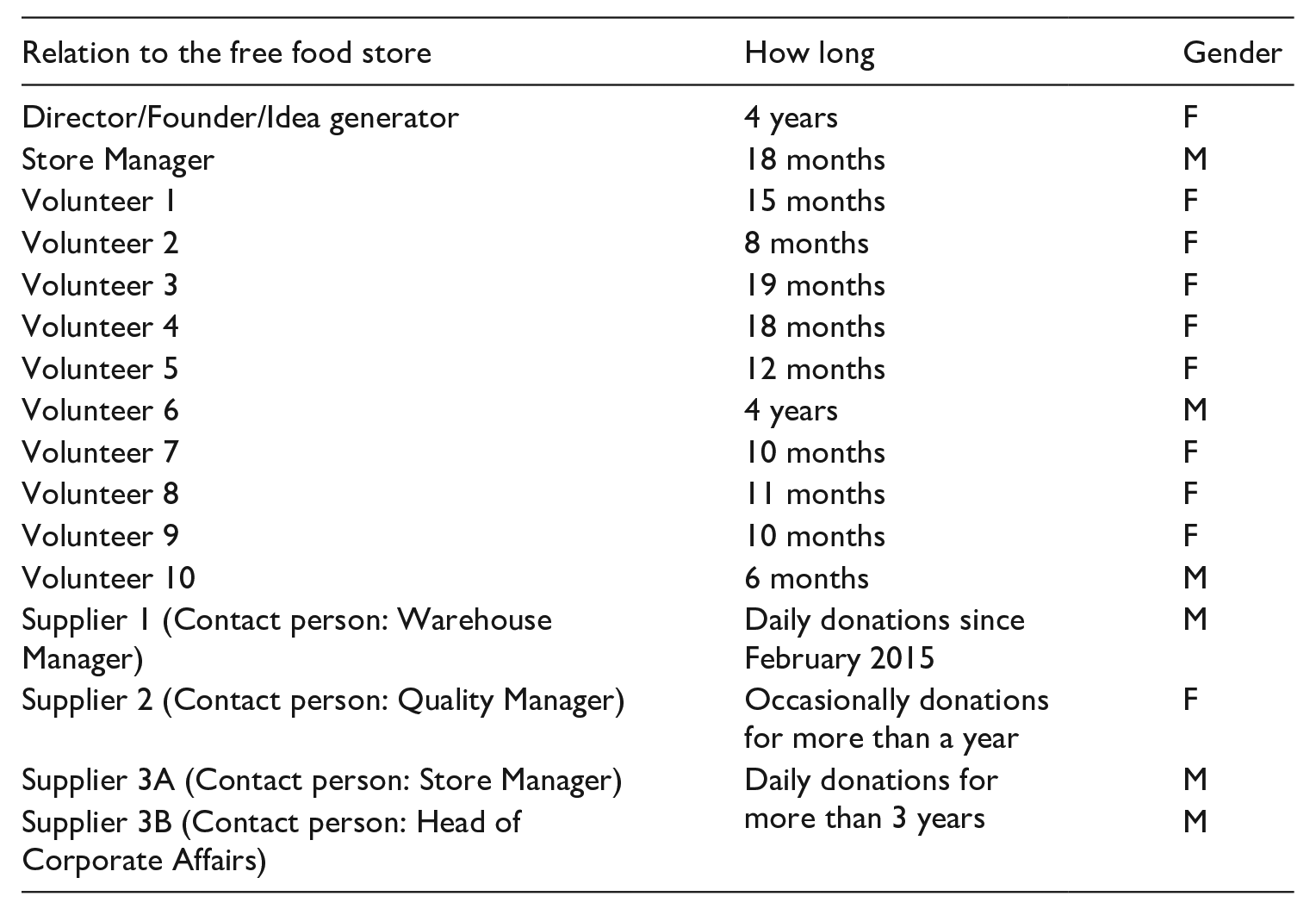
| Relation to the free food store | How long | Gender |
|---|---|---|
| Director/Founder/Idea generator | 4 years | F |
| Store Manager | 18 months | M |
| Volunteer 1 | 15 months | F |
| Volunteer 2 | 8 months | F |
| Volunteer 3 | 19 months | F |
| Volunteer 4 | 18 months | F |
| Volunteer 5 | 12 months | F |
| Volunteer 6 | 4 years | M |
| Volunteer 7 | 10 months | F |
| Volunteer 8 | 11 months | F |
| Volunteer 9 | 10 months | F |
| Volunteer 10 | 6 months | M |
| Supplier 1 (Contact person: Warehouse Manager) | Daily donations since February 2015 | M |
| Supplier 2 (Contact person: Quality Manager) | Occasionally donations for more than a year | F |
| Supplier 3A (Contact person: Store Manager) | Daily donations for more than 3 years | M |
| Supplier 3B (Contact person: Head of Corporate Affairs) | M |
Acknowledgements
This study has gone through various stages, with earlier versions presented at conferences like the Academy of Management in 2016 and 2019, the 12th Organisation Studies Workshop in 2017 and the Sociological Association of Aotearoa New Zealand Conference in 2018. I want to sincerely thank Patrizia Zanoni, Raza Mir, Craig Prichard, Fahreen Alamgir, Ralph Bathurst and Alban Ouahab for their invaluable and friendly feedback on the earlier versions of this study. I also owe a debt of gratitude to my colleagues at Massey University (Aotearoa New Zealand), who provided unwavering support during my fieldwork and at Utrecht University (the Netherlands), who shared their feedback and comments in the writing process of my study. Additionally, I appreciate the warm welcome and help I received from friends and colleagues at the free food store. I would also like to acknowledge the journal editor, Mark Learmonth, and the three anonymous reviewers for their valuable guidance and insightful comments. Their collegiality and generosity serve as a reminder that the peer review process can be a constructive dialogue to advance scholarly ideas collectively.
Funding
The author received no financial support for the research, authorship and/or publication of this article.
