



Abstract
Over recent decades, critical scholars have quite rightly warned of the control implications of new management initiatives. There is a danger, however, of treating control in a ‘distal’ way or as an ‘end’. Through drawing on proximal theorising, we make explicit what is often implicit in such accounts, which is that control is best understood as unfinished, in process, for it is inherently contingent and unpredictable. Viewed in this way, control becomes elusive as it always has to be achieved. The article draws on ethnographic research conducted in a back office of a manufacturing organisation to illustrate this understanding of management control. It highlights tensions between staff and management and between multiple layers of management that can thwart control.
Keywords
Of our elaborate plans, the end
Of everything that stands, the end
No safety or surprise, the end . . .
Can you picture what will be?
—The End, The Doors
Introduction
There is a longstanding interest in organisational control (e.g. Braverman, 1974; Burawoy, 1979; Edwards, 1979; Friedman, 1977). It has been suggested by some that the ‘iron cage’ of bureaucratic control is being tightened through new management initiatives (e.g. Barker, 1993; Delbridge et al., 1992; Korczynski, 2001; Ray, 1986; Sewell, 1998; Sewell and Wilkinson, 1992; Visser et al., 2018; Willmott, 1993). Scholars have focused on attempts to control employees’ values (Hawkins, 2008), emotions (e.g. Hochschild, 1983) and meanings (e.g. Kärreman and Rylander, 2008) through normative (e.g. Kunda, 1992; Müller, 2017; Wilson, 1999), neo-normative (Fleming and Sturdy, 2011; Jenkins and Delbridge, 2017) or concertive (Barker, 1993; Hawkins, 2013) means, which often combine hierarchical and peer-based control (Clegg and Courpasson, 2004; Sewell, 1998).
This literature has shed considerable light on different modalities of control. We seek to add to it by adopting a ‘proximal’ approach which refers to ‘The continuous and unfinished; it’s what is forever approached but never attained, . . . always partial and precarious’ (Cooper and Law, 1995: 239). This approach attends to the ‘processes’ rather than the ‘effects’ of control. By contrast, a ‘distal’ understanding of control focuses on outcomes or ‘ends’. It: privileges results and outcomes, the ‘finished’ things or objects of thought and action . . . the distal is what is preconceived, what appears already constituted and known . . . stresses boundaries and separation, distinctiveness and clarity, hierarchy and order. (Cooper and Law, 1995: 239)
Even critical scholars can slip into distal thinking when culture is considered to be ‘The last frontier of control’ (Ray, 1986); space ‘The final frontier’ (Baldry, 1999) and total quality management (TQM) as pushing ‘back the frontier of control’ (Delbridge et al., 1992). We must avoid assuming or implying that control, like a frontier, can be crossed or achieved. Delbridge et al. (1992) acknowledged that conflict and resistance will remain and this is consistent with Goodrich’s (1920) understanding of the ‘frontier of control’. Nevertheless, control is often represented in a distal way as inexorably straightjacketing employees who ‘are forced toward surviving rather than resisting their exploitation’ (Delbridge, 1995: 814). By contrast, we see workplace struggle as ‘a fluid and imprecise borderline’ (Hughes and Dobbins, 2020: 1) that is ‘always contestable and often contested’ (Ackroyd and Thompson, 1999: 89).
This article seeks to make the contested processes of control explicit by recognising that control has to be made to work because ‘organizations do not simply “persist” . . . they have to be continually produced – that is, reproduced’ (Burawoy, 1979: 6). Proximal theorising is incompatible with the notion of a frontier of control beyond which employees’ freedom, autonomy or uncertainty is lost because organisations are understood to be continually in a process of becoming (Tsoukas and Chia, 2002). Control then cannot be equated with intentions, potential or the design of control systems (e.g. Sihag and Rijsdijk, 2019), for it is an ever-unfolding process.
We thus challenge, both theoretically and empirically, that control can be attained or, alternatively, that ‘we may be approaching’ (Raelin, 2011: 150) a post-bureaucratic era that heralds the ‘end of managerial control’ (Raelin, 2011: 136; emphasis added) as both reflect distal thinking. Drawing on proximal theory, we would caution against assuming that operating ‘without a hierarchy’ means that ‘control has been replaced by social relationships, shared responsibility’ (Raelin, 2011: 144) because shared responsibility simply constitutes a different form of control. In view of this, we believe that ‘control will persist’ (Raelin, 2011: 150) under capitalism due to the economic necessity of paid employment and the indeterminacy of labour power. We agree with Raelin (2011) that control takes different forms and is ‘widely distributed’ (Raelin, 2011: 146) but this is not necessarily due to management intentions or design but because, as Cressey and MacInnes (1980) put it, ‘workers themselves actually control the detail of the performance of their tasks’ (Cressey and MacInnes, 1980: 14).
There is a voluminous literature on resistance that questions a ‘totalising’ understanding of control for even in seemingly ‘cleansed cultures’ (Strangleman and Roberts, 1999) resistance remains (e.g. Hawkins, 2008). However, pointing towards resistance is insufficient to avoid ‘distal’ thinking because metaphorically, control may still be seen as the granite against which resistance chips. Through focusing on the processes of control, we can avoid ‘distal’ conceptualisations and perceive control as far more fluid, porous and fragile.
In the 1980s and 1990s, numerous organisations began to adapt the principles of TQM in developing their own quality systems (Weckenmann et al., 2015). One of the most widely known is Six Sigma (e.g. Linderman et al., 2003) developed by Motorola. A less known system is Manufacturing Excellent Standards or MES (pseudonym) – an initiative developed and practised by the parent organisation (PO) of our case study company. It reflects a broader based approach than Six Sigma. It is less data oriented and revolves around three principles: (1) process improvement and waste elimination; (2) decision-making; and (3) problem-solving. It therefore combines normative and rational discourses (Barley and Kunda, 1992) or, more precisely, lean manufacturing techniques (Womack et al., 1990), quality improvement philosophies (e.g. Deming, 1986) and teamwork (Barker, 1993).
We explore the control dynamics of MES through an ethnographic study of a manufacturing organisation called Boltsco (pseudonym). Senior management displayed distal assumptions in relation to MES, which was presented as enabling the organisation to ‘achieve a level of quality and productivity improvement that will delight our customers’ (corporate website). Likewise, some critical scholars display distal thinking when they argue that quality systems create ‘an enhanced, more insidious form of . . . control’ (Wilson, 1999: 672). Delbridge (1995), who in his ethnographic study of TQM/JIT (just-in-time), considered the ‘process of management control’ (Delbridge, 1995: 803) argued that such a system allows ‘management to avoid the dysfunctions of bureaucratic control’ (Delbridge, 1995: 809). By contrast, we illuminate the complex and unpredictable ways in which MES unravelled, its dysfunctions and unintended consequences. We do so through focusing on multiple struggles between employees versus managers and managers versus managers. The central question we explore is: how can our understanding of control be enhanced by adopting a proximal approach that views control as a process not an end? The next section engages with relevant literature on control. The ethnographic research methodology will then be outlined before we present the empirical findings. Finally, the key insights of the article are drawn out in a discussion and conclusion.
Control at work
There is a wealth of critical literature that focuses on control but, at times, it is presented in distal terms (Cooper and Law, 1995). What we mean by this is that statements are made regarding control that present it as achievable or an already achieved end that exploits, dominates or subjugates employees through deskilling (Braverman, 1974), panoptic (Sewell and Wilkinson, 1992; Veen et al., 2020), branding (Müller, 2017), concertive (Barker, 1993; Hawkins, 2013), cultural (Ezzy, 2001; Ray, 1986), neo-normative (Fleming and Sturdy, 2011; Jenkins and Delbridge, 2017) or spacial (Baldry, 1999) means. Hence, Casey (1995) referred to a ‘new culture program’ where managers ‘deliberately designed’ a culture that is capable of ‘shaping the way things are done . . . and the character of its employees’ (Casey, 1995: 93). Similarly, Ezzy (2001) referred to the ‘colonization of the self’ that occurs through ‘normative control’ that ‘results in the virtual absence of displays of resistance’ (Ezzy, 2001: 636).
In relation to TQM, Tuckman (1994) argued that it removes individual autonomy and enables management determination by reshaping workers’ initiative. In a similar vein, Steingard and Fitzgibbons (1993) depicted TQM as a ‘totalizing narrative that, by implication, subordinates and silences any “Other” voices’ (Steingard and Fitzgibbons, 1993: 28). Although we are sympathetic to the concerns of these critics and believe that their warning needed to be sounded, it also needs to be said that control rarely works so seamlessly (see Knights and McCabe, 1998).
Approaching control from a distal perspective tends to conflate design with outcomes. For example, Boje and Winsor (1993) posited that by convincing workers that power stems from their own actions, TQM programmes have ‘succeeded in eliminating the resistance that has long characterised management/labour relations’ (Boje and Winsor, 1993: 66). The possibilities of a given technology are extrapolated, whereby control implications are presented as being, or potentially being, realised. It could be argued that these critiques are polemics intended to counter the swathe of managerialism that saturates our lives. Yet proximal theorising can also destabilise established narratives through illuminating that organisational life is precarious.
More recent literature has pointed towards the hybridisation (Courpasson and Dany, 2009; Veen et al., 2020) of different forms of control. Critics have argued that post-bureaucratic discourses and the associated ‘flexibility offensive’ (Cooke, 2006: 224) mask the tightening grip of the bureaucratic iron cage (Barker, 1993; Clegg and Courpasson, 2004; Korczynski, 2001; Sewell and Wilkinson, 1992; Willmott, 1993). New cultural forms of control (e.g. Müller, 2017) are understood to supplement traditional bureaucratic methods (Korczynski, 2001) and yet we know surprisingly little about ‘the interfaces and interactions’ (Thompson and Van den Broek, 2010: 9) between different modalities of control. More work is needed on how they evolve and ‘the role over time of organizational actors in gradually shaping and defining mechanisms’ of control (McLoughlin et al., 2005: 71; original emphasis). Although tensions between bureaucratic and post-bureaucratic discourses have been explored (e.g. Hodgson and Briand, 2013), the associated control mechanisms are often assumed or are depicted as blending ‘seamlessly together’ (Hodgson, 2004: 98), which fits with distal theorising.
Sewell’s (1998) analysis of the ‘integrative role of chimerical control’ (Sewell, 1998: 421) is a case in point. While he offers a compelling analysis of the processes of control, according to his analysis domination is ‘supported and amplified’ by the combination of surveillance and peer group scrutiny. Others, for example, Callaghan and Thompson (2001: 23) in their study of a call centre, also illustrate how control is ‘strengthened and deepened’ by the application of structural control. While indicating that there is scope for individual and collective agency, the authors explore how structural control utilises the complementary effects of bureaucratic and technological controls which ‘blend together’ (p. 13) and shape not only the organisational but also the social structures of the workplace. In a similar vein, Orlikowski’s analysis (1991: 29) illustrates how the introduction of ‘electronic mediation’ can lead to the ‘augmentation of personal, social structural, and cultural control’ and Veen et al. (2020: 395) describe how technical, bureaucratic, normative and algorithmic control act in ‘tightly interwoven, complementary and reinforcing ways’ in the gig economy sector.
Our ethnographic study adds to these insights by examining how control plays out in ways that generate unintended consequences, reflecting a proximal perspective. Through exploring the inherent uncertainty of social relations, which does not cease when control becomes legion or when management seeks to remedy errors of design or implementation, our concern is to illuminate how managerial control is never an end since the web of control is apt to be perennially flawed. Nor will the need for managerial control end while people are forced by economic necessity to work. In distal terms, control, spider-like, scurries along a web attracted by tiny vibrations, but in proximal terms, the web is often pierced, torn, frayed or unfinished. Nevertheless, control should not be thought of as ‘a single, collective super-organism’ but rather like an ant colony where every ant ‘is part of the action and carries it forward’ or back (Ingold, 2008: 210).
Earlier ethnographic studies have focused on cultural forms of control (Barker, 1993; Casey, 1995; Hawkins, 2008, 2013; Kunda, 1992) whereas we consider rational/bureaucratic and normative controls (see also McCabe, 2014). To add to ethnographies focusing on relations between management and labour (Beynon, 1975; Burawoy, 1979; Collinson, 1992; Delbridge, 1995; Roy, 1955), we also consider struggles between multiple layers of management. We therefore elucidate additional complexities that hinder control. Although ethnographic studies have explored ‘management’ (Watson, 1994a), the focus was not on control per se but on understanding how managers ‘make sense of their work . . . while striving to shape both their lives and the work efforts of others’ (Watson, 1994b: 894) or the experiences and practice of managerial work (Kornberger et al., 2011).
Ethnographic research methods
This article is based on a nine-month long at-home ethnography (Alvesson, 2009). We understand ethnography as a particular ‘way of seeing’ (Wolcott, 1999), which entails prolonged immersion in the studied community. It is ideally suited to a proximal analysis that attends to organisational details, relations and processes (Cooper and Law, 1995: 249). The third author collected the data while working at Boltsco and studying for an academic degree under the supervision of the second author. As an insider ethnographer, she had already worked at Boltsco for two years, initially as a logistics clerk and subsequently in sales, prior to data collection and so was familiar with the challenges facing MES implementation. The purpose of the study was to gain an in-depth understanding of how organisational actors related to and implemented MES in their daily activities. Owing to the open access as well as the scope and timelines of MES implementation at Boltsco, the site was ideally suited for our research question. As the fieldwork commenced, the third author was promoted and became a middle manager in marketing. This provided a unique vantage point shifting from an employee on the receiving end of MES to a more engaged management role. This change, however, also posed additional demands as MES changed from ‘something new to learn’ (research journal) to a managerial responsibility as the researcher was assigned to three different MES teams.
Research access was obtained through a promise of anonymity and the provision of a research report. Participant consent involved subtle daily negotiations, often undertaken while taking field notes. This process of negotiating consent was imbued with ethical issues due to the researcher’s entanglement in different relationships and multiple commitments. Participants were promised anonymity both in relation to other organisation members and in the report to senior management. The insider ethnographer status enabled up-close exploration of the unexpected twists and turns of MES but it also involved tensions in terms of ‘walking the line’ (Gottwald and Sowa Staples, 2018). In other words, striking a balance when trying to navigate multiple and competing demands and roles in relation to the professional and academic contexts. Ongoing researcher reflexivity, facilitated by discussions with the academic team, helped to address these situational microethical issues (Guillemin and Gillam, 2004).
Data collection and analysis
The research included participant observation, ‘go-along’ interviews (Kusenbach, 2003) and documentary analysis. The bulk of the data were generated through participant observation and involved daily field note-taking – often seen as the hallmark of ethnographic studies (Van Maanen, 2015). Ethnography, as an approach and an analytic tool (Dewalt et al., 2010), enabled us to investigate how different organisation members worked with MES. One hundred weekly MES team meetings were observed, which translated into over 200 entries in the research journal. In addition, other management, project and update meetings were observed, which offered an opportunity to capture many impromptu conversations pertaining to MES.
Impromptu conversations were recorded as short verbatim dialogue transcripts in the research journal. Rather than following a formal interview schedule during sit-down interviews, daily informal discussions were conducted with a cross-section of, in total, 40 Boltsco employees. ‘Go-along’ interviews (Kusenbach, 2003) were highly suitable for our research question as they combine observation with questions embedded in the work situation. Organisational documents, including the complete suite of MES resources from the corporate website, training materials, high-profile case studies, internal presentations, progress reports, MES audit documents, staff briefings and relevant official communication provided further insights into MES – its objectives, rationale, tools and timelines. In total, 57 documents were gathered and catalogued following Miles and Huberman’s (1994) guidelines.
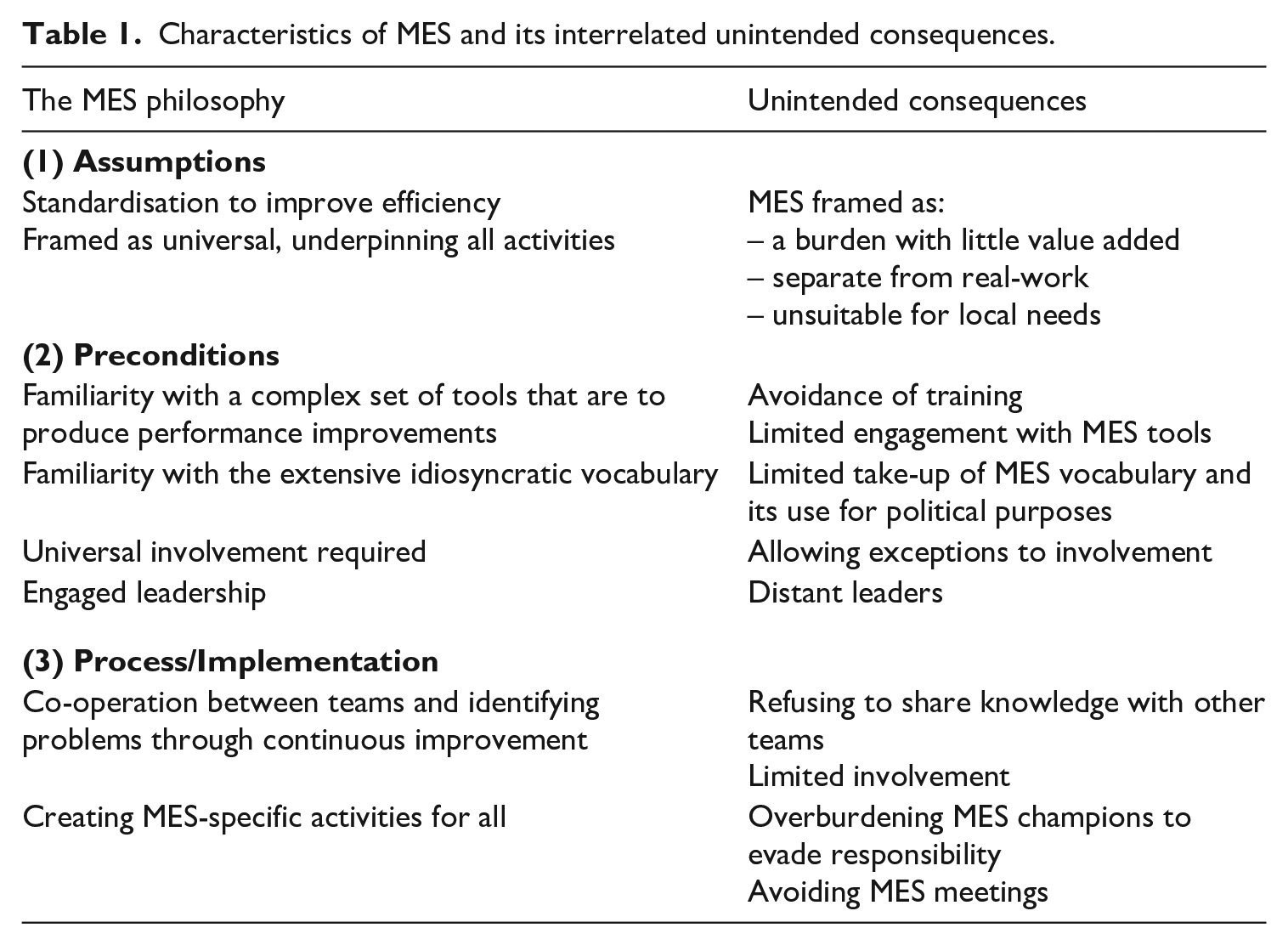
The analysis commenced in tandem with data collection through a daily process of reading field notes and documents and writing in-process descriptive and reflective memos. Initially, the analysis was concerned with understanding the stated intentions, promises, expectations and content of MES and entailed qualitative content analysis of the collected documents (Altheide, 2004). This involved studying MES tools, the chronology of events and the official framing of MES. As familiarity with MES grew, attention shifted towards MES as a form of control. We focused on the evolving formal and informal processes through which MES worked and was undermined. As the analysis progressed, unintended consequences were identified and, through pattern coding (Miles and Huberman, 1994), they were mapped against the content of MES. We traced how these unintended consequences corresponded with the (1) assumptions, (2) preconditions and (3) processes of MES (Table 1), which are explored below. Finally, we analysed how the unintended consequences were imbued with different forms of control and thus traced the interweaving of normative (e.g. teamwork, customer service, continuous improvement) and rational controls (bureaucratic, lean production, standardisation, surveillance).
Characteristics of MES and its interrelated unintended consequences.
The case study
Boltsco, which manufactures products for the construction sector, was founded in the early 20th century. It employs approximately 100 people in the UK, the majority of whom are male and are based in its back office, while a third work in assembly. These two groups of employees work in different sites, hundreds of kilometres away from each other. The research was conducted in the back office, although the third author supported an engineering team, based in a different site with its MES work, for six months. In the early 2000s, Boltsco was acquired by a global, multi-billion dollar conglomerate headquartered in the USA – the PO. The PO operates in a range of industries and all of its units are expected to adopt MES. The PO promotes normative control through teamwork (Casey, 1995; Kunda, 1992) and the ‘cult[ure] of the customer’ (du Gay and Salaman, 1992). It also employs rational control (Barley and Kunda, 1992) by standardising operating systems across its subsidiaries through bureaucratic means.
MES is expected to meet customer demand and deliver world-class quality solutions and services, which is consistent with TQM discourses (Knights and McCabe, 1998; Tuckman, 1994). Through its relentless pursuit of efficiency and waste reduction, as in lean production (Womack et al., 1990), MES is understood in distal terms by the PO as a means to control and improve performance.
During the early stages of its implementation, two of Boltco’s middle managers were chosen to act as its ‘champions’ and underwent a two-day training course in the MES philosophy. It soon became clear that staff and management were reluctant to engage with MES. To meet the PO’s requirements, the champions initially did much of the MES-related work themselves, but pressure increased for them to secure more widespread involvement. Five task groups were therefore created to apply specific MES tools thus putting ‘normative’ (Barker, 1993; Hawkins, 2013) control into motion through weekly team meetings. All of Boltco’s management were allocated to teams.
The Global Financial Crisis in 2008 resulted in some job losses and a re-allocation of MES responsibilities to new champions. In the following sub-sections, we unpack different facets of MES as a form of control. We interrogate how the (1) assumptions, (2) preconditions and (3) processes of MES generated and intertwined with unintended consequences (see Table 1).
Contesting the assumptions of MES
Echoing distal theorising and other improvement philosophies (e.g. Deming, 1986; Womack et al., 1990), corporate documents represent MES as a means to achieve control over product and service quality through standardised tools. It is assumed that MES is a universally applicable philosophy and an all-encompassing operating system that can generate efficiencies. Rather than ‘overcoming certain dysfunctions of bureaucratic control’ (Delbridge, 1995: 814), the emphasis on standardisation and bureaucracy exacerbated them and undermined the core assumptions of MES. Hence, MES tools were seen as opening up a ‘can of worms’ leading to unnecessary work, such as drawing process and communication charts, continuous problem analyses and formal meetings. This view echoes Roy’s (1955) finding that ‘new’ work rules can make ‘more paperwork’ (Roy, 1955: 262), as captured in a conversation prior to a MES meeting of non-managerial staff:
[MES] can be quite complex for no reason at all, it could be simplified.
I think for a lot of people the amount of work they put into [MES] they don’t get it out, they don’t get that much out of [MES].
Instead of improving processes, MES was understood to impede everyday work, generating frustration with the additional bureaucracy. The following quote captured in field notes is indicative of the emerging frustration:
F***ing [MES]. . . takes away from actual work, how am I supposed to get anything done? [group laughter]
This observation endorses Roy’s (1955) insight that employees resist ‘managerial “logics of efficiency” because application of those “logics” produces something considerably less than “efficiency”’ (Roy, 1955: 265). Resistance was not, however, simply about opposition because staff and middle managers circumvented MES ‘to “get work out”’ (Roy, 1955). The third author also prioritised her day-to-day duties over MES. Like other employees, she experienced the bureaucratic MES processes as frustrating because they created extra work, measures and controls which changed how tasks were perceived.
The additional bureaucracy contributed to this negative assessment of MES as did its imposition without regard for the local context, which reflected its assumed universal applicability. Rather than tightening the ‘iron cage’ of bureaucratic and normative control (e.g. Barker, 1993; Clegg and Courpasson, 2004; Wilson, 1999), MES confronted continuous problems, as a senior manager admitted: When [MES] was first introduced we didn’t fully understand the process and how it could benefit the organisation, it wasn’t fully backed by the Management Team and reflecting on that I may have to take some blame. (Nigel)
As Nigel’s comments suggest, Boltco and the PO’s management were ‘divided’ (Parker, 1995: 540; Watson, 1994a), which hindered control. A core assumption of MES is universal applicability, which meant that the local context was neglected during its implementation. This inadvertently undermined control because the MES bureaucracy rubbed up against Boltco’s anti-bureaucratic cultural traditions.
Challenging the preconditions of MES
As a control mechanism, MES has preconditions that include familiarity with its tools and idiosyncratic language, as well as universal involvement and engaged leadership. The PO’s official documents extolled the simplicity of the MES philosophy. The perception among Boltco employees and managers, however, was that MES contradicted its own preconditions as it was far from simple. Hence, its complex vocabulary was outlined in a 25-page glossary which includes 198 key terms. The third author, who studied all MES-related documents and completed MES online training, experienced MES as being obscured by its own jargon.
The abstruse MES terminology led to misunderstandings – hence the teams that were allocated to work with MES tools were often the only ones that understood them and their language. This inhibited cooperation and understanding between teams, which undermined normative team control (Barker, 1993). Instead of facilitating communication and co-operation, the esoteric terminology was, at times, used for political ends, to resist or enable a particular line of argument. This hindered dialogue, led to confusion and subverted control. This unanticipated political dimension of MES was observed during the weekly team meetings that were held to update the Senior Management Team on the progress of MES implementation. In one meeting, for example, a team leader, Mark, aggressively critiqued and undermined his colleagues. He used the MES terminology to expound his belief that what others deemed to be ‘satisfactory results’ were actually unsatisfactory:
It’s simply not good enough to get a result, you have to peel back the layers like an onion, you need to perform an RRCA (relentless root cause analysis).
[Argument ensued over the definition of ‘satisfactory results’]
… [frustrated] The result is the result; I think you are trying to make something out of nothing in order to tick a box . . . I’ve just congratulated the team on a job well done and all you want to do is tell me how crap we are and how much more we could have done. I’m really pissed off now. What a downer! So now I have to go back and tell everyone I was wrong? They’ll really love that! (middle manager)
As the exchange illustrates, MES requires results to be bureaucratically documented through a particular process (i.e. the RRCA). This bureaucratic control necessitates a normative shift whereby everyone imbibes a particular bureaucratic way of talking, thinking and acting. This would support a shared understanding of the corporate philosophy and its unique language – a precondition of MES. The use of MES jargon, however, generated antagonism and obstructed understanding. In unintended ways, the MES language undermined another MES precondition – its requirement for universal involvement – because the obscure terminology precluded participation. As Trish’s remarks indicate, the emphasis on bureaucratic control undermined control because it disengaged employees. Even official MES champions did not always understand it, as the third author found out when seeking clarification on a tool she was tasked to work on. As she was told: … there’s an element of common sense with regards to the tools. However, I’m still not completely clear on how some of them should work, so if, for example, someone asks me about . . . [a MES tool], I would have to search for paperwork . . . This leads to a constant worry ‘cos if I am challenged, I’m pretty much buggered. [laughing] (Niall, middle manager)
The precondition of universal involvement was to be achieved through a comprehensive training programme and the application of MES tools. The staff were required to complete 17 online training modules over a nine-month period. The modules ranged from 30 minutes to three hours and electronic surveillance was used to monitor their completion. Although the training was monitored on a monthly and then weekly basis, our analysis revealed that only 37% of individuals completed the training by the deadline. Some staff, including four middle managers, completed less than 20% of the training while the Managing Director did not complete any of the modules. Since statistics were compiled to create staff rankings based on completed training, this bureaucratic control gradually contributed to what Sewell and Barker (2006) refer to as reverse surveillance as it exposed managers to scrutiny. The lack of management participation demoralised those tasked to encourage employee training:
I don’t get it! How can they make us do this training when they don’t hold themselves accountable?
I don’t know, it just isn’t fair, I don’t want to be in this position, I don’t want to be chasing everyone and I don’t really know what to say when it’s pointed out that certain managers couldn’t be bothered . . . I’m becoming a bit of a joke, I’m putting pressure on people every day, and they laugh when they see me. [frustrated laughing]
Louise bemoaned the lack of management ‘accountability’. It created a contradiction for, by failing to display an accountable self (du Gay and Salaman, 1992), Boltco’s managers hindered the normative controls they sought to promote. It illuminates that managers may be ‘responsible for lapses in the translation of effort into output’ (Burawoy, 1979: 10). The managers further contradicted the precondition of universal involvement by allowing some staff to evade control. This surfaced, for example, in an exchange during a team meeting when a manager criticised another for their lack of involvement:
Can you discuss this with Amy as she still hasn’t attended any [MES] meetings?
This is not the forum for that, it’s easy to point the finger at individuals who aren’t taking [MES] seriously but it’s not appropriate at this level . . .
[after the meeting]
. . . what did you think about Trisha’s comments regarding Amy?
Bloody disgraceful, Amy works really hard.
(research journal)
Despite universal involvement being a precondition of MES, Amy opted out of team meetings and, as a ‘hard’ worker, was allowed to evade normative control (i.e. team subjectivity). Rather than achieving normative consensus through teamwork, MES therefore inadvertently created divisions.
Another precondition of MES was ‘engaged leadership’ but management diverged in its engagement and some resisted by failing to complete MES training. Other managers encouraged engagement in MES, while simultaneously ‘distancing’ (Collinson, 1994) themselves from it. Some evaded MES work and diverted attention from themselves by criticising others for a lack of engagement. It was not uncommon for MES to be raised only briefly at the end of meetings. At one such formal meeting of Boltco’s middle managers, a senior manager observed in a concluding speech: We have to embrace [MES] and show an example to staff that we believe in this. Maybe I need to be involved in some more activities. [. . .] We should all not be so cynical, we need to use more tools and get better feedback. We talk the language, we need to make sure we do the deal. [MES] makes a difference; we need to move this forward. [MES] so far, within our organisation, has been more luck than judgement. We don’t do a good job of selling the good stuff, and instead we make out it’s a chore. [. . .] Look, we just need to make sure that everyone believes it’s the way forward . . . the coercive pressure didn’t help, if we had a chance to implement ourselves gradually . . . well, who knows! (Nigel, senior manager)
The allusion to MES being a ‘chore’ and to ‘cynicism’ implies that it was resisted at multiple levels. Raising MES at the end of the meeting suggests that it is not a priority. Additionally, Nigel’s comment that ‘maybe’ he needs to be more ‘involved’ reveals his distance from it. His criticisms of the PO’s coercion may unintentionally fuel opposition to MES. Reflecting these contradictions and managerial divisions, the third author continued to perform her marketing role without much change in her routine. Although, as a manager, she felt obliged to implement MES while working in cross-functional teams, she was reluctant to impose MES processes on her peers as this ran counter to cultural norms at Boltsco.
This section has discussed how senior and middle managers along with staff engaged in activities that undermined the preconditions of MES. The outcome was that MES was seen as ‘the work of the few and not of many’, despite ‘universal involvement’ and ‘engaged leadership’ being its preconditions. The content of MES (jargon, bureaucracy, complexity) that was supposed to secure control had the unintended consequence of undermining its preconditions. We now turn to the ways in which MES ‘processes’ eroded control.
Undermining MES through its processes
As a mechanism of control, MES required everyone to participate in continuous improvement through teamwork and inter-team co-operation. This process was undermined because teams focused on individual projects, and often failed to share the outputs of their work with other teams, which in turn made it more difficult for other teams to work on their tasks. Team members were also reluctant to engage in the work of other teams. This is evident in the following extract from a conversation between a team leader and team member. The leader asked for help in tackling a problem that another team was facing:
No! no way . . . I am not joining another team, I don’t have time . . .
(research journal)
Trish clearly felt separate from the work of other teams and refused to embrace the normative discourse of teams beyond that of her own team. The work of MES was seen as an additional burden for which Trish did not have ‘time’. The lack of input from unreconstituted staff, who refused to embrace the normative discourse of teamwork, undermined how MES was supposed to work:
It is becoming more difficult to keep the team engaged as there is little or no information to work with. I seem to be having meetings for the sake of meetings, which is becoming a joke. We are trying to come up with reasons for working on improvements without the evidence to back it up. This is not how it is supposed to work.
This frustration was also experienced by the third author who, while working in the certification team, struggled to complete MES tasks as there was no input from other teams to work on. At times, this caused tensions among staff and between staff and the team leaders. Neither the PO nor senior managers looked at how tasks were accomplished as long as MES metrics were deemed satisfactory. Control stuttered and staggered and continually met with obstacles.
One very unpopular MES tool was the 5S process, which required staff to ‘sort’ and ‘straighten’ their workspace to ‘create workplace efficiency’ and ‘improve morale’ (MES training manual). Daily 5S workspace inspections antagonised both the 5S inspectors and the inspected. The third author, who briefly worked in the 5S team, described her experience of inspecting colleagues’ workspaces as ‘emotionally draining’ and ‘surreal’. The 5S performance rankings were regularly published and staff were ‘named and shamed’ for small transgressions, such as keeping too many pens. Rather than securing control, being ‘named and shamed’ gradually became socially acceptable. The implementation of this unpopular MES tool exacerbated tensions among staff as those who were tasked with carrying out the inspections, in particular the leader of the 5S team, became the target of deep resentment. It was not uncommon to hear references to the ‘5S Gestapo’. Such unpopular MES tools further undermined morale and MES’s effectiveness.
A further challenge for the processes of MES was staff not attending team meetings. Every MES team meeting was observed to suffer from absences because they were seen as an interruption to the day’s work. Even staff who attended meetings frequently failed to participate. To urge involvement, MES champions used coercion thus intensifying the sense of negativity. The complex bureaucracy that arose through MES allowed staff to resist participating in its processes as the following example illustrates:
So have you done any online training yet?
No! Mark asked me about progress on this twice, the first time I told him I hadn’t done it, the second time I said I’ve never formally been asked to do it, I haven’t heard from him since. [laughing]
So you haven’t started?
No, he never sent the paperwork, I’m still waiting for my official invite, and I’m not about to remind him either. [laughing]
The MES bureaucracy, lack of resources, overburdened employees and champions plus the disengaged Boltsco management undermined the processes through which control was to be achieved. Frank used the bureaucracy to avoid training, which can be seen as a form of ‘making out’ (Burawoy, 1979; McCabe, 2014; Roy, 1955) to avoid what he saw as unnecessary work. Nevertheless, this resistance is not divorced from consent as he continued to plough on with his job (see also Collinson, 1992, 1994; McCabe, 2014).
Discussion and conclusion
This article has sought to advance our understanding of management control through drawing on proximal theorising. This encourages us not to see control as an ‘end’ to the ‘elaborate plans’ of corporate executives, consultants or gurus but as a process. Rather than the ‘end’ of ‘everything that stands’, it is understood that everyday life continues with its complexity, twists, turns, contradictions and ambiguities irrespective of the form of control. Control is not ‘presumed or privileged in advance’ (Cooper and Law, 1995: 240) because ‘safety’, in terms of the ability to resist corporate demands, remains, as do ‘surprises’, because the outcomes of control are not guaranteed. This means that we cannot ‘picture what will be’ from corporate intentions and so control emerges as an ongoing process that needs to be explored. If we assume the ends of control without investigating the processes through which it is pursued, not just in theory but in practice, there is a danger of slipping into ‘distal’ (Cooper and Law, 1995) thinking that equates outcomes with the potential of strategies, technologies or cultures. This is like predicting the journey of a cart before it is hitched to the horse or ‘putting its ends before its beginnings’ (Cooper and Law, 1995: 237). Of course, control often has deleterious effects on employees. Nevertheless, to think about control as a ‘process’ rather than an ‘end’ can help to put such mechanisms into context whereby control is seen as always unfinished, contestable and indeterminate.
To return to our earlier metaphor, distal theorising assumes that the fly can be caught due to the design/properties of the web. It underestimates the agency of the fly, flaws in the web’s construction, dew on the threads or leaves that pierce its strands. A distal approach to control is evident in our case study in the way that the PO and some Boltco managers proffered tools and assumed that MES could be achieved. A proximal understanding of control can also be seen in the aspiration of continuous improvement, which means that control ‘remains forever “unfinished”’ (Cooper and Law, 1995: 267) because if control can be improved then it has not reached an ‘end’.
A ‘proximal’ approach suggests ‘that everything could be otherwise’ (Cooper and Law, 1995: 264); it draws our attention to the actions, subjectivities, processes, unintended consequences and incompleteness of control. In our case, the proximal is evident in the ubiquitous unintended consequences that arose in relation to MES. The controls generated and melded with unintended consequences and so control, in proximal terms, is in constant tension, adaptation and movement. It is not just that multiple forms of control meld together to produce something new (Orlikowski, 1991), or that each form of control ‘generates quite specific tensions’ (Clegg and Courpasson, 2004: 545), but that control is elusive and has to be continually produced.
It makes little sense then to ‘take it for granted that there are hierarchies or sequences given in the order of things’ (Cooper and Law, 1995: 240) because how control plays out is unlikely to match the intended order or intentions (see Knights and McCabe, 1998). While the distal ‘spider of control’ remains vigilant, proximal theorising elucidates its failures and continuous attempts to repair an imperfect web. In Ingold’s (2008) amusing account, the agency of the fly allowed it to escape the web but it could equally have been a hole or tear in the web (i.e. jargon, tools, paperwork, drawing processes or communication charts) as the material world plays a part in both securing and thwarting control.
To assume, in managerial terms, that the problem is one of design or implementation reflects ‘distal’ thinking such that next time MES will be pursued successfully in a less bureaucratic way by united managers and accountable leaders who skilfully communicate their intentions. Yet, proximal theorising suggests otherwise, for the web of control will slip from the branch, fluttering wings may catch it and the spider will begin again spinning its yarn. These insights, generated through proximal theorising, could help to explain why so many change initiatives fail, along with the recent succession of management fads and fashions.
To conclude, we are advocating a way of understanding control that avoids ‘prediction’ (Cooper and Law, 1995: 241) or anticipating outcomes based on a certain technology, strategy or intervention, for to do so presents an ‘end’ that cannot be known in advance. By contrast, control from a proximal position ‘always remains unfinished . . . never arrives, it’s always next’ (Cooper and Law, 1995: 242) and so it is never an end. Of course, employees may be subject to intense and debilitating control but still the everyday operation of control is ongoing and needs to be explored. A proximal approach calls for ethnographic research to unpack the unfolding details, processes, relations, subjectivities, actions and unintended consequences that arise. As Cooper and Law (1995) point out, the distal and the proximal exist in tension and ‘depend on each other’ (Cooper and Law, 1995: 271). The proximal is a target for control through distal means whereas the proximal remains elusive. We hope that these insights will encourage others to excavate what control means on-the-ground rather than predicting its outcomes at-a-distance.
Footnotes
Funding
The author(s) received no financial support for the research, authorship, and/or publication of this article.
