




Abstract
What insights can postcolonialism and decoloniality offer into workplace accentism? Drawing upon these two strands of literature, this article contributes to workplace research through proposing a view of accentism as an intersectional phenomenon, rooted in the historically sedimented unequal social structure and relations formed during the colonial past. Based on a qualitative study of Brazilians in Portugal, we identify two forms of workplace accentism experienced by the participants: (1) overt accentism – which involves an explicit, direct reference to a person’s accent; and (2) accent-activated stigmatisation – which occurs upon the listener’s realisation that the speaker is a member of a particular group (specifically, nationality). We theorise the experiences of accentism as contemporary manifestations of the workings of colonial power and prejudices. In addition, we distinguish between four approaches to managing workplace accentism: suppressing, confronting, marginalising and exiting. We theorise these as contemporary expressions of resistance strategies historically used by the colonised in response to colonial power. We also highlight the intersectional differences – along the axes of class, race and gender – with regard to individuals’ deployment of each of these approaches. The article enriches our knowledge about how colonial power relations continue to underpin discrimination and its consequences throughout the global economy.
Keywords
Introduction
Discrimination is widespread in contemporary society, and inherent in organisational life (Contu, 2020). A growing body of work has focused on discrimination against foreign workers, such as economic migrants looking for prosperity in the receiving country (Qin et al., 2018); self-initiated expatriates, who relocate abroad with the intention of a temporary stay (Andresen et al., 2020); or refugees seeking a safe new home (Nardon et al., 2021). Scholars have shown how the intersections of categories of difference, especially gender and foreignness, affect what happens to foreign workers (Hwang and Beauregard, 2022; Rodriguez et al., 2016). There is also evidence of the impact of language on people’s experiences in a host country, including experiences of discrimination associated with levels of language fluency (e.g. Brannen et al., 2014; Śliwa and Johansson, 2020).
Despite the proliferation of research into the various bases, facets and effects of discrimination against workers from foreign backgrounds, little is known about one specific type of discrimination affecting this group: accentism. The term ‘accentism’ refers to ‘accent-based discrimination often connected to one’s non-standard accent along with one’s linguistic and social class background, nationality, and country of origin’ (Orelus, 2016: 127). Understanding how people experience and manage accentism in the workplace contributes to understanding and overcoming obstacles to more inclusive organisations and society.
Diverse accents are integral to communication in the globalised world (Roessel et al., 2020), and play an important role in ‘controlling and regulating the immigrant experience’ (Tomic, 2013: 2). Non-native accented speakers are often subject to stereotypes and discrimination in spheres such as education, employment and the housing market (Freynet and Clément, 2019; Gluszek and Dovidio, 2010). The phenomenon of accentism reflects the perceptions and stereotypes that members of certain groups hold in relation to members of other groups. In different contexts, speakers with different types of accents are not subject to the same extent or manifestations of accentism. The perceptions and manifestations of accentism towards speakers with certain accents can have complex and multi-layered historical roots, so that their effects, while profound, are not well understood. For instance, although it has been highlighted that within work settings in postcolonial contexts, accents play a role in reinforcing colonial relations between migrant workers and customers (Ramjattan, 2022), these insights have rarely been examined with reference to postcolonialism (e.g. Thomson and Jones, 2017; Zhang, 2021) and are yet to be integrated into workplace research. To address this gap in knowledge, we draw on postcolonialism (Bhabha, 1984, 1985; Saïd, 1978) and decoloniality (Lugones, 2009; Mignolo, 2007; Quijano, 2000) scholarship (see Bhambra, 2014; Yousfi, 2021) to explore workplace accentism and its intersections with other axes of inequality, and in particular the ways people experience and manage accentism.
Empirically, we focus on the workplace experiences of Brazilians (i.e. members of a former colonised nation) in Portugal (i.e. country of the former coloniser). One legacy of the Portuguese–Brazilian colonial past is that people in both countries speak Portuguese, albeit with different accents. 1 Scholars have previously called for investigation of the power relations and hierarchy imbalances between the former coloniser and colonised nations inside organisations (Bousebaa, 2022). Drawing theoretical inspiration from postcolonialism and decoloniality, we ask: how do Brazilians working in Portugal experience and manage workplace accentism?
In analysing the forms in which workplace accentism manifests itself, we make a distinction between overt accentism (Dryden and Dovchin, 2021 – also referred to as accent discrimination; see Freynet and Clément, 2019; Gluszek and Dovidio, 2010; Orelus, 2016, 2018) and accent-activated stigmatisation (see Cantone et al., 2019; Hegarty, 2020; Levon et al., 2021). Overt accentism, as defined by Dryden and Dovchin (2021: 1, emphases added), albeit in relation to the English language, ‘refers to discriminatory practices where people explicitly and overtly mock, make fun or laugh’ at someone’s accent. Accent-activated stigmatisation is a term we use to refer to situations where the speaker becomes subject to negative behaviour – but without overt and explicit reference to accent – specifically following the identification of their (Brazilian) nationality (‘revealed’ through accent) and the activation of class-based, gendered and racialised stigmatisation of members of this nationality.
The article addresses the need to scrutinise the continuing influence of the legacy of colonialism on contemporary organisational life and workplace relations (Irigaray et al., 2021; Sayed and Frenkel, 2022; Yousfi, 2014). This is particularly important as the proportion of migrants from ex-colonies going to former coloniser countries increases (Hajro et al., 2023). To date, little is known about the organisational impacts of colonialism in relation to the Brazil–Portugal dyad. We explore the experiences of workplace accentism for Brazilians in Portugal to build a more nuanced, historically contextualised, intersectional understanding of workplace accentism beyond viewing it as directed at ‘any’ non-native accented language users (Russo et al., 2017). While stigmatisation is related to the socio-historical context (Garcia-Lorenzo et al., 2022), both accentism- and stigma-related research have suffered from scarce, if any, attention to socio-historical contextualisation (Hegarty, 2020; Johnson et al., 2022).
Our research makes two key theoretical contributions. First, it theorises experiences of workplace accentism – as well as stigmatisation more broadly – as contemporary manifestations of the workings of colonial power and prejudices. Second, it theorises the ways in which members of a former colonised nation manage workplace accentism directed at them in a former coloniser country as contemporary expressions of resistance strategies historically used by the colonised in response to colonial power.
Towards an understanding of accentism informed by postcolonialism and decoloniality
As we discuss below, there exists a body of research on accentism in society and the workplace that addresses how accentism affects individuals and how they respond to it. In addition, a growing strand of literature, which we outline subsequently, seeks to consider the importance of the nation-specific historical and cultural context underpinning accentism (Hegarty, 2020), including the recognition of accentism’s roots in the colonial past (Ramjattan, 2022). Building upon this work, we propose a framework for an understanding of workplace accentism informed by ideas developed within postcolonialism (Bhabha, 1984, 1985; Saïd, 1978) and decoloniality (Lugones, 2009; Mignolo, 2007; Quijano, 2000). This allows us to explain workplace accentism and the ways in which people manage it with reference to knowledge about how colonial power operates and how it is resisted.
Individuals’ experiences and ways of managing workplace accentism
Accentism ‘occurs between individuals who belong to preexisting social groups and who treat each other differently based on categories that are ascribed in interaction’ (Hegarty, 2020: 174). Accentism manifests in different ways, from overt expressions of negative sentiment to non-verbal behaviours, to justifications and rationalisations of views without recognition of biases and discrimination (Monteith et al., 2010). In contrast to overt racism and sexism, accentism has not yet become a social taboo. Neither, with the exception of France, is accent a ‘protected characteristic’ covered by anti-discrimination laws. A non-native accent can function as a collective stigma (Zhang et al., 2021) that relates to the group or ‘tribe’, in which ‘differentness’ in terms of the accent applies to all members of a social group – such as a nation or an ethnic group – equally (Goffman, 1963). Moreover, accentism intersects with other forms of discrimination. For instance, studies have shown that negative evaluations and discrimination of speakers are exacerbated at the intersection of accent and: gender – to the disadvantage of women (Nelson et al., 2016; Timming, 2017); social class – to the disadvantage of speakers from lower-class backgrounds (e.g. Levon et al., 2021); race – to the disadvantage of non-white speakers (Dryden and Dovchin, 2021; Stoever, 2016); religion – to the disadvantage of speakers from Muslim backgrounds (Rakić et al., 2020); and sexual orientation – to the disadvantage of gay speakers (Fasoli and Maass, 2020). Notwithstanding these contributions, an intersectional approach to accentism remains under-developed and calls for scholarly attention (Dragojevic et al., 2021).
Unsurprisingly, people’s experience of accentism is predominantly negative. Accentism affects individuals’ working environment and other dimensions of life (Ragins, 2008). It reproduces in interactions social groups’ power dynamics, which become expected and/or feared by those subjected to it (Hegarty, 2020). As with all types of stigmatisation (Zhang et al., 2021), accentism can have devastating consequences as stigmatised groups are excluded, disapproved or rejected, and have fewer working opportunities available (Garcia-Lorenzo et al., 2022; Paetzold et al., 2008).
In workplace contexts, accentism has been shown to lead to discrimination in access to employment (Timming, 2017), career advancement and job satisfaction (Russo et al., 2017). Being on the receiving end of workplace accentism results in experiences of anxiety, embarrassment, fatigue and negative emotions (Kim et al., 2019) and impacts people’s psychological well-being and social functioning (Birney et al., 2020). Those who experience workplace accentism develop their own strategies for managing and preventing it. Such strategies involve, for example, ‘masking’ one’s accent, as well as disengagement and withdrawal from interactions and situations perceived as threatening, or maybe leaving an employer altogether (Kim et al., 2019; Nath, 2011). These responses are similar to the strategies that are known to be applied in response to other forms of stigmatisation (Doldor and Atewologun, 2021; Garcia-Lorenzo et al., 2022; Zhang et al., 2021).
Accents are not considered equal in terms of status and prestige. In practice, not all speakers with non-native accents are subject to accentism. Accents viewed as standard or prototypical tend to be associated with the dominant group and with high status and socio-economic privilege. As such, they can be a source of advantage for speakers, both in the workplace and in other social contexts. Western European accents tend to be valued more highly than those from less economically developed regions (Lorente, 2018). By contrast, accents considered to differ from the standard, and therefore also those who speak with these accents, are usually associated with lower social status and prestige (Dragojevic et al., 2021).
The occurrence, extent and manifestations of accentism are influenced by the historically sedimented relations between particular groups, such as their colonial history (Ramjattan, 2022). Here, the legacy of colonialism influences power dynamics between immigrants from the former colonies and the former coloniser countries (Bobowik et al., 2018). Call centres are an example of workplaces in which accentism has been observed to contribute to the replication of past colonial inequalities, especially in the context of the former British empire (Nath, 2011; Ramjattan, 2022). In many call centres located in India, workers are trained to ‘neutralise’ their accents, and to emulate ‘British-sounding’ English (Mirchandani, 2012; Nath, 2011). This includes training in caring and deferential intonation, which, as Mirchandani (2012) argues, reproduces the stereotypical colonial image of members of the Global South nations as inferior and subservient to the colonisers from the United Kingdom and other Global North countries.
All this suggests that accentism is not directed at all non-standard and foreign speakers in the same way, and that in some contexts it can be traced back to colonialism. Nevertheless, an understanding of workplace accentism that explicitly and in theoretical detail draws on ideas developed within postcolonialism and decoloniality scholarship (see Bhambra, 2014; Yousfi, 2021) is missing from workplace research. Below, we outline a theoretical framework for building such understanding.
Drawing on postcolonialism and decoloniality to understand workplace accentism
To build a nuanced and historically contextualised understanding of workplace accentism, we draw on two closely related traditions of thought (Bhambra, 2014): postcolonialism and decoloniality. The former, an intellectual movement rooted in the ideas of Frantz Fanon, Edward Saïd, Homi Bhabha and Gayatri Spivak, developed primarily with reference to the colonised geographical regions of the Middle East and South Asia, and their coloniser regions of Europe and the West. The latter, a body of work developed by scholars such as Anibal Quijano, María Lugones and Walter Mignolo, emerged with reference to the colonised regions in South America and their coloniser European states, starting with the 15th-century colonisation of lands that became known as the Americas. While postcolonialism largely focused on cultural as well as material and socio-economic issues, decoloniality was connected to world systems theory, development and underdevelopment theory, and the Frankfurt School tradition of critical social theory (Bhambra, 2014).
Postcolonialism and decoloniality, while sometimes seen as binary or even conflicting concepts, provide converging and complementary insights (Rufer, 2019). Both share the premise that the colonial past continues to persist in the present and both are relevant to our study. In drawing upon postcolonialism and decoloniality, we focus on the commonalities they share (Bhambra, 2014) to build a comprehensive understanding of workplace accentism. In particular, postcolonialism – with its intellectual roots in the humanities – brings attention to the discursive constructions of the colonial situation and representations of otherness, including the stereotypes regarding the colonisers and the colonised, and to the material consequences of and possible responses to these discourses and stereotypes, especially as exemplified by mimicry and hybridity (Bhabha, 1984, 1985). Decoloniality, on the other hand, is particularly valuable for our research as it highlights the importance of considering South America for understanding coloniality, along with the need to move away from an excessive emphasis on discursivity, as theorised by European thinkers. Decoloniality also helps us understand the enduring character of the ‘energy of discontent’ and opposition to coloniality – expressed, for instance, in people’s actions concerned with (re)building lives with dignity (Mignolo and Walsh, 2018) – that first arose in response to colonial oppression at the beginning of the colonial period, and that continues (Mignolo, 2007; Rufer, 2019). Both postcolonialism and decoloniality offer important insights into how colonial power operates, drawing attention to the role of the ideology of Eurocentrism (Amin, 1989), along with race, gender, class and the nation state. Below, we outline each of these aspects of colonial power, and draw attention to the ways in which historically, colonial power can be resisted by the colonised.
Eurocentrism/Eurocentrist universalism
Culturally, colonialism is founded on Eurocentrist assumptions of universalism, whereby those who hold positions of political dominance are considered to possess the ‘universal’ features of humanity. Consistent with this assumption, the European culture is viewed as descriptive of humanity in general and globally valid, with other cultures, exhibiting different characteristics, ‘consigned to the status of being backward, needing tutoring in civilization, incapable of governing themselves’ (Ashcroft et al., 1995: 55; see also Alcadipani et al., 2012). Colonisation practices are underpinned by a belief in the inferiority of the colonised people versus the colonisers, and in the alleged right of the latter to control, dominate and maintain the subservient and peripheral status of the former (Saïd, 1978).
Historically, language played a significant role in the construction of ideologies legitimising European colonisation and in the processes of cultural colonisation. As Rosa and Flores (2017) argue, European colonisers considered the language practices of the indigenous colonised populations as ‘animalistic’ and unable to express complex ideas. Such beliefs enabled the discursive framing of these populations as ‘subhuman’ and provided legitimation to the project of ‘conquering’ them through, for example, the imposition of the (European) language spoken by the coloniser (Migge and Léglise, 2008).
Race and gender
Beyond Eurocentrist universalism, colonial power operates through the linguistic construction of opposites between the ‘One’ (the ‘superior’ coloniser) and the ‘Other’ (the ‘inferior’ colonised). These processes of othering involve constructing hierarchical contrasts between the bodies of the colonisers and the colonised. Above all, the constructed difference is racialised, with the body of the colonised marked by race – what Fanon (1967) refers to as ‘epidermalisation’ – and the body of the coloniser viewed as normative and not marked by race. However, there is an important intersectional dimension to how colonial power operates, in that gender ‘fuses’ with race. With specific reference to the context of South America, the decolonial feminist scholar Lugones (2009) explains that the status of colonised women was inferior to both that of colonised men and of white women. By contrast to white European women who were characterised as fragile and sexually passive, non-white, colonised women, including African enslaved women, were attributed with an extraordinary physical strength, sexual aggression and perversion.
Class
Further, the workings of colonial power manifest themselves through societal class divisions and hierarchies. Both postcolonialism and decoloniality scholars argue that colonial power operates through economic exploitation, legitimised on the basis of the assumption of ‘mythologically understood’ Europe as ‘a world capitalist center that colonized the rest of the world and, as such, the most advanced moment in the linear, unidirectional, continuous path of the species’ (Lugones, 2009: 192). In addition, decoloniality scholarship highlights that economic exploitation is ‘inherent in the institution of slavery’ (Collins, 2000: 82), which placed enslaved people at the bottom of the colonial socio-economic class structure. White European colonisers were located at the top of this structure, with non-enslaved members of the colonised populations occupying class positions in between enslaved people and the colonisers.
Nation state
Decoloniality scholarship (e.g. Mignolo, 2007; Mignolo and Bussman, 2023) analyses the central role of the nation state within colonial domination. Specifically, Mignolo (2007) points to ‘internal colonialism’ and the emergence of ‘colonial nation states’ in South America and the Caribbean, following the formation of European nation states in the 19th century. In the colonial nation states, colonial power was re-enacted through a takeover of power from Portuguese and Spanish monarchies by a white elite of European descent. As Mignolo (2007: 157) argues, ‘the co-existence of the modern nation-state with colonial nation-states is one of the key points in the transformation of racism and the colonial matrix of power since the beginning of the nineteenth century’.
Historically, in response to colonial power, the colonised adopted various strategies of resistance. Here, postcolonialism draws attention to the role of mimicry and its (sometimes unintentionally) subversive effects (Bhabha, 1984). First, mimicry can be subversive because it exposes the artificiality of expressions of colonial power, for example, through ‘performing’ the external appearance (e.g. attire) of the colonisers. Second, mimicry exercised through copying ‘western’ ways of thinking and lifestyles (e.g. education and career focus) can lead to subverting the traditional power relations between the colonised and the colonisers. Another way in which postcolonialism illuminates resistance to colonial power is encapsulated within Bhabha’s (1985) concept of hybridity. Bhabha (1985) argues that the process of colonising does not produce a ‘pure’ colonised subject as intended by the coloniser. Rather, cultural translation and indigenisation of the ideas and norms imposed upon the colonised, once internalised, result in a ‘hybrid’ cultural form. As an illustration, this is exemplified by the development of an Indian version of Christianity, which retained elements of the Indian/Hindu tradition or was chosen by some Indian people – such as women aiming to escape the constraints of a traditional patriarchal caste – for strategic, not necessarily religious, reasons (Anagol, 2005).
Decoloniality scholarship offers a complementary account of responses to colonial power, and it emphasises the continued importance of decolonial resistance in society. In a study addressing resistance in the contemporary workplace context of postcolonial Brazil, Irigaray et al. (2021: 829) argue that ‘organizations represent arenas of struggle between the “colonizers” and the “colonized”’. The authors discuss a decolonial approach of resistance as re-existence (Grosfoguel and Mignolo, 2008: 34; trans. by Irigaray et al., 2021: 820), which considers decoloniality as ‘a type of activity (thought, turn, option), of confronting the rhetoric of modernity and the logic of coloniality’. The concept of re-existence is crucial as it draws attention to the possibilities of ‘redefining and re-signifying of life in conditions of dignity’ (Achinte, 2008: 85–86). Through opening up and engaging different ways of thinking and living, re-existence denotes going beyond the ‘undoing’ of the Eurocentric assumptions and logics dating back to colonialism (Mignolo and Walsh, 2018). Irigaray et al. (2021) highlight that the practices of resistance by members of historically marginalised groups, and their questioning of the Eurocentric norms and colonising discourse, offer insights into decoloniality.
As discussed earlier, it has previously been acknowledged that there is a link between accentism and the status of the person it is directed against as a member of a formerly colonised nation. Drawing on the above insights offered by postcolonialism and decoloniality into how colonial power operates and how it is resisted, we therefore call for deepening our understanding of workplace accentism, especially in relation to workplace contexts in which members of the formerly colonised nations interact with members of the former coloniser nations. Given the role of race, gender and class in the operation of colonial power, building such an understanding entails viewing accentism as an intersectional phenomenon (Crenshaw, 1989; Orelus, 2018). To date, those studies that have engaged in an intersectional analysis of accentism (e.g. Dryden and Dovchin, 2021; Timming, 2017) have not considered the impact of the colonial past. An exception in this regard is Lorente’s (2018) research on domestic/maid agencies in Canada. The author discusses how the agencies use accents to mobilise and reinforce stereotypes about migrants from different locations and their skills: European job applicants’ accents are associated with ‘professionalism’, whereas the accents of Filipino workers are taken to signify an inferior level of intelligence, skills and confidence of the speakers. This results in migrants of European origin being stereotyped – and offered employment – as, for example, the ‘ideal nanny’, and Filipino candidates being judged as best suited to ‘low-skilled housekeeping’. While raising a general point about the difference between the way women from former colonies are treated in comparison to those coming from countries that were not subject to colonisation, Lorente’s (2018) research does not refer to any specific former colony/former coloniser dyad.
The above discussion highlights the importance of developing an historically contextualised, and informed by postcolonialism and decoloniality, intersectional understanding of workplace accentism. The small body of research that currently addresses the link between the colonial past and workplace accentism has been conducted with a focus on the English language and the former British empire. Addressing accentism in the context of the Brazil–Portugal colonial past is thus also an empirically novel endeavour.
The history of Brazil–Portugal relations
Our study is located in the postcolonial setting of Brazil and Portugal, two countries interconnected since the beginning of Portuguese colonisation of Brazil in 1500 and both under-studied in workplace research. At the outset of colonisation, the Portuguese colonisers described Brazil as a place where human and environmental resources were available for exploitation (Schwarcz and Starling, 2015). To exploit the land, the Portuguese introduced capitanias hereditárias (hereditary captaincies), an administrative system in which the land was divided between a few Portuguese owners, requiring intensive labour from enslaved people, brought from Africa (Prado Júnior, 2012). In the capitanias hereditárias the masters owned big houses (the casa-grande) and the land, while the enslaved people, and later servants, lived in ‘slave quarters’ (the senzalas; Freyre, 2003). That system resulted in a social class abyss in Brazil, with significant differences in access to resources. For at least three centuries, Portugal influenced Brazil’s social structure, religion and laws, and the Portuguese language became the official language of Brazil. After Brazil gained independence in 1822, ties remained close, though by this time Portugal was dependent on Brazil, which had economically outperformed the former coloniser. The peaceful independence process, however, created space for the elite to retain colonial-style domination (Santos, 2003) and for the class system to solidify.
‘Brazilians’ developed from indigenous natives, Portuguese settlers, African enslaved people and latterly other Europeans, as the result of a complex interaction process (Schwarcz and Starling, 2015). While class distinctions in Brazil are sharp, racial boundaries are much more fluid, owing to miscegenation that started with the colonisers (Santos, 2003). Although racism based on skin colour exists in the country, overt prejudice is more often related to class (Layton and Smith, 2017). However, since enslaved people were historically at the bottom of the social system, class distinctions inherently embedded elements of race (Freyre, 2003). Moreover, the marginalisation of classes and race derived from colonialism intersects with gender. At the time of colonisation, both Brazil and Portugal were male-dominated, patriarchal and patrilineal societies, in which the role of women was marginal (Russell-Wood, 1977). Historical stereotypes about Brazilian women depict white women as passive, confined to the domestic sphere, and expected to meet men’s needs. By contrast, black and brown women were stereotyped as ‘a symbol of sensual arousal and sexual fulfillment’ (Russell-Wood, 1977: 2), with assumptions made about their alleged promiscuity, sexual availability and infidelity.
Class is an important concept for Brazilians and income-based class differences remain racialised and gendered. Brazil has a simple class differentiation based on income (A, B, C, D and E): A earns more than 20 times the minimum wage, B five to 10 minimum wages, C between one and three, and D and E below the minimum wage (ABEP, 2021). In classes A and B 70% are white, while 77% in C, D and E are black or brown. 2 Women, on average, are paid 78% of the income men earn (Guedes, 2021). Further, while 35% of white people work in the informal market, this increases to 47% among black or brown Brazilians (IBGE, 2020). Finally, education level is the most important signifier of class distinction (ABEP, 2021), as only 17.4% of Brazilians have a university degree (IBGE, 2020). Those who do, earn on average 140% more than those with secondary education (OECD, 2019).
The implementation of the Portuguese language in the process of Brazil’s colonisation was hierarchical, as only Brazilians with a high social status would speak Portuguese, and it contributed to the ‘physical elimination’ (Migge and Léglise, 2008: 302) of part of the indigenous population. The colonial imposition of Portuguese in Brazil merged first with indigenous languages, and then with African languages with the influx of African enslaved people, resulting in the development of uniquely Brazilian ways of speaking Portuguese, characterised, among other features, by Brazilian Portuguese accents – clearly distinguishable from European Portuguese accents. The gaining of independence in 1822 opened Brazil to other nations, who brought different elements to the language in Brazil, leading to further differences between the Brazilian and European varieties of Portuguese (Teyssier, 1982).
Brazil is classified along with the other Portuguese-speaking countries as Lusophone. In the Lusophone context, the European Portuguese language variety is considered to be the standard, a linguistic point of reference against which Brazilian-accented speech is compared and evaluated as inferior. The Portuguese still refer to Brazil as a colony, consider European Portuguese as the ‘correct’ Portuguese and refuse to use what they refer to as ‘the Brazilian language’ in Portugal (Iorio and Nogueira, 2019). Brazilians, by contrast, do not see themselves as a colony: the colonial relationship with Portugal ceased two centuries ago, and other European countries and the USA are now also influential there (Schwarcz and Starling, 2015). Meanwhile, Brazil’s sustained economic growth has given rise to migration from Portugal to Brazil in the past two decades. At the same time, although not widely discussed, the legacy of Portuguese colonisation is alive in both Brazil, as reflected in the socio-economically polarised and racialised social structure of the society, and Portugal, as manifested, for instance, through the workplace accentism that Brazilians working in Portugal are often subject to.
Even if, in reality, it did not make their experience in Portugal easy (Sardinha, 2011), the shared language made Portugal attractive to internationally mobile Brazilians, aiming to gain education in prestigious Lusophone universities, and to escape from Brazilian economic crises and stagnation or, more recently, from political crisis and violence (França and Padilla, 2018). Brazilian immigration to Portugal changed over time. Throughout the 1980s and the 1990s it was composed of political refugees, Portuguese descendants and highly skilled professionals from the upper and upper middle classes. The second wave from the late 1990s to 2010 was marked by an increase in the number of women and those occupying lower-paid jobs, fostered in 2001 by legalisation enabling Brazilians to obtain legal status in Portugal. Low-paid workers – employed in sectors such as cleaning, construction, hospitality, customer service and retail – were still the majority after that, but immigrants also included pensioners, students and investors (França and Padilla, 2018). Nowadays, there are 204,694 Brazilians registered in Portugal (SEF, 2022a) – the largest foreign community – and the majority report prejudice in social and working relations (Sardinha, 2011). Between 2017 and 2022 there was an increase of 433% in xenophobic complaints from Brazilians in Portugal (Barrucho, 2022).
Methodology
Data collection
We conducted 42 semi-structured interviews with Brazilians in Portugal between 2019 and 2021, identified from different sources: (1) social media; (2) Brazilian companies, helped by the Confederação Nacional da Indústria (National Confederation of Brazilian Industry); and (3) personal contacts of researchers and of other participants. The interviews were carried out using Skype, WhatsApp and phone calls, and continued until saturation was reached (Glaser and Strauss, 2017). We interviewed Brazilians who lived in Portugal at different points in time and had different lengths of stay, covering a period between 1995 and 2020 (see Table 1). We chose a diverse group in terms of gender, age, occupation (including those expatriated by a company), position in organisational hierarchy, regions in Brazil and Portugal, and years of living in Portugal in order to understand if any of those characteristics had an influence on participants’ experiences in Portugal in a range of workplace contexts. Our sample does not include Brazilians who would not have been able to secure the resources necessary to travel to Portugal or wealthy Brazilians, who moved to Portugal on the Golden Visa Programme (i.e. bringing a minimum investment of €250,000; SEF, 2022b), as they are unlikely to be part of workplace contexts as employees. The Tratado de Amizade, Cooperação e Consulta (Treaty of Friendship, Cooperation and Consultation) established in 2001, under which Brazilians can enter Portugal with a tourist visa and then apply for permanent residency, provided they find legal employment, has attracted Brazilians to Portugal (Consulado de Portugal, 2020). The jobs generated through this scheme are predominantly in customer-facing sectors, such as hospitality (Sardinha, 2011).
Participants’ profiles.
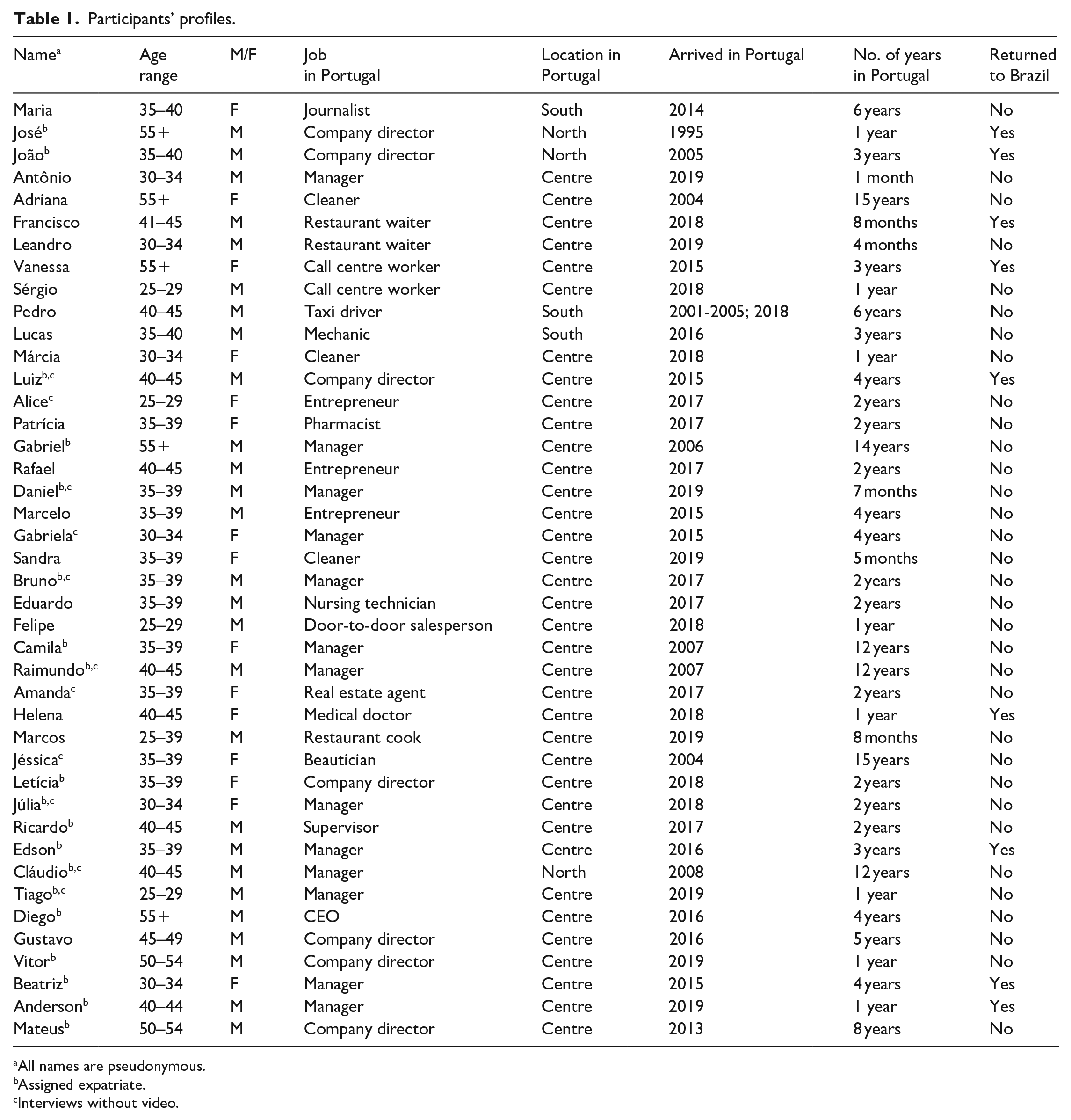
All names are pseudonymous.
Assigned expatriate.
Interviews without video.
Interviews were conducted in (Brazilian) Portuguese by the two researchers of Brazilian background to foster understanding and trust, and to facilitate potential discussion of any sensitive issues. At the start of each interview, participants were reassured about the anonymity and confidentiality of the research, and their right to withdraw from it. Speaking with Brazilian accents contributed to a sense of rapport between the interviewer and interviewee, as illustrated by statements such as ‘as a Brazilian, you understand it’, made repeatedly during the interviews. To protect participants’ anonymity, we use randomly chosen names, different from the participants’ own (see Table 1).
Where appropriate, we recorded participants’ demographic characteristics such as skin colour (which we did not ask about explicitly, but noted based on participants’ spontaneous self-identifications, e.g. ‘I am this typical brownish Brazilian woman’ or ‘I am lucky because I am white’), 3 gender, social class (again, based on participants’ self-identifications) and education to understand if and in what ways those categories of difference might have impacted their working experiences in Portugal. Information about the educational level and job position of participants in Brazil helped us to infer their social class, although many mentioned it themselves during the interviews. It is noteworthy that 34 participants have a university degree and mainly worked in managerial positions in Brazil – a strong indication that most of the participants belong to the middle and upper middle classes in Brazil.
From our first interviews the impact on participants’ experiences connected to speaking with a Brazilian accent became clear. The diversity of participants allowed us to establish that accentism has accompanied Brazilian migrants’ experience in Portugal for a long time, that it has contributed to some participants’ decisions to return to Brazil and that even those who are no longer exposed to it (including those who left the country a decade ago) continue to have vivid memories of accentism and how it affected them. Participants who had left Portugal retained clear memories, using expressions such as ‘as we speak, I remember [such and such a situation]’, reinforcing the extensive evidence that significant or traumatic events tend to stay in the memory (e.g. Thorne, 2000).
Following the interviews, we drew on previous research and current news items to help us confirm that the participants’ perspective in Portugal was shared widely. We read Portuguese (Observador, O Público and Diário de Notícias) and Brazilian (Folha de São Paulo) newspapers and found items related to discrimination and stigmatisation experienced by Brazilians living in Portugal and the challenges they face in the country, including some asking for help to return to Brazil. Accent was a prominent issue, as were the problems encountered by students at schools or universities who speak with Brazilian accents, and discussions about whether Brazilian and Portuguese were the same language.
Data analysis
All interviews were recorded and transcribed. Six randomly selected interviews were translated in full for an initial analysis of the data, and then we identified key points in the interviews related to accentism. One of the authors translated them into English and another back-translated. Interviews and all related excerpts were cross-checked by a third author (who speaks English as their first language but is familiar with the European variety of Portuguese) for equivalence of meaning (Chidlow et al., 2014). As a result, some words were replaced in the original translation, particularly those related to mannerisms and jargon.
Transcripts were examined hermeneutically, with constant iteration between the texts and the shared understanding of the researchers, encapsulated in our mapping (Taylor, 1979), allowing us to capture and interpret the meaning of lived events. We opted for a hermeneutic approach rather than coding templates since the latter restricts the interpretation process (Mees-Buss et al., 2022). In the first step of the analysis, we noted that all participants highlighted the importance of the fact of speaking Portuguese with a Brazilian accent for their experiences in Portugal. We also noted that, in talking about their experiences, the participants made numerous references to the colonial history, as well as to different axes of inequality, such as gender and race, and that they spoke about being proactive in ‘managing’ these experiences.
We decided to focus further analysis on workplace experiences. To interpret the material, we turned to several bodies of literature: the work on accentism, developed both in linguistics and in workplace research (Dryden and Dovchin, 2021; Kim et al., 2019; Timming, 2017); workplace research on stigmatisation and responses to it (Doldor and Atewologun, 2021; Garcia-Lorenzo et al., 2022; Zhang et al., 2021); and the works of postcolonialism (Bhabha, 1984, 1985; Saïd, 1978) and decoloniality (Lugones, 2009; Mignolo, 2007; Quijano, 2000) scholars. Subsequently, we sought to categorise participants’ experiences of accentism and ways of managing it. We found that while the participants often described experiences of what linguistic research refers to as ‘overt accentism’, they also often shared that their accent resulted in them being identified as Brazilian, and that having their nationality identified would result in the activation of anti-Brazilian sentiments on the part of their Portuguese interlocutors.
This kind of experience was different from what the literature refers to as ‘native speakerism’ (Holliday, 2006), an ideology developed with reference to English language teaching (ELT), which devalues ‘non-native’ language use and users. Following another round of probing the data in light of the literature on accentism and on stigmatisation in the workplace, we decided to categorise such experiences as ‘accent-activated stigmatisation’. Having introduced this distinction between these two manifestations of workplace accentism, we then focused on clustering participants’ ways of managing both overt accentism and accent-activated stigmatisation. When analysing the clustered material, we identified patterns in terms of the types of experiences and the ways of managing accentism, along the lines of class (reflective of type of work – professional/managerial versus manual/low paid), gender and race. Owing to the central role of references to the Brazil–Portugal colonial past within the interviews, we drew on ideas from postcolonialism (Bhabha, 1984, 1985; Saïd, 1978) and decoloniality (Lugones, 2009; Mignolo, 2007; Quijano, 2000) to interpret these intersectional experiences of and approaches to overt accentism and accent-activated stigmatisation.
Researcher positionality
The authorial team consists of four scholars, diverse in terms of nationality, gender and linguistic background. While not auto-ethnographic, this project speaks to our own experiences and values. All of us have lived in a foreign country, three of us have been affected by accentism related to the type of accents we speak with (including two of us having the experience of speaking Portuguese in Portugal with a Brazilian accent), and two of us have been navigating the world of work as foreign women. We have a shared interest in history, and we all care about making organisations and societies more inclusive. In the process of collection and analysis, we became sensitised to the differences between our own experiences of accentism as white, highly educated people, with the privilege and protection that these characteristics granted us, and how these compared with the interviewees. This, along with the reviewers’ comments, prompted us to pay attention to the intersectional dimensions of accentism in the analysis of the empirical material. As two of us are women and three of us are non-native English speakers, we were able to reflect on our experience of workplace accentism and on its gendered manifestations. Altogether, this research project has led us to develop greater awareness of our own positionality, especially in terms of class, gender, nationality and occupation.
Below, we discuss our empirical findings. We have divided the analysis into two main sub-sections, focusing, respectively, on ‘experiencing’ and ‘managing’ workplace accentism. Further, we have sub-divided each of these sub-sections according to type of work carried out, that is, professional and managerial work versus manual and low-paid work. Within this structure, we also discuss the intersectional aspect of the experiences of and approaches to managing accentism, with an emphasis on the role of gender, race and class (see also Table 2).
Illustrative quotes.
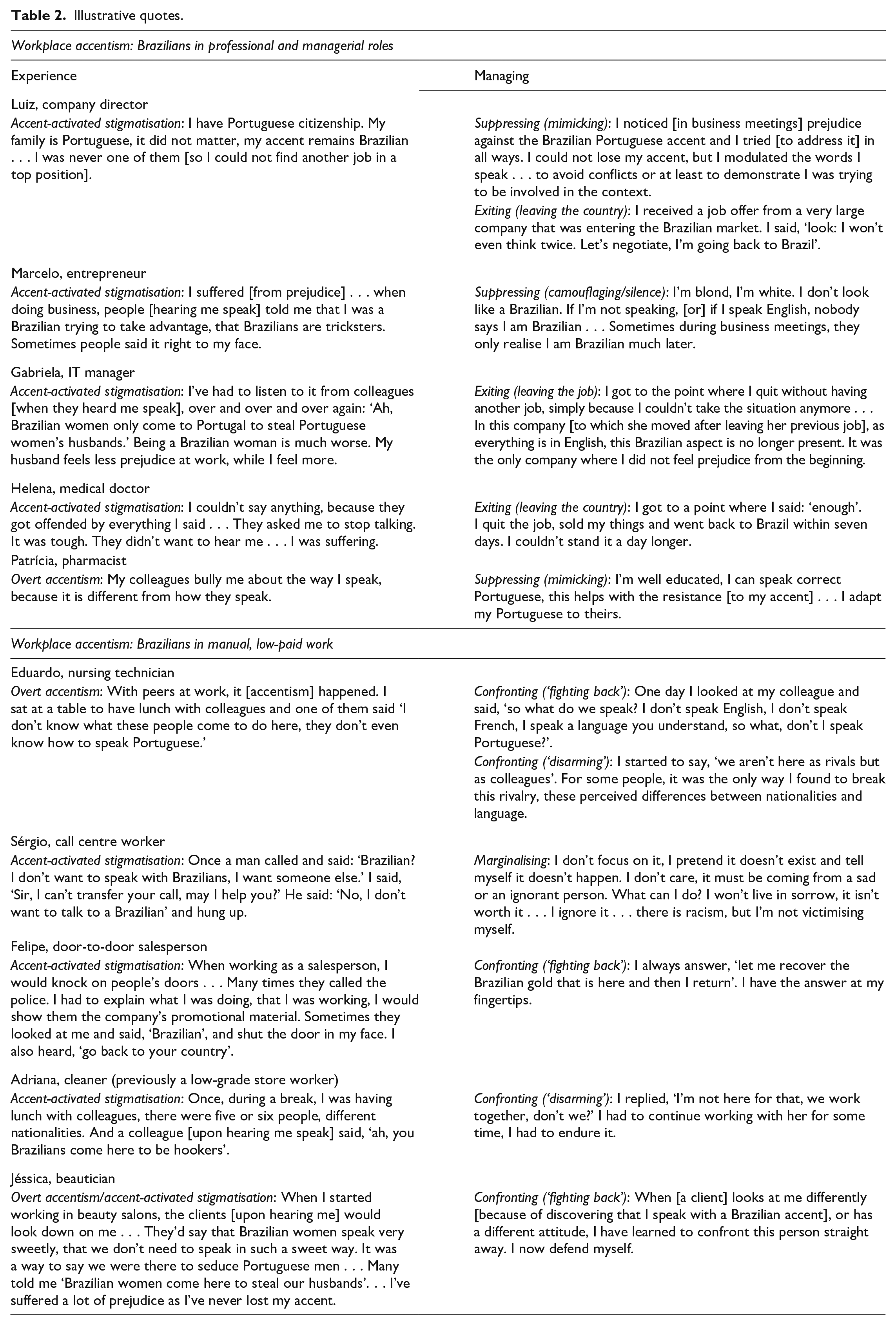
Experiencing and managing workplace accentism by Brazilians in Portugal
Workplace accentism: Experiences of Brazilians in professional and managerial roles
Among participants employed in professional and managerial roles, 4 there was a clear gender difference between the manifestations of accentism.
As summarised by Letícia, a company director, commenting on her workplace experiences in Portugal: ‘it is more difficult because I am woman’. More specifically, men did not report the experience of overt accentism, for example, having their accents mocked or corrected in the workplace or experiencing comments, with reference to their accents, undermining their competences. Nevertheless, they felt that, as soon as they spoke to a Portuguese person in a professional context for the first time, they were perceived, owing to their accent, as carrying a stigma of being ‘inferior’ as coming from Brazil – a former colony and a developing economy. They reported experiences of what we refer to as accent-activated stigmatisation, whereby their identification as Brazilian led immediately to their abilities, or even the way they dress for work, being questioned. João, a company director, for instance, shared that his Portuguese superiors were ‘concerned about the way I was going to dress and how I behave in front of the clients’. Overt resentment, when encountered by men in managerial roles, was expressed with reference to their high earnings, and included accusations of ‘stealing’ opportunities from the locals. For instance, Mateus, a company director, recalled how he was told by his boss that ‘the company is in Portugal, it should have more and more Portuguese and not Brazilians in leadership’, whereas José, also a company director, argued that ‘the Portuguese, when we arrived, were afraid that we were actually there to take someone’s job’.
In contrast to men, Brazilian women in professional and managerial positions reported numerous experiences of overt workplace accentism. For instance, Gabriela, an IT manager, observed how she was ‘picked on’ at work because of her accent: When we had meetings at work, they would say: ‘your Portuguese accent is awful’. Whenever I spoke in a way my [male] colleague found wrong, he opened Skype and messaged me the ‘correct’ way to say it.
Maria, a journalist, whose work involved TV appearances, spoke of receiving emails from viewers whose authors would not comment on the content of what she said on-air, but on her accent and nationality: ‘I don’t like your accent, I don’t like Brazilians.’ Helena, a medical doctor, spoke of how she would be mocked and shamed at work by colleagues asking, ‘don’t you speak Portuguese?’. Amanda, a real estate agent, was asked by her manager to change her ‘sugary’ Portuguese to ‘proper’ Portuguese. All these illustrations demonstrate that manifestations of workplace accentism are gendered, and specifically that, in the case of Brazilians employed in professional and managerial roles, overt accentism is used as a mechanism of discrimination against women but not men.
Women participants working in professional and managerial roles also spoke about experiences of accent-activated stigmatisation (see Table 2). In particular, they reported that regardless of their actual position, in response to their accent, the Portuguese interlocutor would assume that they were employed in low-paid jobs or did not have the skills to perform certain tasks. For instance, Gabriela, an IT manager, mentioned that one day a colleague, with whom she had not previously interacted, heard her talking and asked if she was the cleaner. On hearing Camila, a manager, speak, her boss asked her: ‘you work with Excel, right? Do you understand Excel?’, regardless of the fact that Camila would regularly send Excel spreadsheets to her over a period of four years. Accent-activated stigmatisation involved devaluing the professional competences of Brazilian women.
Workplace accentism: Experiences of Brazilians in manual and low-paid occupations
Compared with participants doing professional and managerial work, those in manual, low-paid roles experienced stronger instances of overt accentism and accent-activated stigmatisation (see Table 2). In the case of men in low-paid occupations, overt accentism came from customers, colleagues and superiors. For instance, Sérgio, a call centre worker, experienced customers saying ‘bad things’ to him, and that ‘sometimes people do not want to talk’ to him ‘because of [his] accent’. Eduardo, a nursing technician, recalled how patients and their family members would refuse to communicate with him, or even to be looked after by him: ‘I speak Portuguese, I want to speak with a person who also speaks Portuguese, not you . . . You cannot even speak proper Portuguese, so don’t touch me.’ Here, accent-activated stigmatisation intersects with disrespect for a person in a low-paid occupation to produce a particularly aggressive outcome of disgust. Eduardo also experienced overt accentism from a colleague, who once told him that he would ‘rather have a relationship with a black Angolan that speaks proper Portuguese than with a Brazilian’. Brazilian women doing manual, low-paid work reported experiencing accent-activated stigmatisation mostly in connection with objectifying sexualisation by Portuguese men and stereotyping by women colleagues: Adriana, a cleaner, was told: ‘you Brazilians come here to steal others’ husbands’ as well as ‘you Brazilians come here to be hookers’.
To summarise, the experiences of workplace accentism differed between those in professional/managerial roles and those in low-paid/manual roles, and accentism intersected with other axes of inequality, especially class, race and gender. Importantly, participants in professional and managerial positions were more likely to have come from middle-class backgrounds and to describe their skin colour as branco (white) or pele clara (light skin), compared with those working in manual, low-paid jobs, who were more likely to have come from disadvantaged backgrounds, and to refer to their skin colour as moreno (brown) or negro (black). The experiences of workplace accentism were also gendered, as women encountered overt accentism in the workplace much more often than men, and it had a more controlling and aggressive character.
Managing accentism by Brazilians in Portugal
The experiences of workplace accentism have affected Brazilians in Portugal in different ways, and have resulted in different ways of managing them by the participants. We have clustered these under four categories: (1) ‘suppressing’ (which involved ‘mimicking/camouflaging as’ Europeans and/or ‘hiding’ Brazilianness); (2) ‘confronting’ (which ranged from gentler forms of ‘disarming’ accentism through reasoning or the use of humour to ‘fighting back’ against accentism in an assertive or even aggressive manner); (3) ‘marginalising’ (neither openly confronting accentism nor internalising it); and (4) ‘exiting’ (either leaving the job or leaving Portugal and returning to Brazil). The choice of these approaches was connected to the type of work carried out, and it intersected with class, gender and race (see Table 2).
Managing accentism by Brazilians in professional and managerial roles
Participants in professional and managerial positions, with university degrees, including linguistic proficiency in language(s) other than Portuguese, would often opt for suppressing their Brazilianness through ‘mimicking’ or ‘camouflaging as’ Europeans. The main objective of this approach was to prevent workplace accentism from occurring. For example, Gabriel, a manager, explained how in the workplace, he adopts the vocabulary, grammar and syntax associated with European Portuguese: ‘I’m careful about how I speak. When we speak in a “wrong” way, they don’t like it. I’m careful about how I build the sentences. I need to adjust to that.’ Similarly, Maria, a journalist, admitted: ‘I make concessions for specific terms.’ ‘Mimicking’ also involved using English in business contexts. The ability to successfully engage in mimicking/camouflaging had a racialised dimension, as ‘European-looking’ Brazilians were in a better position to ‘pass’ as a member of a European nation when speaking English. Daniel, a manager, explained: ‘I look extremely European. They talk to me in English, and I answer them in English. It’s perfect.’
Another way of suppressing Brazilianness was through ‘hiding’ one’s Brazilian accent behind silence, sometimes used by those in managerial and professional positions although more commonly used by those working in manual, low-paid occupations. Helena, a medical doctor, said: ‘I had a palavrometro (a ‘word counter’) to count how many words I said in a day. There were times when the day went by and I had not said a word.’ Those participants who chose to manage workplace accentism through ‘suppressing’ their Brazilianness found it to be ‘a self-defence. It is a way to deal with it’ (Maria, a journalist).
When faced with overt accentism – for example, with assertions that they do not speak ‘proper’ Portuguese – participants employed in managerial and professional roles were likely to adopt ‘disarming’ as a way of explicitly addressing it. This approach involved using irony and jokes, thus recognising the occurrence of accentism while avoiding confrontation. Júlia, a manager, for example, would laughingly respond to such assertions: ‘you are right, we polished [Portuguese]. We made it better’. Among those in professional and managerial roles who spoke of experiencing overt accentism – all of whom, as discussed in the previous sub-section, were women – we did not find examples of a more confrontational, assertive or aggressive approach to managing workplace accentism.
Another approach to managing accentism was ‘exiting’, which involved either leaving current employment or leaving Portugal (see Table 2). Brazilians working in professional and managerial roles were able to find new jobs more easily than those working in manual and low-paid jobs. They often had the option to move to large, non-Brazilian multinational enterprises (MNEs), with English as the lingua franca, or to Brazilian companies with a significant number of Brazilian workers. For instance, Edson and Júlia, both managers, experienced their move to MNEs as a relief, since ‘there is no room for prejudice . . . everything is in English’ (Edson) and ‘because of the number of nationalities, we speak in English . . . so you don’t feel [the prejudice] at work’ (Júlia).
Some of those in professional and managerial work opted to ‘exit’ through returning to Brazil. Participants in such occupations tended to be white and have come from socio-economically privileged backgrounds in Brazil, and not to have experienced discrimination in their country of origin. Both women and men talked about the comfort they had left behind there and emphasised the high social status they enjoyed back in the home country and how their experience in Portugal had been a social, financial and career ‘downgrade’. For example, Camila, a manager, spoke about her wish to return to Brazil, reflecting on how at the time of coming to Portugal, even though still young: ‘I was already receiving a wonderful salary, it was like this: with my career all structured, I was exactly at the level where I wanted to be.’ A similar sentiment was shared by Helena, a medical doctor, who considered the overall experience of working in Portugal as ‘a throwback in my career’. She returned to Brazil where she held a ‘good’ position, as she felt that if she had stayed in Portugal she would have had ‘to give up many things’.
Managing accentism by Brazilians in manual, low-paid work
Participants employed in low-paid and manual occupations approached managing workplace accentism differently to those in managerial and professional positions (see Table 2). They usually came from less advantaged backgrounds in Brazil, where they did not have opportunities to earn university degrees or to learn foreign languages, and the option to engage in ‘mimicking’ and ‘camouflaging’ as Europeans through modulating their Portuguese or speaking English in workplace contexts was generally not available to them. Among such participants, especially those whose jobs involved little public contact, ‘suppressing’ their accents and ‘hiding’ their Brazilian identity behind silence was a common approach to managing workplace accentism. They would go about their daily functions at work silently, just following guidance from colleagues and superiors. Leandro, a restaurant waiter, stated that he comes to and leaves work ‘with my mouth shut’ because ‘it is not good to talk at the workplace’. Participants whose job required a lot of interaction with others reported addressing accentism by ‘confronting’ it: either through ‘disarming’, which involved the use of reasoning or humour or ‘fighting back’, that is, adopting a more assertive stance against the perpetrators of accentism. For instance, Jéssica, a beautician, explained how, when a client, in response to her accent, would accuse her of being a sex worker, she would say: ‘From where do you know me? I am here working as a manicurist. You have not seen me at a prostitution site . . . But even if I were, it is none of your business.’ Felipe, a door-to-door salesperson, referring to an experience of accent-activated stigmatisation at work, when he was called ‘a useless Brazilian’, spoke of how he ‘came close to [the perpetrator]’ and said: ‘if you talk to me like that again, I’ll break your neck’.
As another approach, sometimes applied in parallel with ‘disarming’, participants working in low-paid and manual jobs would opt for ‘marginalising’ manifestations of accentism. In practice, they would neither directly confront nor internalise workplace accentism as something that called for suppressing their Brazilianness through ‘hiding’ their accent. When engaging in this kind of response, participants would not attribute much importance to accentism and its perpetrators, in order to not allow experiences of accentism to have a negative influence on how they felt about themselves. Adriana, a cleaner, explained: I laugh about it; it doesn’t help to cope with it any other way. If I didn’t cope that way I’d go crazy . . . it isn’t easy, but in order to not get stressed I treat it in that way.
Those employed in low-paid jobs who adopted ‘exiting’ as their approach to managing accentism would usually leave their current job but stay in Portugal. They typically came from less advantaged backgrounds in Brazil, self-identified as moreno (brown) or negro (black) and had previously experienced poor treatment in socio-economically polarised Brazil. While recognising that ‘only the really strong people survive here’ (Lucas, a mechanic), they felt they had to endure their situation in Portugal, at least until they achieved Portuguese citizenship and, along with it, the right to live and work in any member state of the European Union. Unlike participants in professional and managerial roles, they saw a return to Brazil as evidence of failure and even punishment. As Felipe confessed: ‘I thought many times about going back to Brazil but I felt guilty.’ They would move from one sector to another, sometimes quitting even before they had another job to go to.
Discussion
On the basis of the analysis, we discuss below two key theoretical contributions of our research: (1) theorising experiences of workplace accentism – as well as stigmatisation more broadly – as contemporary manifestations of the workings of colonial power and prejudices; (2) theorising individuals’ approaches to managing workplace accentism as contemporary expressions of resistance strategies historically used by the colonised in response to colonial power.
Experiences of workplace accentism as contemporary manifestations of the workings of colonial power and prejudices
Studies have explored how members of minority groups, especially migrants and women, are affected by stigmatisation in the workplace and society (Doldor and Atewologun, 2021; Hwang and Beauregard, 2022). Previous research has recognised that members of specific groups will have different experiences of stigmatisation, in particular, depending on the level of controllability and disruptiveness of the stigma (Zhang et al., 2021). It has also acknowledged that stigmatisation is a relational phenomenon, which involves not only the stigmatised but also the stigmatisers and the underpinning socio-historical context (Garcia-Lorenzo et al., 2022). Our study contributes to this work through theorising overt accentism and accent-activated stigmatisation in the workplace as contemporary manifestations of the same mechanisms through which, historically, colonial power operated – via Eurocentrism, race, gender, class and the nation state – and of the prejudices against members of specific groups formed in colonial times. Through offering insights into the compounded impacts of the intersections of nationality, race, gender and class, the research also contributes to an intersectional understanding of stigmatisation, which to date, has primarily been studied with reference to either one or two categories of difference (Johnson et al., 2022).
Two main forms of workplace accentism were experienced by the participants: (1) overt accentism – which involves an explicit, direct reference to a person’s accent; (2) accent-activated stigmatisation – which occurs upon the listener’s realisation that the speaker is a member of a particular group (specifically, nation). In activating either of these two forms of accentism, a crucial role was played by identification related to the nation state. Here, the historically unequal power dynamics between Brazil and Portugal were echoed in the activation of stigmatisation related to the ‘Brazilianness’ of the targets. While previous research has pointed to accent serving as a proxy for race (Stoever, 2016) or social class (Levon et al., 2021), in our study it served as a proxy for nationality, giving rise to the surfacing, in the form of overt accentism and accent-activated stigmatisation, of anti-Brazilian prejudices and stereotypes on the part of the Portuguese interlocutor(s). The roots of these prejudices and stereotypes can be traced back, first, to the colonisation of South America in the 15th century and, second, to the formation of nation states in the 19th century (Boehrer, 1960; Mignolo, 2007). Within the actual manifestations of accentism, we theorise that, contemporarily, the long-established mechanisms of colonial power remain in place. Drawing on postcolonialism (e.g. Bhabha, 1984; Fanon, 1967) and decoloniality (e.g. Lugones, 2009; Mignolo, 2007), both of which offer insights into the operation of colonial power, enables us to understand why, when working in a country that historically colonised their country of origin, different people, even if they might speak with an accent associated with the same nationality, find themselves on the receiving end of different manifestations of accentism. Here, gender, race and class – as well as the intersections of these axes of inequality – are key to explaining the extent and form of workplace accentism.
With regard to gender, our study suggests that the belief in Brazilian women’s inferior social position – and men’s right to control them (Russell-Wood, 1977) – has persisted throughout centuries (de Souza et al., 2023). Contemporarily, it can be discerned in overt workplace accentism aimed at Brazilian women in Portugal. Here, the intersections of race, gender and class produce different experiences of workplace accentism for white women working in managerial and professional positions compared with non-white women working in manual and low-paid occupations. While the former would typically have their accents corrected and mocked, the latter would experience particularly aggressive forms of accent-activated stigmatisation, and specifically, sexualisation, echoing the sexual prejudice and exploitation, during the colonial times, of the bodies of women in South America who were not of European descent, as highlighted by the decoloniality scholar Lugones (2009).
At the same time, the patriarchal and racialised nature of colonial societal structures helps explain why white Brazilian men in professional and managerial roles were not subject to overt workplace accentism in Portugal – which can be seen as a positive outcome of the intersecting effects of race, gender and class for members of this group – but were resented because of their high earnings. First, the socio-economic structure imposed through colonisation meant that the status of members of the colonised population was inferior to that of the colonisers (Prado Júnior, 2012). In economic terms, this situation was perpetuated in earlier waves of migration from Brazil to Portugal. The condition in which highly educated, usually company-expatriated, Brazilians enjoy an equal or even higher economic status than their Portuguese colleagues is relatively new and can cause discomfort in the latter. The literature of postcolonialism, and especially Bhabha’s (1984, 1985) concepts of mimicry and hybridity offer an explanation of this role reversal as an example of the subversive effect of mimicry. In addition, this discomfort with the reversal of the colonial socio-economic order is likely to be exacerbated because of the ‘male breadwinner model’ that persists in Portugal (Tavora, 2012). Consequently, Portuguese men may fear that Brazilian men are usurping the resources and earning opportunities to which Portuguese men feel entitled.
Finally, both postcolonialism and decoloniality scholarship is helpful in understanding the aggressive forms of workplace accentism experienced at the intersection of gender, class and race by men in low-paid roles. The manifestations of accentism towards members of this group – who were also from low echelons in the social hierarchy in Brazil and were not white – were more aggressive than the manifestations of accentism towards Brazilians working in professional positions, but they were also different from the manifestations of accentism towards women working in manual and low-paid occupations in that women’s experiences were marked by sexualisation and men’s were not. For example, the refusal of a patient to be touched by a Brazilian carehome worker can be seen with reference to ‘untouchability’, a known trope within postcolonial literature, previously discussed in relation to India (Cháirez-Garza, 2022). It can also be interpreted as a continued impact of colonialism and a racialised social structure dating back to the low social status of enslaved people brought to South America from Africa, as highlighted by decoloniality scholars (Collins, 2000; Quijano, 2000).
Approaches to managing accentism as contemporary expressions of resistance strategies historically used by the colonised
The research also offers insights into how migrants from a former colony manage workplace accentism, which they experience in the former coloniser country. Following other studies that have identified different responses to workplace accentism (Kim et al., 2019; Nath, 2011) and, more broadly, stigmatisation (Doldor and Atewologun, 2021; Garcia-Lorenzo et al., 2022), our analysis has distinguished between four types: suppressing, confronting, marginalising and exiting. We have highlighted the intersectional differences with regard to deployment of each of these approaches.
On encountering accentism at work, Brazilians interpret it as the outcome of Portuguese people’s view of Brazilians as an inferior colonised nation, including assumptions of limited professional competences and qualifications, untrustworthiness and possible involvement in illegal or immoral activities such as the sex trade, and with breaking up Portuguese families (Sardinha, 2011). Given this way of interpreting workplace accentism, both postcolonialism and decoloniality enable us to consider Brazilian migrants’ approaches to managing workplace accentism in Portugal in light of historically developed strategies of resistance to colonial power by the colonised.
The empirical material suggests, above all, the intersecting effects of race and class – and to a lesser extent of gender – in terms of the choice of approaches to managing accentism. In this regard, postcolonialism – and especially Bhabha’s (1984) concept of mimicry – helps us understand how class- and race-based privilege made it possible for participants working in professional and managerial roles to engage in ‘suppressing’ their Brazilianness by adapting their use of Portuguese to that of their Portuguese interlocutors, or hiding their national identity through using English in professional communication and ‘mimicking/camouflaging’ as Europeans. Class- and raced-based privilege also enabled those participants to opt for ‘exiting’ through taking up employment in anglophone MNEs or returning to more rewarding careers in Brazil. The ‘suppressing’ of one’s Brazilianness through mimicking (Bhabha, 1984) the European Portuguese accent or through speaking English, along with ‘camouflaging’ as white Europeans and engagement in ‘racial passing’ (Dawkins, 2014) in work-related situations can be interpreted as rooted in the internalised Eurocentric (Amin, 1989) assumptions of those participants who were able and willing to choose this strategy. It aimed at both avoiding stigmatisation and at attracting the kind of ‘premium’ treatment that, since colonial times, white Europeans have been receiving in Brazil and globally. The fact that some participants chose to manage accentism and accent-activated stigmatisation through ‘mimicking/camouflaging’ as Europeans suggests that, in postcolonial contexts, including workplaces, assumptions about the privileged and superior status of white Europeans persist.
By contrast, participants from less socio-economically advantaged backgrounds did not have the resources to engage in ‘mimicking/camouflaging’ as Europeans, and had fewer opportunities to escape it through ‘exiting’ by taking up a position in which they would not be exposed to accentism. Therefore, they typically approached workplace accentism through ‘confronting’ or ‘marginalising’ it. Viewed from the perspective of decoloniality scholarship, both ‘confronting’ and ‘marginalising’ can be seen as strategies of ‘re-existence’ (Achinte, 2008; Grosfoguel and Mignolo, 2008) whereby those affected by workplace accentism did not internalise the prejudices and negative reactions towards themselves but asserted their dignity either through directly confronting accentism or through minimising its impact on how they felt about themselves. That members of disadvantaged groups did not consider returning to Brazil as a desirable option can be seen as another manifestation of the contemporary impact of the colonial past, in that colonialism resulted in the creation of economically and racially unequal social structure in the country (Quijano, 2000). Overall, the fact that the key differences in approaches to managing accentism were observed along the lines of race and class can be explained through reference to decoloniality literature, which highlights the persistence and significance of historically formed, racialised socio-economic differences between members of local elites in former South American countries – who were of European descent – and the wider population (Mignolo, 2007; Mignolo and Bussman, 2023).
Although gendered differences in approaches to managing accentism were much less salient than those associated with the intersecting effects of race and class, we note that in our study, there was only one instance in which the participant – a man working in a low-paid role – spoke of threatening his perpetrator with physical violence, as opposed to ‘fighting back’ through verbally assertive means. On this basis, we call for further research into the importance of gender for migrant workers’ responses to workplace accentism.
Conclusions
Our study deepens current knowledge about the extent to which colonial power relations continue to underpin discrimination and its consequences throughout the global economy. It responds to calls for addressing the importance of the historico-cultural national context underpinning accentism (Hegarty, 2020) and, more broadly, stigmatisation (Garcia-Lorenzo et al., 2022). While, previously, the importance of the postcolonial context of accentism has been discussed in relation to India and the former British empire (Mirchandani, 2012; Ramjattan, 2022), this research has offered insights into how the colonial long-distant past still influences experiences and ways of managing accentism for Brazilians in Portugal. It has also provided a nuanced picture of the intersectional differences in the approaches to managing workplace accentism, showing how for different groups, ‘hybridity’ (Bhabha, 1985) plays out differently in postcolonial contexts. As our study has shown, when working in the country of the former coloniser, migrants from the former colony resist stigmatisation and reclaim their dignity (Yousfi, 2021) through the means that are available to them within the unequal, racialised power structure (Fanon, 1967) both in the country of origin and in the receiving country.
We conclude with practice and policy implications and directions for future research. While certain accents, such as Received Pronunciation in British English, are known to generate advantage for the speaker, speaking with an accent associated with a former colony is likely to be a source of disadvantage, especially in the former coloniser country. We recommend that organisations and leaders, especially in postcolonial contexts, develop an awareness of accentism and its negative impacts on people and workplaces. This could be done, for instance, through making knowledge about accentism and practical approaches to overcoming it an integral aspect of leadership training, be it in the form of sessions offered in-house in corporate settings or provided as part of formal qualifications, for example, through business school education. Further efforts are needed to create inclusive working environments in which accentism is not accepted. For policymakers, we recommend making accent a protected characteristic covered by anti-discrimination law.
In future research, it would be relevant to examine whether and how workers from former African colonies in Portugal and, more broadly, migrants working in different ex-colonies of the same former colonial power experience and manage workplace accentism. Beyond the focus of our study, we call for continued attention of workplace researchers to discrimination against migrant workers, and for investigating it through drawing on the ‘southern voices’ (Alcadipani et al., 2012) of scholars from former colonies. Such investigations have the potential to generate further insights into different forms of discrimination and to further enrich our theorisations of organisational resistance in general (Irigaray et al., 2021).
Footnotes
Acknowledgements
The authors thank Denise Rossato Quatrin and Confederação Nacional da Indústria for their assistance with data collection, and the Associate Editors as well as the reviewers for their constructive comments and guidance throughout the development of the article.
Funding
The authors received no financial support for the research, authorship and/or publication of this article.
