




Abstract
For decades, research on person–environment (P-E) fit has been a prevalent topic, emphasizing alignment between employees and the work environment and the accompanying positive consequences that flow from good fit. However, given the frequency of change and volatility experienced in organizations, it is far more likely that individuals, work groups, and organizations will sporadically experience misfit with various aspects of the environment. This recognition has led to steady growth in misfit research, but this literature lacks conceptual clarity, provides differing views on the interplay between fit and misfit, and as a result, insights on the consequences of misfit are fragmented. To address these shortcomings, we conducted a systematic review of the misfit literature and analyzed 106 scholarly articles published between 1981 and 2021. Our review offers three key contributions. First, we identify four distinct conceptualizations of misfit from the literature and then offer an integrative definition of misfit. Second, we provide a multi-level synthesis of the antecedents and outcomes of misfit that highlights the need for more cross-level and multi-level research. Third, we lay out a rich and detailed agenda of future research to further enhance our knowledge of misfit as a concept distinct from its P-E fit roots.
Keywords
Introduction
For decades, person–environment (P-E) fit research has been a prevalent and complex topic of management research, as evidenced by multiple reviews (Edwards, 2008; Kristof, 1996; Kristof-Brown et al., 2005; van Vianen, 2018). The alignment of employees and their work environment implies positive manifestations for the employee and various aspects of the work environment. Inherent in P-E fit research is that its absence (i.e. misfit) relates to adverse consequences (Edwards, 1996; Furnham and Schaeffer, 1984). Until recently, this simplistic view predominated, resulting in a shallow understanding of misfit (Edwards and Cooper, 1990; French et al., 1974). However, three recent trends have contributed to significant growth in misfit research. First, methodological advancements for examining two forms of misfit (i.e. deficiency and excess; Edwards and Rothbard, 1999) allowed conceptualizing and empirically examining misfit in new ways. Second, scholars using a qualitative approach have produced meaningful insights into misfit (Cooper-Thomas and Wright, 2013; Follmer et al., 2018; Jansen and Shipp, 2019). Finally, recent attention has been directed at temporal dynamics of misfit (i.e. how misfit plays out over time). For example, Follmer et al. (2018) studied misfit episodes, Jansen and Shipp (2019) identified two misfit journeys (e.g. accumulation and identity threat), and Vleugels et al. (2019) examined variability in values fit and misfit. As a result, the misfit literature has developed in significant and conceptually distinct ways from its P-E fit ancestor.
Yet, given its heritage, what remains is fragmented research activity revolving around an increasingly relevant phenomenon. Despite misfit’s practical relevance and prevalence, we cannot observe a coherent research field guided by a general agreement about definitions and conceptualizations. Instead, researchers from diverse backgrounds with distinct research agendas and approaches examine misfit with only minimal academic intertwining. Given these trends and the concomitant growth in misfit research in recent years, the time is right for a systematic literature review. Our aim is to provide a coherent understanding of misfit, synthesize prevalent knowledge, enhance conceptual understanding, and outline promising research avenues.
Our systematic literature review of the literature makes three broad contributions. First, we systematize the different implicit and explicit understandings and conceptualizations of misfit and uncover hidden assumptions. In so doing, we see that misfit is characterized by a diversity of conceptualizations (i.e. misfit as deviation from fit, opposite to fit, or absence of fit), is distinct from fit, and is predominantly subjective in nature. These differences suggest the need to separate misfit from its implicit roots and underlying assumptions within the P-E fit literature. We then propose an integrative definition of misfit that reflects these differences, which provides a springboard for further research at the interplay between fit and misfit.
Second, our review recognizes a more dynamic aspect to misfit, which further differentiates it from fit. This dynamic component suggests the need to identify new mechanisms and employ alternative temporal and methodological approaches that have been disregarded by static research approaches prevalent in the P-E fit literature. Although we have a clear understanding of the strengths and weaknesses of P-E fit, we know very little about the underlying cognitive and emotional mechanisms constituting misfit and the process by which it evolves over both psychological and clock time (Shipp and Jansen, 2021). Accounting for recent temporal views in the literature, we provide insights into how misfit evolves, distinguishing approaches that view misfit as momentary or enduring. By disentangling the processes that accompany and presumably cause and sustain misfit, we make the case that misfit is a concept worthy of study.
Third, we contribute to understanding the diverse antecedents and consequences of individual misfit. Initially, we identify triggers, situations, and events where misfit manifests. It is essential to holistically assess triggering events and integrate the underlying mechanisms. As such, we need to consider the multidimensionality of misfit: individuals are embedded in their job, team structures, particular organizational settings and cultures, organizational fields, and other spheres of life. These different levels of analysis cannot be viewed separately as previously done; instead, they are interrelated. In adopting a multidimensional view, we address boundary conditions for misfit emergence and its development over time. Furthermore, while previous work primarily addressed job-related outcomes, we distinguish coping and defense mechanisms, holistically identifying diverse mental and work-related outcomes.
Conceptual background
For over a century, scholars have examined the interactions between employees and work environments and their consequences for organizational behavior (Edwards, 2008). In the past 30 years, research has primarily emphasized various dimensions of employees’ fit with several broad concepts reflecting the work environment. Initially, these studies focused on person–organization (P-O) and person–job fit (P-J) (Bowen et al., 1991; Cable and Judge, 1996; Kristof, 1996; Schneider, 1987a). Further dimensions of fit followed, with subsequent research examining the nature and consequences of interpersonal fit with supervisors or colleagues (Kristof-Brown et al., 2005). This dimension-oriented approach proliferated for many years. More recently, scholars shifted to characterizing P-E fit as a constructed or holistic integration of multiple fit dimensions, both conceptually (Jansen and Kristof-Brown, 2006) and empirically (Andela and Van der Doef, 2019; Chuang et al., 2015), constituting more complex views of the relationship between fit and misfit.
Relatedly, research into the negative consequences of poor fit dates to the late 1970s and early 1980s, investigating antecedents of work stress from a P-E fit lens. Here, scholars considered deviations between organizational requirements and individual skills (i.e. lack of demands–abilities fit), as well as between individual needs and organizational opportunities (i.e. lack of needs–supplies fit; Caplan and Jones, 1975; French et al., 1974), explicitly tied to P-E fit research by Blau (1981). At times, only partial components such as “high workload” or “low decision latitude” were considered (Landsbergis, 1988). For instance, according to Lazarus and Folkman’s transactional model, “situations where demands tax or exceed resources (i.e. D-A misfit) are characterized as stressful only when meeting these demands will enhance or preserve a person’s commitments” (Edwards and Cooper, 1990: 295). Edwards and Cooper (1990) were the first to point to theoretical and methodological problems, establishing an ample P-E misfit discourse throughout the 1990s. In this vein, scholars considered misfit a divergence from P-E fit, indicating that misfit must be objectively measurable. However, the ensuing research solely applied a static perspective on misfit. For example, Edwards and Cooper (1990) speak of “situations” appearing in certain moments of time. Hence, early research mainly conceptualized misfit as a momentary absence of or deviation from P-E fit.
This implicit focus on fit over misfit was challenged during a global e-conference when Talbot and Billsberry (2007) highlighted misfit as a distinct concept worthy of closer attention. Simultaneously, other researchers employed a temporal lens to examine how fit (and misfit) evolve and change over time (e.g. Kristof-Brown and Jansen, 2007; Shipp and Jansen, 2011). Combined, these milestones provided the impetus for significant conceptual development and extensive growth in misfit research in recent decades. Yet, much of that research continues to focus on misfit as a byproduct of fit rather than the distinctive nature of misfit itself (De Cooman et al., 2019). This is surprising since management research aims to foster positive outcomes (i.e. sustaining fit) and prevent or lower adverse work outcomes (i.e. overcoming misfit).
We believe the time is right for a systematic literature review of misfit research based on three significant gaps. First, misfit research lacks conceptual clarity. There remains no clear understanding of misfit as a distinct construct from fit, even though research continues to proliferate along several different streams. These divergent developments foster siloed thinking and will hamper a consistent approach to misfit. Future research needs a common, integrative foundation for scholars to develop meaningful insights (Vleugels et al., 2018, 2019) and engage in fruitful debates. Second, ideas of the interplay between fit and misfit differ widely. Misfit is often viewed as one end of a fit–misfit continuum (e.g. Bermiss and McDonald, 2018; Naus et al., 2007). In contrast, recent empirical work postulates that fit only becomes relevant in the presence of misfit (i.e. the “tight shoes” phenomenon; Jansen and Shipp, 2019). This notion reflects an asymmetrical relationship, if not a fundamental difference, between the concepts. We need to better understand not only the relationship between fit and misfit, but also the timing and duration, and its episodic or absolute nature (Vleugels et al., 2023). Third, insights on the antecedents and consequences of P-E misfit are fragmented. Research primarily examines isolated triggers and effects of misfit at the individual level (e.g. Kristof-Brown et al., 2005; Wheeler et al., 2007). However, research fails to illuminate the underlying cognitive processes leading to misfit as well as identifying its impact on individuals, potential effects on other organizational members, the consequences at the organizational level, and the impact on other spheres of life (see Chi et al., 2020; Cooper-Thomas and Wright, 2013). This fragmentation aggravates developing a holistic understanding of misfit, obstructing relevant theoretical and practical insights. Our goal in conducting this review is to shine the spotlight on a concept that has been hampered by implicit assumptions and measurement-centered research choices to build a solid conceptual foundation and foster research that encourages productive scholarly debate.
Methodology
To conduct our systematic literature review of P-E misfit, we followed Denyer and Tranfield’s (2009) procedure as reported in Figure 1. Our literature search was geared toward the following research questions:
How is P-E misfit conceptualized and measured?
How does P-E misfit develop, grow, and change over time?
What are organizational- and individual-level antecedents and outcomes of P-E misfit?
We chose the EBSCO database for our search to ensure scientific rigor by focusing on peer-reviewed articles published by recognized outlets. Moreover, EBSCO focuses on outlets within the domain of business studies, reducing the potential for misidentifying research (e.g. in medicine) using the term differently.
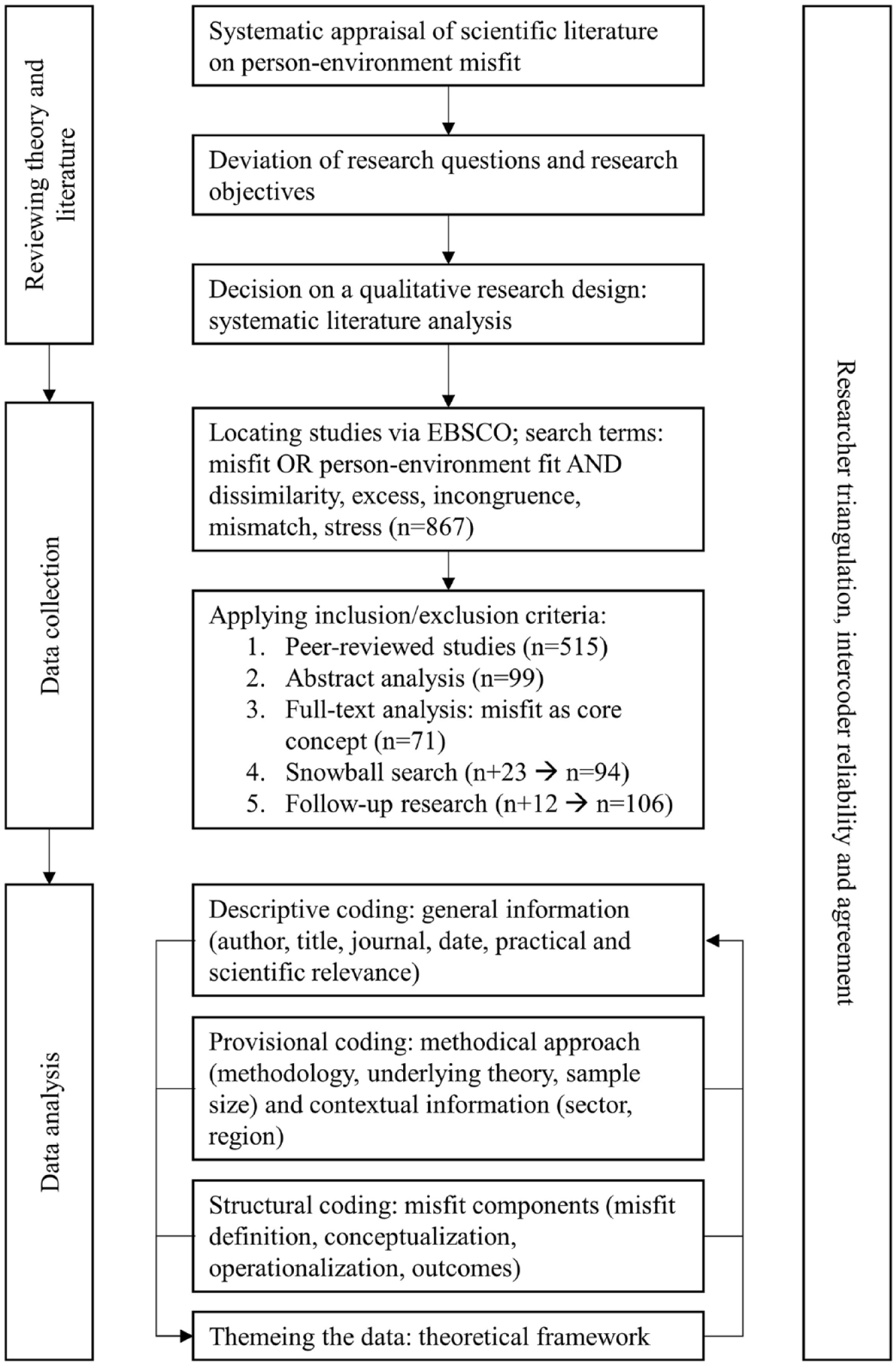
Methodological procedure.
In our initial search of the literature, we included potential synonyms for misfit to broaden the literature base and allow inclusion of research where scholars did not refer directly to the term “misfit” despite conceptually capturing it. For instance, “excess” is a term used in many quantitative P-E fit studies (Kristof-Brown et al., 2005), implicitly referring to situations of misfit where individual supplies exceed organizational demands (Edwards and Cooper, 1990). Using search terms such as “misfit OR person–environment fit AND dissimilarity, excess, incongruence, mismatch, stress” yielded 867 articles, of which 515 were peer-reviewed articles. We subjected these articles to a detailed screening of the abstracts to ensure that the research speaks to P-E misfit. For example, during screening we excluded articles that focused on misfit between an organization and its environment or institutional system. The screening process reduced our sample to 99 articles. We then conducted a full-text analysis on this set of articles using two content-related inclusion criteria. We retained articles that (1) defined and conceptualized misfit (e.g. Follmer et al., 2018) or (2) explicitly elaborated on misfit as a distinct phenomenon even when referring to related terms (like incongruence or mismatch) when drawing from P-E fit theory (e.g. Gabriel et al., 2014). The two applied inclusion criteria allowed us to explore research distinct from the predominant P-E theorizing, without ignoring studies that primarily build on P-E fit. With this step, we narrowed our set of articles to 71. Finally, based on our reading of the full texts, we applied a snowball and follow-up search of related articles. The snowball search helped identify articles not captured in the EBSCO database. The follow-up search ensured covering studies using concepts not initially identified, but relevant in the context of misfit research (e.g. over- and underqualification; Sim and Lee, 2018). This step resulted in a final sample of 106 articles (conceptual: n = 15; qualitative-empirical: n = 6; quantitative-empirical: n = 85; period: 1981–2021).
Our analysis incorporated a four-step approach (see Figure 1). First, we assessed the articles using three coding steps (Saldaña, 2013). We (a) categorized articles descriptively to outline the studies’ characteristics (author information, journals, practical and scientific relevance). We (b) provisionally coded all articles to systemize methodological approaches, theoretical specificity, sample sizes, and organizational contexts (study locations: sector, region). In the last coding step, we (c) structurally coded our sample with respect to misfit definitions, conceptualization approaches, operationalizations, and misfit outcomes. Afterwards, we applied the “themeing the data” technique whereby we interpreted our code system through continuous discussions with the author team during this process. We then aggregated the codes to overarching themes to develop our theoretical framework on misfit concepts, outcomes, and dynamics. Throughout this phase, we iteratively went back and forth to the first step, enabling us to delineate coherences and infer research gaps. To increase intercoder reliability, we continuously discussed inconsistencies and discrepancies until agreement was achieved (Campbell et al., 2013; O’Connor and Joffe, 2020).
Results
To provide a better understanding of the research field, we present the characteristics of the 106 assessed articles based on (1) the historical development as a research field, (2) the applied research design, (3) the distribution among journals, (4) the regional and sectoral focus, and (5) the theoretical foundation of the studies. The histogram depicted in Figure 2 shows that misfit research received relatively little attention for almost 30 years: only 35 out of the 106 identified articles (33%) were published between 1981 and 2010 suggesting that misfit research has intensified in recent years (see supplemental material). The early misfit research was predominantly comprised of causal and descriptive empirical studies (typically quantitative; see Zikmund et al., 2013). 1 In the past 10 years, conceptual (n = 7; 6.6%) and exploratory empirical studies (n = 4; 3.8%; typically qualitative) have contributed to the theoretical density and a better conceptual understanding of misfit.
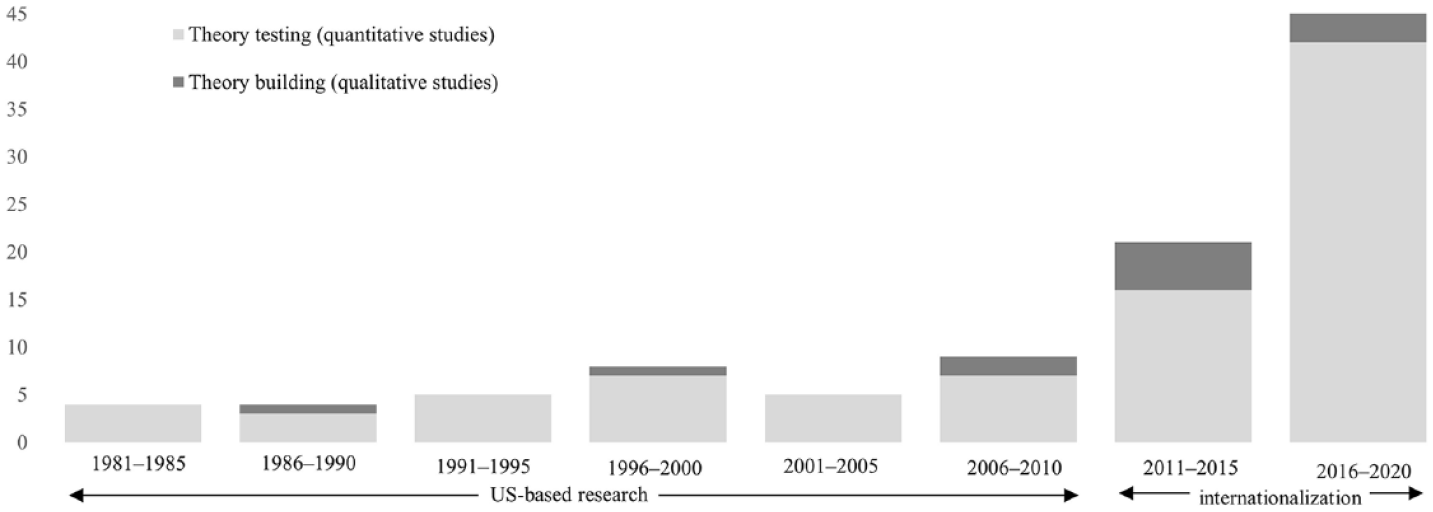
Articles by period, epistemological perspective, measurement approaches, and region.
The distribution of articles across journals indicates misfit’s embeddedness in organizational behavior research. The outlets cover a broad spectrum, from journals focused purely on work psychology to management-oriented outlets. The most represented journals in our sample are: Journal of Organizational Behavior (n = 9), Academy of Management Journal (n = 7), European Journal of Work and Organizational Psychology (n = 7), Journal of Applied Psychology (n = 7), and Human Relations (n = 5). Regionally, the studies concentrate largely on North America (USA: n = 43; Canada: n = 3). There has been greater internationalization in the last 10 years, with studies conducted in Europe (Netherlands: n = 5; UK: n = 5; Belgium: n = 4; Germany: n = 2; Spain: n = 2; Switzerland: n = 2; Austria: n = 1; France = 1; Italy: n = 1; Turkey: n = 1) and Asia (China: n = 10; Singapore: n = 3; South Korea: n = 4; Pakistan: n = 1; Taiwan: n = 1). This geographic distribution reflects the desire to improve the generalizability of findings across different countries and cultures. Concerning the studied sectors, the descriptive picture is quite diverse. While 15 studies do not report a specific sector (e.g. Naus et al., 2007), the others report a diversity of sectors (e.g. university, employment security office, IT, private equity, automotive, restaurants, hospitals, healthcare, insurance, breweries, manufacturing, construction, aerospace, tourism and hospitality, and telecommunications). Concerning the articles’ theoretical foundations, most research is situated in the P-E theory (n = 87) or Schneider’s attraction–selection–attrition (ASA) framework (n = 7). Other theoretical perspectives are mostly applied as an additional perspective and receive only sporadic interest (e.g. leader–member exchange (LMX): n = 4; cognitive appraisal theory: n = 3; social identity theory: n = 2). The descriptive results reported above and our analysis of the misfit literature highlight two distinct perspectives in how misfit is conceptualized.
Conceptualizing and measuring misfit relative to fit
In the first perspective, predominantly pre-2007 (see Figure 2) but continuing sporadically into the present, misfit is operationalized and measured in a static manner, applying quantitative designs based on cross-sectional data. Those studies typically applied proxy measures for singular dimensions such as P-J misfit at a specific point in time and used P-E fit theory or ASA as theoretical underpinnings.
In our analysis, we identified three different ways misfit has been conceptualized and measured in this literature as shown in Figure 3: (1) deviation from fit (n = 83), (2) opposition to fit (n = 5), and (3) absence of fit (n = 7). In the following section, we note a fourth perspective: misfit as dynamic trajectory (n = 13), which draws upon these conceptualizations but does so from a temporal perspective.
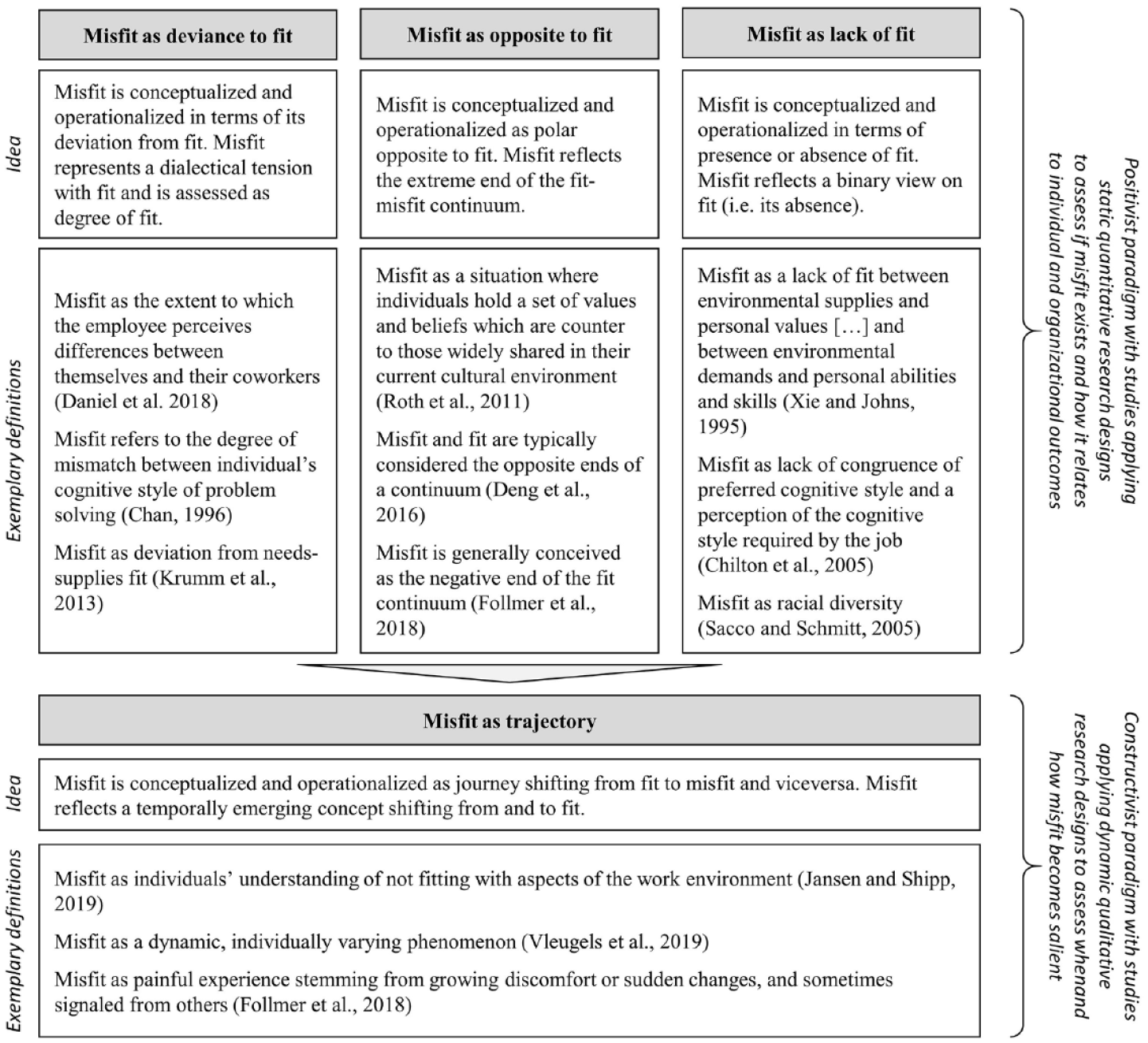
Role of fit, time, epistemological paradigms, and measurement approaches in misfit conceptualizations.
The first two conceptualizations of misfit (deviation from and opposite to fit) are both in relation to fit and presume a continuum along which a person and environment align or differ (Stich et al., 2019). Whereas fit focuses on the compatibility between individuals and their environment (Edwards, 2008; Kristof-Brown et al., 2005; Van Vianen, 2018), misfit research focusing on the deviation from fit examines when the person exceeds environmental characteristics, or the environment exceeds the individual qualities (Jansen and Kristof-Brown, 2005; Shaw and Gupta, 2004), for example, organizational supplies falling short of personal needs (Erdogan et al., 2020; Tepper et al., 2018). This conceptualization of misfit requires a conscious reflection on or comparison to fit, indicating some degree of deviation from fit along the continuum (Krumm et al., 2013). Conceptualizations of misfit as the opposite to fit see fit and misfit as the extremes or endpoints of the continuum (Roth et al., 2011). Misfit here is seen as polar opposition to fit, such as in the case of individuals being either value congruent or incongruent (neglecting potential nuances between these endpoints). The third conceptualization of misfit is as an absence of fit or a lack of fit (Xie and Johns, 1995). This research tends to dichotomize fit from misfit, such as indicating the presence or absence of demographic fit (Sacco and Schmitt, 2005) or how contemplations about fit and misfit originate from workplace changes (Klag et al., 2015).
Despite the conceptual differences between these three perspectives, scholars often apply similar measurement strategies. Most research measures misfit in a static manner by applying quantitative methods using cross-sectional data. Hence, researchers following a positivistic approach (n = 52) operationalize misfit by taking either objective (n = 18; two independent data points are collected for the person and the environment, and misfit is measured as their deviation, e.g. Brenninkmeijer et al., 2018) or subjective measurement strategies (n = 34; the person evaluates both personal characteristics and characteristics for the environmental variable; e.g. Bermiss and McDonald, 2018). In these studies, misfit is mainly analyzed using polynomial regressions and response surface analysis. A smaller set of articles employs a constructivist approach (n = 32) capturing misfit directly via perceived measures (e.g. Liu et al., 2015). In this research, study participants evaluate their perceived deviation from their environment. All of these studies apply proxy measures for singular dimensions such as person–job misfit at a specific point in time. Their value is in taking a snapshot of misfit to assess antecedents and consequences aligning with misfit at the same time.
Conceptualizing and measuring misfit as distinct from fit
Another view of misfit emerged more recently, conceptualizing and measuring misfit as mismatch perceptions related to a dynamic work environment (Cooper-Thomas and Wright, 2013). This perspective is characterized by a more holistic and temporal view of misfit (Jansen and Shipp, 2019; Klag et al., 2015) playing out across various dimensions (Follmer et al., 2018) and drawing upon a broader range of theoretical perspectives (e.g. sensemaking theory, regulatory focus theory, implicit person theory, and self-determination theory). Corresponding with this shift, a newer conceptualization, misfit as dynamic trajectory, is an emerging view employed by only a few studies (n = 13) to date (for a recent review of fit dynamics, see also Vleugels et al., 2023). In contrast to the other conceptualizations, here misfit is perceived as something qualitatively different from fit (Bittel and Ramsey, 1983; Miller and Cunnigham, 1981; Vleugels et al., 2019). This research describes misfit as a direct perception of mismatch regarding a salient dimension in the work environment (Cooper-Thomas and Wright, 2013). According to this conceptualization, individuals experience situations or states of “not fitting” into the environment (Jansen and Shipp, 2019; Wheeler et al., 2007). Studies following this approach explicitly deviate from more traditional approaches by adopting a holistic view, where misfit constitutes a salient perception of mismatch (Follmer et al., 2018). Other scholars suggest that misfit is a temporal phenomenon that develops over time (Jansen and Shipp, 2019; Shipp and Jansen, 2021; Vleugels et al., 2019; Vogel et al., 2020). For example, Talbot et al. (2007) emphasize the instability of misfit (and fit), indicating that both result from different antecedents and, thus, likely constitute a distinct concept. Furthermore, Jansen and Shipp (2019) identified a variety of misfit “journeys”, indicating that misfit does not merely “occur” in any given moment. Instead, it may accumulate, resolve itself, or threaten one’s identity with both the passage of objective (i.e. clock) time and subjective retrospection and anticipation. Moreover, in their longitudinal study collecting weekly measures of fit and misfit, Vleugels et al. (2019) question the assumption of fit and misfit as dichotomous categories. They emphasize the dynamic, individually varying nature of misfit. Finally, Gabriel et al. (2014) found that misfit develops in line with individuals’ emotional states, suggesting that misfit experiences are likely embedded in complex emotional processes. Even though research following this conceptualization offers relevant insights concerning misfit development and coping, essential questions remain unanswered, primarily given its recent emergence.
Antecedents and outcomes of misfit: A multi-level framework
Our literature analysis shows that individuals’ misfit is relevant for and has implications on four different analytical levels. In addition to the frequent focus on the (1) individual level (intra-individual and work-related), misfit research addresses (2) the interpersonal level, (3) the organizational level, and (4) the external environment. Our review identified two significant points regarding levels of analysis that are particularly relevant to misfit, resulting in a deviation from common multi-level frameworks (e.g. Follmer and Jones, 2018). First, while employees face misfit in the work environment, this also affects their private lives. Thus, we also accounted for the extra-organizational domain (i.e. the external environment), apparent in the literature (e.g. Edwards and Rothbard, 2000). Second, misfit experiences and consequences relate to underlying intra-personal processes (e.g. Klag et al., 2015). Thus, we differentiate the individual level into work-related and intra-individual processes. Incorporating these two separate (yet related) aspects is relevant for a holistic understanding of antecedents and outcomes of misfit (Gabriel et al., 2014). In addition, this differentiation allowed a more fine-grained systemization.
Thus far, the literature lacks studies addressing the antecedents of misfit and applying it as a dependent variable. Instead, scholars primarily equate misfit with respective trigger events concerning four levels: (1) individual (e.g. person–job), (2) interpersonal (e.g. person–person), (3) organization (e.g. person–organization), and (4) the external environment (e.g. person–extra-organization). After disentangling these levels, we observed that job-related misfit analyses dominate the literature. Thus, the majority of studies addresses misfit related to the (1) individual level (i.e. the job). While less pronounced, we observe a high share of studies focusing on the (2) interpersonal level. Still, the review also highlights that both the organizational level and the level of the external environment were studied much less. Specifically, we find limited attention for the organizational level and a prominent blind spot related to the external environment.
First, scholars explicitly highlight high job complexity (Shaw and Gupta, 2004), missing functional expertise (Chen and Hambrick, 2012), or misfit regarding the job type (Furnham and Schaeffer, 1984) as antecedents of misfit. Moreover, scholars elaborate on a low level of control (Ramsey and Etcheverry, 2013; Rijk et al., 1998), deviating personal values concerning job characteristics (Song et al., 2020; Van Den Ouweland and Van den Bossche, 2017), fundamentally incongruent work conditions (Kim et al., 2021; Yang et al., 2008), or a lack of meaningfulness (Vogel et al., 2020). Moreover, several studies presume a deviation between demands and abilities (Chi et al., 2020; Gabriel et al., 2014; Turnipseed and VandeWaa, 2020; Vleugels et al., 2018) or between needs and supplies as the roots of misfit (Chi et al., 2020; Giauque et al., 2014; Vleugels et al., 2018; Yu and Davis, 2016). Lastly, over- (Angrave and Charlwood, 2015; Arvan et al., 2019; Erdogan et al., 2020; Wu et al., 2017) and underqualification are examined as core triggers of misfit (Sim and Lee, 2018). Second, on an organizational level, the mismatch between personal and firm-level values represents the core misfit antecedent assessed in current research (Cable and De Rue, 2002; Deng et al., 2016; Maruping et al., 2019; Naus et al., 2007; Spanjol et al., 2015; Vleugels et al., 2019; Yu and Davis, 2016). Third, concerning interpersonal misfit, studies focus on individuals’ incongruence with respect to sociodemographic characteristics (age, race, and sex; David et al., 1999; Etzion, 1988; Sacco and Schmitt, 2005; Zhang et al., 2012). Moreover, a divergent ideology (Daniel et al., 2018), value incongruence (Doblhofer et al., 2019; Vandevelde et al., 2020), or competitive climate (Fletcher et al., 2008) among coworkers result in misfit. Lastly, supervisor misfit arises owing to a deviating pacing style (Oh et al., 2020), differing expectations in terms of leadership behavior (Lambert et al., 2012; Tepper et al., 2018), or psychological distance between supervisor and employees (Meirovich and Goswami, 2021).
Given these elaborations, the misfit research landscape exhibits several blind spots. First, intra-individual, organizational, and interpersonal factors only receive selective attention. Second, misfit has rarely been assessed as a distinct dependent variable. This is surprising since such analyses are vital to illuminate and better understand the misfit trajectories. Finally, studies lack industrial and cultural embedding. As a result, which professional fields and cultures are prone to misfit remains unclear.
Regarding the impact of misfit, we find 85 articles addressing at least one outcome variable of misfit along the different analytical levels. As depicted in Figure 4, most studies examine individual work outcomes, while others incorporate outcomes and moderators on the intra-individual level, interpersonal level, organizational level, and other life domains (“external environment”). We characterize the research at these various levels below.
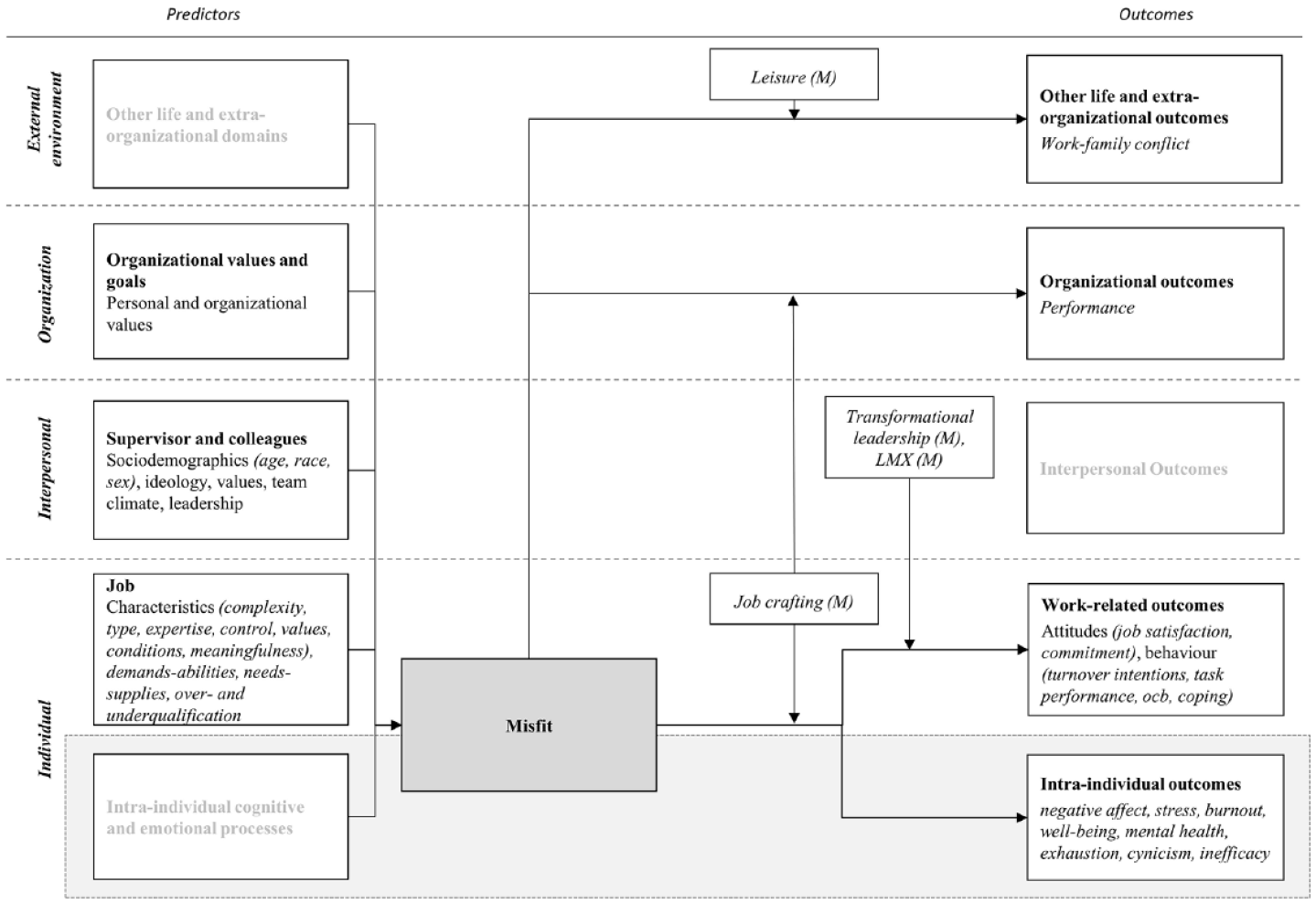
Predictors, moderators, and outcome variables in quantitative misfit research.
Level 1a: Individual work outcomes
Most studies focus on misfit at the individual level and, thus, assess individual work outcomes. When considering employees’ attitudes, research focuses on job satisfaction because misfit seemingly leads to job dissatisfaction (Furnham and Schaeffer, 1984). Dimensions of misfit related to job dissatisfaction vary across the analyzed studies, with most studies addressing P-J misfit. However, job satisfaction seems rooted in all dimensions of P-E fit (e.g. person–group (P-G) fit: Jansen and Kristof-Brown, 2005), and scholars often use multidimensional measures (Kreiner, 2006; Yu and Davis, 2016). Second, scholars address misfit’s impact on commitment, primarily focusing on P-G misfit (Daniel et al., 2018; Doblhofer et al., 2019; Maruping et al., 2019). Indeed, misfit on the level of teams or communities decreases individual commitment, indicating disconnectedness with colleagues. Further studies apply P-J fit (Sim and Lee, 2018), P-O fit (Doblhofer et al., 2019; Fletcher et al., 2008), as well as a multidimensional approach (Giauque et al., 2014). In particular, organizational climate constitutes perceptions of misfit, which translate into decreasing commitment (Fletcher et al., 2008). Third, scholars addressed turnover intentions. The idea that “misfits” tend to leave an organization to cope with misfit experiences is well established (Schneider, 1987a). The mixed and inconclusive results indicate that misfit does not predict turnover intentions as expected. For instance, Sim and Lee (2018) show that P-J misfit translates to turnover intentions. Wheeler et al. (2007) indicate that misfit with the organization does not always lead to turnover intentions. Qualitative research suggests that leaving an organization requires complex decisions (Follmer et al., 2018). Several factors affect turnover decisions resulting in complex thought processes (Klag et al., 2015). For instance, anticipating positive changes reduces the likelihood of turnover (Jansen and Shipp, 2019).
For behavioral work outcomes, scholars find that misfit relates to individual performance. For P-J misfit, studies provide evidence for reduced performance (Chilton et al., 2005; Ramsey and Etcheverry, 2013). Furthermore, P-O misfit (e.g. value incongruence) predicts lower performance, for instance, task performance (Vogel et al., 2016). Whereas early research indicates no correlation between misfit and performance (Chan, 1996), more recent studies suggest that misfits tend to perform lower than other employees (Doblhofer et al., 2019). Still, current research does not account for the theoretical mechanisms linking misfit and performance.
Furthermore, misfit reduces organizational citizenship behavior (OCB), indicative of lower levels of employee proficiency (Doblhofer et al., 2019). OCB is particularly crucial for a functioning organization and group-level processes. Given that OCB is a voluntary behavior, misfit seems to result in decreased work morale (Tepper et al., 2018). Thus far, research approaches OCB and misfit focusing on the dimensions of P-O misfit (Doblhofer et al., 2019; Vogel et al., 2016) and person-supervisor misfit (P-S misfit) (Tepper et al., 2018). In addition, misfit is found to be related to absenteeism (Doblhofer et al., 2019; Furnham and Walsh, 1991). These findings indicate that those individuals experiencing misfit may try to avoid confrontation with the undesired circumstances causing misfit.
Most research articles focus on turnover, either from the perspective of P-O misfit or multidimensional P-E misfit, and are based on the premise that misfits tend to leave (Schneider, 1987a). Misfit does not unequivocally predict actual turnover (Follmer et al., 2018). Instead, turnover seems to be the last resort for individuals facing extreme misfit experiences (Bermiss and McDonald, 2018) or failing to cope with misfit (Follmer et al., 2018; Jansen and Shipp, 2019). Still, some studies suggest that misfit predicts turnover if examining misfit and turnover at different points in time (Boon and Biron, 2016; Chan, 1996; Follmer et al., 2018).
In response to misfit, scholars incorporate coping and defense strategies as a relevant work-related outcome. It is assumed that misfit experiences are related to individual reactions aimed at resolving the problem. For instance, Follmer et al. (2018) show that individuals who experience misfit apply coping (such as resolution and relief-seeking) and defense strategies (such as resignation). These findings indicate that once aware of their misfit, employees attempt to cope with their situation or submit to fate instead of immediately fostering turnover (Devloo et al., 2011; Yu and Davis, 2016).
Work outcomes are examined not only in terms of direct relationships with misfit. Accordingly, coping is a viable moderator, as it decreases the adverse effects of misfit (Rijk et al., 1998; Sánchez-Cardona et al., 2020; Vleugels et al., 2019); the same holds for leisure activity (Vogel et al., 2016). Furthermore, transformational leadership and LMX are significant moderators between misfit and work outcomes, with both able to buffer adverse effects (Boon and Biron, 2016; Sim and Lee, 2018; Tepper et al., 2018; Zhang et al., 2012).
Level 1b: Intra-individual outcomes
Misfit ultimately constitutes individual experiences related to cognitive and emotional processes. That is, even if scholars examine misfit in terms of objective deviations between individual and environment, outcomes on the mental level can be expected. To this end, scholars examined how misfit relates to (1) stress and strain, (2) negative affect, and (3) mental illness and health more broadly.
First, stress and strain have been a prevalent outcome studied, with misfit examined as deviations between the individual and one or more aspects of the work environment (Blau, 1981), which are presumed undesirable because they indicate painful experiences (Follmer et al., 2018). Such experiences are defined as stressors because they pose a threat. Further studies explicitly address P-J misfit (Stich et al., 2019; Sturman and Walsh, 2014; Xie and Johns, 1995). Overall, misfit relates to stress and psychological strain. However, the relationship depends heavily on the measurement approach, resulting in inconclusive implications.
Second, studies incorporate the relationship between misfit and affect, accounting for psychological processes (Gabriel et al., 2014). In line with the focus on misfit experiences, these studies propose affect to be the primary driver of individual perceptions (Tepper et al., 2018). The articles point to different possible relationships between misfit and affect (Vleugels et al., 2018). Early research suggests that misfit experiences trigger negative affect. More recent approaches consider the possibility of synchronous relationships, providing evidence for a synchronous connection. Negative affect and misfit do not seem to follow the “effortful and complex process of comparing and contrasting change in P and E elements” (Vleugels et al., 2018: 1077). Instead, misfit experiences are rooted in relatively immediate experiences in the workplace. However, the present research does not offer conclusive insights.
Finally, scholars also broadly focus on mental illness and health. Concepts such as burnout (Etzion, 1988; Rijk et al., 1998; Tong et al., 2015), well-being (Shaw and Gupta, 2004; Stiglbauer and Kovacs, 2018; Yang et al., 2008), and mental health (Furnham and Schaeffer, 1984) received attention. Research on mental health primarily addresses the dimension of P-J fit, with one study also incorporating P-O fit (Tong et al., 2015). The studies provide evidence for the negative impact of misfit experiences on mental health, for instance, by increasing the likelihood of burnout (Rijk et al., 1998). For example, Tong et al. (2015) show that misfit translates to increased exhaustion, cynicism, and inefficacy.
Level 2: Interpersonal outcomes
While research addresses misfit on the interpersonal level (supervisors and colleagues), for instance, through a P-G misfit or P-S misfit lens, we did not find a single study examining interpersonal misfit outcomes like missing team cohesion or low LMX. We elaborate on the need for such studies in the discussion.
Level 3: Organizational outcomes
Few studies address organizational outcomes originating from organizational misfit (regarding organizational values and goals). These studies examine how P-O and P-J misfit of executives affects organizational performance (Chen and Hambrick, 2012). Given that supervisors and executives profoundly impact organizations, it is not surprising that misfit experiences cause adverse effects. This cross-level effect implies that individual misfit affects organizations if the employee has a central and impactful position. Thus far, no studies address misfit of less prominent employees or the impact of misfit in groups or departments.
Level 4: External environment
Similar to the organizational level, only a few studies address outcomes outside the workplace. As misfit experiences cause stress and psychological strain and affect mental health, other life domains are also affected. This includes concepts such as work–family conflict (Kreiner, 2006; Sturman and Walsh, 2014), related to some misfit experiences. Given the ubiquitous research endeavors on mental outcomes, the relatively few efforts to explore consequences outside work environments are surprising.
Discussion
An integrative definition of misfit
Our systematic literature review shows that previous approaches to misfit vary in scope (holistic versus specific misfit) and breadth (dynamic versus static misfit). Although differences in existing misfit conceptualizations are apparent, uncovering hidden assumptions allows for an integrative understanding of misfit. The conceptualizations of misfit as deviation from, opposite to, and absence of fit, all suggest a direct relationship between fit and misfit on a continuum. Integrating this perspective with the recent conceptualization of misfit as dynamic trajectories, suggests that the link between fit and misfit is not simply a linear continuum; rather, it follows diverse journeys moving dynamically from fit to misfit and vice versa (for a recent review of fit dynamics, see Vleugels et al., 2023). To synthesize these perspectives and provide an integrative conceptualization of misfit devoid of any particular methodological approach, we offer the following definition: Misfit is the recognition of misalignment with one or more aspects of the environment experienced in moments, as events occur, or as situations evolve.
This definition highlights several important conceptual clarifications. First, recognition of misalignment acknowledges cognitive awareness of incongruence (see “tight shoes”; Jansen and Shipp, 2019: 1169), without making any attribution about whether misfit is desirable (e.g. Ostroff, 2012) or undesirable (e.g. Wheeler et al., 2007). Recognition is important because individuals may not become aware of the extent of misfit without reflection or a contrasting situation. Second, the trajectory by which misfit evolves acknowledges that misfit can be more than the moment of recognition; it is also a process that may (a) include a consideration of past, present, and future, (b) be short-lived and intense (i.e. sudden and sharp), or (c) gradually accumulate or diminish over time. Third, misfit can be described as a trajectory by which it evolves across objective and subjective time – reflecting both momentary and accumulating experiences of misfit. This definition also acknowledges that misfit can occur at multiple aspects and levels of the environment. Finally, it is worth noting that, in contrast to the homogeneity assumption of the ASA framework (Schneider, 1987b), our definition acknowledges that subjective intra-individual misfit can exist even in the presence of objective congruence (i.e. measuring the person and environment separately).
A research agenda for studying misfit
The integrated definition of misfit above and the multi-level framework provided in Figure 4 highlight significant blind spots in the currently fragmented literature. Building on the integrated definition and insights obtained during the review, we outline several avenues for future research within three overarching themes.
Incorporate temporality and dynamism in studying misfit
Most of the prior research captures misfit at only one point in time, emphasizing misfit in the moment and disregarding the developmental and dynamic nature of the concept. Despite the dominance of static approaches, and because it remains unclear why some individuals deviate from what is expected in traditional fit theory (Shipp and Jansen, 2011), there are several opportunities for studying misfit as a temporal and dynamic phenomenon (e.g. as a trajectory; Vleugels et al., 2018, 2019).
First, our review recognized several studies highlighting the importance of underlying processes of misfit that play out over time, such as complex cognitive and emotional processes (see Gabriel et al., 2014). However, misfit research lacks theoretical integration accounting for what happens “below the surface”. We encourage further research examining the underlying subjective experience of misfit within subconscious processing and intra-individual perceptions. For example, the cognitive perspective on stress grounded in psychological research (Lazarus, 1982; Lazarus and Folkman, 1984) is well suited to explain why different misfit experiences can mean different things depending on who faces them. Furthermore, contemporary appraisal theories may help to explain how misfit unfolds within emotional processes and provide a more nuanced understanding of various individual reactions to misfit (Moors et al., 2013).
Second, some process-based research has provided initial evidence that individuals may experience various journeys through misfit and have a temporal zone of tolerance of misfit over time before reaching a threshold requiring action (Jansen and Shipp, 2019). However, additional research is needed to better understand the dynamics of misfit episodes and journeys, such as when and why they unfold, and how long they are tolerated or endured. For example, future research can examine additional journeys that may occur, the factors predicting the length of time an individual endures various types of misfit, and further details characterizing the process that occurs once the temporal zone of tolerance has been exceeded. In this vein, further interpretive research (Smith, 2019; Smith and Osborn, 2011) may be particularly useful. Overall, there are many opportunities for increasing our understanding of the dynamic processes associated with misfit over time.
Third, future studies should extend our understanding of the subjective interplay between fit and misfit in terms of how and why individuals subjectively recraft (Shipp and Jansen, 2011) their perceptions of retrospected and anticipated (mis)fit, especially in the short term (Gabriel et al., 2014; Vleugels et al., 2018). Since misfit occurs sporadically and experiences are often triggered by specific environmental changes or events (Klag et al., 2015), research is needed to observe and examine participants’ immediate reflections from a psychological time perspective to better account for the fluctuations in evolving misfit experiences. Experience-sampling methods (Fisher and To, 2012; Uy et al., 2010) can be used to capture these short-term misfit-related experiences. Trajectories can also be particularly helpful for tracking long-term fluctuations over time, including misfit journeys and longer-term employment histories and misfit experiences. This longer-term data may provide insight into why individuals react differently to misfit experiences and determine whether trigger events form misfit perceptions in an additive (as suggested by the fit–misfit continuum) or multiplicative manner. Sequence analysis can be used to capture the impact of patterns in work lives (Aisenbrey and Fasang, 2009; Biemann and Datta, 2014) preceding or following misfit experiences.
Finally, additional temporal dynamics regarding early misfit experiences and historic misfit have been broadly unexplored, yet they likely shape how individuals interpret later work experiences. For example, early career misfit experiences are often “treated” (Vleugels et al., 2023; Wilk and Sackett, 1996) or socialized away. We also lack insights regarding the forgetting (see Bauer, 2015) of both retrospected and anticipated misfit. Understanding why individuals suppress or forget misfit experiences or when exactly misfit is (un)consciously experienced remains unclear. We suggest applying longitudinal qualitative research, such as repeated interviews that follow considerable parts of individual careers and work histories. Such research designs receive broad attention in medical research addressing individual experiences and coping in the light of illness (Calman et al., 2013). A longitudinal approach can provide insights into the basic mechanisms (i.e., the underlying cognitive and emotional processes that drive misfit trajectories) and exploring meaningful variation at the interpersonal level.
Increase theoretical and empirical density of misfit research
Although empirical misfit research has accelerated in the last 10 years, our review revealed that most causal misfit studies (theory testing) focus on immediate conditions and outcomes and the need to cope with these circumstances, both only at the individual level. Yet, the theoretical underpinnings of misfit research often originate from other analytical levels, such as the ASA model’s emphasis on organizational homogeneity over time (Schneider, 1987b). Our review indicates that, despite conceptually being situated on several analytical levels, contemporary misfit research exhibits a strong tendency to focus on the individual and interpersonal level. We observe a lack of research focusing on the organizational level and the external environment. In addition, the field also lacks insights on cross-level mechanisms.
The first way to improve the theoretical and empirical density of misfit research is to examine cross- and multi-level misfit, accounting for the complexity of organizations and workplaces. For instance, in coping with change in the organizational environment, employees engage in activities such as short-term negotiations or longer-term job crafting, which likely affect coworkers and supervisors. These potential cross-level effects (e.g. Cialdini et al., 2021) can be studied by focusing on group communication and meetings (Kauffeld and Lehmann-Willenbrock, 2012; Lehmann-Willenbrock and Allen, 2014). It is intriguing to consider how those experiencing misfit alter communicative behavior and affect team-level and individual-level outcomes of co-workers. Similarly, it may shed light on how social or organizational support can affect misfit journeys and outcomes across analytical levels. Similarly, organizational performance may suffer or even benefit from individual misfit depending on the individual’s position in the workplace network. Modern research designs, for example, applying qualitative comparative analysis (QCA; Mello, 2021) allow for an examination of how misfit manifests across different environmental dimensions (e.g. across teams or organizations) over time. Misfit is not an outcome of a single predictor. QCA can help to account for such interacting antecedents and cross-level effects. Overall, we encourage researchers to study the cross-level and multi-level aspects of misfit.
Second, research is also needed on the desirable aspects of misfit to counteract the overemphasis on adverse outcomes. By constantly focusing on the negative consequences of misfit while simultaneously implicitly recognizing fit as a positive outcome (i.e. in hiring for fit and assimilating employees to fit), are we inadvertently creating a self-fulfilling prophecy that misfit is undesirable and without benefit? Research acknowledges that misfit is not inherently negative (Grant, 2016), and practice suggests it can be both valued and productive (e.g. Apple’s “crazy ones”; IBM’s “wild ducks”, diversity in culture and experience). 2 Even if misfit were viewed as an undesirable experience in a single moment, research also suggests that coping processes ultimately lead to productive solutions and personal growth (Follmer et al., 2018; Jansen and Shipp, 2019). Given that those experiencing misfit may remain in the organization over time, it would be helpful to explore productive outcomes of misfit, such as innovative energy, supportive behavior, and increased resilience to adverse situations. Moreover, by studying constructive aspects of misfit, we may discover new ways to transform negative experiences into positive ones and better understand how misfits as mavericks (see Jones et al., 2016) help to foster innovation and enhance organizational culture.
Finally, research is needed to further distinguish misfit from fit, including the various conditions and durations of misfit, ranging from productive misfit, recognition of misfit, or long-tolerated undesirable misfit. In so doing, we can also further the distinctions between fit and misfit. For example, misfit experiences are often characterized as highly salient and painful (Follmer et al., 2018) and tend to constitute a threat. These high-impact experiences indicate a clear distinction from fit. As recent research suggests, individuals often start contemplating fit in the presence of misfit experiences (Klag et al., 2015) or the “tight shoes” phenomenon (Jansen and Shipp, 2019). To further distinguish between perceptions of fit and misfit, we need to first improve our understanding and measurement of perceived misfit and then design research that examines both simultaneously to better understand their influence and temporal interplay.
Integrate misfit with contemporary societal challenges
Much of the research conducted on fit and misfit tends to focus on employees (mis)fitting within their organization. Yet, as ASA theory (Schneider, 1987b) suggests, micro-level actions can generate change at the macro-level. Therefore, we consider several organizational and extra-organizational dynamics that should be incorporated into future misfit research.
First, factors that bring about, mitigate or buffer misfit seem promising (see Vogel et al., 2016). We particularly recommend focusing on strategies that foster productive problem-oriented coping, such as organizational support systems and Employee Assistance Programs (EAPs). These initiatives may help to prevent the development of adverse misfit experiences in the first place (Follmer and Jones, 2018). Thus, future research should examine the potential impact of policies and resources provided by organizations. Intervention studies seem well suited to address the impact of training that promotes a proactive approach to misfit experiences (e.g. mindfulness).
Second, in contrast to employee-focused coping with misfit, studies that examine organizational coping with misfit are needed. The COVID-19 pandemic and digital transformation have clearly shifted not only the location of work, but also ways of working. Some organizations have embraced these new ways of working, others have taken a hard line on “returning” to the office, and still others continued to work without any significant changes from the past. These various categories of experience have generated new types of misfit, making for some complex arithmetic to determine who fits (and with what) and who does not. Organizations have been pushed into new ways of making accommodations, negotiating alternative work arrangements, and coping with the fallout for misfits who flat-out resign. As a result, greater attention to developing organizational resilience in the face of large-scale misfit is encouraged.
Third, as mentioned earlier, misfit has traditionally been viewed as a negative experience, and the quest for “good fit” may have hampered our ability to embrace diversity. If we can break the tie between fit and misfit, perhaps we can begin to celebrate our differences rather than socializing these differences out or requiring the individual to be the one to change. If misfit was the productive goal, how might organizations change their values or practices (e.g. recruitment, selection, and socialization)? When and under what conditions can misfits generate positive outcomes?
Finally, misfit research can be expanded to consider broader societal trends. For example, flows of refugees are increasing owing to political and ecological crises, skilled worker shortages abound, and in each case, new forms of misfit are besetting organizations. From a socio-political perspective, this is often the purview of integration research. However, it is also relevant from a misfit perspective in terms of how and when organizations anticipate, recognize, and respond to these new and unpredictable forms of misfit. Overall, by liberating misfit from the P-E fit literature, an abundance of opportunities for addressing grand challenges and significantly changing the experience of misfit are presented.
Conclusion
In the past 30 years, research examining misfit has proliferated, and in that time, theoretical assumptions, conceptualizations, and operationalizations have continued to evolve. Our review synthesizes the variety of theoretical assumptions, conceptualizations, and operationalizations that have been developed, clarifies the distinction between fit and misfit, and provides an integrated definition and future research agenda emphasizing dynamic, perceptual, and multidimensional approaches. Our hope is that this review lays the groundwork for a consistent and conceptually driven approach for studying misfit. We are convinced that future research endeavors will need to leverage subjective, dynamic, and multidimensional approaches to examine momentary and enduring misfit experiences and extend our understanding of the painful and productive aspects of misfit: Here’s to the crazy ones, the misfits, the rebels, the troublemakers, the round pegs in the square holes . . . the ones who see things differently. (Apple, 1997)
Supplemental Material
sj-pdf-1-hum-10.1177_00187267231187751 – Supplemental material for The incongruity of misfit: A systematic literature review and research agenda
Supplemental material, sj-pdf-1-hum-10.1177_00187267231187751 for The incongruity of misfit: A systematic literature review and research agenda by Benedikt Englert, Martin Sievert, Bernd Helmig and Karen Jansen in Human Relations
Footnotes
Acknowledgements
We would like to thank the reviewers for taking the time and effort to review the manuscript. We sincerely appreciate all valuable comments and suggestions, which helped us to improve the quality of the manuscript.
Funding
The authors received no financial support for the research, authorship, and/or publication of this article.

Supplemental material
Supplemental material for this article is available online.
Notes
References
Supplementary Material
Please find the following supplemental material available below.
For Open Access articles published under a Creative Commons License, all supplemental material carries the same license as the article it is associated with.
For non-Open Access articles published, all supplemental material carries a non-exclusive license, and permission requests for re-use of supplemental material or any part of supplemental material shall be sent directly to the copyright owner as specified in the copyright notice associated with the article.
