



Abstract
This article contributes to developing a management and organisation studies perspective on political organising by focusing on: (a) populism; (b) the exercise of political power; and (c) the organisation of politics. We address two questions: in what ways have English populist politicians in the 20th and 21st centuries utilised language along with other aspects of campaign organising to build and enhance their symbolic power? And: how do populist political organisations convert symbolic power into symbolic violence? Drawing on a range of concepts from Pierre Bourdieu’s sociology, most specifically his work on symbolic power, symbolic violence, political ontology and the performativity of language, we conduct a comparative analysis of texts from four waves of right-wing English populism culminating in Brexit. We develop a three-step framework to explain the organisation of right-wing populism via what we term populist political methodology: (1) establishing the symbolic power of the leader and the message; (2) organising power and the division of labour of domination; and (3) reinforcing symbolic violence in targeted sections of society. Understanding how populist politics is organised can support us in resisting, challenging and disrupting right-wing populism, providing lessons for organisations campaigning against racism and xenophobia.
Keywords
Introduction
Given a decade of turbulent politics and political shocks within Europe and beyond, management and organisation studies (MOS) scholars have yet to catch up with the phenomenon of populism in terms of political organising and organisations (Bristow and Robinson, 2018). To address this lacuna, we suggest putting to work tools and concepts developed or adapted within the MOS field in order to understand the workings of symbolic power in these, often new, forms of organisations and organising. Developing such an understanding of political organising is, we believe, particularly pertinent in helping to explain, in organisational terms, the resurgence of right-wing populism in many parts of the world. This success is manifested by Brexit in the UK and the election of Trump in the USA, by Modi in India, Bolsonaro in Brazil and Orbán in Hungary. Of course, scholars in different fields have been attempting to understand this rise of populist politics both locally and globally, and the challenge populists present to established parties and democratic politics (e.g. Albertazzi and Van Kessel, 2021; Revelli, 2019; Thomas and Tufts, 2020). However, extant insights do not address populism from a specifically organisational perspective.
Thus, although populism has become a growing area of interest in MOS since 2016 (see Robinson and Bristow, 2020), MOS researchers, in dealing with politics in general, have tended to focus more on the politics of organising (e.g. Levy and Reiche, 2018) than on the organising of politics (Husted et al., 2022). Similarly, in addressing populism MOS scholars have to date focused on the phenomenon of populist politics (e.g. Barros and Wanderley, 2020; Mollan and Geesin, 2020) rather than on the effects of populism on specific organisations or on the role organising plays in establishing, supporting and developing populist movements. This means that a deeper understanding of how populism – and more broadly, the politics of campaigns and campaigning – is organised has yet to be developed within MOS. To quote Robinson and Bristow (2020: 367), we need to study ‘the organisation of populist movements, looking at political parties as organisations’.
In light of the above, we set out to examine the organisation of populism through addressing the historical successes and failures of right-wing populist movements in one country, England – since England/English is considered the primary national identity by right-wing populists in the UK (see Barnett, 2017) – over an extended time frame. To do this, our study draws on and analyses four English populist campaigns in the 20th and 21st centuries, including the Brexit campaign in 2016 and the vote for the UK to leave the EU, which continues to impact organisations in the UK and those who work in them (Kerr and Śliwa, 2020).
For a theoretical perspective on power and political organising we turn to Pierre Bourdieu, whose key concepts – specifically, fields and forms of capital; field of power; symbolic power and symbolic violence; ressentiment and political representation (Bourdieu, 1991a, 2021) – along with Bourdieu’s thinking in relation to language, organisational power and the performativity of texts, enable us to understand the power of and the interrelationships between both discursive and material elements in organising populism. Following Bourdieu (1989: 23), we define ‘symbolic power’ as ‘the power to make things with words [. . .] the power to consecrate and reveal things that are already there’. Bourdieu (1991b), in discussing how the symbolic power of political texts is mobilised, integrates the insights provided by Austin’s (1962) classic work on speech act theory: that is, words (as speech acts) have material consequences if and only if the conditions of enunciation are ‘felicitous’: that is, the speaker has the legitimate authority – or, in Bourdieu’s terms, symbolic power – to speak those words in that place at that time.
Integrating speech act theory also means we can extend textual analysis beyond the text and consider the conditions of possibility of a text’s production and performance. We can then identify how texts, when delivered by symbolically powerful individuals, have performative effects, resulting in what Bourdieu (Bourdieu and Passeron, 1970) calls symbolic violence: that is, the successful imposition of meanings as legitimate, to the point where the speaker’s vision of the world becomes internalised by individuals and groups, and moves them to action. That is, such symbolically powerful texts, speeches, articles and slogans are in themselves interventions in politics: they encode a vision – or di-vision – of the world as ‘our’ people and nation, and existential threats, and are part of a project to impose this vision of the world onto the world (Bourdieu, 2021). We can therefore argue that adopting a Bourdieusian approach in the analysis of how populism is and has been organised also contributes to developing a MOS lens on political organising that is both timely and pertinent.
Our research is guided by two questions. The first of these is empirical and focuses on the historical and contemporary development of English populism: in what ways have English populist politicians in the 20th and 21st centuries utilised language along with other aspects of campaign organising to build and enhance their symbolic power? To answer this, we analyse a selection of key texts of populist politicians’ speeches in connection with organisational efforts aimed at achieving electoral success that have been adopted in four waves of English populism: the British Brothers League (BBL; 1900–1905); Oswald Mosley’s British Union of Fascists (BUF; 1932–1939); Conservative politician Enoch Powell’s anti-immigration campaigns (1961–1975); and the Brexit ‘Leave’ campaigns (2015–2016), led by elements of the Conservative Party and by the UK Independence Party (UKIP).
Our analysis identifies a range of commonalities across the four waves of English populism while also suggesting that ‘professionalised’ political organising has intensified in recent times, as evidenced by the new professional practices of fund raising, strategic planning and opinion polling, as well as the employment of focus groups and social media. The analysis also provides the empirical background for addressing our second, theoretically oriented question: how do populist political organisations convert symbolic power into symbolic violence? In answering this question, we put forward a theoretical framework explaining the organisation of populist politics. The framework encompasses three steps that lead from a political text to the establishment of symbolic violence: (1) mobilisation of symbolic power by the leader, that is, the one who has the legitimate forms of political capital to address ‘the people’; and (2) establishing organisational power and the division of labour of domination to reinforce the message (the absence of this organisational power explains, in part, Powell’s political failure). Steps 1 and 2 operate in a ‘cycle of mutual reinforcement’ involving the work of political technologists, identifying demographics and designing target messages aimed at giving voice to ressentiment and xenophobia that, in step 3, translate into symbolic violence in targeted sections of society. For right-wing populists, we conclude, symbolic violence is established via what we term populist political methodology, which we define as discursive mobilisation of the dual threat to ‘us’ (i.e. our people and nation) from aliens and elites.
In advancing the application of Bourdieu’s work within MOS (see Maclean et al., 2017), the article also generates methodological contributions through a historically contextualised textual approach, and theoretical contributions through insights into power, domination and language. In practical terms, our framework, which offers an alternative view of populism compared with the people/elite theories of populism (Mouffe, 2018), helps explain the difficulties facing the organisation and mobilisation of left-wing populism. Given that MOS has hitherto not paid much attention to the organisation of politics (Husted et al., 2022), in discussing our study’s contributions to MOS, we also suggest future research directions on the topic.
Towards a comprehensive application of Bourdieu’s thinking in MOS
In recent years, there has been a notable increase in the application of Bourdieu’s work within MOS (see Robinson et al., 2022 for a detailed overview). His ideas and concepts have been applied to most MOS sub-fields, including notable work within this journal. Studies have made substantial contributions to research on: entrepreneurship (Vincent and Pagan, 2019); career studies (Chudzikowski and Mayrhofer, 2011); the creative industries (Townley et al., 2009); the professions (Lupu et al., 2018; Spence et al., 2015); leadership (Robinson and Kerr, 2009); multinational companies (MNCs; Levy and Reiche, 2018); work-based inequalities (Cooper, 2008; Vincent, 2016); and equality and diversity (Ozbilgin and Tatli, 2011).
The most popular of Bourdieu’s concepts employed within MOS are: forms of capital (Levy and Reiche, 2018), habitus (Lupu et al., 2018) and field (Ozbilgin and Tatli, 2011). These are most commonly applied as individual concepts, but occasionally used in combination (De Clercq and Voronov, 2009; Kerr and Robinson, 2009; Vincent, 2016; Wright, 2009), as a ‘theoretical triad’ (Sieweke, 2014: 532). However, Townley (2014: 39) has noted what she terms ‘a ghostly apparition’ in MOS, in that Bourdieu’s work is often cited but rarely applied thoroughly and holistically. Relatedly, Sieweke’s (2014) review of articles citing Bourdieu in nine leading MOS journals (but excluding Human Relations) argues that the full potential of Bourdieu’s work has rarely been exploited. In particular, he observes the lack of interest in power and domination, with only 2.3% of the articles citing Bourdieu in relation to power.
Yet, as a relational sociologist, Bourdieu has had an enduring focus on the exercise of power and domination (Robinson et al., 2022). As Golsorkhi et al. (2009: 781) argue, ‘the notion of domination informs and infuses’ all aspects of Bourdieu’s work. They saw this potential for the study of power and domination within and between organisations, to ‘reveal and possibly challenge the most insidious aspects of domination within and between organisations’ (2009: 781). Yet, engagement with Bourdieu’s ‘sophisticated treatment of power’ (De Clercq and Voronov, 2009: 820), remains underdeveloped within MOS.
There are some exceptions, however. For example, Robinson and Kerr (2009) demonstrate through a case study of a British organisation operating internationally, how a cult of the charismatic leader is built up through his discourses, including email communications and actions – both those of the leader and of his ‘disciples’ – which act as symbolic violence in terms of legitimising the leader’s power even after his departure from the case organisation. Bourdieu’s modes of power and domination have also been applied to the banking sector (Kerr and Robinson, 2012; Riaz et al., 2016) and higher education (Ratle et al., 2020).
What is even rarer in MOS is the application of a connected area of Bourdieu’s work, namely the use of language and symbolic power as exemplified in Bourdieu (1991b). However, a somewhat neglected article by Contandriopoulos et al. (2004) is an example of applying Bourdieu’s ideas to the interrelationship between language and power in organisational contexts. In this study of public participation in the healthcare system in Quebec, the authors analyse speakers’ ‘in use’ definitions of ‘the public’, unearthing an ongoing symbolic struggle between those claiming to represent the ‘public will’ and those claiming to act in the ‘public interest’. The former (discourse), they argue, is closely aligned to the lack of formal power to influence decision making. This leads to a wider discussion on the role of language and symbolic struggles. Drawing on Bourdieu, the authors demonstrate that a ‘symbolic struggle is a struggle for specific meanings or perspectives’ (Contandriopoulos et al., 2004: 1575). They also refer to Bourdieu (1982) in relation to the performative power of language, pointing out that ‘people’, ‘opinion’ and ‘nation’ are some of the words politicians use to talk about their own will. Contandriopoulos et al. (2004: 1593) conclude that: ‘categories are never simple descriptions of the world but rather tools used to act on the social representations of the world’.
Bourdieu-inspired work that draws on historical texts is another promising avenue of enquiry, as exemplified by Wild et al.’s (2020) article about the 18th-century landscape architect Lancelot ‘Capability’ Brown. The authors show how Brown built his powerbase through ‘position taking’, namely actions to alter the distribution of power within a given field (Wild et al., 2020: 353), which they explore through textual analysis of (inter alia) letters to, from and about Brown. Wright (2009: 856) also uses a historical narrative approach drawing on the private archives and libraries of English cricket’s administrative body to chart the historical development of English First Class cricket, analysed, following Bourdieu, in terms of ‘fields as sites of struggle for capital among relationally positioned actors’.
As discussed above, Bourdieu’s ideas have been used widely in MOS. However, the extant body of literature tends to selectively apply his concepts in specific studies, and researchers have shied away from a more comprehensive application of Bourdieu’s thinking and conceptual repertoire. We see great potential in bringing together a range of Bourdieu’s concepts, combining his ideas about social fields and power with his understanding of the role of language in the exercise of power.
Bridging the study of organisations and political organisations
In addition to recent calls for further integration of Bourdieu’s work within organisation studies (Maclean et al., 2017), there are calls for MOS scholars to take a closer look at political organisations and organising. Indeed, as Husted et al. (2022: 1328) observe with regard to MOS, ‘hardly any studies investigate (political) parties from a truly organisational point of view’. This is where MOS scholarship is best placed to contribute to research on populism. Indeed, recent years have seen a growth in research into populism’s effect on organisations, including universities and business schools (Boussebaa, 2020). This interest has resulted in a range of responses, in particular from the critical management studies (CMS) community (Bristow and Robinson, 2018; Robinson and Bristow, 2020), where political theorists (e.g. Laclau, 2005, Mouffe, 2018) have been influential in theorising populism as the mobilisation of the people against the elite in light of the breakdown of traditional, class-based political parties.
For instance, seeking to advance an understanding of politics from a MOS perspective, Husted et al. (2022: 1337) analyse the phenomenon of ‘the digital party’, a new type of online political organisation that resembles online corporations but promotes ‘direct democracy’ (see also Husted and Plesner, 2017; Ringel, 2019). Hensmans and Van Bommel (2019) use the inclusionary left-wing model to analyse UK politics, arguing that, post-Brexit, English nationalism has been rediscovering itself in a post-imperial world in ways that might facilitate left-wing populism. Addressing the same phenomenon but from a leadership perspective, Sinha et al. (2021) analyse the rise of Jeremy Corbyn as UK Labour leader (2015), providing insights from a (resistant) leadership perspective into the organisation of what some have seen as a left-wing populist event. The appeal, they claim, was the refreshing difference of the leader himself that enabled him to serve as: (1) channel/mirror of others; (2) a focal point; (3) a rupture from the past or a non-traditional leader; and (4) the anti-charismatic leader. Although informative and thought-provoking, neither of these studies addresses the organising behind populist politics.
Following the advance of right-wing populism in countries such as the USA (Trump), the UK (Brexit), India (Modi), Brazil (Bolsonaro) and Hungary (Orbán), some MOS research has focused on the Trump phenomenon. For example, Gills et al. (2019: 294) argue that Trump ‘campaigned as the alternative to a broken politics of elites and claimed to have readily available simple solutions to long-standing entrenched and complex problems’. The authors link Trump’s success with people’s discontent with rising inequalities, resulting from the processes of globalisation, financialisation and deindustrialisation. In another analysis of Trump’s success, Mollan and Geesin (2020: 405) identify Trump’s ability to draw on his cultural capital as ‘a successful and decisive business leader’ in speaking to certain ‘left behind groups’, showing how Trump’s persona as a business leader and celebrity was shaped into a ‘revolutionary leader who has come to save a nation’ through the use of traditional and social media and by political strategists such as Steve Brannon.
By contrast to discussions of right-wing populism in the USA, Prasad (2020) focuses on India, arguing that Modi brought together fear of COVID-19 and moral panic, thus falsely associating the Muslim ‘other’ with the spread of the pandemic disease. Also exploring the Indian context, Masood and Nisar (2020) consider Modi as a populist at the level of politics, but a neoliberal at the level of economics. Barros and Wanderley (2020) use the case of Brazil to draw attention to the institutional context underlying national populism(s). They also call for examination of the role of business and business-funded think tanks in enacting right-wing populism. All these analyses are consistent with Kerr and Śliwa’s (2020) view of populism as building on the ressentiment and the particular emotional zeitgeist – manifested, for example, in hostility against immigrants – that can be identified across societies.
Notwithstanding the above contributions, there is a need for a more fine-grained analysis based on salient features of political organisations or campaigns. The extant research – both in political theory and MOS – has not explored the specific mechanisms of how the relationship between the populist leaders and ‘the people’ operates, and the broader practices involved in organising populist politics. In addition, there is a need for historically informed approaches to populism from an organisational perspective (see also Barros and Wanderley, 2020). We see potential for an original contribution based on an in-depth study of the organisation of a particular brand of populism and the aspects of organising it involves. To do this, we examine English populism, focusing on historical examples of populist politicians and the discursive and organisational factors that contributed to their success or failure. English populism provides a historically recurring series of cases whose study helps us understand the exercise of symbolic power and symbolic violence through political organising more generally.
Understanding the organising behind right-wing populism: Putting Bourdieu to work
Bourdieu-inspired conceptual framework
Our analytical approach is inspired by a range of Bourdieu’s concepts, which we briefly discuss below, and that we apply as a framework that combines Bourdieu’s views on power, politics and language (including the performativity of texts).
Fields and forms of capital, field of power
In Bourdieusian terms, the social universe of a nation is a series of social fields, including the political field, media, business and cultural production. Fields are dynamic arenas of contestation, with insiders and outsiders manoeuvring to maintain or destabilise the field’s equilibrium by mobilising field-specific forms of capital: economic, social, symbolic and cultural.
Powerful agents can then manoeuvre for position in the field of power (Bourdieu, 2021). This meta-field is a social space criss-crossed by power struggles in which the dominant factions of each field (political, economic, media, etc.) compete against and form alliances with structurally homologous factions from other fields (Bourdieu, 2014, 2021). For example, media players with interlocking interests (newspapers, TV, radio) can help to make or break individual politicians, and also contribute to the reproduction of a zeitgeist of fear, panic and ressentiment (Kerr and Śliwa, 2020).
Ressentiment and political representation
The concept of ressentiment refers to the feelings of powerlessness that permeate certain social groups and individuals (Bourdieu, 2016), be it the underprivileged, in which case the group members will have a sense that their increasingly precarious economic status is threatened by invasive ‘aliens’; or the relatively privileged (retirees, homeowners and small business people), who feel they are being unjustly denied their rightful socio-cultural dominance by immigrants encouraged by the machinations of unaccountable metropolitan, cosmopolitan, liberal ‘elites’ (Kerr and Śliwa, 2020).
Populism works in part through the representation of such groups through texts – most notably, speeches – delivered by populist leaders, where targeting a fragmented, atomised, ‘voiceless’ population allows populist politicians to ‘speak in the name of’ (Bourdieu, 1991b: 204), and so create – and represent – ‘the people’ as a social identity group, while re-categorising neighbours and co-workers among others as ‘immigrants’ or ‘aliens’.
Political ontology, modes of domination, symbolic violence and symbolic power
Politics, as Bourdieu (1977: 80) claims, is in part a struggle over ‘the power to impose (and even inculcate)’ a ‘vision of the world’ in the form of a taxonomy of entities (people, nations, etc.). This taxonomy of political entities combined with representation of the social processes that unite and divide them, constitutes a political ontology (Bourdieu, 1991a). Bourdieu (1991a) introduces this concept to address the ‘Heidegger question’; that is, the issue of Heidegger’s relationship with the Nazis. Based on analysis of Heidegger’s (1933–1935) speeches, Bourdieu (1991a) identifies the elements of Heidegger’s political ontology as an authentic, indigenous German people and nation united under a single leader, facing ontological threats from internal and external enemies. For Bourdieu, acceptance of a vision of the world occurs through modes of domination (Kerr and Robinson, 2016), that is, symbolic violence, in interpersonal (charisma) or institutionalised form (‘inert violence’; Robinson and Kerr, 2009); through economic violence (the brute necessity of economic dependence) or overt violence (physical violence, force, repression). But to be effective in inculcating symbolic violence through the power of words, the speaker must first have the recognised authority – the symbolic power – to do so.
Language, organisational power and performativity of texts
Bourdieu (1991a) draws on Austin’s (1962) work on speech act theory to claim that words such as Heidegger’s do not have power in themselves. That is, words (as speech acts) have performative force and material consequences on the world when the conditions of enunciation are ‘felicitous’; that is, the speaker is believed to have the legitimate authority to speak those words in that place at that time (Bourdieu, 1991a). For a political text to become performative, the speaker and the text need to be supported by some sort of political organisation and by an audience that believes in the speaker’s vision of the world. In this way, symbolic power can be exercised on behalf of an organisation and those it represents, and accepted as symbolic violence by a receptive public. However, other than in his discussion of political parties (Bourdieu, 2021), Bourdieu says little about this organised or ‘organisational power’ that stands behind a delegated political representative’s symbolic efficacy. The role of organisations and organising in populist politics is one of the issues we turn to in our analysis.
Method of analysis
We developed an analysis focusing on the symbolic power of political texts (Bourdieu, 1991a, 1991b). In doing this, we needed to address the textual analysis problem: the temptation to over-interpret and read social process directly off the text. Bourdieu (1991b) avoids this by incorporating speech act theory (Austin, 1962) into his approach to language and power. Considering the performative effects of political utterances allows Bourdieu (and us) to extend analysis of the symbolic power of speech from the text into its immediate and wider contexts. However, the main power aspect neglected by speech act theory is the role of political organisations in preparing the conditions for texts to be (in potentia) performative, including and differentiating between, parties with a permanent apparatus (legitimate institutionalised symbolic violence) and ad-hoc associations such as campaigning groups (Bourdieu, 2021).
Therefore, our initial approach to the phenomenon was via key texts and the traces of historical events (e.g. parliamentary debates, rallies, public or restricted speaking engagements, press releases) as embedded in the wider processes and structures of their time in which they were interventions. The stages of the analysis were as follows:
Stage 1: we consulted historical analyses (e.g. Nairn, 1970) to identify precursors of the Brexit ‘Leave’ referendum campaigns; that is, waves of right-wing English populism with generic similarities. We identified three such waves in addition to Brexit: the British Brothers’ League, Oswald Mosley’s British Union of Fascists and Conservative politician Enoch Powell’s political activities. Through a process of sifting through historical and historically informed texts, including archived newspapers and speeches, biographies and analyses, and by discussion among the authors, we selected primary and supporting texts from these waves of English populism. Choice of key texts was based on the historical centrality of the speakers and the occasion of delivery of the text.
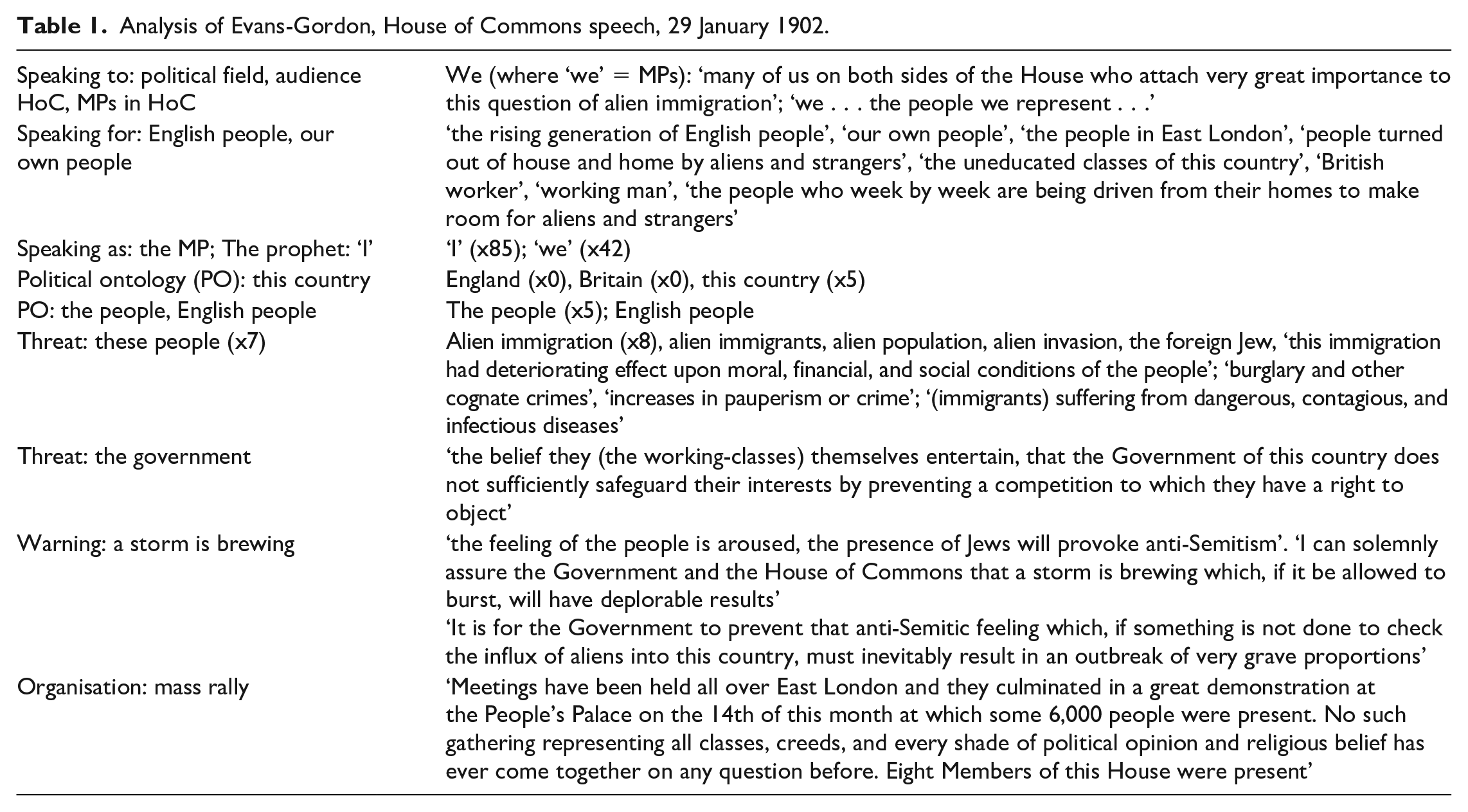
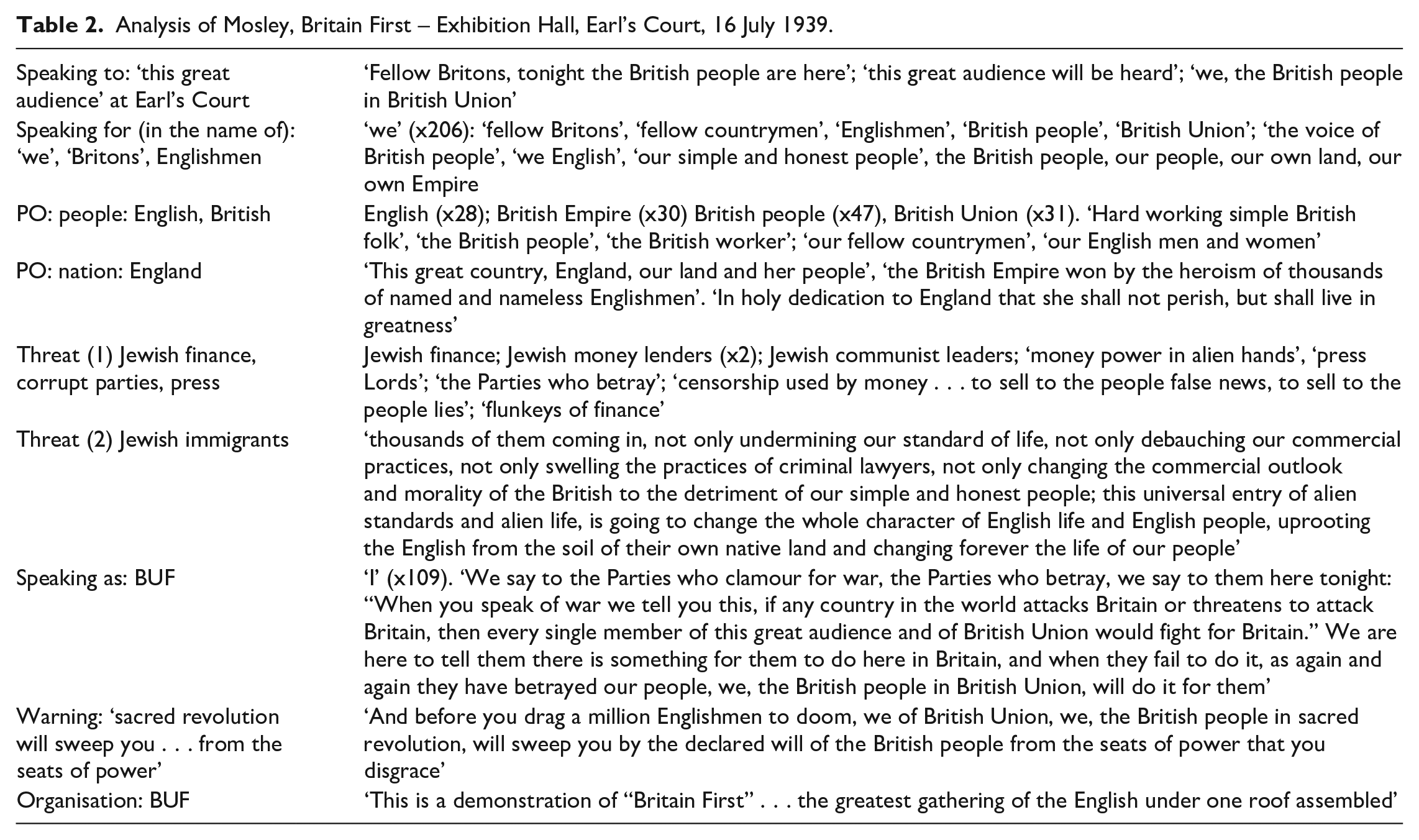
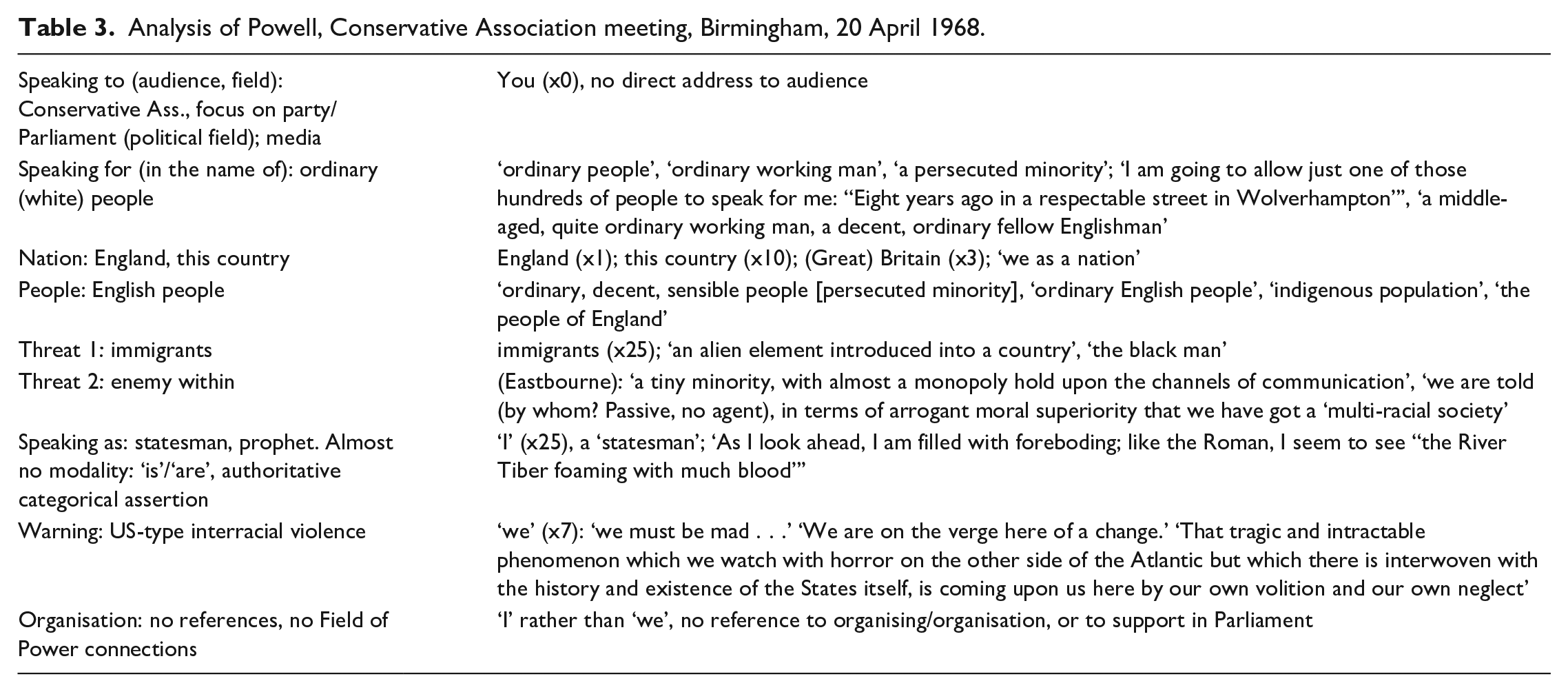
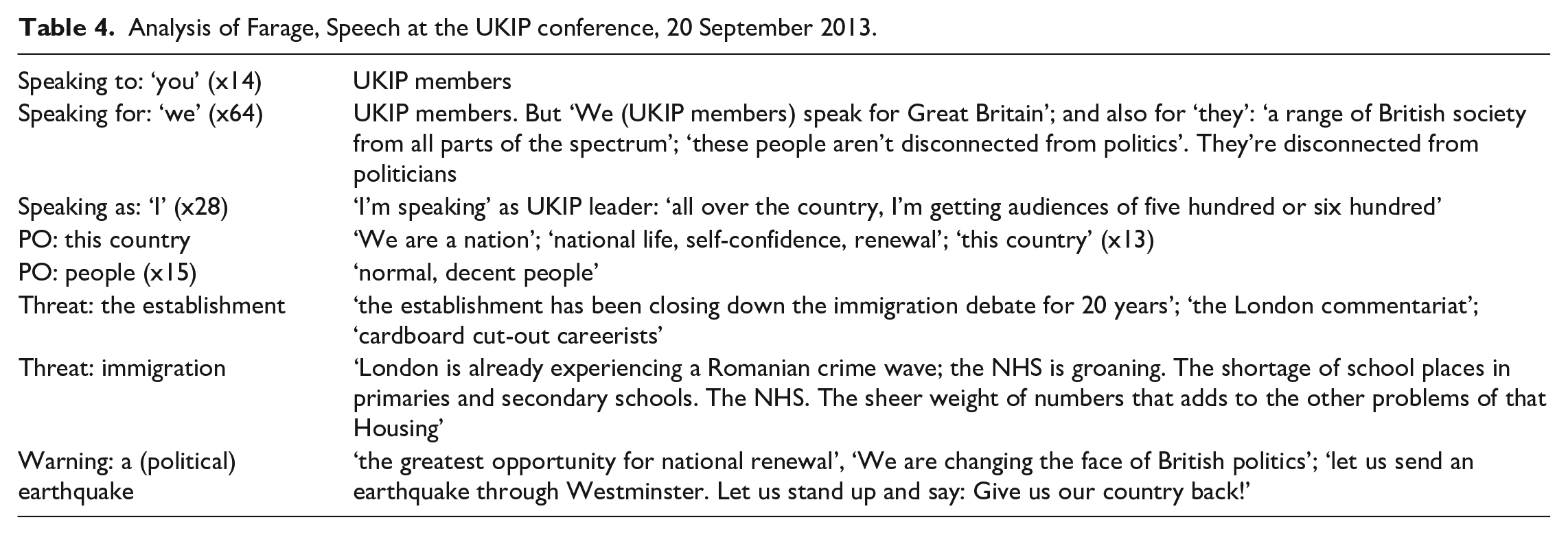
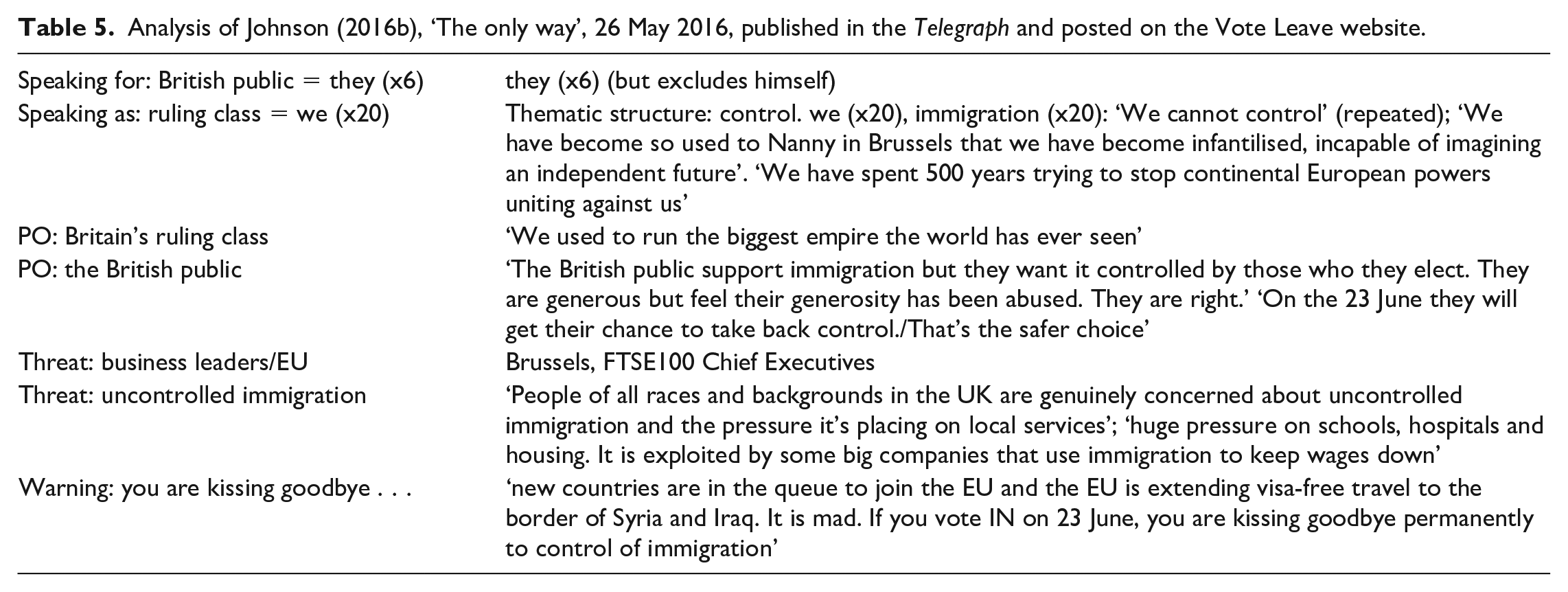
Key texts are: (1) BBL: Evans-Gordon’s (1902) House of Commons, ‘Immigration of destitute aliens’, during a debate on immigration control (see Table 1); (2) BUF: Mosley’s (1939) ‘Britain First’ rally, at the Earl’s Court Exhibition Hall (see Table 2); (3) Powell’s (1968a) ‘Rivers of blood’ speech at a Conservative Association meeting, Birmingham (see Table 3); (4) Farage’s (2013) speech at the UKIP conference, 20 September (see Table 4); (5) Johnson’s (2016) ‘The only way’, in the Telegraph (see Table 5).
Analysis of Evans-Gordon, House of Commons speech, 29 January 1902.
Analysis of Mosley, Britain First – Exhibition Hall, Earl’s Court, 16 July 1939.
Analysis of Powell, Conservative Association meeting, Birmingham, 20 April 1968.
Analysis of Farage, Speech at the UKIP conference, 20 September 2013.
Analysis of Johnson (2016b), ‘The only way’, 26 May 2016, published in the Telegraph and posted on the Vote Leave website.
Stage 2: in the textual analysis stage, we identified how the English populist politicians, by the construction and performance of the symbolic power of their text, make a claim to symbolic violence (Bourdieu, 1991b) whose naturalisation by the represented ‘people’ can, in turn, be the foundation of the speaker’s domination in the political field and then the field of power. The analysis involved identification of discursive functions: how a text constructs/depicts a world of entities and threats. We paid attention to thematic structure, for example, how the text is organised around sets of hostile antinomies, such as our people/these people (aliens), health/disease; ordinary people/immigrants. Bourdieu (1991b: 213, emphasis in the original) also claims that ‘(i)n the symbolic domain, takeovers by force appear as takeovers of form . . . When an apparatchik wants to make a symbolic takeover by force, he shifts from saying “I” to saying “we”.’ We therefore identified how the speaker uses personal pronouns (I, we, they) as identity categories (Fairclough, 2009) to position the speaker with respect to social identity – and to make claims to symbolic violence; that is, the right to impose a vision of the world based on a political ontology.
We posed the following questions, adapted from Bourdieu (1991b): Who does the text speak to? To those present and/or a wider audience? In what field(s)? Focus on pronominal choice: use of ‘you’, and/or speaker inclusive ‘we’? Who does the text speak for (represent)? What are the voices in the text? Is there direct reference to a group, party, organised campaign? What self-referential pronominal choice does the speaker make: ‘I’ or ‘we/us’?
How is legitimacy performed/claimed?
Who does the text speak as? Does the speaker claim to be a legitimate representative of the organisation; or self-ordained/proclaimed prophet? Speaker positioning: ‘we’ as group/party/people/nation; or prophetic warning: ‘I’. Political ontology: what is the nation? Who are the people? The thematic structure of the speech and the underlying political ontology. Who is included/excluded? Political ontology: who/what are the threats? Are there thematic antinomies plus warning, prophecy, call to action? What are the positive or negatively marked associations in relation to the purity/security/health of the nation/people? For example, ‘alien’ as threat to health, religion, security, jobs.
However, as noted above, textual analysis alone is not enough to understand how populist campaigns are organised. We also needed to consider wider socio-economic/cultural contexts; that is, what is not immediately present in the text (Fairclough, 2009).
Stage 3: how and where is the text performative? We applied a MOS perspective: how and where do messages derived from/interpretations of the text circulate? What are the vectors of circulation? Does the speaker operate within a field, trans-field, in the field of power or extra-field? How is the text received and by whom?
Below, we use these questions to analyse key texts from each of the four waves of right-wing English populism, presenting the context and a commentary on the text and our analysis. Then, based on our analyses and commentaries, we draw up juxtaposition tables to illustrate how the populist methodology was applied over time (see online Supplementary Material).
Historicising English populism: From the British Brothers to Brexit
First wave of English populism: The British Brothers League, 1900–1905
Context
The BBL was chaired and financed by Conservative MP, William Evans-Gordon, who was elected as MP for Stepney (East End of London) in 1900 on an anti-immigration platform (Brodie, 2004). The League’s slogan was ‘England for the English’ (Evans-Gordon, 1904; see Toczek, 2015). Its aim was to put pressure on Parliament to pass laws restricting ‘alien’ mass immigration. The majority of these ‘aliens’ were Jewish refugees fleeing persecution in Eastern Europe and Russia (Johnson, 2014).
Commentary
Our key text for the BBL is Evans-Gordon’s speech on ‘Immigration of destitute aliens’ in the House of Commons on 29 January 1902. Evans-Gordon speaks as an elected representative addressing fellow MPs on behalf of the English people, the ‘English working man’. Asserting his symbolic power as an elected and legitimate representative, speaking for and on behalf of: our people, our simple and honest people. The thematic structure of the speech is contrastive: our people vs these people, the latter being ‘aliens’ or ‘foreign invaders’; that is, Jewish immigrants, impoverished, destitute, with dirty insanitary habits, spreading infectious disease. A second, internal, threat comes from the political class, who do not understand the people’s fears of ‘alien immigrants’ taking jobs, practising an alien religion, speaking alien languages and spreading disease and crime (see Table 1).
Evans-Gordon informs his audience of the BBL’s organisational power among the ‘simple and honest people’: ‘meetings have been held all over East London’, he says, including ‘a great demonstration at the People’s Palace on the 14th of this month at which some 6,000 people were present’. He concludes his speech with a warning of overt violence: ‘a storm is brewing which, if it be allowed to burst, will have deplorable results’. He can make this threat of overt violence based on the activities of the BBL’s quasi-military structure of local ‘brigades’ in East London who organised street parades of ‘English’ workers aimed at provoking violent confrontations with Jewish workers’ organisations. This street mobilisation was complemented by a media arm led by Arnold White, anti-Semite, journalist and author of The Destitute Alien in Great Britain published in 1892 (Bloom, 2004). In terms of the field of power, the League also had support from senior elements of the religious establishment, including a future Archbishop of Canterbury. The League’s campaigning was successful in pressuring Parliament to set up a Royal Commission on Alien Immigration, with Evans-Gordon as Chair, which resulted in the 1905 Aliens Act, restricting immigration into the UK.
Second wave of English populism: Oswald Mosley’s British Union of Fascists, 1932–1939
Context
The second wave of English populism is the British Union of Fascists (BUF, 1932–1939, see Dorril, 2007), led by Oswald Mosley. From an aristocratic background (which gave him high social and cultural capital), Mosley first represented the Conservative Party in Parliament, then became an independent MP, before joining the Labour Party in the 1920s. After failing to attain a powerful government office, he resigned in 1931 to organise his own proto-fascist New Party. This was during the Great Depression, with mass unemployment, disillusion with democracy and a turn to ‘strong’ leaders in Europe. However, the New Party failed to gain any MPs in the General Election of 1932; Mosley abandoned democratic politics and, modelling his new organisation on the Italian fascists, founded the British Union of Fascists (BUF), attracting economic capital from Mussolini and then Hitler.
Commentary
We analysed Mosley’s ‘Britain First’ (1939) speech, given at the Earl’s Court rally in London on 16 July. Mosley addresses 30,000 BUF supporters, claiming to speak to his ‘fellow countrymen, Englishmen’ as a representative of ‘our simple and honest people’ (see Table 2).
In his speech, Mosley exercises symbolic power to speak on behalf of his organisation (the BUF) and the nation, claiming to represent ‘this great country, England’ and ‘English men and women’. Both, Mosley claims, are threatened by money and power in alien/Jewish hands, by party politicians ‘who betray the people’, and ‘press Lords (who) sell lies/false news to the people’. They are also threatened by immigration: ‘thousands of them coming in, this universal entry of alien standards and alien life’, where ‘them’ stands for Jewish refugees from Nazi Germany. In targeting both ‘Jewish finance’ and Jewish refugees, Mosley brings together the dual threats into an inclusive ‘alien’ conspiracy directed against the Empire and its people. Mosley concludes with a warning of overt violence to come: ‘we, the British people in sacred revolution, will sweep you (politicians) by the declared will of the British people from the seats of power that you disgrace’ in order that England and its people ‘shall live in greatness’.
At Earl’s Court, Mosley was preceded into the arena by drummers, trumpeters and banners. He spoke from a spot-lit plinth above the mass of 30,000 people, so embodying the symbolic power (and theatricality) of the strong-man leader (Charnley, 1990). By mobilising the ‘Jewish threat’ (after 1935) Mosley aligned himself with the Nazis and with the pro-fascist wing of inter-War British society, while the BUF’s quasi-military ‘Blackshirt’ squadrons organised overt violence in the form of anti-Jewish street mobilisations. However, Mosley was unable to overthrow the established field of power; he was discredited as a political figure by the War, having been interned at the outset of the Second World War and detained until 1943.
Third wave of English populism: Enoch Powell, 1961–1975
Context
Born in 1912, Powell’s social trajectory took him from a grammar school in Worcestershire (and therefore a low degree of social and cultural capital), via a scholarship to study Greek at Cambridge, to Professor at The University of Sydney, Australia (aged 25), so acquiring a high degree of cultural capital. Powell served as an intelligence officer in the Second World War, and post-War joined the Conservative Party and accumulated enough political capital to be elected to Parliament in 1950, and to serve in government and then in the shadow cabinet (Heffer, 1998).
Powell’s turn to politics emerged from the traumatic shock of Indian independence in 1947 (Schofield, 2013). Following the ‘loss’ of India, Powell’s political project would be to return the ‘English nation’ to a state of national sovereignty, preserving the ethno-cultural homogeneity of its ‘indigenous population, the people of England’ (Powell, 1968b), who, he felt, were threatened by mass immigration from India, Pakistan and the Caribbean.
Commentary
We analysed Powell’s (1968a) ‘Rivers of blood’ speech given at the Conservative Association meeting, Birmingham, on 20 April (see Table 3).
Powell is addressing his local Conservative Association, but with a wider agenda of acquiring symbolic power through press and TV coverage of the speech (Heffer, 1998). As such, Powell’s speech is an attempt to influence his party’s leadership in favour of the ‘repatriation’ of Black and Asian immigrants. In its intended performativity, the speech targets politicians, and therefore it is primarily a manoeuvre within the political field.
Powell makes no claim to organisational power: he speaks predominantly in first person singular (‘I’ occurs 25 times) and as a ‘statesman’, making no in-text reference to organising or any organisation. He claims to speak for and represent the nation (England) and the people, giving voice to (for example) ‘a middle-aged, quite ordinary working man, a decent, ordinary fellow Englishman’. Powell’s claim to symbolic power is based on his contact with ‘ordinary people’, whom he can claim to legitimately represent as his constituents; that is, the people who elected him to Parliament. Such ordinary English people, Powell argues, feel threatened by ‘an alien element introduced into a country’; that is, (Black and Asian) immigrants (‘immigrants’ are mentioned 25 times). Powell employs anecdotes and vignettes, ventriloquising the fears and prophesies of his constituents, while distancing himself from overt racism. For example, the ‘quite ordinary working man’ who Powell meets tells him that ‘in 15 or 20 years the black man will have the whip hand over the white man’. From the speech, we can reconstruct Powell’s fundamental political ontology of England as a sovereign nation of ordinary white, English people (‘the English are a white people’), threatened by ‘the black man’ and other alien immigrants. For Powell, England is an exceptional nation: a nation ‘unique in history’ (Powell, 1961), which ‘cannot be merged in the (European) Community’.
In the speech, Powell mobilises his cultural capital via references to classical literature, most notably Virgil’s Aeneid. In his peroration, Powell speaks as a prophet: ‘As I look ahead, I am filled with foreboding; like the Roman, I seem to see “the River Tiber foaming with much blood”.’ He foresees race riots, ‘That tragic and intractable phenomenon which we watch with horror on the other side of the Atlantic.’ Powell both predicts and threatens overt violence, if his anti-immigrant policies are not adopted. But Powell both miscalculated the power of his political capital and had no organisational power behind him: the speech had no immediate performative force within the political field or in the field of media production. Indeed, in Powell’s follow-up speech in Eastbourne that year, the media are identified as a hostile elite: ‘a tiny minority, with almost a monopoly hold upon the channels of communication’ (according to The Times, ‘Rivers of blood’ was ‘an evil speech’; see Heffer, 1998: 620). Nevertheless, the speech did have considerable (unintended) performative force in the series of strikes, extra-parliamentary marches and rallies organised by Powell’s working-class supporters, which he was unwilling to legitimise by leading (Lindop, 2001). In linguistic terms, Powell as ‘I’ (the self-proclaimed statesman) refused to become ‘we’ (the leader of a campaign). Yet, he continued as a legitimating figure for proponents of the ‘great replacement’ theory, such as Renaud Camus, and for politicians such as Nigel Farage: in 1994 Farage drove an elderly Powell to a UKIP rally to gain Powell’s blessing as a sort of anointed successor (Hope, 2014).
Fourth wave of English populism: The Brexit campaigns
Context
‘Brexit’ was the outcome of a long series of campaigns against Britain’s EU membership conducted by right-wing ‘Eurosceptics’ (including Powell in the 1970s) and their media supporters, particularly the Sun, The Express and the Daily Mail (Berry et al., 2016). Key in these campaigns, from 2010, was the rise of Nigel Farage, acquiring symbolic capital as a media celebrity and converting this into political capital through leadership of his United Kingdom Independence Party. As a new entrant into the political field, Farage and his party represented an outsider challenge to the dominant faction of the Conservative Party led by Prime Minister David Cameron, who, under pressure from within and outside the political field (particularly from the anti-EU media), called a Leave/Remain referendum for June 2016.
The official Remain campaign was supported by Cameron and his allies. They faced competing/complementary campaigning organisations: ‘Vote Leave’, which mobilised the political capital of Conservative Party politicians Boris Johnson and Michael Gove, leveraging mass-media support and economic capital from, for example, investment bankers. To run their campaign, Vote Leave fundraiser and organiser Matthew Elliott organised a team of 50, led by strategist Dominic Cummings (Shipman, 2016). Cummings had acquired symbolic capital as a campaign strategist via his work on campaigns against the Euro (1998), against a Northern England assembly (2004), and against voting reform (2013).
A competitor organisation, Leave.EU, drew on economic capital from insurance company owner, Aaron Banks, and real estate developer Richard Tice. Fronted by Farage, and leveraging his celebrity capital to attract media attention, Leave.EU also deployed a ‘ground army’ of UKIP members to campaign and canvass voters.
Commentary
We analysed a speech given at the UKIP conference, 20 September 2013 in which he addresses an audience of party members (see Table 4).
In terms of symbolic power, Farage claims to speak for the exceptional nation (‘we’); he declares that ‘Britain is different . . . We think differently. We behave differently.’ The first element of the Leavers’ political ontology is England/Britain as the exceptional nation. For the Leavers, the nation’s exceptionalism has been compromised by its membership of, or (in their view) its subjection to, the EU and its ‘establishment’ allies in UK politics. Farage, the self-presented outsider, attacks ‘the metropolitan media elite’, claiming that ‘the deracinated political elite of parasites’ (Farage, 2013) has encouraged mass immigration ‘(that) is making parts of the country appear unrecognisable and like a foreign land’ (Farage, 2013). Farage concludes with a warning of overt/physical violence – ‘a political earthquake’ – and with a call to ‘give us our country back’. For Leave-supporting politicians, the first threat to the nation is from a cosmopolitan/rootless elite depicted as hostile to, or scornful of, the ‘ordinary, decent people’ (Farage, 2016). This is a message amplified by the Leave-supporting media: for the Daily Mail, the enemy is an ‘arrogant, out-of-touch political class’ collaborating with ‘a contemptuous Brussels elite’ to promote ‘uncontrolled’ immigration (Daily Mail, 2016).
We next turn to Boris Johnson’s (2016b) ‘The only way’ (see Table 5).
Johnson constructs a text around the thematic of control: he repeats ‘control’ 20 times, associated with ‘immigration’, ‘borders’, ‘numbers’ (of immigrants), so identifying and targeting ‘uncontrolled immigration’ as a threat. This move to target resentment of immigration was consciously planned by Cummings and his team of professional campaigners, employing expertise in testing, polling, data harvesting, fundraising and communications, with the aim of activating cycles of mutual reinforcement; that is, politicians giving ‘voice’ to those who feel neglected in return for recognition – the classical form of legitimising symbolic violence (Bourdieu, 2021). Focus groups were used to develop and check the impact of the three key messages – ‘take back control, the £350m paid to the European Union each week and immigration’ (McCabe, 2016). Strategically, Cummings (2017) ‘always’ knew that targeting fear of immigration was key to winning. Therefore, in the final weeks before the referendum vote, Leave campaigners focused on the issue, with Vote Leave’s poster ‘Turkey (population 72 million) is joining the EU’ coinciding with Leave.EU’s ‘Breaking point’ poster, showing a long line of dark-skinned refugees queuing to cross the EU’s border (Shipman, 2016). Vote Leave also circulated (12 June 2016) a video warning that ‘Turkish criminals’ would be able to enter the UK if it remained part of the EU (available on Google images).
As the referendum vote drew near, Vote Leave messages associated Muslim immigrants with ‘sexual abuse’ and terrorism, based on New Year celebration incidents in Cologne after c. 1 million mostly Syrian refugees were allowed into Germany in 2015. This supposed danger of sexual violence was exploited by Cummings who tweeted: ‘EU law = once Cologne sex abusers get citizenship they can fly to UK and there’s nothing we can do. #VoteLeave = safer choice’ (quoted in Mortimer, 2016). Leave.EU also utilised anti-Muslim rhetoric, targeting Facebook users with the message ‘Islamist extremism is a real threat to our way of life’ over a visual of Islamic State fighters, and ‘free movement of Kalashnikovs in Europe helps terrorists’ (available on Google Images).
In terms of organising, the ‘respectable’ Vote Leave and the ‘bad boys’ of Leave.EU, benefitted from being rivals pursuing the same objective. They were able to transmit messages that reinforced each other, to exploit diverse media formats with highly disciplined messaging (as evidenced by Johnson’s speech, above). With regard to symbolic power, ‘take back control’ conflated and concealed the dual threat under a vague yet unifying slogan that offered room for interpretation: ‘take back control’ might be from deracinated elites, from invading aliens or from both, depending on the audience. In combining political and media capital with organisational power and economic capital, the ‘Leave’ campaigners succeeded in destabilising and ultimately overthrowing the dominant political elite: Cameron resigned as PM immediately after ‘Leave’ won the referendum. The ad-hoc campaigning organisations were dissolved. However, over the next three years, Cummings and Johnson moved on to take over the Conservative Party leadership to ‘get Brexit done’, confirming their (temporary) domination through symbolic violence by their electoral success in 2019.
Discussion
Regarding our first question, In what ways have English populist politicians in the 20th and 21st centuries utilised language along with other aspects of campaign organising to build and enhance their symbolic power?, six key findings emerge from our analysis. First, across the four waves of English populism, there are commonalities, discursive similarities and continuities, but with differing substantive content, which is embedded in the specific circumstances characterising each of the four waves. Second, national exceptionalism is fundamental to the political ontology in all four periods. Third, in all four waves of English populism, internal and external enemies are portrayed as those who weaken and threaten the nation and people. This ‘dual threat’ consists of an internal threat that comes from an elite establishment disconnected from ‘ordinary’ people, whereas the external threat comes from ‘invasive’ alien immigrants. Fourth, the performativity of the text depends on the symbolic power of the speaker and that requires a receptive audience (or series of audiences) and organisational support – which, again, are context-specific. Fifth, while there is always a need for a division of organisational labour, in recent years, we identify an increasing specialisation and professionalisation in terms of messaging, targeting voters and so on. Finally, our findings suggest a new paradigm of political organising (compare Husted et al., 2022; Ringel, 2019), with the techniques and methods of campaigning being transferred to governing, so government becomes, as it were, a permanent campaign.
In relation to the second question, How do populist political organisations convert symbolic power into symbolic violence?, we put forward a theoretical framework explaining the organisation of populist politics. Inspired by and building upon Bourdieu’s concept of political ontology, we see the organisation of populist politics in terms of the application of a populist political methodology, which involves the discursive mobilisation of a ‘dual threat’ to ‘our nation and people’ from ‘aliens’ and ‘elites’. Theorising how the ‘dual threat’ methodology is applied, the framework consists of three steps that are necessary in converting symbolic power into symbolic violence: (1) mobilisation of symbolic power by the leader, that is, the one who has the legitimate forms of political capital to address ‘the people’; and (2) establishing organisational power and the division of labour of domination. Steps 1 and 2 operate in a ‘cycle of mutual reinforcement’ involving the work of political technologists, identifying demographics and designing target messages aimed at giving voice to ressentiment and xenophobia that, in step 3, translate into symbolic violence in sections of wider society (see Figure 1).
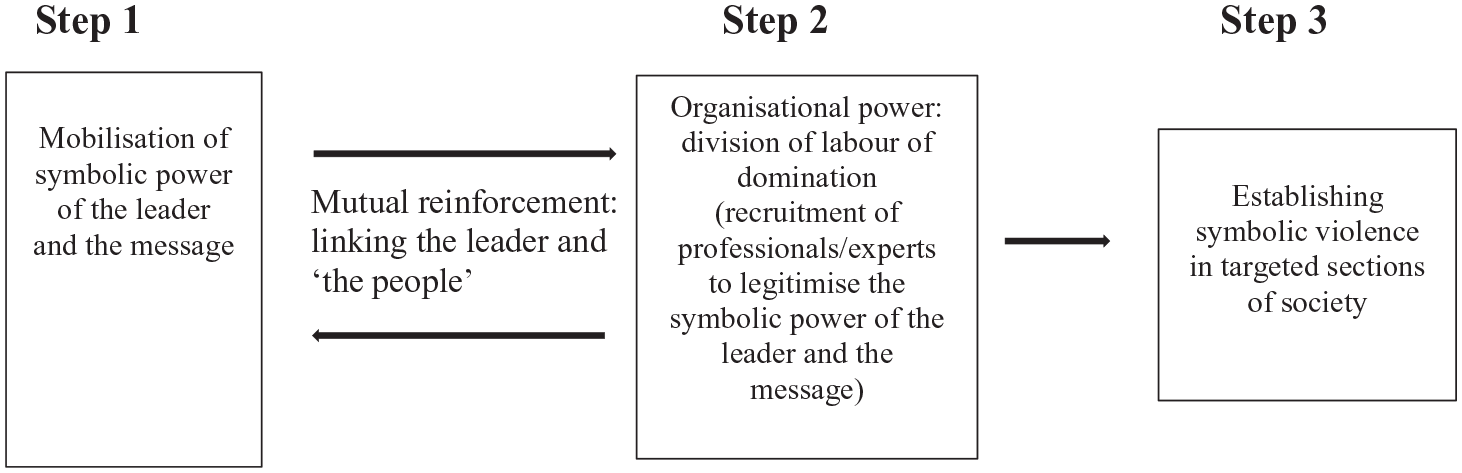
Organising populist politics: Converting symbolic power into symbolic violence.
The first step includes mobilisation of symbolic power to deliver performative texts. Such texts play a key role in mobilising symbolic violence. However, power does not inhere in the text; it has to be mobilised in relation to audiences, either external or internal to the speaker’s organisation. The symbolic power of the speaker has three possible sources: the organisation the speaker represents, the speaker’s own symbolic power (based on a combination of capitals) and recognition from audience(s) the speaker addresses and speaks on behalf of (Bourdieu, 2021). Therefore, speech acts delivered by legitimate representatives may be performative in the immediate context, the organisational context, and/or in the dynamic arena of the political field (Levy and Reiche, 2018). To establish and maintain symbolic violence (legitimate domination) requires organisational power; marshalling symbolic, economic and material resources in order to create the necessary conditions for a (populist) political text to have material consequences.
Across the four waves of English right-wing populism, we identified a variety of organisational forms and strategies that can be seen to belong to step 2 of the framework. Evans-Gordon operates within a formal party in Parliament, but sets up an ad-hoc campaigning organisation to influence the government via the threat of overt violence. Mosley organises an extra-parliamentary party on the fascist model based on his own legitimising political charisma. This organisation, with its quasi-military command structure, needs inputs of economic capital and social capital to be sustainable. Powell, however, operates within an existing party, but abandons it, becoming a ‘lonesome leader’ (Wellings, 2013), with no organisational power, a self-described political failure. Finally, the Brexit campaigns required concerted organisational effort, bringing together players in the political field, the field of ideological production (think tanks and academic outsiders), and specialists in other forms of organisational work, including strategy and planning, interaction events (marches, rallies), social media and communications, as well as support from journalists/opinion columnists circulating between the fields of media production and politics, working for dominant media players such as Rupert Murdoch.
The second step in successful populist organising and in the application of a populist political methodology of ‘dual threat’, especially contemporarily, involves the recruitment of professionals and experts, that is, political discourse technologists, specialists in the production and diffusion of thematic slogans, whose task it is to legitimise the symbolic power of the message. Such discursive technologists are employed in populist campaigns, but all contemporary campaigns and parties require forms of specialised organisational work, including strategy and planning, media communications and social interaction events (marches, rallies). Given the material need for financial capital, the role of fundraisers and funders is central but little studied (but see Poruthiyil, 2021). All this organising amounts to an efficient division of the labour of domination (Bourdieu, 2021) and suggests there are opportunities for MOS research into the business of organising politics, examining in particular the role of specialists (advisers and consultants). Arguably, Brexit succeeded through combining the efforts of organisational professionals from different fields, possessing different forms of capital (Wild et al., 2020). Building on Bourdieu (2021: 148–149), we call this phenomenon ‘organisational power’.
Steps 1 and 2 operate in a cycle of mutual reinforcement. Mobilising symbolic power includes the speaker’s ability to speak to and on behalf of a group, a party, a people – speaking from a position of power to the immediate audience in the hall, and beyond to a wider audience via the media; and in so doing constructing identity groups from categories such as ‘the people’ and ‘the nation’. By targeting a fragmented, atomistic, ‘voiceless’ population (Bourdieu, 2021), populist politicians can then claim to ‘speak in the name of’ (Bourdieu, 1991b: 204) via the symbolic power of categorisation, so creating a di-vision of the world including ‘the people’ as an identity group they claim to represent, while re-categorising neighbours and co-workers as ‘immigrants’, ‘aliens’ or ‘cultural elites’. This sets up a cycle of mutual reinforcement between the politicians and ‘the people’, facilitated by political technologists and mediated by media actors.
The strain of right-wing populism that we have analysed is based on a political ontology of the (exceptional) nation and people, the latter discursively constructed as ‘decent, ordinary’, thus providing the norm against which others are judged to be ‘alien’ or ‘deracinated’, detached from – or even conspiring against – the interests of ‘ordinary people’. In operationalising this political ontology through the application of a populist political methodology of dual threat, the mutual reinforcement of steps 1 and 2 in populist campaigns also takes the form of responding to and aggravating ressentiment in social groups who sense that their increasingly precarious economic status is threatened by invasive ‘outsiders’; or among the relatively privileged, who feel they are being unjustly denied their rightful socio-cultural dominance by immigrants who are encouraged by the machinations of unaccountable metropolitan, cosmopolitan, liberal ‘elites’. In the third step, domination becomes naturalised as symbolic violence in targeted sections of society.
As our analysis has shown, across all four waves of populism, central to the efforts of populist politicians to establish symbolic violence in sections of society has been the discursive use of the dual threat to the nation allegedly presented by aliens and elites. Thus, instead of the Laclau-Mouffe populist methodology that divides the people from the elite (Laclau, 2005; Mouffe, 2018), we have (ordinary) people versus immigrants and the elite. In addition, for Mouffe (2018; see also Sinha et al., 2020) the people’s collective will is expressed through a charismatic leader pitted against a dominant ‘establishment’. However, we find that, while ‘men of destiny’ may succeed in terms of individualised symbolic violence (Robinson and Kerr, 2009), English populism provides, in the cases of Powell and Mosley, ‘men of destiny’ who ultimately fail in politics, although both were highly skilled at constructing and delivering speeches that make an emotional connection with their audience(s). Arguably, it is Powell’s inability to draw on organisational power and the division of labour of domination that made it impossible for him to convert symbolic power into symbolic violence; while Mosley’s organisational power and individual charisma were ultimately delegitimised by association with fascism and the Nazi model of organising.
Implications for understanding political organising
The above framework has broader implications for our understanding of the exercise of symbolic power and symbolic violence through political organising. One conceptual contribution of our study lies in clarifying what right-wing populism is, and distinguishing it from other varieties of populism, by identifying the political methodology underpinning its organisation. In that light, our analysis identifies a specific challenge faced by left-wing populists (as discussed by Hensmans and Van Bommel, 2019 and Sinha et al., 2021; following Mouffe, 2018), in that it implies that the unwillingness of left-wing politicians to verbally attack immigrants using explicit racism – that is, the reluctance to apply the ‘dual threat’ methodology – means that left-wing movements cannot in good faith be populist in this way. Put bluntly, racism and/or xenophobia are elements necessary to the success of right-wing populism (see Gills et al., 2019). On the other hand, we may come to see the difficulties of institutionalising populism in government, with populists turning to authoritarianism to maintain themselves in power (see Kaltwasser and Taggart, 2016).
Contributions to MOS literature and future research directions
Our research, which offers a worked example of the comprehensive application of Bourdieu’s concepts in MOS, also extends his work on political parties by focusing on ad-hoc political organisations (Bourdieu, 2021). Through adopting a conceptual framework combining key concepts from Bourdieu (1991a, 2021) – specifically, fields and forms of capital; field of power; symbolic power and symbolic violence; ressentiment and political representation (Bourdieu, 1991a, 2021) – we provide a novel approach to understanding organisational power and the performativity of political texts. To do this, we turn to speech act theory, as does Bourdieu (1991a), to develop a historically contextualised approach that links the material and discursive in the study of political organising. As we have argued, Bourdieu’s work on power and language has been under-used in MOS, with the exception of the somewhat neglected article by Contandriopoulos et al. (2004) that we draw on. Therefore, the approach that we develop here offers an original methodological contribution to Bourdieu-inspired studies within MOS, going beyond the application of the ‘theoretical triad’ (Sieweke, 2014: 532), and applying a more bespoke Bourdieusian framework, which draws on both his interest in speech act theory and in political ontology.
We have also responded to calls for further integration of Bourdieu’s work in organisation studies (Maclean et al., 2017) and to earlier calls by Golsorkhi et al. (2009) for work on domination within organisations. Focusing on the relation between Bourdieusian concepts, we theorise the dynamic process that converts symbolic power and organisational power (our conceptual innovation) into symbolic violence, while introducing the concept of populist political methodology to theorise a key driver in the process. Further, our research contributes to the extant work in MOS on symbolic violence, in particular Kerr and Robinson (2012, 2016) and Robinson and Kerr (2009). Specifically, Robinson and Kerr’s (2009) research shows how symbolic violence is established in the relationship between a leader and followers. In turning to speech act theory, we address an aspect that this leader–follower model neglects; that is, the foundational importance of organisational power in facilitating the exercise of symbolic power, with the case of Powell offering a counter example of organisational failure.
A number of possible research directions emerge from this study. Given the ongoing challenges Brexit presents for organisations in the UK, including British universities, and given the current salience of right-wing populist movements in different parts of the globe, it is urgent and timely for MOS scholars to pay greater attention to the organisation of politics and the work of politicians, and to the impact of politics on life and work in organisations (Husted et al., 2022). It is also clear that we need studies of populism in government and its connection to right-wing authoritarians. In addition, there is a need for historically informed approaches to populism from an organisational perspective, contextualising and explaining the success of populist politicians across the world, such as Bolsonaro (Barros and Wanderley, 2020), Modi (Masood and Nisar, 2020; Prasad, 2020), Orbán and Trump (Gills et al., 2019; Mollan and Geesin, 2020), whose willingness to leverage conspiratorial thinking became particularly problematic during the COVID-19 crisis (2020–2021), constructing ‘threats’ from outside and within that merge into vast organised conspiracies, targeting shifting and disparate identity groups (Kerr and Śliwa, 2020). Further, future research might explore whether there are other examples from history that show how political methodologies are applied by more progressive populist movements (see, for example, Husted et al., 2022; Robinson and Bristow, 2020).
MOS scholars are well equipped to explore how political technologists organise populist politics, interacting with agents in the political field, with polling specialists and with the media to construct conflicting social identities - for example, the creation of ‘the people’ and the mobilisation of racism and xenophobia against our neighbours, work colleagues and ourselves, re-categorised as ‘aliens’ at the behest of a populist project. As MOS scholars we may not have been interested in political organisations – but political organisations, we have learned, are interested in us.
Conclusions
In this article, we analysed English populism through an organisations and power lens, demonstrating that populist politics involves the coordination of discursive and material aspects of organising, whereby populist politicians need to be able to mobilise organisational power in order to convert the symbolic power of their texts into symbolic violence in targeted sections of society. We have demonstrated how, in their search for power/domination, English populist politicians combine different forms of capital to impose their political ontology of national exceptionalism and the ‘dual threat’ methodology on the electorate.
In conclusion, we highlight the implications of this study for universities. Given populist hostility to ‘experts’, and challenges to the legitimacy of ‘elite’ institutions, we need to understand well the dangers posed by these populist organisations, their roles in manoeuvring in the field of power, their modes of organising and of mobilising forms of capital. Understanding how populist politics is organised can support campaigners in resisting, challenging and disrupting the organisation of right-wing populism, providing lessons for organisations campaigning against racism and xenophobia. By interrogating history and developing theory we have been reminded that xenophobic populism is endemic and waits for opportunists to activate it.
Supplemental Material
sj-pdf-1-hum-10.1177_00187267221129181 – Supplemental material for Organising populism: From symbolic power to symbolic violence
Supplemental material, sj-pdf-1-hum-10.1177_00187267221129181 for Organising populism: From symbolic power to symbolic violence by Ron Kerr, Sarah Robinson and Martyna Śliwa in Human Relations
Footnotes
Acknowledgements
The authors wish to thank the Editor, Professor Andrew Brown, and the anonymous reviewers for their invaluable help and support in shaping this article for publication. Thanks are also due to the organisers of, and participants in, seminars and workshops where earlier versions of this article were presented, in particular the University of Essex workshop on populism (2019), invited seminars at the University of Wellington Business School (2019) and the University of Edinburgh Business School (2020), and a presentation to the Academy of Management Critical Management Studies community (2021).
Funding
The authors received no financial support for the research, authorship and/or publication of this article.

Supplementary material
Supplementary material for this article is available online.
References
Supplementary Material
Please find the following supplemental material available below.
For Open Access articles published under a Creative Commons License, all supplemental material carries the same license as the article it is associated with.
For non-Open Access articles published, all supplemental material carries a non-exclusive license, and permission requests for re-use of supplemental material or any part of supplemental material shall be sent directly to the copyright owner as specified in the copyright notice associated with the article.
