




Abstract
What may individuals themselves do to enhance their identification with their employer organization? Does being socially courageous promote such formation of identity? If so, does this process occur because those who are socially courageous also proactively foster positive relationships and collaboration amongst co-workers and thus enhance social resources at work? Answering these questions is essential given that positive relationships and identification at work are essential for employees’ motivation and well-being and organizations’ success. Using conservation of resources theory, we expected that increases in workplace social courage would strengthen organizational identification via boosting increases in two types of relational job crafting, namely crafting relationships and collaboration, which in turn were expected to increase three social resources at work: meaningful relationships, relational identification, and social support. Findings based on a sample of 2919 employees who participated in the study twice, in late 2019 and late 2020, largely supported our hypotheses. Findings suggest that crafting social aspects of work can increase social resources and help maintain positive attachment with one’s workplace, and such relational crafting may be fostered by being socially courageous at work. This applied similarly to those who increasingly teleworked because of the COVID-19 related social restrictions and those who did not.
Keywords
Given the benefits of employees’ identification with their employer organization for employees and organizations alike, it is vital to have a broad and inclusive understanding of the processes that promote organizational identification (OI). This task is crucial given the unpredictable and changing world of work with growing insecurity, most recently posed by the COVID-19 pandemic, which has challenged social relationships at work and OI whilst making them even more important. To date, we know more than ever about the organizational, top-down factors that foster OI, such as organizational attributes (e.g., the attractiveness of the organization), leadership, perceived organizational support, and justice (He and Brown, 2013). Yet, this literature says only little about whether and how individual employees themselves may promote their OI and thus be the proactive sculptors of their own social identity. This deficiency in our understanding limits the scope and effectiveness of potential approaches and interventions that organizations, and we all as individuals, may take to foster OI.
OI reflects the positive, emotional, and cognitive bond and oneness between the employee and the organization (e.g., Edwards, 2005). Improving OI is essential as it is related to several attitudes and behaviors in the workplace, such as higher organizational citizenship behaviors, employee well-being, performance, and lower turnover intentions (e.g., Greco et al., 2021; He and Brown, 2013). Notably, this is so even above and beyond factors such as job involvement and organizational commitment (Lee et al., 2015). OI is “a fundamental binding of self-definition with the collective” (Ashforth, 2016: 362) and thus goes beyond having mere positive attitudes towards the employer. In this study, we recognize individuals as active agents who shape their social environment, and by this eventually their OI, and thus provide new insights and solutions for building a sense of belongingness within organizations.
In addition to illuminating the social consequences of individuals’ actions, which is essential in the socially embedded world of work (Tims et al., 2022), we examine a potential driver, a personal resource, for such actions: workplace social courage. Socially courageous employees demonstrate courage by behaviors that may damage an actor’s relationships or social image (Howard et al., 2017; Schilpzand et al., 2015). Courageous acts are considered voluntary, intentional behaviors that bear a risk to the actor and are primarily motivated to bring about a noble good or worthy end, and thus such behaviors are assumed to eventually benefit both the actor and others in the workplace (Detert and Bruno, 2017). In practice, workplace social courage can take many forms – for example, asking questions that others might find dumb, admitting to making mistakes, or letting coworkers know if one is concerned about something, even though they might think one is being too negative. We shed light on how social courage enables employees to strive towards their own and their organizations’ goals despite the presence of social risks and eventually build their identity (Koerner, 2014).
Drawing from the concept of resource caravans in conservation of resources (COR) theory (Hobfoll, 2001), we demonstrate how an individual-level resource (social courage) may promote identification with a group (OI) via increased resource investment behaviors (relational job crafting) and social resources (co-worker support, and relational identification and meaningful relationships with co-workers) at work. By this, we illuminate the process through which personal resources and proactive employee behaviors may benefit individuals’ identification with a group over time and provide the following contributions.
As the main contribution to theory and OI literature, we draw bridges between COR theory (Hobfoll, 1989) and the social categorization theory (SCT; Turner et al., 1987). Guided by the SCT, the existent OI literature has provided essential insights regarding the top-down processes that promote OI. We argue that as a result of reliance on one theoretical framework, OI literature has largely sidelined the bottom-up, employee-initiated, job redesign mechanisms as drivers of OI (Ashforth, 2016). We seek to elaborate such individual drivers by incorporating the theoretical notions of resource investment behaviors and personal resources from COR theory. By showing what employees themselves may do to promote their OI, what drives such behaviors, and how this process occurs over time, we go beyond current OI literature and expand the current theoretical understanding of SCT regarding how individuals come to identify themselves in terms of group membership. In so doing, we also contribute to COR theory by illuminating how individuals themselves may acquire resources by molding their social environment (Halbesleben et al., 2014).
Second, drawing from COR theory, we postulate that individuals may acquire social resources at work via two complementary types of relational job crafting: crafting positive relationships and crafting collaboration practices at work. Here, we contribute to job crafting research (Wrzesniewski and Dutton, 2001) as we extend the current understanding of relational crafting. We suggest that relational crafting should include a broader aim to improve both informal interactions and instrumental collaborations at work, rather than crafting being only about improving one’s work situation. By embedding the individual job crafter within its social environment (Tims et al., 2022), we show that improving relationships is an essential aspect of self-initiated improvements in one’s working environment as it may bear various social consequences at the workplace. Understanding such social consequences is necessary as the social environment at work is an important determinant, for instance, for extra-role behaviors, and mental and physical health (Halbesleben and Wheeler, 2015; Taylor, 2011). Relatedly, relatively little is known regarding the mediating mechanism of job crafting (Tims et al., 2022), such as whether being proactive is sufficient by itself or if changes in the environment are necessary for the beneficial effects of job crafting. The question of whether job crafting behaviors actually change the targeted working conditions similarly remains largely unanswered (however, see Harju et al., 2021; Tims et al., 2013). We also demonstrate how social courage, an emerging concept and thus far understudied personal resource, may benefit both the employee and employer by promoting relational crafting. Increasing the understanding regarding the antecedents, outcomes, and the mediational mechanisms of relational crafting is essential for organizations seeking to make the most of employees’ proactive behaviors.
Third, as the effect of resources may vary depending on their context as postulated in COR theory (Hobfoll, 2002; Hobfoll et al., 2018), we increase the understanding of resources in different contexts by testing whether the same mechanisms of resource accumulation apply equally to those who switched to teleworking and those who did not. Given that during COVID-19 millions of employees switched to telework, and the amount of telework is likely to remain higher than before the pandemic (ILO, 2021), this investigation provides important evidence for both practitioners and researchers interested in how teleworking during COVID-19 may impact various aspects and processes of work.
Theoretical background and hypotheses
According to COR theory, individuals strive to acquire and foster resources, which are defined as things (e.g., conditions, states, objects, skills, traits) that people value and that are beneficial in attaining one’s goals and aims (Halbesleben et al., 2014; Hobfoll, 1989). Importantly, resources are likely to accumulate over time as gains in one beneficial resource are likely to promote gains in another resource (Hobfoll, 2001). This is because those who initially have or acquire resources are better positioned to attain further resources in comparison with those whose resources did not change or decreased. For instance, those that are engaged at work, thus possessing surplus resources, are more likely to gain more personal and job resources (Xanthopoulou et al., 2009). Therefore, at the core of COR theory is the perspective of resource accumulation that represents a dynamic process that unfolds over time. This builds on the notion that individuals are motivated to preserve and acquire resources that are beneficial for their well-being and social relationships (Hobfoll, 2002).
Personal resources promote resource investment behaviors: Increases in workplace social courage as an antecedent of crafting relationships and collaboration
Personal resources are aspects of the self that are generally linked to resiliency and refer to individuals’ sense of their ability to control and impact their environment successfully (Hobfoll et al., 2003), thus aligning with the concept of social courage as it represents a trait or a disposition to act courageously despite the involved social risks (Detert and Bruno, 2017). Attainment of personal resources is likely to promote further resource investment behaviors, as personal resources provide a basis or source of energy for such behaviors (Hobfoll et al., 2018). Resource investment represents an act or behavior by which individuals seek to maintain existing, and gain new, resources (Hobfoll, 2011). We consider social courage as a personal resource that promotes resource investment behaviors, that is, relational job crafting.
We investigate two types of relational job crafting: crafting relationships and crafting collaboration practices. Relational crafting refers to proactive actions employees take to change their social relationships and interactions at work (Wrzesniewski and Dutton, 2001). Our conceptualization of relational crafting comprises two complementary elements in co-worker interactions: (i) fostering positive relationships by showing consideration for a colleague, for example, and (ii) improving collaboration practices, for example by creating new practices that promote collaboration via proactive, employee-initiated behaviors.
A central tenet of COR theory is that when individuals gain resources, such as being increasingly socially courageous reflecting a gain in personal resources, they are better positioned to invest increasingly more (i.e., craft relational aspects of the job), whereas those who lose resources are more likely to show decreases in resource investment (Hobfoll et al., 2018). In the context of our study, self-initiated behaviors bear social risks as they may disturb and challenge established interpersonal relationship patterns (e.g., by starting conversations about matters outside of the work domain with colleagues or seeking ways to improve collaboration at work), which may not be appreciated by others (Reynolds Kueny et al., 2019). As socially courageous employees are more ready to face the potential social risks of changing the status quo of relationships at work, increases in social courage (a personal resource) are likely to manifest as increases in relational job crafting (a resource investment). Accordingly, studies have found social courage to be positively associated with proactive behaviors that aim to improve the work environment, such as prosocial voice and organizational citizenship behaviors (Howard, 2019; Howard and Holmes, 2020). Given these empirical findings and on the basis of COR theory (Hobfoll, 1989), we postulate a process wherein gains in personal resources (i.e., social courage) lead to more resource investment in terms of relational job crafting:
Hypothesis 1: Increases in workplace social courage are related to increases in (a) crafting relationships and (b) crafting collaboration practices at work.
Resource investments promote resources: Relational crafting as an antecedent of social resources at work
Similarly drawing from COR theory (Hobfoll, 1989), we expect that increases in the aforementioned resource investment behaviors – that is, relational job crafting – lead to gains in the targeted resources, that is, social resources at work. Social resources represent interpersonal aspects and characteristics of one’s work that are functional in achieving work goals and benefit well-being and motivation at work (e.g., Halbesleben et al., 2014, Hobfoll, 2002). Put differently, we conceptualize relational crafting as a behavioral strategy that shapes the social aspects of the work and thus benefits by obtaining and protecting social resources at work. In this study, we focused on three types of social job resources: meaningful relationships with co-workers, relational identification with co-workers, and social support from co-workers as they cover a broad range of cognitive, affective, and behavioral workplace social resources.
Drawing from Grant’s (2008) conceptualization, by meaningful relationships we refer to the experience that the job provides opportunities for meaningful interactions with co-workers and enables building close relationships and emotional connections with colleagues. Relational identification, in turn, is defined as “the extent to which one defines oneself in terms of a given role-relationship” (Sluss and Ashforth, 2007: 11). Social support is about the experience that one is cared for, esteemed, and valued by others, and part of a social network of mutual assistance and obligations (Taylor, 2011).
Building on the notion of COR theory that resource investment promotes resource gain, we expect that increases in crafting relationships and collaboration (i.e., relational crafting as a resource investment) will promote increases in the three social job resources. Crafting informal, positive relationships at work by showing more friendliness towards co-workers and crafting more creative practices for collaboration are both likely to increase the meaningfulness of these co-worker relationships. This is because the more positive and beneficial interactions one has with co-workers, the more there are opportunities to have meaningful communications, close relationships, and emotional connections with co-workers, that is, meaningful relationships. Furthermore, when one proactively crafts positive relationships and better collaboration with co-workers, this person, in return, is also likely to gain more social support as such actions are likely to be reciprocated amongst co-workers (e.g., Halbesleben and Wheeler, 2015). Moreover, as relational identification with co-workers arises from interactions with them (Sluss and Ashforth, 2007; Zhang et al., 2014), crafting such interactions to be more positive and collaborative (i.e., relational crafting) is likely to promote relational identification with co-workers.
In a study by Tims et al. (2013), efforts to increase one’s social job resources by asking for advice, feedback, coaching, and looking to one’s supervisor for inspiration, were associated with increases in social resources. Similarly, Harju et al. (2021) found that job crafting was associated with changes in the targeted working conditions. Given the aforementioned theorizing and empirical findings, we formulated the next two hypotheses:
Hypothesis 2: Increases in crafting relationships are related to increases in (a) meaningful relationships with co-workers, (b) relational identification, and (c) social support.
Hypothesis 3: Increases in crafting collaboration are related to increases in (a) meaningful relationships at work, (b) relational identification, and (c) social support.
Social resources promote group identification: Social resources as an antecedent of organizational identification
As those who acquire resources are more likely to acquire further resources as postulated in COR theory (Hobfoll, 1989), we expect that increases in the three social resources at the co-worker level are likely to increase identification with the organization. Drawing from the SCT and the notion of group identification (Turner et al., 1987), OI refers to the extent to which an employee defines her/himself in terms of their organizational membership (Ashforth and Mael, 1989) and is manifested as an emotional and cognitive bond with the group (Leach et al., 2008).
All three co-worker social resources (i.e., social support from co-workers, and relational identification and meaningful relationships with co-workers) are likely to build a sense of belongingness with the organization. Specifically, the convergence model (Sluss and Ashforth, 2008) postulates that generalization occurs across entities that are nested within each other and tied together structurally and/or cognitively, such as co-workers nested within an organization. Put differently, co-workers are entities that belong to and are part of the organization, and the deeper the relationships with the co-workers are, the more one is expected to also identify with the organization as a whole (Ashforth et al., 2011; Sluss et al., 2012). Having increasingly strong ties with co-workers (i.e., meaningful relationships, relational identification, and social support) is also likely to provide stronger cues for employees that they are a valued part of the organization, thus increasing their OI (Tyler and Blader, 2003; Wiesenfeld et al., 2001).
Accordingly, studies have found support for identification with a social entity promoting identification with another amongst entities nested within a work organization (e.g., Marstand et al., 2020; Sluss et al., 2012). Furthermore, studies have shown social support and group identification to be positively associated (McKimmie et al., 2020; Wiesenfeld et al., 2001). Given the above theorizing and empirical findings, we hypothesize as follows:
Hypothesis 4: Increases in (a) meaningful relationships at work, (b) relational identification, and (c) social support are related to increases in organizational identification.
Resource caravan: From increases in workplace social courage to increases in organizational identification
Next, we summarize the aforementioned four hypotheses as we expect that gains in workplace social courage (i.e., a personal resource) promote employees’ identification with the organization indirectly via increases in relational crafting (i.e., resource investment behaviors) and social resources (meaningful relationships and relational identification with co-workers, and social support from co-workers). Here, we draw from the notion of the resource caravan in COR theory (Hobfoll, 2011), which postulates that those who gain resources are likely to gain other resources over time in a chain-like process, thus leading to accumulation of resources. The concept of resource caravans emphasizes that resources co-occur and travel in packs and this process occurs over time rather than treating resources as something that exist independently from each other and are static (Hobfoll et al., 2018). Based on COR postulating a resource caravan process that occurs over time (Hobfoll, 2011), and given the previous hypotheses, we expect that gains in social courage will lead to increases in OI via increases in relational crafting and social resources at the co-worker level:
Hypothesis 5: The relationship between increases in workplace social courage and increases in organizational identification is mediated via increases in relational job crafting (crafting relationships and collaboration) and increases in social job resources (meaningful relationships, relational identification, social support).
An important yet less examined aspect of COR theory is the notion that resources do not exist in a contextual vacuum, but rather their effects may depend on their ecological context (Hobfoll et al., 2018). In a given context a specific thing can be a beneficial resource, yet in another context, the same resource may not bear similar benefits or result in similar further resource accumulation (Halbesleben et al., 2014). It is thus necessary to consider the potential effects of the context, such as changes in the environment, when testing the assumptions drawn from COR theory. Similarly, the impact of job crafting behaviors may depend on the context as some behaviors may be more possible to execute in a given environment (Wrzesniewski et al., 2013).
During the data collection for this study in Spring 2020, the COVID-19 pandemic began. This led millions of employees across the globe to telework, which typically took place from home owing to COVID-19 related social restrictions. This environmental change, which was associated with a substantial decrease in face-to-face interactions amongst coworkers, may have had a profound impact on the social aspects of work. Thus, switching to telework during COVID-19 may have also impacted how various social behaviors and social resources examined in this study operate. For instance, working from home may be less fertile ground for social courage to promote relational job crafting as possibilities to act socially courageously at work may be diminished in comparison with work contexts characterized more by face-to-face interactions with coworkers. At the same time, having social courage to craft interpersonal relationships may be especially important when the previous ways of working and interacting are no longer possible, such as when switching to telework. This similarly applies to the potential impact of relational job crafting on social support, relational identification, or meaningful relationships amongst coworkers, and whether such social resources converge into OI. For instance, Pulido-Martos et al. (2021) demonstrated that the positive association between social support and vigor at work was stronger amongst employees working face-to-face in comparison with teleworkers. Yet, to the best of our knowledge, the current literature and theorizing are not sufficient to draw specific hypotheses of how the switch to telework may moderate the hypothesized associations in this study. Therefore, we present the following research question:
Research question: Are there differences in the mediated resource caravan model from increases in workplace social courage to increases in OI (Hypothesis 5) between those who increasingly teleworked and those who did not?
Method
Data
This study is based on two-wave longitudinal questionnaire data collected in seven organizations in Finland (N = 2919). The organizations were from different industries, including companies in the field of media, insurance, ICT, construction, food industry, and one large municipality in Finland. The first data collection, Time 1 (T1), was conducted in October–December 2019 with an electronic survey sent to 11,068 employees by the authors who obtained the email addresses from the employer organizations. In the invite and survey instructions, respondents were guaranteed confidentiality as only the researchers had access to participants’ responses. Participants worked in various professional, administrative, clerical, and managerial duties. These included a wide range of occupational groups from public and private sectors, such as social and health care, education, culture, HR, ICT professionals, customer service, editorial workers, finance experts, lawyers, engineers, architects, and product developers. Altogether, 5248 responded at T1, resulting in a response rate of 47%. Of these respondents, 57% responded also to the second survey, which was administrated a year later in late 2020. The final sample consisted of 2919 matched participants who responded and were employed at both time points.
To examine whether the participant attrition could have impacted our main results, we examined whether there were differences between those employed respondents who responded only at Time 1 (n = 2283) and those who responded at both time points and were included in the final data (n = 2919). The mean levels of hypothesized variables did not differ statistically significantly between these groups, as indicated by non-significant p-values (p > 0.05) for t-tests (contact the first author for detailed results), except for OI at T1, which was slightly higher among those who responded at both time points (M = 3.35) than those who only responded at T1 (M = 3.22), t(5192) = 5.024, p < 0.001. The respondents did not differ in gender but those who responded at both time points were slightly older (M = 47.32) than those who responded only at Time 1 (M = 45.68), t(5181) = –5.526, p < 0.001. Given that the differences found in OI and age were rather small (i.e., 0.13 on a scale from 1 to 5 for OI and 1.64 years of age), albeit statistically significant in the sample of nearly 3000 participants, it is unlikely that this amount of potential non-random attrition would have substantially affected our findings.
Of the examined sample, 62.4% were women and 36.8% were men. The mean age of the participants was 48.33 (SD = 10.04). Most of the participants (73.8%) had a degree from a university or a university of applied sciences, whereas 26.2% had upper secondary school or vocational education. Most (92.9%) participants were working full-time. At Time 2, 59.4% of the participants reported that they had teleworked more compared with the time before the COVID-19 outbreak. For 38.0%, the amount of telework had remained the same as before, and 2.5% reported that the amount of telework had decreased.
Measures
A full list of scale items and response scales is presented in the Appendix. The Cronbach alpha coefficients and correlations among variables are presented in Table 1.
Correlations, means, standard deviations, and Cronbach alpha coefficients.
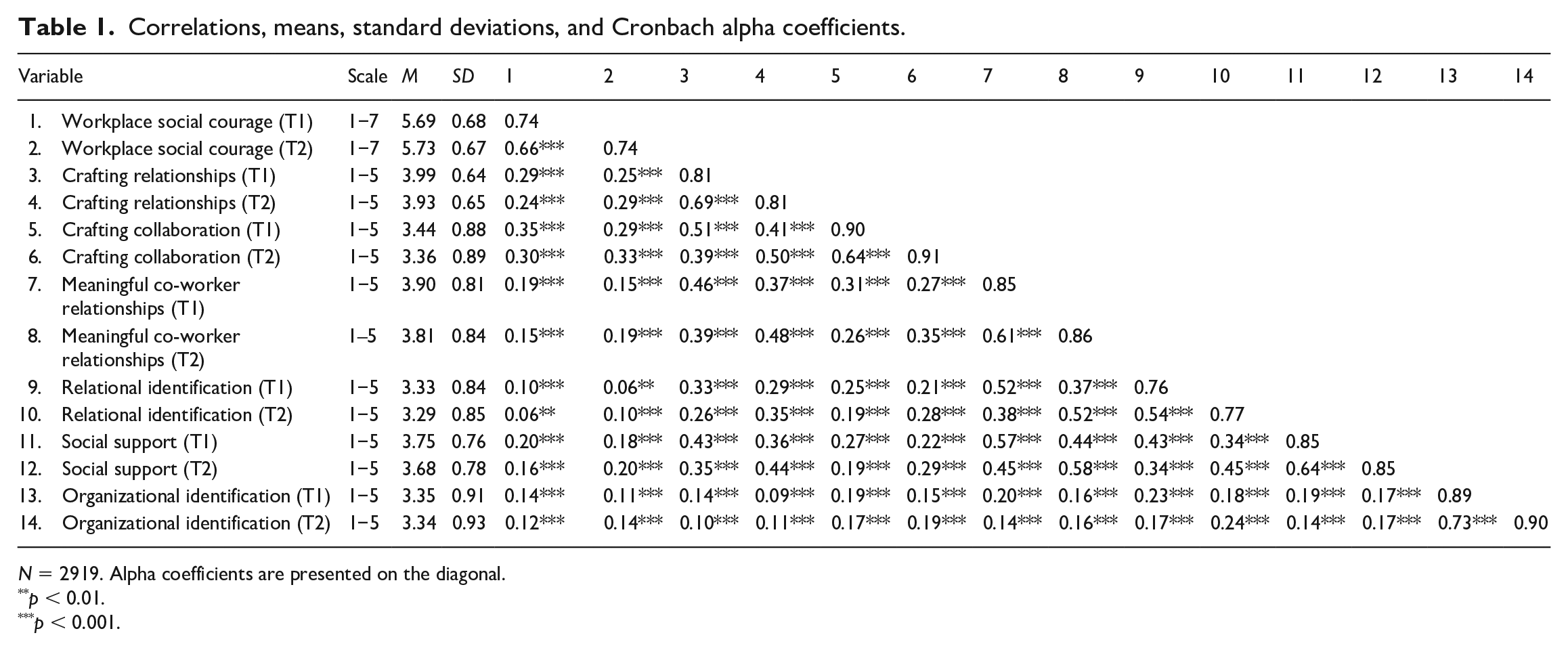
N = 2919. Alpha coefficients are presented on the diagonal.
p < 0.01.
p < 0.001.
Workplace social courage was measured with six items that were adapted from the Workplace Social Courage Scale (Howard et al., 2017). From the original scale, we excluded items that were not apt or applicable to the respondents of our study, such as showing courage to one’s subordinates, as most of the respondents did not have subordinates, or showing courage when leading a project or giving a presentation at work, as such tasks were not part of the job description for all the employees in the examined organizations.
Drawing from the job crafting theory postulating employees as proactive agents who shape relational aspects of their work (Wrzesniewski and Dutton, 2001), we developed scales to measure crafting relationships and crafting collaboration. Crafting relationships were measured with four items that assessed proactive behaviors to foster positive informal relationships and climate amongst co-workers. Three of these items (e.g., “I try to get my co-workers into a good mood”) were developed based on a scale measuring co-worker friendliness (Hakanen et al., 2014). In the used scale, we changed the respondents to be the actor in the items, rather than their co-workers. One item was new (“I ask my co-workers how they are doing”), by which we aimed at capturing everyday means that employees may have to foster relationships at work. Crafting collaboration was measured with three newly developed items, which tap into employees’ proactive behaviors targeted at improving collaboration at their jobs. The items were based on the team member proactivity measure by Griffin et al. (2007), with the focus switched from fostering team performance to collaboration.
Of the three co-worker social resource scales, meaningful relationships with co-workers were measured with three items developed for the study. Here, we drew from Grant’s (2007) theory of relational job design. The items were adapted from the measure of contact depth by Grant (2008), with the target of the original items, “people affected by one’s work”, replaced with “co-workers”. Relational identification was measured with three items adapted from Sluss et al. (2012). Social support from co-workers was measured with four items adapted from Peeters et al. (1995), which tapped into emotional (e.g. empathy and caring), appraisal (e.g. positive feedback and appreciation), instrumental (e.g. assistance in work tasks), and informational (e.g. advice and suggestions) support.
OI was measured with four items following the recommendation by Postmes et al. (2013) for measuring group identification. Three items, which tapped into the satisfaction, solidarity, and centrality dimensions of group identification, were adapted from Leach et al. (2008). One item measuring overall identification (“I identify with [organization X]”), with the content in brackets replaced by the name of the participant’s employer, was added as recommended by Postmes et al. (2013).
Analysis
In hypothesis testing, we used latent change score modeling (LCSM; Henk and Castro-Schilo, 2016). These structural equation model analyses were conducted using Mplus version 8. We used maximum likelihood estimation with robust standard errors because it is robust to non-normality (Muthén and Muthén, 2017), which was present in some of the scales. We estimated the over-time covariances among residuals of the same items as commonly recommended for repeated measures structural equation modeling (e.g., Little, 2013). For mediational analyses, we calculated the bias-corrected 95% confidence intervals using 10,000 bootstrapped samples (MacKinnon et al., 2004).
LCSM was the most suitable analytical approach to test the hypothesized associations as it captures within-person changes across two time points and relationships between such changes. Notably, LCSM does not have the same limitations as change estimates drawn from subtracting two scores from each other or residual change scores that do not estimate within-person processes accurately (Henk and Castro-Schilo, 2016). In the model, latent factors at Time 1 and Time 2 were construed by regressing the multiple measured (i.e., observed) items on their respective latent factors. Latent change scores were modeled by (a) regressing the Time 1 latent factor and the latent change score on the latent factor at Time 2 with fixed path coefficients of 1.0, (b) setting the residual of the Time 2 latent factor to zero, and (c) estimating the covariance between the latent change score and the Time 1 latent factor (Henk and Castro-Schilo, 2016; Newsom, 2015). The resulting latent change score represents within-person changes and is free of measurement error.
In hypothesis testing, we controlled for the effect of organizational membership as the different contexts across the participating organizations may affect the baseline levels and changes of the focal constructs. This was achieved by coding six dummy variables based on the participants’ organizational membership (e.g., belong to organization A, 0 = no/1 = yes; belong to organization B, 0 = no/1 = yes, etc.). Membership in the seventh organization was controlled for by the group that had a value of 0 in all the six dichotomous organizational membership variables. These six variables were regressed on all latent factors at Time 1 and latent change scores to achieve full control of covariate influences in the final hypothesized model. A model excluding these six control variables led to the same main conclusions (please contact the first author for detailed results).
Results
Preliminary analyses
The hypothesized factor model provided a good fit with the data (see Table 2; configural model). Factor loadings ranged between 0.494 and 0.939. In the configural model, we estimated four residual covariances that were between the residuals of items “If needed, my colleagues help me with a certain task” and “If needed, my colleagues give me advice on how to handle things” in the social support scale, and the residuals of items “Being an employee at [organization X] is an important part of how I see myself at work” and “I identify with [organization X]” in the OI scale at both time points. These residuals correlated between 0.36 and 0.52 at p < 0.001. Such covariances may indicate that the items share similar content and may thus be redundant to some extent (Byrne, 2012). Residuals of items that are worded similarly and measured with the same method, such as a single-source survey, are also more likely to covary (Brown, 2015). Rather than removing any meaningful content (i.e., items) from the measured phenomena, we followed the suggestions to estimate such residual covariances and thus take into account their effect in the models (Brown, 2015; Byrne, 2012; Cole et al., 2007). As stated by Cole et al. (2007: 395), “Omitting (or obscuring) design-driven correlated residuals can easily lead to undetectable model misspecifications and to the construction of latent variables that do not represent the constructs of interest”.
Tests of measurement invariance over time.
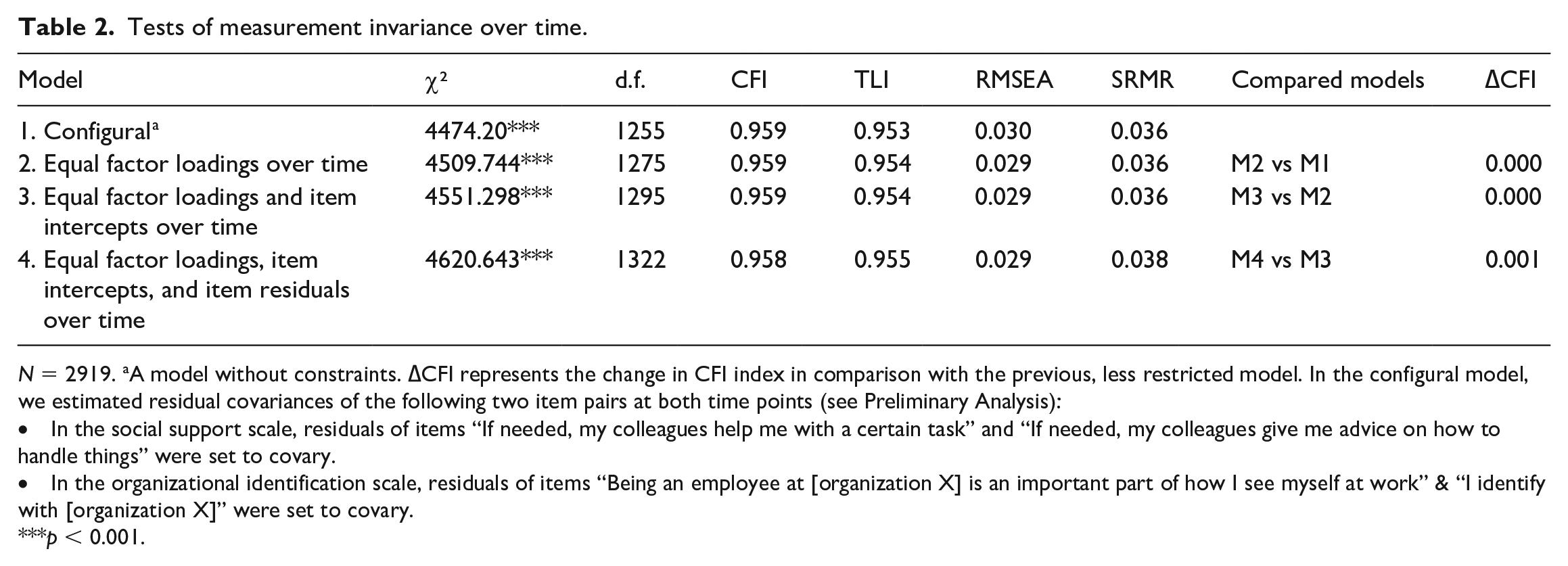
N = 2919. aA model without constraints. ∆CFI represents the change in CFI index in comparison with the previous, less restricted model. In the configural model, we estimated residual covariances of the following two item pairs at both time points (see Preliminary Analysis):
• In the social support scale, residuals of items “If needed, my colleagues help me with a certain task” and “If needed, my colleagues give me advice on how to handle things” were set to covary.
• In the organizational identification scale, residuals of items “Being an employee at [organization X] is an important part of how I see myself at work” & “I identify with [organization X]” were set to covary.
p < 0.001.
In addition to providing good fit with the data, the hypothesized factor model provided a superior fit in comparison with alternative factor models – for instance, a model where collaboration and relationship crafting items loaded on the same factor provided poor fit with the data: χ²(1280) = 8409.57, p < 0.001, RMSEA = 0.044, CFI = 0.909, TLI = 0.899, and SRMR = 0.064. So did a model where social courage, collaboration crafting and relationship crafting items loaded on the same factor, χ²(1301) = 11,964.659, p < 0.001, RMSEA = 0.053, CFI = 0.864, TLI = 0.851, and SRMR = 0.076, and a model where all three social co-worker resource scale items loaded onto a single factor, χ²(1301) = 8718.55, p < 0.001, RMSEA = 0.044, CFI = 0.906, TLI = 0.896, and SRMR = 0.045. These findings supported the notion that the examined hypothesized constructs differed empirically from each other.
Strict measurement invariance over time for the measurement model (i.e., equal factor loadings, and item intercepts and residuals over time) was established following the criterion of CFI decrease below 0.01 between increasingly constrained models as shown in Table 2 (Cheung and Rensvold, 2002). This finding indicates that the changes in the scales are more likely to represent true changes rather than changes owing to scale items being interpreted differently at different time points. Next, we proceeded with the strict measurement invariance model to test the hypothesized associations.
Main analyses
As shown in Figure 1, changes in social courage were positively associated with changes in crafting relationships and crafting collaboration. Thus, Hypotheses 1a and 1b received support as increases in social courage were associated with increases in crafting relationships and collaboration. Both types of social crafting were positively associated with changes in all three co-worker resources (meaningful relationships, relational identification, social support) thus providing support to Hypotheses 2a, 2b, 2c, 3a, 3b, and 3c. Hypothesis 4b and 4c were supported, as increases in relational identification and social support were associated with increases in OI. However, as changes in meaningful relationships with co-workers were not associated with changes in OI, Hypothesis 4a was not supported.
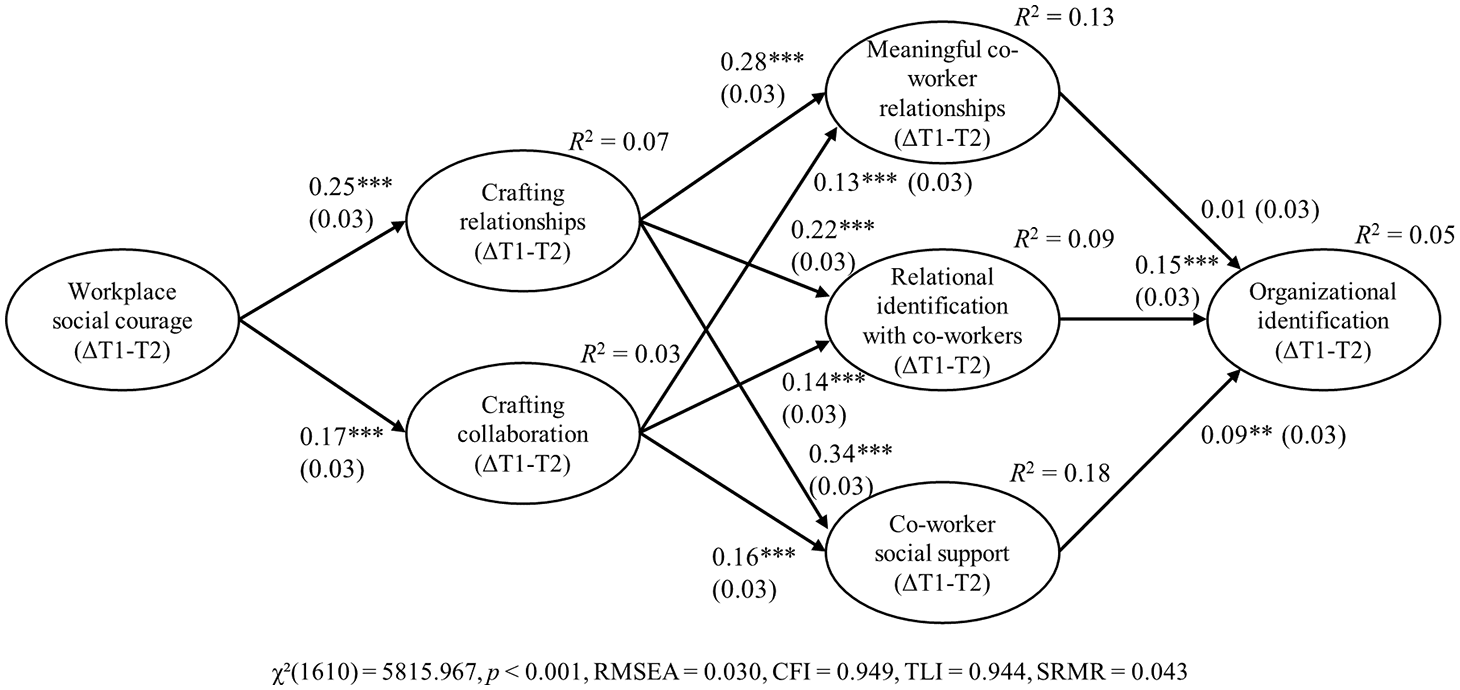
Hypothesized latent change score model. N = 2919. Standardized path estimates with standard errors in parentheses are presented. T1 = Time 1; T2 = Time 2. Symbol Δ refers to within-person changes. For clarity, omitted from the figure are latent factors’ items, latent factors at Time 1 and Time 2, residual covariances between the latent change score factors, and the six dichotomous organizational membership variables which were controlled for in the model. The presented R2-values are all statistically significant at p < 0.01. *** p < 0.001, ** p < 0.01.
The hypothesized indirect paths (Hypothesis 5) received partial support. Four out of the six hypothesized indirect paths were supported, as for them the 95% confidence interval did not include zero (Table 3). Specifically, increases in social courage were associated with increases in OI via the paths of increases in crafting relationships and relational identification, crafting relationships and social support, crafting collaboration and relational identification, and crafting collaboration and social support. However, increases in social courage were not indirectly associated with increases in OI via the paths of increases in crafting relationships and meaningful co-worker relationships and increases in crafting collaboration and meaningful co-worker relationships.
Standardized coefficients for indirect effects.
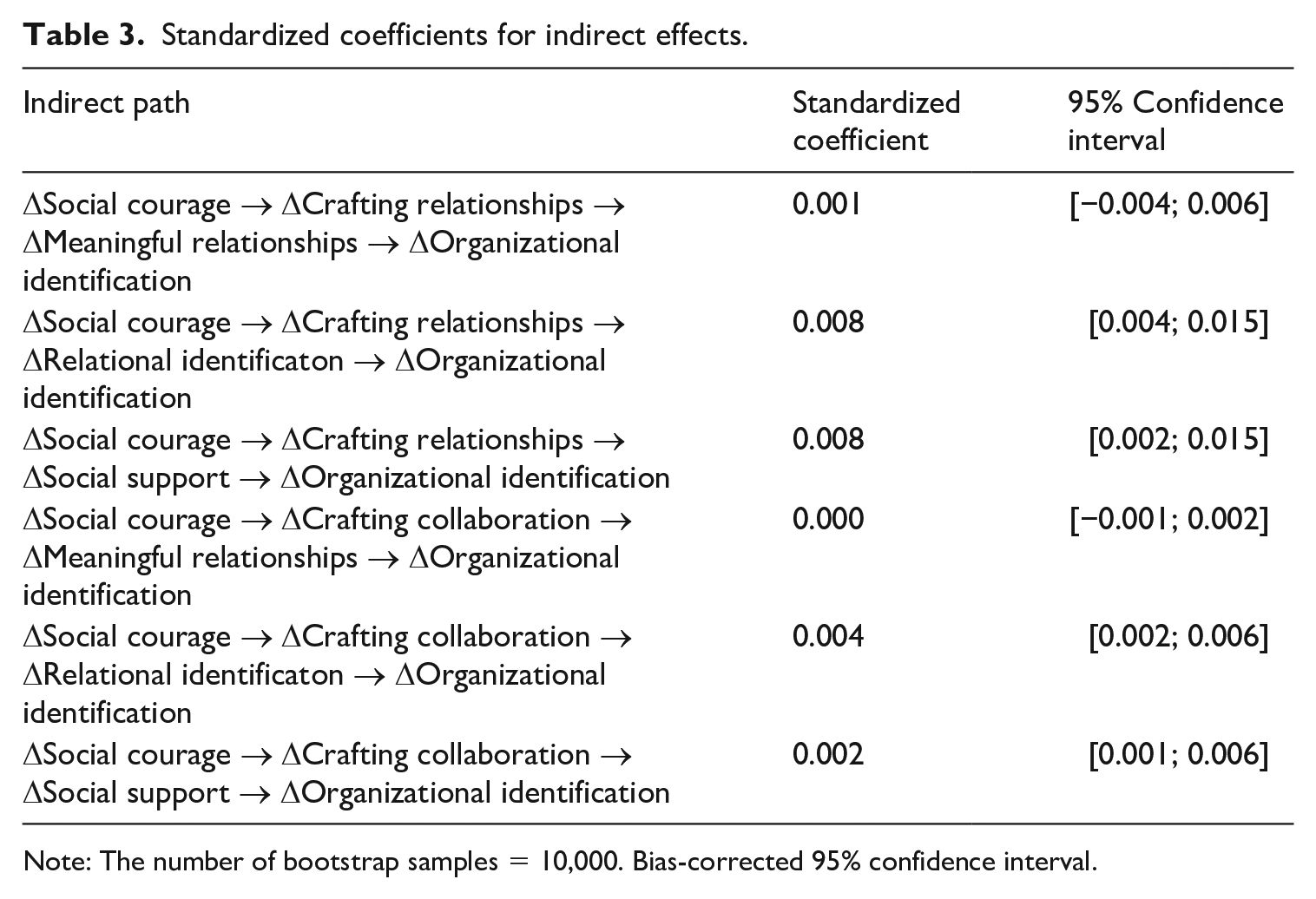
Note: The number of bootstrap samples = 10,000. Bias-corrected 95% confidence interval.
To answer the research question of whether increases in teleworking moderated any of the hypothesized associations, we examined whether the hypothesized paths differed between those who increasingly teleworked (n = 1665) and whose teleworking time did not increase (n = 1136) since the outbreak of COVID-19 in March 2020. This was tested by using multigroup modeling and model constraint command in Mplus software, by which we estimated whether an estimate of difference was statistically significantly different from zero. The difference estimate was construed by subtracting a specific hypothesized path estimate of the telework group from the estimate of the non-telework group (see Table 4). These analyses suggested that there were no differences between these two groups as none of the 11 difference estimates were statistically significantly different from zero. Furthermore, the hypothesized model (as in Figure 1) provided a good model fit for both groups. For those who increasingly teleworked, model fit indices were χ²(1610) = 4062.42, p < 0.001, RMSEA = 0.030, CFI = 0.948, TLI = 0.943, and SRMR = 0.046, and for those whose teleworking time had not increased, indices were χ²(1610) = 3395.36, p < 0.001, RMSEA = 0.031, CFI = 0.946, TLI = 0.941, and SRMR = 0.048. These findings showed that the hypothesized associations did not differ between those who increasingly teleworked and those who did not.
Difference tests between those who increasingly teleworked (n = 1665) and those who did not (n = 1136) for each hypothesized path estimate.
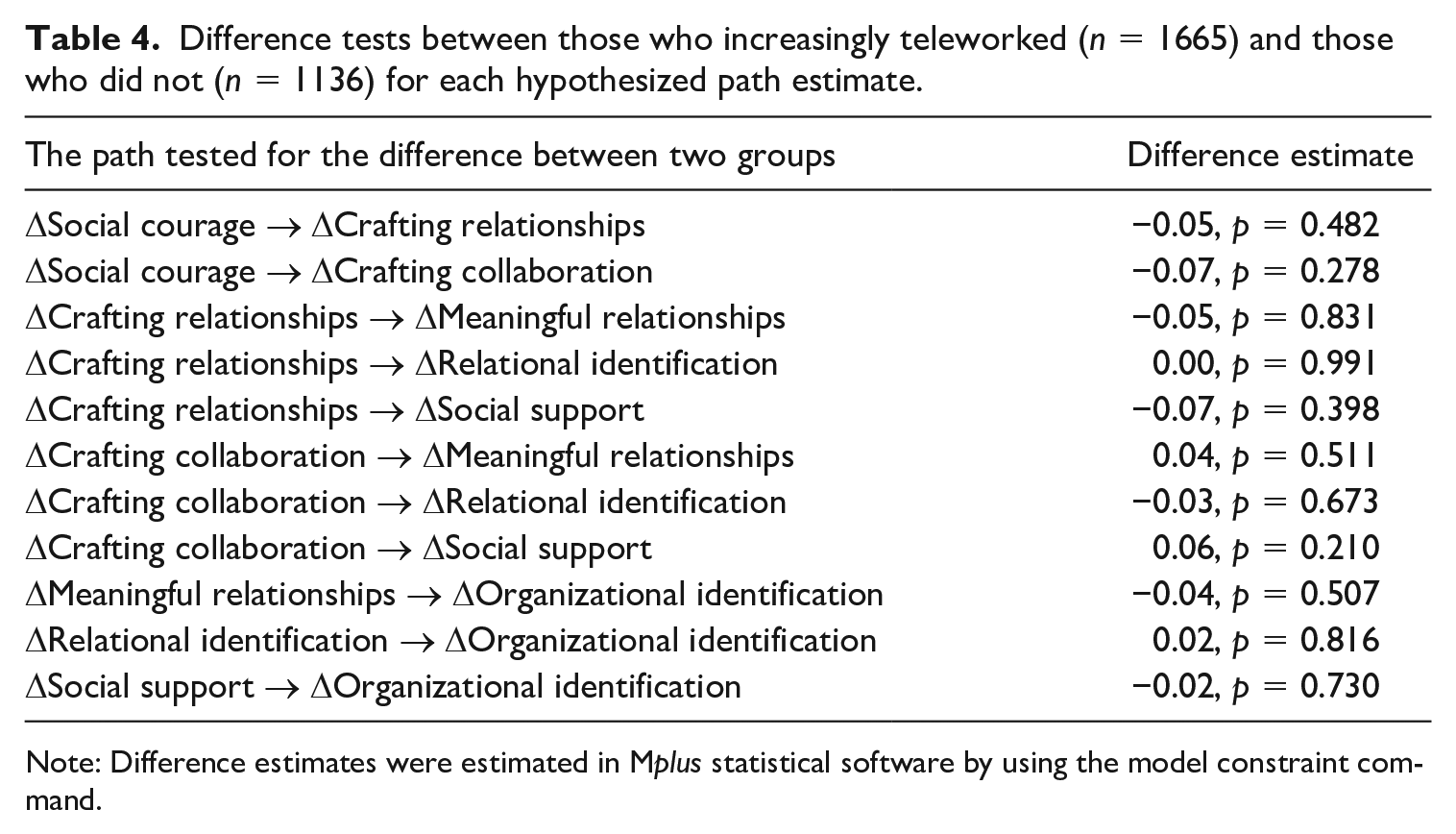
Note: Difference estimates were estimated in Mplus statistical software by using the model constraint command.
Discussion
By incorporating the notions of personal resources and resource investment behaviors from COR theory, we show how employee-initiated actions may increase one’s identification with the organization and thus expand the nomological net and understanding in the OI literature. Our findings suggest that by being increasingly socially courageous, individuals proactively craft the social aspects of their work and as a result have deeper relationships with colleagues, identify more with the co-worker relationships, and receive more social support. Relational identification and social support eventually promoted OI.
Our results provide insights regarding the importance of employees’ enactment of social courage in their daily working lives. Aligning with our argument of relational crafting having a favorable prosocial impact at work, social courage is about acts that may at first put the actor at risk but eventually benefit both the actor and others. Crafting the social aspects of a work environment entails risks, which may include the risk of being rejected, misunderstood, or even ridiculed if other people do not appreciate or reciprocate the efforts. Being ready to take such risks may entail favorable outcomes in terms of increased social resources and belongingness at the workplace. As a personal resource, social courage may provide the necessary basis for behaviors that accumulate social resources and identification with a group to the extent that it promotes informal and instrumental relationships amongst co-workers.
What employees themselves may do to promote their organizational identification
By integrating COR theory (Hobfoll, 1989) and SCT (Turner et al., 1987), we extend the understanding of what employees themselves may do to promote their identification with an organization and how this process unfolds over time. As the group identification literature in the quantitative organizational behavior domain has predominantly drawn from SCT and has established an abundance of top-down processes that influence group identification (e.g., leadership, justice; He and Brown, 2013), less is known about “what are the various means through which bottom-up processes may in turn shape higher order identities?” (Ashforth, 2016: 366). We address this question by drawing from the notions of personal resources and resource investment behaviors in COR theory (Hobfoll, 2001) and employee-initiated proactive behaviors in the job crafting literature (Wrzesniewski and Dutton, 2001) and thus expand the understanding of antecedents of OI. Our approach echoes the arguments that when a single theoretical framework, such as SCT, dominates a specific field of literature, it may increase the risk of researchers sidelining other essential aspects that may (also) promote OI but that are typically outside of the given theoretical framework (Ashforth, 2016; Brown, 2017). Relational job crafting is an example of such a promising new angle to OI research. As elaborated by Wrzesniewski et al. (2013: 298), “Job crafting offers an important contribution to this field by envisioning employees not as passive recipients of job characteristics, but as active participants in the construction of the meaning of their work and themselves”. Although by this we go beyond most of the current (quantitative) OI literature, our approach draws parallels with qualitative identity work literature, which similarly emphasizes individuals as active agents in building, creating, maintaining, and revising their identities (e.g., Ashforth and Schinoff, 2016; Brown, 2017; Koerner, 2014). By using quantitative methods, we provide new evidence regarding the generalizability of individuals as crafters of their social identities. Relatedly, we also address calls to examine OI as a dynamic process that evolves rather than as a static state, which provides only snapshots of the phenomena and thus limits our understanding regarding the means to promote OI over time (Edwards et al., 2017; Sillince and Golant, 2018).
We also illuminate how individual employees can promote their OI by enacting social courage in their daily working life. By this, we answer calls to incorporate individual-level factors as antecedents of OI as it has received only limited attention (Ashforth, 2016). The few OI studies that have examined these aspects have identified personality traits, such as the need for affiliation as factors that influence OI (for a review, see He and Brown, 2013). We expand this understanding and nomological net by demonstrating how an individual’s disposition to act courageously in social contexts may promote OI. We illuminate this process further by uncovering relational crafting and social resources as underlying processes that are likely to explain why social courage may lead to increases in OI. That is, the effect of social courage on group identification may occur to the extent it leads to prosocial behaviors that increase social resources. This adds also to the theoretical understanding of social courage as a promoter of social identity and broadens the knowledge regarding the social consequences of social courage (Koerner, 2014).
Against our expectations, which were based on the resource accumulation process postulated in COR theory (Hobfoll, 1989) and the convergence model (Sluss and Ashforth, 2008), increases in meaningful relationships with co-workers were not associated with increases in OI. This indicates that the experience of meaningful personal relationships at work may not directly generalize to the organizational level. Potentially, meaningful relationships with co-workers may be a more proximal predictor of the relational identification and social support amongst co-workers, as indicated by the correlations amongst the variables (Table 1). Therefore, whereas gains in meaningful relationships as a social resource may not manifest directly as increases in OI, it may do so by fostering gains in other social resources at the co-worker level. Meaningful relationships may thus play a role in promoting OI, even if this potential role is not completely captured by our model. This finding also corroborates the importance to examine various social resources simultaneously as it may provide insights into their relative importance.
Relational crafting is about crafting courageously both relationships and collaboration
In their seminal work on job crafting, Wrzesniewski and Dutton (2001) envisioned that by crafting their job, employees may revise their work identities (see also Wrzesniewski et al., 2013). We show how identity formation may result from relational crafting and thus address calls to examine the interaction between work and identities and how individuals may craft to promote their sense of belonging (de Bloom et al., 2020; Kira and Balkin, 2014). By this, we also expand the current understanding of job crafting as embedded within its social environment (Tims et al., 2022). Specifically, our examination of relational job crafting as crafting positive relationships and collaboration practices provides novel insights into job crafting theory as it expands the current conceptual understanding of relational crafting and its antecedents. Previous measures of job crafting have denoted that the aim of crafting relational boundaries is to make the job better suit the employee themselves. This idea has been captured with items about investing in relationships that are positive for the job crafter or limiting one’s relational network to achieve one’s work goals (Niessen et al., 2016; Rofcanin et al., 2019). Alternatively, previous scales have focused only on informal relationships at work (Slemp and Vella-Brodrick, 2013). We add to this research by arguing that relational crafting is not necessarily only about improving one’s own work situation. We suggest that relational crafting is better captured by a broader aim at improving joint interactions and collaboration, thus considering more fully the informal and instrumental prosocial effects of one’s behaviors.
Whereas existing studies have shown that previous conceptualizations of relational crafting are associated for instance with better person–job fit (Lu et al., 2014), we show how relational crafting as crafting relationships and collaboration is likely to benefit both the employee and employer in terms of increasing the social resources amongst co-workers and at the organizational level. Interestingly, Kerksieck et al. (2019) did not find evidence that crafting social resources at work would be associated with social support. This finding may implicate that asking one’s supervisor and colleagues for coaching or feedback, as examined by Kerksieck et al. (2019), may not similarly benefit social support as showing consideration and concern for colleagues and improving collaboration (i.e., relational crafting) appears to do.
Furthermore, by answering calls to investigate the mechanisms leading to the outcomes of relational job crafting (e.g., Tims et al., 2022), we show that relational crafting is likely to promote OI by improving the targeted working conditions (i.e., social resources at the co-worker level). Thus, being socially proactive may not be sufficient by itself, but to observe and facilitate its positive impact at work, the working conditions need to be changed and altered as a result of proactive behaviors that then subsequently lead to positive outcomes for the employee and employer.
Three-fold contributions to the conservation of resources theory
Our findings provide insights into COR theory as a theoretical framework in the following three ways. First, we provide new knowledge into how individuals may acquire resources as it is one of the less known and understood aspects “despite 25 years of research aimed at testing and refining the theory” (Halbesleben et al., 2014: 1337). We illuminate the active role that employees themselves may have in regulating their own behavior and how it may lead to resource gains. Although having resources is not solely the responsibility of an individual employee, we show that employee-initiated actions are likely to play a role in the process of social resource accumulation. We therefore uncover the underlying process through which internal resources (individual’s social courage) may promote external and contextual resources (social resources amongst co-workers; e.g., ten Brummelhuis and Bakker, 2012). This provides new insights regarding why resources accumulate for some but not for others, as for those who are socially courageous such accumulation may be more likely.
Second, drawing from the theoretical advances suggesting that COR theory needs to be viewed in context as the effect of resources may depend on a given environment (Halbesleben et al., 2014; Hobfoll et al., 2018), we examined the resource caravan in two different contexts. Interestingly, we did not find differences in the examined associations between those who increasingly teleworked and those who did not during the COVID-19 outbreak. Telework therefore did not appear to impact the resource accumulation process. On the one hand, one could have argued that teleworking limits the opportunities to be socially courageous as the interactions are more restricted. On the other hand, it could be that especially during times of social isolation, social contacts and interactions matter more than before. Yet, our findings align with the notion that resources and their effects are primarily universal as postulated in COR theory (Hobfoll, 1989) and contribute to all examined relevant streams of literature, as they indicate that social courage may promote OI via relational crafting and social resources in different working environments. By this, we also address calls to examine teleworking during the pandemic as it represents a unique context that may impact previously theorized relationships (Wang et al., 2021).
As the third contribution to COR theory, our analytical approach of within-person processes represents a more accurate and informative attempt to test the accumulation of resources over time, the central tenet of COR theory (Hobfoll et al., 2018). By this, we provide new insights on how evolution (i.e., increases or decreases) in employees’ personal resources, resource investment behaviors, and social resources are associated. Notably, relevant studies have rarely addressed the antecedents and outcomes of within-person changes in the examined constructs. This potentially undermines the understanding of resource accumulation and the drivers of social resource increases, whereas our examination more accurately reveals the benefits of cultivating such behaviors and resources.
Practical implications
For managers, leaders, and HR professionals, our results emphasize that to increase employees’ identification with their employer organization, it is suboptimal to focus solely on top-down organizational processes (e.g., leadership, the status of the organization) as identified in previous research. This is because OI may also be driven by employee-initiated behaviors as our findings suggest. For this, it is necessary to create working environments and conditions that promote employees' socially courageous acts, such as voicing their concerns and making suggestions proactively. Providing sufficient employee discretion and managerial encouragement for employees to be proactive may help. Also, psychological safety and trust at the workplace are likely to support courageous actions at work. However, as being courageous by definition is about taking risks, workplaces that are not psychologically safe may actually have a stronger need for social courage and also benefit more from such acts. Therefore, all organizations, regardless of how psychologically safe they are, could benefit from even small steps to become more tolerant of courageous behaviors. Importantly, what is brave and favorable behavior for an employee may not be valued as such by the manager. Open dialogue may be needed to understand the motives behind courageous acts and to build a company culture where courage is appreciated as a constructive feature of a healthy organization.
Our findings suggest that both aspects of relational crafting, crafting relationships and better collaboration practices, are important for meaningful and supportive social relationships and identification with one’s co-workers and organization. This finding underlines the value of not only formal, task-oriented but also informal social interactions at work. To ensure conditions for building a positive, considerate, and kind co-worker climate can be a powerful way to strengthen employees’ identification.
For the employed individuals, our findings suggest that by taking social risks, being considerate towards others, and finding new ways to improve collaboration, one may benefit not only the others but also strengthen one’s belongingness and identification with the employer organization. This group identification subsequently yields, for instance, health benefits for the employee (Steffens et al., 2017). Our results also show that taking social risks, such as the risk of losing face or receiving negative reactions from others, may at times be necessary to improve relationships and ways of working. When trying something new, the consequences are not always known. Our findings, however, suggest benefits for the actor and others. Yet, we do not propose that resolving organizational deficiencies should be the responsibility of an individual employee. We rather posit that employees are active agents who can reshape their social working conditions and thus benefit themselves and others.
Interestingly, our results suggest that the impact of social courage on OI did not differ depending on whether an employee’s teleworking time increased or not. This finding indicates that social courage, relational crafting, and social resources may all benefit the employee and employer regardless of whether they are enacted face-to-face or via telecommunication. The good news is that switching to telework during the COVID-19 pandemic may not have diminished the possibilities to promote social relations at work even if teleworking on average hampers social relationships and belongingness at work (Allen et al., 2015). It may be that when teleworking, employees need to be more proactive in initiating interactions via online or phone, which contrasts with interactions at the workplace that may just happen when meeting someone face-to-face (Wang et al., 2021). For practitioners pondering upon work arrangements in their company and their impact on social aspects of work, it may be helpful to realize that there are means to uphold and promote social resources also in teleworking settings. For instance, organizations could ensure and further develop means and channels to enable proactive social interactions between co-workers.
Limitations and future research
One of the limitations of our study was its correlational nature, which limits causal inferences. However, as we examined changes with established measurement invariance over time, our study may provide stronger causal evidence in comparison with study designs that examine only absolute scores at specific time points (Henk and Castro-Schilo, 2016). Future research with more measurement time points and manipulation of the examined variables are necessary to substantiate the causal claims further. For instance, studies examining lagged association over time could further illuminate the direction of effects between relational crafting and social resources (Tims et al., 2022). Another methodological limitation is common method bias, which may result from using the same method (i.e., self-report survey) to measure all the study variables. This concern is alleviated to some extent by our use of repeated measures across different contexts. We also emphasized participants’ confidentiality in the survey instructions (Spector, 2006). We call for future studies to use other-rated measures of social courage and crafting behaviors. Yet, in comparison with studies examining data from a single organization or field of industry, our approach of collecting data from a range of industries and different organizational contexts likely strengthens the generalization of our findings.
Future research is needed regarding the predictors of workplace social courage, which was outside the scope of this study. Studies could examine, for example, how employees’ personal attributes, psychological safety at the workplace, and leadership qualities support or hinder social courage at work (Detert and Bruno, 2017; Howard and Cogswell, 2019). Such study designs could illuminate to what extent workplace social courage is an individual’s trait, and to what extent it depends on the social and environmental context. Whereas we found support for the positive relationship between social courage and relational crafting, future studies could illuminate, for instance, the role of individuals’ need for belongingness as a potentially essential driver of relational job crafting (de Bloom et al., 2020). Future research could also illuminate further the potential mechanisms and conditions for the relationship between work group and OI. For example, in addition to being structurally nested, the more two social entities resemble each other, for instance in values and norms, the more likely it is that identification with one strengthens identification with another (Marique et al., 2014; Sluss and Ashforth, 2008). Also, group identification promotes adherence to a group’s norms and values (Turner et al., 1987). Thus, if interests of a work group are against the interests of the organization, identification with the work group could potentially even hamper identification with the organization in such cases.
Conclusion
We focused on two types of self-initiated and socially focused behaviors: social courage and relational job crafting. We found how they are related to various social resources at work and increases in OI. Although research on relational job crafting has attracted increasing attention, it is still a rarely studied type of job crafting (e.g., Rofcanin et al., 2019). This is noteworthy considering that employees rarely work or craft their jobs in isolation and as relationships are an essential aspect of work. Social courage is even less investigated even though the need for social courage is pronounced in socially embedded and turbulent work–life. The present study suggests that to foster OI even during uncertain times, the employees themselves may strengthen their psychological ties with their organization.
Footnotes
Appendix: Construct items and scales
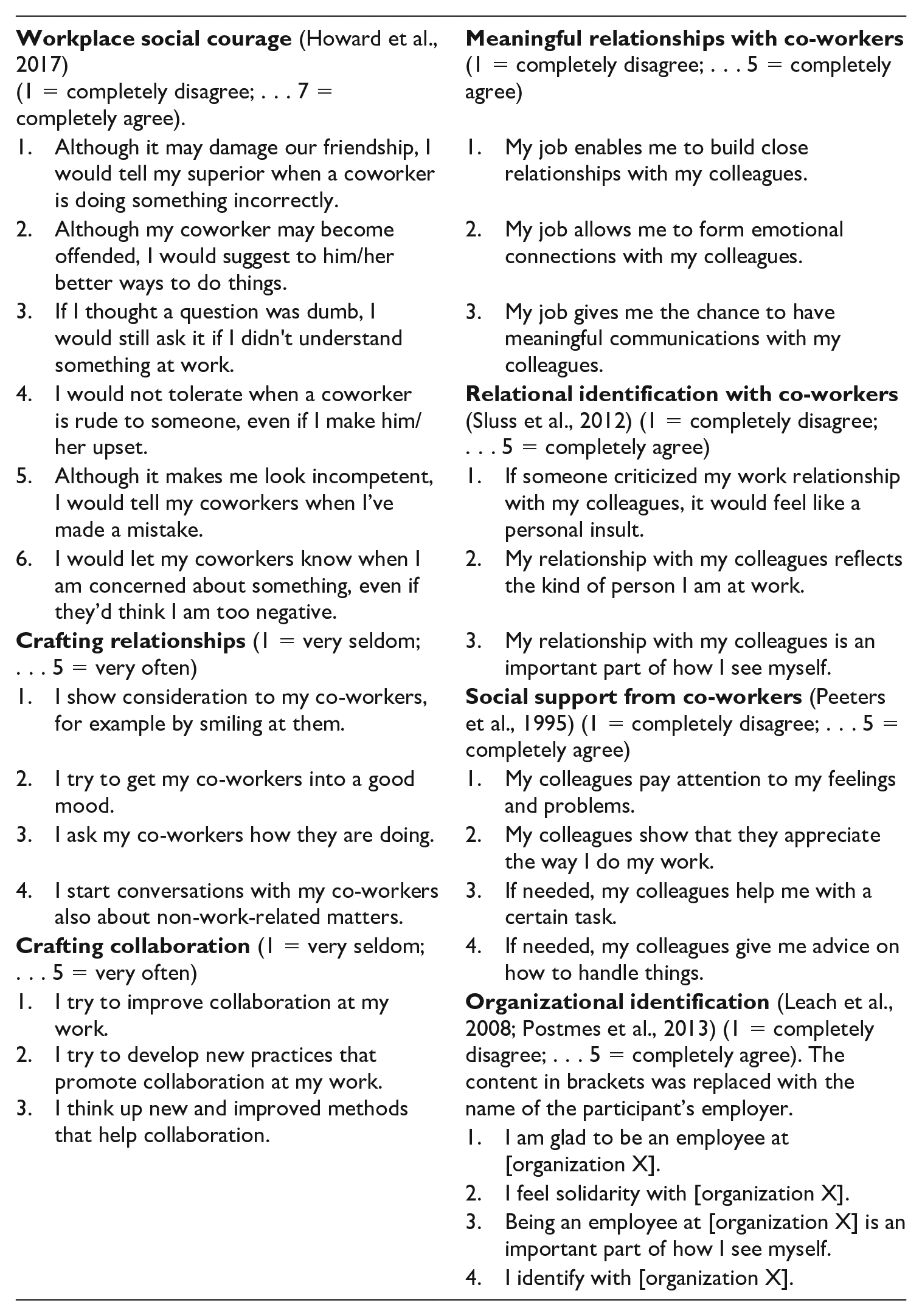
(1 = completely disagree; . . . 7 = completely agree). |
|
| 1. Although it may damage our friendship, I would tell my superior when a coworker is doing something incorrectly. | 1. My job enables me to build close relationships with my colleagues. |
| 2. Although my coworker may become offended, I would suggest to him/her better ways to do things. | 2. My job allows me to form emotional connections with my colleagues. |
| 3. If I thought a question was dumb, I would still ask it if I didn't understand something at work. | 3. My job gives me the chance to have meaningful communications with my colleagues. |
| 4. I would not tolerate when a coworker is rude to someone, even if I make him/her upset. | |
| 5. Although it makes me look incompetent, I would tell my coworkers when I’ve made a mistake. | 1. If someone criticized my work relationship with my colleagues, it would feel like a personal insult. |
| 6. I would let my coworkers know when I am concerned about something, even if they’d think I am too negative. | 2. My relationship with my colleagues reflects the kind of person I am at work. |
| 3. My relationship with my colleagues is an important part of how I see myself. | |
| 1. I show consideration to my co-workers, for example by smiling at them. | |
| 2. I try to get my co-workers into a good mood. | 1. My colleagues pay attention to my feelings and problems. |
| 3. I ask my co-workers how they are doing. | 2. My colleagues show that they appreciate the way I do my work. |
| 4. I start conversations with my co-workers also about non-work-related matters. | 3. If needed, my colleagues help me with a certain task. |
| 4. If needed, my colleagues give me advice on how to handle things. | |
| 1. I try to improve collaboration at my work.2. I try to develop new practices that promote collaboration at my work.3. I think up new and improved methods that help collaboration. | |
| 1. I am glad to be an employee at [organization X]. | |
| 2. I feel solidarity with [organization X]. | |
| 3. Being an employee at [organization X] is an important part of how I see myself. | |
| 4. I identify with [organization X]. |
Acknowledgements
We thank Maria Hirvonen for the data preparation.
Funding
The authors disclosed receipt of the following financial support for the research, authorship, and/or publication of this article. This research was supported by the Finnish Work Environment Fund (grant 190126).
