



Abstract
A major preoccupation in the contemporary organizational landscape is governance and how to cope with conflict and uncertainty. These challenges are particularly evident in the governance of cities, with their complex histories, politics and administrative processes. We argue that visual artefacts can form powerful visual impression management, constituting ‘visual governance’, for dealing with such complexities. We construct a framework from the visual semiotics of Umberto Eco, extended by medieval aesthetics. We analyse the pre-modern case of the Sienese Biccherna panels (painted covers and paintings linked to the city accounts) to show how their calligraphy, heraldry and pictures convey idealized reassuring images of orderly administration, in times of complicated, disordered underlying realities. In demonstrating how art and accounting are intertwined as tools of governance, and that there are contemporary resonances in corporate annual reporting, we add both to research in governance and to visual organizational research, and pave the way for further interdisciplinary work on the relationship between art and organizations.
Images are as much a material force in and between societies as are economic and political forces.
Introduction
Siena is celebrated both for its commercial success in pre-modern times and for the serene beauty of its civic art, incorporating harmonious depictions of city life. Yet, for much of its history, the Italian city state of Siena was faction-ridden and in a state of political turmoil (Hook, 1978; Najemy, 1983). Why might this apparently contradictory state of affairs be so?
A major preoccupation in the contemporary organizational landscape is governance and how to cope with conflict (Davies, 2005), complexity and uncertainty (Renn, 2017). Political unrest and social conflict can challenge the capacity of local authorities to govern (Davies, 2005). With their complex histories, politics and administrative processes, cities provide significant sites for exploring governance and the mediation of city governments (Vith et al., 2019). In such a multi-stakeholder environment, often interweaving public and private bodies, city administrations can address these issues by ‘crafting strategy texts [. . .] conceptualised as discursive devices’ (Brandtner et al., 2017: 1076). Among these discursive devices, we argue, visual artefacts play a powerful role in dealing with the complexity and contradictions that characterize city governance, as they can craft, convey and store multiple yet cohesive messages (Meyer et al., 2018; Quattrone, 2017). Despite their value in the governance domain, the role of visual devices in aiding city governance (Quattrone, 2017) has remained surprisingly overlooked in organization studies.
We take the case of the pre-modern Sienese Biccherna panels (an important set of painted book covers and paintings linked to the city accounts, see Figures 2A, 2B, 2C, 3A, 4A, 6A), 1 to show that visual artefacts can form powerful visual impression management, constituting ‘visual governance’. We reunite the artistic and administrative domains of the panels, which became both physically and intellectually separated over the centuries, to understand better how reassuring visual images (calligraphy, heraldry, pictures) frame ideal administrative practice in times of complex underlying realities.
We add both to research in governance and to visual organizational research through elucidating the important strategic role played by the production of visual images and their affordances (Brandtner et al., 2017; Meyer et al., 2018) in complex governance processes. Our focus is city governance. Governance is a long-established research domain (Ezzamel and Reed, 2008). We understand governance under the institutionalist perspective, and take as our definition of ‘governance’, the ‘processes and institutions, both formal and informal, that guide and restrain the collective activities of a group’ (Keohane and Nye, 2000: 12). We further envisage governance as ‘a loosely coupled set of “coping mechanisms” that assist organizations in [. . .] dealing with the conflicting, and often incompatible, demands made by internal and external stakeholder groups embedded in highly diverse and pluralistic institutional environments’ (Ezzamel and Reed, 2008: 609). The visual, long a ‘blind spot’ in organization studies (Strangleman, 2004) – ignored, or trivialized as neutral information or empty decoration (Bell and Davison, 2013) – is increasingly recognized as playing an important role in organizing processes (for overviews see Bell and Davison, 2013; Bell et al., 2014; Boxenbaum et al., 2018; Davison, 2015; Meyer et al., 2013; Puyou et al., 2012; Quattrone et al., 2021; Styhre, 2010). We add the visual dimension to governance, and further consider contemporary resonances in corporate annual reports suggested by our study of the Biccherna panels.
The Sienese ‘understood superbly the power of visual art to serve the concerns of government’, and were ‘shrewder than other Italian city-states in manipulating art for political ends’ (Smith and Steinhoff, 2016: 2). Literacy was low, even among the ruling classes, 2 and visual media were therefore essential forms of communication. Sienese authorities used visual symbols ‘to offer a façade that was carefully controlled by legislative measures, architectural interventions and artistic commissions that combined to present an ideal vision of the polity’ (Nevola, 2007a: 17). Art was an important means of knowledge acquisition in the realms of medieval moral and political thought (Carruthers, 2013: 17). Confidence was key to the thriving commerce of the pre-modern Italian city states (McLean and Padgett, 1997); judgements need to be confidently made, and this is not just a matter of logical demonstration, but also of being made to ‘feel confident’ through the rhetorical persuasion that art can offer (Carruthers, 2013: 42).
Our reading of secondary historical sources (Bowsky, 1970, 1981; Norman, 1999) together with consideration of Lorenzetti’s celebrated Allegory of Good Government fresco (1338–1339) led us to identify for analysis three key areas where idealized visions of administrative practice arguably provided ‘coping mechanisms’ for dealing with underlying realities and complexities. These are: the sophisticated administrative system of the city itself where in reality practice was often defective; the relationship between city and church, intertwined but where relations were often strained; and the symbiotic but tense relationship between the city and its contado, or surrounding rural areas. We accordingly reviewed the surviving Biccherna panels for these themes, and identified those cases where both panels and accounting documents exist for the same period.
We take as our analytical model the visual semiotics of Umberto Eco, the Italian medievalist, philosopher and semiotician, and in particular The Open Work (1989) and ‘Critique of the image’ (1982). 3 We develop a framework of iconic codes, iconographical codes and codes of taste and sensibility. We extend this by reference to Carruthers’ (1990, 1998, 2013) investigations of the medieval aesthetics of proportion, varietas and polyfocality. We use this semiotic framework to analyse in detail three Biccherna panels to show how the panels’ sign systems (calligraphy, heraldry, pictures) constitute Visual Governance.
The contributions of our interdisciplinary study to work on (city) governance and to visual organization studies are therefore threefold. First, we extend the visual dimension to strategic city governance (Brandtner et al., 2017) by elucidating through detailed semiotic analyses the Biccherna panels’ idealized frames of visual impression management, under-examined in organization studies (Meyer et al., 2013) and in showing empirically how they work to infiltrate, spatialize, captivate and materialize (Meyer et al., 2018) concepts of governance. Second, we develop a framework for analysis of the visual from visual semiotics, important in art history (Bal and Bryson, 1991), but under-explored in organization studies (Meyer et al., 2013); we follow Eco (1982, 1989), extended through Carruthers (1990, 1998, 2013). Finally, we offer a study of visual artworks (the Biccherna panels), important but surprisingly rare in organization studies (Meyer et al., 2013), and reunite the panels’ artistic and administrative domains, showing forgotten links relevant to contemporary times (Quattrone, 2017).
An initial section, ‘Governance and visual settings’, places the article in existing academic literature. A framework is subsequently developed of ‘visual semiotics’, and our ‘Method’ is then outlined. Our case study of the Biccherna panels is first placed in its ‘Background’ and in the visual political ideology of the Allegory of Good Government (1338–1339). This is followed by our detailed semiotic analyses where we show how the panels constitute ‘Visual governance’ in (1) ‘Visual civic administration’, (2) ‘Visual fusion of city and church’ and (3) ‘Visualizing city and contado’. Finally, we summarize and discuss the modern-day organizational context of the corporate annual report in ‘Summary, medieval aesthetics and contemporary resonances’.
Governance and visual settings
Governance, cities and the visual
Governance, a ubiquitous term in contemporary organizational discourse, can be explored through multiple theoretical and disciplinary perspectives (see Eberlein, 2019; Ezzamel and Reed, 2008; Osborne, 2010; Rhodes, 2007). We understand governance under the institutionalist perspective, and our focus is city governance. In contemporary governance research ‘cities have frequently slipped under the radar’ (Vith et al., 2019: 1040), but have challenges in ‘manoeuvering [. . .] tensions and bridging governance gaps [. . .] to create connectivity regarding values, norms and principles among all actors involved’ (Brandtner et al., 2017: 1077). At the city level, governance focuses on interaction between the local authority and the different components of society. The institutionalist perspective enables the uncovering of the social and cultural underpinnings of governance structures by including a broad range of formal and informal ‘coping mechanisms’ (Ezzamel and Reed, 2008: 609) that sustain institutions (Drori et al., 2006; Kooiman and Jentoft, 2009).
A few studies have examined city governance under the institutionalist perspective, revealing the dynamism of society, as well as evolving governance responses across different cities as a consequence of different institutional arrangements. For example, Vith et al. (2019: 1024), in a consideration of 16 global cities, discuss the ways in which, in the sharing economy, ‘city governments have to fulfil a balancing role in the face of multiple – sometimes irreconcilable – interests and claims’. According to Brandtner et al. (2017: 1078), governance can be seen as a ‘culturally embedded set of institutions that transcend particular coordinating and steering activities’. It follows that the capacity of the city administration to govern is not given, but needs to be established and maintained; conflicts emerge as an ‘animating feature’ of urban governance (Davies, 2005).
More broadly, Rhodes (2007) calls for greater analysis of those decentred accounts through which it is possible to understand the shifting patterns of governance in terms of the evolving landscape, shaping actors’ understanding of governance. Bovaird (2005) emphasizes the importance of informal means in shaping governance perceptions. Indeed, in a case study of Newcastle City Council in the UK, Coaffee and Healey (2003) show the role of governance practices and discourse, alongside culturally embedded assumptions and habits, within processes of innovation.
Material and visual artefacts, such as strategy documents, charts and diagrams, can provide city administrators with powerful devices that ‘rhetorically enact aspired governance configurations’ (Brandtner et al., 2017: 1076). Through these devices, a given city administration ‘describes a desirable future, arranges people, objects and topics in time and space and prescribes actions’ (Brandtner et al., 2017: 1076). These artefacts also provide accounts of the ‘expectations, aspirations and justifications’ of the city administrators (Brandtner et al., 2017: 1079), manage lack of consensus and complexity, shape power structures and legitimate local government. More generally, material, visual and rhetorical sign systems play a powerful role in shaping city identities (Jones and Svejenova, 2017). In particular, images are viewed as essential means of governance (Kooiman and Jentoft, 2009: 820–821).
The institutionalist perspective on city governance thus enables us to unpack its social and cultural underpinnings, as well as the complexity that is part of governance systems. The conflicts of city governance (Davies, 2005) can be recomposed through ‘aesthetical harmony’ (Quattrone, 2017: 593), and ‘strategizing has to be understood as an aesthetic performance whose power resides in the simultaneous and iconic representation of facts (e.g. numbers) and values (big picture)’ (Kornberger and Clegg, 2011: 156). Visual devices can play a powerful role in achieving mediation and sustaining city administration. We add to this work by bringing to the fore the visual dimension in (city) governance in the art of pre-modern Siena, and by suggesting contemporary resonances in the corporate annual report.
The visual
Awareness of the importance of the visual is increasingly emerging in organizational research, such that it is now possible to refer to a ‘visual turn’ (Quattrone et al., 2021: 1197). We extend this work to the realm of governance by showing in a historical case how visual artworks act as strategic framing of governance (Vith et al., 2019), or governance by visual means – ‘visual governance’.
Meyer et al. (2013) provide a comprehensive review and conceptual structuring of prior research of the visual dimension in organizational research into five categories: an archaeological approach interprets pre-existing visual texts, such as CEO portraits (Guthey and Jackson 2005); a practice-based approach examines visual artefacts in situ, such as dress (Rafaeli and Pratt, 1993); a strategic take is interested in the potential to ‘elicit desired responses from audiences’ (Meyer et al., 2013: 511) and frequently draws on psychology and/or rhetoric (e.g. Davison, 2014); the dialogic approach involves participation with field actors, for example, in photo-elicitation (Gustafsson and Swart, 2020); finally, in the documenting approach, visual artefacts are generated by researchers, as in a city project (Czarniawska, 2010). We see our work as contributing to the archaeological and strategic approaches. Meyer et al. (2013) point to the potential for cross-fertilization between these approaches, leading to a better understanding of complex phenomena, such as power, politics and, we argue, governance. They suggest this could be improved by greater engagement with visual impression management, visual semiotics and art history. We contribute to each of these areas.
We extend the limited prior work on visual impression management (see, for example, Biehl-Missal, 2011; Davison, 2010) by showing how it can be used as a tool of city governance, in providing idealized and reassuring images that constitute ‘visual governance’ in times of conflict. Prior work framed in visual (as opposed to linguistic) semiotics in organization studies is scarce and rarely involves formulated analytical frameworks (Bell, 2012), but includes analyses of recruitment brochure photographs (Hancock, 2005), and of annual report images (e.g. Davison, 2007; Preston et al., 1996). We enrich visual semiotics in organization studies through the work of the key semiotician, Umberto Eco. Rather than drawing on Eco for language-based analyses (Burrell, 1993; Czarniawska-Joerges, 1995), we focus instead on Eco’s visual semiotics, and in particular his ‘Critique of the image’ (1982), to form a framework to guide our analyses of the pre-modern visual art of the Biccherna panels. In taking inspiration also from medieval aesthetics, guided by Carruthers’ (1990, 1998, 2013) thought on ‘proportion’, ‘varietas’ and ‘polyfocality’, our work is again novel. We shift focus from the medieval aesthetics apparent in texts, charts and numbers (Puyou and Quattrone, 2018; Quattrone, 2009, 2015, 2017) to that of visual art, and its role in city governance. Finally, art history, a ‘natural companion to researching the visual’ (Bell and Davison, 2013: 175), is surprisingly lacking in visual organizational research (Meyer et al., 2013). We add to rare studies that have shown the importance of art in organizing (e.g. Barnes and Newton, 2017) and earlier references to the Biccherna panels (Catturi, 2013; Yamey, 1989), by showing that artworks can contribute to governance.
Meyer et al. (2018) further identify four ‘affordances’ of the visual pertinent to our study of the Biccherna panels. First, the visual can infiltrate: ‘the indeterminacy of visual meanings combined with the lower social regulation of visual text enables [. . .] the communication of intangibles’ (Meyer et al., 2018: 398), such as ‘good governance’. Second, the visual can spatialize, is well suited to ‘communicating complex and multidimensional relationships [. . .] and allows for the bridging of individual elements through composition and positioning (Meyer et al., 2018: 399). Third, visual text captivates: ‘it is perceived rapidly [. . .] and expresses and elicits attitudes and emotions powerfully’ (Meyer et al., 2018: 399). Finally, the visual materializes ‘tangibility and shape in the concrete materiality of people, objects, and events’ (Meyer et al., 2018: 399). These qualities of the visual become apparent through our analyses of the ‘visual governance’ of the Biccherna panels.
In sum, cities are highly complex, pluralistic, little researched but important organizations that can be usefully examined under the institutionalist perspective, and whose governance can be sustained by ‘coping mechanisms’. Visual impression management, visual semiotics and art history have been cited as key, but neglected, approaches for better understanding complex phenomena (Meyer et al., 2013). We show that governance can be aided by strategic visual impression management, by using the lens of Eco’s visual semiotics, augmented by medieval aesthetics, to highlight ‘visual governance’ in the case of pre-modern historical artworks, the Biccherna panels. At the same time, we demonstrate empirically the ‘affordances’ of the visual (Meyer et al., 2018) in governance.
Framework of visual semiotics
We develop a framework of visual semiotics from Umberto Eco’s (1982, 1989) work that offers a systematic means of examining visual images. In a broad-ranging definition, ‘semiotics is everything that can be taken as a sign’ (Eco, 1979: 7, emphasis in the original). Semiotic analysis may be applied to many social and cultural domains, from touch, taste and music, to written languages, ancient alphabets, secret codes and visual modes such as painting and photography (Eco, 1979). The tradition of ‘social semiotics’ has informed much visual organizational research (see, for example, Kress, 2010; Meyer et al., 2018). Visual semiotics is a ‘fundamentally transdisciplinary theory’ that is well established in art history (Bal and Bryson, 1991: 175), if less well known in organizational research, and better suited to our case study of historical artworks.
Eco is one of the great philosophical semioticians, and offers one of the few universal models of the visual sign, along with Roland Barthes (1980, 1982). Eco’s semiotics makes a good choice of over-arching framework to the Biccherna panels, and for more general applications, for a number of reasons: Eco’s work stems from a background and interest in (medieval) art history; his framework can be applied to the full range of visual signs, including calligraphy, heraldry and pictorial composition (whereas Barthes’ theories (1980 and 1982) are directed at the photograph and the advertisement); Eco argues for the arbitrary nature of the visual sign, therefore suited to analysis of the varied signs of the Biccherna panels (as opposed to Barthes, who emphasizes the tie with the referent). Eco favours open interpretations in line with polysemy of meaning (Bal and Bryson, 1991: 207); his work emphasizes the participation of the receiver, to be compared with Alpers’ ‘Is art history?’ (1977), Barthes’ ‘Death of the author’ (1984) and Baxandall’s ‘Period eye’ (1972); nonetheless, like Clark’s (1984) placing of art in social history, and Schapiro’s (1996) examination of the complex text–image relationship, particularly in medieval texts, Eco accepts that a sign ‘takes place in a historically and socially specific situation’ (Bal and Bryson, 1991: 207), whereas Barthes tends to the ahistorical; finally, interpretation should be evidence-based (as opposed to the intuition of ‘iconology’ (Panofsky, 1939) or the ‘punctum’ of Barthes’ (1980) Camera lucida model). Eco’s semiotics therefore allows for an open, but argued and context-aware interpretation of the multiple signs of the Biccherna panels and related governance systems, and can be transposed to contemporary artefacts.
We adopt as our broad underlying set of principles ‘The poetics of the open work’ (Eco, 1989). Here, Eco (1989: 21) proposes that ‘every work of art [. . .] is open to a virtually unlimited range of possible readings, each of which causes the work to acquire new vitality’. The text is not fixed, and the reader/spectator is not passive; meaning is generated through free and interactive dialogue between a text and its receiver. For Eco, this does not, however, mean that all interpretations are equally valid: interpretations should be based in structured evidence, integrated with history (Eco, 1989).
We take as our over-arching model ‘Critique of the image’ (Eco, 1982). 4 Here, Eco identifies three layers of visual meaning: an initial level of ‘iconic codes’, a higher level of ‘iconographic codes’ and a further level of ‘codes of taste and sensibility’.
Iconic codes
Eco defines iconic codes by their subdivision into figures, signs and semes, which all inter-react with each other. It is ‘difficult to separate distinctly an iconic sign into its elements of primary articulation’ (Eco, 1982: 35). Figures are ‘conditions of perception’ that are ‘transcribed into graphic signs according to the rules of the code’ (Eco, 1982: 36). Thus, figures are the primary elements of a visual image, such as lines, colour and light. At this level, we see shapes and materials without ascribing any precise system or meaning, such as the bright pigments and gold of the Biccherna panels. Signs denote semes of recognition by conventional graphical means. This is the level at which we recognize a particular mode of representation or sign system, such as a conventional written language, hallmarking or pictorial composition. For the Biccherna panels, signs are calligraphy, heraldry and pictures. Semes are minimal units of meaning. Thus, we might see that a word means ‘a man’, or understand the designation of a hallmark, or see a painting of ‘a man’. These are the descriptive meanings of the panels’ calligraphy, heraldry and pictures in indicating aspects of governance.
Iconographic codes
These are higher levels of visual meaning stemming from semes, and are dependent on their reception by individuals. These ‘connote more complex and culturalised semes’ so that ‘a man’ might be recognized as ‘a king’, and beyond that more abstract notions, such as power or justice (Eco, 1982: 37). These codes might be highly symbolic, such as the symbolic mastery of the provveditori intimated by the calligraphy of the Biccherna panels, the trust and respect signalled by their family pedigrees in the heraldry, or idealized pictorial visions of governance.
Codes of taste and sensibility
According to Eco, further codes of taste and sensibility establish the meanings provoked by the iconographic codes, depending on the period and the situation (Eco, 1982: 37). Thus, ‘a king’ might be seen in a historical context (e.g. Roman as opposed to modern) or a geographical context (e.g. European as opposed to Chinese). Calligraphy and heraldry had particular meanings in medieval Siena, and understanding of medieval aesthetics assists in interpretation of the pictures with respect to the panels’ visual impression management of governance.
Medieval aesthetics
Further insight into the historical aesthetic context of the panels is provided by Carruthers’ investigations of the role of the visual in sustaining memory, and in engendering thought patterns through proportion, varietas and the polyfocal (The Book of Memory, 1990; The Craft of Thought, 1998; The Experience of Beauty in the Middle Ages, 2013).
Method
Our interpretive visual semiotic analysis of selected Biccherna panels is founded in an examination of primary archives and secondary sources.
To have an understanding of the historical city context in which the panels were produced, we reviewed authoritative secondary sources, notably Bowsky’s The Finance of the Commune of Siena (1970), and A Medieval Italian Commune: Siena under the Nine (1981) regarding financial governance, and Norman’s Siena and the Virgin (1999) concerning art and politics. To position the panels within Siena’s visual ideology, we also considered Lorenzetti’s celebrated Allegory of Good Government fresco (1338–1339), with related secondary reading. From this historical context we derived three recurring governance themes: civic administration, city and church, city and contado.
In order to have a complete overview of the panels, we examined the collection of 134 remaining panels as reproduced in Borgia et al. (1984). We categorized the 134 panels for: (1) their panel type (book cover or hung painting); (2) iconic sign system used (calligraphy, heraldry, pictorial composition); (3) our three recurring governance themes (see Appendix).
In parallel, we conducted archival work, together with discussions with the archivist, in the State Archive in Siena (see note 1), where we could observe the main collection of 107 original Biccherna panels. In order to reunite the panels with their related accounts, art with administration, we searched the records to ascertain those cases where both the Biccherna panel and main associated accounting documents survive; we identified 36 such cases. As semiotic analysis has to be undertaken in close focus, from our 36 cases we selected one exemplary panel for each theme for detailed analysis. Our choices are the following:
(1) Civic administration – the majority of our 36 panels dealing with this theme show the camerlengo alone; just nine show the Biccherna office, 5 of which four are in Siena and easily accessible – these four all have similar elements (the camerlengo, a second individual, office furniture, money) of these, we select Don matteo, treasurer and a taxpayer (1340) for the fineness of its pictorial composition, attributed to the School of Lorenzetti.
(2) City and church – just six of our 36 panels concern this theme, three of which include the Virgin Mary, particularly key to Siena, 6 and of which one is in Siena and easily accessible – we select this panel, The treasurer washes his hands, the Virgin protects Siena (1451), also for the fineness of its pictorial composition by Sano di Pietro, its conjunction of the Virgin, the city architecture and the Biccherna office. Viewers of this later painting would be more familiar with the genre of the Biccherna panel and its by then conventional depiction of sound administration.
(3) City and contado – only one of our 36 panels, held in Boston, concerns this theme, which we therefore select – The offering of tributes (1364).
Following this selection, we conducted detailed semiotic analyses to elucidate the impression management of visual governance of the iconic sign systems (calligraphy, heraldry, pictorial composition) of each panel, structured in line with our framework from Eco (1982, 1986) extended by Carruthers (1990, 1998, 2013). To avoid repetition, we analyse the pictorial composition alone in the 1451 and 1364 panels. In all three cases we subsequently considered the complex reality of the historical background (informed by Bowsky, 1970, 1981; Norman, 1999 and others) in contrast to the idealized images of governance provided in the panels.
The Biccherna panels of Siena: Background
Background
In pre-modern times Siena was a city republic or commune that ruled the whole of southern Tuscany in Italy ‘with financial connections that extended from Rome to London’ (Lightbown, 1963: 292), and was governed by an oligarchy of merchants and bankers, excluding the old feudal families, considered a threat to stability and communal principles (Padgett and McLean, 2011). The city had sophisticated governance processes, closely intertwined with the Church, and the contado. The Biccherna office was the central financial administrative office, and a fundamental aspect of governance (Giorgi et al., 2019). It was a large, powerful and highly regulated institution, administered by four provveditori or commissioners. There were many restrictions over the provveditori role to balance power and guard against corruption (Bowsky, 1970). The provveditori appointed a camerlengo (a treasurer), assisted by a scrivener.
Prior to approval by the General Council, the city’s accounts were enclosed within wooden covers, known as ‘Biccherna panels’, later to become wall-hung paintings. The early panels focus mainly on the work of the Biccherna office, but over time the covers become more elaborate, and incorporate civic, religious, historical and classical themes. Many panels were painted by acknowledged masters: for example, Duccio executed a series of Biccherna panels covers (now lost) (Hourihane, 2012: 345). A number of panels are missing: dispersal began in the 18th century to Sienese families; more were lost during the Napoleonic wars; and others were sold by Sienese officials (Lightbown, 1963). The main collection is in the State Archive of Siena (see note 1), and others survive elsewhere worldwide, a unique collection totalling 134 panels.
Although, as with more recent moveable organizational visual artefacts such as 19th-century banking portraits (Barnes and Newton, 2017), it is not possible to trace all the locations where the Biccherna panels were displayed in pre-modern times, we believe it reasonable to suppose they had a wide audience. The fact that the panels were commissioned by the Commune, of well-known artists, probably influenced by important officials (Norman, 2003: 20), and at some expense, and their durability over several centuries, would corroborate this supposition. The Biccherna office was located on the ground floor of the Palazzo Pubblico, a prestigious civic building open to the public and used to impress visitors to the city (Steinhoff, 2016). The Biccherna accounts were extensively audited (Catoni, 1975; Moscadelli, 1982), and then presented to 200–500 members of the General Council of the city (Bowsky, 1970; Norman, 1999). The panels were subsequently maintained as public records or hung as wall paintings in the Palazzo Pubblico (Catturi, 2013). The Biccherna panels therefore circulated widely among citizens, were on show in prominent and accessible places and aided in promulgating ideas of order enshrined in governance and accounting systems.
A visual political ideology of ‘good government’
The Biccherna panels ‘constitute one of the great Sienese expressions of the connections between art and administration’ (Boucheron, 2005: 1147). They are to be placed in the context of sustained visual ideological communication by the Sienese Commune through splendid civic architecture (the Campo and the Palazzo Pubblico) and through Lorenzetti’s celebrated cycle of frescoes, known as the Allegory of Good and Bad Government (1338–1339) that adorn the walls of the Council Chamber in the Palazzo Pubblico in Siena (Figure 1). The frescoes were, like the Biccherna panels, commissioned by the city Commune. There was a need to project legitimacy, and for co-ordinated propaganda to inculcate citizens’ faith in the virtues of a political regime of republican self-government that was under threat (Boucheron, 2005; Nevola, 2007a; Skinner, 1986). The Biccherna accounts detail, as civic expenditure, payments to Lorenzetti for the frescoes (Polzer, 2002: 99). The Allegory of Good Government fresco is remarkable in its capacity to persuade and to incite interpretation (Boucheron, 2005). A benchmark for the continued success of the fresco can be seen ‘in the repetition of parts of the throned figure in civic commissions of later periods’ (Nevola, 2007b: 8): for example, attributed to Lorenzetti is the Biccherna panel of 1344, entitled Good Government, and there are later renditions in an anonymous panel (Good Government, 1385) and another by Benvenuto di Giovanni (Good Government, 1474) (Figures 2A, 2B, 2C).
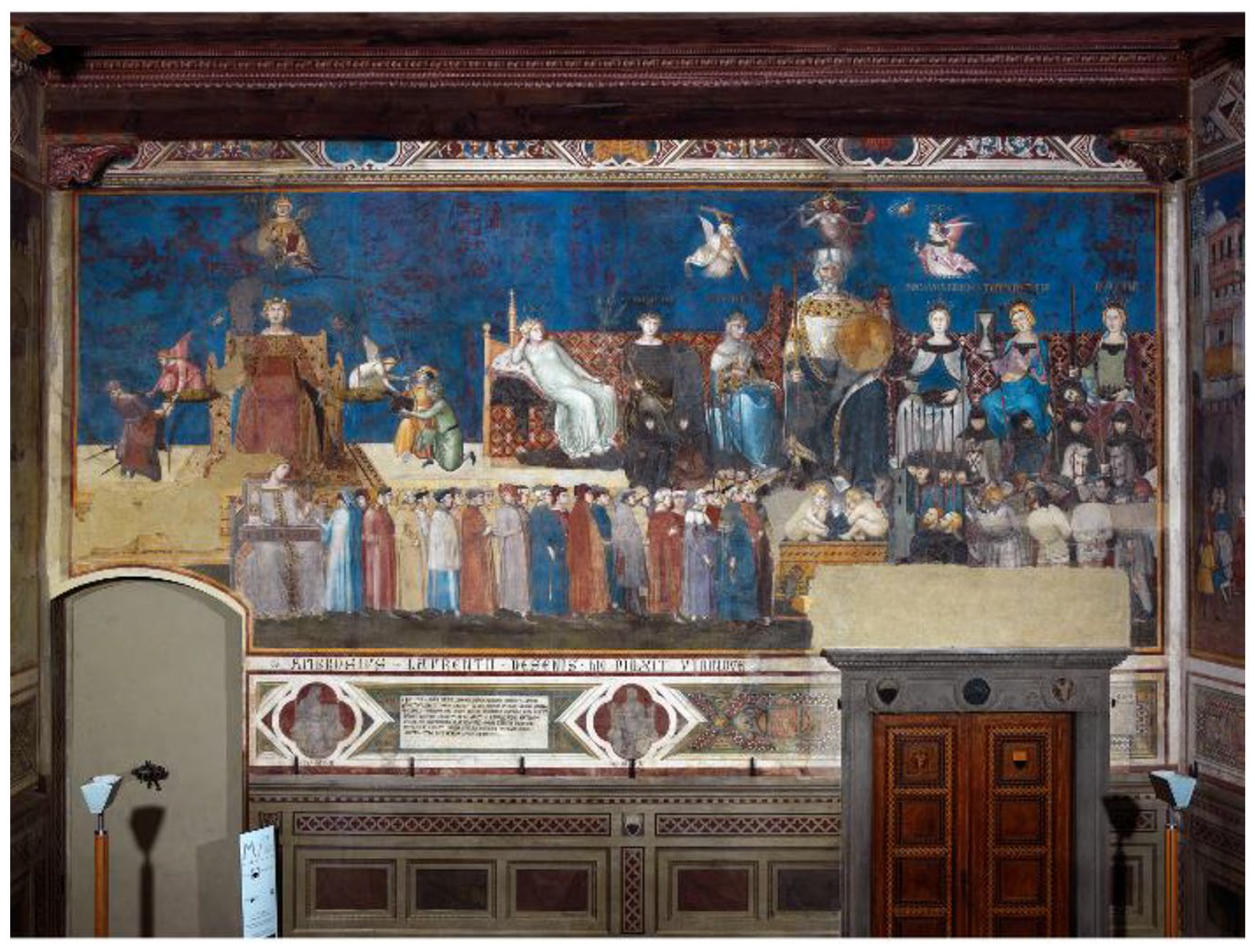
Ambrogio Lorenzetti, Allegoria del Buon Governo, Siena, Palazzo Pubblico, Sala della Pace, 1338. Museo Civico. Reproduced with permission of Comune di Siena (‘© Comune di Siena’).
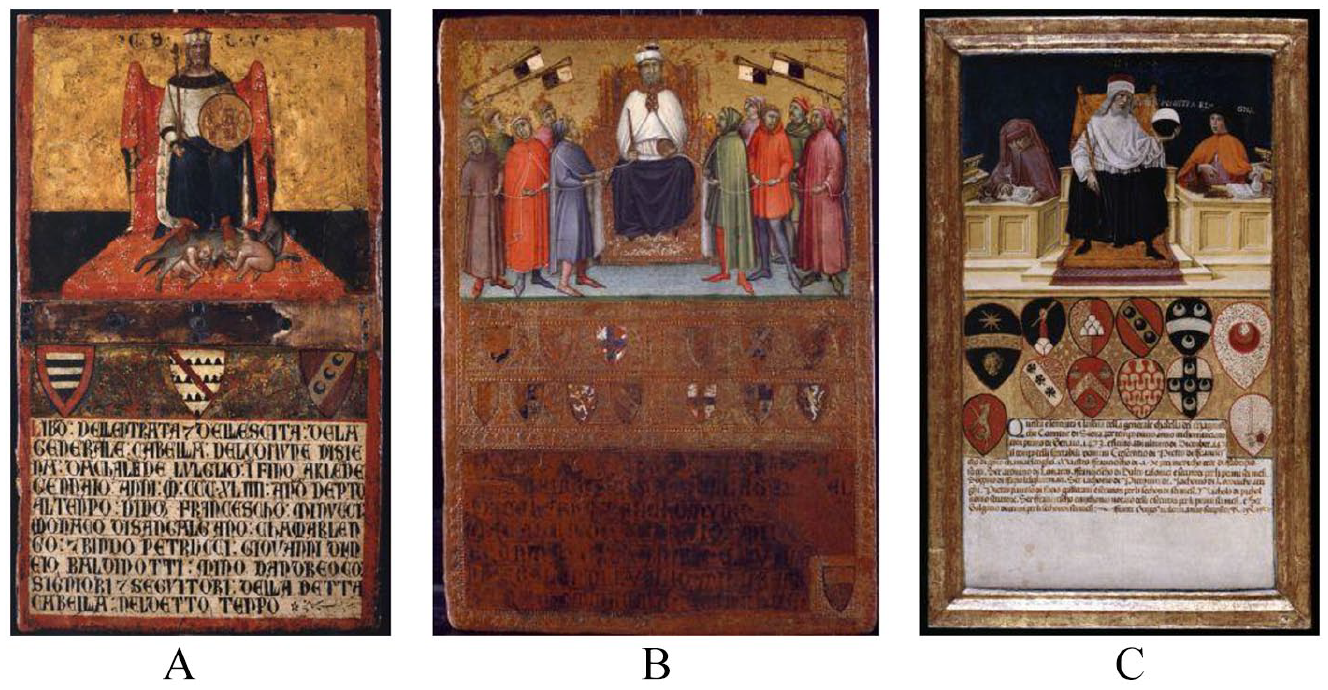
Figure 2A Biccherna panel: Good Government, Siena, Siena: Archivio di Stato (ASSi, Tavoletta di Biccherna n. 16, (ex Gabella), Ambrogio Lorenzetti, ‘Il Buon Governo di Siena’, 1344, luglio-dicembre), reproduced with permission of the Archivio di Statio, Siena; Figure 2B Biccherna panel: The Allegory of the Good Government of the Ten, Siena: Archivio di Stato (ASSi, Tavoletta di Biccherna n. 19, anonimo, ‘Allegoria del Governo dei Dieci’, 1385 gennaio-giugno), reproduced with permission of the Archivio di Statio, Siena; Figure 2C Biccherna panel: Good Government in the Gabella Office, Siena: Archivio di Stato (ASSi, Tavoletta di Biccherna n. 38, (ex Gabella), Benvenuto di Giovanni, ‘Il buon governo nell’ufficio della Gabella’, 1474), reproduced with permission of the Archivio di Statio, Siena. Any further reproduction of these figures is forbidden.
The notion of ‘good government’ is driven by fear of discord, lawlessness and division. Lorenzetti arouses ‘gripping fear’ in the spectator by his accompanying fresco of ‘Bad government’ and its depiction of ‘Tyranny’, flanked by Cruelty, Deceit, Fraud, Fury, Division and War (Boucheron, 2005). In contrast, the fresco of ‘Good government’ analyses ways of achieving and preserving peace and tranquillity. There are three central figures in the fresco: Peace reclining in the centre has to her left a large regal figure, and to her right the figure of Justice. The giant regal figure is an enigma but has been variously interpreted as a personification of the ‘Common Good’ (Rubinstein, 1958), a ‘symbolic representation of the type of signore or signoria a city needs to elect if the dictates of justice are to be followed and the common good secured’ (Skinner, 1986: 44) or an amalgam of both of these (Boucheron, 2005). ‘Concordia’, one of the two fundamentals for achieving peace and the ‘Common Good’, is shown giving out a symbolic rope that binds 24 citizens together with Justice and the ‘Common Good’.
The fresco includes figures and symbols that relate to accounting, fundamental in achieving ‘good government’. Skinner (1986: 34) suggests that the large carpenter’s plane on Concordia’s lap represents the principal of ‘Aequitas’, or equity, necessary to civic peace. To the right and left of Justice are two angels, with the labels ‘Distributiva’ and ‘Commutativa’, one holding instruments of measurement, based on the Thomastic-Aristotelian principles of fair dealing, just distribution and exchange, essential to civic life (Skinner, 1986). The principles represented in the Allegory of Good Government might be abstract, allegorical ideas, but they formed the basis of everyday practicalities, such as just methods of taxation (Boucheron, 2005: 1169). The frescoes include scenes extending beyond the city itself to convey harmony with the surrounding contado (Norman, 1999), and depict the iconic antique religious symbol of the church of San Cristoforo, thus incorporating the religious within the civic ideal. These harmonious ideals of governance continue to be celebrated in the Biccherna panels and their visual impression management of civic administration, city and church, and city and contado.
Visual governance
Visual civic administration
Most of the early Biccherna panels focus on the work of the financial Biccherna office. This is an unusually precise and secular focus at a time when most pictorial composition concentrated on religious themes. Figures 3A and 3B show the Biccherna panel for 1340 together with the first page of the related accounts.
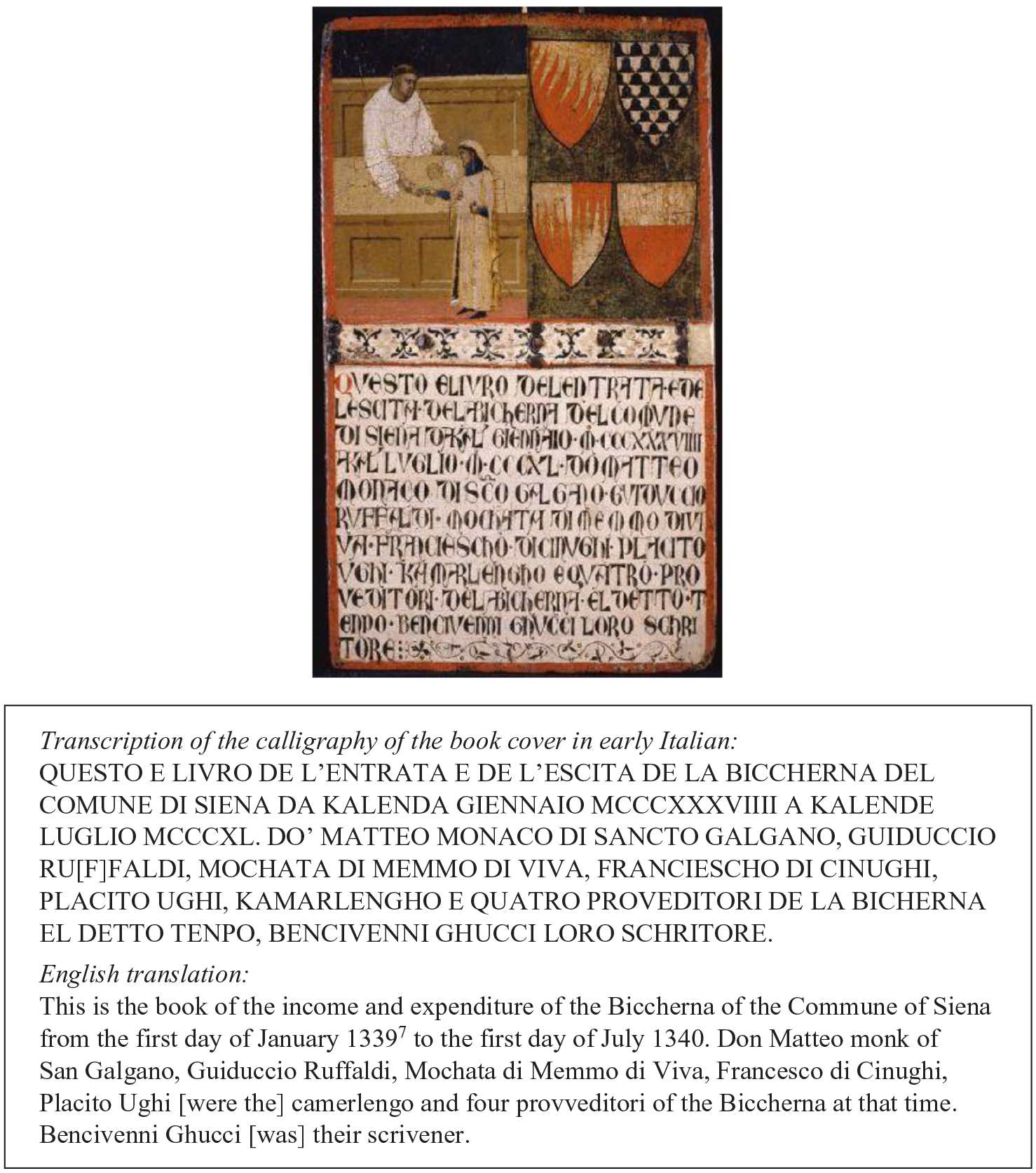
Biccherna panel. The Treasurer and a Taxpayer. Siena: Archivio di Stato (ASSi, Tavoletta di Biccherna n. 15, scuola di Ambrogio Lorenzetti, ‘Esattore e contribuente’, 1340, gennaio-giugno). Reproduced with permission of the Archivo di Stato, Siena. Any further reproduction is forbidden.
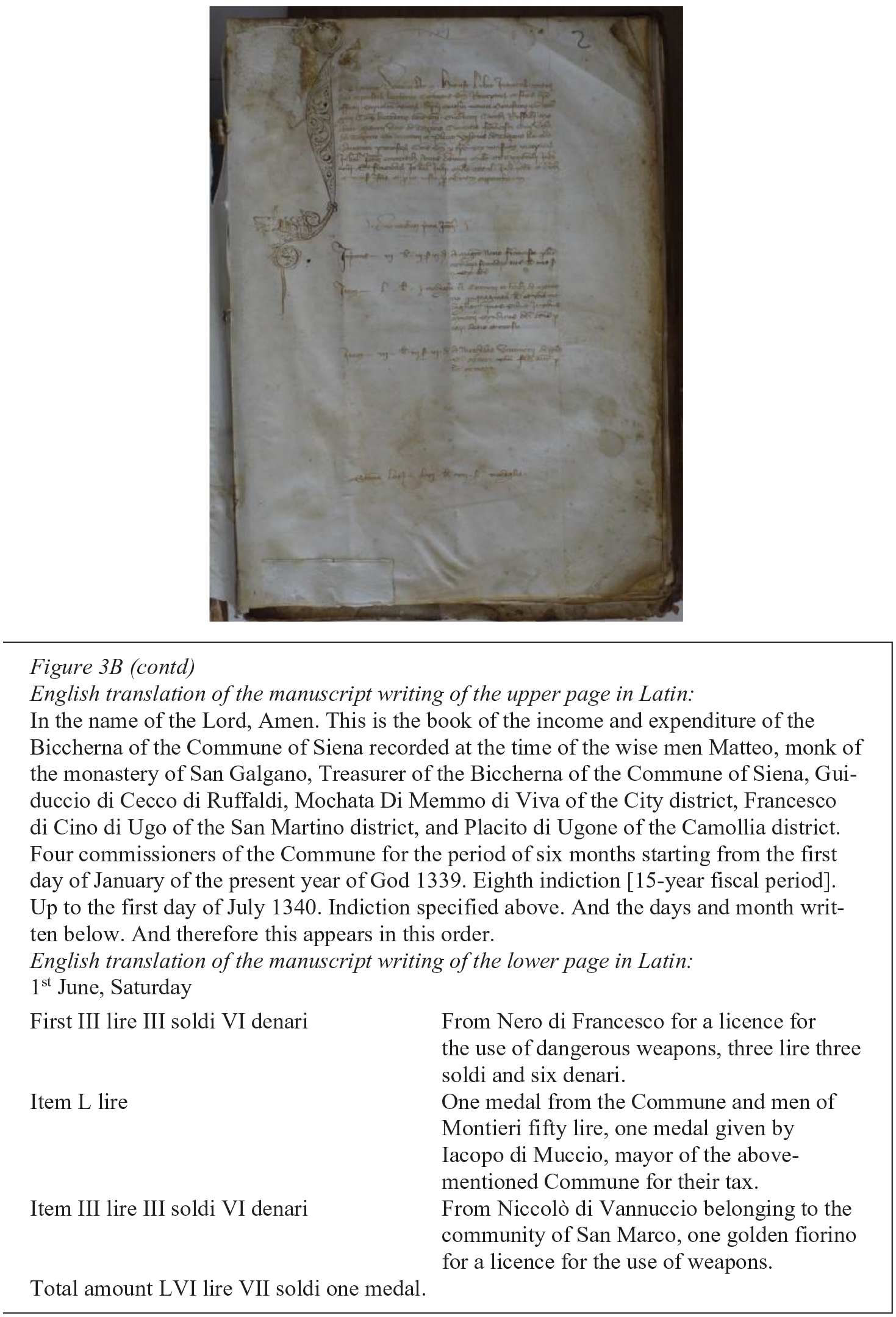
Beginning of the accounting records of the Biccherna in Latin with English translation (first semester 1340 – page 2 recto). Siena: Archivio di Stato (ASSi, Biccherna n. 205, c. 2r, anno 1340). Reproduced with permission of the Archivio di Stato, Siena. Any further reproduction is forbidden.
First, iconic codes of the colours, lines and shapes of the figures are evident, especially in their brightness and use of light and contrast, vital medieval aesthetics (Eco, 1986). Even the figures carry meaning and inter-relate with iconographic codes and medieval codes of taste and sensibility. Sienese artists aimed ‘to dazzle the beholder with the splendour of colour just as with the shimmer of tooled gold surfaces’ (Hoeniger, 1991: 115). Bright pigments, such as the red used here, were expensive, and thus immediately a sign of the finest craftsmanship (Carruthers, 2013: 188), wealth and power (Berger, 1972) connected to the governance of the Biccherna office.
Second, the iconic codes of signs are evident in calligraphy, heraldry and pictorial composition, recognized as codes containing specific semes or meanings.
Calligraphy is in itself a medieval art form. The 1340 panel is typical of many of the panels (see Appendix) in incorporating a large proportion of this ‘painted writing’ or ‘visible speech’ (Boucheron, 2005; Ciociola, 1997). In accordance with medieval codes of taste and sensibility (Eco, 1982), writers did not distinguish between ‘verbal’ and ‘visual’ memory: ‘the letters used for writing were considered to be as visual as what we call “images” today; and as a result the page as a whole was considered a cognitively valuable “picture”’ (Carruthers, 1998: 122). In medieval Latin, ‘pingere’ refers both to lettering and to painting (Carruthers, 1998). For the illiterate majority, the calligraphy had no precise semes or coded meaning. However, as an iconographic code, writing was ‘a sign of mastery, a kind of magic and a sign of domination’ (Starn, 1987: 9), and thus carried implications of power, importance and political authority. Norman (1999: 57) notes the prominence of text in the Sienese Maestà by Simone Martini (1315) (Figure 5), in even adding ‘real’ material text, and thus indicating an atavistic belief in the power and magical properties of the word. For the literate, the calligraphy is in the vernacular early Italian, an innovation at the time, and (unlike Latin) accessible to the merchants and bankers with whom power resided. The painted calligraphy of the book cover has therefore been used to ‘speak’ visually to a wide audience, and to emphasize, highlight and make a visual artefact of important principles of governance.
For those who can read, the semes of the painted writing give a detailed account of the governance mechanisms under which the Biccherna office operated. A precise timescale is indicated: the first six months of 1340. The timescale is short, for efficiency and the avoidance of corruption (Bowsky, 1970). The four provveditori or commissioners are named in full, the names of the treasurer and his scrivener are given. This is therefore prominent visual accountability. Beyond the straightforward semes, there are more complex iconographic codes of financial governance. The provveditori are recognized by their names as powerful, wealthy citizens (Bowsky, 1970). As a monk, the treasurer is portrayed as competent, in being both learned and honest, independent from the provveditori and financial administration, and an indication of the Church at the heart of civic life. Moreover, he comes from the Cistercian monastery San Galgano, known for its strength in mathematics.
The first page of the related accounts gives largely the same information, slightly expanded, in ordinary script in Latin (Figure 3B), accessible only to notaries and clergy. The accounts themselves start below the introduction; they date from a time when the spread of double-entry bookkeeping was in its early stages (Antinori, 2004), and accounts consisted of a combination of narratives and numbers. Here they are already visually presented in a manner that structures the information in a schematic tabular form (Hoskin and Macve, 1986).
Heraldry provides the second set of signs. A host of ‘insignia’ or ‘marks of corporate or individual identity dominated the visual landscape of late medieval and renaissance Europe’ (Lincoln and Rihouet, 2013: 681–682), even in primarily religious paintings in Siena such as Simone Martini’s Maestà (1315) (Figure 5), which includes carefully worked heraldry in its canopy (Norman, 1999). Heraldic shields were forerunners of portraits in medieval Europe, and the crests carry important semes. They use patterns that were definable, recognizable and hereditary (Maclagan and Louda, 2002). Crests were used in key locations: monuments, tombs, doorways, tapestries, coins and seals. As here, they were also used in important documents that called for a visual means of authentication, since ‘in an age when literacy was almost confined to the clergy, a seal was more use than a signature’ (Maclagan and Louda, 2002: 7). On Biccherna panels they are striking visual forms, combining geometric patterns together with a variety of symbols, important to medieval life (Eco, 1986). On this panel, for example, the multiple triangles of the upper right-hand shield are in the black and white colours of Siena. The crests have been identified as those of the families of the four commissioners (Borgia et al., 1984). When read at the more complex levels of iconographic codes, and historic codes of taste and sensibility, the crests are arguably more important than the commissioners’ names: names are individual, whereas heraldry denotes family, history and genealogy (Belting, 2004), of key interest in the governance of pre-modern Siena. Family pedigree and lineage are further indicators of trust and respect for the commissioners governing the city, and the basis of economic activity (Padgett and McLean, 2011).
Pictorial composition forms the third set of signs of the iconic codes. The viewer recognizes the semes of the pictorial composition as indicating two men in a room, with various accoutrements. We analyse more complex iconographic codes and codes of taste and sensibility. One individual, the camerlengo (treasurer), dominates the scene: his physical appearance is that of a young, handsome man with a distant, almost beatific gaze. In similar vein to the large figure representing the ‘Common Good’ in Lorenzetti’s Allegory of Good Government, he is of unnaturally large size. The other figure, probably a merchant, is contrastingly smaller and older; he appears more focused on the transaction in hand. The camerlengo is dressed in a monk’s habit, its whiteness suggesting purity, and his hair tonsured. The merchant, in contrast, wears fashionable robes, head-dress and shoes, intimating worldliness and wealth. The spatial elements surrounding the figures indicate a functional, even spartan office, simply furnished with a wooden desk and screen whose panelling nonetheless indicates a certain affluence. Tables are key elements in portraiture (Campbell, 1990), and the large desk that occupies much of the picture is used to display artefacts of organizational significance, to maintain the dignity of the camerlengo and his office and to show distance between him and the merchant. The interpersonal actions show that an exchange is taking place, and the camerlengo is giving or receiving money. The variety of coins, of different sizes, metals and origins (as on a number of panels), confirms the importance of Siena in the commercial and banking activities of the time (Degasperi, 2018). The office is sober and orderly, and is dominated by a treasurer portrayed as being of utter calm and probity. The picture has glorified the camerlengo. In all aspects, the visual impression management of the picture reinforces the messages of good governance given by the rest of the front cover.
Yet the underlying reality was more complex. We see in the crests a visual promotion of the ‘blending of economic, social and political logics’ of medieval Italy (Padgett and McLean, 2011: 43). However, the accustomed privileges of old and wealthy families continued to hold sway (Bowsky, 1981). Najemy (1983) observes that the references to balanced harmony within the city are largely propaganda, and points to the constant tension with guilds, and their repression by the Commune. There were tensions too with the legal profession, and judges and notaries were excluded from power (Bowsky, 1981). The seeming financial independence and power of the Biccherna office was partly illusory as ultimate authority lay with the ruling elite (Bowsky, 1970). The San Galgano monks who commonly served as (theoretically detached) treasurers have been viewed as ‘businessmen in monastic habits’ (Vitullo and Wolfthall, 2010: 135). The immense and complicated apparatus of the governance of the Biccherna office itself testifies to difficulties of financial probity. The provveditori rarely observed the statutory 18-month period before returning to office and were accused of corruption; at times the accounts were not audited (for six consecutive terms in 1343, for example), to the extent that ‘the said offices seemed to be unbridled’ (City Council Act, 24 July 1353, quoted by Bowsky, 1970: 268). To combat these tensions, the Biccherna panels therefore provided a ‘coping mechanism’ (Ezzamel and Reed, 2008: 609) in emphasizing the idealized polity (Nevola, 2007a).
Visual fusion of city and church
Pre-modern Italy was a time of transition, and ‘political and social theory was saturated with doctrines drawn from the sphere of ethics and religion’ that extended to capitalism (Tawney, 2015: 21). Indeed, the notion of ‘common good’ in Lorenzetti’s Allegory of Good Government (Figure 1) has Christian derivation. Some of the pictorial compositions in the Biccherna panels are a good illustration of this transition, and are quite distinctive in their juxtaposition of the political and the sacred. As well as juggling the interests of citizens within the Commune, and balancing the interests of the Commune with the contado, the ruling elite had to find ways of co-existing with the Church. Presenting a visual fusion of a civic/religious state is a way of ‘co-opting the authority of the Church’ (Steinhoff, 2016: 27).
Our illustrative example is the pictorial composition from the Biccherna panel for 1451, The treasurer washes his hands, the Virgin protects Siena, shown together with extracts of the co-surviving accounts (Figures 4A, 4B and 4C). Once again, the figures of the picture are proportioned and suffused with colour and light. An iconographic interpretation of the blue pigment again implies wealth, and light has metaphysical symbolism (Carruthers, 1998; Eco, 1986). The signs of the picture are cleverly divided through the use of perspective into two juxtaposed spaces: the basic semes indicate a larger space occupied by a furnished room and two men, and a smaller space occupied by various buildings, with a third figure floating above them.
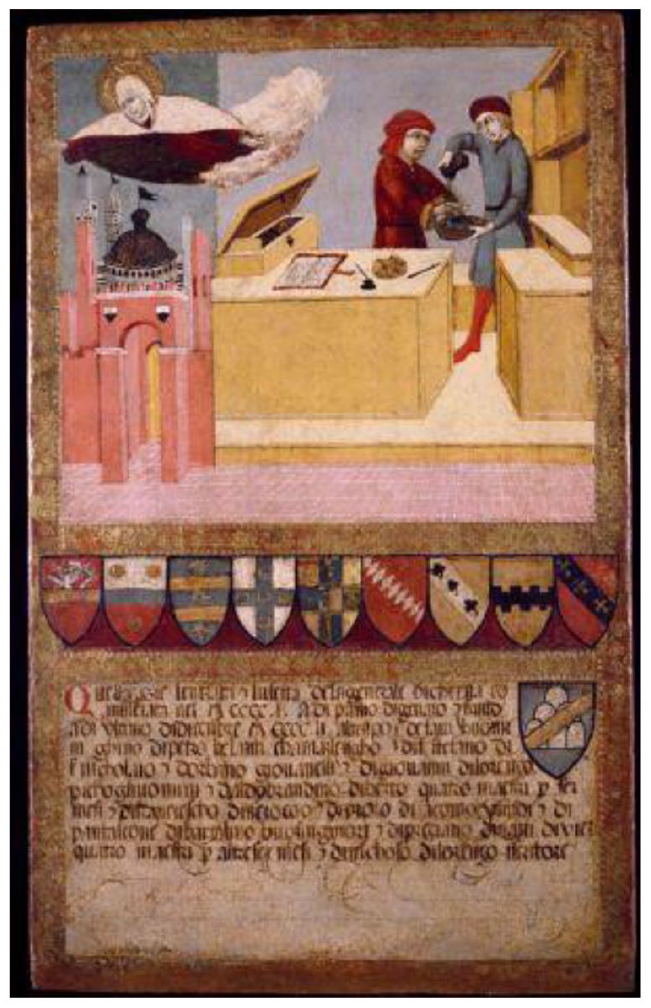
Biccherna panel: The treasurer washes his hands, the Virgin protects Siena (ASSi, Tavoletta di Biccherna n. 29, Sano di Pietro, ‘Il Camarlingo si lava le mani, la Vergine protegge Siena’, 1451). Reproduced with permission of the Archivio di Stato, Siena. Any further reproduction is forbidden.
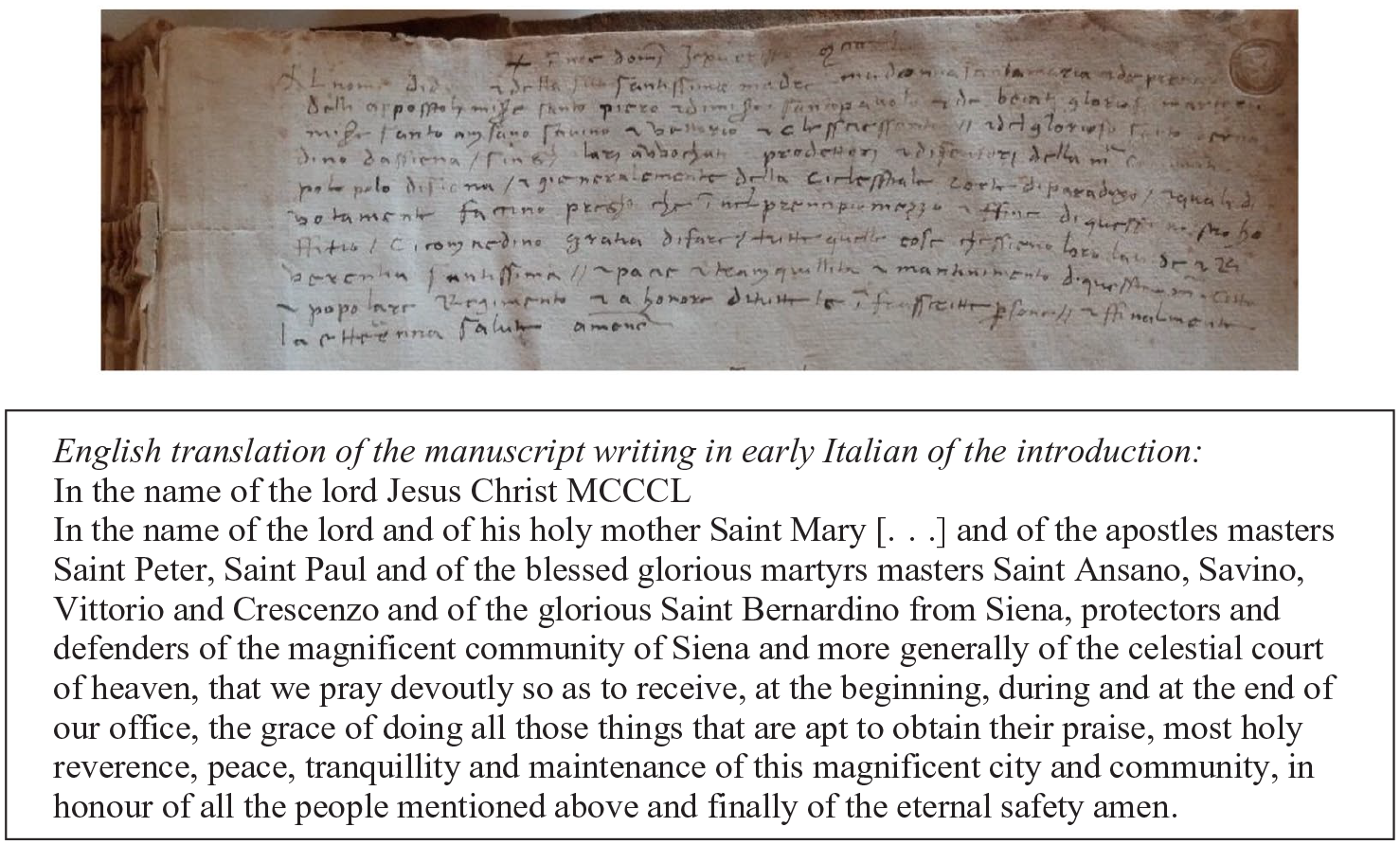
Introduction to the accounting records of the Biccherna 1451 – page 1 recto. Siena: Archivio di Stato (ASSi, Biccherna n. 319, c. 1r, anno 1451, particolare). Reproduced with permission of the Archivio di Stato, Siena. Any further reproduction is forbidden.
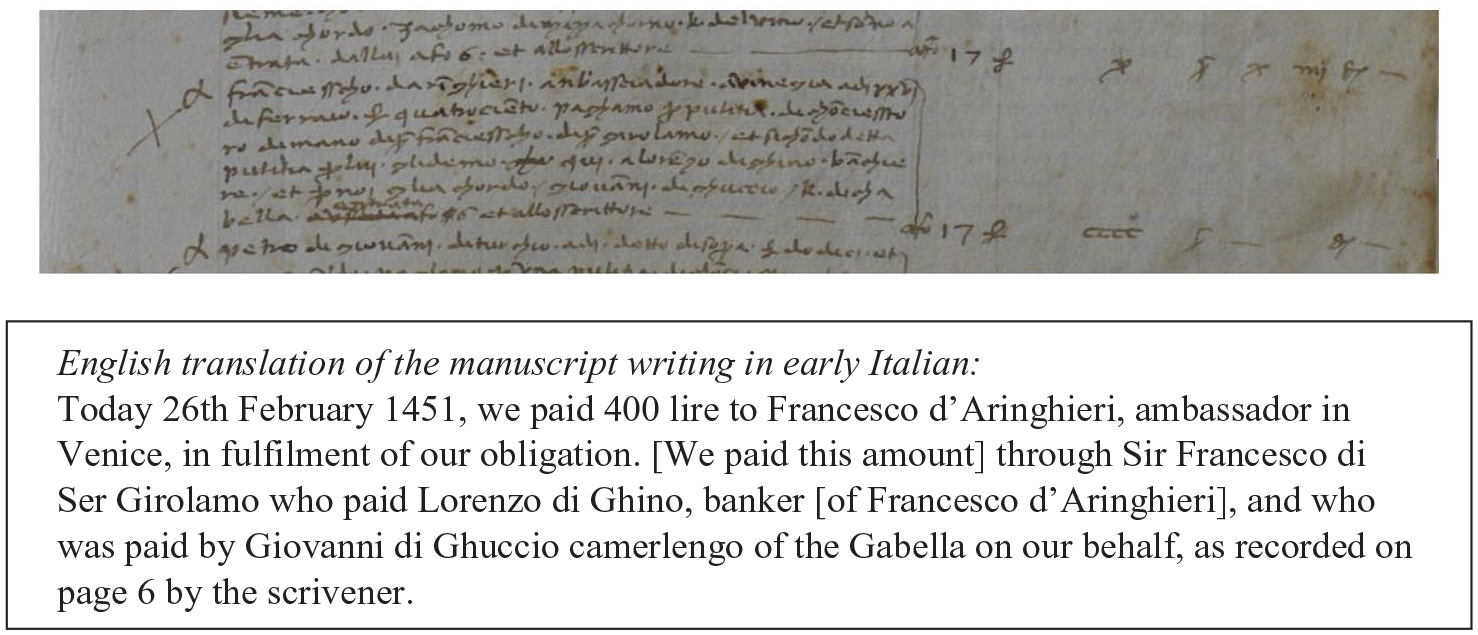
Accounting records of the Biccherna 1451 – page 56 recto. Siena: Archivio di Stato (ASSi, Biccherna n. 319, c. 56r, anno 1451, particolare). Reproduced with permission of the Archivio di Statio, Siena. Any further reproduction is forbidden.
An iconographic interpretation of the semes, informed also by historic codes of taste and sensibility, suggests a complex fusion of civic and religious messages. The room is the Biccherna office, and the buildings are the civic architecture of the city gates in the foreground, dominating the cathedral dome behind. The young camerlengo is again depicted in monk’s attire, but coloured rather than the purity-connoting white of the previous example. Again, a desk takes centre stage (Campbell, 1990), drawn with less attention to the panelled detail than in the previous example (Figure 3A), but displaying with greater prominence the clerical tools of the trade. The camerlengo is undergoing a ritualistic washing of the hands or anointment by another monk, probably symbolizing purity and honesty. Here again there is exchange, but in contrast to that between camerlengo and taxpayer (Figure 3A), the exchange is symbolically religious rather than financial, and between individuals of equal standing, both officials positioned behind the desk. Above and between the two spaces floats the Virgin Mary, clothed in gowns metamorphosing into cloud. Siena was undergoing various conflicts and in need of protection at that time. In particular, in April 1451, Siena signed an alliance with Venice as reinforcement in the conflict against Florence. The Biccherna panel was produced in conjunction with accounts related to the formalities of the alliance with Venice, for example details of the payments, names, roles and work of ambassadors (Figure 4C).
The introduction to the accounting narratives reinforces this message of civic/religious fusion: ‘the magnificent community of Siena [. . .] the celestial court of heaven’, and the ‘peace, tranquillity and maintenance of this magnificent city and community [. . .] the eternal safety’ (Figure 4B). The cult of the Virgin Mary was of paramount importance in Siena, and her image was the focus of both ecclesiastical and civic religious devotion, exemplified by the Duccio Maestà (1308–1311) at the heart of ecclesiastical life over the cathedral’s high altar, and the more courtly Martini Maestà (1315) (Figure 5), which makes specific reference to Mary as a ruler, on the wall of the principal council chamber in the Palazzo Pubblico (Norman, 1999). She was at the heart of the religio-political ideology of the city, and its ‘exercise of just and stable government’ (Norman, 1999: 65). The camerlengo and Biccherna office, and by extension financial governance, are thus depicted at the very core of a civic/religious society, where symbolic readings assert governmental relationships with the divine (Steinhoff, 2016).
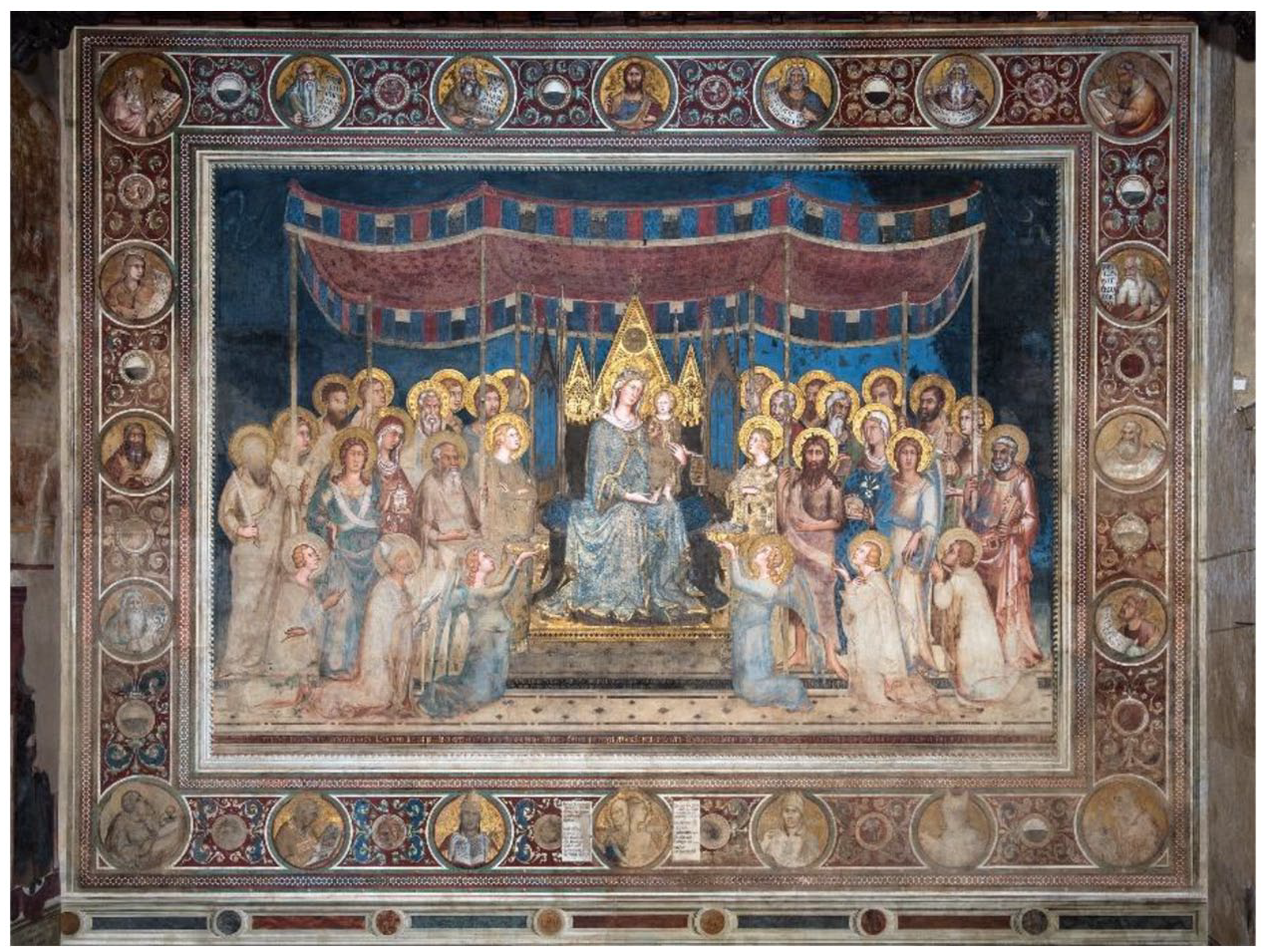
Simone Martini Maestà, Siena, Palazzo Pubblico, Sala Mappamondo, 1315. Museo Civico. Reproduced with permission of Comune di Siena (‘© Comune di Siena’).
Once again, the reality of the underlying governance relationships between city and church are less serene and harmonious than their visual representations. Each institution sought financial support from the other, there were tensions between ecclesiastical and civic courts, and pious individuals and organizations were prone to fraudulent activities (Bowsky, 1970). The city, on the other hand, applied moral pressure to the Church on the grounds that ‘the good and pacific state of the city [. . .] so redounds to the good and utility of clerics and ecclesiastical persons as [it does] to the laymen of the city’, and that it was therefore ‘fitting and convenient and just that the clergy too contribute to the support of the state’ (1324 Siena Statute quoted by Bowsky, 1970: 220). Yet ‘some hardened places, monasteries and clerics whose goods and possessions are in the Sienese contado and jurisdiction, and are defended’ did not respond (Bowsky, 1970: 221).
The Biccherna panels thus formed a ‘coping mechanism’ to deal with the underlying complexity of the relationships between city and church by providing an image of balanced fusion between civic and religious ideals, while also underlining the ‘material and technical prerequisites for survivability’ (Ezzamel and Reed, 2008: 609).
Visualizing city and contado
A number of the pictures of the Biccherna panels depict relations between the city and their surrounding contado. The Biccherna panel The offering of tributes (1364) (Figure 6A) is exemplary. The ‘figures’ of the ‘iconic codes’ again imply wealth and power through an iconographic interpretation of the extensive use of shimmering gold, with red pigments. The viewer understands basic ‘semes’ of meaning from the painted ‘signs’: a large man seated on a chair, surrounded by other men, some of whom play trumpets, and others who carry objects. The iconographic codes and codes of taste and sensibility suggest more complex interpretations of the government’s desire to give a visual impression of the pre-eminence of the city. At the centre is a larger-than-life dominant enthroned figure holding a symbolic orb in the black and white colours of Siena, that may variously be defined (as in Lorenzetti’s fresco, which it recalls) as ‘the Common Good’ (Rubinstein, 1958), ‘the government, the commonwealth, the office, or just Siena’ (Swarzenski, 1950: 46). Chairs are highly symbolic in portraiture (Campbell, 1990), and the throne, symbol of both civic and ecclesiastical authority, dominates the scene, richly coloured in gold with silver and red insignia (Lincoln and Rihouet, 2013), recalling Lorenzetti’s Good Government fresco (Figure 1), and forming part of a series of similar depictions in Biccherna panels (Figures 2A, 2B, 2C). To each side of the throne are trumpet-players (whose black and white flags are again symbols of Siena), that add majesty and ceremony. The ‘tributes’ are offerings from members of the local communities, which take symbolic forms: for example, an olive branch, a set of keys and a castle. Thus, the picture legitimizes a relationship of subordination between the Commune and the local communities, as also demonstrated by the related accounts of 1364 concerning the payment of tributes (Figure 6B). The use of proportion and careful balance and symmetry (Carruthers, 2013: 137) emphasizes the importance of the tributes, and adds to an impression of the justice and fairness of the power apparatus surrounding the Commune.

Biccherna panel. Lippo Vanni, Italian (Sienese), active about 1344–1375. Biccherna Cover: The Tribute Offering, about 1364. Tempera on panel 44.5 x 33 cm (17 1/2 x 13 in.). Museum of Fine Arts, Boston Charles Potter Kling Fund 50.5.
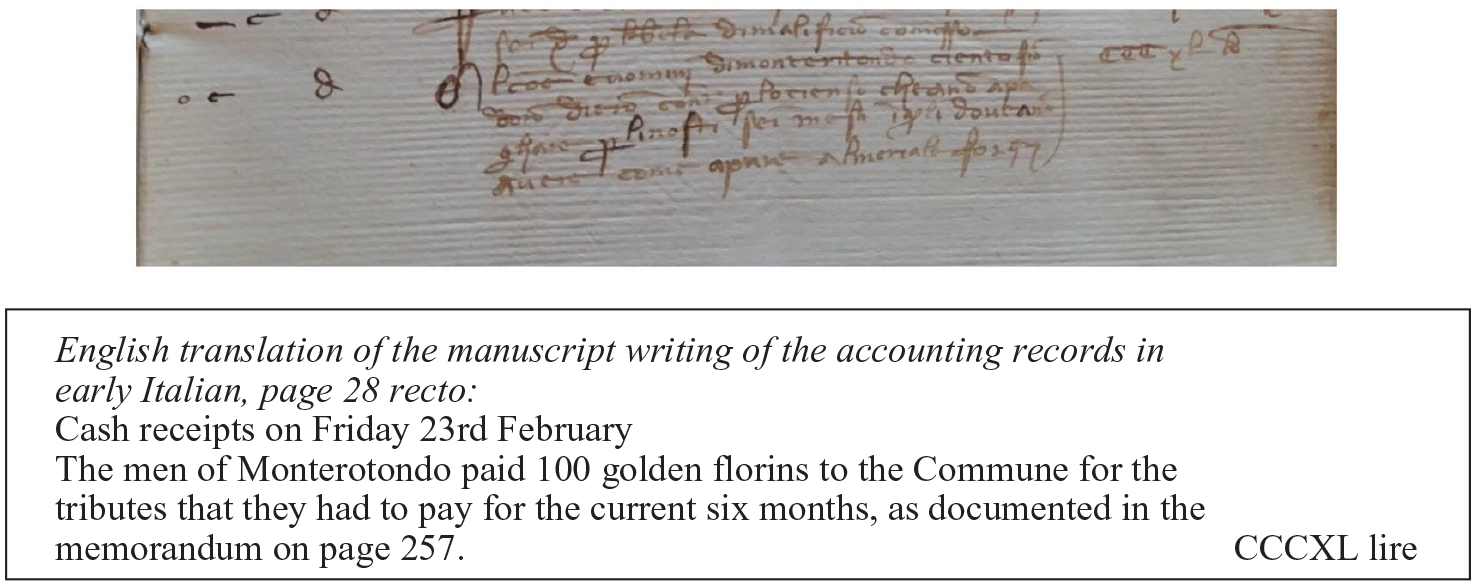
Accounting records of the Biccherna 1364 – page 28 recto. Siena: Archivio di Stato (ASSi, Biccherna n. 244, c. 28r, anno 1364, particolare). Reproduced with permission of the Archivio di Statio, Siena. Any further reproduction is forbidden.
However, once again, the governance relationship between the city and the contado was more complex than the panels indicate. The city acquired towns, castles and communities, and depended on the contado for food, raw materials, manpower and political influence (Norman, 1999), and there was a symbiotic relationship between them. In reality, although the contado had ‘considerable political and economic significance for the city’, it consisted of ‘a fragmented, haphazard collection of lordships and townships, having almost nothing in common except its fragile subordination to Siena’ (Norman, 1999: 10, citing Waley, 1991: 108). The subordination of the contado was marked through religious rituals of submission, and the maintenance of control over the contado was regularly celebrated in works of art (Norman, 1999). For example, a series of paintings of conquered castles was commissioned for the two most important council rooms in the Palazzo Pubblico (Norman, 1999: 15), such as The Submission of a Castle (Figure 7).
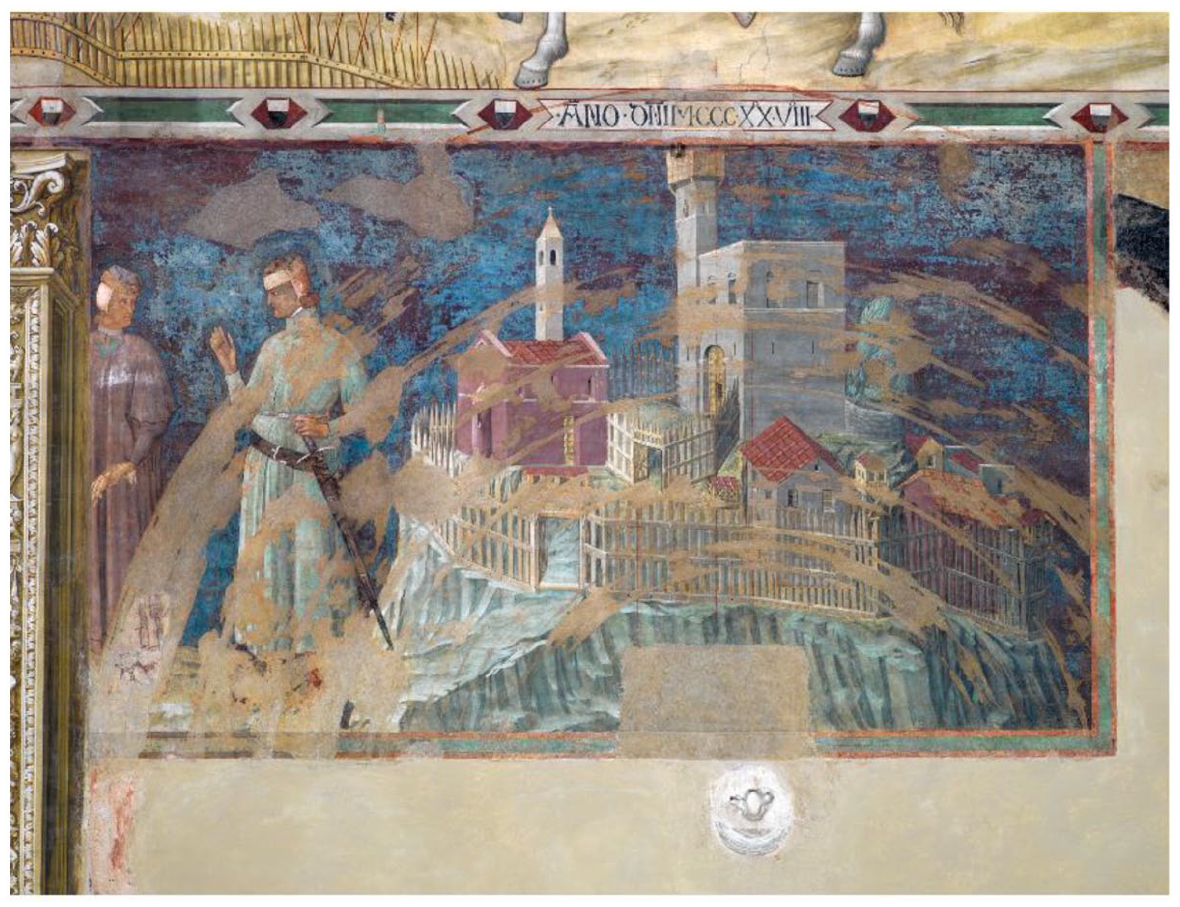
Duccio di Buoninsegna attr. Resa di un castello, Siena, Palazzo Pubblico, Sala Mappamondo, 1314. Museo Civico. Reproduced with permission of Comune di Siena (‘© Comune di Siena’).
There were detailed constitutions and regulations, and every contado was required to appoint a proctor who reported to the provveditori of the Biccherna, and guaranteed payment of the contado’s obligations (Bowsky, 1970). Yet in 1323 there ‘was and is a great muttering in the City of Siena’ because many citizens of the contado owed taxes and forced loans dating back 20 years (Bowsky, 1970: 108). The Biccherna panels therefore provided a strategic visual governance mechanism to cope with complex underlying tensions between the city and the contado.
Summary, medieval aesthetics and contemporary resonances
Through our analyses, we have reunited the artistic and administrative domains of the pre-modern city of Siena, which have become both physically and intellectually separated over the centuries, to contribute a rare study of art history, important but lacking in visual organization studies (Meyer et al., 2013). We do not claim to extend theory, but to construct a new analytical framework, and offer original empirical analyses. We show how the Biccherna panels constitute governance by visual means, or that ‘visual governance’ can be a ‘coping mechanism’ (Ezzamel and Reed, 2008: 609) to assist with risk, conflict and complexity.
We add to work on the role of visual artefacts (Quattrone et al., 2021) in impression management, much researched except in the significant omission of many of its visual aspects (Meyer et al., 2013). We suggest that the painted Biccherna panels contributed to visual governance through visual impression management, which built confidence through emphasizing in idealized terms the mechanisms of civic governance, and by depicting co-operative relations between city and church, and between the city and its contado. As commissioned works they are to be placed in the context of the Commune’s concerted efforts at political visual communication, through splendid civic architecture, and other commissioned works such as Lorenzetti’s Allegory of Good Government (1338-1339). In reality, Siena had a large and complex internal citizenship and there were difficult disputes between the city and the Church, and between the city and surrounding communities (Bowsky, 1970; Najemy, 1983).
Visual semiotics, also ripe for exploration (Meyer et al., 2013) has guided our open interpretations (Eco, 1989), assisted by a frame of visual semiotics of coded sign systems (Eco, 1982) and further informed by medieval aesthetics (Carruthers, 1990, 1998, 2013). At the same time, we extend identification of four affordances of the visual (Meyer et al., 2018) to visual governance. First, the visual images of the Biccherna panels show the capacity of the visual to infiltrate, through crafting configurations of aspired ‘good government’ (Lorenzetti, 1344). Their iconic codes (Eco, 1982) consist of three elements: figures of bright colours, light, gold and symmetry; juxtaposed signs of calligraphy, heraldry and pictorial composition that all communicate visually; and semes giving the identity of responsible financial officials with their period of office, family lineage and scenes from the Biccherna office, from civic, church and contado life, together classical and other allegorical motifs. Their iconographic codes (Eco, 1982) and codes of taste and sensibility (Eco, 1982) celebrate, in diverse complex ways, wealth and power, the order and harmony of city governance, of a fusion between city and church, and between the city and contado. Second, in the Biccherna panels the visual spatializes complex relationships, such as those within the city and between city and church and city and contado, through a medieval aesthetics of symmetry, varietas and polyfocality (Carruthers, 2013) that builds memorable harmony and links between diverse elements. Third, painted images captivate through colour and through the perceived ‘magic’ power of calligraphy (Starn, 1987). Fourth, the panels visually materialize ‘people, objects and events’, the commissioners, treasurers, architecture, desks, money, religious persona and contado tributes (Meyer et al., 2018: 399) that are key to the ‘coping mechanisms’ of corporate governance.
Medieval aesthetics
Carruthers (1998: 118) observes that in medieval rhetoric the image is a ‘cognitive tool’, a ‘cognitive machine’ (1998: 198–199) that acts as ‘inventio’ (both creative invention and inventory or memory store) (1998: 11–12). Four elements of her extensive analyses are pertinent to our study of the Biccherna panels. First, the visual has a primordial role with regard to memory, in governance as elsewhere. Visual images act as ‘memorial hooks and cues’ (Carruthers, 1990: 274), whether as ‘mental pictures’ (1990: 291), through mnemonic and often playful marginalia (1990: 309–324), such as the figure in the margin of one of our examples (Figure 3B) or through memorable grid formats (1990: 325) such as those of all the panels. Second, symmetry, proportion and balance between opposing poles are key to managing tensions (Carruthers, 2013: 22–23), and often incorporated in ‘artful play’ (2013: 22). Harmonious proportion and balance are clearly in evidence in all the panels, and while pure symmetry is not always present, it is a fundamental feature of a number of panels, as in three of our examples (Figures 2B, 2C and 6A). Third, ‘varietas’ or variation (Carruthers, 2013: 137) adds stimulation to pure repetition, in suggesting ‘ductus’ or paths of thought, patterns, links and connections. As can be seen from our few examples (Figures 2A, 2B, 2C, 3A, 4A, 6A), as a series the panels follow a memorable, recognizable, repetitive pattern combining different media, reinforcing ‘good government’ messages, but yet with varietas sufficient to interest and work the mind. Finally, a ‘polyfocal perspective’ (Carruthers, 2013: 151–155), as in the mixed media and juxtapositions of all the Biccherna panels, ‘builds harmony from strong contrasts of diverse colours and materials and sudden shifts of view’ (2013: 151). We suggest that these qualities of medieval aesthetics contribute to visual impression management in the face of the conflicts and complexity of Sienese city governance. We further suggest that these qualities are still apparent in present-day governance.
Contemporary resonances
In the modern-day world, characterized by increasing complexity and uncertainty, medieval aesthetics can assist in understanding the ‘craft of thought’ embedded in images (Carruthers, 1998). Medieval rhetoric has been explored, for example, in the context of administrative accounting practices (Quattrone, 2015), and data visualizations in contemporary reports and dashboards (Quattrone, 2017), to show the role of images in dealing with uncertainty and complexity in management decision making and organizing. Opposites can, for example, be united in antithesis (Carruthers, 2013; Puyou and Quattrone, 2018).
The powerful attributes of the visual and its affordances (Meyer et al., 2013) make it a potent medium for impression management in present-day governance. Carruthers (1990, 1998), writing on images and the Middle Ages, notes the findings of contemporary psychology regarding the power of the visual in mental mapping to be a startling corroboration of ancient observations. Research in psychology has shown visual images to be powerful framing and priming devices in cognition (Tversky and Kahneman, 1986), which can influence contemporary investors (Townsend and Shu, 2010). The visual attracts attention – experimental psychology has shown that subjects spend twice as long looking at pictures as text (Tversky, 1974), and the visual assists in communicating complex messages with simplicity (Anderson, 1980). Vision plays a central role in the mind: ‘neurobiologists assume that around sixty percent of all information that reaches the brain is of visual provenance and that the brain uses a considerable proportion of its capacity (about thirty percent) to process this information’ (Zielinski, 2006: 84). Moreover, psychology has demonstrated the ability of visual material to arouse emotion (Joffe, 2008), while experiments have shown that visual framing elicits stronger emotional responses (Brantner et al., 2009).
Contemporary city strategy documents use of visual discursive devices (Brandtner et al., 2017), increasingly important, for example in smart city strategies where visualization is key to models of complexity and human behaviour (Batty et al., 2012). We suggest, however, that the closest modern-day equivalent to the Biccherna panels is the front cover of the corporate annual report. Like the Biccherna panels, the annual report front cover can act as a ‘coping mechanism’ (Ezzamel and Reed, 2008: 609) or a go-between, projecting outwards to investors and society, a largely lay readership, and relating internally to the organization. It constitutes a ‘surround’ (Hopwood, 1996), or a ‘paratext’ (Davison, 2011) to the reporting documents. Like the Biccherna panels too, the annual report front cover is generally commissioned of a design firm, or even of a creative artist. Yet the centuries-old Biccherna panels are arguably richer domains both of communication and accountability. The Biccherna panels juxtapose three highly crafted iconic sign systems (Eco, 1982) (calligraphy, heraldry, picture) compared with the annual report front cover’s typical domination by a picture or photograph, with occasional words and a corporate logo, today’s insignia (Lincoln and Rihouet, 2013). The Biccherna panels are a prominent display of iconic semes (Eco, 1982) of governance (commissioners and their lineage, the treasurer and his monastery, his scrivener, together with the city name and the title and precise dates of the documents) together with a rich iconography (Eco, 1982) of messages regarding the city, the Church and the contado. The typical annual report front cover is relatively meagre in governance semes, providing merely a corporate name and a title, although its visual imagery is also typically rich in iconography, often related to strategic governance (Davison, 2014); extensive evidence of good corporate governance, in many ways comparable to the sophisticated systems of pre-modern Siena, is provided inside, but it is hidden and inaccessible compared with the transparency of the Biccherna panels.
WPP, the communications and advertising conglomerate, makes an apposite contemporary comparison and case study. The Biccherna panels were accounting book covers, a practice common across medieval Italy, but special in Siena for their elevation to an art form, and for having frequently been commissioned of sought-after artists. WPP’s annual reports are similarly exceptional, in having been consistently award-wining, and in featuring the commissioned work of contemporary artists across the globe. Like Siena too, WPP’s organization is characterized by highly intricate structures, and resultant lack of common purpose: its CEO, Mark Read, refers on its website to ‘Organizational Complexity’ caused by ‘No common WPP vision, culture or purpose’, ‘9 separate creative or digital networks’ and ‘at least 500 brands’ (Read, 2020: 11).
We suggest that, like the Biccherna panels, WPP’s annual report front covers constitute visual impression management that can act as a ‘coping mechanism’ of strategic governance, and assist in giving cohesion to disparate elements. The iconic signs (Eco, 1982) of the WPP front cover for 2003 (Figure 8) are almost exclusively pictorial, unlike the Biccherna panels’ rich combination of calligraphy and heraldry together with the pictorial. Their semes (Eco, 1982) are of human heads containing mine-shafts. Iconographically (Eco, 1982), therefore, there is an inference of the creativity for which the group is known. The codes of taste and sensibility (Eco, 1982) are modern in suggesting creativity through electronic circuits, or even futuristic cyborgs (Davison, 2014), and yet are eerily close to the medieval depiction of the brain (Figure 9). Their rhetoric too harks back to medieval aesthetics as seen in the Biccherna panels: the diagrammatic grid of repetition with varietas, recalling an image discussed by Carruthers (2013) (Figure 10), is memorable (Carruthers, 1990), suggests links and connections, and through its polyfocality builds harmony out of diversity (Carruthers, 2013).
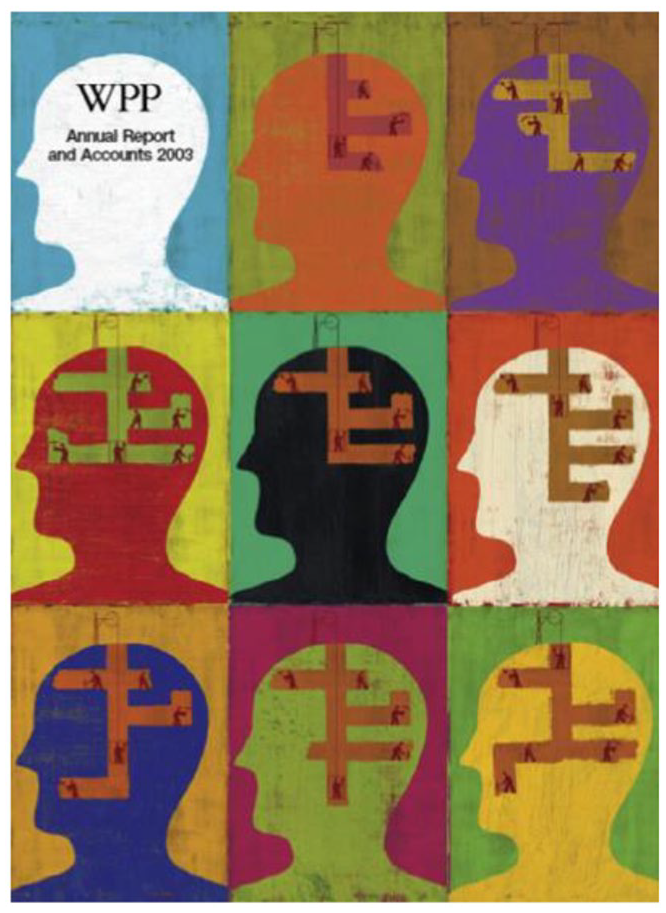
WPP plc Annual Report Front Cover 2003. Reproduced by kind permission of WPP plc.

Diagram of the human brain with five faculties Qualiter caput hominis situatur, page 490v. Around 1330.
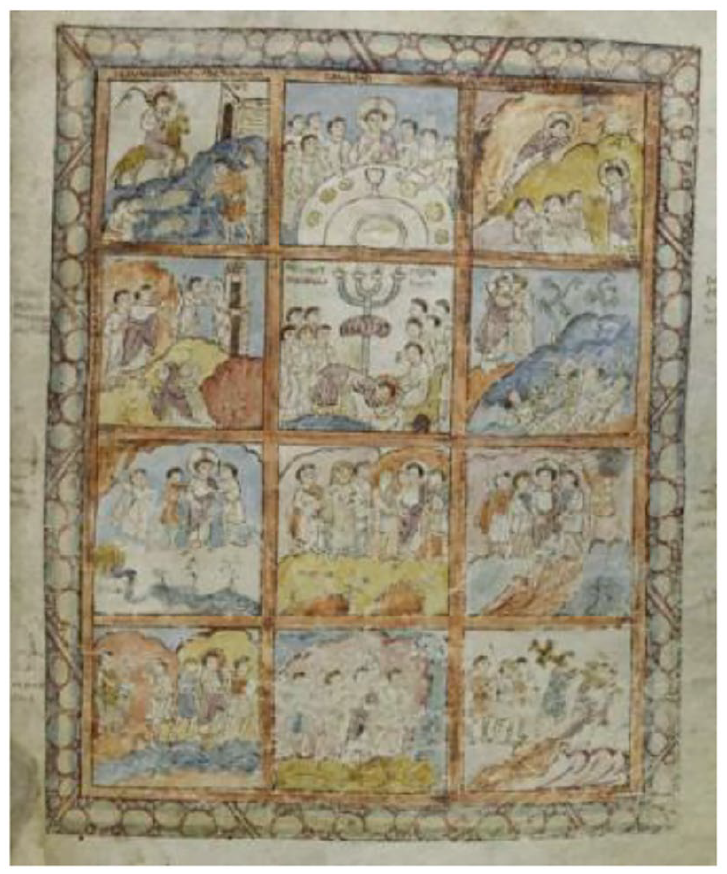
The Gospels of St Augustine, faculties, Cambridge Corpus Christi College MS 286 fol. 125r, sixth century. Courtesy of the Parker Library, Corpus Christi College, Cambridge.
The iconic signs of the contrasting front cover for 2015 (Figure 11) are again exclusively pictorial, in this photographed street mural, redolent of medieval Siena in indicating the omnipresence of art and creativity within the community. Their semes are of two intertwined Cuban musicians. Thus, iconographically, there is again emphasis on creativity, here musical as well as visual. The codes of taste and sensibility are geographically and culturally associated with Cuba, where WPP has a new presence. The rhetorical pathways again hark back to medieval aesthetics, in the use of proportion and symmetry between the two figures acting as ties (Carruthers, 2013; Puyou and Quattrone, 2018), and harmony comes of diversity (Carruthers, 2013) in their interlacing, and in the moulding together of man and double bass, and of human figures with their background. These contemporary visual images act as ‘cognitive tools’ (Carruthers, 1998: 118) and ‘memorial hooks’ (Carruthers, 1990: 274) for WPP, and it is likely that contemporary annual report front covers will, like the Biccherna panels, be better remembered by posterity than the technical accounting content to which they relate.
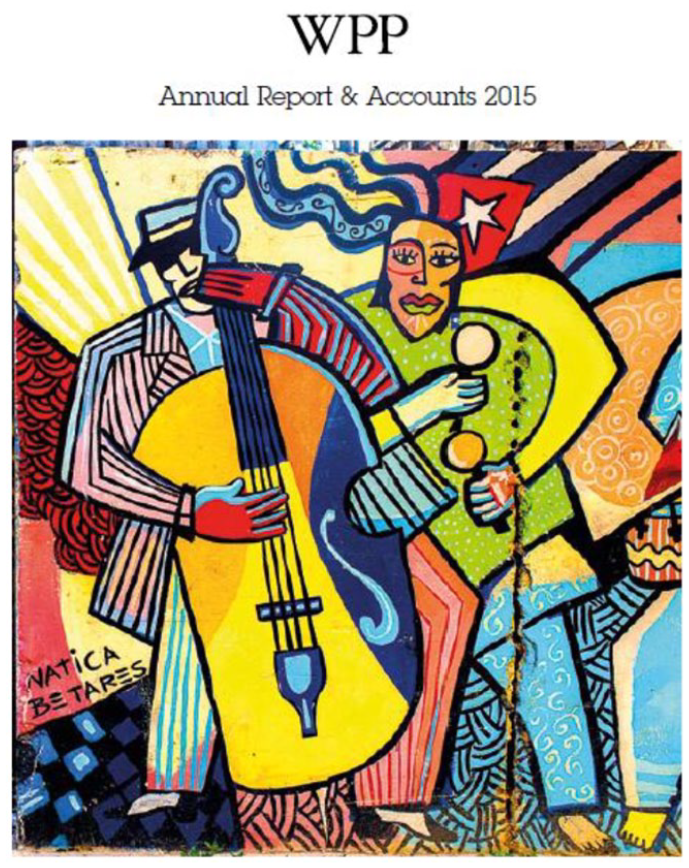
WPP plc Annual Report Front Cover 2015. Havana street mural by Natica Betares photographed by Patricio Molina Vargas. Reproduced by kind permission of WPP plc.
By extending organization studies on the affordances of the visual (Meyer et al., 2018) to governance, our analysis shows how visual mechanisms can help in dealing with the complexity and ambiguity underpinning city governance systems. In so doing, we add to the scant governance studies that have focused on visual rhetorical strategies for enacting desired city governance configurations (Brandtner et al., 2017). We suggest that this study of visual impression management in the Biccherna panels of pre-modern Siena could lead to a variety of further studies on the relationship between organizations and art, generated not only within organizations, but also by artistic observers, and in a variety of historical and contemporary contexts. Rafaeli and Pratt (2006) have noted the irony that ‘artefacts in organizations are highly visible but overlooked’. The power of the visual is increasingly becoming visible in organizational research: ‘Images are more real than anyone could have supposed’ (Sontag, 1977: 180).
Footnotes
Appendix: Analyses of Biccherna panels (1258–1677)
Total 134 panels (source documents are those reproduced in Borgia et al., 1984).
Acknowledgements
Jane Davison authored the introduction, visual literature review, framework of visual semiotics, method, background to the Biccherna panels, ‘visual governance’ empirical analyses and the ‘summary, medieval aesthetics and contemporary resonances’. Elena Giovannoni conducted the archival work and discussions with the archivist in Siena, authored the governance literature review, provided translations from the Italian and managed the copyright permissions.
We are extremely grateful to the Associate Editor Helena Liu and the three anonymous reviewers across disciplines for taking the time to engage with our interdisciplinary work, and for constructive and helpful comments throughout the review process. We should also like to acknowledge the useful comments of Andrea Giorgi and Christopher Nobes on draft manuscripts. The article additionally benefited from the observations of participants at seminars at Toulouse Business School (2016) and Royal Holloway (2017), the Interdisciplinary Perspectives on Accounting Conference, Edinburgh (2018) and the Accounting History Conference, Paris (2019)
We should like to express our thanks to the State Archive in Siena for their assistance, and note that ‘Figures 2A, 2B, 2C; 3A; 3B; 4A; 4B, 4C and 6B (ASSi, Tavoletta di Biccherna n. 15, 16, 19, 29, 38; ASSi, Biccherna n. 205, c. 2r; n. 319, cc. 1r and 56r; n. 244, c. 28r) are reproduced in this article with permission of the State Archives of Siena, Italy (Siena, Archivio di Stato: protocol number 837 dated 3 May 2022). Any further reproduction is forbidden (“Divieto di ulteriore riproduzione”)’. We should also like to note that ‘Figures 1, 5 and 7 are reproduced in this article with permission of the Comune di Siena. Any further reproduction is forbidden (“Divieto di ulteriore riproduzione”)’. We further thank the Parker Libary, Corpus Christi College, Cambridge and WPP plc for kind permission for the reproduction of images
Funding
The authors received no financial support for the research, authorship, and/or publication of this article.
