




Abstract
Visual impairment, as a form of disability, remains understudied in the context of employment and careers. Drawing on career ecosystem and career sustainability theories, we explore factors that lead to career success and career sustainability of visually impaired individuals. We collected qualitative data from 66 visually impaired individuals from India who had experienced varying degrees of career attainment. We applied grounded theory to study their deep-seated attitudes and ingrained behaviors that help build successful and sustainable careers. High-career-attainment participants were extremely resilient, able to bounce back after rejection, and willing to adopt certain key psycho-social processes such as non-acceptance of rejection, relatability (forging positive relations with the sighted), family support, enabling self through technology, and influence mindset change, which led them to be ‘masters of circumstance.’ Conversely, the characteristics of low-career-attainment participants included their unquestioning acceptance of fate, higher degrees of skepticism, and obligation to support the family, which led them to become ‘victims of circumstance.’ We contribute to the career ecosystems and career sustainability literature by expanding it to wider populations and crystalizing processes that influence careers. The findings have policy implications for visually impaired individuals as well as for other people with disabilities, as well as for organizations and governments. Individuals should challenge conventional norms, be persistent and improve self-efficacy. Organization should think out of the box in order to win the war for talent by employing hidden talent.
Introduction
People management in contemporary labor markets requires specific attention to workforce inclusion, as this improves organizational and national competitiveness (Kirton and Greene, 2015) and benefits society. Yet, there is limited career literature on stereotyping, stigma, and discrimination of the disabled (Broadbridge and Fielden, 2018). Some aspects of inclusion – disability, in particular – require special consideration from managers (Nafukho et al., 2010). A critical function of human resource management (HRM) is to acquire, develop, and manage available talent without excluding some segments owing to prevailing attitudes. To benefit from a wider talent pool, as well as to act with social responsibility, organizations should employ People with Disabilities (PWDs) (Kulkarni et al., 2016).
The understanding of disability has expanded and transitioned from the mere medical diagnosis of an inability or a limitation toward its socially constructed definition (Doyle, 1995). The World Health Organization (WHO, 2011: 3) defines it as ‘the umbrella term for impairments, activity limitations and participation restrictions, by referring to the negative aspects of the interaction between an individual (with a health condition) and that individual’s contextual factors (environmental and personal factors).’ Dealing with disability is a social, managerial, and human rights issue because PWDs continue to suffer as they do not benefit from employment and career growth opportunities available to their non-disabled counterparts (Bonaccio et al., 2019) resulting in low employment, low pay, job insecurity, and poor quality of life (Shantz et al., 2018). To augment the limited literature in this area, research is focusing on the prevailing barriers, stereotypes, discrimination, and attitudes toward PWDs, and how organizations can support integration of PWDs into the workforce. Yet, it misses out on an equally important but frequently overlooked issue of PWDs’ careers and the challenges they face while pursuing a career (Hoque et al., 2018), and how they negotiate the barriers. We build on the works of Baldridge and Kulkarni (2017) and Kulkarni and Gopakumar (2014) by focusing exclusively on visually impaired individuals (VIs) and their career journeys and by doing so, we respond to calls to focus on VIs’ careers (Beatty et al., 2019). We still know very little about how VIs overcome barriers to build successful and sustainable careers. Career sustainability is inherently dynamic and directly connected to evolving employability and workability (Richardson and McKenna, 2020), and is about the capacity to attain and maintain career success – most notably, be productive, be healthy, be happy (De Vos et al., 2020).
Most research on PWDs has been conducted in the United States (US), accounting for 60%, while the United Kingdom, Canada, and India accounted for 9%, 5%, and 5%, respectively (Beatty et al., 2019), although discrimination against PWDs is universal. Disability discrimination legislation in these countries has increased the rate of employment of PWDs and introduced practices for management of disability like developing PWD-friendly interview processes, and documentation of PWD employment, among other initiatives (Rieser, 2018; Woodhams and Corby, 2007). Additionally, there is a covert form of discrimination that is equally detrimental for PWDs (Jones et al., 2016). National cultures and values determine economic, social, and legislative contexts that in turn affect the treatment accorded to PWDs. This leaves a gap in the literature on the state of global PWD research (Colella et al., 2017; Dwertmann, 2016). When compared with the West, inclusion of PWDs within the workplace in India is negligible. Disability is a taboo in India owing to prevailing beliefs and PWDs hailing from the lower economic strata families are sometimes discarded by their own families or are ill-treated, thereby denied their right to life, education, and employment (Dalal, 2006).
Visual impairment is a common form of impairment in the global working population (Disabled People in the World, 2019) and India accounts for roughly 20.5% of the global VI population, the largest globally (Daniel, 2020). Only half of this population is literate (Census of India, 2011), but with suitable training and employment opportunities, VIs can become productive individuals (Foster and Wass, 2013; Vandekinderen et al., 2012). They tend to be committed like other PWDs and their performance is comparable with the sighted (Pogrund, 2018). Employment opportunity tallies poorly for the global labor market for VIs, with 29% of them in non-competitive employment such as homemakers and unpaid family work vis-a-vis 1.5% of those with other forms of disability (Warren-Peace, 2009). The VIs with access to education, training, and employment in India is low compared with those in developed countries (Ozawa and Yeo, 2006). Efforts of the Government to improve the employment statistics for VIs have not yielded desired results (De Boeck et al., 2018). This could possibly be owing to stereotyping and the belief that not much can be done about VI individuals (Mackelprang and Salsgiver, 2016: 281).
We shed light on this area of study by expanding the knowledge on career success and sustainability for a disadvantaged population like the VI. The study focuses on the overarching research question: How do the visually impaired overcome barriers (stereotypes, stigma, and discrimination) and manage to build successful and sustainable careers? To bridge this gap, we have integrated and expanded two relevant contemporary theories – career ecosystems theory (Baruch, 2015; Baruch and Rousseau, 2019; Gribling and Duberley, 2020) and career sustainability (De Vos and Van der Heijden, 2015; De Vos et al., 2020). We do so in the context of career inclusion to elucidate the psycho-social processes that VIs use to overcome and transcend the barriers of stereotypes, stigma, and discrimination. We also observe that, to date, researchers have not explored what VIs and other PWDs do to foster acceptance by co-workers, and how they do this, which is a key factor in the success of PWDs (DeWall and Bushman, 2011; McLaughlin et al., 2004). The contribution of the study will further expand the existing literature on career ecosystem theory and career sustainability and integrate both literature streams in the light of career inclusion as a form of workplace diversity. We also contribute to the literature on the acceptance of VIs and PWDs and the important role it plays in the career inclusion of VIs and PWDs.
Underpinning theory and literature review
People with Disabilities
Much of the research on PWDs (for exceptions, see Baldridge and Kulkarni, 2017; Kulkarni and Gopakumar, 2014) focuses on discrimination, stereotyping, and barriers to the employment market (Mackelprang and Salsgiver, 2016) and not on their careers’ sustainability or career success. This is a major omission, because PWDs face challenges to even have any type of career, with less than a third in appropriate employment (Shaw et al., 2007). When compared with the sighted, VIs have lower employment rates and earnings, and are more likely to be underemployed (Houtenville and Ruiz, 2011). They have fewer job opportunities and even when employed they are less integrated in the system (Colella, 2001). Biases and stereotypes link disability to incompetence, dependency, helplessness, and lower productivity. These perceptions negatively affect the hiring of PWDs (Benoit et al., 2013; Heslin et al., 2012) and hinder their social acceptance once employed (Colella, 2001; Ren et al., 2008; Stone and Colella, 1996). When employers design supporting HR policies and practices, career success of PWDs can be positively affected (Kulkarni, 2016).
Different career management strategies can be adopted by PWDs, where a positive mindset, disability advocacy, overcoming stereotypes through sensitization, and taking feedback helped PWDs to achieve their career goals (Kulkarni and Gopakumar, 2014). They also found that PWDs set their own career objectives and focus on achieving subjective, personalized career outcomes. Disability variability in terms of type, severity, and chronicity, among others, should be acknowledged while conducting disability research (Beatty et al., 2019). Visual impairment is a serious form of disability and calls for exclusive examination.
Baldridge and Kulkarni (2017) focused on the requirement of hearing-impaired individuals to change their approach to their careers while facing life-changing events like adult onset of disability. They reported redefining self, success, work, and social networks as the key findings that helped these individuals to attain career success and develop sustainable careers. The study sample was from the US and covered individuals who became deaf as adults, and the findings further illuminate the understanding of the careers of PWDs. These two studies inform us on the careers of PWDs, and our study focus on VIs will further deepen our understanding of how an important segment of the PWD population manages the challenges it faces to achieve successful and sustainable careers.
The employers of VIs identified spatial orientation and mobility as predictors of job success (Golub, 2006). The amount of vision, gender, and other disabling conditions significantly affected the employment rate of VIs (La Grow, 2004); and experience at work, assistive technology, locus of control, and academic background were important factors for the employment of VIs (McDonnall and Crudden, 2009). ‘Claiming’ versus. ‘downplaying’ strategies adopted by PWDs (which also included some VIs) aimed at gaining improved evaluations from others (managing impressions of others for positive evaluations from the non-disabled) (Lyons et al., 2016). But none of these foregoing studies looked at either career success or career sustainability and their contribution to career theories remains wanting. Other forms of disability have received greater scholarly attention: the hearing impaired (Baldridge and Kulkarni, 2017), PWDs in general (Kulkarni and Gopakumar, 2014), and mental disabilities (Vornholt et al., 2018).
Career theories
Attaining career success and career sustainability is important to individuals, irrespective of whether they are PWDs or those without disabilities (Spurk et al., 2019). Comparing individuals according to their career success is an innovative method that enables scholars to explore careers using the relevant and valid identification of career success as a critical factor (Milhabet et al., 2020). This was also similarly applied by Kaše and colleagues (2020) who compared those with low versus high career success schema complexity. The literature distinguishes career success and career sustainability; the first one is about both subjective and objective success. The subjective element is self-perceived, self-evaluated satisfaction derived from one’s career achievements, whereas the objective element is the external progress that has measures and indicators through which this type of career success is perceived and evaluated by others (Ng et al., 2005; Spurk et al., 2019).
A sustainable career can be achieved via performance, resilience, and a positive approach to life (Hart, 2021). We explore what goes into making careers sustainable and successful for VIs. As mentioned earlier, we build on and extend careers ecosystems and career sustainability theories. Further, we delineate the processes through which VIs overcome barriers and expand our understanding of the factors most critical to secure sustainable and successful careers. The need to adapt is among the current expectations within the notion of the career ecosystem theory, a social system of employment and career-related development and opportunity that emerges from inter-dependencies among actors or entities, including individuals, networks, firms, and social institutions (Baruch and Rousseau, 2019: 92). To be sustainable, any ecosystem needs to enable its actors to benefit from each other and use resources in an optimal manner; and use of human talent enables organizations to perform better (Collings et al., 2019).
PWDs in general, and VIs particularly, are an underutilized resource, and the literature can benefit by applying an ecosystem perspective to understand how the different actors in the system benefit from mutual collaboration. To maintain balance in a career ecosystem, actors interact with one another and forge bonds for mutual gain, goal attainment, and a thriving system. Advancing the interests of one set of players at the cost of others creates ecological imbalance in the career ecosystem and makes it unsustainable. Compared with other PWDs, the challenge for VIs is even greater because of restricted mobility and missed visual social cues. Both top-down and bottom-up processes in a career ecosystem require institutions to regulate and enhance employability, training, and investment in people (Garsten and Jacobsson, 2013; Van der Heijde and Van der Heijden, 2006). At a national level, establishing a quota for PWD employment helps create balance in career ecosystems, thereby benefiting disadvantaged groups. Even India reserves places in government for PWDs, via the use of quotas. Career ecosystem theory thus offers a suitable platform to study the careers of VIs in a wider context.
According to Van der Heijden and De Vos (2015), sustainable careers refer to ‘sequences of career experiences reflected through a variety of patterns of continuity over time, thereby crossing several social spaces, characterized by individual agency, herewith providing meaning to the individual’ (p. 7). Sustainability implies that employees have the possibility and ability to function in the long term in terms of achievement and maintenance of performance, engagement, and health. De Vos et al. (2020) consider three groups of indicators of a sustainable career – health, happiness, and productivity. To remain sustainable, career systems should benefit from all its constituents, and, in terms of individuals, this means effective use of human talent (De Vos et al., 2020). If some segments of the population like VIs are not included for participation in the labor market, long-term sustainability will be at risk. VIs constitute a segment of the population that has the potential to participate and contribute; however, if neglected or underutilized, they might become a social liability.
We explore the process of how our participants achieve career success and sustainability in the light of career ecosystem theory and career sustainability, contrasting enablers against barriers. VIs are vulnerable labor market players and have significantly limited employment opportunities and career mobility. As a result, they strive harder than their non-VI counterparts to secure employment and achieve career success and sustainability. To achieve this, VIs should adapt, and acquire the right skills and experience to fit in the dynamic work environment. Failure to do so may otherwise hinder their progress. Although some of them do acquire and possess the requisite talent, VIs are not sufficiently represented in the career management literature so, by covering this segment, we plug this gap and thereby contribute to the literature on career theories and career inclusivity for the VIs and other PWDs.
Acceptance of People with Disabilities and career inclusivity
Within organizational and social contexts, acceptance contributes tremendously to the well-being (Plomp et al., 2016) and effectiveness of workers. To be effective on the job, PWDs need to be accepted by colleagues and be socially integrated. The personal and social advantages of acceptance seem to be the cornerstone for long-term integration of PWDs at work and for employment sustainability (Vornholt et al., 2013). Some studies have examined acceptance of PWDs by the co-workers but failed to pay adequate attention to the role VIs (PWDs) themselves play in gaining acceptance (Jackson et al., 1993; Saks and Ashforth, 1997).
While there is limited research on the acceptance of PWDs by co-workers, the VI population and how they can gain acceptance among co-workers is excluded from this debate (DeWall and Bushman, 2011; McLaughlin et al., 2004). This is particularly important because co-workers and employers may suffer from a higher aesthetic anxiety (commonly referred to as anxiety arising out of the negative perceptions that visual impairment may bring to the business and organization) in the presence of a VI colleague (Colella and Bruyère, 2011). How VIs build mutual acceptance among the co-workers goes a long way in building career inclusivity in the career ecosystem, thus leading to workplace inclusion. Although a few studies have looked at workplace inclusion of PWDs (Colella and Bruyère, 2011; Kulkarni et al., 2016; Zhu et al., 2019), none has studied career inclusion in the light of acceptance curated by the VIs for career success and sustainability. The challenge of managing disability inclusion in countries like India is significant (Cooke and Saini, 2010) because Indian society views PWDs as ‘suffering’ and deserving recipients of charity or support, but does not consider them in the context of equality of employment opportunity. Therefore, most employers engage in charity work for PWDs outside the organization while offering them minimal or no employment (Kulkarni and Rodrigues, 2014).
However, employers aiming to benefit from an inclusive workforce need to frame inclusive policies and follow relevant practices (Houtenville and Kalargyrou, 2012) so that VIs can secure employment and achieve career success. Although empirical evidence is scant, there is a positive relationship between inclusiveness and performance (Sabharwal, 2014). Mor-Barak (2000: 339) defines the inclusive workplace as one that values and encourages individual and intergroup differences within its workforce, cooperates with and contributes to its surrounding community, alleviates the needs of disadvantaged groups in its wider environment, and collaborates with individuals, groups, and organizations across national and cultural barriers.
The presence of PWDs in the organization positively affects the acceptance of new employees with disabilities (Kulkarni and Lengnick-Hall, 2011). When a VI individual is accepted within a workplace, other employees do not regard them as contributing less, but rather as contributing differently (Vornholt et al., 2013). Prior research has explained the role that acceptance plays in a PWD’s work and social life, and how organizational inclusivity promotes their employment (Kulkarni et al., 2016). However, organizational inclusion might just mean employment of PWDs – not their career experiences, success, and sustainability. We explore how VIs (PWDs) foster career inclusion defined as a ‘culture that contains the basic assumption that there should be equal career opportunities and greater support for employees who are underrepresented in the organization’ (Hall and Yip, 2014: 10) for career success and sustainability. We know virtually nothing about the processes through which VIs build acceptance that in turn helps in career inclusivity for them. By integrating acceptance and inclusive career literature, we address the gap in our understanding of how the entire career ecology works for VIs and other PWDs and how they are able to attain career success and career sustainability. Hence, we pose the following research question:
How do visually impaired individuals overcome and manage barriers to achieve successful and sustainable careers?
Context
VIs face discrimination and barriers owing to the prevailing cultural beliefs and biases around disability ingrained in the Indian society (Dalal, 2006; Mitra and Sambamoorthi, 2008). This problem becomes compounded by certain religious beliefs like Hinduism (a large majority of the population follow this religion) and the associated Karma orientation (deeds of the past birth(s) good or bad come to haunt in the present and future birth[s]) that views disability as an outcome of past bad deeds. Such religious sentiments foster feelings of guilt and shame among PWDs and their families (ostensibly owing to their past deeds) and evoke responses of pity and charity from the able-bodied (Kumar et al., 2012). Some of the PWDs are rejected by their own families and end up begging on the streets or do errand running chores for a living (Dalal, 2006). It was found that heads of the family in the Indian villages in the state of Tamil Nadu who have negative attitudes toward PWDs results in low expectations of PWDs by their own families and community leading to discrimination by co-workers and employers (Mitra and Sambamoorthi, 2008). India has ratified the UN Convention on the Rights of Persons with Disabilities in 2007 and subsequently enacted the Rights of Persons with Disabilities Act, 2016. The provisions of the Act mandate that at least 4% of the total number of vacancies in Indian Government establishments in specified categories and an additional 1% in some others need to be reserved for PWDs. Even the private sector organizations also have some obligations as per this Act and requires organizations to have Equal Opportunity Policy for PWDs and maintain records for inspection (Kochhar et al., 2018). The efforts of the Indian government and the civic society largely resulted in a medical model of rehabilitation (curing the disability) (Kalargyrou, 2014) but not rehabilitation for work or career.
Given the context, to have a sustainable career for VIs is to ensure that they perform well on their job, and develop a positive psychological contract with their employer leading to a long-term relationship. Positive psychological contract is based on positive psychology, for example, enabling and promoting meaningfulness at work (Hart, 2021) and robust mutual acceptance of both parties, leading to mutual benefits for both parties (Baruch and Rousseau, 2019). This is particularly important given the cultural context of India where employers and co-workers held negative attitudes toward PWDs. This is mutually beneficial to the VIs and their employer.
Methods
Career studies over-utilize quantitative methods at the expense of qualitative ones. Examining 3279 career related studies, Stead et al. (2012) found that only 6.3% of them employed qualitative methodologies. This is a major gap in this literature, because quantitative and qualitative methodologies are complementary rather than competing approaches. In line with Kindsiko and Baruch (2019) we argue that, in addition to ‘seeing’ the career as a measurable phenomenon, a more introspective dimension should be incorporated into the career – the way individuals experience their career. Grounded theory is ‘most suited to efforts to understand the process by which actors construct meaning out of intersubjective experience’ (Suddaby, 2006: 634). We adopted grounded theory because it offers ‘greater explanatory and predictive power’ (Glaser and Strauss, 1967: 24).
Sample
To achieve a representative target sample, we approached the National Association of the Blind (NAB) in New Delhi, the Blind Relief Association (BRA), and Enable India, Bangalore, a non-governmental organization (NGO) working with VIs, and employed a purposive sampling strategy to access prospective participants who were willing to talk about their career challenges and experiences. We were guided by theoretical sampling to collect data to develop concepts, themes, and dimensions and then establish various connections among them (Gentles et al., 2015). The sample comprised 66 individuals with zero vision (totally blind), engaged in different types of employment. The interviews’ narratives revealed startling inter-individual differences in the way the participants negotiated challenges as VI, and their associated agentic behaviors. We then segregated the participants on the basis of positive or negative tone of the participant, sense of accomplishment or disappointment, spirited or dispirited, desire to help the VI community, or suspicious of others.
Comparing individuals according to their career success is an innovative method that enables scholars to explore careers using the relevant and valid identification of career success as a critical factor (Milhabet et al., 2020; Smith et al., 2011). This was also similarly applied by Kaše and colleagues (2020) who compared those with low versus high career success schema complexity.
Forty-three participants were identified as holding prestigious positions, thus we labeled them the ‘high career attainment’ (HCA) category, and 23 who just managed to secure employment (this is some level of success for VIs) were labeled as the ‘low career attainment’ (LCA) category. This categorization of sample is also in line with existing literature (Follmer et al., 2018; Kwok et al., 2012; Pudelko and Tenzer, 2019). Following Arthur et al.’s (2005) recommendation, we adopted both objective and subjective criteria for gauging HCA and LCA success; even simply securing employment is a major challenge for VIs (Seibert et al., 2001; Verbruggen, 2012). We applied the specific criteria below for labeling the categories as HCA category and LCA category.
For the 43 in the high career attainment category, the lowest qualification was an undergraduate degree and the highest qualification a doctoral degree. They worked as lawyers, chartered accountants, entrepreneurs, government policymakers, IT professionals, small business and start-up entrepreneurs, performing artists, and other professionals. About 40% of the participants had won national awards from the President of India for their exemplary work in the VI community. Their salaries ranged from US$500 to US$3,000 per month. Some participants were able to effect job changes easily, whereas others found this a little harder. At worst, some had to endure very brief periods of unemployment (on average, two months) before securing another job. About 70% hailed from families with respected socio-economic backgrounds, and 30% had sighted siblings. These participants spoke about their career journey with pride and many of them experienced financial independence, success in their job, and satisfaction in life overall, indicating perceptions of subjective career success.
For the low career attainment category, the participants were typically not well educated, lacked professional skills, and secured low-quality employment, 80% of them hailed from poor socio-economic backgrounds, and 30% had VI siblings. They worked as massage therapists, receptionists or front-desk clerks, candle-makers, office attendants, small-shop owners, dispatch clerks, and other positions. Many participants had erratic schooling and most spoke only a vernacular (in Hindi), which is a disadvantage in the labor market. The only formal education or training any received was from schools for the blind. Generally, they earn less than US$100 per month. The majority had family responsibilities as sole breadwinners.
Almost half the participants (32 out of 66) were VI since birth; the remainder lost their eyesight completely by the age of 10. All participants were living in metropolitan Indian cities, like Delhi, Mumbai, Bengaluru, or Kolkata. Half of them were originally from rural villages, having migrated for education and employment. Their ages ranged from 21 to 65 years (median 33) and their work experience ranged from two to 31 years (median 11). Table 1 presents the participants and their demographic characteristics.
Participants profile.
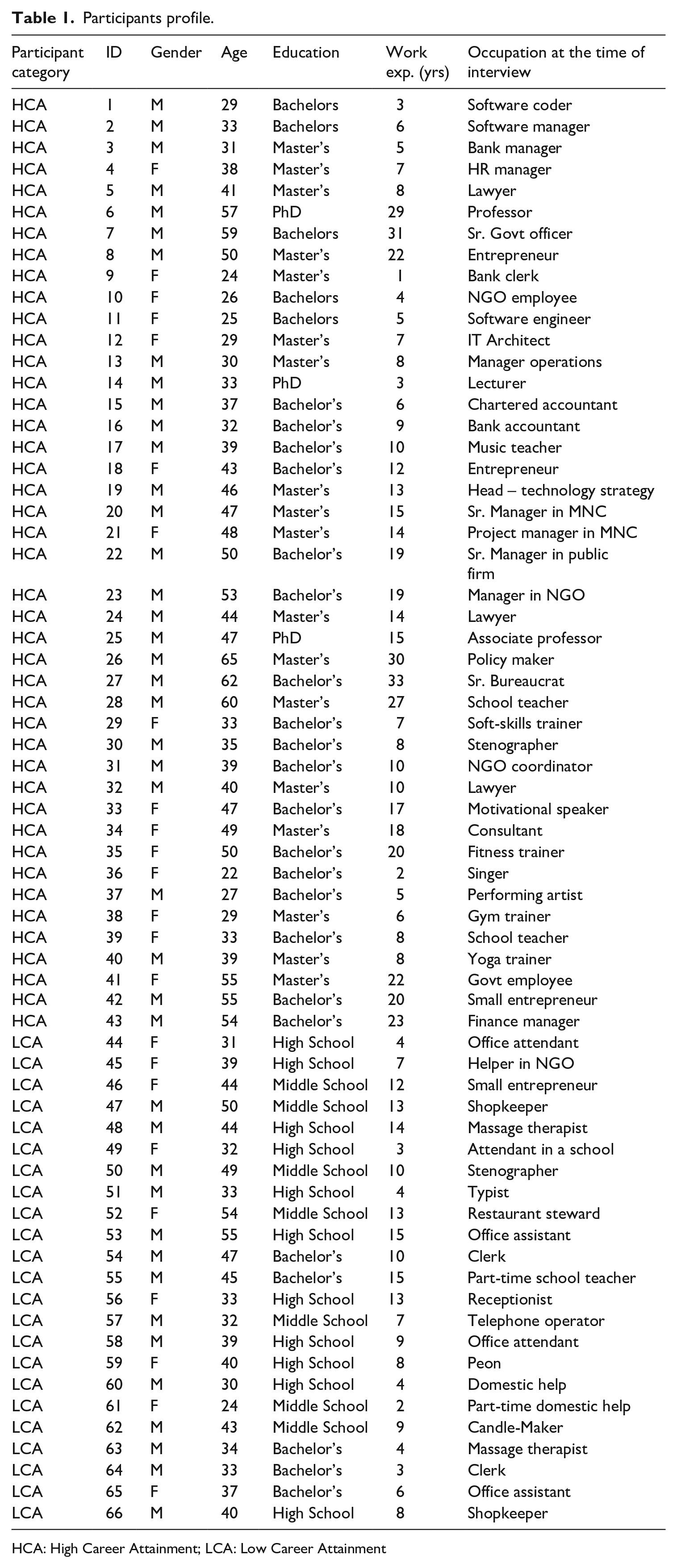
HCA: High Career Attainment; LCA: Low Career Attainment
Interviews
The semi-structured interviews were conducted by the first and second authors with the help of an interview protocol. Each interview lasted for approximately 90 minutes with some lasting for 120 minutes. Six interviews were telephonic. All participants except three permitted audio recording of their interviews. Seventy per cent spoke English, 20% spoke Hindi, and the remaining 10% spoke regional Indian languages. The interviews were professionally translated into English and transcribed resulting in 630 single-spaced pages of data. Transcript accuracy was verified by the first and second authors who knew the language of the participants.
Data analysis
We achieved data saturation through constant comparison. We compared additional data with previously collected data and analyzed them to identify similarities and differences. We ceased collecting additional data when new themes failed to emerge (Guest et al., 2006). The final sample size of 66 was far above the norm in qualitative studies (Saunders and Townsend, 2016). We executed the process of data collection and coding in parallel, to facilitate further exploration of emergent themes in subsequent interviews.
To ensure appropriate coding and reduce potential bias, an external coder independently reviewed the coding scheme and wherever the agreement was more than 75% we retained the codes. For cases of disagreement, two authors reviewed the interview notes and coded until reaching consensus in accordance with Lincoln and Guba’s (1985) recommendations for process trustworthiness. Herein, we achieved rigor in coding by coding the verbatim interview transcripts via NVivo 10 and, once this was completed, we created nodes in NVivo.
We coded each transcript for mention of barriers (any kind) in their careers. We counted anything as a barrier that was constraining or an impediment to pursuance of the career goals and used open coding (Corbin and Strauss, 2008) to keep a record of every barrier (45 first-order concepts) encountered in the participants’ narrative. Through constant comparison we grouped similar barriers into broad three second-order themes: feeling of being in the pits, societal denial to the VI, and struggles and hardships in the pursuit of opportunities. These second-order themes helped us to parsimoniously describe feelings, reactions, and responses to the categories we coded (Gioia et al., 2013). The connections and inter-relationships between first-order concepts and second-order themes were examined and consolidated into one theoretical aggregate dimension labeled ‘non-acceptance of rejection’ that served as a starting point for the participants to overcome barriers, prejudices, and discrimination and to develop strategies to achieve career goals.
We first looked at the 43 transcripts from the high career attainment category to code for psychological and behavioral responses of the participants – how they cope, manage, and overcome barriers. This enabled us to generate 125 first-order concepts that we grouped further based on commonalities into 11 second-order themes: adapting to the sighted world, understanding the sighted perspective, acculturation to the sighted world, parental support, mentoring, confidence in technology adoption, belief in technology, enabling self through technology, prejudices and stereotypes about the VI, sensitization and communication programs and apprehensions and cynicism. All these second-order themes further were subsumed into a set of four aggregate dimensions: relatability, family support, smart use of technology, and demolish mindset barriers. When we looked at the career accomplishments of these participants, they were all high achievers with successful and sustainable careers and emerged as ‘masters of circumstance.’
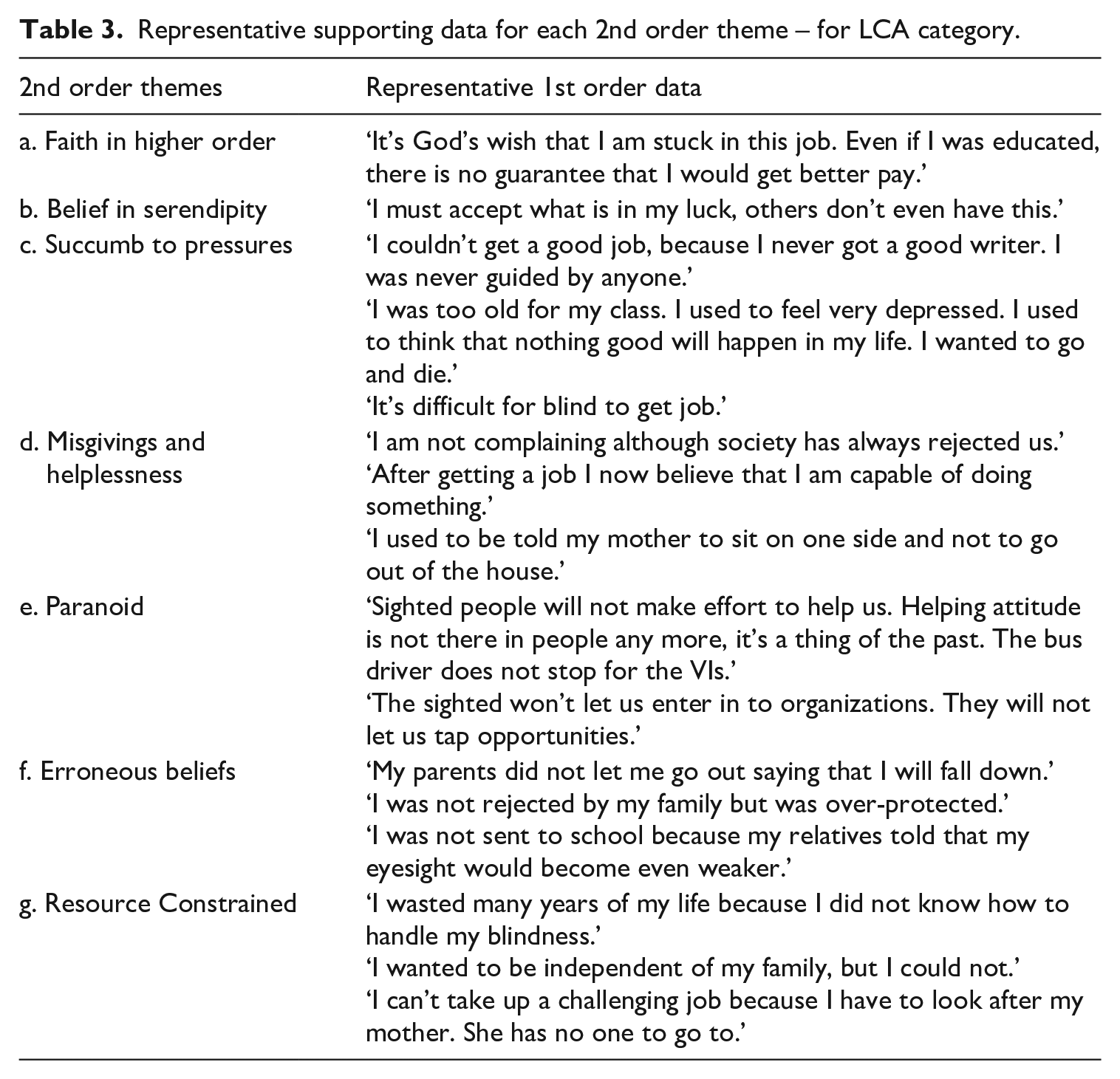
We then looked at the 23 transcripts of the low career attainment category, noticing how these participants described the handling of the barriers and reported extreme difficulties in coping, managing, and overcoming the barriers and how they became ‘victims of circumstance.’ We set out to code their responses to barriers and generated 26 first-order concepts that were then grouped into three second-order themes: faith in higher order, belief in serendipity, and succumb to pressures. These three were then subsumed into a theoretical aggregate dimension labeled as ‘acceptance of fate’ that is markedly different from the ‘high career attainment’ category of participants that was ‘non-acceptance of rejection.’ Then we looked at how these participants tried to cope, manage, and overcome these barriers and started the next round of coding that generated 49 first-order concepts that were further grouped into four second-order themes: misgivings and helplessness, paranoid, erroneous beliefs, and resource-constrained. Based on the similarities, we grouped two second-order themes into an aggregate dimension labeled ‘skepticism’ and the other two themes into another aggregate dimension labeled ‘obligation to support the family.’ The two sets of participants responded differently to barriers and challenges. Therefore, we created a data structure (Figure 1) that displays the logical progression from the first-order concepts to second-order themes to the aggregate dimensions. Tables 2 and 3 show the representative statements for the second-order themes.
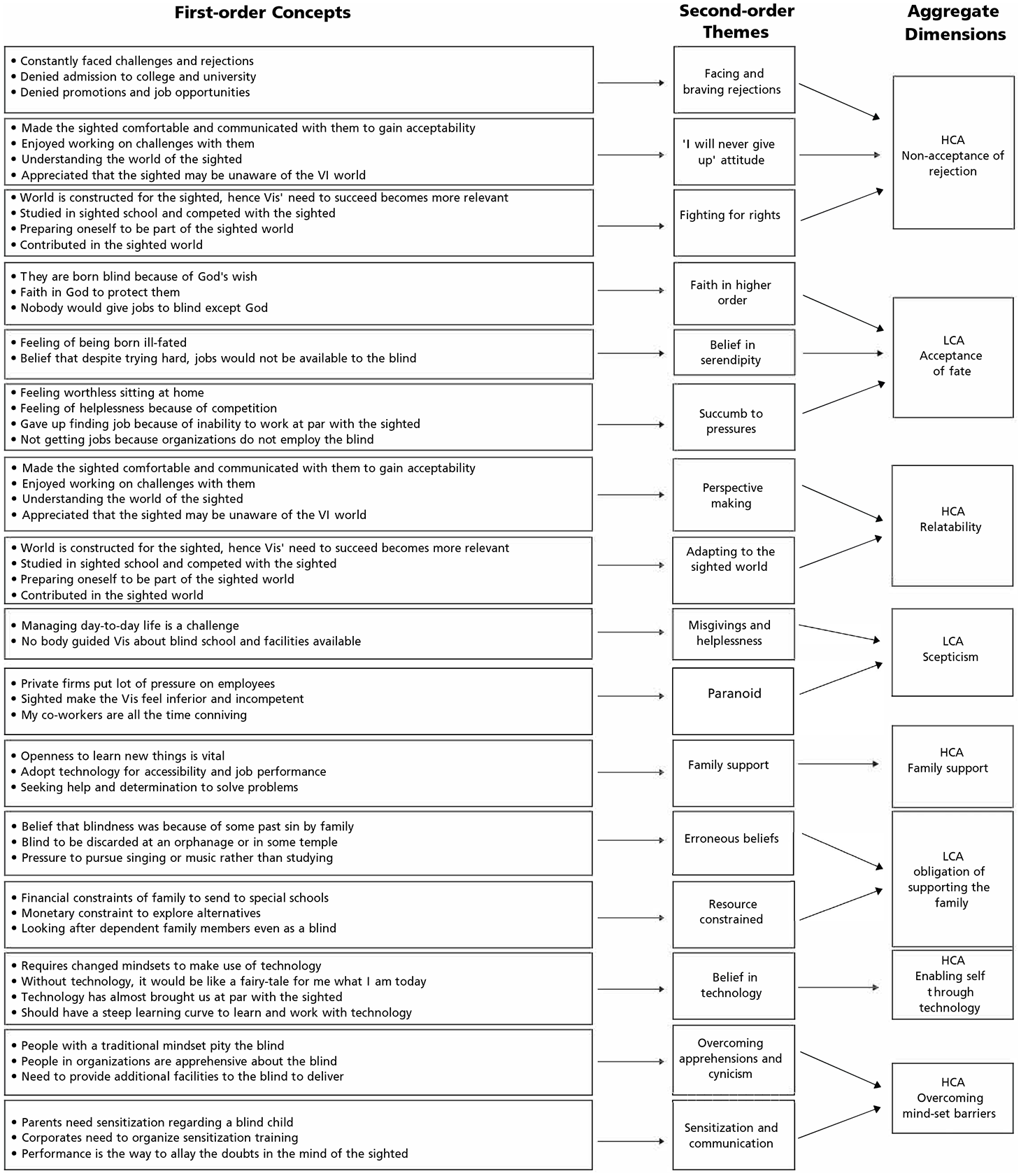
Data structure for careers of visually impaired individuals.
Representative supporting data for each 2nd order theme – for HCA category.
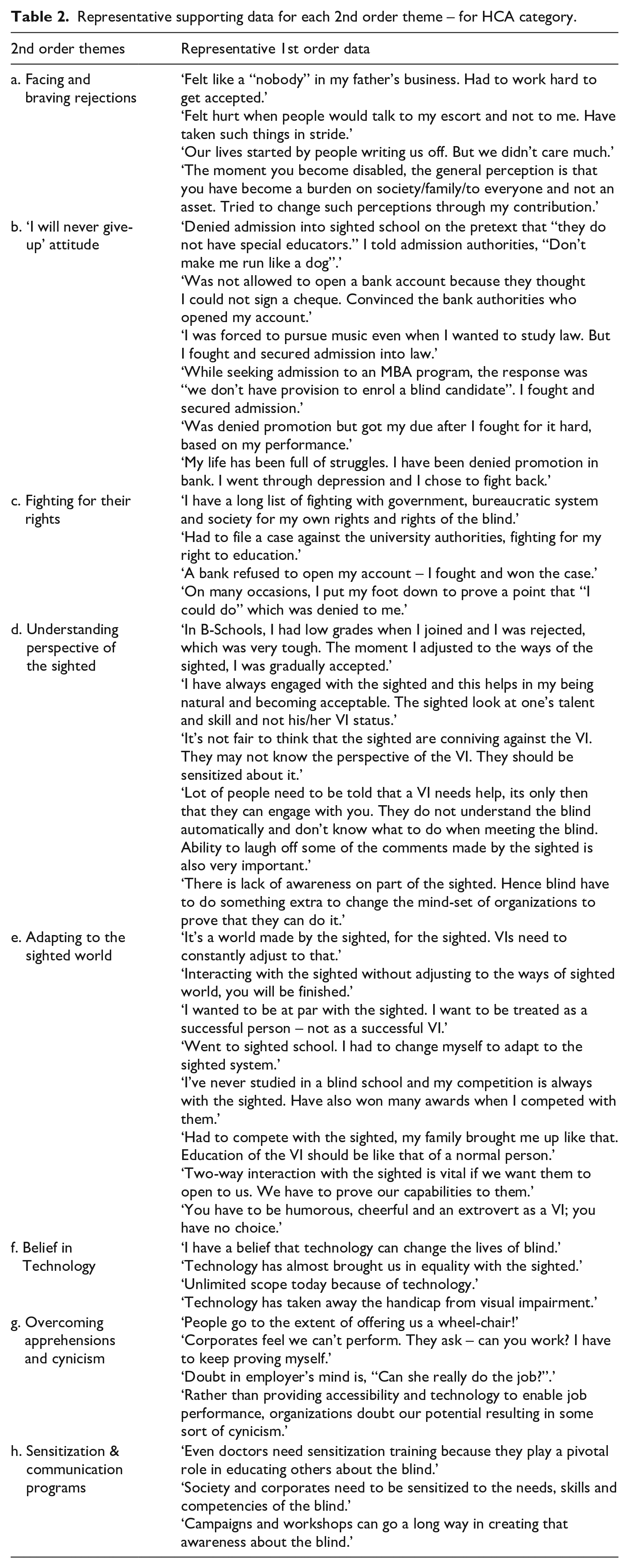
Representative supporting data for each 2nd order theme – for LCA category.
Findings
Our analysis was guided by the two career theories (career ecosystem and career sustainability) that may help us in finding answers to our research question. Our study participants encountered barriers and challenges while trying to pursue their career goals but the manner in which each responded to the barriers and challenges varied widely between them. We labeled the group ‘high career attainment’ to represent the ones who successfully negotiated the barriers and tried to bring a balance in the career ecosystem to secure meaningful employment while experiencing career satisfaction and success over time, which suggests that their careers were sustainable. This group displayed a very high degree of personal agency and could galvanize support of the different stakeholders – that is, parents and family members, classmates, colleagues, individuals in positions of authority, and community members – to support them in their endeavors to advance their career. Non-acceptance of rejection has been the primary response that fueled their unfailing belief that they are worthy and should have the opportunity to prove themselves.
The response of the other group to barriers and challenges was different; it was more like ‘fait accompli’ that we label ‘low career attainment.’ The defining response of this group has been ‘acceptance of fate’ and they did not exhibit the spirited response of the other group; instead, they meekly succumbed to rejections. The members of this group were victims of the belief that disability is a result of some wrongdoing (in a past life) and therefore the suffering they endure (Mitra and Sambamoorthi, 2008). They did not have the same family support as the other group had and they were resource-scare. Our findings depict and represent the career experiences of both these groups starting from childhood to attainment of employment and lead to a theoretical contribution for the understanding of contemporary careers through the lenses of career ecosystem and career sustainability theories. In the first section, we depict the career journey of the ‘high career attainment’ category followed by those who had ‘low-moderate career attainment.’
High career attainment category
In this section, we show how this group managed and overcame barriers to achieve career goals of success and sustainability. The dimensions that characterize the behavior and response of these participants to barriers are non-acceptance of rejection, relatability, family support, enabling self through technology, and influence mindset change that are narrated below.
Non-acceptance of rejection
One of the most defining responses to constant rejections at different quarters was an astounding non-acceptance of rejection. The participants experienced stigma, stereotyping, discrimination, and denial of opportunities in education, employment, and career growth, among other barriers, despite possessing the talent and potential – for example, ‘[I was] not allowed to take entrance exam for admission to MBA’ [HCA13]. They fought for their rights against prejudice and stereotyping; ‘. . . approached the judiciary for my rights and got an order in my favor’ [SR15]. Even the ones who had attained career success had to continually expend efforts to prove their self-worth in gaining acceptance among colleagues to get into the mainstream: ‘My manager at a Big-Four firm was apprehensive about my capability despite my performance but I proved myself worthy of promotion’ [HCA 4]. We define ‘Non-Acceptance of Rejection’ (NAR) as an iterative process of ‘responding to rejections by first not accepting them and then working even harder using personal resources to gain acceptance and access to opportunities.’ It goes beyond simple acceptance into the realm of assertion, demanding equitable treatment. These participants could have succumbed to the pressure of rejections, but they chose not to. Rather, they exhibited a spirited NAR, resolutely focusing on overcoming the psychosocial burdens of stigma, stereotyping, and discrimination that are associated with this condition.
Our analyses indicate that three factors – facing and braving rejections, embodying an ‘I will never give up’ attitude, and fighting for rights – together constitute NAR. These participants showed resilience and had a burning desire to succeed. NAR, in fact, helps VIs to gain self-esteem and protect themselves from the impact of social rejection.
Facing and braving rejections – VIs prefer employers who base their hiring decisions on the assessment of the knowledge and skills required for the job: ‘Hard to get interviewed for positions that I am qualified for’ [HCA 43]. Regaining self-esteem is a core virtue that sets apart success: ‘After surviving many rejections, I became a professor at the University of Colorado’ [HCA 25]; ‘one insensitive professor taunted me saying “why should the blind even join the MBA” and I secured the highest GPA and a decent job’ [HCA 20]. Many participants spoke of their ability to walk past the failures; ‘because of all the failures, I am where I am. Died many deaths . . . but every failure taught me a new lesson’ [HCA 12]. They have learnt to humor insults and sarcasm and stay goal-oriented: ‘I have taken many derogatory remarks in my stride and went on to win awards in college’ [HCA 36].
They also held a single-minded focus toward the goals – an ‘I will never give up’ attitude. VIs said their most important attributes are their ‘never-say-die attitude’ [HCA 30], ‘their unwavering desire to succeed’ [HCA 2], and their ability to think out of the box. One of our participants took it upon himself to dispel the myth that a VI cannot sign a check. Driven by the desire to change the erroneous assumptions of the sighted, he developed a software solution by which the VI would be able to write and sign a check. In a lighter vein, one participant said, ‘We may not have eyesight but we must not lose our vision’ [HCA 26]. As one asserted, learn to self-advocate: ‘Speak for self, else you will be pushed to the corner’ [HCA 17]. One participant denied admission by a premier engineering college in India succeeded in securing admission in the undergraduate program at Stanford University in the US. The spirit of never-give-up and never-say-die acted as a guiding lamp in setting direction for their goals and subsequent accomplishment.
Fighting for rights – Denials and rejections forced these participants to resist the authorities until their complaints are heard and their demands are met. Some of these participants secured jobs through continued perseverance: ‘Prove self-worth by showcasing skills, then disability becomes secondary and you get a break’ [HCA 29]. Our participants were determined not to relinquish their goals and often even overcompensated for their lack of sight: ‘never cited visual impairment as an excuse, rather took charge upon myself for career advancement’ [HCA 19]. Through sheer persistence, they sublimated the negative energy of rejection into the conditions for individual success.
Relatability
To gain acceptance, these participants make concerted efforts to cultivate relatability with the sighted. Relatability is an attribute developed by the high career attainment participants that makes them easy to be understood and feel connected. We define it as the ‘ability to relate to the sighted by understanding their expectations – hence perspectives – and therein facilitating greater acceptance within the sighted world’s social interactions and opportunities.’ Relatability contributes to the acceptability of VIs and determines whether they view themselves either as victims or masters of circumstance. The latter refers to their disability using positive language and tone; they even sport about it sometimes. They are conscious of the need to connect with the sighted to make them (the sighted) feel comfortable about their disability. Hence, understanding the sighted perspective becomes very important for them: ‘Only if VIs understand the sighted ableist perspective can they win in the sighted world’ [HCA 14]. The lack of visual cues makes it difficult to strike meaningful conversations. This group of participants understand this limitation and aim to compensate for missing the cues by developing unique conversational capital to forge connections with the sighted and gain acceptance. This promotes a two-way interaction. The sighted will then tend to open up to the VIs, giving them the much-needed opportunity to conduct business because ‘the more you interact with the sighted, the better integrated you are’ [HCA 34].
Besides developing unique conversational capital, relatability also means developing appropriate etiquette such as ‘neatness in appearance and right posture’ [HCA 32]. Participants with high career attainment were able to make sighted individuals feel comfortable by acculturating to the ableist, sighted world, understanding their perspectives: ‘From managing team dynamics to office politics, successful participants have developed a knack to handle divergent issues smoothly’ [HCA 25]. It is very important for VIs to seek help, and for others to extend it if VIs do not want to feel discriminated against, just as it is critical to reach out to the sighted to engage with them. The resultant self-esteem acquired by the VIs boosts their self-confidence further in a self-fulfiling ‘virtuous cycle,’ enabling them to compete with the sighted and, in turn, enjoy appreciation for their contributions: ‘I was shown respect as a professional and my manager expected me deliver the same standards as my colleagues’ [HCA 10].
VIs who tasted career success understood the priority as recognition of talent rather than their VI status. Perspective making and adapting to the sighted world together constitute relatability.
Perspective making – understanding the sighted perspective implies knowing what a sighted person expects from a VI. These participants made strides to understand the expectations of the sighted that in turn helped them to hone their skills. They would not seek concessions by taking advantage of their disability: ‘I never give any excuses, like giving in late assignments, or being a free-rider in submitting team assignments with sighted people’ [HCA 5]. A higher degree of interaction with the sighted helped the VIs ‘interact more with the sighted so that the positive attributes of the VIs get highlighted’ [HCA 21]. Speaking the same language helps: ‘It is essential to be up-to-date in one’s knowledge and skill so we can speak the same language as the sighted and get accepted’ [HCA 8]. Joining in informal gatherings helps a great deal in building acceptance: ‘Enjoy social gatherings . . . join conversations but do not irritate them’ [HCA 3] because ‘it is a world made by the sighted for the sighted; hence, we have to constantly adjust to it’ [HCA 7].
Adapting to the sighted world – VIs understand the need to be prepared to work in a sighted world in order to succeed. Thus, those who studied in sighted schools with special educators developed better relatability skills than those who attended special schools for VIs alone. One participant working for a Big Four firm asserted:
The more you get involved with the sighted community, the more you will be normal, although it is not easy. . . For me, the VI factor is like a minor blemish on my face. There is nothing much which separates me from the sighted. [HCA 34]
VIs can extend their purpose by adapting to the sighted community. The relational aspect of our participants’ relatability helps prepare them for work, while it also enables them to feel less apologetic about their disability: ‘I feel assimilated into the team and the mental comfort boosted my confidence and job performance’ [HCA 38]. Relatability facilitates acceptance of the VIs by the sighted, but it is together that NAR (a more internal mechanism to deal with rejection) and relatability (a more external manifestation of behavior) set the roadmap for these participants and form the bedrock for pursuing career goals of success and sustainability.
Family support
Participants who managed to reach high career attainment reflected on having wise and enlightened families, who found optimal ways to raise a resilient VI child. The key parental message is captured as, ‘You are different only to the extent that you do things differently.’ Wise parenting empowers VI kids from their formative years to overcome feelings of fear, deficiency, and limitation. Many participants highlighted the advantages of being brought up with sighted siblings: ‘I have a sighted brother and both of us were brought up in almost the same way. . . I was made to choose things based on my passion and not forced to choose music’ [HCA 28]. Some of the participants also had a blind elder sibling who turned out to be a mentor:
It is very difficult, and that’s when one needs family support and love. I have a mentor in my brother who is already blind. His journey was more difficult than mine because our parents were really disheartened seeing that both their sons were VIs. But seeing my brother managing by himself, I have started feeling more confident. [HCA 17]
Family guidance is critical for VIs when choosing study disciplines and our participants lauded the unflinching support extended by their families. Because of the stereotyping associated with visual impairment, and the belief that it does not require great intellect, it is standard practice for Indian families to encourage VIs to take up music or singing as a vocation. However, it is hard to find particularly successful musical artists or singers among VIs, with the exception of one participant who became a celebrity singer because his father decided to forgo his own career to further that of his VI son: ‘My family’s support has brought me to a point that I am performing on stage and my calendar is full. I am pursuing my Master’s in Music. It’s great going’ [HCA 37]. They were never handled with kid gloves by the families. One participant stated, ‘My family never molly-coddled me because I should be able to survive on my own after they are no more’ [HCA 39]; instead, they were brought up to be mentally tough and resilient. Some of the participants have attributed their success to the family:
Family influence is beyond support – it’s the values, the influences on your attitude, the approach, it’s about dreaming. My family has always supported me. When I had to decline a job offer, they never pressurized me into taking up the job. [HCA 40]
Family plays a key role in instilling a spirit of experimentation and perseverance. It is difficult to accommodate a VI child in a sighted school, particularly without continuous support from at least one of the parents. One respondent reflected:
My father was uneducated and could not progress in life because of lack of education but he ensured that I got the right education. Despite his own illiteracy, he encouraged me and told me that if I want to be successful, I have to be independent. Later I went on to beat the sighted in chess, climb a mountain peak in India and tell my employer not to give me any concessions just because I am VI. [HCA 19]
Parents of successful VIs actively sought information and guidance from different sources and from western countries while others formed social groups to interact and exchange best practices in raising VI children. For some of the participants, the spouse was a major source of support and anchor: ‘I received encouragement from my wife when I was not selected for jobs and was terribly depressed’ [HCA 22]. The family remained a major source of strength and support without which these participants would not have attained the levels they were currently in.
Enabling self through technology
These participants adopted technology for solving day-to-day problems as well as in education and in jobs. They could apply for some of the jobs because of assistive technology that helped them in their job performance. Our participants have a new-found optimism from the avenues that technology has opened up for them. One said, ‘I was confident that IT would grow and there would be growth in computers. I always wanted to do something new using technology, which not many VIs had ventured into until then’ [HCA 31], and many others viewed it as a new-found hope: ‘Computers have changed my life and I feel that this is where I have realized my full potential, and this could make a difference to my career’ [HCA 22]. Many believe that technology is a great leveler: ‘Technology has almost brought us on a par with the sighted’ [HCA 29].
They emphasized the need to follow a steep learning curve to take advantage of technological advancements because of the rapid changes and the need to become sensitized and accustomed to its usage. Nevertheless, technology has assured them of career progression and productivity as individuals. It has made them less dependent on others for physical mobility – for example, through booking taxis on smart phone applications. Technology has also enabled many to work from remote locations. These participants have tremendous belief in technology – many of our participants were IT professionals and believe that technology had brought them infinite opportunities. Now, many of them use smart phones with GPS and digital maps for navigation. Technology has facilitated many to take up jobs that need intellect and talent and, thus, many of the participants work as professors, lawyers, or chartered accountants among many other roles. One of the participants in the senior management team of one of the largest IT firms India said: ‘We see things differently’ [HCA 12]. Another respondent recounted:
My career has taken a 180-degree turn and I have become hugely productive because of assistive technology. Even in my wildest dreams, I could not have imagined to be where I am today. For me, it is like a fairy-tale. [HCA 2]
Some of these participants have become so sophisticated in using technology that they have become technology developers using artificial intelligence tools to convert speech into Indian sign language. One of the participants [HCA 12] has also developed a Chatbot known as Mera Mitra (meaning ‘my friend’ in the Hindi language), which is part of Google Assistant that uses SMART technology to provide information about disability rights and other issues. The participants felt confident that, with the right technology adoption, they can accomplish almost anything except for driving a car. The participants use education and technology tactically to overcome multiple challenges and secure high-paying jobs.
Influence ‘mindset’ change
Prejudice and stereotyping about VIs abound. The primary question in the minds of the sighted is, ‘How can I trust a VI person not to make mistakes; how can he work as well as the sighted?’ This question of ‘trust,’ in the minds of the sighted vis-a-vis the VIs, is the greatest barrier. Our participants narrated how stereotyping and myths in the minds of the sighted evoke either outright rejection or sheer pity toward VIs. Many people consider them to be illiterate because they cannot see, and curiously mansy extend this to doubt their hearing. They are perceived as ‘low-productivity individuals with nuisance value’ [HCA 43]. The mindsets that VIs experience in routine encounters often border on the absurd. One of the participants [HCA 18] was prevented from becoming a professor because the interviewers asked him an inappropriate if not ridiculous question, ‘What if the students walked out of the class?’ Others mention that they have bizarrely been offered a wheelchair for their disability. Another said, ‘It is outrageously erroneous and absolutely ridiculous to equate one’s disability with one’s inability. VIs have the inherent potential of being agents of active change rather than being passive recipients of benefits’ [HCA 7].
These participants report that they must expend extra effort and push boundaries to prove that they ‘can do it’ in order to shift the mindset of others: ‘I push myself to do various kinds of projects along with the sighted in order to prove my caliber’ [HCA 4]. This sustained drive to provide such physical evidence effectively launches VIs into roles as motivational speakers, NGO founders, VI and PWD mentors, and others similarly noted for their purpose. One of the participants observed, ‘How we behave, conduct ourselves, and deliver will stay in the minds of the sighted’ [HCA 32]. Their self-confidence enables them to follow their passion with authenticity and achieve their full potential. Participants with high career attainment articulate their vision, define their objectives, and pursue these whole-heartedly with optimism and persistence. They were able to influence mindset change by overcoming apprehensions and cynicism and through communication and sensitization.
Overcoming apprehensions and cynicism – participants who secured employment realized that preconceived notions are the greatest impediments to their development and career progress. Referring to the ableist attitude of the sighted, one respondent who held an important government position commented poignantly, ‘VIs face several barriers. Sometimes the extended family has misgivings and prejudices. People may have bona-fide intentions but they totally erode the self-confidence of the VI’ [HCA 22]. Another related his employer’s apprehensions: ‘My boss said, “When we meet clients, we want to put our best people forward. I don’t know how your blindness will go down with them”’ [HCA 20]. Sharing his cynicism about insensitive, ableist attitudes, another respondent reported:
Even though I’m an MBA and I’m doing well, my colleagues, as well as people outside my bank consider me illiterate. When I ask a shopkeeper for something, he does not answer me directly but talks to the person who is with me. Just because I can’t see, he thinks I can’t hear or even understand. [HCA 20]
By excelling in their chosen vocation and asserting their rights, they have been able to provide visibility to what they can accomplish competently.
Sensitization and communication programs – sensitization of the sighted is crucial because lack of awareness about VIs is often the reason for hostility or resistance toward them, sometimes resulting in negative response. Many of the participants reported that even the parents of VIs need to be sensitized on how to handle the visual impairment of their children. Yet, the need for sensitization extends far beyond family than family or local communities. They advocate that business leaders should be sensitized about VIs to provide and facilitate opportunities for them. They also informed us of certain progressive organizations that impart sensitization training to team members of VIs, particularly regarding special needs, inclusion, and adjustments required to work alongside them: ‘My organization includes a small module as a part of the induction training to help colleagues develop sensitivity towards PWDs and it helps a lot’ [HCA 19]. Some progressive schools have designed orientation programs for teachers to handle students with disabilities. One of the participants [HCA 26] said, ‘even doctors need to be sensitized to handle visually impaired patients because they ask naively “how do you manage your day-to-day life”’. The experience of our participants has always been pleasant when they dealt with someone who had some sensitization to work with the VI.
Figure 2a shows the emergent significant dimensions of non-acceptance of rejection (NAR), relatability, family support, enabling self through technology, and influence mindset change for those VIs who secured employment and experienced career success. The dynamic interplay among these dimensions is complex and not simplistic or discrete psycho-social processes as Figure 2a might suggest. Rather, they interact richly, mutually supporting and reinforcing each other to form the overarching NAR. Table 2 presents representative supporting data for each second-order theme. We have reported the findings in a narrative format to reveal the intensity and affective content of the participants’ experiential journeys.
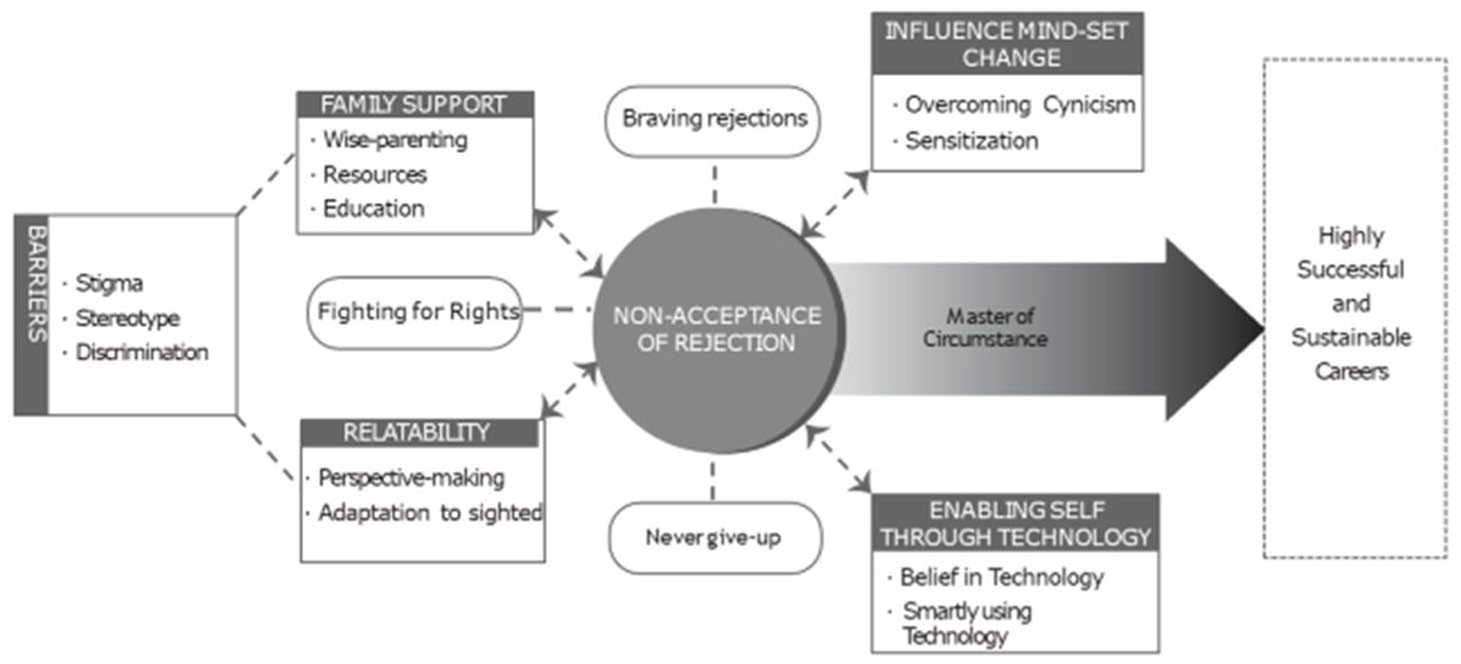
High career attainment category.
Then we present the dimensions that characterize the low career attainment participants: Acceptance of Face, Skepticism, and Obligation to Support Family. Finally, we present a model (Figure 2a and 2b) that synthesizes the dimensions and various attributes that help to contribute to career success and career sustainability for our participants.
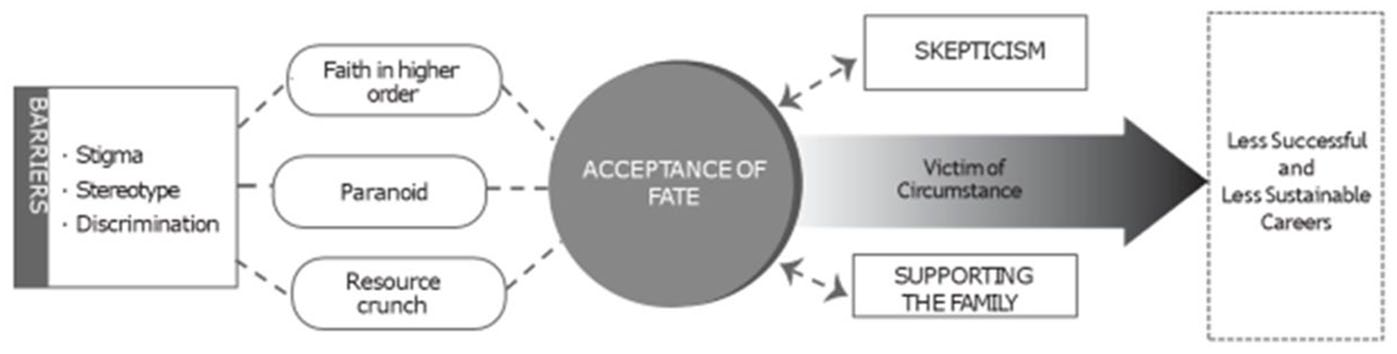
Low career attainment category.
Findings: Low career attainment category
This category of participants hails from poor socio-economic backgrounds and from families lacking awareness of the existing facilities for the VI. Their socio-economic status seems to have a role in their low career attainment. These participants had erratic schooling and the families were over-protective with most of them having an ‘anchor’ in a mother or sister. They also received scathing remarks from relatives. Training received from NGOs, blind relief associations, and national associations for the blind had given them some hope and confidence, even though most earned a paltry income of around US$100 per month that nevertheless did boost their morale a bit. The prevailing family circumstances, social ostracism, and limited education were daunting for these participants. This resulted in feelings of inferiority and most believed that only a government job (such jobs are generally secure in India) could ensure them a reliable income. Hence, financial security was their key consideration.
At times, they felt constrained and limited in their ability. Their voices revealed a sadness from constant rejections and suffering. These participants lacked self-belief, while they harbor suspicion toward the sighted and high career attainment VI individuals. The following three dimensions describe their characteristics and capture their typical employment journey devoid of the prospects of a successful and sustainable career.
Acceptance of fate
These participants reported strong faith in the Divine shaping their destinies. Numerous rejections, seen as inevitable therefore, had made them under-confident with lowered self-esteem. These feelings were exacerbated by a belief that the Divine provides a helping hand to those who succeed and that, in the absence of such help, failure is imminent and destined. They view the ‘luck’ factor as instrumental in their futures: ‘the VIs who have good jobs do not connect with me. They are just lucky’ [LCA 58].
Compared with the high career attainment category, these participants find life tough, have lower resilience, tend to be stressed, accept denial, and are inclined to seek concessions (accommodations). One participant working for a bank confessed:
I get disappointed quickly, that is why I do not want a challenging job. Dealing with everyday life itself is very challenging. I want to spend life comfortably. I have no desire to become a manager and don’t want to deal with too much pressure. [LCA 64]
After a short struggle for jobs, they get tired and accept the situation and settle for whatever opportunity comes their way. They secure poor-quality jobs with very low pay and poor working conditions: ‘With great difficulty I got the job of telephone operator with one-third the pay given to other operators, but I had to take it because of no choice’ [LCA 57]. This group harbored superstitions; they believed that visual impairment is owing to their past sins and they have to suffer the consequences in this life. ‘My relatives tell me that my father and grandfather had committed sins and therefore I am born blind’ [LCA58]. Owing to such beliefs, they have lost the desire to fight back and struggle hard to realize opportunities for employment and build careers.
Skepticism
These participants were skeptical about how the sighted view them, which affected their self-confidence, making them feel vulnerable and paranoid. This in turn impacted their employment prospects. They paint a worst-case scenario for self and feel hopeless with their primary response being ‘I don’t know’ to most questions. Many of them are resigned, reflecting their misgivings about society. They also feel that the sighted routinely make them feel inferior. Most of them need income security but not job security and reported that they would join a private firm only if their income was guaranteed. They sometimes feel that the sighted conspire against them:
I did not study after school because I got a job in candle making. I knew I would not get a job even if I studied further. Those who get good jobs do so because they bribe people in authority. However, I am not like that. At least I am better than someone who is begging. [LCA62]
Or they only select VIs get good jobs who had enough parental support and information about jobs, the rest don’t. It’s a lie that VIs get jobs. [LCA60]
At times, these participants blame the society for not extending a helping hand. ‘Sighted people will not make efforts to help us. Helping attitude is not there in people; it’s become a thing of the past’ [LCA65]; and ‘even the bus driver won’t stop for the VI’ [LCA59]. Another participant said, ‘she used to have a positive opinion about the sighted and narrated a bad experience in a bus while traveling which made her change her opinion of them’ [LCA56]. A doubting and suspicious mind further aggravated the problems for these participants because it has resulted in erosion of their trust in society and the help and support they could potentially receive through relatability, like the high career attainment category experience.
Obligation to support the family
This set of participants’ hail from low-income, typically non-educated parents, mostly from rural backgrounds. The father is the sole breadwinner and the mother sometimes accepted extra chores to support the family. Some had one or two VI siblings, which made the situation worse. Most of these participants (about 70%) had family responsibilities, and in some cases were the sole breadwinners. Lack of proper education and training resulted in poor quality, erratic employment with low salary. These jobs were not steady, and the participants had to suffer brief to long periods of unemployment. Ninety per cent of the participants went to school at the age of 12 (mostly a blind school) and then on to a vocational rehabilitation center to receive some vocational training. These centers facilitated them to get some jobs that became a source of livelihood for them and the families. ‘My trainer at the rehabilitation center referred me for the job and I receive 6000 INR (Indian rupees) through which I support myself and the family’ [LCA52]. Some of them have a spouse who is also a VI (dependent on the spouse who is the husband in most cases): ‘My relatives arranged my marriage with a blind girl and who never went to school and somehow learned to do home chores’ [LCA45]. In the case of the high career attainment category, the parents and/or the spouse are a major source of guidance and support but, with this category of participants, the participant is the chief of the family and everyone else is dependent on him/her. The earnings are insufficient and sometimes they have to borrow money on credit from a relative to attend to family needs. For them, income security was more important than job quality or career prospects. Therefore, they did not have much hope or aspiration to build successful careers.
Career model for the visually impaired
Figure 1 shows the data structure for the key themes, while Figure 2a presents the effectual connections among the key themes that contribute to career success and sustainability of VIs (HCA category). Figure 2a also posits the central role of NAR and relatability in shaping the careers of VIs.
The concept of acceptance is pivotal to VIs trying to overcome barriers in order to succeed in their career goals. The HCA category has demonstrated a highly spirited response in the form of NAR to fight rejections and adopt relatability as key strategies. Relatability enabled the VIs to develop adaptability skills – in both work and non-work situations – and sociability skills toward the sighted community, which further eased the process of their acceptance. Therefore, our model (Figure 2a) suggests that NAR and relatability are fundamental psycho-social processes that offer VIs the requisite mental resources to withstand rejection, interact meaningfully, and forge acceptance in the pursuit of career goals. In contrast, the LCA category (Figure 2b) succumbed to rejections and accepted it as ‘fait accompli.’ Rather than trying to build relational skills and adaptability to the sighted community, this category was extremely skeptical and harbored negative beliefs about the sighted, which led to difficulty in securing employment and developing a career.
Wise parenting and family support were key differentiators that contributed to the success of the high career attainment group along with socio-economic status. Overprotective parenting proved to be counter-productive, sapping confidence and ultimately leading to life-long dependence (LCA category). Because they undertook their education in regular schools rather than in special schools, quality education and skills acquisition resulted in secure employment for the HCA participants. Parents and family members, or sometimes a sighted sibling or spouse, had a prominent role in proactively shaping the personality of the HCA participants.
Enabling self through technology and influencing mindset change both act as enablers for the HCA category to become more productive. NAR and relatability help the participants adopt technology and overcome mindset barriers; in turn adopting technology and demolishing mindset barriers enable NAR and relatability. The cyclical nature is presented in Figure 2a for the HCA category. Adoption of technology is central to education, skills acquisition, and performance at work, particularly for VIs. Overcoming resistance to technology adoption and mobilizing resources to buy digital technology is key; the HCA participants were very adept at deploying technology to accomplish tasks otherwise thought impossible for VIs. Some of these participants have used technology platforms to raise awareness among the sighted on where and how VIs can be productively employed, thereby helping demolish the mindset barriers that the sighted hold about VIs as less competent or productive individuals. It is imperative that the assumptions and prejudices of the sighted toward VIs are nullified, to allow for opportunities for employment that may further their path in achieving sustainable and successful careers. The LCA category on the other hand lacked financial resources to purchase technology given the socio-economic status of the family. They also took family responsibilities upon themselves that further compounded their plight, resulting in poor employment and low career attainment.
Discussion
We have explored the factors that make VI’s careers successful and sustainable despite their disability. These are internally driven individuals who, since childhood, have managed to bounce back from feelings of ‘being berated.’ We contribute to the study of careers by positioning the careers of VIs within the frameworks of the career ecosystem and career sustainability theories. Our findings suggest that NAR and relatability displayed by the HCA participants are the primary drivers of their success. Thus, our main contribution is the identification of these two concepts. McLaughlin et al. (2004) posit that, in the PWD context, acceptance is important but that, to date, scholars and practitioners have not studied it as a crucial factor in the context of VI’s career success. Integration of PWDs cannot take place without acceptance, which influences their self-perception, job satisfaction, and commitment to work (Jackson et al., 1993; Vornholt et al., 2013; Wanous, 1992). Our study evinces how the ‘personal agency’ characteristic of the VI serves as the key contributor to success in the career. The study also found the primacy of technology in the career success and sustainability of VIs, thus responding to calls to explore the effect of technology on the treatment of PWDs in organizations (Baldridge and Kulkarni, 2017; Stone and Colella, 1996).
PWDs find it more difficult to cope with societal attitudes toward disability than with the actual physical or biological disability itself (Task Force on Psychology and the Handicapped, 1984). Our findings reinforce the message that social interaction between the VI and the sighted is often awkward, which might lead to isolation (Emerson et al., 2021). Adapting to the sighted world appears to be a critical factor in their career success and sustainability.
Theoretical contributions
Our study makes the following theoretical contributions. The overarching contribution to theory is positioning together and conceptually linking the concepts of career success, sustainable careers, and career eco-systems. Earlier reviews (Spurk et al., 2019; Sullivan and Baruch, 2009) did not integrate these, and we offer a meaningful way to indicate how sustainability of careers is an essential part of career success in the long term. Further, we identify how the labor market can benefit from inclusivity where different actors become aware of specific type of actors to participate and develop successful and fulfilling careers for the individuals, and enabling organizations open to diversity to benefit from the underutilized human capital.
More specifically, we list these contributions. First, it lends support to the career ecosystem theory (Baruch, 2015; Baruch and Rousseau, 2019) by demonstrating that the nature and quality of interactions and transactions among the different actors determines the viability and strength of an ecosystem as demonstrated by the HCA participants. For ecosystems to be sustainable, organizations and society utilize VI talent and develop it further without discrimination. We manifest the interrelatedness of individual agency and their interaction with other constituencies of their careers, in particular the employers, their families, and other institutions in the society (Baruch, 2022). The specific context of India may be contrasted with contemporary career literature that tend to overly focus on individualized careers in the western context (Tu et al., 2006). Stereotypes and false beliefs lead to exclusion even if VIs possess requisite competence and willingness to contribute to organizational and societal goals. Our study also reveals how VIs engage in the learning processes inherent in continual adjustment, fight against barriers, and adapt to new challenges by acquiring social and career-related skills to overcome rejections. The entry of VIs into educational institutions and organizations influences fellow students’ and co-workers’ perceptions, attitudes and acceptance, respectively, which in turn benefits the VIs, the employing organization, and the wider social systems (by striking an ecological career balance where VIs thrive alongside the sighted). We also emphasize the relevance of multiple constituencies besides the primary role of the self – the family, educational/training institutes, the employer, judiciary, and NGOs – in developing and maintaining sustainable careers within the career ecosystem. Notably, we also found that institutions were generally considered barriers rather than enablers until the VIs fought for their right to equality of opportunity to bring a balance in the career ecosystem. For example, when schools or colleges denied admissions, the judiciary intervened and directed them to admit VIs; when employers denied employment, the government enacted a law for reservation of jobs for PWDs in public institutions. The various actors played their part in ensuring an ecological balance in the career ecosystem.
Second, by answering our research question, ‘How do VIs overcome and manage barriers to achieve career success and career sustainability,’ we contribute to the contemporary career literature, in particular career sustainability (De Vos and Van der Heijden, 2015; De Vos et al., 2020; Guan et al., 2019). We do so by identifying the psycho-social processes that VIs adopt to transcend structural and psychological barriers to make careers sustainable. Further, by revealing distinctions between VIs who attained high levels of career attainment vis-a-vis those with low career attainment, pointing out what it takes to achieve sustainable career success, and thus answering calls to enable understanding of how careers of VIs (PWDs) can be sustainable (Baldridge and Kulkarni, 2017). The former category takes charge and becomes the ‘master of circumstance’ but the latter category gives up and becomes the ‘victim of circumstance.’ Many of the high career attainment participants won recognition awards for their performance (productivity) on the job and their community service for the VIs (PWDs) leaving them healthy and happy, which is an indication of their careers being sustainable (De Vos et al., 2020). Our findings indicate that, for careers to be sustainable, VIs and PWDs need to be highly resilient alongside strong performance that may not be the case for ableist individuals thereby extending sustainable careers theory. The psycho-social processes of non-acceptance of rejection, relatability, and readiness to use technology helped in making VI’s careers sustainable.
Third, this study acknowledges the critical role of acceptance orchestrated by the VIs (personal agency) in achieving their career goals (DeWall and Bushman, 2011; Kirton and Greene, 2019; McLaughlin et al., 2004; Vornholt et al., 2013) extending the literature on acceptance of PWDs by the co-workers in the workplace. The high career attainment participants through high performance at work refute stereotypes of low competence and low performance leading to their positive evaluations by their co-workers (Bengisu and Balta, 2011). Denial of accommodation was responded to by working longer and harder than people without disabilities (Harlan and Robert, 1998) and they held the personal resources to influence others highlighting their agency characteristics in social situations (Beatty et al., 2019). The successful participants protected their self-image through high self-esteem and high cognition (Stone and Colella, 1996). Acceptance of PWDs facilitates inclusion at the workplace and a culture of inclusion promotes a harmonious and healthy workplace where diverse populations (VIs included) are accepted and integrated, leading to career inclusion (Olkin and Howson, 1994; Yuker, 1988). This has to be built on solid individual and societal values (Mor-Barak, 2000; Pless and Maak, 2004). VIs overcome commonly encountered rejections through non-acceptance of rejection and relatability, which helps them gain acceptance, a critical factor for maintaining sustainable careers. VIs try to convert rejection (negative) into acceptance (positive) by overcoming apprehensions and cynicism through sensitization and communication with the sighted, thereby influencing mindset change to adopt a positive attitude (Jammers et al., 2016) toward VIs by virtue of their job performance. Although the literature on disability is replete with findings on the barriers the VIs face, the concepts of non-acceptance of rejection and relatability bring into focus the role of the VI as ‘change influencers’ in overcoming barriers and gaining acceptance to build career inclusivity in the career ecosystem.
Fourth, our study reinforces the role of the family in building resilience and shaping career aspirations through constant mentoring, particularly during the formative years (Wolfe and Hall, 2011) and its subsequent impact on work life (Ten Brummelhuis et al., 2014). VIs brought up alongside sighted siblings generally held a more professional approach to careers and were also able to handle discrimination pragmatically. We identified the family’s role in developing career aspirations from the formative years among VIs who need special guidance to shape their career goals. We extend earlier research where spousal support was found to be a moderator between perceived organizational support and career success in mid-life (Ocampo et al., 2018). In line with previous research (Tomlinson et al., 2018), and, as evinced from the backgrounds of the HCA participants, the family’s socio-economic status played a role in shaping career aspirations of VIs, which ultimately impacted career success and sustainability.
Fifth, we expand career theory by revealing that high career attainment participants held individualistic career attitudes, although their careers are not necessarily boundaryless (Arthur, 2014; Guan et al., 2019; Hart and Baruch, 2022). Traditional career paths were preferable and easier to sustain for certain VIs, given the stability they offer. In terms of institutional-focused versus individual-focused career management, having an individualist career orientation, self-propelled, in line with the protean career theory (Hall and Yip, 2014; Hart and Baruch, 2022) is a critical factor that enables VIs to overcome barriers and thereby prove their self-worth. Managing barriers within an organization is less difficult than managing them between and across organizations. This contributes to the debate on the bounded nature of careers, particularly for disadvantaged populations like VIs and PWDs (see Baldridge and Kulkarni, 2017).
Finally, we expand the general PWD careers literature by exclusively covering VIs, an important segment of the disabled population, which has not been adequately covered by most studies (for an exception, see Srijuntrapun, 2018), answering recent calls to explore the subject more expansively (Magrin et al., 2019).
Implications
For organizations
Adopting diversity policies and practices improves profitability and the financial success of firms (Cox and Blake, 1991). Providing a fair opportunity to VIs goes a long way in contributing to the diversity agenda of organizations. Fairness to all while developing specifically tailored ‘idiosyncratic deals’ with certain employees may be a challenge for organizations (Marescaux et al., 2021; Rousseau, 2015), as, for the new career era, psychological contracts are specifically tailored to individuals (Rofcanin et al., 2018). Our study expands the general people management approach and practices applied to support VIs in the workplace (Hoque et al., 2018). To gain competitive advantage, organizations need to optimally use human resources. Applying talent management to benefit from un-utilized or under-utilized resources can optimize overall performance (Collings et al., 2019). Organizations should develop a strong inclusive culture and a conducive environment where (sighted) employees both accommodate and maintain positive attitudes toward the VIs. Leaders should champion and sponsor the hiring and development agendas of the VIs. This also promotes camaraderie and positive behavioral change (Kirton and Greene, 2019). Organizations should invest in supportive technologies to enhance the productivity of VIs. A buddy system for VIs can also help their inductions, orientation, and assimilation.
Besides the above, organizations should emphasize the right to work with dignity. This study manifests the process of dignification of work for populations that may otherwise might be excluded from the labor market or from roles of importance. This would lead to tangible outcomes because cognitive diversity can have a positive impact on team and organizational performance (Choi and Rainey, 2010; Hambrick et al., 1996), as well as on organizational brands and reputation, which is critical for competitiveness (Chen et al., 2017).
For visually impaired individuals and People with Disabilities
VIs aiming to achieve career goals should acquire education and training by seeking information through disability networks like the National Association for the Blind and the Blind Relief Association. Maintaining a positive mindset and not having a sense of entitlement would help in achieving their career objectives. Networking with high achievers in their community adds to their chances of success, and they should actively seek mentoring from successful VIs. Showing resilience would prompt high achievers from the VI community to support them, which would go a long way to progressing in their career goals of success and sustainability.
For hiring managers
Recruiters need to make concerted efforts to assist VI candidates in accessing job postings on companies’ and directories’ websites and enable them to fill out job applications easily. To fulfil this, organizations may usefully connect with NGOs to identify suitable VI candidates. One of the major issues in hiring VIs is their lesser skillsets and training histories through lack of opportunity. To address this, organizations can form partnerships with NGOs and support or sponsor skill-building programs for VIs, before then hiring them. When employed, VIs show unmatched commitment and a sense of gratitude and achievement, without any sense of entitlement. Better acceptance of VIs would certainly be an effective talent management practice in the global labor market (Kulkarni and Scullion, 2015).
Limitations and future research agenda
While we did have a strong sample size for a qualitative study (Saunders and Townsend, 2016), all our participants were from the same country. As context is important for understanding phenomena, future studies may explore different context where PWD, in particular VIs, can develop and sustain successful careers. Future studies could benefit from expanding the sample internationally. Future researchers could also perhaps develop a quantitative measure for acceptance because this has emerged from our study as a core construct in the success of VIs. The importance of the input of parents and siblings on careers could also be studied as well as family finances because these factors appear to play a larger role in shaping the careers of PWDs particularly and non-disabled in general than previously supposed.
Conclusions
Recent research interest has moved beyond discrimination and the barriers faced by PWDs toward contributions made by PWDs in the workplace, and not just as passive recipients of concessions. We set out to explore what makes the VI successful and obtained deep insights into exactly why and how they extricate themselves from disability stigma to compete effectively with the sighted. Our findings suggest that certain attributes, that we identified, enable VIs to achieve career success in the workplace. The five dimensions in our model are also career-enablers for VIs, and possibly for other PWDs. Developing these attributes can empower VIs and plant in them a desire to succeed. Finally, we draw from our findings to contend that with the right family support and access to resources, along with NAR, relatability, and the due support of organizations, VIs can indeed sustain careers and achieve success.
Footnotes
Acknowledgements
The authors thank Professors Sherry E Sullivan and Beatrice, BIJM van der Heijden, the three anonymous reviewers and the Associate Editor, Professor Yasin Rofcanin, for their insights and helpful comments that considerably contributed to improving the quality of the paper.
Funding
The author(s) received no financial support for the research, authorship, and/or publication of this article.
