




Abstract
This article explores the role of cities’ institutional capital in the context of massive waves of migration from rural regions to cities in China. We examine reasons for and consequences of the accelerated urbanization process from both social and individual points of view. Based on surveys using a database of 8113 Chinese people, we identify and analyse factors that influence career success according to their migration status, comparing those who have migrated from rural to urban areas with those who have not moved. We also identify the role of an individual’s migration status and the role of a city’s institutional capital as moderators of the relationships between human, social capital and career success. We find that human, social and institutional capital, both individually and interactively play important roles in career success. The article offers an original contribution to career theory, in particular by incorporating migration status as a novel factor, and by determining the role of a city’s institutional capital in the process. With these overwhelming structural changes in populations, it may also inform internal migration policy and its implementation.
Introduction
Career theories and concepts have been mostly developed around urban occupations, as the majority of populations are concentrated in cities. The field of career studies has a long tradition in understanding both past careers and new career systems (Akkermans and Kubasch, 2017), though research into careers tends to overlook the role of cities in the process of career progress. This is a challenge because, beyond that of central governments, cities have considerable influence on their regions. They also have different levels of institutionalized capital investment, such as that which influences entrepreneurship activities at the city level (Ahlstrom et al., 2007; Wank, 1996).
Study into careers in China is a limited area but fast developing, with emerging studies on career choice (Zhao, 2012), health (Russo et al., 2014) and generational differences (Yi et al., 2010). A recent review examines the role the concepts of time and space play in Chinese careers, suggesting the relevance of within-country migration and calling for empirical research (Yao et al., 2019). This complements earlier calls for career studies to span geographical locations and cultures (Tams and Arthur, 2007). Within the specific context of significant rural–urban restructuring in a population, it is important to explore the potential role cities themselves may play in their inhabitants’ careers.
To the best of our knowledge, no academic study to date has focused on understanding the factors surrounding Chinese urbanization processes that may influence individuals’ careers, nor the implications of this internal migration for either individuals or the nation. Our article builds on current knowledge by exploring the process of pre-designed accelerated rural-to-urban migration at the national level and its impact on individuals and families. Mass migrations in the past were different in pace and context; in the case of China, it is important to understand why and how today’s mass migration is impacting careers across the country.
The article aims to shed light on the processes, causes and outcomes at the individual, city and national level. In particular, we focus on how an individual’s career success can be explained by his or her migration status, human capital, social capital and the city’s institutional capital. The latter has had scant scholarly attention, despite playing an important role in achieving sustainability (Platje, 2008). We examine whether the well-documented impacts of human capital and social capital on career success will be moderated by an individual’s migration status or a city’s institutional capital.
To the best of our knowledge, this is the first study in the career literature to address the intrinsic links among human, social and institutional capital in the context of career success. Distinct from most career scholarship that tends to concentrate on individual-level analysis, the strength of this study lies in the inclusion of micro-, meso- and macro-level variables as well as the effects of complementarity and interactions. Drawing from a large database covering a representative sample of 8113 Chinese individuals, we offer important contributions to research into careers and structural changes in China, by applying career theory to contemporary China. Our analysis compares the characteristics of those who have migrated from rural areas to cities against those who have not migrated. We also examine the moderating impact of city-level institutional capital on the relations between human and social capital, and extrinsic and intrinsic career success. We present findings that are important to cities looking to attract human talent, and to national policies and practices in the management of sweeping migration that brings about population restructure.
The potential impact of human and social capital on careers has attracted a healthy degree of academic attention. Yet, the role of institutional capital has not yet been recognized in the field (Inkson and Thorn, 2010). Indeed, the intrinsic links among these types of capital in today’s knowledge economy rest on three facts: first, human capital facilitates the empowerment of people to achieve career success. Second, social capital awards people the necessary soft skills to interact, coordinate and collaborate with, and engage in, larger society, which promotes their acquisition and use of knowledge (Landry et al., 2002; Maskell, 2001). Third, a city’s institutions and legacies help in constructing individuals’ preferences, interests and social norms. They are responsible for the distribution of resources, shape individuals’ incentives to develop, and give rise to human and social capital (Som, 2015).
The context
It is important to comprehend how China – a centralized economy noted for long-range planning – is able to sustain such tremendous economic growth (Ansar et al., 2016; Chen and Feng, 2000) by means of systemic national processes in which mass rural-to-urban migration is a core component. Technology, labour, entrepreneurship and infrastructure are major drivers of Chinese economic growth (Mathis, 2013) and all are related to the notion of cities and urbanization in some way. Unlike the equivalent processes that took centuries to unfold in the West (De Vries, 1994; Hobsbawm and Wrigley, 1999), urbanization in China has seen unparalleled acceleration over the last three decades (Ansar et al., 2016; Song et al., 2018), mostly promoted by the Chinese leadership (Ansar et al., 2016) and by the demand for skills (Fu and Gabriel, 2012).
This mass rural–urban transition of labour forces has far-reaching individual, regional and national implications (Qin and Liao, 2016). Life in rural China is characterized by daily challenge, poverty and resistance in managing change (Unger, 2016). Personal and economic pressures – for example, the insecurity of land ownership – drive many to relocate to cities (Giles and Mu, 2017). The government has significant impact through its policies and practices guiding labour transition, at both local and centralized levels (Zhong, 2015). Regions are influenced by cities, quite apart from that of central government. Indeed, cities have differing degrees of institutionalized capital investment, such as providing stimulus for city-level entrepreneurship (Ahlstrom et al., 2007; Wank, 1996).
The mass rural-to-urban migration process is controlled by Chinese residence registration (hukou), which was established in 1949 to restrict free movement (Xiao and Bian, 2018). It is centrally planned rather than individually planned or economically driven (Ma and Xiang, 1998). Clearly, individuals also need to cross considerable boundaries – physical, psychological and cultural – when moving to cities. The dynamic is characterized by the influence of individual motivators and structural constraints, at various levels. Over time, therefore, the hukou system has responded by evolving, for example in relaxing the residence registration conditions (Zhang and Xie, 2013).
Review and hypotheses development
Career ecosystem
Our presentation above reflects a complex ecosystem, where myriad forces cause the players within it – both local city and national authorities as well as individuals – to respond to economic and social constraints. As a result, individuals make personal decisions in forging their careers, such as life-changing resolutions to relocate from rural to urban settings. To better understand the process, we posit that such changes can be elucidated by the theory of ecosystems – (1) the general management ecosystem (Jacobides et al., 2018) and (2) the specific career ecosystem (Baruch and Rousseau, 2019). A recent definition considers an ecosystem as ‘a set of actors with varying degrees of multi-lateral, non-generic complementarities that are not fully hierarchically controlled’ (Jacobides et al., 2018: 2264). There is an increased interest in applying the ecosystem perspective to the study of people management (Garavan et al., 2019), though this approach may be more of a conceptual umbrella term than a specific coherent theory (Spigel, 2017). Specifically, career ecosystem theory was introduced to capture how careers can be analysed from multiple perspectives (Baruch, 2015; Baruch and Rousseau, 2019) in dynamic labour markets. In such an environment, people can move across institutions and geographies, being pushed and pulled by external forces of employment and opportunities (Arthur, 2014; Baruch et al., 2016). Together with the relative ease and low cost of travel, such forces can shape the movement patterns of populations (Amior and Manning, 2018). The implications of this for individuals and their decision making have begun to gain attention, including in China (Weng et al., 2010). Yet, there is scant research into equivalent forces in the greater system, despite the involvement of multiple actors at this level (Baruch, 2015; Tomlinson et al., 2018).
Urbanization at such pace requires significant investment in both infrastructure and people. The considerable size of the required workforces to achieve ambitious national and regional economic growth targets in China necessitated top–down strategic focus in human resource development, ultimately building human capital. The sheer magnitude of the outcomes spans earnings (Akay et al., 2012), family well-being (Xu and Xie, 2015), and general perceptions of quality of life (Treiman, 2012), among other factors. It also presents various governance challenges associated with development, like attention to sustainability and the environment (Chen and Lees, 2018; Qin and Zhu, 2018).
Human, social and institutional capital, and career success
Human capital is a critical factor for economies at the individual, organizational and national level (Becker, 1964). At the individual level, it is associated with career success (Donald et al., 2019; Ramaswami et al., 2016), measured both objectively (Aryee et al., 1994) and subjectively, as in earnings (Kitson et al., 2000). Individuals construct careers based on their career orientation (Wolf, 2018), which can be understood according to their proactivity in pursuing their aims (Seibert et al., 1999).
Organizations acquire and maintain human capital (Becker and Huselid, 1998) because of its critical role both practically and strategically (Boon et al., 2018). At the aggregate firm level, human capital is associated with firm performance (Crook et al., 2011; Pennings et al., 1998). When human capital at the individual and organizational levels are seen in aggregate, it is clearly a major factor in a country’s wealth (Lutz et al., 2017) and economic growth (Barro, 2001).
Early studies tended to undertake individual-level analysis in identifying the critical role of human capital (Smith, 2010) and social capital (Seibert et al., 2001) for career success. National-level analysis provides less conclusive results (Westlund and Adam, 2010). Moreover, rural-to-urban migration is not covered in contemporary career literature, probably due to large-scale global migration to cities in Organization for Economic Co-operation and Development (OECD) countries having occurred before career studies were established (Greenhaus et al., 2010). Such early works that did have a focus on China tended to examine general human or social capital, rather than the role of migration (Zhang and Fung, 2006). Our aforementioned observations on the accelerated pace of internal Chinese migration thus deem the phenomenon worthy of closer scholarly attention.
Urbanization, education and the state of the national economy are all positively related (Kumar and Kober, 2012), although decentralization policy that invests in human capital in rural regions has also proven beneficial (Andersson et al., 2009). The mass migration we examine has been fuelled by many factors, including human capital and skills deficits. While for the individual, the fit between the environment and their personality and needs is critical (Ballout, 2007), from the wider national perspective, the demand for skills is a dominant factor in this trend (Fu and Gabriel, 2012). Clearly, there is a need to understand the process of migration and its distinct outcomes for individuals, regions and the country as a whole.
In addition to human capital, social capital is an important complementary element related to career success and can be instrumental in achieving it (Ng and Feldman, 2010). There is a lack of clarity over the role of social capital in the process. In particular, networking is strongly embedded in Chinese culture, and difficult for outsiders to fully comprehend even if they share the cultural background (Uy et al., 2015). Yet, the common view sees social capital as a critical antecedent of career success (Seibert et al., 2001).
Finally, North (1990: 3) stated that ‘institutions are the rules of the game in a society or, more formally, are the humanly devised constraints that shape human interaction’. A voluminous body of literature documents how the main determinant of differences in prosperity and development is differences in economic institutions (Rodrik, 2008). The conditions of city-level institutions, such as government transparency, property rights enforcement, market entry barriers and social services, can be influential in supporting local business to flourish and enabling individuals to develop (Wank, 2001). Institutions can be regarded as a city’s capital, as they are reasonably permanent or at least durable, having gradually accumulated from legacies over the course of history (Som, 2015).
Hypotheses development
Antecedents of career success
Both human capital theory (Becker, 1964) and career theory (Arthur et al., 1989; Gunz and Peiperl, 2007) suggest that certain individual characteristics and qualities are associated with career success. Both implicit and explicit assumptions on this suggest causal relationships, namely that human capital and social capital are antecedents for career success (Ng et al., 2005). This has been shown to be valid for both intrinsic (subjective) and extrinsic (objective) career success (Heslin, 2005; Ng et al., 2005), particularly the former (Ng and Feldman, 2014). Education, and human and social capital were found to have positive relationships with career success (Judge et al., 2010; Ng et al., 2005), whereas poor mental health has been shown to be negatively associated with career success (Judge et al., 2010; Tang et al., 2001). Both physical and mental health can therefore lead to positive career success, with findings supporting this for both western societies (Judge et al., 2010) and China (Russo et al., 2014).
Social capital – in particular its networking component – is a strong antecedent of career success in various contexts (Seibert et al., 2001; Wolff and Moser, 2009). Networking helps to improve earnings and its effects are stronger in sectors with less institutionalization and for jobs of lower skill specificity in Chinese cities (Bian and Huang, 2015). This aspect of social capital is influential and achieved via guanxi, or interpersonal connections. Guanxi facilitates favour exchanges that are enhanced during social events like eating together (Bian, 2001). These illustrations imply that individuals who are more resourced in human and social capital are more likely to achieve career success (Ballout, 2007; Bozionelos and Wang, 2006; Seibert et al., 2001).
We thus offer the following hypotheses:
Hypothesis 1a: Human capital is positively associated with career success.
Hypothesis 1b: Social capital is positively associated with career success.
Hypothesis 1c: Human capital and social capital are interactively positively associated with career success.
Differences across populations according to migration status
The next hypothesis anticipates possible differences and variations in research variables and their relationships with the migration status of an individual. We regard migrants as individuals who were born in rural areas but relocated to cities.
Comparing cities to the countryside, current knowledge suggests that human capital in cities – particularly due to the education system – tends to be of higher quality than that in rural areas (Monk, 2007). In China, efforts led by ideology were made to improve education in rural areas, although inequalities persisted nevertheless (Hannum, 1999). The returns to human capital are higher in urban than rural areas (Corcoran et al., 2010). Even within the former, immense education inequality can be observed among the large cities – such as those municipalities, provincial capitals and cities in the eastern coastal areas – and small ones (Qian and Smyth, 2008). Thus, people who migrate from rural to urban areas and across or among urban areas will usually possess higher human capital than those who live in rural areas. Career ecosystem theory (Baruch, 2015; Baruch and Rousseau, 2019) suggests push and pull factors at the environment level can influence individual decisions. Cities may offer various incentives and attractions that address the needs of individuals looking to move.
Education can be regarded as a resilient and transferable form of networking, because it facilitates interpersonal interaction and exchange (Coleman, 1988). People with better educations are reported to be usually more willing to engage with others in a constructive and trustworthy manner in order to develop collaboration, overcome certain constraints and co-achieve objectives (Huang et al., 2009). People who have migrated from rural to urban locations or across or between urban areas tend to have or develop a higher capability to build social capital than those remaining in the countryside. Therefore, moving to urban areas is expected to augment both human and social capital, and as a result, career outcomes like earning capacity.
However, the benchmark for self-definition of career success may be subjective (Heslin, 2003; Spurk et al., 2019) as it is essentially a perception. Those who have moved from rural areas to cities may compare themselves to those who are urban rather than to their regional counterparts they left behind. Having less immediate social support and fewer connections in cities, migrants from rural areas or across or between urban areas are usually less confident and might suffer from anxiety or depression (Qiu et al., 2011). Hence, they might feel less successful in comparison, perceiving a lower level of career success. This is subjective. In contrast, people living in their native settings (either rural or urban) may have less desire or less pressure and may be more easily satisfied by enhancements in life quality. Therefore, migrants may have relatively lower intrinsic career success than those remaining in their native settings.
Finally, it is well documented that migrants usually work harder than local people (Gregson et al., 2016). This is because they tend to perceive themselves perpetually in survival mode without the back-up they are accustomed to. When people depart from their native settings, they are often separated from their families, social networks and circles of influence. The sense of insecurity may enable them to operate with fewer resources and develop a heightened sense of alertness and awareness. Given that human beings more proactively aim to optimize conditions and circumstances when in survival mode, it is reasonable to assume that migrants achieve better careers than local people. We thus hypothesize:
Hypothesis 2a: Migrants will have higher extrinsic career success than non-migrants.
Hypothesis 2b: Migrants will have lower intrinsic career success than non-migrants.
Role of institutional capital at the city level
The impact of human capital and career orientation on career outcomes is well established, but other exogenous, institutional factors may influence the level of this impact. Earlier work has identified the role of organizational agency in perceived career success (Guan et al., 2015). We add the notion of city as an overarching institution.
A useful indicator of how ‘good’ or ‘bad’ a city’s intuitions are is the level of freedom. The keystone of a modern economy is the ‘sphere of spontaneous action it secures’ for the individual (Von Mises, 1957: 374). Indeed, freedom is the fundamental right of every human to control his or her own labour and property, which serves as an essential condition for a market economy to function properly (Gwartney et al., 2004). The influence of a city’s institutional culture of freedom on its citizens’ career success is evident. Aligned with classical, liberal and libertarian views, a ‘free’ city provides the liberty to its citizens and businesses to produce, trade and consume any goods and services acquired without the use of force, fraud or theft (Yang and Tang, 2010). This freedom is embodied in the rule of law, protection of property rights, freedom of contract and most characterized by good governance, namely that governments conduct public affairs and manage public resources in a fair, open and transparent way, meeting the needs of the mainstream rather than select groups in society (Miller et al., 2015). Obviously, a ‘free’ city can attract the best companies, top talent, brightest entrepreneurs and most productive investments, and therein foster new business and innovation clusters that help organizations and people to thrive (Arthur and Rousseau, 2001; Kuckertz et al., 2016).
However, as the benchmarks for intrinsic career success are highly personal and subjective (Heslin, 2003), it is possible that job market competition is so severe in a dynamic ‘free’ city that its citizens may have relatively lower subjective evaluations in their perceptions of career success. We thus hypothesize:
Hypothesis 3a: A city’s institutional capital is positively associated with extrinsic career success.
Hypothesis 3b: A city’s institutional capital is negatively associated with intrinsic career success.
Anticipated moderation effects of migration status and a city’s institutional capital
Investment in human and social capital is important for local and national competitiveness (Porter, 1989). This clearly derives from the aggregate impact of human capital at the individual level (Becker, 1964). Knowledge transfer is faster in cities, facilitated by greater social capital, which is another critical factor (Van Wijk et al., 2008). At the regional and city levels, decision makers can provide impetus for investment in human capital, as a vehicle for economic development (Mathur, 1999), thereby rendering it more directly relevant for individuals and employers.
Thus, both migrant status and cities’ institutional capital should have a moderation effect on the relationships hypothesized earlier. The role of social and human capital is of great importance in contexts where movement across boundaries is more attainable (Arthur and Rousseau, 2001; Baruch and Rousseau, 2019) and where individual agency dominates (Gunz and Peiperl, 2007; Hall, 2002).
Migrants (both rural-to-urban and inter-urban) with higher human and social capital tend be more flexible, collaborative and resourceful, based on their courage, skills and risk-taking that have driven their life experiences, than those they leave behind in their native settings. The former should be able to operate more quickly, effectively and efficiently. Therefore:
Hypothesis 4a: Migration status moderates the relations between human capital and both extrinsic and intrinsic career success. For migrants, human capital will have a stronger impact on career success than for non-migrants.
Hypothesis 4b: Migration status moderates the relations between social capital and both extrinsic and intrinsic career success. For migrants, social capital will have a stronger impact on career success than for non-migrants.
Furthermore, a ‘free’ city with high institutional capital will facilitate a culture of creativity and discovery, enabling citizen and business innovation, and supporting them to bring inventions and initiatives to the market place. It provides the necessary support and distributes the associated risks in ways that make entrepreneurship possible (Kuckertz et al., 2016). Thus, its individuals with high human capital should have greater chances to challenge traditional thinking and approaches because such a city tends to allow discretion through, for example, guaranteeing freedom from needing to apply and await for orders or permissions from authorities. Hence, individuals can enrich their enterprises and fellows through creative disruption within the existing system; they can enjoy room for manoeuvre and thus self-development. Well-educated individuals thus should be more likely to achieve perceived career success, in a ‘free’ city.
Hypothesis 4c: A city’s institutional capital moderates the relations between human capital and extrinsic and intrinsic career success. In a city with higher institutional freedom, human capital tends to have a stronger impact on career success.
A city’s institutions may moderate the impact of social capital on career success. The reasons are that in a city with low levels of the abovementioned freedoms, people will usually rely on social connections, or guanxi, to achieve positive outcomes (Banerjee, 2016). Given that social capital fuels a city’s social infrastructure, which to some degree facilitates the exchange of information and the coordination of public goods provision, social capital may inadvertently promote criminal activity by those entrusted with authority, including to acquire illicit career benefit. However, in such a setting, it is less compelling for businesses and citizens to generate relational capital with administrators and politicians in order to gain access to resources (Du and Mickiewicz, 2016). Therefore:
Hypothesis 4d: A city’s institutional capital moderates the relations between social capital and extrinsic and intrinsic career success. In a city with higher institutional freedom, social capital tends to have a weaker impact on career success.
Finally, in a city with a low level of ‘freedom’, people will usually instead need social connections, or guanxi, to achieve positive outcomes. For migrants with fewer connections and resources, a city with a high level of institutional freedom would enhance their ability to gain greater perceived career success. Individuals seeking new careers or niches, such as entrepreneurs, can benefit from multiple types of network, including those involving relationships with authorities (Chen et al., 2015).
We refer to perceived success because studies of economic freedoms (Shen and Williamson, 2005) and of city competitiveness (The Economist, 2013) rely heavily on subjective, qualitative evaluation; accordingly, the notion of success is subjective. Thus:
Hypothesis 4e: A city’s institutional capital moderates the relations between migration status and extrinsic and intrinsic career success. In a city with higher institutional freedom, migrants tend to have greater career success than non-migrants.
Our combined model, as illustrated in Figure 1, consists of direct relationships between two antecedent variables, and two variables that are both antecedents and moderators and two outcomes (intrinsic and extrinsic career success).
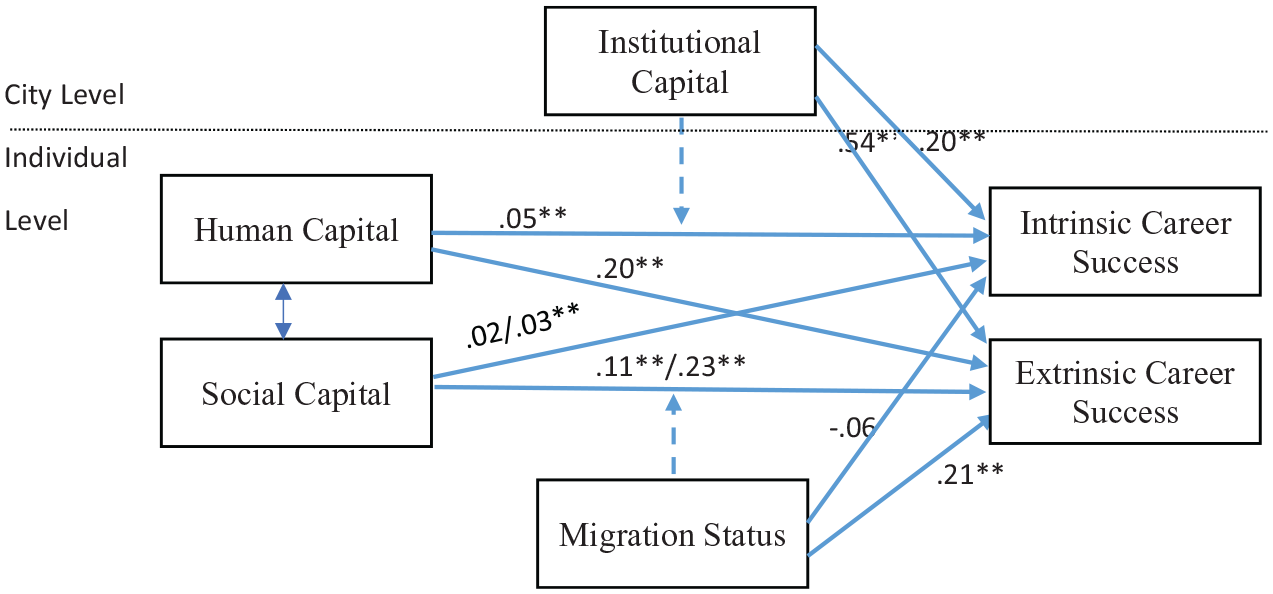
The research model.
Method
Sample
We employed a quantitative research paradigm, using big data to ensure rigour and achieve significant findings (Kitchin, 2014). We used the 2015 social survey dataset provided by China’s National Survey Research Centre (NSRC, 2018). Based on the sixth census data, the survey was conducted using a stratified clustered sampling design and was representative for the non-institutionalized adult (i.e. 18 and above) population in China.
The cluster sampling mechanism is composed of three levels of units. The primary survey unit (PSU) is at the county level or district level, the second smallest administrative unit. The secondary survey unit (SSU) is at the community level, namely villages, or cun, and neighbourhood committees, or ju wei hui, the smallest administrative unit. The third survey unit (TSU) is at the household level. There are 2762 PSUs in China. NSRC randomly selected 67 PSUs from the four largest metropolitan areas – Beijing, Shanghai, Guangzhou and Shenzhen. The remaining 2695 PSUs are ranked by GDP per capita, urbanization rate and population density. They are then classified into 50 strata. Within each stratum, two PSUs were selected with the Probability Proportional to Size (PPS) sampling method (Lavrakas, 2008). In each selected PSU, four SSUs were sampled with the PPS method. In each selected SSU, 25 TSUs were sampled with the PPS method. Survey administrators visited each TSU after 6 p.m. on weekdays or after 2 p.m. during weekends and holidays to maximize participation rates. The total sample size of design was 12,000 households and the valid sample size was 10,968.
Given that our study focuses on the working population, we eliminated the long-term unemployed, retirees, students and those without residence registration, or hukou, from the sample. The remaining sample size is 8113 respondents (4013 females and 4100 males) from 125 PSUs. Among these respondents, around 58% have rural residence registration and around 6.13% are migrants. The average age of the respondents is around 40.
Measures
Career success
We used two measures, one objective – extrinsic career success, and one subjective – intrinsic career success. The objective construct is the normalized annual total income percentile adjusted by city and industry. While typical measures of career success include not just income but also tier in a hierarchy (Heslin, 2005; Spurk et al., 2019), for heterogeneous populations where organizations vary in their nature and size – from the self-employed or flat power structures in small companies, to tall power structures in larger corporations and organizations – hierarchical tier is clearly problematic for use. Even though the use of single-item measures in the behavioural sciences is discouraged, this should not be perceived as a ‘fatal error’ in the process (Wanous et al., 1997) as single-item measures have been used in the literature even for performance rating (Erez and Judge, 2001) though it is less desirable than using multiple items.
The subjective construct is measured by a respondent’s perceptions of social or economic status compared to others of a similar age, and of their status progress both within the last three years and the last 10 years. A sample item was ‘Do you think your socio-economic status is better than that of three years ago?’ For each statement, the responses were given a value from (1) ‘not at all’ to (4) ‘very true’. The Cronbach’s alpha was .85. The items were normalized by scaling between zero and one and then aggregated as an intrinsic career success index.
Migration status
A migrant is defined as an adult born in a rural area with a rural residence register but living in an urban area for more than six months (National Health and Family Planning Committee, 2018). A dummy variable is generated.
Human capital
Following James (2000), we measure a respondent’s human capital as their highest level of education attained. The variable comprises six categories, coded as zero for ‘no formal education’, one for ‘completed primary school’, two for ‘completed junior high school’, three for ‘completed senior high school’, four for ‘completed undergraduate’ and five for ‘completed postgraduate’. The variable education was normalized by scaling between zero and one.
Social capital
It is widely viewed that social capital is comprised of social structure (i.e. network ties and configurations) and shared understandings (i.e. social norms, values and beliefs) (Granovetter, 1985). We followed previous studies (Gao et al., 2015; Li and Rose, 2017; Liu et al., 1995; Mujahid et al., 2007) to measure two types of social capital: civic participation and civic trust.
Civic participation (CP) is a manifestation of structural social capital that describes tangible configurations of linkages among people. It was assessed by the frequency with which an individual has participated in 15 different civic activities during the previous 12 months, such as sport, entertainment, festivals or religious events. A sample item was ‘How frequently do you participate in festival activities?’ For each statement, the responses were given a value from (1) ‘not at all’ to (5) ‘very frequently/at least once per week’. The Cronbach’s alpha was .90. The items were normalized by scaling between zero and one and aggregated as a civic participation index.
Civic trust (CT) is a manifestation of cognitive social capital that describes the nature and quality of social configurations. It was measured by the degree to which a respondent trusted people, based on 13 different types of relationship, such as with neighbours, people living in the same district with the same surname, relatives, acquaintances, locals, co-members of gymnasiums or non-political associations, colleagues and total strangers. A sample item was ‘Do you trust your colleagues?’ For each statement, the responses were given a value from (1) ‘not true at all’ to (5) ‘very true’. The Cronbach’s alpha was .81. The items were normalized by scaling between zero and one and aggregated as a civic trust index.
Institutional capital
A city’s institutional capital is defined as both its formal constraints, which are legal including regulations and enforcement mechanisms, and informal constraints, which are social norms and mandates; both of these determine the social-economic context in which individuals organize themselves and their activities (The Economist, 2013; World Economic Forum, 2015). A good institutional environment should protect private property rights, achieve judicial effectiveness and have government integrity so that its inhabitants can be highly productive (Shen and Williamson, 2005). We measured cities’ institutional capital with a scale of nine items, which reflect how participants perceived it (see Nishii et al., 2008). The items measure the extent a respondent is satisfied with the authority’s performance in terms of transparency and accountability, social inequality, healthcare disparity, social services for the elderly and poor households, education services, judicial efficiency and fairness, crime crackdown, policing and environment protection. A sample item was ‘Are you satisfied with the authority’s transparency and accountability?’ For each statement, the responses were given a value from (1) ‘not true at all’ to (5) ‘very true’. The Cronbach’s alpha was .89. An aggregated score was generated by taking the arithmetic mean of the items. The aggregate individual-level score needed to be converted to a city-level score. We followed Goldstein’s (2011) approach to normalize the aggregate individual-level score between zero and one and then to group-centre and aggregate from the individual level to city level by taking the arithmetic mean among the individuals within the same county. The aggregate city-level score was used as the institutional capital index.
Control variables
In line with previous studies, we include several control variables in the research models. The demographic variables are age, male, household size (the number of family numbers living under the same roof), length of residence (the number of years living at the current address), working hours per week, employment in the public sector, being married (a dummy variable, with a value of one if the respondent is living with a spouse) and years of work experience.
Finally, we include a health-related control variable (Judge et al., 2010; Russo et al., 2014; Tang et al., 2001), which was aggregated from two components: (1) the four items of the short-form brief pain inventory (Cleeland and Ryan, 1994), whereby respondents indicated whether any physical issues or pain had interfered with their daily activities, normal work, social interactions or sleep in the month previous; and (2) five items from the simplified version of the Chinese Mental Health Inventory (Wu, 1984). A sample item was ‘Do you often feel calm and peaceful?’ The Cronbach’s alpha of the nine items was .85. The items were normalized and aggregated as a health index.
The correlation table and descriptive statistics are shown in Table 1.
Statistical characteristics and correlations across the study’s variables (N = 8113).
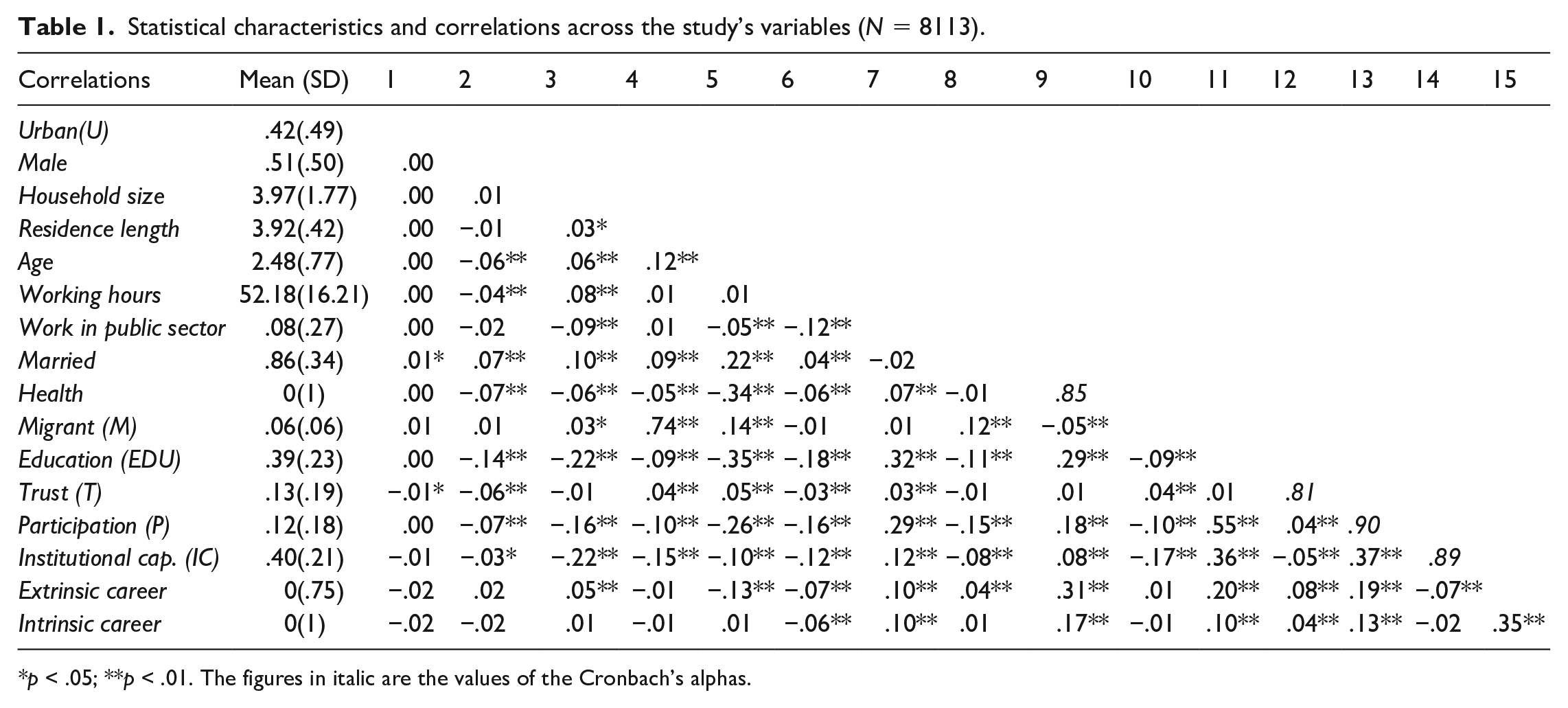
p < .05; **p < .01. The figures in italic are the values of the Cronbach’s alphas.
Analyses and findings
The research model is shown in Figure 1. Given the hierarchical structure of this dataset, we adopted a two-level modelling strategy (that is, a respondent is nested in a city so that the IC is measured at the second level). We followed the nested modelling strategy widely used in the multilevel modelling literature (Goldstein, 2011). Models 1a and 1b include the control variables and the main effects of human capital, social capital and institutional capital, respectively. Models 2a and 2b added all the two-way interactive effects upon Models 1a and 1b, respectively.
To verify whether multilevel modelling was an appropriate strategy, we conducted three analyses recommended in Goldstein (2011). First, we calculated the variance partition coefficient (VPC, see Table 2). The models attributed a significant amount (around 24%) of the total variance of extrinsic career success to differences among cities. The VPCs in the models with intrinsic career success as response variable were not substantially large. The relatively small VPCs suggested that we should not include random slopes, as the additional random effects would be redundant (Goldstein, 2011). Second, we conducted the Normal tests to see whether the variances among cities (
Regression results.
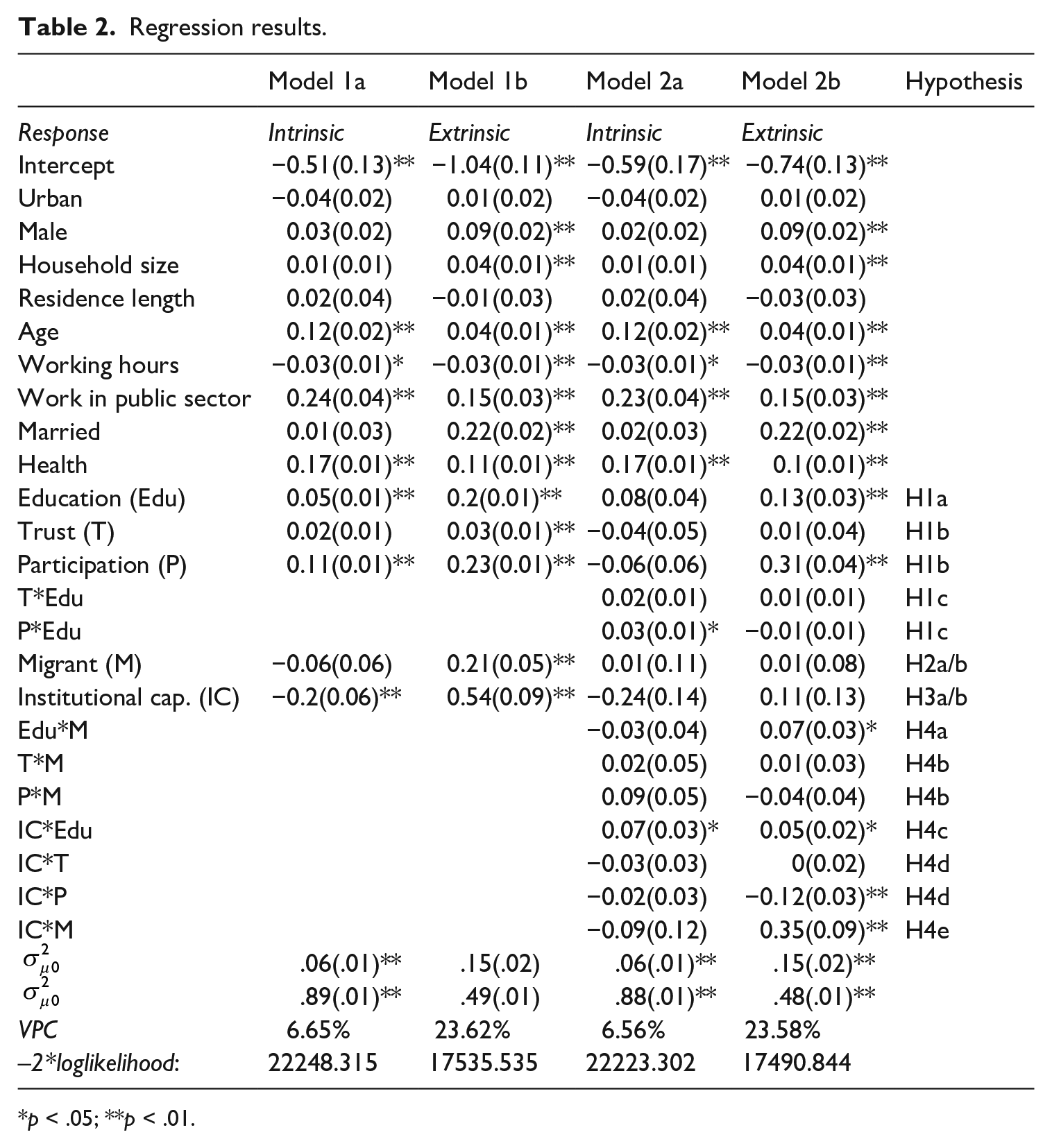
p < .05; **p < .01.
Multilevel regression results are reported in stepwise order in Table 2. We conducted the likelihood ratio tests for Models 1 versus 2. Models 2a and 2b reached much smaller loglikelihoods than Models 1a and 1b, respectively (Δ1a–2a = 25.01, Δ1b–2b = 44.69, d.f. = 9, p < .01). The chi-squared tests indicated that these differences were statistically significant at the 1% level, supporting the two-way interactive effects in Model 2.
On close inspection of Models 1a and 1b in Table 2, it is clear that males (.09, p < .01) have higher extrinsic career success than females. Household size and being married are positively linked to extrinsic (.04, .22, p < .01, respectively) but not intrinsic career success. Age is weakly associated with intrinsic (.12, < .01) and extrinsic career success (.04, p < .01). Working hours per week leads to both negative intrinsic (–.03, p < .05) and negative extrinsic (–.03, p < .01) career success. Employment in public sectors is positively associated with both intrinsic and extrinsic career success (.24, .15, p < .01, respectively). As expected, good health status promotes both forms of career success (.17, .11, p < .01).
Testing for main effects
In Models 1a and 1b, education plays an important role in both intrinsic (.05, p < .01) and extrinsic career success (.20, p < .01). Social participation is significantly associated with both forms of career success (.11, p < .01; .23, p < .01, respectively). Social trust is associated with extrinsic career success (.03, p < .01). In general, Hypotheses 1a and 1b are fully supported.
In Model 2a, the interactive effect of social participation and education is positively associated with intrinsic career success (.03, p < .05, see Figure 2a). Hypothesis 1c is partially supported.
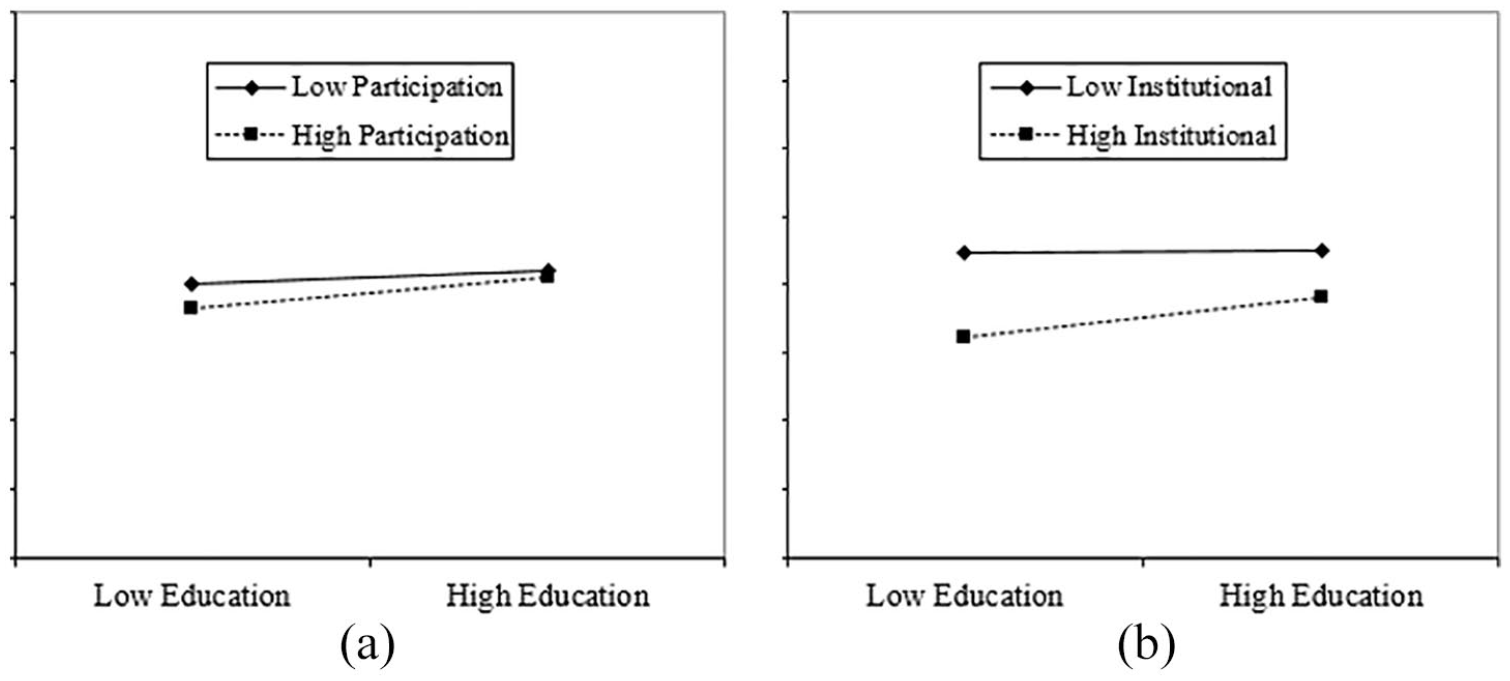
The significant interactive effects on intrinsic career success.
Migrants relocated from rural to urban areas tend to have higher extrinsic career success (.21, p < .01) than non-migrants do. Hypothesis 2a is supported and Hypothesis 2b is partially supported.
Finally, institutional capital is strongly positively associated with extrinsic career success (.54, p < .01) but negatively associated with intrinsic career success (–.20, p < .05). Hypothesis 3a and 3b are supported.
Testing for moderation
Models 2a and 2b addressed the interactive effects. In Model 2b, the interactive effect of migrant and education is positive and of institutional capital and migrant is also positive (.07, p < .05, see Figure 3a; .35, p < .01, see Figure 3b, respectively). Hypotheses 4a and 4e are partially supported. The interactive effects of education and institutional capital are positive (.07, .05, p < .05, respectively, see Figures 2b and 3c) in both Model 2a and 2b. Hypothesis 4c is supported. Finally, the interactive effect of social participation and institutional capital is strongly negative (–.12, p < .01, see Figure 3d). Hypothesis 4d is partially supported.
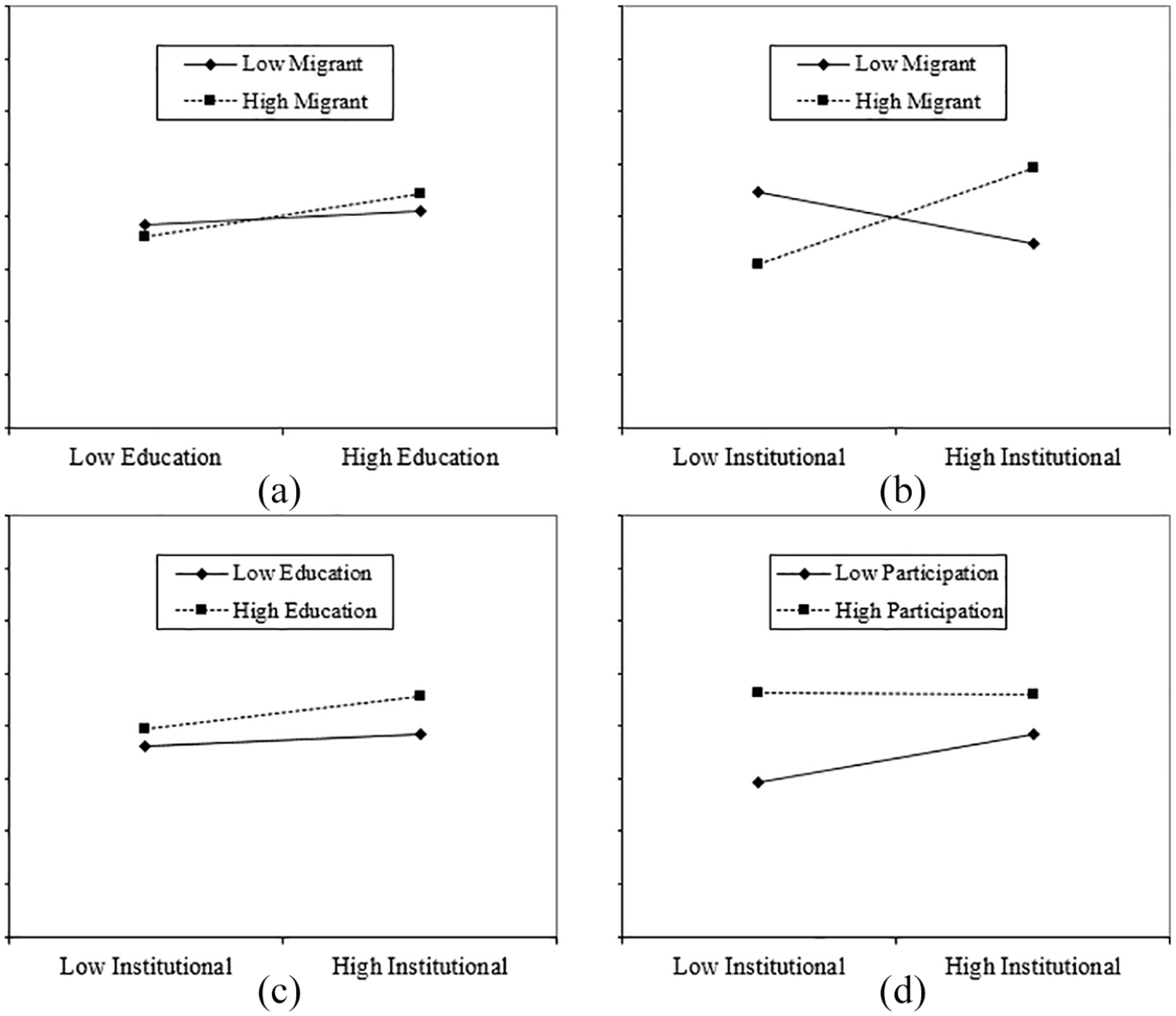
The significant interactive effects on extrinsic career success.
To sum up, we find that both human and institutional capital tend to have stronger effects on extrinsic career success for people who migrated from rural to urban areas. However, excessive social participation may be linked with lower extrinsic career success in a city with relatively high levels of institutional capital. Further, education may play a greater role in promoting both forms of career success in a city with higher levels of institutional capital.
The statistically significant interactive effects are plotted in Figures 2 and 3.
Discussion
We studied the career success of people who have migrated from rural to urban areas and live in cities whose investment in institutional capital for their residents varies widely. As a dynamic and growing economy, China is experiencing considerable change at both individual and society levels, and career mobility can be instrumental in ensuring long-term sustainability for people and the economy (Ansar et al., 2016; Qin and Liao, 2016). We explore the factors and conditions deemed essential for achieving successful national development and sustainability (Mathis, 2013). The study contributes to current understanding of what influences individuals’ careers in relation to particular immediate resources, namely human capital, social capital and migration experience, and to the institutional environment of a city.
Our findings validate the suggested research model that predicted both direct impact and moderation of different factors on career success. We tested relevance for both intrinsic (subjective) and extrinsic (objective) career success, contributing to and expanding the body of knowledge in established economies (Ng and Feldman, 2014; Ng et al., 2005; Spurk et al., 2019). We present similarities and differences between the process and its outcomes as experienced in the western context (Hobsbawm and Wrigley, 1999) with the urbanization process in China (Ansar et al., 2016; Song et al., 2018).
Theoretical contributions
The findings enhance and expand knowledge of career outcomes to encompass broader contexts and perspectives, from western to eastern (Heslin, 2005; Spurk et al., 2019). Career theory is developed in a way that reflects its multidisciplinary nature (Arthur et al., 1989; Lee et al., 2014). Indeed, postmodern principles call for integrating plural worldviews, hence the inclusion of individual, economic and societal factors in understanding a major phenomenon like mass migration to cities.
The empirical support for our hypotheses can be explained by a combination of factors. For example, the first hypothesis may relate to the mediating role of self-efficacy, which is a confirmed antecedent of career success (Spurk et al., 2019). The role of institutional capital can be attributed to its intersection with human and social capital (Som, 2015).
Our study sheds light on the role and relevance of institutional capital for individuals’ careers, in accordance with the career ecosystem theory (Baruch and Rousseau, 2019). It acts both as an antecedent and moderator of the relationships between various factors and career success. A strong presence of free institutions in a city leads to an increase in business opportunities, promotes market efficiency and encourages entrepreneurial innovation (The Economist, 2013), which in turn provides more career opportunities to people and results in higher mutual gains.
The study also indicates that a city’s institutional capital plays a significant role in the career success of those having migrated from rural to urban areas. This finding supports the liberal view of economics and offers an important contribution to career theory, with both direct and moderated impact. The moderation is intriguing: for people who have moved from rural to urban areas, living in a city with a high level of institutional capital (i.e. a ‘free’ city) is a good choice for extrinsic career success, as the interactive effect is positive and significant (.35, p < .01). This is probably because a ‘free’ city may foster or generate more opportunities for talented individuals. However, for people with high level of social participation, living in a ‘free’ city may not be a good choice for extrinsic career success, as the interactive effect is negative and significant (–.12, p < .01). This is possibly because excessive civic participation may waste these individuals’ time and resources.
Our findings are in line with the human capital theory: industrialization, skills enhancement and education help individuals (hence their societies) via augmented human capital, as suggested by Becker (1964) and Schultz (1961). We explain how employees might enhance their value in organizations, leading to improved skills, autonomy and socio-economic well-being. The process of individualization in human capital is evident in China. When neglected, it can be linked to growing economic insecurity, low productivity, diminished autonomy and – more specifically – increased levels of personal debt (Fleming, 2017). The positive impact of human capital on society includes improved economic conditions, although this does not necessarily translate into improved individual well-being (Turkle, 2011, 2015).
A further contribution we offer is insight on migration in a different context from that of the OECD (Naccache and Al Ariss, 2018). We found that migration across urban areas and human capital have a substantial combined effect on career success, thereby expanding the theory of boundaryless careers (Arthur and Rousseau, 2001). It points to the role of individual agency (Hall, 2002) in how individuals transfer their human capital to cities and build new social capital. This was unavailable as an option in the past in China. The finding adds support for the moderating role of structural constraints (Guan et al., 2019) to the realization of boundaryless careers. It adds empirical support to the career ecosystem theory, bringing together the combined role of individuals’ motives and authorities’ interests to career decisions in an interactive system, where multiple actors are interdependent (Baruch, 2015; Baruch and Rousseau, 2019).
Practical implications
Government interventions, both central and local, are aimed at maintaining economic growth and sustainability. As in the West, developing countries progressively need proportionately fewer rural workers to produce food, whereas industry requires increasingly higher labour levels and upgrading of skills in order to compete globally. Institutional capital can be provided at the city level, helping to bridge the skills gap and support individuals and communities. As made clear by our moderation tests, it is highly and positively influential for migrants currently in or moving to cities (see, for example, Figure 3). To ensure national competitiveness and bearing in mind skill gaps, there should be investment in human and social capital via multiple routes. The role of cities in this is critical, and benchmarking across cities can help with such processes.
Limitations and future research agenda
As a quantitative study, it is difficult to identify the deeper reasons for migration, and the actual balance of external versus internal factors that might have caused individuals to migrate. Also, the cut-off points for defining migration are set by the data rather than the authors’ choice. Future studies may usefully apply qualitative epistemology to collect and analyse data for a deeper understanding of the reasons underpinning migration and the exact mechanisms through which individuals perceive and benefit from cities’ institutional capital. It is important to identify how institutional capital investment translates into career success, economic prosperity and sustainability.
Another limitation is in scope. In considering city-level impact, of the three types of ‘capital’ discussed, institutional capital is the construct most relevant. Future studies may look beyond institutional capital to explore the effects of additional city-level variables on career outcomes, while controlling for already established individual-level effects, such as human and social capital. The measures we used are limited also; ideally objective career success will include measures of both income and hierarchical progress, for example. Yet, the latter varies considerably across organizations and professions so we only used income as a measure for extrinsic career success. What is more, our dataset is correlational in nature and our findings cannot signify causation between human, social and institutional capital and career success. Future studies could design experiments to explore the causes and effects.
Finally, this phenomenon of mass migration from rural to urban areas may be unique in human history and because of thwarted urban residence registration (hukou), rural-to-urban migrants are often excluded from local educational resources, citywide social welfare programmes and many jobs. Therefore, our findings may not be easily generalizable to other countries without rigid registration systems aimed at strong control or indeed mass migration of such scale in such a short period.
Conclusions
The burgeoning demand for and subsequent migration of labour from rural areas to cities in China has been widely acknowledged as an important factor in Chinese continuous economic growth. The process and its outcomes are understudied in terms of its internal mechanisms, such as the impact on career actors and their roles (Baruch, 2015). We identified how both human and social capital influence both extrinsic and intrinsic career success. We also identified the roles that migration status and a city’s institutional capital play in influencing career success, both directly and via moderation of the abovementioned relationships.
Footnotes
Funding
The authors received no financial support for the research, authorship and/or publication of this article.
