



Abstract
On 2 June 1994, an RAF Chinook helicopter crashed into the Mull of Kintyre, Scotland, killing all crew members and intelligence personnel on board. In this article, we analyse the 17-year campaign to set aside the finding of gross negligence against the two pilots. Existing literature has tended to focus on sensemaking during the inquiries that typically follow an accident, crisis, or disaster. However, we have a more limited understanding of the post-inquiry sensemaking occurring after an inquiry has published its findings. Drawing insights from the sociology of science and sociology of knowledge, we conceptualise post-inquiry sensemaking as three phases involving a ‘black box’ being constructed and closed, re-opened and overturned. We propose the concept of ‘applied deconstruction’ to make sense of the latter two phases. We identify the components of the ‘engine of applied deconstruction’, namely: animated actors who seek to ‘open the black box’; the building of a coalition that spans institutional sites of power; activities of discrediting the official version and crediting alternative versions; and activities of ‘lamination’ that build successive ‘layers’ of doubt. We conclude by discussing the implications arising from our case for advancing the understanding of post-inquiry sensemaking.
At about 17.59 hours on 2 June 1994 an RAF Chinook Mark 2 helicopter, ZD 576, on a flight from Aldergrove to Inverness,
1
crashed into a cloud-covered
2
hill on the west side of the Mull of Kintyre,
3
a short distance inland of and uphill from the lighthouse. The pilots, Flight Lieutenants Jonathan Tapper and Richard Cook, the other two crewmen and the 25 passengers, who were all senior members of the Northern Ireland security services, were killed.
Introduction
The investigation into the Mull of Kintyre crash conducted by the Royal Air Force (RAF) faced a series of challenges. Unlike in the Mann Gulch disaster analysed by Weick (1993), the ‘miracle on the Hudson’ of the American Airlines Flight 1549 (Fraher, 2011: chap. 6), or the Black Hawk tragedy (Snook, 2000), there were no survivors to tell their story. Unlike in the Tenerife plane crash (Weick, 1990), the American Airlines Flight 587 crash (Fraher, 2011: chap. 4), or again Black Hawk (Snook, 2000), there was no cockpit voice recorder, no black box and no communication with air traffic control to help to piece together the story of what went wrong. What is more, the aircraft was so badly burnt and damaged that any equipment malfunction identified from the wreckage could have been caused by the crash itself. With no survivors, no direct witnesses of the final moments, no recordings and no conclusive physical evidence, any official body tasked with finding the ‘truth’ about what happened faced a significant challenge.
The Mull of Kintyre crash was a context of high equivocality, with multiple possible ways of making sense of the cause of the crash. Were the pilots to blame? If so, were they guilty of neglecting their duties? Or was it a navigational error? 4 Were mechanical or technical faults to blame? 5 Given the British intelligence personnel on board, could the aircraft have been shot down, sabotaged or bombed by the IRA? 6 Could the aircraft have crashed accidentally after deliberately flying low to avoid radar detection because it was heading for a secret conference relating to covert counter-terrorism operations? 7 Or could it have been an ‘inside job’ 8 by those within the MoD seeking to change the course of the Northern Ireland peace process? 9
Despite this high level of equivocality, two senior RAF reviewing officers concluded from the RAF Board of Inquiry (BoI) that the two pilots were responsible for the crash and recorded an official finding of ‘gross negligence’. This official version was both symbolically and materially consequential. The pilots not only had their reputations tarnished but their families also faced the scorn of the relatives of the other victims of the crash. The relatives of the two pilots were also denied the compensation given to the other relatives. 10 Moreover, the official version was also consequential for what did not happen next. For example, the new Chinook fleet was not grounded and there was no investigation into mechanical or software problems. However, importantly for our purposes here, this ruling by the RAF did not serve to remove equivocality in the wider public discourse. As we will show, numerous campaigns followed in which the RAF ruling was contested and alternative versions of the crash were put forward. Seventeen years after the crash, the UK Ministry of Defence (MoD) finally overturned the RAF’s finding of gross negligence and issued a formal apology to the families of the deceased pilots.
There are three main bodies of literature that take distinct approaches to the study of disaster and crisis sensemaking. The first body of literature examines the sensemaking of the actors involved in the crisis or disaster as it unfolded (e.g. Weick, 1990). A second body of literature examines the sensemaking of official bodies tasked with ascertaining the ‘truth’ about what happened and answering questions about what went wrong and who (or what) was to blame (e.g. Brown, 2000). In these situations, specially appointed and formally authorised actors working within an institutional setting – such as public inquiries, trials, courts of appeal, coroners, boards of inquiry, fatal accident inquiries or tribunals 11 – are granted the power to decide an officially-sanctioned version of events.
A third body of work has been emerging in recent years that examines the sensemaking that takes place after the official body has reached its conclusion. We will refer to this body of literature as post-inquiry sensemaking. For example, Scraton (2004, 2013) has examined how the Scarman Report on the 1981 Brixton riots, the Hillsborough disaster in 1989 and the Dunblane shooting in 1996 were all contested or discredited by families of the deceased, expert commentators and the media. McMullan (2005) and Verberg and Davis (2011) also analyse the contest between narratives of victim-blaming and corporate criminal negligence in the 1992 Westray disaster in Nova Scotia, Canada. In some cases, like the one we analyse here, the contestation surrounding the official version is sufficient for it to be overturned. For example, Cooper and Lapsley (2021) trace the ‘thirty year (ongoing) battle for accountability’ (p. 2) to overturn the finding of the Taylor report into the 1989 Hillsborough disaster and clear the Liverpool fans of any responsibility for the disaster.
It is to this third body of literature that this article contributes. We ask: how do actors deconstruct official versions of events produced by inquiries? We analyse this case in order to contribute more broadly to theorising about the mechanics and trajectories of post-inquiry sensemaking in situations where the official version is contested. We contribute to theory development in two ways. First, we contribute to theorising about the mechanics of how official versions are contested (and sometimes overturned) by developing the concept of ‘applied deconstruction’ and explaining its role in the contestation of official versions through the re-introduction of equivocality and the opening of the ‘black box’. 12 We define applied deconstruction as the practical activities used to undermine the ‘truth’ status of an official version of reality. Secondly, we contribute to theorising about the trajectories through which official inquiries exert, or fail to exert, power effects in society. Official bodies normally serve the purpose of removing or at the very least reducing equivocality: they seek to ‘settle the matter’ and ‘end the debate’. However, as our case shows, this does not always happen. Our analysis enables us to understand the degrees of contestation that official versions face following their publication. We conceptualise the degree of contestation as a ‘continuum of applied deconstruction’.
Crisis and disaster sensemaking
Research into disaster and crisis sensemaking has focused on one of three related aspects: sensemaking at the time of the disaster or crisis as it unfolded, sensemaking during post-hoc official inquiries or investigations into the events, and a third, small but growing, body of literature that examines societal sensemaking following the publication of an official report. The first body of literature seeks to explain how sensemaking played a role in the real-time unfolding of events during a crisis or disaster (Colville et al., 2013; Cornelissen et al., 2014; Snook, 2000; Turner, 1976; Weick, 1990, 1993, 2010). This literature focuses its attention on the sensemaking of the actors involved in the crisis or disaster event itself. For example, scholars have highlighted the role played by the escalation of commitment to frames during organisational mistakes (Cornelissen et al., 2014; Weick, 1990). Here, commitment to a frame serves to remove equivocality when consideration of alternative frames would have, with the benefit of hindsight, averted disaster, such as in the case of the Stockwell shooting (Cornelissen et al., 2014). Colville et al. (2013) also examined the Stockwell shooting and show how the introduction of Kratos, a new protocol for handling suspected suicide bombers, served to increase the equivocality faced by the police officers trying to make sense of the unfolding situation. Others point to the relationship between individual, group and systemic sensemaking in aircraft accidents (Fraher, 2011; Snook, 2000).
A second body of literature focuses on official sensemaking about the crisis or disaster during post-hoc inquiries or investigations (Ainsworth and Hardy, 2012; Boudes and Laroche, 2009; Brown, 2000, 2004, 2005; Brown and Jones, 2000; Gephart, 1984, 1993, 2007; Kenny and Ó Dochartaigh, 2021; Mueller et al., 2015; Scraton, 2016; Whittle and Mueller, 2012). Here, actors working in an official capacity undertake their duty in investigating the disaster or crisis to construct an official finding, ruling or verdict about what happened, who (or what) was to blame and what lessons could be learnt (Gephart, 2007). Inquiries and investigations perform many important functions in society as part of a wider system of assurance and accountability (Skærbæk and Christensen, 2015), including but not limited to the allocation of blame, the demonstration of transparency, the performance of ‘holding to account’ those responsible and the assurance of learning from mistakes and accidents (Gephart, 2007). In these inquiry-type settings, the actors directly involved in the events are typically invited to give testimony about their role in the events, in addition to evidence from other actors such as witnesses, specialists and experts. In some cases, academics can also be invited to provide their expertise, such as in the case of Professor Phil Scraton’s long-term contributions to the Hillsborough inquiries.
Settings such as public inquiries, investigative committees, boards of inquiry, public hearings, tribunals and courts of law are key sites of power in organisations and in wider society because they produce ‘truths’ that are consequential for those implicated (Brown, 2000). Inquiries also have historical implications because they form the written records through which significant events will be remembered in the future (Gephart, 2007: 143). To achieve this, multiple versions of events have to be transformed into a single ‘truth’, and any ambiguity and equivocality of meaning must normally be removed from the official account (Hancock and Liebling, 2004: 91). For the purposes of this article, these various types of setting are all examples of ‘official discourse’ (Bourdieu, 2014; Burton and Carlen, 1979). Official bodies of this kind rest on their ‘claims to impartiality and disinterestedness’ (Burton and Carlen, 1979: 2) and eschew any notion that their finding was, for example, subjective, ideologically-invested or politically-motivated (Coole, 2005). Official discourse is also known to play a key role in governance by serving functions of restoring legitimacy, moral order and authority following a crisis or disaster and, as such, can often span the branches of the state (Bourdieu, 2014; Burton and Carlen, 1979; Gilligan, 2004).
Research on official sensemaking following scandals, crises and disasters has highlighted the political nature of the official sensemaking process and the far-reaching organisational, institutional and societal-level implications that hinge on their conclusions (Gephart et al., 2010). Within the field of organisation studies, a range of advances have already been made into the study of official discourse. Gephart (2007: 132) identifies five streams of research into public inquiry sensemaking, grounded in the distinct theoretical traditions of narrative analysis, rhetoric, ethnomethodology, conversation analysis and critical theory.
The dynamics of power have been a central theme across this body of work. An early contribution by Gephart (1984: 206) analyses the political implications of the ‘authoritative sensemaking’ in the aftermath of a major environmental disaster in Santa Barbara, California. From his analysis of the Allitt inquiry into a nurse who was a serial child killer, Brown (2000: 67) concluded that inquiry reports are designed to ‘stifle potentially competing or contradictory plotlines’, making them ‘an exercise in power’. Ainsworth and Hardy (2012) have also shown how power is exercised in official inquiries when personal stories and expert statistics are handled differently by an inquiry, with effects on which version is credited and rendered ‘official’.
Power is also implicated in the allocation of culpability and blame within official discourse. In their analysis of the Scott inquiry into the ‘Arms-to-Iraq’ affair, Brown and Jones (2000: 681) showed that ‘power holders try to single out a conventional culprit at the lowest possible level’, thereby deflecting blame from the institutions involved. Boudes and Laroche (2009) analysed the inquiry into the deaths during the 2003 heatwave in France, showing how the narrative simplification of the final official version served to ‘depoliticise’ the event and maintain the legitimacy of the institutions involved. Whittle and Mueller (2012) and Tourish and Hargie (2012) show how competing storylines and competing metaphors, respectively, were used in an inquiry into the 2008 banking crisis, with implications for how blame and responsibility were framed. Research into the inquiry into the role of auditors in the financial crisis has also found that competing versions differed on how blame was attributed and whether reform was demanded (Mueller et al., 2015; Whittle et al., 2016).
Official sensemaking is understood by Brown (2004: 107) to exercise ‘hegemonic’ power when it seeks to ‘impose a particular version of reality on its readers’. According to Brown (2004: 96), ‘a hegemonically successful report is one that is wholly or largely uncritically accepted as providing a comprehensive and accurate account of the events it purports to describe’. Official reports need to present themselves as non-partisan and objective to avoid being viewed as politically biased or a whitewash designed to protect the ‘establishment’, such as in the case of the Hutton report (Coole, 2005). Official bodies are therefore understood to serve hegemonic purposes when they protect the status quo and deflect scrutiny of societal institutions. For example, in his analysis of the Barings Bank collapse, Brown (2005: 1580) argued that sensemaking underlying the inquiry and the resulting report, ‘is not disinterested, but an exercise in power designed to reinforce the legitimacy of the Bank of England and the City of London’. Importantly for our purposes here, Brown (2004) also recognises that the legitimacy of the official version is dependent upon judgements of its status as an objective ‘truth’. According to Brown (2000: 48), ‘[to] succeed, inquiry reports must strike their intended audiences as truthful’. This opens up a research agenda, namely the study of situations when the official findings are not widely accepted as truthful. 13 Societal acceptance of the official version is, of course, not guaranteed. A third, much smaller, body of work has begun to address this research agenda.
The process through which official ‘truths’ are contested has to date been given only limited attention in the literature. In an overview of significant public inquiries, Scraton (2004) has shown how findings by official bodies in the cases of Lord Chief Justice Widgery’s report into the deaths of 13 protesters in Northern Ireland in 1972, the Scarman Report on the 1981 Brixton riots and Lord Cullen’s report on the Dunblane shooting in 1996 were all contested or discredited. In the case of the 1992 Westray mining disaster in Nova Scotia, Canada, McMullan (2005: 7–8) identified the contestation between the media, the criminal justice system, the public inquiry and the bereaved families in their accounts of the disaster. Verberg and Davis (2011), also analysing the Westray disaster, analyse the ongoing contest before, during and after the criminal trials and inquiry between those who viewed it as an unfortunate accident, those who sought to blame the miners, and those who sought to blame the corporation for criminal negligence. These contests were also, like in our case, materially consequential: for instance, for the payment of compensation, the possibility of criminal prosecutions and the likelihood of tighter industry regulation (Verberg and Davis, 2011).
In the case of the Hillsborough disaster and Bloody Sunday, like ours, the initial official findings were not only widely contested but they were also eventually replaced by new inquiries that set aside the original finding. Lord Justice Taylor’s inquiry into the Hillsborough disaster in 1989 did not close the matter; nor did the subsequent report by Lord Justice Stuart-Smith in 1998, because ‘there remained widespread dissatisfaction regarding the focus of the official inquiries’ (Scraton, 2004: 57). As Cooper and Lapsley (2021) show, it took a 30-year battle by the families of the deceased and their supporters to achieve a new inquiry, which concluded ‘that the 96 people who died in the disaster were unlawfully killed, overturning the verdict of accidental death at the original inquest’ (p. 22). Similarly, Kenny and Ó Dochartaigh (2021: 387) trace the 25-year campaign to ‘redress the errors of the Widgery Report into the events of Bloody Sunday’ with the publication of the new Saville Inquiry in 2010. Our aim in this article is to contribute to this third body of literature on post-inquiry sensemaking. To do so, we will now turn to discuss the theory upon which we build our analysis.
Theory: Opening the ‘black box’, equivocality and applied deconstruction
One way of conceptualising the process through which official bodies produce their ‘truths’ is through the metaphor of the ‘black box’ (Latour, 1987, 1999; Woolgar, 1988). The term ‘black box’ is used to refer to any system in which ‘only their input and output count’ (Latour, 1987: 3) and its inner workings are opaque and obscure or simply unknown (Latour, 1999). In the sociology of science and technology, the term ‘black box’ has been used to conceptualise how scientific and technical work is made ‘invisible’ 14 by the success of its output: ‘When a machine runs efficiently, when a matter of fact is settled, one need focus only on its inputs and outputs and not on its internal complexity’ (Latour, 1999: 304).
Scientific theories, for example, are transformed into ‘facts’ when they are treated as a ‘black box’ and the ‘loose ends and forgotten controversies’ involved in their construction are hidden, denied or simply relegated to history and forgotten (Lynch, 1998: 829).
Here, we seek to develop these arguments by examining official discourse as a form of ‘black boxing’. Whatever social, psychological, economic or political processes went into the ‘sensemaking’ about the events by actors involved in conducting the official inquiry, these processes are ‘closed away’ in the ‘box’ once the official finding is published. Black boxing, in the case of official discourse, involves the process of removing traces of the ‘sensemaking’ that went into the construction of the official version, thereby presenting the outcome as the ‘facts speaking for themselves’. This metaphor of the black box has particular relevance, we propose, for the third body of literature we have identified. It is during the process of contestation of the official finding that actors seek to ‘open the black box’ (Pinch, 1992) and question the sensemaking of the official body. 15
It is here that the concept of ‘applied deconstruction’, which we develop from Lynch and Bogen (1996: 142), is helpful for conceptualising how official versions are contested and discredited through the reintroduction of equivocality. The study of applied deconstruction requires the analyst to identify how actors themselves seek to undermine and discredit a particular version of reality and credit alternative versions (Lynch and Bogen, 1996: 10). 16 For example, Lynch and Bogen’s (1996) analysis of the testimony of Oliver North at the Iran-Contra hearings reveals the methods employed by North as an ‘applied deconstructionist’ as he sought to ‘counteract the operation of the truth-finding engine’ of the interrogation (Lynch and Bogen, 1996: 142).
The Iran-Contra affair presented the Reagan administration with a potential crisis of confidence, given the fact that the sales of antitank and ground-to-air missiles to Iran ‘was authorized by neither Congress nor its intelligence oversight committees, and it violated U.S. policies against aiding terrorist nations’ (Gephart, 2007: 142). Lynch and Bogen (1996: 5) analysed the methods through which testimony provided during the inquiry was ‘solicited, verified, challenged and equivocated’. For example, the officials conducting the inquiry sought to frame acts such as the shredding of documents as evidence of a criminal act of intentionally destroying evidence. North engaged in applied deconstruction in his attempts to discredit the official version of events and re-frame his actions as ‘innocent’, routine, run-of-the-mill shredding activities (Lynch and Bogen, 1996: 22). Importantly, Lynch (1998: 829) links the concepts of ‘applied deconstruction’ and ‘black boxing’ by showing how the former serves to ‘open up’ and undermine the latter: ‘such uncertainties and contingencies are ‘forgotten’ or ‘deleted’ when facts and artefacts are treated as ‘black boxes’ (stable entities, processes or laws which are dissociated from the circumstances of their production)’.
Applied deconstruction, then, works by highlighting all the ‘uncertainties and contingencies’ used to construct the official version. In other words, applied deconstruction brings equivocality back in. Equivocality is a central construct in sensemaking theory. Weick (2001: 9) defines equivocality as the co-existence of ‘multiple, conflicting interpretations, all of which are plausible’. Official bodies typically serve the purpose of reducing equivocality by ‘whittling down’ multiple versions of an event to a single definitive version that is accorded the status of ‘official truth’. Although there are certain situations where official bodies do permit a degree of equivocality – such as in cases with hung juries or open verdicts by coroners – official bodies typically serve the purpose of reducing or removing equivocality. Applied deconstruction, we propose, works in the opposite direction: re-introducing equivocality by questioning the plausibility of the official version and/or by introducing alternative plausible versions.
To sum up our theoretical perspective, then, we propose viewing the official inquiry as a ‘black box’ that is ‘shut’ when the (unequivocal) finding or ruling of the inquiry is declared. The black box is then ‘opened up’ when actors seek to contest and discredit the official finding through activities we refer to as ‘applied deconstruction’.
Data and methods
Our analysis is based on a collection of publicly available sources concerning the Chinook ZD 576 crash. Five types of sources were compiled: (a) all official inquiries relating to the crash (the original RAF BoI held in 1995 was only later made public in 2001), 17 (b) parliamentary records from the House of Commons and House of Lords where the crash was debated, (c) books about the crash written by various authors and investigative writers, (d) media coverage in major British newspapers and (e) various websites and blog posts, including those putting forward conspiracy theories. Table 1 provides an overview of all the sources used.
List of data sources (in date order).
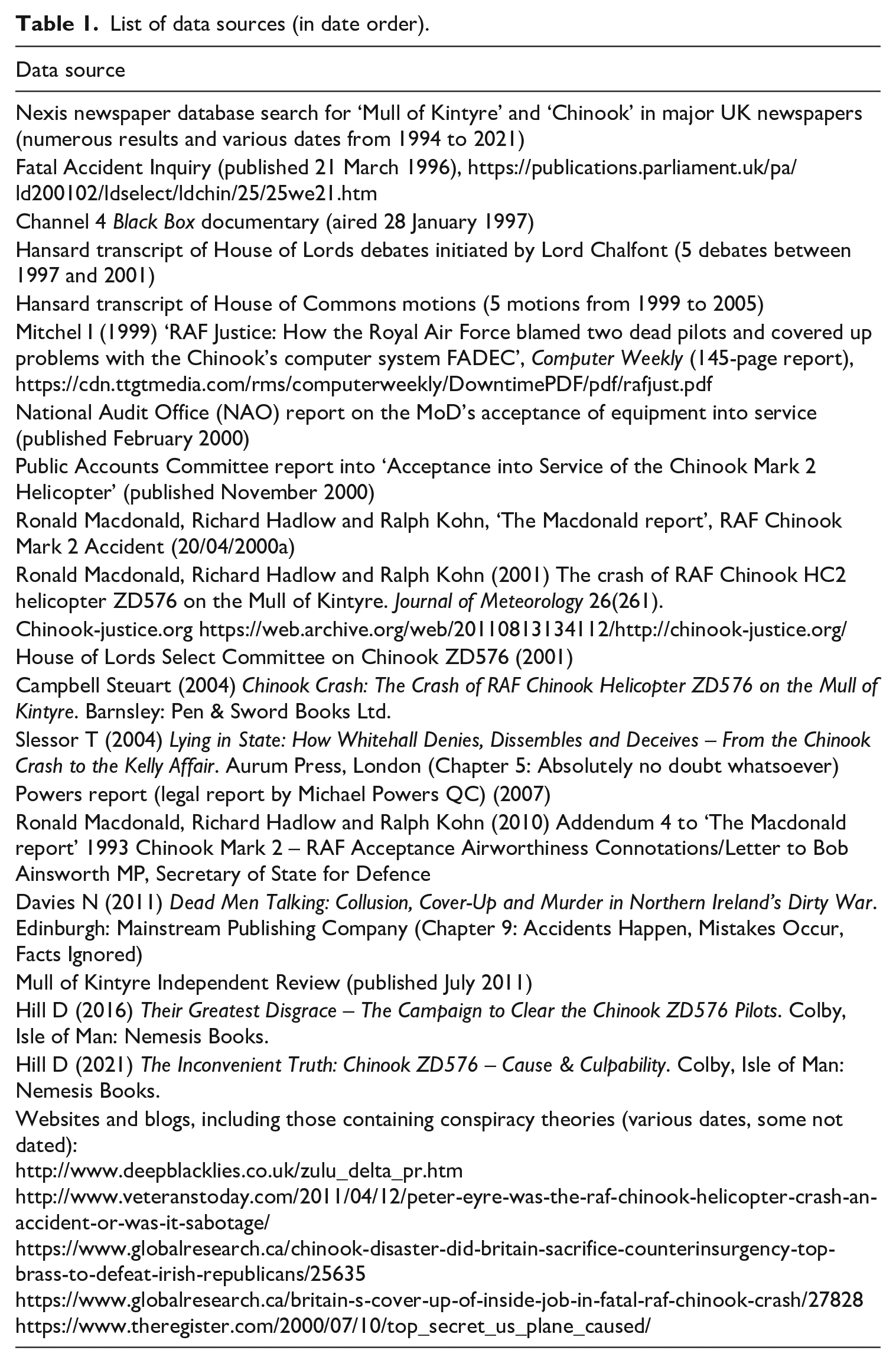
When first examining this collection of sources, we had no particular theoretical framework in mind. However, like all forms of qualitative analysis, no interpretation of ‘data’ can ever be ‘theory free’, and we were certainly informed by the theories with which we were familiar. Early iterations of the analysis began by using narrative analysis to explore the competing narratives of the causes of the crash. Later iterations, with an additional member of the author team, were informed by theories from the sociology of knowledge and sociology of science. In particular, we were familiar with the concept of the ‘black box’ developed by Latour (1987) and Woolgar (1988), ‘applied deconstruction’ developed by Lynch and Bogen (1996) and ‘reality disjuncture’ developed by Pollner (1975) and used by Gephart (1984) in the context of public inquiry sensemaking. Hence, we immediately labelled the official versions as ‘black boxes’, we ‘noticed’ moments in the unfolding of the case where reality disjunctures appeared (for example, between the RAF and FAI findings) and we could ‘see’ applied deconstruction being used by the group campaigning for the government to overturn the RAF finding. However, the analytical concepts developed in the article (which we label the ‘engine of applied deconstruction’) and analytical figure we present later were developed during the review process through an iterative process of moving back and forth between the ‘data’ and ‘theory’ (and with thanks especially to one of the reviewers for their input into this process).
Our case is similar to other such cases where official findings were later overturned, such as Bloody Sunday (Kenny and Ó Dochartaigh, 2021) and Hillsborough (Cooper and Lapsley, 2021; Scraton, 2013). However, our case differs in respect of one feature, namely that it involves not one official ‘black box’ but two. Two competing official versions co-existed, triggered by the Scottish Fatal Accident Inquiry (FAI) reaching an inconclusive judgement 18 in contrast to the RAF’s inquiry finding the pilots responsible, despite working to a lower standard of proof. Despite the existence of these two official ‘black boxes’, our analysis focuses on the applied deconstruction work targeted at the original RAF inquiry for the simple reason that there was no campaign to overturn the FAI version. If there were no actors seeking to deconstruct the FAI version, there was no applied deconstruction work for us to analyse. This does not imply any asymmetrical analytical stance, like the one taken by scholars such as Cooper and Lapsley (2021), who treat one version as true and another as false. Rather, we adopt a symmetrical analytical stance and examine how different versions of ‘truth’ are constructed.
Data analysis of the sources listed in Table 1 involved three steps. Given the focus of our research question, we first read each source and set aside those that supported the official finding of gross negligence. The rationale was simple: those defending the RAF version would by definition not contain the ‘applied deconstruction’ activities we were seeking to identify. The question of how official bodies defend the official version in the face of contestation is a different question and not the focus of this article. Second, we analysed all sources containing ‘applied deconstruction’ in the temporal sequence in which they occurred. This was an important methodological decision because it enabled us to trace the temporal process through which equivocality developed over time as successive actors built upon previous attempts at applied deconstruction. Here, we sought to identify connections between sources to build a picture of how each source was consequential for building the ‘layers’ of deconstruction that ultimately led to the finding of gross negligence being set aside. 19
During step two, we mapped the trajectory of all the alternative theories about the crash, including both those that ‘caught on’ and those that did not. The latter included theories by Campbell (2004) that the crash was caused by a navigational error and conspiracy theories suggesting IRA involvement or an ‘inside job’ mentioned at the beginning of the article. Throughout our analysis, we adopted the ‘symmetrical’ approach to analysis, as used in the sociology of knowledge and science and technology studies. 20 This means that we did not ourselves, as analysts, adjudicate between rival versions. 21 Rather, we analysed how the actors themselves established what was ‘true’ and how the controversy evolved over time.
Third and finally, through these iterations of moving between theory and data, including helpful suggestions by reviewers, we began to label the various components of the applied deconstruction process. Using the metaphor of an ‘engine’, we labelled the actors involved as ‘animated actors’ who drove the campaign and built a ‘coalition’ of supporters from different institutional spheres around them, together with the activities of ‘discrediting’ the RAF version, ‘crediting’ alternative versions and ‘lamination’ of successive layers of doubt.
Applied deconstruction and equivocality in the Mull of Kintyre crash
Phase 1: The RAF’s official version – seeking to close the black box
In this first phase, we will show how the official version of events produced by the RAF, which was the target of the subsequent applied deconstruction activity, was constructed by conceptualising this as a process of ‘black boxing’. Shortly after the crash, an RAF Board of Inquiry (BoI) was conducted by three RAF officers. Assistance was provided by the independent Air Accident Investigation Branch, who also visited the scene of the crash to gather evidence. As the cockpit was not fitted with either a flight data recorder or a cockpit voice recorder, 22 from the outset the investigation relied on the painstaking work of piecing together the aircraft wreckage and making observations about the terrain and weather conditions. There was reported to be no ‘mayday call’ and the last communication with the Scottish military air traffic control centre at Prestwick at 1655 was routine and gave no sense of alarm.
The RAF BoI report was created for internal RAF use on 3 February 1995. The report found several potential causes of the accident but, despite detailed and in-depth analysis, the Board was unable to determine a definite cause. 23 The report concluded that the most probable cause was a selection by the crew of an inappropriate speed and rate of climb on a route that deviated from the planned flight path. Although the Board could not conclude why the pilots had done this, it was nevertheless seen as a breach of Visual Flight Rules to continue to fly towards the Mull at an inappropriate speed and rate of climb in conditions of low visibility.
Following RAF protocol, the findings were then reviewed and signed off by two senior reviewing officers, Air Chief Marshalls Sir John Day and Sir William Wratten. The reviewing officers set aside the inconclusive finding of the BoI and concluded, with ‘absolutely no doubt whatsoever’, 24 that both pilots were ‘negligent to a gross degree’. 25 To continue to fly towards the mull at an inappropriate speed and rate of climb in conditions of low visibility was, in their view, to put in danger the aircraft and the safety of the passengers on board. The ‘doubt’ of the Board had been superseded by the ‘absence of doubt’ of the two senior reviewing officers.
Malcolm Rifkind, the Secretary of State for Defence of the Conservative government in power at the time, announced to Parliament on 15 June 1995: After an exhaustive inquiry into all the circumstances, the possibilities of major technical or structural failure, hostile action, or electro-magnetic interference with navigation equipment were eliminated as possible causes. On all the evidence, it was concluded that the cause of the accident was that the two pilots had wrongly continued to fly towards the Mull of Kintyre, below a safety altitude in unsuitable weather conditions. This constituted a failure in their duty and, regrettably, therefore, it was concluded that the pilots had been negligent.
Phase 2: Opening the black box
In this section, we will trace the activities of those actors who engaged in ‘applied deconstruction’ and sought to open the RAF’s black box, namely their finding that the pilots were responsible for the crash. During the analysis, we will point to five features that we conceptualise as the components of the ‘engine of applied deconstruction’. The ‘engine’ refers to the activities of ‘discrediting’ an official version, ‘crediting’ an alternative version, and ‘lamination’ (where ‘layers’ of doubt are built by actors referencing and building on previous acts of crediting and discrediting). The ‘drivers’ of this engine are the actors involved in driving the engine of applied deconstruction, namely the ‘animated actors’ and the ‘coalition’ of actors they assembled from various institutions. By ‘animated actors’ we refer to those who are sufficiently ‘animated’ by an official ‘black box’ version that they campaign to get it set aside or overturned. In our case, this was primarily the families of the two pilots. By ‘coalition’, we refer to the actors in positions of institutional power who were assembled to aid the campaign.
As soon as the RAF finding of gross negligence was announced, the families of the deceased pilots contested the outcome in subsequent press coverage. 26 It was at this moment that we first saw the families of the pilots becoming ‘animated actors’. The first time that an official institutional body ‘entered the fray’ and contested the RAF version, however, was with the publication of the finding of the FAI in 1996. 27 The FAI, led by Sheriff Young, took place in Paisley Sheriff Court in Scotland. The inquiry began on 8 January 1996 and lasted for 18 days; 38 civilian and military witnesses took part.
For our purposes here, we will focus on the applied deconstruction used by the Sheriff to ‘discredit’ the RAF finding of gross negligence and ‘credit’ alternative versions of what happened. To conceptualise this event, the first row of Table S1 (available in the online Appendix) summarises the ways that Sheriff Young sought to (a) ‘discredit’ the official RAF version of gross negligence by questioning the inferences about the evidence and witness testimony made by the RAF, and (b) ‘credit’ an alternative version of what happened, which allowed for doubt about the possibility of technical or mechanical failure. Sheriff Young concluded that it could not be established, on balance of probabilities, that the cause of the accident related to a decision about speed and rate of climb taken by the crew. The FAI concluded that the cause of the crash could not be definitely ascertained (Sheriff Young cited in: House of Lords Select Committee Report, November 2002).
By failing to reach any definitive conclusion about the cause of the crash, an official ‘reality disjuncture’ had been created (Pollner, 1975). A reality disjuncture is a situation when ‘the same world can appear differently to different observers’ (Pollner, 1975: 411). Societal actors were now facing a predicament, namely: ‘Which of the parties to a disjuncture’ – in our case the RAF or the FAI – ‘is a deficient witness to reality?’ (Pollner, 1975: 411). In other words, societal actors were left asking the question: which official version is ‘true’? Crucially, because the British military and the Scottish judiciary are separate institutional seats of power, there existed no established institutional means of arbitration between them. At this point, we now have two ‘black boxes’. Both were ‘official’ in their own way, but derived from separate institutional bodies. Importantly, though, one (i.e. the RAF) attracted considerable applied deconstruction activity, whereas the other one did not (i.e. the FAI).
On 28 January 1997, a major turning point in the controversy was reached when it was raised in the House of Lords by Lord Chalfont, 28 who asked the chamber to consider the RAF ruling of gross negligence. Chalfont cited the Channel 4 documentary he had watched the night before, nicely illustrating the process of ‘lamination’ whereby acts of discrediting are referenced and added to by actors seeking to cast doubt on an official version. Chalfont claimed that the documentary ‘cast considerable doubt on the justification for a verdict which found two young officers of considerable experience guilty of gross negligence’. From 1997 onwards, a group of around 20 friends and family members of the deceased, together with a small group of parliamentarian supporters, including both MPs and Lords, formed the ‘Mull of Kintyre Group’ (Hill, 2016: 43). The MoK Group sought to exonerate the pilots of blame and get the RAF inquiry re-opened and overturned. Lord Chalfont agreed to take the role of Chair, which he undertook until November 2002 (Hill, 2016: 43).
Chalfont became a key member of the ‘coalition’ assembled by the families of the pilots. Chalfont not only joined the coalition, he was also a central driving force behind the campaign, such was his apparent ‘animation’ at the sense of injustice he felt about the case. As such, we would conceptualise Chalfont as an ‘animated actor’ driving the deconstruction process. Importantly, Chalfont’s influence arose from his position within an institutional seat of power with its own mechanisms of official inquiry (such as a Select Committee in the House of Lords) and also his dogged persistence in raising the matter, despite the many rebuttals he received. Table S2 (provided in the online Appendix) gives an overview of the applied deconstruction work undertaken by Lord Chalfont during the period 1997–2001. Lord Chalfont’s first four attempts to reopen the inquiry were rejected by the Government. It was Chalfont’s fifth attempt that was decisive, when he established a Select Committee to re-examine the crash in 2001, which we will discuss later. 29
The reality disjuncture between the RAF and FAI findings became a notable cause of concern in public discourse at the time. Media reports at the time covered both doubts about the integrity of the RAF’s version of events (‘discrediting an official version’) and theories of what else could have caused the crash (‘crediting an alternative version’). Speculation and theories of a ‘cover-up’ by the MoD over safety issues with the new Chinook, Mark 2, helicopter were rife in the media (The Guardian, 27, 28 January 1997; The Guardian, 8 November 1997; Daily Mail, 26 November 1997; Independent, 7 December 1997). In particular, reports about possible problems with the Full Authority Digital Engine Control (hereafter FADEC) software system that controlled the engines, were reported in the press from 1998 onwards (The Guardian, 4 February 1998). A significant turn of events came when Sir Malcolm Rifkind, the former defence secretary who had announced the finding of gross negligence to parliament, began to express doubts about the finding in public. Rifkind, by 1998 now a backbench opposition MP, was reported in the press calling for the opening of a new inquiry, claiming to have ‘no recollection of being briefed about FADEC problems’ (The Guardian, 9 February 1998). At this point, in conceptual terms, Rifkind had joined the ‘coalition’ that was campaigning to get the RAF’s inquiry re-opened and was sufficiently ‘animated’ by the issue that he was willing to go public with his calls for a new inquiry.
On 4 March 1998, a House of Commons Defence Committee was assembled to respond to this growing media attention triggered by the reality disjuncture. The Committee concluded that there was no evidence to suggest that any flaws in the design of the Chinook Mark 2, or its components, could have caused or contributed to the crash. The Committee concluded that issues relating to the validation and approval process for the FADEC software that controlled the engines raised ‘no safety-critical questions’. The Committee concluded that no information had come forward of a substantially material nature to give grounds to overrule the RAF finding of gross negligence. In conceptual terms, then, the Committee had concluded that the ‘black box’ should remain shut. The act of discrediting in this case was discrediting the version of events put forward by the applied deconstructionists, not the RAF.
Alternative versions of events in the media continued to feed the controversy. Following the publication of the Defence Committee findings, an aviation expert, along with the pilots’ families and five cross-party MPs, claimed to have new evidence that ‘cast fresh doubts on the findings’ (The Guardian, 20 May 1998) and were ‘demanding a new inquiry’ (Mirror, 20 May 1998). The campaign group had expanded their ‘coalition’ to include aviation experts, in a bid to bolster the credibility of their claims. The incumbent Defence Secretary, George Robertson, dismissed these reports and rejected the calls to reopen the inquiry (The Guardian, 20 May 1998). The media, however, continued to report claims of a cover-up of FADEC software problems by lawyers acting on behalf of the families (Mirror, 3 June 1998), various MPs and two aviation experts: a former test pilot, Robert Burke, and an aviation computer expert, Malcolm Perks (Daily Mail, 4 June 1998). At this point, the media continued to give voice to those crediting alternative versions of the crash, particularly the version that proposed that software problems had caused the crash.
The campaign group continued to build their coalition of supporters from various institutional seats of power. Between 1999 and 2005, five ‘early day motions’ were raised by MPs. (Early day motions are used by MPs to seek to get an issue formally debated in the House of Commons. Although few are actually debated, including all those listed in Table S3 (provided in the online Appendix), these motions allow MPs to draw attention to an issue or cause.) The list of signatures is also significant here, signalling the degree of support these campaigners had across all political parties, shielding the campaign against the accusation of being a ‘partisan’ project.
Further events contributed to the discrediting of the RAF’s version of events. In May 1999, speculation of a ‘whitewash’ by the MoD intensified further with the publication of a report from a three-month investigation by Computer Weekly that suggested that the RAF had blamed the two deceased pilots in order to conceal problems with the FADEC system. The report suggested that MPs were incorrectly briefed because the MOD’s foremost FADEC expert and a senior RAF Chinook unit test pilot were not consulted, or were actively barred, from aiding the initial investigation. The report concluded that the gross negligence ruling was ‘manifestly unsafe’ on this basis. In conceptual terms, the publication of the Computer Weekly report was a key moment in ‘opening the back box’. The authors of this report appeared to be sufficiently ‘animated’ by the feeling of a ‘cover-up’ to have dedicated their time to compiling such a detailed report and taken the risk of publishing it, given the potential legal repercussions of their allegations. As such, we can conceptualise them as ‘animated actors’ driving the deconstruction process.
In June 1999, the family of the most senior of the intelligence officers killed in the crash began to publicly voice their ‘concerns about the reliability of the Chinook ZD576’ (Mirror, 17 June 1999), alleging that there were ‘known problems’ with ‘the reliability of the systems and the airworthiness of the aircraft’ (The Guardian and Daily Mail, 17 June 1999) and calling for the inquiry to be reopened (Daily Mail, 17 June 1999). This was another key turning point in the deconstruction process because, until this point, the families of the intelligence officers killed had supported the RAF finding of gross negligence and expressed anger towards Sheriff Young’s contrary FAI finding (reported in the Mirror and The Guardian, 22 March 1996). In conceptual terms, the coalition of ‘animated actors’ had now expanded and those family members of the deceased who previously wanted to keep the ‘black box’ closed now sought to have it ‘opened up’.
While concerns about the reliability of FADEC persisted, The Guardian also reported on a ‘cease fly’ order issued by Boeing following the discovery of serious faults within the Chinook Mark 2 gearbox (The Guardian, 11 August 1999). In conceptual terms, this additional ‘layer’ of doubt about the RAF version added strength to the case to ‘open the black box’ because concerns about the engine control software (FADEC) used in the Chinook Mark 2 were now joined by doubts about the reliability of its hardware (gearbox). The press continued to publish stories about apparent contradictions between statements and documents (The Guardian, 30 July 1999), problems with other Chinook aircraft (The Guardian, 11 August 1999) and speculation about a cover-up by the MOD, referencing the Computer Weekly investigations (for instance: Mirror, 10 September 1999; Daily Mail, 14 October 1999; Mirror, 15 October 1999). Calls to reopen the inquiry were also made by an all-party group of MPs led by Menzies Campbell (The Guardian, 11 August 1999), which included Sir Malcolm Rifkind (The Guardian, 14 October 1999). Rifkind explained his ‘U-turn’ by stating that he found it ‘puzzling and disturbing’ that he had been ‘kept in the dark by officials over the aircraft’s history of problems’ (Mirror, 15 October 1999). In conceptual terms, the coalition had been strengthened by this network of cross-party politicians who could exert influence through the House of Commons, dovetailing Chalfont’s influence in the House of Lords.
On 11 February 2000, the National Audit Office (NAO) published a report on the MoD’s acceptance of equipment into service. The NAO report concluded that ‘the Chinook was in service despite doubts about its safety’ and that its ‘engine-control computer software [was] not fit for the purpose’. The NAO report sparked further media interest in the controversy, being the first official government body to have ‘questioned the MoD stand’ (Daily Mail, 12 February 2000). In conceptual terms, the NAO report added further to the ‘opening’ of the ‘black box’ by discrediting the RAF’s version of the event (which presumed no technical faults) (see second row of Table S1 in the online Appendix).
On 8 March 2000, as part of their routine role in scrutinising government expenditure on behalf of the House of Commons, the Public Accounts Committee (PAC) began the task of examining the NAO report. The introduction of the FADEC system to the Chinook fleet was examined in detail. To conceptualise this event, the third row of Table S1 (see online Appendix) provides an overview of the applied deconstruction methods used by the PAC to both (a) discredit the RAF finding of gross negligence on the grounds that they did not adhere to the required standard of proof and used a flawed process for convening the BoI, and (b) credit an alternative version based on reports of possible mechanical failure caused by the inability of the MOD to act as an ‘intelligent customer’ when outsourcing contracts and possible faults in the acceptance into service of the Chinook Mark 2.
Malcolm Rifkind continued to be sufficiently ‘animated’ to persist in the campaign. In 2000, Rifkind met with Geoff Hoon, the Defence Secretary, to call on the Government to overturn the verdict or open a new inquiry (Daily Mail on Sunday, 14 May 2000). Rifkind’s request was rejected. Members of the Mull of Kintyre Group, the campaign group set up to represent the families of the dead pilots led by Lord Chalfont, were also calling on the Government to act. Their case was helped by the publication of a report in April 2000 by three retired Captains (the ‘Macdonald report’) – seemingly animated by the sense of injustice done to the two dead pilots – who undertook an investigation into the handling of the crash investigation by the RAF. The report claimed that Chinook Mark 2 engine malfunctions linked to FADEC had been deliberately withheld from the BoI.
The Macdonald report was given to The Guardian newspaper and published online, prompting further press coverage doubting the finding of gross negligence. In conceptual terms, the publication of each report meant that additional ‘layers’ of doubt – running across different institutions and running across the political spectrum – could be built up in media coverage. Media coverage continued to cite doubts about technical issues with the FADEC system raised by the 1999 Computer Weekly report (The Guardian, 10 March 2000; The Guardian, 15 June 2000; The Guardian, 20 June 2000) and now also the Macdonald Report (Daily Mail on Sunday, 14 May 2000; Sun, 15 May 2000). The press also reported a growing sense of ‘gross injustice’ (The Guardian, 30 June 2000) from a number of high-profile figures questioning the gross negligence ruling, including Scotland’s chief QC, Lord Advocate Colin Boyd (Mirror, 15 June 2000) and a range of MPs from across the political spectrum. Throughout this period of media scrutiny, however, the MoD continued to state that no new evidence had arisen to warrant a new inquiry (Daily Mail on Sunday, 14 May 2000; Sun, 15 May 2000; Daily Mail, 21 June 2000; Daily Mail, 28 June 2000; The Guardian, 30 June 2000).
In July 2001, the Select Committee that Lord Chalfont had relentlessly campaigned for was finally established. The committee comprised five Lords, each with legal, military or aviation expertise. Lord Jauncey, a former Scottish appeal court judge, was appointed as chairman. Over three days in late October 2001, a total of 14 witnesses were called to give evidence, along with a variety of written submissions. To conceptualise this event, the fourth row of Table S1 (see online Appendix) summarises the applied deconstruction activities used in the Select Committee report to ‘open the black box’. Firstly, the report sought to discredit the RAF finding of gross negligence on the basis that (a) it did not apply the correct standard of proof because doubt did exist, (b) for making questionable conclusions about the cloud cover that led to the gross negligence finding and (c) giving credence to a flawed Boeing simulation. 30 Secondly, the Select Committee report credited an alternative version of events involving technical failure, which the report stated could not be ruled out because of the history of technical faults with the Chinook Mark 2.
The Select Committee report, published on 31 January 2002, unanimously concluded that: ‘. . . the reviewing officers were not justified in finding that negligence on the part of the pilots caused the aircraft to crash’. The MoD stated it would ‘study the report in detail and make a response’. Later that year, the Defence Secretary Geoff Hoon announced to Parliament that the Government did not accept the conclusion of the House of Lords report, insisting that the Government’s position remained unchanged. In conceptual terms, although the Select Committee had clearly failed to ‘overturn’ the black box, it did manage to get onto the public record a series of ‘layers’ of doubt from a range of witnesses, technical experts and legal experts who provided testimony and written evidence to the Committee.
In January 2003, David Hill, a retired MoD engineer and programme manager, began his direct involvement in the campaign (Hill, 2016: 32). Hill had serious concerns about the acceptance into service of the Chinook Mark 2 and claimed that the aircraft had not received the correct Release to Service (RTS) because of known problems with safety critical equipment and software, and should never have been in operation in the first place. Hill joined forces with the Mull of Kintyre campaign group and extensively lobbied numerous MPs, contacted journalists, wrote reports (including a report provided to the original Air Accident Investigation Board report), compiled documents (including an archive given to him by another investigator Brian Dixon) to build an evidence base to support his claims. Others, including Air Commodore John Blakeley and aviation expert Ralph Kohn (also Fellow of the Royal Aeronautical Society), also subsequently joined the campaign for the verdict against the pilots to be overturned, based on their shared belief that ‘airworthiness’ concerns about the Chinook Mark 2 had been either ignored or covered up by the RAF.
By 2004, the Prime Minister at the time of the crash, John Major, had joined Malcolm Rifkind in going public to state that there was ‘no justification for blaming pilot error’ and calling for the MoD to ‘set aside the original verdict’ (Times, 13 May 2004). In conceptual terms, the ‘coalition’ had gained another influential member. After the House of Lords Select Committee finding was rejected by the Government, Lord Chalfont turned to the legal establishment. The Mull of Kintyre Group commissioned a legal report, conducted by Michael Powers QC, who took on the commission on a pro bono basis. The coalition had been expanded further into a new institutional site of power with its own mechanisms of redress. To conceptualise this event, the fifth row of Table S1 (see online Appendix) summarises the applied deconstruction used in the 2007 Powers report to ‘open the black box’. First, the Powers report discredited the RAF finding by claiming (a) that the standard of proof ‘absolutely no doubt whatsoever’ was not reached, because the deceased pilots could not provide evidence and there were no voice or data recorders, (b) the two senior Reviewing Officers should not have generated a different finding to the BoI based on the same evidence, 31 and (c) incorrect assumptions about cloud cover that led to the conclusion that the pilots were negligent because they were charged with breaching Visual Flight Rules. Second, the Powers report credited the alternative version of events involving technical failure by stating that reasonable doubt did exist about the possibility of technical or mechanical faults.
The Powers report concluded that: ‘the finding of gross negligence on the part of the deceased pilots ought not to stand’. The report was handed to the Defence Secretary, Des Browne, in January 2008, who agreed to review the dossier and give the findings ‘serious consideration’. After reviewing the report, the MoD refused to overturn the finding. The Mull of Kintyre Group continued to press for a full review. In conceptual terms, the Powers Report, like the Select Committee report before it, had also failed to ‘overturn’ the black box. However, it did mean that further ‘layers’ of doubt, on the public record, had been added to the campaign.
Phase 3: Overturning the ‘black box’
In this third and final phase, we will show how the official version of events produced by the RAF was finally overturned. Following the UK general election in 2010, a Conservative–Liberal Democrat coalition government, led by David Cameron, took office. On 16 September 2010, the newly appointed Secretary of State for Defence, Dr Liam Fox, 32 announced an Independent Review of the evidence relating to the crash, led by retired judge Lord Philip and three Privy Counsellors (two Lords and an MP). 33 (An Independent Review is a non-statutory inquiry without the authority awarded under the Inquiries Act, 2005.) A range of individuals gave evidence, and written submissions were also provided, including a meeting with Malcolm Rifkind, who gave evidence at his own request. David Hill, the retired MoD engineer we mentioned earlier as a key campaigner, also submitted written and oral evidence to the Independent Review. According to Hill (2016: 160), the ‘silver bullet’ he had been searching for came with help from Dudley Denham, the author of the 1992 CHART (Chinook Airworthiness Review Team) report. After watching a Newsnight programme about the crash (aired 12 April 2011), Denham contacted Hill and informed him of the existence of the full 373-page original report, which Hill gained access to on 30 April 2011 following a Freedom of Information request. The CHART report included damaging information about technical problems with the Chinook fleet that, according to Hill (2016, 2021), the MoD had ‘covered up’. Hill supplied a copy of the CHART report, alongside other documents, to the Independent Review and Dudley also gave formal evidence to the Review.
The Independent Review concluded that the required standard of proof was not met and the finding of gross negligence was unfair when made against deceased crew, who did not have the opportunity to represent or defend themselves. The report also noted a series of failings in the process through which the MoD reached their original judgement. The Independent Review report was published on 13 July 2011. The report attributed the ‘mistake’ by the two Reviewing Officers to inadequate and unduly reassuring legal advice about the standard of proof required. Importantly for our conceptual purposes, this conclusion also sidesteps the attribution of more ‘ulterior’ motives, such as seeking to blame the pilots in order to ‘cover up’ something else, such as technical problems with the Chinook Mark 2 (which could have implications for blaming those who approved its use and grounding the whole fleet) or IRA involvement (which could have implications for the Northern Ireland peace process).
On the day the Independent Review was published, the Secretary of State for Defence, Dr Liam Fox, announced to Parliament ‘the finding that the pilots were negligent to a gross degree should be set aside’ and offered his apologies to the families of the two pilots. It had been 16 years since the initial announcement of the finding of gross negligence by Malcolm Rifkind on 15th June 1995. In conceptual terms, on 13 July 2011, the ‘black box’ had been both ‘opened’ and ‘overturned’. The publication of the Independent Review did not, however, remove equivocality. The apology by the MoD only served to remove one version of events – namely the version blaming pilot negligence – from the official record. It did not provide an alternative account of who or what caused the crash. Even the removal of the pilot negligence version was contested by some actors. 34
Some key campaigners, such as David Hill, remained convinced that the Independent Review ruling, which blamed the ‘poor legal advice’ given to the two senior Reviewing Officers, was nothing more than an ‘excuse’ and ‘scapegoat’ (Hill, 2016: 182, 203) to cover up the serious failings and years of dissembling and ensure the ‘perpetrators remain protected’ (Hill, 2016: 183). The truth, according to Hill, had been ‘whitewashed’ (Hill, 2016: 184) in the Independent Review report, and the real ‘perpetrators’ were those within the MoD who allowed a ‘not airworthy’ (Hill, 2016: 182; 2021: 44) aircraft to be flown. As such, ‘the aircraft being unairworthy meant one could not blame the pilots’ (Hill, 2021: 45). It was a ‘cover-up’ by the MoD, Hill claimed, whereby the ‘MoD systematically destroyed much of the evidence’ (Hill, 2021: 40) ‘that both main parties [Conservative and Labour] had, while in power, been party to’ (Hill, 2016: 185). For campaigners such as Hill, the Independent Review ‘black box’ did not ‘settle the matter’ and the campaign to find the ‘truth’ must continue. For the wider public, equivocality remains, and multiple versions of ‘what happened’ in the Mull of Kintyre crash co-exist to this day. 35
Discussion
Our analysis of the Mull of Kintyre crash has revealed the three phases in which official sensemaking about the crash played out. In the first phase, an official version blaming the pilots of negligence was assembled by the RAF. This official finding served to transform an equivocal situation, where multiple versions of what happened and who (or what) was to blame are circulating, into an unequivocal ‘official truth’. Institutions that produce ‘official truths’ normally intend for them to ‘settle the matter’ and be accepted in society as ‘factual’. We have conceptualised this as a process of constructing and ‘closing’ a ‘black box’.
However, as our case shows, official versions do not always ‘settle the matter’. After their findings have been published, societal actors can produce alternative, rival versions of what happened and who (or what) is to blame. In these situations, equivocality is not reduced or removed. In our case, a second phase of sensemaking involved the RAF version being ‘opened up’ and scrutinised in a process we conceptualise as ‘opening the black box’. We have traced the efforts of a variety of actors and institutions – ranging from family members, journalists, documentary makers, computing specialists, politicians, members of the legal establishment and members of the House of Lords – to discredit the official RAF version and credit alternative versions. We have proposed the concept of ‘applied deconstruction’ to conceptualise the practical activities used by these actors to re-introduce equivocality.
In the Mull of Kintyre case, it took tireless and persistent campaigning by an emergent coalition of actors from a range of institutional fields to pressure the government to enter a third and final phase, where they re-opened the inquiry and set aside the finding of gross negligence. Figure 1 provides a conceptual overview of these three phases of sensemaking comprising the closing, opening and overturning of the ‘black box’.
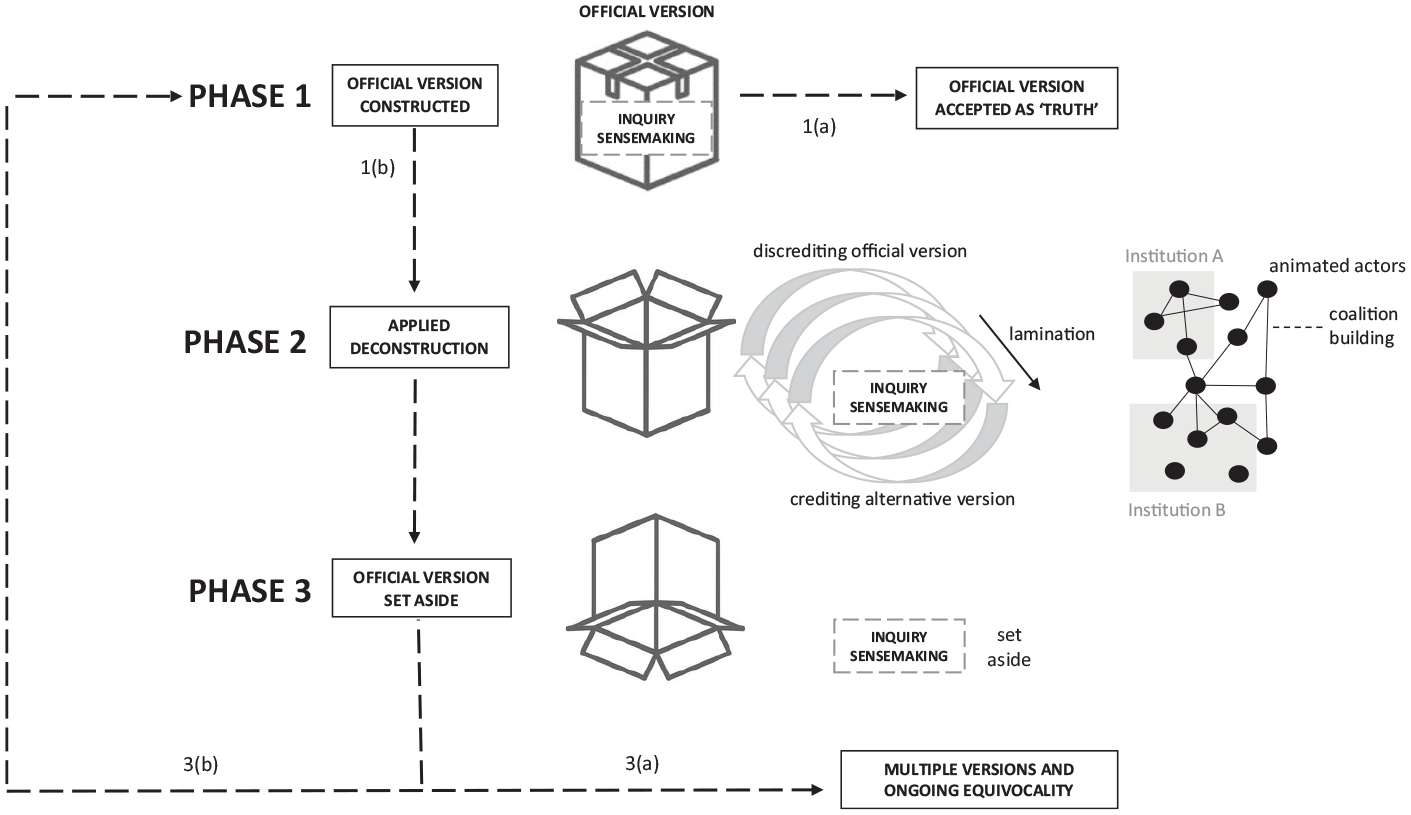
Phases of black box construction and applied deconstruction.
For conceptual purposes, given our focus on applied deconstruction, the RAF version represents the ‘black box’ in the figure. We acknowledge that the FAI was also a ‘black box’ in its own right, producing its own ‘official version’ of events, but in our case the FAI is actually part of the deconstruction process because it played a key role in ‘discrediting’ the RAF’s black box during Phase 2. Although our case therefore involved two black boxes (the RAF and the FAI), with the latter forming a key part of the ‘deconstruction’ of the former, in theoretical terms we do not wish to claim that this second ‘black box’ comprises a necessary condition for applied deconstruction in other cases.
Whilst our case quickly moved from Phase 1 to Phase 2, in no small part because of the ‘reality disjuncture’ (Pollner, 1975) created by the contradictory finding of the FAI, in other cases post-inquiry sensemaking can remain at Phase 1. In these cases, the ‘black box’ remains ‘shut’ and society broadly agrees that the inquiry has found the ‘truth’, as represented in path 1(a) in Figure 1. In the case of the Bristol Royal Infirmary scandal analysed by Weick and Sutcliffe (2003), for example, the inquiry was broadly viewed as having uncovered the ‘truth’ about what happened. 36 Our conceptualisation of inquiries as ‘black boxes’ has theoretical implications for how we theorise power in particular. Although there is presumably a hegemonic intent underlying inquiries, insofar as inquiries generally aim to have their findings accepted as neutral and objective ‘truths’ (Brown, 2000), they are not all hegemonic in their effects because – as we have shown – the black box does not always remain shut.
In these other cases, the inquiry is not accepted as the ‘truth’ and the ‘black box’ is ‘opened up’ through activities of ‘applied deconstruction’. In these cases, as depicted in Figure 1, path 1(b) is taken and post-inquiry sensemaking moves from Phase 1 to Phase 2. For example, the Hutton inquiry into the death of Dr David Kelly (a weapons inspector implicated as a whistle-blower in the now-discredited dossier about Iraq’s weapons of mass destruction) and the Chilcot inquiry into the decision to go to war in Iraq both quickly entered Phase 2 when they were discredited by various commentators as a ‘whitewash’. 37 However, despite the attempts of various ‘applied deconstructionists’, these inquiries were never re-opened and the original finding is still the ‘official record’ of what happened. Post-inquiry sensemaking can therefore remain at Phase 2 and, in these cases, the inquiry cannot properly be described as ‘hegemonic’ (Brown, 2000) in its societal power effects.
Cases like ours, where post-inquiry sensemaking enters Phase 3, reveal much about the applied deconstruction activities required to not only open the ‘black box’, but also to get the box ‘overturned’ or ‘set aside’. In our case, the final phase is depicted in Figure 1 as following path 3(a) because the official finding (the RAF’s finding of ‘pilot gross negligence’) was set aside but there was no new inquiry commissioned to produce a new official version. In our case, equivocality about ‘what happened’ remains, and multiple competing versions continue to co-exist, with varying degrees of influence, uptake and traction.
In other cases, post-inquiry sensemaking follows the path depicted in Figure 1 as path 3(b), where a new inquiry is established. In the case of Bloody Sunday, the Widgery Inquiry in 1972 was widely branded as a ‘cover-up’ and a ‘whitewash’ by the families and in the press, but the Saville Inquiry (established in 1998 and published in 2010) was broadly viewed as having found ‘the truth’. The ‘black box’ has broadly remained shut ever since, albeit with calls for full accountability for those now deemed responsible and with some criticism by certain parties for having ‘cherry picked’ evidence. 38 In cases like these, path 3(b) is taken and the new inquiry is broadly accepted as the ‘truth’ (path 1(a) in Figure 1).
In other cases that follow path 3(b), however, the new inquiry is itself subject to applied deconstruction. After the Hillsborough disaster, for example, the original Taylor Inquiry published in 1990 was widely criticised (Scraton, 2016). However, the second investigation (involving ‘scrutiny’ of evidence by Lord Justice Stuart-Smith published in 1998) was also widely discredited. 39 This second ‘official truth’ did not settle the matter, and applied deconstruction by the bereaved families and their supporters continued for many years. It was only when the report of the ‘Hillsborough Independent Panel’ was published in 2012, which exonerated the Liverpool fans of any blame, that the families and the media appeared to be broadly satisfied that the ‘truth’ had been found, even if some campaigners still report that ‘justice’ against the police officers has not been served. 40 In this case, the full cycle of Phases 1 to 3 occurred not once, but twice. It took three inquiries before societal actors were largely satisfied that the ‘truth’ had been found.
Overall, our findings show that applied deconstruction is far from a quick or straightforward process. Our case shows that it took more than one animated actor, building coalitions across more than one institution, working tirelessly over 17 years, to get the official finding in the Mull of Kintyre case set aside. 41 Drawing out broader implications from our one case, we propose that the ‘engine of applied deconstruction’ has a number of components, which we shall now consider in turn.
Firstly, the ‘engine of applied deconstruction’ relies upon social actors who are ‘animated’ or ‘outraged’ enough to invest their time, energy and resources to contest an official version. The list of animated actors in our case is relatively long and spanned multiple social and institutional roles: families of the deceased pilots and passengers, Lords, MPs, retired RAF Captains, barristers, investigative journalists and authors, technical experts and aviation engineers. Secondly, from the scope of this list, it is clear that the early campaigners began to build a ‘coalition’ spanning multiple institutions. This second element of the ‘engine of applied deconstruction’ – which we call simply coalition building – involves building formal or informal alliances between actors with access to resources and positions of influence across institutional sites of power. For example, the families of the two pilots increased their influence by building alliances across the legislature (in our case MPs and Lords), the judiciary (in our case senior barristers) and the military (in our case retired pilots), who all joined their campaign for ‘justice’ under the banner called the Mull of Kintyre Group. However, not every ‘animated actor’ is necessarily a member of a coalition. For example, investigative writer Steuart Campbell (2004) was clearly ‘animated’ enough by the crash to spend years investigating the incident and to publish a book about it. However, to the best of our knowledge he was not a member of the Mull of Kintyre Group and has in fact been subject to criticism by its members, including families of the deceased. 42 This is depicted in Figure 1 by the animated actors who are not connected to the network of any formal or informal coalition.
Importantly, this finding enables us to develop a more sophisticated understanding of the relationship between inquiry reports and the so-called ‘establishment’. Existing literature has tended to view inquiries as instruments of power designed to protect institutions from scrutiny and maintain the status quo (Brown, 2000, 2004, 2005). Although inquiry reports might typically seek to legitimate social institutions and ‘extend the hegemony of prevailing system-supportive ideologies’ (Brown, 2000: 48), in our case actors traditionally understood to be part of the ‘establishment’ decided to ‘break rank’ and join the fight against the official version. Those ‘breaking rank’ included members of the House of Commons and House of Lords, senior members of the judiciary and retired senior military officers. It even included Malcolm Rifkind, the Secretary of Defence who had announced the finding of gross negligence to Parliament, and John Major, the Prime Minister at the time of the announcement. We therefore suggest that theories of official sensemaking need to appreciate the ‘schisms’ and ‘fractures’ that can develop within and between institutions involved in the production and legitimation of official truths.
The next two elements of the ‘engine of applied deconstruction’ involves activities through which animated actors engage in ‘applied deconstruction’ by questioning the truth status of the official version. We have identified two related activities. Applied deconstructionists can propose that the official version is mistaken or erroneous. We have called this third component ‘discrediting the official version’. Alternatively, or in addition, they can propose that another version offers a more plausible account of what happened. We have called this fourth component ‘crediting an alternative version’. On some occasions, an applied deconstructionist can do both at the same time, as Table S1 shows (see online Appendix).
Discrediting the official version can be attempted using various methods, such as pointing to social, psychological, political or economic factors that are said to undermine its factual status. In the Mull of Kintyre case, actors used a range of methods to discredit the official RAF version. Some actors pointed directly to a political motive for ‘covering up’ the real cause of the crash by ‘scapegoating’ the two pilots. The political motives attributed to the RAF and MoD varied. For some conspiracy theorists, the political motive related to the threat posed by the crash to the Northern Ireland peace process if the IRA had been implicated. For other actors, they pointed to more mundane – but not less damaging – implications that the MoD had covered up technical problems that should have been identified during the acceptance into service process.
Economic factors also played a role in some of these versions. Some actors implied that successive cost-cutting achieved by the outsourcing of procurement had undermined the MoD’s ability to act as an ‘intelligent customer’ and identify technical problems in outsourced software. Implicit in some versions was also the idea that the MoD was reluctant to acknowledge technical problems because of the economic implications of grounding and checking the whole Chinook Mark 2 fleet for technical faults. Other actors pointed more to social-psychological processes, namely the interpretation of evidence by the two RAF Reviewing Officers, such as their discounting of character witnesses on the grounds of bias or unsupported assumptions about cloud cover (which was pivotal to the conclusion of gross negligence in this case) generated by selective crediting of certain eye-witnesses over others. Other actors criticised the RAF’s conclusion that the aircraft did not experience mechanical failure, citing the possibility that the evidence could have been destroyed in the impact itself. Here, actors pointed to the way that the Reviewing Officers placed ‘cues’ into a particular ‘frame’ based on a method of inference that was, in their view, faulty or flawed.
Alternative versions can come from various sources with varying degrees of legitimacy and influence. For example, there is clearly a difference between conspiracy theories believed only by marginal sub-sections of society and more widespread doubt about official versions circulating in the mainstream media and endorsed by experts or influential commentators. Alongside conspiracy theories, our case included theories of what caused or contributed to the crash put forward by military experts, retired pilots, ex-military engineers, meteorologists and computing experts. In our case, one particularly influential ‘alternative version’ came from another ‘official’ source, namely the Scottish FAI. The fact that the Scottish legal system had declared a contrary finding to the RAF added ‘fuel’ to the applied deconstruction efforts. However, to be clear, an official reality disjuncture such as this is neither a necessary nor sufficient condition for applied deconstruction. In other cases, such as Bloody Sunday and Hillsborough, no such official reality disjuncture occurred. Moreover, in our case, the publication of the FAI finding did not trigger the RAF to overturn their finding of gross negligence.
The fifth and final component of the ‘engine of applied deconstruction’ we have labelled ‘lamination’. Lamination involves the building of successive ‘layers’ of doubt when actors reference and credit previous sources of doubt. In our case, it was layers of doubt cast in the press, in a documentary television programme, in a report published by a computing magazine and from a technical report accessed via a Freedom of Information request that helped to successively build the case for setting aside the finding of gross negligence. Moreover, it was the successive reference to these sceptical sources by actors in positions of power in various institutional settings that, arguably, made the most difference.
Conclusion
Cases such as Mull of Kintyre are not as rare as one might imagine. There are many cases where doubt or distrust has been expressed following the publication of an official finding. For example, the Hutton inquiry and the Chilcot inquiry both faced widespread and immediate discrediting by ‘applied deconstructionists’. The 2021 Sewell report into race relations was widely discredited as soon as it was published. In other cases, public doubt and distrust can occur even before the inquiry has begun. In recent years, announcements about inquiries into the Grenfell Tower fire and the scandal involving the prosecutions of sub-postmasters by the Post Office have both been met with allegations that they will be a ‘whitewash’ even before they have started. 43
Existing literature has suggested that official inquiries are typically designed to deflect blame from the institutions involved and maintain the status quo (Boudes and Laroche, 2009; Brown, 2000, 2004, 2005; Gephart, 1984, 1993; Verberg and Davis, 2011). However, as our case and the examples just cited show, they are certainly not always successful in being accepted as the ‘truth’. It is not only academics who seek to ‘deconstruct’ (Brown, 2000) official versions of events; many other societal actors can and routinely do. Societal actors, both ‘ordinary people’ and actors occupying positions of institutional power, can brand inquiries as a ‘cover-up’, ‘whitewash’ or ‘smokescreen’. In other words, to use our conceptual terminology, societal actors can work as ‘applied deconstructionists’. They can start their work before, during or after the inquiry has completed its work. Importantly, as a practical rather than a purely intellectual pursuit, ‘applied deconstruction’ matters because it has real-world consequences: people are blamed or exonerated, fined or compensated, jailed or released, based on the success or otherwise of the ‘engine of applied deconstruction’ we have identified. Some commentators point to the fact that distrust in official bodies is on the rise (Bachmann et al., 2015), making these processes of applied deconstruction ever more prevalent and pervasive.
Although most scholars develop their analyses after inquiries have published their report, other scholars have influenced the inquiry process itself by providing expert testimony. Professor Phil Scraton’s work on the Hillsborough disaster 44 and Professor Prem Sikka’s testimony during the inquiry into the role of auditors in the financial crisis 45 are two examples of this. Our theoretical model enables us to understand how any version of ‘what happened’, including versions produced by academics, can play a role in the ‘engine of applied deconstruction’. Our model therefore helps us to conceptualise situations where academics are called to, or choose to, ‘enter the fray’ – for example, by joining the ‘campaign for justice’ or giving testimony at inquiries. Given the trend towards encouraging ‘impact’ from research, we would expect to find more academics choosing to go down this path.
There are three main directions for future research that can build on our work here. First, a methodological limitation of our study concerns our reliance on publicly-available data sources. As such, without access to the ‘backstage’ discussions, lobbying and decision-making, we are missing valuable insights into the activities that constituted the ‘tipping point’ at which the Government agreed to re-open the inquiry. An ethnographic research design would prove valuable in addressing this limitation in future studies. A second line of research would involve the compilation of a systematic corpus of cases for comparison, with a view to identifying the features of cases that take the different paths depicted in Figure 1. The compilation of such a corpus could also help to identify the conditions under which members of the so-called ‘establishment’ act as a homogenous and unified group to defend a contentious official finding. Thirdly, given our UK focus, future research could usefully consider the mechanics and trajectories of post-inquiry sensemaking in other countries with different political and legal systems, with their degrees of media freedom and institutional rights to appeal, for instance. By incorporating our insights into the ‘engine of applied deconstruction’ in the Mull of Kintyre case, further developing a body of knowledge about post-inquiry sensemaking could also offer practical benefits for actors involved in campaigns to overturn official findings.
Postscript
The aim of this article was not to answer the question ‘what really happened’ in the Mull of Kintyre crash. Answering this question has been described by Hill (2021: 3) as ‘the Holy Grail of aircraft accident investigation’. However, the reader might be curious about what the authors of this article personally think might have caused the crash. Having researched the case for the past seven years and having between them reviewed all the sources listed in Table 1, the author team remain divided in their opinions. One of the authors believes the crash was caused by technical failures, including but not limited to problems with the FADEC engine control software. Another author originally believed the theory put forward by Campbell (2004) but later changed their mind after being convinced by the explanation put forward by Hill (2016). The authors are united, however, in their view that there was never sufficient evidence to conclude that the pilots were grossly negligent.
Supplemental Material
sj-docx-1-hum-10.1177_00187267221082881 – Supplemental material for Official truth, applied deconstruction and post-inquiry sensemaking in the Mull of Kintyre helicopter crash
Supplemental material, sj-docx-1-hum-10.1177_00187267221082881 for Official truth, applied deconstruction and post-inquiry sensemaking in the Mull of Kintyre helicopter crash by Frank Mueller, Andrea Whittle and Susan Addison in Human Relations
Footnotes
Acknowledgements
The authors would like to thank the handling editor and three reviewers for their helpful feedback in developing this article, as well as delegates at the 2016 Process Organization Studies symposium who provided useful comments on an earlier draft of this article.
Funding
The authors received no financial support for the research, authorship and/or publication of this article.

Supplemental material
Supplemental material for this article is available online.
Notes
References
Supplementary Material
Please find the following supplemental material available below.
For Open Access articles published under a Creative Commons License, all supplemental material carries the same license as the article it is associated with.
For non-Open Access articles published, all supplemental material carries a non-exclusive license, and permission requests for re-use of supplemental material or any part of supplemental material shall be sent directly to the copyright owner as specified in the copyright notice associated with the article.
