



Abstract
Do high job demands help employees to stay challenged at work, or do they challenge their well-being? Despite burnout being an ever-pressing matter in contemporary workspaces, the understanding of the link between job demands and burnout remains limited, especially considering the important multilayered role of context in organizations. Our study develops an integrated perspective on the antecedents of burnout, rather than viewing various elements in isolation. Specifically, we uncover a three-way interaction among job demands, collective trust, and competitive pressure across the three levels of study via a multilevel analysis of 5485 employees, nested into 2872 units in 89 German organizations. The three-way interaction of individual-level job demands with unit-level collective trust depends on the magnitude of competitive pressure at the organizational level. In a condition of low organizational-level competitive pressure, unit-level trust can mitigate the positive effect of individual job demands on burnout. Our findings indicate that job demands can be a double-edged sword, bringing with them both benefits and burdens. From a practical perspective, we provide guidance for organizations on how to maintain high job demands by emphasizing collective trust and open communication about organizational-level competitive pressure to mitigate burnout at work.
Work-related uncertainty and stress are increasingly affecting workplaces, leading to heightened occupational health and well-being challenges, such as burnout (De Neve et al., 2013; Grawitch et al., 2015). Burnout, defined as a state of psychological and physical exhaustion that one’s professional life causes (Freudenberger, 1974), can be a costly matter for all parties involved. From an individual perspective, burnout has been associated with increased health problems, decreased work performance, absenteeism, heightened turnover and disengagement, social withdrawal, and substance abuse (Demerouti et al., 2001; Zaniboni et al., 2013). From a societal perspective, burnout is recognized as a serious public health issue with prevalence levels varying between 4% and 18% worldwide (Aronsson et al., 2017), whereas the costs related to its negative consequences are measured in billions (European Agency for Safety and Health at Work, 2014, 2016).
Studies applying the theoretical framework of the job demands-resources (JD-R) model (Bakker and Demerouti, 2007, 2017) have done much to explain how individual-level job characteristics and personal factors contribute to burnout (Bakker et al., 2004; Demerouti et al., 2014). Outlook on JD-R theory proposes a multilevel approach that considers nestedness and allows for analyzing different indicators of individual well-being operating at and across different levels simultaneously (Bakker and Demerouti, 2017, 2018). However, only a few studies have extended the JD-R framework by including moderating variables from multiple levels to explain the impact of job demands and resources on employees’ well-being in an interactive manner (Bakker and Demerouti, 2007; Demerouti and Bakker, 2011; van den Tooren and de Jong, 2014). This is important when extending the JD-R framework because it cannot be concluded that individual- or/and organizational-level job demands and resources will maintain the same effects at and across all the levels within the organization (Bakker and Demerouti, 2017). Both job demands and resources can exist at higher levels of organization (e.g., unit and organizational level), and can interplay in determining employee health and well-being in many ways (Ghezzi et al., 2020). In line with JD-R researchers’ calls to use a more systematic multilevel approach (Bakker and Demerouti, 2017, 2018), we propose that organizational-level competitive pressure and unit-level collective trust can act as job demands and resources, respectively, that interplay in predicting employee burnout.
Remarkably, competitive pressure—although described in previous studies as an undesirable job demand (i.e., hindrance demand)—has also been positively linked to employees’ motivation and performance (i.e., challenge demand; see Fletcher et al., 2008; Patel et al., 2017). A recent meta-analysis on burnout at work shows that hindrance and challenge job demands, while conceptually distinct, exhibit inconsistent relationships with outcomes, depending on individual demands/resources and contextual boundary conditions (Mazzola and Disselhorst, 2019). Although it is common sense that people will suffer more from psychological exhaustion and burnout when exposed to a combination of different job demands unfolding from different levels within the organization, the evidence of such research is surprisingly scarce (Bakker and Demerouti, 2017; Cham et al., 2021; van Woerkom et al., 2016).
This question is important to address because: (1) job demands unfolding from different organizational levels may have different effects on employee health and well-being, (2) the combination of job demands unfolding from different organizational levels is most likely to occur in real-world work scenarios, and (3) job demands could be viewed as a hindrance in one situation but as a challenge in other situations, depending on the combined contextual boundary conditions.
We utilize the JD-R framework (Bakker and Demerouti, 2017, 2018) from a multilevel perspective to understand comprehensively what settings managers may apply when having to maintain high job demands at different organizational levels while also trying to prevent individuals from burning out. As organizational processes may unfold differently at the organizational, unit, and individual levels (Rousseau, 1985; Rousseau and House, 1994), unit- and organizational-level job demands and resources may influence employee well-being differently (Bakker and de Vries, 2021; Bakker and Demerouti, 2017, 2018). In this vein, by viewing organizational-level competitive pressure in combination with the job resources and demands at other levels, we can ascertain their cumulative, combined effect in a systemic, embedded manner. Based on this, we complement the JD-R framework with specific insights into conditions when job demands may be kept high, and when they have to be kept low to avoid burnout.
Developing this understanding makes several important contributions to theory and practice. First, we complement existing research on burnout predictors (see Alarcon, 2011; Jackson et al., 1986; Lee et al., 2011) by focusing on the interplay of individual-, unit-, and organizational-level factors that may reinforce or prevent burnout occurring at work. Although trust and internal competitive psychological climate have been explored within the JD-R framework fragmentally (see Burtscher et al., 2018; Molines et al., 2017; Spurk et al., 2021), studies exploring these important well-being indicator factors stem from disjointed streams of research, failing to account for their potential interplaying effects at and across various levels of analysis (Bakker and Demerouti, 2017, 2018). Our approach highlights that antecedents of burnout should not be viewed in isolation; rather, we advance current research by calling attention to situational cues that stem from various levels of investigation and interactions with each other in influencing employee burnout. In our study, we attempt to integrate these important factors into a multilevel framework.
Second, JD-R theory argues that workers will feel particularly energized when high job demands, such as organizational-level competitive pressure, are combined with job resources, in our study unit-level collective trust (Tadic et al., 2015). In our model, we explore a “double-edged sword dilemma”: whether workers will still feel sufficiently energized when they must manage job demands at the individual and organizational level. Specifically, our study clarifies the interactive role of trust and competitive pressure in determining the effects of high job demands on one’s health and well-being at work. Moreover, the current study proposes that organizations may persevere with high job demands at the individual level, thus keeping their employees challenged only if there is a sufficient level of collective trust in units and when the competitive pressure organizations exert is kept under control. Such a comprehensive multilevel approach provides a complementary theoretical perspective of job demands and resources unfolding from the higher levels of an organization to the processes occurring at the lower levels (Bakker and de Vries, 2021; Bakker and Demerouti, 2017, 2018).
From a practical point of view, our study points towards specific avenues managers can take to foster work settings at different levels that prevent or decrease employees’ burnout (Kranabetter and Niessen, 2016; Lundmark et al., 2017). To stay competitive in the market, companies need to consider employees’ health and well-being closely to be able to take full advantage of their human potential. In this vein, we show that organizations can proactively shape the work climate by building the trust in units that will help them to buffer negative effects of high job demands, thus preserving a healthy working environment.
Endeavoring to break the link between job demands and burnout at work, the current study informs management research and practice by presenting a more coherent and complete picture of individual-, unit-, and organizational-level contingencies predicting burnout, and enhances the understanding of how to design not only jobs, but also unit- and organizational-level settings that prevent individuals from burning out. Figure 1 presents the multilevel model developed and tested in this study.
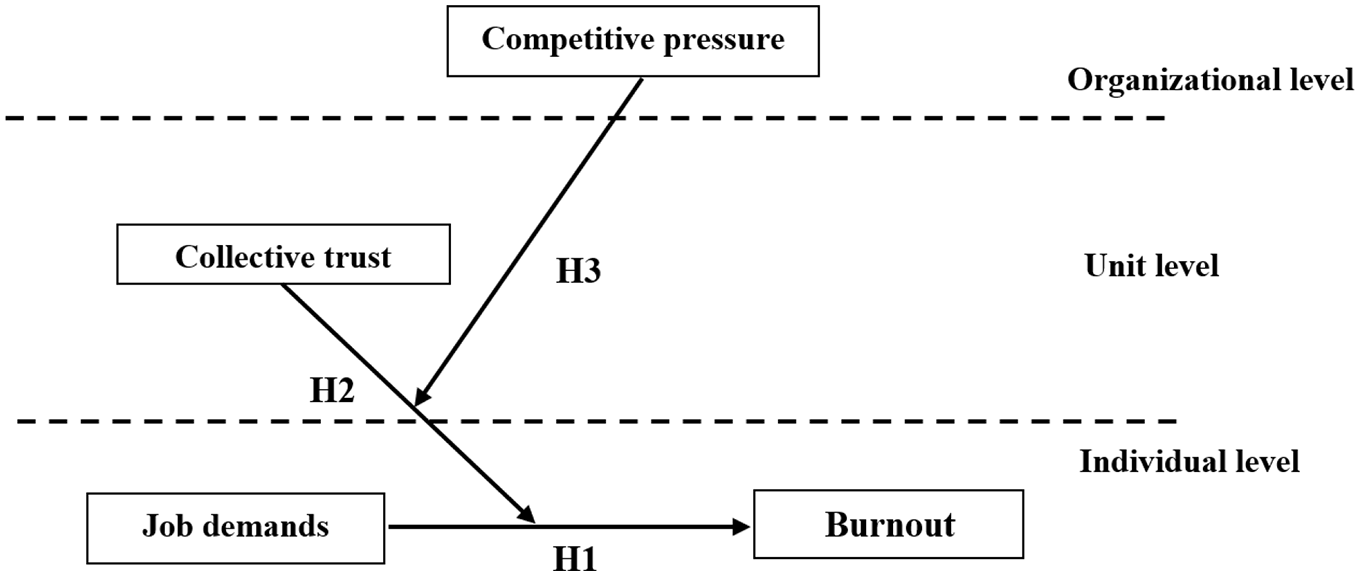
The multilevel model with hypotheses.
Job demands and burnout
The rapidly accelerating pace of life, irregular working hours, and increasing knowledge requirements (European Agency for Safety and Health at Work, 2014, 2016) place pressure on employees to push their capacity limits. Such increasing job demands are organizational factors that require effort and skills, and are associated with physiological and psychological costs (Demerouti et al., 2001). Workload, complex tasks, work speed, reduced control over performance, and conflicts are examples of job demands (Bakker and Demerouti, 2017, 2018; Häusser et al., 2010). Whereas high workloads and work complexity can be considered as challenge demands that motivate employees to perform well, conflicts with coworkers and work interruptions, for example, are hindrance job demands that undermine work performance (LePine et al., 2005). However, both challenge and hindrance job demands result in depleting employees’ energy resources, and as such, positively relate to employees’ burnout (LePine et al., 2004; Podsakoff et al., 2007).
According to the JD-R model (Bakker et al., 2004; Demerouti et al., 2001), excessive job demands tend to turn into job stressors when accomplishing those demands exceeds employees’ ability to cope with or control them and when certain job resources (e.g., coworker support) are limited (Schaufeli, 2017). Previous research has confirmed that under conditions of high job demands, employees generally work more, are less satisfied with their work–life balance, and have an increased likelihood of feeling depleted, stressed, and burned out (Eurofound and The International Labour Office, 2017). Job demands in terms of quantity, time pressure, uncertainty, and aspects of the emotional workload can cause health impairment if employees are exposed to such working conditions over a prolonged period of time (Bakker and Demerouti, 2018). Consequently, and in line with previous research findings, we hypothesize that job demands cause chronic exhaustion on the individual level, which increases the likelihood of burnout:
Hypothesis 1: Perceived job demands are positively related to employees’ burnout.
However, the relationship between job demands and burnout might not be this straightforward; the JD-R framework indicates the importance of both top-down and bottom-up processes related to the link between job demands and resources on one hand and burnout on the other (Bakker and de Vries, 2021; Bakker and Demerouti, 2017, 2018). Moreover, when challenging our assumptions, we found that, when predicting employee well-being, JD-R models have mostly been concerned with internal, individual-level job demands and resources (e.g., job control, supervisor’s support, interpersonal conflicts; Schaufeli, 2017) and less with external demands (e.g., competitive pressure). We anticipate that introducing top-down environmental variables, such as competitive pressure, when investigating internal perspectives in the form of individual-level job demands and unit-level collective trust, can further inform management on how effectively they can manage high job demands and prevent employees from burning out. We elaborate on these relationships more thoroughly in the next sections.
Job demands, collective trust, and burnout: A two-way interaction
Besides job demands and resources acting independently, the JD-R framework argues that they also can have combined effects in the sense that job resources mitigate job demands on strain (Bakker et al., 2014; Bakker and Demerouti, 2017, 2018). In line with this logic, we argue that increasing available job resources across levels of analysis may buffer the negative effects of individual-level job demands on burnout (Bakker and de Vries, 2021; Bakker and Demerouti, 2017, 2018).
Trust proactively builds committed cooperation (Li, 2015), and based on the JD-R framework, can be treated as a resource at workers’ disposal. Trust arises from the honest and cooperative behavior among coworkers based on the congruency of what is said and done (Whitener et al., 1998). Hence, the trustor must believe that the other party will fairly carry through with the promised action (Lambert et al., 2012).
Previous research has pointed out the importance of multi- and cross-level perspectives when studying trust in organizations, along with the need to understand trust both within and between organizational units (Schoorman et al., 2007). In our study, we follow Schoorman et al.'s (2007) conceptualization of trust, arguing that trust is an aspect of relationships rather than a dispositional, trait-like construct, and hence examine aggregated, collective trust at the unit level (Shamir and Lapidot, 2003). Trust at the higher levels refers to the degree of trust individuals collectively share within a unit, with a sufficient consensus (Fulmer and Gelfand, 2012). Zhang et al. (2008) further note that trust “is a fundamental ingredient in any positive and productive social process” (p. 111) and can provide a supportive environment by creating solidarity when tasks become too demanding to handle individually. Accordingly, we examine how employees’ perceived trust in their immediate coworkers (work units) impacts the relationship between job demands and burnout. Messick's (1999) appropriateness framework states that individuals’ social behavior is influenced by their interpretation of the appropriate conduct in a given social context. Indeed, employees are most like to accurately report collective trust in relation to their immediate work settings (i.e., their work units). Hence, the perception of shared trust informs an employee that responsible behavior is expected in a given environment and that other employees are likely to behave in the same manner (Burtscher et al., 2018).
Trust might be especially important when individual job demands are high because all unit members’ contributions and actions are relevant for an individual to be able to complete demanding tasks (Wageman, 1995). Thus, the effects of job demands at the individual level may depend on the other unit members’ actions. In other words, unit-level collective trust will accordingly change individual perspectives on highly demanding work tasks (Dirks and Ferrin, 2001), and hence potentially leverage their effects on burnout. As we note, the JD-R framework indicates that job resources are particularly important when job demands are high and that employees can positively modify their working conditions in their units (Bakker and Demerouti, 2017, 2018). Despite challenging working conditions, if there is a shared (collective) unit-level trust, employees will be more likely to perceive their work goals as attainable (Halbesleben et al., 2014), given the expected coworkers’ reciprocal committed cooperation, help, and support.
High levels of unit-level collective trust help employees to respond more resiliently to work overload (Burtscher et al., 2018) because collective trust increases a collaborative atmosphere and the reliance on coworkers when job demands arise. Furthermore, trust enables more flexibility when managing job demands because it gives a sense of security, and reduces the need of monitoring the other party (Patel et al., 2017). This is because trust enhances confidence that work will be accomplished with the others’ help, providing a salient resource for employees to overcome high individual job demands, thereby decreasing the likelihood of burnout.
Given a lack of trust in the work groups, we predict a decrease in the management’s flexibility of work demands, owing to the lack of perceived security and accountability in the work teams. Within such a decreased collaborative atmosphere, employees can expect having to deal with job demands alone, owing to the lack of a collaborative atmosphere, which in turn, can lead to less individual resilience in the case of work overload and high job demands.
According to the JD-R framework, transparent employees who can proactively ask for support in critical times such as work overload and high job demands should be able to optimize between job demands and their capability to cope with demanding work (Bakker, 2015). By contrast, when the collective trust is low, an individual will feel less secure and confident in other’s intention to complete the demanding task. Consequently, in comparison with the high level of collective trust, when unit-level collective trust is low, an individual will perceive job demands as more stressful, which can eventually result in burnout:
Hypothesis 2: Unit-level collective trust moderates the relationship between job demands and burnout, making it weaker in units characterized by high levels of collective trust.
Competitive pressure: A three-way interaction
Conditions predicting employee burnout are likely dependent on the nature of combined demands and resources (Crawford et al., 2010; Mazzola and Disselhorst, 2019) across various levels at work. As noted earlier, competitive pressure may qualify for both strain and motivation, potentially resulting in positive and negative work-related outcomes (see Lewin and Sager, 2007; Patel et al., 2017; Tijdink et al., 2013). According to the JD-R framework, an individual dealing with a job demand (e.g., at individual level) may deplete their available resources, making employees unable to deal with the potential additional job demands from the top, and finally resulting in burnout. Thus, it is valid to ask: How many job demands can an employee take on and how can available job resources support these employees? Accordingly, we investigate if high individual-level job demands may be optimized by high levels of collective trust in units when organizational-level competitive pressure is also high.
Competitive pressure exists in situations in which multiple organizations are producing similar or competing products or services (Oliver, 2004). It can be advantageous for organizations’ research and development processes and for innovative product development (Boone, 2000). However, increased competitive pressure may be problematic in other respects, such as pressure to reduce costs can sometimes motivate people to resort to unlawful practices (Baumann and Friehe, 2016). It is worth noting that competitive pressure is distinct conceptually from internal competitive climate, which has been investigated within the JD-R framework (see Jaworski and Kohli, 1993; Spurk et al., 2021); further, that the link between external competitive pressure and employee well-being may not be as inconsistent as it appears. From an organizational perspective, the internal management system reflects external competitive pressure via a bundle of policies and practices placed on the employee (Albrecht et al., 2015; Johns, 2006; Mowday and Sutton, 1993). From an individual perspective, to sustain external competitive pressure that is internally induced, work must be intensified to keep up with new developments and maintain the competitive advantage (Halawi et al., 2005; Rahimli, 2012). Moreover, employee layoffs are a traditional method of dealing with reduced firm profitability owing to competitive pressure (Allan and Loseby, 1993), which can evoke in employees a fear of layoffs, decreased perceived job security, and increased internal competition. This can interplay with trust within working units, increase job demands, and create feelings of being stressed and burned out at work (Lewin and Sager, 2007; Eurofound and The International Labour Office, 2017; Tijdink et al., 2013).
The remedy for externally imposed competitive pressure might lie in strong social ties and high levels of internal trust. In fact, competitiveness in global industries increasingly requires developing trusting relationships within organizations (Huff and Kelley, 2003). However, the levels of trust vary across units within the organization because management systems reflect external competitive pressure and affect how an organization’s members are committed to the promised actions between each other. In other words, escalating external pressure to remain competitive may stimulate either collaborative or competitive behaviors among employees (Albareda, 2013; Hernaus et al., 2019). In these situations, the magnitude of competitive pressure may interplay with the effective levels of collective trust in units, moderating the effect of job demands on well-being.
This line of argumentation is in line with JD-R theory, which argues that workers will feel energized when high job demands, such as organizational-level competitive pressure, are combined with job resources, in our study unit-level collective trust (Tadic et al., 2015). However, in our model, it is particularly important to explore further if workers will still feel equally energized when they must manage additional job demands at the individual level (a double-edged sword dilemma). In other words, when job demands at the individual level are already high, employees will use all available resources to manage these job demands, which will make them incapable of dealing with additional job demands, such as competitive pressure from the top (Bakker and Demerouti, 2017). Thus, creating extra pressure from the top when job demands at the individual level are high and resources (collective trust) are depleted can lead to employees’ burnout (Bakker, 2015). Therefore, the important question is whether and to what extent the interaction of job demands with collective trust depends on the magnitude of competitive pressure, and finally, how such interaction affects employees’ psychological well-being.
Figure 2 provides an overview of four possible scenarios underlying our cross-level, three-way interaction, which we conceptualize below.
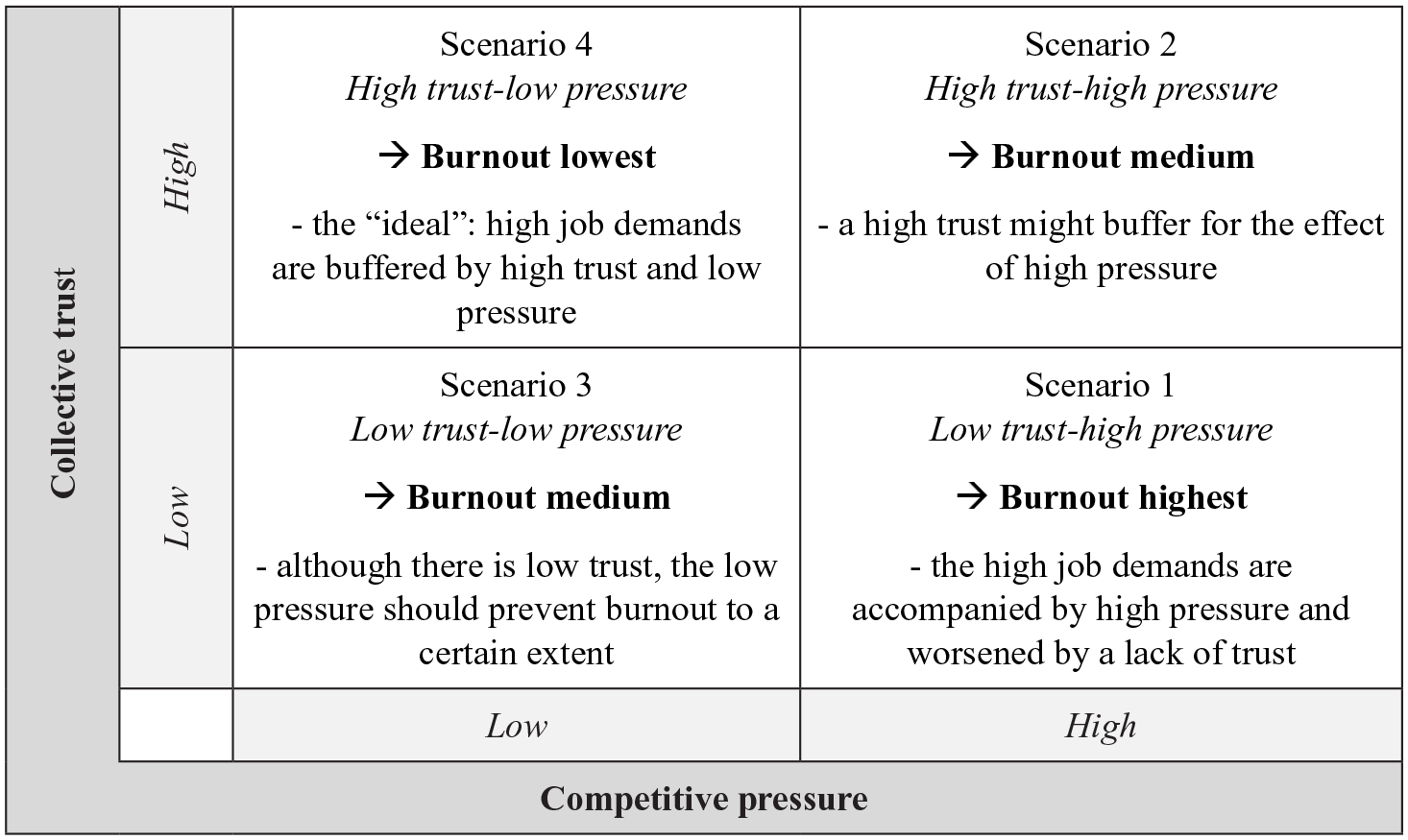
Burnout by different job demands, collective trust, and competitive pressure conditions.
High competitive pressure – low trust
In organizations with high competitive pressure, high uncertainty can influence the effects of mutual trust (Adobor, 2006). In such conditions, employees can become more competitive. When employees fear for their jobs, they can start to develop mistrust in management because the lack of job security negatively impacts the psychological contract between the employee and employing organization (Rousseau, 1989). Further, coworkers might be increasingly seen as competitors for scarce jobs. In such a condition, employees’ expectations that the other party will perform actions important to the trustor are being violated, thus harming positive relationships and duties at work (Harvey et al., 2003; Schoorman et al., 2007). The lack of trust can also be a stressor (Lambert et al., 2012), and when combined with high competitive pressure, may lead to employee frustration owing to work overload. The interaction between high competitive pressure and low collective trust can considerably enhance the negative effects of job demands on burnout owing to the lack of resources mutual trust generates. Hence, in this situation, we expect that high organizational-level competitive pressure, in conjunction with low levels of collective trust in units, will increase the deleterious effects of employee-level job demands on burnout (see Scenario 1 in Figure 2).
High competitive pressure – high trust
When employees are able to maintain committed cooperation despite their exposure to high competitive pressure, the stimulating work environment can help them complete their work goals in a timely and successful manner (Burtscher et al., 2018). In the circumstances characterized by the uncertainty of constant competitive pressure, people may rely on collaboration and mutual trust, which reduces the need for formal agreements and other contractual complexities of organizational life (Dietz and Hartog, 2006). Trust enables more flexibility when managing job demands because it allows a sense of security, and reduces the monitoring of and control over another party in a highly competitive work environment where it becomes even more important to succeed (Patel et al., 2017). This is because trust enhances confidence that work will be accomplished with others’ help, providing a salient resource for employees to overcome high job demands. However, high collective trust may not buffer all negative effects of high job demands at the individual level because the competitive pressure from the top amplifies them. Thus, high unit-level collective trust might act as a buffer for the effect of high job demands, leading to moderate levels of employee burnout when competitive pressure at the organizational level is also high (see Scenario 2 in Figure 2).
Low competitive pressure – low trust
When uncertainty stemming from the competitive environment is low, people may not need high levels of mutual trust to reduce the harmful effects of high individual-level job demands on burnout. Trust requires a great deal of commitment among all parties involved (Yamagishi et al., 1998); thus, in an environment characterized by low competitive pressure, simultaneous engagement in trust creation may not be crucial (Bhattacharya et al., 1998). Here, collaboration among people may not be the most important job resource when dealing with high job demands. Therefore, employees may still be able to preserve some resources at the individual level when dealing with high job demands. Accordingly, when the competitive pressure and collective trust are low, we expect this to outbalance the increased risk of high job demands at the employee level and result in medium levels of burnout overall (see Scenario 3 in Figure 2).
Low competitive pressure – high trust
Lastly, when competitive pressure is low, we expect that employees with high levels of unit-level collective trust are less likely to negatively respond to high work overload and job demands at the individual level (Burtscher et al., 2018) because collective trust mitigates job insecurity (Jiang and Probst, 2016) and increases the collaborative atmosphere and reliance on coworkers when job demands arise. This is additionally supported by low competitive pressure that eliminates the intense competition among employees to succeed (Gould, 1996), thus fostering unit-level collective trust. Owing to the low competitive pressure, people decide to collaborate and simultaneously engage in committed cooperation (Li, 2015). In the condition of high collective trust and low competitive pressure, people will positively assess the demanding situation and favorably interpret other’s actions based on previous positive experiences and trust that all members will take the proper actions and complete the demanding work (Breuer et al., 2020). Indeed, the combination of low organizational-level competitive pressure and high unit-level collective trust should create the ideal scenario in terms of employees’ psychological well-being. High levels of trust within units buffers the negative effect of high job demands on burnout, and high competitive pressure within the organization does not jeopardize such a condition (see Scenario 4 in Figure 2):
Hypothesis 3: There is a three-way interaction among employee-level job demands, unit-level collective trust, and organizational-level competitive pressure, such that burnout is lowest in the condition of high job demands, high collective trust, and low competitive pressure.
Methods
Data collection and sampling
Data collection occurred as part of a large benchmarking project involving German companies in a range of industries (54% service, 28% production, 9% finance, 6% sales, and 3% manufacturing). Of the 135 companies that voluntarily applied to participate, 37 did not participate or failed to provide sufficient data, thus leading to an organizational response rate of 73%. Owing to other missing data on particular items, we adopted a list-wise missing value deletion procedure, and the final data sample consisted of 89 organizations. The participating companies varied in size, ranging from 12 to 2019 employees (M = 373). In line with the Podsakoff et al.'s (2003) recommendations for reducing the risk for common method bias, we obtained data from two sources: an employee survey and a human resource (HR) management survey.
Data were collected in three steps. First, the HR management at a given organization provided key information on the organization’s general characteristics, such as its number of employees and its affiliation with a particular industry to confirm organizations’ participation in the study. Second, employee survey data were collected to obtain information on the focal study variables. All members of the organization received an email invitation from the HR department, which featured a description of the study’s purpose as well as a Web link to a survey that an independent information technology company hosted.
On average, the participating employees were 40 years old (SD = 11.96, 38% female) and had been employed by the company for eight years (SD = 9.06).
Third, we asked a member of each company’s HR management to assess the company’s competitive pressure. Most members of the top management sample were male (90%), had worked an average of 13 years for his or her company (SD = 8.38), and on average was 49 years old.
Measures
Professional translators translated all survey items into German following a double-blind back-translation procedure to ensure semantic equivalence with the original English items (Schaffer and Riordan, 2003). All of these items are listed in Appendix 1. Unless otherwise noted, all measures were assessed on a 7-point Likert-type scale ranging from 1 (strongly disagree) to 7 (strongly agree).
Job demands
Job demands were measured by using four items adapted from the Dutch Questionnaire on the Experience and Evaluation of Work (Boschman et al., 2013; Van Den Tooren and De Jonge, 2008; Veldhoven et al., 2002). A sample item is: “Do you have to work very quickly?” (α = .84).
Burnout
Burnout was measured by using five items adapted from Maslach and Jackson (1981). Accordingly, a sample item is: “I feel burnt out from my work” (α = .91).
Collective trust
We measured unit-level collective trust by using three items adapted from Huff and Kelley (2003). Accordingly, a sample item is: “There is a very high level of trust throughout my organization” (α = .87). To validate the aggregation of individual-level measures to the unit level (using composition approaches with a referent shift), we calculated the intraclass correlations (ICCs). ICC(1) was .06, and ICC(2) was .19 (F = 1.19, p < .01). A perceived unit-level collective trust reflects employees’ composition of perceptions and is thereby de facto a unit-level construct measured using a referent shift approach (going from referring to an individual to referring to the unit; see Klein and Kozlowski, 2000).
Competitive pressure
The member of HR management who represented each company included in the sample assessed competitive pressure using a five-item scale adopted from Jaworski and Kohli (1993). A sample item is: “One hears of a new competitive move almost every day” (α = .70).
Control variables
We controlled for the following variables (at Level 1): age (as indicated in Brewer and Shapard’s [2004] meta-analysis in relation to burnout); gender (as pointed out in Purvanova and Muros’s [2010] meta-analysis); and the number of weekly work hours, as this variable could significantly influence objective and subjective levels of burnout. At Level 2, we controlled for unit size (as perceptions of trust within units could depend on their sizes; Burke, 1996).
Analytical procedures
Table 1 reports the descriptive statistics of all variables analyzed in our study. Fit indices for the multilevel confirmatory factor analysis suggested a good four-factor model fit (χ2 [56] = 916.445, p < .000; Comparative Fit Index (CFI) = .968; Tucker Lewis Index (TLI) = .957; Root Mean Square Error of Approximation (RMSEA) = .05; Standardized Root Mean Square Residual (SRMR) within = .038; SRMR between = .084).
Means, standard deviations, alpha reliabilities, and correlations among variables.
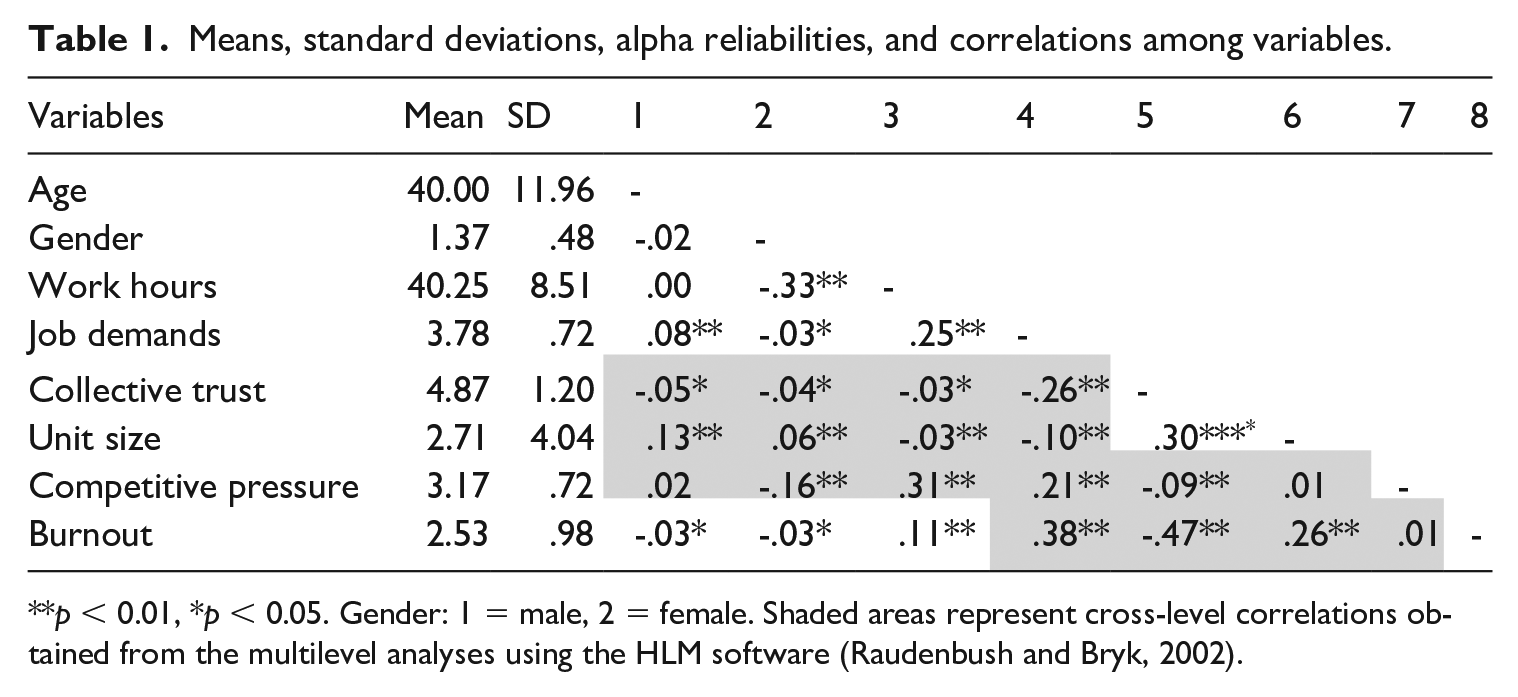
p < 0.01, *p < 0.05. Gender: 1 = male, 2 = female. Shaded areas represent cross-level correlations obtained from the multilevel analyses using the HLM software (Raudenbush and Bryk, 2002).
The employees in our sample were grouped into work units and organizations, thereby leading to a three-level, nested dataset. To test our hypotheses, we applied a multilevel analysis using hierarchical linear modeling via HLM version 7.0 (Raudenbush and Bryk, 2002) with a restricted maximum likelihood estimation. This approach allowed us to model the non-independence in our dependent variable by partitioning its variance into within and between components. The predictor variables were grand-mean centered 1 to reduce unnecessary multicollinearity between the linear terms and their quadratic counterparts as well as the direct and interaction terms (Aiken and West, 1991). All of the equations applied at each level can be found in Appendix 2.
Results
We present the results of the multilevel analysis in Table 2. We began with the intercept-only (null) model that predicted burnout (Model 1). In the second step (Model 2), we entered individual-level control variables. In the third step (Model 3), we added the individual-level predictor (job demands), which was positively related to burnout (γ = .46, p < .01), thus supporting Hypothesis 1. In the fourth step (Model 4), we added the cross-level direct and moderating effects of unit-level collective trust as well as a unit-level control (unit size). Unit-level collective trust exhibited a significant direct cross-level effect (γ = −.10, p < .01) as well as a significant cross-level moderating effect on the job demands–burnout relationship at the individual level (interaction term = −.05, p < .01). The resulting plot portrayed in Figure 3 illustrates how the positive relationship between job demands and burnout becomes less positive in conditions of high unit-level collective trust (simple slope gradient at high levels of collective trust = .48, t = 10,733, p < .01; at low levels of collective trust = .45, t = 10,062, p < .01), thus supporting Hypothesis 2.
Results of the multilevel analysis for the cross-level interactions predicting burnout.
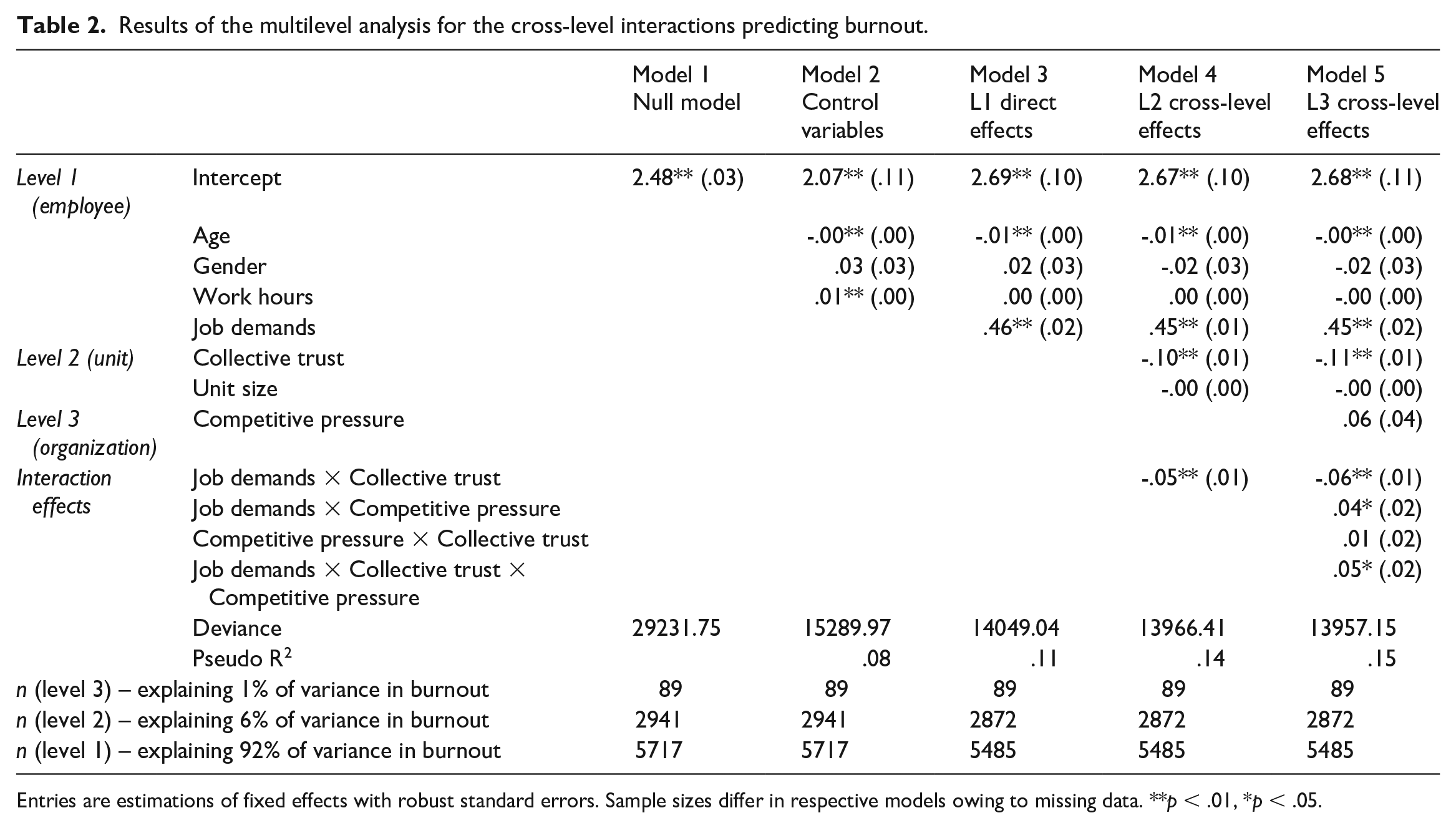
Entries are estimations of fixed effects with robust standard errors. Sample sizes differ in respective models owing to missing data. **p < .01, *p < .05.
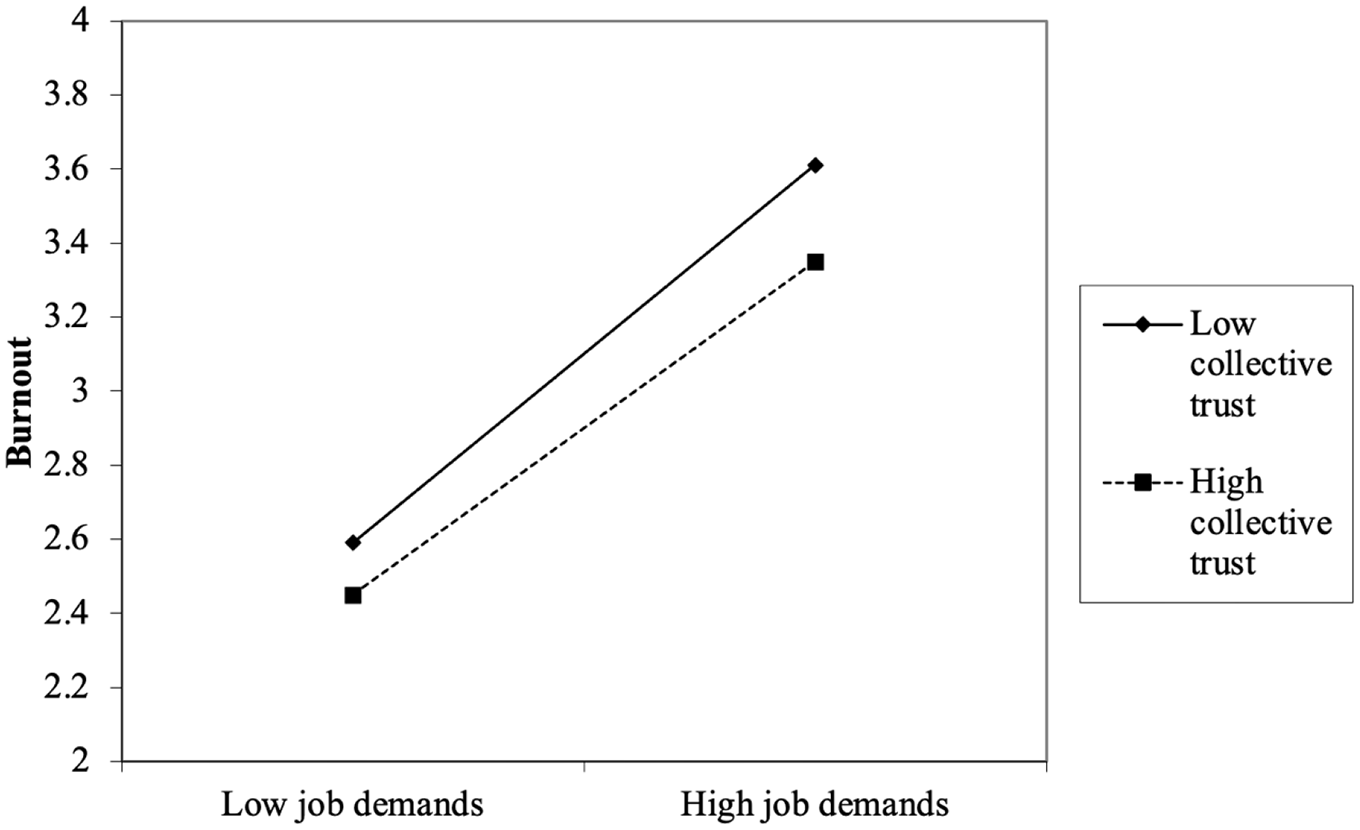
The relationship between job demands and burnout by the level of collective trust.
In the final, fifth step (Model 5), we added the three-way interaction of the organizational-level competitive pressure as well as all of the corresponding two-way interactions needed to calculate the three-way interaction. The cross-level, three-way interaction was significant (three-way interaction term = .05, p < .05). The three-way interaction plot portrayed in Figure 4 illustrates how burnout was lowest in the condition of high job demands, high collective trust, and low competitive pressure, thus supporting Hypothesis 3. Simple slope analysis revealed that the slope of line 2 for high collective trust and low competitive pressure was significantly different from the slopes of the other three lines. All slopes were significantly different from zero (line 1 gradient = .45, p < .01; line 2 gradient = .38, p < .01; line 3 gradient = .49, p < .05; line 4 gradient = .47, p < .05). 2
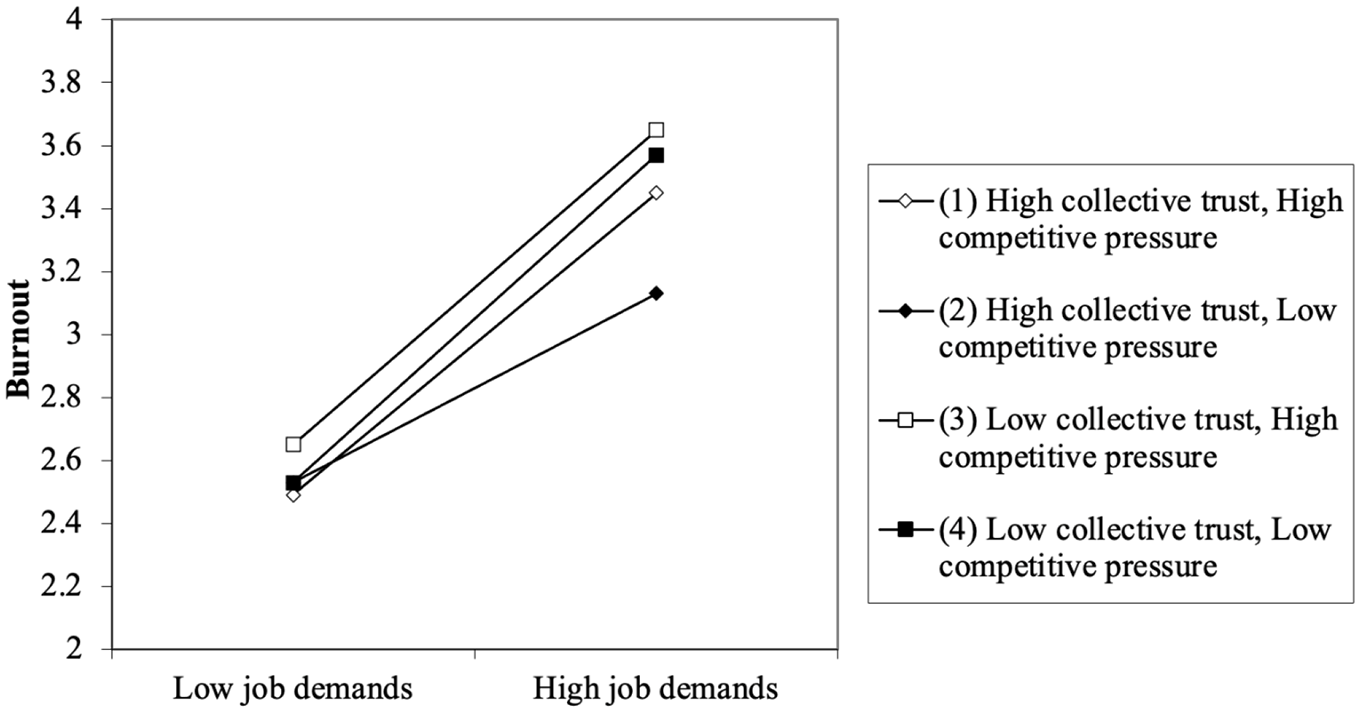
The relationship between job demands and burnout by the level of collective trust and competitive pressure.
Discussion
Competitive pressure increases the psychological costs stemming from workload acceleration, job insecurity, a lack of interpersonal relationships, and communication issues (Cox, 1993), which may become even more pronounced as workplaces evolve and change over time. Ambitious personal goals (e.g., to excel in skills so as to stay competitive in the job market) push people to work long hours and relinquish a good deal of flexibility to increase their earnings and achieve their goals (Hirschi, 2018; Tawfik et al., 2018). Consequently, increasing concerns related to employees’ occupational well-being are being raised. Thus, our investigation aimed to better understand the emergence of burnout by integrating multiple levels of predictors in research using the JD-R model. Our results from 5485 workers nested in 2872 units in 89 German firms supported all three of our hypotheses: The multilevel analysis of three-way, cross-level interactions confirmed that job demands were positively related to burnout at the individual level. At the unit level, collective trust moderated the link between job demands and burnout. Moreover, results supported a three-way interaction among job demands, collective trust, and competitive pressure in the study. Specifically, we found that in the case of high job demands, burnout was lowest in the condition of high collective trust and low competitive pressure, meaning that such a context can successfully outbalance high job demands.
Theoretical contributions
Our study makes two important contributions to the extant research. First, we complement the existing literature on burnout predictors (see Jackson et al., 1986; Lee et al., 2011) by focusing on the interplay of individual-, unit-, and organizational-level factors. High levels of job demands can be strenuous and contribute to workplace stress, burnout, and related occupational health issues. Specifically, when job demands are accumulated form various levels within the organization, they may turn into harmful job stressors, thus causing serious health issues, such as burnout. Likewise, prior research has shown that job resources buffer the negative impact of job demands on burnout (Bakker et al., 2005). In fact, job resources gain full potential when high job demands pose a challenge for employees. Our study adds another layer of comprehending the complexity that needs to be accounted for when considering the organizational reality of contextual factors unfolding at and across multiple levels. We have shown that organizations do not need to necessarily reduce high job demands at the individual level. However, this is possible only if high mutual trust in units supports such a condition and is not reinforced by competitive pressure at the organizational level. We complement existing research by adding unit-level collective trust as a preventive factor, and organizational-level competitive pressure as a risk factor to the series of antecedents of burnout at work. This way, we contribute to a better understanding of job demands and resources’ cross-level interactions and their effects on burnout. As our work has shown, even if these interactions occur at higher levels, they are instrumental in shaping mental health and well-being at the individual level.
Second, we complement the current research on burnout applying the JD-R model (see Bakker et al., 2005; Crawford et al., 2010; Schaufeli et al., 2009) by expanding this framework across multiple levels. Job demands can potentially act as a double-edged sword and be interpreted either as a challenge or a hindrance by demonstrating negative and positive effects on workers’ well-being under specific conditions (see Cavanaugh et al., 2000; Crawford et al., 2010; Giebe and Rigotti, 2020; Mazzola and Disselhorst, 2019; Widmer et al., 2012). This research is also a response to the call to uncover the specific conditions under which job demands act as a hindrance versus a challenge (Bakker, 2015; Bakker and Demerouti, 2017). Such an approach highlights the importance of considering complex cross-level interactions among the individual-, unit-, and organizational-level phenomena that shape individuals’ well-being at work. With our investigation, we respond to calls and theoretical advancements that JD-R scholars (see Bakker and Demerouti, 2017, 2018; Demerouti and Bakker, 2011) have made to integrate multiple levels of burnout in research using the JD-R model. As previously noted, by viewing organizational-level competitive pressure in combination with job demands at other organizational levels, we are able to ascertain their cumulative, combined effects in a more systemic, embedded manner. What might be considered an energizing job demand at the individual level, can turn into a hindrance job demand when combined with effects at the across multiple organizational levels—hence our notion of the “double-edged sword.”
In addition, we show that another optimum might exist when job demands are high. Specifically, we argue that job demands should not be looked at in isolation, but through considering contextual boundary conditions, which also provides insights into how individuals interpret specific job demands and resources at work as well as how these affect their well-being. In this vein, we show that unit-level collective trust could mitigate the negative effects of high job demands at the individual level on burnout because the work was potentially shared among team members. However, when competitive pressure from the top, along with job demands at the individual level, was high, trust did not have the same positive effect. This might be because people start to fear for their work positions owing to the high competitive pressure, and therefore are less open for collaboration and overall share less trust. Hence, they have less job resources at their disposal when facing high job demands from the top.
In sum, our study indicates that organizations may persevere with high job demands at the individual level, thus keeping their employees challenged only if there is a sufficient level of collective trust in units and when competitive pressure organizations exert is kept under control. The current study shows that collective trust can mitigate the effects of high job demands, whereas competitive pressure exacerbates their influence. Employees and organizations can do a lot to proactively cope with high demands by mobilizing resources in units and by keeping demands at higher organizational levels under control, thereby ensuring healthy and safe work environments.
Practical implications
Our study has important implications for managerial practice.
First, it informs organizations about the development of a stimulating but not overwhelming amount of job demands, accounting for contextual conditions that might outbalance these job demands at various levels. Hence, in a highly competitive organizational setting, a diminished level of interpersonal trust might be present, meaning that no higher-level job resources can be available to outbalance individual-level job demands. Generally, an overload of job demands positively predicts burnout, indicating that managers should be cautious about distributing demands across jobs. They should do this not only based on the individual level, but also considering higher-level factors, such as team constellations and organizational settings. Research indicates the importance of linking the constructs' relationships at various levels as well as using the JD-R framework (Bakker and de Vries, 2021; Bakker and Demerouti, 2017, 2018). We show that the remedy for actively coping with high job demands lies in mobilizing resources in the form of mutual trust, which provides additional insights into the dynamics of a healthy work environment. Hence, single-level analysis may be biased without accurately incorporating conditions at higher levels into models that explain organizational realities (Dunn et al., 2014).
Hereby, our study confirms that the recently advanced JD-R framework can be used as a valuable tool in practice to reduce burnout at work. Management needs to be mindful of how the number of demands (emotional, physical, mental, work pressure, work ambiguities, changes in tasks, and uncertainty) needs to be assigned specifically to a particular employee in a given work situation and adjusted accordingly. Furthermore, job demands should not be viewed in isolation. Specifically, as our results imply, contextual cues at higher levels matter. A key unit-level job resource that can buffer against high job demands and burnout is collective trust. The literature on trust informs us of several important practices (e.g., participation in decision-making, a delegation of control, information sharing) that managers can adopt to facilitate interpersonal trust (Lau et al., 2014). Similarly, a useful guideline for managers when building team trust can involve using open communication and feedback systems (Zhou et al., 2009). When building mutual trust, organizations can think about introducing emotional intelligence (EI) training methods to their employees. Research indicates that EI is effective in developing positive relationships among people and in building trust in general (Rezvani et al., 2019). EI can be measured and fostered with nudges distributed via mobile apps (e.g., Headspace). In line with our results, we encourage management to utilize these solutions to outbalance potentially high individual-level work demands.
Second, organizations can foster employee engagement and therefore gain competitive advantage (Albrecht et al., 2015) simply by nurturing open communication’s policies and practices. In practice, the tendency might be to avoid disclosing to employees challenging situations, which might be the wrong strategy because people will still know and feel it via high job demands or elevated levels of stress stemming from harsh competition. A more useful strategy might lie in transparent communication about the market situation, for example, which in turn would strengthen people’s confidence and self-efficacy as a personal resource (Bakker and Demerouti, 2007, 2018) when coping with the situation. Moreover, open communication facilitates shared trust and collaboration, making people believe that personal goals are positively linked to collective goal attainment. In contrast, in a situation of low trust and competition, people perceive that their goals are mutually exclusive and that an individual’s goal attainment makes the other person’s goal attainment less likely to be achieved. Hence, in situations of open communication and high trust among unit members, mutual goal attainment becomes an instrumental resource buffering against job strain.
Third, situational cues influencing perceptions and behaviors at the employee level can originate from the organizational level. Our study indicates that despite the pressure to perform well in the market, organizations should actively try to lower employees’ perceptions of competitive pressure. Signaling plays an important role in this, particularly top-down signaling by C-level management and executives. They also play an integral part in sending situational cues that impact collective trust in units and thereby influence job demands and ultimately preventing or enhancing employee burnout. However, as we outlined above, to build on the positive energy within their organizations, managers should nourish open communication about the competitiveness situation. Involving management and other staff members in problem solution is important for two reasons. Challenging situations (e.g., high competition) elevate employees’ engagement and activation (Albrecht et al., 2015; Lazarus, 1991). If strong social ties build confidence that the current situation can be overcome, positive activation (via positive stress; Folkman, 2008) will be achieved and increase employees’ engagement. Here, managers can frame the potential danger as both a challenge and an opportunity to learn and grow from adversity. Such framing does not mean sugarcoating the upcoming danger; rather, it promotes employees’ confidence, strengths, and abilities so they can meet and overcome the upcoming challenge together (Bruch and Vogel, 2011).
Limitations and future research suggestions
As any, our study is not without limitations and opens up avenues for further research. As the data were collected in a cross-sectional manner, we cannot make explicit causal claims regarding the direction of our proposed relationships. Despite this, our model’s theoretical grounding, logic, and the multilevel nature reinforce our arguments, thus making reverse causation rather unlikely in our scenarios. Nevertheless, future studies replicating our model could do so by adopting a longitudinal or experimental approach, which would enable the statistical testing of our uncovered relationships’ causality.
Another limitation is related to our treatment of trust. It is conceptualized and operationalized as a unit-level construct. However, the scale that was used to measure it pertains to the organization, although it also targets trust in collectives. Our approach was based on how employees are likely to report collective trust in relation to their immediate work settings (i.e., their units, teams, and work groups), which we captured as trust in management as well as management’s trust in employees. This is why we believed it made the most sense both theoretically and logically to treat collective trust at the unit level, not the organizational level, because the levels of perceived trust can vary significantly across units within the same organization (Chiu and Chiang, 2019; Clapp-Smith et al., 2009; Crossley et al., 2013). Nonetheless, we do recognize this as a limitation, and we urge future research to pay extra attention to aligning the theoretical considerations, conceptualizations, and operationalization/measurement of trust as a unit-level construct.
Future research could also explore how a multilevel context in organizations contributes to shaping burnout experiences dynamically over a longer period as well as beyond the individual employees' perceptions at work. When burnout occurs, it rarely happens in a vacuum: If an employee burns out, this person is likely to produce a reduced quality of work, if any. This creates increased work demands for other team members owing to the reduced quality of work, wherefore burnout might spread to other employees, thus creating a looping cycle (Lambert et al., 2012). In work teams, this can involve feelings of work overload, emotional exhaustion, cynicism, and poor productivity (Maslach, 2011; Maslach and Leiter, 2008). Team members experiencing burnout often find themselves in a state of helplessness and hopelessness (Espeland, 2006; Lee and Ashforth, 1993) owing to the chronic stress associated with high work demands for which resources are insufficient (West et al., 2018). Thus, for effective prevention efforts, organizations must detect burnout's causes and symptoms at the early stages (Maslach et al., 2012; West et al., 2018) before it loops to higher unit or organizational levels. As a result, future research examining burnout's context and manifestations over a longer period of time is necessary.
Conclusion
Previous studies that applied the theoretical framework of the JD-R model did much to explain how individual-level job characteristics and individual factors contribute to burnout. However, the context of this individual-level relationship remained largely underexplored and thus motivated our current study exploring contextual contingencies in the relationship between job demands and burnout at work. Our results inform management research and practice by painting a more coherent and complete picture of individual-, unit-, and organizational-level contingencies that predict burnout. They also enhance our understanding of how to design not only jobs, but also organizational settings that prevent individuals from burning out. Through this, we specifically focused on how to mitigate conditions when job demands are high, which is a pressing reality at many of today’s workplaces and hence is of high importance to management research and practice.
Footnotes
Appendix 1
The below items were measured using a 7-point Likert-type response scale ranging from strongly disagree (coded as 1) to strongly agree (coded as 7).
Competitive pressure (Jaworski and Kohli, 1993): (a) Competition in our industry is cutthroat; (b) There are many “promotion wars” in our industry; (c) Anything that one competitor can offer, others can match readily; (d) Price competition is a hallmark of our industry; (e) One hears of a new competitive move almost every day.
Collective trust (Huff and Kelley, 2003): (a) There is a very high level of trust throughout this organization; (b) In this organization, subordinates have a great deal of trust for managers; (c) Managers in this company trust their subordinates to make good decisions.
Job demands (Boschman et al., 2013; Veldhoven et al., 2002): (a) Do you have to work very fast?; (b) Do you have to work extra hard to complete something?; (c) Does your work demand a lot of concentration?; (d) Do you have to work with a lot of precision?
Burnout (Maslach and Jackson, 1981): (a) I feel emotionally drained from my work; (b) I feel used up at the end of the workday; (c) I feel fatigued when I get up in the morning and have to face another day on the job; (d) Working with the people all day is really strain for me; (e) I feel burn out from my work.
Appendix 2
Acknowledgements
The authors would like to thank Professor Robert G Lord and Christopher Giebe for helpful comments on an earlier version of this manuscript. We are also thankful to the handling editor, Professor Chidiebere Ogbonnaya, and three anonymous reviewers for constructive feedback and guidance during the review process.
Funding
The author(s) disclosed receipt of the following financial support for the research, authorship, and/or publication of this article: This research was supported by the Slovenian Research Agency (Core Project Funding J5-2555 and P5-0410).
