




Abstract
Drawing on insights from the sociology of work, this article contributes to job demands–resources (JD-R) theory by arguing that collective employee voice should be considered within the framework as an antecedent of job demands and job resources. An empirical test is offered to substantiate the theoretical argument, hypothesizing that collective voice – measured as trade union influence at the workplace level – reduces job demands and increases job resources. Based on the notion that some jobs may be inherently demanding, an additional hypothesis posits that collective voice balances demands with job resources by supplementing resources particularly where demands are high. Drawing on data from the European Social Survey covering 27 countries, results of multi-level analyses reveal that while not associated negatively with job demands, collective voice enhances job resources, particularly where demands are high. On this basis the article encourages further sociologically informed analyses of the JD-R model.
Introduction
Job demands–resources (JD-R) theory (Demerouti et al., 2001) is applied frequently in studies of contemporary working life (see Bakker and Demerouti, 2017 for a review). According to the theory, which has its roots in occupational psychology, job resources such as job training and autonomy are central aspects of the work climate as they enhance employee engagement and capacity, as well as counteracting some negative effects of job demands, such as a high workload (Bakker and Demerouti, 2017; Llorens et al., 2006; Van den Broeck et al., 2010, 2012). This article argues that collective dynamics can be integrated usefully in the JD-R framework, contributing to a line of research drawing connections between collective employee voice and the literature on employee well-being (Bryson et al., 2013; O’Brady and Doellgast, 2021). In a sociological perspective, key factors within the JD-R framework can be regarded as the subject of contested terrain concerning the social relations at work and control over the labour process (Edwards, 1979). Importantly, trade unions function to alter such social relations, providing employees with an independent and collective voice (Freeman and Medoff, 1984; O’Brady and Doellgast, 2021; Wilkinson et al., 2020) through which they may extend their autonomy and influence over organizational activities. Contributing to JD-R theory with an interdisciplinary perspective by incorporating insights from the collective voice literature, embedded in broader sociology of work debates, this article argues that JD-R theory can be developed by considering collective voice as an antecedent of job demands and job resources. An empirical analysis is offered to test these arguments, whereby collective employee voice – measured as trade union influence at the workplace level – is posited as an important mechanism within the JD-R framework.
The article assesses two main hypotheses pertaining to the relevance of collective voice to JD-R theory, proposing that collective voice, as an antecedent, reduces job demands, and increases job resources. Based on the notion that some jobs may be inherently demanding, an additional hypothesis examines whether collective voice renders demands more tolerable by supplementing job resources particularly where demands are high – thus, in effect, balancing demands with resources. The article addresses what Van den Broeck et al. (2010: 739) label challenging job demands (job challenges), using a self-reported measure in which employees state whether their job requires them to work very hard. The resources of concern are structural job resources (as distinguished from social job resources, such as social support, see Tims et al., 2012), which include development opportunities and employee autonomy (Tims et al., 2012: 177). The article looks specifically at employee control over the pace, the scheduling and the organization of work, as well as wider influence over policy decisions about the activities of the organization. Job training is also included as a job resource.
The empirical analyses are based on European Social Survey data (ESS Round 5, 2010), covering 16,407 individuals in 27 European countries. Results of hierarchical regression analyses (Hox et al., 2017) reveal that collective voice, while not associated negatively with job demands, tends to have a positive effect on job resources, particularly where demands are high. These findings substantiate the argument that collective voice, as an antecedent of job resources, should be construed as an important mechanism within the JD-R framework. More broadly, the findings demonstrate the utility of a sociologically informed lens on the JD-R model, contextualizing processes that risk being abstracted from the social relations at the workplace. Future research is encouraged to build on this contribution by examining further the role of collective voice within the JD-R model, such as pertaining to voice effects on other forms of job demands.
The following section presents a brief overview of JD-R theory, linking the concept of collective voice with job demands and job resources and developing the hypotheses. Then follows a discussion on data and methods used, after which the results of the analyses are presented. Theoretical and practical implications of the findings are discussed subsequently.
Literature review
JD-R theory divides characteristics of the work environment into two broad categories: demands and resources (Demerouti et al., 2001). Demands are efforts associated with physiological and/or psychological costs, whereas resources refer to aspects of the job that are functional in achieving work goals, notably including those which can reduce the physiological and psychological costs associated with job demands (Bakker and Demerouti, 2017). Importantly, in a sociology of work perspective, factors conceived in JD-R theory as job demands and job resources can be regarded as the subject of contested terrain concerning the social relations at work and control over the labour process (Edwards, 1979). Central to such a view is a dialectic between management’s interest to control the organization of work, and employees’ efforts – in the parlance of JD-R theory – to increase their ‘job resources’ (i.e. to extend their autonomy and influence over organizational activities). Owing to a great deal of variation in the opportunities for employees to do so individually, many workers gain from organizing collectively (Crouch, 1982; Hyman, 1989: 39–40; Wright, 2000). In this connection, trade unions can be conceived of usefully as a form of collective employee voice (Freeman and Medoff, 1984), a broader concept with significant implications for JD-R theory.
Wilkinson et al. (2020: 5) define employee voice as ‘the ways and means through which employees attempt to have a say, formally and/or informally, collectively and/or individually, potentially to influence organizational affairs relating to issues that affect their work, their interests, and the interests of managers and owners’. Employee voice is an elastic concept, subject to various interpretations across academic disciplines. In what Wilkinson et al. (2020: 4) describe as an employment relations approach to voice, focus is on collective, formal structures and, in contrast to what is common in the organizational behaviour literature (Kaufman, 2015: 28; Wilkinson et al., 2020: 3), divergent interests of management and workers. Many argue that independent and collective forms of voice, on account of their ability to impose coordinated sanctions on employers, are more effective in terms of providing workers with influence over conditions at work (Crouch, 1982; Freeman and Medoff, 1984: 8–9; O’Brady and Doellgast, 2021), particularly concerning issues in which mutual gains are less immediate (Kaufman, 2015: 34). As Freeman and Medoff note, independent voice institutions such as unions draw on their collective strength to constrain arbitrary managerial practice: In the union setting [. . .] the union constitutes a source of worker power, diluting managerial authority and offering members protection through both the ‘industrial jurisprudence’ system [. . .] and the grievance and arbitration system, under which disputes over proper managerial decision making on work issues can be resolved. (Freeman and Medoff, 1984: 11)
Such countervailing influence may run through a variety of mechanisms, ranging from institutional channels to custom and practice and the more informal micro-level day-to-day politics of the workplace (MacKenzie and Martínez Lucio, 2005).
That said, voice is hardly present in JD-R debates. In the extent to which voice is covered, focus tends to be on direct and individual voice, construed as one among several resources (Conway et al., 2016: 902; Holland et al., 2017; Li et al., 2021; see also Barry and Wilkinson, 2021). Given the arguments outlined above, there are strong reasons to consider collective voice as an important mechanism within the JD-R framework, notably as an antecedent of job demands and job resources. Encompassing more than employee participation, such voice mechanisms are manifestations of the collective agency of employees, through which they can alter the social relations at work (Bryson et al., 2013: 1008; Hyman, 1989: 38; Simms, 2017) and thereby via a variety of channels ranging from collective agreements to more militant actions in turn potentially reduce job demands and augment job resources such as autonomy and training. By arguing explicitly for the integration of collective voice in the JD-R model, the present article contributes to a line of research that draws connections between insights in the collective voice literature and studies on organizational behaviour and employee well-being, including recent engagement with JD-R theory (Bryson et al., 2013; O’Brady and Doellgast, 2021). In order to demonstrate the significance within the JD-R framework of collective voice mechanisms, this article examines the effects of union influence at the workplace level; while unions are not synonymous with collective voice, they are the dominant form (Freeman and Medoff, 1984; McBride and Martínez Lucio, 2011).
First, there is cause to expect employees to utilize their collective voice to reduce, or at least limit the ability of the employer to increase, the demands placed upon them (e.g. Adăscăliței et al., 2022; Bacon, 1999; Beynon, 1973; Green, 2004; Green et al., 2022) – resulting in a negative voice effect on job demands. Indeed, as an antecedent, the literature on work intensity and intensification frequently highlights the importance of union influence as a countervailing force in this regard (e.g. Adăscăliței et al., 2022; Bacon, 1999; Green, 2004: 731). As O’Brady and Doellgast assert: unions are on the front lines of efforts to combat well-established causes of stress at work. [. . .] Union shop stewards enforce collective agreement provisions, engage in labor-management cooperation over key areas of mutual concern, and initiate campaigns designed to alleviate stress in the workplace. (O’Brady and Doellgast, 2021: 307)
Similarly, Green et al. (2022: 475) argue that unions represent an important counterbalance against work pressure and intensification, accordingly finding some evidence that union recognition has a negative effect on the intensity of work. The same authors conclude on a broader note that the diminution of collective voice during recent decades is likely to be a contributing factor to the widely recognized intensification of work across Europe (Green et al., 2022: 480; see also Adăscăliței et al., 2022; Green and McIntosh, 2001). With regard to the potential mechanisms involved, Bacon (1999: 7) offers a few case-based insights by documenting how the de-recognition of unions can be aligned closely with a management strategy to individualize employee relations, ultimately aimed at work intensification. Comparing the intensity of work at a particular company before and after union de-recognition, Bacon concludes: ‘Although unions appeared to have little influence over the wage-effort bargain at the time, with hindsight they had deterred more excessive work intensification’ (Bacon, 1999: 10). Hence, while this study looks at the intensity of work at one point in time and not the intensification of work across time, research into the latter offers some insights that are pertinent in relation to the broader theoretical argument about the impact of collective voice on job demands. The finding that unions deter work intensification by inference suggests that unions have a negative effect on work intensity. These insights could then be reflected in a cross-sectional analysis comparing the level of job demands (work intensity) at workplaces with collective voice relative to those lacking in such mechanisms. In sum, extant research points to the value in considering collective voice within the JD-R framework as an antecedent of job demands, facilitating employees’ efforts to reduce, or at least limit management’s attempts to increase, job demands. The following hypothesis is proposed:
Hypothesis 1: Collective voice is associated negatively with job demands.
Furthermore, this article proposes that an established union influence – again constituting an independent collective form of employee voice – should have a positive effect on structural job resources such as autonomy and training (Berton et al., 2023; Esser and Olsen, 2012; Hoque et al., 2017; Simms, 2017 and see Parker et al., 2016; Verma, 2005 for broader reviews). With regard to issues of autonomy and control, although some identify a negative effect of union voice (Gallie et al., 2004), others suggest a positive impact (Bryson et al., 2013: 1000; Esser and Olsen, 2012; Hoque et al., 2017) – Beynon (1973) providing an illuminating if historically bound case-based account centred around control over the pace of work. An important contribution in this connection is offered by Hoque et al. (2017), studying the effects of union representation at work on job content, a construct that includes worker influence and development. Hoque et al. (2017) discern a number of mechanisms through which unions can augment factors conceived here as structural job resources. The authors note that while an element of the voice-thesis concerns the establishment of communication channels through which unions bring problems to the attention of management (Hoque et al., 2017: 29–30), the extent to which such problems are addressed depends upon the de facto influence of unions (i.e. their ability to put pressure on employers). This relates to a broader point concerning the ambiguous results of previous research regarding the impact of unions on employee autonomy (Boxall and Winterton, 2018: 37, 41), as many studies use fairly blunt measures of voice such as union membership or union presence, which are argued not to capture the actual influence of unions (O’Brady and Doellgast, 2021: 311). Accordingly, Hoque et al. (2017) find that worker influence and development is more favourable at workplaces with onsite union representation and that this effect is mediated by the extent to which the union provides effective collective voice. Moreover, as further support for a positive voice effect on job resources, research shows that job autonomy tends to be higher in countries with higher union density – also when controlling for variation in skills (Edlund and Grönlund, 2010; Esser and Olsen, 2012). While there are many other important variables to consider when making international comparisons, Esser and Olsen (2012: 452) conclude: ‘the power of workers through unions may improve quality of working life by constraining the actions of employers and thereby provide workers with greater involvement in decision making and more control over worktasks’. Beyond autonomy, union influence is also demonstrated frequently to promote the provision and extent of job training and development (Berton et al., 2023; Heyes and Stuart, 1998; Simms, 2017; Wang et al., 2022); that is, another job resource of concern. Berton et al. (2023: 617) find that part of this effect can be attributed to what they refer to as a watchdog function pertaining to unions’ effective monitoring of training plans and ‘the creation of a working culture of continuous learning’ – a conclusion that resonates with the argument that unions play an important ‘policing’ role on the implementation of HRM policies (Cook et al., 2020). In sum, there are strong reasons to posit collective voice as an antecedent of job resources, representing a causal mechanism through which employees can enhance such factors as job autonomy and job training:
Hypothesis 2: Collective voice is associated positively with job resources.
Lastly, the degree to which demands have negative effects is often affected by their level of covariation with resources (Bakker et al., 2005). However, and notably, research exploring factors affecting their covariation remains scarce (Bakker and Demerouti, 2017). In this connection there is cause to consider collective voice as such a covariation element, moderating the association between job demands and job resources. In terms of job challenges, some jobs may be inherently demanding, and in such contexts collective voice can function as a causal mechanism through which high demands are met with more job resources. Through collective agreements and other means, unions can strive to ensure that challenging job demands (such as high workloads) are met with job resources, including employee autonomy and adequate training – thus providing a ‘remedy’ to dissatisfaction (Barry and Wilkinson, 2021) that may follow from work intensity (Huo et al., 2022; Pohler and Luchak, 2014). While H2 introduces a general voice effect (i.e. regardless of demands), this line of reasoning suggests in addition that where demands are high, employees may be more likely to raise concerns for job resources via their collective voice, and further that the prevalence of high demands may provide a stronger case for such efforts in negotiations with management, for both reasons enhancing the voice effect on structural job resources. Harney et al. (2018) argue along partly similar lines and engage explicitly with the JD-R model, focusing on employee consultation – arguably a form of voice although not conceptualized as such. The study concludes: ‘[. . .] when work is highly intensified, employees will feel less exhausted and less dissatisfied with their job the more extensive consultation that they experience’ (Harney et al., 2018: 248). This article suggests that the effect of collective voice similarly may be more pronounced where demands are high, although in this context not as a resource in its own right but as a mechanism that supplements job resources particularly where job demands are high:
Hypothesis 3: Collective voice moderates the demands–resources relationship, such that the positive association between collective voice and job resources is more sizeable statistically where job demands are high.
In sum, three hypotheses are proposed concerning the causal impact of collective voice on job demands and job resources. While granting the inability on the basis of the cross-sectional data empirically to substantiate the postulated causal effects, H1 suggests that collective voice reduces job demands, H2 proposes that collective voice increases job resources, and H3 proposes that collective voice increases job resources particularly where job demands are high.
Data and methods
The analyses are based on data from the European Social Survey (ESS) 2010 wave on ‘Family, work and well-being’ (Charlwood et al., 2014: 165; ESS Round 5, 2010). The ESS is academically driven and covers a large number of European countries, with the objective of equivalent sampling plans in all participating countries (aiming for a minimum sample size of 800 per country). Data are based on face-to-face interviews and strict random probability sampling, with a minimum target response rate of 70%. Samples are representative of all persons aged 15 and over resident within private households in each country regardless of their nationality, citizenship, or language. The analysed subsample is limited to individuals who are currently employed (omitting those who are self-employed). After listwise deletion, the main sample comprises 16,407 individuals nested in 27 European countries.
Key variables
In H1, perceived job demands is the dependent variable, based on a self-reported measure where employees respond to the statement: ‘My job requires that I work very hard’. The variable is used frequently in studies on work intensity
In H2 and H3, structural job resources are the dependent variables. Autonomy and control are measured by considering a range of discrete variables capturing employee influence over various aspects of the job and broader organizational activities. The approach to consider separately these respective elements of autonomy and control – which, while likely to correlate empirically, arguably are distinct theoretically (e.g. Blauner, 1964: 16–22) – accounts for the possibility that the effect of voice could be heterogeneous across the specific measures. Previous empirical work, for example, distinguishes between task discretion on the one hand and influence at the wider organizational level on the other (Gallie et al., 2004: 249–250). Similarly, an individual employee may have very little control over the pace of their work, but near complete control over their work schedule. Treating the variables separately accounts for such nuance as well as, importantly, the possibility that unions may be in a stronger position to augment some forms of employee autonomy/control relative to others. Three variables are based on the following statement: ‘Please say how much management at your work allows you to’: . . . decide how your own daily work is organized? . . . influence policy decisions about the activities of the organization? . . . choose or change your pace of work?
These are labelled in the analyses, in turn, as control over own daily work, control over activities of organization and pace control. Respondents rate their degree of control over each element on a scale from 0 (‘no influence’) to 10 (‘complete control’). Next, a variable capturing schedule control is based on the response to the proposition: ‘I can decide the time I start and finish work’. This ordinal scale variable is dichotomized, distinguishing between: ‘not at all true’ (0) and ‘a little true’/‘quite true’/‘very true’ (1). Results are consistent with those reported below if the variable is coded differently, distinguishing between ‘not at all true’/‘a little true’ (0) and ‘quite true’/‘very true’ (1). Lastly, job resources also concern job training, based on a variable measuring (if employees receive paid training) how much of their job training or education was paid for by their employer or firm. The variable is dichotomized, distinguishing between those receiving no paid training (0) and those with ‘some’/‘about half’/‘most’/‘all’ (1) of their training paid for by their employer or firm. Additional tests (not shown) reveal consistent results when the variable distinguishes instead between ‘none’/‘some’ (0) and ‘about half’/‘most’/‘all’ (1).
The main independent variable is collective employee voice, measured as perceived union influence at workplace level, based on the following question: ‘How much influence would you say that trade unions at your workplace generally have over decisions that affect your working conditions and practices?’. Following previous studies (e.g. Gallie, 2013: 460), the variable is dichotomized, distinguishing between those reporting that unions have ‘quite a lot of influence’/‘a great deal of influence’ (coded as 1) and those reporting ‘No trade unions/trade union members at workplace’/‘not much or no influence’/‘some influence’ (0). The variable hence explicitly addresses union influence as opposed to mere presence. Sensitivity analyses (not shown) assess the effects of collective voice when coded differently, such that those without trade unions at the workplace (0) are distinguished from those with union presence, regardless of the degree of union influence (1). These analyses reveal some notable differences to the results reported below: the positive effect of voice on job resources is much less consistent, and there is no significant moderating effect. Similarly, a less consistently positive effect is revealed when ‘some influence’ is grouped together with ‘quite a lot of influence’ and ‘a great deal of influence’. This supports the notion of union influence rather than mere presence being a relevant proxy for the effect of collective voice (see also Berton et al., 2023: 612; Hoque et al., 2017; O’Brady and Doellgast, 2021).
Covariates
As the prevalence of collective voice and job resources may vary systematically across occupations based on their general orientation (e.g. between service and production), all models control for work logic, drawing on Oesch (2006), distinguishing through dummy-variables between: (1) interpersonal, (2) organizational, or (3) technical. The models also control for authority at work (supervisor/not) and socio-economic status, using the international socio-economic index of occupational status (ISEI). Representing a weighed score for occupational earnings and skills, the ISEI is ranked on a scale from 10 to 90 on the basis of occupational codes (four-digit ISCO codes), education and income, and is particularly suitable for comparative research (Ganzeboom et al., 1992). A higher value on the ISEI scale signifies higher occupational status. Furthermore, models control for skill-specificity (e.g. Edlund and Grönlund, 2010), based on the time respondents report it would take for someone with the right education and qualifications to learn to do the job reasonably well (on an ordinal ranging from 1 day or less to more than 5 years), sector (public/private), age (and age squared when significant), firm size and gender. The model exploring H1, where job demands is the dependent variable, also controls for hours worked per week (e.g. Green et al., 2022: 465).
Statistical analyses
Given the extensive scope and the structure of the data used, it is necessary to account methodologically for the diversity of the countries covered in the analyses. To this end, when observations belong to different hierarchical levels (here individuals in countries), multi-level analysis (MLA), or random effects, is a suitable method (Hox et al., 2017). MLA accounts for the fact that observations are not independent – hence the possibility, for example, that the prevalence of job demands and job resources varies systematically between countries – by allowing for a random intercept. Essentially, the effects of the independent variables are assessed in relation to a particular ‘baseline’ within each country. As a consequence, the models make it possible, among other things, to explore the effect of collective voice while controlling for compositional variation in terms of the prevalence of collective voice across countries (e.g. Brewster et al., 2007). By taking into account the hierarchical data structure, it is also possible to calculate the proportion of total variance in the dependent variable attributable to factors at the individual-level on the one hand, and the country-level on the other hand. The latter is referred to as the ‘intraclass correlation’ (ICC) – which is derived on the basis of an empty model (i.e. a model with no independent variables). Moreover, the MLA approach also makes it possible to explore whether the effects of individual-level variables – notably collective voice – vary across countries. This is done by including in the model specification a ‘random slope’ for the variable of concern. The model fit indicators in the model that includes the random slope are then compared with the same model but without the random slope. If the results of such a comparison demonstrate a statistically significant improvement in model fit when the random slope is included, this indicates that the effect of the variable under scrutiny does vary across the countries. In sum, the MLA approach accounts methodologically for the diversity of the countries covered in the analyses in several ways, allowing for focus on the core concern of providing a broad assessment of the effects of collective voice.
The analyses use several dependent variables, some of which are continuous and some of which are binary. Linear regression models are fitted to the continuous variables and logistic regression models to the binary variables. All quantitative independent variables are standardized (z-score). The statistical software used is R Statistics (R Core Team, 2020). Multi-level models are produced with the lme4 package (Bates et al., 2015).
Correlation coefficients and descriptive statistics for the variables are shown in Table 1.
Correlations and descriptive statistics.
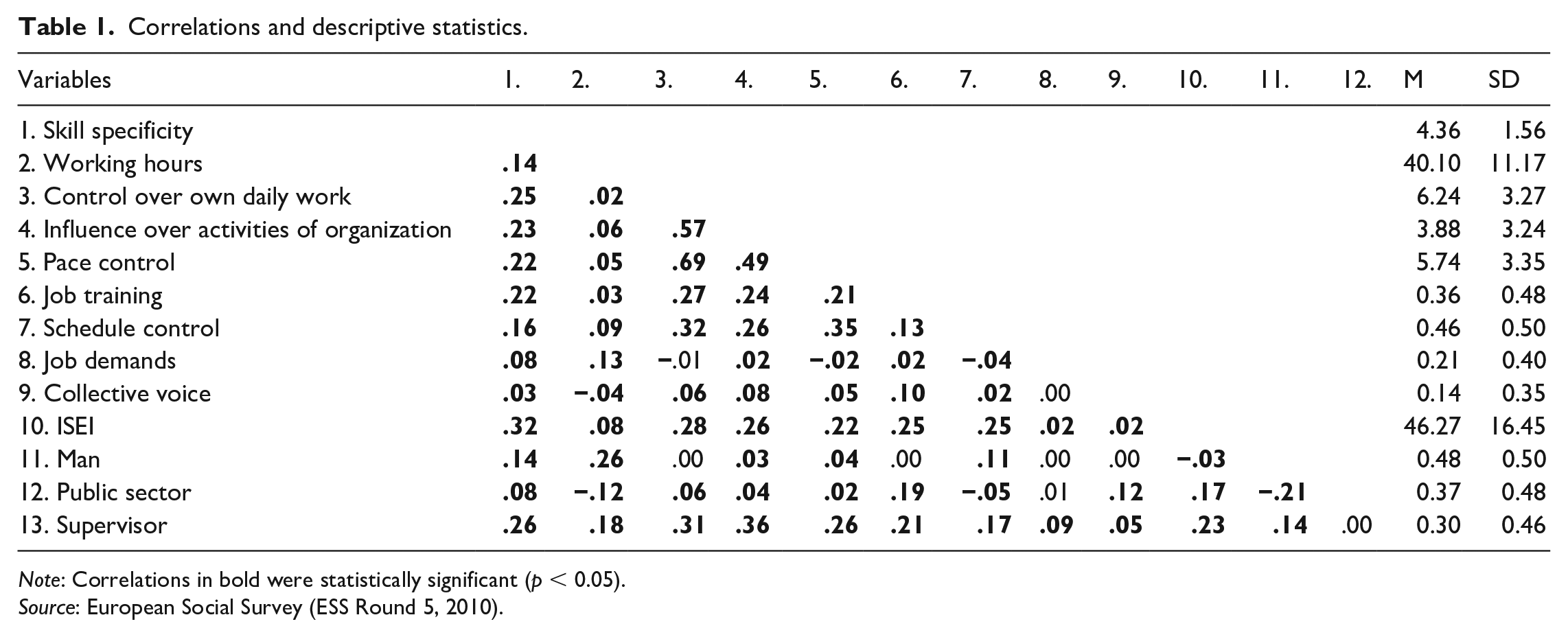
Note: Correlations in bold were statistically significant (p < 0.05).
Source: European Social Survey (ESS Round 5, 2010).
Results
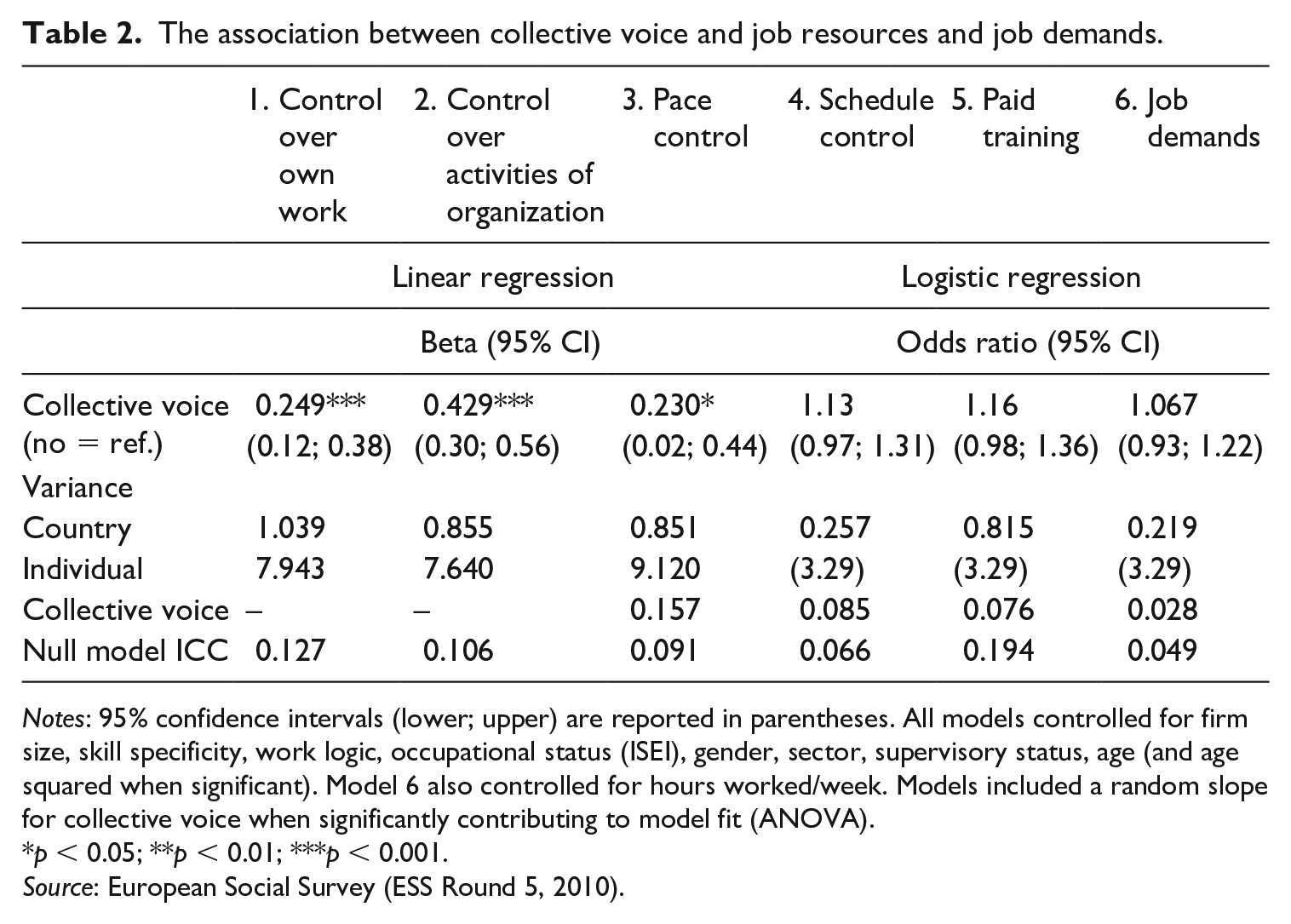
Model 6 in Table 2 shows the results pertaining to H1, in which perceived job demands was the dependent variable. All models included a random slope for collective voice when contributing significantly to model fit. When inclusion of a random slope contributed to model fit, this meant that the ‘effect’ of the variable varied significantly across the countries of the sample. As seen, collective voice was not statistically significantly associated with job demands in either direction; there was only a weak tendency for a positive association. The results did not support H1, according to which collective voice was associated negatively with challenging job demands. While on average across the sample there was no negative (or positive) voice effect, the addition of a random slope for collective voice improved model fit (although such an inclusion did not alter the sign or non-significance of the voice effect), indicating that there was significant variation across the countries in the ‘voice effect’ on job demands. Such country variation hence constitutes a pertinent topic for future research, an issue considered further in the concluding discussion.
The association between collective voice and job resources and job demands.
Notes: 95% confidence intervals (lower; upper) are reported in parentheses. All models controlled for firm size, skill specificity, work logic, occupational status (ISEI), gender, sector, supervisory status, age (and age squared when significant). Model 6 also controlled for hours worked/week. Models included a random slope for collective voice when significantly contributing to model fit (ANOVA).
p < 0.05; **p < 0.01; ***p < 0.001.
Source: European Social Survey (ESS Round 5, 2010).
Models 1–5 present the results of the analyses pertaining to H2, according to which collective voice was associated positively with structural job resources.
The results revealed that collective voice – that is, union influence at the workplace – was associated positively with all forms of job resources apart from schedule control and job training. There was, further, a tendency for a positive voice effect on job training (p < 0.1). On average, on a scale from 0 to 10, employees at workplaces with an established collective voice rated their ability to decide how their own daily work was organized .25 points higher than those at workplaces with no or weak collective voice. On the same scale, the level of influence over policy decisions about the activities of the organization was rated .43 points higher at workplaces with collective voice. Additionally, collective voice was associated on average with a .23-point ‘increase’ in workers’ possibility to choose or change their pace of work. The variables measuring schedule control and paid training were binary; the results reported were odds ratios, where a value below one signified a negative association (or ‘effect’), whereas values above one conversely implied a positive association. Neither, however, was associated significantly with voice. Thus, while varying slightly by output measure, the results partially supported H2: collective voice tended to supplement job resources. The results indicated that there was variation across the countries regarding the effects of collective voice on some resources. The inclusion of a random slope for collective voice improved model fit in the models exploring pace control, schedule control and paid training. Nevertheless, as seen, in terms of pace control, the average collective voice effect held (i.e. the tendency for voice to be associated positively with pace control remained statistically significant) when a random slope coefficient was included. Among the models in Table 2, Model 5 was the only one in which inclusion of a random slope for collective voice substantively altered the statistical significance of the voice effect, which was significantly positive (p < 0.05) without the inclusion of a random voice slope (not shown).
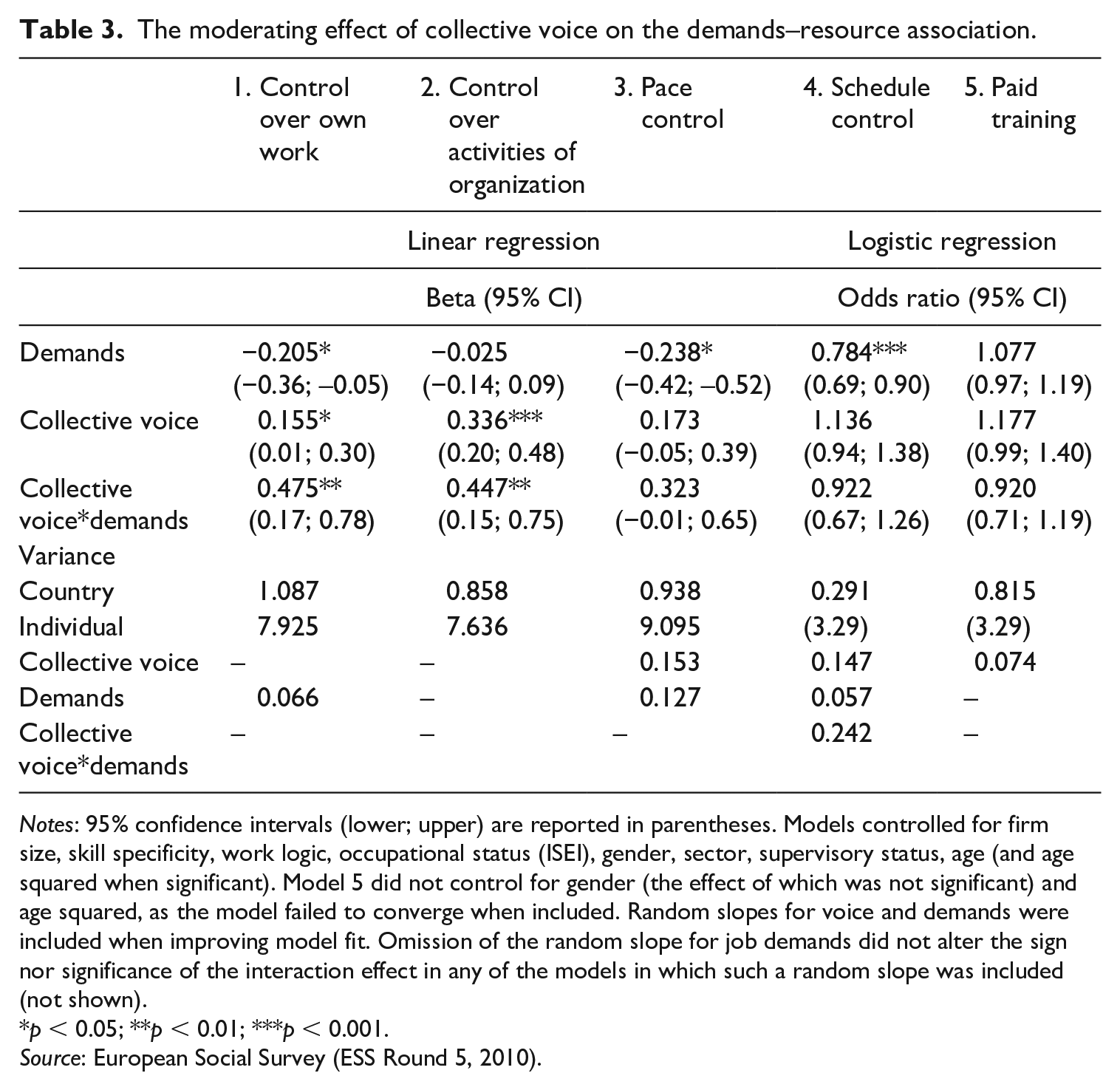
Lastly, the analyses reported in Table 3 assessed whether collective voice had a moderating effect on the association between demands and resources by supplementing resources particularly where demands were high, as suggested by H3. The interaction term between demands and collective voice indicated whether the association between demands and resources was affected by collective voice. A positive interaction term meant that high demands were associated with job resources more often in workplaces with collective voice, or expressed differently, that voice had a supplementing effect on job resources particularly where demands were high. Indeed, as seen in Table 3, the results showed that collective voice did tend to moderate the association between demands and some of the job resources of concern: where there was an established collective voice, high demands were associated with more employee control over the organization of daily work and the policy activities of the organization. H3 was thus supported partially: collective voice tended to moderate the association between demands and some job resources, such that where there was collective voice, high demands were met more often with employee control over the organization of own daily work and the policy activities of the organization.
The moderating effect of collective voice on the demands–resource association.
Notes: 95% confidence intervals (lower; upper) are reported in parentheses. Models controlled for firm size, skill specificity, work logic, occupational status (ISEI), gender, sector, supervisory status, age (and age squared when significant). Model 5 did not control for gender (the effect of which was not significant) and age squared, as the model failed to converge when included. Random slopes for voice and demands were included when improving model fit. Omission of the random slope for job demands did not alter the sign nor significance of the interaction effect in any of the models in which such a random slope was included (not shown).
p < 0.05; **p < 0.01; ***p < 0.001.
Source: European Social Survey (ESS Round 5, 2010).
To illustrate the statistically significant interaction effects reported in Table 3, Figure 1 plotted the marginal effects (predicted values) of collective voice respectively where demands were high and where they were not high. The control variables were held at their mean (quantitative variables) or reference categories (categorical variables). Both panels in Figure 1 showed that the voice effect indeed was more pronounced where demands were high, and further that there was also a positive effect where demands were not high. Where demands were not high, employees at workplaces with trade union influence rated the control over their own daily work on average .16 points higher than those without union influence. Where demands were high, the difference was substantially larger: employees at workplaces with collective voice rated their control over their own daily work on average .61 points higher than those without collective voice. A similar pattern could be observed in terms of control over the activities of the organization: there was a visibly stronger voice effect where demands were high. As demonstrated in Table 3, both the main effect of collective voice and the interaction effect between voice and job demands were statistically significant – meaning that the alternative hypothesis should be accepted despite the overlap in confidence intervals revealed in Figure 1 (Schenker and Gentleman, 2001).
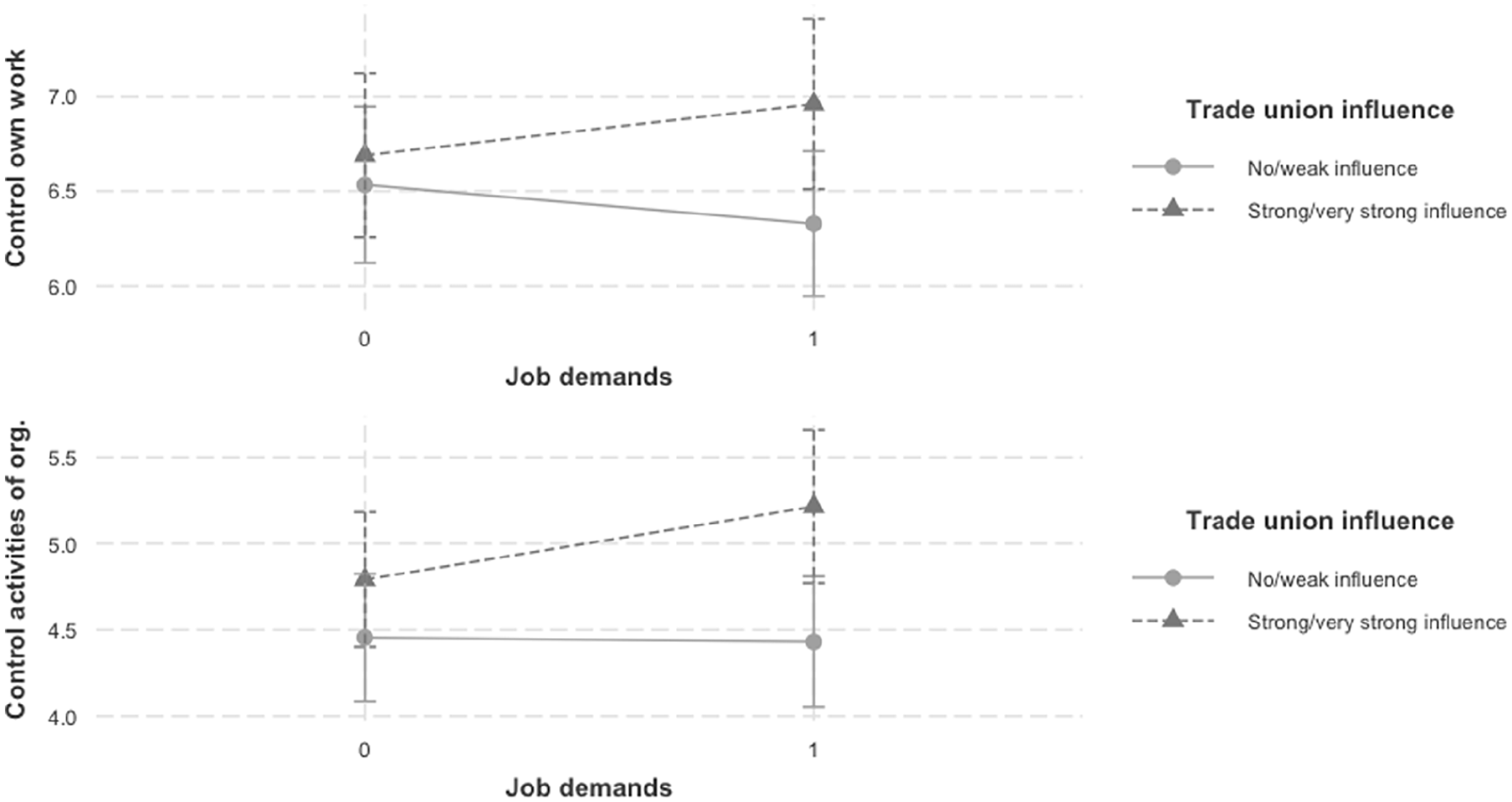
Predicted values of control over own daily work (top panel) and control over activities of organization (bottom panel).
Concluding discussion
This article argues that JD-R theory (Demerouti et al., 2001) can be developed by considering collective employee voice as an antecedent of job demands and job resources. Representing a causal mechanism through which employees can alter the social relations at work, collective voice is posited to reduce job demands and increase job resources. An empirical analysis is offered to test these propositions, and on balance the empirical results support the utility of collective voice – measured as trade union influence at the workplace level – within the JD-R framework. While not associated negatively with job demands, the results reveal that collective voice enhances structural job resources, particularly where job demands are high. These findings are significant in relation to work and employment debates stressing the need for interdisciplinary approaches, and specifically variants of which that acknowledge collective elements (Godard, 2014; O’Brady and Doellgast, 2021). An increasing research focus on individual voice mechanisms has been observed in the employee voice literature, and this extends to the application of the voice construct in the JD-R framework (Barry and Wilkinson, 2021; Conway et al., 2016; Holland et al., 2017). As a counterweight, the findings of the present article demonstrate that interdisciplinary insights from the sociology of work indeed can contribute constructively to JD-R theory by contextualizing processes that risk being abstracted from the social relations at the workplace. Going forward, JD-R research can benefit from considering the significance of collective voice as a key mechanism through which employees can augment their job resources. Employees do indeed co-create their own work environment, but this is often a collective endeavour (Hyman, 1989; Laaser and Karlsson, 2022; Simms, 2017). For many employees, collectivism is not antithetical to, but rather a means with which to extend their individual autonomy, such as the ability to influence how daily work is organized. Sociology of work scholars may build on this contribution further to develop the JD-R model, suggestively by exploring voice effects on other forms of job demands (including work overload, work–home conflict and harassment) and by examining how collective voice – partly by enhancing job resources – can influence various outcomes relating to employee well-being (see also O’Brady and Doellgast, 2021).
While it also remains a task for future research empirically to disentangle the underlying causal mechanisms, the observed effects of collective voice are likely to reflect both formal and informal mechanisms of job regulation such that employees, via trade unions, influence the conduct of work both ‘institutionally’ through collective agreements and in the more micro day-to-day politics of the workplace (Freeman and Medoff, 1984: 10–11; Hoque et al., 2017; Hyman, 1989; MacKenzie and Martínez Lucio, 2005; O’Brady and Doellgast, 2021: 330). This point holds relevance to the operationalization of collective voice, as the impact of voice is likely to be captured most adequately through measures accounting for union influence, as opposed to mere presence (Hoque et al., 2017; O’Brady and Doellgast, 2021). The weight of such influence – and this is a factor that distinguishes union voice from individual and other less independent forms – rests upon the various possibilities for unions to pressure and impose sanctions on employers, ultimately underpinned by the ability for employees collectively to withdraw their labour (Crouch, 1982: 75, 116).
Interestingly, the results do not support the hypothesis that collective voice is associated negatively with (i.e. ‘reduces’) job demands; this in spite of voice having a positive effect on job resources such as employee influence over the pace and organization of daily work. This notable finding deserves further consideration and may relate to the particular job demand measure used in the present study, which captures whether the job requires very hard work. In this sense, some jobs may be inherently demanding, and in such contexts, employees (via collective voice) can focus on ensuring that high demands are met with more job resources. This argument opens up JD-R debates relating to an important research gap concerning moderators of the demands–resources relationship (Bakker and Demerouti, 2017). The results of the present article reveal that in addition to the generally positive effect of collective voice on job resources, an established collective voice will imply that employees with high demands in particular have more control over the organization of their own daily work and the policy activities of the organization. The fact that the voice effect on such job resources is particularly pronounced where demands are high may reflect an increased tendency for employees to raise concerns for resources because of the effects of these demands, as well as an added weight and sense of legitimacy attached to such concerns in the view of the employers (making them more amenable to the employees’ case). Thus, while in some cases functioning to reduce or alter the nature of the demands (Bryson et al., 2013; Green et al., 2022; O’Brady and Doellgast, 2021), collective voice can also render certain demands more tolerable by supplementing resources particularly where they are high.
An important limitation of the study concerns the cross-sectional nature of the data, which implies that causal interpretations of a more conclusive nature cannot be drawn. The possibility of reverse causation cannot be excluded; workplaces where employees have more job resources may simply be more likely to facilitate union voice; for example, reflecting more ‘enlightened’ management practices. Also, on the basis of the data used, the non-effect of voice on job demands can be interpreted in numerous ways. Employees may raise concerns and push also for reductions in terms of job demands, but their scope of action in this direction may be restricted by management, who are in turn constrained by factors relating to the wider political economy (Gumbrell-McCormick and Hyman, 2019: 95–96, 106; Thompson, 2003). Similarly, if a selection mechanism is at play, voice may in actuality have a substantial negative effect on demands, such that demands are reduced (hence appearing in a cross-sectional analysis as a non-significant effect, leading to no distinction between union and non-union workplaces). Longitudinal research concerning the effects of collective voice on job demands would thus constitute a valuable addition. Another limitation in this connection pertains to the use of self-reported measures; H1 in particular could benefit from an objective measure of job demands. Relatedly, future research can pursue further the distinction between different forms of demands – such as hindrances versus challenges (Van den Broeck et al., 2010) – as collective voice could be more likely to have a negative effect on the former compared with the latter. Further analyses concerning the impact of collective voice can also seek to utilize datasets that contain more nuanced measures of the key constructs, and control in various ways for the psychological predispositions of the respondents.
Moreover, the analytical strategy pursued in this article reflects a focus on the core concern of providing a general assessment of the effects of collective voice in the JD-R framework: aggregated analyses serve such purposes, given the opportunities afforded by MLA to account for the diversity of the countries in the sample. Nevertheless, this macro focus comes at the expense of contextual nuance pertaining to the varying effects of collective voice across countries and institutional settings. The empirical results indicate indeed that the effect of collective voice on job demands and certain job resources varies across countries. In this regard, factors conceived in the JD-R framework as demands and resources are subject to the complex interplay between cooperation and conflict in the contested terrain of workplace (Edwards et al., 2006), where unions’ positions are not pre-determined. Hence, future disaggregated investigations of contextual variation are likely to provide fruitful research paths (see insightful discussions in Boxall and Winterton, 2018; Edwards et al., 2006; Parker et al., 2016). These avenues for research represent some of the many potential opportunities for further exchange between sociologists and JD-R scholars befitting the nature of this journal (Grugulis et al., 2012). The JD-R approach is increasingly important in a range of work-related literatures and its utility is well-documented for studying a multiplicity of important employee-related outcomes. It is therefore timely that the sociology of work community engages with the theory, to which it has much to offer.
Footnotes
Acknowledgements
The author would like to extend his sincere gratitude to Robert MacKenzie, Danat Valizade, the editor Marek Korczynski and the four anonymous reviewers for many supportive and helpful comments and suggestions. The author would also like to thank Hanne Berthelsen, Tomas Berglund, Kristoffer Holm, Henrietta Huzell and Daniel Larsson.
Data availability
Data supporting the findings are available from the corresponding author, upon request.
Funding
The author received no financial support for the research, authorship, and/or publication of this article.
