



Abstract
Can cultural identity be a disadvantage for indigenous employees? Can it lead to critical issues around workload and pressures? This article explores the role of cultural identity for Māori, the indigenous people of Aotearoa/New Zealand, and the findings are telling. We target Māori scientists, given their limited number but growing legislated sector demands around cultural engagement. We conducted several studies. Study one (12 interviews) identified cultural themes of whakawhanaungatanga (relationship management), kawenga (responsibilities) and taumaha (workload). Study two (wave one and wave two) focused on a large cohort of Māori scientists (between 41 and 60), and themes showed commonality with study one. Also, other themes emerged specifically āheinga tangata (human capacity), tikanga (correct practice), hauora (well-being), and umanga takaware (career disruption). Ultimately, we classify these pressures as aronga takirua (cultural double-shift) and present a theoretical model for understanding the drivers and consequences of this cultural double-shift for Māori scientists. Finally, study two (wave three) and study three were conducted to examine job descriptions/contracts and, overall, we find limited employer support for adequate engagement in cultural roles. These findings reinforced the themes from the previous studies. We discuss implications for employers and the sector.
Introduction
Lessons from indigenous communities are beginning to filter more widely through academia, such as distinctive leadership models (Spiller et al., 2015, 2020). Spiller et al. (2020) argue that there are many lessons to be gained by contemporary management from indigenous philosophy and praxis. The present study seeks to understand the effects of indigenous scientists’ workplace-driven cultural obligations on their work roles and outcomes. Typically, the literature focuses on the negative consequences of long working hours and the struggle to balance work and non-work roles (e.g. Unger et al., 2015). Theoretically, role conflict explains how different work and non-work roles create pressures (Greenhaus and Beutell, 1985), highlighting the detrimental impacts on work and well-being outcomes (Eby et al., 2005). Fundamentally, the literature focuses on work and family roles (e.g. Eby et al., 2005) or work and non-work roles (Haar, 2013). These studies fail to include cultural factors. This study argues that work-driven cultural obligations may exert a significant influence on work experiences for indigenous employees. Indeed, Reid (2011) notes that cultural values may impact career experiences for indigenous employees and highlight the complexities of careers for indigenous peoples. This cultural approach to work is still not well explored in the management literature, despite the growing acknowledgement of the need to foster equitable working conditions in increasingly culturally dynamic and diverse workforces.
The present study focuses on Māori, the indigenous people of Aotearoa/New Zealand (NZ). Internationally, Māori are among the most successful indigenous populations, with the national zeitgeist moving increasingly from a deficit view of cultural traditions and customs to one that embraces the positive strengths, including in work (Haar et al., 2019). In NZ, there is growing interest in the Māori economy and the economic contributions Māori make to NZ society (Nana et al., 2020). Within the broad fields of science and research, Māori plays a unique role (Ruckstuhl et al., 2019) because NZ has a legislated obligation to engage with Māori in science and innovation (MoRST, 2007). The science sector policy called Vision Mātauranga (VM) outlines this obligation, which seeks to unlock the innovation potential of Māori knowledge, resources and people (MoRST, 2007). VM has been integrated as a requirement across government science investment areas since 2010 (MBIE, n.d.). We speculate that the VM policy would create a positive impetus for science sector organisations to recruit and grow the number of Māori scientists in science and research. However, we also argue that employment settings have created an environment that seeks to engage Māori in a manner that makes and compounds role conflicts around cultural obligations related to the work roles of Māori science sector employees.
We suggest that Māori scientists may experience unaccounted work pressures and demands around Māori cultural roles in the science workforce. We postulate that this may be owing to inadequate employment conditions shaped by organisations responding to the VM policy. Theoretically, additional functions, such as when Māori scientists act as a conduit between employer and indigenous groups (to affect the VM policy), can create unique role conflicts (Greenhaus and Beutell, 1985). Heightened role conflict may result when employees draw on personal relationships and reputation in their cultural world, such as when performing stakeholder engagement with Māori entities/representatives. This conflict might occur from a genealogical perspective: whānau (extended family), hapū (larger whānau groupings) and iwi (Māori tribal groups). Despite a decade of legislated requirements, insights into these relationships between Māori employees, their science organisations, VM and role demands remain unexamined. The present article explores this phenomenon to understand better the influence cultural roles might play.
Overall, the present study makes two significant contributions: (1) we explore cultural roles on the work experiences and lives of Māori scientists to understand unique cultural drivers; and (2) we produce a theoretical model of antecedents and consequences facing Māori scientists. We achieve this by undertaking three studies, including interviews, surveys and focus groups, to establish initial insights, confirm findings and then conclude by examining job descriptions/contracts of Māori scientist jobs to triangulate earlier themes identified. The next section provides background on Māori and then outlines our theoretical lens used. We provide a glossary of Māori terms and their English translation in the Appendix.
Māori background
Māori accounts for 16.5% of the NZ population (Statistics NZ, 2019a), with substantial employment, although at levels lower than non-Māori (Statistics NZ, 2019b). Māori culture includes a distinct set of traditional principles (Hook et al., 2007), such as whanaungatanga, which refers to the importance of relationships and networks (Haar and Delaney, 2009). This study responds to calls by Durie (2003) regarding the more significant examination of Māori culture in the workplace. This call is predicated on the notion that Māori has unique cultural determinants (Durie, 2003, 2006), including the Māori language (te reo Māori), a legislated official NZ language (Maori Language Act 1987). Similarly, rangatiratanga (self-determination), whereby Māori seek to determine their paths, including employment, plays a driving role. O’Connor and MacFarlane (2002) highlight two vital values for Māori: (1) respect for a place (whenua or land) and (2) honouring of family and whakapapa (genealogy). Other critical cultural factors include whānau (representing extended family, including multiple generations) (Haar et al., 2012) and collectivism (Haar et al., 2019).
With regards to whānau customs, Bishop (2005: 119) stated they include ‘warm interpersonal interactions, group solidarity, shared responsibility for one another and cheerful cooperation for group ends’. Ratima and Grant (2007: 2) stated that for Māori, what is essential is ‘first about one’s relationship with one’s own whānau, and in a broader sense it emphasises one’s connection to all peoples and all things in the natural world’. As indigenous people, Durie (2003) notes the importance of cultural identity and values in providing positive reinforcement of Māori culture. Fundamentally and notably in the context of this study, relationships are essential for Māori, and we suggest maintaining, strengthening and developing such relationships – especially within the work context – might place additional role demands on Māori employees. Indeed, studies of Māori employees have highlighted the challenges of work, family and life roles (Haar et al., 2014). Currently, Māori traditional world views are often maintained while living and working in modern society (Ruru et al., 2017). Still, the broader literature fails to engage whether these culturally driven values create unique role pressures on Māori employees.
Role conflict theory
Kahn et al. (1964: 19) defined role conflict as the ‘simultaneous occurrence of two (or more) sets of pressures such that compliance with one would make more difficult compliance with the other’. Relatedly, Greenhaus and Beutell (1985: 77) defined inter-role conflict as ‘a form of role conflict in which the sets of opposing pressures arise from participation in different roles’, occurring when pressures from various roles ‘are mutually incompatible in some respect (1985: 76). This approach has been critiqued, with Haar (2013) arguing that the focus on work and family roles fails to consider other roles outside work and family. Specific to our focus here, we suggest that a culturally appropriate and nuanced understanding of role pressures faced by indigenous employees like Māori is critical to understand employees who might have unique factors influencing their work experiences. The theory argues that when employees engage in multiple roles, this is likely to result in conflict and detrimental outcomes (Eby et al., 2005).
One study using role conflict theory among Māori employees was Haar et al. (2012). They found Māori had turnover intentions dominated by whānau roles despite meta-analysis expecting work roles to dominate work outcomes (Shockley and Singla, 2011). Given Māori are viewed as having a robust collectivistic culture (e.g. Haar et al., 2014, 2019), and whānau is a core cultural value, this highlights that indigenous employees could be influenced by roles different from the predominantly western employees that dominate the literature. The present study embraces these insights and suggests that cultural roles might have similarly powerful effects for indigenous employees, but these have been mostly unexplored in prevailing (western) knowledge. Focusing on cultural roles aligns with Durie’s (2003) assertion that for Māori, cultural identity is a core value. Hence, for Māori scientists, conducting VM research and engaging with Māori stakeholders is likely to align with their cultural identity that benefits their work focus. However, this might add another (new and unique) role pressure to their work under role conflict theory. Indeed, recent studies have found that cultural factors (e.g. cultural well-being) are critical to Māori employees beyond other established (again western) elements (e.g. Haar and Brougham, 2013). Hence, examining these factors might provide unique insights to understand Māori at work better.
Research context and questions
Our study targeting Māori scientists is of broad interest because, as an ethnic group, the low participation of Māori at higher levels of tertiary education may create unique pressures for the small pool who go on to careers requiring these qualifications. The 2018 Census data show that 11.3% of adult Māori have a bachelor’s degree qualification or higher (compared to NZ Europeans at 22.4%). At the PhD level, 0.23% of adult Māori have a PhD compared with 0.86% of NZ Europeans (Statistics NZ, 2019a), indicating NZ Europeans are 374% more likely to hold a PhD. However, given NZ Europeans are much more numerous than Māori (424%), when we compare Māori PhDs versus NZ Europeans on a total basis, Māori will represent roughly 1/16 (6.25%) of the scientific research ‘resource’ at a PhD level compared with NZ Europeans. Next, consider that with growing positive attention to Māori culture in NZ, there has become a strong acknowledgement that Māori need better consultation and engagement in the NZ science system (Mercier, 2018). Overall, this contributes an additional pressure on Māori employees to facilitate engagement with Māori stakeholders, which might create unique pressures on a workforce already constrained by its small size. We argue this makes the study context of Māori scientists, especially useful.
Our approach highlights the arguments of Papuni and Bartlett (2006), around a distinction between work and non-work roles being a new phenomenon for Māori. Formerly, the intertwined notion of work and whānau meant these roles could be complementary, aligning with cross-cultural findings from Spector et al. (2004). Role conflict was less detrimental for collectivistic cultures because the family focus means that hard work is less harmful than in individualistic cultures. Ratima and Grant (2007) assert that understanding unique Māori cultural perspectives is needed for NZ society to support Māori employees in achieving their potential adequately. Our focus reports an interplay between culture and institutional/science sector demands on indigenous employee experiences.
Our focus also aligns with arguments around the need for more culturally appropriate role conflict exploration (Liu, 2010). Wang et al. (2004) assert that collectivistic employees are more focused on the needs of others, making the exploration of role demands especially pertinent. As Māori employees potentially face unique cultural pressure to represent both the Māori world and their institutions, this could lead to more significant role pressures. Markus and Kitayama (1998) assert that employees of a collectivistic orientation view themselves in relation to social connections, and the present study extends this to cultural (Māori) relationships. This focus aligns with the importance of cultural identity (Durie, 2003, 2006) and how this might influence the willingness to engage with role pressures from Māori stakeholders. Indeed, these cultural factors, including whānau (Harris, 2007) and collectivism (Brougham and Haar, 2013), have important influences on working Māori.
The present study suggests that cultural values and pressures (both cultural and professional) aligned with Māori cultural identity will mean that skilled Māori employees will engage strongly in cultural roles, ultimately generating role conflict. Thus, for Māori scientists, our overarching research question is: does representing Māori culture, science, VM, and engaging with Māori stakeholders, create unique role pressures? Aligned with role conflict theory, we expected that cultural roles represent an extraordinary cultural pressure that will lead to higher time demands, placing more significant pressures on Māori scientists. Further, we seek to understand whether Māori has unique cultural support that enables and facilitates additional role pressures to function fully. Alternatively, we examine whether aligned with the theory and meta-analytic evidence (e.g. Eby et al., 2005), these pressures are primarily detrimental.
Our second research question is: what are the outcomes of these role pressures? Are they universally detrimental, or are there potential benefits? Mercier (2018) notes that Mātauranga Māori (Māori knowledge) has growing importance for researchers as they seek to engage with Māori. However, this reinforces the potential cultural role pressures within the science sector. Given Māori scientists are a resource in critical supply, it might also be that NZ research entities consider Māori scientists a scarce resource and provide unique mechanisms to enable their activities as potentially both western researcher and VM researcher. Our third research question is: are there particular strategies that Māori scientists utilise to balance these work demands?
In summary, our study focuses on a small but skilled number of indigenous workers who might have to ‘straddle’ the dual-worlds of western science and Mātauranga Māori – or at least feel compelled to embrace te Ao Māori (Māori world views). Such actions might produce additional role pressures. Our interest in cultural roles aligns with western researchers recognising the importance of the overlap between work and non-work factors (Ford et al., 2007; Graves et al., 2007), although the exploration of cultural roles remains underrepresented. Our fourth and final research question is: does the NZ VM policy have unintended consequences around the well-being of Māori scientists? Our research seeks to provide a broad answer to this potential issue. In brief, we explore: (1) does VM place additional cultural demands on Māori scientists? (2) Are the pressures predominantly detrimental or beneficial? (3) Do Māori scientists engage in any specific strategies to alleviate these pressures? (4) Does VM policy have unintended consequences?
Methodology
The research used a kaupapa Māori (Māori ideology) research methodology approach (Smith, 1999), which is appropriate because it has a specific focus on Māori (researchers, the researched and focus). Smith (1999) states such research should be open to te Ao Māori, connect to Māori principles and engage the legitimacy of Māori cultural values and approaches. For example, this approach to Māori experiences has been used in leadership studies (e.g. Haar et al., 2019; Ruru et al., 2017). We followed Māori protocols around conducting culturally safe research, including karakia (prayers), extending hospitality (kai – food) and researching locations comfortable to the participants (offices or home in study one, and on marae – Māori meeting house in study two).
Method
We seek to answer these questions using a multi-study approach with largely full-time Māori scientists and full ethics received. Throughout our analyses, we use the term ‘scientists’ and acknowledge we use it to capture all Māori participants, whether life, physical, social scientists, academic, researcher or researcher manager. See Figure 1 for an overview of the methodology, participants, analysis methods and key findings.
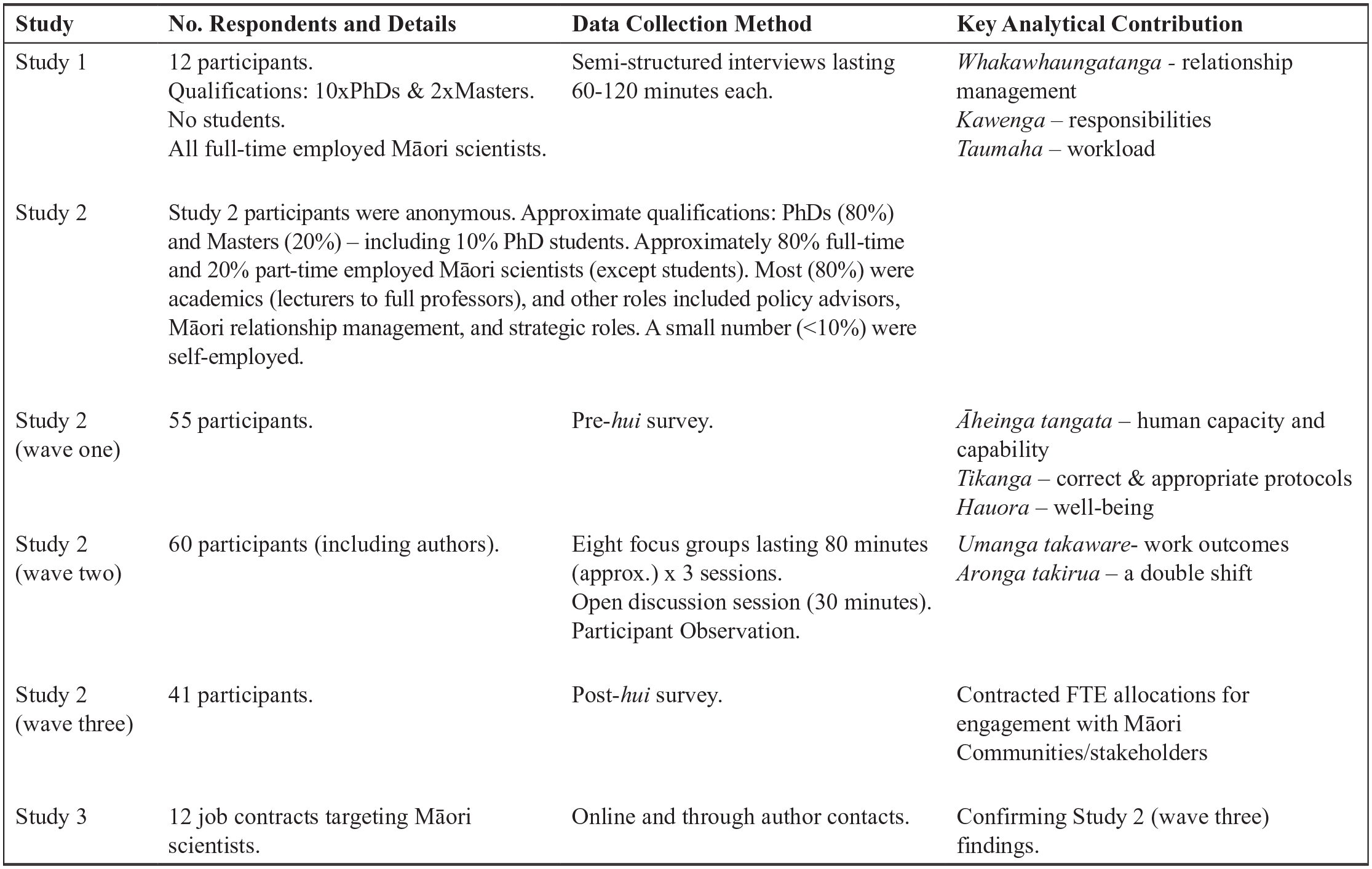
Study methods overview.
As an overview, study one is an initial scoping study, while study two (wave one and wave two) builds and extends on study one. Study two (wave three) and study three focus on employment details around workloads to triangulate previous studies’ findings. Study one interviewed 12 Māori scientists in active research roles. Study two involved a two-day hui (workshop) of the NZ National Science Challenges (Calude et al., 2020; Salmon and Priestley, 2015), attended by only Māori scientists including PhD students occupied with research with Māori communities. We used three waves of data collection. In wave one (pre-hui), we gathered online data from Māori scientists (n = 55) registering for the hui, asking them, ‘What are the important issues you are facing as a Māori VM researcher?’ In wave two (two-day hui), the authors participated in and took notes, and recordings captured conversations. Finally, in wave three (post-hui), we followed up with hui participants, asking them a question about their job contracts (n = 41). We asked, ‘Does your current employment contract acknowledge your working with Maori (e.g. hapū, iwi, other Maori stakeholders etc.)’, with response options shown in Table 1.
Employment contract acknowledges your working with Māori?
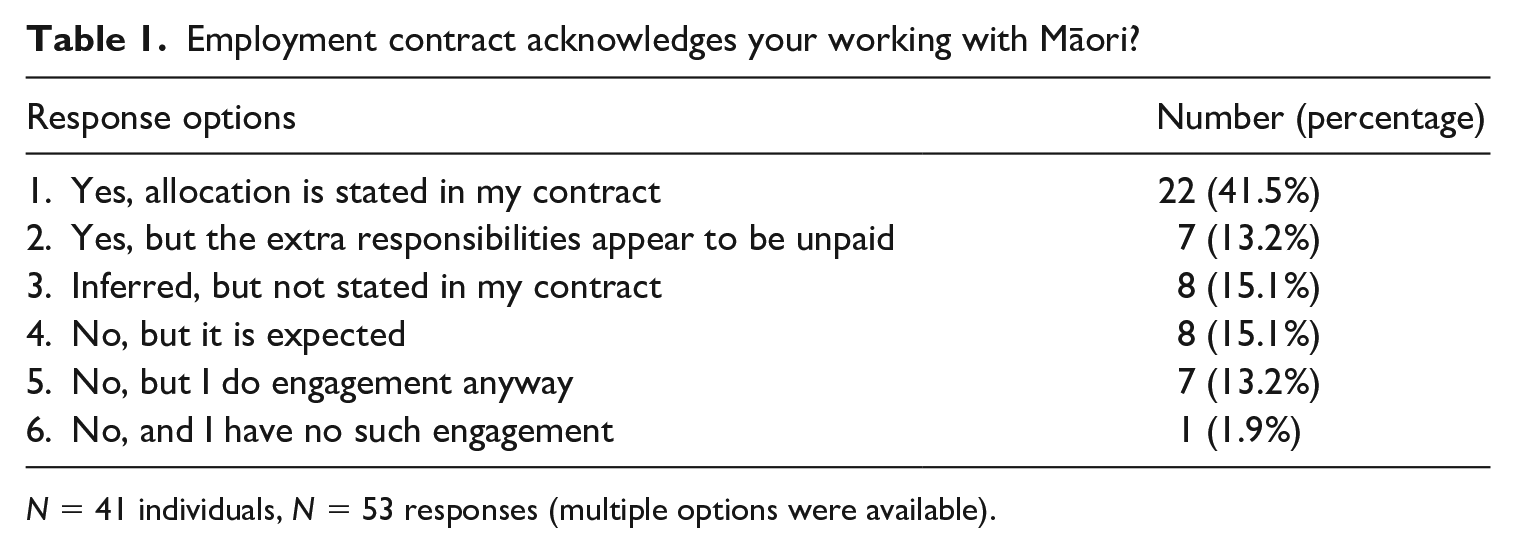
N = 41 individuals, N = 53 responses (multiple options were available).
Finally, in study three, we sampled a dozen new job descriptions/contracts of various scientist roles in NZ, explicitly targeting Māori (collected through research networks and online advertisements in 2019). This study aimed to understand contractual obligations around engaging with Māori stakeholders (if any) and related workload issues (if any). The entities were predominantly universities and included any with a research focus (i.e. not teaching only roles) and were purposefully broad: natural and physical sciences and social sciences (e.g. business).
Analysis
For study one and study two (wave one and wave two), we followed Haar et al. (2019), using a kaupapa Māori (Māori ideology) research approach (Smith, 1999), which has a specific focus on Māori (researchers, the researched and focus). Smith (1999) states such research should be open to te Ao Māori, connects to Māori principles and is predicated on the legitimacy of Māori cultural values and approaches. We followed Māori protocols around conducting culturally safe research, including karakia (prayers), extending hospitality (kai – food) and researching locations comfortable to the participants (offices or home in study one, and on marae – Māori meeting house in study two). We transcribed all study interviews and focus groups (study two, wave two). Transcription analyses used the interpretative phenomenological analytic (IPA) techniques. We acknowledge that the interviews raised several other potential themes beyond the focus of the present study, especially study two.
The IPA approach is useful for complex and novel topics (Ruru et al., 2017), and Willig (2001) suggests it can help capture the depth of an individual’s experience and how these individuals make sense of that experience (Smith, 2004). It involved a two-stage process: (1) initial thematic analysis (significant themes) and then (2) detailed thematic analysis, cross-referenced back to data. These were conducted separately by both authors and then in combination to achieve coding consensus. Aligned with a kaupapa Māori approach (Smith, 1999), we presented a brief report on findings. Here, we use direct quotes but disguise names/contexts to maintain respondent anonymity. We use square brackets [] to clarify and provide meaning/translation where needed. Finally, for study two (wave three) and study three, we conducted a content analysis. We present these data to understand the nature of employment descriptions/contracts around time (paid/unpaid) regarding engagement with Māori stakeholders.
Study one results
Three themes emerged from the Māori scientists in study one interviews that reflected their work experiences, although we acknowledge they overlap and interplay. We titled these: (1) whakawhanaungatanga (relationship management); (2) kawenga (responsibilities); and (3) taumaha (workload). We address these presently.
Whakawhanaungatanga
Respondents almost universally acknowledged that whakawhanaungatanga – building and maintaining strong whanaungatanga (relationships) – with Māori stakeholders was critical for working with Māori stakeholders. Fundamentally, they saw whakawhanaungatanga as core to establishing and growing the trust with Māori stakeholders that create the social licence to develop and enact the science. This trust-building process required an important investment of time. The following quote typifies this: ‘It takes time to build trust in these relationships’ (Scientist #2). Many noted the natural importance of relationships when it came to working with Māori stakeholders, with comments including: It’s whanaungatanga bro – it’s just the way it is! (Scientist #1) We’re Māori – for us, relationships are where it starts and ends. I can’t rush things – whakawhanaungatanga takes time. Even though they know me, they don’t know this mahi [work] and thus I have to establish relationships around the science, my project and the people in my team. This [relationships] takes time! (Scientist #12)
This respondent provided a useful example of why engagement is vital, stating: When I was going down there [to hapū/iwi] talking about the science . . . I was blown away by how much people actually know. They know about the science we are doing but understand it in a different way. They have their own paradigms and models to help them understand. I love going into the marae [Māori meeting place] to talk to them, and I love it when they challenge me because if they challenge you, it means that they are listening to you. (Scientist #5)
Another highlighted the importance of cultural drivers in their work, stating: ‘A lot of time, the science that I do with the communities is not about money. It’s about kaitiakitanga [stewardship] or rangatiratanga [self-determination]’ (Scientist #3).
Respondents noted that there were good scientific as well as cultural reasons for developing relationships, with one scientist noting this rationale for developing such long-time commitments: ‘Understanding the science will go a long way to alleviate the perceived clash between tikanga [Māori cultural practices] and western science’ (Scientist #11). Hence, whakawhanaungatanga is not just about trust-building but is a basis from which to negotiate and de-risk potential conflicts and misunderstandings. A well-developed rapport can make science translation more achievable. This rapport can demystify the technicalities of the science, and its methodologies can be in a manner that is palatable to Māori stakeholders. Where technicalities were of less interest to Māori stakeholders, strong whanaungatanga allowed Māori stakeholders to have confidence that the science was being executed appropriately, allowing them to focus their attention on outcomes. This respondent explains this, stating: Truthfully, the iwi probably still doesn’t get all the science I am explaining. But they get the potential benefits. They need those benefits, aye, for their people – for my whānau. So, after a while, the engagement produces the trust and the belief in the science – and then we start developing things and moving forward. (Scientist #9)
Another Māori scientist highlighted the challenge of whakawhanaungatanga, where they had to explain and guide not only Māori stakeholders through the science process but also their own science team around te Ao Māori and Mātauranga Māori, stating: I had to drive this idea from the inside of my science team – without my drive, this just wouldn’t have happened. It was frustrating at the start but has become really worthwhile now. We now have sufficient interest and buy-in [both from the scientist team and Māori stakeholders], and we are making progress. (Scientist #4)
Finally, on the whakawhanaungatanga theme, one scientist noted they were taking a specific Māori research approach and the challenges this created. They stated: My project is a true kaupapa Māori research project. I am embedded in the community, and my research is on a project that the community wants [they decide it]. This is what relationship building – whakawhanaungatanga – is all about. Time to build trust. But how does the [western] funder respond? Sheez, they are not happy! They supported the approach at the start, but they don’t have much patience! These things take time (years!). But they just see the clock ticking down and don’t appreciate the approach two years into the project. (Scientist #6)
Kawenga
The second theme identified was kawenga, which relates to duties and obligations. We use this theme to understand why Māori scientists spend so much time and effort in their mahi (work) and highlight how this theme provides the rationale for their time developing trust in our first theme (whakawhanaungatanga). Overall, this theme captures the sense of responsibility that Māori scientists feel. Importantly, kawenga can be intrinsic or imposed. For example, regarding employer pressures, one stated: ‘My employer wants me to do engagement with my iwi. The role is not paid – and yes, it’s extra work – but it gives me a chance to give back to my iwi’ (Scientist #10).
The following example aligns with role pressures placed upon Māori scientists from outside the workplace. It also highlights the potential stresses that Māori stakeholder engagement places upon Māori scientists: The mahi (work) I undertake is important to me – but my tribe wants me to take the role of being their whakamāori [interpreter] in one area of science that is not my speciality at all. I can’t refuse – they are my people! But I feel the responsibility to my paid mahi (my employer), I feel the pressure from my iwi to represent them, but I also feel the pressure from my (science) field. I can’t say no, but I sure feel the pressure. It’s like I am walking a tightrope! (Scientist #2)
Importantly, the pressure to respond to these obligations and responsibilities can also be driven by the self and not necessarily need to come from an employer or stakeholder. One respondent stated: For me, I really want to engage with my hapū. That means everything to me. But that engagement has now taken way more time than was expected [by their employer], and now I am literally stretched thin. I enjoy the extra mahi with my hapū – but my other work is suffering. (Scientist #7)
Taumaha
The final theme gleaned from respondents related to the additional cultural workload and impact on time demands and was discussed in the context of other identified themes. While most did not address the time demands specifically, many referred to how working towards relationship building (whakawhanaungatanga), and the cultural obligations and responsibilities they felt (kawenga) meant there was a drain on their time and energy. The following Māori scientist highlighted that they maintained multiple connections with Māori stakeholders, which resulted in time pressures, stating: I work in facilitating science to Māori but also tikanga Māori to other non-Māori scientists. I work at disseminating knowledge to hapū and iwi, but also as a conduit for hapū/iwi concerns to be relayed back into the science domain. However, this work is not only with my own iwi but with other iwi around the country. It’s pretty full-on [the time the engagement takes]. (Scientist #1)
Other Māori scientists noted how their Māori approach to relationship building is often at odds with the science system, with one stating: It all takes time – these things. And it is all very money centred these days! You have got to meet your outcomes; you have got to meet your milestones . . . it isn’t easy [engaging with Māori stakeholders], but that’s the job! (Scientist #3)
Study one summary
Overall, the interviews highlighted a sector whereby Māori scientists report significant challenges in doing an excellent job of engaging with Māori stakeholders. Such work was viewed positively by Māori scientists, although the consequences of workload and time to develop these relationships was problematic. This cultural engagement included career consequences, where excessive time on something less rewarded by the employer (Māori stakeholder engagement) did not generate positive career consequences. We explore these aspects further in study two.
Study two (wave one) results
In study two (wave one), the pre-hui data resulted in 55 responses identifying important issues faced by Māori scientists. These issues aligned well with the themes above, although a few new themes emerged around working in the science sector. This included suggestions of how to improve the Māori–science interface, especially around improving the current VM policy (respondents #9, #12, #38, #62, #63) and engagement with Māori stakeholders. New themes were entwined with the initially identified whakawhanaungatanga and taumaha themes. The following quote highlights the complexity of developing relationships and trust within Māori networks – although this example relates broadly to the science level. Respondent #8 stated: There is a perception that VM research is its own thing. That publishing VM research is more important than carrying out research that uses VM contextually. Sometimes I feel as though researchers see VM as a box to tick and want Māori involved as an indication, they have VM in their research but have not approached the research with VM woven into the science; rather are trying to apply it afterwards. VM research is not just taking products to market; it is also basic science.
Beyond providing consensus to our initial three themes, we also identified clear examples of drivers relating to taumaha (workload) and whakawhanaungatanga (relationship management). We explore these next. We identified āheinga tangata (human capacity) and tikanga (correct practice), as well as the consequences of these factors as seen in hauora (well-being) and umanga takaware (career disruption or delayed career advancement).
Āheinga tangata
This theme refers to the need to develop āheinga tangata (human capacity and capability) in the sector. Many respondents raised the low national capacity of people who can dually navigate both the scientific sector and te Ao Māori. This capacity issue was salient in the low number of Māori scientists in the sector, coupled with a lack of non-Māori scientists and lay Māori stakeholders/communities who could operate in the other domain. The need to develop āheinga tangata is a crucial influence on workloads, illustrative of why Māori scientists were fielding high demands for their time, including time obligations to develop others. The following quotes typify this theme: [We need] building capacity for Māori as there are few technical experts. (#10) Low numbers of Māori VM experts mean that each gets a number of requests. They get spread very thin. (#12) Lack of capacity and capability – we are stretching Maori researchers thinly, rather than impactfully. (#53) Building capability (technical skills) of emerging Māori researchers. Building capacity to respond to opportunities for integration of Mātauranga Māori into science. (#46)
Tikanga
Tikanga refers to the principle of correct and appropriate practice regarding Māori culture and traditions. It was clear from the responses that Māori scientists feel a sense of responsibility to ensure that cultural knowledge, people and processes are being conducted in a culturally appropriate way. Māori scientists grapple with this additional kaitiaki (caretaker) dimension to their work that other NZ scientists do not have to consider. This issue is potentially a more nuanced description of the kawenga theme, but we discuss this separately to ensure the strong cultural driver behind these additional pressures is captured. Several associated comments that identified this theme were: Upholding the integrity of Mātauranga Māori. (#54) Ensuring that Māori values, principles and aspirations prevail in the co-design, implementation and intervention phases of research. (#59) How do we ensure consistency about what VM is and isn’t? How do we build the capability of non-Maori researchers in VM? Whose responsibility should this be? Us as Maori researchers or non-Maori researchers? (#81) Feeling stretched in terms of my work in the lab and within the Māori community. Protecting and safeguarding te reo Māori research within the mainstream university environment and community. (#90) Often Māori becomes the teachers to those who don’t often understand te Ao Māori, which can take away the focus of quality Māori-led research. (#93) The pressure and demands on senior Māori researchers to respond to multiple issues in many spaces. (#41)
Hauora
Hauora refers to well-being, which respondents raised as a consequence of taumaha and āheinga tangata. Thus, there is an acknowledgement that employee well-being is widely influenced and impacted detrimentally by the additional cultural roles, as shown in the following comments: Too stretched and being too many things for too many people. Labouring for the other (Pākehā [NZ European]). Not enough resourcing maintaining well-being. (#17) Overloaded! But need the funding. Plenty going on – exciting, but a lot [of work]. Workload issues – lack of equity. (#21)
Hauora is essential and fundamental to all individuals, and we detail this further in study two (wave two) below.
Umanga takaware
Work outcomes, specifically those around careers, were widely noted and deserved a distinct theme from hauora. While largely detrimental, these should be viewed in the context of āheinga tangata, leading to taumaha, career disruption or delayed career progression (umanga takaware). These respondents provide a stark indication of the effects of whakawhanaungatanga on umanga takaware: An important aspect of my work is consultation and collaboration with iwi, hapū and other Māori organisations. That requires a lot of preparation, travel and time. Taking me out of the lab, away from the coal face of the research. (#18) How to manage demands across multiple projects; how to encourage and enable cultural competency with research partners; the disconnect between institutional success measures (e.g. PBRF [academic performance metric]) and personal/cultural success measures (e.g. grounded impact/change). (#19) I work in a non-Māori research environment and have to do double labour to be recognised as a researcher with expertise not only in my disciplinary area and cultural studies but in the emerging field of kaupapa Māori (in my field). As such, I am an edge worker consistently positioned at the margins. (#27)
Study two (wave one) themes in combination
Study two (wave one) analyses identified strongly related, albeit distinct, themes more starkly than study one. This highlights a pattern of inter-relatedness, and thus we present a few examples where these themes flow strongly together. The following quote encompasses aspects of āheinga tangata, tikanga, hauora and umanga takaware. It highlights the complex intertwined nature of how the lack of capacity can lead to greater workloads and detrimental consequences. Respondent #12 stated: Māori scientists working in VM often do so at the detriment of their academic careers, as some of those outputs are not often rewarded by their institutions. There is a large demand on Māori scientists to be intermediaries between the scientific and Māori domains. This carries a number of relational and career risks that are in addition to the day-to-day of the general scientist. Projects that bring together both Māori and scientific teams who’ve never worked together require a significant investment of time and finance for both the formation of the relationships and the management of the collaboration and the collaborative process. These aspects are not always acknowledged by most funding systems. A larger question is why there are very few Māori VM researchers within scientific organisations? This suggests that VM researchers are streamlined out of mainstream science departments and organisations. It makes it hard to attract or retain Māori VM capability in the science sector as it does not look like a plausible career option. It also means there aren’t enough senior Māori scientists to which a budding Māori scientist might land for development and retention in the science sector.
Study two (wave one) summary
Overall, the initial insights provided by study two (wave one) revealed several themes related to study one but also nuanced aspects that build on study one findings. Māori scientists see the lack of capacity as driving issues within the field, which flow on to health and career disruption. Importantly, there is a cultural pressure to safeguard the appropriate use (tikanga) of Māori knowledge and resources that provides additional unique pressures on Māori scientists. Generally, we might expect all scientists to strive to do good science. Still, when this also includes maintaining and advancing good cultural science (i.e. Mātauranga Māori), this places additional unique pressures on Māori scientists. We explore this aspect further in study two (wave two).
Study two (wave two) results
Because the individuals who provided comments identified above in study two (wave one) are also in study two (wave two), we focus on refining the initial themes identified to aid our understanding of drivers and consequences. Here, we identify one new theme central to capturing our earlier themes (especially tikanga above) and provide examples of hauora and umanga takaware brought up repeatedly at the hui. Our central theme identified was aronga takirua (double labour) and builds on earlier themes of whakawhanaungatanga, taumaha, āheinga tangata and tikanga. We also offer more explicit evidence around hauora and umanga takaware, raised extensively in the hui. This section no longer includes number identifiers because comments were drawn from focus groups and discussions where individuals were not identified.
Aronga Takirua
We use the term aronga takirua to refer to Māori scientists working multiple roles from dual foci (western and Māori). Indeed, the respondents often referred to this aspect as ‘double labour’. This is more than merely taumaha, which might encompass workload issues. Instead, it captures the sophisticated and complicated issue of wearing multiple hats while performing the science job of a Māori scientist. Indeed, we translate this term into doing a cultural double-shift because this captures the workload issues (potentially twice the workload) and the source of being culturally driven. The following quotes illustrate this theme: That’s why early career researchers never progress at the same pace as white people and at the upper level, like Associate Professor. It’s almost like we have to be experts in multiple directions, and in serving others in their needs, we don’t get to advance our own kaupapa [projects], and that is a really good way of keeping you down structurally. It’s a double duty, double labour. We need to be able to have a very strong narrative about this double labour and talk about it in exploitation terms, in labour terms. What I’m hearing is the idea of double labour and the idea of exploitation. Early-stage researchers have to go and do another degree in Mātauranga Māori. It’s what the institution wants from us in that the funding settings mean you have to tick that box, so you are pulled in as an early career researcher in a precarious way. There is a continual forgetting of political power hierarchies, and we need to be very clear to say, actually, there is institutional racism that manifests in these ways. Let’s acknowledge it, and then let’s put some systems in place to stop that to make a really significant change. It’s not just in government; it’s in other organisations like universities where there is a huge amount of research that shows institutional bias and that women of colour tend to be at the lower end of the power hierarchy and are always doing double duty.
Overall, there was clear evidence from the hui that Māori scientists perceived they must do twice the labour of non-Māori academics in their VM research. At the individual level, this might be culturally rewarding. It is not always the case. The following quotes help contextualise why this additional engagement can be frustrating and damaging, and ultimately detrimental: They [colleagues] also do the ‘Where are you from? Can we talk to your iwi? Can you introduce me?’, but I don’t even talk to my iwi! They need to have institutional relationships and not rely on you. We spend more time being Māori for others than being Māori for ourselves. My students get asked a lot of VM questions, but they’re so junior. It’s just too big of an ask – they’re putting too much pressure on them. It hurts how sometimes when I’m asked to review something, and I think it’s because I’m a scientist, but they say, ‘Oh no, we just want you to look at the cultural.’ And I want to say, ‘but I just noticed that your design is rubbish and that you’ve got no controls in your experiment’, but they say they’ve got other scientists to do that for us, thank you. That hurts; that’s why I’m angry. I hear the struggles, and I see the struggles being put into this space, and just recently, I’ve been asked to do a karakia [prayer] to open a thing, and I said, ‘No, thank you, I don’t do that.’ I know karakia, but I don’t open and close things because I’m a Māori. I think what everybody is saying is we just ‘have to do’ that because we don’t want to be pigeonholed into a space because you’re brown, you have to do brown things. I wouldn’t.
Hauora and umanga takaware
As noted above, respondents made numerous mentions of examples of hauora and umanga takaware, which we briefly detail. Importantly, the term repeatedly made was ‘job burnout’. It appeared to be a strong consequence of the cultural double-shift. Furthermore, turnover or exiting the science sector was mentioned or alluded to by respondents, noting that Māori ex-colleagues had left the profession owing to the workload, double-shift and burnout. Examples included: I feel exhausted and burnt out [reiterated by many hui participants]. Burnout is real (in the science system), but it’s also real in an iwi, hapū and whānau setting too. How do we keep ourselves and each other safe throughout these spaces and places? The more of us that say ‘yes’ to 0.1 [10% of a full-time equivalent (FTE) role] on a project, the more they will just use us and burn us out – we have to speak up collectively on this! Staff turnover is huge, and this doesn’t support institutional memory. Those of us who have been on the ground for a while have seen the movement of people. There are 700 Maori PhDs, and most of them aren’t in the system, so there is a huge amount of burnout. It’s a huge issue for us to reflect on, and that is largely how the system is accelerating burnout. What does that mean for us in terms of the next generation of Maori researchers? I have [Māori] ex-colleagues who were so burnt out they left the profession for good! [Reiterated by several hui participants.]
Study two (wave two) summary
Overall, study two (wave two) reinforced the insights provided by study one and study two (wave one). It also focused on what we term the cultural double-shift, providing insights into understanding cultural role demands among Māori scientists within the NZ science system. This additional role leads to detrimental consequences. This study clarified the well-being focus from study two (wave one) and provided more specific outcomes of job burnout in study two (wave two). This pressure of the cultural double-shift leading to job burnout shapes our next section (study two, wave three). After the hui, we return to these respondents to ask them for details around their job contracts and workloads, exploring the cultural double-shift.
Study two (wave three) and study three results
We combine the previous two studies because they are strongly aligned. In study two (wave three), we received 53 recorded responses from 41 respondents regarding their employment contracts and engaging with Māori stakeholders (see Table 1).
Overall, 41.5% do have a contract stating engagement is part of their job. However, over a quarter of this group (n = 6) also reported option 2, around extra responsibilities being unpaid. Two more reported that additional work was inferred but not stated in their contract. While most (91.1%) engage with Māori stakeholders, options 2–5 have the highest frequency (56.6%) and thus indicate that engagement with Māori stakeholders is unpaid. In comparison, 43.4% feel this is expected rather than contracted explicitly.
In study three, to triangulate our findings, we examined a dozen job descriptions/contracts of various Māori scientist roles in NZ and found support for study two (wave three) results. Three contracts, which were from the social sciences in universities, specifically targeted Māori. While contracts referenced engagement with Māori stakeholders and conducting research of interest to Māori, there was no specific mention of Māori stakeholder engagement roles and, importantly, no dedicated time allocation or particular funding for these activities. The other nine contracts were from natural and physical sciences, with seven being traditional academic roles (teaching, research and service) and more specific Māori engagement roles. Again though, the findings are clear. There are no definitive time allotments; for example, no explicit 0.2 or 0.4 FTE time allocation for engaging with Māori stakeholders. Hence, NZ employers (mainly universities but other research entities) do not explicitly state the time allowed or expected to engage with Māori stakeholders from an operational perspective. These findings align with the options of engagement being inferred or encouraged but ultimately undefined and potentially unpaid.
Study two (wave three) and study three summary
Overall, there appears to be a large majority of Māori scientists engaging with Māori stakeholders. A large proportion is either doing this from their own initiative or through being encouraged but not paid by their employers (for any extra time). Our analyses indicate that Māori scientists are not allocated any specific paid work time or sufficient additional paid time to engage in these cultural roles. Given the strong and almost universally detrimental consequences of the overload associated with the cultural double-shift, this indicates that serious structural issues are facing Māori scientists, particularly around job contracts. We address this next.
Discussion
The present study acknowledged that indigenous communities and experiences can play essential roles in understanding management phenomena (Haar et al., 2019; Spiller et al., 2020) and responded to calls for greater focus on Māori cultural workplace factors (Durie, 2003, 2006). Despite numerous calls for a significant examination of cultural differences around work (e.g. Liu, 2010; Wang et al., 2004), there has been scant attention paid. Our kaupapa Māori approach (Smith, 1999) provides a Māori ontology, epistemology and critical examination of power relations in the broad academe. It provides insights into institutional inequities facing Māori. Here, we focused on Māori scientists because there is both legislative pressure within the science sector to engage purposefully with Māori stakeholders and a limited number of Māori PhD graduates to engage in this work. In this context, we found strong evidence of our assertion that cultural factors drive Māori scientists to experience additional role pressures leading to high role conflict and ultimately causing frustration, exhaustion and turnover. This aligns with the role of conflict theory (Greenhaus and Beutell, 1985; Kahn et al., 1964) and extends this to include cultural roles. This provides much-needed extensions to ensure all workplace voices, including indigenous, are captured. It also highlights a weakness in predominantly western approaches to organisational phenomena owing to not engaging in other cultural practices, including indigenous.
Māori scientists either have a unique role that requires engagement with Māori stakeholders or do such engagement as part of their research. This engagement is often compelled intrinsically or by their employer. We offer the following model to understand better the drivers and consequences of the cultural double-shift (see Figure 2). Starting at the left side of the model, we offer two core factors that play roles on Māori scientists in the sector. Our research identified the fact that Māori scientists are a scarce human resource. Consequently, the āheinga tangata or human capacity issues mean Māori scientists are too few to meet the growing needs and demands (including legislated) of the science sector. More individualistic employees might withdraw their skills and time (or leverage this for personal enhancement, e.g. greater pay, promotion). However, Māori scientists feel cultural responsibility (kawenga) placing pressures on them to continue the engagement with Māori stakeholders, even if beyond the job description. Recent evidence shows that Māori employees react more positively to workplace collectivism (Brougham and Haar, 2013), although collectivism can place unique pressures on employees in the workplace (Wang et al., 2004).
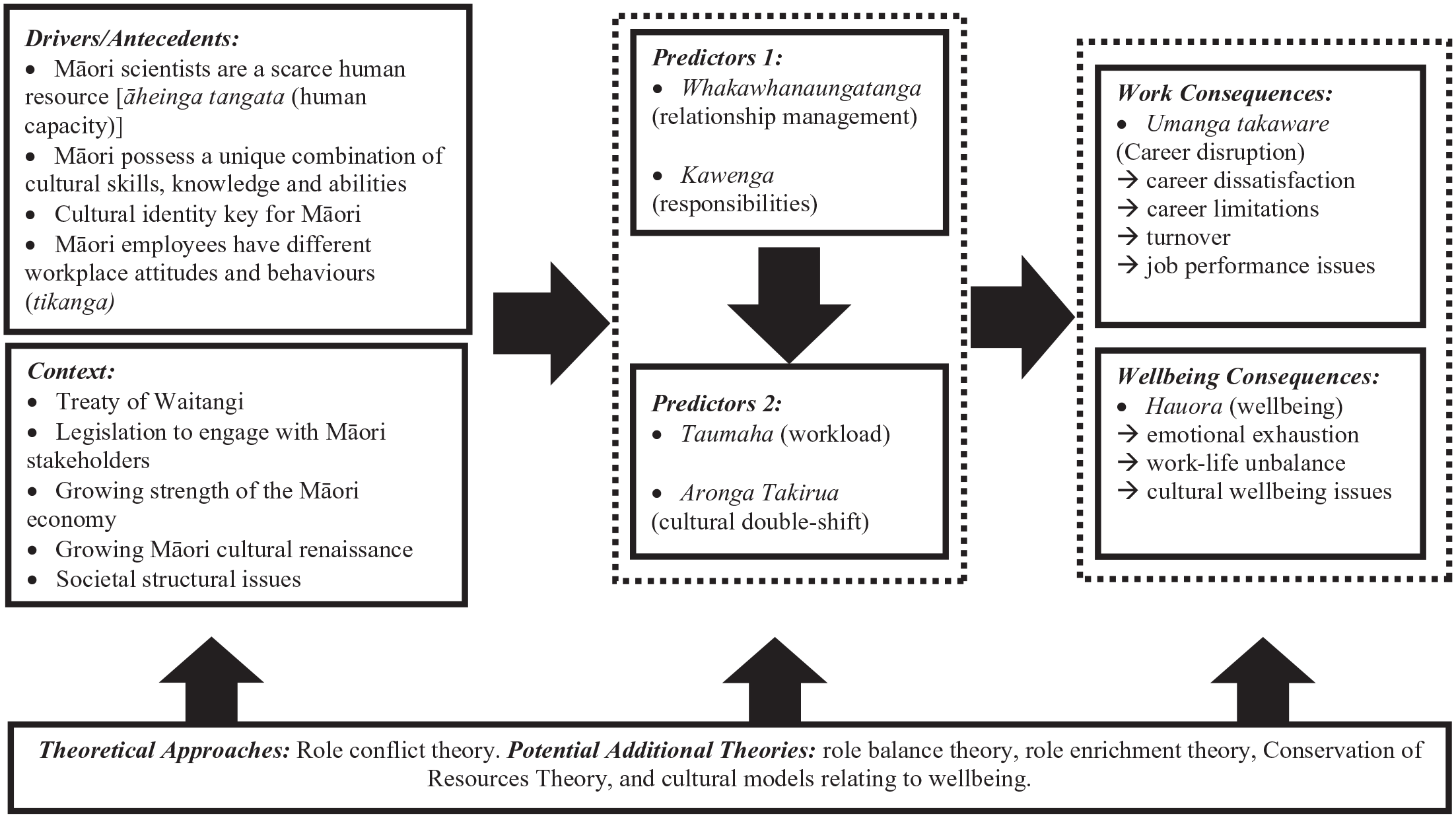
Aronga takirua (cultural double-shift model).
Our model captures the conflicting influences that strong cultural identity (Durie, 2003, 2006) can perversely drive Māori scientists’ increased time engagement with Māori stakeholders (e.g. whānau, hapū, iwi). This is through being a knowledge conduit, which ultimately acts as a dual-edged sword. Engagement with Māori stakeholders brings cultural and scientific value (joy, importance, meaningful work), but the time requirements, pressures and associated demands, firmly tie into the detrimental effects of role conflict theory (Greenhaus and Beutell, 1985; Kahn et al., 1964). Thus, cultural identity drives cultural engagement, and while intrinsically rewarding, it ultimately has detrimental consequences.
Our model acknowledges the context of NZ, including the legislative requirement to engage with Māori stakeholders and the Treaty of Waitangi, which is a foundational document between Māori and the Crown, which shapes NZ society (Tawhai and Gray-Sharp, 2011). We also identify the growth and acceptance of Māori culture in NZ (including Māori language in science, e.g. Calude et al., 2020) and the importance of the Māori economy. These external factors illustrate the contextual drivers applying pressure on Māori scientists giving them intense role demands within the science sector, but potentially more opportunities outside the sector. Further, the growing Māori economy might also provide interest around science commercialisation by Māori, especially iwi. Ultimately, the structural pressures force greater role demands on Māori scientists, reflect potential weaknesses within the broad science system for Māori. Finally, the model acknowledges that NZ is not without societal-level structural issues that disadvantage Māori, including employment inequalities (see Haar and Brougham, 2013) and issues specifically within the science sector for Māori (Prussing and Newbury, 2016).
The middle section of our model highlights that the above factors shape Māori scientists’ whakawhanaungatanga, where they build trust through engaging in relationships. As noted by Haar and Delaney (2009), networks (whanaungatanga) are critical in Māori culture, and thus Māori scientists face cultural pressures to engage in meaningful and real relationship building. Importantly, this also relates to translating their science, so it brings professional pressure as well. For example, turning up to a hui to discuss one’s science project and then leaving is likely to be viewed as anathema to Māori scientists, creating additional role pressures. Instead, this might require days embedded in the local community it is serving. This occurs with kawenga whereby Māori scientists feel a responsibility to be good scientists and good Māori. Indeed, Smith (1999) warned that historical interactions between Māori and science were predominate of a one-sided ‘take’ relationship, and thus Māori communities are often wary of scientists – whether Māori or not.
Combined, this highlights a process of action whereby Māori scientists become engaged and face cultural pressures and obligations to ensure their science work meets both science goals and Māori cultural aims, which leads to issues around workload (taumaha). Thus, cultural drivers (e.g. networking) bring additional pressures to engage, including for a longer time, reinforcing role challenges and incompatibility of roles leading to poorer outcomes (Eby et al., 2005). However, we categorised a distinct theme around aronga takirua that represents a cultural double-shift. Here, Māori scientists operate with the burden of two workloads. Importantly, to perform well as both a scientist and a Māori means that Māori scientists are likely to feel they wear multiple hats (work numerous roles) and conduct this work across two potentially full-time domains (work and cultural). Examining employment contracts, we find that Māori scientists are given wide autonomy around engaging with Māori stakeholders and broad encouragement. However, the lack of time or additional time allocation appears detrimental for Māori scientists because this can encourage them to engage in multiple roles (aronga takirua). Overall, this cultural double-shift has severe consequences as our last section of the model highlights.
Our aronga takirua theme aligns with the double-consciousness argument by Du Bois (1903), where he suggested black people must have two fields of vision: (1) conscious of how they view themselves and (2) conscious of how the world views them. It highlights the complexities and challenges that indigenous and minority ethnicities (Du Bois, 1903) face when operating within society and, specifically here, academia. Our model brings a unique cultural approach to the role conflict theory (Greenhaus and Beutell, 1985; Kahn et al., 1964), improving its broad appeal. Our extension does not contradict the theory but highlights how some cultural roles might create unique effects previously unknown in mostly western-focused theories. We suggest this study extends role conflict theory and makes it more accepting of individual cultural drivers.
There are also clear work consequences of this extensive engagement, with career factors being raised prominently by Māori scientists. The requirements around engaging with Māori stakeholders, educating non-Māori scientists and completing VM-related aspects in research grant applications all require additional commitments. This leaves Māori scientists with less time to conduct research and publish, which is fundamental to career progression for scientists in NZ and internationally. Overall, the higher work demands, and lack of career progression, are also likely to play a role (along with reduced well-being) in driving Māori scientists out of the profession, with turnover being a highlighted consequence (among Māori ex-colleagues). Finally, well-being (hauora) issues were highlighted, with job burnout being especially prevalent. This theme aligns with Durie’s (1994) Whare Tapawhā model and highlights the complexities and entwined nature of hauora for Māori. This accounts for health aspects via the physical, extended family, spiritual and thoughts and feelings (Durie, 1994). It highlights the complexities of well-being for Māori scientists and how perhaps pressures from whānau (extended family) might drive the cultural demands leading to lower physical well-being. This highlights an intertwined and likely symbiotic relationship.
Regarding job burnout, Swider and Zimmerman (2010: 487) state it is ‘a psychological syndrome involving chronic emotional and interpersonal stressors that individuals experience at work’. Not only is burnout a serious state itself, but it is linked to higher turnover and lower job performance (Swider and Zimmerman, 2010). We also expect other forms of hauora to be influenced, not least work–life balance owing to its links with role conflict (Haar, 2013) and cultural well-being. Haar and Brougham (2013) define cultural well-being as how indigenous employees perceive their cultural values are accepted at work and are vital towards the career satisfaction of Māori employees.
Finally, our model highlights the usefulness of role conflict as the core theoretical approach. Still, we also seek to extend this approach to indigenous work by acknowledging other potential theories (e.g. the Conservation of Resources (COR) theory; Hobfoll et al., 2018). COR theory focuses on resources (e.g. time, energy) and highlights that employees can experience resource losses and gains. This might be pertinent to studying work outcomes like job satisfaction in Māori scientists. Similarly, role balance theory (Haar, 2013) and work–family enrichment (Greenhaus and Powell, 2006) both extend the focus (to include non-work roles) and approach (highlighting positive effects), and both can theoretically advance our understanding of indigenous workers. We encourage researchers to extend these theories to encompass cultural roles among indigenous employees. Finally, given the hauora importance here, expanding the examination of well-being to include other culturally appropriate models is encouraged.
In summary, we find strong support for our first research question, with VM and associated cultural factors placing intense additional demands on Māori scientists. While there are some cultural benefits around such engagement, the outcomes appear largely detrimental, including career, health and employment, answering research question two. Interestingly, our studies did not identify any specific strategies (including cultural) that might aid the challenges of such demands, providing initial evidence for our third research question. This suggests a more structural intervention is needed. Further exploration around this aspect is encouraged. Finally, we answered our last research question, finding strong evidence that while VM policy has been beneficial for engagement with Māori communities and stakeholders, it appears to have unintended consequences. Specifically, placing excessive demands on a small Māori scientist workforce seems to have long-term detrimental effects.
Implications
The present study’s key implication is that Māori scientists feel they operate across two worlds and thus operate with a double-shift (scientific and cultural work), which ultimately limits their careers and leaves them feeling burnt out. Therefore, employers, HR professionals and managers need to pay special attention to the roles and workloads of Māori scientists. This is especially true for junior staff starting their careers. However, highly experienced Māori scientists might similarly be engaging in the cultural double-shift (and potentially have been for a long time), making their well-being also of paramount importance. This implication aligns with our findings from study two (wave three) and study three. Most Māori scientists have a role that involves engaging with Māori stakeholders, although for some, that is a core part of their job contract; it is at least sometimes unpaid. The easiest implication would be to enable Māori scientists who want to engage with Māori stakeholders (remembering a small proportion did not) and size these roles accordingly. Perhaps at double the current weighting to capture this cultural double-duty. This might be a way to address somewhat the disparity faced by Māori scientists, considering they noted the extra responsibilities and burdens they carry: for example, upholding Mātauranga Māori, ensuring Māori aspirations prevail and ensuring consistency about VM-related activities. This highlights the cultural commitment that Māori scientists bring to academe.
Better resourcing of the roles of Māori scientists is essential, and good mentoring, both by Māori and non-Māori established scientists, is likely to be beneficial. Beyond the individual level, NZ VM policy needs additional work to alleviate the extra demands placed on a critical human resource (Māori scientists). In the NZ education system, the government provides ‘bonus’ funding for universities and wananga to incentivise high-level academic studies for Māori (e.g. PhDs). Perhaps a structural solution is needed around additional funding for Māori scientists, such as through a government entity with dedicated VM funding for Māori scientists only. Resourcing of time and research funding – including more permanent full-time work – appears needed to maximise better the contribution the indigenous people of NZ can make to the science sector. Also, more work is required to develop and build capacity among Māori scientists. Our findings provide stark evidence of the challenges facing the science sector and their engagement with and employment of Māori. Finally, legal redress might be an option for Māori scientists as a collective, perhaps through a Treaty of Waitangi claim. Such approaches have been undertaken recently (e.g. WAI 262 claim) whereby Māori seek redress for ongoing inequalities for which the government are responsible (Geismar, 2013). Ultimately, the legislative requirement of engagement between the NZ science sector and Māori is borne by Māori scientists, who are critically under-resourced, and appears to come at a severe cost to Māori scientists themselves as well as their professions.
Conclusion
The present study sought to explore the role of cultural factors on the work experiences of Māori scientists. Using role conflict theory to account for the potential effects of additional cultural roles and these were strongly supported, although a complex intertwined set of relationships became apparent. We offered a cultural double-shift model to capture these relationships (including drivers) and provide insights into how the performance, career aspirations and well-being of Māori scientists are currently affected by the NZ science system. Most Māori scientists have a strong cultural identity and play a vital role in the NZ science system. However, this system appears to overwork these scientists, thus addressing some of the structural issues. Specifically, the cultural double-shift is needed to provide gains for all NZ society, including Māori.
Footnotes
Appendix
Glossary of Māori terms.
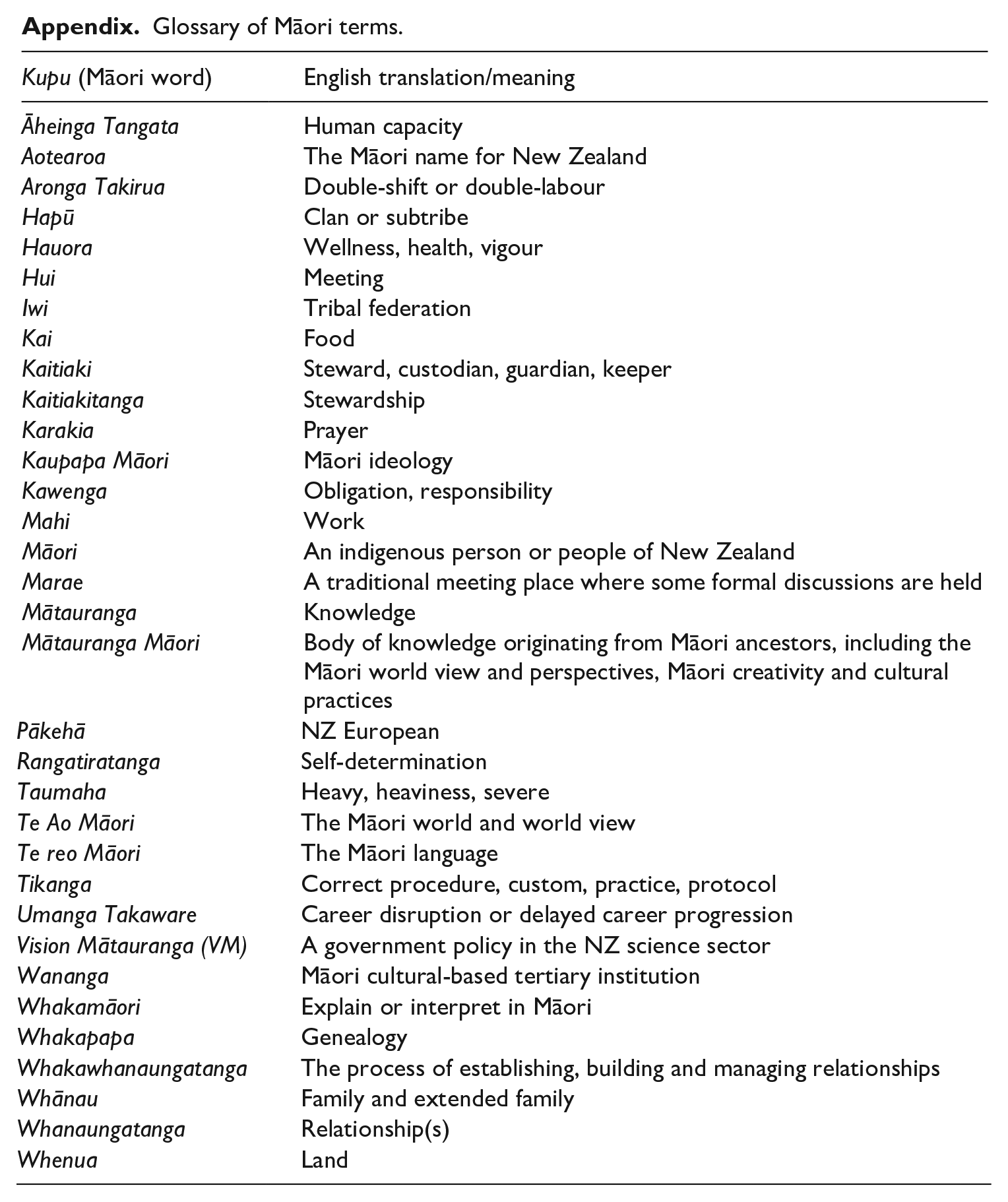
| Kupu (Māori word) | English translation/meaning |
|---|---|
| Āheinga Tangata | Human capacity |
| Aotearoa | The Māori name for New Zealand |
| Aronga Takirua | Double-shift or double-labour |
| Hapū | Clan or subtribe |
| Hauora | Wellness, health, vigour |
| Hui | Meeting |
| Iwi | Tribal federation |
| Kai | Food |
| Kaitiaki | Steward, custodian, guardian, keeper |
| Kaitiakitanga | Stewardship |
| Karakia | Prayer |
| Kaupapa Māori | Māori ideology |
| Kawenga | Obligation, responsibility |
| Mahi | Work |
| Māori | An indigenous person or people of New Zealand |
| Marae | A traditional meeting place where some formal discussions are held |
| Mātauranga | Knowledge |
| Mātauranga Māori | Body of knowledge originating from Māori ancestors, including the Māori world view and perspectives, Māori creativity and cultural practices |
| Pākehā | NZ European |
| Rangatiratanga | Self-determination |
| Taumaha | Heavy, heaviness, severe |
| Te Ao Māori | The Māori world and world view |
| Te reo Māori | The Māori language |
| Tikanga | Correct procedure, custom, practice, protocol |
| Umanga Takaware | Career disruption or delayed career progression |
| Vision Mātauranga (VM) | A government policy in the NZ science sector |
| Wananga | Māori cultural-based tertiary institution |
| Whakamāori | Explain or interpret in Māori |
| Whakapapa | Genealogy |
| Whakawhanaungatanga | The process of establishing, building and managing relationships |
| Whānau | Family and extended family |
| Whanaungatanga | Relationship(s) |
| Whenua | Land |
Acknowledgements
We acknowledge the Rauika Māngai and Ngā Pae o te Māramatanga for convening the Vision Mātauranga Leadership hui. We recognise the contributions of our many participants – tēnā koutou i ngā kura nā koutou rā i whakamārama mai. Finally, we acknowledge Associate Professor Te Taka Keegan for conceptualising the ideas in this article into Māori and attributing the term, aronga takirua.
Funding
The authors disclosed receipt of the following financial support for the research, authorship and/or publication of this article: this study was funded by the New Zealand National Science Challenge: Science for Technological Innovation [Kia kotahi mai – Te Ao Pūtaiao me Te Ao Hangarau].
