




Abstract
What are the strategies entrepreneurs apply to present business closure to public audiences? Most entrepreneurs choose to communicate venture failure publicly so as to foster a favorable impression of failure, in effect engaging in impression management to maintain and/or repair their professional reputation for future career actions. To date, however, the focus of most research has been on managing failure within organizational settings, where organizational actors can interact closely with their audiences. We know little about entrepreneurs’ strategies in presenting failure to public audiences in cases where they have limited opportunities for interaction. In response to this, we present an analysis of public business-closure statements to generate a typology of five venture-failure narratives—Triumph, Harmony, Embrace, Offset, and Show—that explains entrepreneurs’ distinct sets of impression-management strategies to portray failure in public. In conclusion, we theorize from our public venture-failure typology to discuss how our work advances understanding of the interaction between organizational failure, impression management, and entrepreneurial narratives.
Keywords
Introduction
It is not uncommon for entrepreneurs to be forced to liquidate their businesses; nevertheless, making such a decision can be an image-threatening event for them (Byrne and Shepherd, 2015; Cardon et al., 2011; Cope, 2011; Shepherd, 2003). After announcing business closure, prior and future stakeholders might doubt entrepreneurs’ professional skills and devalue their professional reputation (Gardner and Avolio, 1998; Semadeni et al., 2008; Shepherd and Haynie, 2011). Thus, if not managed successfully, business closure can have significant negative social consequences on an entrepreneur’s ability to fulfill their professional role in the future (Kibler et al., 2017; Shepherd et. al., 2011). As a means to maintain or repair organizational actors’ reputation after failure, research has emphasized the importance of impression management (Bolino et al., 2008; Elsbach, 2003; Shepherd and Haynie, 2011), that is, the means available for creating a likable impression of the self (Goffman, 1959; Tedeschi and Melburg, 1984). For instance, prior studies show that organizational actors can apply impression management (IM) defensively to restore legitimacy or assertively to bolster acceptance in the wake of organizational failure events (Bolino et al., 2016; Carter, 2006).
Organizational failure research, however, has largely focused on IM applied within organizational settings that involve durable professional relationships, as well as on failure events that have limited social consequences for individual actors, such as not meeting project goals (Bolino et al., 2016; Dahlin et al., 2018). The termination of a business, in turn, reflects an extreme organizational failure event that is visible to the public and can substantially threaten the professional reputation of entrepreneurs and managers involved in the business from its inception (Shepherd and Cardon, 2009; Shepherd et al., 2011). At the same time—and in contrast to IM within organizational settings—organizational actors have only limited opportunities for interaction with their public audiences, which means that their initial public presentation of business closure is the vehicle by which a favorable impression of venture failure may be created (Kibler et al., 2017; Morrison and Bies, 1991; Semadeni et al., 2008).
Creating a favorable public impression of venture failure is of great importance for entrepreneurs because their future projects largely depend on personal credibility in the context of starting new businesses and attracting resources and talent (Garud et al., 2014; Lounsbury and Glynn, 2001). To our surprise, while narrative research on entrepreneurs’ sense-making of failure has indeed expanded over the past decade (Byrne and Shepherd, 2015; Mantere et al., 2013; Ucbasaran et al., 2010; Vaara et al., 2016), only a few studies have looked into how failed entrepreneurs engage in IM (Kibler et al., 2017; Shepherd and Haynie, 2011). Strikingly, those rare studies suggest contradictory findings: a recent experimental study shows that the general public responds more positively when entrepreneurs attribute business failure to external factors beyond their control (Kibler et al., 2017), whereas another study indicates that public narratives which blame other actors or external events can be expected to communicate an unfavorable image of the entrepreneur (Cardon et al., 2011). As a next step in this line of research, we argue, it is necessary to complement current understandings of the different types of venture-failure narratives (Mantere et al., 2013) with insights from post-failure IM research (Bolino et al., 2008, 2016) in order to better comprehend the various strategies which entrepreneurs can apply to create a favorable impression of such failure amongst the public.
Against this backdrop, our study advances knowledge of IM after organizational failure by addressing the following research question: What are the strategies entrepreneurs apply to present venture failure to public audiences? In tackling this question, we uncover the types of public failure narratives created by entrepreneurs by examining 118 business-closure statements posted in English on the websites of discontinued ventures. To uncover variations among failure narratives, we first applied latent semantic analysis (LSA) (Landauer et al., 1998), resulting in five theoretically distinct text types. Second, to interpret the primary impression(s) that each text type conveys to the public, we conducted an abductive analysis (Alvesson and Kärreman, 2007; Eisenhardt et al., 2016) by drawing on Bolino et al.’s (2008) glossary of IM tactics. Finally, we considered and theorized the textual semantics and IM strategies in tandem. The key theoretical insight to emerge from our analysis is the generation of a novel typology of five public venture-failure narratives—Triumph, Harmony, Embrace, Offset, and Show—that explains how each narrative type creates different meanings of failure by taking advantage of a different set of IM strategies.
Our study generates several contributions to the literature. First, we expand research on managing organizational failure (Dahlin et al., 2018; Mellahi and Wilkinson, 2010; Shepherd and Haynie, 2011) by demonstrating how entrepreneurs—as key organizational representatives in the public—engage in public IM after business closure. Specifically, we extend knowledge of post-failure IM (Bolino et al., 2016; Kibler et al., 2017; Shepherd and Haynie, 2011) by explaining how key organizational representatives make use of single, dual, or multiple IM strategies to mitigate potential threats to their professional image following a publicly visible failure event. Second, we add to research on venture-failure narratives (Byrne and Shepherd, 2015; Mantere et al., 2013; Vaara et al., 2016) by relocating the focus of interest from failure narratives as a means of sense-making in confidential research settings to the study of venture-failure narratives as a means of impression-making in public. Drawing from our study’s insights, we suggest that, whereas confidential research settings encourage entrepreneurs to blame external factors and other people for their venture’s failure (Mantere et al., 2013), in public settings entrepreneurs aim to focus on presenting their own efforts, positive outcomes, and the lessons they have learnt from such failure with an eye to maintaining or strengthening their professional image and relationship with stakeholders.
Managing organizational failure
Research on organizational failure has made important contributions to our knowledge on how organizational actors can manage and cope with failures (for an overview, see Dahlin et al., 2018). This stream of research has shed light on how organizational actors can recover and learn from failure arising, for instance, from not meeting project targets (Shepherd and Haynie, 2011; Shepherd et al., 2011), committing errors or being unable to prevent accidents (Chuang et al., 2007; Vogus and Sutcliffe, 2007). As an important means for mitigating the potential negative implications from failure, research has long emphasized how IM can help organizational actors avoid or camouflage work situations that could threaten their professional image (Bolino et al., 2008, 2016; Gardner and Avolio, 1998; Tedeschi and Melburg, 1984). In a nutshell, IM concerns an individual’s desire to use the means available to address social perceptions of the self (Bolino et al., 2016; Elsbach, 1994; Goffman, 1959) and thereby protect their current image or foster a new, likable image (Sutton and Callahan, 1987; Tedeschi and Melburg, 1984).
Several studies have demonstrated how organizational actors use IM strategies to bolster acceptance in the wake of failures and errors (Elsbach, 2003; Gardner and Martinko, 1988; Zhao and Olivera, 2006). For instance, organizational actors use IM defensively to restore legitimacy (Elsbach, 1994; Rosenfeld et al., 1995); or assertively to regain their professional reputation after a failure event (Caldwell and O’Reilly, 1982; Carter, 2006). Other research has pointed to the role of demonstrative IM (Bansal and Kistruck, 2006), emphasizing the presentation of facts or details, or drawing from broad generalizations to help manage negative impressions of failure (Bolino et al., 2008). Despite a number of important contributions, in this stream of research the predominant investigative focus has been on the management of failure within organizational settings where organizational actors have the opportunity to interact closely with their audience and to address how others evaluate their behavior (Cooper, 2005; Rosenfeld et al., 1995). Here, scholars have particularly emphasized the importance of understanding how the organizational context—such as manager–subordinate relationships, team dynamics, and work culture—contributes to how organizational actors cope with failure and successfully continue operations that follow a failure event (Brown and Jones, 1998; Dahlin et al., 2018).
The situation of entrepreneurs facing organizational failure can differ drastically from that of managers or employees (Barney and Busenitz, 1997), who typically continue working in their respective organizations after failure events (Elsbach, 2003; Gardner and Martinko, 1988). In extreme cases, organizational failure means that the organization ‘cannot continue to operate under the current ownership and management’ (Shepherd, 2003: 318), and entrepreneurs become the very actors who are personally affected by such venture failure and who are responsible for communicating it to their relevant audiences (Kibler et al., 2017). Being forced to close down a business can be an emotionally traumatizing experience, in particular for actors who have developed and managed the business from its inception (Cope, 2011; Fang He et al., 2018; Jenkins et al., 2014; Singh et al., 2015). At the same time, business closure can cast serious doubts on individuals’ personal competence in running a new business, or it can harm their decision-making capacities throughout their future career (Hayward et al., 2010; Shepherd, 2003; Shepherd and Cardon, 2009; Ucbasaran et al., 2010). The ultimate termination of an organization is typically visible to their public audience, which is defined as the groups targeted by a particular activity (Merriam-Webster, 2019); in our research context, this can include former employees, customers, investors, and present and potential future business partners, many of whom the entrepreneur may not know in person (Shepherd and Haynie, 2011). With this in mind, entrepreneurs often have limited opportunities for interaction with their public audiences. Thus, presenting venture failure in public is fraught with risk, and the initial public business-closure statement is crucial for creating a favorable public impression of venture failure (Kibler et al., 2017; Morrison and Bies, 1991; Semadeni et al., 2008).
A closer look at the literature reveals an emerging body of research that applies narrative analysis to examine venture-failure stories presented in confidential research settings and to understand how entrepreneurs—typically the founders and/or CEOs of their own organizations—make sense of their business closure (Byrne and Shepherd, 2015; Mantere et al., 2013; Singh et al., 2015). Narratives are themed accounts which convey meaning from the author/narrator to the reader/listener, either orally or as written text (Balogun et al., 2014; Fraher and Gabriel, 2014; Vaara, 2002). The main thrust in the literature on venture-failure narratives (obtained in confidential research settings) has been to highlight the importance of determining the cause of failure, in order to process and overcome such an event (Vaara et al., 2016). To this aim, entrepreneurs assign meaning to failure by either attributing it to their personal actions and embracing failure as an integral part of organizational life (Zacharakis et al., 1999), or by attributing failure to external circumstances and thereby distancing themselves from the failure event (Jenkins et al., 2014; Shepherd and Haynie, 2011). In the only narrative typology on venture failure to date, Mantere et al. (2013) build on this premise and offer a valuable starting point for understanding how assigning meaning to a failure event relates to important emotional and cognitive processes of failure recovery. Essentially, their typology suggests that distinct narratives used by entrepreneurs attribute the cause of failure to individual, collective, or non-human factors, and thus serve different purposes in enabling entrepreneurs to justify their own role in the failure, recover from their loss, and restore their professional and emotional competence after the failure.
Complementing recent insights into entrepreneurs’ sense-making of venture failure (Byrne and Shepherd, 2015; Cope, 2011; Mantere et al., 2013), scholars have begun to examine how entrepreneurs can maintain and/or repair their professional reputation after failing with their business (Kibler et al., 2017; Shepherd and Haynie, 2011). This nascent line of research suggests that entrepreneurs’ emphasis on responsibility-taking and/or distance-taking reflects post-failure IM behaviors that can help create a favorable image of themselves (Kibler et al., 2017; Shepherd and Haynie, 2011). For instance, Kibler et al. (2017) illustrate that public audiences respond more positively to entrepreneurs who emphasize external rather than internal causes, thus attributing venture failure to external factors beyond an entrepreneur’s control. In contrast, Cardon et al. (2011) suggest that venture-failure stories that publicly blame other actors or external events convey an unfavorable image of the entrepreneur. The limited—and contradictory—evidence suggests that we still lack a thorough understanding of IM after venture failure and, in particular, that IM theory remains underutilized in explaining the strategies used by entrepreneurs to portray venture failure to their public audiences.
Against this backdrop, we propose that advancing our understanding of entrepreneurs’ post-failure IM requires complementing the dominant investigative focus on entrepreneurs’ sense-making of failure with research that better equips us to identify and distinguish between the different—types and combinations of—strategies that entrepreneurs use to present venture failure in public. Specifically, we argue that focusing on written business-closure statements (which reflect the initial public announcement of venture failure and thus serve as a key means for entrepreneurs to convey a specific meaning of failure) allows us to advance IM research that mainly focuses on orally communicated stories shared in confined organizational environments with ample opportunities for interactions (Bolino et al., 2008, 2016).
Data
Our primary data set for developing a typology of public venture-failure narratives comprises 118 public business-closure statements. These are various forms of termination announcements as well as blog posts published on the websites of discontinued companies. In order to minimize differences arising from specific industrial characteristics and to construct a homogeneous sample of entrepreneurial ventures, we focused on software and IT companies that had discontinued operations over approximately the past 20 years.
The companies in our sample were primarily headquartered in Anglo-American countries (67% in the USA, 10% in the UK, and 4% in Canada), with a smaller number of companies located in four European countries (Belgium, Switzerland, Germany, and the Netherlands). The companies had existed for between 6 months and 11 years by the time they ceased operations. The sample was distributed fairly equally between founder-CEOs who did not have entrepreneurial experience prior to the case company (39%), serial entrepreneurs who had prior entrepreneurial experience (34%), and portfolio entrepreneurs involved in multiple businesses at the time of the shutdown (27%). In 43% of the cases, the founder-CEO was the sole founding member, and in 57% of cases the start-up team included additional members.
The data collection utilized the Crunchbase database provided by TechCrunch, an online magazine tailored for an audience interested in innovative technology-based companies. By the end of 2014, the database contained the profiles of over 2600 discontinued IT and software companies, and included details on the business in question (e.g., location and date of establishment) and the founding team (e.g., names and team size). We screened each of the approximately 2600 IT companies in Crunchbase for reliable information on business closure; chiefly, we only included companies that could clearly be identified as having completed the formal legal process of dissolution or withdrawal. In 48% of the companies we were not able to identify such information to a satisfactory degree, and this resulted in a sample of 1248 IT companies. Following this, we initiated data collection by using Internet Archive’s Wayback Machine to access the homepages of the 1248 discontinued companies at the moment of the shutdown event, and we systematically screened for closure statements in English (Hackett et al., 2004). In this way, we were able to access 214 companies’ homepages.
We then applied two further criteria to select our final sample: first, we checked whether the entrepreneur (i.e. founder-CEO) had remained with the company for the entirety of its lifespan. We excluded cases from the sample where a professional manager replaced the founder-CEO prior to the shutdown, for reasons that this would not reflect entrepreneurs’ public narratives on venture failure. Second, to avoid confusing the closure of a failed business with a voluntary exit (DeTienne et al., 2015), we excluded cases where the company had been acquired by another company (e.g., a larger competitor), which then proceeded to shut it down, as well as cases that did not contain sufficient information for determining the conditions for the shutdown. As a result, we reduced the sample to 118 business-closure statements for our main text analysis and subsequent development of a failure-narrative typology.
We complemented the business-closure statements with interview and audience data so as to help us provide a more detailed illustration of the public failure narratives. Specifically, after our main text analysis identifying the five theoretically distinct types of failure narratives, we contacted six founder-CEOs for each narrative type and asked for interviews (i.e. a total of 30 founder-CEOs from the original sample of 118 companies). Eleven founder-CEOs agreed to our interview request, which amounted to at least two interviews (each lasting about 30 minutes), with a founder-CEO for each narrative type. Further, we collected audience reactions (from customers, stakeholders, or peers) directly via two social media channels: Twitter and Facebook. We further enriched this data collection process by drawing from media articles which published interviews with the founder-CEOs and/or which communicated the sentiments of their audiences.
Analytical procedure
In order to address our research question of what strategies entrepreneurs apply to present venture failure to public audiences, our analysis aims to develop a typology of theoretically distinct public failure narratives (i.e. ideal types), where each narrative type contains a unique combination of consistent and conceptually relevant attributes (Cornelissen, 2017; Doty and Glick, 1994). With this in mind, we applied three analytical steps. In Step 1, we followed recent textual analyses in the field of management and organization studies (e.g. Müller et al., 2016; Piezunka and Dahlander, 2019) and conducted a latent semantic analysis (LSA) of the business-closure statements to differentiate latent narratives based on theoretically distinct meanings of failure embedded in the semantic patterns of the closure statements. Hence, we chose LSA as the basis for our typology-building process because it aids the inductive detection of the key attributions of failure that underpin the differences and similarities across business-closure statements, and thus ensures that our typology differs from ‘classification,’ which would divide companies and their statements into empirically heterogeneous groups (Doty and Glick, 1994). This step resulted in five semantic text types (i.e. ideal types of failure narratives). In Step 2, we abductively coded for the presence of IM tactics in the 118 business-closure statements and then determined which statements and IM tactics were predominantly associated with each of the semantic text types identified in the previous step. In Step 3, we formulated a typology of public venture-failure narratives by combining the results of the first two analytical steps. In the following, we explain our three analytical steps in more detail.
Step 1: Identifying semantic text types
In the first analytical step, we conducted a LSA to develop an understanding of multiple ideal types of failure narratives based on distinct semantic patterns used in the 118 business-closure statements (Landauer et al., 1998; Piezunka and Dahlander, 2019). Our analysis consisted of four stages. First, we prepared the textual material for analysis by selecting words that would serve as the basis for semantic patterns and enable us to conduct the LSA. With this goal in mind, we used Linguistic Inquiry and Word Count (LIWC) software (which employs established dictionaries) to identify distinct words used in the closure statements and remove words that did not add value to the semantic analysis (Pennebaker et al., 2001; Tausczik and Pennebaker, 2010). As a result, we identified over 33,000 words used in the closure statements. By removing non-significant words (e.g., articles, numbers, and prepositions), we reduced the set to 1853 distinct words for the LSA procedure.
Second, following the preparatory stage, we ran LSA to identify latent text types within the closure statements (Müller et al., 2016). In this process, the LSA assesses different configurations of word usage—such as emotional expressions, cognitive markers, time orientations, and narrator perspectives (Tausczik and Pennebaker, 2010)—that distinguish one latent text type from another. The latent text types are not distinct in the sense of specific word patterns being exclusive to any given text type. Instead, a particular latent text type is characterized by the relative presence (positively high-loading) and relative absence (negatively high-loading) of particular word patterns. For instance, a latent text type may be distinct from all other identified text types owing to the relatively high presence of word patterns referring to future orientation or to a relative absence of positive emotional content. As a result, the identified text types are ‘latent’ and cannot be directly observed. Instead, they are ideal types that help develop an understanding of theoretically distinct failure narratives (Doty and Glick, 1994).
Third, we therefore followed Sidorova et al.’s (2008) recommendation to run the LSA multiple times in order to find the optimal number of theoretically distinct text types. We first commenced the LSA with a two-factor solution, which results in two distinct text types, and added further factors one by one by assessing their explanatory value. We found that adding a third, fourth, and fifth factor substantially contributed to identifying distinct semantic patterns, whereas adding a sixth factor offered only limited additional value. In the final five-factor solution, at least 370 words were loaded on each factor, whereas fewer than 80 usable words were loaded on the sixth factor. Therefore, the sixth factor did not reveal sufficient semantic patterns for further analysis, and we decided to focus on the five-factor solution (i.e. five ideal types of failure narratives).
Fourth, based on the results from the LSA, we focused on understanding the most dominant attributes in each of the identified text types. Following this, we defined five text types of business-closure statements that reflect three distinct semantic aspects, which we term Ownership Reference (personal ownership, collective ownership), Temporal Focus (past, present, future), and Emotion and Cognition (positive emotions, negative emotions, rational problem-focus). Text Type 1 is conceptually distinct, with its emphasis on personal ownership; Text Type 2 emphasizes collective ownership, present-focused language, and positive emotions; Text Type 3 has an emphasis on all semantic patterns except for positive emotions; Text Type 4 emphasizes future-orientation and rational problem-focus; and Text Type 5 differs from the other types, with its emphasis on past-orientation and negative emotions. Figure 1 presents the aggregation of semantic patterns for the identified latent text types.
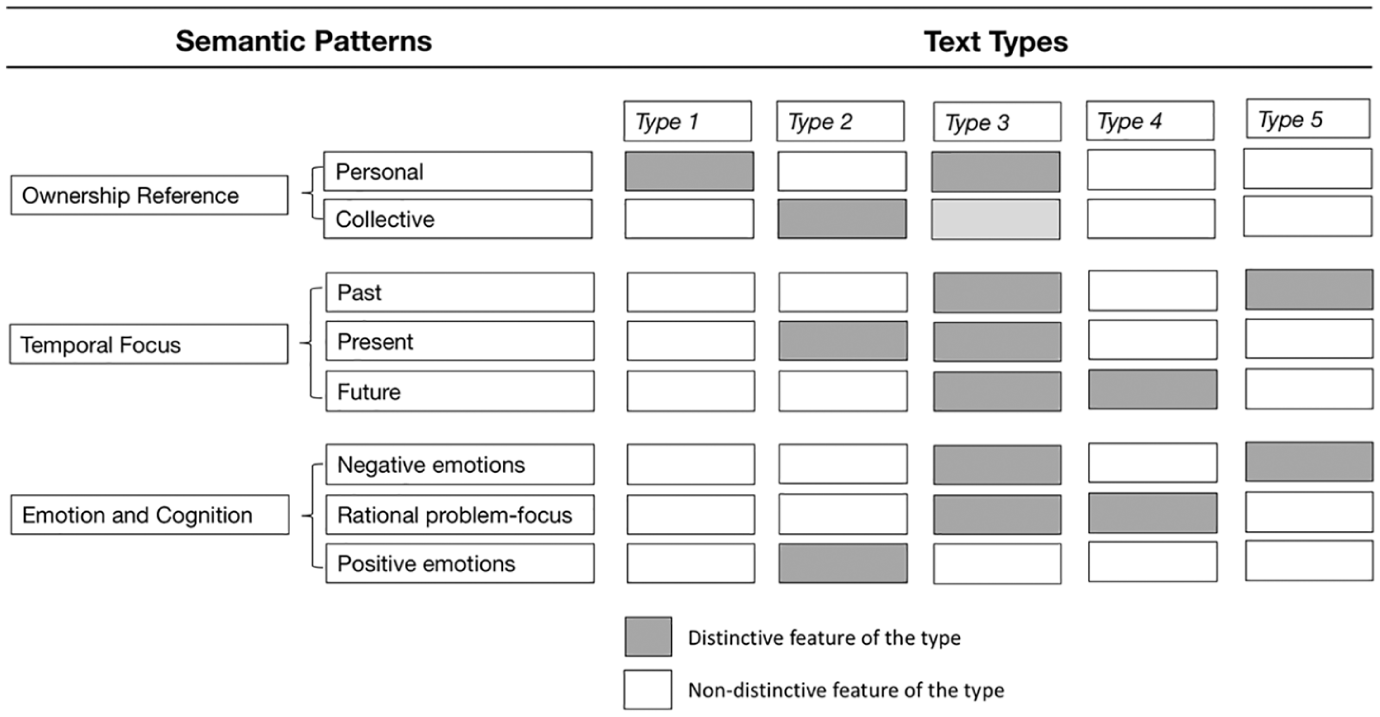
Identification of text types with distinct semantic patterns.
Step 2: Identifying impression management strategies
In the second analytical step, we aimed to develop an understanding of the identified narrative types as a means of IM. Consistent with our focus, we used the established glossary of IM strategies by Bolino et al. (2008, 2016) to identify such instances in the closure statements. We coded for specific IM tactics and then categorized each according to the respective IM strategy (for an overview of IM tactics (sub-category) and IM strategies (aggregate category), see Bolino et al., 2008).
A number of measures were taken to secure robustness in our coding process. First, because the actual business-closure statements are ‘more or less similar’ to the five semantic text types emerging from LSA (Doty and Glick, 1994; Müller et al., 2016), we sorted all closure statements based on their highest loadings (i.e. factor scores) to one of the semantic text types (i.e. factor). Here, we not only considered their absolute loadings—i.e. which closure statement loads highest on which factor—but also at the absolute differences between a statement’s loading across the five factors (i.e. latent text types). Thus, we identified the business-closure statements that clearly load on one factor more than on the other factors, serving as a base for our coding of IM tactics in each of the failure narrative types (a full overview of the individual factor scores for each business-closure statement is available upon request).
Second, three members of our research team independently coded for IM tactics in the 118 business-closure statements. For instance, in our search for distinguishable IM tactics, we coded statements such as ‘We’re honored by their attention and support and regret that we couldn’t have served them even better and for much, much longer’ as an indication of flattery, and statements like ‘we sincerely apologize for the disappointing news’ as evidence for apology.
Third, we repeatedly discussed the coding of specific IM tactics which represent broader IM strategies in order to resolve conceptual inconsistencies. For example, ‘As for what I intend on doing next, you can be sure that it will be something entrepreneurial’ was variously coded as self-promotion, distraction, and enhancement by different researchers. However, everybody agreed that the text excerpt represented a self-focused IM tactic, thereby disqualifying the distraction tactic (related to a defensive IM strategy) and enhancement tactic (related to an assertive IM strategy). Moreover, we realized that differences in interpretation emerged owing to differing understandings of the correct length of a coded text entity. Multiple IM tactics were attributed in particular to lengthier coded text entities, yet these were not equally meaningful in connection to the preceding and following sentences. For example, ‘As I’m sure you’ve noticed, not much has been happening with the site recently. I’m very sorry to report that this is because NewsLabs is ending’ initially resembled opinion conformity, but when viewed in connection with the next sentence, the notion of apology was dominant.
Fourth, we specified the definitions of IM tactics offered by Bolino et al. (2016) as these were in some cases not sufficiently accurate to explain the differences of IM tactics in our text material. For instance, the tactics of self-promotion and of self-enhancement were quite similar yet often interpreted differently by the authors.
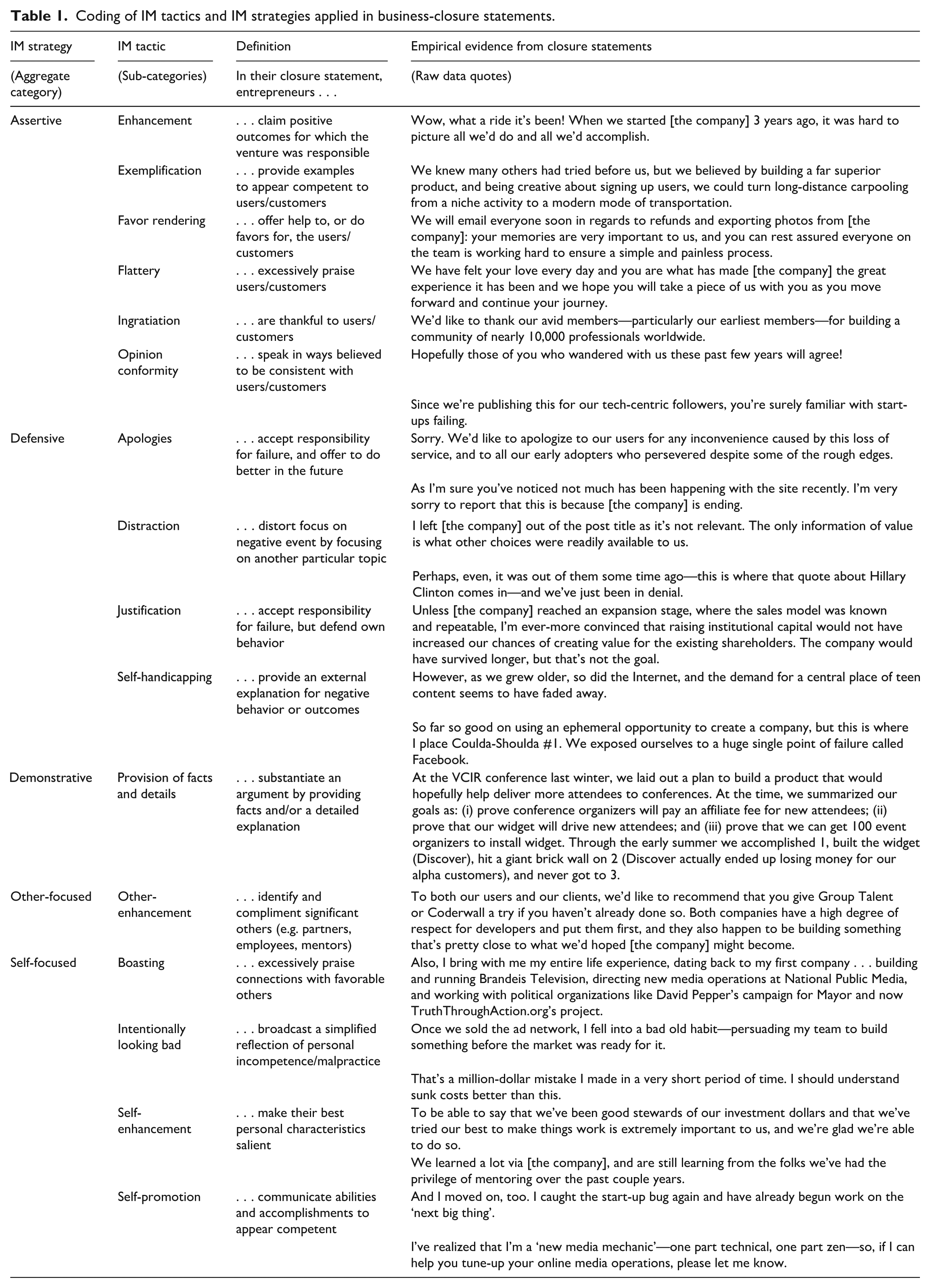
Fifth, we reduced the number of IM tactics from 22 to 16, as some of them (such as blaring, burying, and defamation) were extremely rare. Taken together, after the several rounds of iterations typical for interpretative coding (Farny et al., 2019; Gioia et al., 2013; Shepherd and Suddaby, 2017), our initial intercoder reliability between all authors rose from 49% to 93% in coding the IM tactics. Beyond calculating an intercoder reliability percentage, the four robustness steps were important to create intercoder agreement between researchers (Lombard et al., 2002), which is vital for jointly developing a typology. As a result, we identified 16 IM tactics that clustered into five broader IM strategies (cf. Bolino et al., 2008: 1082): Assertive IM strategy (proactively manage impressions about themselves, typically by means of enhancements, ingratiation, self-promotion, and exemplification); Defensive IM strategy (reactively manage impressions about themselves, typically by means of apologies, distraction, justification, and self-handicapping); Demonstrative IM strategy (provide facts or details regarding the organization’s specific activities); Self-focused IM strategy (behave in ways intended to make the actor appear nice, polite, and hard-working); and Other-focused IM strategy (behave in ways intended to make the target perceive them as likable or attractive). Table 1 illustrates our abstraction from raw data to IM tactics (with our revised definitions) as well as to the broader IM strategies.
Coding of IM tactics and IM strategies applied in business-closure statements.
Finally, we listed all IM tactics used in each semantic text type, and then assessed the distribution of IM tactics within each text type so as to identify the most prevalent IM strategies. When several IM strategies were strongly applied in the semantic text type, we included all of these multiple strategies to one text type; and when an IM strategy was clearly used less than the main IM strategy, we avoided associating the IM strategy with that semantic text type. We concluded that Text Types 1 and 2 applied a single, Assertive IM strategy. Text Type 3 used multiple strategies, including Assertive, Self-focused, Other-focused, and Defensive strategies. Text Type 4 applied a dual strategy of combining Assertive and Defensive IM strategies. Text Type 5 relied on a single, Demonstrative strategy. Figure 2 presents the application of IM strategies in connection to the text types.
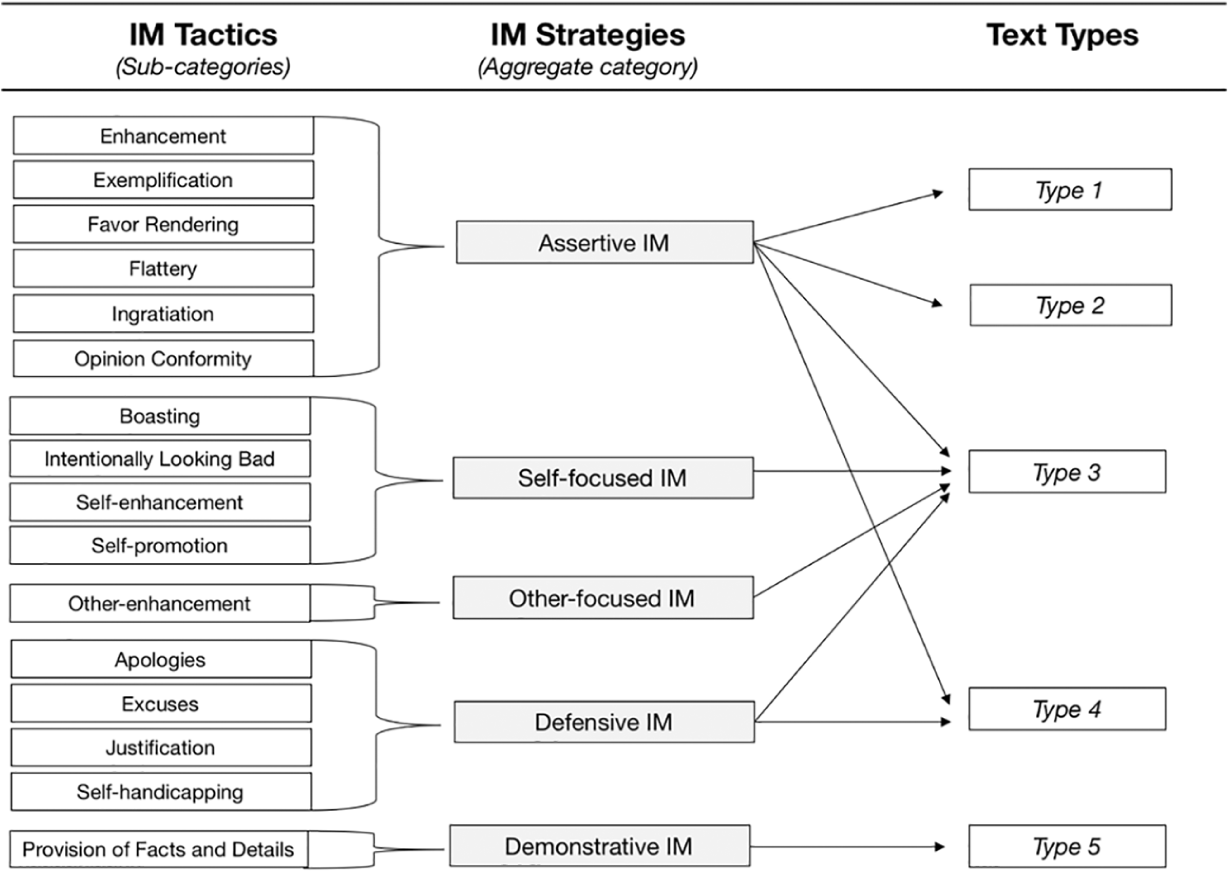
Identification of impression management strategies applied in text types.
Step 3: Generating a typology of venture-failure narratives
In the third analytical step, we built on the preceding analytical steps to formulate a typology of public venture-failure narratives in the context of business closure. Here, we analyzed the specific combinations of the semantic patterns and the IM strategies so as to theorize on how the meaning of failure is portrayed to the public in each narrative type. The core of our analytical process lies in the distinctions that we identified independently in semantic patterns (Step 1) and IM strategies (Step 2). At the same time, as is typical for research that aims to build typologies, we continued to make analytical interventions prioritizing theoretical richness by emphasizing categorical distinctiveness (Cornelissen, 2017; Zahra et al., 2009).
Following an iterative process, we concluded that the results of the LSA analysis revealed two key differences in the meanings of failure conveyed in the text types. First, the text types differed from each other in terms of including an actor-focused or an event-focused meaning of failure, and in regard to conveying affective or non-affective accounts. Specifically, we determined Text Types 1 and 2 as conveying an actor-focused (personal/collective) meaning of failure, whilst Text Types 4 and 5 lacked an emphasis on ownership and encompassed event-focused meanings—which further differed in terms of their orientation on the past or future. At the same time, Text Types 2 and 5 emphasized an affective meaning (negative/positive emotions), whilst Text Types 1 and 4 were emotionally neutral or had a rational problem-focus and were labeled as non-affective. Text Type 3 remained a hybrid; it included actor-focus and affective content but also a clearly rational problem-focus in debating the failure event through all temporal orientations.
Similarly, we assessed the number and type of IM strategies applied in association with each semantic text type in order to understand the core combinations utilized by the entrepreneurs in portraying the meaning of failure to the public. Here, we determined that Text Types 1 and 2 include a clear and decisive strategy in their public IM, because they draw from a single-Assertive strategy. Text Type 5 also adopts a single IM strategy; however, this is a Demonstrative strategy which is more analytical than an Assertive strategy and focuses on the details of the failure. Text Types 3 and 4 include multiple IM strategies; and more precisely, Text Type 3 accentuates the role of human actors with Self- and Other-focused strategies, whilst Text Type 4 adopts an approach that debates a failure event by drawing from the duality of an Assertive–Defensive strategy.
The aggregation of semantic patterns and IM strategies allowed us to interpret which strategies entrepreneurs apply in their narratives to portray venture failure to the public, and to describe how each of these narratives contains a unique set of theoretically consistent attributes. In conclusion, we completed our typology by labeling the narratives as: Triumph (Text Type 1), Harmony (Text Type 2), Embrace (Text Type 3), Offset (Text Type 4), and Show (Text Type 5). Figure 3 illustrates the formulation of the narrative typology based on the use of semantic patterns and IM strategies.
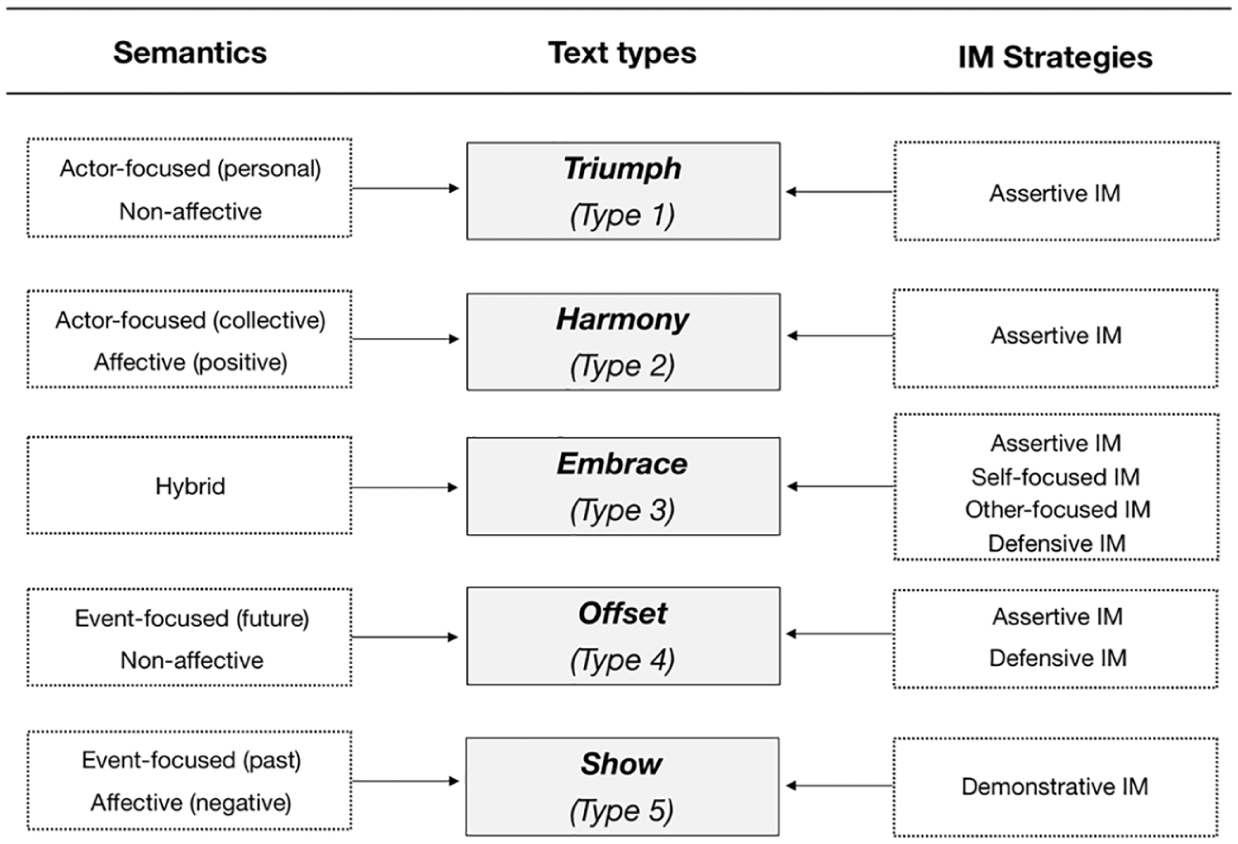
Identification of failure narrative types.
Public venture-failure narratives
Our analysis revealed a typology of five public venture-failure narratives: Triumph, Harmony, Embrace, Offset, and Show. In the following, we describe each failure narrative by presenting the meaning conveyed to the public in regard to venture failure and IM tactics as applied to the present failure. In this context, we integrate interview and social media data to further illustrate the venture-failure narratives.
Triumph narrative
Our analysis suggests that the Triumph narrative offers a confident and clear justification of venture failure and conveys a general acceptance of business closure to a public audience. Through the dominant application of an Assertive IM strategy, the Triumph narrative highlights entrepreneurs’ personal determination and persistence. The semantic meaning of failure is emotionally neutral and self-focused, which draws attention to the entrepreneur’s engagement in running the venture, and is geared to protect the entrepreneurs’ professional image.
Specifically, the Triumph narrative operates an Assertive IM strategy—that is, proactively managing impressions about oneself (Bolino et al., 2008)—by frequently including exemplification and enhancement as the main IM tactics. Exemplification highlights entrepreneurs’ competence, and conveys a message that they tried to ‘do more or better than is necessary,’ as illustrated in the following business-closure statements: He represented a great batch of angel investors on our Board and was one of the main reasons that they were so supportive of the company whenever I asked for anything. In May and June of this year, most of them agreed to participate in an inside round to keep us running through the next series of milestones. I cancelled the transaction a month ago, as I could not be as confident of reaching those milestones as ‘good faith’ requires. Although if I’m honest we also picked our business model because it was easy to explain to some local risk averse VCs. For what it’s worth I still believe in what we were trying to do here, in most of the ways we tried to do it, and in nearly all of the people trying to get it done.
Furthermore, the Triumph narrative frequently applies the enhancement IM tactic in the business-closure statement that claims that ‘positive outcomes for which they are responsible are more valuable than generally believed’ (Bolino et al., 2008: 1082): Before delving into our market and product choices, I need to address our fundraising overall. On forming the company, David and I decided to pursue a low-cap model, postponing institutional investor involvement for the foreseeable future. It really sucks to be here right now, but I think it was the right call. Resigning politely at someone else’s behest, as I’ve done twice before, did not improve any of the stakeholders’ prospects in either case. Unless [the company] reached an expansion stage, where the sales model was known and repeatable, I’m ever-more convinced that raising institutional capital would not have increased our chances of creating value for the existing shareholders. We’ve got some incredible experience and unique development skills that will be put to use. We are also looking at technology-licensing opportunities where our IP can make a difference inside the private cloud. While [the company] as we know it is over, the passion, experience, and vision lives on. There is not a single person on this page I wouldn’t gladly work with again. And be forewarned! I will actively seek out most of them when I figure out what’s next for me.
The Triumph narrative semantically emphasizes a non-affective tone, thus indicating little need for emotional recovery. This is illustrative in an interview with a founder-CEO: The reason [the company] didn’t work is because the music industry is expensive and hard to work with and takes a lot of time, money and energy just to be in compliance. All of that doesn’t exist with this idea. Just because [the company] didn’t succeed, they are all very different animals.
Consequently, the Triumph narrative draws attention to entrepreneurs’ professional qualities. This becomes visible in reactions on social media: [The founder-CEO], you have learnt a lot, possibly more than if you had succeeded. I am sure you will come back later with another idea of business. The important [aspect] is to keep trying to be on the move, to do things. Do not listen to anybody who laughs at you, you tried, you did great things, and they probably never did. It could happen to any entrepreneur and I have a lot of respect for what you did. It is always interesting to understand why.
Harmony narrative
Our analysis suggests that, following the dominant Assertive IM strategy, the Harmony narrative self-confidently portrays failure and offers a clear justification of the failure to a public audience. The Harmony narrative applies an Assertive IM strategy to emphasize the community around the venture rather than focusing on the experience of, and self-appraisals by, the individual entrepreneur (as shown in the Triumph narrative). It presents business closure as a happy ending and wishes to thank and acknowledge others for their support. By highlighting the collective involvement and positive emotions associated with failure, the Harmony narrative maintains a shared emotional foundation and conveys acceptance of the present state.
More precisely, the Harmony narrative resembles the Triumph narrative in that it generally employs a dominant Assertive IM strategy. However, in contrast to Triumph, Harmony involves IM tactics that aim to create a likable image of the entrepreneur by showing the entrepreneur’s appreciation for the support received prior to failure (Bolino et al., 2008). For instance, a dominant IM tactic applied in Harmony narrative is flattery, which praises the importance of users and customers, as exemplified in this business-closure statement: On a personal note, the other founders and I are grateful to each and every one of you who downloaded the app, shared amazing photos and stories, and helped make the world a tiny bit smaller.
In a related manner, Harmony narrative involves ingratiation, which particularly focuses on thanking key stakeholders in the business-closure statement: Though we were never able to fully deliver on the promise of [the company], we know many of you still had wonderful experiences, and thank you for sharing some of them with us. Many of you made new friends in distant countries; some got their first passports and traveled abroad to visit the very people and places they’d discovered via the app; and at least a few even found love. The stories you shared with us convinced us what we were doing had value and real meaning, and for that we’ll always be thankful.
Instead of providing lengthy explanations of how and why failure occurred, the narrative presents a collective, emotional appraisal of the failure event, and thus elevates positive aspects of the situation at hand, as illustrated by this passage in a public business-closure statement: ‘Don’t cry because it’s over. Smile because it happened.’ As such, the Harmony narrative serves the purpose of making entrepreneurs feel good about the venture journey and the value they have created for others, despite the fact that the venture has now ceased its operations, as illustrated in the interviews with the founder-CEOs: We wanted to celebrate our amazing team, partners and customers and so the paragraph describing the wonderful adventures we all had experienced was to recognize both the accomplishments and to acknowledge that for a great many people, our shutting down would be very sad. At least one of our investors has used us as an example since then of how to make the process of losing one’s investment still feel good and, like, something worthwhile was accomplished and learned.
Through a Harmony narrative, the audience is encouraged to show their emotional attachment to the company, as exemplified in the reactions on social media below: Noooo! I’m so sad! I absolutely loved my flight on [the company] and will remember for the rest of my life what an amazing adventure it was. Praying something will work out! I am so sorry about this! The flight I took was really one of life’s great experiences, and the staff there made it even more enjoyable. Oh, I hope you can save it! My ride was one of the most amazing experiences of my life. And the traveling crew that came to New Orleans was so nice and so professional. With the incredible amounts of money companies pay to name stadiums, surely the advertising would be worth it. If not, thank you so much for the experience! I will pray for all of you. My family loved the zeppelin. We flew on it on New Year’s Eve a few years ago. Every time we spotted it, someone would yell ‘Zeppelin!’ Made me happy every time I saw it, and proud of the Bay Area and Moffett Field to be its host. Really a shame. The staff of [the company] should be proud to have operated such an iconic, beautiful and inspirational service.
Embrace narrative
Our analysis suggests that by complementing the Assertive and Defensive IM tactics with Other-focused and Self-focused tactics, the Embrace narrative offers a balanced justification of failure, and portrays business closure in a transparent manner. Simultaneously, it involves a nuanced repertoire of semantic patterns that enable the founder-CEO to share information, experiences, and learning outcomes with others. It emphasizes the entrepreneur’s commitment to the venture by way of a personal reflection on the failure process without camouflaging it as a positive emotional experience. By containing both personal and collective aspects, an Embrace narrative invites the audience to process failure and empathize with the entrepreneur’s necessary process of professional and emotional recovery.
In particular, the Embrace narrative reflects the most complex narrative because it unites a mixture of semantic patterns and four different IM strategies. For instance, Embrace applies a Defensive IM strategy in the business-closure statement to convey responsibility for failure: The reasons are simple: [the company] isn’t generating enough revenue to allow us to continue working on it full time. We failed to secure additional funding to support the company as we built the business. We needed to be able to financially support our families and ultimately decided that we needed new jobs to do so. We didn’t think it was fair to our users, our clients, or especially to our new employers to continue to run [the company] on a part time basis. We worked around the clock during those months, and though the outcome wasn’t successful, we can both walk away knowing that we gave it our all.
Further, as illustrated in the following business-closure statement, the Embrace narrative uses an Assertive IM strategy to actively manage the image of the entrepreneur: But we’ll be around, to mentor, to bounce ideas off of, and hopefully to help others so that they don’t make some of the same mistakes we made.
In addition to the Defensive and Assertive IM strategies, the Embrace narrative applies a Self-focused IM strategy, concretely exemplified by self-promotion as the main IM tactic, to accentuate an entrepreneur’s abilities and accomplishments and to make the entrepreneur appear likable and competent in the business-closure statement: I’m going to take a tremendous amount of experience, lessons, wisdom, etc. with me. And, over the next few weeks, I intend on blogging diligently about every aspect of this failure. I’ve taken extensive mental notes on these lessons, and I look forward to sharing them with you. I think this process will help me institutionalize these lessons for myself, and of course I hope you can learn something from them as well . . . Now, I get to look onwards and upwards. As I look at the table of contents (below) to my start-up’s postmortem, I get excited about working on what’s next. The opportunities I have coming are incredibly exciting, and applying all that I’ve learned to the next Big Thing will make it all worth it. That’s for sure.
Furthermore, the Embrace narrative contains the Other-focused IM strategy and the specific tactic of other-enhancement to communicate to the public that the venture’s achievements relied on co-workers and other stakeholders. By doing so, the business-closure statements seek to avoid the risk that the stakeholders involved, in particular its employees, become stigmatized as failures: To give credit where it’s due, Todd closed the sale of [the company] ad network to [a larger competitor] in less than two weeks from the moment we decided it had to go. I was off promoting [the company’s] targeting system to European demographic data sources and social networks and was not even in the country during those two weeks. I hope to have the opportunity to work again with each and every one of the dozen people who worked at [the company] since it was founded in July 2007.
The narrative presents multiple temporal orientations, and it draws on rational problem-focus and negative emotions to invite compassion and explain what happened, what is happening, and what will happen in the context of the failure experience. As also emphasized by the following interview quotes, entrepreneurs can draw from an Embrace narrative to process the failure openly and involve the audience as a valuable resource for managing the experience: There was this Tumblr that was just collecting all of these App closing statements from start-ups . . . Another one bites the dust, our incredible journey, and they were just trolling them because they all looked the same. We wanted to be the antithesis of that, we wanted to be gift wrapped and we wanted to be truthful and honest. People were like, oh you know shouldn’t we do this, but they were like, no, just, we’ll fix it. And then it was anger, and I just wish they had let us do this and that, and ultimately there was acceptance . . . [T]hrough the acceptance there was still that need, and that desire to have that community. So that has the ability to start it up again. It [the closure statement] definitely helped us in our career, because it became almost a product in itself. People are like, oh yes, you did that really thoughtful shutdown, that was awesome. And second of all, I think that has helped us to get over the fact that we’ve actually shut . . . That became our legacy in a way, even though it’s a very small one, but that became sort [of] an added piece of legacy to the whole journey, which was awesome and that helped us in our professional careers as well.
To conclude, audience reactions on social media show this narrative type seeks to evoke a profound understanding of the venture failure, and suggests an overlap between founders’ personal concerns and those of their audience: A great post by @[the company]: Lessons Learned (they are shutting down operations). Bummer! Is it too late to salvage? Can we help? That is such a shame. You guys really solved a problem for me that I was ecstatic to pay for. Any chance you could open source?
Offset narrative
Our analysis suggests that, following the use of both a Defensive and Assertive IM strategy, the Offset narrative carries an analytical portrayal of venture failure. The narrative presents an entrepreneur both as confident and apologetic, and debates the implications and outcomes of business closure in public. In contrast to narratives that solely use an Assertive strategy, the Offset narrative focuses less directly on maintaining entrepreneurs’ professional image. Nevertheless, we argue that the semantic pattern signals a wish to protect the entrepreneur’s personal credibility by using impartial language and mainly emphasizing pragmatic concerns and lasting implications associated with the venture-failure event.
Concretely, the Offset narrative applies an Assertive IM strategy to underline the great efforts made by all of those involved in the venture’s activities. Here, the narrative particularly uses the IM tactics of exemplification (to draw attention to the competence of the entrepreneur) and flattery (to acknowledge the importance of the team), as illustrated in this business closure statement: We accomplished a great many things in our 18 months in market: an enormously well-received gift offering; widely-lauded experiences for web, tablet, print, and in-store; a network of 600 vendors creating the most exceptional products around, with a robust and streamlined logistics architecture to support them; an assortment of, and an approach to, content that inspired and engaged; and the brilliant and tireless team responsible for it all.
Furthermore, as represented by a Defensive IM strategy, the Offset narrative uses apologies, justification, and distraction as main defensive IM tactics. In their business-closure statement, apologies reflect entrepreneurs who accept their responsibility for certain events or types of behavior that contributed to the termination of their business (Bolino et al., 2008): To my team and their families, our vendors, network partners, and prospects, I can only say that I am deeply sorry for the way this comes to a close. And I don’t mean ‘press release sorry’; I mean really, personally sorry. Please know that I could not have imagined this last Thursday, let alone earlier.
In addition, justification focuses on acknowledging an entrepreneur’s responsibility, yet, nevertheless, seeks to defend his or her behavior in the business-closure statement: I think it’s safe to say these are unprecedented financial times. While the nature of our financing meant that the financial market crisis overtook us more abruptly than most, in the end it’s my responsibility that we hit the wall like this, and I accept it.
Offset statements also present the defensive IM tactic of distraction to shift the focus from failure to another topic, such as the broader significance of the company’s work or the potential external causes that led to failure, as in the business-closure statements below: I have been forced to make a difficult decision: to become complicit in crimes against the American people or walk away from nearly ten years of hard work by shutting down [the company]. We might have been too early, we might have done it wrong or an app like ours might simply have to be built by a bigger company. Be how it may, it’s been an incredibly awesome ride. Interesting Times. I think it’s safe to say these are unprecedented financial times . . . Please know that I could not have imagined this last Thursday, let alone earlier. It is one thing to be failed, quite another to have been deceived.
The narrative employs a future-focused language that contains words relating to cognitive processes (e.g., ‘think’) to assess the entrepreneur’s venture experience but also to explain what might follow such business closure. Hence, the Offset narrative is used to process venture failure and analyze their responsibility, as illustrated in the interviews with the founder-CEOs: I did not try to ‘impress’ anyone . . . As said, I was hoping to change the mind of the people who stonewalled [the company]. I linked extensively, highlighting every document or fact I was referring to, and on a side bar I included three ‘logically tight’ questions, the answer for which would confirm (or deny) the facts of the story. Not surprisingly [the larger competitors] never answered those questions. They took the 5th. To this day I haven’t figured if all the doors are closed because of who I am and/or what I’ve done, or maybe, it is just that the lights are on but there is no one home.
The emphasis on rational problem-focus also indicates limited emotional engagement by the entrepreneur and little need to arouse empathy amongst their audience. The audience’s reactions can thus remain scarce and relatively bland, and overlook entrepreneurs’ worries, as exemplified by short social media statements such as ‘Looking forward to hear from your next move!’
Show narrative
Our findings suggest that the Show narrative applies a Demonstrative IM strategy to present a clear and insightful account of a venture’s failure. By offering a detailed explanation of it, the Show narrative assesses the failure thoroughly and shows that the lessons which have been learnt can be valuable. Beyond this, the semantic focus on the past and on negative emotional content distances the entrepreneur’s future from the failure. Hence, instead of implying that entrepreneurs are suffering, the narrative exemplifies that entrepreneurs seek to leave behind the negative emotions and termination of their business, and move on to building a refined professional image.
Concretely, the Show narrative applies the Demonstrative IM tactic by conveying the failure mainly through the provision of facts and details (Bansal and Kistruck, 2006). It presents causal connections, chains of events, and numerical statements that enable the audience to understand the decision-making process and reasons which led to the venture’s failure, and it offers convincing and conclusive justifications for the failure in the business-closure statements: On July 31st, 2011, [the company] will be closing its doors. [The company] started several years ago at Atlanta Startup Weekend in November 2007 and has had a good run. As a refresher, [the company] aimed to aid writer’s block by allowing bloggers to receive post suggestions from their readers, while helping readers keep track of what their favorite bloggers were working on . . . Unfortunately, [the company’s] traction was not as impressive as we had hoped and [the company] had become more of a niche solution for a small percentage of bloggers. Over the past few years, 45,162 blog post suggestions have been completed through [the company], 2,346 of which were completed/blogged. The vast majority of [the company’s] users did not receive suggestions from their readers for various reasons. Only 1,214 blogs had more than 3 active suggestions. We stopped actively developing [the company] last Spring and decided to pursue other opportunities. Internally, we had begun to think that we needed a stronger value prop for our customers . . . Unfortunately, we have not seen enough traction to make us want to keep working on this. It really is too little, too late . . . Our Deadly Strategic Mistakes: [we] tried to build a sales effort too early, with too weak of a product after initial financing, waited too long [and] waited too long to address the ‘nice-to-have’ problem. Our Deadly Cultural Mistakes: [we] didn’t focus on learning and failing fast until it was too late [and] made compromises in early hiring decisions—[we] chose expediency over talent/competency.
The narrative’s detailed analysis of past activities offers a means for entrepreneurs to present their insights and knowledge gained in the past to their peer groups, as indicated in the interviews by these founder-CEOs: These things are very first world . . . Some rich people lost some money. Someone had to print a new résumé and get a new job three weeks later. No one’s suffered as a result of this. I was already working for this start-up accelerator program, and I had taken other missions as to catch up on the finance side. So, a lot of work to do something else had already begun, and this statement was more of a period at the end of sentence if you want. Like to say, okay, this is done and we’re officializing something that is already de facto a reality. And then probably we also thought of other entrepreneurs who would think about getting into the same business model basically. Like saying, okay, this is what we tried, and it didn’t work for this and that reason, you can try as well, but be aware that this is the difficulties that we had. I had a bunch of founders grill me on the next level of detail. And I got a thank you for explaining yourself, pat on the head from my investors.
Audience reactions in the social media support our interpretation, in that the provision of details creates a professional and trustworthy image of the entrepreneur: [M]y respect to @[founder-CEO] for sharing lessons after shutdown of @[the company], all the best. Must read for founders. @[founder-CEO’s] reflection on ceo mistakes made at @[the company]. Great post by @[founder-CEO] on lessons learned from @[the company]. An excellent post-mortem on @[the company]by @[founder-CEO].
Strategic alternatives for presenting business closure in public
The successful communication of the meaning of organizational failure is an important means for recovering an entrepreneur’s professional image (Byrne and Shepherd, 2015; Elsbach, 2003; Gardner and Martinko, 1988; Shepherd and Haynie, 2011; Turnley and Bolino, 2001; Zhao and Olivera, 2006). However, research on the specific combination of IM strategies in the wake of such image-threatening events is largely absent (Bolino et al., 2016)—which is surprising given the potentially detrimental social and professional consequences (e.g. Cardon et al., 2011). In response, the aim of this study was to understand entrepreneurs’ strategic alternatives for communicating business closure to the public. Therefore, we examined the combination of semantic patterns and IM strategies applied in entrepreneurs’ public failure announcements. By means of a novel typology, we develop an initial understanding of semantic patterns (the what) in connection with the IM strategies (the how and why) used by entrepreneurs to portray meanings of failure to the public. Our three-step analysis revealed a typology of five public venture-failure narratives: Triumph, Harmony, Embrace, Offset, and Show. The typology highlights the value of semantic text patterns in explaining the common and distinctive aspects of different public closure statements, and shows the use of both singular and multiple IM tactics in communicating such failure in public. In this way, our findings foster the theoretical development of strategic failure communication in public settings, through alternative combinations of IM tactics and supportive textual elements. Table 2 summarizes the developed typology of public venture-failure narratives.
Typology of public venture-failure narratives.
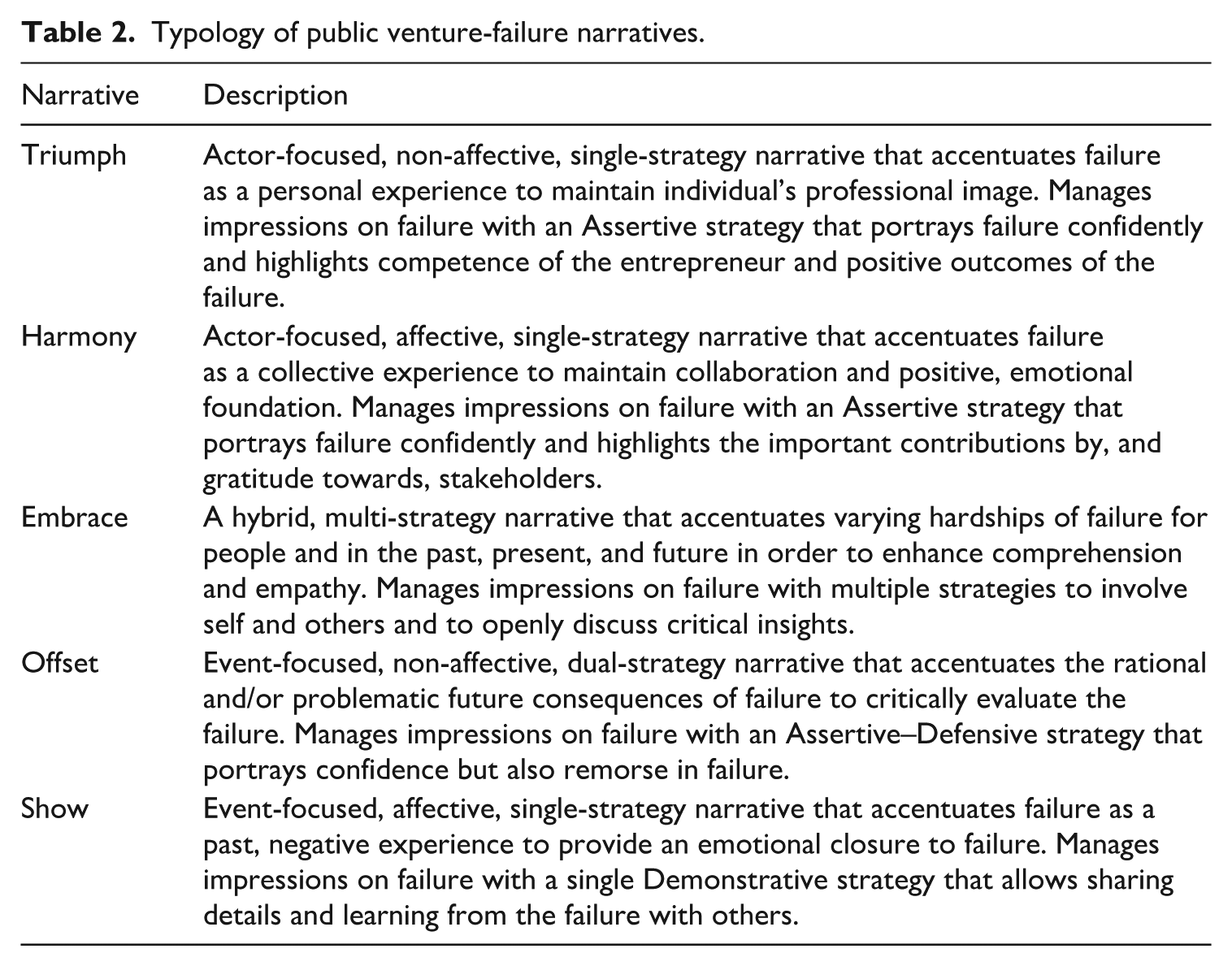
First, our narrative typology implies that the identification of semantic patterns helps explain the meaning of venture failure conveyed in public texts. In general, business closure can gain meaning as a failure event that is scrutinized and explained to the public, or it can be cast as an issue affecting human actors, and specifically the entrepreneur’s social image and relations with others. At the same time, an entrepreneur has the option to narrate venture failure in non-affective terms as a pragmatic personal, professional concern, and/or in affective terms that also emphasizes the past and shared experiences. Here, we find that the Triumph narrative accentuates the personal and non-affective experience of failure through a language of personal ownership. The Harmony narrative accentuates the collective experience and positive emotional outcomes of business closure. The Offset narrative applies a problem-focused language, with an emphasis on presenting rational concerns and the implications of the event. The Show narrative portrays emotional aspects and relegates the failure event to the past whilst refraining from highlighting either personal or shared experiences of the failure event. Lastly, adopting a hybrid perspective, the Embrace narrative accentuates both personal and collective notions of failure, all of its temporal aspects, as well as providing a problem-focused yet also emotional account of the hardships faced by the entrepreneur. Our typology points out that venture-failure narratives involve emotional content when discussing shared and past experiences, but refrains from affective language when focusing on the entrepreneur’s personal actor-role, and also when discussing future implications of the failure event.
Second, our narrative typology explains distinct applications of IM strategies to communicate business closure to an external audience. As the focal point of our typology, we suggest that the use of a single, Assertive, IM strategy in a public narrative conveys a decisive and unambiguous justification for the business failure so as to help entrepreneurs comprehend and overcome the failure. Triumph and Harmony narratives use a single Assertive IM strategy, which indicates entrepreneurs’ acceptance of failure and their continued confidence after business closure. As such, both narrative types communicate positive achievements in the face of failure. Furthermore, the Show narrative draws from a single IM strategy, yet by applying a Demonstrative IM strategy it specifically offers a detailed and rich account of how venture failure occurred. This allows entrepreneurs to take advantage of the failure by shifting the focus of attention away from a single incident to the broader lessons to be learnt from venture failure. Beyond this, public narratives can also represent a combination of IM strategies that enable the entrepreneur to be more reflective in terms of failure in a public arena. As an example of this, the Embrace narrative offers a versatile combination of IM strategies, which involves great efforts at communicating the closure transparently to the public audience. In this respect, we suggest that the inclusion of Self- and Other-focused strategies engages the audience and motivates them to support and empathize with the entrepreneur. In turn, the application of a dual Assertive–Defensive IM strategy in the Offset narrative relates to how entrepreneurs process failure and judge the implications of shutting down the business. We did not find a predominantly defensive IM type and, instead, we suggest that a partly defensive communication strategy helps to enhance reflexivity in combinatory applications. Stand-alone defensive strategies, we argue, are unlikely to create favorable reactions amongst the public in regard to the entrepreneur’s competence.
Contributions and future research directions
Our work contributes to the management literature on organizational failure by addressing the communication of severe and publicly visible organizational failure events, and in particular the IM strategies applied by entrepreneurs—typically the key public representatives of organizations—to mitigate the potential negative effects of organizational failure. To date, the predominant investigative focus of organizational failure literature has been on managing failure within organizational settings (e.g. Shepherd and Haynie, 2011; Vogus and Sutcliffe, 2007), such as the everyday maintenance and retrieval of professional credibility amongst employees and superiors (e.g. Elsbach, 2003; Mellahi and Wilkinson, 2010; Zhao and Olivera, 2006). We complement such insight by developing a fresh understanding of public venture-failure narratives; in particular, we do this by exploring the types of strategies which entrepreneurs (can) apply in public business-closure statements—written texts that offer limited opportunities for interaction and iteration of the message—in order to maintain and/or repair their professional reputation in the eyes of the public. By doing so, we contribute to the research on managing organizational failure, as well as the research on venture-failure narratives.
Implications for research on managing organizational failure
Situated at the intersection of organizational failure and IM (cf. Bolino et al., 2008, 2016; Dahlin et al., 2018), our study expands on organizational research on managing and coping with organizational failure (Dahlin et al., 2018; Mellahi and Wilkinson, 2010; Shepherd and Haynie, 2011) by demonstrating how key organizational representatives make use of single, dual, or multiple IM strategies to mitigate potential threats to their professional image following a publicly visible failure event. Our typology of five distinct public business-closure texts explains how organizational actors make use of different sets of public IM strategies in the immediate aftermath of an organizational failure event. We find supportive evidence that Assertive and Defensive IM strategies are dominant, just as suggested by current IM research (Bolino et al., 2008, 2016). The former refers to tactical means such as enhancement, favor-rendering, exemplification, and ingratiation, whereas the latter points to tactical means such as apologies, distraction, justification, and self-handicapping. In order to contribute to this debate, our study presents a novel account of how and why assertive and defensive strategies are applied and combined in public failure narratives. Moreover, we move beyond examining the use of these two dominant IM strategies by elucidating the mobilization of Demonstrative, Other-focused, and Self-focused IM strategies in the context of organizational failure. This directly responds to the call for advancing our knowledge on combinations of IM strategies in the wake of image-threatening events (Bolino et al., 2016).
We believe that providing a new basis for understanding how single, dual, or multiple IM strategies are applied in failure narratives opens up significant avenues for further research. For instance, how can the application of IM strategies contribute to a more appreciative recovery of—prior and potentially future—employees at the receiving end of organizational failure? How can entrepreneurs communicate closure to their audiences in a manner that diminishes the threat to their employees’ sense of self-esteem and future commitments, that is, forestall stigmatization in the eyes of the public? What happens when entrepreneurs’ public closure statements deviate substantially from the experience of other important stakeholders, e.g. venture capitalists (Zacharakis et al., 1999) and user communities (Hampel et al., 2019)? How can entrepreneurs make use of the different IM strategies to ameliorate negative stakeholder reactions not ‘only’ after business closure but also in the course of ‘radical pivots’ of an established venture (Hampel et al., 2019; McDonald and Gao, 2019)?
In conclusion, though we remain confident about the robustness of our typology, further research is needed to empirically capture the efficiency of the five public failure narratives for entrepreneurs’ emotional recovery and learning from venture failure (Cope, 2011; Fang He et al., 2018). We also hope that our typology can serve as a post-failure IM tool and that it represents a step towards enhancing entrepreneurs’ ability to better evaluate the core functions of IM following business closure (Kibler et al., 2017) or ‘radical’ venture pivots (Hampel et al., 2019).
Implications for research on venture-failure narratives
In prior research on venture-failure narratives, scholars have made important contributions to understanding how entrepreneurs explain failure in confidential research settings, and how this enables them to make sense of failure (Byrne and Shepherd, 2015; Mantere et al., 2013; Singh et al., 2015). Our study extends this knowledge by promoting public business-closure statements as a means for explaining venture failure to their public audience. Our key insight is that, whereas confidential settings allow entrepreneurs to blame external factors, in public settings entrepreneurs focus on casting failure in selective terms by involving analysis and emotion that engage public audiences, and explaining their effort and lessons learnt from failure in order to maintain a credible professional image.
In particular, we expand on Mantere et al.’s (2013) work by demonstrating how core characteristics of their confidential failure narratives are partly preserved yet appear distinctly when entrepreneurs communicate failure to their public target audience. Our findings uncover how public narratives exhibit significant semantic variations in regard to the focus on an individual actor (the entrepreneur) vs collective actors (the team/company), different levels of positive and negative emotions, and diverse temporal orientations (past, present, and future) in regard to the failure event. This evidence allows us to suggest that public narratives not only justify the causes of failure, but also expose implications for entrepreneurs themselves and their stakeholders when they communicate valuable lessons in their work. More specifically, our findings add to the research on entrepreneurs’ attributions of the causes of failure. Mantere et al. (2013) have identified four failure narrative types—Catharsis, Hubris, Nemesis, and Fate—employed by entrepreneurs to explain the causes of failure. Catharsis encompasses the entrepreneur’s personal responsibility for failure, yet at the same time emphasizes that the entrepreneur has learnt from the experience. Hubris attributes failure either to irrational behavior arising from overconfidence or to an atypical social context in which failure is a common occurrence. The Fate and Nemesis narrative types attribute failure by blaming other actors or external societal factors. Our findings demonstrate different combinations of Mantere et al.’s (2013) Catharsis and Hubris in each of our five public failure narratives, but we find that none of the five public narratives attributed failure solely to external factors, as in the cases of Fate and Nemesis. This is an important finding in itself, especially when we consider that prior research is contradictory in explaining how public audiences evaluate venture-failure narratives.
Following Cardon et al. (2011), public narratives which blame other actors or external events are expected to construct an unfavorable image of the entrepreneur: communicating a denial of responsibility conflicts with the public’s understanding that entrepreneurs do indeed play a role in the failure of their businesses. This may even result in entrepreneurs stubbornly clinging to previously failed strategies in their future businesses (Eggers and Song, 2015). In contrast to this, Kibler et al.’s (2017) study suggests that public narratives which attribute business closure to external factors, and thus serve to distance entrepreneurs from failure, create a favorable public failure impression. Adding to this debate, we conclude that public narratives appear to focus more strongly on attributing failure to the organization’s own mistakes, or at least avoid blaming others, than narratives collected in confidential research settings. The practical implication of this insight is that closure (which is often equated with failure) is not necessarily a stigmatizing event—if it is properly communicated. Instead, the successful managing of venture failure can help develop entrepreneurs’ competencies and so reduce their fear of failure when starting a new venture (Cacciotti et al., 2016).
Building on this, we suggest leaving behind a parsimonious analysis of whether failure narratives justify causes of failure either as internal (the mistakes of the entrepreneurs or their teams) or external (attributable to actors outside the firm, or arising from uncontrollable events), and moving on to create a more complete picture of how distinct types of public narratives create more favorable or unfavorable failure impressions, as well as how they relate to the profound meaning of failure to entrepreneurs themselves. Adopting a narrator-reader perspective would help develop our knowledge of discursive narrative accounts (Balogun et al., 2014; Vaara, 2002) and how public venture-failure narratives are constructed through emotion- and problem-focused debates within the venture, as well as examining the long-term consequences of IM efforts on failed entrepreneurs.
Essentially, we propose scrutinizing the interplay between various attributes of semantic patterns (e.g. personal/collective references, emotive vs problem-focused wording) and the various single, dual, and multiple IM strategies applied in public narratives to help develop an understanding of how ‘failed’ entrepreneurs can maintain and/or rebuild their legitimacy in the eyes of their public audiences. For instance, to what extent do the messenger and her/his semantics as well as IM strategies dominate in the case of a favorable public reception in different (online) audiences? How do semantics and/or IM strategies override an audience’s critical evaluation of truthfulness and actual content? Do professional audiences differ from consumer groups; and how might audiences’ legitimacy judgments on failure differ within and across regional (Kibler et al., 2014) and national contexts (Kibler et al., 2018)? It may well be that certain audiences perceive failure as a vital part of start-up culture and, as a result thereof, celebrate even misconduct and gross negligence. Therefore, we argue that we need to better understand where, when, and how entrepreneurs might feel incentivized to obscure, or possibly even ‘lie’ about, failure or change processes; in other words, we call for future research that reveals how ‘failed’ entrepreneurs can rebuild their legitimacy without constructing entrepreneurial narratives which are ‘too bold’ (Garud et al., 2014) and which might substantially harm the ‘ethical standing’ of the entrepreneurs themselves, as well as the entrepreneurial community as a whole.
Conclusion
This article developed an understanding of public narratives as a means of IM in the aftermath of an organizational failure event. Our empirical case dealt with business closure as a severe and publicly visible failure for entrepreneurs who terminated a business they had started and managed from the outset. Based on an analysis of published business-closure statements, we generated a new typology of five public failure narratives that explains entrepreneurs’ uses of different IM strategies in combination with dominant semantic patterns to convey different meanings of venture failure. All in all, we hope that our work serves as an inspiring foundation for further research at the intersection of organizational failure, IM, and entrepreneurial narratives.
Footnotes
Acknowledgements
We are greatly indebted to Andreas Kuckertz and Teemu Kautonen for their collaboration and important support for developing the first versions of the article. We would also like to thank the three anonymous reviewers and the editors of the Human Relations Special Issue on ‘Organizational change failure: Framing the process of failing’ for their helpful guidance, and deep engagement with our work, throughout the entire review process.
Funding
The authors disclosed receipt of the following financial support for the research, authorship, and/or publication of this article. We gratefully acknowledge the financial support received from the Academy of Finland.
