




Abstract
Based on a study of Lean management practices at the Swedish Migration Board, we develop a novel theoretical understanding of the translation of management ideas. We show how translation, rather than being reduced to a network of human intentions and actions governing the transformation of organizational practices, can instead be understood as a historically contingent, situated flow of mundane everyday work practices through which social and material translators simultaneously become translated, conditioned to be and act in certain ways. We show how prior actor-centric accounts of translation of management ideas can be understood as performative consequences of a conceptual vocabulary inherited from Callon and Latour. Contrasting this, the non-actor-centric vocabulary of social anthropologist Tim Ingold allows us to background the intentional human actor and foreground the flow of mundane, situated practices. In adopting this vocabulary, we capture how the flow of practices conditions subjects and objects to become enacted as well as act, and develop an understanding of translation as occurring within, rather than distinct from, these practices. In essence, our novel view of translation emphasizes how management ideas are radically unstable, and subject to alteration through the flow of practices rather than as a result of deliberate implementation efforts.
Keywords
Introduction
In considering how management ideas become modified, adapted, blended, or re-invented—and ultimately shape and change organizations, institutions, and society—much of the current management and organizational literature has come to adopt the notion of translation (O’Mahoney, 2016; Spyridonidis et al., 2016; Wæraas and Nielsen, 2016; van Grinsven et al., 2016). As this notion has grown in popularity over the past two decades, organizational research has produced considerable variation in the meaning of the term, approaches to its study, and concepts used to account for the process (O’Mahoney, 2016; Spyridonidis et al., 2016; Wæraas and Nielsen, 2016; van Grinsven et al., 2016).
Across different streams of translation studies, a common trait is the framing of translation as a process through which more or less distinct and stable sets of ideas ‘enter’ an (organizational) context through a combination of institutional pressures and stakeholder initiatives, and the idea then being reshaped through efforts to align the idea with existing conditions and interests (Bergström and Diedrich, 2011; Brès and Gond, 2014; Bruce and Nyland, 2011; Huising, 2016; Johnson and Hagström, 2005; McCabe and Russell, 2017; Morris and Lancaster, 2006; O’Mahoney et al., 2013; van Grinsven et al., 2019; Whittle et al., 2010). In this understanding, the intentional human actor is positioned as the central agent governing the translation process, sometimes assisted by material objects either supporting or resisting the intentions and initiatives of the human actors (e.g. McCabe and Russell, 2017). Consequently, translation is accomplished by human and non-human actors changing their behaviors and convincing other actors to do the same, implying that a management idea can only transform organizational practices to the extent that more or less intentional and influential translators allow and facilitate it.
We argue that this actor-centric view is problematic: first, as it reduces our understanding of translation to an action that requires as its necessary condition (or cause) an already constituted actor, that subsequently acts; and second, as it hides the process through which actors not only do changes in practices, but undergo change—that is, the ways in which they continuously become translated as they are differently positioned and conditioned by the situated flow of mundane, everyday work practices (Ingold, 2008, 2011; Latour, 1996, 2004). Put differently, the tendency to assume and center distinct and primarily human actors frames translation, and more generally change, as an intentional doing, and excludes an understanding of change as continuously emerging in the mundane practices of everyday work (Feldman and Orlikowski, 2011; Scott and Orlikowski, 2014; Tsoukas and Chia, 2002).
Therefore, in this article, we contribute to the literature on translation of management ideas by employing a perspective that decenters the actor (human as well as non-human), and attends to how management ideas translate in situated, mundane, everyday work practices. In so doing, we critically examine the conceptual vocabulary inherited from Callon (1999) and Latour (1999a, 2005). Specifically, we show how an actor-centric vocabulary—including concepts such as actor, network, connection, enroll, association, and mediator—prompt researchers to account for the translating agency as located within, or in the interaction between, distinct and predominantly intentional actors. Our argument is further developed through a study of Lean management (e.g. Womack and Jones, 1994) practices at the Swedish Migration Board (SMB), in which we discovered evolving practices that were not possible to explain using an actor-centric theoretical lens. This discovery led us to realize that we needed a different conceptual vocabulary to account for and theorize about our case—a vocabulary that does not locate the agency of translation within, or between, separate actors, but is grounded in a view of agency as an ongoing flow of practices, inheriting conditions of possibility from prior actions and imparting conditions of possibility to subsequent actions. We draw on such a vocabulary, developed by social anthropologist Tim Ingold (2007a, 2007b, 2011, 2015), to develop an alternative, decentered, theorization of the translation of management ideas. Our study thus responds to calls for critical examination of the diversity of concepts, approaches, and underlying assumptions of studies of translation of management ideas (O’Mahoney, 2016; Spyridonidis et al., 2016), and the implications for translation theory (Spyridonidis et al., 2016).
Translation of management ideas: Translation, agency, and irreduction
In ‘The powers of association’, Latour (1986) contrasts his theory of translation and the theory of diffusion (e.g. Ansari et al., 2010; Benders and Van Bijsterveld, 2000; Fiss et al., 2012; Frenkel, 2005; O’Mahoney and Sturdy, 2015). Processes of diffusion may be explained either by studying the initial force that enables the management idea to move through society (such as academics, managers, consultants, or project leaders) (Abrahamson, 1996; Clark and Greatbatch, 2002; Clark and Greatbatch, 2004; Mazza and Alvarez, 2000; Newell et al., 2001) or by pointing to the resisting medium (individuals, collective members of organizations, structures or institutions engaged in the adoption/adaptation process) (Bresnen et al., 2004; Guler et al., 2002; Robertson et al., 1996). The process of translation, in contrast, is not a simple matter of transportation through a medium, but a continuous transformation (Latour, 1984, 1987) enacted in specific, situated practices.
Figure 1 illustrates this important difference between the process of diffusion and the process of translation. Diffusion (Line 1) constitutes a transportation (or movement) from point A to point B, through a medium (adoption/adaptation process). Here, the initial force of actors with power, and the medium through which power is exercised, are key. The medium may diminish the force (or movement) because of various types of friction (implementation difficulties) and resistance (willful attempts to counter implementation) (Bresnen et al., 2004; Guler et al., 2002; Robertson et al., 1996). In contrast, translation (Line 2) encompasses the notion that ideas, goods, and artefacts are always in the hands of actors modifying, deflecting, betraying, appropriating, or adding to translation (Latour, 1986). The ongoing transformation is not caused by any initial impetus; its impetus ‘is the consequence of the energy given to the token [idea] by everyone [mediator] in the chain who does something with it’, shaping it ‘according to their different projects’ (Latour, 1986, 267–268).
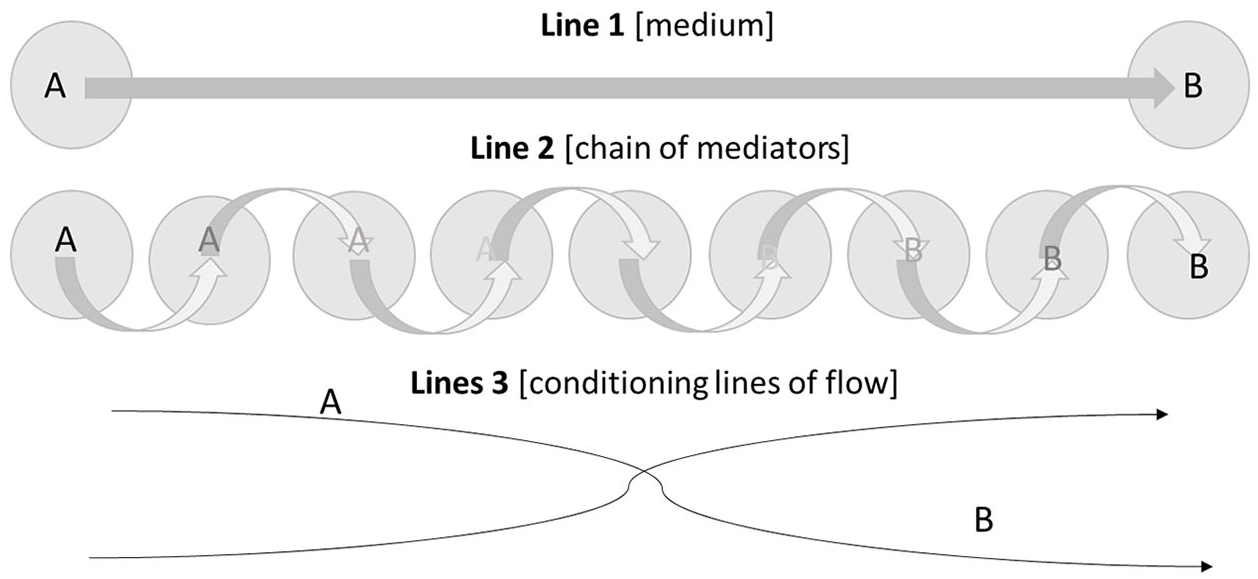
Diffusion, translation and translating flow.
The ambition of this article is to contribute to the specific literature on translation of management ideas that adopts this Latourian view of translation. We therefore do not engage substantively with the ‘diffusion school’ of literature on translation (Ansari et al., 2010; Benders and Van Bijsterveld, 2000; Fiss et al., 2012; Frenkel, 2005; O’Mahoney and Sturdy, 2015). This boundary setting provides a clear focus for our theorizing, and also helps avoid constructing an argument conducted across an ontological chasm: whereas the Latourian and Ingoldian views, and thus our theorizing, rely on a process ontology, diffusion studies typically employ broadly positivist perspectives (Ansari et al., 2010; Fiss et al., 2012). Thus, we focus our critical review of the literature on research traditions rooted in the Latourian view of translation—specifically, Scandinavian institutionalism and the sociology of translation.
Specifically, we argue that the actor-centric vocabulary inherited from Latour (1999a, 2005) and Callon (1986, 1999) counters the intention of these studies to decenter or deconstruct anthropocentricism (O’Mahoney, 2016). Though this vocabulary allows us to attend to the multiplicity of actors transforming or translating the management idea (Line 2 in Figure 1), we are, nevertheless, left with the problem of how to study that which happens between these assumed (human and non-human) actors—in other words, how any assumed actor becomes positioned to think, act, interact, translate, and become translated in specific ways rather than others. In order to study this conditioning flow of translation, we cannot start with assuming distinct actors (links in the chain or dots on the line of flow). Rather, we need a temporally oriented vocabulary that allows us to account for the conditioning flow of action, along lines (Ingold, 2007a, 2007b, 2011, 2015) (Line 3 in Figure 1). This requires us to abandon the idea that behind every action there is an already assumed actor. Rather, assuming an Ingoldian view (explained below), we show that more original than any assumed actors is the ongoing flow of translating action, conditioning possibilities to be and act as it flows. But first, let us consider the Latourian inspired literature more closely.
Tracing the heritage from Latour and Callon
Inspired by Latour (1984, 1987, 1994), Czarniawska and Sevón (1996) introduced the notion of translation to organization studies by outlining a model of how management ideas and concepts travel across time and space. Working in the tradition of Scandinavian institutionalism, they aimed to develop an alternative to models of diffusion, isomorphism and decoupling developed by American institutionalists (e.g. DiMaggio and Powell, 1991). In their view, translation—seen as the situated nature of institutionalization and practice variation (Lawrence et al., 2011; Lounsbury, 2008)—helps explain ‘how apparently isomorphic organizational forms become heterogeneous when implemented in practice in different organizational contexts’ (Boxenbaum and Pedersen, 2009: 191).
Studies in this stream have analyzed how organizations adopt and translate ideas such as Lean management (Morris and Lancaster, 2006), reputation management (Wæraas and Sataøen, 2014), Total Quality Management (Özen and Berkman, 2007), MBA models (Lamb and Currie, 2012), scientific ideas (Ritvala and Granqvist, 2009), and hospital management innovations (Kirkpatrick et al., 2013). Common to these studies is a view of actors as active and creative in their responses to the actions of other actors (Sahlin and Wedlin, 2008), constructing shared meanings and generating practices to adapt institutional change to the local context (Binder, 2007; Heinze et al., 2016; Zilber, 2006). Whether focusing on individual human actors, such as consultants (Heusinkveld and Visscher, 2012), middle managers (Radaelli and Sitton-Kent, 2016, project managers or corporate executives (Benders, 1999; Morris and Lancaster, 2006; Özen and Berkman, 2007; Spyridonidis et al., 2016; Wæraas and Sataøen, 2014), or organizational units, such as a procurement function (O’Mahoney et al., 2013), or industrial or organizational actors (Boxenbaum, 2006; Cassell and Lee, 2017; Morris and Lancaster, 2006), actors are analytically positioned as enacting translation by enrolling other actors into their preferred translations. They are thus intentionally negotiating, linking, mediating, editing and reshaping ideas to their local contexts, using human and non-human intermediaries to achieve these translations. Often, actors with hierarchically significant positions are focused, and translation work is portrayed as more or less strategic (Boxenbaum, 2006; Ritvala and Granqvist, 2009; Spyridonidis et al., 2016).
The sociology of translation literature draws on the work of Callon (1986, 1999) and has been extended by Latour (1999a, 2005), especially to account for how ideas become materialized and localized in specific situated practices. In spite of this, work in this stream retains the tendency to locate agency predominantly with human actors. It seems that this work has turned Latour’s (1987) advice to ‘follow the actors’ into a practice of identifying distinct actors as significant in translation practices—for example, institutional entrepreneurs (Czarniawska, 2009), consultants (Brès and Gond, 2014), corporate, organizational, or academic representatives (Bergström and Diedrich, 2011; Johnson and Hagström, 2005), change agents (Whittle et al., 2010), and management gurus (Bruce and Nyland, 2011). By following the actors, scholars also come to follow the ways in which these actors purposefully enroll, connect, and mobilize a network of human and non-human actors to be faithful to a specific cause, idea, or political stance (Bergström and Diedrich, 2011; Doorewaard and Van Bijsterveld, 2001). For example, Bergström and Diedrich (2011) study how a high-tech company exercises corporate social responsibility (CSR) in the events following the announcement of layoffs, concluding that:
. . . this outcome was the result of a process whereby corporate representatives managed to enroll and mobilize a network of actors into being faithful to, and defending, their definition of social responsibility. This indicates that a company can assume an active role in the construction of the same network of actors that it is asked to respond to and impose upon other actors its own definition of what it means to be socially responsible. (Bergström and Diedrich, 2011: 897)
Correspondingly, Doorewaard and Van Bijsterveld (2001) conclude in their study of the translation of the Integrated Approach to IT Management in a bank:
The different actors who are involved in IT change redefine and translate general notions in such a way that implementation of the new concept promises to support their particular interests and wishes. (Doorewaard and Van Bijsterveld, 2001: 69)
While the human actors and their attempts to enroll heterogeneous actors into their preferred translations are thus foregrounded, the flow of everyday work practices through which actors are conditioned to hold certain meanings and act in certain ways, and in which the management idea is conditioned to assume certain meanings, becomes backgrounded. Moreover, to the extent it is recognized that social discourse is embedded in material relationships, ‘non-humans’ are attended to mainly in terms of their structuration or conditioning role. Specifically, in the analytical narratives, non-human actors often become taken as intermediaries, playing the role as available objects and tools to which human actors can delegate tasks of translation (e.g. Farquharson et al., 2014)—or, taken as scripts or boundary objects, mediating human action and diffusing novel practices across social and geographic boundaries (Jones and Massa, 2013; Monteiro and Nicolini, 2015; Nicolini et al., 2012; Swan et al., 2007). Although recent work (e.g. McCabe and Russell, 2017) has acknowledged how material objects do not always act in the interests of human translators, but can have an ambiguous impact and resist and hinder intentional translations, it still takes actors as the starting point, thus backgrounding the ways in which material objects become conditioned to act in certain ways in mundane, everyday work practices, and consequently to either resist or hinder intentional translations.
Indeed, Latour himself (1996, 2004) argues that the slippage into a ‘demiurgic version’ of ANT (Latour, 1999a)—in which actors seem to exist separately from each other and the relational whole that already enact them—can partly be explained by the vocabulary of ANT, which gives the notions of ‘actor’ and ‘network’ unintended significance (Latour, 1999a). This vocabulary can be traced back to the initial reference point of the sociology of translation: the seminal article on the scallops and the fishermen of St Brieuc Bay (Callon, 1986). Callon here positions the researchers (in their attempts to enroll a set of heterogeneous actors (fishermen, scallops, towlines, colleagues, and so forth) as the prime movers of the storyline, while the non-human actor (the towline) functions as an ‘interessement device’ to ‘extend and materialize’ the intended hypothesis or interests of the researchers (Callon, 1986: 209, 212), thus being ‘nothing but a program of negotiations’ (Callon, 1986: 212).
Although Latour emphasizes translation as a transformational process in which the translating agency is irreducible to any actor or point, he often presents his actors or actants as distinct entities that ‘link’ or are ‘associated’: ‘I used translation to mean displacement, drift, invention, mediation, the creation of a link that did not exist before and that to some degree modifies the original two’ (Latour, 1999b: 179, emphasis added). This type of phrasing, prevalent in Latour’s corpus, has arguably become integral to the translation work of organization studies scholars, leading to the unintended consequences discussed above.
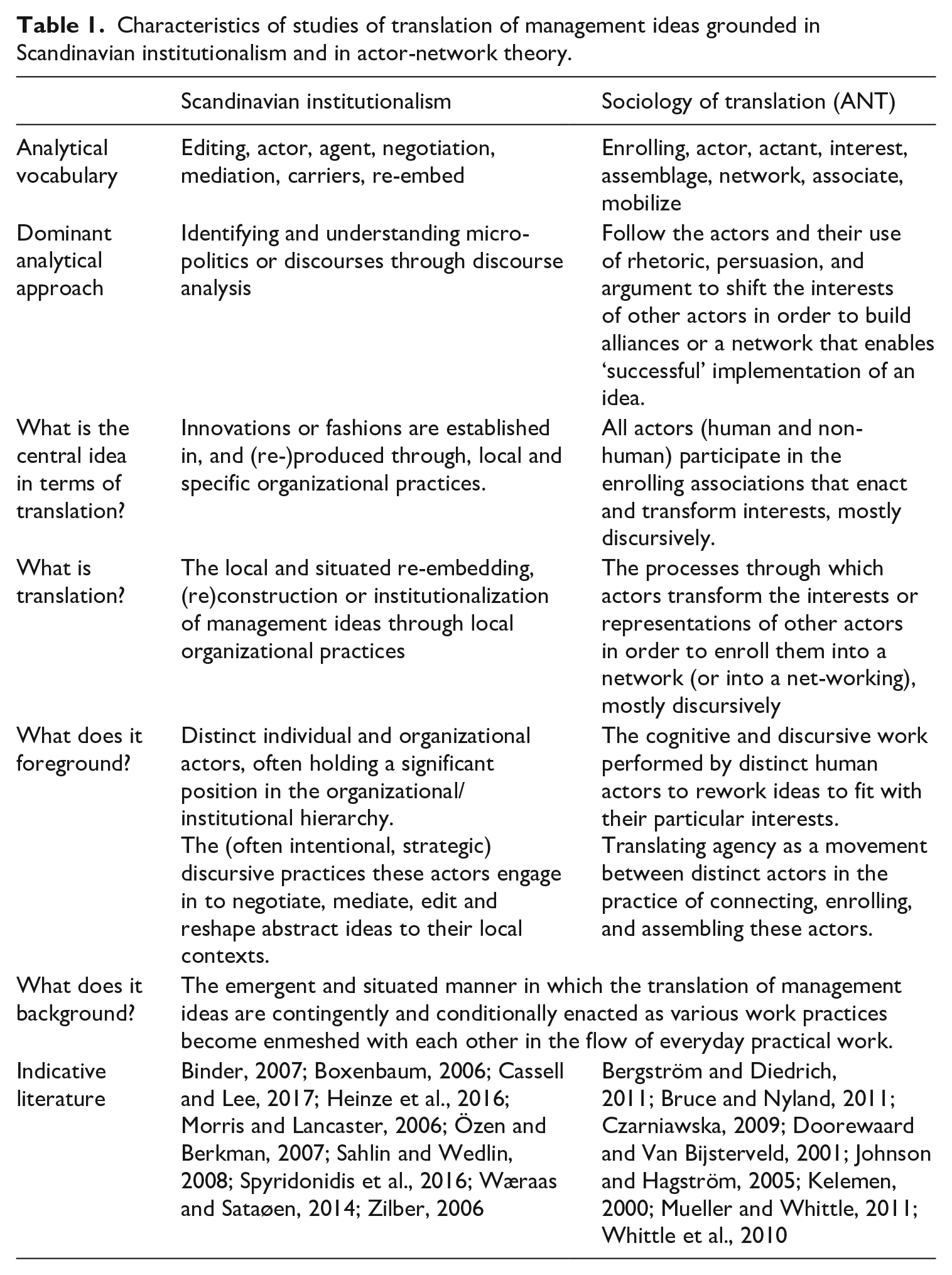
Table 1 provides a summary of the analytical vocabulary and approaches used in the relevant literature of the translation of management ideas grounded in Scandinavian institutionalism and the sociology of translation/ANT. It also summarizes how a particular understanding of the process of translation becomes enacted through these vocabularies and approaches, and indicates what these understandings foreground and background.
Characteristics of studies of translation of management ideas grounded in Scandinavian institutionalism and in actor-network theory.
In order to move beyond actor-centric accounts of translation and instead foreground the situated and conditioning flow of everyday organizational practices, we need an alternative vocabulary that allows looking beyond the movements of actors, at how the actors we now assume are already conditioned, or ‘made to act’ (Latour, 2005) in certain ways. That is, ‘to move beyond the modernist polarization of subject and object that remain[s] trapped within a language of causation that is founded on the very same grammatical categories and that can conceive of action only as an effect set in train by an agent’ (Ingold, 2011: 213). Importantly, a new vocabulary is not just the use of different analytical terms: it matters because vocabulary is performative of what we tend to take as ontologically significant, and not (Bruner, 1990; Tsoukas, 2005).
In the next section, we consider the work of the social anthropologist Tim Ingold (2007a, 2007b, 2011, 2015), and outline how his vocabulary can render visible the historical, situated movement of action and reveal the constitutive flow of sociomaterial practices in our accounts of translation of management ideas.
The flow of practice along the line: Translation as a meshwork of corresponding lines
Ingold argues that to study ‘things and people is to study the lines they are made of’ (Ingold, 2007a: 5). This requires an approach that accounts for actors not as bounded entities surrounded by an environment, but as ‘an unbounded entanglement of lines in fluid space’ (Ingold, 2011: 64). Lines are not defined by the points they connect, or by the points that might compose them. In contrast to the lines of an ANT network, they do not connect, assemble, or associate entities. Rather, they are trails along which life is lived (Ingold, 2007a; 2015). They disclose relationality, not between the actor ‘here’ and the context ‘there’, but as correspondence or co-occurrence with other lines, as they flow. The life, or living, of all things extends along multiple lines, knotted together to form a meshwork (Ingold, 2007a, 2011, 2015).
What is it that flows, along the lines, one might ask? Ingold would answer that it is the movement of life that flows. To grasp the flow of life is not like observing a sequence of actions, in a specific space—that is, what actors do. It is more akin to listening to the flow of a melody, or a conversation. Clearly, the actions of actors—such as playing the notes or saying the words—are necessary. However, the flow of the melody, or the conversation, emerges through the ways in which every sound and meaning become conditioned by prior, and condition subsequent, sounds or meanings. This conditioning flow is constitutive of the conversation, exactly as a conversation rather than an assembly of utterances (Ingold, 2011, 2015). Thus, similar to a conversation, when we think of life (or agency) as flowing, we see how it inherits conditions of possibility from prior actions and imparts conditions of possibility to subsequent actions—with every translation engendering new possibilities for being and action (Deleuze and Guattari, 1987). In following the lines of flow, of action, we follow the transformative flow of agentic possibilities, not assumed ‘actors.’ Importantly, the flow of life along lines is not an object that one can interact with, but the ground that enables the possibility of interaction. The flow along lines, in short, is the very condition of agency. But it is not, in itself, an agent (Ingold, 2011). Along the flow of practices, assumed subjects or objects are emergently enacted, not separate actors given a priori. To understand this continuous enactment, Ingold introduces two notions: attentionality and undergoing.
Attentionality is not intentionality: in the flow of any habitualized practice (walking, talking, writing, etc.), the subject is not just intentionally doing, but also attentionally undergoing these practices (Ingold, 2017). Attention in this sense is not consciously directed by a subject, but emergent in the event, ‘activated by the force of the directionality the event calls forth’ (Manning, 2016: 154). Importantly, the notion of attentionally undergoing does not imply a state of passivity. Rather, as constitutive of a continuously emergent practice, it requires responsiveness and activity. We suggested above, following Ingold (2017), that agency is always and everywhere already flowing, and that this flow conditions our possibilities for being and action. Through the notions of attentionality and undergoing, we can suggest that working practices are attentional processes that animate us. By attending to this conditioning flow—as we go about our daily work practices—we also undergo our work as we respond to this conditioning flow—in the way our feet and body attentionally respond to the terrain, when we walk. Our work is both directed (intentional) and being-directed (attentional), something we do and something that is actively happening to us (Ingold, 2017). The ‘I’ who acts is not put in front (of the verb, as conventions of grammar require), but rather in the midst of the experience undergone. Thus, agency becomes more-than-human and decentered—a dance between the intentional and the attentional, along many heterogeneous lines of flow, in which it is not clear which of these are the determining force (Ingold, 2007a, 2007b, 2011, 2015). These interrelated insights are central to our analysis and discussion below. Thus, when referring to ‘the conditioning flow of practice’ or ‘flow along the line’, we are always simultaneously highlighting the attentional undergoing in which we do our work and our work simultaneously does us.
Research setting and methodology
The Swedish Migration Board (SMB) is the central authority for implementation of migration policy in Sweden, managing applications and making asylum decisions, defending decisions in appeals court, and managing integration and settlement for those granted asylum. In September 2008, the Migration Board decided to review the asylum process with the purpose of shortening processing time. A management consulting firm was hired, and in December 2008 submitted a report to the Director General, providing recommendations on how the SMB could improve operational efficiency based on a Lean management approach. Based on the principle of flow efficiency, Lean management aims at shortening the time it takes for a product or service to be produced and delivered, by identifying value-creating steps, eliminating those steps that do not create value, and pursuing continuous improvement of the process (Womack and Jones, 1994). After a pilot in 2009, the Lean work model was implemented at all examination units country-wide. So-called Lean navigators and change agents were responsible for development of standardized work practices, education and coaching of team leaders, and for serving as the link between management and operational staff in the Lean transformation.
Collecting our data
Our fieldwork started in November 2012 with the overall ambition to study Lean management ideas at the SMB. Through the late fall and spring of 2013, the first author (and field researcher) conducted interviews and observations at an examination unit, and subsequently, from January to April 2014, at a Reception unit, both in Stockholm. This article focuses on operational practices at the examination unit, while also drawing on data from the Reception Unit to enrich our understanding of the organization and its institutional context (for example, our understanding of practices related to refugees was helped by the broader view of practices, values and goals gained from data collection at the Reception Unit). As our approach was explorative and inductive, observations during early fieldwork were aimed at developing an understanding of all major operational work practices at the examination unit (see Table OS1 in the online supplement). 1
As our engagement with the literature deepened and our analysis started to form, we focused our observations on practices that had developed or fundamentally changed since the implementation of Lean, and that repeatedly appeared in our data as central in the enactment of ‘legitimate and effective work’ for case officers and team leaders. This implied careful note-taking of details in observed practices, and collection and documentation of various artifacts used in the daily work of the officers.
Supplementing the observations, 67 interviews (see Table OS2) were conducted with staff members from all professional categories. Of these, 27 interviews were conducted with staff working at examination units in four different cities. Most interviews focused initially on current operational practice, i.e. what a workday looks like, challenges and enjoyments related to different practices, and interaction with applicants, colleagues, and managers, etc. These questions were aimed at gaining a situated and nuanced sense of the flow of interviewees’ current work practices and how they see themselves, and their responsibilities, as professional public servants. The aim was also to explore issues of change, professional performance expectations and potential resistance against the new ‘Lean’ routines. Where interviewees had experience from working at the SMB before the implementation of Lean (a majority of interviewees), they were also encouraged to describe these experiences and to point to differences with current practices. During the latter part of the fieldwork, when we had started to develop a theoretical approach to structure our analysis, we returned to some of these interviewees to inquire more thoroughly about how specific practices developed over time. Interviews lasted 40 to 90 minutes and were, with one exception, recorded and transcribed.
Archival records were important in tracing how Lean has historically become translated (see Table OS3). By studying PowerPoint presentations, implementation plans, training material, user manuals, IT activity logs, IT requirements priority lists and IT change requests dating back to the time of implementation, we were able to understand and account for how the idea of Lean materialized in the operations around the time of implementation. Specifically, for the line of flow of the work scheduling practice, user manuals, IT activity logs, IT requirements priority lists, and IT change requests were particularly valuable as they allowed us to account for how seemingly trivial technical problems, and solutions to these, fundamentally reconfigured the conditions of possibility for ‘a Lean operation’ to become in everyday work practices. For the line of flow of the performance monitoring practice, the training material, implementation plan, and handbook were significant, as they included many detailed pictures and descriptions of the intended outline and use of the whiteboards. Together with interview accounts, these sources allowed us to foreground the mundane, contingent, and sociomaterial nature of the translation of the two specific ‘Lean’ practices of scheduling asylum examinations and monitoring operational performance.
A genealogical analysis of the data
Our approach to analysis was historical in the sense of what Foucault (1991) calls a ‘history of the present,’ a genealogy. A history of the present aims to understand the myriad, contingent conditions of possibility that make the present—subjects, objects, practices, etc.—seem obvious and appropriate. It is a history that ‘seeks to show how social relations of power and knowledge are reconstituted to create new ways of seeing and acting’ (Burrell, 1988: 229, emphasis added). However, in this historical tracing we were not concerned with discovering ‘substantial entities (subjects, virtues, forces) or to reveal their relationships with other such entities’ as causes or origins (Dreyfus and Rabinow, 1983: 109). Rather, we were concerned with the enactment, or clearing, of a space of possibility for certain ways of being and acting to make sense, or be taken for granted as being true and valid—a space in which ‘subjects do not first preexist and later enter into combat or harmony’ but rather ‘emerge on a field of battle and play their roles, there and there alone’ (Dreyfus and Rabinow, 1983: 109).
In other words, we were interested in tracing ‘the struggles, displacements and processes of repurposing out of which contemporary practices emerged, and to show the historical conditions of existence upon which present-day practices depend’ (Garland, 2014: 373, our emphasis). As such, our genealogical approach oriented us to consider the mundane, often taken-for-granted practices, rather than focus on events, actors, initiatives, proposals, and so forth. Moreover, our theoretical commitments (in line with our genealogical approach) oriented us to understand the temporal movement of actions (as conditioning lines of flow) rather than as points of action, as we attempted to trace our genealogy. As such, we did not try to understand ‘where’ the translation happened as much as understand how the translation was conditioned, to be what it was taken to be, in and through the flow of mundane practices.
To get an overview of how operational practices had emerged over time, historically, we began the analytical process by chronologically coding passages within interview transcripts and field notes. We used the codes ‘Before implementation of Lean’, ‘Intended Lean’ (practices enacted in consultancy reports and educational material), ‘Early phase of implementation’ (up to 6 months after implementation), and ‘Current Lean practices’ to organize events and practices along a timeline and create an overview of how operational practices had developed, genealogically. We then undertook open coding, identifying emergent codes related to the translation of everyday work practices within each chronological segment. Codes covered practices such as work scheduling, distribution of asylum cases, planning, coordinating, examining the applicant, performance monitoring, teamwork, and administration, as well as transformation of practices over time, such as focus on quantitative measures, team orientation, automatization, and standardization. Our coding also came to include how the conditions for, and experiences of, case officers and team leaders performing everyday work changed over time, including loss of control, and decisions based on professional judgement.
After this coding step, we engaged more deeply with the literature on translation of management ideas in order to identify second-order explanatory themes. As we did this, we noted how the conceptual vocabulary rooted in ANT (network, actor, connection, association) applied in other translation studies, and made us attend to the sayings and doings of individual actors (human and material) and push to the background the temporal movement emerging from our data. We then started to search for a conceptual vocabulary that would allow us to account for the translating agency as an ongoing flow of the past into the present, and onwards to the present to be. Increasingly, the works of Ingold (2007a, 2007b, 2011, 2015), became central to our emerging analysis. Ingold’s conceptual vocabulary, such as ‘flow’, ‘lines’, ‘attentionality’, and ‘undergoing’ helped shift our focus from what assumed actors did (or say they did)—or what non-human actors afforded—to the constitutive conditions that rendered certain actions and subject/object positions (rather than others) meaningful, obvious and legitimate. These concepts also informed the aggregation of codes into second-order themes. For example, we were able to group the codes describing the changing conditions for, and experiences of, case officers and team leaders performing their everyday work, as ‘the undergoing of practices’. Moreover, thinking about translating agency as a flow along lines enabled us to look at the practice categories we had identified in the current daily work of the officers and ask: What are the constitutive conditions that allow this particular flow of practice to seem obvious, meaningful, or legitimate? We then traced genealogically the historical lines through which these practices have become enacted as legitimate in a ‘Lean operation’. Table OS4 shows how these lines of flow were analytically connected. The following section accounts for, and presents our analysis of, the genealogy of two particular practices: the scheduling practice and the performance monitoring practice. These practices have changed the most since the implementation of Lean and are also what most staff members refer to as ‘Lean’.
What Lean has become: Tracing the conditioning flow of everyday operational practices
Refugees seeking asylum in Sweden enter an administrative process that begins with a visit to the application unit of the SMB. Here, officers register basic information about the applicants, and take their fingerprints and photos. Next, they conduct a search in a digital scheduling system, integrated with the main administrative system (SKAPA), to schedule an appointment with a case officer in the examination unit. The scheduling system distributes cases according to a standard production target of three cases weekly per officer. It is connected to the Outlook calendars of all the examination officers and programmed to automatically schedule the first available 2.5-hour time slot, irrespective of the case officer’s experience and expertise. Case officers conduct appointments with assistance from an interpreter, aiming to elicit applicants’ reasons for asylum and any other information relevant for asylum decisions.
Each examination unit is divided into teams, each with one team leader, two decision makers, and nine or ten case officers. Decision makers are responsible for legal decisions, and the team leader is responsible for coordinating operational work. The main occasion for work coordination is the daily 15-minute update team meeting at 9 am, typically held standing in front of a whiteboard in the team leader’s office. Boards share the same basic layout, displaying the names of team members and an outline of the weekdays with team members’ examinations and schedule deviations, such as absences, plotted out. Key quantitative operations metrics are also displayed, such as the number of cancelled examinations, open examinations, cases open longer than 90 days, and decisions taken the past week. These measures provide the starting point for discussions about operational status and work coordination.
These daily work practices encompass what Lean has become, as enacted in daily operational practices at the SMB. Below, we trace genealogically the conditioning flow of the automatic work scheduling practice and the performance monitoring practice. Though our ambition in our analytical narrative is to background actors and foreground the conditioning flow of practices, the account does include references to ‘case officers’, ‘asylum seekers’, ‘whiteboards’, ‘Outlook Calendars’, etc. It is important to keep in mind that these actors are not taken as given. Instead, they are already the ongoing accomplishments of the conditioning flow of agency along multiple and corresponding lines. To speak with Ingold (2007a, 2011, 2015): they do not act, as such; it is the flow of action that acts them. Thus, when in our analytical narrative we say the ‘case officer’, we say this only to the extent that the flow of practice has already conditioned actors to take themselves (and other actors) to be and to act in particular ways and not in others.
Tracing the flow of the work scheduling practice
Becoming a regional expert
Before the implementation of Lean, the operational practice in the examination unit was divided into five independent subunits, each responsible for handling asylum cases from a specific region. Each unit consisted of 25–30 officers, working independently, in individualized offices, with specific expertise on cases from one region, for example Russia or West Africa. Asylum cases, managed by unit coordinators, were distributed to officers based on their expertise and current workload.
Officers had exclusive control over the cases they were considering. They stored ‘their’ dossiers in a file cabinet in their office until the examination meeting. If an officer went on vacation or sick leave, or happened to work on very complex and time-consuming cases, dossiers at the bottom of the cabinet were simply put on hold, at the officer’s discretion. As a consequence, processing times for asylum cases could vary from 1 to 6 months, sometimes longer. To balance officers’ workloads, coordinators maintained lists of case assignments. Though the lists served as a practical basis for distribution of cases, they were not considered meaningful as a means to evaluate or monitor the work of the individual officers, as such. If a case officer took longer to administer a particular case, it was assumed that they had a valid reason, based on their professional judgement. In the flow of these various work practices, case officers took themselves to be autonomous regional experts, as the following quotes illustrate:
Back then we all had a regional expertise . . . I would say many people chose to work at the SMB because they had interest in and knowledge about a specific region and culture. (Team leader) With a background in anthropology, I really liked to dig deep and to really understand the culture and political circumstances of a region, to develop my knowledge and become an expert in an area. (Case officer)
Why did they take themselves as autonomous experts? From our Ingoldian perspective, we argue that they did so because the conditioning flow of heterogeneous work practices produces a grid of intelligibility in which taking themselves as autonomous experts made sense—not because the officers intentionally chose such positioning, but rather because in the very undergoing of these mundane work practices, they became enacted as such. To use Ingold’s example of walking, the officers spend most of their days not intentionally being experts but rather attentionally becoming experts by responding to and adjusting to the multiplicity of practices—a meshwork—enacting them as exactly such (low level of monitoring, autonomous control over cases, individualized offices, etc.) Thus, in this attentional flow of daily work practices, officers become enacted as autonomous regional experts, and applicants as unique cases from a specific region that needs to be assessed with expert competence.
Becoming an expert team
When entering the SMB in 2008, the consultants identified problems related to the case officers’ autonomy. Reporting to the Director General, they argued that a lack of common operational processes led to inability to monitor and develop efficient work practices. To address this, they suggested removing the subunits and reorganizing case officers into smaller teams with mixed regional competencies. The report stated:
‘To facilitate a more effective coordination and to avoid cases sitting for too long with individual officers, we recommend that a team-based work model should be introduced at all units.’
This recommendation suggested a shift from the individual expert officer as the only authority and work unit, to the team as the responsible work unit. Following the advice of the consultancy report, examination units were reorganized into teams of nine or ten officers, two decision makers, an assistant team leader, and a team leader—responsible for coordination, monitoring, and reporting of officers’ performance. Team-based work was difficult for officers to reconcile with seeing themselves as autonomous experts: ‘Am I autonomous if I am not a leader, and everything is a team effort?’
Instead of local coordinators at each unit distributing cases, the application unit took over this task, distributing cases evenly to team leaders, who in turn assigned them to individual officers based on their knowledge of the officers’ workload, experience, and competence. In the undergoing of the case assignment practice—and other corresponding lines of flow—the team leader becomes enacted as legitimate ‘leader’, and the officer as subject to the professional judgement of the team leader (and thus no longer autonomous). Nevertheless, the conditionality of regional expertise, from prior practices, is still attended to. What we see then, in the flow of these new work practices, is the enactment of an expert team, subject to the scrutiny of a team leader. In this flow, my case files become our case files, my expertise becomes our expertise, and my performance becomes our performance. For the case officer undergoing this flow of action, acting as an autonomous regional expert in control of her own expertise and work no longer seems like an obvious, meaningful, and legitimate way to be and to act.
Becoming standardized production resources
The manual allocation of cases to officers with appropriate region-relevant expertise, whilst also considering the applicable performance measures, turned out to be a time-consuming administrative task for the team leaders:
The scheduling took up all of our time as we needed to manually create and change the master schedule in Excel. It crowded out the tasks that we were really supposed to do as team leaders such as work with continuous improvements of operational routines and coach the officers. (Team leader)
In their efforts to schedule and coordinate the team, the team leaders started to use the electronic Outlook calendar system to schedule examination meetings. Case officers would share their calendars with team leaders, who could thus get an overview of their availability and send digital scheduling requests for examination meetings—which were ‘accepted’ as and when appropriate. In this scheduling practice, the availability of the officers becomes enacted as displayed in the Outlook calendar system—that is, an available officer is one who has an open timeslot in Outlook. Through this practice, Outlook becomes enacted as the appropriate and legitimate way to determine availability of, and to schedule, an officer.
Though this arrangement made it easier for the team leaders to schedule work, the routine was very time-consuming and, towards the end of 2009, team leaders and the Lean implementation team realized that something had to change or the new operational strategy would collapse. A project team was formed with representatives from the operations and IT departments to investigate how the work of the team leaders could be supported through an IT solution. Such a solution was subsequently developed, connecting the Outlook calendars to the main administrative system, SKAPA. In this way, staff at the application units—the first point of contact for newly arrived asylum applicants—could use SKAPA to access and search, algorithmically, all officers’ calendars to find the first vacant time slot. When a booking is made, it is saved as an activity in the case officer’s Outlook calendar, including information about time and place, case number, and the applicant’s citizenship and language proficiencies (Figure 2). However, in order to allocate cases automatically, some sort of production standard was required. The management team decided on a standard production rate of three cases per week per officer, to be used and evaluated during a 6-month pilot project. The assumption of the search and selection algorithm was that availability—as enacted through Outlook—was the only necessary condition for allocation of a case, rather than the experience, expertise, or interests of the case officer.
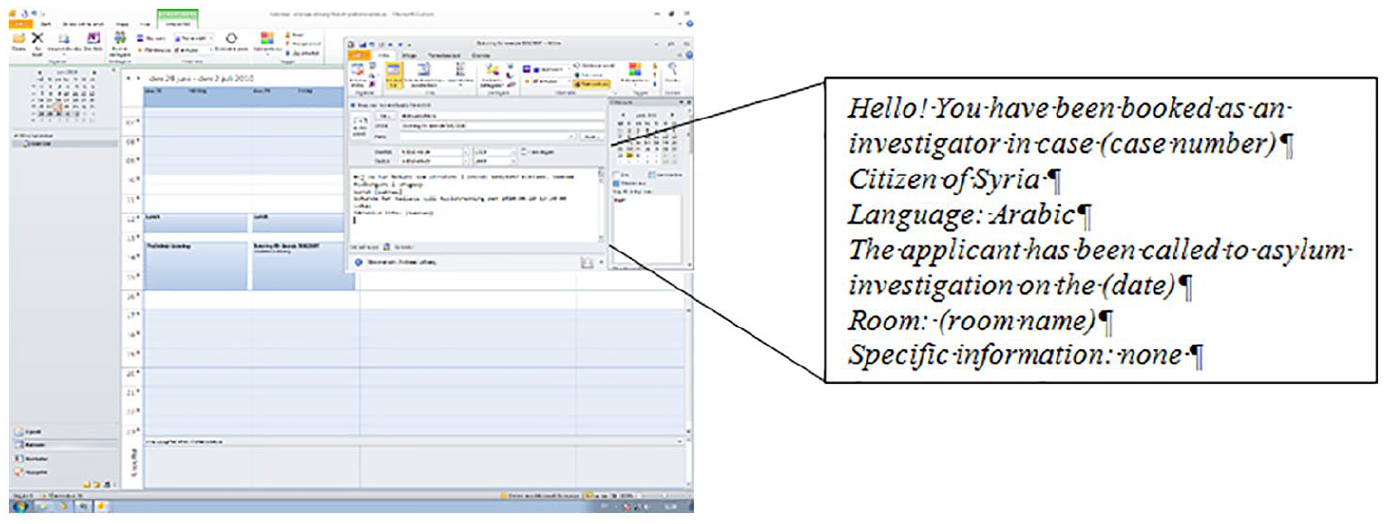
A case booking received in Outlook calendar.
Let us pause to note how the adoption of seemingly obvious ‘solutions’ (new work practices) reenacted the team leaders and case officers. The scheduling practice by team leaders using Excel enacts the team leader as a discretionary ‘scheduler’ of an expert officer. Adopting Outlook enacts the case officer as visible and ‘available’ (or not), disregarding expertise. Moving the scheduling practice to the application unit—together with the adoption of a necessary production standard—enacts the case officer as a quantifiable standard resource. That is, from an expert officer, scheduled by the informed judgements of the team leader, to a standard resource, scheduled by an algorithm based on a standard production rate. Correspondingly, the applicants become enacted as standard units of production.
The digital scheduling system was initially negatively received by the case officers, who experienced a loss of control and became stressed when meetings automatically appeared in their calendars. Today, some officers with longer work experience explain that they sometimes miss the opportunity provided in pre-Lean operations to specialize and develop region-specific expertise. However, most officers have become accustomed to this new scheduling and coordinating practice, and it seems to have become established as a legitimate Lean practice:
In that sense, it makes my life easy. I don’t have to prioritize between tasks and cases. That, the scheduling system has already done. I just have to show up and produce my numbers. (Case officer) I think the work scheduling system is a good tool . . . I think it’s efficient. (Junior case officer) In that sense, the scheduling system is very Lean, since it prioritizes an efficient workflow. (Team leader)
Visible in these quotes is not only a particular understanding of the work required in a Lean operation, but also how case officers have rediscovered themselves undergoing this practice. Rather than being experts who can prioritize their own work according to professional judgement, they experience themselves as subjects enacted as efficient and prioritized. This experience becomes meaningful in the flow of practice, where the authority of the standard production target has become established as legitimate, enacting officers who ‘just have to show up and produce [their] numbers’. Ergo, in an operation where quantitative targets constitute the basis for production of value, maximizing team flexibility and efficiency (producing the numbers) at the expense of individual specialization becomes enacted as appropriate practice.
Clearly, the translation of the scheduling practice does not unfold in this specific way because of the work of individual humans, intentionally pushing or accepting the implementation of an automatic and standardized case distribution practice. Team leaders and case officers cannot be understood as either active advocates or passive receivers of this changing practice. This is because in the flow along the line of the scheduling practice, attentive team leaders and officers are not in front (or outside) of the scheduling practice but in the midst of it. They do their work, and at the same time undergo it. In this undergoing, they do not fully own the agency to change or resist, but neither do others, doing and undergoing—not the managers, and not the scheduling system. As Ingold (2015) suggests, ‘our deeds belong to no-one: not to ourselves, not to others, but to history . . ..’ Of course, case officers could resist, protest, or do things differently, but they mostly tended not to. Why? We would suggest that it was because each step of the translation made sense, given their previous attentional undergoings, along the line, through which these case officers progressively became their practices—that is, assumed certain ideas and practices as appropriate and legitimate.
Tracing the flow of the performance monitoring practice
Becoming improvers of process
Before Lean was implemented, there were no common qualitative or quantitative parameters upon which case officers’ work were evaluated, as suggested above. There was no system in place to keep track of individual or group performance over time. Throughout the examination process, ‘improvement of quality’ meant self-initiated changes to work practices based on professional judgements. This changed with the implementation of Lean, as daily morning meetings in front of whiteboards were introduced to enable continuous evaluation and feedback of operational work. The case officers, team leaders, and decision makers intimately associate this practice with evaluation and feedback, and it is also closely connected to their understanding of what a Lean operation is.
In the PowerPoint presentation used to inform and train team leaders before the implementation of Lean, the whiteboard is presented as a tool for the team to ‘analyze the workflow, identify problems, and continuously develop suggestions for improvement’. Emphasis is placed on the development and monitoring of so-called ‘flow-oriented key performance indicators’ such as the time from registration to completed examination, and time from examination to decision. The presentation also stresses the importance of attending to deviations from these key measures, identifying their root causes and implementing improvements. The PowerPoint presentation also included an example whiteboard layout, which became commonly used as Lean was implemented (Figure 3). As visible in the figure, the board displays the team’s overall performance in relation to expected outcomes. The main part of the board constitutes a space where identified deviations and operational problems are listed together with improvement suggestions.
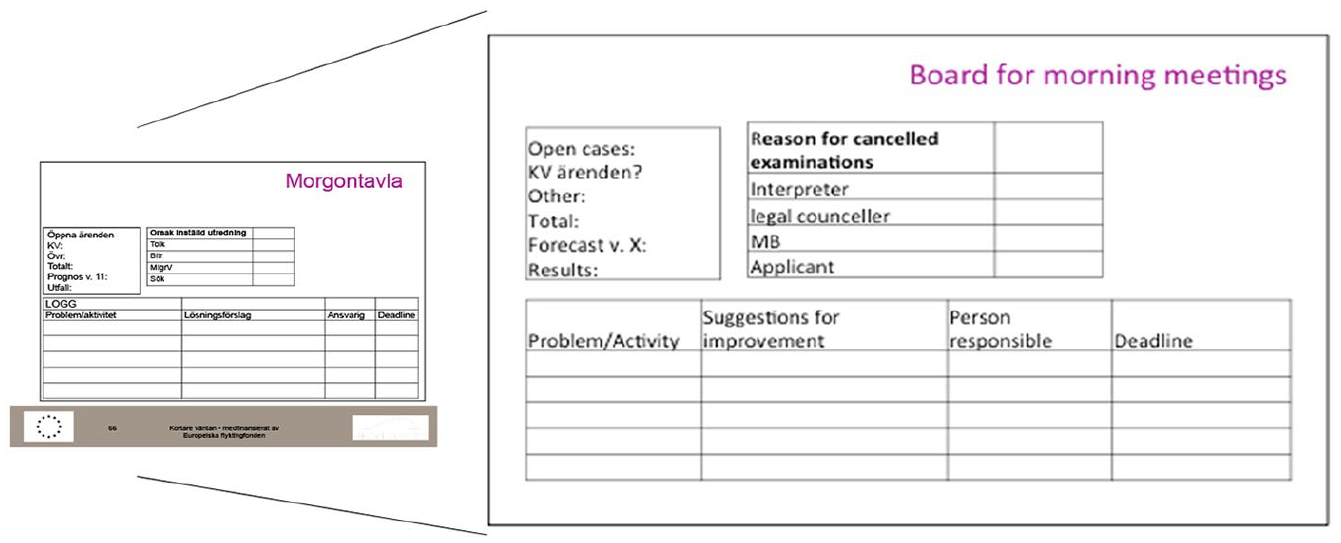
An example of a Lean whiteboard layout according to educational material (template with translation into English).
How did the practice of ‘meeting in front of the whiteboard’ enact the case officers? Who were they and what were they doing in attending the meeting practice? In engaging attentionally in the morning meeting practice—where workflow and processes become foregrounded—the team members become enacted as legitimate improvers of a work process in which the quality of activities, rather than the quantity of cases processed, becomes the focus of attention.
Another common board design during this period visualizes the flow of each asylum case through the whole administrative process of applying for asylum (Figure 4). On this board, each asylum case is represented by a magnet placed in one of the columns, such as ‘waiting for continued examination’, ‘waiting for the memo from the legal counsel’, and ‘waiting for final decision’. Each magnet holds a colored piece of paper: red color marks that the case has taken longer than 3 months, blue that the case has been remitted, and pink that it is waiting for medical judgment. These visualizations give the team an overview of how individual cases are progressing, and facilitate discussions about when in the process and why problems arise, and how the team can prevent bottlenecks. In the situated flow of the morning meeting with this board, each case and, thus, each asylum seeker, becomes enacted as a distinct case flowing through the various stages of the asylum process, requiring urgency. Meeting in front of this whiteboard, the team members become enacted as an expert group collectively sharing concerns and expertise about particular cases to be resolved collectively—an expert team that sees process improvement as an obvious and meaningful activity.
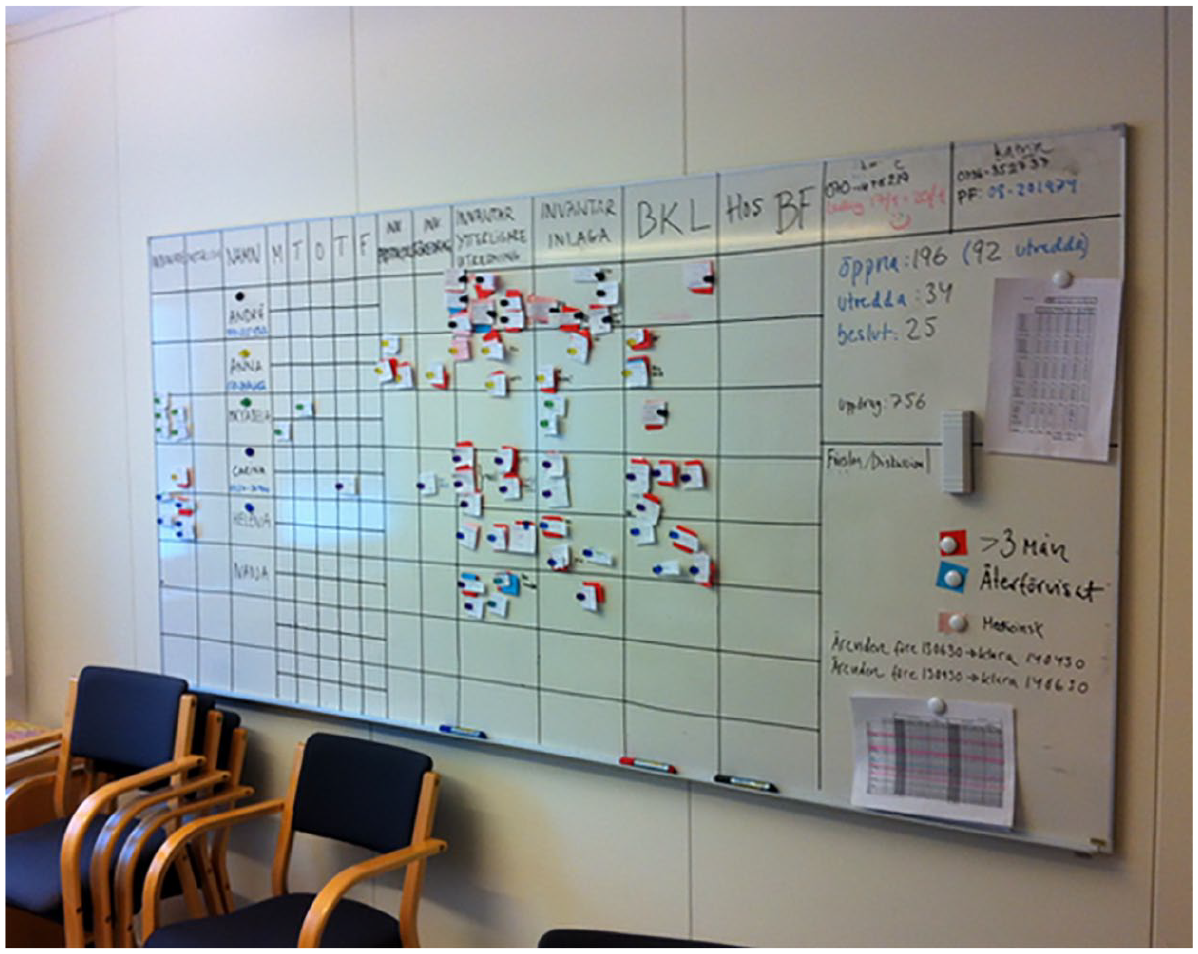
A whiteboard visualizing cases in different stages of the asylum process.
Becoming a resource to be improved
When the Outlook scheduling system (discussed above) was implemented, it was integrated with the administrative system SKAPA. The integration was based on the standard production target—the number of cases per officer per week—which was also programmed into SKAPA. This provided officers, team leaders, and senior management with a basis not only for measuring the time between different steps in the asylum process, but also for measuring and improving the productivity of each officer and team.
As per current practices, whiteboards at the examination unit have a typical layout as follows (Figure 5): team members are listed in the left column, followed by an outline of the weekdays with examinations and schedule deviations, such as absence due to illness. On the right side of the weekly schedule, operational key performance indicators are listed, such as number of cancelled examinations, number of open examinations, cases that have been open longer than 90 days, and decisions taken during the past week. The number of decisions per week in relation to the yearly target is marked in red. Compared to earlier whiteboard designs (e.g. Figures 3 and 4), we see how this design focuses neither on processes for improvement nor on the flow efficiency of individual cases. Rather, its focus is on the performance of the case officers, whilst the unique asylum seeker is pushed to the background, as a unit of production.
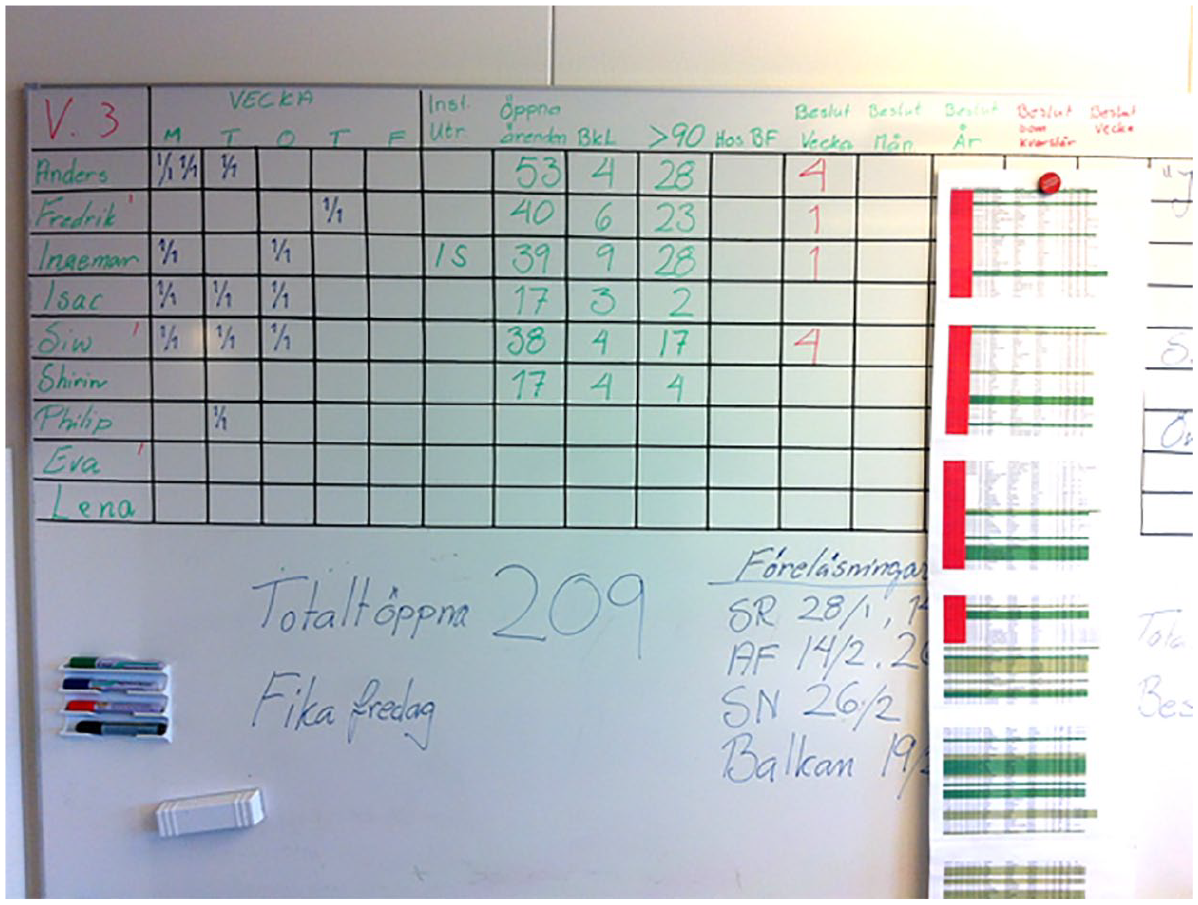
A whiteboard visualizing the operational schedule and key production measures.
Through the enactment of this board, efficiency and quality is not understood in terms of the time it takes to handle a specific case, or the professional skills it takes to perform a specific task. The flow of this monitoring practice does not call for considering specific aspects of the examination process or specific work tasks. Rather, it conditions the flow of practice towards seeing improvement primarily through quantitative measurements—promoting an enactment of work practices that fit the measurable—and the professional fitting in and performing according to the measurable. In front of this whiteboard, the obvious and meaningful thing to do is to focus on the performance of the case officers, as enacted through quantitative measures. In this practice, it is the officers that become enacted as performing (or underperforming), not the process. In other words, the subject enacted is not the autonomous expert or expert team member. Rather, the subject is that of the over- or underperforming case officer:
Over all, there is a very big focus on performing the numbers. That is how we are evaluated. The best officer is the one who completes the most cases. And the best team leader is the one whose team completes the most cases. (Case officer) The morning meeting is mainly used to discuss how the team’s figures compare to the target. (Case officer)
In the meetings in front of the whiteboards, case officers are enacted as the source of success or failure—the thing to be improved. Simultaneously, the asylum applicant becomes enacted, not as an individual with a geographic origin, nor as a unique team case, but rather as a standardized unit of work to be completed.
These enactments, of ‘the thing to be improved’ and ‘the standardized unit of work to be completed’, are not necessarily chosen by the operational staff and the asylum seeker or considered most appropriate in order to achieve efficient and qualitative work. In fact, staff at all hierarchical levels express skepticism towards what they refer to as ‘chasing points’, and emphasize that the quality of the case officers’ work cannot be captured in quantitative figures. Nevertheless, as the case officers attentionally engage in the performance monitoring practice, along the corresponding lines in the meshwork where the standard production target acts as an integrated part of the administrative system SKAPA, they are still constituted as being in need of ‘monitoring’ in order to become enacted as efficient officers. Thus, in the conditioning flow of the performance monitoring practice, where a standard production target is already enacted as appropriate and legitimate, it makes sense for team leaders, unit managers, and higher management to follow up and monitor performance based on this target:
If you create an operational standard, you need to be able to visualize and measure the operational work in relation to this standard. (Operations Manager)
Figure 6 summarizes our analysis, showing how the translation of ‘Lean’ at the SMB unfolds along the flow of the two corresponding lines that we have accounted for—the lines of flow of the scheduling practice and the performance monitoring practice. These corresponding lines capture both how the doings of these operational practices change—in the conditionality of the flow—and specifically how this flow translates (or enacts) the meaning of ‘scheduling’ and ‘monitoring’ differently over time—for example, how the team leaders’ scheduling practice inherited geographical orientation from the previous practice, and how it imparted to the subsequent practice a particular understanding of officer ‘availability’ to be scheduled, and moreover how this understanding of ‘availability’, enacted by the Outlook Calendar function, culminates in ‘availability’ as an algorithmic scheduling practice. In other words, they capture the ways in which the flow of practice establishes a set of constitutive conditions, which render certain modes of being and acting to be taken as obvious, meaningful, and legitimate.
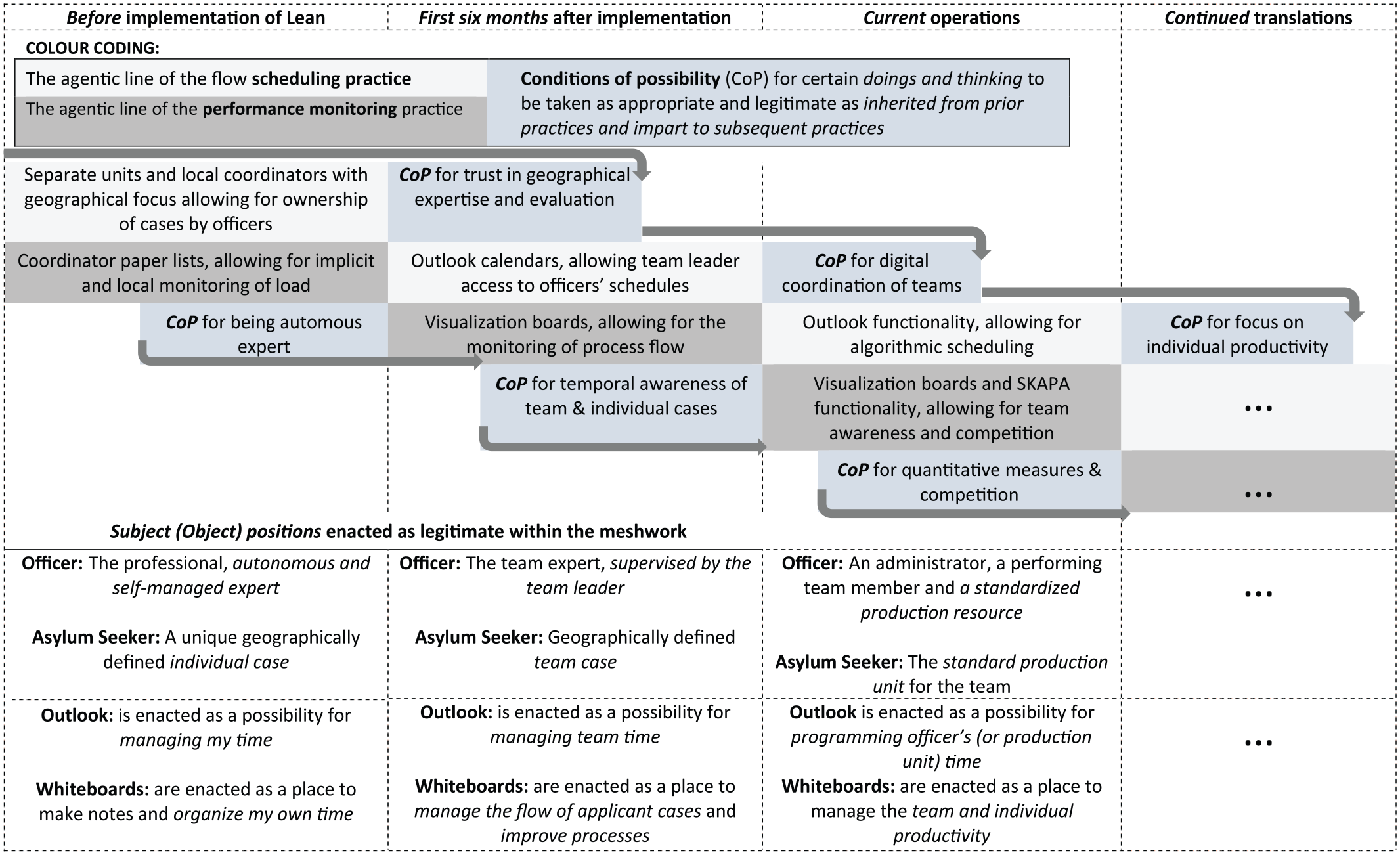
Translations of Lean through the temporal flow of agency (the meshwork of the Swedish Migration Board).
Important to note is how the temporal flow, both in terms of the Lean project, more generally, and in terms of daily work, more specifically, functions to constitute a ‘space or plane’ where everyday struggles, displacements, and processes of repurposing enact what Lean actually and practically becomes: the struggles by the case officers not to be mere production resources, and not to treat asylum seekers as just another case; the displacements where the Outlook functionality frames what it means to be available as a case officer; and the repurposing where the whiteboard moves from process improvement to officer improvement, for instance.
Finally, Figure 6 shows how these different lines of flow mesh together to enact what Lean has become in the SMB. By ‘mesh together’, we mean the way they correspond to constitute each other’s possibility to be what they are, and to enact a meshwork in which certain ways of being and acting become taken as meaningful, obvious, and legitimate. This is the translation of Lean, accounted for genealogically.
Discussion
How do ideas translate? From intentional doings to attentional undergoings
We began this article by showing how the adoption of an actor-centric vocabulary in studies of translation of management ideas (e.g. Bergström and Diedrich, 2011; Bruce and Nyland, 2011; Morris and Lancaster, 2006; Mueller and Whittle, 2011; Spyridonidis et al., 2016) has led to a certain form of reduction, in which one assumes that action requires as its necessary condition (or cause) an already constituted (human or non-human) actor, who subsequently acts. As Ingold puts it, such reduction ‘can conceive of action only as an effect set in train by an agent’ (2010: 95). In order to reorient our attention and capture the emergent, situated, and distributed nature of translation processes, we adopted the language of Ingold (2007a, 2015), enabling a shift from the assembling of actors into networks, to the interweaving of lines of flow in and through the meshwork (Ingold, 2011, 2015).
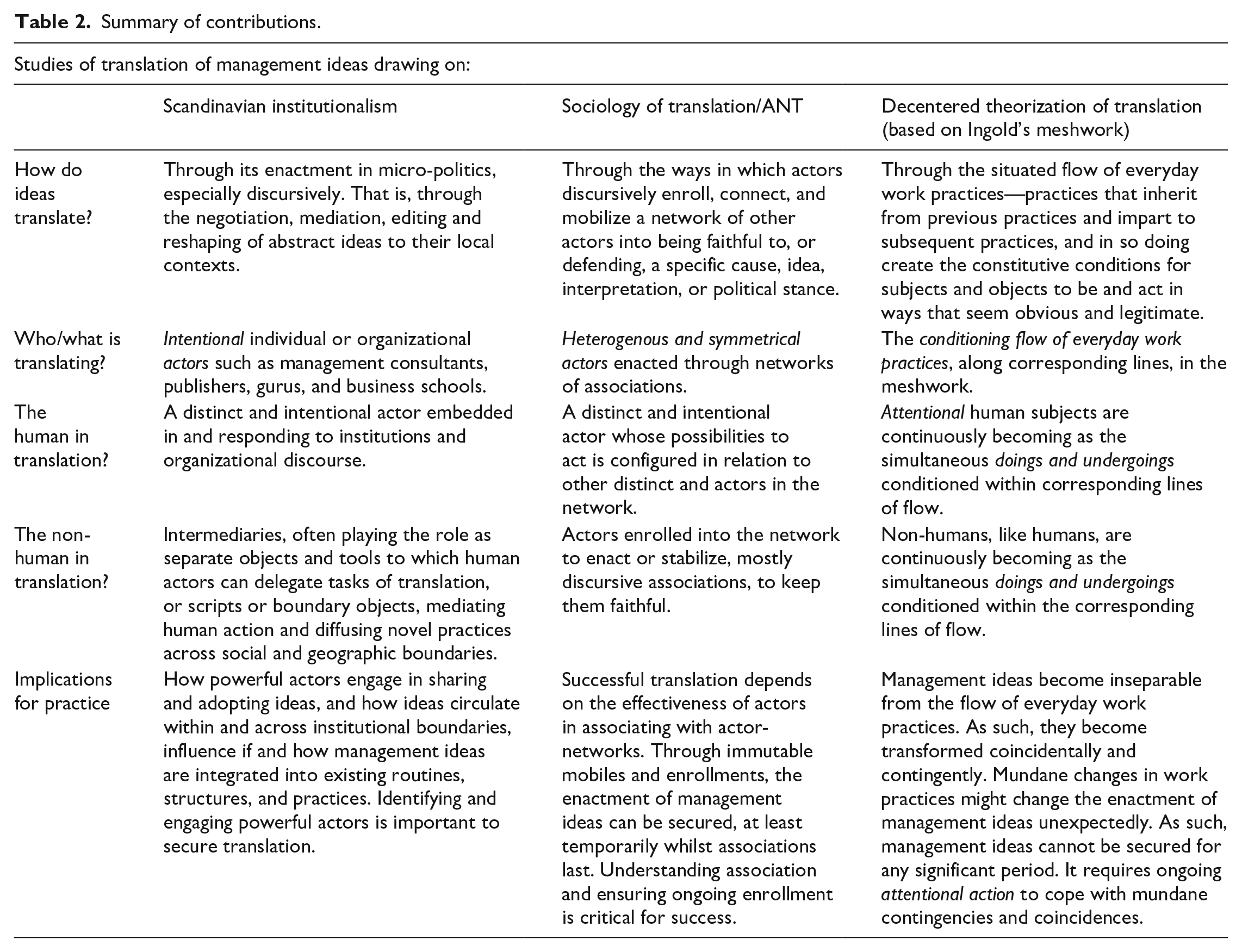
How does our shift in vocabulary and consequential decentering of the human actor make a difference for our understanding of how Lean translates at the SMB? In Table 2, we summarize how our approach rooted in Ingold’s (2007a, b; 2011, 2015) work enacts a particular understanding of how ideas translate, and the role of subjects and objects in this translation process. We contrast this with extant research on translation of management ideas, particularly the streams referred to as Scandinavian institutionalism and sociology of translation/ANT.
Summary of contributions.
Had we employed a typical actor-centric lens, we would have assumed specific actors as our starting point and identified consultants and change agents as central and influential actors in the translation process (e.g. Bergström and Diedrich, 2011; Bruce and Nyland, 2011; Johnson and Hagström, 2005; Mueller and Whittle, 2011; Whittle et al., 2010). We would have interviewed these actors, followed them in their work to develop a Lean operation, and studied how they related to other distinct actors. We would also have centered specific technological and textual objects and studied how they exercised agency by coordinating, controlling, or altering human practices. Through this, we would most likely have produced a description of Lean practices resulting from the intentions, scripts, and actions of these distinct actors, including how they had been able to enroll and create a constellation of actors. The differences between actual practices and descriptions in the consultancy report and educational material would have been attributed to the relative success of, and interplay between, intentional and influential humans with strategic agendas and material objects either supporting or resisting the intentions and initiatives of these human actors (McCabe and Russell, 2017).
In contrast, by following the flow of practices along lines in the meshwork (Ingold, 2007a; 2015), we make visible the translating or transformative agency, not as located in and owned by the subject or object positions we like to call actors, but rather as a temporal flow that inherits from previous practices and imparts to subsequent practices and, in so doing, creates the constitutive conditions for subjects and objects to be and act in their everyday work practices. In our account, intentions, interests, and preferences do not originate in assumed actors. Thus, the ability to skillfully manipulate interests (Morris and Lancaster, 2006), enroll and mobilize other actors (Bergström and Diedrich, 2011), or reconstruct and repackage ideas or issues (Brès and Gond, 2014) is not centered or primary in this understanding of translation. Rather, our non-actor-centric vocabulary allows us to shift our attention away from assumed actors to the conditioning flow of practices enacting the possibilities to do (e.g. negotiate and manipulate) and think (e.g. interpret), and ultimately become enacted as subjects.
Understanding agency and intentionality as forming and transforming from within practices transforms our understanding of the idea of Lean management, from a defined and bounded phenomenon, more or less distinct from its situated enactment, to the doings and undergoings that have become enacted as appropriate and legitimate in the everyday flow of practice along the corresponding lines in the meshwork. Rather than being a dot (an idea, a set of principles, a philosophy), or a connection or assemblage of dots (Lean navigators, change leaders, the scheduling system, the whiteboards, educational materials), we can understand Lean as a line, or a bundle of lines, along which it is conditioned to become in different ways at different times. Thus, the management idea does not exist outside the situated doings and undergoings of subjects and objects enacted within the flow of practices. It cannot be ‘stretched’ (Heusinkveld et al., 2013; McCann et al., 2015), ‘worn out through use’ (Benders and Van Veen, 2001), or ‘decoupled’ (Heusinkveld et al., 2013; McCann et al., 2015) from primary concepts because such concepts have no meaning outside the conditioning flow of practice. It cannot be inscribed into materiality (Jones and Massa, 2013; Sahlin and Wedlin, 2008) or become materialized (Czarniawska and Joerges, 1996; Czarniawska and Sevón, 2005; Monteiro and Nicolini, 2015) because it is always and everywhere already materialized. This shift in understanding of the ‘idea’ of Lean consequently changes our understanding of how the idea is transformed and, at the same time, transforms organizational practices.
As the ‘idea’ of Lean is always enacted in situated practices, and as no one owns the agency to define its boundaries, it is not only transforming organizational practices to the extent that influential human or non-human translators allow and facilitate its ongoing translation. Rather, as management ideas are inseparable from the flow of everyday work practices, they become transformed coincidentally and contingently. As mundane changes in work practices might change the enactment of management ideas unexpectedly, outcomes where ideas become ‘diluted’ and ‘eroded’, commonly described in the literature (e.g. McCann et al., 2015), become quite expected. Assuming a decentered view of translation, the central question for researchers and for practitioners is not how an idea can be more or less ‘successfully’ implemented (McCann et al., 2015), or how a specific translation of an idea can be secured. 2 Rather, when we understand management ideas as genealogical lines constituted by the ongoing flow of practices, management ideas cannot be secured for any significant period and, instead, what becomes interesting is the ongoing attentional action to cope with mundane contingencies and coincidences.
Who/what is translating? The conditioning flow along corresponding lines
When using an actor-centric vocabulary, we tend to say that team leaders did this (assigned asylum cases to individual officers based on their knowledge of the officers’ workload, experience, and competence) or case officers did that (considered cases only from a specific geographical region). However, this way of speaking conceals the fact that team leaders and case officers did this (or that) because these actions stood out as already obvious and meaningful things to do or say, owing to the ongoing conditioning of the flow. As we focus our analysis on the attentional responses and adjustments to the conditionality of the flow of mundane everyday work practices along the lines in the meshwork, we see how actors not only do changes in practices, but also undergo change: in walking, the walking walks them (Ingold, 2017). In following the flow of lines, we see how actors identify or take themselves to be positioned in the flow in specific ways: as consultants, managers, change agents, team leaders, and case officers, as well as suggest what they take the non-human actors to be in the flow. However, more importantly, we see how this positioning of assumed actors becomes conditioned by prior practices and conditions subsequent practices, in the flow of everyday work life. This means that in our account, a case officer is not reduced to a dot in a network, and her conditions of possibility to become are not configured in relation to other assumed actors. She is all doings and undergoings enacted along the flow of her corresponding line: a regional expert, member of an expert team, standardized production resource, improver of process, and a resource to be improved. She is not without choice, but always conditioned in her choices, and in her doings and undergoings, within the corresponding flows of practice (Ingold, 2017).
Similarly, we see how materiality matters in the translation process, not as objects working to modify other objects or subjects, but as ongoing enactments along the line, conditioning possibilities for action along other corresponding lines. In the meshwork (Ingold, 2007a, 2015), an object’s properties (or affordances) cannot be found in its ‘nature’, in its materiality. Nor are they merely in the mind of the observer or practitioner. Thus, along the interweaving and corresponding flow along lines in the meshwork, we do not find non-human actors (Outlook, the scheduling algorithm, whiteboards) mediating across boundaries (cf., Jones and Massa, 2013; Nicolini et al., 2012; Monteiro and Nicolini, 2015), or supporting and stabilizing connections or associations; our account does not show what happens between the assumed whiteboard and the team (i.e. what they are doing to each other). Instead, we show what ‘performance’, and ‘the team’, are becoming in the flow of practice where the whiteboard and its contents are already enacted as appropriate and legitimate.
Consequently, foregrounding the situated flow of everyday work practices, our account reveals how subjects and objects are not only translating but are also continuously being translated. Our account thus contrasts with the extant literature on translation of management ideas, which has either largely neglected the transformation undergone by the subjects involved in translating practices (e.g. Brès and Gond, 2014; Mueller and Whittle, 2011), or implicitly accounted for this transformation in human-centric ways, such as through intentional actions, strategic changes in frames (Boxenbaum, 2006), interpretive schemes (Brès and Gond, 2014), or interests and goals (Morris and Lancaster, 2006). Whereas such accounts suggest that the translators are already constituted as specific actors and that transformation merely takes place in actors’ interpretations of their work, themselves, and the material objects they use, our account shows how, in the flow of practice, the translators become ontologically constituted as this or that specific actor, as and while it happens. This process of translation is not a ‘dual mechanism’ through which subjects construct the management idea and themselves in relation to their organization (cf. van Grinsven et al., 2019). Rather, in this process, subjects, objects, and the management idea become, ontologically, as the simultaneous doings and undergoings conditioned within the corresponding lines of flow. Thus, boundaries and relations enacting meaningful subjects, objects, and ideas cannot be spatially identified, in the interaction between things or actors. Rather, boundaries and relations are continuously enacted and reconfigured temporally as actions condition other actions along the lines in our genealogical account.
Moreover, our account contributes to the discussion on how materiality matters in translation processes (Jones and Massa, 2013; Monteiro and Nicolini, 2015; Nicolini et al., 2012; Swan et al., 2007) by showing how a decentering of the human as the primary translating actor does not necessarily mean that we have to imbue materiality with agency, and study it as either facilitating, triggering, or resisting human intention (McCabe and Russell, 2017). Rather, our account shows how, by focusing on the conditionality of the flow of practice, we restore objects, as well as subjects, to the lines through which they came into being and continue to subsist (Ingold, 2015). We show how we can attend to materiality by telling their stories, tracing their genealogy (Foucault, 1991), that is, by starting in present everyday work practices, and showing how they are enactments of many contingent lines of flow. Thus, a case officer in the meshwork is never just a case officer with different interests, intentions, and frames; and a pen (or any other material object) is never just a pen that we can interpret differently—for example, as a writing device or as a pointer. Rather, in our account, a pen becomes ontologically constituted as a specific tool (a pointer, or a writing device) in the flow of a meshwork of specific practices.
Accounting for the multiplicity of doings and undergoings enacted within the corresponding lines of flow is very different from revealing a plurality of interpretations of subjects, objects, and management ideas (Benders and Van Bijsterveld, 2000; Bruce and Nyland, 2011). The doings and undergoings of the flow of practice do not assume and enact the existence of a single subject, object, or idea that is observed, perceived, and interpreted differently by different social groups or stakeholders (Bergström and Diedrich, 2011). Rather, this multiplicity is ontological, which means that there is nothing and nobody outside the subject and object positions enacted in the contingent and situated flow of practice that/who can perceive or interpret. Thus, our approach not only introduces a new theoretical reading to the study of translation of management ideas, but also brings a different ontological understanding of the subjects, objects, and ideas involved in this process. It enables us to move beyond the dichotomous view of subject and object, structure and agency, idea and translator, and recognizes how categories such as ‘ideas’ or ‘identities’ are radically unstable and open to modification and alteration.
Concluding remarks
In this article, we contribute to the literature on translation of management ideas by offering a theoretical reading that decenters the human actor and attends to how management ideas translate in situated, mundane, everyday work practices. In so doing, we juxtapose the Ingoldian conceptual vocabulary with the conceptual vocabulary inherited from Callon and Latour and its performative consequences, namely a dominance of actor-centric accounts of translation of management ideas. Thus, our study responds to calls for critical examination of the concepts, approaches, and underlying assumptions of studies of translation of management ideas (O’Mahoney, 2016; Spyridonidis et al., 2016). It also responds to recent calls for cross-pollination between the diverse theoretical approaches to study translation within the discipline of management (O’Mahoney, 2016; Wæraas and Nielsen, 2016).
Our research, of course, has limitations. Firstly, space restrictions prevented a more explicit account of how our performative approach configured our research practices, how data collection and analysis were performatively enacted, and how it might have been done differently to allow for a more diffractive approach (Barad, 2014). We refer to Hultin (2019) for such an account. Secondly, one important agentic line of flow missing from our account is the evolving subject position of the asylum seeker. Tracing this line through the historical frames would have been interesting (cf. Hultin and Introna, 2018). Did they indeed come to see themselves as transformed from an individual unique case to a unit of production (in the manner the officers referred to them)? They were not included because we did not have permission to interview them and also were concerned about the ethics of asking them for informed consent given the power asymmetries involved. Thirdly, it would have been possible to trace many other lines of the meshwork, in order to show in more detail how and why certain conditions of possibility were established and how these enacted subject/object positions. Finally, the performative nature of language itself, and its structural actor-centricity, makes it challenging to write in a way that completely decenters actors. This perennial problem for process-oriented scholars has no obvious solution (Tsoukas, 2005; Tsoukas and Chia, 2002), given the predominance of the narrative form as a manner of presenting research.
In conclusion, therefore, this study is merely a first step towards developing a decentered theoretical perspective on translation of management ideas. We nevertheless hope that our contribution will inspire and inform future work, and do believe that our work creates a new orientation and shows how this orientation can be helpful to bring to the foreground what is often backgrounded, namely the importance of the flow of mundane everyday practices in enacting management ideas, concretely, in the local and situated flow of daily work.
Supplemental Material
897967_supp_mat – Supplemental material for The decentered translation of management ideas: Attending to the conditioning flow of everyday work practices
Supplemental material, 897967_supp_mat for The decentered translation of management ideas: Attending to the conditioning flow of everyday work practices by Lotta Hultin, Lucas D Introna and Magnus Mähring in Human Relations
Footnotes
Acknowledgements
We gratefully acknowledge the generous access provided by the case organization. Furthermore, we would like to express our sincere appreciation for the highly valuable feedback and guidance provided by Associate Editor Mathew L Sheep and the three anonymous reviewers during the review process.
Funding
The authors disclosed receipt of the following financial support for the research, authorship, and/or publication of this article. Financial support from the Jan Wallander and Tom Hedelius Foundation, (P2016-0085), the Marianne and Marcus Wallenberg Foundation (MMW 2016.0078), and the Torsten Söderberg Foundation (E54-15) is gratefully acknowledged.

Supplemental material
Supplemental material for this article is available online.
Notes
References
Supplementary Material
Please find the following supplemental material available below.
For Open Access articles published under a Creative Commons License, all supplemental material carries the same license as the article it is associated with.
For non-Open Access articles published, all supplemental material carries a non-exclusive license, and permission requests for re-use of supplemental material or any part of supplemental material shall be sent directly to the copyright owner as specified in the copyright notice associated with the article.
