



Abstract
Objective
This review and synthesis examines approaches for measuring and assessing team coordination dynamics (TCD). The authors advance a system typology for classifying TCD approaches and their applications for increasing levels of dynamic complexity.
Background
There is an increasing focus on how teams adapt their coordination in response to changing and uncertain operational conditions. Understanding coordination is significant because poor coordination is associated with maladaptive responses, whereas adaptive coordination is associated with effective responses. This issue has been met with TCD approaches that handle increasing complexity in the types of TCD teams exhibit.
Method
A three-level system typology of TCD approaches for increasing dynamic complexity is provided, with examples of research at each level. For System I TCD, team states converge toward a stable, fixed-point attractor. For System II TCD, team states are periodic, which can appear complex, yet are regular and relatively stable. In System III TCD, teams can exhibit periodic patterns, but those patterns change continuously to maintain effectiveness.
Results
System I and System II are applicable to TCD with known or discoverable behavioral attractors that are stationary across mid-to long-range timescales. System III TCD is the most generalizable to dynamic environments with high requirements for adaptive coordination across a range of timescales.
Conclusion
We outline current challenges for TCD and next steps in this burgeoning field of research.
Application
System III approaches are becoming widespread, as they are generalizable to time- and/or scale-varying TCD and multimodal analyses. Recommendations for deploying TCD in team settings are provided.
Keywords
INTRODUCTION
Teams are uniquely equipped to operate in complex environments that require heterogeneous knowledge, skills, and abilities that no single operator can provide. Teams comprise two or more agents that come together for a limited time to accomplish a shared and valued goal (Salas et al., 1992). Team research traditionally involves how teams develop complementary and/or converging knowledge, skills, abilities, attitudes, and how coordination processes mediate between team inputs and outputs (e.g., team effectiveness; Ilgen et al., 2005). Coordination involves the dynamic organization of team components. At the extremes, team coordination structure can be either fixed or constantly changing. Research has increasingly focused on how teams adapt their coordination structures in response to changing and uncertain operational conditions (van den Oever & Schraagen, 2021). This shift in focus is significant because historically coordination lapses have been associated with delayed responses (e.g., Hurricane Katrina; Leonard & Howitt, 2006), whereas adaptive coordination has been associated with timely responses (e.g., military-civilian evacuation efforts following 9/11; Boin & Bynander, 2015).
Team dynamics are often treated metaphorically, subjectively, or using static analytical approaches (Kozlowski & Chou, 2018). A recent zeitgeist in team measurement has shifted focus to objective methods that measure how teams change over time (Salas et al., 2015; von Davier et al., 2017). In this context, team coordination dynamics (TCD; Gorman, 2014; Wiltshire et al., 2019) is an approach that utilizes the mathematics of dynamical systems theory (Abraham & Shaw, 1992) and extends the coordination dynamics research program, introduced to study movement synchronization (i.e., two or more systems moving in temporal alignment) in physiologically and informationally coupled systems (e.g., rhythmic limb movements, social dynamics; Tognoli et al., 2020), to teams.
TCD is concerned with modeling and predicting how coordination structure changes over time in relation to the team’s environment to maintain team effectiveness. TCD involves the study of teams as (a) systems of components (humans, technology), (b) component relations (how and when components interact), and (c) how component relations change under the action of internal and external influences (“perturbations”). This paper provides a theoretical lens on fundamental TCD types as they relate to team science and resources and practical recommendations for researchers interested in applying TCD.
Some types of team coordination can be described using relatively straightforward TCD models in which the dynamics do not change over time (lower dynamic complexity), whereas other types require models in which the dynamics are subject to change over time (higher dynamic complexity). We organize our discussion of TCD around three foundational TCD “System Types.” Inspired by Wolfram’s system typology (Wolfram, 1984), the progression through each system type is characterized by the ability to handle increasing levels of dynamic complexity. These system types synthesize contributions from across classic team science, movement and sport science, and human factors, to provide a three-level typology for understanding how TCD can be applied across increasing levels of dynamic complexity. Indexing levels of dynamic complexity requires the concept of a dynamic attractor, which is the behavior that teams evolve toward over time. During a period of observation, we differentiate among: System I Dynamics—The states of the team evolve toward a relatively stable fixed state (fixed-point attractor). Stable indicates that once the attractor is reached, it becomes difficult to perturb a team from that state. States in this case may include converging or shared knowledge, behavioral, emotional, or attitudinal states, as well as degree of coordination among team members. System II Dynamics—The states of teams evolve toward a periodic (repeating) pattern (periodic attractor), which can appear complex, yet repeats regularly and is relatively stable. These dynamics take the form of known or discoverable periodic attractors, which can be modeled using deterministic equations or empirically driven attractor reconstruction (Abarbanel, 1996), where the periodic dynamics are assumed to be relatively fixed (“stationary”) over time. System III Dynamics—The dynamics are time- and/or scale-varying (“nonstationary”), meaning that the shared or collective cognitive, behavioral, emotional, or attitudinal coordination among team members changes over time. Rather than evolving toward a fixed state or repeating (periodic) pattern, in System III the coordination dynamics are continuously changing to maintain effectiveness in dynamic environments (“complexity”; Waldrop, 1992).
General factors that impact TCD, including team size, team familiarity, and team composition are considered in the following sections. Note that this work is illustrative and necessarily non-exhaustive; therefore, we point the reader to the systematic review by Ramos-Villagrasa et al. (2018) for a more exhaustive discussion of factors impacting TCD, particularly System III. We emphasize System III dynamics because this approach is increasingly useful for capturing coordination and adaptation in real-world settings, wherein team dynamics are likely nonstationary and/or difficult to describe using System I (point attractor) or System II (periodic) dynamics. Given recent calls for longitudinal analysis of team dynamics incorporating multimodal sensors, heterogeneous human-AI-robot teaming, and real-time monitoring and feedback (Huang et al., 2021; Kozlowski & Chao, 2018), System III approaches are becoming more prevalent.
SYSTEM I DYNAMICS
How team inputs are coordinated into team outputs has long been a concern for researchers and practitioners. Early on, it was proposed that linear functions could account for how team inputs (e.g., divisible and specialized team roles) lead to team outputs (e.g., number of products or quality of outcomes) via a coordination rule (e.g., summation of inputs; minimum of inputs) that minimizes process loss (Steiner, 1972). It was theorized that there existed a variety of task-dependent coordination rules (Davis, 1973). These models evolved into the input→process→output framework (Hackman & Morris, 1975), which has found wide application in human factors, wherein process variables such as verbal and nonverbal communication have been widely studied (Marlow et al., 2018). To handle increasing task complexity, Marks et al. (2001) proposed that teams transition through multiple, overlapping input→process→output sequences in tasks involving simultaneous, overlapping goals. Ilgen et al. (2005) subsequently proposed a feedback loop from output to input to account for emergent team states after transitioning through input→process→output sequences.
Although indicating the need for advanced TCD methods, the input→process→output approach often takes “snap-shot” measures of team coordination using questionnaires, ratings, knowledge elicitation, and/or in-task probes to teammates, which are generally shown to relate to team effectiveness, motivation, and behavior (Cannon-Bowers & Salas, 2001; DeChurch & Mesmer-Magnus, 2010). By aggregating temporal data into one or a few “snap-shots”, this approach is limited in capturing the time-varying structure of team coordination beyond fixed-point states, although recent efforts have integrated other System Types into the input→process→output framework (Delice et al., 2019; Kazi et al., 2021).
Guastello and colleagues were among the first to study System I TCD using nonlinear dynamical systems (NDS) methods. NDS are systems in which the same inputs at distal time points can have different results (and thus not a linear combination) due to the changing relations between the team and its environment. A landmark study by Guastello and Guastello (1998) investigated the dynamics of four-person coordination in an intersection learning task. The task required participants to take turns playing a card to implicitly learn the coordination rule (e.g., a higher card should always follow a lower card) that achieved the largest payoff. They found that teams’ learning functions exhibited point attractor dynamics as teams learned the coordination rule, interspersed with highly unpredictable (“chaotic”) dynamics as teams transitioned to a new point attractor corresponding to a different coordination rule (Figure 1). Their results anticipated continuous team reorganization dynamics, described later under System III, and begin to realize the input→process→output task complexity proposed by Marks et al. (2001), including tasks requiring explicit verbalization during emergency response (Guastello, 2010) and physio-behavioral team coordination (Strang et al., 2012). Simplified schematic of System I team coordination dynamics. The left panel depicts a stable point attractor (labeled “coordinated state”), which corresponds to a steady state that teams evolve toward over time: when team behavior is perturbed by an external force, behavior quickly returns to the same state. The right panel depicts the transition from one point attractor (“coordinated state”) to another (“phase transition”) in which behavior during the transition is highly unpredictable (Guastello & Guastello, 1998).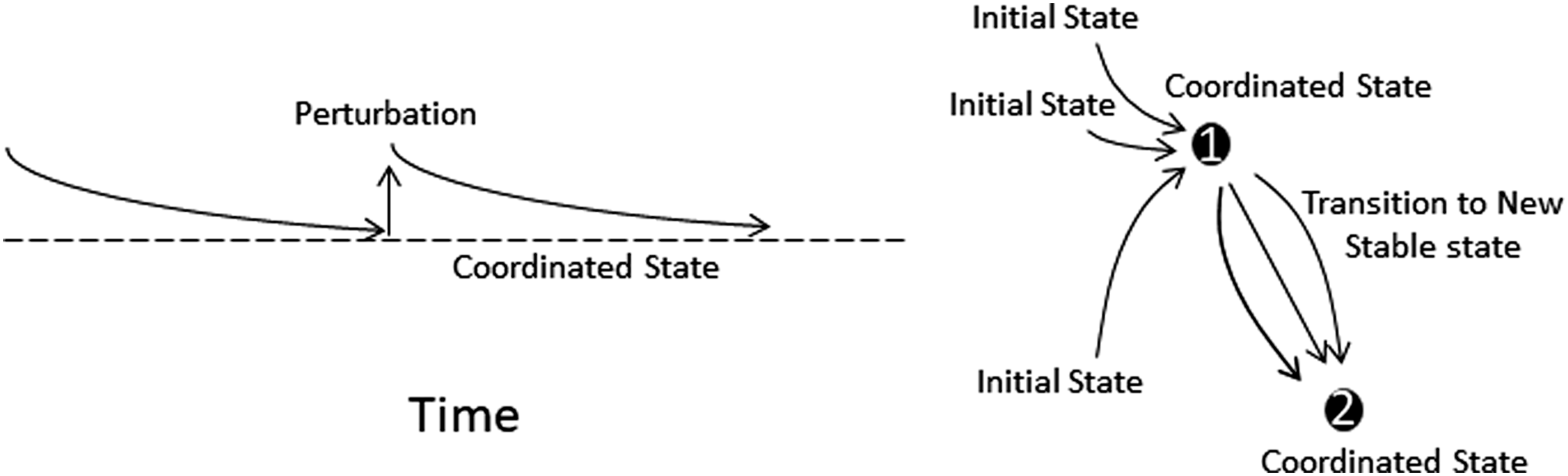
Although the System I approach is highly applicable to foundational team science concepts, such as knowledge convergence over time, they are the least developed in the literature. However, concepts such as the development of shared mental models and cohesion over time are ripe for the System I approach. Theory and varieties of System I dynamics applicable to teams can be found in Butner et al. (2015) and Borjon et al. (2018).
SYSTEM II DYNAMICS
System II dynamics are characterized by periodic team behavior. In psychology, System II dynamics were introduced to study individual-level perceptual-motor coordination (Kugler & Turvey, 1987) but can be used to model TCD in the form of verbal (Gorman et al., 2010) and perceptual-motor (Nalepka et al., 2019) team interaction. Figure 2 illustrates how System II dynamics can model team interaction using a “phase space” depicting human-robot coupling. Whereas, state space comprises all possible states of a system, phase space shows the trajectories the system takes through its state space over time, graphically representing the dynamic attractor of the team. As the operator moves the joystick forward (positive on the Control axis), the robot moves forward (positive on the Velocity axis); as the operator moves the joystick backward (negative on the Control axis), the robot moves backward (negative on the Velocity axis). Indicated by different sized trajectories, phase space captures the dynamics between the operator’s control and the robot’s velocity for different amplitude movements. In System II, these relationships are assumed to be periodic, meaning that teams regularly transition through the same sequences of states. Illustrations of System II dynamics. Top: example illustrating the dynamics between the operator’s control movements (Control axis) and the robot’s forward-backward velocity (Velocity axis) for different amplitude movements; larger trajectories through phase space correspond to greater amplitude movements. Bottom: phase space (attractor) reconstructions of periodic team coordination attractors for “intact” (left) versus “mixed” (right) uninhabited air vehicle (UAV) teams (adapted from Gorman et al., 2010). Note that the phase space dimensions of the bottom attractors are not physical (e.g., control position; velocity) but are abstract dimensions reconstructed from time-delayed (τ) copies of a communication-based team coordination time series (x). These dimensions are essentially the first three dimensions of a dynamical systems “factor analysis”, in which the x(t), x (t + τ), and x (t + 2τ) terms are the first three “dynamical degrees of freedom” of the system. Different trajectories in phase space are the system’s attractors observed under different conditions (e.g., movement amplitude, top; intact vs. mixed teams, bottom).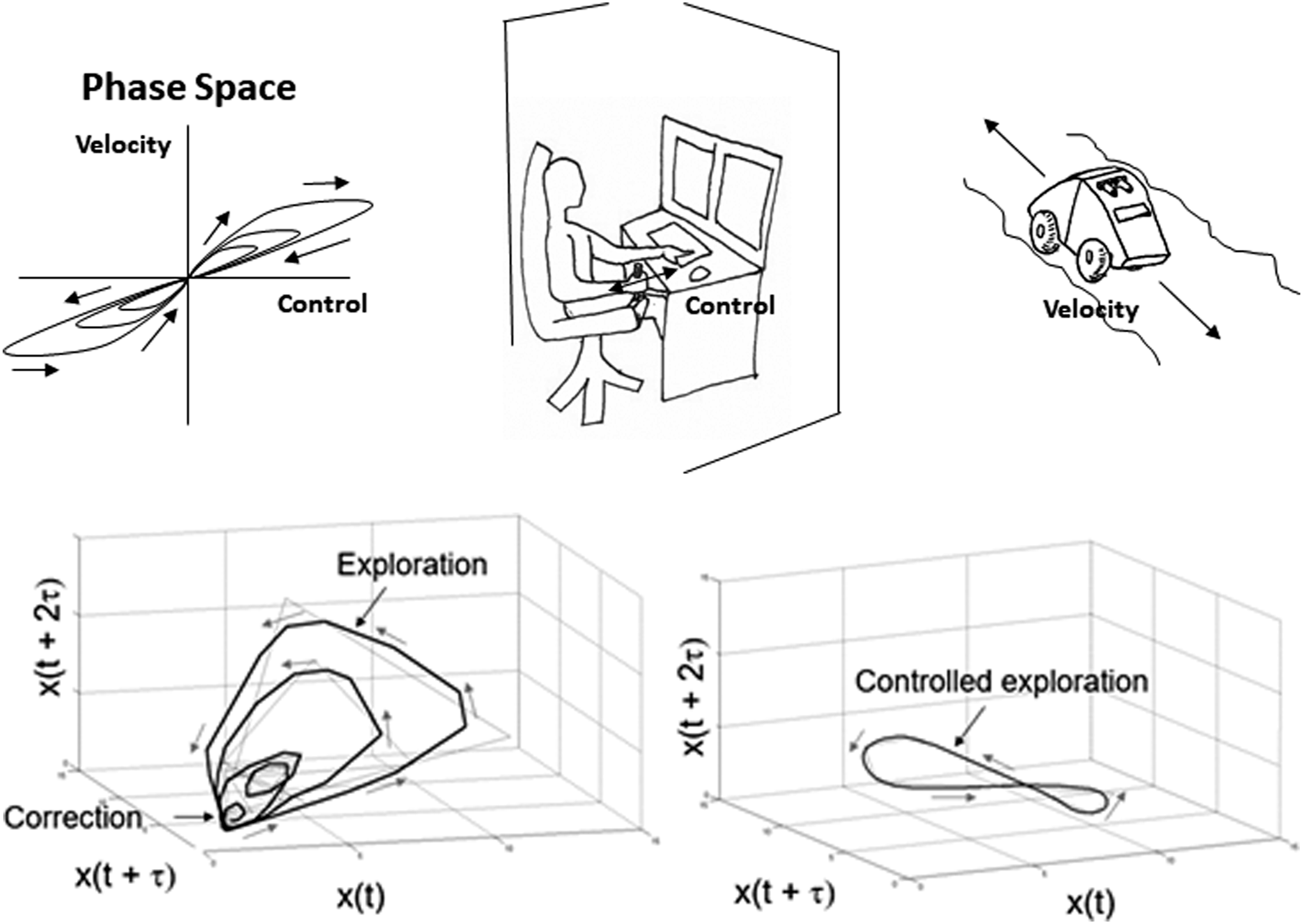
Gorman et al. (2010) examined communicative TCD in teams controlling a simulated UAV and observed periodic attractors that were more stable when team member composition was mixed after a retention interval: increased stability predicted teams’ ability to overcome novel perturbations (Figure 2, bottom). Collective synchronization in soccer teams, which models player movements as periodic oscillators relative to each other and the goal, can also be understood using System II dynamics (López-Felip et al., 2018), including the ways that teams and opponents coordinate their collective performance (Duarte et al., 2013). Nalepka and colleagues have recently shown how System II TCD can be applied to the issue of human-AI teamwork. Nalepka et al. (2017) examined the ability of teams to perform a virtual sheep herding task and found that the optimal herding strategy was to contain the sheep using coupled oscillatory movements between the human and AI team member around the herd and observed transitions to this optimal strategy when it was discovered. For human-AI coordination, these periodic dynamics were modeled using differential equations (Nalepka et al., 2019). Nalepka and colleagues refer to these types of dynamic teamwork strategies as “dynamic perceptual-motor primitives,” which are differential equations that represent discrete movement and oscillatory multi-agent coordination for machine learning. Dynamic perceptual-motor primitives may be suitable for a wide range of team dynamics involving human-robot-AI teaming that can be represented using sets of equations that are valid over the expected range of team tasks.
System II TCD assumes stationary dynamics over the period of observation. However, stationary periodic dynamics may not be complex enough to track the time- and/or situation-varying structure of team coordination. As task complexity increases, coordination patterns form, evolve, adapt, and dissipate, and they can look very different depending on the scale of analysis and changing environmental context (Kelso, 2021; Wiltshire et al., 2019). For those interested in modeling System II dynamics, see Butner et al. (2015), Tognoli et al. (2020), and Vowels et al. (2021).
SYSTEM III DYNAMICS
Team coordination in real-world settings, we argue, predominantly involves System III dynamics. In System III, teams and their environment are continuously changing; rather than having a fixed-point or periodic attractor, their dynamics are nonstationary. This increased complexity is characterized by the emergence of novel team coordination patterns that counteract environmental perturbations. Karwowski (2012) and Guastello (2017) noted that performance complexity in human factors is theoretically akin to Ashby’s law of requisite variety (Ashby, 1956), wherein a team must be able to produce sufficient coordination variety to compensate for the external variety (perturbations, novel challenges) of their environment. For teams, the concept of coordination variety is to flexibly exhibit novel coordination patterns in an intelligent and adaptive way.
System III approaches were methodologically pioneered by Stevens and colleagues in research on synchronization of team neural patterns in response to perturbations during submarine (Stevens et al., 2012) and medical (Dias et al., 2019) team training. Starting with a time series of codes representing teams’ collective neural state, they measured entropy (an index of variety) of neural synchronization (higher entropy means more variety and less neural synchronization) across team members using a sliding window technique, in which one slides the window across the time series and continuously recomputes entropy. Their analyses revealed continuous reorganization of collective neural patterns that tracked changes in the training environment (e.g., shift from scenario to debrief or man overboard training event).
System III windowing techniques have been used to track continuous reorganization across physiological, communicative, and technology-mediated coordination. Gorman et al. (2019; 2020) examined how momentary “spikes” in team reorganization behavior (i.e., moments of high coordination variety) linked back to specific team members or technological subsystems and perturbations (e.g., equipment failures). Figure 3 shows reorganization spikes measured using different indices of variety, with the caveat that there are different ways “variety” and “spike” can be operationalized (see the works cited in the figure caption). In Figure 3, the timing of reorganization spikes in relation to perturbations correspond to the team’s adaptive response. Spikes in the component layers (individual subsystems or team members in the graphs) indicate the most influential, and influenced, components during the adaptive response. Figure 3 (top) shows human-autonomy team reorganization across communication, vehicle, and controls layers in response to automation and autonomy failures (Cooke et al., 2020), and Figure 3 (middle) shows a medical team adapting to a simulated electrocautery fire (Gorman et al., 2020). Wiltshire et al. (2019, 2021) also examined how coordination variety changes over time and how it relates to task performance using sliding window metrics that detect reorganization spikes (moments of “critical instability”) in team interactions. Figure 3 (bottom) shows how this approach detected task-related as well as team interaction related reorganizations in a business team. Top: human-autonomy remotely piloted aerial system (RPAS) with simulated (A) automation, (B) autonomy, and (C) cyberattack perturbations; significant reorganization spikes (i.e., moments of high coordination variety; *) are observed in different system components (“layers”) depending on the type of perturbation (adapted from Cooke et al., 2020). Middle: medical simulation with electrocautery fire perturbation; the surgeon and registered nurse are driving team reorganization at the component level (adapted from Gorman et al., 2020). The red lines in the top two figures correspond to a 99% confidence interval computed over the variety metric. Bottom: coordination dynamics of a seven-member business team performing a collaborative problem-solving task; spikes in coordination variety (“reorganization spikes”) at the team-level track changes in tasks and coordination demands (adapted from Wiltshire et al., 2021).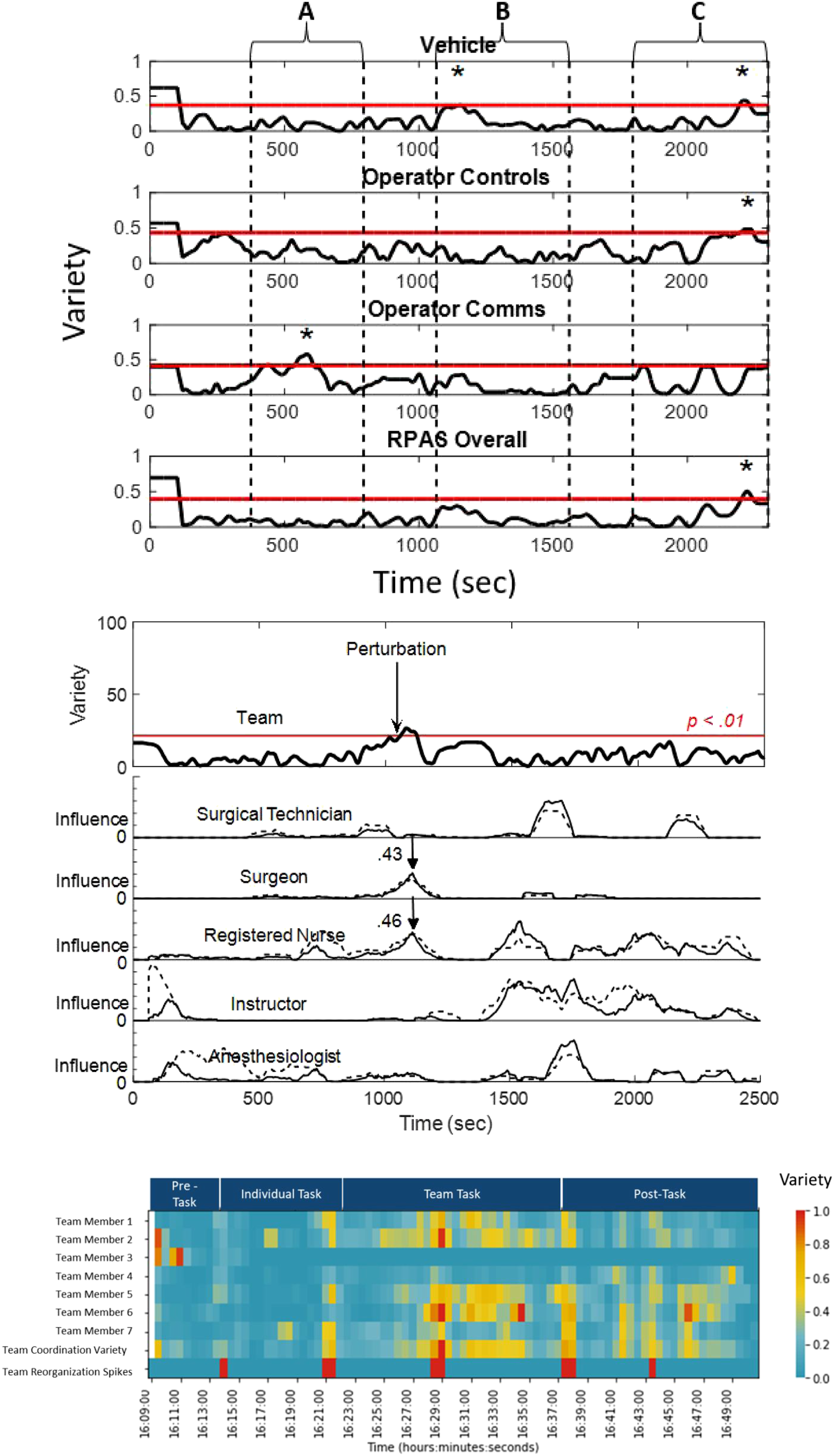
A generalizable performance metric of System III dynamics is the time between perturbation onset and peak coordination variety (i.e., reorganization spike) both at the team-level and in team components, where teams with greater adaptive ability have shorter times (Gorman et al., 2020). Perturbations or task transitions not accompanied by increased variety indicate a failure to adapt (Gorman et al., 2020), and variety spikes that do not correspond to perturbations indicate internal team reorganization (Wiltshire et al. 2021). Additional details, methods, and inspirations for examining System III dynamics can be found in Likens and Wiltshire (2021) and Schiepek and Strunk (2010).
Limitations and Future Directions
TCD is a powerful mode of explanation that emphasizes objective team interaction data over expert observations and subjective methods and is applicable to increasing levels of dynamic complexity. It is, however, not without limitations. We outline three challenges and future directions for TCD.
One criticism of TCD, particularly System III, is that it places emphasis on idiographic analysis of dynamics in context, rather than nomothetic mechanisms of team adaptation (Challenge 1). Replication strategies showing TCD effects occurring reliably in teams, rather than on average across teams, are common. Dynamical approaches emphasize the psychology of active systems in context, and its core mechanisms (e.g., perturbations, attractors, reorganization) relate to specific activities performed by teams, rather than traditional psychological constructs (e.g., attitudes, working memory). Efforts that combine idiographic and nomothetical levels of analysis offer a way forward (Wiltshire et al., 2020). For example, idiographic analyses of TCD can be compared to scripted or observed perturbations or an archive of TCD from previous team performances that focus on generalized team competencies (e.g., adaptability, resilience) in response to perturbations (e.g., Figure 3).
Extracting meaning from dynamics, or the function of coordination, is another challenge (Challenge 2). Dynamics are highly substrate-independent, and one may observe similar patterns of behavior, although the intent and/or meaning behind them may be difficult to infer (e.g., detecting the meaning of a wink vs. a blink; Juarrero, 1999). Typically, one infers the meaning of TCD with reference to environmental context, internal/external team perturbations, study manipulations, and/or team properties. What is needed are more data-driven, bottom-up approaches for inferring meaning. Annotating coordination dynamics with real-time semantic analysis of speech to infer meaning and/or intent appears promising (cf. Strang et al., 2012; Wiltshire et al., 2018). Additionally, a requirements analysis can be conducted to match TCD metrics (e.g., team influence metrics; Figure 3) to functions performed by team members (e.g., leadership emergence and coaching; Tannenbaum & Salas, 2021).
Another challenge for TCD (Challenge 3) is how and when to use dynamics to train team coordination and adaptation. Meeting this challenge impacts both how and when to scaffold instructional support and how and when to provide real-time feedback. As illustrated by Figure 3, TCD has the potential to provide personalized and team-level feedback on how team members influence coordination and adaptation in real time. What is needed is a way to translate the dynamics into meaningful feedback (Challenge 2) and real-time analysis capabilities. Kierkegaard, (1843) claimed that life can only be understood backwards, though it must be lived forwards. Similarly, dynamicists typically utilize large samples of processes that have already occurred, such that dynamics can only be understood post hoc. However, team coordination and adaptation are always forward-looking and evolving, and real-time methods are required to fully exploit this approach. Analyzing TCD in real-time is accomplished using the sliding window technique described earlier, but rather than sliding the window over a time series post hoc, the window remains stationary and new data are slid through it as they become available. Because System I and System II assume stationary dynamics, they may require reconfiguring the dynamical parameters (e.g., number of phase space dimensions) as the window updates, making real-time analysis cumbersome. Therefore, we recommend pursuing System III TCD, which does not assume stationarity, for real-time analysis (e.g., Gorman et al., 2020).
The research contexts we mention have high ecological validity but are nevertheless laboratory studies and simulations. Applying TCD methods in operational environments is largely an issue of instrumenting measurement sensors for time series data collection that minimize the influences of nuisance variables encountered in the field. For example, speech flow detection in noisy operational environments may require specialized instruments such as throat or bone microphones to mitigate the influence of background noise on speech detection. In operational environments, TCD may also require approaches that model TCD within a web of sociotechnical interactions. Approaches that integrate verbal interactions with signals from machines and interfaces may provide a holistic picture of TCD in complex real-world settings (e.g., Gorman et al., 2019).
Conclusion
TCD can be technically challenging and sometimes difficult to connect to traditional psychological constructs. In our synthesis of TCD, however, we provide examples where they can lead to deep analytics of team coordination and adaptation for broad HF/E application. Our main purpose was to provide readers with a theoretical lens to view TCD in terms of System I, II, and III dynamics, including the assumptions (e.g., stationarity; level of complexity) made in using these approaches. Although we do not provide technical details, we have pointed readers to specific sources within, and at the end of, each system type where they can find those details.
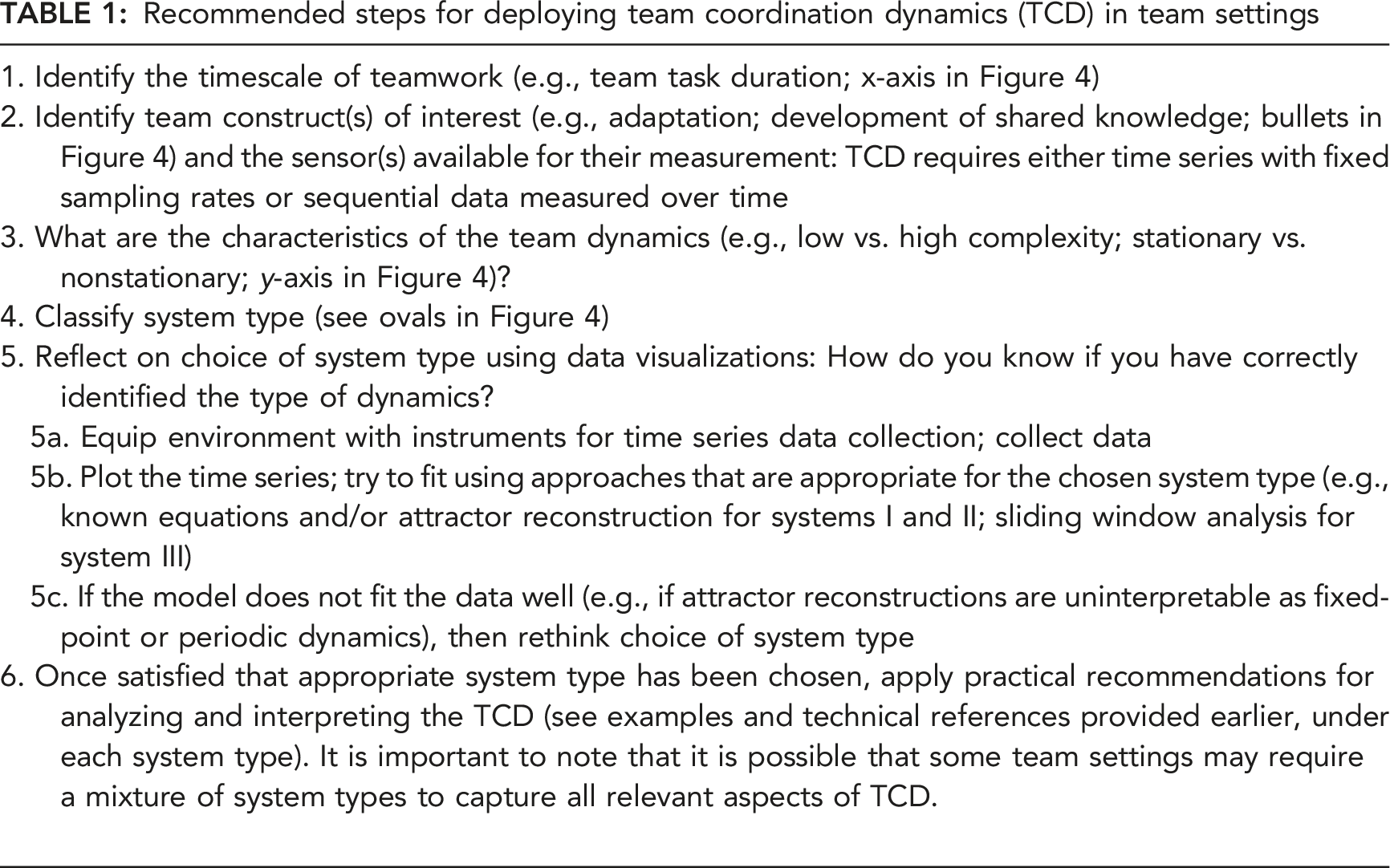
Outlined in Figure 4, System I addresses team coordination issues in which the goal is to evolve toward a stable fixed state (fixed-point attractor; e.g., converging/shared knowledge), System II addresses issues in which the goal is to evolve toward a periodic state (e.g., regular rotations or procedure following), and System III addresses issues in which the goal is to continuously adapt to changes in dynamic environments. Figure 4 also suggests how these dynamics can play out over different timescales of observation. System I dynamics are most pertinent to longer-timescale team constructs that promote coordination, such as cohesion and shared knowledge, and System II dynamics are most pertinent to understanding intermediate timescale processes, such as procedure following or synchronized team interactions during a work shift. System III dynamics covers the broadest range of timescales, in which coordination flexibility, reorganization, and adaptation occur continuously across multiple timescales. We argue that System III most broadly articulates the time-varying structure of TCD, making System III a compelling approach for researchers and practitioners interested in both momentary and longitudinal TCD in dynamic environments. In conjunction with Figure 4, we recommend that team scientists consult Table 1 in thinking through how to deploy TCD in team settings. Representation of System I, System II, and System III dynamics as a function of dynamic complexity (fixed-point; periodic; coordination variety) and timescale of observation. System I dynamics are most appropriate for longer-timescale coordination constructs (e.g., converging knowledge), and System II dynamics are most appropriate for mid-timescale coordination constructs (e.g., procedure following). Because they are scale-varying, System III dynamics are applicable across a wide range of timescales over which team reorganization and adaptation processes continuously occur across multiple scales of observation. Recommended steps for deploying team coordination dynamics (TCD) in team settings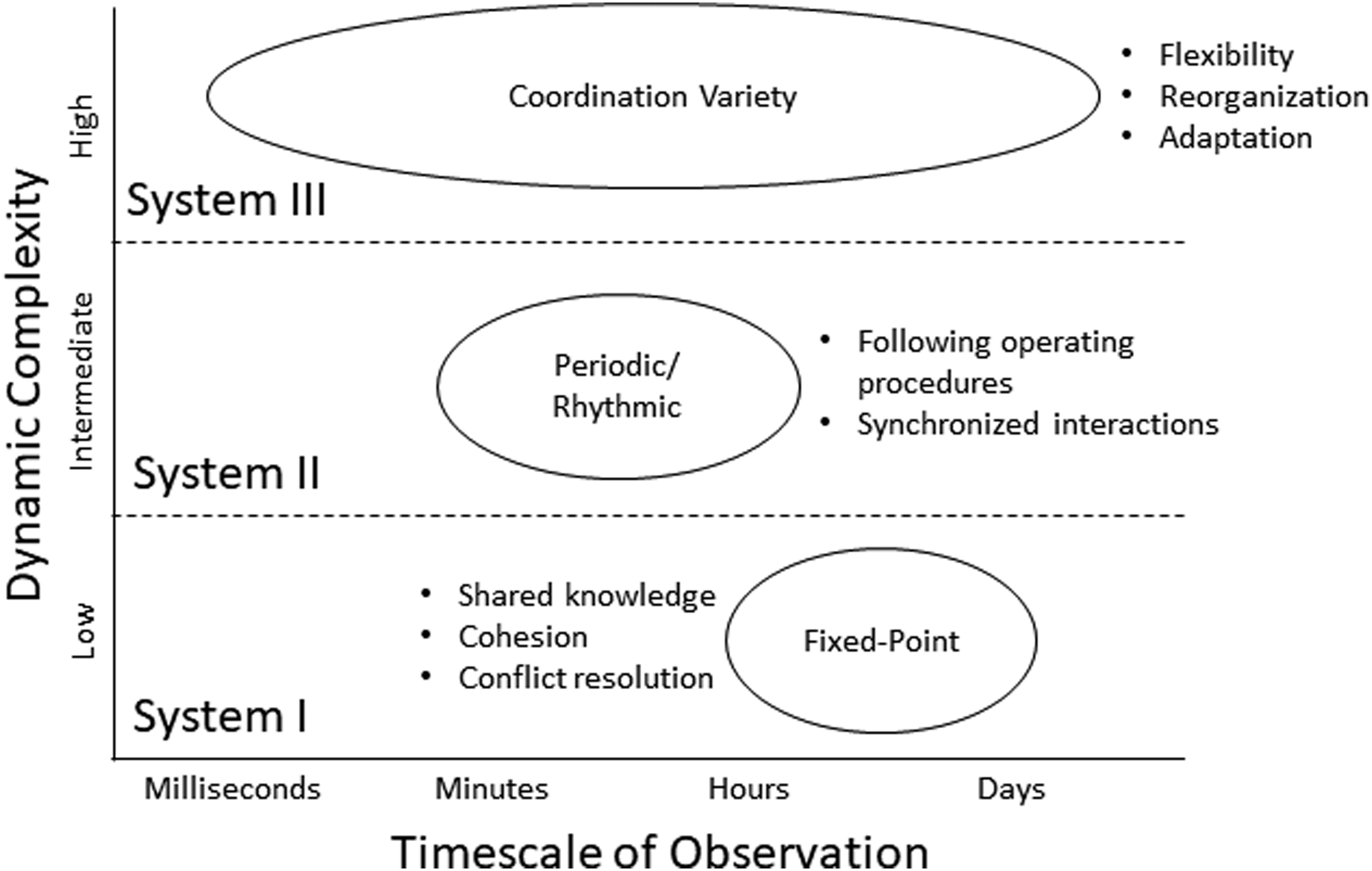
Footnotes
ACKNOWLEDGEMENT
This research was supported in part by Air Force Research Laboratory Grant FA8650-21-2–6242, subcontract CERI_GT_2017_002,382 from Office of Naval Research Grant N00014-17-1–2382, and subaward 1,559,732 from National Science Foundation Grant DRL2019805 to JCG and by the Dutch Research Council (NWO) as part of the NWO-KIEM Creative Industries and Digital Humanities program project number KI.18.047 and NWO-KIEM ICT project number ENPPS. KIEM.019.016 to TJW. The authors are grateful to Polemnia Amazeen, Martin Atzmueller, Nancy Cooke, John Flach, Dan Hudson, Michael Hunter, Ron Stevens, and Jennifer Winner for their contributions to the ideas presented in this paper. The opinions, findings, and conclusions or recommendations expressed in this paper are those of the authors and do not necessarily reflect the views of any funding agency.
KEY POINTS
Team coordination dynamics (TCD) is a crucial factor for understanding adaptive and timely team response in dynamic environments. TCD research indicates that the dynamic complexity of team coordination can be increasingly examined using stable, fixed-point states (System I), periodic changes in team state (System II), and continuous reorganization of team state that aligns with environmental dynamics (System III). System I is most appropriate for long timescale processes (e.g., converging attitudes, mental models over hours to days), System II is most appropriate for intermediate timescale, repeating processes (e.g., procedure following during a work shift over minutes to hours), and System III is appropriate across a range of timescales (e.g., tracking variety of team coordination patterns over seconds to days). System I and System II approaches assume stationary coordination dynamics over the period of observation, utilizing known or empirically-discoverable behavioral attractors. System III approaches do not make these assumptions and analyze the dynamics “bottom-up,” rather than assuming known or discoverable attractors. System III approaches should be pursued, because they provide the most generalizable assessment of TCD across time- and/or scale-varying properties of team coordination, and they are highly applicable to multimodal and longitudinal analyses of team coordination in dynamic environments.
Jamie C. Gorman is a professor in the Engineering Psychology program at the Georgia Institute of Technology. He received his PhD in Psychology from New Mexico State University in 2006.
Travis J. Wiltshire is an assistant professor in the Cognitive Science and Artificial Intelligence Department at Tilburg University. He received his PhD in Modeling & Simulation from the University of Central Florida in 2015.