



Abstract
Objective:
This study compared the visual inspection performance of airport security officers (screeners) when screening hold baggage with state-of-the-art 3D versus older 2D imaging.
Background:
3D imaging based on computer tomography features better automated detection of explosives and higher baggage throughput than older 2D X-ray imaging technology. Nonetheless, some countries and airports hesitate to implement 3D systems due to their lower image quality and the concern that screeners will need extensive and specific training before they can be allowed to work with 3D imaging.
Method:
Screeners working with 2D imaging (2D screeners) and screeners working with 3D imaging (3D screeners) conducted a simulated hold baggage screening task with both types of imaging. Differences in image quality of the imaging systems were assessed with the standard procedure for 2D imaging.
Results:
Despite lower image quality, screeners’ detection performance with 3D imaging was similar to that with 2D imaging. 3D screeners revealed higher detection performance with both types of imaging than 2D screeners.
Conclusion:
Features of 3D imaging systems (3D image rotation and slicing) seem to compensate for lower image quality. Visual inspection competency acquired with one type of imaging seems to transfer to visual inspection with the other type of imaging.
Application:
Replacing older 2D with newer 3D imaging systems can be recommended. 2D screeners do not need extensive and specific training to achieve comparable detection performance with 3D imaging. Current image quality standards for 2D imaging need revision before they can be applied to 3D imaging.
Keywords
On December 21, 1988, Pan Am Flight 103 exploded over Lockerbie, Scotland, due to a bomb in a passenger bag transported in the hold of the aircraft (Strantz, 1990). Since then, many terrorist attacks have targeted airplanes (Baum, 2016; Singh & Singh, 2003). The most recent involving a bomb in hold baggage occurred on October 31, 2015, when Metrojet Flight 9268 was blown up during flight killing all 224 passengers (Baum, 2016). In response to such bomb threats, explosive detection systems (EDS) based on 2D imaging for hold baggage screening (HBS) were developed and introduced about 15 years ago (Caygill, Davis, & Higson, 2012; Harding, 2004; Singh & Singh, 2003). Such EDS-HBS assist airport security officers (screeners) who visually inspect X-ray images of passenger bags before they are loaded into the hold of an aircraft (Wells & Bradley, 2012). Newer 3D imaging technology uses computer tomography (CT). Technically, this has better automated explosive detection, higher baggage throughput, and 3D-rotatable images. Nonetheless, it also has lower image resolution and, therefore, poorer image quality than older 2D imaging technology (Flitton, Breckon, & Megherbi, 2013; Mouton & Breckon, 2015; Oftring, 2015; Wells & Bradley, 2012).
Human-machine system performance depends on technology and human factors. For instance, if lower image quality with 3D imaging would make it harder for screeners to decide whether a bag contains an improvised explosive device (IED), then 3D screening could in fact be inferior to 2D screening despite having better automated explosive detection. On the other hand, and this is a very important point to consider, if screeners would achieve at least similar detection performance with 3D imaging compared with 2D imaging, then the human-machine system as a whole would perform better with 3D imaging because this technology has better automated explosive detection and higher baggage throughput. Investigating this issue is of major practical relevance: Although some countries introduced 3D imaging several years ago, other countries do not accept such technology due to their lower image quality compared with older 2D imaging EDS-HBS technology, even though 3D imaging has better automated explosive detection capability and higher baggage throughput (Flitton et al., 2013; Oftring, 2015). Moreover, there is a current debate on the international regulatory level regarding whether screeners working with 2D imaging need extensive and specific training before they can be allowed to work with 3D imaging technology. Our study addressed both issues by testing 2D and 3D screeners with 2D and 3D imaging in a simulated hold baggage screening task with the following research questions: (a) Can screeners achieve at least similar detection performance using 3D imaging compared with 2D imaging despite lower image resolution? (b) Does visual inspection competency acquired with one type of imaging transfer to the other type of imaging? These research questions are also interesting from a theoretical perspective—in particular, with regard to human-machine interaction, visual information processing and transfer of learning. Before discussing the relevant literature, it is important to clarify important terms and processes regarding the airport security screening of cabin and hold baggage.
Passengers store their carry-on bags in the cabin of airplanes. Because such cabin baggage can be accessed during flight, guns, knives, IEDs, and other items that could pose a threat (e.g., electric shock devices) are prohibited (Hancock & Hart, 2002; Harris, 2002; Schwaninger, 2005). As required by law (e.g., European Commission, 2015), screeners visually inspect every piece of cabin baggage at airport security checkpoints using X-ray machines. Larger baggage, in contrast, is stored in the hold of an aircraft and processed differently (Shanks & Bradley, 2004). Passengers have to register such hold baggage at check-in stations before going through airport security checkpoints. Hold baggage is then processed by a baggage handling system containing X-ray machines that have EDS-HBS (Level 1 of hold baggage screening) that highlights areas on the X-ray image that might contain explosive with colored rectangles (2D imaging systems) or by coloring the suspect area (3D imaging systems; see Figure 1 for illustrations). Whereas there are multiple target types (guns, knives, IEDs, explosives, other prohibited items) in cabin baggage screening, this is not the case in hold baggage screening. Because passengers cannot access items stored in the hold of an aircraft, guns or knives do not pose a threat, and hold baggage screening targets only fully functioning IEDs (Bretz, 2002). Only X-ray images of hold baggage on which an EDS-HBS has raised an alarm are sent to remote screening locations for on-screen alarm resolution by screeners (Level 2 of hold baggage screening). They visually inspect the X-ray images and decide whether the bag is harmless or contains a fully functioning IED with the following components: a triggering device, a power source, an explosive, and a detonator that need to be connected to each other by, for example, wires (Turner, 1994; Wells & Bradley, 2012). If screeners decide that an X-ray image is suspicious, more time-consuming investigations follow including rescreening with other X-ray technology, trace detection, explosive detection dogs, passenger reconciliation, and the opening of bags (Shanks & Bradley, 2004; Singh & Singh, 2003).
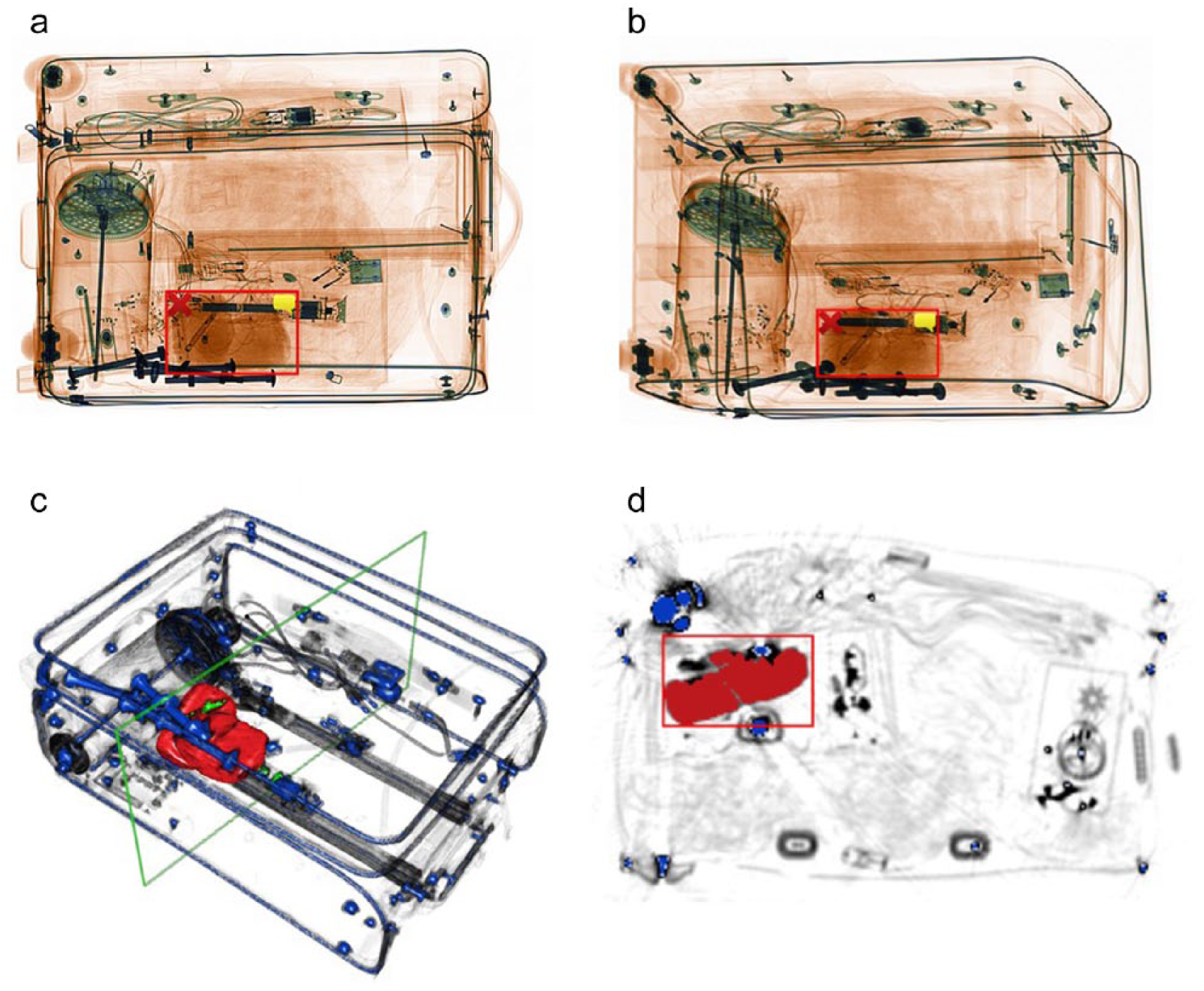
Target-present bag containing an IED recorded with a 2D multiview X-ray and a 3D CT imaging system currently used at airports: (a) 2D default image, (b) second 2D image with 30 degrees difference in perspective, (c) 3D-rotatable image, and (d) 3D-sliceable image. Explosive material is highlighted by the 2D imaging system with red rectangles (Figure 1a and 1b) and by the 3D imaging system with red coloring (Figure 1c and 1d). With 3D imaging, the detonator is visible in green (Figure 1c) and in blue (Figure 1d).
Since the terrorist attacks on September 11, 2001, there have been many studies on the visual inspection of X-ray images of cabin baggage, which consists of visual search and decision making (Koller, Drury, & Schwaninger, 2009; McCarley, Kramer, & Wickens, 2004; Wales, Anderson, Jones, Schwaninger, & Horne, 2009; Wolfe & Van Wert, 2010). Visual search challenges include low target prevalence, variations in target visibility, and the possible presence of multiple targets (Biggs & Mittroff, 2014; Clark, Cain, Adamo, & Mitroff, 2012; Godwin et al., 2010; Godwin, Menneer, Cave, Thaibsyah, & Donnelly, 2015; Mitroff, Biggs, & Cain, 2015). When it comes to decision making on whether a bag contains a prohibited item, screeners need to know which items are prohibited and what they look like in X-ray images (Schwaninger, 2005). Several studies have shown the importance of computer-based training in helping screeners to achieve and maintain high visual inspection performance (Fiore, Scielzo, Jentsch, & Howard, 2006; Halbherr, Schwaninger, Budgell, & Wales, 2013; Koller et al., 2009; Koller, Hardmeier, Michel, & Schwaninger, 2008; Schuster, Rivera, Sellers, Fiore, & Jentsch, 2013; Schwaninger & Hofer, 2004; Schwaninger, Hofer, & Wetter, 2007). International regulations take this into account by mandating initial and recurrent training of screeners. For example, European regulations mandate at least 6 hr of image recognition training and testing in every 6-month period for cabin- and hold-baggage screeners (European Commission, 2015).
Target prevalence in real-world baggage screening is about 2% because airports use threat image projection, a technology that projects X-ray images containing targets into the flow of images that are visually inspected by screeners (Hofer & Schwaninger, 2005; Schwaninger, 2006; Schwaninger et al., 2007; Schwaninger, Hardmeier, Riegelnig, & Martin, 2010). The challenge of low target prevalence in visual search refers to the finding that rare targets are frequently missed (Godwin et al., 2010; Wolfe, Brunelli, Rubinstein, & Horowitz, 2013; Wolfe, Horowitz, & Kenner, 2005). This is consistent with signal detection theory (SDT, Green & Swets, 1966) according to which the probability of signal occurrence (target prevalence) influences the probability of responding that a signal (target) is present. Using the SDT framework, the target prevalence effect can be explained as a shift in response bias (Fleck & Mitroff, 2007; Godwin et al., 2010; Lau & Huang, 2010; Wolfe et al., 2007; Wolfe & van Wert, 2010). SDT provides a measure of detection performance (d′) that is independent of response bias (and therefore also of target prevalence). This has been confirmed for different domains and tasks (Green & Swets, 1966; MacMillan & Creelman, 2005; Swets, 1996) including X-ray image inspection and visual search (Meneer, Donnelly, Godwin, & Cave, 2010; Verghese, 2001; Wolfe & Reynolds, 2008; Wolfe & Van Wert, 2010). Moreover, Schwaninger, Hofer, and Wetter (2007) found very similar detection performance (d′) in screeners when performing a computer-based test with a target prevalence of 50% compared with detection performance (d′) measured on the job using threat image projection data with a target prevalence of 2%.
Regarding target visibility, studies have shown how image-based factors impact on visual inspection performance (e.g., Bolfing, Halbherr, & Schwaninger, 2008; Schwaninger, Hardmeier, & Hofer, 2005; Schwaninger, Michel, & Bolfing, 2005, 2007). For example, objects depicted from unusual viewpoints are more difficult to recognize (effect of viewpoint). Moreover, in X-ray images, objects appear with overlay, and detecting prohibited items depends on how much they are superimposed by other objects (effect of superposition). Finally, prohibited items are more difficult to recognize in complex bags containing many other items and clutter (effect of bag complexity). These challenges can be reduced with 2D imaging that displays a passenger bag as two X-ray images from different perspectives (dual-view imaging). However, previous studies on cabin baggage screening have shown that although dual-view imaging leads to higher detection performance than single-view X-ray imaging, it also increases response time (von Bastian, Schwaninger, & Michel, 2008; Franzel, Schmidt, & Roth, 2012). Similar results have been found for motion imaging in which bags are displayed as an animated sequence of X-ray images depicting a bag from different viewpoints (Mendes, Schwaninger, & Michel, 2013).
Several years ago, advanced CT technology, which has been implemented highly successfully in medical imaging (Barrat, 2000), became available for hold baggage screening (Mouton & Breckon, 2015; Wetter, 2013). Compared with the older 2D imaging technology used in HBS, state-of-the art CT scanners feature better automated explosive detection, slicing, and 3D-rotatable images (Flitton et al., 2013; Mouton & Breckon, 2015; Oftring, 2015; Wells & Bradley, 2012). Slicing refers to the production of cross-sectional images or “slices” of a bag. From a series of image slices, a bag can be reconstructed as a 3D CT volume image and the bag can be displayed as a 3D-rotatable and 3D-sliceable image (Flitton, Breckon, & Megherbi, 2010, 2013). This could result in better detection performance among screeners for two reasons: First, it might be easier to recognize the different components of an IED that, in certain 2D views, would be displayed from a difficult viewpoint and/or superimposed by other items in a complex bag (Bolfing et al. 2008; Schwaninger, Michel, & Bolfing, 2005, 2007). Second, object recognition research has shown that exposure to 3D images results in richer visual object representations (Tarr & Vuong, 2002; Vuong & Tarr, 2004). This could improve screeners’ detection performance not only in 3D but also in 2D images. On the other hand, CT systems have lower image resolution and therefore lower image quality compared with EDS-HBS 2D imaging (Flitton et al., 2010, 2013; Mouton & Breckon, 2015), and this could impair screeners’ detection performance with 3D imaging. Regarding response times (RT), screeners might take more time to visually inspect 3D images because rotating X-ray images and slicing both require additional time.
This study extends previous research on cabin baggage screening by addressing questions of high practical and theoretical relevance for hold baggage screening. We wanted to know (a) whether screeners using 3D imaging can achieve at least similar detection performance to that when using 2D imaging despite lower image resolution, and (b) whether the visual inspection competency acquired with one type of imaging transfers to the other type of imaging. We addressed these research questions by asking two screener groups that differed in their experience in working with the two imaging technologies to perform a simulated hold baggage screening task with both 2D and 3D imaging. In order to achieve high external validity, we used X-ray images that were recorded with 2D and 3D imaging systems that are currently operational at airports. It is important to note that the reason for comparing 2D and 3D imaging differing in image quality is that the two types of imaging tested in this study are from real-world systems; there is therefore a need to know whether 3D screening results in better human-machine system performance despite lower image quality.
Our main dependent variable was detection performance (d′), which has high external validity for real-world baggage screening because it is independent of target prevalence. Due to the fact that airports use threat image projection with a target prevalence of about 2% (Hofer & Schwaninger, 2005; Schwaninger, Hofer, & Wetter, 2007), target-absent RT were also important, because they account for about 98% of X-ray images in real-world hold baggage screening. Based on our results, we shall discuss whether replacing older 2D with newer 3D imaging technology improves the human-machine system performance in terms of efficiency and effectiveness of the hold baggage screening process as a whole. In addition, our results have important implications in light of current international discussions on whether extensive and specific training should be mandated for 2D screeners before allowing them to work with 3D imaging technology.
Method
Participants
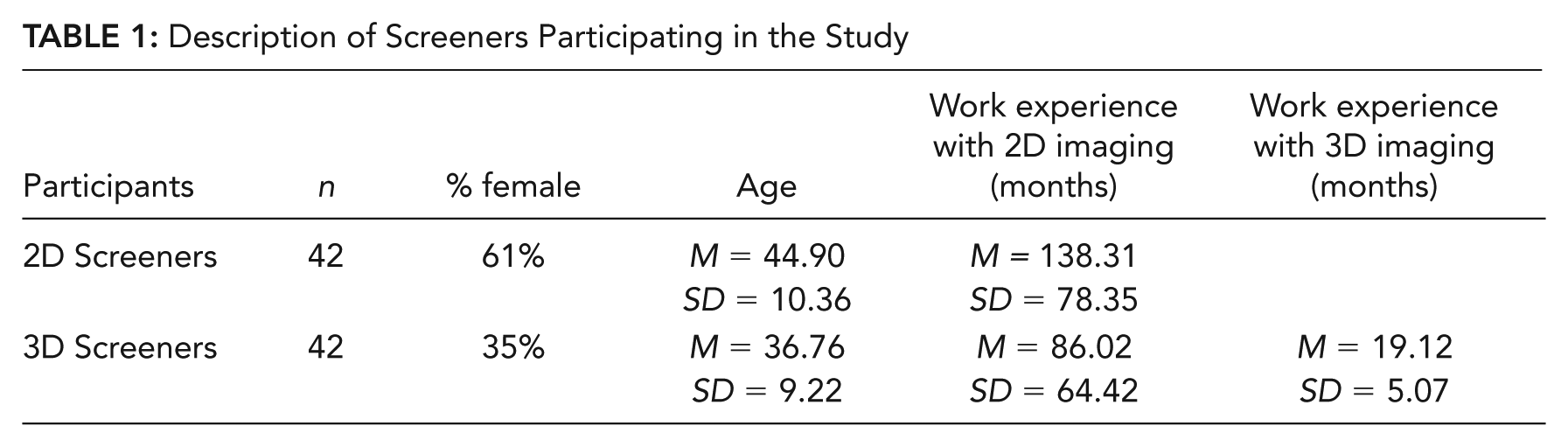
Participants were professional hold baggage screeners from two international airports (see Table 1 for details). All screeners had been selected, qualified, trained, and certified according to the standards set by the appropriate national authority (civil aviation administration) in compliance with the relevant EU regulation (European Commission, 2015). Eighty-eight screeners consented to participate in the study (43 2D screeners and 45 3D screeners). Three screeners (one 2D and two 3D) who could not attend the main test due to illness were excluded. One further 3D screener had to be excluded due to a malfunction of the simulator. This left a total of 84 screeners (42 2D screeners [21 tested with 2D imaging and 21 tested with 3D imaging] and 42 3D screeners [23 tested with 2D imaging and 19 tested with 3D imaging]). The current research complied with the American Psychological Association Code of Ethics and was approved by the institutional review board of the University of Applied Sciences and Arts Northwestern Switzerland. Informed consent was obtained from all participants.
Description of Screeners Participating in the Study
Design
All participants attended the airport test facilities twice. First, they completed a pretest to familiarize themselves with the 2D and 3D simulators and the testing procedure. For the main test 2 weeks later, screeners were randomly assigned to be tested with either 2D or 3D imaging. The experiment (main test) used a between-subjects design with X-ray imaging technology (2D vs. 3D imaging) and screener group (3D vs. 2D screeners) as independent variables and visual inspection performance measures as dependent variables (detection performance [d′], target-absent RT, and target-present RT).
Materials
Aviation security experts from a specialized police organization running one of the test centers responsible for airport security equipment testing and certification in Europe created 64 different IEDs (32 for the pretest and 32 for the main test, IEDs were randomly assigned to be used in the pretest or the main test). X-ray images of hold baggage were recorded at this test center by five aviation security experts and the first and second author using 2D multiview X-ray and 3D CT imaging systems that are currently being used at airports (see Figure 1 for examples of images and further information).
Thirty-two different bags were used repeatedly by repacking them to create unique stimuli for the pretest and the main test. All bags were of medium complexity as defined by the aviation security experts. Target-present images contained one IED. Target-absent images contained EDS-HBS false alarms (e.g., cheese, certain liquids, etc.). To ensure that the 3D imaging condition had the same system reliability (e.g., Rice & McCarley, 2011) as the 2D imaging condition, we used EDS-HBS alarms from 3D imaging as a reference when setting red frames manually around the same objects of interest in 2D imaging stimuli.
The pretest consisted of 64 2D X-ray images and 64 3D CT images of different bags. Target prevalence was 50%. Each IED was used twice in different bags: once recorded from a more frontal perspective displaying more surface area, and once from a horizontally or vertically rotated perspective using medium superposition. The main test consisted of 256 bags that were recorded with 2D and 3D imaging. Target prevalence was 50%. Each of the 32 IEDs was used four times in four different bags by varying viewpoint and superposition.
As described in the introduction, 3D imaging systems have lower image quality than 2D imaging systems. To assess such differences, we used the standard test piece (STP) and protocol, which is currently the most widely used international standard for the assessment of image quality of 2D imaging systems (see the Appendix for details).
Procedure
Tests were conducted without giving performance feedback using simulators provided by the manufacturer of the 2D and 3D imaging systems. Six computer workstations with 19’’ TFT monitors were set up in a normally lit room. Each screener sat approximately 50 cm away from the monitor. The X-ray images covered about two thirds of the screen. Four to six participants performed the test in each session while working individually, quietly, and under supervision. This is a typical scenario in hold baggage screening (Kuhn, 2017). Screeners received instructions before the start of each test informing them about the imaging systems, the number of images, and that the target items were IEDs. To prevent a criterion shift (change of response bias) during the experiment, we informed the screeners beforehand about the target prevalence in the experiment (see also McCarley, 2009; Rich et al., 2008).
Screeners were instructed to visually inspect each X-ray image as if they were working at the airport and to decide as accurately and quickly as possible whether or not the image contained a target by clicking on a target-present or a target-absent button on the simulator interface (a yes–no task in signal detection theory; see MacMillan & Creelman, 2005). After receiving their instructions, all participants started the experiment with 10 practice trials (5 target-absent and 5 target-present images in random order). A time limit of 90 s was set for viewing an X-ray image; afterwards, the image disappeared, but the screeners still had to make a decision.
European regulations mandate that screeners have to take a break of at least 10 min after 20 min of continuous visual inspection of X-ray images (European Commission, 2015). Therefore, tests were divided into four blocks, and screeners were asked to take breaks of 10 to 15 min after completing each block. Block order was counterbalanced across participants. Images appeared in random order within a block. All participants completed the pretest in less than 40 min and the main test in less than 1.5 hr including breaks.
Analyses
We computed analyses of covariance (ANCOVA) with detection performance (d′), target-absent RT, and target-present RT as dependent variables and age and 2D work experience as covariates (using SPSS version 22 and an alpha level of .05). Age was used as covariate because 3D screeners were, on average, younger than 2D screeners (see Table 1) and because previous research showed a negative correlation between age and the visual inspection performance of screeners (Ghylin, Drury & Schwaninger, 2006; Schwaninger et al., 2010). 2D work experience was used as covariate because 2D screeners had on average more 2D work experience than 3D screeners (see Table 1). We conducted post hoc comparisons with R version 3.22 (R Core Team, 2015) and applied Holm–Bonferroni corrections (Holm, 1979). We report ANCOVA effect sizes with ηp2; effect sizes of t tests, with Cohen’s d.
According to SDT (Green & Swets, 1966), there are four possible outcomes depending on stimuli and participant responses (Table 2). Detection performance (d′) was calculated using the following SDT formulae, whereby z refers to the inverse of the cumulative distribution function of the standard normal distribution (Green & Swets, 1966; MacMillan & Creelman, 2005):



Definition of Hit, False Alarm, Miss, and Correct Rejection According to SDT (Green & Swets, 1966)
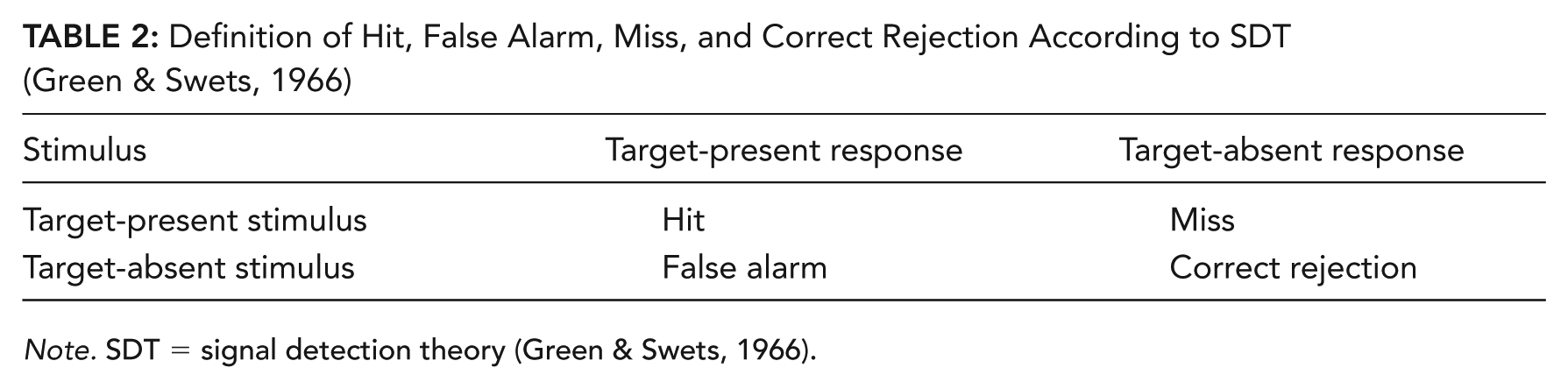
Note. SDT = signal detection theory (Green & Swets, 1966).
Results
Image Quality
Detailed results on image quality assessment with six tests of the STP are reported in the Appendix. In summary, results confirmed that the 2D imaging system passed all image quality tests. The 3D imaging system did not pass two of the six tests: The spatial resolution and useful penetration tests could not be solved using either the 3D-rotatable or the 3D-sliceable image. Nonetheless, taking all test results into account, it should be possible to recognize main IED components (triggering devices, power sources, explosives, and detonators) to a similar degree with 2D and 3D imaging. However, recognizing thin wires when they are hidden behind aluminum of a thickness of 7.9 mm or more was not possible with 3D imaging.
Visual Inspection Performance
We first present the results on detection performance (d′) because this is the main dependent variable for addressing our research questions. We then present RT, whereby target-absent RTs are more important due to the fact that they account for about 98% of all X-ray images in real-world hold baggage screening when using threat image projection (Hofer & Schwaninger, 2005; Schwaninger, 2006; Schwaninger, Hofer, & Wetter, 2007; Schwaninger et al., 2010). Figure 2 shows detection performance d′ depending on X-ray imaging technology (2D vs. 3D imaging) and screener group (2D vs. 3D screeners).
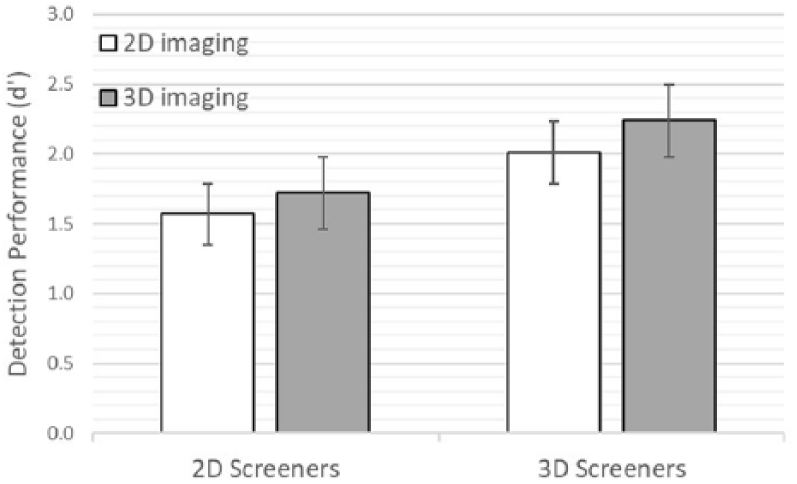
Detection performance (d′) by X-ray imaging technology (2D vs. 3D imaging) and screener group (2D vs. 3D screeners). Error bars are ± one standard error.
A 2 (2D vs. 3D imaging) × 2 (2D vs. 3D screeners) ANCOVA with d′ as dependent variable while controlling for age and 2D work experience revealed a trend toward better detection performance (d′) with 3D imaging (mean values of main effect: 2D imaging d′ = 1.80; 3D imaging d′ = 1.97). However, this effect did not attain statistical significance, F(1, 78) = 3.56, p = .065, ηp2 = .04. There was a significant effect of screener group with 3D screeners performing better with both types of imaging than 2D screeners (mean values of main effect: 2D screeners d′ = 1.72; 3D screeners d′ = 2.05), F(1, 78) = 10.18, p = .002, ηp2 = .12. The interaction between imaging and screener group was not significant. There was a significant effect of the covariate age, F(1, 79) = 2.86, p < .001, ηp2 = .16 but not of the covariate 2D work experience.
Figure 3 shows target-absent RT by X-ray imaging technology and screener group.
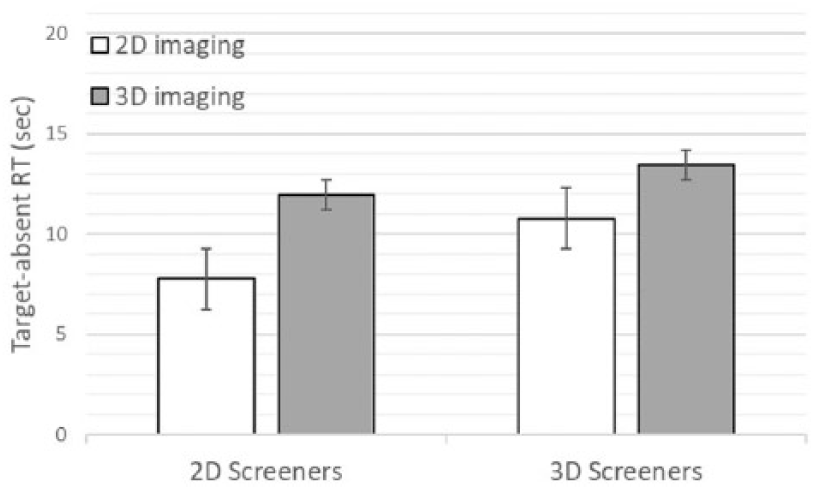
Target-absent RT by X-ray imaging technology (2D vs. 3D imaging) and screener group (3D vs. 2D screeners). Error bars are ± one standard error.
We calculated a 2 (2D vs. 3D imaging) × 2 (2D vs. 3D screeners) ANCOVA for target-absent trials with RT as dependent variable while controlling for age and 2D work experience. We found a main effect of imaging F(1, 78) = 12.12, p < .001, ηp2 = .13, and screener group, F(1, 78) = 11.22, p < .001, ηp2 = .13, but no significant effect for their interaction. Further, there was a significant effect of the covariate age, F(1, 78) = 7.75, p = .007, ηp2 = .09, but not of the covariate 2D work experience. To examine whether speed–accuracy trade-offs can explain why 3D screeners had higher detection performance (d′) than 2D screeners with both imaging systems, we used two-tailed independent samples t tests to examine accuracy in target-absent trials (percent correct rejections, PCR). For 2D imaging, 2D screeners had significantly higher PCR than 3D screeners, t(42) = −3.88, p < .001. For 3D imaging, we did not find a difference between the screener groups for PCR, t(38) = −.00, p = .997. This means that we found no evidence that the better detection performance (d′) of 3D screeners compared with 2D screeners could be explained by a speed–accuracy trade-off in target-absent trials.
Figure 4 shows target-present RT dependent on X-ray imaging technology and screener group.
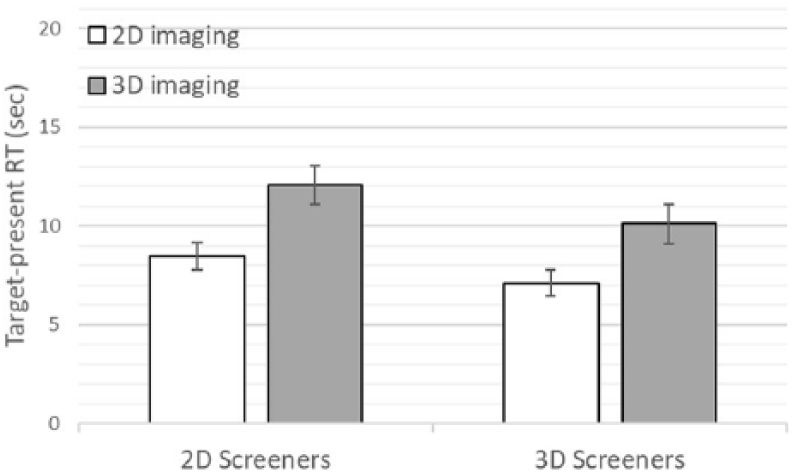
Target-present RT by X-ray imaging technology (2D vs. 3D imaging) and screener group (2D vs. 3D screeners). Error bars are ± one standard error.
We calculated a 2 (2D vs. 3D imaging) × 2 (2D vs. 3D screeners) ANCOVA for target-present trials with RT as dependent variable while controlling for age and 2D work experience. We found a main effect of imaging, F(1, 78) = 20.32, p < .001, ηp2 = .21, and a significant effect of the covariate age, F(1, 78) = 25.52, p < .001, ηp2 = .25 but not of the covariate 2D work experience. Neither the main effect of screener group nor the interaction was significant, making a speed–accuracy trade-off an implausible explanation for the better detection performance (d′) of 3D screeners compared with 2D screeners.
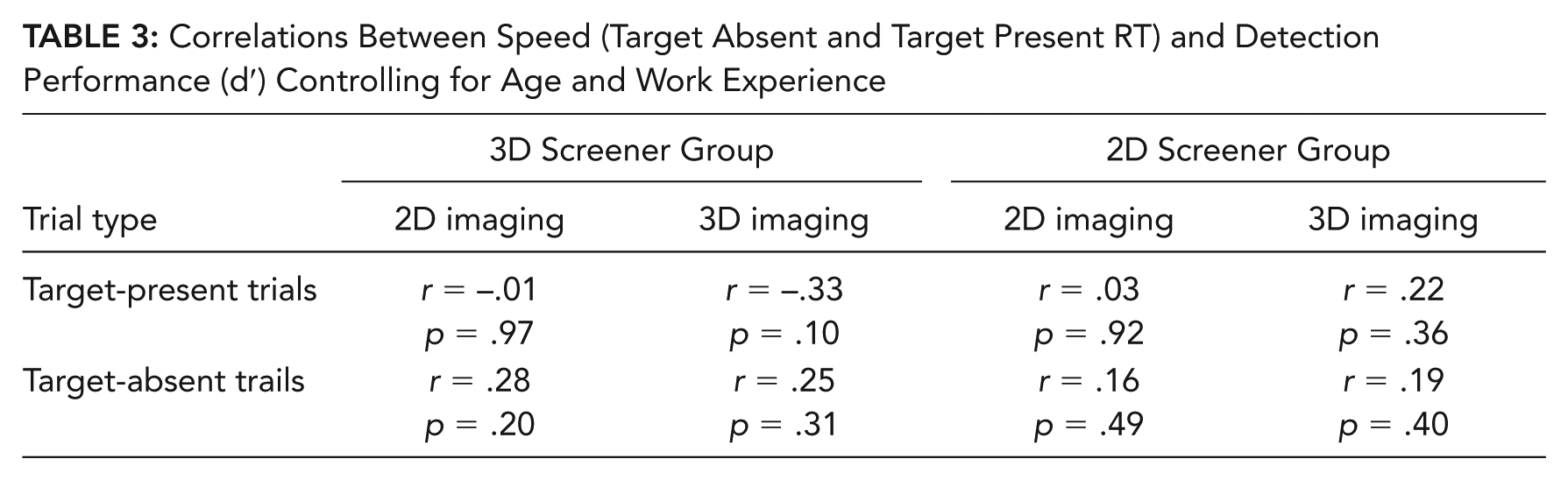
To examine speed-accuracy trade-offs within the screener groups, we also calculated two-tailed partial correlations between response times and detection performance (d′) while controlling for age and work experience (Table 3). A speed-accuracy trade-off would have been supported if at least one significant positive correlation (longer reaction times and higher detection performance [d′]) would have been found. This was not the case, which makes speed-accuracy trade-offs very unlikely.
Correlations Between Speed (Target Absent and Target Present RT) and Detection Performance (d′) Controlling for Age and Work Experience
Discussion
This study addressed two questions of high practical and theoretical relevance for the airport security screening of hold baggage: (a) Can screeners achieve at least similar detection performance using 3D imaging compared with 2D imaging despite the lower image quality of 3D imaging? (b) Does visual inspection competency acquired with one type of imaging transfer to the other type of imaging? We addressed these questions by asking 2D screeners and 3D screeners to perform a simulated hold baggage screening task with both types of imaging. We first discuss the results on detection performance (d′), the main dependent variable for our research questions. We then discuss the results on response times (RT) whereby target-absent RTs are more meaningful for real-world baggage screening. We conclude by discussing implications of our results for the efficiency and effectiveness of hold baggage screening using 2D versus 3D imaging systems.
Despite lower image quality (see the Appendix for these results and their discussion), 3D imaging resulted in a similar detection performance (d′) of screeners compared with that for 2D imaging. Benefits of 3D imaging allowing three-dimensional rotation and slicing seem to compensate for the potentially negative effects of lower image quality. This is consistent with earlier research on cabin baggage screening that showed better detection performance for motion imaging compared with static 2D imaging (Mendes et al., 2013). 2D screeners achieved a similar detection performance (d′) with 3D imaging to that with 2D imaging. This indicates a very large transfer effect and has important practical implications in light of the current international discussions on whether specific training should be mandated for 2D screeners before allowing them to work with 3D imaging systems. Our results suggest that 2D screeners do not need extensive and specific training to achieve similar detection performance with 3D imaging compared with that attained with 2D imaging.
3D screeners also achieved similar detection performance (d′) with both imaging systems, but they performed better than 2D screeners with both types of imaging. As explained in the introduction, object recognition research has shown that exposure to 3D images results in richer visual representations that could therefore also increase detection performance in 2D images (Tarr & Vuong, 2002; Vuong & Tarr, 2004). This is a plausible explanation for our finding that 3D screeners performed better than 2D screeners not only with 3D imaging but also with 2D imaging. Alternative explanations might be based on group differences in age, cognitive abilities, training, or work experience along with speed–accuracy trade-offs. Because we used age as covariate, age differences are an unlikely explanation for performance differences between 2D and 3D screeners. Visual-cognitive abilities have also been shown to impact on screener performance (Hardmeier & Schwaninger, 2008; Rusconi, Ferri, Viding, & Mitchener-Nissen, 2015; Rusconi, McCrory, & Viding, 2012; Schwaninger, Hardmeier, & Hofer, 2005). However, it is also unlikely that differences in these abilities can explain the detection performance differences between 3D and 2D screeners in our study. The organization providing the 2D screeners had implemented a very selective pre-employment screening procedure including a visual-cognitive test battery and an X-ray object recognition test (Hardmeier, Hofer, & Schwaninger, 2006; Schwaninger, Hardmeier, & Hofer, 2005). Moreover, it is difficult to explain differences between 2D and 3D screeners by amount of training because both screener groups were qualified, trained, and certified according to the same European standards including a 6-hr mandatory image recognition training and testing every 6 months (European Commission, 2015). Finally, differences in 2D work experience cannot explain why 3D screeners were better with 2D imaging than 2D screeners, because the latter had more work experience with 2D imaging, and 2D work experience was used as covariate. Thus, the most plausible explanation based on results from object-recognition research (Tarr & Vuong, 2002; Vuong & Tarr, 2004) would seem to be that extensive exposure to 3D imaging during work and training resulted in richer visual representations and therefore better performance of 3D screeners than 2D screeners for both types of imaging.
The target-absent RT of 2D screeners when using 2D imaging was 8 s. Threat image projection data from experienced 2D screeners working with a similar 2D imaging system revealed target-absent RTs of about 7 s (Schwaninger, Hofer, & Wetter, 2007). This suggests that the target-absent RT found in our study would generalize quite well to real-world conditions (at least for 2D screeners when using 2D imaging) despite large differences in target prevalence. Both screener groups needed more time (about 2 s [3D screeners] and 4 s [2D screeners]) when using 3D imaging compared with 2D imaging. This result was anticipated, because rotating and slicing 3D images takes longer to process than the visual inspection of static 2D X-ray images. When no target was present, 3D screeners took longer for visual inspection than 2D screeners. For 3D imaging, the difference was small (about 1 s). For 2D imaging, 3D screeners took 3 s longer than 2D screeners. Although speculative, one possible explanation could be that 3D screeners were used to rotating and slicing images but were unable to do this when using 2D imaging. This may have resulted in longer target-absent RT. However, the important result is that the higher detection performance (d′) of 3D screeners with both imaging systems compared with 2D screeners could not be explained by a speed–accuracy trade-off.
The target-present RT of 2D screeners when using 2D imaging was 8 s. This was similar to the real-world target-present RT of 9 s for experienced 2D screeners when using 2D imaging for hold baggage screening (Schwaninger, Hofer, & Wetter, 2007). This provides further support for the view that the RT found in our study would generalize to real-world conditions despite large differences in target prevalence. As for target-absent RT, both screener groups needed more time: 3 s (3D screeners) and 4 s (2D screeners) when using 3D imaging. Differences between screener groups were not significant for target-present RT, making a speed–accuracy trade-off an extremely implausible explanation for the better detection performance (d′) of 3D screeners compared with 2D screeners with both imaging systems.
Whereas 2D work experience did not have an impact, age had an influence on all dependent variables: Older screeners had lower detection performance (d′) and longer response times. This result is consistent with previous research showing a negative correlation between age and visual inspection performance of screeners (Ghylin et al., 2006; Schwaninger et al., 2010). Because we used 2D work experience and age as covariates, the observed screener group differences in detection performance (d′) and response times cannot be explained by preexisting differences in the covariates.
To summarize, the results on detection performance (d′) answered our two research questions: (a) Screeners achieved a similar detection performance (d′) using 3D imaging compared with 2D imaging despite lower image resolution of 3D imaging. (b) Visual inspection competency acquired with one type of imaging transferred to visual inspection with the other type of imaging. However, both screener groups needed more time (2–4 s) when using 3D imaging compared with 2D imaging.
What do our results on screeners’ visual inspection performance mean for the efficiency (throughput) of 2D versus 3D hold baggage screening at airports? According to Oftring (2015), 2D and 3D imaging systems can process about 1,500 bags per hour, but 2D imaging systems have false alarm rates of at least 35%, whereas 3D imaging systems achieve much lower false alarm rates (15%). The installation of 3D imaging (Level 1 in hold baggage screening) should therefore already result in a 31% increase in efficiency. Based on the amount of bags sent to visual inspection and the target-absent RTs found in our study, an efficiency increase from 36% to 49% on Level 2 of hold baggage screening (alarm resolution of screeners) can be achieved (see Table 4 for the calculation). As explained in the introduction, if screeners decide that an X-ray image is suspicious, more time-consuming investigations follow including rescreening with other X-ray technology, trace detection, explosive detection, dogs, passenger reconciliation, and the opening of bags (Shanks & Bradley, 2004; Singh & Singh, 2003). Therefore, efficiency gains will be even higher in practice because 3D imaging results in less hold baggage being sent to Level 2.
Estimation of Efficiency Increase (Throughput) When Using 3D Imaging Compared With 2D Imaging Based on Target-Absent RT Results
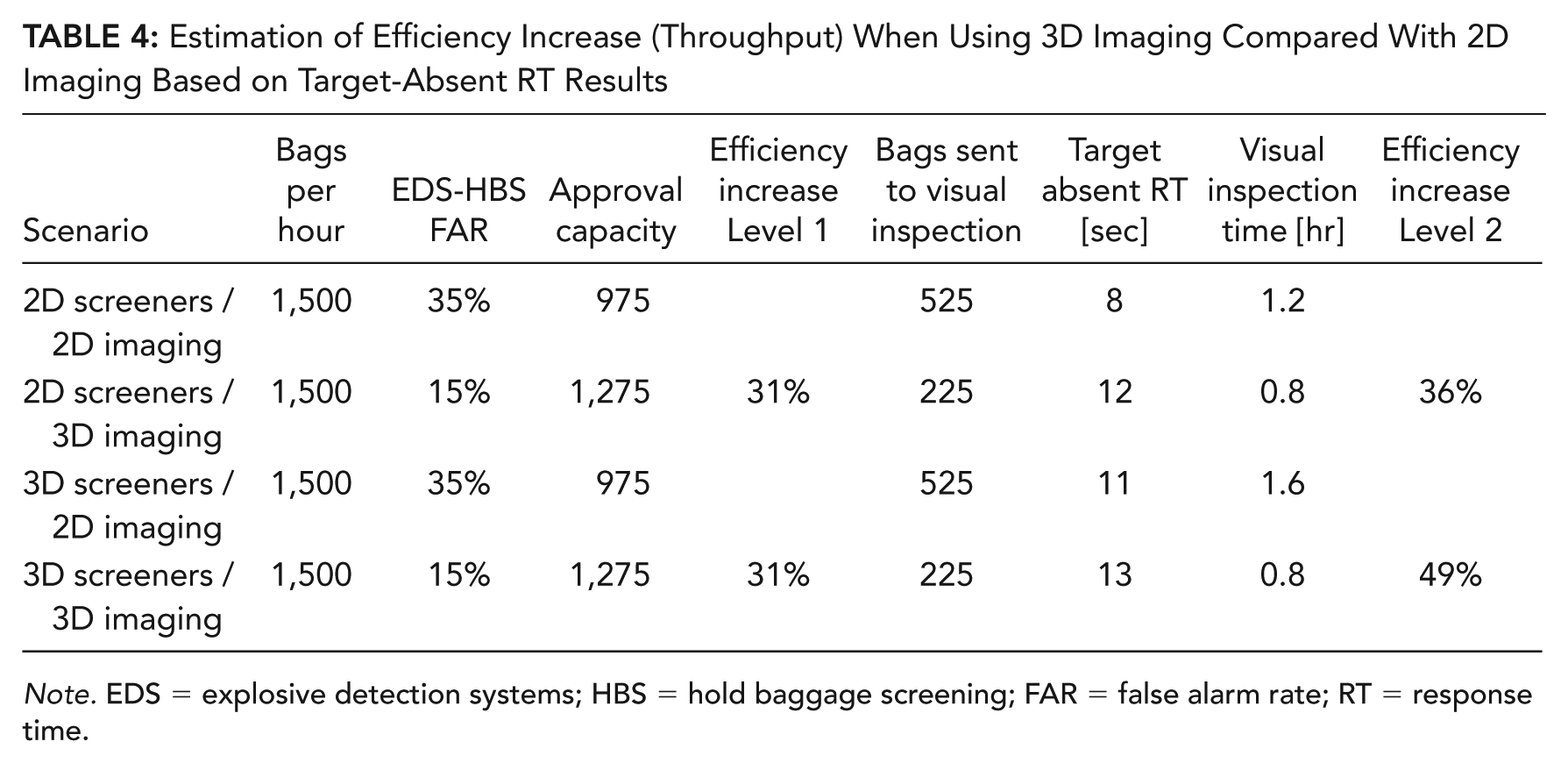
Note. EDS = explosive detection systems; HBS = hold baggage screening; FAR = false alarm rate; RT = response time.
Estimating the increase in effectiveness (detection of IEDs) is more difficult, because the detection rates of 2D and 3D imaging systems are not publicly available for security reasons. However, it is clear that 3D imaging systems achieve substantially higher detection of explosives than 2D imaging systems (e.g., Oftring, 2015; Singh & Singh, 2003; Wells & Bradley, 2012). Moreover, in Europe, EDS-HBS have to meet European detection standards and be approved by test centers of the European Civil Aviation Conference (ECAC). So far, only 3D imaging systems have met ECAC Standard 3, whereas 2D imaging systems achieve only Standard 2 (European Civil Aviation Conference, 2018). ECAC Standard 3 requires higher hit rates and lower false alarm rates and therefore higher detection performance (d′) of EDS-HBS.
Taking together the results of our study on screeners’ visual inspection performance with the performance advantages of 3D imaging technology, it is reasonable to infer that the whole human-machine system performance when using 3D imaging technology is superior to 2D imaging not only in terms of efficiency (throughput) but also in terms of effectiveness (detection of IEDs) of the HBS process as a whole. The results of our study further suggest that extensive and specific training is not needed for 2D screeners before allowing them to work with 3D imaging systems. Nonetheless, some limitations do call for further research: Screener performance was tested with only one 2D and 3D imaging system. It would be interesting to see whether different results would be obtained with other 2D systems using a larger angular difference between the two views of a bag (e.g., 60–90 deg), with 3D systems that have higher image resolution, and with hybrid systems that show four views (3D-rotatable, 3D sliceable, and two different STP-compliant 2D views). Although it is not possible to conclude from our study that higher image resolution of 3D imaging systems would result in better visual inspection performance among screeners, it would be worth investigating this in future studies. Second, it would be interesting to see whether the results of our study can be replicated with screeners from other airports using a within-subjects design to investigate transfer effects from 2D to 3D imaging and vice versa over several months (although this might be rather difficult to achieve in practice). Conducting such a study with student participants is not an option for reasons of external validity as well as the security-sensitive nature of the image material and on-screen alarm resolution protocols.
Despite these limitations, we believe that our study is robust enough to make a significant contribution to the theory, practice, and knowledge base of human factors and ergonomics—particularly with regard to its practical relevance. First, we can recommend a wide-scale implementation of 3D imaging systems with an image quality equal to or higher than that of the 3D imaging system tested in this study, because it can be expected to result in better human–machine system performance in terms of efficiency and effectiveness of the hold baggage screening process as a whole. Second, due to large transfer effects, 2D screeners do not require extensive and specific training to achieve similar detection performance with state-of-the-art 3D imaging. Third, image quality standards and procedures need revision before they can be applied to 3D imaging systems.
Key Points
● This study compared the performance of airport security officers (screeners) using state-of-the-art 3D imaging and older 2D imaging for airport security screening of hold baggage.
● Despite lower image quality, screeners achieved a similar detection performance with 3D imaging to that for 2D imaging.
● 3D screeners revealed higher detection performance with both types of imaging than 2D screeners.
● Features of 3D imaging systems (3D rotation and slicing) seem to compensate for the lower image quality.
● Visual inspection competency acquired with one type of imaging seems to transfer to the other type of imaging.
● 2D and 3D screeners required more time for visual inspection of 3D versus 2D images. However, baggage throughput would still be substantially higher with 3D imaging systems for hold baggage screening due to lower EDS alarm rates than those for older 2D imaging systems.
● Replacing older 2D with newer 3D imaging systems for hold baggage screening can be recommended to increase the efficiency and effectiveness of hold baggage screening.
● Extensive and specific training of 2D screeners before allowing them to work with 3D imaging is not needed to achieve a similar performance to that with 2D imaging.
● Current image quality standards for 2D imaging need to be revised before they can be applied to 3D imaging systems for hold baggage screening.
Footnotes
Appendix
Acknowledgements
We thank the German Federal Police Technology Center for the valuable expertise and support for creating the stimulus material.
Nicole Hättenschwiler is a PhD student working at the University of Applied Sciences and Arts, Northwestern Switzerland, in the field of human factors in aviation security. She obtained her Master of Science in Psychology from the University of Bern in 2014.
Marcia Mendes earned her PhD in the field of human factors in aviation security from the University of Basel in 2016.
Adrian Schwaninger received his PhD in psychology from the University of Zurich in 2003. Since 2008, he has been Professor of Psychology at the Institute Humans in Complex Systems of the School of Applied Psychology of the University of Applied Sciences and Arts Northwestern Switzerland. Since 2009, he has been the Head of this Institute.