




Abstract
Objective:
This study aimed to formatively evaluate a new nutrition label education intervention featuring the computer game Food Decisions with school students to assess feasibility, fun, perceptions and potential for impact on mediators of making healthier food choices.
Methods:
Noncontrolled, pre–post intervention study with a class of 30 Year-10 pupils conducted in Yorkshire, England. Data collected orally and by questionnaire to evaluate students’ perceptions, confidence and knowledge of using labels to make healthier food choices.
Results:
A total of 27 pupils consented to participate in the study and 20 participants (mostly White British, 95% and female, 55%) submitted both pre- and postintervention questionnaires. Participants perceived that learning with the game was ‘fun’ (95%, n = 19) and their levels of confidence in making healthier choices increased significantly (MD = +3.2, SD 2.3, p < 0.05).
Conclusions and implications:
This gamified nutrition label education intervention is feasible for use with students in school and has the potential to impact participants’ learning and confidence using nutrition labels to make healthier food choices.
Introduction
Populations, including young people, are experiencing high levels of obesity associated with excessive dietary intakes of energy and nutrients of public health concern (World Health Organisation [WHO], 2021). Enabling and empowering individuals to make healthier food choices is a key strategy to improve public health (UK Department for Health and Social Care [DHSC], 2018). One way to enable people to choose healthier foods is to provide product-level nutrition label information on the content of energy and nutrients, particularly by means of Front-of-Pack nutrition labelling (DHSC, 2018; Jones et al., 2019). Alongside these, nutrition label education can promote use and understanding of this widely available source of product information, and is recommended in several countries (European Union [EU], 2011; Food and Drug Administration [FDA], 1993). It is recognised that attainment of healthy eating behaviours requires adequate food literacy, defined broadly as a range of knowledge and skills around food, its preparation and nutrition aspects, including food label use (Thomas et al., 2019). Developing food literacy skills is highly relevant in young people in the United Kingdom given that members of this group consume excessive intakes of sugars, salt and saturated fat, and experiences growing levels of obesity (DHSC, 2018).
Health education innovations to promote food literacy now include gamified ‘serious game’ approaches which are intended to promote learning by engaging players in games which are designed for reasons other than entertainment (Brown et al., 2015; Krath et al., 2021). Such game-based learning incorporates game elements (i.e. point scoring, competition, etc.) into learning activities (Brown et al., 2015; Floryan et al., 2019) which are designed to achieve specific learning objectives to support health knowledge, skills and behaviours, including those needed to enable positive health behaviour change around nutrition and food choice (Arnab, 2020; Suleiman-Martos et al., 2021). However, although there exists a public health need to promote the use of nutrition labels among young people, this population may not consistently receive this education in UK schools (Public Health England, 2015). In addition, the extent to which gamified education can support the use and understanding of nutrition labels among young people is not evidenced in the literature. For example, existing research on the effects of gamification of nutrition education interventions tend to focus on general healthy eating principles (Brown et al., 2015; Suleiman-Martos et al., 2021), while research on nutrition label education focusses mostly on adults and group education approaches (Moore et al., 2018). Nonetheless, the potential for computer gamification of nutrition label education to support healthier eating in young people is reflected in the findings of a systematic review of health video games used in obesity interventions, which suggest some impact on obesity-related outcomes (Lu et al., 2013). Evidence also shows that gamified education promotes advertising literacy over traditional classroom approaches and increases children’s engagement and learning (Herrewijn et al., 2021).
Within the emerging field of nutrition label education gamification, the aim of this study was to pilot and formatively evaluate a new gamified nutrition label education intervention–the recently developed Food Decisions computer game (https://www.fit-talent.com/post/food-decisions-is-live-now) with school aged young people. With the goal of informing future efficacy trials, we evaluated the feasibility of undertaking this intervention in school, participants’ perceptions of the game experience, and the potential to promote learning and skills that support use of nutrition labels to make healthier food choices.
Methods
Intervention
Based on educational aspects previously identified as key to nutrition label education (Moore et al., 2018) and the educational engagement of young people (Public Health England, 2015), a school learning session was devised with the overall aim of outlining healthier eating guidance and promoting use of nutrition labels to enable identification of healthier food products. The session was held during a Year-10 three-hour food technology class and included a brief presentation and a hands-on group-based game activity exploring labels on real-life products, followed by individual pupil access to the Food Decisions game (Fit Talent Management Gmbh, 2022) on laptop computers which had been set up by the School IT Team. The Food Decisions game was developed by Fit Talent Management GmbH as part of a knowledge transfer project (Moore et al., 2021) involving the current study team. The game offers progressive experiential learning on how to read and use product-level nutrition label information within virtual retail food environments (i.e. café, marketplace and supermarket store) (Figure 1).
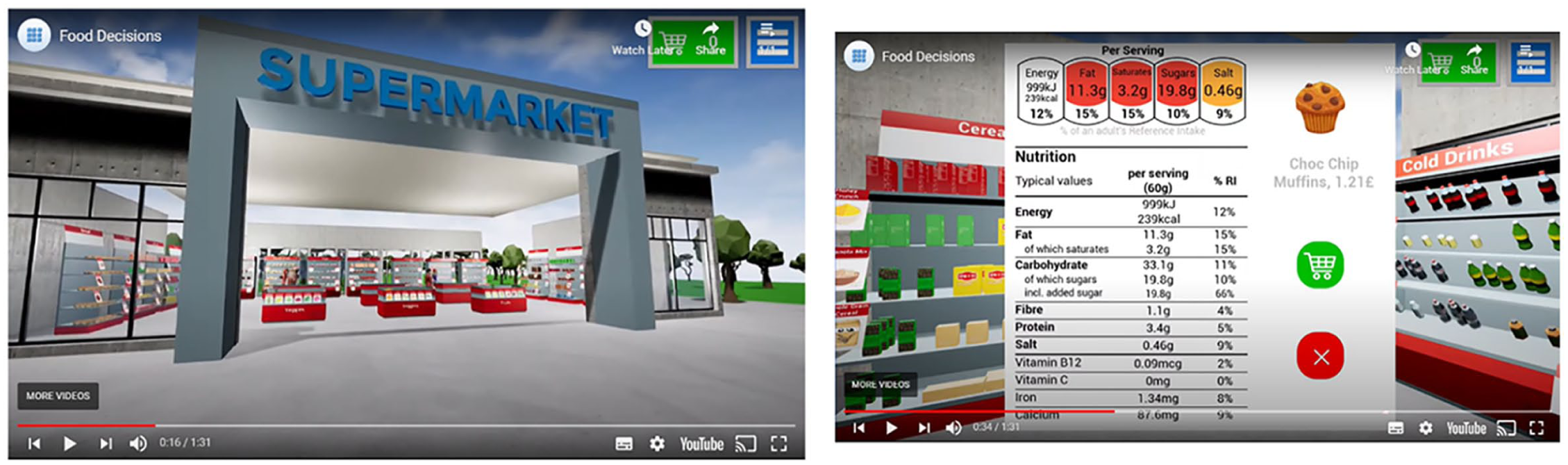
Food decisions game.
The development of the Food Decisions computer game was informed by three key aspects of the health education evidence-base. First, the game content was aligned with international and UK dietary recommendations and communications which emphasise fruit and vegetable, sugar and fibre intakes, as well as the use and interpretation of nutrition labels to guide healthier eating (DHSC, 2018). Second, game development was grounded in ‘serious games’ pedagogical frameworks (Arnab, 2020; Floryan et al., 2019) a number of which are recognised in the existing literature (Krath et al., 2021), drawing specifically on the Input–Process–Output (IPO) Game Model (Garris et al., 2002) and the Learning Mechanic–Game Mechanic–Self-Determination Theory (LM-GM-SDT) framework (Proulx et al., 2017). For example, in the game, the IPO game model conceptualises learning as a cyclical process that integrates instructional content with game elements, engaging players through judgement (i.e. label reading) and behaviour (i.e. food selection), reinforced by system feedback (i.e. ‘you chose the food with the highest sugar’), debriefing, and culminating in the intended learning outcomes (Krath et al., 2021), which in our case were to enable students to differentiate nutritional content by using labels, and identify healthier food choices.
Evaluation design
A single cohort, noncontrolled pre–post measures design was used to formatively evaluate the feasibility of this intervention (Smith and Ory, 2014) and its potential to impact on mediators of making healthier choices among Year 10 (14–15 years) pupils at a single secondary school in Yorkshire, UK.
Participants
All 30 Year-10 secondary school group pupils were invited to participate in the study, via their teacher who sent online invitations to seek informed consent from both participants and their parents/carers, 2 weeks prior to the intervention.
Ethics
Before the study commenced, ethical approval was received from Leeds University Research Ethics Committee for Business, Environment and Social Sciences (Reference: AREA 21/137). Meetings took place between the researchers, school teachers and school representatives to ensure that participant safety, anonymity and inclusion were appropriate and considerate of individual needs. Our ethical conduct of the research included (1) seeking written informed consent from both the parent and the young person participant prior to the class session and data collection; (2) providing opportunities for participants to receive teacher support during or after the session, if they felt challenged or personally triggered by the topics discussed; (3) ensuring all communications and activities were framed by a nonjudgemental and inclusive approach to personal food choice. For example, the session introduction began: ‘Healthy eating is for everyone and everyone is different. Everyone can choose what they eat without being judged, including in this session’.
Data collection
An online questionnaire was used to collect data from participants at preintervention including gender and ethnicity characteristics, educational attainment level (based on predicted GCSE grades 1–8), and their prior experience and reasons for playing computer games (e.g. for fun, friends, relaxation etc). Post-intervention questionnaires used validated items adapted from previously used tools to assess young peoples’ game enjoyment, learning motivation and fun using a 5-point ‘emoji’ agreement scales (i.e. Awful, Not very good, Average, Good, Excellent) (Herrewijn et al., 2021; Read, 2007).
Both pre- and post-intervention questionnaires evaluated participants’ confidence making healthier choices ( ‘choosing healthy foods’) and in their own understanding of nutrition labels using a 10 point scale (1 = not confident at all, 10 = extremely confident) (Miller et al., 2017). In addition, participants’ self-reported general nutrition knowledge, frequency of nutrition label use, and influence on purchases were assessed using two 5-point Likert-type-type scales (i.e. 1 = never/none, 5 = always/excellent) (Jay et al., 2009; Mackison et al., 2010).
Participants’ objective knowledge of using nutrition labels (UK Front-of-Pack traffic lights) to accurately select ‘healthier’ choices was also assessed pre- and post-intervention with three ‘quiz’ question items which displayed this label information alongside multiple choice answer options (Madkison et al., 2010). Finally, during the game-play part of the intervention, three researchers (SM, JL, SG) noted verbalisations from individual participants on their perceptions and experiences of playing the game.
Data analysis
Participants’ who had consented and submitted both pre- and post-intervention questionnaires were included in the analysis. Questionnaire responses using 5-point ordinal scales assessing self-reported knowledge, label use and perceptions of the game were summarised descriptively by calculating the proportions of participants (%) who selected each category. Participants’ pre–post intervention confidence levels, evaluated using 10-point scales, were summarised as means and standard deviations (SD), whereas knowledge quiz scores were calculated as a percentage of correct answers. Pre–post differences in knowledge, quiz score, confidence and label use were evaluated using Chi-square tests for categorical data, or mean differences and paired t-tests for continuous data, with a significance level set at p < 0.05. Finally, verbal data collected using notes by each researcher were combined and initially analysed using an approach based on thematic analysis, to identify emergent themes and illustrative quotes, in line with our research aim (Braun and Clarke, 2022).
Results
Sample characteristics
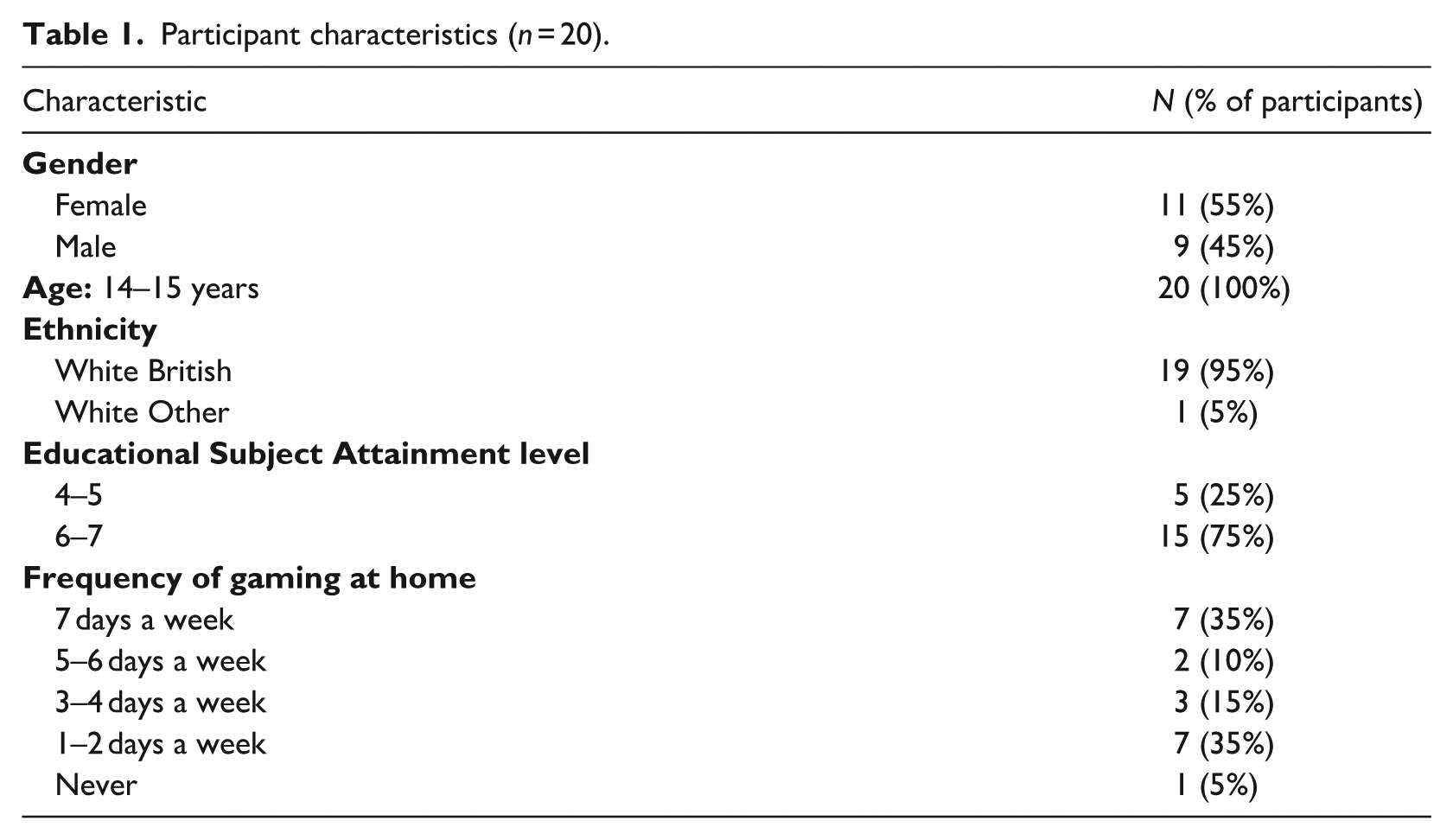
A total of 27 pupils and their parents consented to participate, with 23 preintervention and 20 postintervention questionnaires submitted online. Participants (n = 20) who had submitted both questionnaires and were included in the analysis were aged 14–15 years and mostly White British (95%) and female (55%), with GSCSE educational attainment levels ranging from 4 to 7 (Table 1). The three participants who had completed postintervention questionnaires only and were not included in the analysis were all White British and female with similar educational attainment characteristics. Most participants played computer games at least once a week (n = 19, 95%) because they found them ‘fun’ (95%) and gave them chance to play with friends (80%), relax (60%), or keep their ‘brain active’ (40%). The school teacher reported that no ethical related issues were raised by participants or their parents during or after the research project.
Participant characteristics (n = 20).
Participants’ perceptions
The majority of participants agreed they found the game ‘fun’ (95%) and would ‘play the game again’ (80%). Most participants indicated the game had helped them to ‘understand nutrition labels better’ (95%), remember the things they ‘learnt’ (80%), and that they had ‘learnt something new’ (85%). Participants’ verbalised perceptions captured during the session also evidenced that the game was considered ‘cool’ or ‘very entertaining’, while contrasting it with routine teaching; ‘the game is better than being taught from power point’. Verbal data also evidenced that the game was perceived to promote learning via engagement because they could ‘play with friends’ and on ‘phones outside of school’.
Potential impact on participants
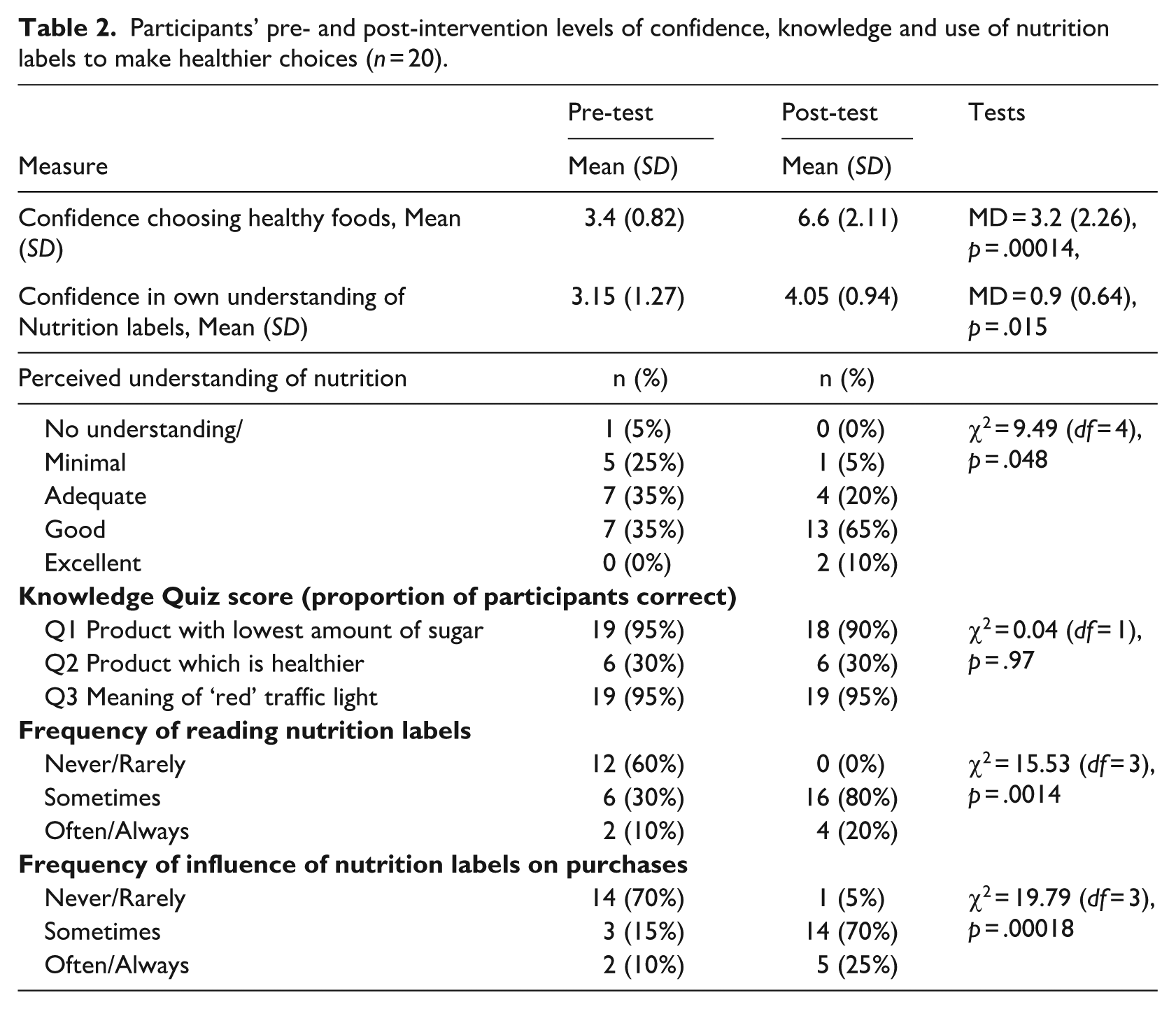
Participants’ levels of reported confidence in choosing healthier foods at pre- and postintervention increased significantly (mean difference + 3.2, SD 2.3, p < 0.05), as did their perceived knowledge of general nutrition (Table 2). While participants’ levels of confidence in their own understanding of nutrition label information also increased, no significant difference was found between the proportions of participants who correctly answered the three label quiz questions at pre- and postintervention. Finally, the number of participants who frequently read, or whose purchases were (expected to be) influenced by, nutrition labels increased significantly from pre- to postintervention (Table 2).
Participants’ pre- and post-intervention levels of confidence, knowledge and use of nutrition labels to make healthier choices (n = 20).
Discussion
The aim of this study was to formatively evaluate a new gamified nutrition label education intervention featuring the recently developed Food Decisions computer game with young people in school. Evaluation findings indicate the intervention was feasible to conduct in a UK secondary school with a class of Year 10 students. Findings also suggest young people perceived the intervention and computer game as positive, fun and potentially more engaging than traditional classroom methods, such as ‘power point slides’. While our study design precluded direct comparison against other intervention delivery approaches, ‘fun’ is key feature of effective learning and engagement with serious games (Arnab, 2020). The study now adds to the literature by providing practical learning on the elements of successful research required when working with young people in schools, including prior ethical considerations, the involvement of teachers and the need to support participant’s online questionnaire submission.
However, although the study was not formally designed to detect pre–post differences in nutrition label knowledge acquisition, our findings suggest that participants’ objectively assessed knowledge of nutrition labels (quiz scores) did not increase from pre- to postintervention. This is different from previous research with US adults which showed increases in accuracy of healthier option identification following use of a web-based ‘training’ approach (Miller et al., 2017). One reason for this could be that study participants already possessed high levels of knowledge (preintervention quiz scores) about Front-of-Pack (traffic light) labels. Alternatively, it is also possible that the gamification of nutrition label education might be more effective if tailored to target ‘knowledge gaps’ in label understanding (Moore et al., 2018), which we did not attempt to assess prior to intervention in our study. Nonetheless, participants in this study expressed that they liked Food Decision’s ‘mini games’, an aspect intended to promote knowledge acquisition (Ledoux et al., 2016), and this may explain why our findings also show potential pre–post increases in participants’ confidence and motivations to intend to use nutrition labels to make healthier choices in future.
The feature(s) of the intervention game which inspired increases in players’ levels of motivation and confidence in using nutrition labels to make healthier choices are not identified here, but we consider two areas important. First, the core game mechanics were based on familiar (i.e. traditional family) games and established pedagogic frameworks. For example, the game’s ‘decision’ premise was modelled on the familiar card game called ‘Top Trumps’, requiring players to compare nutritional values on cards and predict the healthier (i.e. lowest or highest) option. The mechanic of this well-known family game reinforces learning (i.e. evaluative judgement and promoting competence) and is emphasised in the LM-GM-SDT pedagogic framework used during game development (Proulx et al., 2017). In addition, the game required multiple rounds of play, allowing learners to cycle through judgement, feedback and behavioural refinement, aspects aligned with the game’s iterative engagement aspects introduced using the IPO model (Garris et al., 2002) during development. Together, this deliberate integration of pedagogical theory and game design elements may have ensured that the game not only conveyed educational content but also supported learner motivation through repeated, meaningful interactions.
A second possibility is that the game provided opportunities for players to experience using recognisable real food labels and price information to select products in a range of virtual ‘real-life’ retail food environments (i.e. supermarkets, cafe and marketplace). This aspect of the game was mentioned verbally by several participants as exciting and interesting. Indeed, future development of these aspects of the game are warranted and could include, for example, an option to play within a virtual online food delivery ‘app’ or platform, or with products which display recently introduced front of pack nutrition labelling such as those labels now mandated in Canada (Government of Canada, Health Canada, 2025) and proposed in the United States (U.S. Food and Drug Administration, 2025). Using computers to situate gamified experiential learning within or near to real-world food environments warrants further research in terms of its impact on people’s real-world health behaviours. Indeed, other researchers are now exploring the use of gamification to encourage consumer use of nutrition labels while they use a commercial online supermarket (i.e. the retailer’s own) website (Braga et al., 2023).
Overall, our formative research suggests that gamification has serious potential to engage learners and build confidence in and motivation for nutrition label use in younger people, echoing previous review findings on the generally positive effects of more traditional educational interventions (i.e. groups, with leaflets) on adults’ intended use of nutrition label information (Moore et al., 2018). This is important because a lack of motivation to use nutrition labelling is a known ‘bottleneck’ which prevents this information positively affecting peoples’ food choices in real life (Grunert et al., 2010).
Strengths and limitations
In the context of existing evidence on gamified learning in health and nutrition, this small formative study contributes practical insights on the feasibility on innovating nutrition label education in schools with young people. This is a new area not yet covered in the current evidence base which tends to focus instead on evaluating the use of games in education and their impact on (generalised) nutrition knowledge (i.e. overall healthy eating) (Chagas et al., 2020; Holzmann et al., 2019; Lakshman et al., 2010). Future research is now also made possible since the Food Decisions game is freely available and provides additional support for research into how to improve the use of nutrition label information which is already currently available in retail settings across Europe and the United States (Flabel, 2012).
Several limitations with the study exist, including the use of a single group, pre–post study design for this formative evaluation, and the absence of a control group which precludes conclusions about the impact of this intervention on these outcome measures. However, this pragmatic and commonly employed pre–post study approach to educational intervention evaluations, particularly in school settings (Smith and Ory, 2014) enabled this study to assess feasibility with secondary school pupils given the available resource challenges. Future formal efficacy testing using a randomised, controlled evaluation design is recommended with larger sample size powered to detect meaningful statistical differences in outcomes of interest, such as skills, knowledge and behaviours around labels and diet.
Another limitation is use of self-reported nutrition label behaviours (i.e. reported frequency of label reading and influence on purchases) directly after the intervention delivery, rather than at follow-up. Both approaches are commonly used and highlighted as ongoing research limitations within evaluations of nutrition label use, since such measures could be subject to social desirability bias and participant over-reporting (Grunert et al., 2010). Finally, the intervention required the game to be played within a classroom setting using an in-person introduction and contextual explanation, such that the practicalities and impact on participants of a remote version of this intervention (i.e. entirely outside the classroom) remains to be evaluated.
Conclusion
Overall, the nature and conduct of the gamified nutrition label intervention described in this paper are important steps towards further research which supports the wider global ambition to promote healthier sustainable diets via optimising food literacy competencies in young people, including via their food label use skills. Indications of the game’s potential to impact on mediators of making healthier food choices in young people such as confidence and motivation, combined with the qualitative feedback outlined here, can be used to further refine the game and inform a larger future study formally evaluating the impact on real-life nutrition label use and other food behaviours and choices in young people, during the course of their future lives.
Footnotes
Acknowledgements
The authors thank the participants, teachers and staff at Armthorpe Academy and in particular the school’s IT Team and its manager, Harry Quartermaine.
Funding
The authors disclosed receipt of the following financial support for the research, authorship and/or publication of this article: a 2021 UK Economic Social Research Council (ESRC) Impact Acceleration Award supported the Food Decisions game development by Fit Talent Ltd in collaboration with University of Leeds Academics. Financial support for the project was also provided by a Leeds Social Science Institute (LSSI) internship award.
