



Abstract
Background:
In health education, there is a risk of giving overly prescriptive recommendations, potentially activating conflicting in-group norms that reduce message receptiveness. For example, the notion of ‘unhealthy youth’ is a stereotype which suggests that young people are expected to make unhealthy choices. If such in-group norms are activated as part of health education, the will to emulate healthy out-group behaviour may decrease.
Objective:
The objective of this study was to explore how young people construct different types of eaters in relation to health recommendations.
Method:
Group interviews were conducted with 31 students aged 10–16 years (from school grades 5 and 8) in northern Sweden and data were analysed using reflexive thematic analysis.
Results:
The analysis yielded eight ideal eater types: healthy-but-not-too-healthy; obsessively healthy; devil-may-care; destabilised; contextual; powerless; intuitive; and discontented eaters. Participants’ preferred types did not overly regulate their eating, bute intuitively ate what they liked and/or needed in a balanced way. They were also receptive to social and contextual cues without being completely guided by them.
Conclusion:
Even in the current era of individualism, food retains its social meanings, and young people’s views of healthy eating are shaped by valued social groups. We therefore recommend the promotion of shared individualism as part of health education, where the expression of individual taste is encouraged alongside adherence to group norms. It is also crucial to highlight how healthy and unhealthy foods can coexist as part of a balanced diet.
Introduction
Social groups categorise themselves and others by what they do and do not eat (de Garine, 2001). Studies of barriers to healthy eating among young people have highlighted convenience, taste and lack of concern, but also the effects of social norms (Jenkins and Horner, 2005; Shepherd et al., 2006; Stevenson et al., 2007). In Sweden and Denmak, children and young people associate healthy food with family dinners, while so-called junk food is associated with friends (Ludvigsen and Scott, 2009; Sylow and Holm, 2009). The ‘unhealthy youth’ stereotype has some basis in fact. In Sweden, young people tend to eat too much added sugar and too little fruit and vegetables compared to official recommendations (Enghardt Barbieri et al., 2006). Making such in-group norms salient can reduce the will to emulate out-group behaviour (O’Neill et al., 2004; Oyserman et al., 2007; Oyserman et al., 2014; Tarrant and Butler, 2011), which means that the stereotype of young people eating unhealtihy (Evans et al., 2003) risks may create a self-fulfilling prophesy.
The original rationale for the design of this study was the problematisation of Home Economics education for young people whose in-group norms may not align with prescriptive health advice. We were concerned that prescriptive health education and advice that presupposed unhealthy habits (cf. Eriksson and Hjälmeskog, 2017) might perpetuate the stereotype and therefore make matters worse. Swedish Home Economics is taught to children that are 10–16 years old. It centres on cooking, health, personal finance and the environment, but in this study, we focused specifically on health. Healthy food is not only associated with adults, but also with the middle and upper classes, women and urban populations (Hearty et al., 2007; McPhail et al., 2012; Woolhouse et al., 2011). In contrast, men, rural populations and working-class people are more or less expected to make unhealthy choices (Germov and Williams, 2008; Gough, 2007; Ludvigsen and Scott, 2009; Lupton, 1996; O’Neill et al., 2004). This creates positive reinforcement for urban, middle-class girls, but also guilt at not conforming to the ideal. Conversely, it makes healthy food non-in-group defining for working-class boys in rural areas.
Because of this, we hypothesised that rural, northern Swedish Home Economics students might construct healthy eating as an out-group behaviour based on age-related, regional, classed and/or gendered norms. The aim of this study therefore was to explore how young people construct different types of eaters in relation to prescriptive health recommendations.
Method
We were inspired by a study conducted in northern England (Stead et al., 2011) in which participants were asked to assemble lunch boxes for different types of people: trendy, untrendy, popular, unpopular, geeky, healthy, unhealthy, poor, rich and famous. We adapted the method for use in the Swedish context by replacing the lunch box with ‘food for an outing’ (since Swedish schools serve lunch free of charge). We also added boy/girl and northerner/southerner to the types of people to reflect important factors influencing food choice based on gender and geographical area (Bohm, 2016). The first author conducted semi-structured group interviews with a convenience sample of 31 students from one grade 5 (10/11 years old) and three grade 8 (14/15 years old) classes in a small school with approximately 300 students in northern Sweden (Table 1). The school was chosen because of its geographical location, and all students in the grades that had Home Economics as part of their curriculum were invited to participate. The study was approved by the Regional Ethics Review Board at Umeå University (Reference: 2010–255-31 M). All participants and their legal guardians provided written informed consent.
Description of group constellations, participants (with pseudonyms) and duration of interviews.
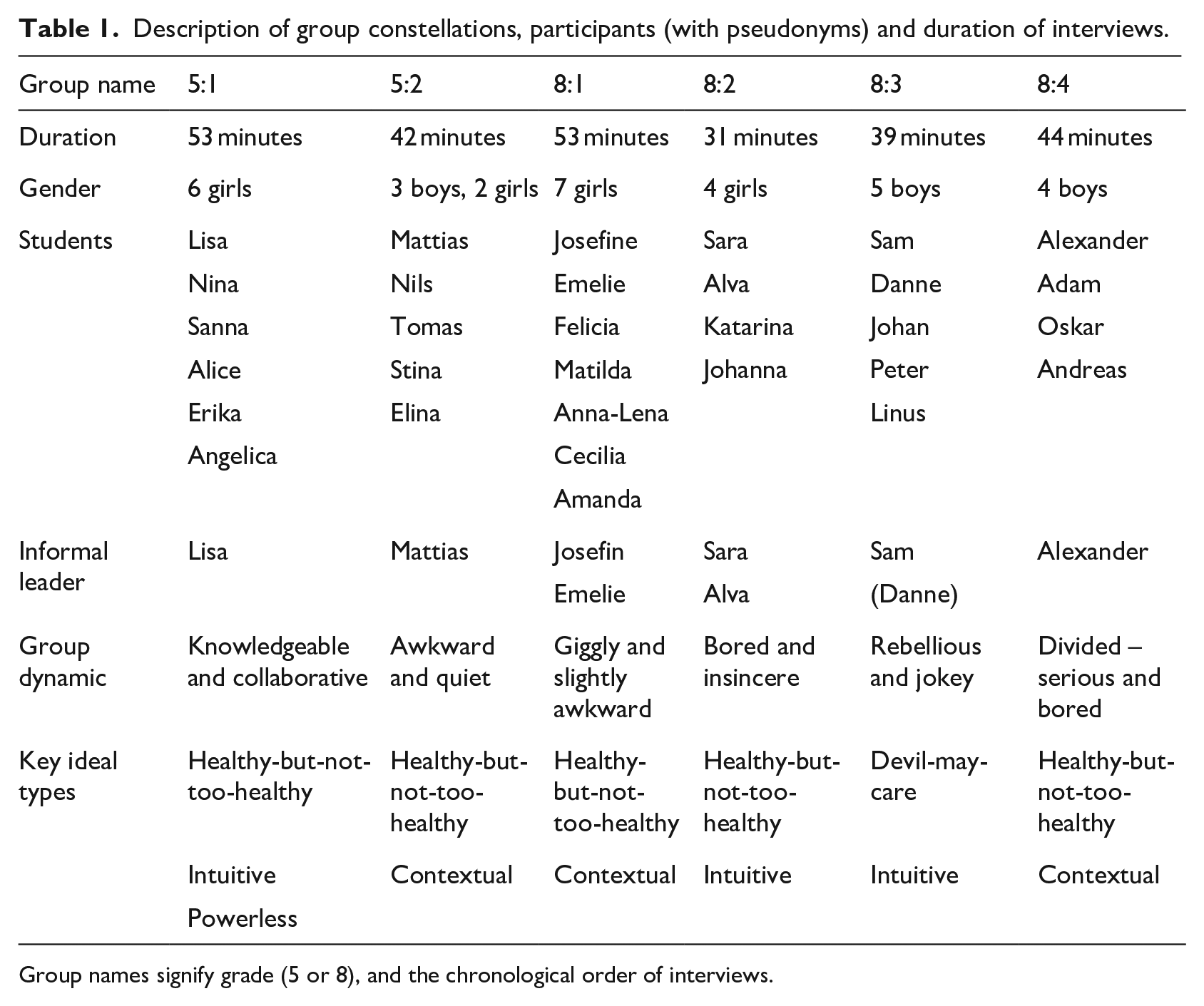
Group names signify grade (5 or 8), and the chronological order of interviews.
The interviews were conducted in the school library or in vacant classrooms and recorded using an mp3 recorder. The groups were comprised of four to seven students from either grade 5 or grade 8, and were named 5:1, 5:2, 8:1, and so on to reflect the grade and the chronological order of the interviews. All but one of the groups were gender homogeneous (see Table 1 for details), since a boy-only grade 5 group would have been too small and we strove to include all students who wished to participate. Because the interviews were conducted during Advent, the students were offered gingerbread snaps and fruit squash as recompense for participating in the study. We chose to offer sweet snacks to avoid giving the impression that potentially unhealthy foods were forbidden. A semi-structured group interview was deemed suitable for data collection because our target group was young people and the power imbalance between them and the interviewer might make them taciturn in a one-to-one setting. We also wished to hear how they reasoned together in relation to different types of eaters, rather than write down their answers or reply to questions in a way that might prevent their immediate reactions.
The interview guide was divided into two parts. The first part involved assembling food for an outing or a whole day for different kinds of people. In an attempt to engage participants’ visual and emotional thinking (Stewart et al., 2007), we used photographs of foods informed by the nutrition tables of the National Food Agency. Both raw ingredients and mixed products or whole meals were included (e.g. raw fish, bread and sushi). We chose foods and dishes that were readily available and commonly eaten in the area, both for home meals and for eating out with family or friends. Participants were also asked to draw slips of paper that had different types of people written on them. These types – boy/girl, popular/unpopular person, rich/poor person, healthy/unhealthy person and northerner/southerner – were deliberately dichotomous, stereotypical and provocative, to elicit an immediate response. They will henceforth be referred to as ‘stereotypes’ to separate them from the ideal types later described in our findings. For each stereotype, participants chose images of food that they thought such a person might eat and were asked to explain why.
In the second part of the interview, participants were invited to respond spontaneously to slips of paper containing words and phrases to do with food and health. These were taken from the chapter on food and health in their Home Economics textbook (Sjöholm et al., 2012) and included terms like vitamins, healthy and fibre, together with prescriptive health recommendations such as ‘eat fish three times a week’. During the first interview with group 5:1, the students seemed to view the questions as a test of their knowledge, which led the interviewer to modify the order of the questions and the way they were worded. Because of this, the first interview may be viewed as a pilot. Another problem that surfaced was that students had trouble thinking of foods that fitted the outing context, since some of them focused quite a lot on logistical constraints. Since we did not view the outing itself as particularly important but had only chosen it to mimic the lunch boxes of the English study (Stead et al., 2011), we changed the context to ‘food for a whole day’ for the final two groups.
The recordings were transcribed verbatim by the first author, including laughter, sighs, hesitation and tone. Notes on gestures and body language, written immediately after the interviews, were also added. The transcripts were read through by both authors and initial impressions were discussed, but our analysis encountered some obstacles, producing somewhat banal results. To counter this, we attempted to analyse the data using a discourse analysis method employed in a parallel study. This proved too time-consuming and produced too-detailed results. Finally, Braun and Clarke’s (2021) reflexive thematic analysis provided the tools to capture the latent content in young people’s responses and subtle social interactions at a higher level of abstraction. The very first of our new, more latent codes was ‘knowledgeable’, which crucially shifted our perspective. For example, during our earlier attempts to categorise a long passage where group 5:1 eagerly divided food items into healthy and unhealthy piles, we had viewed their discussion as a mere reflection of their opinions. In contrast, a thematic approach revealed that participants strove to promote and identify with an eater type who was knowledgeable but balanced in their approach. Their eagerness itself was relevant to the coding. Following this break-through, other aspects of latent content became obvious, such as rebelliousness and the promotion of freedom from rules.
Once the themes had been created, the transcripts were scanned for sites of especially significant social interaction. Since the participants all went to the same school and discussions focused on potentially sensitive but also engaging issues such as food and health, popularity, class, regional identity and gender, the participants may have avoided voicing deviant opinions and experiences (Hollander, 2004). Therefore, we paid special attention to conflicts, disjoints and informal leaders in the groups. The data were searched for differences in opinion and how these were handled. Here, a tool from conversation analysis, repair organisation, was applied in a ‘roughing the surface’ way (Ten Have, 2007) to find the source of trouble (disagreement) and identify whether participants corrected one another and whether they amended their views to match other participants’ views. Finally, we also paid attention to hesitant or awkward silences, the pronouns used in connection with different stereotypes, and laughter. Since the first author had worked as a high school teacher for several years, she used this experience to interpret group atmospheres and tone, but also to analyse what different types of laughter seemed to signify in different situations.
Based on our analysis, we created eight dimensions that we then used to construct eight ideal eater types (Figures 1 and 2). The names of the dimensions and eater types were created by the researchers, and we did not check these with participants since several years had passed since the interviews were conducted.
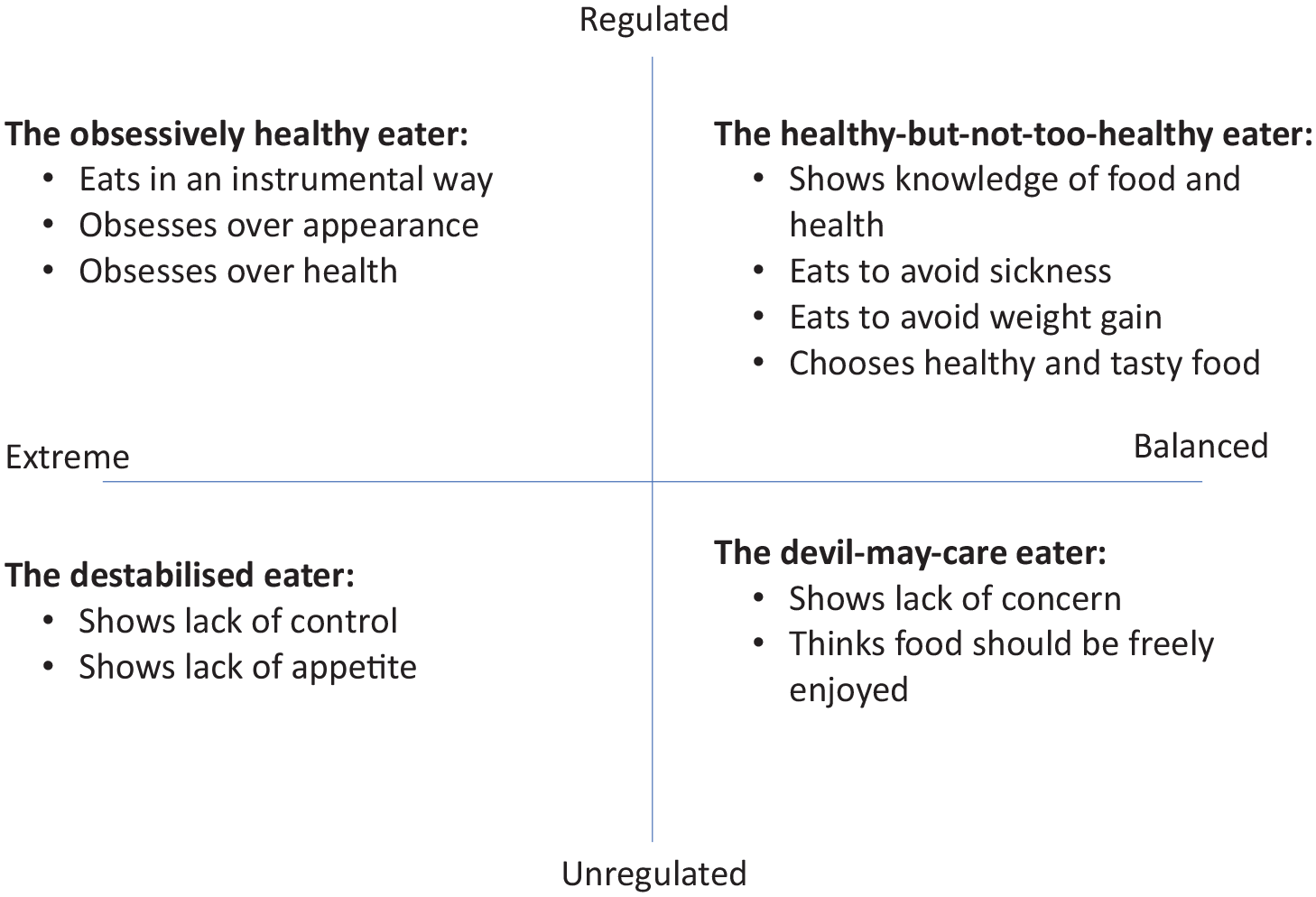
Aspects of regulation: how eaters eat in relation to health recommendations.
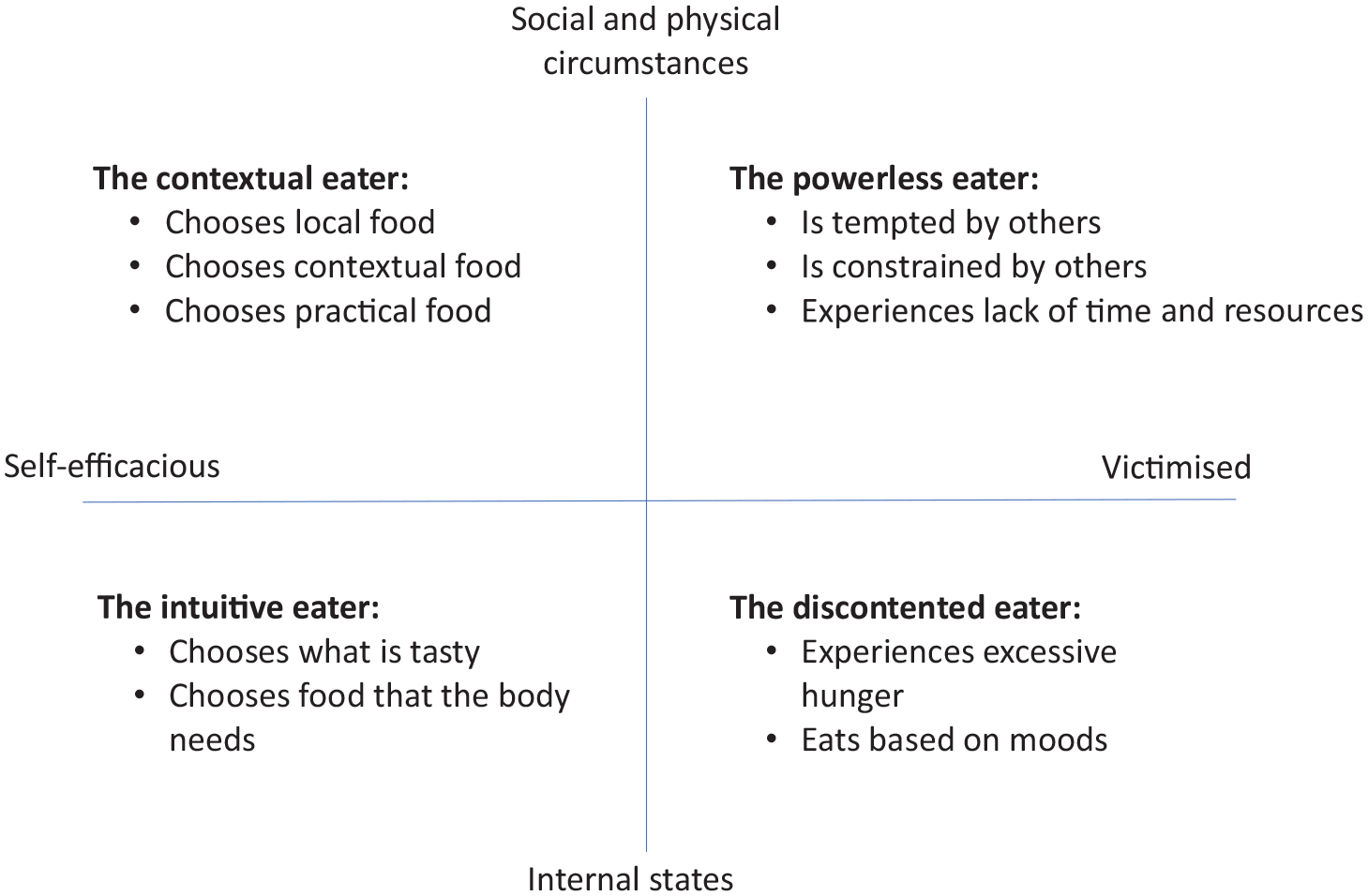
Aspects of context and individuality: why eaters eat like they do.
Findings
Each group developed its own ‘culture’, with participants striving to identify with one or a few shared, favoured ideal types and stereotypes that differed between groups. The ideal types presented below were constructed via two sets of dimensions that informed how people eat in relation to health recommendations (Figure 1), and their rationale for this (Figure 2). Figure 1 shows how an eater was positioned somewhere between regulated and unregulated and between balanced or extreme, forming four ideal types: the healthy-but-not-too-healthy eater (regulated but balanced), the obsessively healthy eater (extremely regulated), the devil-may-care eater (unregulated but balanced) and the destabilised eater (extremely unregulated). Figure 2 shows the reasons for eating like the ideal types in Figure 1. Here, eaters were positioned as being influenced by internal states or by outside forces or context, and as completely guided by these or rather self-efficacious. The four ideal types based on these dimensions became the contextual eater (self-efficacious and contextual), the powerless eater (completely guided or victimised by context), the intuitive eater (self-efficacious and driven by internal states) and the discontented eater (guided or victimised by internal states). In general, participants laughed a lot during discussions, especially when talking about unhealthy food or when the interviewer challenged their views on what was healthy and not.
Aspects of regulation: how eaters eat in relation to health recommendations
The healthy-but-not-too-healthy eater
This ideal type was regulated but balanced, and knowledge about food and health was valuable if it was used to prevent sickness and weight gain. Good food was both tasty and healthy, for example fruit and some vegetables. Students who promoted the healthy-but-not-too-healthy ideal type agreed with reducing sweet foods and snacks, but found it difficult and felt a need to, sometimes, include at least some unhealthy foods. However, they rejected the increased consumption of foods they did not like, for example beans and brown bread. They also did not want to eat fish too often or reduce their meat consumption. The dimension of balance meant that some unhealthy food was acceptable in an otherwise healthy diet, as illustrated in the following passage from group 8:4.
But can it be . . . do you think it can be healthy to eat such things [doughnuts] sometimes?
No. (Giggles)
No.
Once in a while doesn’t hurt.
Once in a while. Not very often, but a little?
Yeah, sort of. You need a little.
Here, Sara’s laughter seemed to indicate that she found the question about doughnuts strange, but it prompted her to bring up the importance of balance.
A different way of being a balanced eater was to compensate for unhealthy eating by exercising. This was a view particularly expressed by boys in groups 8:3 and 8:4.
The obsessively healthy eater
This ideal type was regulated and extreme, and none of the participants identified with it. Here, healthy people – often thin girls – were constructed as instrumental eaters who only chose healthy foods for health reasons. In the following excerpt, group 5:2 discussed the stereotype ‘girl’. Even though Stina indicated that this was a prompt that started her thinking, it was the boys who answered first and suggested different kinds of fruit. When the girls joined in, they suggested a salad.
What about this salad?
Mm, we’ll take this one.
Mm.
Mm, we have fruit and hard bread and salad. Why would a girl bring fruit [to an outing], do you think? (Laughs) You’re both girls and boys in this group, but . . .
Because girls, they’re more like obsessed with like how they look and stuff, and want to be like thin and stuff.
Here and elsewhere, girls used the word ‘they’ to talk about the girl stereotype. While this might indicate that they distanced themselves from an obsession with appearance and weight, we do not wish to make too much of it. Sometimes, other participants would also use the word ‘they’ when talking about potential in-groups, for example boy groups talking about the ‘boy’ stereotype.
The devil-may-care eater
This ideal type was unregulated but balanced, and it was characterised by a lack of concern about health matters. For the devil-may-care eater, food should be freely enjoyed rather than restricted. Boys, popular people, unhealthy people and northerners were stereotypes that were often tied to this ideal type. They ate what was tasty and/or easy to make, regardless of what was recommended or trendy. For Matilda in 8:2, thinking about nutrients was a chore.
How does it feel when you see it [the word vitamins]?
A drag . . . Nah, just kidding. (Laughs)
(Laughter)
Yeah, okay. A drag, in what way?
Mm . . . like . . . if you like thi . . . have to think about what vitamins to eat and all that stuff, then it’s just a hassle.
It was mainly members of group 8:3 that identified with the devil-may-care ideal type. During the interview, Peter even started reversing all the offered health recommendations to say the opposite – for example, if the slip of paper said ‘Eat less meat’, Peter would say ‘Eat more meat’, and was urged on by the laughter of his peers. Sam pointed out that they needed healthy food too, but that they did not care.
The destabilised eater
This ideal type was unregulated and extreme, either exhibiting a lack of control that made them eat large amounts of unhealthy food, or a lack of appetite that made them eat very little. None of the participants identified with it, but brought it up in relation to unhealthy, overweight or depressed people, who were sometimes conflated. While the devil-may-care eater could also eat unhealthily, this type still retained a balance that destabilised eaters did not. Sometimes specific foods were tied to unhealthy or overweight people, as in the following excerpt from group 5:2 where Mattias suggested strawberries and cream for a northerner’s outing.
Cream (giggles) and strawberries.
No, that’s . . .
What is it, then?
Yes, that’s what it is. Exactly.
That’s for, like, fatties. (Laughs)
Foods could even change meaning depending on who ate them: if a devil-may-care eater ate a sausage, it was tasty, but if a destabilised eater ate it, it was unhealthy.
Aspects of context and individuality: why eaters eat like they do
The contextual eater
This ideal type was self-efficacious but adaptable to the situation. Comfort and practical concerns influenced decisions, such that for an outing, coffee was good to fend off the cold and peaches were easy to eat on the go. At weekends, unhealthy food could be used to ‘celebrate your freedom’ (8:2). The type could also eat to fit in with a chosen group or because of convenience. When discussing the northern/southern stereotypes, wild berries, vegetables, milk and meat were mentioned because they were easily found in nature, home-grown, produced on local farms or found in the wild. But stereotypes based on geographic location were not always easily constructed. For example, group 5:2 had trouble seeing the difference between northerners and southerners, and only hesitantly cited convenience as a basis for northern and southern food habits. This response seemed prompted by the question rather than something they would have come up with spontaneously, and may have reflected the group members’ age: perhaps they did not have enough knowledge about the rest of the country to have an opinion.
This hesitant response contrasted greatly with the importance of the northern stereotype in group 8:3, where participants positioned themselves as part of it by mostly using the ‘we’ pronoun and mentioning the same foods for boys and northerners. Meat and home-cooked food were northern, while Asian, trendy and low-calorie foods were southern and feminine (cf. McPhail et al., 2012). The importance of the northern stereotype was highlighted when Danne said northerners ate Chinese food and Sam objected:
Not northerners!
Yes, they do.
No . . .
(Challenging) Oh?
No, that’s southerners.
After this brief argument, Danne spent the next 7.5 minutes connecting Chinese food to southerners, effeminate city dwellers and healthy people to repair the conflict and side with Sam.
[What does a southerner eat?]
Like, the opposite.
Sushi. Chinese food.
(. . .)
Where’s that Chinese food, then? Southerners eat lots of that.
There’s . . . spring rolls . . .
Yep!
Mm. Okay.
There’s more Chinese, too. Here’s some Chinese! . . .
City people are more effeminate.
Yes.
Yeah, exactly.
(Laughter)
And what does an effeminate person eat?
Vegetarian food.
Vegetarian food. Like, Chinese.
This was an especially clear example of how informal leaders influenced what views were expressed in the groups.
The powerless eater
This ideal type was guided by context in the form of norms, temptations or restrictions in their environment. For example, unhealthy eating habits could be related to lack of time or other resources, such that stressed-out city dwellers might buy ready-made food instead of cooking their own. Context could also be social in the form of norms and temptations. For example, several groups connected popularity to thinness. Someone who wanted to be popular, no matter their gender or weight, had either to lose weight or stay thin – members of group 5:2 even had trouble imagining an unpopular person who was thin.
Norms relating to healthy eating could also – paradoxically – be accompanied by temptation. For example, adults were a source of knowledge about food and health, and imposed limits on sugar intake because it was bad for your teeth. But they could also tempt children by buying and keeping sugary foods where they were visible. For example, Angelica and Nina in group 5:1 mentioned how parents bought soft drinks and kept them in the refrigerator even though their consumption was dissuaded. They also explicitly described what they saw as a double standard:
But sometimes it’s like . . . you get food, and there’s a lot of sugar in it, and you think it’s really good and then . . . ‘[I want] more!’ And like, and it’s really good, and then . . .
And then they tell you like . . .
Yeah . . .
You know, ‘you have to eat less sugar’, and there’s, well, a lot of sugar [in the food they were offered].
You understand me! (Puts a hand on Nina’s arm)
Angelica and Adam in group 8:4 even pointedly commented on the interviewers offering snacks as recompense for participating in the study.
The intuitive eater
This ideal type was self-efficacious and based their eating on internal states or traits, such as bodily needs or taste preferences. Consumption choices depended on who the person was, which meant this ideal type had room to manoeuvre according to their individual needs rather than merely reacting to contextual cues. For example, popular people could eat what they wanted because they were popular. They could also choose to eat very little because they were busy and wanted to do other things. Group 8:1 reasoned similarly for the unpopular person and concluded that food choice depended more on the individual than whether they were popular or not. Here, as in many other instances, taste was paramount.
What do you think? Do you eat differently depending on who you are?
Mm . . .
No, but well, it doesn’t have anything to do with whether you’re popular or not, it’s from person to person.
Mm, what you like.
A self-efficacious person sometimes chose food based on what their body needed, such as vitamins, carbohydrates and salt, but they did not pay any special attention to it. Rather it was an individual, perhaps unconscious, need that this type of individual satisfied through their food choices.
The discontented eater
This ideal type was guided by internal states such as excessive hunger or extreme moods. For the discontented eater, hunger was a bad thing that made them eat more than they needed. Depressive moods could also lead to comfort eating, as in the following excerpt where group 8:4 discussed unpopular people.
They’re probably not satisfied with themselves.
So, sweets, then.
(Affectedly) Or a sandwich for breakfast and tea.
(Laughter)
(. . .)
They’re . . . Probably they . . . they can comfort eat.
Yes. They eat sweets.
None of the participants identified with the discontented eater.
Discussion
Pleasure and rational responsibility
Participants in this study valued ideal types that did not overly regulate their eating, but intuitively ate what they liked and/or needed in a balanced way and were receptive to reasonable contextual cues, without being completely guided by them. If the preferred ideal types chose unhealthy food, they did do so from a position of self-efficacy and freedom rather than as victims of their own hunger or mood. Individual choice was held in high regard, but also a certain degree of responsibility.
Many study participants expressed genuine interest in following health recommendations but sought out a balance in which less healthy choices were acceptable as a complement, in certain contexts, on weekends, and when recommendations did not fit personal taste. This aligns with current ideals in health education rather than the historical focus on healthism (Crawford, 1980) that mirrors the all-or-nothing mind-set of the obsessively healthy eater. Nowadays, a more nuanced approach allows some space in the diet for foods considered less healthy, reflecting the healthy-but-not-too-healthy eater (cf. Quennerstedt et al., 2010). However, this balance was sometimes difficult to achieve. Temptations from others and from situational cues could influence decisions (the powerless eater), as could inner states such as hunger or bad moods (the discontented eater). When talking about this, some participants brought up their own fraught struggle for balance, contrasting this with the spontaneous and self-efficacious choices of the idealised intuitive eater.
This signals an age-old dilemma. When it comes to food and health, highly valued aspects of well-being such as pleasure may conflict with physical health goals (Jallinoja et al., 2010). It has been theorised that alongside the ideal of rational thought and self-discipline, Western society is increasingly influenced by the Romantic notions of happiness, self-fulfilment and the celebration of the individual (Lupton, 1996). According to Illeris (2003), everything young people encounter must be judged against an internal ruler and found relevant or not to their ‘me project’. The world expects young people to carve out their own fortunes, to take charge of their lives and to attain success and happiness on their own terms and by their own efforts, which creates pressure to perform. The ostensibly humanistic view on health as empowerment (Nutbeam, 2000) thus creates an expectation on young people to choose according to their own wishes, but this in itself can be difficult. After all, making food choices based on science requires applying a rational system of evaluation on something that is inherently emotional, social and symbolic (Fischler, 2011), illustrating the potential conflict between self-discipline and Romanticism.
Participants in this study dealt with this dilemma through rebelliousness, derision of out-groups, self-deprecating humour, guilty laughter, accounts of shared struggles and counter-arguments against health recommendations. This exemplifies how people often devalue their in-group compared with culturally dominant groups, and also how they construct out-groups as deviant eaters compared to the in-group (de Garine, 2001). Eating unhealthily, then, may be a source of shame, but also of pride and defiance. Since northern Sweden has a history of political and economic marginalisation and resistance against the dominant south, local food habits can signify independence. This is corroborated by findings from earlier research in the same northern Swedish context, where a strong preference for meat over vegetables was found (Bohm et al., 2015), and physical health was not deemed especially important (Bohm, 2016). Young Swedish people in general eat too few vegetables (boys even less than girls), the consumption of sugary drinks is higher in rural areas (Enghardt Barbieri et al., 2006), and in-group norms can perpetuate this problem.
In-group collectivity and shared individualism
Most of the groups in this study agreed that healthy food was necessary but sometimes difficult to choose, and the participants expressed shared guilt of failing to self-regulate. Self-regulation was a conscious choice not to gain weight or become ill, contrasting with external forms of regulation. This tension between the individual and the outer world was a recurring topic when participants talked about social and physical circumstances versus inner states. Balancing personal preference or needs and external cues was a fine line to tread, since self-efficaciously adapting to context was seen as positive while bowing to social norms in the form of trends or being forced to follow rules was negative. Different types of people had different degrees of freedom, such that some people could always choose food according to their personal tastes and needs, while others limited their choices because of bodily goals, social norms or lack of control over their lives. At first glance, this promotion of self-efficacy may be seen as a simple expression of individualism, negating the social function of food. Interestingly, though, positive instances of the freedom to choose were always tied to a social group. While unhealthy and depressed people could sometimes eat what they wanted, their ‘freedom’ was based on being unpopular or socially indifferent, as in the case of the destabilised and discontented eater. In contrast, the intuitive eater was sometimes described as popular, and could adapt to social and physical circumstances from a position of safety.
Even the members of the most rebellious group, 8:3, constructed themselves as part of a collective, namely, ‘northern boys’. Interactions revealed strong conformity to food norms, which meant they were rebellious as a group. Similarly, group 5:1 shared the goal to be healthy-but-not-too-healthy, but they also described the difficulties of actually following recommendations. Interestingly, these two groups differed in their demands on conformity: while 8:3 sought consensus on specific foods that were in-group defining for northern boys, 5:1 exhibited a kind of shared individuality where they compared their personal likes and dislikes to the group’s and confirmed each other’s uniqueness. Thus, even when there was a focus on individual choice, it was always constructed in relation to a group, be it a classed, gendered and geographically located group in society at large or the focus group created specifically for this study. Being individualistic, then, did not mean being lone wolves that ate what they wanted no matter what others said. Rather, it entailed striking a balance between indulging in personal tastes and whims on the one hand and adapting to the situation and a chosen group on the other.
This means that even though Western society has developed towards increasing individualism, food retains its social meanings in slightly new ways: even as eaters express individualism, they do so in relation to specific groups. Since peer importance increases in adolescence, young people’s views of food and health are shaped by interaction with friends as well as the family and the home. During this transformational period, health education in the form of Home Economics or other forms of school intervention is a potential arena both for conflict and compromise between these different influences and official health recommendations. Activating in-group norms can strengthen or weaken the willingness to adopt healthy eating habits, depending on what social group is valued and how that group’s approach to self-regulation is viewed (Oyserman et al., 2007). Therefore, prescriptively discussing health recommendations in Home Economics classes or any other health education context may strengthen existing tendencies towards the devil-may-care eater type, but also encourage obsessively healthy eater types. It may be possible to modify extreme views of the in-group by highlighting examples of healthy-but-not-too-healthy in-group eater types such as local profiles or celebrities.
However, the actual division into in-groups and out-groups is a constant even if group norms change over time, and some young people will continue to identify strongly with groups that are constructed as unhealthy. Perhaps another counter-measure might be to promote more of the shared individualism of 5:1, where the expression of individual taste is encouraged as an integral part of belonging to a group. Likewise, the tendency for young people to value balance could be harnessed in health education by highlighting how so-called healthy and unhealthy foods can be combined together. Unfortunately, a study in Home Economics shows that some teachers tend to promote nutrition in theory while bowing to cultural traditions in cooking, thereby creating a rift between physical and psychosocial health instead of promoting holistic factors for well-being (Bohm et al., 2023).
In future research, it might be interesting to study the intersection between geographical location, age and gender more closely, since the groups in this study showed such different reactions to the northerner/southerner dichotomy.
Strengths and limitations
The interviews in this study were based on provocative and leading questions to elicit strong reactions, but this did not always work as intended. The participants had trouble understanding some questions, and the prescriptive and dichotomous nature of the offered foods, concepts and stereotypes may sometimes have dissuaded them from expressing their own ideas. Letting participants construct their own stereotypes freely might have elicited different and richer results, but considering the taciturnity of many participants, perhaps too-open questions would have yielded less data. Because of the study design, it was also no surprise that participants constructed healthy food as a form of regulation, but this elicited interesting reactions in its own right, ranging from rebelliousness to more or less genuine acceptance depending on the group.
It might have been a better idea not to use the ‘outing’ context in any of the interviews, since this prompted context-aware answers. On the other hand, having contextuality emerge as such an important factor that eaters needed to handle can be seen as a strength of the study, since convenience and practical constraints might not otherwise have come up in the same way and the context-dependent eater types might not have been identified.
Throughout the whole analysis, codes, categories and themes were continually discussed and compared to refine and deepen the analysis. Such continuous discussion, together with the use of quotes that both illustrate the themes and categories and give voice to the respondents’ own experiences, helps to establish the credibility and trustworthiness of the findings (Elo et al., 2014).
Conclusion
Participants’ preferred ideal eater types did not overly regulate their eating, and intuitively ate what they liked and/or needed in a balanced way. Current trends in health education favour such a nuanced approach, but study participants also saw the sought-after balance as difficult to live up to. Both inner states such as hunger or moods and external factors in the form of social and physical circumstances could upset the balance. Even for self-efficacious eaters, individual choice was based not only on personal needs and tastes but also on context and valued social groups. Thus, even though Western society has developed towards increasing individualism, food retains its social meanings, even though the nature of those meanings may change. Ultimately, young people’s views of whether and how to eat healthily remain shaped both by personal preference and by the social groups they strive to belong to. Perhaps one way forward for health education is to promote a shared individualism, in which personal taste is encouraged alongside adherence to group norms. Here, finding impactful in-group role models is crucial. It is also essential to focus on how both healthy and unhealthy foods can find a place in a balanced diet.
Footnotes
Acknowledgements
The authors wish to thank participants for sharing their time and thoughts. They also thank Agneta Hörnell and Gun Åbacka for valuable input during the initial analysis phase of work.
Funding
The author(s) received no financial support for the research, authorship and/or publication of this article.
