




Abstract
Objectives:
In early 2021, Western Sydney school principals expressed heightened concern about rising e-cigarette usage among high school students. This prompted us to assess knowledge, attitudes and perceptions surrounding adolescent vaping in students, school staff and parents, and their preferred strategies to effectively communicate prevention messages.
Design:
Exploratory qualitative study.
Setting:
Participants included students (aged 12–16 years), school staff and parents from government high schools in Greater Western Sydney, Australia.
Methods:
We held research workshops with 162 students, 133 school staff and 29 parents across seven schools. We used interactive activities which included individual written responses, small-group brainstorming and open group discussions. Data analysis was undertaken by two researchers using Framework Analysis.
Results:
Findings demonstrated differing perceptions among students, staff and parents regarding reasons why adolescents vape. Although common motives emerged, such as the perception that vaping differs from smoking, social normalisation, peer pressure and mental health considerations, there were important differences in emphasis. Students were concerned about dependency and vaping to cope, staff were concerned about the impact of vaping on students’ learning and behaviour, and parents were concerned about being ill-equipped to support their children. Strategies to tackle vaping also differed, with an emphasis on education and engagement over surveillance and consequences.
Conclusion:
Adolescent vaping is a pressing concern within Australian school communities, necessitating a comprehensive, holistic approach supported by strong partnerships between the health and education sectors. Addressing this issue effectively demands heightened education and engagement among students, staff and parents.
Background
E-cigarettes (‘vapes’) are battery-powered devices that heat e-liquids to produce an aerosol which is inhaled by the user (Munsif et al., 2020). Vaping is the act of inhaling this aerosol. Originally designed as smoking cessation tools for adults, disposable e-cigarettes have gained popularity among young people (Hammond et al., 2020; Watts et al., 2022). A recent national survey of current smoking and vaping patterns in Australia revealed the percentage of adolescents aged 14–17 years who have used a vaping product during the last month (current vaper) increased from 0.8% in 2018 to 14.5% in 2023 (Wakefield et al., 2023). This increase in adolescent vaping raises two major public health concerns (among others). First, nicotine use during adolescence has detrimental effects on brain development, impacting areas related to attention, learning, mood, and susceptibility to addiction (US Department of Health and Human Services, 2016). And second, vaping may actually increase the risk of the initiation of tobacco smoking (Banks et al., 2022).
Research findings from secondary schools internationally highlight a significant rise in student vaping over the last decade (Creamer et al., 2020; Jongenelis and Robinson, 2023; NHS Digital, 2022). The school environment can influence the establishment of adolescent health behaviours, including exposure to and the uptake of vaping (Bonell et al., 2013; Ennett et al., 2010; Lippert, 2018). Studies from the USA reveal that witnessing vaping on school grounds doubles the odds of students’ susceptibility to try and ever-use e-cigarettes (Mantey et al., 2021). That is, the mere presence of vaping in schools contributes to the normalisation of vaping and fosters an environment conducive to the uptake of harmful health behaviours (Jackson et al., 2020).
Schools have traditionally been used to deliver tobacco prevention programmes as they provide access to a significant proportion of the adolescent population and have proven effective in reducing adolescents’ intentions to initiate tobacco smoking (Guerin and White, 2020; Liu et al., 2020; Thomas et al., 2015). Prevention curricula delivered in classroom or group settings support students to make informed decisions around tobacco use, develop refusal skills, and gain a sense of collective confidence as they learn alongside their peers (Burke et al., 2009; Liu et al., 2020). Although schools are now compelled to urgently develop interventions targeting adolescent vaping, scant evidence of effective e-cigarette prevention programmes exists from an Australian context (Jongenelis and Robinson, 2023; Thomas et al., 2013). Following the principles of health promotion stated in the Ottawa Charter, it is vital that communities are involved in setting their own priorities, decision making, and the development and implementation of strategies to optimise health outcomes and reduce inequities (World Health Organization, 2024). Therefore, prior to the development of a local intervention to address adolescent vaping, we initiated this study to understand the knowledge, attitudes and behaviours surrounding vaping in the school community.
A recent systematic review of 25 studies from the USA, UK and Canada found that adolescents generally viewed vaping as a safer alternative to smoking, though their views on potential health harms were inconsistent (Sharma et al., 2021). These perceptions were influenced by adolescents’ exposure to e-cigarette marketing, advertising and social networks. Several recent studies contribute to understanding the Australian context, which is essential for developing appropriate, effective and targeted prevention messaging. Generation Vape used cross-sectional survey methods to understand the experiences and perceptions of vaping among young Australians aged 14–24 years, parents, and school staff in NSW (Watts et al., 2022). Watts et al. have shown that disposable e-cigarettes containing nicotine are desirable and highly accessible to young Australians; the authors advocate for the enforcement of strengthened federal and state tobacco control policies to address this issue. Two online surveys have focused on the experiences of staff in Australian primary and secondary schools (Jongenelis and Robinson, 2023; Pettigrew et al., 2022). In both studies, staff reported vaping to be an increasingly prevalent problem in the school environment, concern for the impact of vaping on student well-being, and a lack of supportive policies and educational programmes to address the issue. One online survey of Australian parents found parents generally supported the implementation of a wide range of policies to restrict adolescents’ access to e-cigarettes and exposure to marketing (Measey et al., 2022). These survey studies provide insights into the perceptions and experiences of parents or students or teachers across the country. Our study, initiated in 2022, adds to this conversation by generating rich qualitative insights into specific school communities’ experiences of vaping and what they need to address vaping in their schools.
The study was conducted in Greater Western Sydney (GWS), a rapidly growing and culturally diverse metropolitan region. GWS is characterised by a high proportion of Indigenous Australians, newly settled migrants and those who speak a language other than English at home. Furthermore, the region has a higher proportion of low-income families, unemployment, and students who do not complete high school compared to the rest of Sydney (Australian Bureau of Statistics, 2021). To address the specific needs of this community, we used an action research approach, which positions community members as ‘experts’ in the discussion of the issues affecting them and the identification of strategies to improve health outcomes (de Brún et al., 2016). By adopting a qualitative school community-wide approach, our study allowed us to explore each school’s culture, and their shared sociodemographic and geographic context. This study aimed to (1) explore the knowledge, attitudes and experiences of vaping in students, school staff and parents and (2) identify strategies to effectively convey e-cigarette prevention messages to adolescents.
Methods
Study context
The study was conducted between May and November 2022 in seven government high schools in GWS.
Study design and recruitment
We initially recruited five schools with whom we have long-standing connections through the facilitation of health-promoting peer-education initiatives. An additional two schools were recruited subsequent to the presentation of our work at a school principals’ conference.
Schools had autonomy to recruit the students, staff and parents. Some schools invited all staff while others opted for specific groups. For student participants, we asked schools to select a single year-group class of about 25 students. For parent participants, we asked schools to broadly advertise the study through newsletters or parents and citizens’ association committees. 1
We conducted the study in seven high schools and held research workshops with students, school staff and parents in each of the schools. The student and staff workshops were held face-to-face, while the parent workshops were held over Zoom for their convenience. There was no demographic information collected from any individual participant.
Research activities
Research workshops were facilitated by the research team using interactive activities informed by principles of action research and our long-standing experience in schools (Shah et al., 2011, 2017; Shrewsbury et al., 2020). Separate research workshops were held in each school for students and staff. At the beginning of the student workshop, we asked participants to complete three individual activities to understand their initial perceptions of vaping in comparison to the literature. They produced individual written responses captured on Post-it notes providing the percentage of students in the school who believe vape; whether they agreed or disagreed with the statement ‘Vaping is safer than smoking?’; and the reasons they think students vape. These activities encouraged individuals to engage and focus their thinking on the topic at hand. This was particularly important for student engagement, as all students could be involved without having to speak in front of everyone, ensuring a safe and inclusive space. Participants then formed into four small groups to discuss specific questions related to e-cigarette knowledge, attitudes, behaviours, and prevention strategies (see online supplemental file 1).
Each group documented their answers on A3 sheets of paper and verbally presented their answers back to the whole group, with the facilitator encouraging group discussion. The whole group discussion was captured by note-takers, including some verbatim quotes. For ethical reasons and in order to maintain the anonymity of participants, discussions were not audio recorded. Workshops with school staff were run in the same way. Parent workshops were adapted to take place online. Parent responses were documented using the Zoom chat and ‘whiteboard’ features. While each workshop addressed the same general issues, some questions were adapted to reflect the group’s interests and context.
The study received ethics approval from the University of Sydney Human Research Ethics Committee (approval number: 2021/527) and the NSW Department of Education (SERAP approval number: 2021/271). Approval by the University of Sydney Human Research Ethics Committee allowed opt-out consent by students on the grounds that such processes encourage a broader range of participation and reduce non-participation bias (Tigges, 2003). This was vital for ensuring a diversity of student perspectives. In addition to an information letter sent to parents, at the beginning of each research workshop, students were also reminded they were able to cease participation at any time and partake in alternative learning arrangements. We obtained formal consent from school staff and parents, who were required to sign a consent form included with their participant information statement. They were reminded at the beginning of each research workshop that they could withdraw at any time. At no point in the study were participants asked to disclose individual behaviours.
Data analysis
The qualitative data reflected students, staff and parents talking about their beliefs and perceptions regarding student vaping; some participants also shared experiences of their own e-cigarette use. We used Framework Analysis as it is a well-established, systematic, transparent approach known for its practical orientation (Ritchie and Spencer, 2002). We followed the Framework Analysis approach as outlined in Goldsmith and Parkinson et al.’s qualitative studies (Goldsmith, 2021; Parkinson et al., 2016). This process involved five steps.
Steps 1 and 2: Familiarisation and framework development
Beginning with staff data, CL and JMS familiarised themselves with the data by making notes of key ideas and insights relevant to the research question. Then, they developed an analytic framework to organise the data for later analysis (see online supplemental file 2). The framework resembled ‘a tree with many branches’ comprised of higher-level categories reflecting predetermined areas of interest and lower-order specific categories that emerged from the data (Goldsmith, 2021).
Step 3: Indexing
Each category was given a numerical code, and CL ‘indexed’ all the data by assigning these codes to each piece of data. The dataset comprised participant-produced summaries of small-group discussions, research-team-produced contemporaneous notes (with some verbatim quotes) of whole group discussion, and individual participant responses.
Step 4: Charting
CL then ‘charted’ the data. This involved summarising all the data indexed with a specific numerical code into an Excel spreadsheet, with JMS reviewing. The unit of analysis was the school. Each school’s data was summarised across one row in the Excel spreadsheet, with each cell holding the data for each category within the framework. This same process was repeated for the student and parent data, although minor adjustments were made to specific sub-categories of the framework for each group.
Step 5: Mapping and interpretation
After all the data was charted, CL and JMS began the ‘mapping’ and ‘interpretation’ phases of the work, which shifted the focus to understanding the data as a whole, looking for similarities and variations within and across schools and groups (students, teachers and parents). To ensure analysis quality, the whole research team reviewed the proposed frameworks and the analysis. This allowed us to ensure the analysis resonated with their experience of collecting the data and the research questions that drove the project. In the analysis below, we provide data excerpts to illustrate an analytic point. These are rarely verbatim quotes; most of our dataset comprises single words, short phrases or summaries of discussions.
Findings
We engaged a total of 162 students aged 12–16 years, 133 school staff (from administration to teaching staff) and 29 parents. The following are ideas and insights based on the Framework Analysis.
Perceptions of use
Even the good kids are trying (it) and it’s not just the typical kids who you would expect to smoke (from a teacher discussion)
Students, staff and parents described vaping as ubiquitous, with e-cigarettes perceived as highly accessible to young people through friends, family, retailers and dealers. Participants’ individual written responses indicated that students, staff and parents generally perceived that between 25–50% of students at their school vape.
Perceptions of harm
There was consensus across the groups that e-cigarettes were harmful and contained a myriad of dangerous substances including household chemicals and nicotine. Individual written responses revealed that more than half of students and staff disagreed with the statement ‘vaping is safer for young people compared to smoking’. Interestingly, most parents disagreed, making them the least likely to endorse this statement.
Perceptions of legality
In discussions, the groups appeared confident that it was illegal to sell e-cigarettes containing nicotine to people aged under 18 years, although they were unsure of the specific laws and the legal repercussions of adolescent vaping. There was a strong perception that current laws are only loosely enforced and frequently breached. All groups wanted to know why, if they are illegal, e-cigarettes are so highly accessible in Australia.
Accessing information
All groups described accessing information about e-cigarettes through similar avenues: media, reputable health sources and social networks. Students also reported accessing information about e-cigarettes through less reliable sources such as personal experiences and retailers. Staff and parents identified students as one of their primary sources for information about e-cigarettes regarding where students are accessing them, what they are, what they contain and what is happening at school.
Information needs
Participants wanted more general information about regarding their contents, harms, laws and regulations and the appropriate consequences for adolescent vaping. There were important variations in the specific information each group sought: students wanted to understand how e-cigarettes work and why they are so addictive, while staff wanted practical information related to effective educational and disciplinary strategies to manage student vaping. Parents wanted to know everything about e-cigarettes, such as their chemical contents, short and long-term harms, strategies for discussing vaping with their children, and what the government was doing to address the issue. Parents reported a strong sense of feeling ‘ambushed’ by the issue of vaping and the potential threats it posed to the health and well-being of their children. Parents did not know what information was available to them, often relying on their children, and so they felt disempowered when talking about vaping.
Explaining why young people vape
Figure 1 represents the categorised individual responses for why participants thought young people vape. Students, staff and parents offered similar reasons, including being influenced by the social normalisation of vaping as ‘cool’, peer pressure, the appealing product features of e-cigarettes, and a lack of understanding about the harms of vaping. However, there were important differences in the distribution of reasons across the three groups.
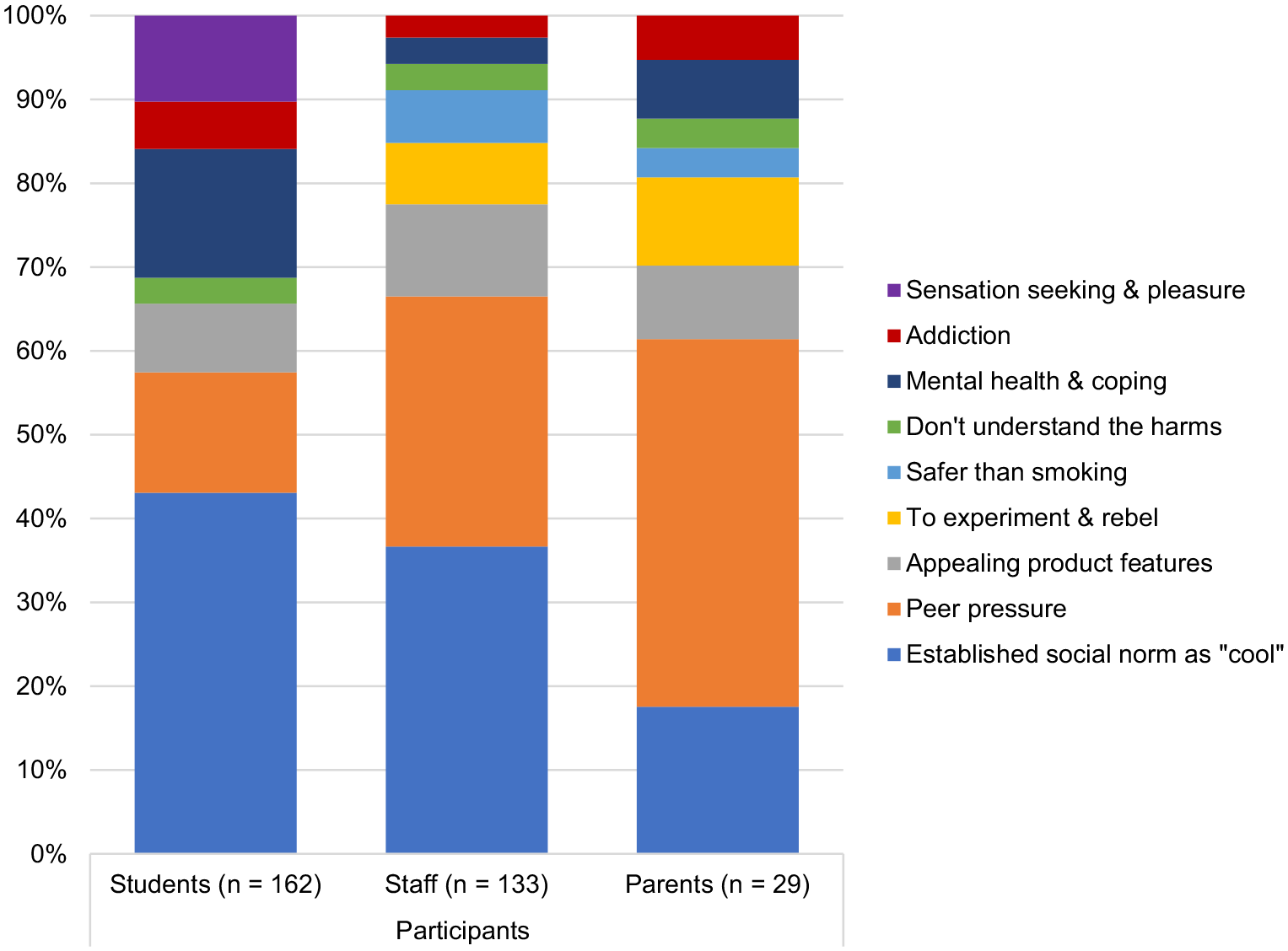
Participants’ responses to the question ‘In your opinion, what is the main reason that adolescents vape?’
Taking these individual written responses together (Figure 1), the proportion citing a social influence dimension was very similar across each group. However, students were more likely to cite social norms (being influenced because you want to be seen in a particular way) and parents were more likely to cite peer pressure (a pressure to conform). A slightly different picture emerged from the small group brainstorming and large group discussion: all groups perceived that young people might vape because it has become socially normalised within youth culture, appearing to be everywhere and without stigma. Vaping was seen to be influenced by peers, social media, family, celebrities and role models. In the student discussions, as well as vaping to ‘fit in’, students talked about vaping to ‘stand out’ from their peers and gain social currency as popular or rebellious. In the individual written responses and in the group data, students did not often explicitly attribute adolescent vaping to peer pressure. However, when students were specifically asked how they would feel about refusing an e-cigarette from their peers, their responses reflected an overt sense of peer pressure and lack of confidence to refuse. They felt young people might experience feelings of anxiety or shame if they had to refuse an e-cigarette from their friends.
Figure 1 shows students were much more likely than staff or parents to cite mental health and coping, or sensation seeking and pleasure as a reason for use. Mental health emerged as a major theme in the student discussions; they talked about vaping as ‘numbing – takes the pain away’, distraction, anxiety and stress. Students also described their peers as potentially vaping as a ‘social crutch’ or to cope with family problems and poor self-esteem. Mental health was only briefly touched on in staff and parent discussions, usually as a perceived negative consequence of vaping.
Parents and staff were much more likely to report young people vaped because they perceived vaping to be safer than smoking (Figure 1). In group discussions, staff and parents talked in detail about the differences between vapes and combustible cigarettes and how this difference partly explained young people vaping. They believed young people saw e-cigarettes as cleaner, cheaper, better and healthier. One parent said, ‘Teenagers believe it is not as harmful as cigarettes’. This comparison to smoking was simply not a touchpoint for students. Talk was narrower, on vaping as an alternative to smoking. Some talked about it being safer, and others as being just as harmful as combustible cigarettes. But, the detailed discussions that were present in parent and staff data were absent.
Concerns about young people vaping
In small group brainstorming and whole group discussions, students, staff and parents broadly expressed concern for the health and well-being-related harms of vaping and its far-reaching implications for the school environment, other students and family relationships. Students described an expanse of serious health harms such as cancer and death, but they spoke about these harms occurring at a distant event horizon. More immediate, pressing concerns for students related to the misuse, dependency, and the possible gateway effect of vaping, including concerns about starting to use other substances. Echoing their beliefs that vaping could be driven by mental health and coping, students were concerned that they could become dependent on vaping as an unhealthy coping mechanism and consequently ‘lose yourself to addiction’ as noted by a student.
Staff expressed concern for the impact of vaping on students’ physical and mental health, but their primary concern was related to students’ learning, education and behaviour. Staff believed that students viewed e-cigarette-related harms with a sense of nonchalance and impunity towards the potential consequences of their use. While students recognised the harmful nature of e-cigarettes, staff worried that the seriousness of these harms and current prevention messaging did not resonate with students. One staff member explained that the ‘health effects seem like ghost stories’ to students. Staff talked about the physiological impact of vaping and its management in the school environment as causing students to become aggressive and entitled, particularly if their e-cigarette was confiscated. Moreover, they worried about the unintended consequences of their management of vaping in the school environment. For example, close monitoring of school toilets/bathrooms could mean that other students felt too uncomfortable to use these amenities.
Parents also mentioned health concerns, but they were primarily concerned about vaping interfering with their capacity to genuinely engage their children. They felt the discreet nature of e-cigarettes made it difficult to initiate open and honest conversations with their children. It became apparent in the data that parents did not feel equipped with adequate information to lead conversations about e-cigarettes with their children. Like staff, parents believed that students do not take the harms of vaping seriously, which they attributed to the rebellious and risk-taking nature of adolescence, as they saw it. Parents also described a sense of frustration regarding government inaction at the local and national levels to prevent vaping. They felt there had been limited efforts to raise awareness and educate the community.
School responses to vaping
In small-group brainstorming and whole-group discussions, participants described how they perceived vaping in their school. Students generally described vaping as a divisive issue affecting all year-groups. They viewed vaping as either harmful and unappealing, or cool and trendy. In response to the issue, staff described schools as having taken a range of actions with mixed success. Interventions mentioned included conversations with shock value, installation of vape detectors, closure of toilets and bathrooms and traditional disciplinary actions like suspension and contacting parents. While such actions were noted by some as being effective in the short term, staff felt it was difficult to determine their real impact and that students have responded by becoming more discreet with their vaping. Students even challenged the effectiveness of schools’ responses to vaping, stating that ‘suspension doesn’t work. It just gives them more time to do it’ and ‘what if parents don’t care?’. Parents were often unaware of how their school was addressing vaping among students; those who were aware were appreciative of their school’s transparency on the issue and the enforcement of firm consequences.
Recommended strategies to prevent vaping
Students, staff and parents suggested a range of strategies to address vaping in schools. We would broadly categorise these as either increased education and engagement, or consequence and surveillance. All groups generally wanted greater education and engagement among all members of the school community. Participants said students required further education using a variety of learning approaches including consistent messaging around the school environment, group discussions, workshops, interactive activities, guest speakers, peer-led initiatives and social media campaigns. Staff, students and parents endorsed clear, targeted messaging delivered through a variety of media like advertisements, music and posters. Students suggested that prevention messaging should communicate the physical harms of vaping, the legal consequences, the benefits of non-use and aim to de-normalise vaping. Young people were seen to play a key role as ‘trendsetters’ in a necessary cultural shift. One student explained that they would like to see prevention messages as ‘not coming from teachers but coming from students and from young people who have had real-world effects’.
At the broader school level, staff advocated strongly for clear strategies to reduce vaping with follow-up action, policies from the State Department of Education which support these strategies, education for staff and parents, and external cessation support for students.
To a lesser extent, all groups talked about greater surveillance and consequences for vaping. Student discussions generated more extreme interventions such as the implementation of bag and body searches and increased staff monitoring of bathrooms. When further prompted, students noted that such actions were likely an invasion of privacy which they would not like. Staff and parents also talked about the installation of vape detectors and more consistent, genuine consequences for students caught vaping such as the involvement of local authorities.
Discussion
This study provides rich, qualitative insights into perceptions of adolescent vaping among students, staff and parents in Australian high schools in a specific socio-economic context, and what is required to address vaping at the school level. The findings underscore that adolescent vaping is an urgent, pervasive concern that significantly impacts entire school communities. In Australia, it is illegal to sell or purchase e-cigarette products containing nicotine without a medical prescription (Department of Health and Aged Care, 2023). Despite this, our study revealed that participants perceived vaping to be widely prevalent across all year-groups and easily accessible to students with comparatively poor enforcement of existing safeguards. Participants’ perceived prevalence of vaping, ranging from 25-50% of students, well-exceeded recent population estimates of 14.5%. Adolescents’ tendency to overestimate the prevalence of smoking among their peers is well-documented, leading to an increased risk of smoking as they desire to conform with their peers (Sussman et al., 1988; Unger and Rohrbach, 2002). Overestimates of smoking prevalence among adolescents are often informed by the observation of close friends’ smoking behaviours, accessibility to cigarettes, and the prevalence of smoking within the media and school environment (Unger and Rohrbach, 2002). To address social norms around adolescent vaping, it is crucial to utilise prevention strategies which correct students’ inflated perceptions of vaping and create a school environment supportive of not vaping.
We saw important differences in how students, staff and parents experienced and understood adolescent vaping. During the group discussions, all participants stated that young people might vape due to social normalisation and peer pressure because ‘it’s not like smoking’, and mental health issues. All groups recognised that students vape because of its social normalisation and the peer pressure to fit in. Rather than describing an explicit sense of peer pressure to vape, students described a lack of confidence to refuse e-cigarettes offered to them by peers. Students held a nuanced understanding of how vaping could be used to both fit in with, and to stand out from their peers. This highlights the importance of implementing interventions which utilise comprehensive or social influence approaches to empower students with the social competence, resilience, and life skills to overcome social pressures to use tobacco products (Cuijpers, 2002; Thomas et al., 2013).
Our findings related to young people vaping because ‘it’s not like smoking’ have implications for how education needs to target parents, staff and students. When our focus was on what the participants themselves believed (individual written responses), more than half of parents and staff indicated that they themselves disagreed with the statement ‘vaping is safer than smoking’. When the focus shifted to what they thought young people believed (group discussions), they thought young people did believe it was safer and that this shaped their vaping behaviour. The detailed talk about the comparison with smoking was clearly an important touchpoint for staff and parents. The literature offers some support: a recent systematic review found that adolescents generally viewed vaping as a safer alternative to smoking (Sharma et al., 2021). In contrast to what parents and staff believed about them, young people (in their written responses) also tended to disagree that vaping was safer than smoking. Further, when they discussed reasons why young people might vape, they mentioned vaping as an alternative to smoking, and there was some talk about its relative safety, but we did not see detailed comparison talk in the young people’s discussions.
What does it mean that adults think the comparative safety of vaping versus smoking is a salient concern for young people, but young people seem not to do so? Qualitative research (Hughes et al., 2021) with 36 young people of a similar age to our sample offers some insights. Their participants viewed smoking and vaping as part of ‘a complex array of practices’ including other drugs and transgressive behaviours. Vaping and smoking were not necessarily ‘closely associated’ leading the authors to challenge the idea that young people understand vaping in relation to smoking. Our findings offer support for this.
The reason to talk with young people about the safety of smoking versus vaping is a concern that we need to address a misperception that is shaping their choices. Our findings and those of Hughes et al. show the comparison may be not salient in young people’s decision making. By raising the comparison with smoking, education reinserts smoking in young people’s worlds and implies they are choosing between the two as if it is a fixed, binary choice. This assumption is not borne out by our research, although we would advocate for further research. In a systematic review of global evidence on the health outcomes of vaping, Banks et al. posit that the comparison of vaping as safer than smoking is only pertinent among adult smokers – we understand this to mean that the choice between two activities is relevant; the central point is that vaping is harmful to adolescent non-smokers (Banks et al., 2022). Vaping education for young people would do better to decentre smoking and address the factors that influence young people to vape, its harms, and building individual resilience (Liu et al., 2020). Given the perception of adults in our data, education targeting parents and teachers should support them in talking with young people about vaping beyond comparison to smoking.
What young people did foreground was vaping to cope with an array of mental health issues. Where staff and parents only briefly recognised that students might vape to cope with stress or anxiety. Our findings suggest that young people urgently require additional upstream and downstream supports which prevent the development of mental health challenges and promote health and well-being.
All participants expressed concerns about the health and well-being-related harms of vaping in young people, albeit through varied perspectives which were reflective of their role in the lives of students. While previous studies have shown adolescents to view vaping with mixed harm perceptions, our findings demonstrated that students recognised the serious adverse effects of vaping (Sharma et al., 2021). Students also expressed significant caution around the misuse, addictiveness and gateway effect of vaping.This observed awareness among students may stem from their exposure to schools’ individual efforts to address vaping and a New South Wales state campaign (‘Do you know what you’re vaping?’) launched in early 2022 (NSW Health, 2023). In comparison, staff and parents expressed concern for the broader harms which affected students in the short and long term.Beyond this, staff were primarily concerned about the added burden of vaping on schools’ pre-existing responsibilities and its impact on the behavioural management, learning and safety of students. Previous surveys of Australian school staff have similarly identified vaping as an urgent priority and threat to the school environment (Jongenelis and Robinson, 2023; Pettigrew et al., 2022). Parents talked about concerns regarding their capacity to engage their children in informed conversations about vaping and address their complacency towards potential harms. Including parents within prevention efforts is vital for shifting favourable attitudes towards vaping that parents might hold, and to empowering them to reinforce prevention messaging delivered in schools (Brown et al., 2020).
Participants suggested several strategies to prevent and mitigate student vaping. First, there needs to be greater education which addresses the unique needs of students, staff and parents. Staff strongly recognised the engagement of the whole school community – including parents – as crucial to the reinforcement of prevention messages delivered to students. Previous reviews of preventive health education programmes have endorsed a holistic, multi-modal approach which involves staff, parents and the broader community to effectively address adolescent substance use (Liu et al., 2020; Tobler, 1986). Moreover, staff specified that a whole-school approach necessitates the development of a comprehensive strategy to address student vaping; policies from the state Department of Education which support this strategy; andexternal cessation support for students. These findings are consistent with previous surveys of Australian school staff which championed the urgent implementation of robust policies at the school and government level to address student vaping (Jongenelis and Robinson, 2023; Pettigrew et al., 2022). Second, participants recognised that students require education through a variety of approaches beyond teacher-led classroom lessons. The focus of education should extend beyond the content of what students learn to also include how they learn through alternative methods like group discussion and peer-led initiatives. Effective school-based tobacco prevention programmes have been similarly identified as including components such as social influence models, interactive activities, normative education, pledges, refusal skills practice, and peer leaders (Flay, 2009). Third, the content of prevention messaging for adolescents needs to be clear, targeted and delivered through a variety of channels like social media, school-wide campaigns and role models to whom students relate. Participants also strongly emphasised that e-cigarette prevention messaging should centre youth voice, coming from students and young people themselves. However, in recognition of the ethically complex nature of managing adolescent vaping in schools, it is not advised that such insights are uncritically adopted. For example, while students may endorse prevention messaging which communicates the extreme physical harms of vaping, there is limited evidence for the effectiveness of fear-based messaging in substance use prevention (Esrick et al., 2019; Stalgaitis et al., 2023).
Using pragmatic and flexible methods which engage the whole school community is necessary to address the community-wide problem of vaping. Our study did not identify notable major differences across schools, but we have described important differences between students, school staff and parents. Understanding these differences across groups is crucial for the development of relevant, targeted education and prevention messaging within the school community. This is a strength of our study: listening to either students, staff or parents alone would have missed these important nuances. For example, students’ perceptions of how mental health problems contribute to vaping, school staff’s concern for the impact of vaping on student learning and behaviour, and parents feeling ill-equipped to support their children.
Generating relevant and contextualised knowledge is key to developing relevant programmes, interventions and activities in partnership with school communities. As one unintended consequence of our investigation, several schools were inspired to take on their own actions to prevent vaping following their participation in the study. For example, one school modified their teaching and learning programmes to deliver targeted prevention curricula earlier to junior students and another school initiated a ‘vaping amnesty’ initiative where students could ‘give up’ their e-cigarettes to school staff without any negative consequences.
While parents made a valuable contribution to the study, they proved difficult to recruit. Those who participated in workshop sessions often expressed personal concerns for the impact vaping had had on their children at school. That is, our sample reflected the views of ‘concerned’ parents. Future research should examine more innovative ways to engage with parents of high school-aged children. Moreover, data were only collected from government high schools in specific geographical area. Given the unique sociodemographic characteristics of this region and potential for selection bias, our findings may not be generalisable beyond the context in which they were obtained. As a qualitative study, we sought rich and contextualised knowledge through engagement with a specific socio-economic context. As noted above, many of our findings resonate with other Australian research, suggesting transferability to other contexts. Nonetheless, we would advocate for future research in diverse school contexts.
Further investigation is now needed to appraise the acceptability, effectiveness and ethical implications of schools’ responses to student vaping, given that nicotine vaping is highly addictive and a reported coping mechanism among students. Moreover, research is needed to appraise participants’ recommended strategies to address vaping in the school environment and rigorously evaluate school-based e-cigarette prevention programmes in the Australian context.
Conclusion
This study highlights the urgent need to develop targeted, context-specific programmes and interventions to empower young people to make informed choices regarding vaping. Our findings underscore the necessity of multifaceted, comprehensive strategies to address this complex issue. A collaborative community-wide approach, encompassing increased education and policy, is crucial to effectively prevent adolescent vaping.
Supplemental Material
sj-docx-1-hej-10.1177_00178969241246170 – Supplemental material for Unpacking vaping in schools: Voices from the school community
Supplemental material, sj-docx-1-hej-10.1177_00178969241246170 for Unpacking vaping in schools: Voices from the school community by Catriona Lockett, Smita Shah, Kym Rizzo Liu, Susan Towns, Rebecca Smith and Julie Mooney-Somers in Health Education Journal
Supplemental Material
sj-docx-2-hej-10.1177_00178969241246170 – Supplemental material for Unpacking vaping in schools: Voices from the school community
Supplemental material, sj-docx-2-hej-10.1177_00178969241246170 for Unpacking vaping in schools: Voices from the school community by Catriona Lockett, Smita Shah, Kym Rizzo Liu, Susan Towns, Rebecca Smith and Julie Mooney-Somers in Health Education Journal
Footnotes

References
Supplementary Material
Please find the following supplemental material available below.
For Open Access articles published under a Creative Commons License, all supplemental material carries the same license as the article it is associated with.
For non-Open Access articles published, all supplemental material carries a non-exclusive license, and permission requests for re-use of supplemental material or any part of supplemental material shall be sent directly to the copyright owner as specified in the copyright notice associated with the article.
