



Abstract
Objective:
The aim of this study was to explore the school principal’s role in promoting physical activity for inactive children in school settings.
Design:
Exploratory qualitative interview study.
Setting:
The study was conducted in seven elementary schools in central Sweden.
Method:
Data were collected by means of semi-structured interviews with eight school principals. Theories of bioecology and teacher agency informed the study and shed light on the environmental factors and resources affecting school principals’ efforts to promote physical activity for inactive children.
Result:
The most common strategy school principals described was to delegate responsibility for planning organised activities to dedicated school personnel working with the children. In their leadership role, principals described having the power and opportunity to recruit school personnel with positive attitudes towards promoting physical activity, which likely increases inactive children’s opportunities to engage in PA.
Conclusion:
When provided the adequate resources, and by virtue of their management position within the school, principals have the opportunity to make a difference to promote PA for inactive children. Delegating responsibility to school personnel may however create unequal PA opportunities, and if there are no initiators dedicated to this work, inactive children may be left out of PA opportunities in school.
Introduction
For several decades, schools have been identified as auspicious arenas in which to undertake health promotion (Andermo et al., 2020; Ekblom, 2011; He et al., 2011; Peterson, 2007). One advantage schools offer when it comes to providing opportunities for children to be more physically active is the possibility of reaching a large number of children (Ekblom, 2011; Hedström, 2016; Pawlowski et al., 2015). However, inactive children (i.e. those who do not attend physical education lessons, those who do not take the initiative to be physically active during school breaks, those who do not engage in spontaneous or organised leisure-time sports and those who do not reach recommended levels of physical activity [PA] of >60 minutes of moderate PA per day) may be especially difficult to engage in PA at school (Dartsch et al., 2017; Högman et al., 2020). Such children likely need extra support to be physically active in school settings. Strategies suggested for promoting PA among inactive children include increasing the numbers of teacher-led activities (preferably of a non-competitive nature); using indoor spaces (i.e. classrooms) for PA activities; and creating varied schoolyards with fewer open spaces (He et al., 2011; Pawlowski et al., 2015). For those that have them, the school leisure centre has also been highlighted as a promising setting in which to reach inactive children in PA promotion (Ekblom, 2011).
As teachers spend a significant amount of time with children in the school setting, they likely have important knowledge about children’s needs in regard to being physically active at school. Their knowledge is, therefore, important for promoting PA in school settings, and if teachers themselves value PA, this may affect their students’ levels of PA (Abi Nader et al., 2018). However, it is critical for teachers to receive the support they need from school leaders when working to promote PA (Mullins et al., 2019). In Sweden, where this study took place, it is the school principal’s role to manage the school and therefore to plan and support work to promote PA (Swedish National Agency for Education [SNAE], 2020a). A supportive principal can act as a role model for the school as a whole by prioritising PA promotion (Lee and Welk, 2019; Storey et al., 2016).
That said, there is a lack of research exploring how school principals manage this work for children, especially for inactive children who need it most. Hence, the aim of this study was to explore school principals’ approach to managing the promotion of PA for inactive children in school settings. The following research questions guided the work:
Research question 1 (RQ1). What strategies do school principals use in their work to promote PA for inactive children?
Research question 2 (RQ2). What opportunities and barriers do school principals identify in their work to promote PA for inactive children in school settings?
To answer these questions, an exploratory qualitative interview study was conducted with eight school principals of elementary schools in central Sweden. Principals were asked about how as school leaders they went about promoting PA for inactive children. Drawing on bioecological theory (Bronfenbrenner, 2005; Bronfenbrenner and Morris, 2006) and theories of teacher agency (Biesta et al., 2015; Priestley et al., 2015), our results offer insight into these issues showing something of the complexity of the setting in which school principals work.
Theoretical framework
Theories of bioecology (Bronfenbrenner, 2005; Bronfenbrenner and Morris, 2006) informed the study alongside other theoretical concepts identified as effective within this research area (Högman et al., 2020; Nobre et al., 2020; Vélez-Agosto et al., 2017). Such theories divide environments into layered systems (e.g. micro, meso, exo and macro) that are seen as being in constant interaction.
Applying a bioecological lens to the school setting and principal’s role in promoting PA, principals work within the exosystem. At this level, and in Sweden, they manage curricula, school policies and finances, which affect the opportunities children are offered to be physically active (Bronfenbrenner, 2005; Bronfenbrenner and Morris, 2006). Informed by such a perspective, the development of children’s PA behaviour can therefore be placed at the centre of the theoretical model. By doing so, light can be shed on how principals’ management work in the exosystem of the model influences the PA opportunities children are offered at the microsystem level. Figure 1 draws on bioecological system theory to show the relationships involved.
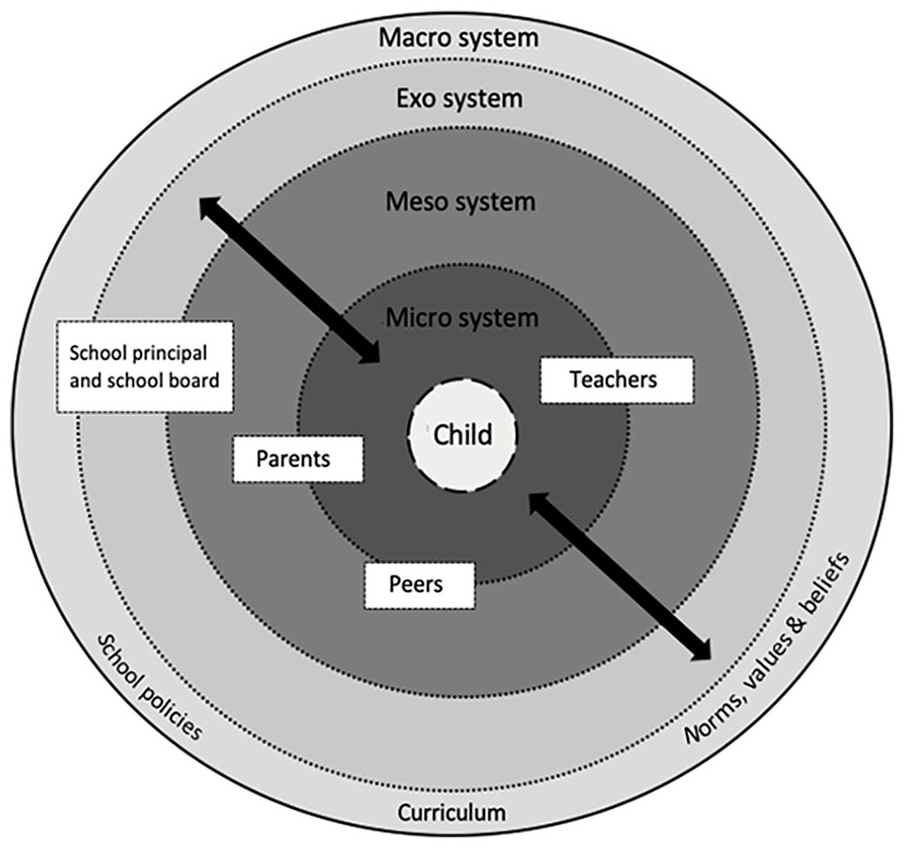
The bioecological model of human development, adapted to the context of children in school settings (adapted from Bronfenbrenner, 2005).
To better understand school principals’ role in the management of promoting PA at school, concepts of teacher agency (Biesta et al., 2015; Priestley et al., 2015) were also engaged with. Achievement of agency is considered to be influenced by previous experiences and planning for actions moving forward. Previous experiences and perspectives on the future thus result in actions in the here and now. In the present—here referred to as the practical-evaluative dimension—principals are influenced by a number of factors including cultural, material and structural (social) resources (Biesta et al., 2015; Priestley et al., 2015). In this study, it was of particular interest to us to see how cultural (beliefs and regulations governing children’s PA in school settings), material (the physical environment) and social (mandates given to teachers and their work in supporting children in PA) resources influenced the approach taken by school principals in management of the school PA promotion. These resources not only create opportunities but also act as barriers to school principals’ work (Biesta et al., 2015; Priestley et al., 2015).
Methods
Study design
An exploratory qualitative approach was considered best suited for data collection (Cohen et al., 2018) since our analyses were to be based on principals’ perceptions and experiences. The study formed part of a larger research project on ‘The Inactive’ conducted at the University of Karlstad and underwent ethical review and received approval as part of this (reference: C2017/546).
The larger project explored children’s PA and inactivity and how school environments can become arenas for sustainable PA promotion for inactive children (Hedström, 2018). In previous work, the diverse perspectives of children, teachers, preschool teachers and after-school teachers have been explored to capture a broad range of perspectives on school organisation (Hedström, 2018). The present study aimed to add knowledge about school principals’ role in undertaking the work of promoting PA for inactive children at school.
Sampling
The empirical data for this study comprised eight semi-structured interviews with school principals across central Sweden. The principals were contacted by email using a targeted selection approach (Cohen et al., 2018) and worked in geographic areas where work on the larger project was taking place. Individuals were recruited from both rural areas and small cities in central Sweden. Participants had to be employed as either a principal or deputy principal in school, as both roles exercise school leadership functions (SNAE, 2020b; The Swedish Confederation of Professional Associations [SACO], 2020).
Principals also had to work at an elementary school level in line with the larger goals of the ‘The Inactive’ project (Hedström, 2018). Importantly, none of the principals (nor the schools they worked in) had been involved in the project before.
Contact information for the principals was obtained from the schools’ websites, and 20 school principals were initially contacted. Of these, 12 did not reply; three turned down the invitation to participate and five school principals confirmed their participation. From the five school principals who accepted to participate in the study, contact was made with three additional school principals who chose to participate in the study. Thus, eight principals in all agreed to participate. School principals signed a consent form after being informed about the study’s purposes and the ethical guidelines to be followed.
Data collection and analysis
Data were collected in April and early May 2021. The first author conducted all the interviews. A pilot interview was held with one of the recruited principals face-to-face at the school where they worked. Since no revisions were made to the interview guide, the pilot interview data were included. Due to the COVID-19 pandemic, the remainder of the interviews were held via video call.
The interview guide comprised questions regarding strategies used to promote PA for inactive children at school and questions about how each principal worked with other school personnel. The semi-structured character and open-ended questions of the interview allowed the principals to give nuanced and well-developed responses (Bryman, 2011). The interviews lasted between 35 and 50 minutes and were audio-recorded and later transcribed verbatim by the first author. To ensure confidentiality and avoid using their real names, the principals were assigned codes P1–P8. The names of schools and cities are not provided because this information is not relevant to the study’s findings.
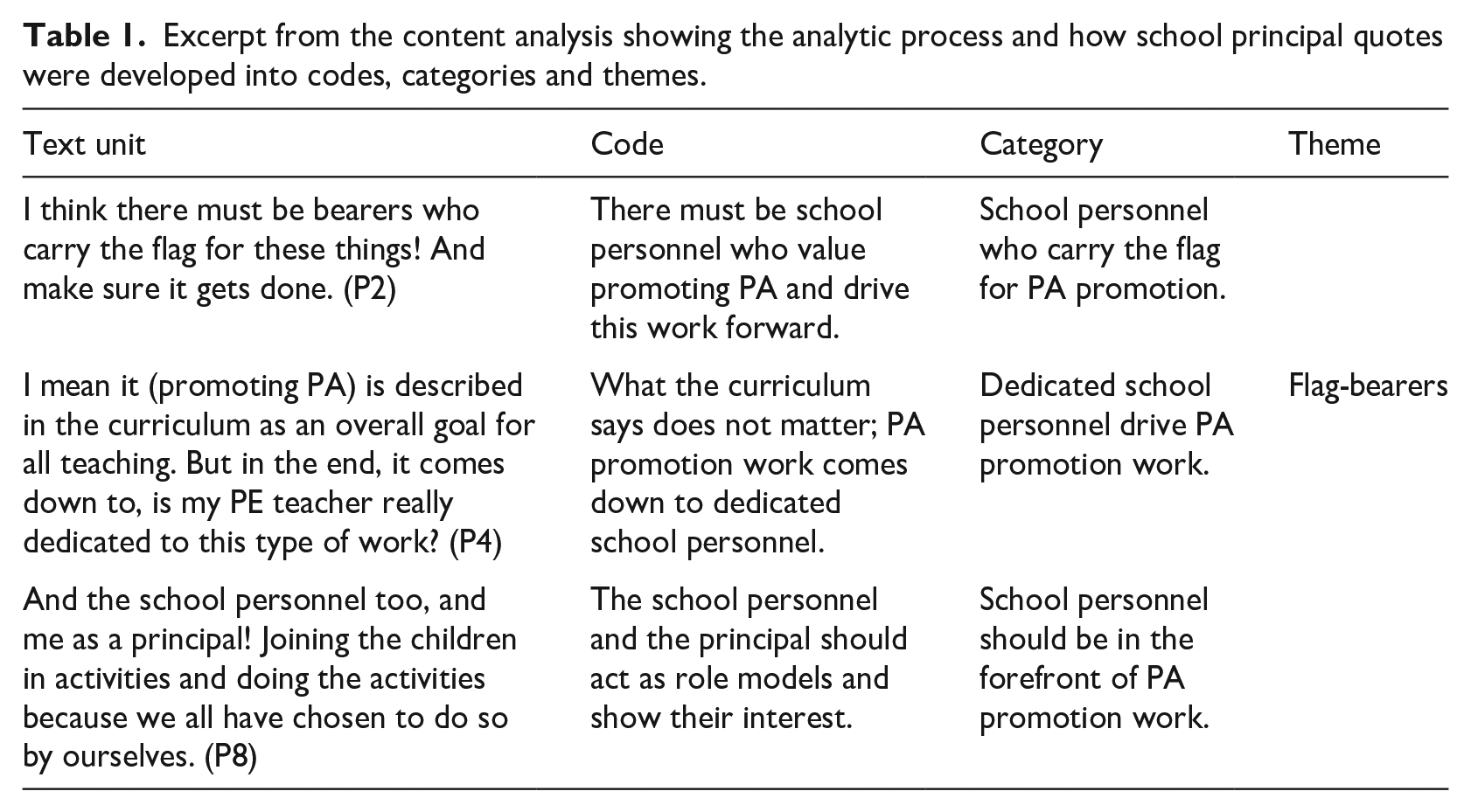
A qualitative content analysis (Kvale et al., 2014) was conducted on the data collected, and the analytic process was guided by the theoretical framing of the study (Bronfenbrenner, 2005; Priestley et al., 2015). Analyses were conducted for each research question. First, text units that related to the research questions were identified in the transcribed material and placed in a separate document. These text units were then condensed into codes, and the essence of the codes was then used to create categories (Table 1). Finally, a single theme that captured the meaning of the text units relevant to each specific research question was developed (Kvale et al., 2014). During the coding process, the authors engaged in a wider discussion with other researchers in ‘The Inactive’ project.
Excerpt from the content analysis showing the analytic process and how school principal quotes were developed into codes, categories and themes.
Results
The results of the analyses reveal the strategies, barriers and opportunities that school principals identified in relation to the promotion of PA for inactive children in school settings. In response to the research questions asked, four main themes became clear during the analysis. In relation to RQ1, strategies for targeting inactive children included (1) delegating responsibilities to other school personnel and (2) hiring school personnel with a special interest in PA. Regarding RQ2, opportunities and barriers in the work of promoting PA for inactive children were (3) becoming flag-bearers of a new kind of initiative and (4) engaging with the need to cater for a diverse school environment alongside school personnel who lead the initiative.
Strategies to reach and involve inactive children
Delegating responsibilities to other school personnel
Having organised activities led by school personnel who offered all children the chance to find a form of PA well suited to their skills, interests and needs was a strategy that all school principals described. This theme was developed from three categories developed in the data analysis as follows: scheduled PAs; teacher-led PAs and teachers meeting the needs of all children.
Several school principals identified inactive children as those in need of organised and teacher-led activities during recess in order to be active. Thus, one management strategy for motivating children to be active was to encourage teachers to engage such children in organised activity. P1 explained this:
At the same time, there is one part that is organised for those children who need the structure. There is also one more open part [of the playground] where the materials can be used. There is always one teacher leading an activity [during recess] and one in the more open area [facilitating an activity for children to engage in] (P1)
This same principal explained that their school offers organised activities not only for children who required opportunities for PA but also for those who do not need them. This was described as an open part of recess. Similarly, P2 described how having teachers organise activities was one way of interesting inactive children in being active: ‘We try to get them out[side], by having organised activities to lure them outside’ (P2). Several principals described how school personnel went about scheduling these types of PAs during recess. P5, for example, explained that the school personnel responsible for PA promotion met every two weeks and planned the activities to be implemented. Similarly, P1 considered that recess did not have to be only ‘free play’, saying: ‘It does not say anywhere that recess is optional; recess can mean that you are scheduled to be physically active. And then we (the school staff) have to look at how to do that!’
Furthermore, having teachers organise activities made it possible to meet the needs of all children, according to several principals. Thereby, structured activities benefitted not only inactive children but all children: ‘It is important that you find something you like in what we have to offer, so that everyone can participate!’ (P5). P5 went on to say that, when designing activities, the focus should be on offering something to every child, rather than ‘nothing’, as many physically inactive children did not spontaneously engage in PAs themselves.
Several principals described how teacher-led activities could also shift the focus away from competition in the PA context; this could result in reaching the inactive children who, otherwise, would not participate. This strategy is similar to that described in previous research (He et al., 2011; Thedin-Jakobsson, 2015). If the focus is on competition, inactive children do not want to participate. P1 illustrated this by saying: ‘Because the ones who need it the most are hardest to reach, then they will do something else because they do not want to compete’ (P1).
Similarly, principals noted that the activities provided should not reflect the most popular and traditional sports in society as these were unlikely to attract inactive children. Instead, a variety of activities should be offered during recess periods during the school day. One principal described this as follows: We offer a diverse set of activities every day that should not be about football or competing. We have one person who is responsible for this during the morning recess and then another one during the lunch break (P2).
In addition, and in line with findings from Högman et al. (2020) and Pawlowski et al. (2015), inactive children may need support from adults such as school staff in order to participate. Across the schools in our study sample, there was variation in which member of school staff was responsible for leading activities. It could be a PE teacher, a classroom teacher, an after-school teacher or a health coach. Why responsibility for planning and organising PA differed between schools was unclear.
Hiring school personnel with an interest in PA
Many school principals talked about their aim of ensuring they recruited dedicated school personnel to drive the work of promoting PA at the school in general. This theme was developed from the three analytic categories: School personnel have to believe PA is important in school; inactive children need dedicated school personnel and hiring demand.
Several principals expressed that recruiting individuals with a knowledge and interest in children’s PA was an important priority for them and was relevant to the appointment of not only PE teachers but all school personnel. Principals considered that a positive attitude towards PA among school personnel was especially important since inactive children often depend on the dedication of adults to participate in PA. Other research (e.g. Abi Nader et al., 2018) has shown that children’s PA levels are affected by their teachers’ attitudes towards PA, and as one school principal in this study put it, ‘It’s important that the ones working here have education [backgrounds] and attitudes which helps them recognise that [promoting] physical activity is an important part of the work we do!’ (P1)
P3 also noted that having a deputy principal who was also interested in PA facilitated PA promotion: ‘I have the luxury to have a deputy principal who also is a PE teacher! So, she understands this too’. If two teachers with equitable qualifications applied for a job, principals said they would hire the one with an interest in PA.
Opportunities and barriers
Principals highlighted both barriers and opportunities in their management of PA for inactive children.
Flag bearers
The theme flag-bearers was developed from the categories school personnel who carry the flag for PA promotion; dedicated school personnel drive PA promotion work; and school personnel should be in the forefront of PA promotion work. The theme highlights the importance of having dedicated school personnel to promote PA for inactive children at school.
Often, the PA policies of the particular school, rather than the curriculum, affected the work of encouraging the engagement of inactive children in PA. Principal 2 described the situation as follows: ‘I think there must be bearers to carry the flag for these things! And make sure it gets done’ (P2). This same principal did not clarify who in the school organisation should have the role of flag-bearer for the work. Other principals interviewed described their personal leadership role as critical for PA promotion. Principal 8 talked about their personal dedication and commitment when describing who should be responsible for promoting PA in school saying. ‘[it’s the responsibility of] the school personnel too, and me as a principal joining [in] the children in activities’ (P8). It was said that, although the curriculum states that the school has a responsibility for promoting PA, this was often dependent upon the dedication of school personnel: ‘I mean it [promoting physical activity] is described in the curriculum as an overall goal for all teaching. But what in the end it comes down to is my PE teacher being really dedicated to this type of work’ (P4).
Furthermore, the principals rarely talked about the curriculum guiding PA promotion work among school personnel. Instead, the work was dependent on who among the school personnel considered the promotion of PA to be their responsibility or to whom this responsibility had been assigned. Principal 3 described success in promoting PA for everyone in school: ‘It is very person-dependent. In one of my schools, the PE teacher considers this [promoting PA] to be obvious, but in another, I get to hear: “Do you think this is my mission?” ‘(P3). Principal 5 expanded on the issue, saying:
Then it all comes down to having school personnel who have a passion for these questions and understands the value of it [promoting PA], because if I didn’t have this and were to just to hand this [responsibility] out by random, nothing would happen. (P5)
Unsupportive school environment
The categories underpinning the theme unsupportive school environment were open schoolyards hinder inactive children and schoolyards need to meet all children’s needs. In addition, teacher and environmental cooperation was seen as connected to barriers, with a focus on how to overcome them.
If school environments do not support PA, they can become a barrier to the school principal’s desire to offer children a variety of opportunities to be physically active. One school principal described how the openness of the schoolyard could act as a barrier to children’s involvement in PA. This was felt to be true for all children but primarily affected inactive children or those with special needs. P4 explained, ‘Since we are a big school, the children who have special needs think it is too big [and that] and feel “too visible”’ (P4). P2 concurred:
You come out and it is very clear what you are doing. It is football, or . . . {?} You cannot be invisible in this schoolyard. There are no trees, no bushes, nothing in the environment that provides opportunities for being active spontaneously. (P4)
As a result of this openness, children who have no routine for being active feel exposed and vulnerable. In other work, Massey et al. (2021) have described how some children need a less-visible part of the schoolyard for ‘a quieter recess experience’ (p. 323). Not being able to give children the opportunity to be less visible or to offer an environment that supports diverse opportunities for PA hindered principals’ efforts to promote PA. The solution to such barriers was to be found in supportive school personnel. Once again, principals stressed the importance of school staff in helping children feel comfortable and want to participate.
In summary, principals in this study saw school personnel’s dedication and interest in PA, rather than curricular guidelines or the creation of safe space for engagement in non-competitive PA, as the means of managing the promotion of PA for inactive children. The support school personnel gave to children for participation in PA was considered more important than regulations (or cultural recourses). When material resources, such as the schoolyard, were not designed in a way that inactive children felt comfortable with to engage in PA, principals with the help of other school personnel attempted to engage the inactive children. Rarely however was it described how the principal planned to change the physical environment itself, for example, by trying to design safe spaces for the children where they were less visible to the rest of the schoolyard.
Discussion
How do the theoretical concepts provided by bioecology (Bronfenbrenner, 2005; Bronfenbrenner and Morris, 2006) and teacher agency (Biesta et al., 2015; Priestley et al., 2015) help an understanding of the situation described? From a bioecological perspective, we have discussed how the principals’ management of PA at an exosystem level could affect the micro-environment of inactive children and the opportunities they were offered for being physically active at school. Applying the concept of teacher agency (Biesta et al., 2015; Priestley et al., 2015), principals’ strategies (agency) and their attitudes towards managing the promotion of PA in school can be better understood. Furthermore, how the material, cultural and social resources available influenced principals in promoting PA for inactive children in school environments warrants discussion.
As previous research has shown, the work of promoting PA in schools benefits from management by a headteacher or principal who prioritises such work, acts as a role model and is dedicated to being involved in it (Abi Nader et al., 2018; Storey et al., 2016). In the present study, the principals we interviewed saw the promotion of PA for all as an important part of their leadership role. However, with a notable few exceptions, they highlighted the role of other school personnel rather than themselves in promoting PA.
The importance of school personnel having an interest in PA was highlighted by the principals, and some went so far as to see this a hiring requirement. There is however some complexity in terms of recruitment processes, for example, which personnel are available. How achievable is the principal’s goal of having the right staff available within a specific school context was not discussed. Therefore, principals may have been describing an ideal situation. Should principals employ this strategy, then decisions made about school personnel at the exosystem level may impact the attitudes and work of teachers and other school staff at both the mesosystem and microsystem levels (Bronfenbrenner, 2005; Bronfenbrenner and Morris, 2006).
In school principals’ statements, it was possible to recognise familiarity with international and national recommendations for PA. However, curricular and regulatory requirements were not main drivers of principals’ efforts to promote PA. Instead personal dedication and the dedication of specialist members of staff were given precedence. Hence, whether or not PA for all was offered in a school depended on the presence of dedicated school personnel. As such, these staff can be viewed as comprising an important social resource in principals’ work to promote PA. Drawing on this result, we see a need for principals to make daily PA an investment in the whole school, not just dedicated teachers (for comparison, see Lee and Welk, 2019).
When discussing the material resources available to promote PA in school as part of a supportive school environment, principals considered an open schoolyard where children were always visible to be a barrier. Since this resulted in inactive children shying away from PA, principals used the strategy of engaging school personnel to initiate PA across the whole schoolyard. As earlier research has stated, the school setting itself has considerable potential to influence children’s PA behaviour (Högman et al., 2020). The principals’ collective statements reveal a lack of control over the physical space which their schoolyard offered. It is important to note that those principals who considered their schoolyards to offer diverse spaces and play areas for PA still commented that the inactive children needed an initiator in order to use the schoolyard/physical environment effectively for PA. Previous research has also stressed the importance of adult (teacher) involvement during recess for children’s PA as well as for social and safety support (Larson-Nielson et al., 2014; Pawlowski et al., 2015).
Limitations
Like all research, this study has its limitations. A key limitation here was the small sample size. This affects the generalisability of the results to a wider population of school principals. Hence, we are aware that the statements from the principals in our study need not be typical of all school principals, as those principals who participated in this study may have been particularly in the matter of PA promotion. However, we hope that the important statements made by the principals in our study can inform future studies on the topic of PA promotion for inactive children in school settings.
Conclusion
In this study, school principals’ most frequently used strategy in work to promote PA among inactive children was to employ dedicated school personnel as PA initiators. Having school personnel drive this work forward was seen as a positive opportunity and an important social resource. However, if there are no so-called ‘flag-bearers’ or initiators dedicated to this work, inactive children may be left out from opportunities to be physically active in school.
Through the school principal’s statements, a poorly diversified schoolyard with few secluded playing spaces for PA proved to be a barrier for inactive children’s PA engagement. The school principals in this study expressed having limited control over the schoolyard design available to them, which made them rely on school personnel for PA promotion.
Future research should continue to study the effects of the school yard and playing spaces on inactive children’s PA. We also advocate for future exploration of whole-school PA promotion and the greater use of regulatory guidelines as part of wider efforts to promote PA in school.
Footnotes
Acknowledgements
The authors are grateful to the school principals who participated in the interviews.
Declaration of conflicting interests
The author(s) declared no potential conflicts of interest with respect to the research, authorship, and/or publication of this article.
Funding
The author(s) disclosed receipt of the following financial support for the research, authorship, and/or publication of this article: This work was supported by The Swedish Research Council for Sport Science (P2020-0050).
