




Abstract
Background:
The 2018 legalisation of cannabis in Canada sparked concern and conversation about the potential negative impacts of youth cannabis use. It is clear that young people are already engaging in cannabis use for a variety of reasons; therefore, youth cannabis education is desirable to promote harm reduction and reduce the risk of adverse physical and mental health outcomes.
Objective:
To identify and categorise Canadian cannabis education resources using a social-ecological approach informed by the youth health literacy framework, considering multiple factors at the micro-, meso- and macro-levels that influence health literacy and impact behaviour.
Methods:
In line with scoping review methodology, database searches and an environmental scan of materials were completed. Specific inclusion criteria were identified to encompass all Canadian cannabis education resources directed towards young people aged 9–18 years and adults in contact with youth.
Results:
A total of 60 resources were identified and categorised using the youth health literacy framework in terms of their focus on (1) micro influences (resources for youth); (2) meso influences (resources for teachers, parents, mentors); and (3) macro influences (resources for indigenous communities and medical professionals).
Conclusions:
While many resources were identified, issues exist with the accessibility, quality and multicultural considerations of such resources, warranting the development of comprehensive, evidence-based and harm reduction–focused cannabis education for youth.
Introduction
The 2018 legalisation of non-medical cannabis in Canada (Government of Canada, 2019) gave Canadian citizens access to cannabis products. Although not the intent of the legalisation, cannabis use by young people is still common. In 2021, 37% of Canadian youth reported using cannabis in the past 12 months, with 20% of them consuming cannabis daily or near daily (Government of Canada, 2021). An earlier 2018 survey found that young age (15–24) was significantly associated with intent to try cannabis or increase cannabis use following legalisation (Sandhu et al., 2019), a finding that is incongruent with earlier aims of restricting youth cannabis use. Intent to use cannabis has been preliminarily revealed in the Cannabis Use, Obesity, Mental health, Physical activity, Alcohol use, Smoking and Sedentary behaviour (COMPASS) longitudinal study of students aged 14 to 18 (Zuckermann et al., 2021). This study revealed an increase in the rates of ever using cannabis from 30.5% in 2016–2017, pre-legalisation, to 32.4% in 2018–2019, post-legalisation (Zuckermann et al., 2021).
Young people report using cannabis for various reasons – boredom, social cohesion, social anxiety and perceived lower risk of harm compared to other substances (Leos-Toro et al., 2020). Recognising that some youth will consume cannabis, strategies are needed to reduce the harms associated with use as suggested by the Lower-Risk Cannabis Use Guidelines (LRCUG; Fischer et al., 2022). This kind of harm reduction approach provides recommendations for safer cannabis use such as age of initiation, product type, method(s) of consumption and frequency of use.
Engaging in heavy cannabis use before age 17 may negatively affect the developing brain, which may result in long-term consequences to health and social outcomes (Ehrenreich et al., 1999; Takagi et al., 2011). Regular cannabis use in youth shows a nearly doubled risk of cognitive impairment and incompletion of schooling, along with an increased risk of mental health issues, psychosis, and cannabis dependence (Cohen et al., 2019; Curran et al., 2016; George and Vaccarino, 2015; Hall et al., 2019; Memedovich et al., 2018).
Educating youth about health and safety is essential; however, there are significant gaps in existing substance use education in Canadian schools (Watson et al., 2019). Generally, school-based substance use education has followed an abstinence approach, teaching young people to avoid using drugs completely. However, such an approach has been shown to be largely ineffective in reducing youth substance use (West and O’Neal, 2004). A harm reduction approach, in contrast, primarily aims to reduce drug-related harms (Lenton and Single, 1998). The concept of abstinence may be engaged with, but it is not the sole or major focus. The youth version of the LRCUG created by the Centre for Addictions and Mental Health [CAMH] (2020) recognises that abstinence is the only way to avoid the harms of cannabis completely; however, there are harm reduction strategies that may be employed to promote safe use.
Health literacy is an essential skill to foster among young people since it lays the foundations for health in later life (Bröder et al., 2020; Wharf Higgins et al., 2009). Associations have been found between adolescent health literacy and health behaviour. Low levels of health literacy are associated with increased probabilities of engaging in alcohol use (Chisolm et al., 2014) and higher health and media literacy levels are associated with reduced smoking behaviours (Page et al., 2011). Kirchhoff et al. (2022) explain that health education and health literacy mutually influence each other, with health literacy influencing educational outcomes, while education can play a factor in determining an individual’s level of health literacy.
Given the limited education on cannabis provided to school-aged children in most Canadian jurisdictions (Watson et al., 2019), a scan of resources currently available to inform youth directly or through the reach of educators and parents is critical. Educators providing comprehensive school health education seek to ensure youth develop the necessary skills to live a healthy lifestyle (Tappe and Galer-Unti, 2001). Targeting cannabis education through family and parental interventions has also been shown to be effective in reducing the frequency of adolescent cannabis use (Vermeulen-Smit et al., 2015).
The Cannabis Health Evaluation and Research Partnership (CHERP) team in Newfoundland and Labrador, Canada, identified a gap in cannabis education for young people within the provincial school system and a desire for interactive, evidence-informed, harm reduction education (Bishop et al., 2022). A scoping review is necessary to identify materials and programming to help inform the future development and inclusion of cannabis content in polysubstance drug education programmes and materials for youth (Arksey and O’Malley, 2005). Starting such education at an early age is essential, as it can influence future substance use behaviours (Lloyd et al., 2000). The purpose of this scoping review, therefore, was to identify Canadian cannabis educational programming and/or materials targeted at children and young people aged 9–18, or adults in contact with youth.
Methods
We followed the methodological framework outlined by Arksey and O’Malley (2005) and recommendations outlined by Levac et al. (2010) to develop the review.
Defining the research question
Our research question was ‘What cannabis education programmes and materials exist in Canada for young people aged 9 to 18?’.
Item selection
The intervention was intentionally broad to encompass all available cannabis education options for youth and/or those in contact with youth. Items were included if the resource: (1) included cannabis as a component or topic; (2) contained content explicitly targeted at young people aged 9–18 or adults in contact with youth; (3) was developed or offered in Canada; (4) was available in English; and (5) was developed, established, actively delivered or published between January 2010 and November 2022. The year 2010 was chosen as a starting point, recognising that Canadian cannabis guidelines first started to emphasise a harm reduction approach to cannabis consumption around this time (Fischer et al., 2011). Items were excluded if they were not educational materials or did not indicate that they targeted youth or adults in contact with youth.
Identifying relevant resources
A comprehensive search strategy was developed in consultation with a health sciences librarian (EK). The initial search strategy was then peer-reviewed by another health sciences librarian using the PRESS guidelines for evidence syntheses (McGowan et al., 2016). The searches were modified slightly for each database but consisted of keywords and subject headings relating to four concepts: cannabis, education, youth and Canada. The geographic portion of the search was adapted from Canadian Agency for Drugs and Technologies in Health’s (CADTH) broad search filter for Canada developed for Ovid platforms (CADTH, 2022). Full search strategies for all databases can be found in online Appendix A. Searches were run in MEDLINE via Ovid, Embase via Elsevier, Scopus via Elsevier, ERIC via EBSCO, PsycINFO via EBSCO, Academic Search Complete via EBSCO and Social Work Abstracts via EBSCO on 18 July 2022. Language limits (English language only) and date limits (1 January 2010 to 18 July 2022) were then applied to reflect the predetermined inclusion criteria.
The search was updated on 10 November 2022 in each of the aforementioned databases to capture additional materials published since the original enquiry. Two reviewers (EJH and ECR) reviewed all the academic items from both searches within Covidence (https://www.covidence.org/), initially examining the title and abstract to confirm relevancy, followed by a full-text review for inclusion. Disagreements were resolved through discussion.
An environmental scan was also undertaken to assess the non-academic cannabis resources available to young people and adults who play an influential role for youth. A specific framework for environmental scanning does not exist; however, we followed the search methods recommended by Choo (1999). The environmental scan of online sources took place between May 2022 and November 2022 primarily by EJH and BST, but with all authors contributing. The scan started with a review of both federal and provincial government websites as well as known cannabis or substance use–focused organisations’ websites for mentions of cannabis, youth and adults in contact with youth. To further expand the scan, Internet searches using terms from the academic search were also completed. All items were reviewed by EJH and BST to determine suitability for inclusion based on the inclusion criteria as noted above.
Summarising and reporting
Charting was initiated with consideration to the sources found in line with Arksey and O’Malley’s (2005) framework. Categories for charting were determined by the team and included: programme or material name; the organisation that created or delivered the programme or material; target population; method of delivery; a notes section (to include the year of publication or establishment, if a special population was considered, or other relevant findings); and whether or not an evaluation occurred. Data charting was completed by EJH using the identified categories and verified by BST.
Following the identification of resources and the charting of the data, items were organised into micro-, meso- and macro-categories of the health literacy framework (Wharf Higgins et al., 2009; see Figure 1). The resources were further sub-categorised within each level according to their target population, as outlined in online supplemental Appendix B. Each identified resource is described and referenced in online supplemental Appendix B. The inclusion of any item does not reflect an endorsement of its quality or accuracy by the authors of this research.
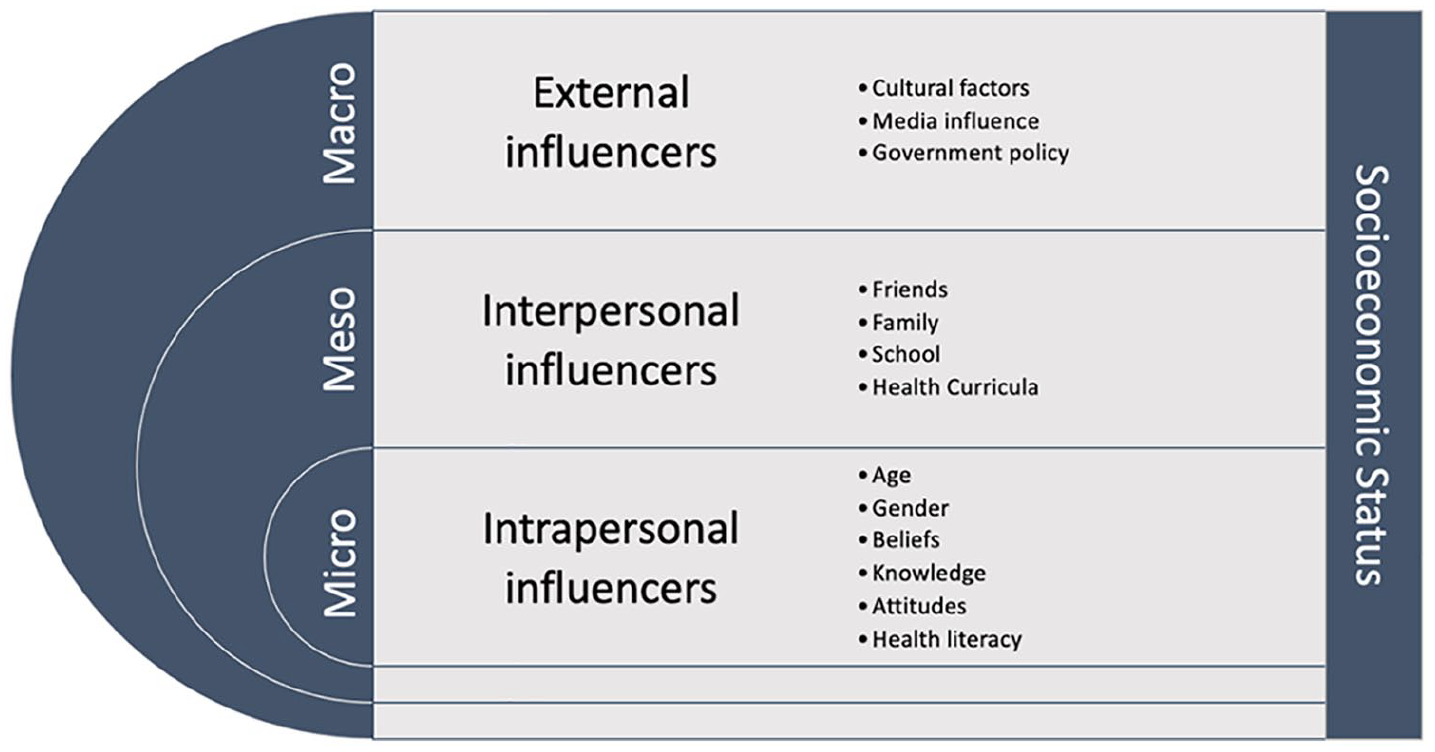
Youth health literacy framework (adapted from Wharf Higgins et al., 2009).
Results
The database searches conducted on 18 July 2022, yielded 1,520 articles. After the removal of duplicates, 634 articles remained. An additional 28 unique articles were identified by the additional database searches conducted in November 2022. Altogether, 662 articles were subjected to title and abstract screening, and 603 were excluded following a review of the titles and abstracts. Fifty-nine studies underwent full-text review, resulting in a further 53 articles being excluded. Six articles remained, and following hand-searching of reference sections, six relevant education programmes or materials were identified.
The environmental scan yielded 59 items. Following a review of all items, two were excluded, leaving 57 resources identified by the scan. Combining the findings from the environmental scan with those from the literature search, three duplicates were found, resulting in a final overall total of 60 included items for both searches. The PRISMA diagram reflecting the review and inclusion process can be seen in Figure 2.
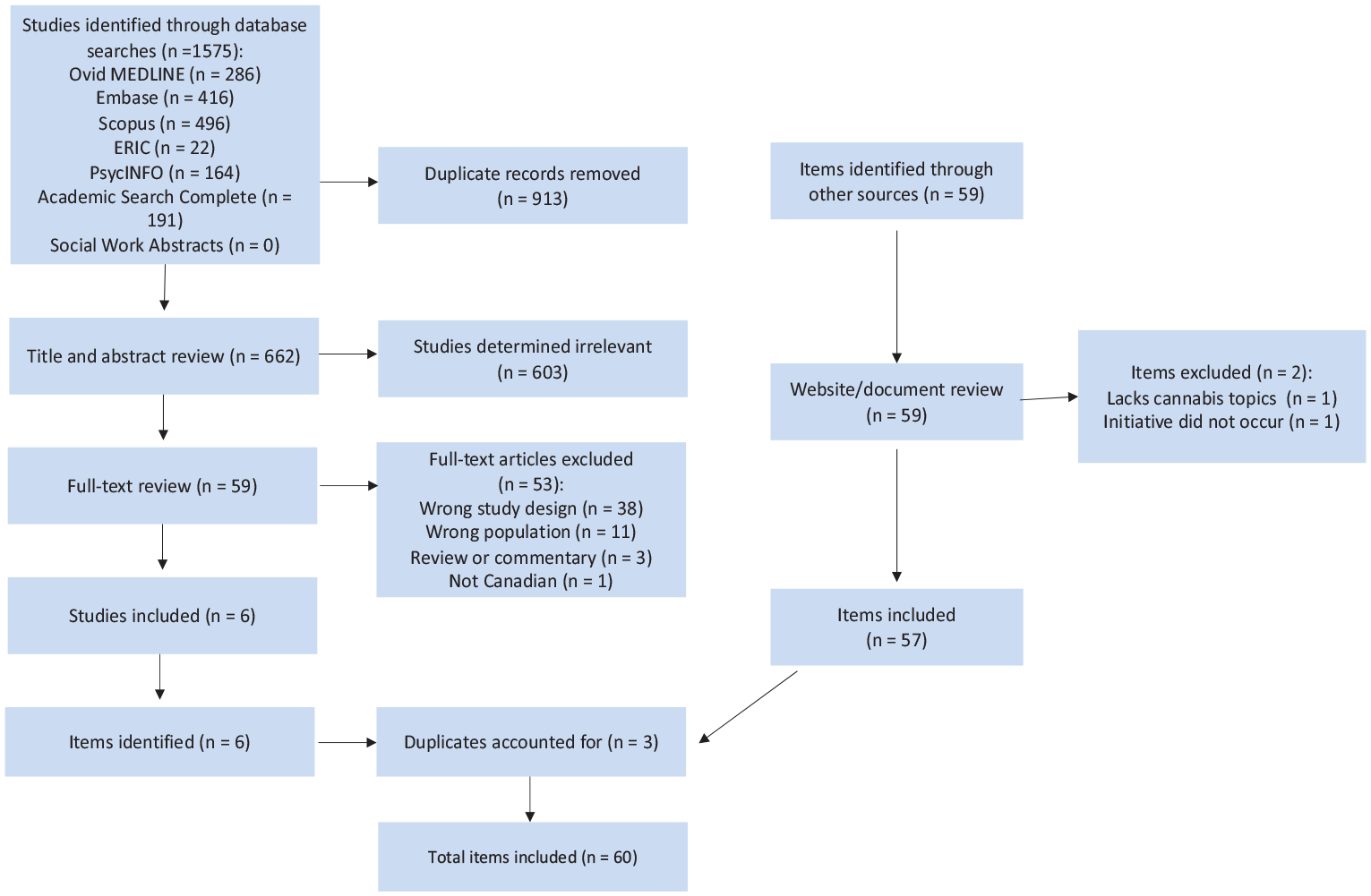
PRISMA-ScR diagram of literature search review and environmental scan with inclusion process (Tricco et al., 2018).
Of the 60 items identified, 31 were considered to be Canada-wide; 14 were developed for use specifically in Western Canada, two in Northern Canada, 15 in Ontario, one in Quebec and one in Atlantic Canada. No programmes had been implemented throughout a provincial or territorial school system. Only three programmes had been evaluated: Cycles (Moffat et al., 2017), Healthy Relationships Plus (Exner-Cortens et al., 2020) and Project SOS (Wong, 2016). Once collected, resources were assigned to the micro-, meso- and macro-categories of the health literacy framework depending on their target population (Wharf Higgins et al., 2009).
Micro-level influences
Micro-level influences (see Table 1 in Appendix B) are influences on health literacy such as age, gender, beliefs and values (Wharf Higgins et al., 2009).
Programming for youth
Five items were included, which involved educational sessions delivered by trained facilitators. These required a facilitator from an organisation to attend a school or a planned event to educate youth about cannabis use. Facilitating bodies included organisations such as Mothers Against Drunk Driving (MADD, 2022), YMCA (YMCA of Greater Toronto, 2021) and academic groups (Jani et al., 2022).
Online resources for youth
Sixteen open-access online general resources targeted youth. These included webpages with links to written documents about cannabis (Government of Canada, 2018a, 2018b), and webpages with written cannabis information embedded in the page (Government of Canada, 2021; Government of Quebec, 2021). Interactive methods and campaigns were also used to educate youth (CCSA, 2022; Cannabis and Mental Health Project, 2022).
Meso-level influences
Meso-level influences (see Table 2 in Appendix B) are influences from other individuals such as teachers, parents and other adults working with youth that may in turn affect health literacy (Wharf Higgins et al., 2009).
Curriculum and online resources for youth educators
Twelve resources had been developed for educators including teachers, mentors and other youth leaders. Information supported conversations about cannabis with students (CAMH, 2020), activity and lesson guides for educators (OPHEA, 2022; University of Victoria, 2022) and training resources for educators to use when hosting education sessions (Health Canada, 2018).
Online resources for parents and guardians of youth
Thirteen items included talk kits for parents and guardians for use in conversations with children about cannabis (Government of Quebec, 2021; Ontario Native Education Counselling Association [ONECA], 2022b) and online web pages offering cannabis information for parents and guardians (heretohelp, 2018).
Online resources for any adult in contact with youth
Four items involved content for adults who had involvement with youth but were not exclusively designed for use by parents/guardians, educators or medical professionals. One resource from YouthREX (2020) was indicated as being for youth workers, while others had general descriptions of their target population including adults in contact with youth, teenagers or students (Canadian Public Health Association, 2018; Valleriani et al., 2021).
Macro-level influences
Macro-level influences (see Table 3 in Appendix B) refer to societal factors that may affect an individual’s health literacy (Wharf Higgins et al., 2009). Resources for Indigenous populations and medical professionals were included in this category due to the potential cultural and community impacts of these resources.
Online resources for Indigenous populations
Eight items had been created by and targeted towards Indigenous populations. Such resources targeted young people exclusively (Bear Paw Media and Education, 2021; Pauktuutit, 2022), adults including the educators of Indigenous youth (ONECA, 2022a) and parents of Indigenous youth (ONECA, 2022b). Some items were available in multiple Indigenous languages.
Online resources for medical professionals in contact with youth
Two items targeted medical professionals who were in contact with young patients. One resource targeted school mental health professionals and provided advice on clinical strategies to address students with cannabis use issues (School Mental Health Ontario, 2019). A discussion guide was identified to assist healthcare professionals to have meaningful conversations with young people about cannabis use (CCSA, 2021).
Discussion
Adolescent health literacy is influenced by the interaction between intrapersonal, interpersonal, social and community factors as they relate to health literacy (Wharf Higgins et al., 2009). The findings from our review are promising since they identify multiple ways for youth and their mentors to seek out cannabis-related information. There are resources available for youth wanting to take an independent approach to their learning as seen at the micro-level of the framework, or to be informed by educators, parents/guardians, other adults and larger communities as mentioned at the meso- and macro-levels. That being said, although youth-targeted cannabis education resources exist, given the widespread nature of cannabis use by youth in Canada, there is a need to develop a greater diversity and number of programmes, materials and resources. Young people have specifically expressed that they desire evidence-informed, harm reduction content that is aligned with the principles in the LRCUG (Bishop et al., 2022; Fischer et al., 2022).
The value of a harm reduction approach
It is promising to note that most resources identified used a harm reduction approach, as abstinence-based teaching about health and health risks has proved much less effective (McBride et al., 2004; Midford, 2010; Valleriani et al., 2018). By way of example, previous research on alcohol use in high school–aged students found that students who were introduced to harm reduction strategies consumed less alcohol, participated less in risky behaviours and encountered fewer harms from alcohol consumption (McBride et al., 2004), which suggests the value of such an approach when used with other drugs such as cannabis. Using a harm reduction philosophy for youth education will also help support young people’s individual health literacy and decision-making ability (Valleriani et al., 2018). With the legalisation of cannabis in Canada, young people need knowledge and guidance at multiple levels, to ensure they receive consistent messaging, and preparing them to make informed decisions.
Indirect targeting of youth: the need for informed cannabis discussion
The majority of resources identified relied upon young people, educators, guardians or other youth mentors to seek out the information, rather than it be integrated directly into the school curriculum. At the micro-level, the attitudes and beliefs of a young person or adult affect their tendency to seek out cannabis resources. Many of the materials indirectly targeted young people through mentors, such as parents, guardians, educators and allies (Cannabis and Mental Health, 2022; Drug-Free Kids Canada, 2022; Health Canada, 2018). Although these resources may be helpful, adults must first seek out the information and internalise the main messages themselves, before sharing that understanding with youth via a process operating the meso-level of the framework (Wharf Higgins et al., 2009). The cannabis education delivered to the young person by an adult may be impacted by the adult’s own perspective on cannabis, resulting in reduced levels of cannabis literacy as mentors ‘filter’ the available information.
This over-reliance on self-selection by intermediaries highlights the need for a wider range of education options for Canadian youth. Our review identified a number of resources targeting health literacy at the meso-level, with some seeking to support parents/guardians to become good educators of their own children. Such an approach has limitations though, since not all family dynamics are the same. Available resources and programming typically speaks to a heteronormative and nuclear family structure, and fails to address the needs of young people whose experience does not align with this limited definition (Jenkins et al., 2021).
The targeting of educators can also be found in resources such as the Canadian Students for Sensible Drug Policy toolkit, which seeks to support non-judgemental conversations with youth (Valleriani et al., 2018), and a Canadian Centre on Substance Use and Addiction (CCSA) substance use guide containing print materials and videos for educators (CCSA, 2022). These resources once more require an educator to seek them out and deliver the education as intended. The delivery of such resources may be difficult for educators if the educational district they work in does not grant approval for the use of such external resources.
Addressing equity in the accessibility of cannabis education
There were relatively few school-based programmes or materials with a focus on the meso-level, and none that had been developed for and by a specific educational jurisdiction. It is important to provide equitable education for all young people by ensuring consistency of provision aligned with federal mandates at the meso-level. However, this can be difficult given the provincially regulated nature of public school systems in Canada (Bruno and Csiernik, 2020; Joint Consortium for School Health, 2009; Watson et al., 2019). When education programmes take place in schools there is often wide variability in the philosophy that underpins the approach taken, triggering criticism of such programming (Bruno and Csiernik, 2020). There is a need for substance use education that includes a focus on cannabis in ways that are inclusive, relevant and accessible.
The majority of resources identified were openly available online, which requires a degree of digital literacy to access them. Potential users without access to a computer, and who live in an area where Internet access may be poor are likely to be disadvantaged. This is especially the case in rural communities in Canada, where only about half of the population has consistent access to the Internet (Government of Canada, 2016). The ability to use available technology at the individual knowledge level also limits accessibility.
Further social inequities affect access to health information especially for youth who lack positive role models, have various levels of education or have language barriers. In addition, adults may interpret materials in ways other than those that were intended. Personal beliefs and experiences can reinforce inequities at the meso-level. The relationship between the intrapersonal, interpersonal and community factors can have an influence on health literacy (Wharf Higgins et al., 2009). As such, socioeconomic barriers impacting access must be considered in the design of education materials to ensure equitable access.
Culturally relevant cannabis education
A focus on culturally appropriate education is critical to achieving a broad reach. Only a limited number of resources we identified considered the experiences, interests and needs of Indigenous and other minority populations, which is a problem given evidence that Indigenous youth use may be at higher risk for use than non-Indigenous youth (Sikorski et al., 2019). Several Indigenous-focused resources created by and for Indigenous people were, however, identified (Bear Paw Media and Education, 2021; First Nations Health Authority, 2022; ONECA, 2022a; Pauktuutit, 2021).
Other materials had been developed specifically for use with Black youth (Jani et al., 2022) and young people from other language and cultural backgrounds (Marko and Watt, 2011). With only a few resources having a specific focus on Indigenous people and minority ethnic populations, young people from such communities may lack access to meaningful and culturally appropriate forms of education.
Resources that take a more upstream approach and target cultural factors at the macro-level should also be a priority for cannabis resource developers. By utilising culturally appropriate content, programmes are likely to be more effective (Joint Consortium for School Health, 2009). However, care and consideration must be made to ensure that the inclusion of cultural content is meaningful and accurate. It is necessary to recognise that minority populations and Indigenous populations are not homogeneous and a deeper understanding of their values, practices and symbols should be considered in content development (Joint Consortium for School Health, 2009).
Gaps in evaluated resources
We identified a variety of education materials to support cannabis health literacy for youth in Canada. However, very few of these programmes have been formally evaluated, so the most effective approaches remain unknown. Only three of the sources identified here showed evidence of being evaluated (Exner-Cortens et al., 2020; Moffat et al., 2017; Wong, 2016) calling into question the potential value and effectiveness of the other programmes and materials. The lack of evaluated programmes for youth has also been noted by others (Watson et al., 2019).
Limitations and future directions
Our review has potential limitations. Focusing on Canadian resources may have excluded good quality materials from other countries where cannabis use has been legalised. Programmes and activities that had not been published or which were not readily accessible or published were also not included. Furthermore, this review focused on materials published between 2010 and 2022, which allowed for the inclusion of materials developed before the 2018 legalisation of non-medical cannabis in Canada. This means that some resources may have reflected pre-legalisation ideas and advice.
Only a small number of resources were identified for use with elementary school children, which limits applicability to that age group. Finally, there was a lack of gender-sensitivity in programming, with none of the materials engaging explicitly with gender considerations, limiting their ability to fulfil programme needs.
Future research should strive to develop a comprehensive approach to cannabis education that engaged with micro-, meso- and macro-level factors in pursuit of equitable provision and the development of health literacy for all youth. Greater concern with the evaluation of the effectiveness of programmes is warranted to determine the impacts they may have on cannabis use and decision-making by youth. Future research should focus on the accessibility of the various programmes and materials, specifically reflecting concern for social inequities. Exploring the best approaches to educate youth about cannabis is critical as this is the time when the foundations of health literacy are formed and decision-making takes place.
Conclusion
Cannabis use by young people remains a concern in Canada. This scoping review identified a number of harm-reduction, cannabis education programmes and materials targeting young people and youth mentors for use in in-school programming, and as online resources. Although most were readily available, utilisation requires selection and digital literacy on the part of users. Social inequities and health literacy should be considered to avoid the exclusion of some populations of young people from accessing resources. There remains limited school-wide programming and minimal evaluation of effectiveness. Engaging with micro-, meso- and macro-considerations in the development of future programmes should ensure the design and delivery of more comprehensive, culturally appropriate and accessible programming for young people.
Supplemental Material
sj-docx-1-hej-10.1177_00178969231191085 – Supplemental material for Canadian cannabis education resources to support youth health literacy: A scoping review and environmental scan
Supplemental material, sj-docx-1-hej-10.1177_00178969231191085 for Canadian cannabis education resources to support youth health literacy: A scoping review and environmental scan by Emily J. Howe, Lisa D Bishop, Bethany S. Torraville, Emily C. Rowe, Eden Kinzel and Jennifer R. Donnan in Health Education Journal
Supplemental Material
sj-docx-2-hej-10.1177_00178969231191085 – Supplemental material for Canadian cannabis education resources to support youth health literacy: A scoping review and environmental scan
Supplemental material, sj-docx-2-hej-10.1177_00178969231191085 for Canadian cannabis education resources to support youth health literacy: A scoping review and environmental scan by Emily J. Howe, Lisa D Bishop, Bethany S. Torraville, Emily C. Rowe, Eden Kinzel and Jennifer R. Donnan in Health Education Journal
Footnotes
Acknowledgements
Thank you to Memorial University of Newfoundland’s librarian, Alison Farrell, for assistance with this review.
Authors’ Note
Eden Kinzel is now affiliated with Gerstein Science Information Centre, University of Toronto, Toronto, ON, Canada.
Funding
The author(s) disclosed receipt of the following financial support for the research, authorship, and/or publication of this article: the authors received financial support for conduct of the research from the Canadian Institutes of Health Research (grant no. RN407334 - 429120) and the Canadian Centre of Substance Use and Addiction for the Partnerships for Cannabis Policy (grant no. RN407334 - 429120).

Supplemental material
Supplemental material for this article is available online.
References
Supplementary Material
Please find the following supplemental material available below.
For Open Access articles published under a Creative Commons License, all supplemental material carries the same license as the article it is associated with.
For non-Open Access articles published, all supplemental material carries a non-exclusive license, and permission requests for re-use of supplemental material or any part of supplemental material shall be sent directly to the copyright owner as specified in the copyright notice associated with the article.
