




Abstract
Objectives:
Whole-school interventions and programmes aim to change school environments to promote health. Previous reviews suggest these are often inappropriately informed by individualistic psychological theories. We undertook a systematic review of whole-school interventions to prevent substance use and violence. This paper reports on a synthesis of theories of change, assessing whether these aligned with, and suggested refinements to, the theory of human functioning and school organisation, a more encompassing, sociological theory. This theory proposes that schools improve health by promoting student commitment, achieved by eroding various ‘boundaries’ (e.g. between staff and students) and reframing provision based on student needs so that students commit more fully to school ‘instructional’ (learning) and ‘regulatory’ (behaviour) orders.
Setting:
International.
Design:
Systematic review.
Methods:
The study involved systematic searches, data extraction and quality assessment. Theories of change were synthesised using a best-fit framework.
Results:
Despite only one intervention being explicitly informed by the theory of human functioning and school organisation, the theories of change of most interventions aligned (at least in part) with aspects of this theory. Synthesis suggested various refinements to the theory. First, it suggested specific activities that can modify boundaries and reframing to increase student commitment. Second, it refined the concept of reframing to include building learning on existing student knowledge using a ‘constructivist’ approach. Third, it suggested future intervention might usefully seek to erode boundaries between the ‘instructional’ and ‘regulatory’ orders of the school to create a single ‘developmental’ order. Finally, it recognised that whole-school interventions might prevent violence and substance use among students in ways other than by building student commitment.
Conclusion:
Our refined theory of change provides a firmer basis for interventions. Future work is needed to examine empirical support for the refined theory.
Keywords
Introduction
Whole-school interventions aim to change schools’ organisation and environments to promote health (Bonell et al., 2013a) and are influential, for example, on the World Health Organization’s Health Promoting School model. A decade ago, a systematic review of such interventions found that these interventions were only rarely informed by broad-based social theory, instead relying on psychological theories, such as attachment theory or the theory of reasoned action (Bonell et al., 2013b). Such theories focus on changes in individual behaviour or social interactions but not on changes to institutions or environment.
This lack of appropriate theorisation has been flagged as a more general problem whereby public health interventions involving change to organisations or environments tend to be informed by psychological theory (Campbell and Bonell, 2014). This means that some interventions work from inappropriate theories of change and that some mid-range sociological theories (i.e. those aiming to explain specific empirical phenomena (Merton, 1968) as well as structural theory are not being empirically tested via evaluation research.
The theory of human functioning and school organisation is a case in point (Markham and Aveyard, 2003). A previous systematic review of whole-school interventions assessed theories of how schools might influence student health, concluding that this theory provided the most specific and comprehensive sociological theorisation (Figure 1). This theory is supported by some evidence from observational studies as to the school-level factors that are associated with specific health outcomes (Bonell et al., 2013a) but not by evaluations of interventions underpinned by such theory.
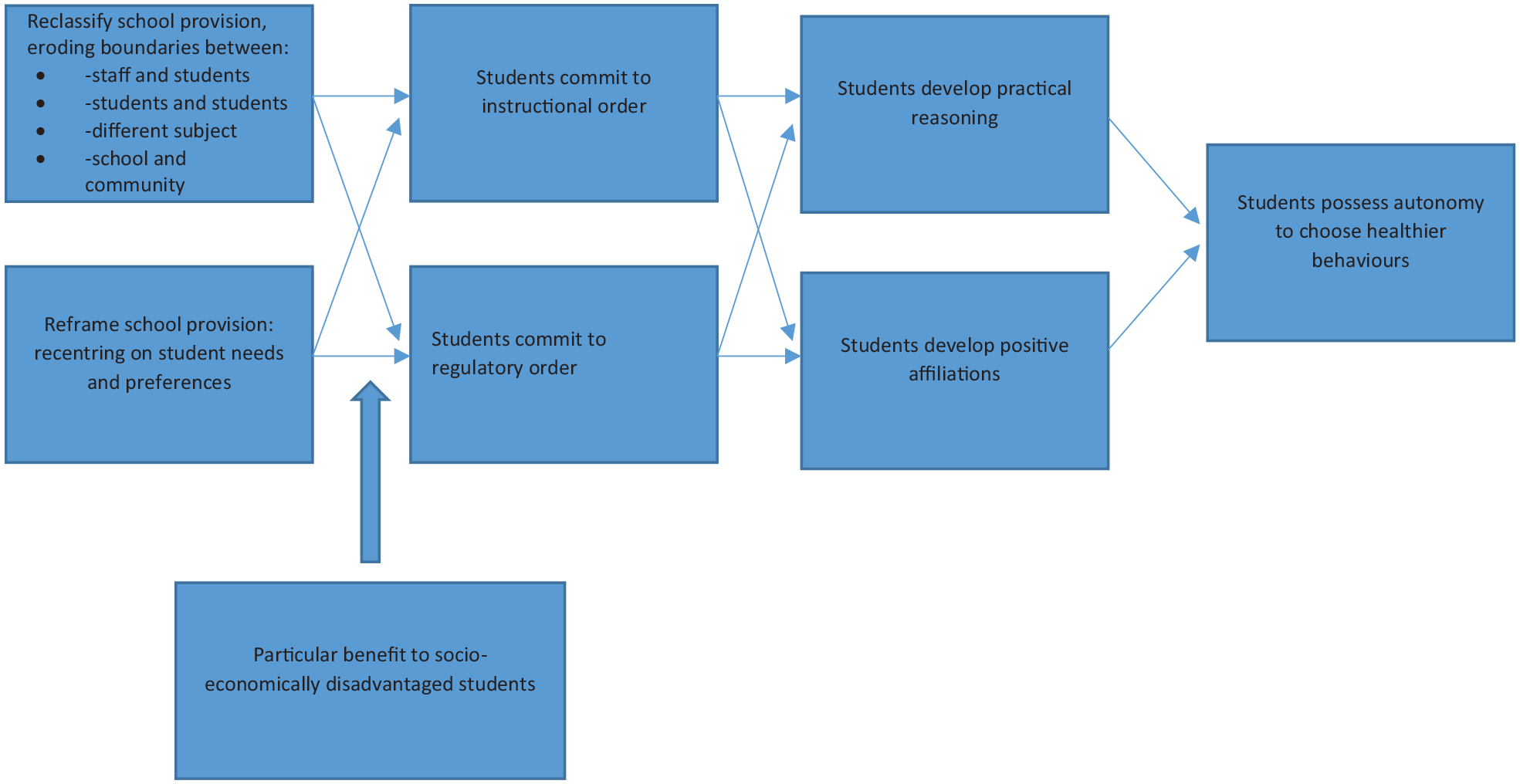
Theory of human functioning and school organisation.
The theory of human functioning and school organisation proposes that students are more likely to be healthy if they feel committed to the ‘instructional order’ (teaching knowledge and skills) and the ‘regulatory order’ (conduct, and inculcating values and beliefs) of the school. Students thus committed are more able to develop forms of practical reasoning and affiliation, both of which enable healthier decisions and actions. ‘Practical reasoning’ concerns the ability to imagine, reason and think critically, enabling a person to make choices. Capacity for ‘affiliation’ involves a concern for other humans and having attachments to others.
Informed by Bernstein’s (1975) educational sociology, the theory suggests that schools can promote student commitment by weakening ‘classification’ between contents. This may be done by weakening boundaries between the school and community (e.g. by enhancing alignment between school and local community culture); between teachers and students, or between students (e.g. by improved relationships and cooperation); or between academic subjects (e.g. by project-based learning). Schools can also increase commitment by weakening the ‘framing’ of pedagogic discourse by reducing didactic teaching and involving students in managing their own learning. The theory of human functioning and school organisation proposes that, because lack of commitment to school is more likely among socio-economically disadvantaged students, weakening the classification and framing of educational knowledge is most likely to benefit these students.
Since the previous review, there has been a growth in evaluations of whole-school interventions to promote health. We therefore undertook a new systematic review, focusing on whole-school interventions to promote student commitment to school to prevent violence and substance (tobacco, alcohol and other drugs) use. The review aimed not merely to assess the effects of this type of intervention but also to examine the usefulness of the theory of human functioning and school organisation in explaining how these interventions work, given the apparent alignment between this theory and the aims of such interventions but incomplete evidence base for this theory.
In this paper, we report on findings from a recent review of theories of change. We aimed to examine whether the theories of change underpinning recent interventions were informed by the theory of human functioning and school organisation; whether these interventions’ theories of change aligned with the theory of human functioning and school organisation; and whether the theories of change might suggest ways in which the theory of human functioning and school organisation might be refined to inform a theory of change for whole-school interventions aiming to prevent violence and substance use via promoting student commitment to school.
This refinement would inform both the testing and the theory against empirical evidence of intervention effectiveness as revealed by our overall review, and improve the extent to which the theory of human functioning and school organisation might be operationalised to inform future whole-school interventions.
Methods
The larger review, of which the present analysis forms one part, was a multi-method systematic review examining theories of change, influences on implementation, and outcomes and cost-effectiveness of whole-school interventions promoting student commitment to school to prevent substance use and violence. The review followed existing guidelines for the conduct and reporting of systematic reviews including those developed by the Centre for Reviews and Dissemination (Centre for Reviews and Dissemination, 2009) and the Preferred Reporting Items for Systematic Reviews and Meta-Analyses [PRISMA]. The protocol was registered as follows: https://www.crd.york.ac.uk/prospero/display_record.php?RecordID=154334.
Rather than requiring interventions to be informed by theories of change with similar constructs to the theory of human functioning and school organisation (which would have been difficult because of inconsistencies in description and reporting), we defined inclusion in terms of intervention activities that broadly aligned with the theory of human functioning and school organisation. We thus included studies of whole-school interventions aiming to reduce violence or substance use by means of modifying teaching to increase student engagement; enhancing student–staff relationships; revising school policies to involve students and/or go beyond health or behaviour-management policies; encouraging all students to volunteer in the community; or increasing parental involvement in school life. To be included, evaluations were also required to focus on children and young people aged 5–18 years and the prevention of violence and substance (tobacco, alcohol or other drug) use. Our synthesis of theories of change drew on the descriptions of theories of change reported in included process evaluations or experimental or quasi-experimental outcome evaluations.
The search strategy included terms for population, intervention and evaluation design. We initially searched 21 databases, three trial registries and 32 websites in January 2020, and conducted an update of the search in May 2021 across 14 databases, two trial registries and 32 websites. The update was of reduced scope because of limits to access imposed by the COVID-19 pandemic. We also searched reference lists of included studies and contacted a range of subject experts. Citations identified by searches were checked for duplicates and uploaded to EPPI-Reviewer 4.0 software. Two reviewers (C.B. and R.P.) double-screened batches of the same 50 references by title and abstract. Disagreements were resolved by discussion. After reviewers had reached 90%+ agreement, the remaining references were single-screened on title/abstract. Retained references were then reviewed on the basis of the full report via an analogous process.
Two reviewers (C.B. and R.P.) independently extracted descriptions of the theories of change underpinning described interventions. Where reviewers disagreed on the details of data extraction, they met virtually to reach consensus. Descriptions of theories of change were quality-assessed by two independent reviewers (C.B. and R.P.) using a modified version of pre-existing criteria concerning whether the theory(ies) (1) described pathways from intervention to outcome, (2) included clear concepts/constructs, (3) described inter-relations between concepts, (4) explained programme mechanisms of action, and (5) explained how mechanisms might differ by place/person(Bonell et al., 2016; Meiksin et al., 2021; Tancred et al., 2018). High-quality reports were given greater narrative weight in syntheses.
To bring together the theories of change, we used a form of best-fit framework synthesis (Carroll et al., 2013), an approach used to understand the applicability of an existing conceptual model to a body of literature and which enables refinement through the elaboration and the incorporation of additional concepts from other sources. The method begins by defining a series of a priori themes based on an existing model or theory and then coding data from included studies against these. Where concepts from the included studies cannot be coded with existing codes, they are coded using inductive thematic analysis. This is then used to refine the existing model.
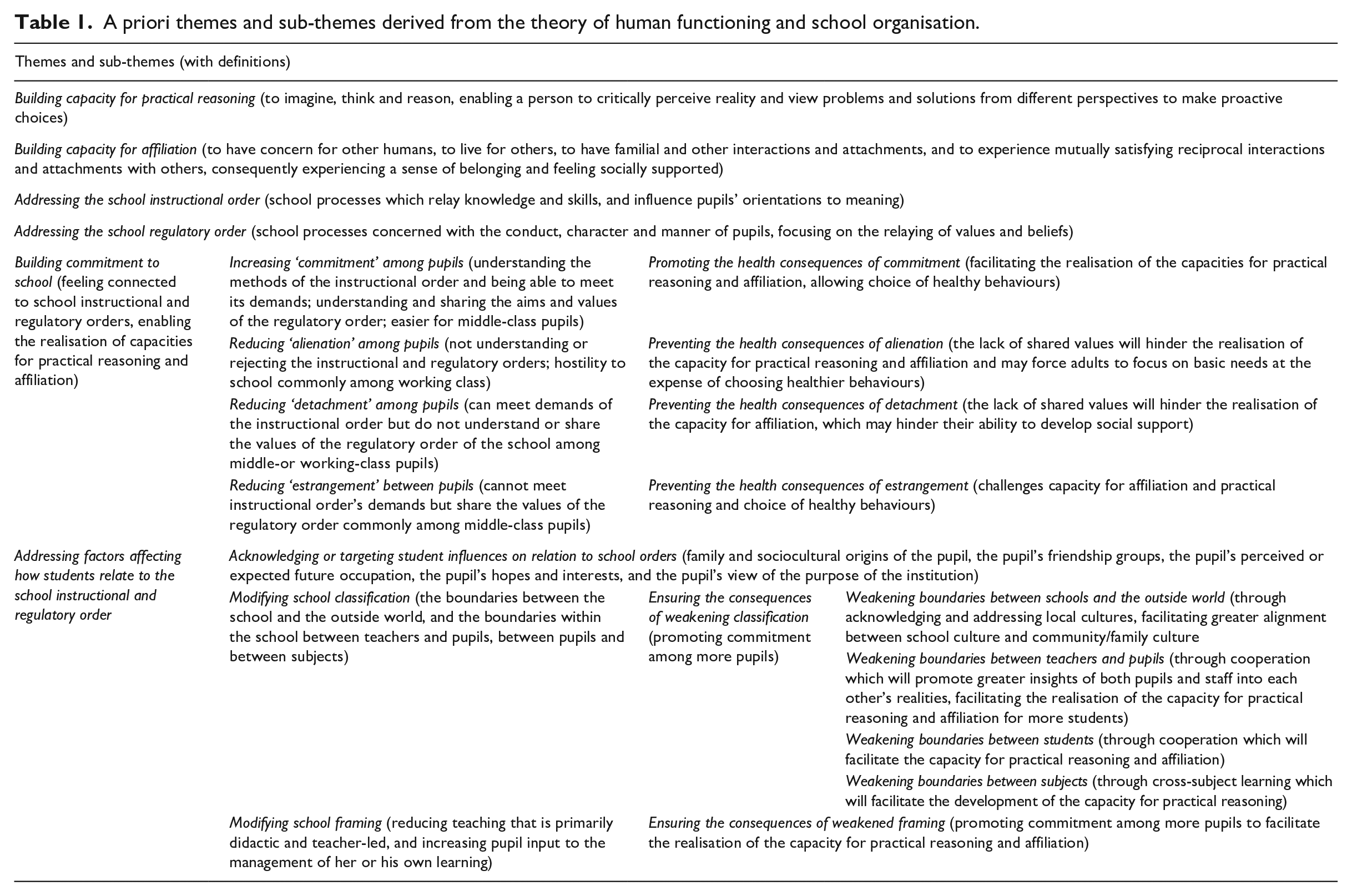
In this synthesis, we reduced the theory of human functioning and school organisation to a set of a priori themes for use in coding (Table 1). Two reviewers undertook a pilot analysis of two reports deemed high quality. The reviewers independently coded these reports using the a priori codes, creating inductive codes where needed (Miles and Huberman, 1994). The same reviewers then compared their coding, developing a refined set of codes before coding the remaining reports. At the end of this process, the two reviewers compared and modified their codes, agreeing on a final framework comprising a priori, modified and new themes.
A priori themes and sub-themes derived from the theory of human functioning and school organisation.
Then, drawing on concepts from meta-ethnography (Noblit and Hare, 1988), the reviewers synthesised themes. They identified instances of ‘reciprocal translation’, whereby similar concepts were expressed in the theories of change underpinning other interventions, and ‘refutational synthesis’, where concepts expressed in the descriptions of intervention theories of change opposed or conflicted with one another. This enabled the development of an overall ‘line of argument synthesis’. This outlines a refined theory of change which, although based on the theory of human functioning and school organisation, was elaborating by piecing together multiple insights from our synthesis of intervention theories of change.
Findings
Included reports
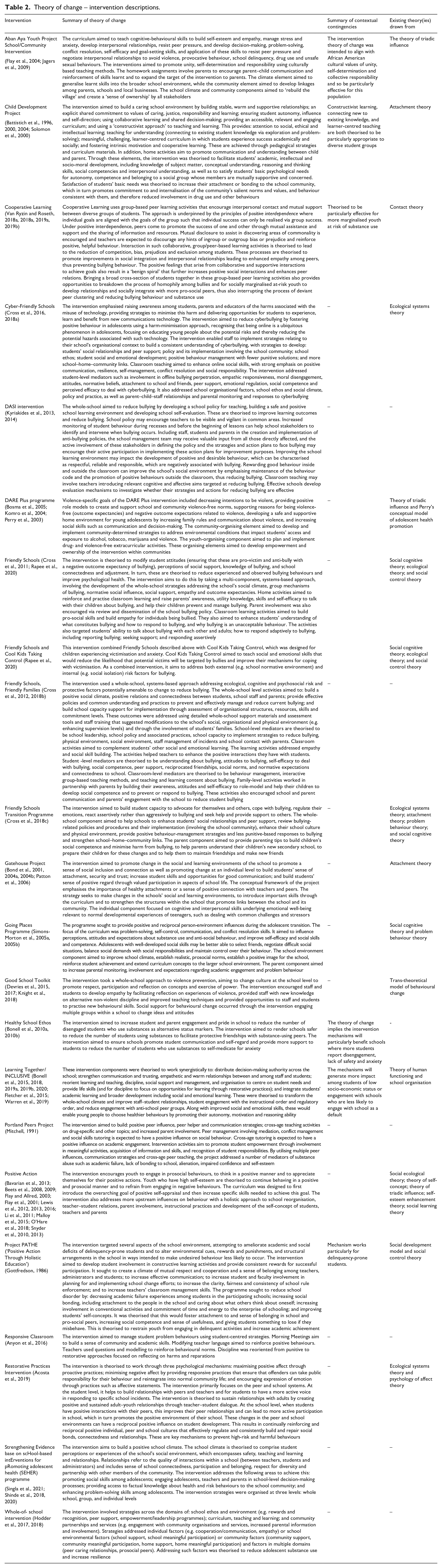
The original searches identified 62,742 unique references and 56 reports eligible for inclusion in the review. The updated search retrieved 9,709 unique references and nine eligible reports. Sixty-three reports on 27 studies of 22 interventions were included in the synthesis of theories of change. All provided some description of a theory of change covering the interventions described in the review. Two reports were not analysed further because they replicated descriptive text provided in other reports (Greco et al., 2018; Legood et al., 2021). We summarised the theory of change for each intervention (Table 2) and the results of the quality appraisal for each report (see Supplemental Online File). The theory of human functioning and school organisation was only identified in the theory of change in the Learning Together programme. Others cited other theories that engaged with organisations and context, not merely individuals, such as ecological systems theory, social ecological theory and the theory of triadic influence.
Theory of change – intervention descriptions.
Synthesis of theories of change
Almost all the interventions, other than the Positive Action intervention and the Going Places intervention, had theories of change which could be brought together and aligned with aspects of the theory of human functioning and school organisation.
We identified various recurrent themes across theories of change which aligned with, and in some cases augmented or refined, the a priori themes. In the narrative below, we present our themes ordered by different elements of intervention and the mechanisms these were claimed to generate, and emphasising new or refined themes.
Inductive coding suggested a number of refinements to our a priori theory, which are discussed later.
Reframing school organisation and management
The reframing of school organisation and management so as to involve students, parents and/or other members of the community more fully in decision-making emerged as an overarching theme across many theories of change. Several interventions had surveyed or consulted with students to identify priorities for action. In some cases, students participated directly in groups with staff to make decisions. Such approaches were theorised as making school policies and provision more student-centred, supporting the implementation of intervention activities and strengthening relationships between or among staff and students. This aligned with our a priori theme of eroding boundaries among and between these groups. The high-quality description of the theory of change for the Strengthening Evidence base on School-based interventions for Promoting Adolescent Health Programme (SEHER) intervention, which included such groups, described the process thus (Shinde et al., 2018):
The intervention’s conceptual framework . . . emphasises the importance of a positive school climate – i.e., supportive relationships between school community members, a sense of belonging to the school, a participative school environment, and student commitment to academic values . . . The community aspect of school climate refers to the quality of relationships within a school (i.e., relationships between teachers, students, and administrators) and includes sense of school connectedness, respect for diversity, and partnership with other members of the community. (p. 2469)
Interventions that recruited parents or community members into the groups leading implementation described efforts to involve the wider school community in organisational management. This closely aligned with our a priori theme of weakening classification by eroding boundaries between the school and parents and/or community members. Such a process was exemplified in a high-quality description of the theory of change for the Aban Aya Youth Project School/Community intervention (Flay et al., 2004):
The community program forged linkages among parents, schools, and local businesses. Each . . . school formed a local school task-force consisting of school personnel, students, parents, community advocates, and project staff to implement the program components [. . .] propose changes in school policy, develop other school-community liaisons supportive of school-based efforts, and solicit community organisations to conduct activities to support the [group’s] efforts. A goal of these linkages was to ‘rebuild the village’. (p. 3)
Reframing the instructional order
Interventions that included this approach commonly included changes to teaching to increase student engagement in learning. Theories of change differed as to whether this was limited to ensuring the quality or cultural inclusivity of teaching methods, or more radically reframing learning to provide students with a more active role. Below we consider these different approaches and how they aligned with our a priori theme of reframing the instructional order to weaken boundaries within and beyond the school.
Some theories of change described enhancing the cultural inclusivity of teaching, describing this as a means of re-centring provision on the needs of students. The evaluation of the Aban Aya intervention (Flay et al., 2004) explained the following:
Studies suggest that programs for African American youth should incorporate components that . . . enhance growth of sense of self and cultural pride and. . . strengthen family and community ties. Hence, the interventions included the Nguzo Saba principles . . . which promote African American cultural values such as unity, self-determination, and responsibility; culturally based teaching methods . . . (e.g., storytelling and proverbs) and African and African American history and literature. (p. 3)
Some interventions aimed to improve pedagogic practices across a school, for example, by organising teachers into teams to share and support good practice. This reciprocally translated with our a priori theme of eroding boundaries between teachers who previously worked independently. The high-quality theory of change for the Dynamic Approach to School Improvement (DASI) intervention described the process as follows (Kyriakides et al., 2014):
. . . teachers interact on issues associated with learning and teaching in order to create a business-like school and classroom environment. . . Interaction and collaboration among teachers can only be beneficial, and could boost [school learning environment] quality. . . the school management team may encourage their teaching staff to learn from each other by exchanging ideas and experiences on facing and reducing bullying. (p. 4)
In one intervention (Gottfredson, 1986), providing careers information and teaching job-seeking skills were seen as introducing students to the world of work and reframing education so as to be more meaningful to students. These processes also reciprocally translated with our a priori theme of weakening boundaries between schools and local communities. This process was described by a medium-quality account of the theory of change for the Positive Action Through Holistic Education intervention (Gottfredson, 1986) as follows.
The Career Exploration Programs, cosponsored by the program and a local technical college, provided high school students opportunities to participate in activities designed to introduce them to technical careers such as engineering, computer science, and industrial technology. (p. 711)
Turning to the more radical reframings of the instructional order, the authors of one account referred to the value of ‘constructivist’ approaches to learning, whereby new knowledge was co-produced with students, in ways informed by existing knowledge and ideas. The medium-quality description of the theory of change for the Child Development Project (CDP) (Battistich et al., 2000) stated,
Learning is inherently an active process in which students interpret new information in light of previous understandings and experiences, work through discrepancies, and construct new understandings . . . CDP’s instructional practices are consistent with this ‘constructivist’ approach to learning . . . (p. 4)
Various forms of cooperative learning reoriented learning methods from individualistic tasks, assessments and rewards towards learning undertaken collaboratively by groups of students. In the Cooperative Learning intervention, this involved a commitment to principles of positive interdependence, whereby individual goals are aligned with those of the group so that individual success can only be achieved via group success (Van Ryzin and Roseth, 2019a).
Activities such as these aimed to erode boundaries between students and boundaries between academic education and students’ broader social and emotional development. As described for the CDP (Battistich et al., 2000),
The specific learning goals or challenges and the particular social skills and behaviors required for successful collaboration are introduced and discussed with students at the beginning of each activity, and students reflect on and discuss their group interaction at the conclusion of the task. Thus, in addition to being an effective approach to learning, the cooperative activities also help students to build interpersonal bonds and develop social and ethical understanding and skills. (p. 6)
By bringing diverse groups of students together, such approaches were theorised as likely to foster insight and understanding of others’ perspectives; encourage positive relationships across a broad cross-section of peers; and erode boundaries between school and diverse local cultures, and between students.
Some interventions, such as the Portland Peers Project (Mitchell, 1991), also included peer tutoring or mentoring, in an effort to erode boundaries between students but also boundaries of status between teachers and students. Other interventions engaged parents in homework, as part of an effort to develop parents’ role in educating their children in support of the school (in effect eroding boundaries between the role of teachers and that of parents) or to draw on diverse family cultures so as to reframe learning (eroding school/home boundaries). As described for the CDP (Battistich et al., 2000), such activities
. . . are designed to promote extended conversations and communication between students and their parents, connect the home to students’ experiences in school, and help students gain knowledge and understanding of their family’s beliefs, experiences, culture and heritage. (p. 7)
The approaches to reframing the instructional order outlined above were theorised as likely to engender school commitment, as well as promote attributes reciprocally translated with by the concepts of practical reasoning and affiliation. Several theories of change suggested such changes may be of particular benefit to students from diverse or marginalised cultural communities or students who are disengaged from learning (Battistich et al., 1996).
Reframing the regulatory order
Theories of change also engaged with the concept of a school regulatory order and its reframing to engender greater student commitment. The concept of a regulatory order was apparent, for example, in the theory of change for the CDP (Battistich et al., 2000):
Although often not explicitly recognised, schooling conveys important moral messages about how we should live our lives and how we should live together as people. . . The CDP program makes this ‘hidden curriculum’ . . . overt and supportive. (p. 4)
Theories of change differed as to whether this reframing of the regulatory order was limited to improvements in, or a radical reframing of, disciplinary practices. The former might involve, for example, enhanced classroom management, increased staff visibility at break-times, consistent enforcement of rules and/or the use of non-violent punishment, and actions to address students’ need for a safe and orderly environment. More radical reframing could provide students with a more active role in school life via strategies such as re-writing school rules; the use of learning-based discipline or restorative practice (whereby teachers held meetings between the party to conflict to identify harm, consider reparation and restore relationships); or teaching students social and emotional skills.
Radical reframing of the regulatory order was theorised to achieve its impacts via mechanisms aligned with our a priori theme of eroding boundaries within the school. Several theories of change suggested that students’ contribution to re-writing school rules or discipline policies worked to erode boundaries between staff and students as well as between students, and would increase overall student commitment to the reframed regulatory order. For example, the DASI intervention described the process thus (Kyriakides et al., 2014):
The active involvement of teachers, students, and parents in defining the school policy on bullying and the strategies and action plans to face bullying may encourage their active participation in implementing these action plans for improvement purposes, since school stakeholders are very likely to adopt a more positive attitude toward improvement projects when they are involved in developing the interventions. (p. 4)
Through such actions, students become not merely the subjects of the regulatory order but its co-creators in ways aligned with students’ own values and cultures. This approach reciprocally translated with our concept of eroding boundaries between schools and local community cultures. There was also a suggestion that it might particularly benefit what were termed ‘delinquent’ students (Gottfredson, 1986).
Other theories of change suggested an even more fundamental reframing of policy and practice to erode the boundary between the regulatory and instructional orders so that discipline becomes a focus of teaching and conflict becomes an opportunity for learning. Such theories informed programmes that aimed to promote positive behaviour via approaches such as ‘learning-based discipline’, ‘restorative practice’ or teaching ‘social and emotional skills’ which saw discipline as a learning rather than a controlling activity. As described for the CDP (Battistich et al., 1996),
. . .. developmental discipline emphasises a proactive ‘teaching’ approach to discipline rather than a coercive approach. (p. 18)
Similarly, social and emotional learning curricula, such as those within the Friendly Schools, Friendly Families (FSFF) intervention (Cross et al., 2012), aimed to teach students how to build relationships with peers, practise self-management skills to maintain engagement in academic learning and make healthy decisions, for example, about violence and substance use.
Restorative practice interventions such as the Learning Together and Restorative Practice interventions focused on building strong relationships between staff and students and among students to prevent misbehaviour and repair relationships after conflict. As explained in the high-quality description of the Restorative Practices intervention’s theory of change (Acosta et al., 2019),
restorative practices (e.g., circles, conferences) help to proactively build relationships with their peer and teachers and to have a more active voice in responding to specific school incidents. When students have positive interactions with their peers, this improves their peer relationships and can lead to more active participation in school, which in turn promotes the positive environment of their school. (p. 878)
Such approaches aim to erode boundaries between school members and between schools’ regulatory and instructional orders. They aim to prevent violence and other risk behaviours by ensuring that perpetrators do not become disconnected from the school community. As was reported for the Restorative Practices intervention (Acosta et al., 2019),
responsive practices . . . ensure that offenders can take public responsibility for their behavior and reintegrate into normal community life. (p. 878)
Other theories also suggested the value of eroding boundaries between the instructional and regulatory orders by transforming teachers’ relationships with students from being merely instrumental towards being affective, rooting learning in caring relationships. As described for the CDP (Battistich et al., 1996), for example,
Teachers and administrators are encouraged to build warm, nurturing relationships with their students, and encourage students to develop warm, supportive, inclusive relationships with each other. (pp. 14–16)
Some interventions sought to involve parents in discipline by encouraging them to more closely monitor students’ behaviour. The aims of such work reciprocally translated with our a priori themes of eroding boundaries between the teacher and the community. As illustrated in the description of the FSFF programme’s theory of change (Cross et al., 2018b),
The intervention was designed to systematically target parenting factors. . . identified as being protective of bullying behavior (and other problem behaviors) including parent modeling, parenting style, parent bullying attitudes and beliefs, normative standards about bullying, family management techniques, connectedness and cohesion, and–particularly–parent–child communication about bullying . . . These activities also aimed to encourage school and parent communication, and parents’ engagement with the school to reduce student bullying. (p. 5)
Reframing relationships with the community
The involvement of parents and community members in school decision-making is described above as a means of reframing organisational management and eroding boundaries between schools and the world beyond. Several projects also aimed to build relationships between schools and local communities through community and voluntary work: by students volunteering in the community, by community members volunteering in schools or by schools building alliances with community organisations. All these reciprocally translated to our prior concept of school-community boundary erosion.
For example, the Aban Aya intervention sought to build relationships between schools and local businesses and community groups so that these might provide funding for school activities, or advice and support to students (Flay et al., 2004).
Engendering positive development and student commitment to reduce risk-taking behaviours
A recurring theme across theories of change was that the processes described were theorised not only as likely to reduce risk behaviours but also as helping build students’ positive development:
CDP’s emphasis is on the promotion of positive development . . . [to] promote children’s positive social, ethical, emotional, and intellectual development. (Battistich et al., 2000: 76–77)
Some interventions sought to achieve this by engendering student commitment to school. Different theories used different terminology to describe what was involved. Some of the key concepts used were school attachment, bonding, school adjustment, inclusion, and engagement and connection.
An example of refutational synthesis occurred when some theories of change viewed student commitment as reflecting a real investment and commitment to shared values, but others saw this more as outward compliance with rules. For example, the medium-quality description of the CDP’s theory of change (Solomon et al., 2000) explained how the intervention aimed to transform schools so that students were fully committed to its ethos and values:
We expect that students who have these needs met by experiencing a caring school community will feel strongly attached to the community, and that this attachment will lead them to feel personally committed to the values and goals the community promotes, particularly if those values and goals are clear and jointly held by the community members. (p. 5)
In contrast, the DASI Intervention (Kyriakides et al., 2014) emphasised the importance of student compliance in adhering to school rules and policies:
. . . schools could set up a motivation system to improve the school’s social environment by taking action to emphasise maintenance of the behavior code and the promotion of appropriate and positive behaviors outside the classroom. (p. 3)
Theories of change described other ways in which intervention activities could benefit students’ positive development. These descriptions aligned with our a priori themes of promoting practical reasoning and affiliation, but elaborated upon these concepts. Several theories of change listed different aspects of practical reasoning such as student skills in conceptual thinking, ethical and moral reasoning, and emotional learning. Affiliation-related impacts included enhanced empathy and greater orientation to others, pro-social norms, as well as better social conflict resolution and communication skills.
Theories of change suggested that interventions would ultimately benefit students in terms of autonomy and competence to make good decisions. One example of this was present in the evaluation of the CDP (Solomon et al., 2000):
. . . autonomy/influence refers to the individual’s opportunities to contribute to the group and the group’s decisions as well as to direct his/her own activities; competence refers to the effectiveness and acceptance of the individual’s contributions to the group as well as his/her own academic and social efforts; and belonging is feeling that one is personally accepted by others and also part of a larger cohesive entity. (p. 4)
Across theories of change, attributes aligning with practical reasoning and affiliation were theorised as enabling students to choose healthier behaviours. Some theories of change suggested that an increase in student commitment to school might impact reducing risk behaviours via changes in student affiliations. This was described as follows for the CDP (Battistich et al., 2000):
. . .. the experience of being a valued member of a caring school community also should reduce the likelihood that students will seek to satisfy their need for social connection through association with gangs or other counter-cultural peer groups. (p. 4)
Summary of key findings
Despite only one whole-school intervention in our review being explicitly informed by the theory of human functioning and school organisation, the theories of change associated with most interventions aligned closely with this elements or aspects of this theory. In the light of our findings, we were able to develop the revised theory of change shown in Figure 2.
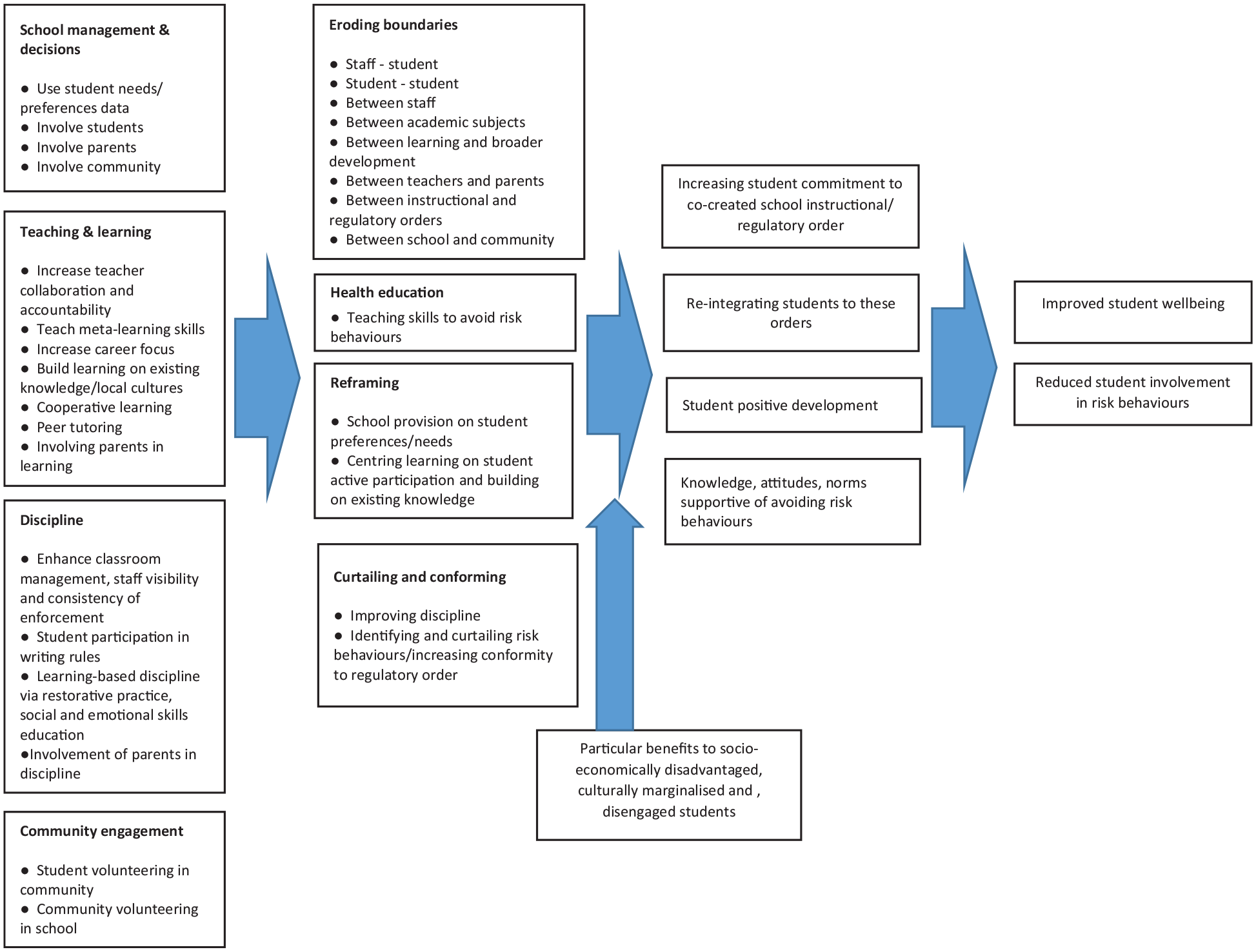
Logic model for refined theory of change for whole-school interventions aiming to prevent violence and substance use via promoting student commitment.
The refined theory of change suggests a list of specific activities that can modify school classification and reframing to increase student commitment to school. In terms of school management and organisation, these include using data on student needs and preferences to inform policy, as well as involving students, parents or other community members more directly in decision-making. With respect to teaching and learning, these include increasing teacher collaboration and accountability, teaching students meta-learning skills, increasing the career focus within teaching, building academic learning on existing knowledge informed by local cultures, instituting cooperative learning methods, using peer tutoring and involving parents in learning. In terms of discipline, these include enhancing classroom management, staff visibility and consistency of enforcement of rules; student participation in developing and re-writing writing rules; and instituting learning-based discipline, restorative practice, or social and emotional skills education. In terms of community engagement, these include students volunteering in the community or community members volunteering in school.
The refined theory of change detailed above extends the concept of reframing so as to include the process of building learning on existing student knowledge through ‘constructivist’ approaches to education. It also proposes additional ways in which the school order might be reclassified via the erosion of existing boundaries. Boundaries that might be eroded include those between staff (via more collaboration and accountability among teachers); learning and the broader development (e.g. via teaching social and emotional skills); the roles of teachers, students and parents (via peer tutoring and involving parents in learning and discipline); and the instructional and regulatory orders of the school (via learning-based discipline methods).
The refined theory of change also recognises how whole-school interventions may prevent violence and substance use among students in direct ways not just by building student commitment. These might include the enhanced monitoring of such behaviours in school, the provision of health education which teaches students the skills needed to avoid risk behaviours and the use of co-constructed discipline systems to identify and curtail risk behaviours.
The refined theory of change suggests that together the above actions may enable students to commit either to separate instructional and regulatory orders or to a joint ‘developmental’ (instructional/regulatory) order, co-created by students and staff. The refined theory also suggests that activities such as restorative practice can help reintegrate students with instructional/regulatory orders. Activities aimed at increasing commitment to school are theorised to reduce involvement in violence and substance use by students developing the practical reasoning and positive affiliation to avoid this and by discouraging students from engaging in peer groups where such risk behaviours are normative. Whereas the theory of human functioning and school organisation suggested that the described mechanisms might be of benefit to socio-economically disadvantaged students in particular, our refined theory broadens this to include students from marginalised or diverse cultural groups, as well as academically disengaged students.
Limitations
Our first review searches involved multiple sources and methods and aimed to maximise the inclusion of relevant reports. However, the updated searches were necessarily narrower because of pandemic-related limits on access. That said, the sources that yielded all of the included study reports found as a result of the original electronic searches were included in the updated search, so we think it unlikely that any studies were missed because of the reduced scope of the update search. Our synthesis of theories of change was limited by the quality of the existing reports, which sometimes did not describe clearly the pathways from intervention activities to intended outcomes. We did not aim to assess the quality of the evidence base for each of the theories of change underpinning the intervention, because this was outside the scope of the current review.
Implications for further research and policy
It is hoped that the refined theory of change, informed by and building upon the theory of human functioning and school organisation, will provide a robust basis for developing future whole-school programmes to prevent violence and substance use. The theory identifies some of the key activities that such interventions might involve and suggests mechanisms by which these might prevent violence and substance use by strengthening students’ commitment to school. Our refined theory of change might also inform future evaluation designs, for example, in terms of choice of mediator and moderator variables. This may enhance future efforts to reduce substance use and violence through work in schools.
Supplemental Material
sj-docx-1-hej-10.1177_00178969221100892 – Supplemental material for Whole-school interventions promoting student commitment to school to prevent substance use and violence: Synthesis of theories of change
Supplemental material, sj-docx-1-hej-10.1177_00178969221100892 for Whole-school interventions promoting student commitment to school to prevent substance use and violence: Synthesis of theories of change by Ruth Ponsford, Jane Falconer, GJ Melendez-Torres and Chris Bonell in Health Education Journal
Footnotes
Funding
The author(s) disclosed receipt of the following financial support for the research, authorship and/or publication of this article: This study was funded by the National Institute for Health Research in England under its Public Health Research Board (17/151/05). The views expressed in this publication are those of the authors and do not necessarily reflect those of the UK NHS, the National Institute for Health Research or the Department of Health for England.
Research materials
All research materials are available on request.

Supplemental material
Supplemental material for this article is available online.
References
Supplementary Material
Please find the following supplemental material available below.
For Open Access articles published under a Creative Commons License, all supplemental material carries the same license as the article it is associated with.
For non-Open Access articles published, all supplemental material carries a non-exclusive license, and permission requests for re-use of supplemental material or any part of supplemental material shall be sent directly to the copyright owner as specified in the copyright notice associated with the article.
