



Abstract
Objective:
The Norwegian National Action Plan for a Healthier Diet calls for discussion of new ways to communicate health information. An already established and important arena in which to do so is school, in the Food and Health (FH) subject in particular. The aim of this study was to investigate how Norwegian students experience the FH subject, and how they believe it impacts on their everyday lives.
Design:
Qualitative study using focus group discussions
Setting:
Three public schools in Norway
Methods:
Focus group discussions were audio-recorded, transcribed verbatim and thematically analysed.
Results:
The students reported the relevance of the school subject FH to their everyday life. However, how much FH was experienced as having impacted on their everyday lives with respect to cooking at home, food choice and food hygiene varied.
Conclusions:
More research is needed to explore how FH can have a stronger impact on students’ actual food choices and cooking practices. This is important in order to tackle contemporary dietary challenges among children and adolescents. Rather than discussing new channels of health education, we suggest that the FH subject area should be strengthened in schools by increasing teachers’ competence and focusing more strongly on how best to influence students’ food choices.
Introduction
A healthy diet is fundamental to living a long and healthy life (Afshin et al., 2019). Hence, action on food and nutrition related challenges is high on both national and international political agendas (Ministry of Health and Care Services, 2017; United Nations, 2017). In Norway, the National Action Plan for a Healthier Diet outlines 13 quantitative targets and indicators for change, some of which are specifically addressed to children and adolescents such as an increased intake of fruit, vegetables and fish, and a decreased intake of sweets and soft drinks (Ministry of Health and Care Services, 2017).
Young people’s food habits are determined by individual, social and cultural factors (Brug, 2008; Murimi et al., 2018). Hence, changing a health-related behaviour such as diet requires the use of ‘careful, thoughtful science that leads to a deep understanding of the nature of what motivates people and the social and economic pressures that act upon them’ (Kelly and Barker, 2016: 114). To impact dietary behaviour, a myriad of competencies relevant to knowledge and skills relating to food and nutrition is needed (Burton et al., 2018; McGowan et al., 2017; Ronto et al., 2016; Seeley et al., 2010). In pursuit of this, Bruun Jensen (2000) has argued for democratic health education which develops students ‘action competence’ to act at both a personal and a societal level. With respect to food and nutrition education, the World Health Organization (WHO, 2006) and the European Commission (2014) recommend a comprehensive approach which includes a focus on cooking, nutrition and developing a healthy lifestyle alongside various awareness raising learning activities.
Schools are an important arena for encouraging health promoting practices (WHO, 2015, 2018). Furthermore, fully 96% of Norwegian students attend public schools (Statistics Norway, 2020). Thus, health promoting education in schools has the potential to reach nearly all children and adolescents regardless of gender, geographical location, socioeconomic status, and cultural background. In public schools in Norway, the Food and Health (FH) 1 is a compulsory subject covering 197 teaching hours though primary (age 6–12) and lower secondary school (age 13–15) (Ministry of Education and Research, 2019). FH is usually taught in the sixth (age 11) and ninth (age 14) grades, and the curriculum states which competences students should be able to achieve after this through its competency aims.
FH is central to developing students’ understanding regarding the connection between diet and health (Directorate for Education and Training, 2019). The FH curriculum describes how the subject will contribute to promoting public health, food enjoyment and interest in a diversity of foods, and good eating habits (Directorate for Education and Training, 2019: 2). Thus, the public health perspective is evident. FH education has existed for more than 100 years and was initially called skolekjøkken (school kitchen). It originally taught students how to cook, clean and do other household chores (Askeland et al., 2017). However, in formal terms, the subject has changed with time to engage with the consequences of living in an affluent society (Holthe, 2009; Øvrebø, 2008). That said, although the national curriculum may have changed to engage with new priorities, Bjørnstad (2003) and Holthe et al. (2013) report that traditional practice in the field of FH remains intact. Most of the teaching in FH today remains teacher centred with a strong focus on cooking (Beinert et al., 2020; Espeland et al., 2013; Veka et al., 2018) despite the fact that the curriculum highlights broader competencies relating to nutrition, sustainability, food labelling and critical thinking (Directorate for Education and Training, 2019). Hence, today’s education in FH does not seem to follow the curriculum to the degree expected (Veka et al., 2018) and, as a result, students’ knowledge, skills and attitudes have not changed in the manner expected (Øvrebø, 2014).
Before the national curriculum reaches students in the classroom, it is interpreted through a local curriculum, an individual school’s semester plan, and local teachers’ interpretations and adaptations. Bjørnstad (2003) questions whether this academic freedom, which might be expected to create diversity, in fact causes a narrowing of the subject, as traditional values and practices prevail. It has been argued that FH needs to shift to a wider concept of developing students’ knowledge, attitudes and skills relating to both theory and practice as part of its concern for health promotion (Beinert et al., 2020). In Sweden, Höijer et al. (2011) interviewed 25 teachers about Home and Consumer Studies, a subject similar to FH in Norway, and which is also referred to as home economics (HE) internationally. Their data revealed a gap between the theoretical aims of the curriculum and the practical cooking activities undertaken in lessons. The authors argue that the main focus should not only be on cooking and food, but on how food is used as an educational tool, or ‘food with a purpose’ as Höijer et al. (2011) describe it. In Norway, Øvrebø (2014) has suggested the greater integration of theory with practice, while Taar (2017) recommends that teachers include more cognitively oriented learning tasks into lessons to enable students to seek meaning in their learning activities.
While a recently published study has investigated teachers’ and students’ experiences of the FH subject in Norway (Beinert et al., 2020), how and to what degree FH education impacts students’ actual lives is unexplored. As FH has an ambitious curriculum which aims to promote public health and which often requires behavioural change of some sort, the aim of this study was to investigate students’ experiences of how the school FH influences their everyday lives, here defined as their day-to-day actions relating to food.
Methods
This study was undertaken as part of the LifeLab FH project at the University of Agder (UiA), Norway, which aimed to develop and evaluate different learning tasks in FH (Beinert et al., 2020, 2021). Data for the study consist of Focus Group Discussions (FGDs), investigating how students experienced the subject, and the ways they believed it impacted on their everyday lives. Three schools in the southern part of Norway with which the UiA had FH teacher education agreements were included in the project, and were chosen using convenience sampling (Stewart and Shamdasani, 2015). After emailing the schools, the project group visited each school and outlined the aims of the project and the school’s role within it if they agreed to participate.
FGDs
Focus groups are ideal for exploring the range of people’s experiences (Merriam, 2009) and particularly helpful when relatively little is known about a phenomenon (Stewart and Shamdasani, 2015). The FGDs were conducted at the three included schools in June and September 2018. Since there is a summer holiday in July, the FGDs were conducted with 6th and 9th grade students in June, and with 7th and 10th grade students in September.
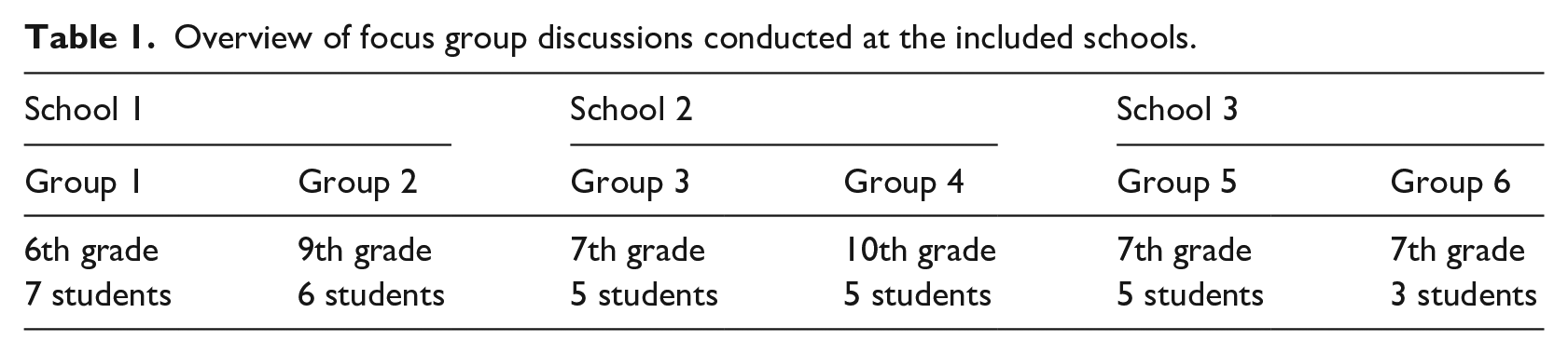
Prior to the FGDs, written consent forms with information about the project and participation were sent to teachers by email (Fossheim, 2015). The teachers handed out the consent forms to students to take home to their parents/carers who provided written consent. The students themselves thereafter provided assent. Because there were more students available than needed for one FGD in each class, the teachers selected which students to participate from among those who had consent to participate, guided by the recommended that there be 5–8 participants per FGD (Krueger, 2015). In total, 31 students participated the study, in groups of 3–7 participants (Table 1).
Overview of focus group discussions conducted at the included schools.
Data collection
FGDs were conducted in meeting rooms or classrooms at the respective schools, and the surroundings were therefore familiar to the students. A topic guide prepared in advance was established the structure of the FGDs, and sought to ensure consistency in the questions asked across groups (Kvale and Brinkmann, 2009; Stewart and Shamdasani, 2015). At the start of each FGD, the students were encouraged to speak freely and share as many thoughts as possible regarding the subject. The students were informed that the discussions would be recorded and then transcribed and then anonymised. They were also told that there are no right or wrong answers and that their honest feedback was highly valued. All this information was given in an age-appropriate manner adjusted to each group. Before recording started, the students were also asked if they had any questions, and these were answered. During the FGDs, the facilitator encouraged natural conversation in an effort to make the process more relaxed for students. Follow-up questions were asked beyond the topic guide whenever issues of interest came up. On average, each of the FGDs lasted for approximately 30 minutes.
Analysis
After the FGDs, the recordings were transcribed into separate documents for each group. It is important to ensure information is retained in a way that is true to its original nature (Braun and Clarke, 2006). Each recording was therefore listened to several times and transcribed verbatim. Words and sounds that might confirm, deny or in any other way complement the content, were also included. To ensure confidentiality, the names of participants, schools or other things that might facilitate identification, were removed.
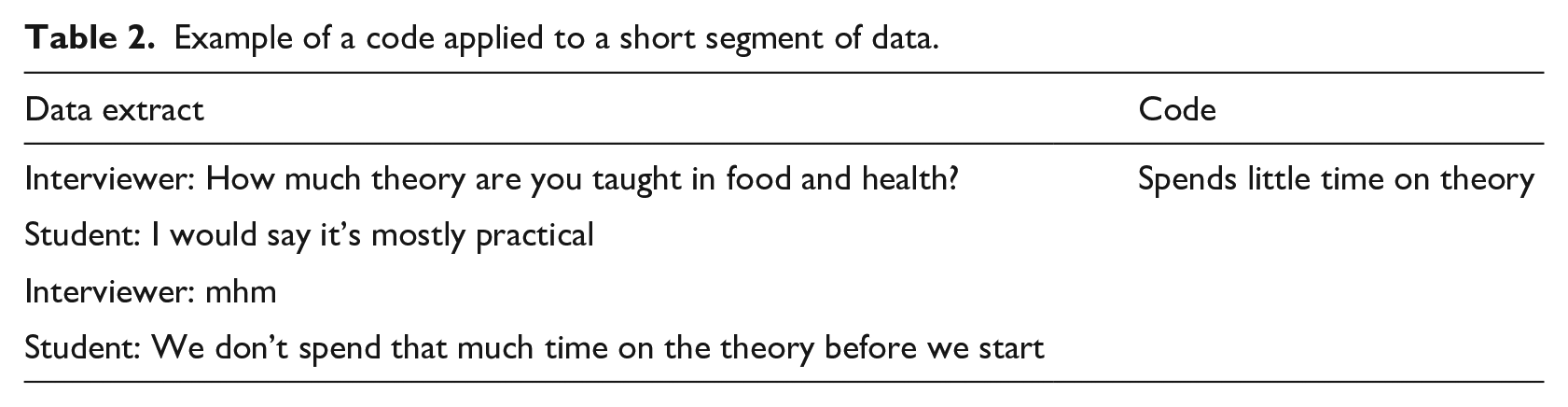
The data were then analysed using qualitative thematic analysis, as described by Braun and Clarke (2006). This process consists of six steps starting with reading the manuscripts several times to get a sense of the whole (step 1) and then generating initial codes from segments of the data that are relevant to the research questions (step 2). Table 2 shows an example of a code applied to a short segment of data.
Example of a code applied to a short segment of data.
The codes were then collated into potential themes (step 3), which were checked to see if they worked in relation both to the codes and the entire data set (step 4). The final two steps involved defining and naming the themes (step 5) before producing a report of the findings (step 6). The coding process was done with the help of NVivo version 12.3.0.
Results
In all FGDs, the general perception of FH was that it is fun, and one of the students’ favourite subjects in school. Students reported FH being relevant to their everyday lives, providing them with knowledge and skills needed both in the present and in the future. However, different views were expressed concerning to the degree to which FH impacted on students’ everyday lives as detailed below.
Food choice
Students agreed that they had more knowledge of food and a healthy diet after FH education, then they did before. This suggests that these topics are included in their FH lessons. Nevertheless, their opinion as to whether FH had influenced their food choices, varied. Some said that FH had influenced their food choices in that they are more aware of what they ate and that they ate healthier now than before because of what they had learned in the FH lessons:
And then the other day we learned about, a handful of fruit or a glass of juice, that it somehow is important, because then you get more nutrients into your body. I didn’t use to think about that, so sometimes when I came home before, I used to maybe take a slice of bread, but now I take some more fruit and more things I know have lots of nutrients in it instead. I have become a little more aware of that.
(Group 1)
I don’t know if it is because of FH but . . . I do not know . . . there might be moments where I think, ‘no, I’m not buying that’ or something like that. . . that I choose something else rather than what I really want. I don’t know if it is because of FH. . . I don’t think so.
(Group 4)
That said, other students expressed that even if they had more knowledge of a healthy diet than before they had FH, they still stuck to old habits, suggesting there were other barriers to dietary change.
You think ‘that it’s not healthy for me’, but then you think ‘this one time is no problem’ . . . (giggles) . . .. and then it gets that way every time . . .
(giggles) yes, then it becomes that way the second time and the third time and . . .
(Group 5)
Group 4 discussed how they had an assignment in which they registered their diet for one day. They explained how their teacher focused on what not to eat in large amounts, such as sugar. Instead of adopting this focus (on what to eat less), students suggested a focus on what to eat more often, thereby adopting a more positive and health-promoting attitude towards food.
Cooking at home
Whether FH resulted in more home cooking or not, varied. Some students said that they cooked just as much at home as they had done before, while others stated that they cooked more subsequently:
Do you feel that you cook more at home or after school now after you have had Food and Health than you did before?
No, not really . . . mostly I help my mom when she cooks . . . so, there is not much of a change.
Well . . . I actually have cooked a couple of dinners after we started with
Food and Health . . . so I actually have made food at home . . .
What about the rest of you?
Yes, it is useful, because one understands much more what’s going on in the kitchen . . . really . . . so it . . . I find it very useful and I have cooked lots at home and . . . I understand much more and . . . mhm
(Group 2)
Some students, however, seemed to be generally less interested in cooking, and even if they knew more about how to cook after the classes than beforehand, they either did not find the time to cook or did not bother to cook:
Do you make any more food at home then, after you have been through Food and Health?
I’ve considered it
You have considered it
But I haven’t had the time
I’ve learned a little more about it, about the stove and stuff that I didn’t know before. But I make just as much food as I used to, but now I might have a little more knowledge to consider.
(others confirm)
I can do it, but my cousin tends to cook at home
(Group 6)
Students described a task in FH where they had to plan and prepare a meal themselves and needed to stay within a limited budget. This was seen as a valuable thing to do and was different compared to a traditional FH class, where the menu and groceries were prepared by the teacher in advance. Some students said it was valuable because it was something they would have to do later in life, and the task prepared them for this independence. Such a task was seen as fun and challenging, but more importantly, useful.
Food hygiene
Beyond cooking at home and food choices, the importance of hygiene to make sure food is safe to eat, was another thing some groups said they had become more aware of after FH:
yes, hygiene and stuff. What kind of knives to use and . . . and all that. . . I have become more aware of that after food and health.
(Group 4)
And then we have learned about hygiene and . . . that it is very wise to wash your hands, and not have meat and vegetables on the same cutting board and other smart things to do . . . in the kitchen.
And how to prepare the food and stuff like that. So that one does not prepare things the wrong way, or that it is something. . . or that it can become dangerous because of a kind of bad chicken or something like that.
(Group 1)
Being able to prepare safe food was clearly something students learned about during FH. The need to use clean knives and cutting boards and keep meat and vegetables separate when preparing food, was specifically mentioned by several students.
Discussion
The aim of this study was to investigate students’ experiences of the effects FH had on their everyday life. Most students agreed that they had more knowledge of a healthy diet after receiving FH, but only a few said this knowledge had led to changes in their food choices.
Children and adolescents’ dietary habits are complex and determined by multiple factors (Brug, 2008; Murimi et al., 2018). For example, although young consumers may be aware of the importance of healthy eating, their food preference behaviour does not always reflect this knowledge (Brown et al., 2000). This aligns with the findings here where students reported increased knowledge, but few dietary changes.
Ronto et al. (2016) argues that in order to impact dietary behaviour, educators should focus on how to apply food and nutrition knowledge. Young people need to have adequate knowledge, skills and motivation to transfer what they learn in school to everyday life. This aligns with the suggestions made by Taar (2017) to include more cognitive oriented learning during class and Øvrebø (2014) who suggests the need for stronger links between theory and practice. Although the FH curriculum states that the subject aims to contribute to promote public health (Directorate for Education and Training, 2019: 2), given the myriad of influences on our health behaviour, (Kelly and Barker, 2016), the curriculum may be too ambitious in what it aims to achieve. Furthermore, since so much of today’s FH teaching is teacher-centred (Beinert et al., 2020; Espeland et al., 2013; Veka et al., 2018), there is a need for more student activating learning approaches to enhance students’ learning outcomes (Beinert, 2021).
Since school reaches by far the majority of children in Norway, and because students have been reported to trust their teachers as health ‘experts’ (Velardo and Drummond, 2019), it is important to further develop good quality pedagogical tools for FH, and to ensure competence to use these among FH teachers. This is important as research has shown that qualified FH teachers, who have specialised in FH as part of their teacher training, teach more in line with relevant competency aims, pay more attention to dietary guidelines, and spend more time on formal FH training (Bottolfs, 2020). As nutrition and health-related topics are often complex, it is reasonable to assume that raising the level of formal qualification of FH teachers, which today is low (Perlic, 2019; Vik et al., 2020), would support teachers’ ability to transcend older styles of teaching and thereby guide students towards healthier food choice and preparation skills.
How much cooking students did at home varied. In part, this may be because students were at an age where they lived at home with parents and were most likely not the primary cook. Kitchen hygiene, however, was often mentioned as something they had learned and practised at home. Interestingly, when asked what they enjoyed or remembered particularly well from FH classes, many students described planning and making a two-course meal by themselves. Other FH lessons should be based on such methods to ensure students are more activated and involved (Dumont et al., 2012; Nordenbo et al., 2008). In addition, FH lessons might focus more on how to motivate students to make healthier choices and bridge the gap between theory and practice.
Finally, an enhanced focus on student led active learn in FH aligns with the commitments of democratic health education and the development of students’ action competence (Bruun Jensen, 2000). According to Bruun Jensen (2000), action competence implies that students are able to exert influence over their own lives and in society. This may lead to later change in personal and public health.
Strengths and limitations
This study has some limitations. Some of these relate to the data collection methods used. While FGDs have the potential to facilitate group interaction (Cozby and Bates, 2014), potential problems can arise from group dynamics influencing how much, and in what way participants choose to share their thoughts (Bryman, 2016). This kind of group effect may be especially evident among middle school students, for whom peers serve as powerful role models (Horner, 2000). In addition, because the FH teacher decided which students (from among those with parental consent) would participate in the FGDs, we do not know what influenced these choices. It is perhaps reasonable to assume that the most engaged students were those selected and most eager to contribute, and this needs to be considered when interpreting the results.
Conducting the interviews in an environment familiar to participants may help reduce the power imbalance between an adult researcher and younger participants (Barbour, 2007; Morgan et al., 2002). However, conducting the interviews in schools could trigger typical school behaviour such as waiting for permission to speak by raising a hand (Gibson, 2007) or seeing the researcher as a teacher and therefore thinking there are right or wrong answers to the questions asked (Fargas-Malet et al., 2010). How the questions were asked might also influence the answers given. Some questions were asked directly, while others were asked more indirectly, which also can have an impact on the answers students provided. Finally, there is always the risk of social desirability bias (Moy and Murphy, 2016: 19), with students saying what they believe is expected from them. Ultimately, we acknowledge that our findings rely on what students were willing to say about their food choices, and this may differ significantly from their day-to-day actions.
Conclusion
Students participating in this study described the relevance of FH to their everyday lives. How FH impacted their everyday lives varied, having mostly little to no effect on food choices. These findings suggest the need to strengthen FH in schools by increasing teachers’ competence and focusing more strongly on everyday food choices. Future research might usefully explore how teaching methods that promote active learning may be used to engage with the curriculum and motivate students to adhere to healthier food choices in everyday life. This way, FH may better fulfil its potential of promoting public health by becoming an influential means of enhancing motivation, knowledge and skills related to food and health. As students come to see the relevance of the subject to their lives, the stronger the role FH can have in promoting health, both today and in the future.
Footnotes
Acknowledgements
We thank students for contributing to the LifeLab Food and Health project.
Funding
The author(s) disclosed receipt of the following financial support for the research, authorship, and/or publication of this article: The University of Agder supported the work undertaken by the LifeLab Food and Health Project.
