




Abstract
Objective:
To evaluate the feasibility and acceptability of a theory-grounded, text message–based intervention targeting sedentary behaviour among university students.
Design:
Single-group repeated measures design.
Setting:
Post-secondary institution in British Columbia, Canada.
Methods:
Data concerning students’ sedentary behaviour were collected via online survey completed at three time points over the course of one university semester: baseline (T1), post-intervention (T2) and 2-week follow-up (T3). The 6-week intervention comprised four weekly text messages delivered to participants’ mobile devices. Participants’ attitudes regarding the intervention were evaluated together with other measures including constructs in the Health Action Process Approach (HAPA). Sedentary behaviour and physical activity were measured using the Physical Activity and Sedentary Behaviour Questionnaire (PASB-Q).
Results:
The intervention was generally well received by participants. Preliminary, observational data suggest some indices of user experience were statistically associated with behavioural outcomes and may inform future work. Hours per week of sedentary behaviour did not change across time points, whereas minutes per week of physical activity decreased significantly from baseline to follow-up.
Conclusion:
While study findings suggest minor modifications to the intervention may improve participants’ engagement, we demonstrated overall that a theory-grounded, text message–based intervention to reduce sedentary behaviour can be feasibly implemented. The efficacy of this intervention should be tested through a randomised control trial with a representative sample of the student population.
Keywords
Emerging adulthood (ages 18–25 years) is an important developmental period in the study of health-related behaviours. For many, emerging adulthood corresponds with post-secondary education. University (or college) student lifestyles are associated with increased sedentary time, decreased likelihood of meeting physical activity guidelines, unhealthy food intake and lack of self-care behaviour (Nelson et al., 2008; Stoliker and Lafreniere, 2015). Because lifestyle behaviours during this period may have long-term implications for health, this transitional stage presents an opportunity for targeted health promotion interventions (Nelson et al., 2008).
Sedentary behaviour is defined as any waking behaviour while sitting or lying down, using less than 1.5 metabolic equivalents (METs) of energy expenditure (Peterson et al., 2018; Tremblay et al., 2017). Prolonged sedentary behaviour is associated with increased risk of chronic disease and all-cause mortality independently of physical activity levels, individual demographic factors (e.g. age, gender), diet and other health-related behaviours (Diaz et al., 2017; Ekelund et al., 2016; Healy et al., 2011; Katzmarzyk et al., 2009). Compared to estimates of 9.5 hours in the general population (Center for Surveillance and Applied Research Public Health Agency of Canada, 2020), undergraduate students engage in an average of 10.7 hours per day of sedentary behaviour as measured by accelerometer (Moulin et al., 2019). Interventions targeting reductions in sedentary behaviour over those focused on increasing physical activity participation are more effective for reducing sedentary behaviour, likely reflecting the conceptual independence of the two constructs (Prince et al., 2014). Strategies for reducing sedentary behaviour include decreasing the duration of continuous sedentary time and encouraging breaks from sedentary behaviour (Cotten and Prapavessis, 2016; Diaz et al., 2017).
The proper use of behaviour change theory to develop interventions can contribute to intervention success (Glanz and Bishop, 2010). One such theory is the Health Action Process Approach (HAPA), a social-cognitive model postulating that behaviour change occurs in two phases: the motivational phase, in which individuals develop intentions to change their behaviour, and the volitional phase, during which individuals execute the intended behaviour change(s) (Schwarzer, 2008; Sniehotta et al., 2005). The HAPA has been applied previously to a counselling behaviour change intervention with university students, resulting in increased breaks in sedentary behaviour compared to an active control group receiving a nutrition-focused intervention (Sui and Prapavessis, 2018).
Text message–based interventions are a cost-effective intervention strategy and can be tailored to specific populations and health behaviours. Text message–based interventions are commonly employed for smoking cessation and promoting physical activity and, less commonly, for reducing sedentary behaviour (Head et al., 2013). Among university students, Cotten and Prapavessis (2016) evaluated a 6-week text message–based intervention and found no significant changes in sedentary behaviour or physical activity between intervention and control groups, although small-to-moderate effect sizes were identified for break frequency, length and standing. Due to the absence of an intervention evaluation, we cannot conclude whether the null findings were attributable to the relatively small sample size (n = 41 per group), general challenges in changing sedentary behaviour in this population or a lack of participant engagement with the intervention.
We are not aware of any text message–based intervention studies designed to reduce sedentary behaviour in university students including an evaluation of user experience. Because of this, a feasibility study is warranted prior to conducting a larger scale controlled experiment (e.g. Blatch-Jones et al., 2018). The addition of a user evaluation component within the context of a mobile intervention is meaningful for the development of larger scale controlled trials as mobile intervention renders the question of adherence difficult to answer. Collecting end-user ratings of intervention enjoyment and engagement may help inform future work by facilitating understanding of intervention features associated with baseline behaviours and with behaviour change over time.
Current study
The study had three main aims:
To investigate the feasibility of a HAPA-informed text message–based intervention designed to target sedentary behaviour in university students;
To evaluate participants’ experience (acceptability) of the intervention and explore possible associations between intervention experience and behavioural outcomes;
To explore changes in sedentary behaviour and physical activity over the course of the intervention.
We expected the intervention would be well received by university students, feasible to deliver and user experiences of the intervention would be related to indices of sedentary behaviour.
Methods
Participants
Full-time undergraduate students aged 17–25 years were eligible to participate. Recruitment consisted of in-person or poster-based information sessions presented at the start of lectures across a variety of classes and fields of study during the first 2 weeks of the autumn 2018 semester. Interested students were asked to provide their email address and were sent an invitation to participate. The study was approved by the University of Northern British Columbia (UNBC) research ethics board (E2018.0821.086). Informed consent was obtained from all participants.
Procedure
All students who expressed interest in the study received an email including a link to the informed consent form and baseline (T1) surveys concerning their self-reported sedentary behaviour, physical activity and HAPA constructs using the SurveyMonkey platform. Following completion of the surveys, participants received the 6-week text message–based intervention, which ran from 15 October to 23 November 2018. Immediately post-intervention (T2) and 2 weeks following the completion of the intervention (T3), participants completed the same surveys. The intervention evaluation, including user experience and acceptability, was completed at T2. At each time point, the surveys were sent only to participants who completed the previous survey and remained available for 4 days, with email reminders sent on the second and fourth days. Upon survey completion, participants were eligible to enter a draw to win a CAD$100 bookstore gift card (T1 and T2) or a Fitbit Alta® (T3).
Intervention
The sedentary behaviour intervention comprised 6 weeks of text messages. Although previous work suggests 6 weeks may not be long enough to elicit meaningful behaviour change (e.g. Cotten and Prapavessis, 2016), this length of time was chosen to be feasible to conduct during a single 12-week university semester (including recruitment, baseline assessment and 2-week follow-up) and because the focus of this project was to assess user experience rather than efficacy. Each week, participants received one fact, one reminder, one tip and one challenge on Monday, Tuesday, Wednesday and Thursday between 9:00 a.m. and 4:00 p.m. (see Online Supplementary Appendix for text message inventory). The order of facts, reminders, tips and challenges was randomised across participants. The content in each message was adapted from Cotten and Prapavessis (2016) and further informed by constructs of the HAPA theory: risk awareness, outcome expectancy, action and coping planning, barriers and resources and self-efficacy (Sniehotta et al., 2005; Schwarzer, 2008). Facts were designed to enhance awareness of risks associated with sedentary behaviour and improve outcome expectancies related to behaviour change. Tips and reminders were tailored to the behaviour intention domain by assisting students with remembering to make time for non-sedentary behaviour. Challenges were tailored to support goal-setting related to intentions.
Text messages were sent using the BulkSMS (Celerity Systems Ltd., South Africa) online platform. Each message was under 150 characters in length and had no punctuation other than periods and exclamation marks.
Measures
Demographics
Demographic information included age, gender, programme and year of study, living arrangements (on/off campus), varsity sport participation (yes/no) and number of classes.
Feasibility and acceptability
Six user evaluation questions were modelled after similar evaluations conducted in the consumer satisfaction literature (Napolitano et al., 2013). Questions assessed whether participants found the text messages they received to be easily understood, motivating, and of appropriate length and frequency; whether participants enjoyed the intervention and engaged with the text messages; and whether they perceived a change in their sedentary behaviour. Feasibility was evaluated based on participant retention and self-reported engagement with text messages. A retention rate of approximately 80% was considered ‘good’ based on previous work (Abshire et al., 2017).
Self-efficacy and HAPA constructs
Total self-efficacy and task self-efficacy towards decreasing sedentary behaviour were measured using Likert-type scales ranging from 1 = strongly disagree to 7 = strongly agree. HAPA constructs were assessed with seven questions adapted from Sniehotta et al. (2005) to measure behaviour intention, risk awareness and outcome expectancy.
Sedentary behaviour and physical activity
Sedentary behaviour and physical activity were measured using the Physical Activity and Sedentary Behaviour Questionnaire (PASB-Q). The reported frequency (days/week) and duration (minutes/session) of moderate-to-vigorous physical activity were multiplied together to compute total minutes per week of moderate-to-vigorous physical activity. Participants also reported the number of days of strength training exercises per week. Sedentary behaviour was measured using 1-hour intervals (from 1 to <2 hours up to >6 hours) for both mandatory sitting time (work, commuting) and leisure (watching TV). Following the procedures of Fowles et al. (2017), these categorical bins were numerically coded using the middle of the range of each category (e.g. the bin ‘1 to <2 hours’ was coded as 1.5). The interval >6 hours was coded as 6.5 hours. The interval at which non-sedentary breaks were taken was reported ordinally in increments of 10–30 minutes per the PASB-Q, and treated similarly for numeric purposes.
Data analysis
Data were processed and analysed using R 3.5.1 (R Core Team, 2018) using tidyverse (Wickham et al., 2019), arsenal (Heinzen et al., 2019), haven (Wickham and Miller, 2019), stats (R Core Team, 2018), lme4 (Bates et al., 2015) and LMERConvenienceFunctions (Tremblay and Ransijn, 2015). It was anticipated data for some outcomes would be heavily skewed. We examined the distribution of scores for each outcome of interest to ensure the appropriate analysis was conducted. Where data were relatively free of skew, we used multilevel parametric Gaussian or binomial logistic regression as relevant, employing by-subjects random intercepts to account for the non-independence of observations over time (e.g. Baayen et al., 2008). Alternatively, where appropriate, non-parametric Wilcoxon rank sum tests were employed to examine data between independent groups (e.g. gender differences). If skew was apparent in any outcome measure, we employed Friedman tests for repeated measures analysis, followed by post hoc analysis using Wilcoxon signed rank tests as relevant.
Results
A total of 158 students provided contact information and were sent the initial survey at T1; 99 students completed the T1 survey and were enrolled in the study (response rate: 62.7%). Only participants who completed T1/T2 surveys were sent surveys at subsequent time points; 84 participants completed surveys at T2 (response rate: 84.8% of T2 survey recipients), and 72 completed surveys at T3 (response rate: 85.7% of T3 survey recipients). Data were examined first for quality to ensure surveys had been completed as intended (e.g. no evidence of filling in the same responses for everything or impossible responses such as >7 days per week of activity). We excluded participants who did not complete surveys at all three time points from analyses of sedentary behaviour and physical activity for a final sample of N = 72. There were no statistically significant differences at T1 between those who completed the study and those who dropped out for total sedentary behaviour, minutes per week of physical activity, or any HAPA construct. The data were examined for outliers using a cut-off of 3 standard deviations from the sample mean. There were no outliers for reported total sedentary time. With respect to physical activity, the number of outliers was minimal at T1 and T2 (n ⩽ 2 for all outcomes), and there were no outliers at T3. We opted to retain high-activity outliers at T1/T2 in the analysis as high-activity participants reported consistently higher rates of activity across time points compared to the sample mean.
Participant demographic characteristics are shown in Table 1. At T1, the M ± SD hours per day of sedentary behaviour was 8.47 ± 2.47, while self-reported physical activity participation was 3.32 ± 1.58 days per week and 151.4 ± 148.3 minutes per week. Men and women reported similar levels of sedentary behaviour across all time points (Table 2). Men reported significantly more minutes per week of physical activity than women at all time points (all p values < .001; Table 2).
Demographic variables of sample at baseline.

Environmental studies – natural resource management, forest ecology and management, wildlife and fisheries, environmental science, environmental engineering, outdoor recreation and tourism management, forestry.
Natural sciences – biochemistry, health sciences, biology, general science.
General arts – anthropology, English, art.
Gender differences in total sedentary time and physical activity participation reported as M (SD).

Intervention evaluation
Descriptive outcomes for the intervention evaluation are provided in Table 3. Because the intervention evaluation was administered at T2, we included all participants who completed the evaluation (N = 84). The majority of participants perceived the text messages to be of an appropriate length and frequency, and over 54% of those who completed the study reported engaging with at least two of the four weekly messages. Of the types of messages sent, participants reported relatively equal preference for all categories with the exception of tips, which were the least preferred (9.7%). The majority of students who completed the study (63.9%) enjoyed participating in the intervention, while approximately one third (30.6%) of the sample was neutral, and only a small handful of participants (5.6%) reported not enjoying the intervention. Examining feasibility and acceptability outcomes between study completers and non-completers (Table 3), it did not appear the length or frequency of messages or enjoyment of the intervention was related to attrition. Over half of the students who completed the study (56.9%) reported perceived changes in their behaviour, while approximately one third did not perceive any changes (29.2%) and a small number were neutral (13.9%).
Intervention evaluation of text content and quality (n = 84).

To explore the degree to which feasibility measures were related to behaviour, we examined total sedentary time in participants who completed all surveys (N = 72) in relation to three outcomes: perceived behaviour change, enjoyment of the intervention and reported level of engagement with text messages (attending to ⩾2 vs <2 per week per median split).
Perceived behaviour change
Responses to the perceived behaviour change question were recoded such that ‘Strongly Agree’ and ‘Agree’ were collapsed into a single category of ‘Perceived Behaviour Change’ (N = 41), while ‘Strongly Disagree’, ‘Disagree’ and ‘Neutral’ were collapsed into a single category ‘No Perceived Behaviour Change’ (N = 31). There were no differences between these sub-groups for total sedentary behaviour at T1. Whether participants perceived a change in their behaviour was unrelated to sedentary behaviour across time points (Figure 1).
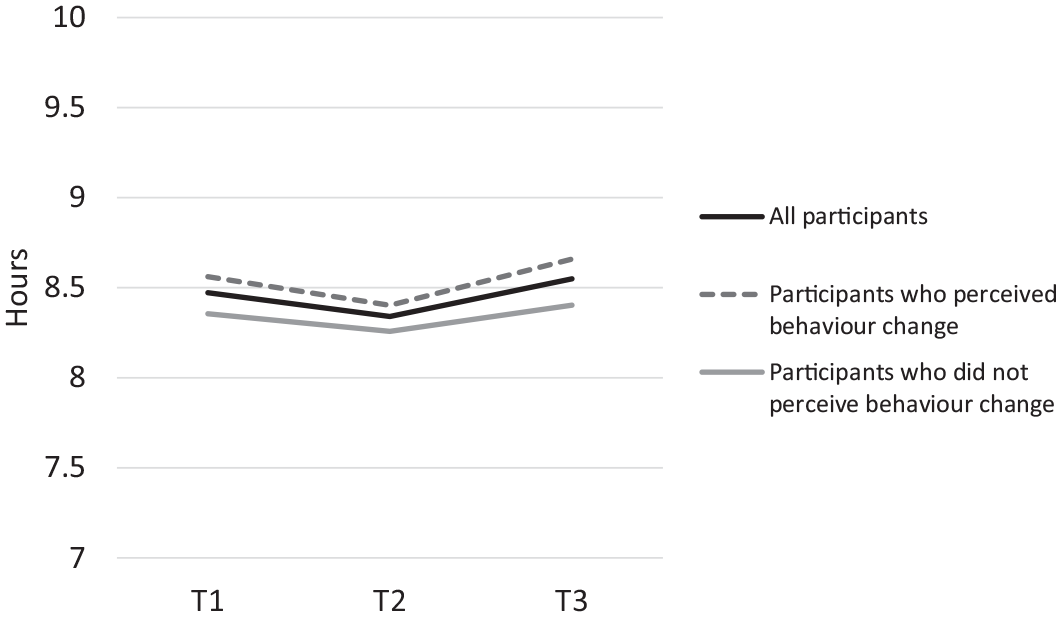
Total sedentary time as a function of self-reported perceived behaviour change during the intervention.
Acceptability of intervention
Responses to the question of whether students enjoyed the intervention were recoded to collapse ‘Strongly Agree’ and ‘Agree’ into a single category ‘Enjoyed intervention’ (N = 46), while ‘Neutral’, ‘Disagree’ and ‘Strongly Disagree’ were collapsed into a single category ‘Did not enjoy or neutral’ (N = 26). There were no differences between these sub-groups for sedentary behaviour at T1. The relationship between intervention enjoyment and total sedentary behaviour is shown in Figure 2. Enjoyment of the intervention did not appear to reflect different behavioural patterns from T1 to T2. At T3, participants who enjoyed the intervention appeared to maintain the same average level of total sedentary behaviour, while participants who did not enjoy the intervention or were neutral showed a slight, but non-significant increase in total sedentary behaviour at follow-up.
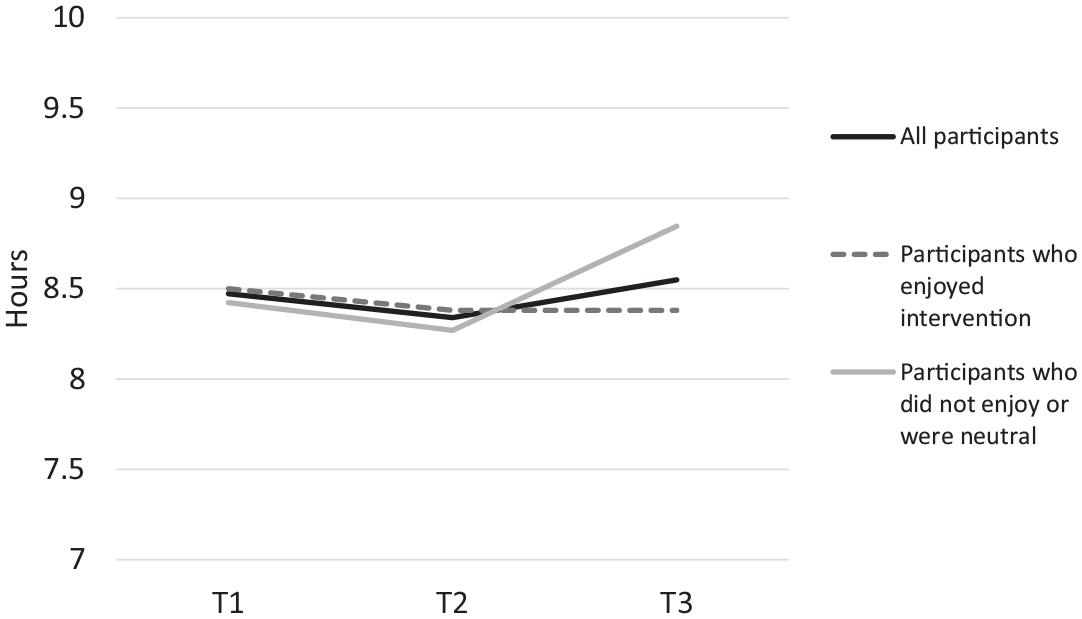
Total sedentary time as a function of self-reported enjoyment of intervention.
Self-reported engagement with the intervention
Participants who reported engaging with two or more messages per week (N = 39) were separated from those who reported engaging with less than two (N = 33). Participants who reported attending to (i.e. acting on) at least two of the four weekly messages demonstrated significantly lower total sedentary behaviour compared to those who attended to fewer than two messages across all time points as indicated by a main effect of sub-group in the multilevel regression, F(1, 138) = 4.92, p = .028, with no group × time point interaction (Figure 3).
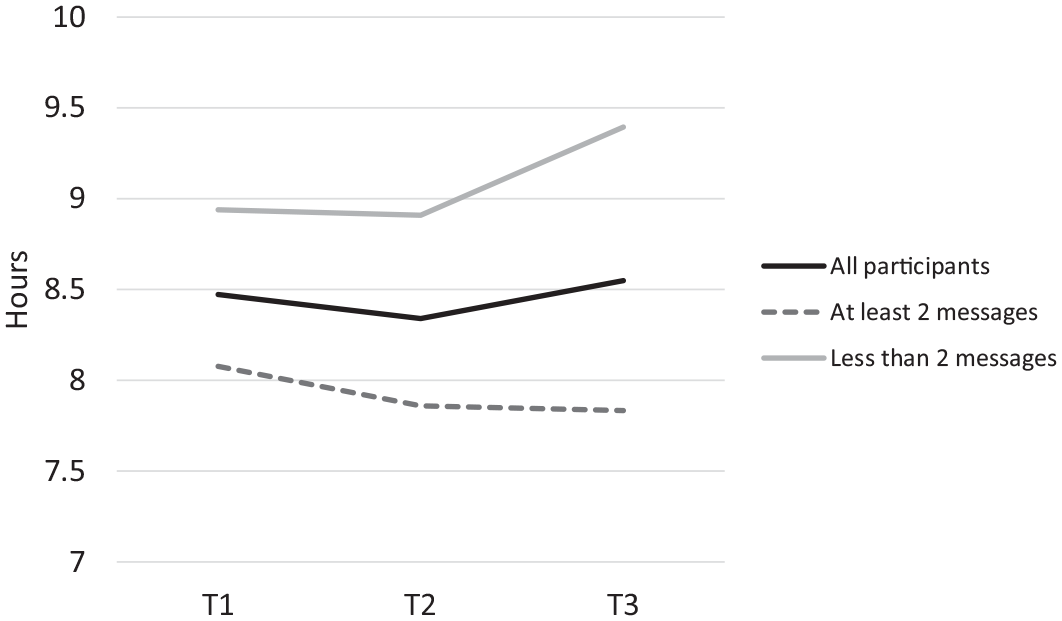
Total sedentary time as a function of self-reported engagement with intervention.
Sedentary behaviour and physical activity
There was no change in sedentary leisure, F(2, 153) = 1.24, p = .290, or total sedentary behaviour, F(2, 141) < 1, across time points (Table 4). Sedentary behaviour related to work/transit showed no change across time points, χ2(2) = 0.00, p = 1.0, nor did frequency of sedentary breaks, χ2(2) < 1, p = .787.
Physical activity, sedentary behaviour and strength training engagement.

Values are M (SD) unless otherwise specified.
p < .05 T3 vs. T1.
p < .01 T3 vs. T1.
Approximately 30% of participants met physical activity guidelines (⩾150 minutes per week), and this did not change over time, F(2, 141) < 1. Examining total minutes per week of physical activity, there was a significant effect of time point, χ2(2) = 7.01, p = .03. Post hoc comparisons revealed a significant decrease in minutes per week of activity from T1 (M = 151.39 ± 148.3) to T3 (M = 114.5 ± 100.0), Z = −2.62, p = .009.
There was a significant change in the length of physical activity sessions over time, χ2(2) = 6.26, p = .044. Minutes per session of activity decreased significantly by approximately 10 minutes per session from T1 (M = 41.0 ± 27.5) to T3 (M = 33.2 ± 21.0), Z = −2.48, p = .013. No other post hoc comparisons were significant. The number of days per week participants engaged in physical activity did not change over the semester, χ2(2) = 1.07, p = .585. The number of days per week participants engaged in strength training changed significantly over time, χ2(2) = 9.09, p = .011. Post hoc tests revealed days per week of strength training increased from T1 (M = 1.28 ± 1.61) to T2 (M = 1.81 ± 1.86), Z = −2.97, p = .005. Days per week of strength training also increased significantly from T1 to T3 (M = 1.61 ± 1.60), Z = −1.97, p = .048, but there was no change from T2 to T3 (p = .338).
HAPA construct measures
There was no change in total, χ2(2) < 1, p = .747, or task self-efficacy scores, χ2(2) = 3.23, p = .199; risk awareness, χ2(2) < 1, p = .670; or outcome expectancy, χ2(2) < 1, p = .973, over time. There was a marginally significant main effect of time on behaviour intention scores, F(2, 141) = 2.82, p = .063. Post hoc tests revealed a significant increase in behaviour intention scores from T1 (M = 4.85 ± 1.03) to T3 (M = 5.11 ± 1.19).
Discussion
The primary aim of this pilot study was to evaluate the feasibility and acceptability of a theory-grounded, text message–based intervention targeting the reduction of sedentary behaviour in university students. Outcomes suggest the intervention was well accepted and feasible, with reasonable participant retention and general enjoyment of or neutrality towards the intervention. Preliminary results regarding the intervention evaluation provide support for the inclusion of evaluation components in larger scale controlled trials to assess the relationship between user experience and intervention efficacy, and refine the development of such interventions in an evidence-based manner.
Intervention feasibility and evaluation
The intervention was feasible to implement and generally well received with a 73% completion rate and only a small minority (5.6%) of students reporting they disliked the intervention. Exploratory analyses revealed higher self-reported engagement with weekly text messages was associated with significantly lower rates of total sedentary behaviour across all time points. It is clear this relationship is not related directly to the intervention itself, as the difference between sub-groups was observed at baseline prior to the intervention. Rather, this indicator of self-reported engagement with weekly messages may have inadvertently captured a latent factor related to individuals’ current motivation to reduce their sedentary behaviour. To overcome this engagement bias, minor modifications could be made to the intervention to improve participant’s social ties (e.g. introducing a competitive approach), which has been previously shown to increase engagement (Bock et al., 2013; Poirier and Cobb, 2012).
Sedentary behaviour and physical activity
No change was observed in sedentary behaviour over time and physical activity declined over the semester, likely due to increased studying demands as midterm and final exam periods approached and the onset of winter in the northern region in which the study was conducted. Both of these factors have been previously identified as barriers to physical activity participation (Deliens et al., 2015; Pelletier et al., 2020). Men reported higher levels of physical activity than women at all time points, but there were no gender-based differences observed in levels of sedentary behaviour. There were no differences in sedentary behaviour between participants who met physical activity guidelines and those who did not, further supporting the relative independence of these constructs.
Participants’ baseline level of total sedentary behaviour was comparatively low with respect to rates reported elsewhere in university students (e.g. Moulin et al., 2019). This low estimate may highlight a potential limitation of the PASB-Q in populations known to be highly sedentary, such as university students (Bakker et al., 2020). The PASB-Q domains each have a ceiling of >6 hours. As such, it is possible the overall rate of sedentary time may be underestimated due to ceiling effects on the PASB-Q in highly sedentary groups. In this sample, approximately 35%–40% of participants reported >6 hours of sedentary work/transit time, while approximately 10% of the sample reported >6 hours of leisure sedentary time. It is possible the null results pertaining to sedentary behaviour across time points are constrained by ceiling effects masking reductions in sedentary time in the >6-hour range of the scale. Application of a more sensitive measure of sedentary behaviour using either self-report or accelerometry is required to understand the degree to which university students’ sedentary time may be underestimated by the PASB-Q.
HAPA and behavioural outcomes
There were no changes in HAPA-related measures over the course of the intervention, although participants’ intention to break up their sitting time and engage in physical activity (i.e. behavioural intentions) increased slightly, suggesting this intervention may show promise for targeting the first (i.e. motivational) phase of behaviour change. An experimental application of the intervention is required to explore this possibility.
The lack of change in HAPA constructs during the course of the intervention may indicate the intervention dose (e.g. the number of text messages per week or length of intervention) was insufficient or the HAPA theory is not predictive of sedentary behaviour. The literature supports the notion that sedentary behaviour and physical activity are distinct, interdependent constructs, and our findings further highlight the need to understand the applicability of behaviour change theories to sedentary behaviour (Rhodes et al., 2012). Although some previous studies have demonstrated the efficacy of a HAPA planning intervention in addressing sedentary behaviour (Rollo and Prapavessis, 2020), it is possible the HAPA model may be more amenable to beginning new behaviours rather than ceasing problematic behaviours. For instance, interventions promoting physical activity participation target starting a new behaviour, while the reduction of sedentary behaviour requires individuals to stop engaging in potentially harmful behaviour very much ‘baked in’ to contemporary society, and may require environmental or institution-level interventions in addition to targeting change at the individual level. The high rates of work/transit-related (i.e. mandatory) sedentary behaviour in this sample are suggestive of this possibility; even if one develops intentions to change behaviour, this construct cannot relate to behavioural outcomes if there are substantial social-environmental barriers to implementing positive change.
Limitations
While the results of this pilot study suggest text message–based interventions are reasonably feasible and generally well received, there was no control group and, as such, we are unable to statistically evaluate the efficacy of the intervention. Analysis was conducted only on individuals who completed the intervention, which may serve as a source of outcome bias; however, given the observed findings of no change in sedentary behaviour and decline in physical activity over time, we believe the risk of bias in this instance is low. Future work should explore participant and intervention characteristics associated with attrition to better understand trajectories of behaviour change. Further, data were limited to self-report, and the sample comprised a non-representative group of university students, limiting its generalisability both to local students as well as university students broadly. Participants were enrolled predominantly in health-related degree programmes, and the majority were women. Individuals in health-related fields may be more prone to social desirability bias because they are aware of the purpose of the intervention (Brenner and DeLamater, 2014). However, the lack of change in sedentary behaviour, reduction of physical activity over time, and overall low proportion of students meeting recommended activity guidelines do not support a social desirability bias in self-reported sedentary time or physical activity.
More broadly, we note two major potential limitations of the PASB-Q. First, the PASB-Q may be susceptible to ceiling effects in populations known to be highly sedentary. This is a potential issue with scale validity and sensitivity. Second, the PASB-Q includes separate items concerning mandatory and leisure sedentary time but does not indicate where the activity of studying should fall for student samples. Studying is a unique activity in that it is not ‘mandatory’ in a formal sense and does not necessarily require a student to be sedentary (e.g. Pilcher et al., 2017). Thus, some students may have reported studying under mandatory (work/transit) sedentary behaviour, while others may have reported it as leisure (i.e. non-mandatory) activity. This would not impact the summed estimates of total sedentary time, but points to a broader limitation in the literature of considering population-specific factors and consequently population-specific needs in tailoring individualised interventions to reduce sedentary behaviour.
Future work
With respect to future study, our analyses of intervention evaluation outcomes in relation to sedentary behaviour suggest perceived behaviour change was unrelated to actual sedentary behaviour, while acceptability and engagement with intervention content may be of value in understanding individuals’ responses to the intervention. In particular, future work should evaluate whether intervention enjoyment is predictive of better retention of behaviour change, and aim to understand the complex relationship between intervention engagement and baseline behaviour status.
Conclusion
This study found a HAPA-grounded intervention targeting sedentary behaviour in university students to be feasible and well received with reasonable retention of participants. Components of user experience of the intervention in relation to sedentary behaviour outcomes show promise for refining the application of such interventions in future work.
Supplemental Material
sj-pdf-1-hej-10.1177_00178969211007163 – Supplemental material for A theory-grounded text message–based intervention to reduce sedentary behaviour in university students
Supplemental material, sj-pdf-1-hej-10.1177_00178969211007163 for A theory-grounded text message–based intervention to reduce sedentary behaviour in university students by Robin Keahey, Nicole White, Annie Duchesne and Chelsea A Pelletier in Health Education Journal
Footnotes

References
Supplementary Material
Please find the following supplemental material available below.
For Open Access articles published under a Creative Commons License, all supplemental material carries the same license as the article it is associated with.
For non-Open Access articles published, all supplemental material carries a non-exclusive license, and permission requests for re-use of supplemental material or any part of supplemental material shall be sent directly to the copyright owner as specified in the copyright notice associated with the article.
