




Abstract
Objective:
This study aimed to investigate individual and work-related resources (decision latitude, self-efficacy and work-related sense of coherence) and their relationship to health and work outcomes (general health, cognitive and emotional irritation, and work satisfaction) among German school principals.
Method:
In 2016, all teachers and principals in Lower Saxony, Germany, were invited to participate in an online-based cross-sectional study. Data from a sub-set of 1,026 school principals and members of the school leadership team (i.e. vice principals) were analysed using univariate and bivariate analysis and stepwise linear regression.
Results:
Findings revealed fairly high levels of self-efficacy and decision latitude and low levels of sense of coherence for administrative tasks. With regards to health, more than one quarter of respondents reported a poor general health status, and more than one third reported being dissatisfied or very dissatisfied with their work. Primary school principals were more often affected by low levels of resources as well as lower health status and work satisfaction. Based on a series of regression analyses, decision latitude and self-efficacy proved to be the strongest predictors of all health and work outcomes.
Conclusion:
Given that school leaders are of critical importance for their entire school, this professional group should be placed more firmly in the focus of school health education and promotion. There is a particular need for health promotion measures for primary school principals, who have the least resources and the lowest health status.
Background
Worldwide, school principals face increasing job demands and responsibilities resulting from the Global Educational Reform Movement (GERM). First described by Pasi Sahlberg (2012), GERM encompasses increasing educational standardisation (e.g. international student tests), higher use of management practices and stronger school accountability (see also Fuller and Stevenson, 2019). Based on this development, schools and their leaders have gained more autonomy, which is reflected, among other things, in greater decision power to manage the school budget (e.g. to hire school staff, to maintain school facilities). In contrast, this process of decentralisation has been accompanied by increasing influences at the system level through, for example, national standardised tests and curricula as well as national school inspections (Huber, 2004). These developments can be seen in Germany, where education policy is the responsibility of the 16 federal states. For example, in 2007, the concept of ‘autonomous’ school was introduced in the federal state of Lower Saxony and anchored in §32 of the Lower Saxony School Act. According to this concept, schools act on their own responsibility in the areas of planning, implementation and evaluation of teaching, management, organisation and administration.
In addition to tasks resulting from centralisation (e.g. financial planning, staff recruitment and development, facility management) and decentralisation (e.g. documentation and reporting, nationwide school tests), school principals are first and foremost educational experts responsible for developing the school programme, for coordinating the teaching and for ensuring coherence between the teaching methods and student learning (Beausaert et al., 2016; Huber, 2004). Moreover, despite substantial heterogeneity in school principals’ roles among European countries, school principals have their own teaching duties which are higher in primary compared to secondary schools.
Given the large number of work tasks and the importance of this occupational group for all school matters, it is perhaps surprising that school leaders are not systematically the subject of health research (Dicke et al., 2018). In their study, Phillips et al. (2007) investigated the prevalence and causes of work-related stress in 290 school principals from Southern England. The results revealed that 43% of respondents perceived their job as ‘very’ or ‘extremely stressful’, with the highest values found for work overload and reduced work–life balance. With regard to sources of managerial stress, school type differences could be found with higher stress levels to curriculum changes for primary school principals. In contrary, secondary school principals felt more stressed when handling pupil discipline and allocating resources. Similarly, Darmody and Smyth (2016) reported that 45% of Irish primary school principals (n = 898) felt stressed by their job. Higher levels of stress were associated with lack of support, poor school climate and current disciplinary measures. Additional sources of stress identified in other empirical studies include time management (e.g. Grissom et al., 2015; Whitaker, 1996), lack of resources (e.g. Chaplain, 2001) and state/federal rules and policies (e.g. Chaplain, 2001; Friedman, 2001).
Although limited, available evidence shows that school principals are often affected by physical and mental health complaints that exceed those experienced by other occupational groups and the general population (Hasselhorn and Nübling, 2004; Phillips et al., 2008). Using the Short Form 12 (SF-12) questionnaire, Dewa et al. (2009) concluded in their Canadian study that approximately 50% of the school leaders surveyed (n = 108) were below the population-based norm of mental health. Overall, evidence from Germany revealed that work-related stress of school principals is significantly associated with negative outcomes such as more psychosomatic complaints and lower levels of well-being (Dadaczynski and Paulus, 2016; Hasselhorn, 2009).
Even if school principals seem to be of growing interest for school health promotion and education in recent years (e.g. Dadaczynski and Paulus, 2015), the majority of existing research has a pathogenetic orientation, focusing on risk factors and their detrimental effects on health outcomes. In contrast, resources for health have scarcely been examined. Because the risks and strains are significant, but not sufficient, conditions for explaining health, the present paper investigates principals’ resources and their relationship to health outcomes. Specifically, the following research questions are addressed:
What is the prevalence of individual and work-related resources of German school principals?
Are there differences in the extent of resources with regard to the sociodemographic and school variables of German school principals?
To what extent do individual and work-related resources predict health outcomes and work satisfaction for German school principals?
Theoretical underpinnings of individual and work resources and health
It is widely known that stress can negatively affect individuals’ health if internal or external resources are not available to them to appropriately cope with demands. The salutogenesis model developed by Aaron Antonovsky (1987) represents a theoretical basis that introduced a paradigm shift from a risk-factor orientation towards a protective-factor orientation. Sense of coherence (SoC) is a main concept within the model. SoC refers to a global orientation towards viewing one’s life as structured, manageable and coherent. As a coping capacity, SoC consists of three dimensions. Comprehensibility is defined as the extent to which internal and external stimuli are cognitively perceived as clear and ordered information. Manageability, the instrumental dimension, refers to the degree to which individuals perceive that they can deal with internal and external demands. Meaningfulness, the motivational dimension, is defined as an individual perception that demands constitute challenges worthy of one’s commitment and investment. Empirical findings suggest a direct and an indirect effect of the SoC on diverse health outcomes (physical and mental health, quality of life and well-being; Eriksson and Lindström, 2006). Moreover, studies conducted in workplace settings show better physical and mental health and lower mortality rates for employers with a stronger SoC (e.g. Albertsen et al., 2001; Kinman, 2008; Poppius et al., 2003). More recently, a work-specific application of the SoC has been proposed, and empirical results from Switzerland and South Africa indicate significant associations with burnout, fatigue and work engagement (Bauer et al., 2015; Van der Westhuizen, 2018). Nevertheless, a lack of studies on SoC among school-based professionals can be observed. In one of the few related studies, Seibt et al. (2013) identified a positive association between SoC and good mental health status in German female teachers (n = 630). Moreover, some effort has been made to develop an SoC instrument focusing on teaching situations (SOCITS; Hoffenbartal and Bocos, 2015), but thus far, no empirical data on its relationship with health and work outcomes have been reported.
In contrast to the lack of findings on SoC, there are numerous findings supporting the high relevance of decision latitude as an organisational resource to support the health status of teachers (e.g. Arvidsson et al., 2016; Hakanen et al., 2006). The demand–control model provides a theoretical framework to explain the relation between the characteristics of the work environment and health outcomes. Decision latitude or autonomy is defined as a job characteristic reflecting the control dimension. It incorporates an individual’s ability to make decisions about his or her own job (decision authority) and/or the degree to which the job involves various tasks and requires the development of new abilities (skill discretion). Combining the control dimension with work demands as a second dimension allows a job to be characterised as high strain (high demands, low control), which poses the risk of reduced mental health (e.g. well-being, burnout; Hakanen et al., 2006; Häusser et al., 2010) and physical health (e.g. coronary heart diseases; Kivimäki et al., 2012). Nevertheless, there is a lack of research on the degree and health relevance of decision latitude for school principals.
Finally, teacher self-efficacy as a personal resource has been examined in a multitude of studies. Grounded in the social cognitive theory (Bandura, 1994: 71), self-efficacy is defined as ‘[. . .] people’s beliefs about their capabilities to produce designated levels of performance that exercise influence over events that affect their lives’. This construct reflects an optimistic belief in one’s ability to carry out activities that are required to achieve certain (educational) goals and to meet environmental demands. Correspondingly, self-efficacy has also been operationalised as a mediator that offers protection against the negative effects of job strain on (mental) health outcomes (Schwarzer and Hallum, 2008). Review results incorporating 165 articles suggest positive associations of teacher self-efficacy with well-being (including job satisfaction and commitment) and negative relations with different burnout dimensions (Zee and Koomen, 2016). Again, research findings of school principals are scarce. In the only study that we are aware of, Devos et al. (2007) indicate significant associations between symptoms of burnout and self-efficacy in a sample of n = 46 Flemish primary school principals; that is, the more confidence the school principals have in their own abilities, the lower their emotional exhaustion and depersonalisation and the higher their personal accomplishment.
Method
Design and data set
In this study, we used data from the Mehr Zeit für gute Schulen (More Time for Good Schools) project carried out in June 2016 in Lower Saxony, the second-largest federal state in Germany. The aim of the survey was to gain insight into which activities teachers perceived as particularly challenging or stressful in their everyday working life (Paulus et al., 2017). The study protocol was approved by the Lower Saxony Ministry of Education.
All teachers and school principals from general primary and secondary schools were eligible to participate. The study was carried out as an online survey using the Enterprise Feedback Suite (EFS) survey tool by Questback. To ensure that only authorised persons could take part in the survey, all teachers received a postal letter including general information about the study and an individualised access code. Participation was voluntary, and anonymity was assured. Upon entering the survey site, participants were presented with information regarding the parameters of the study to facilitate informed consent. After checking a consent box at the bottom of the page, participants were directed to the questionnaire.
The population of all school principals, teachers and educational staff in Lower Saxony is approximately N = 90,000. In total, n = 10,409 individuals participated in the online study, which corresponds to a response rate of approximately 11%.
Study population
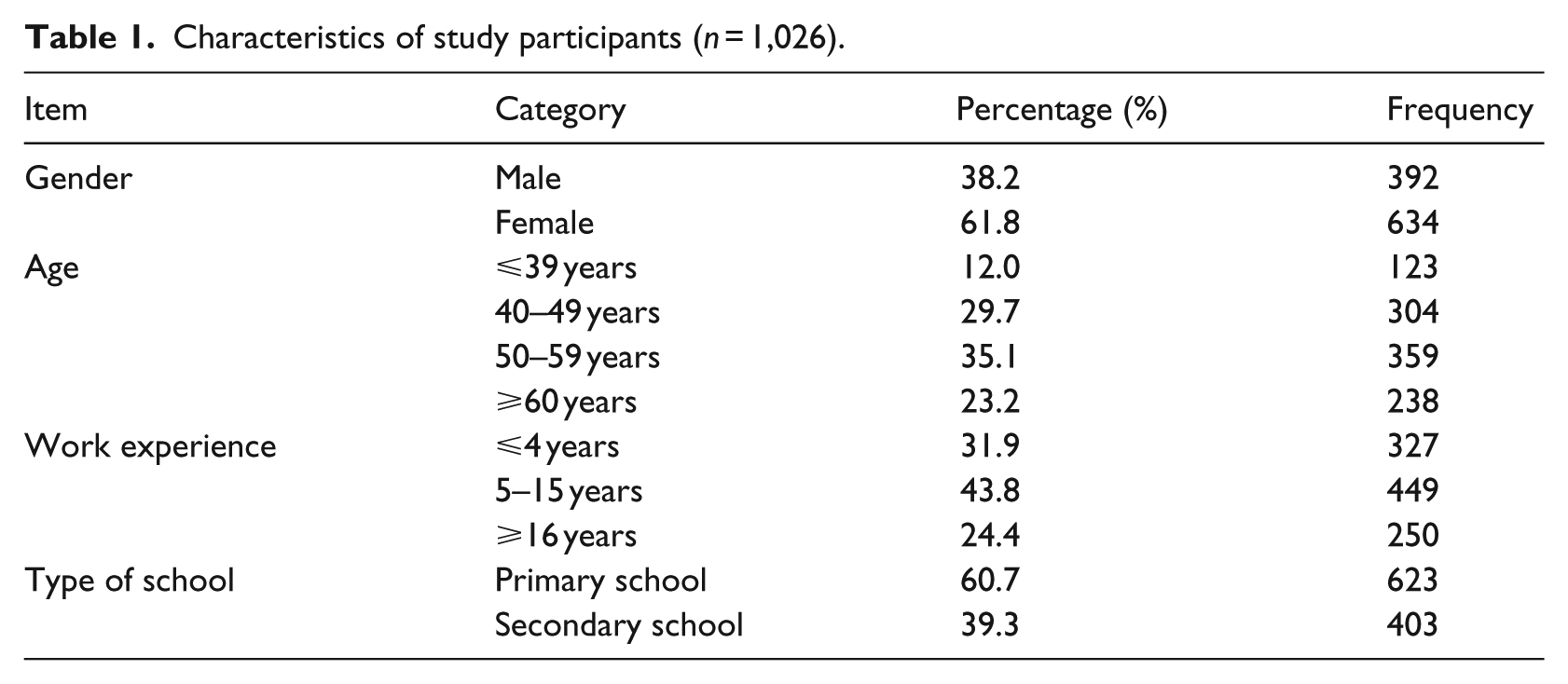
For the purpose of this paper, only school principals and members of the school leadership team (e.g. vice principals) were considered in a separate sub-set. After a plausibility check and adjustment for incorrect data, this set contained n = 1,026 participants. School leaders from vocational schools were excluded from this sub-set and all analyses because variables concerning the SoC were assessed differently, preventing comparability of the results. The majority of the sample was women (61.8%) and from primary schools (60.7%; Table 1). More than half of the respondents (58.3%) were 50 years of age and older (including 23% of school leaders with 60 years of age or older). According to the age distribution, the majority of respondents (68%) had work experience (as school principals or other school managers) of at least 5 years.
Characteristics of study participants (n = 1,026).
Measures
Based on the theoretical and empirical background, SoC, decision latitude and self-efficacy were used as independent variables that reflected individual and organisational resources. In contrast to existing generic instruments, this study attempted to capture the SoC with regard to specific work activities of school leaders. Hence, a working group including researchers and educational practitioners identified 18 work tasks that specifically reflected the responsibilities of German school principals.
Based on the concept of salutogenesis, each task was formulated as an incomplete sentence that could be rated with regard to comprehensibility (‘. . . in which I can understand what is expected from me’), manageability (‘. . . which I can handle well’) and meaningfulness (‘. . . which makes sense for my educational work’) on a 4-point Likert-type scale (1 = ‘not true’ to 4 = ‘true’). The tasks were clustered into four topic areas:
Personal development (6 tasks, for example, ‘Visiting and guiding teachers in the classroom are activities . . .’);
Cooperation and collaboration (3 tasks, for example, ‘Communicating with the school authority is an activity . . .’);
Administration (6 tasks, for example, ‘Managing the budget is an activity . . .’);
Concept development (3 tasks, for example, ‘Developing a concept for data protection and data security is an activity . . .’).
The internal consistency (Cronbach’s alpha) of the four scales was acceptable to good (.71 < α < .85). Decision latitude as an organisational resource was assessed using a four-item scale developed from the questionnaire on the work situation in schools (FASS; Kaempf and Krause, 2004). An example item is, ‘I can decide for myself how I do my job’. All items were rated on a 5-point Likert-type scale from 1 (‘not true’) to 5 (‘completely true’). The internal consistency (Cronbach’s alpha) for this scale was .57. According to Loewenthal (2001), Cronbach’s alpha coefficients of approximately .60 can be considered acceptable for scales containing fewer than 10 items.
To assess perceived self-efficacy, we used the teacher self-efficacy scale developed by Schmitz and Schwarzer (2000). This scale contains 10 items, for example, ‘I can also impose innovations on skeptical colleagues’. All items were rated on a 5-point Likert-type scale from 1 (‘not true’) to 7 (‘completely true’). The internal consistency (Cronbach’s alpha) value was .83.
For the purpose of this study, general health, irritation and job satisfaction served as dependent variables. General health was assessed with one item based on the German version of the Copenhagen Psychosocial Questionnaire (COPSOQ; Nübling et al., 2012): ‘How do you describe your overall health status?’ The item was rated on a 7-point scale ranging from 1 (‘excellent’) to 5 (‘bad’).
To assess subjective emotional and cognitive demands resulting from work, a scale to measure irritation was used (Mohr et al., 2005). Irritation is seen as a mediator between acute stress and mental disorders, and severe levels of irritation are therefore considered to impair mental health. The scale comprises eight items, for example, ‘It’s hard for me to switch off after work’. All items were rated on a 7-point Likert-type scale from 1 (‘not true’) to 5 (‘completely true’). The internal consistency (Cronbach’s alpha) value was .87.
Job satisfaction was assessed with one item from the German version of the COPSOQ (Nübling et al., 2012): ‘Considering all circumstances, how satisfied are you with your overall job situation?’ The item was rated on a 4-point scale from 1 (‘very dissatisfied’) to 4 (‘very satisfied’).
Statistical analysis
To test the assumed factorial structure of the task-based SoC items, we conducted a confirmatory factor analysis. Based on a suggestion on fit indices (Schermelleh-Engel et al., 2003), the proposed four-factor model revealed an acceptable model fit, χ²(129) = 729.60 (p < .01), χ²/df = 5.66, comparative fit index (CFI) = .91, root mean square error of approximation (RMSEA) = .02. Compared to a single-factor model, the model also showed a significantly better model fit, χ²(135) = 1,144.65 (p < .01), χ²/df = 8.48, CFI = .85, RMSEA = .03, Δχ² = 415.05, Δdf = 6, p < .01.
In addition to univariate and bivariate analysis, we conducted stepwise linear regressions for each of the three outcome variables. Age, sex, years of work experience and type of school were included as control variables in the first step. In the second step, self-efficacy and decision latitude were added as predictors. In the third step, the four factors of task-based SoC (development, cooperation, administration and concepts) were added as final predictors. All analyses were carried out with IBM SPSS and its structural equation software AMOS.
Results
With regards to the independent variables, fairly high mean values could be found for decision latitude (M = 3.09, SD = .50) and self-efficacy (M = 3.04, SD = .48). Principals from secondary schools reported significantly higher self-efficacy, t(df = 732, 21) = –3.09, p < .05, and decision latitude, t(df = 837, 02) = –3.09, p < .05, whereas gender but no age differences could be found for self-efficacy, with higher values for female principals, t(df = 958) = –2.14, p < .05. For task-based SoC, the highest values could be found for the dimensions cooperation (M = 3.26, SD = .52) and development (M = 2.97, SD = .55). While male principals reported higher values for the SoC dimension administration, t(df = 953) = 2.96, p < .01; principals from secondary schools showed a higher SoC for development, t(df = 655, 56) = –5.06, p < .001; cooperation, t(df = 894) = –5.28, p < .001; and administration, t(df = 899) = –7.26, p < .001. Moreover, compared to the youngest age group (⩽39 years) school principals aged 60 years or older reported significantly higher levels of SoC for development. F(df = 957, 3) = 3.89, p < .01; cooperation, F(df = 943, 2) = 7.36, p < .001; administration, F(df = 949, 3) = 3.42, p < .05; and concepts, F(df = 930, 3) = 6.01, p < .001.
With regards to the dependent variables, more than one quarter (27.6%) of respondents reported poor general health status (‘bad’ or ‘less well’; M = 2.96, SD = .85), and more than one third (39.2%) reported being dissatisfied or very dissatisfied with their work (M = 2.61, SD = .70). While no gender and age differences could be determined for any dependent variable, principals from primary schools showed poorer health status, t(df = 901) = –4.02, p < .001, and lower work satisfaction, t(df = 729, 13) = –3.62, p < .001, and were more often affected by cognitive and emotional irritation, t(df = 904) = 3.42, p < .001. In addition, significant differences could be found with regard to work experience. Compared to less experienced respondents (⩽4 years), school principals with 16 or more years of working experience reported poorer health status, F(df = 953, 2) = 5.03, p < .001, and lower job satisfaction, F(df = 953, 2) = 3.10, p < .05. A summary of the means, standard deviations and correlations of all variables is shown in Table 2.
Means, standard deviations and correlations (n = 1,028).
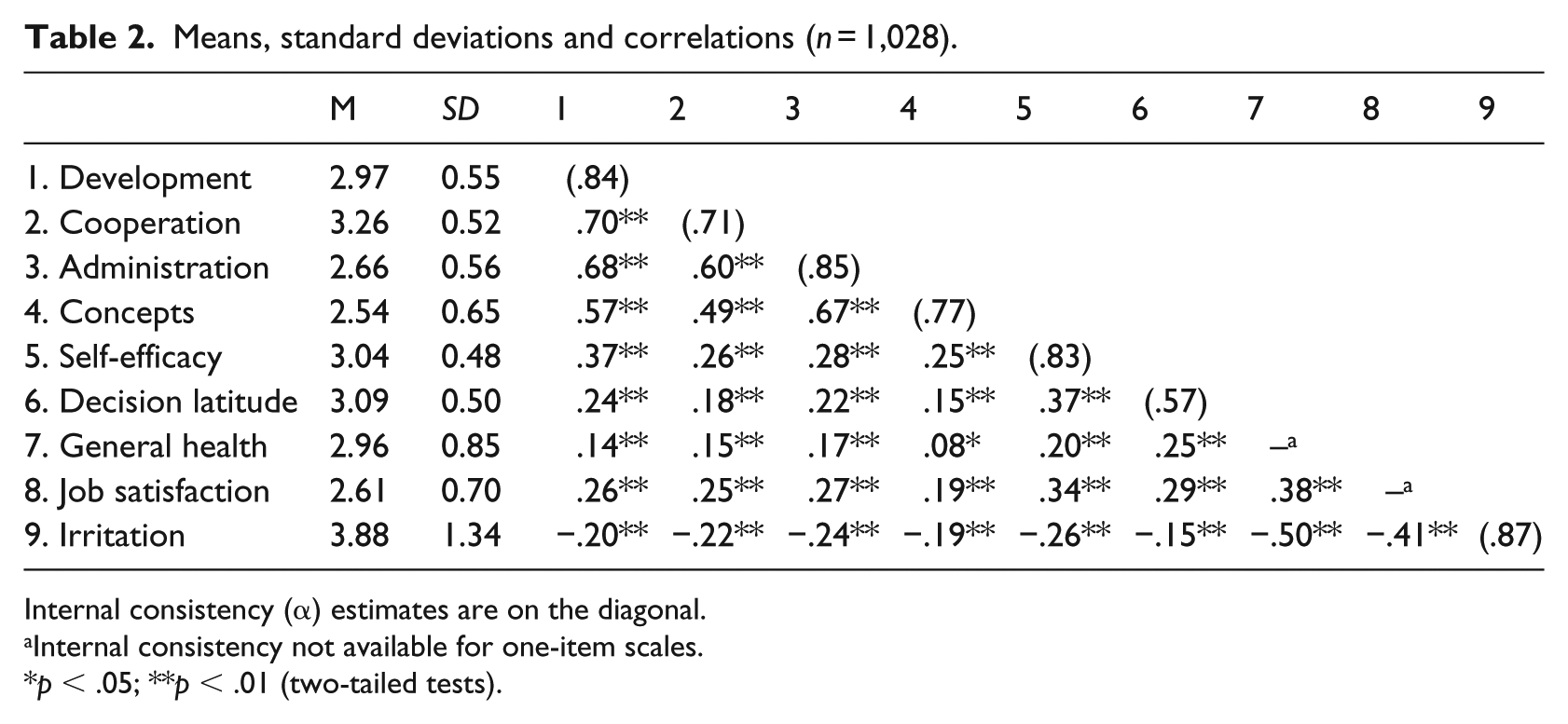
Internal consistency (α) estimates are on the diagonal.
Internal consistency not available for one-item scales.
p < .05; **p < .01 (two-tailed tests).
Table 3 shows a series of linear regression models predicting general health, job satisfaction and irritation. With regard to general health, only type of school as a control variable emerged as a significant predictor (ΔR2 = .03, p < .01). In step 2, self-efficacy and decision latitude were significantly associated with general health and accounted for another 7.3% of the variance (ΔR2 = .07, p < .01). In the final step, only the task-based SoC dimension administration proved to be a significant predictor (ΔR2 = .01, p < .05). In sum, all the variables together accounted for 10% of the variance of general health.
Regression analysis (n = 1,026).
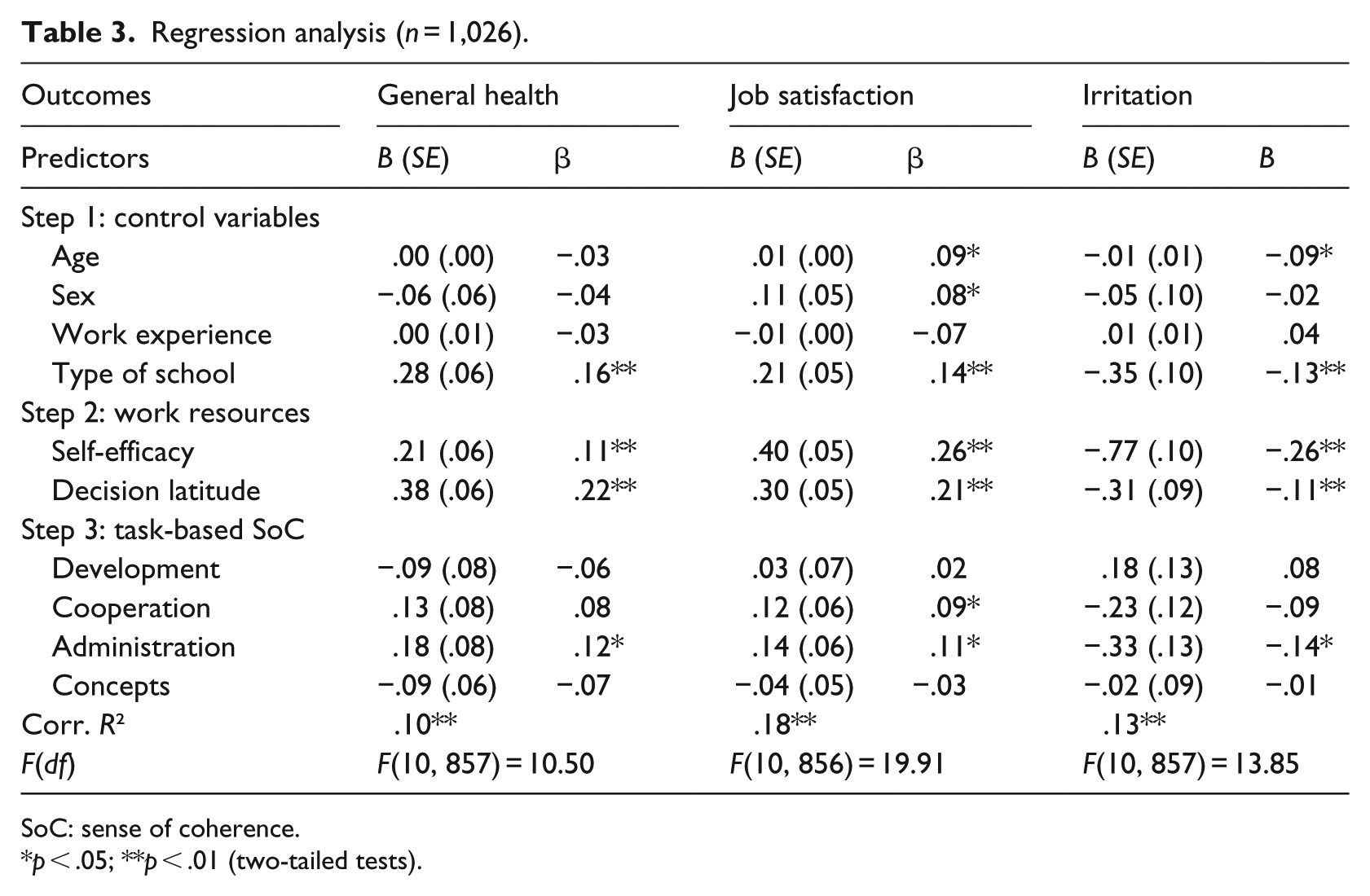
SoC: sense of coherence.
p < .05; **p < .01 (two-tailed tests).
Job satisfaction, as a second dependent variable, showed a somewhat different pattern. In step 1, type of school, sex and age were significant predictors (ΔR2 = .03, p < .01). Controlling for these, school and sociodemographic factors, self-efficacy and decision latitude accounted for another 14% in the second step (ΔR2 = .14, p < .001). When all task-based SoC dimensions were entered in the third step, the dimensions of cooperation and administration contributed significantly to the prediction (ΔR2 = .02, p < .001). In total, all the model variables accounted for 18% of the variance in job satisfaction.
Finally, age and type of school proved to be significant control factors in predicting cognitive and emotional irritation (ΔR2 = .02, p < .001). Again, self-efficacy and decision latitude served as strong predictors that together accounted for 10% of the total variance (ΔR2 = .10, p < .001). In the third step, only the task-based SoC dimension administration emerged as a significant predictor (ΔR2 = .02, p < .001). Here, all variables together explained 13% of the variance in cognitive and emotional irritation.
Discussion
As the result of educational reforms worldwide, the school principal’s role has changed substantially. It is argued that these changes contribute to the experience of stress, which in turn increases the likelihood of negative effects on mental and physical health. Moreover, increasing job demands and responsibilities can be regarded as a cause of the shortage of school principals and a possible reason for early retirement (Dicke et al., 2018).
Although there has been a growing interest in research on the health of school principals recently, little is known about the availability of health-related resources and its association with health indicators. Based on widely recognised theories of work psychology and health science, the SoC and self-efficacy as individual resources and decision latitude as an organisational resource were investigated in a sample of 1,026 German school principals. The results revealed fairly high levels of self-efficacy and decision latitude, with significantly higher values found for school leaders in secondary schools. Compared to studies using the same self-efficacy instrument, it seems that school principals in general have a higher self-efficacy than teachers (Schmitz and Schwarzer, 2000; Schwarzer and Hallum, 2008).
With regards to health outcomes, primary school principals reported a lower health status and work satisfaction and higher emotional and cognitive irritation. While the number of studies is limited, results from the UK also indicated that compared to secondary schools, principals from primary schools had lower psychological well-being (Phillips et al., 2008). Considering work-related resources, our study results revealed that decision latitude is highly associated with general health, whereas self-efficacy served as the strongest predictor for irritation and job satisfaction. These results confirm the high importance of individual and organisational resources for health reported in other studies (e.g. Schwarzer and Hallum, 2008; Stansfeld and Candy, 2006). In accordance with the ‘active job’ hypothesis of the demand–control model, high job demands do not necessarily result in high psychological strains when individuals have sufficient control over their work tasks. Based on study findings indicating high job demands for German school principals (Dadaczynski, 2014), decision latitude should be strengthened especially for primary school principals.
Although comparatively high in the present study, further measures should also be taken to increase and maintain self-efficacy of school principals. Currently, there is no comprehensive, ongoing training for the work as a school principal in Germany. Teachers undergo one-off further training before taking up their leadership position, but the nature of this varies substantially between federal states. The qualification in Lower Saxony comprises 25 days, which are organised into courses of 3–5 days. In addition to this initial training, accompanying measures (e.g. mentoring and supervision) are needed to strengthen school leaders’ confidence in their professional abilities and mastery skills.
Compared to self-efficacy and decision latitude, all SoC dimensions accounted for only a small proportion of the variance in all dependent variables. Studies testing the main effects of the general SoC or the work-related SoC observed more variance in health outcomes (e.g. fatigue, psychological distress, work engagement), partially even after controlling for work characteristics (Kinman, 2008; Van der Westhuizen, 2018). Compared to a more general orientation towards one’s life or the general working situation, our study focused on very concrete working tasks of school principals. Based on the unidimensionality of the SoC concept, we did not differentiate between the components of comprehensibility, manageability and meaningfulness. Instead, the 18 work activities were categorised into four groups on the basis of confirmatory factor analysis. Our study results show lower mean values for SoC with administrative and conceptual tasks across all principals, especially for primary school principals. Moreover, SoC in administrative activities proved to be a significant predictor across all outcome variables. Given the fact, that all school principals were teachers prior to their leadership position with their main experience in curriculum teaching, it is not surprising that the SoC in management-oriented activities is lower. As significant age differences could be identified, a learning effect with increasing age can be assumed.
To our knowledge, this is the first study to adapt the general SoC construct to the specific working situation of school leaders. Due to its specific focus, the results of the task-based SoC could be used for the development of specific support measures (e.g. continuous training, strength-oriented distribution of tasks within the school leadership team and beyond; Tian et al., 2016). Moreover, the concept of salutogenetic leadership might be useful as a further starting point for the development of health promoting interventions (Harazd et al., 2009). This concept includes a series of questions that help school principals to reflect on the quality of information and communication processes in the school (e.g. Have I provided a rational or pointed out the meaningfulness of my decisions?). Vice versa, this concept could also be applied by school authorities in their role as superior for school principals (e.g. Have school authorities provided a rational or pointed the meaningfulness of their instructions for the school principals?)
Limitations and strengths
Despite several strengths (e.g. the sample size and the participatory development of the study in cooperation with the Ministry of Education and educational practitioners), several limitations of this study should be recognised. First, the sample is not representative and the results cannot be generalised to the whole population of school principals in Lower Saxony. Second, based on the cross-sectional design of this study, the results concerning the association between individual and work-related resources and health/work satisfaction can not be interpreted as causal relationships. Third, two of the dependent variables (health status and work satisfaction) were assessed using single items, and it can be argued that the use of only one item reduces validity and reliability. However, study findings support the reliability and validity of single-item measures of work satisfaction and self-rated health (Dolbier et al., 2005; Scheidt-Nave et al., 2012).
Conclusion
In summary, our results show that a considerable proportion of school principals are affected by low health status and low job satisfaction. Given that school leaders are of crucial importance to their entire school, this professional group should be placed more firmly at the focus of school health education and school health promotion. There is a particular need for health promotion measures for primary school principals, who have the least resources and the lowest health status. Moreover, as health is the result of an interplay of demands and resources that can mitigate or even compensate for the negative effects of stress and strains, more complex study designs including both of these aspects are required. However, compared to teachers, there is a lack of complex and specific instruments for assessing psychosocial resources and risks for the occupational group of school principals (see Dicke et al., 2018, for an exception).
Footnotes
Authors’ note
Kevin Dadaczynski is also affiliated with Center for Applied Health Sciences, Leuphana Universität Lüneburg, Lüneburg, Germany.
Funding
The author(s) disclosed receipt of the following financial support for the research, authorship, and/or publication of this article: The authors received funding for the project “Mehr Zeit für gute Schulen” from the Lower Saxony Ministry of Education.
