




Abstract
Some gifted students may have symptoms of attention-deficit/hyperactivity disorder (ADHD), which are associated with academic challenges. Self-efficacy for mathematics is typically lower in students with ADHD symptoms compared with their peers. This study explored how gifted students’ sources of self-efficacy may mediate the relationship between their ADHD symptoms and mathematics self-efficacy. The study was conducted within the Israeli education system, which in recent years has promoted academic excellence alongside the inclusion of diverse student populations, in line with national inclusion policies. A quantitative longitudinal study collected self-report questionnaires from 88 gifted students at the beginning and end of seventh grade, to trace changes across the challenging transition year to middle school. Participants were identified as gifted students, while ADHD symptom levels were assessed as a continuous self-report variable and were not used to define twice-exceptionality. Results revealed that while higher inattention and/or hyperactivity-impulsivity levels correlated with lower mathematics self-efficacy, the effect was indirect, mediated by specific sources of self-efficacy, with the pattern and strength of the mediating relationships differing between the beginning and end of seventh grade. These findings highlight the importance of targeting self-efficacy sources to promote positive mathematical achievement for gifted students with high levels of ADHD symptoms.
Plain Language Summary
Some gifted students (with high cognitive abilities) also show elevated symptoms of attention-deficit/hyperactivity disorder (ADHD), such as distractibility, restlessness, and impulsivity. These students often report lower self-efficacy in mathematics. Research has shown that students with higher self-efficacy tend to perform better academically than those with lower self-efficacy. Therefore, this study examined which factors help gifted students with high levels of ADHD symptoms develop stronger self-efficacy in math.
The researchers followed 88 gifted students in Israel throughout seventh grade, a key transition year into middle school. At both the beginning and the end of the school year, students filled out questionnaires about their symptoms of ADHD, as well as their self-efficacy in math. The study also looked at four sources that help build self-efficacy: mastery experiences (succeeding in the past), vicarious experiences (learning by watching others), social persuasion (encouragement and feedback), and physiological states (how calm or stressed they felt).
Gifted students with high levels of ADHD symptoms tended to report lower self-efficacy in math. This was explained by the four sources of self-efficacy: they had fewer successful experiences in math, felt less calm and focused during math tasks, received less encouragement from others, and had no role models for successful performance.
Teachers and parents can help gifted students with high levels of ADHD symptoms improve their math self-efficacy by strengthening its four sources: providing opportunities for success, offering encouragement, supporting physical and emotional regulation, and enabling learning through both peer observation and exposure to positive role models. Enhancing self-efficacy may help these students better manage math challenges and reach their potential.
Introduction
Attention difficulties are commonly associated with giftedness (Antshel et al., 2007, 2008; Cornoldi et al., 2023). The unique subgroup of gifted children who also exhibit symptoms characteristic of attention-deficit/hyperactivity disorder (ADHD) has been under-investigated in terms of academic self-efficacy and its sources, especially in mathematics, which is considered a key academic domain in the 21st century (Organisation for Economic Co-operation and Development [OECD], 2022). Although gifted students typically enjoy high academic self-efficacy (Pajares & Kranzler, 1995; Shaunessy et al., 2006), research conducted in the general student population has shown that students’ symptoms of inattention and/or hyperactive-impulsive predict lower self-efficacy (Almasi, 2016; Major et al., 2013; Newark et al., 2016; Schmidt-Barad et al., 2023). Thus, while such findings have been established in broader adolescent samples, gifted students with higher levels of inattention, hyperactivity, and/or impulsivity may show lower self-efficacy for mathematics performance. Very few studies have examined the sources of self-efficacy among gifted students. Ozcan et al. (2021), in one of the few studies focusing on gifted students, found that mastery experiences (e.g., receiving good grades) and vicarious experiences (e.g., observing peers who performed less successfully in math) were the most influential sources of mathematics self-efficacy. However, Ozcan et al. did not examine possible links to gifted students’ levels of ADHD symptoms. In addition, although most studies do not indicate widespread emotional or social difficulties among gifted students in general (Tourreix et al., 2023), there is evidence that gifted students diagnosed with ADHD may experience lower levels of self-esteem and confidence compared with their gifted peers without such a diagnosis (Foley-Nicpon et al., 2012). Given these challenges, the present study focuses on gifted students experiencing ADHD-related symptoms, an under-researched subgroup that requires targeted educational support. Understanding the relationship between gifted students’ possible attention and/or hyperactive-impulsive behavior problems and their self-efficacy in mathematics is important to provide adequate educational responses to the distinct needs of this population. This focus is also aligned with OECD (2022) recommendations to promote both excellence and inclusive education for diverse learners.
There are mixed findings in the literature regarding the degree of comorbidity for giftedness and ADHD (Mezzanotte, 2020). For example, gifted children with ADHD may score lower on working memory and processing speed subtests of IQ tests, which may, in turn, lead to failure to identify them as gifted (Dovis et al., 2015; Lee & Olenchak, 2015; Whitaker et al., 2015). Furthermore, they often underachieve academically (McCoach et al., 2020) and may fail to meet the threshold of the national identification process, which emphasizes high academic achievement (Ministry of Education in Israel, 2019, 2024). Thus, the diagnosis of ADHD among gifted individuals is often missed or misdiagnosed (Beljan et al., 2006; Cornoldi et al., 2023; Edwards, 2009; François-Sévigny et al., 2022; Hartnett et al., 2004; Webb, 2005). Moreover, subclinical ADHD symptoms may still impact gifted students’ academic self-efficacy (McCoach et al., 2020). Therefore, it is important to examine ADHD symptom severity as a continuous variable rather than using a binary diagnostic approach. In the present study, ADHD symptomatology was measured as a continuous variable using a validated self-report questionnaire based on Diagnostic and Statistical Manual of Mental Disorders (5th ed., DSM-5) criteria, without relying on clinical diagnoses. This dimensional approach reflects current research trends emphasizing the spectrum of ADHD-related traits within the general population, even when symptoms do not reach diagnostic thresholds (Barkley, 2011; Barkley & Murphy, 2006; Johns-Mead et al., 2023). This approach is consistent with previous research on gifted students with attention-related difficulties, such as McCoach et al. (2020), who also focused on ADHD symptoms rather than formal diagnoses. This method allows for a more nuanced understanding of how increasing levels of inattention and/or hyperactive-impulsive symptoms relate to academic outcomes, even among students who do not meet formal diagnostic criteria.
These diagnostic and academic challenges are particularly relevant during early adolescence, especially in seventh grade, when students face increased academic demands, changes in instructional structure, and the need for greater self-regulation (De Rossi et al., 2023; Langberg et al., 2008). While hyperactivity and impulsivity tend to decrease during this developmental period, inattention symptoms often remain relatively stable (Langberg et al., 2008), potentially affecting students’ self-efficacy. In fact, various studies indicate that although some ADHD symptoms decrease with age and the transition to middle school (Langberg et al., 2008; O’Neill et al., 2017), the transition itself may temporarily disrupt the natural developmental decline in symptomatology. Notably, Langberg et al. (2008) demonstrated that the middle school transition was associated with a plateau, or even a slight increase, in symptoms of inattention, hyperactivity, and impulsivity, particularly as reported by parents. These findings highlight the vulnerability of this developmental stage and support the rationale for focusing on students’ self-efficacy during this period.
Based on this rationale, the study examined ADHD symptomatology as the independent variable, the four sources of self-efficacy (mastery experiences, vicarious experiences, social persuasion, and physiological states) as mediators, and mathematics self-efficacy as the dependent variable. The following literature review examines central concepts and empirical findings related to the core constructs of the study, including characteristics of the target population and key variables relevant to the research model.
Gifted Students
There is no clear consensus in the literature regarding the definition of giftedness, and countries vary considerably in how they identify and educate gifted students (Reis et al., 2021; Renzulli, 2004; Rutigliano & Quarshie, 2021). Definitions of giftedness range from exceptionally high IQ scores and intellectual abilities (Guignard et al., 2016; Murphy & Walker, 2015; Renzulli & Delcourt, 1986) to domain-specific talents, including mathematics (Brulles et al., 2012; Rutigliano & Quarshie, 2021). These definitions often encompass high levels of creativity (Kaufman et al., 2012; Leikin & Kloss, 2011; Leikin & Lev, 2013; Murphy & Walker, 2015), academic motivation (Garrett & Moltzen, 2011; Hong & Aqui, 2004; Murphy & Walker, 2015), and talents in domains such as sports (Walker et al., 2011), the arts (Clark & Zimmerman, 2001), and music (Persson, 2009). Some contemporary models conceptualize giftedness within the theory of multiple intelligences (Gardner, 2011; Reis et al., 2021; Renzulli, 2004; Rutigliano & Quarshie, 2021). In Israel, the Steering Committee for the Advancement of Gifted Education defines gifted individuals as those ranking within the top percentile of their age group across the assessed domains of giftedness: general knowledge, language (Hebrew), and mathematics (Ministry of Education in Israel, 2024). The present study adopts this national definition to identify and examine gifted students in the Israeli context.
Symptoms of ADHD
According to the National Institute of Mental Health (2022), symptoms of the ADHD neurodevelopmental disorder begin in early childhood and can persist throughout life. In Israel, per the Ministry of Health (2024), the formally recognized criteria for ADHD are based on the DSM-5 (American Psychiatric Association, 2013). ADHD is characterized by symptoms of inattention, such as distractibility, overlooking details, inability to maintain attention for extended periods of time, partial listening, losing objects, and forgetfulness, as well as by symptoms of hyperactive-impulsive behavior manifested in excessive movement, need to move hands and legs, talkativeness, and impatience (American Psychiatric Association, 2013). ADHD is often accompanied by difficulty in emotional regulation (Uchida et al., 2021); difficulties such as response delay and difficulties in monitoring, working memory, processing speed, mental flexibility, planning, and organization (van Lieshout et al., 2013); and physiological difficulties manifested in rapid pulse, stress, and tension (Payen et al., 2022).
Globally, the prevalence of the formal ADHD diagnosis among children and adolescents is 5% to 8% (Faraone et al., 2021; Phipps, 2023; Young et al., 2020). Yet, diagnosing ADHD among adolescents is complex and difficult due to the high prevalence of co-occurring psychiatric disorders such as learning disabilities (DuPaul et al., 2013). Many students with ADHD are classified as having low achievements in language and mathematics (Colomer et al., 2013; Czamara et al., 2013; Jangmo et al., 2019; Kaufmann & Nuerk, 2006). Moreover, in the absence of appropriate treatment, there is a high risk of a wide range of negative behaviors (Kappi & Martel, 2022). Some attend special education settings, and others drop out of the education system altogether (Harpin et al., 2016). Among gifted individuals, ADHD is often underdiagnosed or misdiagnosed. Given the challenges inherent to formally diagnosing ADHD in gifted adolescents, the current study measured ADHD symptoms as a continuous, non-categorical variable using self-reports, rather than as a categorical medical or psychiatric diagnosis. Self-report questionnaires or checklists have been widely employed in the research literature (Canu et al., 2023; Coghill & Sonuga-Barke, 2012; Jensen et al., 2021; Johns-Mead et al., 2023; Vold et al., 2023) to effectively assess ADHD symptoms (Kessler et al., 2005). Given this unique educational context, the next section will explore the concept of academic self-efficacy and its relevance for gifted students with symptoms of ADHD.
Academic Self-Efficacy
One of the most important predictors of academic success is self-efficacy, a concept that emerged from Bandura’s social learning theory (Bandura, 1977, 1986, 2006; Koutroubas & Galanakis, 2022; Waddington, 2023). Self-efficacy involves individuals’ belief that in future situations they will be able to organize and execute courses of action that will successfully lead to the desired results. Such beliefs influence academic performance.
Self-efficacy has been widely studied as a factor influencing academic functioning in the general population. For example, Zimmerman et al. (1992) highlighted the critical role of self-efficacy in learning outcomes, showing that students with similar objective capabilities may still experience different levels of academic success depending on their perceived self-efficacy. Among individuals with ADHD, researchers indicate that both students and adults with ADHD tend to feel less academically capable compared to their peers without ADHD (Almasi, 2016; Major et al., 2013; Newark et al., 2016; Sarid & Lipka, 2023; Schmidt-Barad et al., 2023; Waite et al., 2022).
Several studies have shown that gifted students tend to report a higher sense of academic self-efficacy than average-ability students (Baudson & Preckel, 2016; Chae & Gentry, 2011; Guez et al., 2018; Korkmaz et al., 2018; Kuznetsova et al., 2024; Malpass et al., 1999; Ozcan et al., 2021), others have found a positive association between self-efficacy and academic achievement within gifted populations (Askari et al., 2020; Eyni et al., 2022; Malpass et al., 1999; Pajares, 1996; Sarıtaş & Olpak, 2022; Zahed et al., 2019). When ADHD symptoms are present, some studies have found that gifted students may experience emotional challenges, such as lower academic self-efficacy (McCoach et al., 2020), decreased self-esteem, and reduced self-confidence (Foley-Nicpon et al., 2012). Nevertheless, a recent systematic review of the literature (Tourreix et al., 2023) emphasizes that there is no consistent empirical evidence for a distinct or uniform emotional profile among gifted students with ADHD, highlighting the need for further research on this subgroup.
These varying levels of self-efficacy may be shaped by different sources of influence, as conceptualized in Bandura’s social learning theory. The next section outlines these sources and their relevance to the current study.
Self-Efficacy Sources
According to social learning theory (Bandura, 1986, 1991; Usher & Pajares, 2008), four sources predict academic self-efficacy: (a) one’s Mastery Experience, the interpreted result of one’s own previous attainments; (b) one’s Vicarious Experience of observing others and comparing oneself to others, particularly to individuals such as classmates, peers, and adults like teachers; (c) Social Persuasion by a significant other; and (d) one’s Physiological State such as rapid pulse, sweating, and stress, which may be interpreted as inability to perform the task, lowering the individual’s sense of self-efficacy.
To date, the research literature provides little information regarding academic self-efficacy and its sources in general, and mathematics self-efficacy in particular, among gifted students who display ADHD symptoms. The current study will examine the role of these four sources of self-efficacy (Mastery Experience, Vicarious Experience, Social Persuasion, and Physiological State) as possibly mediating between gifted students’ level of ADHD symptoms and level of self-efficacy in mathematics.
While the four sources of self-efficacy have been shown to predict academic self-efficacy in general populations (Bandura, 1977, 1986; Usher & Pajares, 2008), their specific influence on students with ADHD remains unclear. Most existing studies in this field have examined the impact of only individual sources on the self-efficacy of students with ADHD, without providing a comprehensive assessment of all four key sources. Some findings suggest that these sources may operate differently among students with ADHD compared to their peers without ADHD (Colomer et al., 2013; Ewe, 2019; Jangmo et al., 2019; Kaufmann & Nuerk, 2006; Major et al., 2013; Sherman et al., 2008; Somma et al., 2019; Usher & Pajares, 2008); yet, a holistic investigation of their combined role in this population is still lacking. Thus, the present study aimed to determine whether the relationship between ADHD symptom levels and mathematics self-efficacy in gifted students is direct or if it is mediated by the four sources of self-efficacy. Understanding this relationship could provide valuable insights for educational interventions aimed at strengthening self-efficacy in this population.
Mathematics Self-Efficacy and Gifted Students at the Transition to Middle School
Mathematics is considered one of the most challenging and demanding academic fields for many students, and it is included in the OECD’s (2022) target skills for the 21st century. Therefore, examining students’ self-efficacy in mathematics can well reflect these challenges and difficulties for gifted students with inattention and/or hyperactive-impulsive symptoms. Moreover, gifted students are sometimes underachievers in mathematics (Fong & Kremer, 2020), and students with ADHD are considered underachievers in mathematics (Colomer et al., 2013; Czamara et al., 2013; Kaufmann & Nuerk, 2006).
This study’s longitudinal exploration comparing the beginning and end of seventh grade aimed to examine changes in mathematics self-efficacy during this critical transition year to middle school (Eccles & Roeser, 2011; Usher & Pajares, 2008). At the beginning of seventh grade, serving as a baseline, the transition to middle school, represents a critical period for shaping students’ self-efficacy (Usher & Pajares, 2006). Accordingly, self-efficacy may weaken when students are required to take on more self-directed responsibility in learning, particularly if their sense of self-efficacy has not been strongly developed in earlier years. Previous studies have indicated that this transition often results in decreased academic achievements, highlighting the challenge students face in adjusting to new academic and social demands (Benner, 2011; Eccles & Roeser, 2011; Hughes et al., 2013; Pearson et al., 2017; Usher & Pajares, 2008; Uvaas & McKevitt, 2013; van Rens et al., 2018, 2020). The end of seventh grade provides an opportunity to assess the impact of these adaptation processes on mathematics self-efficacy.
Gifted students with high levels of ADHD symptoms who are entering the new middle school environment may face multiple challenges beyond the general academic challenges experienced by all students.
The Current Study
Examining a theoretical model based on Baron and Kenny (1986), the current study explored under-investigated relationships between ADHD symptoms, mathematics self-efficacy, and sources of self-efficacy in the gifted population. Using a longitudinal design, this model allowed for identification of changes across the transition year to middle school in how gifted students’ symptoms of inattention and/or hyperactive-impulsivity may relate to their mathematics self-efficacy, whether directly or as indirectly mediated by sources of self-efficacy like mastery and vicarious experiences. Seventh grade represents a particularly sensitive period in which to examine students’ academic self-efficacy, as prior research has identified the transition to middle school as a challenging phase in students’ academic development (Benner, 2011; Eccles & Roeser, 2011; Usher & Pajares, 2006, 2008; Uvaas & McKevitt, 2013; van Rens et al., 2018, 2020). This study builds on prior findings demonstrating that students’ academic self-efficacy in mathematics often declines during the transition to middle school (Usher & Pajares, 2006, 2008). A longitudinal design was employed to examine changes over the school year. This method is commonly used in educational psychology to track developmental or contextual changes in students’ self-efficacy over time (Caruana et al., 2015; Eccles & Roeser, 2011; Usher & Pajares, 2008).
A noncategorical measure of ADHD symptoms was selected due to the well-documented difficulties in accurately diagnosing this disorder among gifted students (Canu et al., 2023; Coghill & Sonuga-Barke, 2012; Jensen et al., 2021; Johns-Mead et al., 2023; Vold et al., 2023). In the present study, ADHD was not diagnosed clinically or categorically nor classified by severity (e.g., mild, moderate, severe); instead, a continuous self-report measure of symptom levels was used, reflecting students’ inattention and/or hyperactivity-impulsivity. Empirical exploration of this under-investigated research population (gifted students reporting varying levels of inattention and/or hyperactivity-impulsivity symptoms) using novel methodologies (longitudinal design and continuous ADHD measurement) was expected to provide new insights into the mechanisms that promote gifted seventh graders’ self-efficacy in this key 21st-century skill (OECD, 2022) and to assist in designing educational practices to improve this unique subgroup’s mathematics outcomes (Rutigliano & Quarshie, 2021). Thus, the current study aligned with the Israeli education system’s efforts to advance inclusion and integration specifically aimed at gifted students, in accordance with OECD (2022) recommendations. This policy recognizes that academic self-efficacy is key to improving the academic performance and social integration of students with unique needs.
The following hypotheses were formulated based on the existing literature:
A negative relationship was hypothesized between ADHD symptoms and mathematics self-efficacy level among gifted students, at both time points, in line with prior studies indicating that higher ADHD symptoms are associated with lower academic self-efficacy (Almasi, 2016; Major et al., 2013; Newark et al., 2016; Schmidt-Barad et al., 2023).
A negative relationship was hypothesized between ADHD symptoms and the four sources of mathematics self-efficacy among gifted students, at both time points, in line with previous findings suggesting that individuals with higher levels of ADHD symptoms tend to report weaker sources of academic self-efficacy (Colomer et al., 2013; Dvorsky & Langberg, 2016; Jangmo et al., 2019; Kaufmann & Nuerk, 2006; Major et al., 2013; Uchida et al., 2021).
A positive relationship was hypothesized between gifted students’ sources of mathematics self-efficacy and their mathematics self-efficacy levels, at both time points, in line with Bandura’s social learning theory (Bandura, 2006; Usher & Pajares, 2008).
The effect of ADHD symptoms on mathematics self-efficacy level will not be direct but rather will be indirect and negative, as higher ADHD symptoms are expected to reduce the sources of self-efficacy (Usher & Pajares, 2008). These relationships are expected to change over the school year, with the negative indirect effect potentially differing between the two time points due to changes in self-efficacy sources (Eccles & Roeser, 2011).
Self-efficacy in mathematics will be higher at the first time point compared with the second time point, as previous studies have shown that the transition to middle school may lead to declines in academic self-efficacy (Usher & Pajares, 2006).
Method
Participants
The full research sample consisted of 448 seventh-grade students from nine middle schools in Jerusalem, all of whom completed the full set of questionnaires. From this larger group, a subsample of 88 students (32 boys, 56 girls), comprising approximately 20% of the sample, was selected for the current study. These students indicated that they had been identified as gifted during the second or third grade through the Israeli Ministry of Education’s national gifted identification process, which selects the top 1.5% to 3.0% of students based on a standardized test assessing academic and cognitive abilities (Ministry of Education in Israel, 2019, 2024; Shemi, 2022). This relatively high proportion of gifted students reflects the purposeful selection of schools known to have a high concentration of students identified as gifted by the Ministry. Notably, both the overall sample and the gifted subsample included a higher proportion of girls than boys, a gender imbalance possibly explained by the inclusion of single-gender religious schools and the tendency for females to respond more frequently to educational surveys (Porter & Whitcomb, 2005).
Students’ mean age was 12.5 years at the first time point (Time 1, seventh grade, 2022). These seventh graders attended nine urban middle schools in Jerusalem, Israel, including private/public and secular/religious schools. They reported having participated in full pull-out days for gifted students during elementary school. No data were collected about whether they continued to participate in such pull-out programs in seventh grade. All participants studied mathematics according to the standard national seventh-grade curriculum. Seven students reported attention difficulties, and five reported taking medication for ADHD. Chi-square and t-tests were conducted to examine whether the gifted students (n = 88) differed from the broader research sample (N = 448) in terms of demographic characteristics and study variables. No significant differences were found.
All participants were Israeli nationals, fluent in Hebrew, and educated in the Israeli school system. As aforesaid, the participants in this study were identified as gifted by the Israeli Ministry of Education, but were not diagnosed with ADHD or any psychological disorder. ADHD symptomatology was measured as a continuous variable using a self-report scale, rather than a clinical assessment. Therefore, the presence of ADHD symptoms in this study should be interpreted dimensionally, along a spectrum from low to high, without indicating clinical diagnosis or functional impairment. As such, the sample does not represent twice-exceptional students, but rather gifted students with varying levels of self-reported attentional symptoms (Barkley & Murphy, 2006; Johns-Mead et al., 2023).
During the study year, all participants studied mathematics within their regular classroom settings, following the Israeli national mathematics curriculum for seventh grade. The mathematics instruction was not part of an enrichment or pull-out gifted program but rather took place daily as part of the standard academic schedule. Therefore, the learning environment reflected the mainstream educational context shared by all seventh-grade students in Israel.
Self-Report Questionnaires
Students completed three self-report assessments and a demographic questionnaire, all in Hebrew.
Mathematics Self-Efficacy
Using the Self-Efficacy in Mathematics Questionnaire (Midgley et al., 2000), students rated 7 statements such as “I’m certain I can master the skills taught in class this year in mathematics” using a Likert-type scale ranging from 1 = not at all true to 5 = very true. In the data analysis process, the answers to one question (Item 7) were reversed, and a mean score was calculated for the seven statements. Higher scores indicated greater self-efficacy. The reliability of the questionnaire in this study, Cronbach’s α, was .90. The validity of the original scales is documented in Midgley et al. (1998).
Sources of Mathematics Self-Efficacy
The Sources of Self-Efficacy in Mathematics Scale (Usher & Pajares, 2009) comprises 24 statements referring to the four self-efficacy sources using a Likert-type scale ranging from 1 = not at all true to 5 = very true. Six statements each for the four sources included: Mastery Experience (“I make excellent grades on math tests”), Vicarious Experience (“Seeing adults do well in math pushes me to do better”), Social Persuasion (“My math teachers have told that I am good at learning math”), and Physiological State (“Just being in math class makes me feel stressed and nervous”).
The questionnaire was translated into Hebrew for this study. The translation process followed a rigorous forward-backward translation procedure conducted by bilingual experts who are native Hebrew speakers and fluent in English. Cultural and linguistic adaptations were made to ensure conceptual equivalence and clarity for the Israeli educational context.
Seven statements were reversed for statistical processing: all six statements referring to Physiological State (Statements 18–24) and one statement referring to Mastery Experience (Statement 3). Reliability (internal consistency) for the four self-efficacy sources was high in the current study, as indicated by the Cronbach α values: Mastery Experience (α = .90), Vicarious Experience (α = .80), Social Persuasion (α = .89), and Physiological State (α = .93). The validity of the original scales is documented in Usher and Pajares (2009).
ADHD Symptoms
We measured ADHD symptoms as a continuous variable (Coghill & Sonuga-Barke, 2012; Johns-Mead et al., 2023) using the 18-item Adult ADHD Self-Report Scale (ASRS-v1.1; Kessler et al., 2005) symptom checklist, corresponding to the list of ADHD symptoms appearing in the DSM-IV-TR (American Psychiatric Association, 2000). The tool examines symptom presence and severity on a Likert-type scale ranging from 1 = never to 5 = very often (Kessler et al., 2005). The questionnaire has two subscales: a 10-item inattention scale, for example, “How often do you have problems remembering appointments or obligations?” (high reliability: α = .86), and an 8-item hyperactivity scale, for example, “How often do you leave your seat in meetings or other situations in which you are expected to remain seated?” (high reliability: α = .80). The total ADHD score (high reliability: α = .90) was calculated as the mean of the inattention/hyperactivity scores. The ASRS-v1.1 was found to be reliable and valid based on testing on adolescents from different countries (Somma et al., 2019, 2021), and its Hebrew translation was previously found to have high internal consistency (Dayan et al., 2022). The validity of the original scales is documented in Van de Glind et al. (2013). Although the ASRS-v1.1 was developed for adults, its application among adolescents is supported by Sonnby et al. (2015), who validated the scale in a sample of 15- to 16-year-olds and found good internal consistency and acceptable sensitivity and specificity.
Demographic Questionnaire
Self-reported demographic data included gender, age, school type (public/private, secular/religious for boys/girls/mixed), parents’ marital status, country of birth and number of years in Israel, ADHD diagnosis, ADHD medication, and participation in the gifted students’ pull-out program.
Procedure
In Israel, the location for this study, the Ministry of Education is responsible for identifying gifted students and developing national programs to support them. The study was conducted during the 2022 to 2023 school year. In the summer of 2022, after receiving the approvals of the Chief Scientist of the Israeli Ministry of Education and the University Ethics Committee, we requested permission from the nine school principals to conduct the study among seventh grade students at the beginning and end of the school year. In selecting the schools, preference was given to schools with a high potential for a population of students identified as qualifying for the Israeli Ministry of Education Gifted and Outstanding Students Program. The study was conducted in the schools only after obtaining the consent of the school principals and informing the parents. Written notification sent to the parents stated that they could refuse to consent to their child’s participation in the study, without any repercussions. Data were collected at two points during the academic year, reflecting a longitudinal design: at the beginning of seventh grade (Time 1, September 2022) and at the end of the same school year (Time 2, May 2023). Each data collection phase spanned approximately 1 month. The researcher and her research assistant visited schools after advance coordination with the principal and the homeroom teachers, explained the nature of the research and participants’ anonymity to the students, and emphasized their full right not to participate in the study. Several concepts were explained to the students, including mathematics self-efficacy, sources of mathematics self-efficacy, and ADHD symptoms. The research questionnaire was sent to the participants’ mobile phone or personal computer. The study was conducted during class time, averaging about an hour to complete. The researcher and research assistant moved among the students and answered questions or read specific questions at the students' request. Out of the total sample of seventh-grade students in the nine schools who completed the study questionnaires at both time points (N = 448) in a larger research project, the current sample of 88 students self-reported that they had been identified and were participating in the Israeli Ministry of Education Gifted and Outstanding Students Program, including participation in full pull-out days outside the school setting. The identification of gifted students in Israel is based on a national test administered in second or third grade, which assesses abilities in general knowledge, language (Hebrew), and mathematics.
Data Analysis
To address the first three hypotheses, Pearson correlations were conducted. To address the fourth and fifth hypotheses, dependent t-tests were first conducted, followed by path analysis to examine the fourth hypothesis. Path analysis was conducted using AMOS 22 Structural Equation Modeling software to test the mediating role of sources of self-efficacy in the relationship between ADHD symptoms and mathematics self-efficacy level. This multivariate data analysis technique in a graphic environment is used when testing a complex model containing a variety of variables, or a variety of dependent relationships between the variables (Byrne, 2010). The AMOS software makes it possible to simultaneously test relationships between variables and improve the reliability of the test by examining the measurement model and the structural model. This form of analysis can confirm or refute the theoretical infrastructure on which the research is based (Hoyle & Panter, 1995).
The first step in the path analysis was evaluation of the measurement model, where various indices were examined to determine the model’s fit to the data, including root mean square error of approximation (RMSEA), normed fit index (NFI), and comparative fit index (CFI; Hoyle & Panter, 1995; Kline, 2023). This step ensures the reliability and validity of the structural model before testing the mediating relationships. Once the measurement model was validated, we tested the mediation model to examine how ADHD symptoms influence mathematics self-efficacy through the mediating variables of self-efficacy sources. This approach allows for a clearer understanding of the mechanisms at play in the relationship between ADHD symptoms and mathematics self-efficacy.
The RMSEA index indicates the amount of variation that is not explained even after application of the model. The index that examines the fit between the estimated model and the data is called the NFI. The CFI examines this fit between the model and the LR (likelihood ratio), considering the sample size and the c2 tests. The goal is to obtain a low and non-significant c2, indicating a fit between the model and the data. If the sample is too small, the value of c2 may indicate that the data do not fit the proposed model, in which case the model is theoretically meaningless. If the sample is too large, even a “good” model will be rejected, and its effectiveness therefore questionable. If the value of the index normed c2 (c2/df) is less than 3, the fit of the data to the model is good (Hoyle & Panter, 1995; Kline, 2023). If the value of the index RMSEA is at most 0.05, the fit is good. A value greater than 0.08 indicates an error in the structure, and a value greater than 0.1 indicates that the model should be rejected. The closer the values of the CFI and NFI indices are to 1, the better the fit. These model fit standards are consistent with commonly accepted guidelines in the literature (Jung, 2024).
Results
Correlations and Differences
Table 1 presents the means and standard deviations for the study variables at both time points. Partially supporting Hypotheses 4 and 5, dependent t-tests were conducted to examine differences between the first and second time points. ADHD symptoms increased significantly, t(87) = −2.30, p = .012, d = .69. Mastery Experience increased significantly, t(87) = 4.78, p < .001, d = .64. Vicarious Experience did not show a significant change, t(87) = 1.00, p = .161, d = .79. Social Persuasion increased significantly, t(87) = 2.44, p = .008, d = .79. Physiological State increased significantly, t(87) = 4.00, p < .001, d = .97. Mathematics self-efficacy showed a marginally non-significant decrease, t(87) = 1.64, p = .053, d = .74. These findings indicate significant differences over time in four of the study variables, with participants’ scores on ADHD symptoms, Mastery Experience, Social Persuasion, and Physiological State increasing. Vicarious Experience and mathematics self-efficacy did not change significantly over time, although the mean scores for both variables decreased from the first to the second time points.
Means and Standard Deviations for Gifted Students’ Research Variables at the Two Time Points.
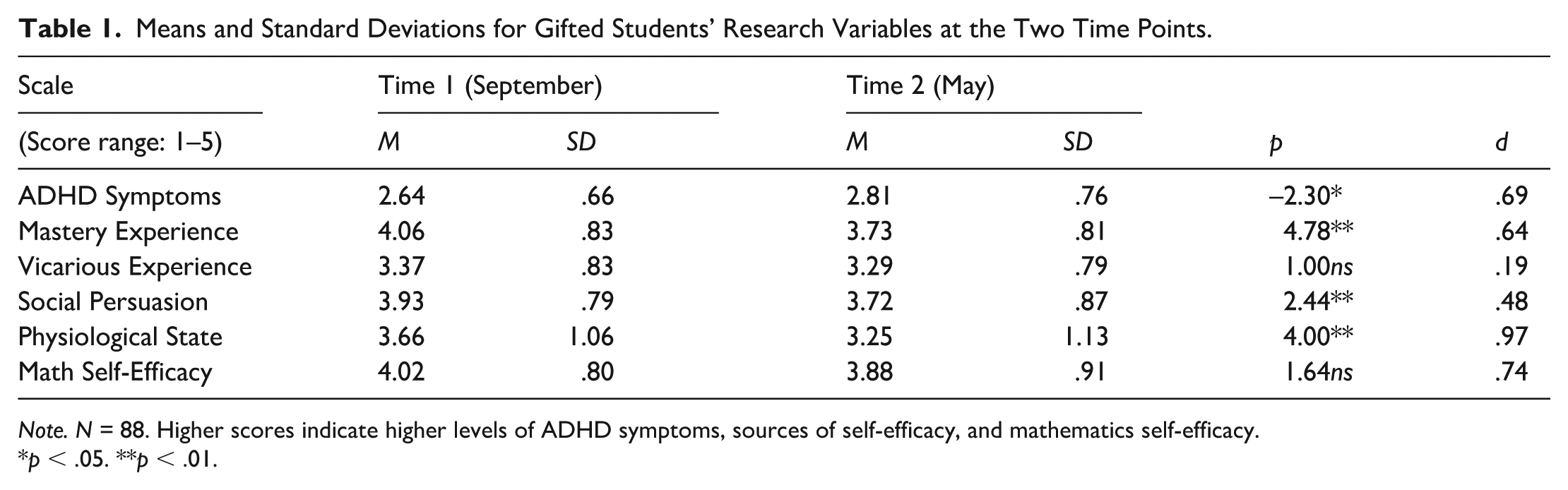
Note. N = 88. Higher scores indicate higher levels of ADHD symptoms, sources of self-efficacy, and mathematics self-efficacy.
*p < .05. **p < .01.
Pearson correlations calculated to test the first three research hypotheses showed significant weak to strong relationships among all the research variables at both time points (see Tables 2 and 3). Mathematics self-efficacy was found to have a strong positive relationship with three of the self-efficacy sources, Mastery Experience (first time point: r = .84, p < .01; second time point: r = .80, p < .01), Physiological State (first time point: r = .76, p < .01; second time point: r = .65, p = .01), and Social Persuasion (first time point: r =.62; second time point: r = .61, p < .01) and a weak negative relationship with ADHD symptoms (first time point: r = −.28, p < .01; second time point: r = −.24, p < .05).
Pearson Correlation Matrix Among Study Variables at the First Time Point, N=88.
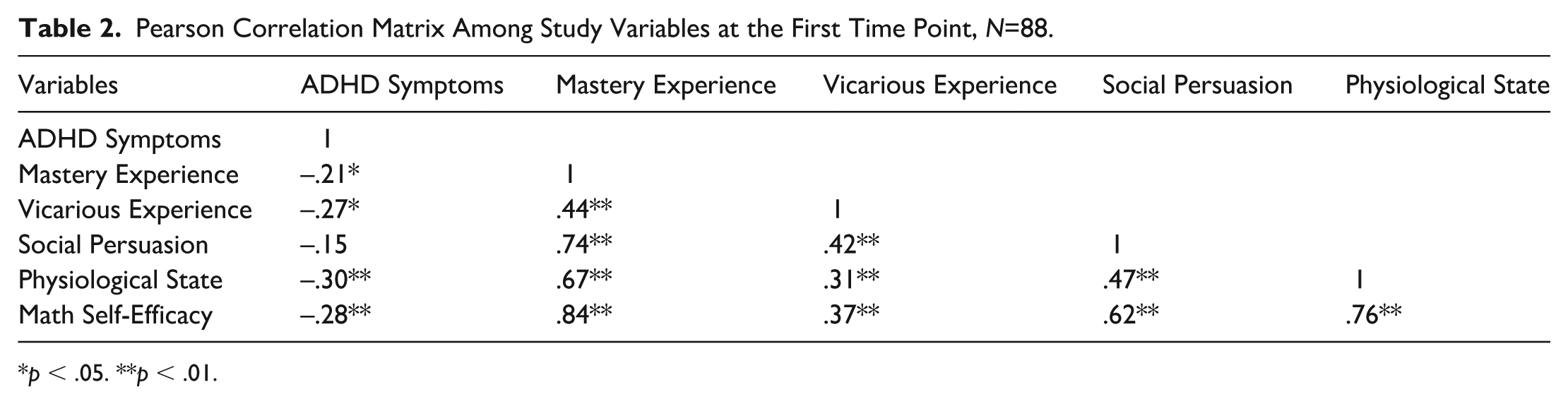
p < .05. **p < .01.
Pearson Correlation Matrix Among Study Variables at the Second Time Point, N=88.
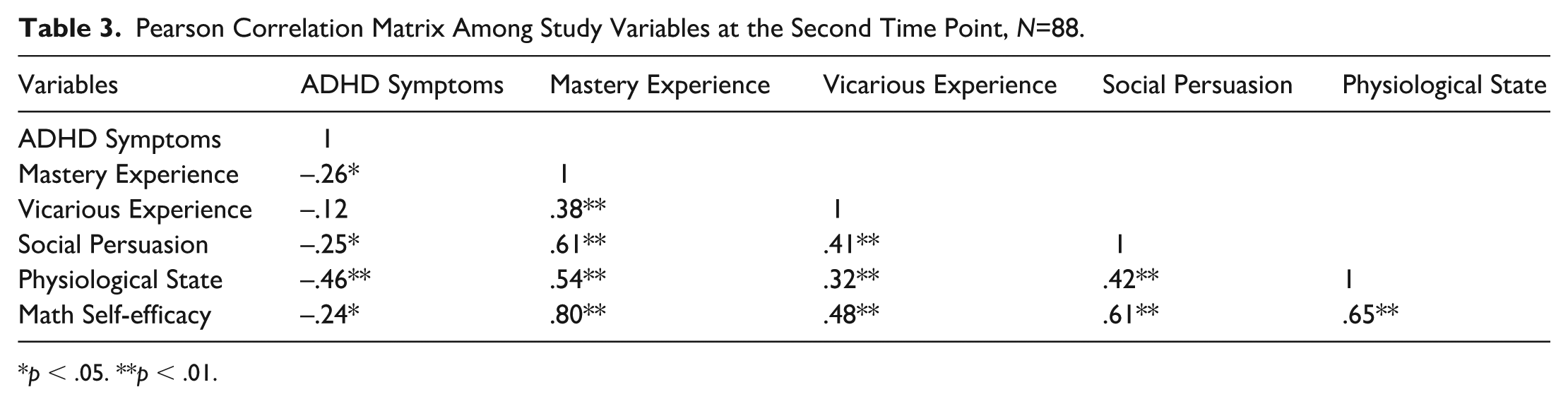
p < .05. **p < .01.
Path Analysis
The first step in structural equation analysis is evaluating the measurement model by examining the extent to which the model fits the data. Table 4 includes the fit indices of the model tested in this study (Byrne, 2010; Hoyle & Panter, 1995) for predicting students’ level of self-efficacy in mathematics. As seen in the table, the measurement of all variables in the model was valid. These results reinforce the theoretical assumptions that dictated the selection of the model variables. The results also indicate a very good fit of the measurement model to the research data, as evidenced by the following fit indices: RMSEA = 0.10, CFI = 0.93, NFI = 0.87, all indicating good model fit (Hoyle & Panter, 1995; Kline, 2023).
Result of Structural Equation Modeling.
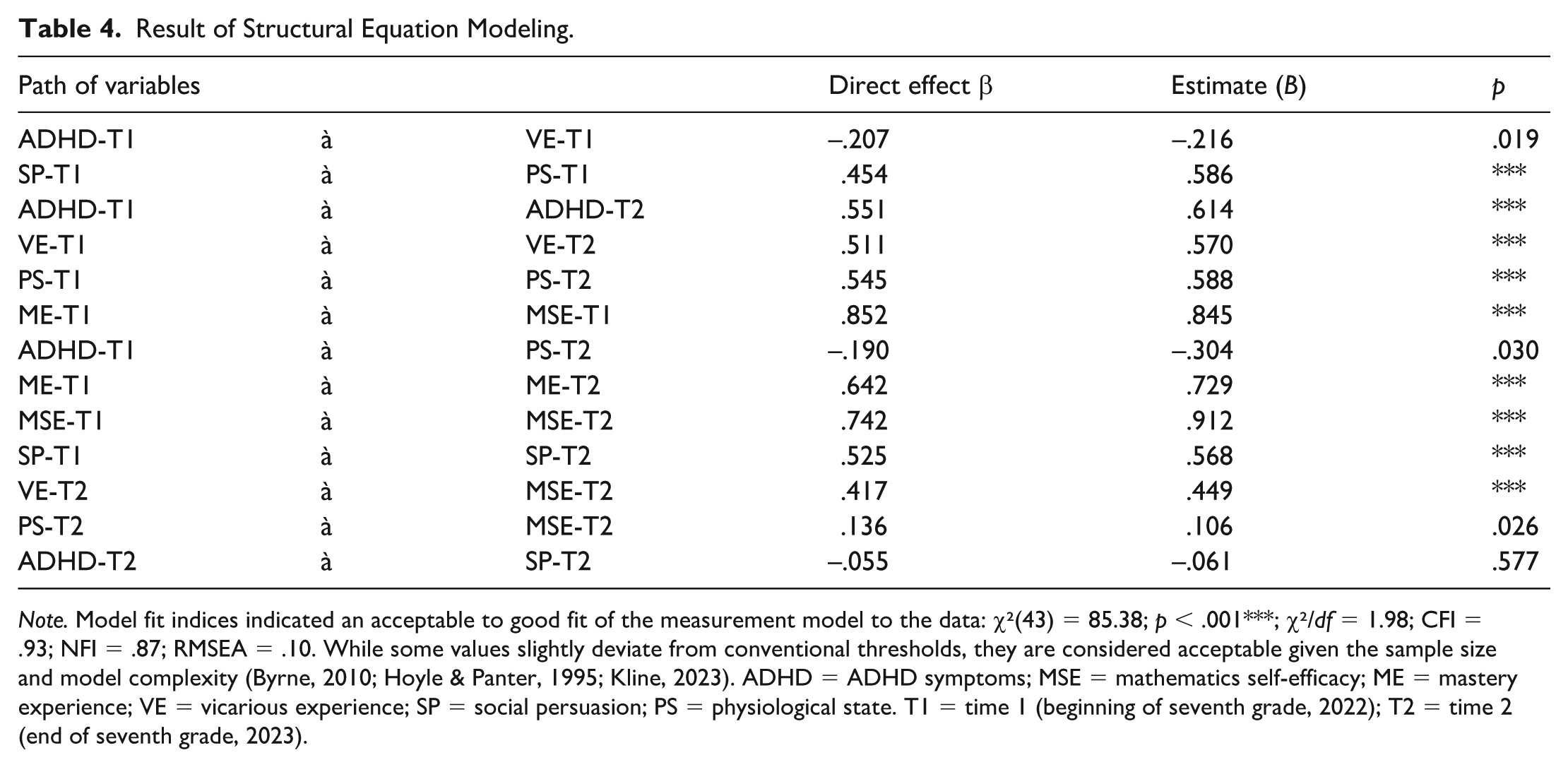
Note. Model fit indices indicated an acceptable to good fit of the measurement model to the data: χ²(43) = 85.38; p < .001***; χ²/df = 1.98; CFI = .93; NFI = .87; RMSEA = .10. While some values slightly deviate from conventional thresholds, they are considered acceptable given the sample size and model complexity (Byrne, 2010; Hoyle & Panter, 1995; Kline, 2023). ADHD = ADHD symptoms; MSE = mathematics self-efficacy; ME = mastery experience; VE = vicarious experience; SP = social persuasion; PS = physiological state. T1 = time 1 (beginning of seventh grade, 2022); T2 = time 2 (end of seventh grade, 2023).
The second step in structural equation analysis is evaluating the structural model to examine the hypothesized relationships between the exogenous (independent) variables and the endogenous variables (influenced by other variables). In this study, all structural equation analysis variables were measured twice, at the first and second time points. The exogenous variable was the level of ADHD symptoms, and the four sources of self-efficacy were the forms of mediation, while the endogenous (dependent) variable was the level of self-efficacy in mathematics. Figure 1 shows the path analysis of the structural model for the study sample at the two time points, at the beginning and end of the year.
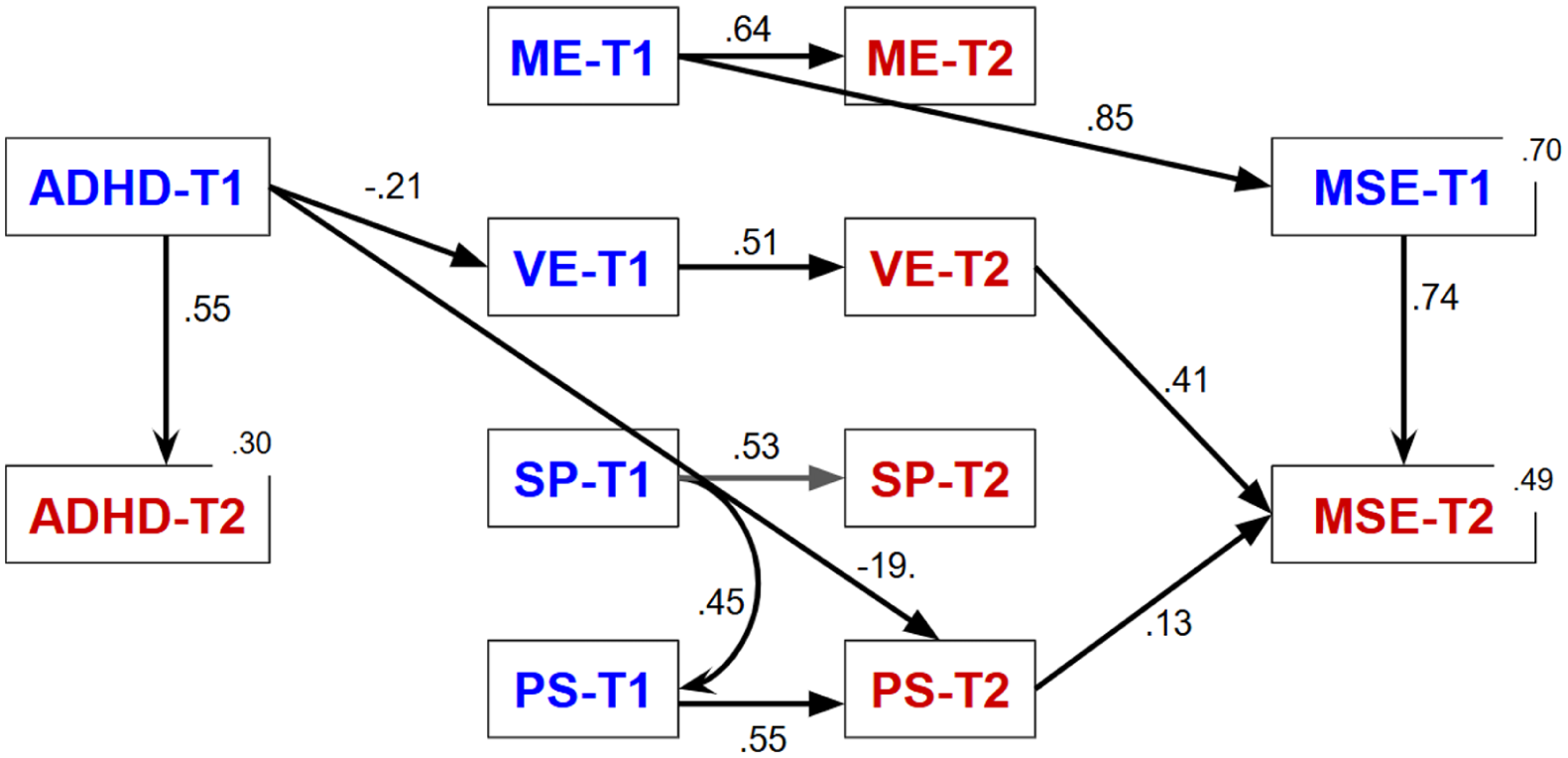
Path Analysis Models for Gifted Students at Beginning (Time 1) and End (Time 2) of Seventh Grade.
The Figure
Findings from the path analysis showed no direct effect of ADHD symptoms on mathematics self-efficacy level, at either time point, in the current sample of gifted students. Self-efficacy in mathematics was predicted by mediating variables at both time points. Students’ level of ADHD symptoms negatively predicted Vicarious Experience at the first time point (β = −.21, p < .05) and higher Physiological State (reversed scoring; β = −.19, p < .05). Namely, when ADHD symptoms were higher, two sources of self-efficacy mediated symptoms’ effect on students’ self-efficacy levels, differently at the two time points: lower Vicarious Experience at the beginning of seventh grade (T1, 2022) and higher Physiological State (reversed scoring) at the end of the school year. Overall, students’ level of ADHD symptoms influenced changes over the course of the year in the role played by students’ sources of mathematics self-efficacy.
Regarding the effects of the mediating variables on mathematics self-efficacy level, at the beginning of the year this dependent variable was predicted only by Mastery Experience (β = .85, p < .05), explaining 70% of the variance. At the end of the year, self-efficacy in mathematics was predicted by Vicarious Experience (β = .44, p < .05) and Physiological State (β = .13, p < .05), which explained 49% of the variance. Thus, the sources of self-efficacy for mathematics performance changed from Mastery Experience at the beginning of the year to Vicarious Experience and Physiological State at the end of the year. Each study variable showed a predictive relationship between the two time points’ measurement, at the school year’s beginning (T1, seventh grade, 2022) and end (T2, seventh grade, 2023). The values that emerged was β = .74, p < .05 for mathematics self-efficacy level at T2 and β = .64, p < .05 for Mastery Experience at T1, showed relative stability between the first and second time points.
Discussion
This longitudinal study aimed to narrow a gap in the literature regarding the mathematics self-efficacy of gifted students who exhibit ADHD symptoms. The discussion below focuses specifically on the gifted student subsample (n = 88), identified as gifted in elementary school, who participated in the present study. It examined the role that inattention and hyperactivity-impulsivity symptoms may play in the decline of self-efficacy as these students transition to middle school, as well as whether self-efficacy sources could mediate this decline. Considerable research has shown that Bandura’s (1977) four main sources of self-efficacy beliefs (mastery experiences, vicarious experiences, social persuasion, and physiological states) exert significant influence on self-efficacy, particularly in mathematics (Gao, 2020; Haciomeroglu, 2019; Joët et al., 2011; Kyaruzi, 2023; Özcan & Kültür, 2021; Usher & Pajares, 2009; Yildiz & Özdemir, 2019). However, these sources have not been sufficiently investigated for their possible role as mediators between gifted adolescents’ ADHD symptoms and their self-efficacy for mathematics, while tracing changes from the beginning to the end of seventh grade.
Overall, the current results showed that higher ADHD symptom levels correlated with lower self-efficacy in mathematics, confirming the first hypothesis. This pattern aligns with studies showing that students and adults with ADHD have a lower sense of academic self-efficacy than those without ADHD (Almasi, 2016; Lewin, 2021; Major et al., 2013; Newark et al., 2016; Sarid & Lipka, 2023; Schmidt-Barad et al., 2023; Waite et al., 2022). Similarly, broader research indicates that gifted individuals diagnosed with ADHD tend to experience lower self-perceptions in various domains, including self-esteem and self-image (Foley-Nicpon et al., 2012; Tourreix et al., 2023). Likewise, the current results demonstrated that higher ADHD symptom levels correlated with lower scores on the sources of self-efficacy in mathematics among gifted students across both measurement points, confirming the second hypothesis. These results align with prior studies showing that adolescents and adults with ADHD symptoms reported diminished impact from self-efficacy sources compared with those without ADHD symptoms (Colomer et al., 2013; Dvorsky & Langberg, 2016; Jangmo et al., 2019; Kaufmann & Nuerk, 2006; Major et al., 2013), as well as heightened affective and physiological arousal (Uchida et al., 2021).
At the beginning of seventh grade, the negative correlation found between the gifted students’ level of ADHD symptoms and Vicarious Experience suggests that as ADHD symptoms increased, the effectiveness of learning through modeling decreased. However, by the end of the seventh grade, this relationship had disappeared, indicating that as ADHD symptoms increased, the influence of verbal encouragement diminished. At the beginning of seventh grade, the primary challenge appeared to be learning from external models, while by the year’s end, the difficulty seemed to shift toward processing verbal persuasion. Perhaps this change in focal challenges may stem from the initial adjustment period at the start of the school year, when students are still adapting to a new environment and instructional methods. By the year’s end, after partial adaptation, other difficulties related to verbal interaction and processing feedback and guidance may have become more pronounced. Furthermore, the decline in the effectiveness of Social Persuasion could potentially be explained by a decrease in positive Mastery Experiences, as reduced positive personal experiences often limit the impact of verbal persuasion on self-efficacy. The current results also showed the positive relationship between sources of self-efficacy and self-efficacy in mathematics among students at both measurement points, confirming the third hypothesis. These findings indicated that as the influence of self-efficacy sources increases, so does self-efficacy in mathematics. These results align with Bandura’s self-efficacy theory (Bandura, 2006; Usher & Pajares, 2008) and the rare findings of Ozcan et al. (2021), which reported a positive correlation between sources of academic self-efficacy and self-efficacy in mathematics among gifted students, suggesting that these sources positively reinforce self-confidence.
Beyond confirming these relationships, the current study expanded on prior research by highlighting a shift in the relative influence of specific sources over the school year. At the beginning of the year, Mastery Experience served as the strongest predictor of mathematics self-efficacy, likely reflecting students’ reliance on prior successful experiences from elementary school. However, as the academic demands increase in middle school, a decrease in students’ personal academic success may possibly lead them to draw more on Vicarious Experience and Physiological State. This shift may be attributed to a growing influence from peers and social comparison during middle school (Dijkstra et al., 2008), which could be speculated as increasing the importance of Vicarious Experience, while Mastery Experience plays a diminishing role. Moreover, as the year progresses, rising academic pressures appear to heighten the impact of physiological factors like fatigue and stress on self-efficacy.
The fourth research hypothesis exploring the mediation model at the two time points revealed a novel finding, whereby mathematics self-efficacy level was not found to be directly influenced by ADHD symptom levels but rather was shaped through self-efficacy sources, whose impact changed over the year. The mediators Mastery Experience, Vicarious Experience, Social Persuasion, and Physiological State were found to play an important role, with their impact on the relationship between ADHD symptoms and mathematics self-efficacy varying over the course of the year.
The fifth research hypothesis predicted that level of self-efficacy for mathematics performance among gifted students with higher ADHD symptoms would decrease during the seventh-grade school year. Indeed, although gifted students generally have a higher sense of academic self-efficacy compared with average-ability students (Chae & Gentry, 2011; Guez et al., 2018; Korkmaz et al., 2018), the main finding in this study indicates a significant and distinct decreased level of self-efficacy in mathematics among gifted students with higher ADHD symptoms. This finding is consistent with previous studies showing that gifted individuals with ADHD face unique academic challenges (Kanapathy et al., 2022; Tourreix et al., 2023), as well as lower self-esteem and self-image compared to gifted individuals without ADHD (Foley-Nicpon et al., 2012). These challenges add to the broader academic demands associated with the transition to middle school, experienced by all students (Benner, 2011; Pearson et al., 2017; van Rens et al., 2018, 2020), and especially by students with ADHD (Langberg et al., 2008; Uvaas & McKevitt, 2013).
In sum, this study revealed the complex dynamics between ADHD symptoms and self-efficacy in mathematics among gifted students, providing a new understanding of their unique learning processes and challenges. Over the school year, a general decline in mathematics self-efficacy was observed among gifted students, with symptom levels further influencing this trend through varying self-efficacy sources. However, the study findings emphasized that ADHD symptoms did not directly relate to mathematics self-efficacy; instead, their relationship was mediated by the four self-efficacy sources, which impacted self-efficacy differently over the year. At the beginning of the year, the decline in self-efficacy was mainly due to a decrease in Vicarious Experience, while Mastery Experience was the primary positive source of influence. Later in the year, the decrease was associated with Social Persuasion, whereas Vicarious Experience became a source of positive influence on mathematics self-efficacy.
Practical Implications of the Study
The current findings highlight that gifted seventh graders’ lower self-efficacy for performing mathematics does not stem from their higher ADHD symptoms alone, but rather from emotional, social, academic, and bodily experiences and situations that affect the students’ beliefs about their academic competence. This pinpoints the importance of developing targeted educational approaches to support sources of self-efficacy in gifted students with inattention and/or hyperactive-impulsive behaviors, especially during critical phases such as the transition to middle school, when personal and social challenges intensify. The findings underscore the need to design and to empirically test the effectiveness of comprehensive educational interventions that foster development of the four sources of mathematics self-efficacy to help this population fully realize their academic potential. Toward this end, it is essential to deepen pre-service and in-service teachers’ knowledge about gifted students and the characteristics of ADHD, recognizing that this disorder does not necessarily diminish mathematics self-efficacy. The focus of intervention should be on the four sources of self-efficacy, providing educational tools to help students cope with challenges and develop a sense of efficacy in mathematics. Below are recommendations for practical intervention based on the four sources of self-efficacy, tailored to students, parents, and educational staff.
Mastery Experience
The experience of success was the primary source of mathematics self-efficacy at the start of the year, but over time, this influence diminished. Increased academic demands in middle school, coupled with limited attentional resources, may have led to a reduction in personal academic successes. To address this, educators should create learning situations that foster gradual successes, emphasizing effort and personal progress while setting achievable goals. In addition, highlighting daily achievements both at school and at home and encouraging self-monitoring of progress can strengthen self-confidence and help students cope with the shifting challenges throughout the year.
Vicarious Experience
At the beginning of the year, a negative correlation was found between the level of ADHD and the vicarious experience source; students with more ADHD symptoms engaged less in learning by observing others. By the end of the year, this negative connection was no longer observed; vicarious experience positively contributed to the sense of mathematics self-efficacy. Perhaps, for gifted students with high inattention symptoms, mentoring programs or conversations with same-age adolescents, with parents who serve as role models, or with respected teachers can have a positive impact by sharing coping strategies and maintaining a positive influence throughout the year.
Social Persuasion
Social persuasion was an important source of self-efficacy; however, among students with high levels of ADHD, this source decreased. Gifted students with high ADHD symptoms can benefit significantly from tailored encouragement, especially from teachers and parents who express trust in their abilities. Teachers should provide positive feedback and foster a sense of belonging in the learning group. Parents play a key role in daily support and consistent reinforcement of their children’s capabilities, focusing on small successes. In addition, students with ADHD symptoms may exhibit heightened sensitivity to both positive and negative feedback, potentially reducing the effectiveness of social persuasion on their self-efficacy (Beaton et al., 2022; Dovis et al., 2015; Furukawa et al., 2021; Luman et al., 2012; Miller et al., 2014; Mohammadi & Khanjani, 2021). This sensitivity can limit the sustained impact of verbal encouragement on self-efficacy, particularly when previous experiences include instances of failure or negative feedback.
Physiological State
Awareness of physiological state is crucial for gifted students with high levels of inattention symptoms, as their physiological state directly impacts their sense of self-efficacy. Parents are encouraged to emphasize the importance of sufficient sleep and physical activity to these students and to support them in maintaining a healthy lifestyle. Teachers are advised to incorporate short breaks during the school day and to encourage stress relief activities before exams, such as breathing exercises, mindfulness, drinking water, and light physical activity. Addressing the students’ physiological state can help them cope with academic challenges and strengthen their sense of self-efficacy. The heightened physiological arousal observed among students with ADHD is often associated with stress and emotional tension, which can negatively impact mathematics self-efficacy (Payen et al., 2022; Somma et al., 2019). Recognizing and addressing the influence of physiological states on self-efficacy is particularly important for students with ADHD, as these factors may impair concentration and confidence during academic tasks. Overall, these findings, which support the existing research literature, contribute significantly to expanding our vital knowledge about this unique population of gifted individuals with ADHD symptoms, emphasizing their need for a tailored curriculum. To address this need, administrators and educational specialists should lead and collaborate in developing appropriate frameworks to provide these students with the necessary pedagogical and personal support (Goksu & Gelicli, 2023; Riga & Malafantis, 2023; VanTassel-Baska & Brown, 2022).
Study Limitations and Recommendations for Future Research
The study was based on a relatively small sample of students, and findings must be re-examined among a larger sample to validate them and enable generalization. In addition, although the current study was longitudinal, it was observational and examined relationships between variables; hence, future interventional research could actively examine causality. Our findings were based on data collected during only one school year; thus, longer-term follow-up would provide a more complete picture, while addressing possible additional background factors not examined in this study. Longitudinal studies are needed to track gifted students with ADHD symptoms over several years. These studies can reveal the dynamics of mathematics self-efficacy over time.
Another limitation concerns the gender distribution within both the full sample and the gifted subsample, which had a higher proportion of girls than boys. This imbalance may be partially explained by contextual factors such as the inclusion of single gender (e.g., religious) schools in the sampling frame, and by evidence that girls are often more likely than boys to voluntarily respond to educational surveys (Porter & Whitcomb, 2005). Therefore, the findings may be less generalizable to gifted male students, and future studies should aim to ensure a more balanced gender representation. In addition, while the gifted subsample was drawn from a larger cohort of seventh-grade students (N = 448), no formal statistical comparisons were conducted between the groups. As such, the distinctiveness of the gifted group within the full sample remains untested, and future research should include inferential comparisons to better establish group-specific patterns.
It is also recommended to further examine the impact of demographic variables such as gender, age, and socioeconomic background on the relationship between ADHD symptoms and self-efficacy in mathematics. Furthermore, future researchers may do well to investigate psychosocial factors like motivation, self-regulation, and problem-solving skills that prior research identified as playing a role as mediators of academic self-efficacy (Mahatmya et al., 2023). Such research could address calls for future empirical exploration to promote understanding of gifted subgroups’ heterogeneity (Bucaille et al., 2022). In addition, further study utilizing additional rating sources and objective measures (e.g., teacher assessments, standardized academic testing) would expand the current study findings, which relied on potentially biased self-reporting through questionnaires. Moreover, further research is recommended to assess academic self-efficacy in various subjects other than mathematics among gifted students with ADHD symptoms, such as sciences, language, or arts.
Finally, this study aligns with international trends while adapting to the Israeli context and educational goals, providing important insights into the unique academic and psychological experiences of gifted students with high levels of ADHD symptoms within the Israeli educational system. Yet, findings from the Israeli context may not be generalizable to other populations, cultural environments, or educational systems. The Israeli education context’s specific programs for gifted students may differ from those in other countries. Future researchers and educators should therefore consider cultural and systemic factors when designing interventions aimed at improving self-efficacy in mathematics for this population.
Supplemental Material
sj-xlsx-1-gcq-10.1177_00169862261422458 – Supplemental material for Longitudinal Study: Sources of Self-Efficacy Mediating Between Attention-Deficit/Hyperactivity Disorder Symptoms and Mathematics Self-Efficacy Level Among Gifted Students
Supplemental material, sj-xlsx-1-gcq-10.1177_00169862261422458 for Longitudinal Study: Sources of Self-Efficacy Mediating Between Attention-Deficit/Hyperactivity Disorder Symptoms and Mathematics Self-Efficacy Level Among Gifted Students by Dorit Meyer and Bracha Kramarski in Gifted Child Quarterly
Footnotes

Ethical Considerations
Ethical approval for this study was obtained from the Ethics Committee of the School of Education at Bar-Ilan University (approval no. 121) on July 25, 2022.
Funding
The authors received no financial support for the research, authorship, and/or publication of this article.
Declaration of Conflicting Interests
The authors declared no potential conflicts of interest with respect to the research, authorship, and/or publication of this article.
Open Practices
The data analyzed in this study are available for purposes of reproducing the results at https://docs.google.com/spreadsheets/d/1KWp63U_4BrT_V_uQqmcNSrzeYxwPmH-w/edit?usp=sharing&ouid=113936421475637428222&rtpof=true&sd=true. The code or protocol used to generate the findings reported in the article are not available for purposes of reproducing the results or replicating the study. There are no other newly created, unique materials used to conduct the research.
Artificial Intelligence Use
ChatGPT4 was used for translation, wording, and linguistic and grammatical accuracy. However, the software did not replace human linguistic editing. The authors confirm that they have taken steps to ensure accuracy of AI-generated content, and that it contains no plagiarism or bias.
Author Biographies
References
Supplementary Material
Please find the following supplemental material available below.
For Open Access articles published under a Creative Commons License, all supplemental material carries the same license as the article it is associated with.
For non-Open Access articles published, all supplemental material carries a non-exclusive license, and permission requests for re-use of supplemental material or any part of supplemental material shall be sent directly to the copyright owner as specified in the copyright notice associated with the article.
