




Abstract
Educational acceleration is well established as a best practice for meeting the learning needs of precocious youth. It occupies one region of a broader spectrum of interventions designed to align educational curricula with students’ learning readiness, namely, appropriate developmental placement. Despite over 100 years of robust longitudinal support, educational acceleration is not reliably implemented in practice or educational theorizing. This investigation extends this literature through a mixed-methods approach to the educational experiences and perspectives of intellectually precocious youths as adults. Study 1 examines the experiences and views of Gifted (N = 1,279) and Highly Gifted (N = 479) individuals in their mid-30s on homogeneous grouping for instruction. Study 2 constitutes a constructive replication of Study 1 involving an unobtrusive generalization probe administered to Profoundly Gifted participants (N = 241) and Top STEM Doctoral Students (N = 695) in their mid-20s. Study 2 focuses on participants’ high school likes and dislikes to determine whether they unobtrusively capture sentiments indicative of appropriate developmental placement in general and educational acceleration in particular. Collectively, participants appear to crave advanced and challenging educational material. Across cohorts and genders, a longitudinal examination of potential moderators revealed that these results did not covary with lifestyle/occupational outcomes at age 50. Findings align with Carroll’s Model of School Learning, Cronbach’s formulation of aptitude × treatment interactions, and modern measurement procedures. They support tailoring curricula to academic readiness for maximizing learning. They also highlight how contextual features embedded in educational settings beyond strictly academic material facilitate learning and psychological development.
Keywords
Over the past few decades, a large body of empirical evidence has accumulated that supports the efficacy of educational acceleration for meeting the learning needs of intellectually precocious youth. Indeed, it constitutes one of the most robust empirical generalizations in the psychoeducational sciences. Teams of international scholars and scientists with expertise in gifted education (Assouline et al., 2015a, 2015b; Benbow & Stanley, 1996; Colangelo et al., 2004a, 2004b; Preckel et al., 2024), meta-analytic reviews (Kulik & Kulik, 1984, 1992; Rogers, 2004; Steenbergen-Hu & Moon, 2011), as well as the National Mathematics Advisory Panel (2008, pp. 52–53) deem this intervention to be a best practice for gifted youth (Preckel et al., 2024; Worrell et al., 2019). That conclusion is reinforced by two 100-year reviews of the gifted field, published in the Review of Educational Research to mark the American Educational Research Association’s (AERA) centennial (Lubinski, 2016; Steenbergen-Hu et al., 2016). Moreover, there is solid evidence that by meeting the educational needs of precocious youth through educational acceleration, the likelihood of subsequent occupational success and creativity is enhanced (Park et al., 2013; Wai et al., 2010).
When used properly, acceleration is not only educationally efficacious (Assouline et al., 2015a, 2015b; Bleske-Rechek et al., 2004; Colangelo et al., 2004a, 2004b), there is no empirical evidence to support concerns about acceleration compromising personal well-being in the short- or long-term (Assouline et al., 2015a, 2015b; Colangelo et al., 2004a, 2004b). In fact, longitudinal studies of multiple cohorts of gifted youth who experienced more educational acceleration relative to their intellectual peers, and who were tracked to age 50 and assessed on psychological well-being, demonstrate that there is no cause for concern (Bernstein et al., 2021; see also Kell et al., 2022). Given this broad background and empirical base, no further research is needed to confirm that educational acceleration is a best practice for meeting the learning needs of gifted youth. While situated refinements are always possible, and valued information will likely come from them, the overarching empirical generalization that tailoring the pace and depth of the educational curriculum to the knowledge base and rate at which students absorb abstract/conceptual material is solidly established (Assouline et al., 2015a, 2015b; Benbow & Stanley, 1996; Carroll, 1989; Colangelo et al., 2004a, 2004b; Corno et al., 2002; Stanley, 2000).
Considering concerns over the replication crisis in the social sciences (Camerer et al., 2018; Open Science Collaboration, 2015), one would think that an empirical generalization this robust would be embraced as welcome news, reliably practiced, and cited as a positive counter-example to the many empirical inconsistencies in the social sciences. Yet, academic administrators, teachers, and parents continue to express hesitation about the practice of allowing highly able and motivated students access to acceleration by expressing concerns regarding students’ psychological well-being and social/emotional development (see T. L. Cross et al., 2018; Dare et al., 2016; Laine et al., 2019; Siegle et al., 2013; Wood et al., 2010). Moreover, there is contentious debate on this question outside of academe as well. Celebrated and historically successful programs for meeting the learning needs of academically advanced students are being challenged and even discontinued (National Working Group on Advanced Education, 2023), from NYC “The End of Gifted Programs?” (Nierenberg, 2021; see also Bellafante, 2022; Closson, 2024) to California “California State Guidelines Discourage Schools from Offering Advanced Middle School Math” (Camp, 2023; see also Schwartz, 2023). These changes have spurred much controversy as parents and students push to retain access to challenging and advanced coursework. And in response to the updated math framework in California, organizations such as Families of San Francisco have organized distinguished Science, Technology, Engineering, and Mathematics (STEM) professionals to champion access to advanced mathematical curriculum and advanced coursework for able and willing students (https://sites.google.com/view/k12mathmatters/home).
For both their individual well-being as well as the well-being of society, it is crucial to provide accessible programs to support all students’ learning needs (Office of Management and Budget, 2022). With respect to the former, unsupported—indeed empirically contradicted—challenges to educationally efficacious practices in key cities across the United States serve to undermine the academic success of many highly talented and motivated students. Although affluent and knowledgeable parents can successfully circumvent any such curriculum constraints to ensure that their children have access to developmentally appropriate learning experiences, even if it means relocating their family (Badger, 2016), motivated and talented students from economically challenged homes remain academically underserved (National Working Group on Advanced Education, 2023). As the correlation between socioeconomic status (SES) and general cognitive ability is only r ≈ .40 (Humphreys, 1985; Lubinski & Humphreys, 1996), 1 we know that exceptional intellectual potential resides across the socioeconomic spectrum. The problem then, especially when public education programs and interventions are challenged and jettisoned, becomes a lack of opportunities, especially for underserved students.
In addition, society needs to develop exceptional talent to keep pace with the increasing complexity of our world and a host of pressing concerns (Hunt, 1995; National Science Board, 2010; National Working Group on Advanced Education, 2023). Climate change, pandemics, and cyber-insecurity are but a few examples of the broad class of challenges that underscore why identifying exceptional talent and nurturing its fruition requires immediate attention. Arguably, it is more urgent to develop talent now than during the era of Sputnik (Super & Bachrach, 1957), when intellectually precocious youth “[were] all the rage” and the interest in identifying their talents came “from concern with prospects for national survival” (Hobbs, 1958, p. 598). It is not hyperbole to say that addressing this issue is required for maintaining and advancing the well-being of modern societies (Kell et al., 2013a, pp. 648–649).
Given this milieu, we wondered if there was some significant aspect absent from the vast scientific literature on acceleration that might facilitate educationally efficacious policies, practices, and theorizing on this topic of national and global interest. Is there a reason why empirical findings on educational acceleration for intellectually precocious youth are not more readily embraced? Is there a reason why the learning readiness of intellectually precocious students continues to be stereotyped by chronological age (Lubinski, 2025)? And is there a missing empirical component, beyond the extensive empirical investigations, case studies, and theorizing on acceleration, which might solidify the implementation of these practices for intellectually able and motivated students?
A missing component identified in this literature is the collective voice of the population that educational acceleration is designed to serve, namely, academically advanced and motivated students (Bleske-Rechek et al., 2004). While best practices have always stressed that able and willing students are first asked if they would like to experience more academically challenging coursework before they embark upon one of the many forms of educational acceleration (Assouline et al., 2015a, 2015b; Colangelo et al., 2004a, 2004b; Wai et al., 2010), a systematic study of the thoughts and feelings in early adulthood of the widely varying educational/school opportunities that intellectually talented students experienced as adolescents has never been conducted. We thought illuminating their perspectives (informed by life experiences beyond their formal education) should be especially informative. It also may add insight to understanding the psychologically operative components of this practice. Do the individual voices of the gifted coalesce around common themes in ways that inform this topic? And, if so, do their testimonies vary as a function of gender?
In addition, we also thought that a broader longitudinal perspective concerning gifted individuals would be informative. Therefore, we decided to compare their thoughts and feelings obtained in early adulthood against their markedly different developmental trajectories assessed at midlife (two to three decades later). We examined life outcomes ranging from objective/public appraisals of creativity and eminence (i.e., typical professionals versus cutting-edge STEM, occupational, and creative leaders); we also examined part- versus full-time workers and full-time homemakers for potential moderators. Such comparisons would enable us to ascertain whether, and the extent to which, participants’ views vary as a function of gender or as a function of contrasting occupational and lifestyle outcomes, where nascent features of their individuality undoubtedly played an instrumental role in structuring (Bernstein et al., 2019; McCabe et al., 2020). These findings could then be leveraged for curating academic environments more suitably tuned to educating possible future innovators that modern societies so desperately need.
Finally, our mixed-methods approach will go beyond assessing reports based on specific accelerative practices. In this investigation, educational acceleration will be placed in the broader context of appropriate developmental placement (ADP), that is, aligning educational opportunities with the individuality of each student, which facilitates learning for all students (Appendix A; Lubinski & Benbow, 2000; Park et al., 2013). 2 Studying ADP in general and educational acceleration in particular has revealed that there are psychologically important aspects of contrasting learning environments that covary with, but are not specifically tied to, variations in academic content for instruction (e.g., the social context). They include, but are not limited to, peers, teachers, and school administrators; these environmental features have implications for learning, and they also have broader implications for social and emotional well-being. Our investigation is designed to capture qualitatively these aspects of their classroom and school environments and the experiences they engendered. We seek to uncover their potential role in either attenuating or facilitating learning as well as in adaptive/maladaptive psychological development more generally.
Study 1
Method
Participants
Participants were drawn from the Study of Mathematically Precocious Youth’s (SMPY) first two talent-search cohorts identified in the 1970s based on above-level Scholastic Aptitude Test (SAT) assessments (Lubinski & Benbow, 2006). Those in Cohort 1 were identified in 1972–1974 as being in the top 1% in ability (SAT-Math [SAT-M] ≥ 390 or SAT-Verbal [SAT-V] ≥ 370 before age 13); they will be referred to throughout as “Gifted.” They came primarily from Maryland (508 females and 771 males): 84.9% White or Caucasian, 0.4% Hispanic, 0.5% Black or African American, 1.3% Asian or Asian American, 0.7% other, and 12.2% chose not to identify their race. Participants in Cohort 2 were identified in 1976–1979 as being in the top 0.5% of ability (SAT-M ≥ 500 or SAT-V ≥ 430 before age 13); they will be referred to throughout as “Highly Gifted.” They came from the mid-Atlantic states (155 females and 324 males): 82.5% White or Caucasian, 0.6% Hispanic, 1.0% Black or African American, 6.9% Asian or Asian American, 2.3% other, and 6.7% chose not to identify their race. Participants in both cohorts were tracked longitudinally with follow-up surveys conducted after high school at age 18 (Benbow, 1983; Benbow & Stanley, 1983), after college at age 23 (Benbow, 1992), early career at age 33 (Benbow et al., 2000), and mid-career at age 50 (Lubinski et al., 2014).
Longitudinal Measures
Age 33 Assessments
Data were secured based on participants’ responses to a two-part item from their early career 20-year follow-up survey conducted in the 1990s, when participants were around age 33 (response rates: Gifted = 77.1%, Highly Gifted = 81.5%; Benbow et al., 2000). This item was scaled with 7-point anchors and followed by a prompt to secure participants’ unique perspectives and reactions to an open-ended question. The item read:
A number of educational policy makers have proposed the following: eliminating homogeneous grouping for instruction (i.e., grouping students according to their abilities and skills, as in reading groups or honors classes) and, instead, teaching students of all ability levels in the same group. How supportive are you of this proposal? Please describe.
Specifically, participants were first asked to indicate their level of support for this policy on scale anchors ranging from (1) “Very Unsupportive” to (7) “Very Supportive.” This item was scaled in the negative direction intentionally in order to stack the deck against positive appraisals for homogeneous grouping. That is, for those possessing positive affinities toward homogeneous grouping for instruction, they would be required to check the negative scale region denoting “Very Unsupportive” or “Unsupportive” (which is a psychologically compelling and forceful response). While this methodology may be slightly confusing to the general population, it is readily implementable with intellectually prodigious adults, and it decidedly ensures that negative appraisals of doing away with homogeneous grouping are genuinely intended and precisely captured. Following this quantitative appraisal, participants were given appreciable room in a response box in which to write an open-ended response stating their thoughts and feelings about doing away with this practice.
Age 50 Assessments
Information on participants’ eventual career and life outcomes was obtained from their age-50 follow-up survey conducted in 2012–2013 (Lubinski et al., 2014). Across both cohorts, the average response rate for the age-50 follow-up was 73.2% (for details on response rate calculations, see Lubinski et al., 2014, Footnote 2, p. 2230). Examining participants’ career and life outcomes enabled us to determine whether their views on homogeneous grouping for instruction varied as a function of individual differences in life course trajectories over different degrees of professional accomplishment (Bernstein et al., 2019), which are immense among SMPY participants (Kell et al., 2022; Lubinski et al., 2023) and intellectually prodigious populations in general (Holahan et al., 1995; Preckel et al., 2024; Simonton, 2014). In consultation with eminent leaders in engineering, physics, law, and government (Bernstein et al., 2019), and drawing upon the psychological literature on talent development (Simonton, 2014), we identified subsets of creative/occupational leaders whose accomplishments were commensurate with tenured faculty at Research-intensive (R1) institutions; the subsets used for analyses here are found in Lubinski et al. (2023, p. 285; Table 1). We also examined other potential moderators, such as part- versus full-time workers and full-time homemakers. We were interested in determining whether markedly different occupational accomplishments and life paths were anticipated by different perceptions of the personal needs and experiences of our participants, on which they reported in early adulthood.
Percentage of Participants Stressing Each Theme or Combination of Themes in Their Open-Ended Response.
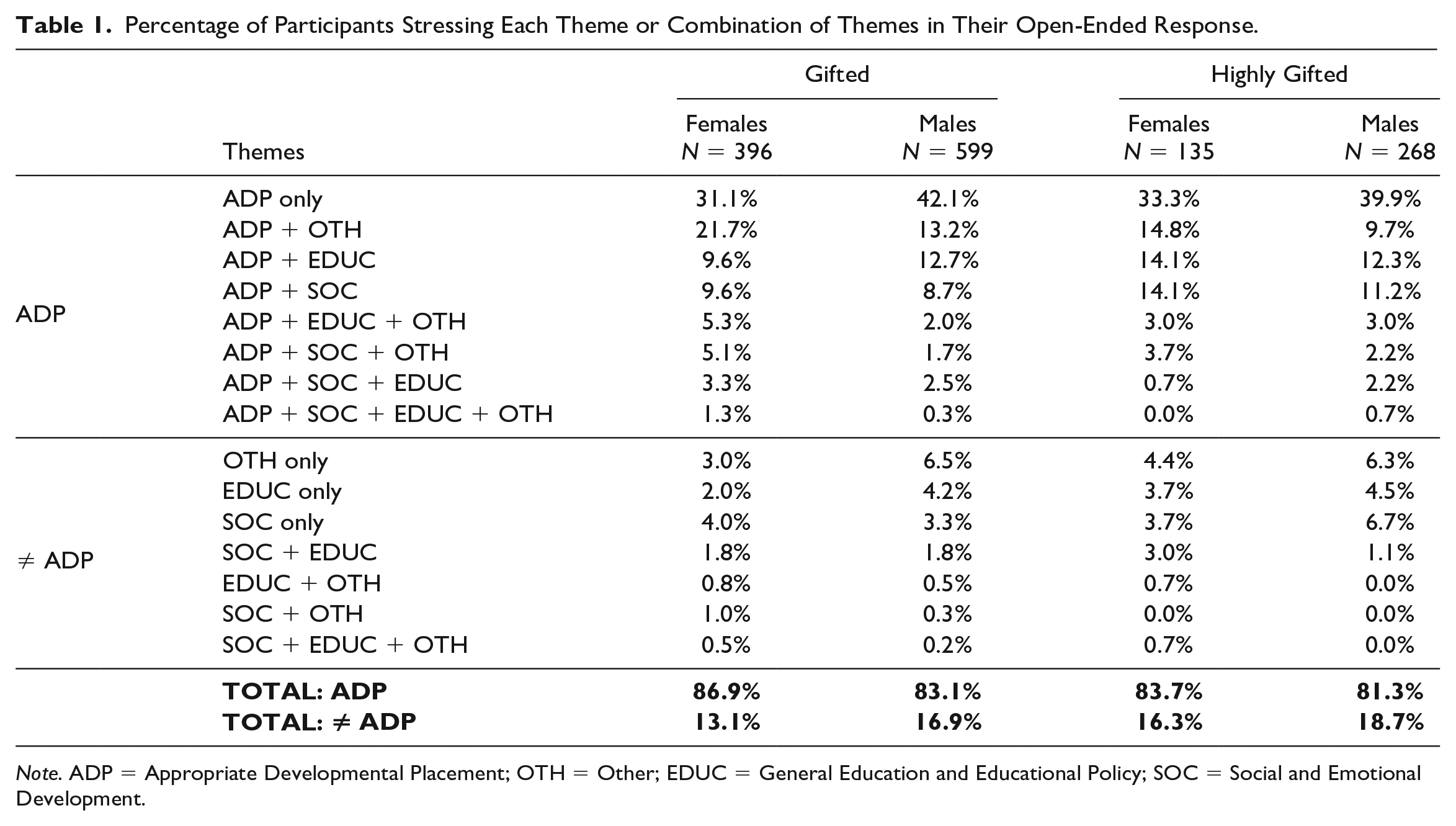
Note. ADP = Appropriate Developmental Placement; OTH = Other; EDUC = General Education and Educational Policy; SOC = Social and Emotional Development.
The complete surveys for SMPY’s age-33 and age-50 follow-ups are available to readers (https://osf.io/2vr6f/?view_only=a995ea9c3073409db64ccba5c39918b4).
Analytic Procedure
For the quantitatively scaled item, statistics on the policy of doing away with homogeneous grouping were computed and histogramically plotted by cohort and gender; they were then examined for moderating influences as a function of different types of career outcomes and life circumstances.
To uncover the major, minor, and tiny themes among the open-ended responses to this item, the first author conducted a qualitative cluster analysis following Bleske-Rechek et al.’s (2004) three-tiered hierarchical scheme. Each open-ended response was dissected to reveal the distinct component thoughts it contained, which were coded as microcategories. Based on content similarity, these components were then aggregated into broader categories. The resultant categories were then grouped into four domains, each of which ultimately captured a dominant theme running through the participants’ responses. The purpose of this parsed hierarchical clustering approach was to uncover major topics running through their responses while simultaneously capturing the participants’ multifaceted perspectives contained within the more nuanced molecular categories. The dominant themes distilled were double-coded to assess reliability and used in the analysis.
Four primary themes emerged from the above analysis: (1) appropriate developmental placement, (2) social and emotional development, (3) general education and educational policy, and (4) other. It is important to note that because many individual responses were multifaceted, a single response could be positively attributed to more than one theme and comments were often doubly or multiply coded. This aspect of our coding system allowed the richness within each response to reveal itself. Just as quantitative analyses have revealed for psychometric items and scales that multiple constructs at general and specific levels of molarity run through all item types and measures (Lubinski, 2004; Lubinski & Dawis, 1992), this procedure allows us to capture and quantify the prevalence of multiple unique features embedded within their responses. Participants can value multiple things at the same time: valuing homogeneous instruction for certain aspects of the curriculum, while simultaneously valuing broad exposure to a diversity of experiences and student populations in other contexts. Our methodology is designed to identify and assess the magnitude and prevalence of these multifaceted sentiments.
Our clustering and refinement of the coding scheme were an iterative process (Bleske-Rechek et al., 2004; Tellegen, 1985; Tellegen & Atkinson, 1974). After the themes were clarified, the first and second authors separately recoded the responses to use in the analysis. Percent agreement (“A”) and Cohen’s Kappa (“k”) for each of the four themes were: ADP [A = 91.3%; k = .63], social and emotional development [A = 88.8%; k = .68], general education and educational policy [A = 81.8%; k = .52], and other [A = 86.5%; k = .63]. Discrepancies in coding were resolved independently by a third rater.
Substantive Nature of the Dominant Themes
Formally, ADP denotes the practice of placing students in learning environments as a function of their readiness to profit educationally from them (Appendices A and B; Lubinski & Benbow, 2000; Park et al., 2013). In the present study, this theme captures aspects of responses that connote positive and negative features of academic material and the rate at which it is presented. For example, responses tied to learning settings in which the pace and depth of the curriculum resonates with students’ individuality (leading to interest and enthusiasm) were included in this theme. This theme also captured comments related to students (notably those at the extremes of the ability/aptitude spectrum) not being served well in learning settings designed for typically developing students. This often ties in with feelings of frustration and boredom for students when the pace of material is misaligned with their individual learning needs. Importantly, ADP has components beyond the academic material presented that are psychologically operative as well, with some components attenuating the learning process while others appear to serve as catalysts for absorbing knowledge. Therefore, the ADP theme also includes comments about the negative impact of the interpersonal milieu in heterogeneous settings, which co-occur with the way academic material is structured (e.g., disruptive students in mixed settings, individual needs not being fulfilled, and holding students back from reaching their full potential), as well as the positive impact homogeneous settings can have (e.g., appropriately nurturing individuality, letting students progress at their own pace, and the social/emotional benefits of being grouped with like-minded peers).
The social and emotional development theme captures comments related to developing interpersonal skills and understandings of others (e.g., exposure to/interaction with students from varying backgrounds and ability levels, development of social skills, and socialization with diverse populations) as well as comments/concerns about the self-esteem and emotional well-being of students in learning environments with less challenging academic material. This theme also captures the need for a balance/mixture of homogeneous and heterogeneous grouping (e.g., pros and cons to each type of grouping, and certain classes being more suitable for heterogeneous grouping than others) as well as including comments that touch on the benefits of peer help in heterogeneous settings.
The general education and educational policy theme includes comments pertaining to education that focus on academic administrators/teachers, educational practices/teaching techniques, and comments that positively endorse heterogeneous grouping and/or detail concerns about implementing homogeneous grouping (e.g., concerns about labeling students, potential for inflexible grouping/students not being able to move across levels as needed, and potential elitism and/or pressure associated with more select homogeneous groups). This theme also captures responses about educational policy as well as those having reference to political ideologies, the general impact of different types of educational practices on society, and concern for the stigma associated with intelligence at varying levels.
The remaining “other” theme involves personal experiences (either lived in or observed [as a parent or an educator]; e.g., “When I was in school. . .,” “As a parent . . .,” “As a teacher. . .”) and also captures comments that do not fit well with the three substantive themes. The first classification of other was more prevalent in the present study, and comments were often doubly or multiply coded as [ADP/social and emotional development/general education and educational policy] and as other, due to the personal experience aspect. A comment classified solely as other often contained a one-off remark that did not logically fall within any of the three substantive themes (e.g., “I would need to hear the arguments for and against the proposal before I could say”; “I don’t think one broad answer without context is possible”; “The ‘policy-makers’ should examine their motives”).
Finally, while our intention is primarily to examine aspects of educational acceleration in particular and ADP more broadly, we realize that as in all mixed-methods approaches, reasonable, informed minds may differ in how responses are coded and clustered. Therefore, we have provided readers with all our raw data and coding decisions in our Data Supplements to this article. We invite readers to see if our approach for capturing the voices of our participants was reasonably comprehensive and whether they are distilled at meaningful levels of molarity. Alternative approaches to forming clusters to understand participants’ personal views are certainly possible.
Results
Figure 1 scales the response distribution for the quantitative item of doing away with homogeneous grouping for instruction. Overall, 79.9% of participants pooled across both cohorts and genders were unsupportive of eliminating homogeneous grouping in education. That is, they responded to this item by checking response options that ranged from “Very Unsupportive” (“1”) to “Somewhat Unsupportive” (“3”). The preponderance of the responses for each cohort and gender, however, were concentrated on the scale’s extreme, “Very Unsupportive” (and conspicuously, their scaling was positively skewed). Only 12.0% of participants indicated that they were “Somewhat Supportive” (“5”) to “Very Supportive” (“7”) of this proposal. 3
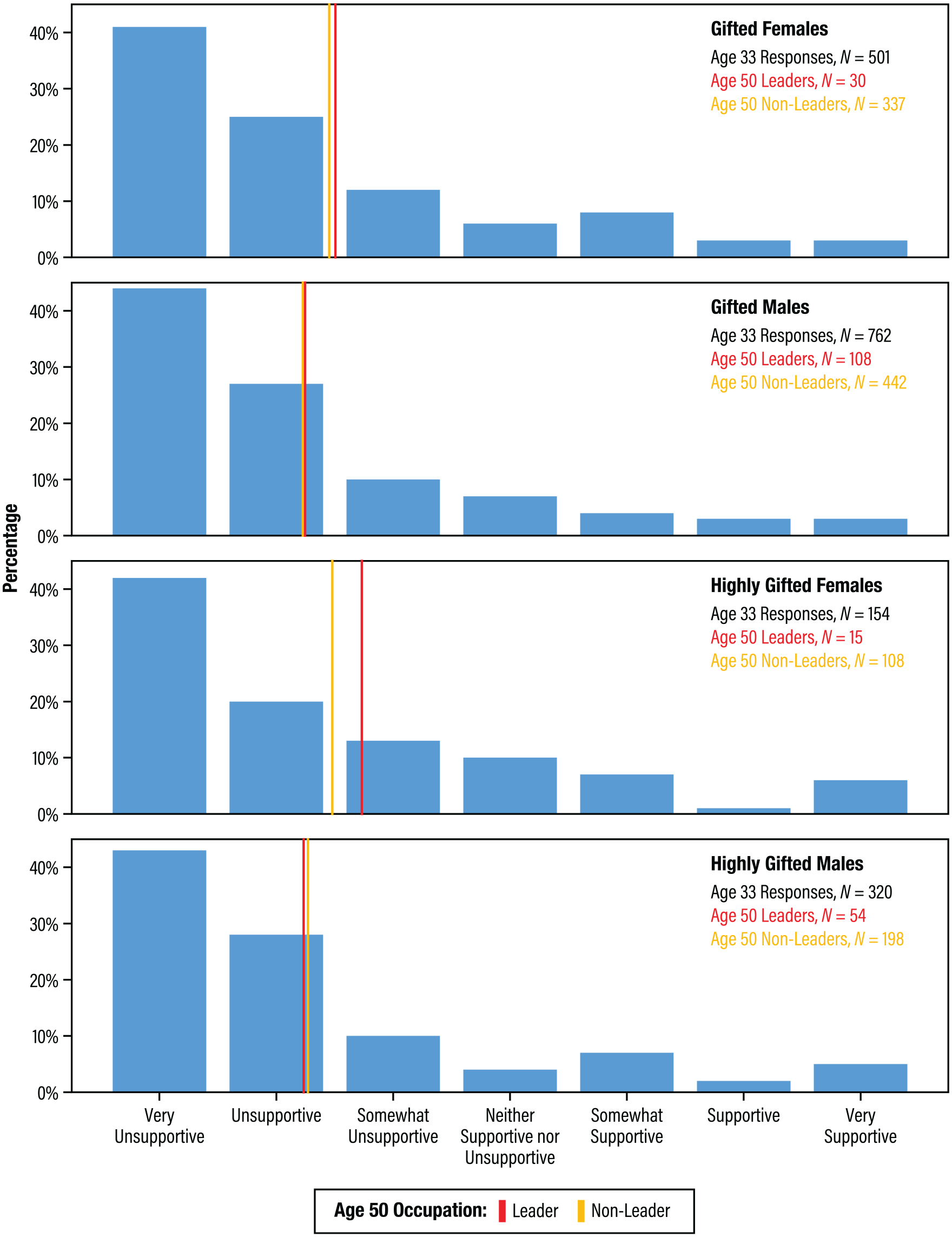
Sentiment for Eliminating Homogeneous Grouping for Instruction.
Moreover, their consensus was consistent across the potential moderators we examined. In Figure 1, red and yellow lines on the histogram illustrate the similarity of participants whose career stature and occupational accomplishments were commensurate with tenured faculty at R1 universities by age 50 as well as those who pursued more typical careers or other endeavors in life. Across genders and cohorts, they are essentially equivalent. When it comes to doing away with homogeneous grouping for instruction, participants at the cutting-edge of their disciplines, professions, and occupations feel comparable to their participant peers pursuing other endeavors. They oppose this educational proposal.
Other potential moderators were examined as well. These ranged from part-time versus full-time workers to full-time homemakers; these various groupings were essentially equivalent in their sentiments on this proposal as well. Statistics on all the potential moderators we examined are found in our Supplement #1. Despite the vast range of individual differences in the developmental trajectories of these participants (Lubinski et al., 2023), their sentiment regarding doing away with homogeneous grouping for instruction was uniformly negative.
For their open-ended responses, the bold black outline in the pie charts in Figure 2 reveals the percentage of participants who mentioned ADP in isolation and ADP in conjunction with one or more of the other three themes (the black percentages within these regions denote each cohort/gender percentage); each possible theme combination is denoted in shades of blue. Those who mentioned one or more of the other themes but not ADP are outside these black outlines (with the non-ADP theme combinations denoted in shades of gray). Overall, 83.9% of participants mentioned ADP (either in isolation or in conjunction with one or more of the other three themes) in their mid-30s response. Table 1 provides the corresponding breakdown of the percentage of participants mentioning each combination of themes.
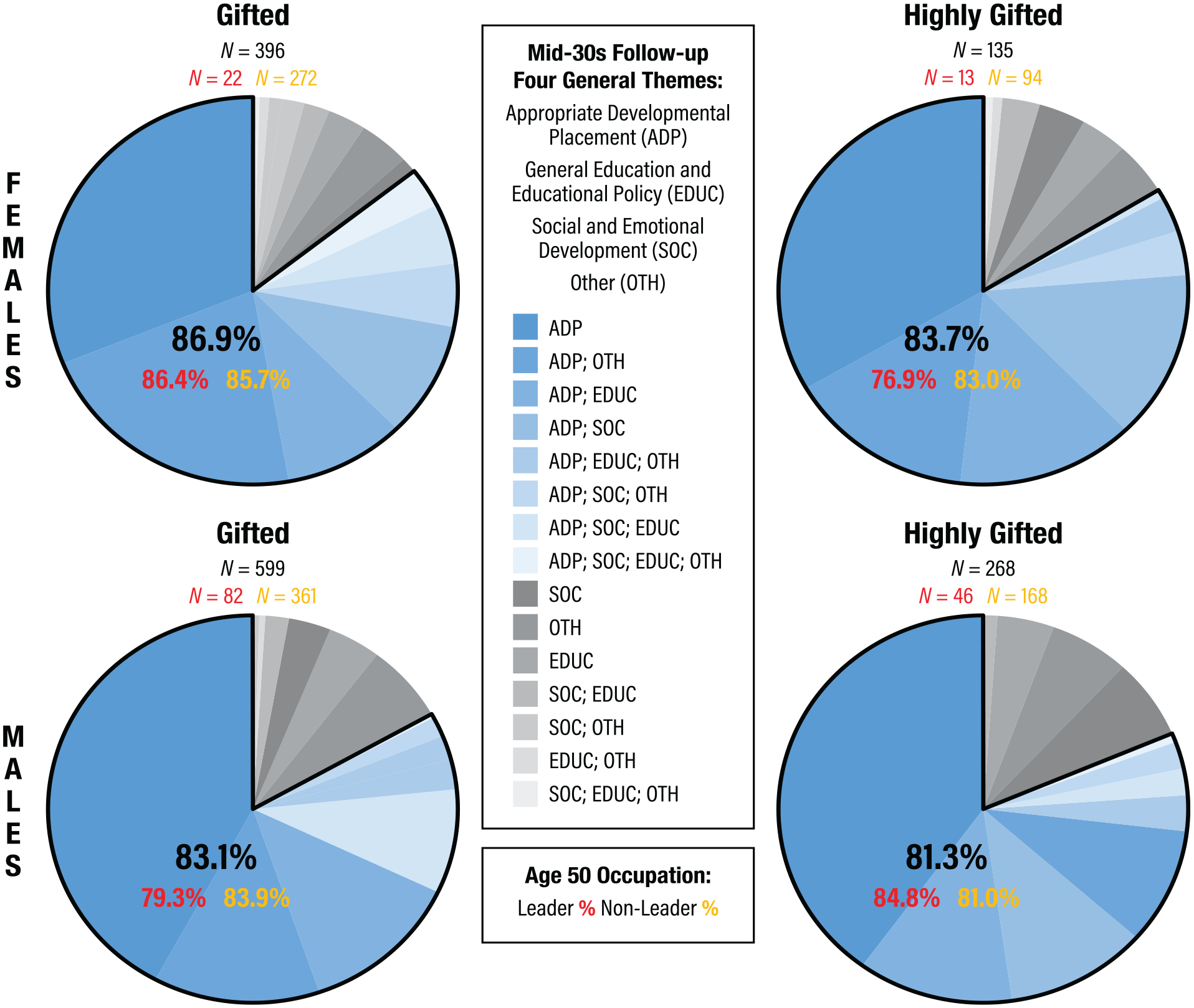
Prevalence of Themes Distilled from Open-Ended Responses to Eliminating Homogeneous Grouping for Instruction.
Figure 2 also contains two additional percentages in red and yellow. These denote participants who mentioned ADP in their mid-30s among those classified as occupational leaders versus all other participants based on their age-50 survey (Lubinski et al., 2023). These red and yellow percentages within each pie chart are accompanied by their corresponding sample sizes just above. There were no significant differences among participants who referenced ADP in their remarks across the leaders versus non-leaders. And, also, based on their age-50 data, we examined cohort and gender breakdowns of participants mentioning ADP across other occupational/lifestyle outcomes (part- versus full-time work, full-time homemaking) and did not find any substantively meaningful differences (see Supplement #1). This item inspired many strong and negative feelings in connection with doing away with homogeneous grouping, and none of these percentages varied significantly as a function of their career/occupational distinction or life trajectory.
Concerning the importance of placing students in developmentally appropriate educational settings across the spectrum of academic readiness, participants referenced the need to “challenge all students at the level of their ability (or slightly above)” [a Gifted male], as well as the “need to challenge students in order to let them develop to their potential” [a Gifted female]. Participants referenced this notion by alluding to the lack of challenge for highly able individuals when they are placed in environments tailored to the pace of typically developing students (e.g., “I think [heterogeneous grouping] could impede the progress of a student who needs more challenges—make them ‘slow down’ to the group’s level” [a Gifted female]; “Being with all ability groups leaves gifted children in the position of helping slower students and teaching/tutoring them, but does not meet the gifted students’ need for stimulation and intellectual challenges” [a Highly Gifted female]). More broadly, participants mentioned the potential misalignment of curricula for students at either extreme of the ability spectrum when placed in settings designed for typically developing students (e.g., “Intelligent/precocious kids get bored and are not challenged and/or slower kids are forced to move too quickly or do not get the attention they deserve [in heterogeneous groupings]” [a Gifted male]; “It is very easy for gifted students to get bored in regular classes, and very easy to overlook students that are below average” [a Highly Gifted male]).
Regarding the ADP components beyond the academic material that can attenuate the learning process, responses such as this from a Gifted female highlight the importance of having an environment wherein highly able students can feel comfortable to engage in academic activities. She wrote:
I had classes like that [heterogeneously grouped] in high school and found I was very bored. The slowest kids in the class were lost. Only the middle range kids get a benefit and even that is questionable. This is particularly problematic in high school where bright students are afraid of being labeled as geeks if they display too much intelligence.
Consistent with this sentiment, another Gifted female mentioned the benefits of homogeneous classes by noting they:
. . . allow gifted students to not feel like “geeks” or pariahs. They also encourage gifted students to keep working hard—I was often able to “coast” to an “A” without intense hard work. If I had worked harder, who knows where I would be today.
Table 2 samples additional ADP-related remarks made by participants in each cohort shown by gender, specifically focusing on those who situated their response in their personal experience. The deeply forthcoming nature of their remarks comes through in their words, and by reading through their comments, a clear portrait emerges of their collective voice, emphasizing the importance of ADP. Table 3 then distills in percentages the major keywords and phrases related to the ADP theme that most frequently emerged, presented by cohort and gender. These percentages were obtained by conducting a root word search and were verified independently by two raters. Asterisks indicate significant gender differences within a cohort regarding the keywords utilized. Both the Gifted and the Highly Gifted females referenced boredom in heterogeneous settings significantly more than did their male counterparts (Gifted:
Study 1—Examples of Actual Responses.
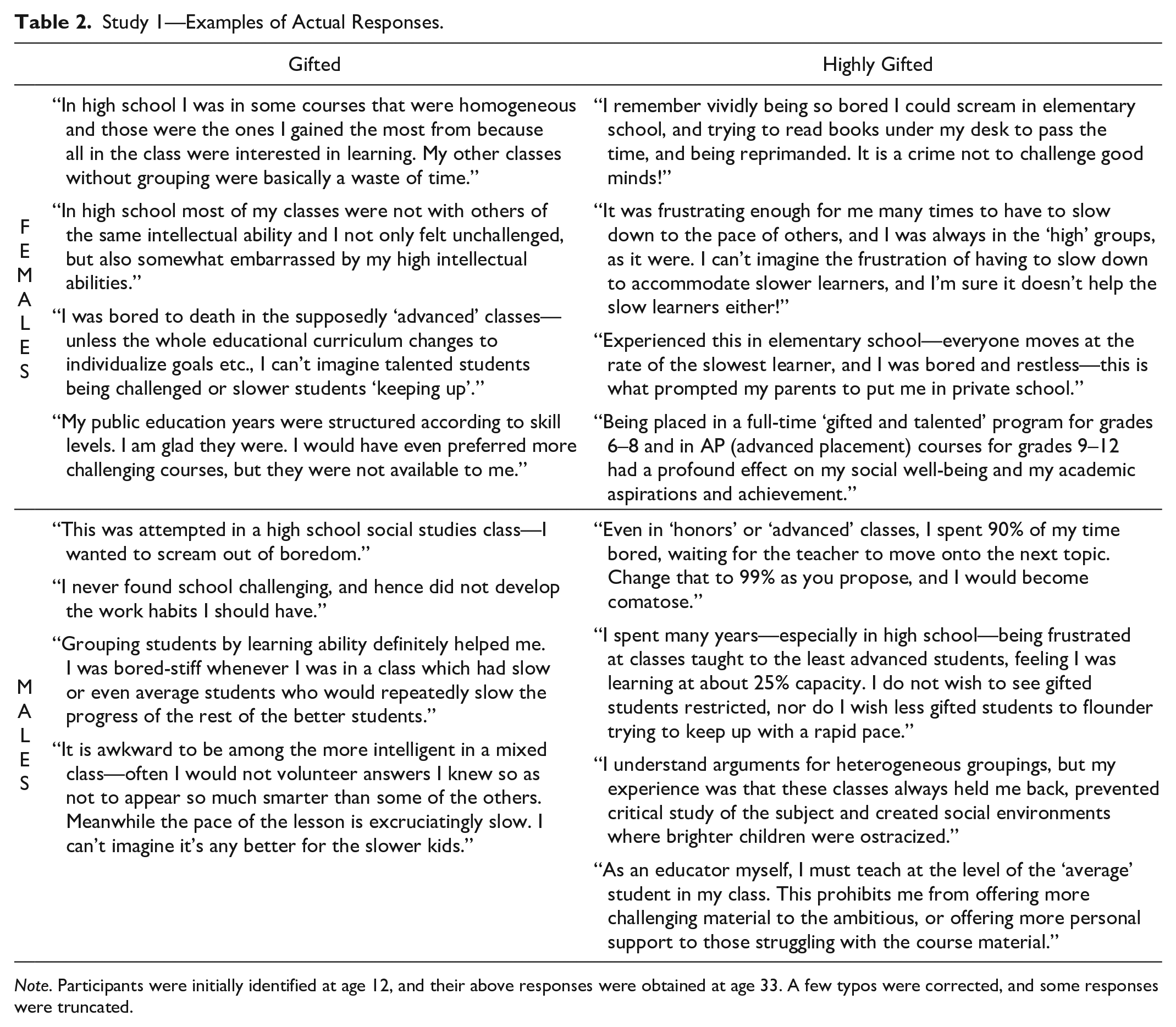
Note. Participants were initially identified at age 12, and their above responses were obtained at age 33. A few typos were corrected, and some responses were truncated.
Percentages of Common Keywords and Phrases.
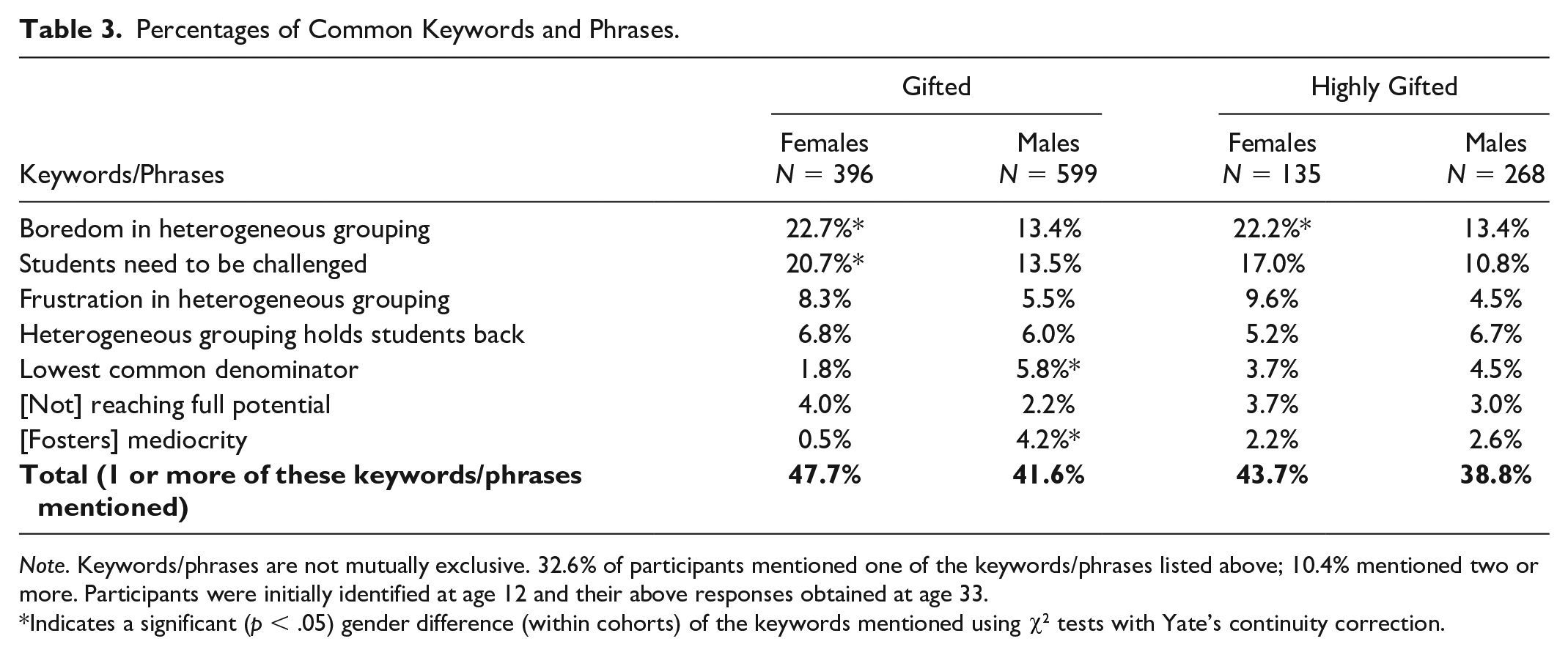
Note. Keywords/phrases are not mutually exclusive. 32.6% of participants mentioned one of the keywords/phrases listed above; 10.4% mentioned two or more. Participants were initially identified at age 12 and their above responses obtained at age 33.
Indicates a significant (p < .05) gender difference (within cohorts) of the keywords mentioned using
Turning back to the collection of responses, the fact that 46.2% of participants mentioned ADP in conjunction with one or more of the other three themes indicates the item also stimulated thoughts about related points across the psychological landscape of academic, emotional, and social development, as well as feelings about teachers and education more broadly. This finding illustrates the stimulus complexity of this item, the multifaceted nature of the themes it evoked (as embedded in participants’ remarks), and the utility of our approach to capture these nuances.
For example, a number of participants acknowledged the importance of homogeneous grouping along with the need to still ensure students have exposure to diverse populations and peer groups (e.g., “I think honors classes and the like are useful, but gifted students need exposure to less talented students and vice versa” [a Gifted male]; “While I believe it is important for students to socialize with people of varying skill levels, I am firmly committed to give every student the best education possible. I think that many (the bright and the slow) will receive a lesser education if all are grouped together” [a Gifted female]).
Others endorsed the importance of a balance between homogeneous and heterogeneous grouping, noting both serve to benefit students in certain situations (e.g., “I feel grouping should be homogeneous for more technical areas where greater depth is possible, but heterogeneous for general knowledge courses to allow interaction among different types of people” [a Gifted male]).
Several participants simultaneously indicated their support for homogeneous grouping while also expressing concern for ensuring students are appropriately placed and re-evaluated as needed. For example, a Gifted male elaborated by noting:
This proposal [heterogeneous grouping] would limit needed attention required by slow learners and could hold back quick learners. Grouping by abilities is appropriate but initial divisions should not prevent movement from one group to another, and no stigma or praise should be attached to “higher level” groups.
Similarly, a Gifted female wrote “When grouped with similar abilities you grow and challenge one another. Heterogeneous grouping doesn’t challenge the higher-level students. The problems lie in determination of levels and the possible advancement from level to level for the hard-working student.” The concern about the stigma associated with intelligence at varying levels was also captured by a Gifted female who wrote:
[In heterogeneous groups] the brighter kids would be taught at a level way below their capability and the slow kids would have trouble catching on. The solution only pacifies those who like to pretend we are all equal. We’re not. That doesn’t mean gifted kids are better than average or slow kids—just that there are all kinds of different kids. The message needs to be given, to gifted kids as well as to whatever segments of society feel threatened by them, that smarter does not mean more worthy as a human being.
Another aspect of education pertaining to grouping students concerns the difficulty teachers face in having to cater to a wide variety of students’ ability levels in one classroom. That concept was endorsed by many participants. For example:
I currently teach a classroom of very wide ability levels and I find it difficult to meet any of their needs. The trend right now is to eliminate ability grouping, but I still do my own grouping within my classroom for reading instruction as the levels range from pre-primer to 6th grade. [a Gifted female] I think [heterogeneous grouping] is difficult for the teacher—one cannot teach on 3 different ability levels at the same time—this is already a difficulty in the public schools to a degree in each classroom—the result is the slower learners don’t get needed reinforcement and the bright students don’t have the opportunity to move ahead—this is one reason why I chose to tutor my bright children at home. [a Gifted female]
Concerning the complexities embedded in their thoughts and seen throughout the examples shared, one Gifted male captured many of the nuances when he wrote:
There are advantages [to heterogeneous grouping], such as fostering greater learning and understanding among the students, however I think that this situation would hinder the advantaged in that they may become bored and lose interest (not being challenged). By the same token, the disadvantaged could become more frustrated and lose heart more easily. [It] would be very difficult for the teachers.
In aggregate, these responses illustrate the forcefulness and range of ways by which participants reference ADP in their responses regarding homogeneous grouping in education. Whether they spoke solely of ADP or referenced other aspects of learning processes and environments in their remarks, this item certainly sparked many strong feelings. Yet the examples shared represent only a sampling; all their responses are found in our Data Supplement, and we encourage readers to further explore all that the participants had to say.
Discussion
Taken together, results from Study 1 show the perceived importance of ADP in education through the collective voice of over 1,300 Gifted and Highly Gifted individuals. These results were consistent across cohorts and gender and did not covary with eventual lifestyle or occupational distinction assessed at age 50. Whether they spoke of ADP in isolation, or in combination with the other themes, participants readily referenced the benefits of homogeneous grouping and other aspects of ADP (e.g., “I think having comparable peers at an early age is beneficial both for having a sense of belonging, being normal and to realize that talent and hard work both contribute to success” [a Highly Gifted female]) or warned against the negative implications of inhibiting students’ access to an appropriately tailored education (e.g., “I’m no expert, but it seems obvious that holding back quick learners or trying to push the students who need more time/attention is terrible” [a Gifted female]). In their responses, many participants drew on their personal experience—either past positive experience in ADP environments (e.g., “I was in homogeneous grouping in advanced classes in high school and college and learned much more and was much less bored than in elementary, junior, and senior high classes where students of all abilities were mixed” [a Gifted female]) or reflections on negative experiences in non-ADP environments (e.g., “Most of the ‘problems’ I encountered in school were due to boredom. The classes which had to move along very slowly were almost useless since I barely learned the minimum” [a Highly Gifted male])—indicating that these lived-in educational experiences continue to reverberate within later life perceptions and remembrances.
As the major, minor, and smaller themes that emerge from this analysis reveal, while participant responses are dominated by an overriding concern and need for ADP, they also express concerns over other aspects of their learning environment, which shows the thoughtfulness they put into their responses and their consideration for the development of the “whole” child as well as for children of all ability levels. These concerns range from educational policies to the compatibility of their peers. In addition, they also include idiosyncratic experiences unlikely to be relevant to normative trends; however, these factors are idiographically informative in characterizing their academic experiences. They also highlight why it is useful to conceptualize educational acceleration in the broader context of ADP. Taken together, what these responses communicate is the complexity of learning environments. Students can feel very strongly that they should be allowed to learn at the pace and depth at which they assimilate knowledge with like-minded peers, but that does not preclude their desire to experience more heterogeneous environments in other settings. Many seek both. Just as everyone is psychologically multifaceted, so too are the diverse environments required to provide for their optimal development (Scarr, 1996; Tyler, 1974). Themes distilled from participants’ responses suggest that academic, emotional, and social development each require appropriate opportunities and venues. This finding comes through in reading over the individual responses, which reveal the complementary power of combining quantitative/qualitative approaches. Importantly, just as items measuring cognitive abilities aggregate to form general and specific components (Lubinski, 2004, Figure 1, p. 99), so too do the qualitative features of open-ended responses (Figure 2). What is especially telling in the open-ended responses is the extent to which they draw on personal experiences during adolescence (Table 2). Individually, each response communicates a noteworthy whisper; collectively, they meaningfully aggregate to form a compelling and loud declaration.
Study 2
Study 2 was designed to constitute a constructive replication of Study 1 utilizing two SMPY cohorts at the outer envelope of (1) cognitive abilities (Lubinski, Webb et al., 2001b) and (2) STEM potential (Lubinski, Benbow et al., 2001a). Each was isolated in a distinct way. The first was a cohort of profoundly gifted participants identified at age 12 as being in the top 1 in 10,000 in cognitive abilities (isolated solely based on their ability); the second was a cohort of top STEM doctoral students attending the most prestigious STEM graduate training programs in the United States (their learning potential or readiness having been documented by assessments across cognitive abilities, interests, personality, values, and their outstanding educational accomplishments and STEM knowledge when they entered elite graduate training programs). Each of these two cohorts certainly meets Simonton’s (2014) standard of what constitutes a significant sample: “[a] sample is significant when it represents the population of cases that have immense theoretical or empirical interest in their own right” (p. 11). We are unaware of any other samples this large that constitute greater intellectual and/or STEM potential identified at an early age and longitudinally tracked for multiple decades.
Given the extraordinary potential of these two cohorts and given the consistency in findings on homogeneous grouping among gifted but not quite as able participants in Study 1, Study 2 participants were not asked about their views about doing away with homogeneous grouping. However, we were curious as to whether the themes that emerged in Study 1 also would be detected and replicated using more unobtrusive measures (Webb et al., 1999). That is, how robust are sentiments among the Profoundly Gifted and the Top STEM Doctoral Students relative to gifted but overall less able participants identified over a decade earlier, and could the prominent themes from Study 1 be constructively replicated (Lykken, 1968, 1991) through a systematic examination of what the Profoundly Gifted and Top STEM Doctoral Students liked most and liked least about their high school experience? Specifically, we were especially interested in ascertaining, given the potential of these two cohorts, if somewhat less-focused questions in their follow-up surveys would nevertheless stimulate responses that indicated the importance of allowing them to experience academic development at their desired (atypically high) rate. We were also interested in determining whether there were any social and/or emotional benefits associated with being in accelerated and, hence, developmentally appropriate learning settings as observed in Study 1 (e.g., being with like-minded peers). Therefore, the primary focus of our analysis is on their ADP responses.
In addition, as in Study 1, we sought to examine potential moderators of their personal views as a function of their age-50 accomplishments and life paths—that is, assessing the relative importance attributed to ADP for high-impact occupational and creative leaders versus that among participants whose life journey followed other paths (Lubinski et al., 2023, p. 285; Table 1). As in Study 1, all our data and coding for Study 2 are provided to readers (which may be used for other things), but here we wanted to make sure we captured their views regarding ADP to appraise its prominence.
Method
Participants
A sample of participants was identified by SMPY between 1980 and 1983 through SAT above-level testing (Lubinski & Benbow, 2006). These individuals represent the top 0.01% in ability level (SAT-M ≥ 700 or SAT-V ≥ 630 before age 13); they will be referred to throughout as “Profoundly Gifted.” These participants were identified across the United States (57 females and 184 males): 71.4% White or Caucasian, 1.2% Black or African American, 19.1% Asian or Asian American, 1.6% other, and 6.7% chose not to identify their race. Like the two cohorts in Study 1, they were tracked longitudinally and assessed after high school at age 18 (Benbow et al., 1996; Dauber & Benbow, 1990), after college at age 23 (Lubinski, Webb et al., 2001b), early in their career at age 33 (Lubinski et al., 2006), and mid-career at age 50 (Lubinski et al., 2023).
Participants in the second sample were identified in their mid-20s in 1992 as first- or second-year graduate students pursuing doctorates at top U.S. STEM programs (335 females and 360 males; Lubinski, Benbow et al., 2001a): 81.2% White or Caucasian, 3.2% Hispanic, 2.6% Black or African American, 9.4% Asian American, 3.0% other, and 0.6% chose not to identify their race. Subsequently, they were surveyed in their mid-30s (Lubinski et al., 2006) and age 50 (Lubinski et al., 2023). These participants will be referred to as the “Top STEM Doctoral Students.” There are some interesting psychological features of this sample worth detailing because, to our knowledge, there is no other systematic study of any other group at the outer envelope of STEM potential in the psychological literature (McCabe et al., 2020).
Cronbach and Snow (1977; Corno et al., 2002; Snow et al., 1996) have long discussed “aptitude” as being much broader than cognitive abilities. Their framework for “aptitude complexes” includes abilities, interests, and personality; indeed, any personal attribute germane to individual differences in learning across contrasting environmental settings can be considered as an “aptitude.” Based on psychometric assessments of abilities, interests, and personality (Lubinski, Benbow et al., 2001a), this sample is exquisitely tuned to embrace and excel in the affordances offered by STEM disciplines. For example, in terms of quantitative reasoning ability, at the time when they were tested, the mean Graduate Record Examination Quantitative Reasoning (GRE-Q) scores for this sample were over two standard deviations above those of the typical graduate student in the United States (Lubinski, Benbow et al., 2001a; for participants used in this study, mean GRE-Q scores were 735.0 and 746.7 for females and males, respectively). Both the women and the men in this sample have comparable ability profiles of greater mathematical than verbal ability scores (Lubinski, Benbow et al., 2001a). Regarding their interests and personality, they exhibit prominent scientific interests and theoretical values, endorse either math or science as being their favorite high school course, participate in STEM-focused extracurricular learning experiences, and “Creative Personality” was ranked first for these participants on the Adjective Check List (ACL; Gough & Heilbrun, 1983; Lubinski, Benbow et al., 2001a). Participants in this cohort who have distinguished themselves in STEM by age 50 may be said to be “super typical” on these attributes, relative to their graduate student peers (Bernstein et al., 2019; McCabe et al., 2020). So, examining the thoughts of these participants, given who they became by age 50, about their high school experiences (assessed when they were in their 20s) holds promise of being especially informative. In addition, just as Cronbach and Snow (1977; Corno et al., 2002; Snow et al., 1996) have argued that individual differences in personal attributes beyond cognitive abilities play a role in learning, our clustering scheme in Study 1 revealed that aspects of learning environments beyond the curriculum play a role in learning as well. So, Study 2 is designed to detect these features of learning environments in similar ways.
Longitudinal Measures
Data were secured based on participants’ responses to two related items about their high school experience. These items appeared on the Profoundly Gifted cohort’s age-23 after-college follow-up survey conducted in the mid-1990s (N = 241; response rate: Males = 80%, Females = 93%; Lubinski, Webb et al., 2001b) and the Top STEM Doctoral Students’ initial survey administered during their first or second year of graduate school in their mid-20s in 1992 (N = 695; Lubinski, Benbow et al., 2001a). Information on participants’ eventual career outcomes was obtained from their age-50 follow-up surveys, which were conducted concurrently in 2017–2018 (see Lubinski et al., 2023); participants deemed creative/occupational leaders whose accomplishments were commensurate with tenured faculty at Research-Intensive (R1) institutions are found in Lubinski et al. (2023, p. 285; Table 1).
The response rates for the age-50 follow-up ranged from 68.9% to 77.2% (for details on response rate calculations, see Lubinski et al., 2023, Footnote 4, p. 299). The complete surveys are available to readers (https://osf.io/2vr6f/?view_only=a995ea9c3073409db64ccba5c39918b4).
Analytic Procedure
The open-ended items analyzed were (a) “What did you like most about your high school experience?” and (b) “What did you like least about your high school experience?” Following each question, participants were given several lines in which to write an open-ended response. We chose to examine both what participants liked most and liked least in order to capture maximal information embedded in their remarks, as both likes and dislikes provide meaningful insight into individuals’ perspectives.
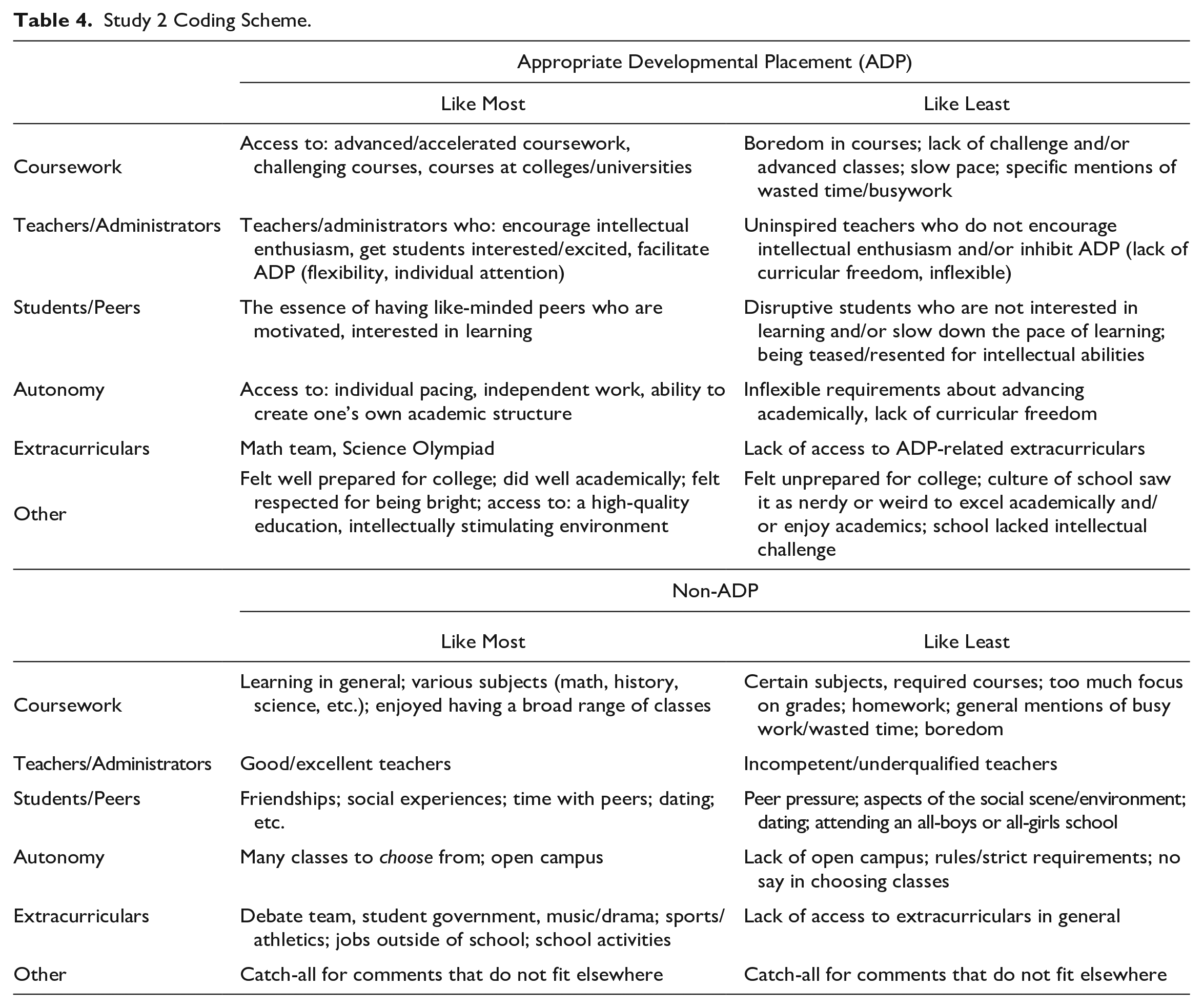
To analyze these open-ended responses, the first and second authors engaged in an iterative process of reading through the responses and refining a classification scheme to distill the primary and secondary themes among the responses (Bleske-Rechek et al., 2004; Tellegen, 1985; Tellegen & Atkinson, 1974). Through this process, it became clear that many participants mentioned aspects of the typical high school/teenage experience (e.g., mentions of their friendships, social activities, and extracurriculars) while also referencing aspects of ADP. In what they liked most about high school, references to ADP indicated their being pleased in having had access to ADP-related educational experiences; in what they liked least about high school, references to ADP indicated their regrets for lacking access to ADP-related educational experiences. Consistent with the complexity of learning environments in general and the aspects of ADP beyond the curriculum presented, participants’ references to ADP were more nuanced than in Study 1 and coalesced into more categories. To accommodate our interest in understanding the aspects of ADP while simultaneously accounting for the complexity found in participants’ remarks (i.e., the range of ways in which ADP was mentioned, as well as the general comments pertaining to mainstream/common high school experiences), we developed a hierarchical classification scheme of ADP or non-ADP across six subcategories: (a) coursework, (b) teachers/administrators, (c) students/peers, (d) autonomy, (e) extracurriculars, and (f) other. This provided up to 12 classifications per response. In other words, each response component was first classified as pertaining to ADP or not, and then further classified into one of the six subcategories. As with Study 1, the classifications are not mutually exclusive; thus, the hierarchical coding scheme enabled us to reveal the superordinate ADP versus non-ADP distinction while also further distilling the uniqueness in each remark. Table 4 shows the descriptions of the coding scheme for Study 2.
Study 2 Coding Scheme.
Parsing ADP
While we coded all responses for completeness, for constructive replication purposes (Lykken, 1968, 1991), our primary focus in this study was on how participants referenced aspects of ADP in their responses. Constructive replications have been used repeatedly in psychoeducational studies of intellectual precocity (e.g., Bernstein et al., 2019, p. 445; Park et al., 2013, p. 189; Wai et al., 2009, p. 819). They are conducted by varying construct-irrelevant features of experimental and quasi-experimental designs and measurement procedures but maintaining focus on the focal constructs of interest.
In the context of this phase of the study, responses coded for ADP among what the participants liked most and liked least about high school primarily reflected their being pleased with having had access to ADP or their regrets for having lacked ADP, respectively.
Consistent with the general conceptualization of ADP (Appendix A), when asked what they liked most about high school, responses where participants endorsed taking challenging, advanced, and/or college-level courses were classified under ADP coursework. Responses that mentioned appreciation for teachers who encouraged intellectual enthusiasm and facilitated access to learning at one’s desired rate were classified as ADP teachers/administrators. Responses that endorsed positively being around like-minded and intellectually oriented students were classified as ADP students/peers. The concept of ADP autonomy in particular follows Cronbach’s (1957) line of research on aptitude × treatment interactions. Over decades of research on the topic with Snow (Corno et al., 2002; Cronbach & Snow, 1977), the strongest aptitude × treatment interaction found was that students with above-average intellectual ability benefited most when they had the opportunity to structure their learning and organize abstract material (Shavelson & Gleser, 2002, p. 38). As such, in terms of autonomy, references regarding access to individual pacing and independent work were included in ADP autonomy. Mentions of ADP-related extracurriculars such as math team and Science Olympiad were classified as such and, more generally, mentions of feeling well prepared for college, having access to a high-quality education, and/or intellectually stimulating environments were included in ADP other.
In terms of what they liked least about high school, responses classified as ADP coursework touched on experiencing boredom or a slowed curricular pace in classroom settings as well as a lack of challenging classes and/or advanced coursework/opportunities. Responses mentioning teachers who did not encourage intellectual enthusiasm and/or who inhibited access to curricular flexibility were coded as ADP teachers/administrators. The ADP students/peers classification in this context captured responses about being surrounded by disruptive/disinterested students as well as comments mentioning the participant was teased for their intellectual abilities/achievements. Comments about a lack of curricular freedom/flexibility were coded as ADP autonomy, and mentions of lacking access to ADP-related extracurriculars were coded as such. Finally, the ADP other classification was used to collect responses of what participants liked least about high school related to feeling unprepared for college, experiencing a school atmosphere that lacked intellectual challenge, or one that saw it as out of character to excel at and enjoy academics.
Once the coding scheme was agreed upon, the first author and a third member of the research team independently coded the responses used in the analysis. Our Supplement #2 provides the Percent Agreement (A) and Cohen’s Kappa (k) for each constituent coded. These are provided for what participants liked most about high school (A: Mean = 96.2%, Median = 96.7%; k: Mean = .77, Median = .80) and what they liked least about high school (A: Mean = 95.4%, Median = 95.4%; k: Mean = .67, Median = .72) along with the agreement when examining the coding scheme as a whole (A: Mean = 95.8%, Median = 95.8%; k: Mean = .74, Median = .74). Discrepancies in coding were resolved independently by the second author.
Results
Paralleling Study 1, the percentage of participants referencing ADP in their responses is shown in the black-outlined regions of the pie charts in Figure 3 with black percentages contained therein. Overall, 48.7% of participants mentioned ADP in what they liked most and/or liked least about high school in their mid-20s response. Mentions of ADP in what participants liked most about high school, liked least about high school, or in both are denoted in shades of blue (those not mentioning ADP are in gray). Table 5 provides the specific decomposition of these percentages. (See Supplement #3 for the percentage of participants mentioning each subcategory of the ADP-related classifications, in what participants liked most or least about high school, respectively).
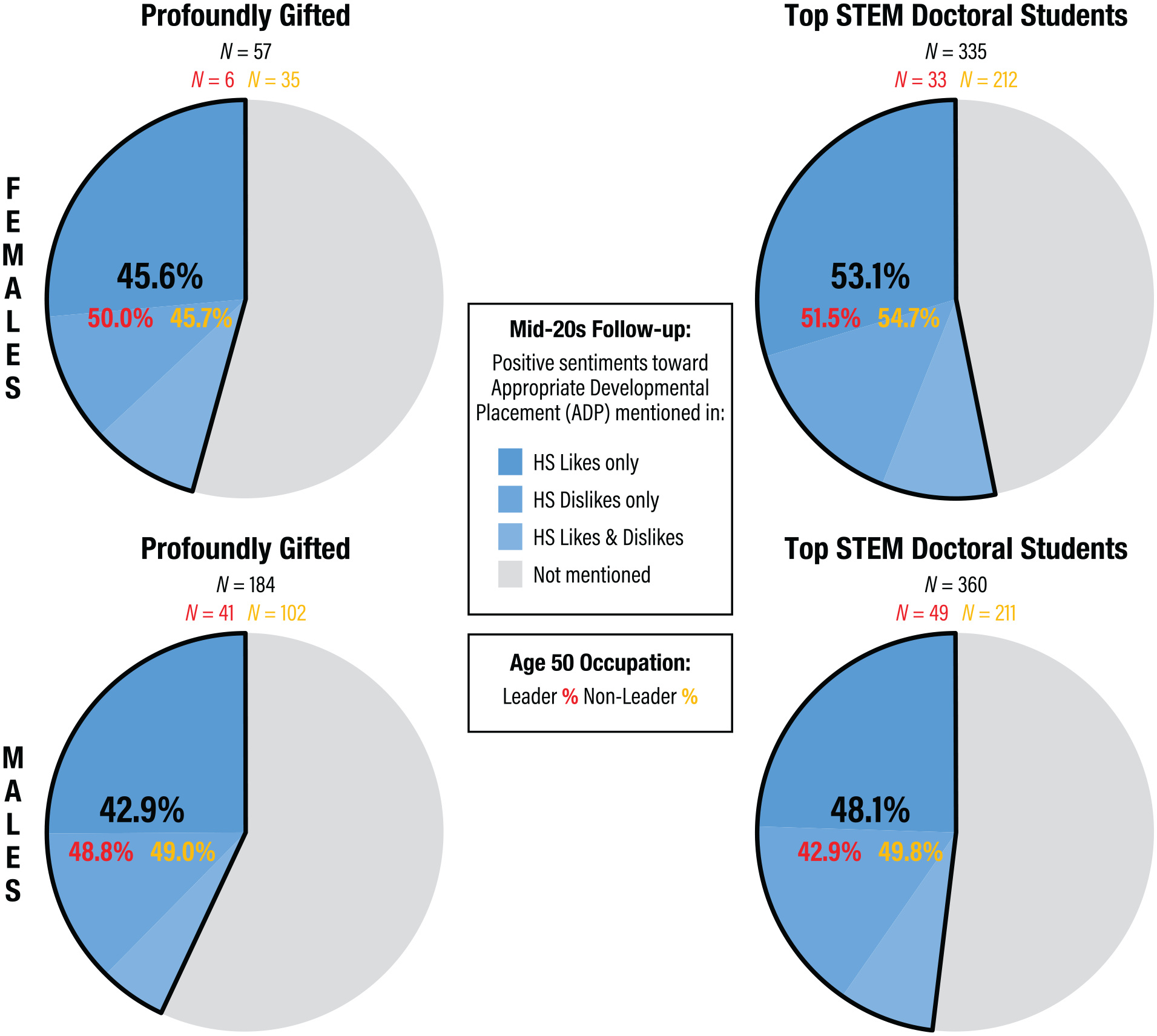
Prevalence of ADP Responses Among Participants’ High School Likes and Dislikes.
Percentage of Participants Stressing the Importance of Appropriate Developmental Placement (ADP): Either Pleased for Having It or Regrets for Lacking It.
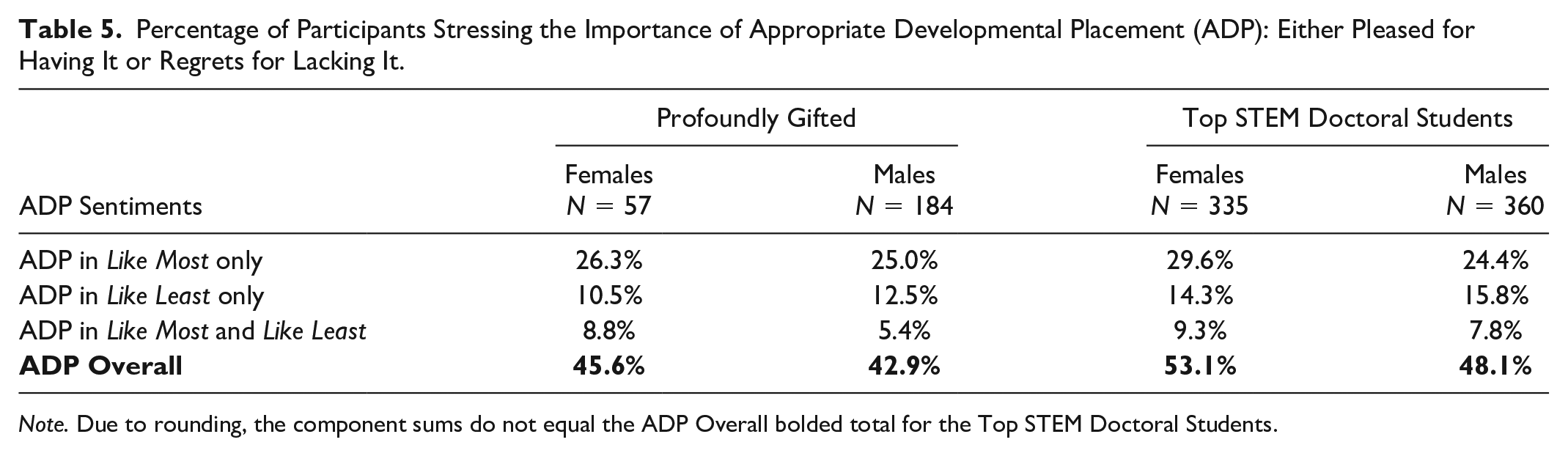
Note. Due to rounding, the component sums do not equal the ADP Overall bolded total for the Top STEM Doctoral Students.
Red and yellow percentages in Figure 3 indicate participants who mentioned ADP for those classified as occupational leaders and the remainder of participants who completed the age-50 survey. And these percentages were comparable. There were no significant differences in participants referencing ADP in their remarks for the leaders versus non-leaders. We also examined other cohort and gender differences in age-50 occupational/lifestyle outcomes (part- versus full-time work, full-time homemaking), and similarly, we did not find any substantively meaningful differences among these breakdowns in participants mentioning ADP across these contrasts (statistical details on these potential moderators can be found in our Supplement #1).
Concerning their coursework, numerous participants appreciated their advanced classes including “college math, AP science and history classes” [a Profoundly Gifted male] and “being able to work ahead and take classes regardless of what year they were ‘expected’ to be taken in” [a Top STEM Doctoral Student female]. Others spoke of their teachers, such as this Top STEM Doctoral Student female who enjoyed “the opportunity to take classes with wonderful teachers. My magnet teachers and Mr. G (he taught all the science AP courses) helped to keep me stimulated in learning and furthering my education” and a Profoundly Gifted male appreciated “the personal attention and sense of genuine interest/excitement I received from my English/History teachers. They taught me to get excited about academics and the literary arts.” Participants also enjoyed being around like-minded peers such as “friends, who were as intelligent as I was” [a Profoundly Gifted male], “having a few close friends (who were also in advanced classes and whom I could identify with)” [a Top STEM Doctoral Student female], and “interaction with teachers and other students who were excited about learning” [a Top STEM Doctoral Student female]. Capturing a number of these ADP-related aspects was a Top STEM Doctoral Student female who wrote, “the math department was excellent; the English was quite good. My high school experience was intellectually stimulating only because I had a few excellent teachers and because I was in advanced classes with other talented students.”
In terms of what they liked least about high school, concerning their coursework, participants did not like that it was “not academically challenging towards the end” [a Profoundly Gifted male] nor the “total lack of challenging work” [a Profoundly Gifted female]. One Top STEM Doctoral Student noted her “Social Studies and English classes were at a lower level, not challenging enough,” while another disliked that his “school didn’t offer AP or other advanced classes like schools in larger cities.” This sentiment carried over into responses that referred to teachers and students who inhibited access to ADP as well. A Top STEM Doctoral Student least liked her “classes with bored and boring teachers, where there was no opportunity to be creative, no challenges. And classes with students who just goofed off and slowed us down.” This reference to other students whose behavior impacted the participants’ educational environments was endorsed by many, with comments mentioning that participants disliked “feeling that I had to hide achievements or face rejection by peers” [a Top STEM Doctoral Student male] and “the ignorant people who put me down for excelling” [a Top STEM Doctoral Student male]. More broadly, participants disliked the “lack of time/freedom to pursue academic interests beyond those covered in class” [a Top STEM Doctoral Student female] as well as the lack of intellectual rigor (e.g., “I found I was rarely intellectually challenged in high school. I got A’s with minimum effort” [a Top STEM Doctoral Student male]).
Additional ADP responses can be found in Tables 6a and b, and the full set of responses and coding decisions can be found in our Data Supplement. As with Study 1, we encourage readers to further explore these responses and classifications. It is also important to note that in addition to the multitude of positive endorsements of ADP found in our analysis, a small percentage of participants in Study 2 (approximately 2%–3%) referenced effects of acceleration in what they liked least about high school (e.g., “. . . being in advanced coursework sometimes made it difficult for me to completely fit in” [a Profoundly Gifted male]). We did not code these comments specifically, and they were not demonstrative in frequency or impact; however, it is important to acknowledge the potential for alternative points of view. While these comments do not speak to the educational efficacy of acceleration for able and motivated students, they do highlight how educational interventions/environments are multidimensional and ought to be assessed and responded to with appropriate adjustments based on students’ individual needs. This is in line with our findings overall and highlights an important aspect of our study: the multifaceted nature of gifted education, the components to attend to beyond the chosen curricula when implementing interventions, and the importance of hearing student voices as adolescents and adults.
(a) Study 2—Examples of Actual Responses; Like Most About High School.
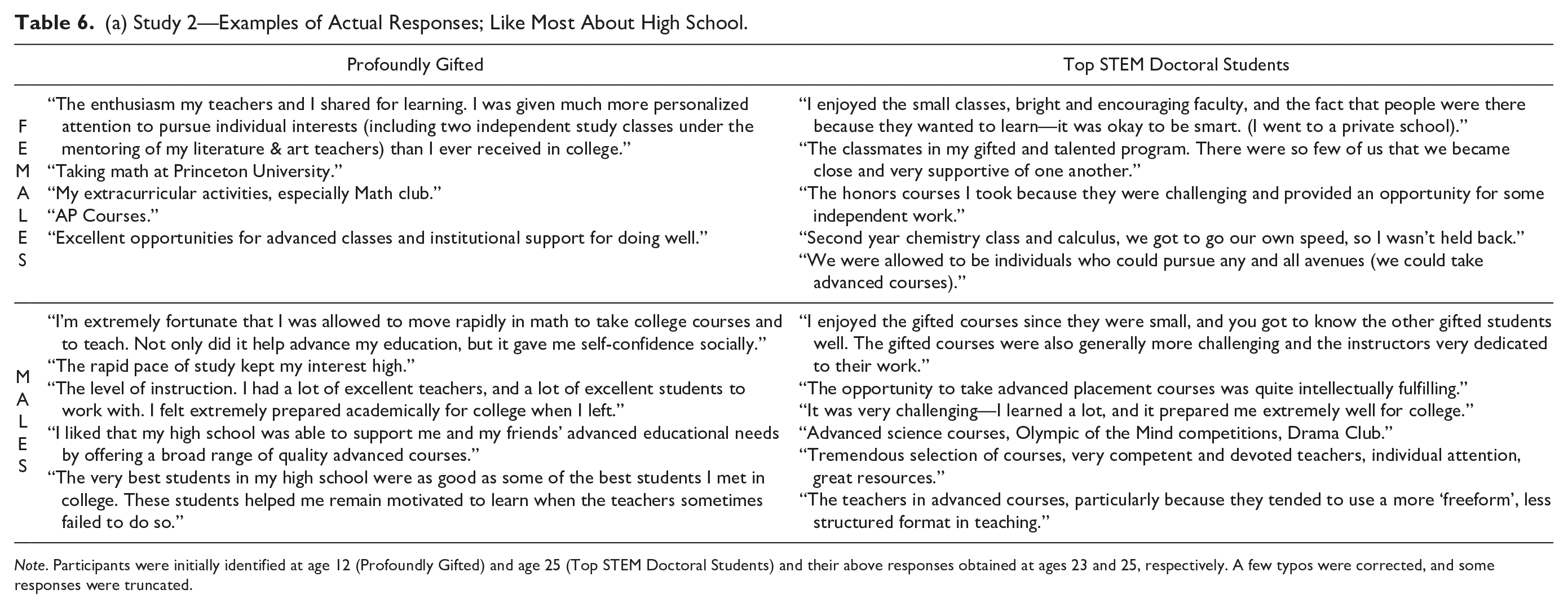
Note. Participants were initially identified at age 12 (Profoundly Gifted) and age 25 (Top STEM Doctoral Students) and their above responses obtained at ages 23 and 25, respectively. A few typos were corrected, and some responses were truncated.
(b) Study 2—Examples of Actual Responses; Like Least About High School.
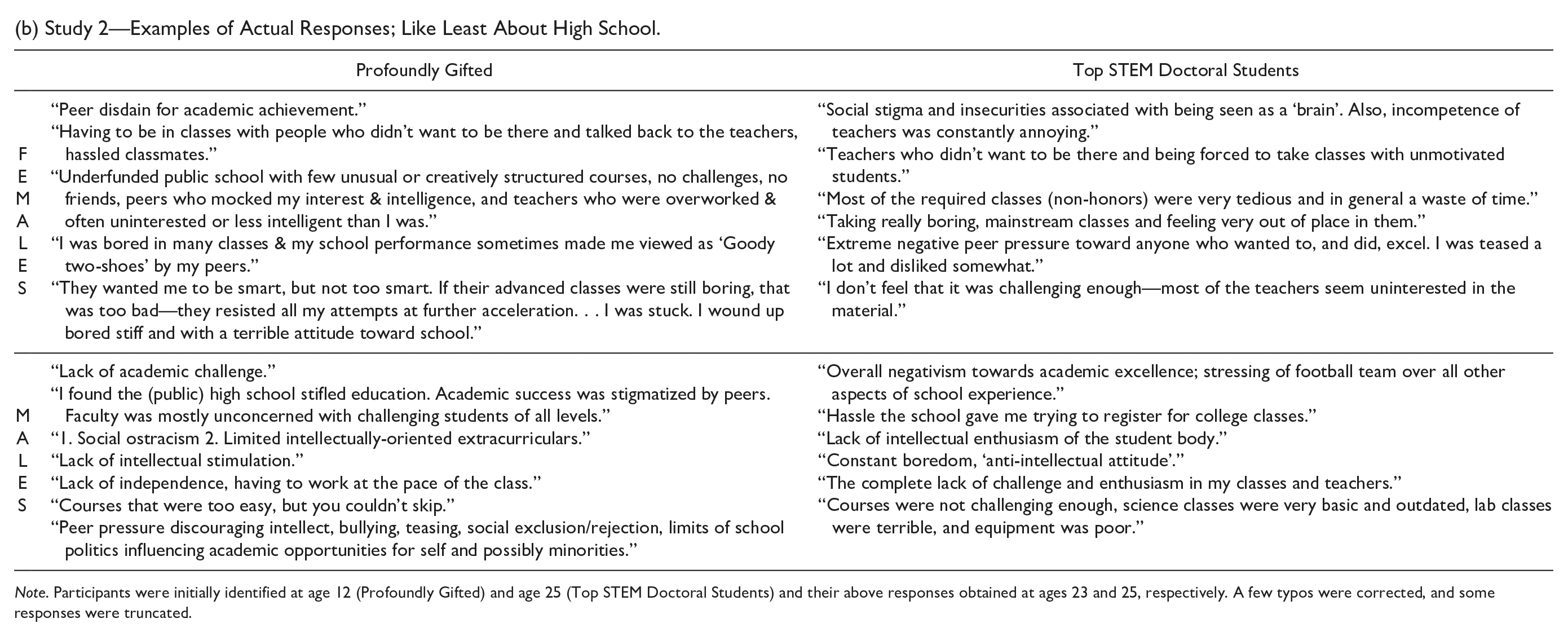
Note. Participants were initially identified at age 12 (Profoundly Gifted) and age 25 (Top STEM Doctoral Students) and their above responses obtained at ages 23 and 25, respectively. A few typos were corrected, and some responses were truncated.
Discussion
Results from Study 2 reinforce the importance of ADP for adolescents at the outer envelope of intellectual and/or STEM potential. Among the Profoundly Gifted and Top STEM Doctoral Students, just under half of the participants mentioned ADP in their responses as to what they liked most and/or liked least about their high school experience. These results were consistent across cohorts and gender and did not covary with the stature or impact of their eventual career outcomes. This consistency shows how impactful access (or lack thereof) to appropriately tailored educational experiences is for high-potential participants; it even surfaces in their responses to a question not explicitly designed to prompt them to think about educational practice. With this unobtrusive measure (Webb et al., 1999), the collective voice that can be heard stressing the importance of ADP among the Profoundly Gifted and Top STEM Doctoral Students echoes the nature and intensity of ADP found in Study 1. These results reinforce Cronbach’s (1990) idea that “A noisy system can deliver a message with high fidelity if the transmission is redundant enough” (p. 389), indicating the psychological significance of ADP and the importance of ensuring that students have access to appropriately flexible educational opportunities.
These results also suggest both the positive impact of providing access to ADP as well as the negative impact of withholding it. That participants reflected fondly on, among other things, their advanced courses, academic autonomy, challenging education, and exposure to like-minded peers, show how these accompanying features of ADP engender positive academic experiences. For example: “The freedom (and guidance) my teachers gave me to learn at my own pace and explore on my own subjects not covered in class was the most enjoyable and stimulating part of my high school experience” [a Top STEM Doctoral Student female]. Likewise, that many participants also endorsed a lack of access to ADP in what they liked least about high school indicates that participants were keenly aware of the ADP-related opportunities and educational environments they missed out on, for example: “[I] felt not readily prepared in math when I entered college. Even though I took the most advanced courses” [a Top STEM Doctoral Student female].
Methodologically, these results also emphasize the importance of assessing both individuals’ likes and their dislikes, as common themes can be found in what someone enjoys or prefers as well as in what they dislike or find less appealing (or even aversive). Future designs employing unobtrusive measures (Webb et al., 1999) would be well advised to consider attractions and aversions for uncovering psychologically significant aspects in learning and working environments, because they hold potential for capturing the same sentiment or construct in different yet complementary ways. Our findings suggest that leaving out either would result in an incomplete portrait of how situations are construed and experienced by participants. When such unobtrusive measures are combined with systematic design variations to form constructive replications (Lykken, 1968, 1991), which preserve focal constructs under analysis, and are applied to significant samples (Simonton, 1999, 2014), findings constitute particularly informative robustness appraisals. In the current context, they also reveal that just as personal attributes beyond cognitive abilities may be conducive to learning, environmental attributes beyond the formal curriculum may also be conducive to learning.
General Discussion
Results from Study 1 demonstrate that, when prompted, Gifted and Highly Gifted participants consider the specific educational practice of homogeneous grouping for instruction desirable and are overwhelmingly opposed to eliminating this intervention. Study 1 participants primarily referenced aspects of ADP in their responses as the reason for their opposition. Over 80% of participants shared the importance of this practice, and many situated their response in their personal experience. That is, they were speaking as individuals for themselves, and that so many did so, with additional social/emotional insights, constitutes a significant addition to the research literature. Given that participants were explicitly asked to reflect on a specific educational practice, their citing aspects indicative of ADP along with the forcefulness of their remarks cry out to be factored into educational policy and theorizing on this topic. That their views are consistent with long-standing case studies and theorizing in the field (Hollingworth, 1942; Hollingworth & Cobb, 1928; Pressey, 1949, 1955; Seashore, 1922), as well as modern and extensive empirical investigations (Assouline et al., 2015a, 2015b; Lubinski, 2016; Lubinski & Benbow, 2021; National Working Group on Advanced Education, 2023; Park et al., 2013; Preckel et al., 2024; Steenbergen-Hu et al., 2016; Worrell et al., 2019), reveals the extent to which converging lines of evidence support providing precocious students access to challenging academic content and allowing them to assimilate it at their own pace.
Findings obtained from Study 2, in which an unobtrusive generalization probe was applied to two distinct cohorts that constitute significant samples (Simonton, 1999, 2014), namely, Profoundly Gifted participants and a cohort of Top STEM Doctoral Students, provide a constructive replication (Lykken, 1968, 1991) of the results obtained in Study 1. As young adults, the participants in Study 2 were not explicitly prompted to consider educational practice specifically but rather simply asked what they liked most and liked least about their high school experiences. Nonetheless, just under half offered some important aspect of ADP in their remarks. Given that the Profoundly Gifted were identified early and provided academic opportunities and mentoring, while the Doctoral Students were admitted to top STEM doctoral training programs, many of these individuals likely had several of such academic needs met. Nevertheless, the fact that they referenced an appreciation for learning challenging academic material at their own desired pace and depth is noteworthy. Moreover, a fair share referred to learning constraints in what they liked least about high school, indicating their regrets at lacking access to challenging academic content. These participants knew what they were missing out on or not getting enough of, and those feelings persisted even after they had graduated from college. Across both Study 1 and Study 2, the proportion of participants referencing ADP in their remarks did not meaningfully covary across cohort, gender, or occupational/lifestyle outcomes.
Thematic Consistency
Themes regarding the need to challenge students and the importance of letting them progress at their own pace emerge regularly from the remarks in the present study (e.g., “I believe grouping children academically helps them by allowing them to be challenged and feel free to fully express their abilities” [a Highly Gifted female]; “The more flexibility there is to approach students in different ways to help them reach their potential, the better” [a Gifted female]). And these personal examples resonate with the broader normative literature (Benbow & Stanley, 1996; Lubinski, 2016; National Science Board, 2010). The National Mathematics Advisory Panel (2008) made the following recommendation: “Mathematically gifted students with sufficient motivation appear to be able to learn mathematics much faster than students proceeding through the curriculum at a normal pace, with no harm to their learning, and should be allowed to do so” (p. 53) and, more generally, the National Science Board (2010) asserts “Students should learn at a pace, depth, and breadth commensurate with their talents and interests and in a fashion that elicits engagement, intellectual curiosity, and creative problem solving” (p. 2). As far back as 1955, Pressey (1955) called for various methods of acceleration to “permit each youngster to move through educational programs at [their] own pace, without being conspicuous if [their] rate is not that of the average” (p. 127), seconding Seashore’s (1922) earlier 1922 admonition to “Keep each student busy at [their] highest level of achievement in order that [they] may be successful, happy, and good” (p. 644).
When the contrary path is taken, and students are stereotyped by age (Lubinski, 2025) or even forbidden access to developmentally appropriate learning environments (Camp, 2023), students are less likely to develop their potential fully and instead often feel their time is being wasted away (Bleske-Rechek et al., 2004; Park et al., 2013; Stanley, 2000; Wai et al., 2010). As pointed out in prior research and theorizing concerning precocious students (Hollingworth, 1938; Pressey, 1967; White & Renzulli, 1987) and emphasized by Carroll (1963): “[I]t is undoubtedly the case that many fast learners lose some of their motivation for learning when they feel that their time is being wasted or when they are not kept at the edge of challenge” (p. 5). A similar sentiment was often mentioned by participants throughout the current study in reference to heterogeneous and slow-paced academic environments. For example:
I was in classes of this sort [heterogeneously grouped] in middle school and I was so frustrated. The classes, because of the mix of skills, were for me a remedial level while for others they were difficult beyond their abilities. Those classes still strongly impress me, even after all this time, as more than just a waste of time, but even a theft of precious opportunity for me. [a Gifted female]
Numerous others provided similar comments, capturing their distaste for classes that held back their academic endeavors (e.g., “Without tracking, the very bright are bored, the least able are frustrated. My ‘untracked’ experiences in school in academic subjects were total wastes of time” [a Gifted female]; “I was forced to take a couple of silly electives (like ‘personal record keeping’) which were so easy they bored me to tears and were a ridiculous, meaningless waste of time” [a Top STEM Doctoral Student female]).
Likewise, when it comes to being among like-minded peers, Hollingworth’s (1926, 1942; White & Renzulli, 1987) students recalled the benefits of being grouped with similarly able peers, and J. R. Cross’s (2016) review on the topic indicated the importance of providing precocious students the opportunity to be with their intellectual peers (see also Rinn, 2018). Williamson (1965) termed this “intellectual camaraderie.” Many participants in both studies in the current investigation provided positive appraisals of their interactions with like-minded peers. 4 For example, a Top STEM Doctoral Student male appreciated that he “had a set of peers who were intellectually on my level and on my wavelength,” a Profoundly Gifted male enjoyed having “friends [who] were just as smart and curious as I was,” and a Gifted female recalled she “learned the most when placed in challenging situations, with demanding teachers and competitive peers.”
Carroll’s Model of School Learning
Carroll’s (1963, 1989) Model of School Learning is especially germane in summarizing our findings and stressing the individual differences among students in the amount of time they require to assimilate academic material fully. After reviewing 25 years of research growing out of this Model, Carroll (1989) concluded:
Inevitably, I think some degree of “streaming” and tracking of students is necessary; objections to such practices stem largely from misplaced egalitarian attitudes. Equality of opportunity to attain potentials implies that students with different amounts and kinds of aptitudes need to have educational programs that differ in pace and content, and perhaps many other ways. As someone has put it, we need not only equality of opportunity but diversity of opportunity. (p. 30)
The multifaceted nature of participant responses in the current project and Carroll’s suggestion of the many other ways in which educational programs ought to differ among students speaks to the complexity of learning environments more broadly. Such nuances reinforce the importance of construing educational environments as more than just the pace or the depth of curricula offered and underscore the idea that educational environments involve any aspect of the environment that either facilitates or inhibits learning and academic success. As demonstrated in Studies 1 and 2, these include aspects of the curricula and learning resources and extend further into other aspects related to students’ social and emotional well-being such as teacher characteristics, classroom peers, and students’ perception of classroom academic rigor.
Conclusion
As Worrell et al. (2019) stated in their Annual Review of Psychology contribution, “Gifted Students,” “It is our hope that policy makers acknowledge and act upon the consensus of psychological science regarding the resources and programming options required to give all of the nation’s gifted students the opportunity to fulfill their potential” (p. 571). It is time we listen to their voices. Not only have the thoughtful voices of the wise intellectual leaders who have studied this problem empirically and longitudinally over the past century repeatedly stressed this, but now the collective voice of intellectually precocious youth as adults seconds the verdict of that body of knowledge, as does that of an impressive cohort of top STEM doctoral students. Jointly, the specific thoughts of the individual respondents aggregate into a loud voice to declare the importance of educational acceleration for able and motivated students. In the words of the 20th President of the American Psychological Association, Carl Emil Seashore’s “The Gifted Student and Research” (Seashore, 1922), “Professors talk about academic freedom, perhaps it is time we heard from the students about academic freedom” (p. 646).
Supplemental Material
sj-docx-1-gcq-10.1177_00169862251339670 – Supplemental material for In Their Own Voice: Educational Perspectives From Intellectually Precocious Youth as Adults
Supplemental material, sj-docx-1-gcq-10.1177_00169862251339670 for In Their Own Voice: Educational Perspectives From Intellectually Precocious Youth as Adults by Gabriella D. Noreen, David Lubinski and Camilla P. Benbow in Gifted Child Quarterly
Supplemental Material
sj-pdf-3-gcq-10.1177_00169862251339670 – Supplemental material for In Their Own Voice: Educational Perspectives From Intellectually Precocious Youth as Adults
Supplemental material, sj-pdf-3-gcq-10.1177_00169862251339670 for In Their Own Voice: Educational Perspectives From Intellectually Precocious Youth as Adults by Gabriella D. Noreen, David Lubinski and Camilla P. Benbow in Gifted Child Quarterly
Supplemental Material
sj-xlsx-2-gcq-10.1177_00169862251339670 – Supplemental material for In Their Own Voice: Educational Perspectives From Intellectually Precocious Youth as Adults
Supplemental material, sj-xlsx-2-gcq-10.1177_00169862251339670 for In Their Own Voice: Educational Perspectives From Intellectually Precocious Youth as Adults by Gabriella D. Noreen, David Lubinski and Camilla P. Benbow in Gifted Child Quarterly
Footnotes
Appendix A
Appendix B
Acknowledgements
The authors would like to thank Frank Miele and Jessica Sommer for commenting on an earlier version of this manuscript.
Declaration of Conflicting Interests
The authors declared no potential conflicts of interest with respect to the research, authorship, and/or publication of this article.
Funding
The authors disclosed receipt of the following financial support for the research, authorship, and/or publication of this article: Support for this investigation was provided by a research and training grant from the Templeton Foundation (61368), by the Eunice Kennedy Shriver National Institute of Child Health and Human Development under Award U54HD083211, and by Alex Gerko.
Open Science Disclosure Statement
The data analyzed in this study are available for purposes of reproducing the results as supplement to this article at  . The link contains the code used to generate the findings reported in the article for purposes of reproducing the results or replicating this study. The link also contains the newly created, unique materials used to conduct the research for purposes of reproducing the results or replicating the procedure.
Ethics Approval Statement
Ethical approval for this study was obtained from Vanderbilt University’s Institutional Research Board (approval nos 020469; 030396, and 101678) in 2011, with annual renewals thereafter.
Notes
Author Biographies
References
Supplementary Material
Please find the following supplemental material available below.
For Open Access articles published under a Creative Commons License, all supplemental material carries the same license as the article it is associated with.
For non-Open Access articles published, all supplemental material carries a non-exclusive license, and permission requests for re-use of supplemental material or any part of supplemental material shall be sent directly to the copyright owner as specified in the copyright notice associated with the article.
