




Abstract
Over the past century, strong applications of psychometrics have resulted in an ideology and practices of identification in the field of gifted education. In recent years, an alternative ideology that construes giftedness in an inclusive light and promotes democratic practices has emerged. This ideology posits a new meaning-making system of giftedness that is process-based rather than person-based. In this article, we elaborate some conceptual principles of this emerging ideology. First, we reflect on the nature of giftedness as a social construct using a symbolic interactionist perspective and articulate the dialectical evolution of collective meanings of giftedness. Second, we address the interdependency between an individual and a context when it comes to helping students realize their giftedness. Third, we accentuate a growth orientation and outline the importance of considering giftedness as a process-based entity. Furthermore, we provide a T:CAD conception of giftedness along with ideas for transaction-focused practices that aim to encourage the rendering of this emerging ideology in practice.
Keywords
Introduction
Even though the idea of giftedness was not alien to ancient societies (Stanley, 1976; Tannenbaum, 2000), a more systematic discourse on giftedness and the implementation of gifted education only began at the turn of the 20th century. Among other contributing factors, two major forces were particularly helpful in realizing gifted education. First, the compulsory education movement that occurred amid the industrial era exerted considerable influence on the development of gifted education (Davis, Sumara, & Luce-Kapler, 2015). In the 19th century, sharp expansion of industrialization ushered in a demand for a large skilled workforce, which in turn resulted in the rise of mass schooling (Carl, 2009). As access to education widened, the diversity of students enrolled in school also increased. In this mass schooling context, educators began to notice the advanced learning needs of students at the higher end of the achievement distribution in the regular curriculum (Davis et al., 2015). In response to these learning needs, differentiated provisions for gifted students (e.g., accelerated programs and specialized schools) began to proliferate in the late 19th century (Freeman, 2002; Jolly, 2018; Nazzaro, 1977).
Second, the emergence of psychometric measurements also contributed substantially to the development of gifted education. Rooted in the empiricist tradition of the 19th century (such as the work of Charles Darwin and Gregor Mendel), Francis Galton (1822-1911) conducted a study on giftedness that investigated its genetic etiology. Later, with the introduction of more sophisticated psychometric measurements of intelligence, such as the Stanford-Binet Intelligence Scales (Terman, 1916), gifted education quickly grew into an educational discipline as educators became able to identify students with greater learning potentials and select students for gifted programs based on their performance on intelligence tests (Jolly, 2018).
Over the past century, strong applications of psychometrics have resulted in an ideology and practices of identification in the field of gifted education. Since its onset, giftedness has been understood as, and believed to be, an innate quality that speaks to exceptional intellectual capabilities that belong to only a small fraction of students. The core pedagogical mission associated with this meaning-making system was to discover groups of gifted students who demonstrate evidence of or possess capabilities in reaching exceptional achievements and/or eminence. However, the adoption of giftedness as a categorical construct (that distinguishes students as either gifted or not gifted) based on psychometric cutoffs has provoked concerns of elitism and reductionist practices (Lupart, 2012; Lupart & Webber, 2012; Porath, 2012).
In recent years, an alternative ideology that construes giftedness in an inclusive light and promotes democratic practices is emerging. Under this alternative ideology, giftedness is understood as a person-in-situ transaction in which the complex nature of the interaction between a person and a learning context is highlighted (Barab & Plucker, 2002; Lo & Porath, 2017; Plucker & Barab, 2005). As person-in-situ transaction suggests, giftedness is a function of context, personal qualities, and development; furthermore, giftedness is relevant to all individuals and outlined as an inclusive guiding framework. In other words, this emerging ideology proposes a new meaning-making system of giftedness that is process-based rather than person-based and focuses on learning paths that lead to excellence (Ziegler, 2005) for all rather than on who is deemed to need special education by virtue of their score on a test of intelligence. To put it simply, this meaning-making system places a strong focus on how to become “gift-ed” rather than those who are “gifted.” In this article, we elaborate the development and some conceptual principles of this emerging ideology and provide ideas for transaction-focused practices that will further encourage the generation of applications of this alternative ideology.
Giftedness as a Living Concept
Our day-to-day life consists of constant interaction and communication with others through the use of symbols and significations (see Symbolic Interactionism, Blumer, 1969). A symbol is a socioculturally derived construct that reflects joint understanding of things, actions, events, and social concepts (in this section, we use the terms symbol and social construct interchangeably). While symbols provide means for people to communicate, converse, and interact, these processes result in modifications of the joint meaning of a symbol (Charon, 1995). That is, the very existence and evolution of meanings of a social construct organically reflects our evolving society and minds. Likewise, it is through constant communication and interaction that a social construct can gain further relevance and conceptual advancement over time in a cultural setting (Benzies & Allen, 2001).
Like the organic evolution of many social constructs, the meaning of giftedness has been modified, realigned, and redefined through a collective interpretive process (Borland, 1997; Lo & Porath, 2017). The first known usage of the word gifted was recorded in the 17th century and it had been used to describe individuals who demonstrate exceptional achievements linked to endowed gifts and talents (Robinson & Clinkenbeard, 2008). This was the dominant conception of giftedness prior to modern onset of gifted education in the 20th century (Jolly, 2018; Lo & Porath, 2017). A perfect example can be found in Francis Galton’s book Hereditary Genius (1869), where he concluded that eminence resulted largely from genetic inheritance and ran in families. Although his work is considered distasteful today for its strong connotations of eugenics and elitism, it nevertheless started an era that viewed giftedness as a scientifically treatable topic and piqued an interest in studying individual differences on the higher end of the spectrum. 1 Prior to Galton’s scientific treatment of giftedness (i.e., endeavors to discover the origin of giftedness with systematic approaches), it had been associated with divinity and mythology. Gradually, with the influence of the scientific revolution, giftedness came to be understood in more abstract terms, such as aptitude, sensory disposition, over-excitability, and cognitive ability.
Today, the term gifted has strong pedagogical connotations. It is commonly referred to as an educational category and reflects dimensional complexity. Evidently, the collective understanding of the term gifted has evolved (some might say been enriched) substantially from what it meant in the 17th century. For instance, the National Association for Gifted Children in the United States posits the following: Children are gifted [italics added] when their ability is significantly above the norm for their age. Giftedness may manifest in one or more domains such as: intellectual, creative, artistic, leadership, or in a specific academic field such as language arts, mathematics or science. (National Association for Gifted Children, n.d.)
As early as 1910, Guy Whipple started to use the term gifted in a psychometric fashion, a conceptualization that has influenced the common practices we have today (Jolly, 2007). It was also around this time that the term gifted made its first appearance in educational textbooks, used to denote a group of students with greater learning potentials in comparison to their peers (e.g., Henry, 1920; Hollingworth, 1926; Stedman, 1924; Whipple, 1919). In the 1920s, the term gifted gained further relevance in education after Lewis Terman introduced the Stanford-Binet Intelligence Scale (a revision of the Binet-Simon Scale), which popularized the idea of differentiating students’ learning potentials by intelligence measurement. 2 Later, with the surge of the compulsory education movement that ushered in a greater need for meeting the diverse needs of students increasingly enrolled in public education (Davis et al., 2015), the pedagogical connotations of the term gifted remained. It has been used in a categorical fashion since the 1920s for the purpose of differentiating a group of students defined as exceptionally intelligent, psychometrically speaking, who need stimulation beyond what an age-related curriculum can provide (Stanley, 1976).
The concept of giftedness continues its symbolic evolution today. Under the influence of the inclusive education movement and an increasingly egalitarian social milieu, more scholars in the field of gifted education started to question the pedagogical implications of having a psychometric condition categorized as gifted (e.g., Borland, 2013; Lo & Porath, 2017; McBee, McCoach, Peters, & Matthews, 2012; Peters; 2016; Reis, 2003). From a pedagogical point of view, the strong (post-) positivist focus on finding a mind that is “truly gifted” is questionable and could obscure the “how” and “when” (Jackson, 2000; Porath, 2013; L. T.Rose, Daley, & Rose, 2011) in meeting the advanced learning needs that exist only when a given learning context is taken into account. Moreover, researchers have also questioned the ethical implications of categorizing students into gifted versus those not so identified, often described as “non-gifted” (e.g., Barab & Plucker, 2002; Borland, 2013; Matthews, Ritchotte, & Jolly, 2014; Sutherland, 2012). While it is still emerging, a major shift concerning the symbolic nature of “gifted” is apparent (Lo & Porath, 2017). This current shift incorporates more complexity that involves systemic sensitivity, ethical practices, and egalitarian considerations.
Giftedness as Person-In-Situ Transactions
At the beginning of the 21st century, a discourse that conceptualized giftedness as a context-dependent entity emerged (e.g., Barab & Plucker, 2002; Dai, 2017; Hymer, 2012; Lo & Porath, 2017; Plucker & Barab, 2005). In comparison to conventional views that regard giftedness as a self-contained entity (i.e., prepossessed conditions awaiting proper identification), the developing discourse conceptualizes giftedness as emergent, situated, and dynamic. Aligning with this discourse, giftedness has been outlined as, for example, “emerging excellence” (Plucker & Barab, 2005, p. 206), “optimal interactualized transaction between an individual and his or her environment” (Lo & Porath, 2017, p. 352), and functional person-in-situ transactions (Barab & Plucker, 2002), all of which address the importance of process and context.
As Plucker and Barab (2005) noted, a transactional view of giftedness highlights dynamic flows and the relational nature between a person and the context where he/she is situated. This primary focus on investigating the dynamic individual–environment interaction rejects a conventional reductionist view that thinks of “persons and situations as independent variables” (Snow, 1992, p. 19) and adopts a systemic thinking that outlines persons-in-situations as integrated systems where interactions are highlighted (Bunge, 2000; Davis et al., 2015; Lo & Porath, 2017; Wan, 2011; Ziegler & Stoeger, 2017). When giftedness is outlined as person-in-situ transactions, personal factors, contextual factors, and factors associated with person-in-situ dynamics are all to be considered as relational parts of an integral whole that contributes to giftedness formation (Barab & Plucker, 2002; Barab & Roth, 2006; Lo & Porath, 2017). To put it simply, a functional transaction occurs when an individual realizes, sustains, and optimizes his/her dispositions and abilities under the parameters set by a society in a given time. To use Mozart as an example, there is no doubt about the existence of his exceptional musical disposition and ability. However, he would not have been able to enact his disposition and develop his ability to accomplish such excellence without a context that provided conditions (e.g., a time/place that valued arts highly) conducive to developing his musical disposition/ability. Likewise, we are not able to know what Mozart could have achieved if he had been born in, say, Mongolia. However, we can be certain that he would not have been the Mozart whom we know today. Meanwhile, we could also fathom that his other abilities and dispositions would/could have been induced by opportunities that Mongolia had otherwise provided.
Ecological psychology provides a fertile ground for this new school of thought. Founded by James Gibson, ecological psychology addresses the importance of understanding the occurrence of an action (e.g., learning) in a system from a relational perspective (Barab & Plucker, 2002). That is, an action can occur only if an individual recognizes (or is made to recognize) certain features of an environment that furnish possibilities of the action. For example, a water pond is swimmable to organisms who have the ability to swim (such as fish) or capability to learn how to swim (such as human beings); a doorknob is turnable to individuals who have the capability and intention to open the door. Two terms, namely affordance and effectivity, are central to understanding the integrated nature of persons-in-situations. Affordances address the possibilities of action that an environment provides, offers, and furnishes ( E. J.Gibson, 2000; J. J. Gibson, 1979/1986; Young, Depalma, & Garrett, 2002). In daily language, affordances are often suffixed with “-able” to address the functional value of an environment, such as a “climbable” hill, a “steppable” ladder, and so on (Pufall & Dunbar, 1992; Warren, 1984). Reciprocally speaking, effectivities are behaviors that an individual can produce so as to actualize possibilities of action (Barab & Roth, 2006; Chemero, 2003; Greeno, 1994; Shaw, Turvey, & Mace, 1982).
Essentially, affordances and effectivities are codetermined in nature (see Figure 1 for an illustration). For educators, in order to engage students to enact their effectivities (e.g., academic abilities), they need to invoke proper attunement to, and resonance with, the affordances (e.g., enrichment opportunities) of a school environment among students (Barab & Roth, 2006). Barab and Plucker (2002) articulated that “the responsibility of the educator is to establish contexts for learning that support individuals in becoming more adept at functioning as part of multiple systems” (p. 175). Adopting the idea of creating a smart context that attunes learners with a larger set of opportunities and fosters emerging excellence has major implications for teaching practices. On a curriculum level, it is vital for educational leaders and policy makers to create a curricular milieu that mirrors increasing possibilities provided by our evolving society (Plucker, McWilliams, & Guo, 2017). An educational reform occurring in British Columbia, Canada (British Columbia Ministry of Education, 2015), spoke to the efforts of making its general education more gifted. For example, the reform addresses core competencies (e.g., communication, collaboration, critical and creative thinking, and social-emotional skills) that a student needs in order to make a successful transition to functional adulthood and develop lifelong learning skills. As a case in point, the reform in British Columbia also features coding/programming skills that have become increasingly relevant to the current generation of digital natives (McWilliams & Plucker, 2014; Plucker, McWilliams, et al., 2017; Prensky, 2001). More important, the reform strives to establish an open system that recognizes, values, and encourages the development of multiple forms of intelligences and talents. Conceivably, when a school system affords and supports the development of multiple pathways, it becomes more inclusive since more individuals in the system are encouraged to embark on a gift-ed process (i.e., person-in-situ transactions) that highlights their unique intelligences, talents, strengths, and/or interests. Colloquially speaking, more individuals are potentially to be recognized as “winners” in an open system.
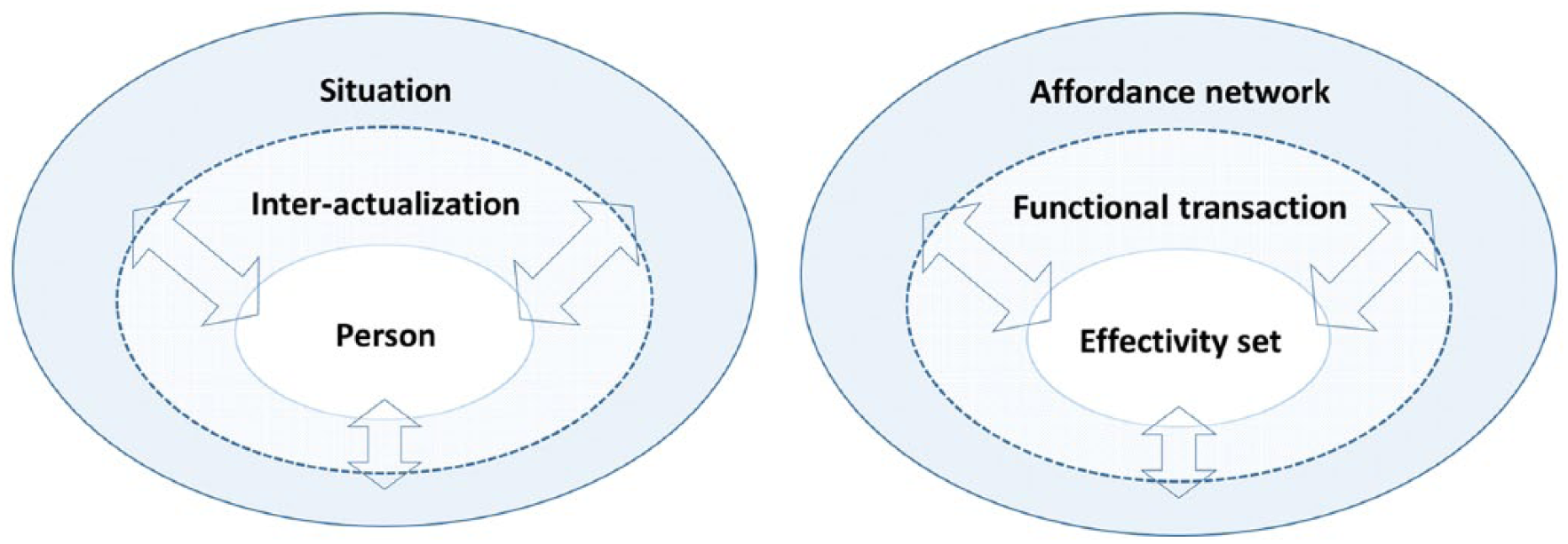
The dynamic nature of a person-in-situ transaction.
Similarly, on a school level, a school principal can create a flexible and resource-rich setting that affords students to explore and sustain their learning interests. As Hertzog (2017) stated, “Because potential talent needs to be nurtured and developed in young children, educators have a responsibility to be thoughtful and intentionally create optimal environments for talent development” (p. 220). Renzulli and Reis’ (1985) schoolwide enrichment model (also see Renzulli, 2008) provides a good example for talent development in an inclusive school environment. In the schoolwide enrichment model, school leaders and teachers work as a team and strive to create an enriched environment by (1) assessing students’ unique profiles of intelligences, talents, and learning interests (e.g., using the “Total Talent Portfolio” developed by Purcell and Renzulli, 1998) and (2) providing a continuum of learning opportunities (e.g., regular classes, interest clusters) that address the variation (types and levels) of abilities.
To address the importance of affordances on a classroom level, a classroom can and should be constructed in an enriched and talent-friendly manner so that it becomes a smart context that provides opportunities for exploring, discovering, and idea-expressing (Curtis & Carter, 2003; Heard & McDonough, 2009; Helm, Beneke, & Steinheimer, 1998) necessary for students to further develop their talents and giftedness. Thus, a smart context is a classroom enriched physically, materially, intellectually, and instructionally so that it excites and engages students. Using the language of the Reggio Emilia approach, a classroom functions as a third teacher when it “listens to” students (Edwards, Gandini, & Forman, 2011) and responds with authentic learning opportunities that promote transactions (Dewey, 1938). Readers seeking inspirations for elevating the affordances of a classroom can refer to Hertzog’s (2017) article wherein a wide range of “makeover” ideas (e.g., creating a nurturing and aesthetic environment, integrating inquiry-based learning) are provided to help teachers transform a traditional classroom into a talent nursery.
Giftedness as a Lived Process
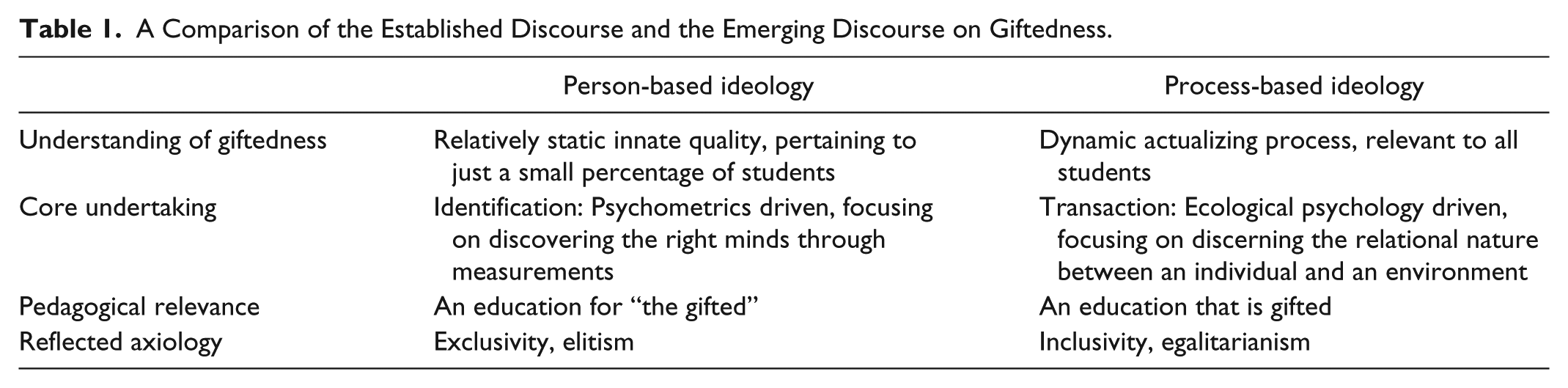
Over the past century, educators and researchers in gifted education have collectively adopted a verificational view that sees giftedness as a verifiable condition, that is, a static view that considers giftedness as a self-contained entity that only pertains to some individuals (Lo & Porath, 2017; Ziegler & Stoeger, 2017). As Hollingworth (1938), one of the modern day gifted education pioneers, famously put it, “Before we can educate the genius, we must discover him in childhood” (p. 306). Fittingly, the notions of “discovery” and “in childhood” reflect a strong verificational view rooted in positivist and post-positivist traditions. Sustained by the surge of psychometric studies in the following decades, giftedness has been associated with innateness and exclusivity, both of which speak to a fixed-mindset orientation in understanding the developmental nature of human possibilities and potentials (Dweck, 2006; Tirri, 2016).
Progressively, a growing number of educators and researchers are espousing a transactional view that sees giftedness as person-in-situ transactions (i.e., process-based entities rather than person-based entities). The core undertaking of gifted education has been switched from identifying the limited few for special services to promoting an actualizing process that one can live through their giftedness. This process-focused ideology naturally speaks to a growth-mindset orientation (Dweck, 2006; Tirri, 2016) in that it highlights the potential and growing nature of human possibilities. Therefore, giftedness is conceptualized as a lived process that can be reflected on and examined formatively. In this light, giftedness also becomes “a pedagogical goal achievable by all rather than measurable predictions for some” (Lo & Porath, 2017, p. 345).
As we mentioned in the previous section, the dimensions of talent development are contingent on the affordances that a learning context furnishes. However, affordances alone are not sufficient for the initiation and sustenance of an actualizing process. In order for a student to actualize possibilities for any action, he/she needs to be aware of (or be apprised of) the possibilities for action in a learning context as well as his/her effectivity set and strengths (Barab & Plucker, 2002). As Turvey and Shaw (1995) noted, successful person-in-situ transactions are contingent on how individuals perceive and react to the environmental opportunities. It is therefore important for an educator to apprise students of not only the learning opportunities but also their potentials in reacting to these opportunities (i.e., self-knowledge). Lo (2014) illustrated the significant role that self-knowledge plays in inducing agentic actions in the LINK (i.e., Label-INduced-Knowledge) model. He studied labeling effects among students with exceptionalities and articulated how an account of well-constructed self-knowledge could help students develop positive adaptive behaviors (such as advocacy, goal setting, and self-regulation). The LINK model centralized a constructive role that an educator can adopt in translating self-knowledge into powerful actions. That is, more than creating a rich learning context, an educator should also strive to promote self-knowledge among leaners with regard to their developing and developable abilities, capacities, and skills. Along the same line, Fogarty (2008) discussed the importance of teachers being aware of the state-of-the-art knowledge of intellectual/learning potentials and creating a classroom climate that induces the variety of human potentials and promotes self-knowledge. In her words, an intelligence-friendly classroom can serve as a “caring companion and mindful guide to the intellect of each and every child in it” (p. 143). For instance, Gardner’s (2006) evolving theory of multiple intelligences, Sternberg’s (1996) successful intelligence, Dai’s (2017) foundational domains of human effectivities, Feuerstein’s theory of structural cognitive modifiability (see Feuerstein, Rand, Huffman, & Miller, 1980), and various theories that tap into moral and social-emotional realms of intelligence (e.g., Coles, 1998; Goleman, 1995) all provided substantial understanding of the nature and development of human potentials and possibilities. As a case in point, the Churchill Center and School, Missouri, saw increased student involvement and ownership in learning after having students with learning disabilities participate in a Demystification Conference designed to help them gain deep understandings of their strengths and weakness in the classroom and by demystifying the medical terms associated with their learning conditions (Elfrink, 2008).
In addition to cultivating self-knowledge of personal strengths among students, scholars have also addressed social-emotional components (e.g., motivation, perseverance) that can help further translate self-knowledge into actualization. For example, de Ruyter (2003) discussed the importance of helping students construct realistic ideals/goals and use these as navigation aids. She defined ideals as “imagined excellences” (p. 467) that are not yet realized. In her words, “Education should therefore involve several worthy ideals that children can commit themselves to as well as critical reflection on the ways in which people are committed to and try to actualize them” (de Ruyter, 2003, p. 467). Likewise, stemming from Ryan and Deci’s (2000) self-determination theory, Aviram and Assor (2010) highlighted a form of interest-based learning wherein students are encouraged to express their authentic interests, given choices to match their interests, and provided with learning opportunities that cultivate the development of “reflection- and exploration-based personal goals and interests” (p. 121).
Furthermore, teachers should consider some meta-cognitive components that can help students monitor/progress through an actualizing process. Providing life models can be a good general strategy (Betts, Kapushion, & Carey, 2016; Kingore, 2001; Lo, 2014; Vidergor, 2015) for students to reflect on the dynamics and contingencies involved actualizing giftedness. By encouraging in-depth case studies of autobiographical and biographical books and films focusing on prominent figures in areas of interests, students can grasp a better understanding of how giftedness is developed through life experiences. By doing so, a better understanding of the procedural dynamics in turn helps students meta-cognitively reflect on their own “gift-ed” process.
To conclude, we see giftedness as a state of self-actualization contingent on cognitive, social-emotional, and meta-cognitive components of agency. We concur with Dearden (1983), who once noted: “I take that with intellectual as with any other sort of development, the nature of the earlier stages can best be appreciated by looking at the final accomplishment” (p. 214). By embracing the idea of giftedness as a lived process, a knowledgeable teacher then becomes a catalyst who helps students realize possibilities of action afforded by a learning context through inducing their motivation and agency.
From Discourse to Practices
Reconceptualizing Giftedness
In this article, we traced the development of, and further elaborated on, the emerging discourse on giftedness and some conceptual shifts in gifted education (see Table 1 for a synthesis). First, we reflected on the nature of giftedness as a social construct using a symbolic interactionist perspective and articulated the dialectical evolution of collective meanings of giftedness. Today, the emerging understandings of giftedness have departed from a static view that sees giftedness as a stable innate condition and increasingly reflects more complexity and reflexivity. Second, we addressed the interdependency between an individual and a context when it comes to helping students realize their giftedness. Delineating giftedness as functional person-in-situ transactions, we emphasized the importance of constructing a stimulating learning context that affords opportunities for students to explore and sustain their unique abilities, talents, strengths, and interests. Third, we accentuated a growth orientation and outlined the importance of considering giftedness as a process-based entity embodied by various developmental opportunities. We suggested educators make efforts to provoke agential actions, such as inducing self-knowledge and cultivating personal goals among students. To sum up, we consider giftedness as a process-based entity pertaining to all individuals and the transaction (T) of such is situated in a sociocultural context (C), induced by individual agency (A), and accrued through incremental development (D). With an intention to invite further discussion, we will provide a synthesis of our conception of giftedness in light of a T:CAD framework, followed by a comparison with some contemporary models of giftedness.
A Comparison of the Established Discourse and the Emerging Discourse on Giftedness.
A T:CAD Conception of Giftedness
Based on a transactional perspective, giftedness is conceptualized as a transacted entity of an individual’s gift profile. It is a gradual development sustained by the interaction of an individual with his/her environment. A gift speaks to natural endowment existing in forms of human potentials (e.g., dispositions, abilities, intelligences, and talents) that can be activated, and become effective, in a given sociocultural context through guidance and exercises. Socioculturally speaking, a gift may be valued more in a particular time and context, and vice versa, a gift may be underappreciated or concealed in a particular time and context. The attainment of giftedness relies on actions by agents that lead to self-actualization. Thus, the validation of giftedness should include personal relevance. However, we also recognize that a well-elaborated account of giftedness may sustain or extend the standards of excellence set by a sociocultural domain.
To further clarify the T:CAD conception of giftedness, we will put it in juxtaposition with two other contemporary models (see Table 2), namely, the differentiated model of giftedness and talent (henceforth DMGT) from Gagné (2004, 2017) and the Three-Ring Conception of Giftedness (henceforth 3-Ring) from Renzulli (1978, 2005).
A Comparison of DMGT, 3-Ring, and T:CAD Conceptions of Giftedness.
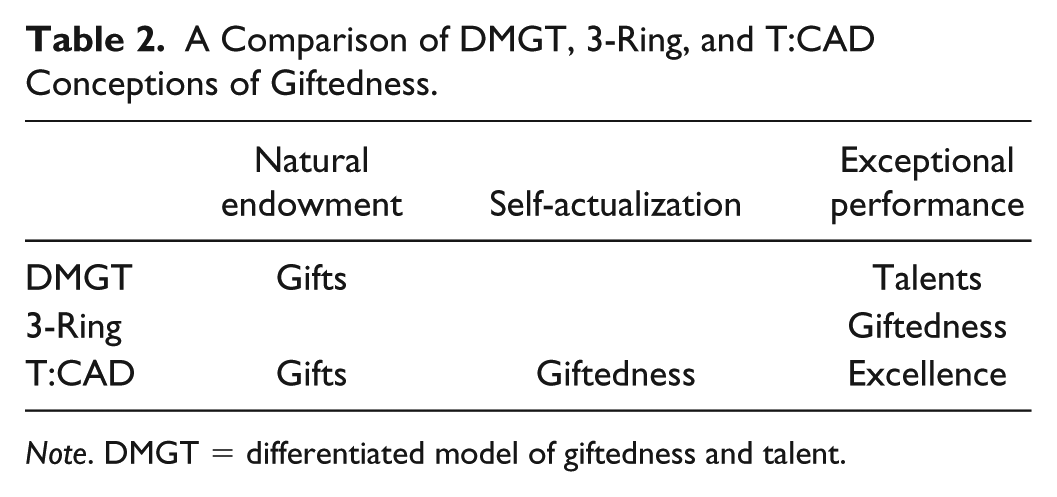
Note. DMGT = differentiated model of giftedness and talent.
With regard to the notion of gift, T:CAD is akin to the one described in DMGT since they both indicate the diversity of human potentials and address the importance of context and development. However, T:CAD and DMGT differ majorly in their educational focus. While T:CAD embraces an inclusive thinking that suggests every student can, and should be given opportunities to, become “gift-ed,” DMGT proposes a threshold (i.e., 10%) that reflects a categorical thinking and confines the model to the education of a small segment of our student population.
With regard to the concept of giftedness, both T:CAD and 3-Ring contemplate giftedness as a process-based entity and emphasize the importance of individual agency (such as motivation in 3-Ring and self-knowledge in T:CAD). However, T:CAD outlines giftedness as a state of self-actualization in which personal relevance is considered, whereas 3-Ring outlines giftedness as exceptional achievements in which social relevance is involved (i.e., must sustain or extend domain-specific standards). As such, giftedness in T:CAD is considered attainable to all individuals and is judged upon personal reflection whereas giftedness in 3-Ring is considered attainable among individuals who possess above-average ability (i.e., top 15% to 20%) and are creative.
Furthermore, readers may have noticed the (dis)similarity between the notion of excellence in T:CAD and the notion of “talents” in DMGT. While T:CAD and DMGT are similar in that they both correspond the ideas of domain-specificity and rarity of prevalence, they differ operationally in how exceptional performances are defined. In defining exceptional performances, DMGT suggests the top 10% in each domain to be considered as talents (in correspondence to its 10% threshold of giftedness). T:CAD, however, adopts a more naturalistic thinking and proposes using consensual standards suggested by social psychologists (see, e.g., Amabile’s [1996] notion of consensual assessment and Csikszentmihalyi’s [2014] notion of gate keepers).
This comparison certainly does not speak to a comprehensive review and warrants further development. For example, we have not included some other key conceptions of giftedness 3 that have also informed contemporary gifted education practices. While we believe that such a comprehensive systematic review is valuable to the field, it is beyond the scope of this article. Nonetheless, by providing a brief juxtaposition here, we hope to not only further illuminate our transactional perspective but also curtail some existing jangle fallacies associated with the mixed word usages (e.g., the usage of giftedness) in our field (Plucker, Rinn, & Makel, 2017).
Reorienting Gifted Education
From Essentialist Thinking to Inclusive Thinking
As we have seen, over the past century, gifted education has been strongly influenced by psychometric studies and has espoused an ideology of identification. Under this distinct meaning system, giftedness has been conceptualized as an innate and relatively stable condition that belongs to only a small fraction of the student population. Deriving from this belief, gifted education has, collectively, reflected an essentialist thinking and been criticized for promoting elitism and potentially entrenching social gaps (Borland, 1997, 2013; Dai & Renzulli, 2008; Ziegler & Stoeger, 2017).
Echoing a sociocultural perspective, transactional gifted education addresses the context-dependency of talent development and recognizes the diverse human potentials that have shaped our evolving society today (Barab & Plucker, 2002; Hymer, 2009, 2012; Kornhaber, Krechevsky, & Gardner, 1990; McWilliams & Plucker, 2014; Plucker, McWilliams, et al., 2017). Thus, transactional gifted education endorses an inclusive thinking that values and celebrates the diverse and varied human potentials in dispositions, abilities, intelligences, and talents. As Hymer (2012) argued, “Gifts and talents are grown and created in an individual’s response to and interaction with her physical, social and intellectual environment” (p. 111). By addressing this interactive nature between a learner and a learning environment, the emphasis of gifted education then turns to help all students realize and transact their gifts through providing them a smart context wherein opportunities for activating, exercising, and elaborating their gifts and becoming “gift-ed” are abundant. In other words, transactional gifted education pleads with educators to imagine schools as not only a context for learning but also a context for talent socialization—a place where students can become familiar with, and appreciative of, the multiple forms of human potentials and endeavors.
From Discrete Programming to Integrative Programming
In alignment with the essentialist thinking, gifted programming has been practiced in a binary fashion. The design and implementation of gifted education services and provisions have been concentrated on meeting the needs of the selected few. As a result, gifted education has been considered as a discrete unit in relation to general education in the school system (Dai & Chen, 2013; Ziegler & Vialle, 2017).
Consistent with developmental theories (e.g., Vygotsky, 1978), a transaction-focused gifted education favors a more integrative programming style that speaks to the continuous and malleable nature of development. First, it promotes the inclusion of development-embedded approaches in order to respond to a range of developmental potentials and encourage a growth-mindset in general education settings. For example, Beghetto and Kaufman’s (2010, 2014) Four C model of creativity, Tomlinson et al.’s (2009) Parallel Curriculum (see also Tomlinson, 2014), and Betts et al.’s (2016) autonomous learner model all emphasize the importance of sustaining students’ growth through scaffolding and providing growth-encouraging feedback. Second, it also argues for proactive programming to address learning needs and readiness that may exceed the ceiling of services that a teacher can provide in a regular classroom setting. At a school level, for example, Peters, Erstad, and Matthews (2017) and Johnsen, Parker, and Farah (2015) urged the implementation of a Response-to-Intervention framework (see National Center on Response to Intervention, 2010) to monitor students’ growth and identify advanced learning needs. Similarly, Treffinger, Young, Nassab, and Wittig (2004) proposed a Levels of Services approach that adopts Universal Design for Learning principles (see D. H. Rose, Meyer, Strangman, & Rappolt, 2002), advocating for tiered services for meeting various levels of developmental potentials and readiness in general school settings. Likewise, further learning opportunities should also be integrated into a general education system to extend the service spectrum and to ensure service capacity for meeting advanced learning needs that may exceed the limits of school-level services and/or require regional (e.g., district, province/state) recourses. Many existing gifted education services (e.g., Assouline, Lupkowski-Shoplik, & Colangelo’s [2017] tiered acceleration options, Brody’s [2017] university-based enrichment programs, and Stoeger, Duan, Schirner, Greindl, and Ziegler’s [2013] mentoring), can readily be resituated in this new meaning making system without substantial modification.
From Identificational Assessment to Transactional Assessment
Amid the rapid development of psychometric studies in the past century, gifted education has thrived on assuming a gifted condition by virtue of a student’s performance on psychometric measurement. 4 The practice of assessment in gifted education has, by and large, been conducted in a verificational manner to determine whether a student possesses a gifted condition or not. Even though common identification practices today have adopted multidimensional approaches (McBee, Shaunessy, & Matthews, 2012), these approaches still centrally rely on the interpretation of a student’s performance on an IQ or cognitive test.
In light of a transactional gifted education, assessment is considered as a crucial partner to both teaching and learning. Data collected are used to elucidate a learner’s unique learning profile and monitoring a learner’s growth and developmental potentials in a specific area. That is, instead of using assessment for identificational purposes, educators are encouraged to use assessment for transactional purposes (i.e., promoting further growth and development) by adopting growth-oriented assessment frameworks, such as Vygotsky’s (1978) zone of proximal development and Feuerstein et al.’s (1986) Learning Potential Assessment. In practice, transactional assessment should focus on providing ongoing feedback to learners to encourage further growth and sustaining evidence necessary for justifying referral decisions on more advanced learning opportunities. Approaches corresponding to this transactional orientation are already abundant. For example, Feldhusen (1994) and Purcell and Renzulli (1998) promoted using multidimensional learning profiles to help student reflect on their learning potentials in various areas of talents and abilities; Tomlinson et al. (2009) and VanTassel-Baska (2001) included rubric design that highlights growth and learning potential in inclusive classroom settings. With regard to developmental potentials in academic areas, scholars (e.g., Lidz & Elliott, 2006; Peters et al., 2017; Peters, Matthews, McBee, & McCoach, 2014) have also advocated for implementing Response-to-Intervention frameworks and/or a more dynamic assessment system to collect data that could support screening and inform evidence-based decision making for referrals to more advanced learning opportunities. Importantly, through collecting students’ responses to more complex and challenging activities (such as an inquiry-based learning project), a teacher will have better opportunities to observe a student’s unique combination of strengths and weakness in learning. On a side note, by collecting ongoing assessment information, it is more likely for a teacher to refer a student who simultaneously demonstrates advanced development in some areas (e.g., abstract thinking, critical thinking, creativity) and setbacks in other areas (e.g., executive functioning, written output) for full psychoeducational assessment for potentially undiagnosed exceptionalities 5 (e.g., learning disabilities).
To sum up, it is clear that threads of thoughts and practices that speak to a transactional gifted education are evident. Indeed, the field of gifted education has accumulated a plethora of good practices that can be reoriented and resituated to address a transactional perspective. As Peters (2016) noted, “The good news is that nearly all of gifted education ‘best practices’ could stay the way it is” (p. 127). However, for a meaning making system in a nebulous stage to gain better understanding and acceptance, it requires further discussion and debate for reaching a potential consensus that can in turn support systematic changes. Furthermore, it requires effort at a policy level (i.e., policy making and policy analysis) to address structural issues (Plucker, Makel, Matthews, Peters, & Rambo-Hernandez, 2017) and encourage early adopters to put forth pedagogical changes such as in teacher training models.
Closing Remarks
Of note, while we outlined an emerging discourse that emphasizes process and posits that everyone “can” transact their gift profile and become gift-ed, it is not our intention to discount the unique social-emotional challenges associated with exceptional cognitive development. As shown by research, some cognitively high-functioning individuals do exhibit social-emotional maladjustment in school settings (see, e.g., Adelson, 2007; Gross, 2002; Neihart, 1999; Webb, 2013) and/or demonstrate issues related to asynchronous development (see, e.g., Peterson, 2012, 2015; Robinson, 1996; Roeper, 2012). However, these findings were confined to cases studies and clinical studies that only pertained to a subpopulation among students conventionally identified as gifted (Richards, Encel, & Shute, 2003). Empirical studies have shown that the majority of students conventionally identified as gifted are well-adjusted and demonstrate fewer social-emotional issues in comparison to their age peers (e.g., Garland & Zigler, 1999; Nail & Evans, 1997; Neihart, Reis, Robinson, & Moon, 2002; Richards et al., 2003; Shechtman & Silektor, 2012; Terman & Oden, 1947). That said, while some learning, social-emotional, and/or developmental challenges are unique to people who exhibit high cognitive functions, having a score that surpasses a predetermined cutoff (e.g., above two standard deviations in a normalized distribution) on a cognitive test does not always equate to the needs mentioned above. Moreover, when gifted is used as an educational category, it could foster the inaccurate belief that it represents a homogenous group who exhibit similar traits and face similar challenges (Guldemond, Bosker, Kuyper, & van der Werf, 2007; Shaywitz et al., 2001). Pedagogically speaking, limiting services to the group of students identified as gifted might very well dismiss some advanced learning needs demonstrated by students who do not score high enough in a cognitive test at a given time (Peters, 2016; Peters, Kaufman, Matthews, McBee, & McCoach, 2014). Indeed, as Peters (2016) resoundingly argued, “the end goal of K-12 gifted education is to provide students in need with some service or intervention that they would not otherwise receive” (p. 125).
Here, we have argued for a sensible and nonreductionist gifted education that could potentially have a two-pronged approach. First and foremost, it should strive to promote an education that is gifted wherein all students are encouraged and supported in becoming gifted in an enriched learning environment. By doing so, the field of gifted education can find a broadened relevance to general education as well as set a justifiable ground for serving students with more advanced learning needs. Second, when considering serving students with advanced leaning needs, the core mission should be identifying discrepancies between a student and a regular grade-level curriculum and providing a more optimal match between child and curriculum (Peters, 2016; Robinson & Robinson, 1982). As Peters, Matthews et al. (2014) articulated, “It is not high ability itself that creates a need for intervention; rather, it is a mismatch between the child’s ability and the pacing, depth, and content of the instruction provided that creates the need for intervention” (p. 27). Correspondingly, Lo and Porath (2017) also suggested that gifted educators discern the differences between a person-based pedagogy (that sees giftedness as an innate condition) and a needs-based pedagogy (that sees learning needs as locally realized “conditionality” [p. 345]).
It is clear that the field of gifted education has been undergoing some conceptual shifts in recent years (see Lo & Porath, 2017). While a new discourse is emerging, our hope is that this article has contributed to further clarification and to engage more conversation in the development of the emerging discourse. Since its modern onset in the 1920s, the field of gifted education has gained a firm conceptual foothold based in psychometric studies and put forth many meaningful practices. By delineating the emerging discourse and a new wave of thinking, we have presented an opportunity for field researchers and educators to reflect on what intellectual and pedagogical legacy we could and would like to establish in the years to come. Once we are engaged in efforts to understand the complexity of giftedness and what makes it, we can further pursue a productive discourse on the realization of its conceptual promises.
Footnotes
Declaration of Conflicting Interests
The author(s) declared no potential conflicts of interest with respect to the research, authorship, and/or publication of this article.
Funding
The author(s) received no financial support for the research, authorship, and/or publication of this article.
