




Abstract
Revelation 14:9–11 has traditionally been used as one of the most important proof-texts for the doctrine of eternal conscious torment. In this article, I argue that when analysed within the context of the whole of chapter 14, and the overall narrative flow of the following chapters (15, 16), and entire book, these verses can instead be interpreted as a figurative description of the Winepress Judgment, and more importantly of the Seven Bowl Judgments, and were likely also partially anticipated in earlier chapters (2:22; 3:10; 6:16–17; 7:2–4; 9:3–10). In this sense, I maintain that these verses should actually be seen as occurring in history rather than in eternity. This is true from the moment that the Book of Revelation utilises recapitulation and is a mosaic and picture-story of apocalyptic images and symbols which steadily move towards God’s ultimate triumph over evil. Finally, I argue that these devastating judgments represent an apocalyptic reversal of the Roman arena where Christians were being mocked, tortured, and killed: in a dramatic vision at the end of the age, Christ, the faithful Witness, has returned as Judge and Lord, and together with his angels has replaced the emperor and his subordinates in the much greater stands of the cosmic arena of world history.
Keywords
Introduction
Revelation 14:9–11 has often been understood as a key text, if not the key text, for the traditional understanding of hell as unending suffering for the reprobate. 1 Instead, I argue that this interpretation suffers from the major exegetical error of separating this pericope from its immediate context and fulfilment in both 14:14–20, and, in particular, in chapters 15 and 16 of Revelation. Even though much has been written about these specific verses themselves, and their linguistic analysis in particular, most exegetes rarely seem to link them to the following verses and chapters of Revelation, and when this is done it is often in passing without a detailed discussion of their importance in the exegesis of the text. 2 If, instead of ignoring the logical flow and natural reading of the book of Revelation by limiting oneself only to the beginning of chapter 14, one considers the message of the three angels (14:6–10) as introducing three messages which are all fulfilled in the following verses (14:14–20), and chapters (15, 16, 18, 19) this difficult passage becomes much clearer. 3 In fact, I maintain that Rev 14:9–11 instead of being seen as part of humanity’s final judgment in eternity, is best understood as a judgment in history, and in particular as a figurative description, of both the Winepress Judgment of the latter part of chapter 14 and the Seven Bowl Judgments of chapters 15 and 16. Moreover, I argue that Rev 14:9–11 should be seen as overturning the Roman arena and Coliseum where Christians at the time of John the Seer were being mocked and tortured publicly before the Roman emperor and his associates. Whereas Rome and its powerful empire had tormented Christians in human-built arenas, putting them to death and ending their earthly lives in agony, now Christ and his angels would afflict the followers of the beast, but this would be done symbolically in the arena of the whole world and on the public stage of history.
Three Angels and Three Messages
Chapter 14 of Revelation after describing the 144,000, their faithfulness to Christ, blamelessness, and their seal, goes on to underline three proclamations from three different angels (14:6–11). Each of these angels announces a future event that will take place shortly; the third angel (14:9–11), in particular, announces the imminent judgment of those who receive the mark of the beast: 9 And another angel, a third, followed them, saying with a loud voice, “If anyone worships the beast and its image and receives a mark on his forehead or on his hand, 10 he also will drink the wine of God’s wrath, poured full strength into the cup of his anger, and he will be tormented with fire and sulfur in the presence of the holy angels and in the presence of the Lamb. 11 And the smoke of their torment goes up forever and ever, and they have no rest, day or night, these worshipers of the beast and its image, and whoever receives the mark of its name”.
4
In practice three main messages are given by the three different angels:
While most exegetes understand the first and second proclamations as taking place in the following chapters and as events in history, the third message is almost always viewed as taking place in eternity. Instead, all three messages can be seen as events in the present age, which take place in the following chapters and verses (Fig. 1).
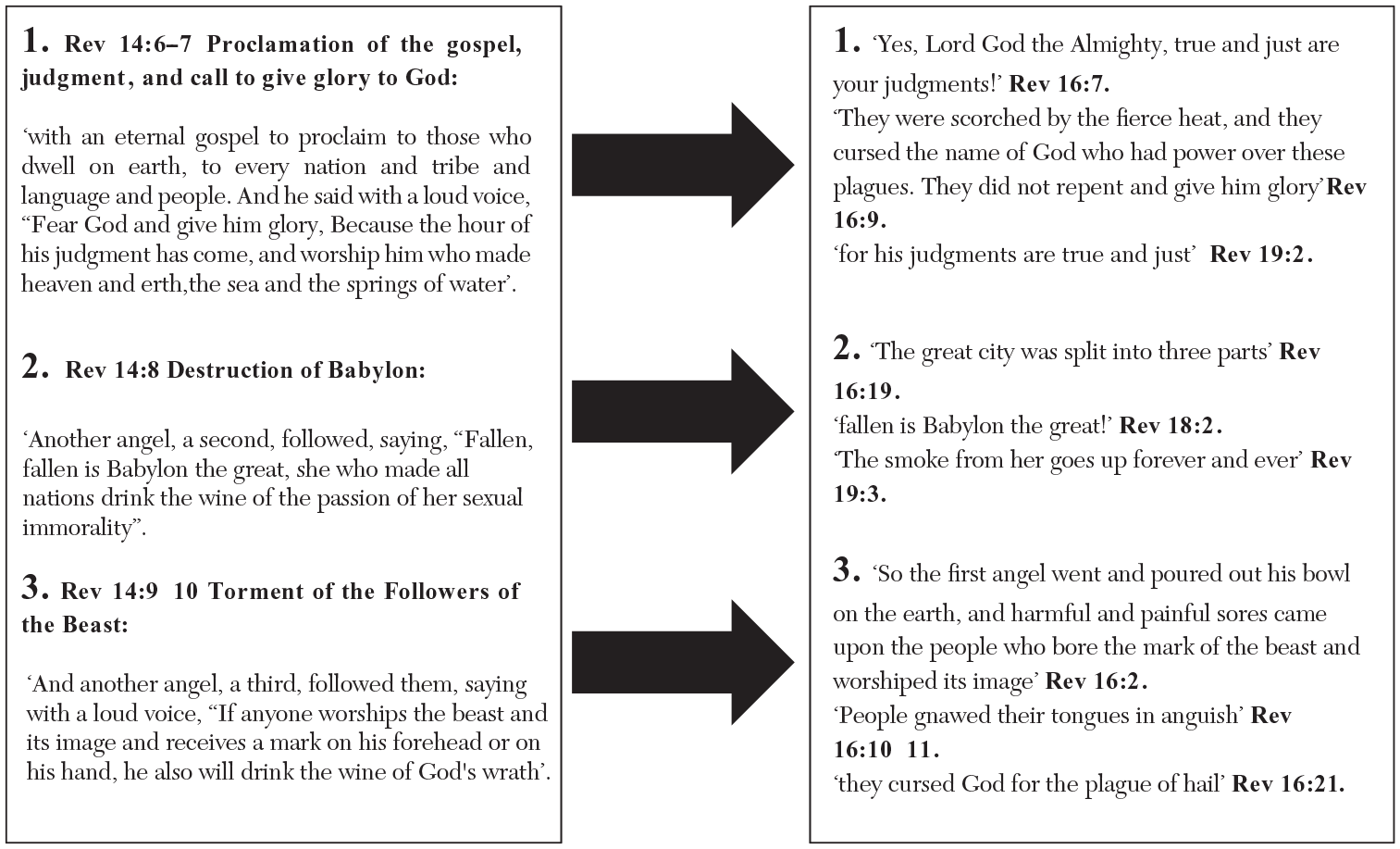
Three Messages from Three Angels.
These three messages of the three angels therefore simply unfold in the continuation of Revelation’s narrative, and were likely anticipated earlier in 8:13, as well as other verses. 5 It appears, in fact, that these events are at first described more generally in the immediate verses and then more in detail in the following chapters. Moreover, similar judgments appear to be described in different ways and from different angles: in this sense, the announcement of the three angels forms a patchwork and mosaic of images, as a form of recapitulation. 6 Furthermore, a clear chiasmus is present: whereas the followers of the beast remain alive and are tormented by the plagues, the followers of Christ die, but enter into God’s peace as they await the resurrection (Fig. 2). 7
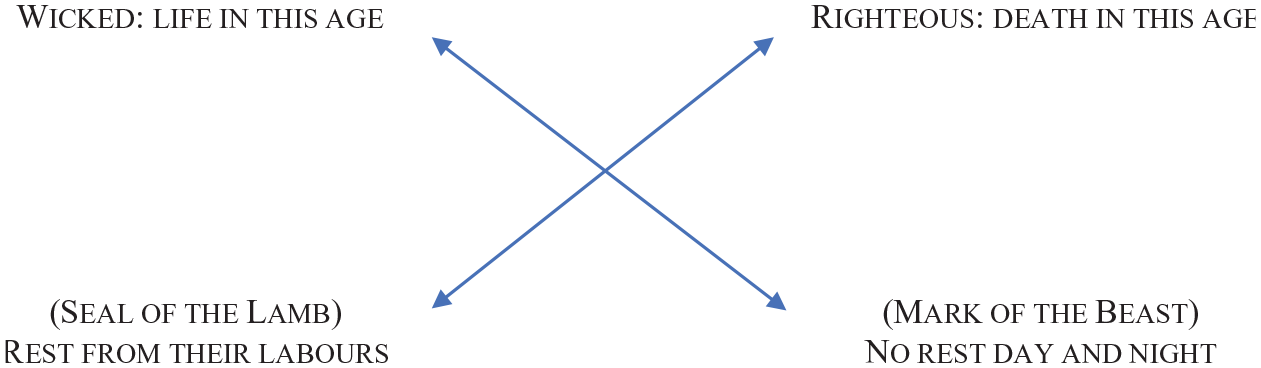
Chiasmus of Rev 14:9–13: the wicked remain alive in this age but are tormented, the followers of Christ die but enter rest.
Verses 14:9–11, and the punishment of those that have received the mark of the beast, are, therefore, the direct counterpart to the seal and spiritual protection received by the followers of the Lamb, the 144,000, described in both 14:1–5 and chapter 7 (Rev 7:3–17)—as well as the victorious saints of 15:2–4—but more generally to the martyrs that die in the Lord in 14:13: while the righteous in Christ have died and await a future where there is no more pain, or heat, and God himself will wipe away their tears, the followers of the beast are seen as still alive on earth and under judgment. 8
Connecting the Chapters of Revelation
The verses immediately after the ones we have been analysing can be seen as describing the judgment which has just been announced (14:14–20). After describing ‘one like a son of man’ with a golden crown and his ‘harvest’ of the earth, the section envisions a terrible judgment: ‘So the angel swung his sickle across the earth and gathered the grape harvest of the earth and threw it into the great winepress of the wrath of God. And the winepress was trodden outside the city, and blood flowed from the winepress, as high as a horse’s bridle, for 1,600 stadia’ (14:19–20). This description of God’s judgment is—at least—a partial fulfilment of ‘the wine of God’s fury’ talked of in Rev 14:10 as this specific language is used (Rev 14:19–20). 9 Moreover, De Villiers sees the three angels of the previous section (14:6–11) as a literary inner ring, which together with the outer ring, that is, the four angels of this section (14:14–20), forms a unit of seven angels in total (3 + 4). In this unit of seven, the fourth angel, one like a ‘son of man’, represents Christ the Judge, and differs from the three angels before and after him. At the same time, this total of seven angels in chapter 14 is clearly also linked to the seven angels of chapter 15, and the seven angels of the seven bowls of chapter 16. 10 There is debate whether this section actually deals with two different events, one being the salvation of the righteous (Grain Harvest) and the other being the punishment of the wicked (Grape Harvest), with De Villiers and Bauckham favouring a judgment with two contrasting destinies; in this double outcome for the righteous and the wicked, Bauckham also sees the two possibilities opened up by the angels of 14:6–11. 11 In the Grape Harvest the ‘wine’ of God’s fury is seen as a great winepress in which the followers of the beast are crushed like clusters of grapes and their blood flows from the press. This apocalyptic image and symbolic hyperbole mixes the ancient Mediterranean, and Middle-Eastern, practice of winemaking and collecting of grapes with the idea of God crushing his enemies to a pulp. Furthermore, the identity of the one that treads the winepress is revealed in 19:14–16, showing that it is Christ himself that judges the nations (cf. 17:14). 12
Next, in chapter 15 we are told of a sign in which there are, ‘seven angels with the seven last plagues—last, because with them God’s wrath is completed’ (15:1). We are then informed by John the Seer that the seven angels have seven bowls representing the seven plagues, which are filled with God’s wrath (15:7); chapter 16 continues the account of the previous two chapters and there is a detailed description of the seven bowls of God’s wrath and how these are directed against those that have the mark of the beast and worship his image (16:2; 14:9; 14:11; cf. 19:20). It is here that I argue that the verses of 14:9–11 find their primary fulfilment. 13 The chapter begins with the reader again being specifically informed that these represent the bowls of God’s wrath: we are told that these plagues are God’s ‘wrath’, the ‘cup of his wrath’, and the ‘wine of his fury’. The use of the wine and winepress metaphor, and a constant underlining of God’s wrath are present throughout these chapters and link them strongly to the reference to 14:10 and its highlighting of the ‘wine of God’s wrath, poured full strength into the cup of his anger’. 14 Warren also underlines the connection between chapter 14 and 16 in regard to the use of wine-related terminology like bowls, cups, libations, the act of ‘pouring’, winepresses, and wine itself, and goes as far as highlighting that the bowls (φιάλας) in Rev 16 may in fact be libation bowls used for wine. 15 We can see, then, a clear thread between the three chapters (14, 15, 16) which connects them through the concept of God’s wrath being unleashed upon the worshippers of the beast that have taken his mark: 14:18–20 uses the imagery of wine and talks of the great winepress of God’s wrath (cf. 19:15; Ps 75:8; Isa 51:17; Jer 25:15–17); 16 in 15:1 we are told of ‘God’s wrath being completed’; whereas 15:7 tells us that, ‘Then one of the four living creatures gave to the seven angels seven golden bowls filled with the wrath of God’; 16:1 once more references the bowls of God’s wrath; and finally the judgments of the worshippers of the beast segues into the judgment of Babylon, and again the language of wine and wrath appear: ‘the cup filled with the wine of the fury of his wrath’ (Rev 16:19). In this sense, chapters 12–13–14–15 can be seen as a narrative unit with similar themes which finds its completion in the Bowl Judgments of chapter 16. 17 While all of the bowls seem to imply some kind of terrible punishment and terror, four of them are explicitly linked to the idea of the torment of the worshippers of the beast:
The judgment of the third angel, on the other hand, suggests a severe lack of water and thirst because of the turning of rivers and springs into blood. These blood-like waters are then given to the wicked to drink, again in fulfilment of 14:11 and the drinking of God’s fury (16:6). It is especially interesting to note how not having rest ‘day and night’ finds a specific parallel in the bowls of the fourth and the fifth angels that affect first the sun and then the darkness, which both torment the idolatrous earth-dwellers (cf. 8:12). In this sense, not only the unrelenting series of Bowl Judgments but even the very celestial elements themselves, sun and darkness, compound the ceaseless punishment of the wicked who have taken the mark of the beast; likewise, here the qualitative genitive construction of ‘day and night’, ημερας και νυκτος (14:11), can also indicate an uninterrupted privation of peace and suffering only as long as the judgments continue to take place. 18
Revelation appears to follow a circular narration in which events already discussed are viewed from different perspectives and in greater detail. The book is not therefore always an exact succession of neatly ordered events and messages which proceed in logical-linear fashion, but rather a mosaic and kaleidoscopic collage of clusters of images and symbols which slowly move towards the final victory of Christ over all evil, and which are interrupted by anticipations, repetitions, hymns, and startling celestial visions. 19 In this sense, the Seven Bowl Judgments are linked to, and anticipated by, the Seven Trumpets of chapters 8 and 9; similarly, both the Seven Bowls and the Seven Trumpets are anticipated by the Seven Seals:

The Seven Seals have general elements, like sword, famine, and plague (6:6–8), earthquakes, the sun becoming dark and stars falling from the sky (6:12–13), which foreshadow the suffering of the followers of the beast described in 14:10–11. Moreover, De Villiers holds that there is a particularly strong link between the septet of the Seven Seals and the septet of the seven angels of Rev 14, whereas, on the other hand, the Seven Trumpets and Seven Bowls also have strong similarities. At the same time, the septets of Seals and Trumpets precede the evil activities of the beast and dragon (Rev chapters 10–13) with the septets of angels and Bowls following them, thus, these four septets of judgment (2 / X / 2), frame on each side this central section of the beast’s demonic activity. 20 The fact that these judgments represent the wrath of the Lamb is also highlighted in the text itself (6:16–17). Furthermore, Rev 7:2–4 links divine protection from the ensuing judgments in history to the seal of Christians and the 144,000 mentioned in chapter 14 (cf. 3:10), which contrasts with the punishments inflicted by those who instead have taken the mark of the beast in history. In a similar way, the fifth angel of the Seven Trumpets, which describes the torment inflicted by the ‘locusts’, appears to also specifically anticipate the torment of the worshippers of the beast: ‘They were allowed to torment them for five months, but not to kill them, and their torment was like the torment of a scorpion when it stings someone. And in those days people will seek death and will not find it’ (Rev 9:5–6; cf. 11:10).
We see, then, that as the series of judgments progress from the Seven Seals to the Seven Trumpets up to the Seven Bowls, the severity of these increases and greater and greater destruction occurs. 21 The gradual nature of the judgments appears to be a warning to, and opportunity for, the earth-dwellers to repent (9:20–21), but it seems that these warnings are not heeded and that despite the incredible sufferings inflicted in the last plagues of the Bowl sequence the worshippers of the beast remain obdurate in their rebellion (16:8, 11). In fact, after the destruction of Babylon and the terrible judgments of God, the inhabitants of the earth still band together with the beast and the false prophet in a last desperate attempt to fight against Christ, but are defeated and destroyed (19:19–20). Ultimately, for John even the torments proleptically described in Rev 14:9–11 are intended to be a final, but failed, possibility for the earth-dwellers to repent and embrace the truth, 22 not a description of an eternal state of agony (16:9, 11; cf. 2:22; Deut 28:15–68). 23
The Roman Arena Overturned
Rev 14:9–11 can also be understood as the reversal of the Roman arena in which Christians were mocked, tormented, and killed before the emperor and his surrogates. Whereas in the Roman arena believers were being fed to wild animals and tormented in the presence of the Roman authorities, symbolically now the followers of the beast would suffer a similar fate, a sort of lex talionis, but the stage would be the entire world and the much greater arena of God’s devasting judgment on the earth, and the spectators placed in their seats of honour would be Christ and his angels. 24 In this regard, Stratton underlines how the image of Christ in Rev 14:10 is clearly a reversal of the violence of the Roman Empire and its gruesome spectacles, with an inversion of spectators and spectacle. 25
This reversal in chapter 14 also follows the sequence of the earlier events of chapter 13, where we are told how: all are forced to take the mark of the beast; the beast is able to perform great signs; that all those that do not receive the mark of the beast are killed by the speaking image; and that nobody could buy or sell without the mark of the beast (13:12–17). Likewise, the phrase ‘This calls for patient endurance on the part of the people of God’ in 14:12 finds a direct parallel in 13:10. 26 In this respect, the catastrophic judgments of God announced in 14:9–11 and carried out in the following chapters (15, 16) seek to overturn the previous order of chapter 13 by destroying the entire system which the beast’s power was based upon, thus showing the hollowness of its claims, and re-establishing God and his Christ as the true sovereigns of creation (cf. 11:15). The progressive destruction of the world (chapter 16), and the natural environment, culminates in the annihilation of both the ‘Great City’, and all the cities of the earth, the original symbols of human pride and rebellion against God (Gen 11:1–9), and the foundation of the beast’s political, economic, and social system. The system of the beast clearly alludes to the Roman Empire, but John may have understood it as an amalgam and symbol of all the evil empires of history which oppress God’s people. 27 This concept of a reversal of the status quo and justice for the victims of oppression was in fact a typical trope of apocalyptic literature: we see it in the Sibylline Oracles, and the interpolated versions of them which have reached us, but also in Rabbinic literature where aspects of Roman law, punishment, and practices from the Coliseum are reversed and transformed into apocalyptic visions of triumph of victims over their persecutors. 28
This idea of a Christian reversal of the Roman Coliseum is also present to a certain degree in the Church father Tertullian who denounced the Roman games and talked of alia spectacula, a different form of spectacle and blood sport in which Christ would take vengeance on his enemies. 29 While Tertullian clearly saw this reversal as taking place in eternity and not in history, as I argue here, it’s interesting how this idea was clearly present in the period of the early Church. 30 In this regard, the story of the martyrdom of Perpetua and Felicity, Passio Sanctarum Perpetuae et Felicitatis, at the beginning of the 3rd century is also particularly illuminating. In this account, which is in part autobiographical, we see how the Christians Perpetua and Felicity, together with other martyrs, were led out into the Roman amphitheatre before a ferocious crowd of jeering spectators and local officials. Here in the Roman arena of Carthage, wild animals, such as a leopard, bear, boar, and even a violent heifer, are unleashed—damnatio ad bestia—against the Christians who are also scourged, and finally are killed at the centre of the amphitheatre by a gladiator with a sword. 31 Likewise, the martyrdoms of both Polycarp, and Ignatius of Antioch, are other examples of the mockery and suffering that early Christians endured in the Roman arena and predate Perpetua and Felicity’s. Polycarp’s martyrdom, in particular, in the stadium in Smyrna, dated around the beginning to the mid-2nd century, highlights the great pressure Christians had to withstand in order not to renounce their faith in the Roman arena. Furthermore, in Polycarp’s death we also see the concept of a reversal of roles; after being accused of being an ‘atheist’, the bishop of Smyrna accuses the crowd of being the true ‘atheists’, and after being threatened with death by fire, he warns of the greater punishment to come. 32 No doubt, John the Seer’s apocalyptic vision was a way both to promise the vindication of suffering Christians, but also to warn them against apostasy in periods of violent persecution and compromise during peaceful coexistence.
Further Considerations
Another detail which favours a symbolic understanding of Rev 14:9–11 as a description of the following plagues is the fact that we are told that the beast worshippers are tormented in ‘the presence of the holy angels and the Lamb’ (cf. 6:16–17). If this were an actual depiction of the final eschatological state, it would appear to be in direct contradiction of Paul’s description of the final judgment of the wicked, in 2 Thess 1:9, where the apostle underlines how: ‘They will suffer the punishment of eternal destruction, away from the presence of the Lord and from the glory of his might’. While it is possible to translate this verse as destruction ‘proceeding’ from the Lord’s presence, the most likely translation appears to be that the unrighteous are excluded from Christ’s presence, as the word apo ἀπό is often translated as ‘separated from’, and various parables also seem to suggest exclusion from God’s presence. 33 In fact, nowhere in the New Testament are we ever specifically told that the wicked will be tormented in God’s presence forever. 34 Moreover, the concept of the unrighteous being tormented before Christ for eternity also contrasts with all the other images we have of peace and joy around God’s and Christ’s throne in Revelation (Rev 21, 22). Similarly, the consistent theme of Scripture in both the Old and New Testament is that the unrighteous will be excluded by God and will not ‘see his face’ (Gen 32:30; Job 19:26; Matt 5:8; Matt 8:12; 1 Cor 13:12).
Finally, in Rev 14:9–11 the actual Lake of Fire, which is used to symbolise the Second Death, is never mentioned. Instead, the language of Rev 14:9–11 appears to be strikingly similar to the historic judgment against Sodom and Gomorrah in Genesis (cf. Ezek 38:22; Luke 17:29), as is the rising of smoke which signified its destruction: ‘Then the Lord rained on Sodom and Gomorrah sulfur and fire from the Lord out of heaven. . .and he looked and, behold, the smoke of the land went up like the smoke of a furnace’ (Gen 19:24, 28). In this, Rev 14:9–11 also follows the traditional trope from the Psalms of the wicked inheriting fire and sulphur (Ps 11:6; cf. Ps 21:9–10, Ps 140:8, Job 18:15, Rev 9:17–19, Rev 11:5–6). The concept of eternally ascending smoke, likewise, utilises the important Old Testament image of Isa 34:8–10: For the Lord has a day of vengeance, a year of recompense for the cause of Zion. And the streams of Edom shall be turned into pitch, and her soil into sulfur; her land shall become burning pitch. Night and day it shall not be quenched; its smoke shall go up forever. From generation to generation it shall lie waste; none shall pass through it forever and ever.
Here the idea of smoke rising forever in the context of the judgment of Edom indicates the finality of the judgment, and a symbolic everlasting memorial, as opposed to an eternally ongoing process, and is used both in 14:11 and in regard to the destruction of Babylon in 19:3. 35
Like much of Revelation, John of Patmos has prophetically synthesised various Old Testament passages in order to create a collage of apocalyptic images which symbolically convey the retribution of the followers of the beast; 36 we see this also in the Bowl Judgments in chapter 16 which mimic fairly closely the judgments of Egypt in Exodus (Exod 7:14, 7:10–29). For John, now, at the end of the age, the totality of God’s wrath has appeared in this final series of judgments as a vindication of God’s holiness and the suffering of the righteous (Rev 16:6, 18:24; Matt 23:35–36).
Conclusions
On a practical level my interpretation of these verses, and their immediate context, should affect contemporary Christian readers in various ways. Firstly, since Rev 14:9–11 is considered perhaps the strongest pillar in the New Testament for the doctrine of the eternal conscious torment of the wicked, viewing it as symbolically occurring in history should make one question the scriptural basis for this doctrine, particularly as it has been traditionally conceived. 37 Secondly, the dramatic nature of John’s vision, should, like it did for his readers in the primitive Christian community, lead contemporary Christians to question their own potential involvement in what Revelation understands as ‘the beast’ and its anti-Christian worldview and actions, while at the same time encouraging suffering Christians not to compromise with its system of idolatry, injustice, and oppression. By depicting God’s judgments against the beast and its adherents as occurring within history, John helps to show the reconquest of the present creation—in which believers must also ‘conquer’, nikaō, evil through their self-sacrificial witness and faith in the Lamb—on the part of God against the forces of darkness which currently enslave it, and thus counters a kind of otherworldly eschatology which abandons the earth and history to destruction. 38 Ultimately, Revelation depicts the hope of a renewed earth and cosmos, cleansed from all sin and evil, in which the kingdoms of the world have been transformed into the ‘kingdom of our Lord and of his Christ’ (11:15, 21:1–5). John, therefore, seeks to highlight the awesome power and justice of God in this present age, not just in some distant future, as a source of encouragement, or ‘staying power’, for those suffering for their faithful witness and as a warning not to compromise with the evil system of the beast. This is why John the Seer, summarising the spiritual significance of Rev 14:6–12, underlines that his message calls for ‘patient endurance on the part of the people of God who keep his commands and remain faithful to Jesus’ (14:12; cf. 3:10). 39
In fine, in this article I have argued for a fairly straightforward, and what I believe is the most coherent, reading of Rev 14:9–11. In my interpretation, what is described as the torment of the worshippers of the beast in the presence of the Lamb with burning sulphur is in fact a symbolic, and hyperbolic, description of the judgments which occur in the immediately following verses (14:14–20), and chapters (15, 16), and which were partially anticipated earlier in the Seven Seals (6:1–17; cf. 2:22, 3:10, 7:2–3, 11:10), and Seven Trumpets (9:3–10). This view appears to fit more closely the overall dynamics of the three messages of the three angel-heralds—and the strong and complex links between the four septets (Seals, Trumpets, angels, Bowls)—which all find their fulfilment in the following chapters, and in history prior to the eschaton. Instead of describing a final state of the wicked in eternity, therefore, as these verses have traditionally been understood, this pericope highlights God’s judgments of the ungodly earth-dwellers in history as the vindication of his justice before the eyes of a sinful world, and as a final possibility for repentance. Furthermore, the very narrative structure of Revelation, which presents a dramatic unfolding of apocalyptic images and symbols which form a mosaic, and is the ‘climax of prophecy’ of all of Scripture, 40 means that it is necessary to view these various sections not as isolated still photographs but as snapshots from different angles of the same multifaceted and overarching film, and picture-story, which is progressing towards its grand finale. This kaleidoscope and recapitulating collage of images and visions can be considered a sort of extended metaphor, which seeks to warn of the fury of God’s judgment. Finally, I argued that Rev 14:9–11 follows apocalyptic literature in imagining a dramatic reversal in the destiny of the righteous and the unrighteous; whereas the Christians that had been tortured and killed now enter God’s peace as they await the coming resurrection, the worshippers of the beast remain alive, but are thrown into God’s devastating judgment and have no rest. Here, watching the arena of world history from its stands are not the Roman emperor and his nobles, but Christ and his angels; the Lamb, and faithful Witness, who died an ignominious death on the cross, has returned at the end of the age as the eschatological Judge, and the true Lord of history.
