



Abstract
This study investigated the typologies of teacher attitudes toward gifted students and gifted education, along with the predictors of such attitudes. For this purpose, surveys were administered to 339 teachers employed in a large faith-based school system in Australia. Analyses including factor analysis and latent profile analysis were performed on the data. In the end, four distinct profiles of teacher attitudes were identified. Two key predictors of these attitudes were found to be (a) school administrative support for gifted students and gifted education and (b) perceived knowledge of giftedness. The major contributions of the study to the literature are discussed.
The focus of this investigation, undertaken in a large faith-based school system in Australia, was on teacher attitudes toward gifted students and gifted education, along with the predictors of these attitudes. Teacher attitudes toward gifted students (who are considered in Australia to possess natural abilities that place them among the top 10% of age peers; Gagné, 2009; Thraves, 2024) and gifted education are an important area for research. This is because such attitudes may influence teacher expectations of gifted students, their instruction of gifted students, and their assessment of gifted students (Baudson & Preckel, 2016; Geake & Gross, 2008; Jung, 2014; Lassig, 2009; Palacios Gonzalez & Jung, 2021). In turn, this may impact the beliefs, motivations, and achievement of gifted students, whose exceptional abilities mean that they have the potential to make major advances to the various fields of knowledge and to make a major difference to the lives of others in society (Siegle et al., 2014). The attitudes of teachers in a faith-based school system were investigated not only due to the large portion of the student population they enroll (i.e., approximately 33%; Australian Bureau of Statistics, 2023; Independent Schools Australia, 2022) but also as faith-based schools have seen a substantial growth in student numbers in recent years in Australia (Australian Bureau of Statistics, 2023).
Review of the Literature
In general, attitudes may be defined as the evaluation of objects, people, or issues on the basis of whether they are positive or negative, good or bad, or harmful or beneficial (Ajzen & Fishbein, 2000; Laine et al., 2019). Under the tricomponent view of the phenomenon, espoused by scholars in the fields of social psychology and special education, such evaluations may also be considered to comprise (a) one's feelings or emotions with respect to relevant objects, people, or issues (i.e., an affective component); (b) one's beliefs with respect to such objects, people, or issues (i.e., a cognitive component); and (c) the behaviors exhibited in response to one's feelings and beliefs (i.e., a behavioral component; Ewing et al., 2018; Stern & Keislar, 1975). Attitudes are important to study due to their likely prediction of human behaviors, although the precise nature of the relationship between attitudes and behaviors appears complex (Ajzen & Fishbein, 2000; Bohner & Wänke, 2002).
The attitudes of teachers toward gifted students and gifted education have been investigated for over 80 years in the international field of gifted education (Peachman, 1942). Collectively, these studies have not yet provided a clear or definitive picture of teacher attitudes toward gifted students or gifted education due to the mixed nature of their findings (Bégin & Gagné, 1994a; Jung, 2014; McCoach & Siegle, 2007; Mullen & Jung, 2019; Palacios Gonzalez & Jung, 2021). That is, some studies suggest that teachers may have largely positive attitudes, possibly reflecting a recognition of the importance of exceptional achievement for societal progress (Jung, 2014; Rizza & Morrison, 2003), whereas other studies have identified generally negative attitudes that may reflect the perception that gifted education is elitist (Cramond & Martin, 1987; Lee et al., 2004; Troxclair, 2013). In contrast to both groups of studies are studies that suggest that teachers may generally have neutral, or both positive and negative, attitudes (Lassig, 2009; McCoach & Siegle, 2007; Troxclair, 2013). Multiple studies indicate that such mixed teacher attitudes extend to the attitudes of teachers in Australia (Geake & Gross, 2008; Lassig, 2009; Mullen & Jung, 2019).
One possible explanation for the mixed findings may relate to the common use in Australian and international studies of variable-centered methodological approaches in understanding people's attitudes rather than person-centered approaches that recognize differences within the population. That is, whereas variable-centered approaches examine the nature of relationships between variables that are considered uniform among participants, person-centered approaches explicitly identify distinct subgroups of participants on the basis of prespecified characteristics (Wang & Wang, 2020). There is certainly some logic in the view that teachers are a heterogeneous rather than a homogeneous group, who may be classifiable into subgroups that each have distinguishing profiles in terms of their attitudes toward gifted students and gifted education.
The diverse range of studies on the topic may be broadly classified into two categories. In the first category are studies that investigated teacher attitudes toward individual gifted student characteristics. Among these studies are studies that ranked the desirability of such characteristics. For example, Cramond and Martin (1987) found that U.S. teachers had positive attitudes toward students who were academically average, nonstudious, and athletic and negative attitudes toward students who were academically brilliant, studious, and nonathletic. In comparison, Lee et al. (2004) found that teachers in Korea most favored academically average, nonstudious, athletic, and male students and least favored academically brilliant, studious, nonathletic, and female students. Similarly, Carrington and Bailey (2000) found that Australian preservice teachers most favored nonstudious students and least favored students who were academically brilliant, studious, and female.
Also in this category of studies are studies that investigated teacher perceptions of characteristics that they commonly associate with gifted students, which may collectively contribute to an overall positive, ambivalent, or negative view of gifted students and gifted education. Many such studies investigated two contrasting hypotheses about gifted students. The first of these hypotheses, the harmony hypothesis, encompasses an overall positive view of giftedness, including superior intellectual ability along with a high level of success, social competence, and positive adjustment. In comparison, the disharmony hypothesis encompasses a more negative view that combines superior intellectual ability with low socioemotional adjustment (Baudson & Preckel, 2016; Preckel et al., 2015). Overwhelming support exists for the disharmony hypothesis in the research to date. For example, multiple studies have found that teachers perceive gifted students to have high intellect but also greater introversion, less emotional stability, less prosociality, and greater maladjustment than nongifted students (Baudson & Preckel, 2016; Weyns et al., 2021). Among studies conducted with Australian teachers, Geake and Gross (2008) also found that many teachers consider gifted students to be “social misfits” who are “disrespectful of authority, seen as elitist, insensitive to others, and social isolates” (p. 226).
In the second category of studies on teacher attitudes toward gifted students and gifted education, which may be more salient to this study, are studies that have investigated the predictors of teacher attitudes or other factors that may be associated with these attitudes. Many of these studies have collected data using the Opinions About the Gifted and Their Education Scale (Gagné & Nadeau, 1991), in its original form or adapted versions, to assess multiple constructs relating to teacher attitudes. More recent versions of the scale, which have demonstrated sound psychometric properties, have concentrated on a smaller number of subscales, particularly, Support for Gifted Programs/Provisions and Perceptions of Elitism, which are two key attitudes toward gifted students and gifted education (Jung, 2014; McCoach & Siegle, 2007; Palacios Gonzalez & Jung, 2021).
Collectively, these studies have investigated more than 50 variables that may predict teacher attitudes toward gifted students and gifted education. Unfortunately, due to some lack of consistency in the findings among these studies, none of these variables appear to qualify as substantial predictors (Bégin & Gagné, 1994a; Palacios Gonzalez & Jung, 2021). Nevertheless, a number of them have potential due to their repeated identification as predictor variables and/or compelling arguments for their inclusion. These predictors include contact with gifted persons, teachers’ self-perceptions of giftedness, educational attainment, occupation as a teacher, female gender, perceived knowledge of giftedness, school focus on gifted education, gifted education professional development, and the holding of a leadership position (Bégin & Gagné, 1994a, 1994b; Geake & Gross, 2008; Jung, 2014; Laine et al., 2019; Lassig, 2009; McCoach & Siegle, 2007; Mullen & Jung, 2019).
Despite a specific focus on acceleration (i.e., one educational intervention for gifted students), the research literature on teacher attitudes toward acceleration may also provide some potential predictors that may influence teacher attitudes toward gifted education more generally. These predictors include anticipated socioemotional outcomes, anticipated academic outcomes, school administrative support, professional development in gifted education, and self-perceptions of giftedness (Palacios Gonzalez & Jung, 2021; Rambo & McCoach, 2012). With the possible exception of self-perceptions of giftedness, studies suggest that the attitudes of Australian teachers toward gifted students and gifted education may also be influenced by these predictor variables (Carrington & Bailey, 2000; Geake & Gross, 2008; Jung, 2014; Lassig, 2009; Matheis et al., 2017; Mullen & Jung, 2019; Plunkett, 2000; Smith & Chan, 1996, 1998).
In addition to these predictor variables, and reflecting the importance of culture on teacher attitudes, the relationship between culture and teacher attitudes has been investigated in some studies. Many such studies are cross-cultural comparisons of teacher attitudes toward gifted students and gifted education. For example, Tirri et al. (2002) found that elements of culture as it relates to education, including conservative beliefs about giftedness and collectivist values, may mean that teachers in Hong Kong are less likely than those in Western countries to believe that all students are gifted, but more likely to support the idea that gifted students should help nongifted students in their spare time.
In Australia, the cultural context as it relates to education is characterized by egalitarian values, which may potentially be hostile to gifted students and gifted education, along with a social justice perspective that prioritizes support for nongifted students (Geake & Gross, 2008; Jung, 2014; Lassig, 2009). At the same time, however, there appears to be a recognition that Australia's brightest and most creative students should be nurtured to promote the country's competitiveness (Jung, 2014; Lassig, 2009). One Australian study that examined the relationship between culture and teacher attitudes toward gifted students and gifted education is Jung (2014). The study investigated the impact of a cultural orientation variable, power distance orientation (i.e., the extent to which less powerful members of organizations accept the unequal distribution of power; Hofstede, 2001), on teacher attitudes and found that teachers who espouse egalitarian values may have more supportive attitudes than teachers who do not.
Of particular relevance to this study, two studies have so far investigated teacher attitudes toward gifted students and gifted education within faith-based school systems in Australia. The key findings of one of these studies, Smith and Chan (1998), were that many teachers are supportive of gifted students and gifted education and recognize the importance of training in gifted education. In comparison, Mullen and Jung (2019) identified that the most important predictors of teacher attitudes toward gifted students and gifted education maybe one's perceived knowledge of giftedness (i.e., greater perceived knowledge is predictive of supportive attitudes), teaching level (i.e., elementary school teachers are more supportive than secondary school teachers), and contact with gifted persons (i.e., more contact with gifted persons is predictive of less supportive attitudes).
The Present Study
In this study, an attempt was made to investigate the type of attitudes that Australian teachers working in a faith-based school system may have toward gifted students and gifted education, along with the predictors of such attitudes, by the introduction of two novel approaches. First, this study went beyond the traditional conceptualizations of teacher attitudes within the field of gifted education by not only acknowledging these conceptualizations (i.e., supportive attitudes and perceptions of elitism) but also acknowledging the prevailing tricomponent view of attitudes (i.e., cognitive, affective, and behavioral attitudes) in the fields of social psychology and special education (Ewing et al., 2018; Oskamp & Schultz, 2005). Second, the study recognized the probable heterogeneity of the teacher population—in terms of their values, beliefs, and characteristics that may collectively influence their attitudes toward gifted students and gifted education—by the adoption of a person-centered methodological approach (i.e., latent profile analysis) to allow for the identification of possible subgroups of teachers who may have differing attitudes.
The potential predictor variables that were assessed in the study comprised variables that appear to have the greatest promise as predictors of teacher attitudes in the research (i.e., contact with gifted persons, self-perceptions of giftedness, educational attainment, gender, perceived knowledge of giftedness, professional development in gifted education, the holding of a leadership position, socioemotional impact, academic impact, school administrative support, and power distance orientation). As such, the study embraced alternative conceptualizations of attitudes and a methodological approach that are espoused in related disciplines while also being informed by the latest developments within gifted education.
The specific research questions that guided the study, within the context of teachers working in a faith-based school system in Australia, were as follows:
What type of attitudes do teachers have toward gifted students and gifted education? What predicts teacher attitudes toward gifted students and gifted education?
It is expected that the findings of the study will provide new perspectives on teacher attitudes toward gifted students and gifted education, and the predictors of such attitudes, that may be conducive to a more nuanced and complete understanding of the phenomenon for teachers working in faith-based school systems in Australia. In turn, it is hoped that such understandings may advance knowledge and practice to allow more optimal support for the needs of gifted students in the future, including support for the needs of gifted students from minority and disadvantaged backgrounds who are commonly underrepresented in gifted education programs (Ford & Grantham, 2003).
Method
Appropriate institutional review board approvals were obtained for the study.
Participants
The participants of the study comprised teachers who were employed in a faith-based K–12 school system in Australia. The school system is large, as it incorporates more than 100 schools, and diverse, as it attracts students from a highly varied range of socioeconomic, cultural, linguistic, and geographic backgrounds. All schools in the system nevertheless share the goal of supporting the “whole person” while instilling values such as a commitment to learning, the fulfillment of potential, respect for the dignity of each person, inclusivity, and support for social justice. Some of these values (e.g., a commitment to learning and the fulfillment of one's potential) may arguably be conducive to supportive attitudes toward gifted students and gifted education, whereas others (e.g., inclusivity and support for social justice) may be conducive to nonsupportive attitudes (Lassig, 2009; Smith & Chan, 1998).
The gifted education provisions offered by the participating schools are guided by a system-wide gifted education policy that follows the definition of giftedness that is commonly adopted in Australia (i.e., Gagné, 2009), and include curriculum differentiation, ability grouping, acceleration, and extracurricular activities. Nevertheless, differences exist in the number and range of provisions offered at each school, with curriculum differentiation being the most common. Similarly, the identification processes differ across schools, although there is a tendency to focus on ability and achievement testing in the academic domains. Many schools in the system are seeking to develop a more rigorous and systematic multiple-criteria identification process that covers both academic and nonacademic domains.
To recruit participants, the principals of all schools in the school system were contacted with information about the study. Thereafter, those principals who agreed to participate (i.e., 20% of principals in the system) forwarded the relevant information to teachers employed at their respective schools. Although 372 teachers commenced participation, the surveys returned by only 339 teachers were retained for analysis after the removal of surveys with more than 50% incomplete items. The 339 participants, who were employed in 20 schools, had a mean age of 44.28 (SD = 11.32), were more likely to be female (n = 222) than male, were more likely to be born in Australia (n = 296) than overseas, held at least a bachelor degree (with 89 holding at least a masters degree), had various ethnic backgrounds (the most common being Anglo-Saxon [n = 232] and western European [n = 58]), and were more likely to be based in an urban (n = 244) than a rural area. Furthermore, the participants were teaching at either the elementary or secondary level (i.e., elementary, n = 131; secondary, n = 198), held various roles in their schools (i.e., regular teacher, n = 231; leadership position, n = 78; and other [e.g., specialist, education support officer, librarian], n = 29), and were unlikely to have received any formal gifted education training (n = 244). As such, although the participants had heterogeneous characteristics, their collective profile was typical of registered teachers in Australia, who are most commonly Australian-born middle-aged females with a bachelor degree and employed as regular teachers in a secondary school setting (Australian Institute for Teaching and School Leadership, 2023).
Survey Instrument
All study participants were administered a survey instrument designed to assess their attitudes and predictors of attitudes toward gifted students and gifted education. The online instrument, comprising 85 items of relevance to the study, was based on a number of psychometrically rigorous scales and adaptations to items used in previous scales (see Supplementary Materials Table 1).
Analysis
Screening and Cleaning
The collected data were analyzed in stages. The first stage involved the screening and cleaning of data, including the address of any missing nonsociodemographic data using the expectation-maximization algorithm (0.55% of data in the 339 surveys had missing data). This was followed by reverse coding, which was undertaken on 15 survey items in a manner such that all items had consistent direction, and higher scores on the items were indicative of more positive attitudes or impacts (in the process, all items that were originally designed to assess perceptions of elitism now assessed perceptions of non-elitism).
Factor Analysis
In the second stage, factor analysis was conducted to define an underlying structure among variables (Field, 2018; Hair et al., 2019). Initially, confirmatory factor analysis was conducted. Nevertheless, the suboptimal fit of the final solution (e.g., comparative fit index and Tucker-Lewis index < .90) indicated that the investigated constructs were not adequately robust for the study sample and in possible need of reconceptualization. For this reason, along with the modifications made to a number of scales, exploratory factor analysis was conducted.
Specifically, those survey items that were designed to assess each of the five attitudes identified in the relevant literature (i.e., support for special gifted programs/provisions, perceptions of non-elitism, cognitive attitude, affective attitude, and behavioral attitude), along with seven potential psychological-perceptual predictor variables (i.e., power distance orientation, perceived knowledge of giftedness, contact with gifted persons, self-perceptions of giftedness, school administrative support, socioemotional impact, and academic impact), were subject to exploratory factor analysis. The analysis was performed in IBM SPSS Version 28, using the maximum-likelihood method of factor extraction and factor extraction criteria including eigenvalues greater than 1, non-trivial communality values, and theoretical interpretability. Oblique rotation was used to interpret factors.
Latent Profile Analysis
Thereafter, all the attitude factors that were identified were input as indicator variables in the latent profile analysis that was performed to identify profiles of teacher attitudes toward gifted students and gifted education. Latent profile analysis is a person-centered approach to data analysis that recognizes heterogeneity in the population by clustering individuals into distinct groups on the basis of participant responses to indicator items (Morin et al., 2016; Wang & Wang, 2020). The typical steps in latent profile analysis were followed: (1) determination of the optimal number of latent profiles, (2) examination of the latent profile classification results, (3) determination of labels for the identified latent profiles, and (4) assessment of any relationships between potential predictors and the identified latent profiles (Wang & Wang, 2020). All analyses were performed using Mplus Version 8.8, with the robust-maximum-likelihood method of estimation. The number of initial-stage random starts was set at 1,000, and the number of final-stage optimizations was set at 250 (i.e., 250 replications) to avoid local optimization. The exponential-moving-average algorithm was used as the optimization algorithm.
To determine the optimal number of latent profiles, a series of models with an increasing number of latent profiles were fit and compared with one another (Wang & Wang, 2020). Multiple criteria were used to compare latent profiles. First, a number of model fit indices were examined, including the Akaike information criterion (AIC; Akaike, 1983), the Bayesian information criterion (BIC; Schwarz, 1978), and the sample-size-adjusted BIC (SABIC; Sclove, 1987). A number of statistical tests, including the Vuong-Lo-Mendell-Rubin likelihood ratio test (VLMR LRT; Lo et al., 2001), the adjusted Lo-Mendell-Rubin likelihood ratio test (aLMR LRT), and the bootstrapped likelihood ratio test (BLRT; McLachlan, 1987), were also performed. Other criteria that were considered were latent profile size, latent profile uniqueness, classification accuracy, and theoretical interpretability.
Upon the determination of the optimal latent profile model, the classical three-step method was employed to identify the predictors of teacher attitudes from the nonattitude data that were collected (i.e., sociodemographic data, teaching-related predictor variables, and psychological-perceptual predictor variables).
Results
Factor Analysis
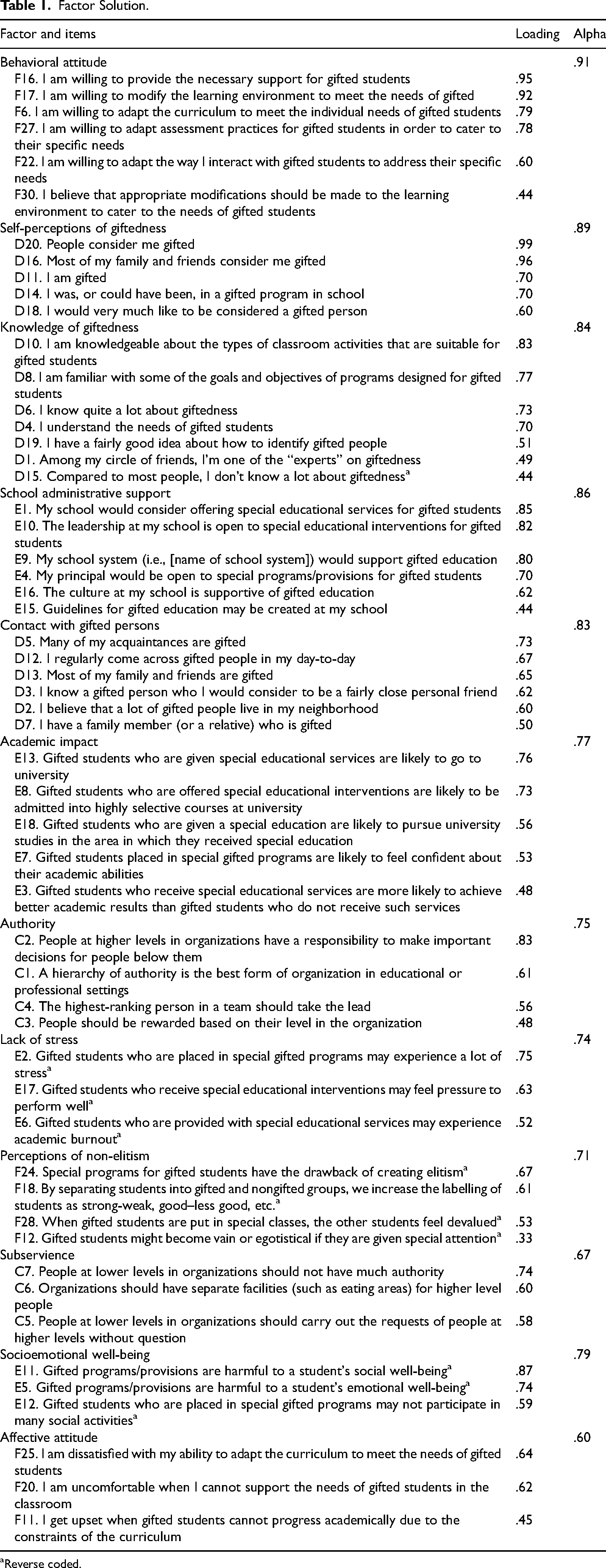
After the progressive removal of 20 items during exploratory factor analysis (for reasons including a lack of substantial loading on any factor [i.e., below .30], substantial cross-loading between factors, low communality values [i.e., below .30], loading on weak “factors,” and loading on noninterpretable “factors”), a 12-factor solution comprising 55 items could be accepted. The factors, which collectively accounted for 64% of the total variance in the data, had eigenvalues ranging from 1.08 to 8.76. Bartlett's test of sphericity (9,533.79, p < .01) and the Kaiser-Meyer-Olkin (KMO) measure of sampling adequacy (0.85) indicated that factor analysis was appropriate for the data. The items, factor loadings, and Cronbach alpha values of the 12 factors appear in Table 1.
Factor Solution.
Reverse coded.
Among the items that were intended to assess different types of attitudes, three attitude factors could be extracted. They were behavioral attitude (i.e., behavioral intentions to support the educational needs of gifted students), affective attitude (i.e., negative affect from inability to support the educational needs of gifted students), and perceptions of non-elitism (i.e., perceptions that gifted programs and provisions are not elitist). In comparison, among the potential predictors of attitudes toward gifted education, nine factors were extracted. Five of these factors were as expected: self-perceptions of giftedness (i.e., perceptions that one is gifted), knowledge of giftedness (i.e., perceptions that one is knowledgeable about giftedness), school administrative support (i.e., school administration or leadership support for gifted education), contact with gifted persons (i.e., contact with gifted people), and academic impact (i.e., positive academic impacts of gifted education). The remaining four extracted factors were lack of stress (i.e., perceptions that gifted education provisions do not lead to stress), socioemotional well-being (i.e., perceptions that gifted education provisions promote socioemotional well-being), subservience (i.e., perceptions that people at lower levels in organizations should be subservient), and authority (i.e., recognition of the authority of people at higher levels in organizations).
Latent Profile Analysis
Identification of the Optimal Number of Latent Profiles
The three different types of attitudes (i.e., behavioral attitude, affective attitude, and perceptions of non-elitism) that were extracted during factor analysis were input as indicator variables to conduct latent profile analysis. An examination of the model fit indices and statistical test results of a series of latent profile models (i.e., models with two to seven latent profiles) that were fit produced mixed results. Therefore, another important criterion in the determination of the optimal number of latent profiles was examined: the size of each latent profile (Wang & Wang, 2020). A review of latent profile size indicated that one of the latent profiles in each of the five-, six- and seven-profile models (i.e., models deemed to be optimal according to at least one model fit index or statistical test) comprised a single participant. As such latent profiles are not meaningful, the participant was removed before the analysis was rerun. Similar results were obtained when a series of latent profile models were fit with the data from the remaining 338 participants. Therefore, a second participant was removed.
The model fit indices and statistical test results of the latent profile models that were fit with the data from the remaining 337 participants again showed largely mixed findings (see Supplementary Materials Table 2). Specifically, the AIC and SABIC values indicated that the seven-profile model may be optimal, the BIC value and the VLMR LRT indicated that the six-profile model may be optimal, and the aLMR LRT indicated that the four-profile model may be optimal (the BLRT indicated that either the four-profile or the seven-profile model may be optimal). Nevertheless, unlike previous findings, none of the latent profiles comprised a single participant. Even so, those models with five or more latent profiles comprised at least two latent profiles with participant numbers representing 5% or less of the total participant pool, inferring that the two- to four-profile models may have a more adequate profile size.
Between the two-, three-, and four-profile models, the four-profile model appeared optimal, as the model fit indices and statistical tests indicated that there was a successive improvement of fit from the two- and three-profile models, and then from the three- and four-profile models. Supporting such an assessment, the latent profiles in the four-profile model were also found to be theoretically interpretable and sufficiently distinct from one another (i.e., the between-subject one-way ANOVA tests on the mean values of each of the three attitude types across the four latent profiles indicated statistically significant differences).
Finally, an assessment was made of the quality of the latent profile membership classification in the four-profile model. Both the entropy value (.95) and the average latent class probabilities for the most likely latent class membership by latent profile (at .97 or above for each of the latent profiles) were very high, to indicate high accuracy in membership classification (Asparouhov & Muthén, 2014). Therefore, a collective consideration of the various criteria indicated that the four-profile model was optimal.
Interpretation of the Four Latent Profile Model
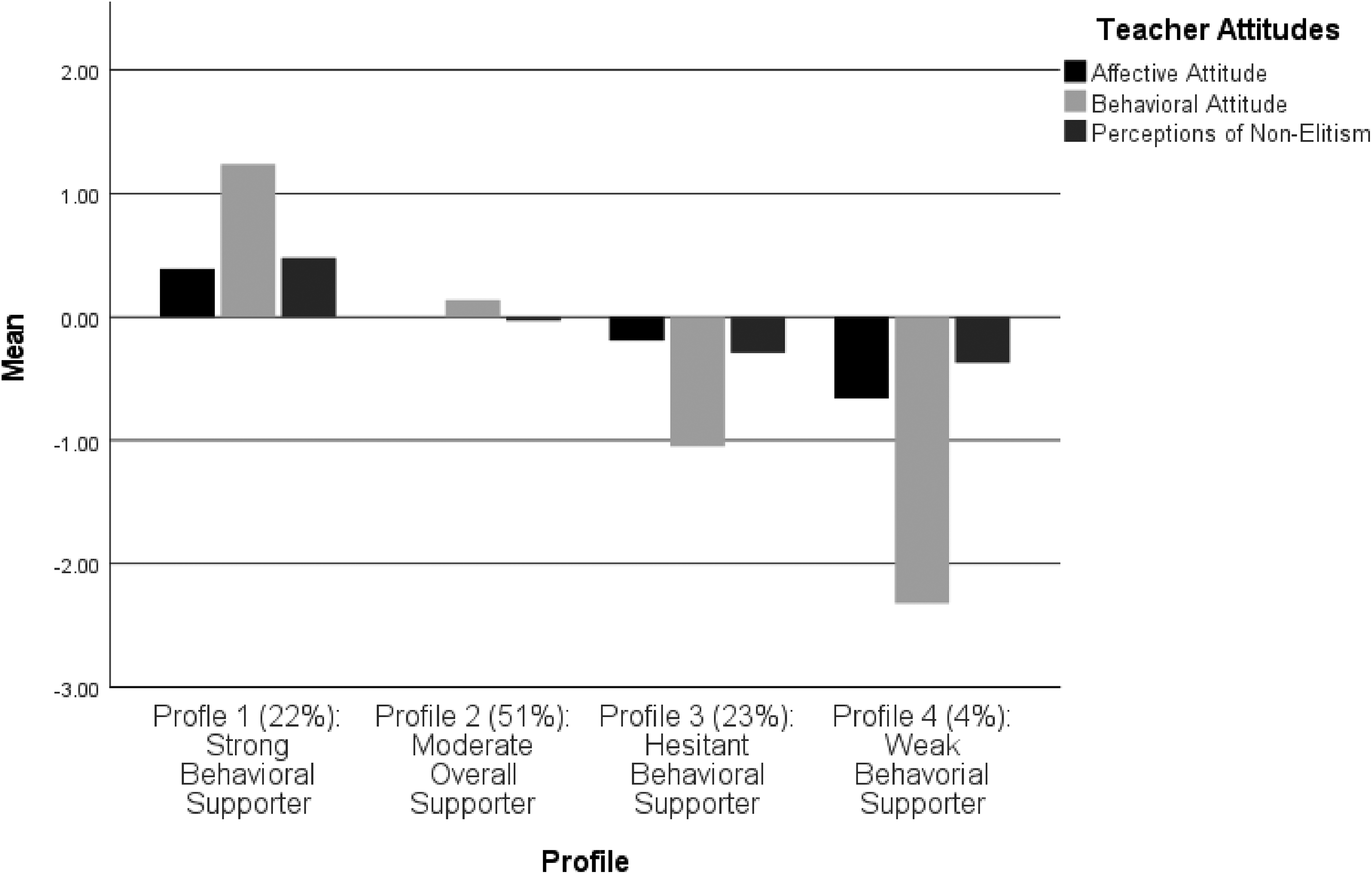
A graphical representation of the optimal latent profile model appears in Figure 1.
Latent profile analysis results.
The figure shows that the four subgroups of teachers differed substantially in their behavioral attitudes and less substantially in their affective attitudes and perceptions of non-elitism. Indeed, all paired group comparisons of the mean behavioral attitudes of the four latent profiles had statistically significant differences (all p < .001), which was not the case for perceptions of non-elitism or affective attitude (the exceptions were between Profiles 2 and 3 and between Profiles 3 and 4 for affective attitude and between Profiles 2, 3, and 4 for perceptions of non-elitism). Moreover, the eta-squared value (η2) was substantially higher for behavioral attitude (η2 = .92) than for perceptions of non-elitism (η2 = .10) or affective attitude (η2 = .08), to indicate the stronger contribution of behavioral attitude to the latent profile classification.
The contribution of behavioral attitude was reflected in the labels given to each of the four latent profiles. First of all, Profile 1 (n = 74; 22%) was labeled Strong Behavioral Supporter of Gifted Education to reflect the fact that behavioral attitude in this profile was the highest among all four profiles, while also being higher than affective attitude and perceptions of non-elitism in the profile. In comparison, the profile in which about half of the participants were members, Profile 2 (n = 173; 51%), was labeled Moderate Overall Supporter of Gifted Education to reflect the fact that the scores in the profile were moderate for all three indicator variables. Profile 3 (n = 76; 23%) was labeled Hesitant Behavioral Supporter of Gifted Education in recognition of its negative scores on all three indicator variables, including a particularly low score for behavioral attitude. Finally, Profile 4 (n = 14; 4%) was labeled Weak Behavioral Supporter of Gifted Education because it had the lowest scores among all profiles on all three indicator variables, including behavioral attitude.
Predictors of Latent Profiles
The classical three-step method revealed a number of important predictors of teacher attitudes toward gifted students and gifted education.
Sociodemographic and teaching-related predictors of the latent profiles
First, three sociodemographic variables (i.e., gender, urban/rural locality, and educational attainment) were assessed for their possible prediction of teacher membership in the latent profile model. As each of these possible predictors qualify as categorical variables, the chi-square test of independence was used. Among these variables, a statistically significant association with membership in the latent profiles was found for both gender (χ2 = 12.63, p = .006, Cramer’s V = .19) and educational attainment (χ2 = 8.81, p = .032, Cramer’s V = .16; see Supplementary Materials Table 3). With respect to gender, female teachers were found to be more likely to have supportive attitudes than male teachers, and for educational attainment, a relationship between higher educational attainment (i.e., graduate study) and positive attitudes toward gifted education was identified. The Cramer's V value for these relationships suggest that they may be small to medium in magnitude (Cohen, 1988).
Thereafter, four teaching-related variables (i.e., receipt of gifted education training [yes/no], teaching level [primary vs. secondary], teaching position [nonleadership position vs. leadership position], and teaching areas for secondary school teachers [i.e., humanities and social sciences; science, technology, engineering, and mathematics (STEM); or other subjects]) were assessed for their prediction of teacher profile group membership. Of these variables, the holding of a leadership position was a statistically significant predictor of latent profile group membership (χ2 = 14.94, p = .002, Cramer’s V = .21; see Supplementary Materials Table 3). Specifically, teachers in leadership positions were found to demonstrate more positive attitudes toward gifted students and gifted education than their counterparts who did not hold such positions. As for the two statistically significant sociodemographic predictors of membership classification, the Cramer's V value for this relationship suggested a small to medium effect size (Cohen, 1988).
Psychological-perceptual predictors of the latent profiles
The assessment of nine psychological-perceptual variables for their possible prediction of subgroup membership followed. As all of these variables were continuous, between-subject one-way ANOVA tests were performed on their mean values to assess for any statistically significant differences across the four latent profiles. For each set of omnibus ANOVA tests, post hoc pairwise profile comparisons were undertaken with the Bonferroni correction. The ANOVA omnibus F test results indicated that seven of the nine psychological-perceptual variables were predictive of teacher attitudes toward gifted students and gifted education (see Supplementary Materials Table 4). The two exceptions were lack of stress and contact with gifted persons.
The strongest of the statistically significant predictors, as assessed using eta-squared values, was school administrative support (η2 = .30). Indeed, all pairwise group comparisons across the four latent profiles, adjusted by the Bonferroni correction, were statistically significant at the .05 level for this predictor. The next two strongest predictors were socioemotional well-being of gifted students (η2 = .21) and teachers’ knowledge of giftedness (η2 = .15). The mean values of socioemotional well-being and knowledge of giftedness were statistically significantly different in all pairwise group comparisons (all p < .05), except for between Profiles 3 and 4. The size of the eta-squared values for all three predictors was above the threshold (i.e., 0.14) that is indicative of a large effect (Cohen, 1988). The direction of the relationships involving these three predictors were such that the participants who (a) reported higher levels of school administrative support, (b) recognized that gifted education provisions result in socioemotional well-being, or (c) considered themselves to be knowledgeable about giftedness were likely to be classified in the profiles (Profiles 1 and 2) with more positive attitudes.
The remaining four psychological/perceptual predictor variables (i.e., subservience, authority, self-perceptions of giftedness and academic impact) were also identified to be statistically significant predictors of teacher attitudes, although their effect sizes were substantially smaller. Of these variables, the direction of the relationship with teacher attitudes toward gifted students and gifted education was positive only for academic impact. That is, teachers who had greater recognition of the positive academic impacts of gifted education were likely to be classified in the latent profiles with more positive attitudes (Profiles 1 and 2). On the other hand, those teachers who (a) perceived that people at lower levels in organizations should be subservient, (b) recognized the authority of people at higher levels of organizations, or (c) perceived themselves to be gifted were likely to be classified in the latent profiles with more negative attitudes (Profiles 3 and 4).
Relative importance of statistically significant predictor variables
For the final analysis, multinomial logistic regression was performed to assess the relative importance of all statistically significant predictor variables that were identified previously using bivariate analytical techniques (i.e., chi-square tests and ANOVA; see Supplementary Materials Table 5). Of note, only a small number of statistically significant effects were identified among the sociodemographic and teaching-related variables. Specifically, educational attainment differentiated teacher classification only between Profiles 1 and 3, and gender differentiated teacher classification in only three of the pairwise comparisons. More consistent findings across the pairwise comparisons were identified for the psychological-perceptual variables. In particular, school administrative support was predictive of latent profile membership across all six pairwise comparisons, and knowledge of giftedness was found to be predictive in five comparisons. Among the other psychological-perceptual variables, self-perceptions of giftedness differentiated teacher classification in four comparisons, and subservience differentiated teacher classification in two comparisons.
In the end, 6 of the 10 statistically significant predictors of teacher attitudes from the bivariate analysis were identified to be statistically significant with respect to at least one pairwise profile comparison when all 10 predictors were collectively analyzed. Of these predictors, two stood out (i.e., school administrative support and knowledge of giftedness). Between the two, school administrative support was the stronger predictor because it is a statistically significant predictor of latent profile membership across all profile pairings, and due to its comparatively higher odds ratios across all of these profile pairings. For instance, the odds of being classified into Profile 1 relative to Profile 4 is 25.34 times greater (b = 3.23, p < .001) for a one-unit increase in school administrative support, but 16.93 times greater (b = 2.83, p < .001) for a one-unit increase in knowledge of giftedness.
Discussion
This study has produced many novel outcomes that advance knowledge on teacher attitudes toward gifted students and gifted education, and the predictors of such attitudes, within the context of a faith-based school system in Australia. First of all, this study combined traditional and nontraditional approaches to the study of teacher attitudes through the assessment of two of the key attitudes that have traditionally been investigated (i.e., supportive attitudes and perceptions of non-elitism) along with the tricomponent perspective on attitudes (i.e., cognitive, affective, and behavioral attitude), which is the prevailing approach in social psychology and special education. In the end, three of the five attitudes (i.e., behavioral attitude, affective attitude, and perceptions of non-elitism) formed factors, only one of which has been traditionally investigated. These findings highlight the importance of moving beyond the somewhat “insular” approaches used in the past within the field of gifted education to embrace ideas and developments in related fields.
It is also noted that traditional studies of teacher attitudes toward gifted students and gifted education have often reached the conclusion that no clear picture of teacher attitudes exist (McCoach & Siegle, 2007; Mullen & Jung, 2019). By recognizing the heterogeneity of the teacher population, through the adoption of a person-centered methodological approach, the findings of this study allow for a more nuanced and sophisticated understanding of teacher attitudes that acknowledge the salience of many of these diverse findings and the coexistence of various groups of teachers with diverse attitudes. In fact, the study findings suggest a segmentation of teachers into four distinct cohorts.
Relatedly, the study findings provide useful new insights into the relative importance of the various attitude components that differentiate teachers. Specifically, it was apparent that teachers’ intentions to engage in behaviors with respect to gifted students and gifted education varied more substantially than their feelings or emotions about gifted students and gifted education, or their perceptions about the elitism or otherwise of gifted students and gifted education. This finding is suggestive of the pivotal role of behavioral attitudes in the identification of teachers with different attitudes toward gifted students and gifted education. That is, instead of an assessment of all three key attitude components to assess the overall attitudes of individual teachers, an assessment of only behavioral attitudes may represent a simpler and more cost-effective alternative. Furthermore, in recognition of the fact that behavioral attitudes have been identified to be the key determinant of a teacher's placement into a particular teacher attitude profile, any educational interventions that focus on behavioral attitudes may be particularly important in supporting or influencing any teacher's attitudes. For example, an educational intervention could be devoted to discussing the practical implementation of specific teaching strategies for gifted students (e.g., curriculum differentiation) to raise awareness of such “behavioral” strategies, self-efficacy for implementation of such strategies, and an understanding of the benefits of such strategies.
In parallel to insights on the pivotal role of behavioral attitude, the study findings provide useful insights into the relative size of each of the teacher cohorts who hold different types of attitudes toward gifted students and gifted education. Although different studies have collectively identified the possible existence of different types of attitudes, none have provided any indication of the relative proportions of teachers who hold these attitudes. This study suggested that close to one quarter of teachers employed in a faith-based school system in Australia may have strongly supportive attitudes, just over half may have moderate attitudes, close to one quarter may have hesitant attitudes, and a smaller number may have strongly negative attitudes.
Predictors of Teacher Attitudes
In terms of the major predictors of teacher attitudes in the faith-based school system in Australia, the study findings suggest that three “tiers” of such predictors may exist, comprising a total of 10 predictors, that may be ordered on the basis of their relative importance. Perhaps occupying the “bottom” tier are those constructs that were identified to be statistically significant predictors only in the bivariate analyses (i.e., socioemotional well-being, academic impact, leadership position, and authority). These predictors may contribute in only a small way toward teacher attitudes. In comparison, the “middle” tier may comprise those constructs that were identified to be statistically significant, but inconsistently so, when all 10 statistically significant predictors from the bivariate analyses were collectively analyzed: self-perceptions of giftedness, educational attainment, perceptions that people who are low-ranked in organizations should be subservient, and gender. Finally, the “top” tier may comprise the most important predictors: school administrative support and perceived knowledge of giftedness.
Although some of the identified predictors have been acknowledged to be salient in previous studies, the collective set of identified predictors may be considered to be a novel addition to the literature in the context of a faith-based school system in Australia. In particular, neither of the two strongest predictors have been regularly recognized to be substantial predictors of teacher attitudes in previous studies. School administrative support has previously been investigated but mostly within the context of acceleration (Palacios Gonzalez & Jung, 2021; Rambo & McCoach, 2012). Among studies that have a focus on gifted education generally, Lassig's (2009) Australian study, which highlighted the predictive role of a school focus on gifted education or a pro-gifted school culture, has come closest.
In comparison, the next most important predictor, perceived knowledge of giftedness, is logically and intuitively a factor that may be associated with positive teacher attitudes. That is, it makes sense that teachers who perceive themselves to have knowledge about giftedness, perhaps through personal research or training, are more likely to understand the specific educational needs of gifted students and the positive outcomes for those who are provided with gifted programs. Indeed, the finding aligns with the findings of one study conducted on teacher attitudes in a faith-based school system in Australia (Mullen & Jung, 2019). Alternatively, it is possible that teachers who choose to engage in activities that advance their knowledge of giftedness may have an interest in gifted students and gifted education that may direct their attitudes, as identified in another Australian study (Jung, 2014).
Among the middle-tier predictors, the finding that one's self-perceptions of giftedness may be predictive of nonsupportive attitudes was counterintuitive and contrary to expectation. The finding is inconsistent with both Bégin and Gagné (1994b), who identified a relationship in the opposite direction, and McCoach and Siegle (2007), who identified no relationship. One possible explanation may be a lack of clear understanding by the participating teachers of the phenomenon of giftedness and a consequent reliance on myths and misconceptions (Mullen & Jung, 2019). A second possible explanation, which may be more applicable in faith-based school systems such as this, may be a religious interpretation of giftedness. For example, Karris and Hayes (2008) noted that among the seven gifts of the Holy Spirit that are imparted on those who receive confirmation in the Catholic Church are the gifts of knowledge, wisdom, and understanding. Relatedly, Cannaday (2017) stated that Christian teachers believe that “every child has gifts as granted by God” (p. 127) to be utilized for the betterment of oneself and society, and Gellel and Camilleri (2023) proposed that giftedness is “distributed by God's grace in order to do things well” (p. 19) for the benefit of all humanity. It is understandable that many teachers with strong religious convictions, but no training in gifted education, may place reliance on religious interpretations that may be at odds with pedagogical interpretations. Such religious interpretations of giftedness are consistent with the values of social justice and equity espoused in the Catholic education sector in Australia, which has led to some resistance toward gifted education and the prioritization of nongifted students who are seen to have “greater” needs than gifted students (Gross, 1993; Smith & Chan, 1998; Young, 2019).
Among the other predictors in the middle tier, a high level of educational attainment (i.e., graduate study) has been identified to be associated with supportive attitudes. Only one Australian study has so far identified educational attainment to be a significant predictor of teacher attitudes (Smith & Chan, 1996), indicating that it may not be a commonly recognized or systematic predictor of teacher attitudes in Australia. Nevertheless, a number of explanations are possible for the relationship. First, in acknowledgment of the fact that strong academic performance is typically a prerequisite for entry into graduate programs, it is feasible that teachers who have high levels of educational attainment are those with a history of high academic achievement. As many of these teachers may have a special interest in gifted programs, for reasons including the instrumental nature of such programs in supporting their academic achievement, they may have favorable attitudes (Jung, 2014). Alternatively, teachers who have completed advanced study may have had greater exposure to gifted individuals during their studies (e.g., academics and students) to allow for a clearer understanding of their specific educational needs and the importance of supporting them. In any case, it is unsurprising that teachers who have completed advanced study are working in a school system that promotes a commitment to learning and the fulfillment of one's potential.
The third of the middle-tier predictors, subservience, which has been assessed using items designed to assess a cultural orientation variable (i.e., power distance orientation), was found to be associated with attitudes that are not supportive of gifted students and gifted education. As for self-perceptions of giftedness, the relationship is counterintuitive, as comfort with inequality among people may be considered conducive to supportive attitudes toward special educational interventions for a segment of the student population with the highest ability. Nevertheless, a possible explanation for the relationship may be the idea that antisubservient values, such as egalitarianism (i.e., a belief that everyone is equal), which are commonly espoused in Australia (Geake & Gross, 2008; Lassig, 2009), may be interpreted by the participating teachers to mean that all students, gifted or otherwise, should be supported in their education with interventions that meet their specific individual needs. Indeed, the finding is supported by an Australian study that investigated the relationship between power distance orientation and attitudes among preservice teachers (Jung, 2014).
Finally, female teachers were identified to be more likely to have supportive attitudes than male teachers. Although a number of Australian studies suggest that teacher attitude may not always be influenced by gender (Lassig, 2009; Plunkett, 2000), Smith and Chan (1996) found that Australian female teachers may have a greater understanding of the general characteristics of gifted students than male teachers. Furthermore, the finding is consistent with the findings of studies conducted outside of Australia. For example, Kaya (2019) demonstrated that female teachers may be more supportive than male teachers of ability grouping (i.e., a gifted education intervention), and Kunt and Tortop (2017) identified female STEM teachers to have more positive attitudes toward gifted education than their male counterparts. As one possible explanation, Kaya (2019) suggested that female teachers may be more sensitive than male teachers to the needs of their students.
A number of factors that have previously been identified to be predictive of teacher attitudes toward gifted students and gifted education in Australia, including in studies that examined teacher attitudes in faith-based schools, were not so identified in this study. These factors include contact with gifted persons and teaching level. The difference in findings between this study and previous studies may be attributed to contextual differences within Australian faith-based school systems, which are often locally controlled and geographically dispersed (Smith & Chan, 1998; Young, 2019).
Implications
A number of implications arise from the study for future research and practice.
Implications for Research
This study, which represents the first known investigation of teacher attitudes toward gifted students and gifted education that utilized a person-centered approach, has identified a set of typologies of teacher attitudes toward gifted education, and their key predictors. The findings both explain the mixed nature of the findings of previous studies and provide a fresh perspective on the topic. At the same time, they raise a number of questions for consideration in future research. First of all, the present study examined teacher attitudes toward gifted students and gifted education in general rather than in a more segmented way, which was the focus of some previous Australian and international studies (Lassig, 2009; Troxclair, 2013). Any such investigations which incorporate assessments of attitudes toward different components of gifted education (e.g., ability grouping and differentiation), and thereby tap into the structure of teacher attitudes, are likely to provide a good complement to this study.
A more comprehensive and complete understanding of teacher attitudes toward gifted students and gifted education, and its predictors, may also be gained through investigations that explore the relevance of predictor variables that were not investigated, such as the political orientations and religious affiliations of teachers. Religion, which has largely been ignored in studies to date, was particularly salient in this study given the possibility of clashing definitions, ideals, and values between the religious beliefs of the participating teachers and the key ideas and principles of gifted education.
Additionally, future studies should aim to replicate this study in other schools in Australia and around the world to assess whether the same typologies of attitudes are identified and whether identical predictive relationships are found. Relatedly, future studies could attempt to develop more rigorous measures of the two attitude types that were not extracted in this study—cognitive attitude and supportive attitude—to verify that they are indeed irrelevant. Finally, in recognition of the fact that some gifted students from minority and disadvantaged backgrounds are not commonly identified as gifted, and are often underrepresented in gifted programs, future research could focus on teacher attitudes toward gifted students from such backgrounds and the educational provisions for these students.
Implications for Practice
As the findings of the study provide some useful insights into the different types of attitudes that may coexist among teachers, school managers may find it useful to identify the specific attitude profiles of individual teachers for the purpose of providing teachers with optimal support in their instruction of gifted students. Any such process of identification of teacher attitudes could focus on the behavioral component of these attitudes (rather than teacher feelings or emotions, or their perceptions of the elitism of gifted education) in recognition of its comparative importance in the differentiation of teacher attitudes.
Independent of the identification of attitudes profiles, some useful directions on ways to effectively support teachers may be gained from the findings relating to the predictors of teacher attitudes. For example, both of the most important predictors (i.e., school administrative support and knowledge of giftedness) may be considered malleable and controllable. Indeed, given appropriate resources, both predictors may be managed to positively influence the attitudes of teachers. For example, a supportive vision in the school leadership and the establishment of a regular gifted education professional development program may be conducive to supportive attitudes among teachers at the school. Furthermore, in recognition of the fact that perceptions of student characteristics have been identified to impact teacher attitudes toward gifted students and gifted education in Australia (e.g., perceptions that gifted students have socioemotional difficulties may be conducive to negative teacher attitudes; Geake & Gross, 2008; Matheis et al., 2017), any professional development programs should cover the cognitive and socioemotional characteristics of gifted students. Moreover, as the support (e.g., identification, services, and learning environment) available to gifted students from minority and disadvantaged backgrounds is often suboptimal, any professional development opportunities (along with the school leadership vision) should proactively acknowledge, and be inclusive of, such students.
Professional development may be important not only to enhance the knowledge of teachers about gifted students and gifted education, but also to allow teachers to more accurately self-evaluate their own giftedness, and to allow them to better cater to the educational needs of gifted students. For the participants of this study, this may be conducive to the development of the desired systematic multiple-criteria approach to identification, and the diversification of the range of gifted education provisions to encompass both academic and nonacademic domains. In faith-based school systems, including the faith-based school system that the participants of this study were from, it may be particularly important for professional development to be designed such that there is adequate differentiation of giftedness between educational and religious contexts. Related to professional development, the promotion of graduate study (i.e., greater educational attainment) may also be conducive to more positive attitudes toward gifted students and gifted education. This could take the form of teaching relief so that teachers may focus on further study, financial incentives for graduate study, and promotion opportunities for teachers who have completed graduate study.
Finally, in acknowledgment of the relationship between subservience, gender, and teacher attitudes toward gifted students and gifted education, some other provisions that may be effective in supporting positive teacher attitudes may be the promotion of equitable (rather than the same) educational opportunities for all students, along with the promotion of personal qualities, including sensitivity, nurturance, and the offering of help to others. The school administration could support the instillation of these values within the teacher body through refinements to the school mission statement, school handbook, school policies, and curriculum guidelines. For example, the school mission statement and staff handbook could be amended to incorporate the message that all students should be provided with an education that addresses their specific needs (which are likely to be different for different students), along with the message that all members of the school community, and particularly teachers, need to demonstrate sensitivity, attention, care, and support for the needs of all students.
Limitations
A number of study limitations need to be acknowledged to aid reader interpretations. First, as all data were collected from a faith-based school system in Australia, the findings of the study should not be generalized to other schools or school systems in Australia or other parts of the world without caution. Second, the possibility exists that teachers who may have more negative attitudes toward gifted students and gifted education may have been reluctant to participate in the study. This limitation may have influenced the relative size of the teacher attitude profiles with negative attitudes. Finally, acknowledgment is made of the fact that as all data were collected exclusively from the participating teachers, it may suffer from a single-source bias. The collection of additional data from the participants’ coworkers, principals, or significant others may have provided more substantiated interpretations of the study findings.
Supplemental Material
sj-docx-1-ecx-10.1177_00144029241271135 - Supplemental material for Teacher Attitudes Toward Gifted Students and Gifted Education: The Typologies of Attitudes and Their Predictors
Supplemental material, sj-docx-1-ecx-10.1177_00144029241271135 for Teacher Attitudes Toward Gifted Students and Gifted Education: The Typologies of Attitudes and Their Predictors by Jae Yup Jung and Jihyun Lee in Exceptional Children
Footnotes

References
Supplementary Material
Please find the following supplemental material available below.
For Open Access articles published under a Creative Commons License, all supplemental material carries the same license as the article it is associated with.
For non-Open Access articles published, all supplemental material carries a non-exclusive license, and permission requests for re-use of supplemental material or any part of supplemental material shall be sent directly to the copyright owner as specified in the copyright notice associated with the article.
