



Abstract
School-to-work transition is a challenging period for youth with learning difficulties (LD). Based on self-determination theory (SDT), we tested the role of autonomy support and motivation in predicting transition status and well-being among this population. This prospective study included 218 students with LD in their last year of a work-study program. They were surveyed at the end of the school year and 1 year later. Two structural equation models were tested: one with the transition status as the outcome and one with well-being. Analyses revealed that autonomy support from fathers was positively associated with autonomous motivation in both models, as was autonomy support from friends in the transition status model. Autonomous motivation positively predicted both outcomes, while controlled motivation negatively predicted them. In sum, the psychological resources proposed by SDT seem to matter for youth with LD, thereby providing support for the generalizability of SDT.
The transition from school to adult life is a challenging period. Successfully navigating this transition encompasses, among other things, being employed (Kester et al., 2021). Indeed, having a job is positively associated with well-being (Vansteenkiste & Van den Broeck, 2014) and is a way of satisfying a social norm of independence and responsibility (Billett & Johnson, 2012). Engaging in work can give young people an opportunity to thrive, find meaning in life, and experience a sense of self-fulfillment and personal control. However, youth who have not completed high school face additional barriers in accessing the job market (Organization for Economic Cooperation and Development [OECD], 2021). Across the 38 OECD countries, only 58% of the 25–34-year-old adults without an upper secondary education are employed, whereas the employment rate reaches 85% for those with tertiary education. In Canada, the employment rate of students without a high school diploma is 67% for men and 41% for women, compared to 89% and 84% respectively for men and women with a university degree (Uppal, 2017). Similar findings are observed in the United States, where the employment rate of 20–24-year-old males without a high school diploma is 57% (36% for women) compared to 89% for males with a university diploma (86% for women; U.S. Department of Education, National Center for Education Statistics, 2013).
A higher proportion of young adults without a diploma have low literacy and numeracy skills compared to their peers who have completed high school (Nanhou & Desrosiers, 2019). For example, only 55.5% of students with learning difficulties (LD) obtain high-schools diplomas in the province of Quebec, Canada (Ministère de l’Éducation, 2021). Students with LD are defined as individuals who, despite the adjustments put in place by the school over a significant period, have not made sufficient learning progress to meet the minimum requirement of the curriculum in core subjects (Ministère de l’Éducation, du Loisir et du Sport [MELS], 2007). Their difficulties might or might not be related to a disability, such as dyslexia or Attention Deficit Hyperactivity Disorder (ADHD). Readers should please remember that the term “LD” has different meanings in the United Kingdom and the United States.
Given that severe LD will hamper the possibility for some students to obtain a high school diploma, various countries and states offer alternate work-study programs (e.g., Flexer et al., 2011; Hofmann et al., 2021). Specifically, in Quebec, when 15-year-old students face significant and persistent challenges succeeding in secondary school, they may be redirected to the Work-Oriented Training Path (WOTP; MELS, 2008). After the WOTP, some students pursue their schooling whereas others leave education to take a job. Even though students with LD risk facing important challenges during their transition to work, very little is known regarding their post-school outcomes and what can be done to support this transition.
School-to-Work Transition and Well-Being
The school-to-work transition is usually characterized as a defined period including the end of education or training and the beginning of employment (Schoon & Silbereisen, 2009). Although youth may take different paths, being employed remains central and is a priority for public organizations (e.g., U.S. Department of Education & Office of Special Education and Rehabilitative Services, 2020) and for the youths themselves (Kester et al., 2021). In addition to employment, the well-being of young adults in this transition is a central issue. Being employed, but feeling sad, frustrated, or unsatisfied, is certainly not an indicator of a successful transition. In this study, we chose an inclusive definition of well-being that covers both the hedonic (i.e., how people feel) and eudemonic dimensions (i.e., how people function). Thus, we define well-being as “the extent to which people experience happiness and satisfaction, and are functioning well” (The Centre for Well-being & New Economics Foundation, 2012, p. 4).
In a 2021 systematic literature review, Mazzotti et al. identified various factors that are beneficial for a successful school-to-work transition for youth with disabilities. They identified school-related factors (e.g., inclusion in general education, high school diploma, transition program), career-related factors (e.g., career awareness, work experience), family-related factors (e.g., parent expectations, parental involvement), and individual factors (e.g., social skills, self-care). In this research tradition, self-determination has been identified as a key factor and is positively associated with employment outcomes 1 year after leaving school (Shogren et al., 2015). However, the context in which it is most likely to flourish has not been extensively studied. Shogren et al. (2017) suggested that the social-contextual factors proposed by self-determination theory (SDT; Ryan & Deci, 2017) are an important ground for the development of self-determination, and that these factors should be further explored in populations with disabilities (Shogren et al., 2019). To fill this gap, we focus on two of these factors in the context of the school-to-work transition, namely autonomous motivation and autonomy support.
Applying Self-Determination Theory to Better Understand Outcomes
SDT focuses on what drives people's behavior toward the actualization of their potential (Ryan & Deci, 2017). SDT postulates that all humans are intrinsically motivated and aspire to develop in ways that correspond to who they are. For this natural tendency to occur, three basic psychological needs must be satisfied: the needs for (a) competence (the feeling of being effective at a task); (b) relatedness (having positive relationships with significant others); and (c) autonomy (experiencing choices in initiation, maintenance, and regulation of behaviors). When these needs are satisfied, people display autonomous motivation. Thus, they engage in an activity because they enjoy or value it, or because they give importance to it (Deci & Ryan, 2016). Autonomous motivation encompasses both intrinsic motivation (i.e., engaging in an activity for the enjoyment and pleasure) and identified regulation (i.e., engaging in an activity because it is important to do it). However, when these needs are frustrated, people experience controlled motivation (Deci & Ryan, 2016), meaning that their actions are controlled by inner or outer forces (e.g., guilt, rewards). This category includes introjected regulation (i.e., engaging in an activity to avoid guilt or to feel proud) and external regulation (i.e., engaging in an activity for a reward or to avoid punishment). While autonomous motivation is associated with positive outcomes such as performance and well-being, controlled motivation is associated with negative ones like ill-being (Howard et al., 2021). SDT thus introduces a more nuanced conceptualization of motivation that goes beyond the traditional distinction between intrinsic and extrinsic motivations, which have been associated with, for example, the achievements of youth with ADHD (Smith & Langberg, 2018).
The need for autonomy appears particularly important for youth with LD. People with disabilities tend to live in more controlling environments (World Health Organization, 2011) where their need for autonomy is presumably frustrated. Individuals’ need for autonomy is fulfilled when we consider their perspective, give them opportunities to make choices and hold responsibilities, and offer them a rationale for performing less pleasant activities (Deci & Ryan, 2016). Different sources of autonomy support have been studied in youth who do not have disabilities, including parents, teachers, and friends (Guay et al., 2016). For example, autonomy support from parents and peers foster college students’ career decision-making (Guay et al., 2003). Moreover, autonomy support provided by parents is positively associated with well-being (Beiswenger & Grolnick, 2010), and teacher autonomy support with school adaptation (Reeve, 2016; Reeve & Cheon, 2021). For youth with disabilities, it has been shown that autonomy support from speech-language therapists (Haerens et al., 2020) and support staff (Frielink et al., 2018) is positively related to autonomous motivation. Autonomy-supportive parenting is also associated with positive behavioral strengths in children and adolescents with autism spectrum disorder (De Clercq et al., 2019). Considering these results, we expand the range of sources in this study by focusing on autonomy support from mothers, fathers, teachers, and friends during the job search of students with LD, one of the most important tasks during the school-to-work transition (WINTAC, 2020).
Evidence Supporting SDT in the Context of School-to-Work Transition and Well-Being
Various studies conducted with populations without disabilities supported the relevance of SDT in the job search domain. First, regarding the relation between autonomy support and autonomous/controlled motivation, unemployed adults whose autonomy is supported by reemployment services report higher levels of autonomous motivation, and lower levels of controlled motivation toward their job search (Koen et al., 2016). In addition, students perceiving that their teachers and fathers support their autonomy in their job search report higher autonomous motivation in this activity (Soenens & Vansteenkiste, 2005). Second, for the outcomes associated with motivation, autonomous motivation is related to students’ intentions to engage in job search (Soenens & Vansteenkiste, 2005), the adaptive job search behaviors of unemployed adults (e.g., job search intensity, use of self-regulation strategies; Koen et al., 2016), and higher well-being in beneficiaries of welfare employment programs (Vansteenkiste et al., 2004). In contrast, controlled motivation is associated with more negative outcomes, such as lower levels of well-being in beneficiaries of welfare employment programs (Vansteenkiste et al., 2005) and maladaptive job search behaviors (i.e., use of haphazard job search strategies; Koen et al., 2016).
The previous results indicate that autonomy support and autonomous motivation are important predictors of successful school-to-work transition and well-being among youth with typical development. More precisely, the expected relations between autonomy support and autonomous motivation, and between autonomous motivation and outcomes, have been supported in a variety of samples and contexts. However, studies with populations with disabilities are still scarce, and very few studies have focused on those with LD (e.g., Deci et al., 1992; Grolnick & Ryan, 1990), leading to an important gap to fill. Although SDT suggests that autonomy support and autonomous motivation are fundamental for fostering positive outcomes in students with disabilities (Shogren et al., 2017), designing programs and interventions for them based on results from the general youth population could be misleading. Among studies conducted with students with disabilities, one found that only the satisfaction of the relatedness need predicted their overall level of self-determination (Shogren et al., 2019). Thus, researchers have not yet explored the specific contribution of autonomy support from different sources in the context of the school-to-work transition; studies that examine the relation between autonomous motivation and school-to-work transition outcomes in youth with LD are lacking and needed.
Hypotheses
We conducted a prospective study to validate a motivational model of school-to-work transition and well-being among students with LD who were finishing their program in the WOTP (see Supplementary File S1). We aimed to examine the role of autonomy support and motivation toward future job search in predicting their transition status and well-being. Based on previous research and SDT, we hypothesized that: (a) the more students perceive that their mother, father, teacher, and friends support their autonomy, the higher their autonomous motivation toward job search will be, and the lower their controlled motivation will be; (b) the higher their autonomous motivation will be, the better the chances that they will be transited and experience well-being; and (c) in contrast, the higher their controlled motivation for job search will be, the lower the chances that they will be transited and experience well-being. Three control variables were considered: gender, age, and education (Koen et al., 2016; Soenens & Vansteenkiste, 2005). These variables were controlled because of the employment rate gap between men and women with disabilities (Uppal, 2017), the more important difficulties that have been observed for older people with disabilities (Beitchman et al., 2014), and the different academic backgrounds of the students in the WOTP.
Method
Sample and Procedure
French-speaking students (n = 218), aged between 15 and 21 years (M = 17.00), participated in this study. Sixty-three percent were men and 80% were Caucasian. Of the participants, 58% self-reported one or more disabilities related to their LD, the most frequent ones being ADHD (n = 91), learning disorder (n = 87), developmental language disorder (n = 52), and dyslexia (n = 25; see Supplementary File S2 for a detailed description of the sample).
Enrolled students were recruited in the WOTP which encompasses two different programs with the same goals of preparing students for life in society and the job market through internships (MELS, 2008). To do so, the teachers’ main role is to support their students’ skills development, both in core subjects and in relation to the labor market; and internship supervisors in the school and work settings closely accompany the students during their professional integration. In each program, students have a different academic background. The first program, the Prework Training (PT), is a 3-year program for students who have not achieved the objectives of elementary school in the verbal and mathematics domains. As students progress through the PT program, they spend more and more time in internships; internship activities may account for up to 60% of their time. The second program, the Training for a Semiskilled Trade (TST), is a 1-year program for students who have achieved the objectives of elementary school in the verbal and mathematics domains, but not those of the first 2 years in secondary schools. In this program, students spend a third of their time in internships. In our sample, 43% were in the PT program and 57% were in the TST program.
The project received ethical approval from the research ethics committee of the university with which the authors are affiliated. Because a small number of students are engaged in the WOTP, the recruitment was extended to numerous school boards across the province (22). Fifty-one teachers in 29 secondary schools presented the research project to their group with a video recorded by the first author, and read the consent form aloud. For the first wave of the study (May and June 2017; Time 1 [T1]), data was collected in the classrooms, with questionnaires distributed by the teacher. If needed (e.g., because of reading difficulties), participants could use an electronic version (PDF) of the questionnaire for speech-to-text devices. The second wave (Time 2 [T2]) occurred 1 year later (May and June 2018) with an online questionnaire sent by email. Participants who had not answered the questionnaire within 2 weeks were contacted by phone. To make sure that the questionnaires were well understood, we pretested them with eight adolescents in the WOTP, aged 16 to 18.
Measures
We employed multiple measures in the project. We describe four of them in the following subsections.
Autonomy Support Toward the Job Search
We used the three subscales measuring autonomy support from the French version of the Perceived Parental Autonomy Support Scale, validated with young adults (Mageau et al., 2015): choice, rationale, and acknowledgment. Participants answered according to their perceptions of their mother’s (α = .91), father’s (α = .93), teacher’s (α = .94), and friends’ (α = .88) support in the context of their upcoming job search at the end of their studies. This specific context was presented in the instructions before the items “In general, in my future job search when I finish school …” (e.g., My mother gives me many opportunities to make my own decisions about what I am doing; When my father asks me to do something, he explains why he wants me to do it; My teacher encourages me to be myself). We made two adaptations to the questionnaire. First, although the 12 original items (four items per subscale) were used for the mother, father, and teacher, we chose six of them for friends. These items were close in content to those of a former study assessing friends’ autonomy supportive behaviors (Furrer, 2005). In autonomy supportive friendships, friends accept each other as they are and express their preferences. We thus removed the rationale scale as well as two items in the choice subscale that referred to requests, limits, and decisions specific to the parental or teacher role. Second, to facilitate participants’ understanding and maximize response rates (Hartley & MacLean Jr., 2006), a 5-point Likert scale (1 = not agree at all; 5 = completely agree) was used instead of the original 7-point scale.
Job Search Motivations
We used the French version of The Career Decision-Making Autonomy Scale (Guay, 2005), validated with young adults. This scale measures external (i.e., “because somebody else wants me to do it or because I would get something from somebody if I did it—rewards, praise, approval”), introjected (i.e., “because I would feel guilty and anxious if I did not perform this activity”), and identified (i.e., “because I believe that this activity is important”) regulations, and intrinsic motivation (i.e., “because I like it and I have pleasure doing it”) toward activities related to career decision-making. In this study, the four items measuring each type of motivation were applied to six frequent job search behaviors identified in previous research (Van Hoye & Saks, 2008): looking at job ads (“Why will you look at ads and job postings?”), visiting job sites (“Why will you look at job websites?”), networking (“Why will you talk with other people about jobs you might have?”), contacting agencies (“Why will you contact agencies or organizations that deal with helping people find work?”), contacting employers (“Why will you contact employers?”), and submitting job applications (“Why will you apply [e.g., send cover letters or your resume]?”). A 5-point Likert scale was used, ranging from 1 (not agree at all) to 5 (completely agree). We computed one score for controlled motivation by averaging the 12 items measuring external and introjected regulations (α = .94) and one for autonomous motivation by averaging the 12 items measuring identified regulation and intrinsic motivation (α = .92). Each score was calculated when participants had answered at least four of the 12 items.
Transition Status
This variable was dichotomized: participants were either classified as “not transited” or “transited,” based on their main occupation. Those who reported employment as their main occupation were classified as transited. Those who had no occupation, who were studying, volunteering, or searching for work, fell into the “not transited” category.
Well-Being
We used the 14-item French version of the Warwick-Edinburgh Mental Wellbeing Scale, validated with various populations, including adolescents (α = .87; Clarke et al., 2011) and young adults (α = .89; Tennant et al., 2007). This single-factor measure uses positive items only and addresses both psychological (e.g., “I’ve been thinking clearly”) and subjective (e.g., “I’ve been feeling cheerful”) components of well-being. Participants were asked to rate their experiences in the last 2 weeks with a 5-point Likert scale (ranging from 1 = never to 5 = always; α = .92).
Statistical Analyses
A two-tailed significance level of p = .05 was used, and coefficients above .20 were also interpreted due to the small sample (Lenhard & Lenhard, 2016). We used SAS (Version 9.4) to compute descriptive statistics and analyze group comparisons. We used Mplus (Version 8.2; Muthén & Muthén, 1998–2017) to run structural equation models; we employed the WLSMV estimator for the transition status (dichotomous variable) and robust maximum likelihood (MLR estimator) for well-being (continuous variable). Because of the sample size, we ran two models. Both addressed the relations between perceived autonomy support and future job search motivation at T1, with a different outcome at T2: one with transition status and one with well-being.
Results
We provide the results of our study in the following subsections. One reports the descriptive results and the other the structural-equation results.
Descriptive Statistics Regarding Occupation and School-to-Work Transition
At T2, 143 participants completed the questionnaire (retention of 66%). A statistically significant difference was found between respondents and non-respondents for age (F = 15.67, df = 1, p < .001, Cohen's d = 0.6) and education (
As expected, participants had varied main occupations at Time 2: 70 attended school (49%), 43 were in employment (30%; see Supplementary File S3 for job titles), 14 were looking for a job (10%), seven did not have any occupation (5%), six had other occupations (4%), two were volunteering (1%), and one did not answer (1%). Regarding the transition status, the 43 participants who were mainly employed fell in the transited category (32%), 93 participants fell in the not transited category (68%), and seven participants could not be classified due to insufficient information.
Structural Equation Models
Means (M), standard deviations (SD), and correlations are available in Table 1. Considering the small sample size and the high number of items in each scale—which can affect the stability of the parameters—we used parcels to assess latent variables of autonomy support and well-being (Matsunaga, 2008). Parcels are combinations of items used as indicators of latent variables, and this approach is particularly relevant for 5-point Likert scales (Yang et al., 2010). Following Matsunaga (2008) guidelines, we first computed a confirmatory factor analysis for the four sources of autonomy support and for well-being that confirmed the unidimensionality of each measure. Thus, we computed three parcels through balanced item discrimination functions for each source of autonomy support (total of 12) and for well-being, which were afterwards used as the indicators (Yang et al., 2010). For controlled motivation, we used the mean score of external and introjected regulation subscales as indicators. For autonomous motivation, we used the mean scores of identified regulation and intrinsic motivation subscales.
Means, Standard Deviations, and Correlations of Structural Equation Model Variables.
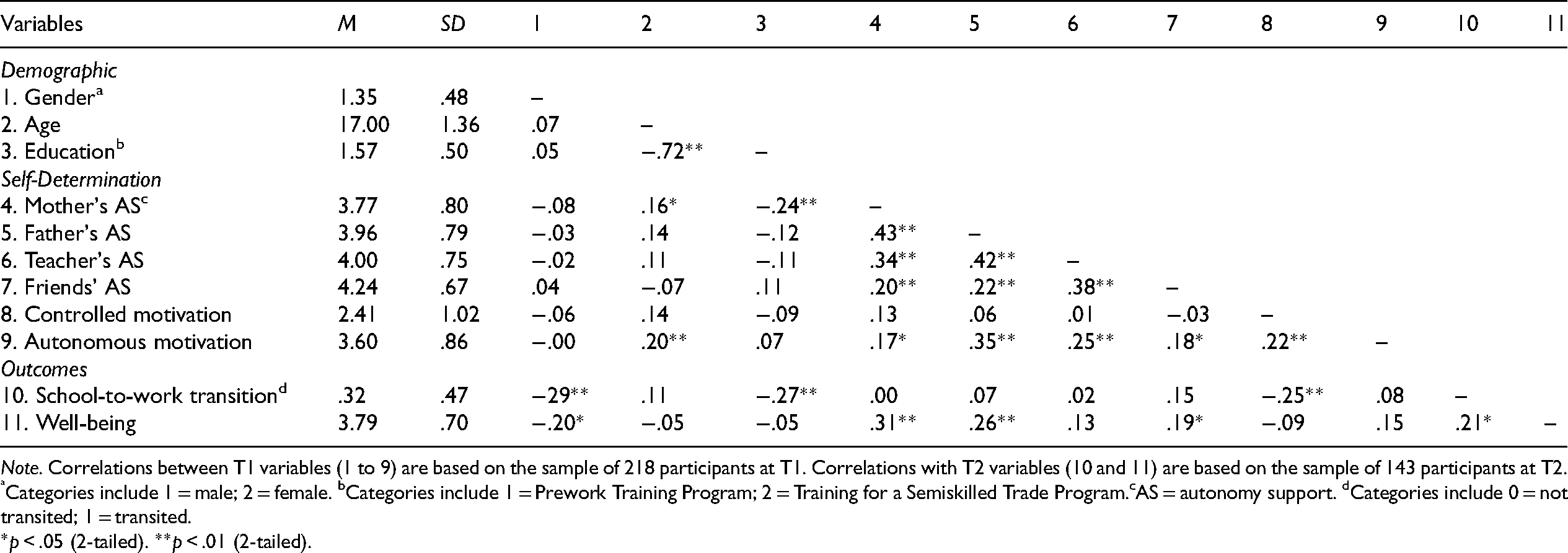
Note. Correlations between T1 variables (1 to 9) are based on the sample of 218 participants at T1. Correlations with T2 variables (10 and 11) are based on the sample of 143 participants at T2.
Categories include 1 = male; 2 = female. bCategories include 1 = Prework Training Program; 2 = Training for a Semiskilled Trade Program.cAS = autonomy support. dCategories include 0 = not transited; 1 = transited.
*p < .05 (2-tailed). **p < .01 (2-tailed).
For each model, we first reported the Chi-square, with its degrees of freedom and p value. To evaluate the goodness-of-fit of the models, we report values for (a) Root Mean Squared Error of Approximation (RMSEA; Steiger, 1990), (b) Comparative Fit Index (CFI; Bentler, 1990), and (c) Tucker-Lewis index (TLI; Bentler & Bonett, 1980). The values we observed—an RMSEA value less than .06 and CFI and TLI values greater than .95—indicated an excellent model-data fit (Hu & Bentler, 1999).
Transition Status
The estimation of the complete measurement model with 20 observed variables (12 parcels, four indicators of motivation, one outcome variable, three control variables) and six latent factors yielded a good model fit (
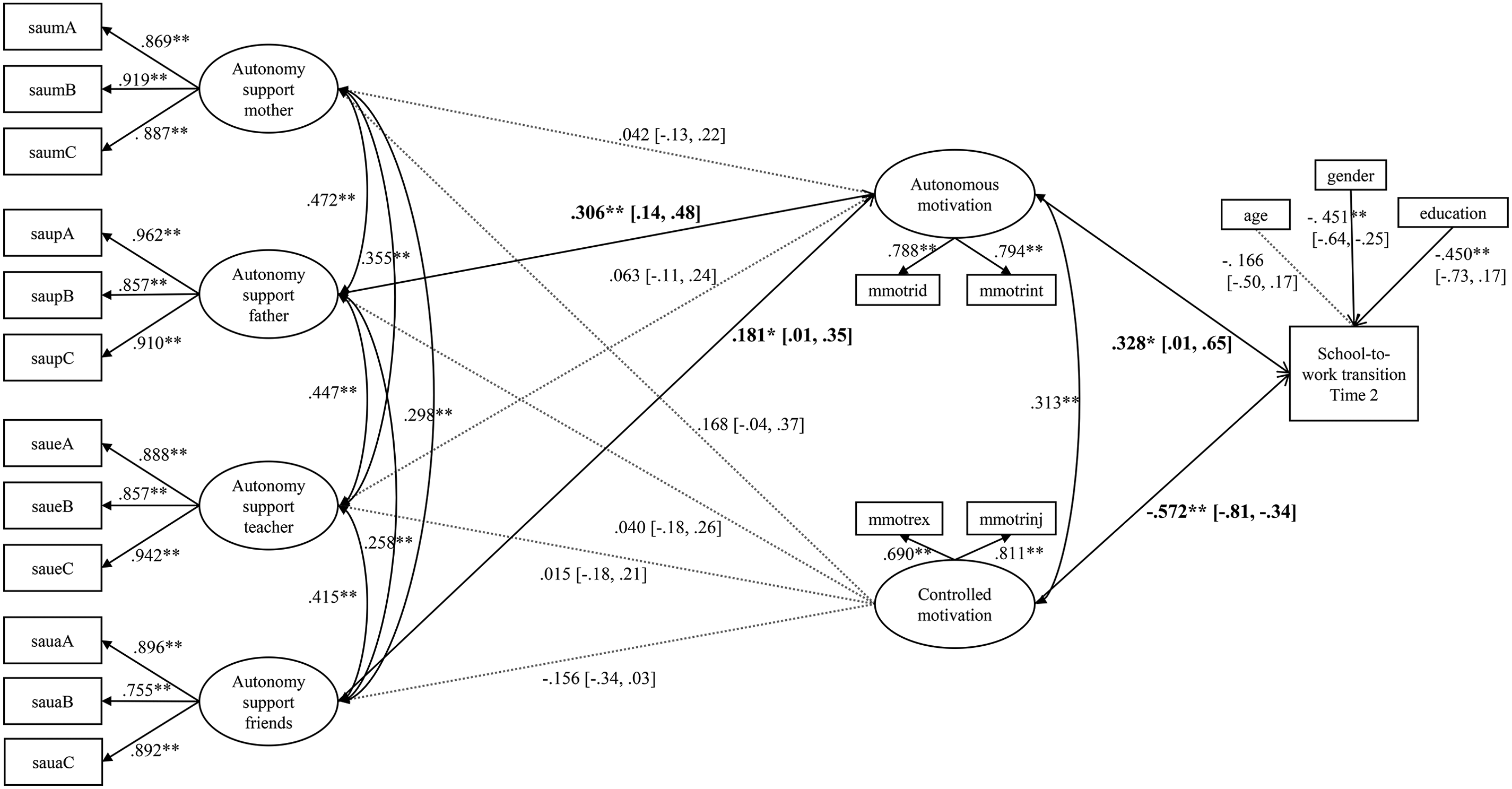
Standardized Path Coefficients for the Hypothesized Model Predicting School-to-Work Transition (N = 187).
Well-Being
An adequate model fit was also obtained for this measurement model with 22 observed variables (15 parcels, four indicators of motivation, three control variables) and seven latent factors (
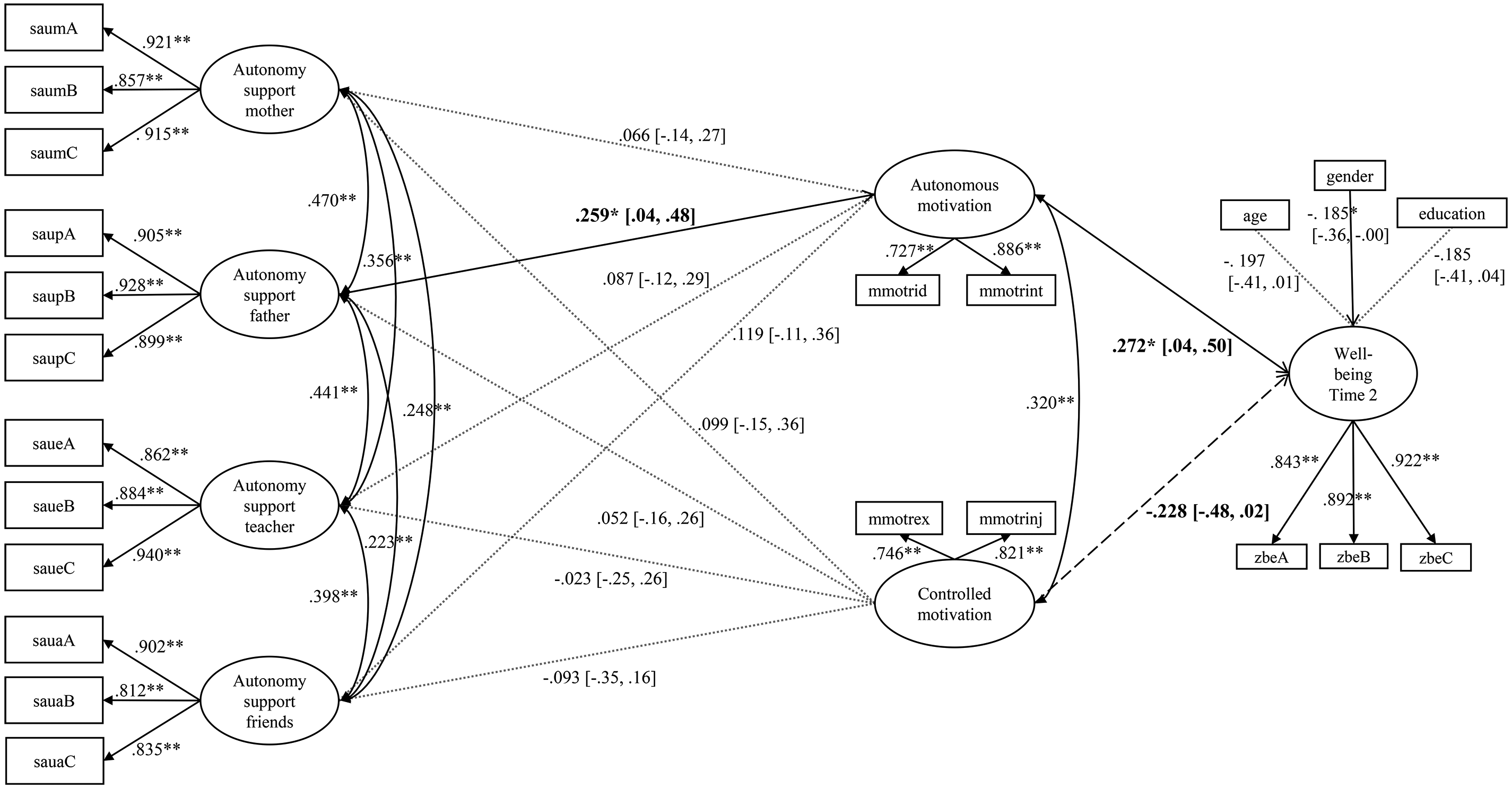
Standardized Path Coefficients for the Hypothesized Model Predicting Well-Being (N = 187).
Discussion
Based on SDT, this study aimed to validate a motivational model of school-to-work transition and well-being for youth with LD. Four sources of autonomy support were examined in the context of the students’ upcoming job search, namely the father, mother, teacher, and friends. Our hypotheses regarding the predictive role of autonomy support in types of motivation, and types of motivation in school-to-work transition and well-being were partially supported.
The Importance of Autonomy Support
Both models evidence the predominant role of the father's autonomy support regarding job searching. Indeed, students who perceived that their father supported their autonomy reported higher autonomous motivation in the school-to-work transition model, and, to a lesser extent, in the well-being model. A plausible explanation is the important role of fathers in their child's development (Flouri, 2005). For instance, studies conducted in diverse cultural contexts indicate that father involvement is related to their adolescent's school performance (Morales-Castillo, 2021) and resilience (Zhang et al., 2015), and father autonomy support is related to their adolescent’s subjective well-being (Beiswenger & Grolnick, 2010). During career development, fathers are particularly important (Pizzorno et al., 2014). Soenens and Vansteenkiste (2005), who obtained similar results, suggested that each parent may have specific contributions during this transition. Indeed, youths tend to share their feelings with their mother, whereas they turn to their father for information (Steinberg & Silk, 2002). For example, young adults report turning to their fathers for information support during career construction, but to both parents for emotional support (Palladino Schultheiss et al., 2001). This could particularly be the case here, where many participants report working either in an occupational category (i.e., 17% of the participants in the trades category) or in jobs mostly occupied by men in Canada (e.g., automobile cleaner, factory worker), based on recent census data (Statistics Canada, 2016). Job searching also implies turning to the outer world and taking social initiatives, a behavior mainly predicted by the adolescents’ perceptions of their father's support (Stolz et al., 2005). On the contrary, mothers’ autonomy support is positively related to the satisfaction of the relatedness need, a supportive function that is not observed for fathers (Inguglia et al., 2018). Exploring this need in future research—in addition to the autonomy need—could help clarify the specific contribution of each parent during the transition to adulthood.
Friends’ autonomy support also contributes to students’ autonomous motivation toward their future job search, as evidenced by the significant effect observed in the school-to-work transition model. As expected, friendships are central during adolescence (Beiswenger & Grolnick, 2010; Way & Silverman, 2012). Adolescents share their feelings and expectations toward their future life with their friends (Brown, 2004). Peers are thus significant sources of support for career-related goals of transitioning students (Tynkkynen et al., 2010), and autonomy support from friends is related to college students’ career decision-making self-efficacy and autonomy (Guay et al., 2003). In sum, considering friends’ contribution is highly relevant in the transition to adult life.
One surprising finding was that the teacher's autonomy support was not significantly related to motivation, despite a small positive correlation between these variables. However, during the transition to post-compulsory education, adolescents of 15–16 years of age do not often report teachers as a significant source of support for career-related goals compared to their friends (Tynkkynen et al., 2010). Thus, when both sources are measured concomitantly, friends may have a predominant role at this age. Another possibility could be that in the WOTP program where students spend a lot of time in internships, other sources of support are more relevant, such as their internship supervisor or the special educators. Specifically, students in the WOTP report that some teachers may lack the time and specialized skills to properly support their needs (Rousseau & Bergeron, 2017). Thus, further studies are needed to explain the teacher's role in supporting the job search process.
Finally, another unexpected finding was that autonomy support was unrelated to controlled motivation, which encompassed external and introjected regulations. In a recent meta-analysis identifying the predictive role of autonomy support in students’ academic motivation, Bureau et al. (2021) found that need satisfaction did not significantly explain external regulation, and explained only a small percentage of introjected regulation. They suggest that autonomy support might not be sufficient to explain controlled motivation. More precisely, evaluating need frustration would be essential, a distinct and highly relevant concept that is associated with amotivation, controlled motivation, and various negative outcomes (Vansteenkiste et al., 2020).
Motivations and Their Relations to Transition Status and Well-Being
As hypothesized, motivations predict the transition status. Indeed, students reporting higher levels of autonomous motivation at the end of their studies were more likely to be transited 1 year later, whereas those reporting higher levels of controlled motivation were less likely to have transited. In previous studies, similar relations were observed between motivation and job search behaviors with adult job seekers (da Motta Veiga & Gabriel, 2016; Koen et al., 2016; Vansteenkiste et al., 2004, 2005), as well as with students regarding their intentions to engage in a job search (Soenens & Vansteenkiste, 2005). It therefore appears that the concrete outcome of employment can also be linked with motivation. In addition, higher levels of autonomous motivation were associated with increased well-being, although higher levels of controlled motivation were associated with poorer well-being. These results are in line with previous research (Vansteenkiste et al., 2004, 2005). Thus, for youth transitioning to work, solely engaging in a job search is not enough; the type of motivation underlying this engagement is relevant. Indeed, those who do it to alleviate internal pressures such as the shame associated with not having a job or external pressures such as financial incentives do not benefit from this process as much as those performing it for autonomous reasons.
To our knowledge, this research is the first to demonstrate that the relation between motivation and post-school outcomes, as postulated by SDT, can be observed in youth with LD, when outcomes were controlled for gender, age, and education. Although this result was expected, questions remain as to why autonomous motivation toward job search positively predicts transition status and well-being, and why controlled motivation negatively predicts these outcomes in this population. A general explanation for this finding could be related to the vitality and energy that come with autonomous motivation (Ryan & Deci, 2008), in opposition to controlled motivation, which is draining. Thus, with this positive activation, autonomously motivated youth experience greater well-being than those who have a controlled motivation depleting their resources. They may also be more inclined to look for jobs that correspond to their interests and that will satisfy their psychological needs, as they have been prepared to do during their WOTP program.
Limitations
The main shortcoming of this research is the small sample. It would be important to conduct further studies with more participants to enhance the generalizability of the results. Validating the motivational model with a larger sample could also confirm the results and possibly tighten the confidence intervals. Another limitation is that all measures were self-reported. Although it is crucial to document the students’ perceptions and thoughts (Scott & Havercamp, 2018), it can artificially increase the common variance among variables (Podsakoff et al., 2003). Thus, in subsequent studies, we suggest triangulating the data with questionnaires filled by parents, teachers, and friends. This would enable a better understanding of how the participant’s perception is aligned with other sources of autonomy support. Furthermore, because the experiences of the students may be subtle, interviews could be conducted to understand their reality. Moreover, there is a need to document their family composition. This would allow a more refined interpretation of the findings related to the parents. The attrition rate was also quite high, although numerous efforts were made to retain participants. Other longitudinal studies with young adults with disabilities have worse attrition rates (e.g., Conti-Ramsden et al., 2018), but to circumvent this methodological problem, a rate lower than 20% would be optimal for further studies (Yew & O’Kearney, 2013). Finally, most students of our sample were Caucasian. One could thus wonder if these findings would be similar in other cultural contexts. Nevertheless, autonomy support appears beneficial for students from a wide range of cultures (Reeve & Cheon, 2021), and a recent meta-analysis indicated that the relations between motivation and education outcomes remain robust across cultural contexts (Howard et al., 2021).
Implications
The main implication of this study is that SDT is a relevant theory in explaining the school-to-work transition of youth with LD. This population has rarely been the focus of SDT researchers, and SDT has rarely been considered by researchers interested in the post-school outcomes of youth with LD. Nevertheless, autonomy support and motivation are essential to the development of one of the important post-school success predictors for youth with disabilities: self-determination (Mazzotti et al., 2021), which flourishes in need-supportive environments that foster autonomous motivation (Shogren et al., 2017). Our results thus help to clarify how important it is for the social environment of youth with LD to adopt autonomy-supportive behaviors (i.e., offering choices, giving a rationale, acknowledging feelings) in terms of enhancing autonomous motivation (Ryan & Deci, 2017). These elements help us better understand how we can support positive post-school outcomes for this population, and further research under the lens of SDT is encouraged. Indeed, SDT could make an important contribution to our understanding of post-school outcomes in students with LD. Our results could serve as a ground to develop studies examining relations between motivation and other outcomes such as educational attainment. Another important field of study in SDT research includes intervention studies, in which stakeholders are taught how to become more autonomy supportive. Examining how these gains translate into benefits for youth with LD could inform the field on how to optimize transition services.
There are also implications for educators and policymakers involved with students with LD. The social context of these students is hardly ever examined through the lens of SDT, even though they indeed report that their learning environment can be demotivating (Rousseau & Bergeron, 2017). First, educators and policymakers are encouraged to create autonomy-supportive contexts to foster autonomous motivation. How this can concretely be achieved has recently been operationalized (Reeve & Cheon, 2021). Indeed, educators are autonomy-supportive when they are (1) taking the perspective of the students, (2) encouraging students to follow their interests, (3) introducing activities in need-satisfying ways, such as offering choices, (4) explaining the rationale regarding the value and relevance of a task for the students, (5) acknowledging students’ negative feelings, (6) using invitational language to support students’ initiative instead of controlling wording, and (7) being patient with their students, including those who might struggle. Such supportive environments have been shown as particularly meaningful to enhance the autonomy satisfaction and engagement of students with mild intellectual disabilities, while reducing their anxiety (Emond Pelletier & Joussemet, 2016). Second, the transition plan elaboration is a particularly favorable context in which educators can establish an autonomy-supportive environment (U.S. Department of Education & Office of Special Education and Rehabilitative Services, 2020). This could enable the students to make choices regarding their transition, express their preferences and worries, and understand the reasons why educators want them to engage in this process with their family. In all cases, policymakers play a crucial role in designing educational policies that align with the features of autonomy support. In addition, various studies evidenced that educators can effectively learn how to provide autonomy support, and that these changes translate into benefits for the students (Reeve & Cheon, 2021; Su & Reeve, 2011). Supporting the educators’ professional development in terms of autonomy-supportive behaviors could thus be a key feature of transition policies.
Finally, motivation is often identified as an area of need in the Individualized Education Plan of students in the WOTP (Rousseau et al., 2012). Thus, educators would benefit from identifying the type of motivation their students have toward a behavior. If their motivation is controlled, its origins could be further analyzed. For example, if students evolve in a non-supporting social environment, educators could work with the student's family and friends to develop autonomy-supportive behaviors. If their motivation is autonomous, supportive behaviors could be underlined and encouraged. This important step could help educators offer a more optimal context for students regarding their school-to-work transition.
In conclusion, this research supports the relevance of SDT in the study of the school-to-work transition of students with LD. Indeed, perceptions of autonomy support from their father and friends predict a higher level of autonomous motivation toward their job search, which in turn contributes to a higher level of well-being and a higher probability of having transited to employment as their main occupation. Educators are encouraged to build on SDT concepts to optimize the context in which their students evolve and support them toward an optimal school-to-work transition and well-being.
Supplemental Material
sj-docx-1-ecx-10.1177_00144029221112285 - Supplemental material for School-to-Work Transition of Youth with Learning Difficulties: The Role of Motivation and Autonomy Support
Supplemental material, sj-docx-1-ecx-10.1177_00144029221112285 for School-to-Work Transition of Youth with Learning Difficulties: The Role of Motivation and Autonomy Support by Pascale Dubois, Frédéric Guay and Marie-Catherine St-Pierre in Exceptional Children
Footnotes
Declaration of Conflicting Interests
The authors declared no potential conflicts of interest with respect to the research, authorship, and/or publication of this article.
Funding

Supplemental Material
Supplemental material for this article is available online.
Manuscript received October 2021; accepted June 2022.
References
Supplementary Material
Please find the following supplemental material available below.
For Open Access articles published under a Creative Commons License, all supplemental material carries the same license as the article it is associated with.
For non-Open Access articles published, all supplemental material carries a non-exclusive license, and permission requests for re-use of supplemental material or any part of supplemental material shall be sent directly to the copyright owner as specified in the copyright notice associated with the article.
