



Abstract
Previous research illustrated that reading comprehension and science performance correlate highly. Because students with specific learning disorders with impairments in reading (SLD-IR) show deficits in reading comprehension, they may struggle to perform in science. As language in science is characterized by linguistic complexity, the question arises whether students with SLD-IR can be supported by reducing linguistic complexity. The aim of this preregistered study was to investigate whether students with SLD-IR benefit more from linguistic simplification in science than their peers without SLD-IR. The sample consisted of 70 students (age, M = 12.67; 50% female) with n = 35 having SLD-IR. Applying a multilevel logistic regression model, we found neither a main effect of linguistic simplification nor an interaction effect (differential boost) on science performance. However, students with SLD-IR performed significantly lower in science. Implications include further investigation on how to support students with SLD-IR in their science performance.
Learning science is essential in order to become an informed citizen and to make decisions regarding one's health and social issues, such as global warming (Trefil, 2007). Because science education is often based on written text and test items (e.g., Norris & Phillips, 2003) due to its highly communicative nature (e.g., Yore et al., 2003), reading comprehension plays an important role for science performance. Considering the strong link between science performance and reading comprehension (e.g., Cromley, 2009), students with reading difficulties may particularly be affected because their science performance may be underestimated due to their reading deficits. In this article, we are particularly interested in the performance of students with specific learning disorders (SLD) with impairments in reading (SLD-IR) in a science test with test items that vary in their level of linguistic complexity, because studies focusing on the performance of students with SLD-IR in science are missing.
To lend students with SLD-IR support in overcoming their deficits, some test accommodations have been investigated, such as providing extra time (e.g., B. Lovett, 2010). However, to the best of our knowledge, there are no studies to date that focus on reducing the linguistic complexity of science test items that may interfere with the ability of students with SLD-IR to demonstrate their content knowledge. Such a test accommodation is referred to as linguistic simplification (LS; e.g., Rivera & Stansfield, 2004). It has been repeatedly investigated in the general education context with ambiguous results (e.g., Prophet & Badede, 2009). However, drawing on another special group of students, meta-analyses provide evidence that LS may be effective for weak readers, particularly for non-native students (e.g., Pennock-Roman & Rivera, 2011).
Given the importance of science education and the prevalence of students with SLD-IR (e.g., Landerl & Moll, 2010) who may have difficulties handling the linguistic demands of scientific texts and test items, the question remains if students with SLD-IR may particularly benefit from LS. To address this lacuna, we aim to investigate whether students with SLD-IR benefit more from LS in science than their peers without SLD-IR, resulting in a differential boost. Therefore, we conducted an experimental study for which we have developed science items in two linguistic versions: an original version that is inspired by academic and school science language (e.g., Fang, 2006) and an item version with (systematic) LS. To simplify the science items effectively, we drew on simplification studies (e.g., Bird & Welford, 1995), secondary analyses (e.g., Heppt et al., 2015), and guidelines (e.g., Kopriva, 2000).
The Importance of Reading Comprehension for Science Performance
Reading comprehension involves many different processes at different reading levels, starting with decoding individual letters and integrating them into a word through decoding the word meaning at the word level up to integrating these words into a coherent sentence at the sentence level or even into a coherent text passage at the text level (e.g., Kintsch, 1998). Research has extensively explored the importance of reading comprehension for overall academic success (e.g., Cooper et al., 2014), linking it to life outcomes, such as higher qualifications and socioeconomic status (e.g., Kutner et al., 2007).
Reading comprehension has further been shown to be strongly linked to science performance (e.g., Dempster & Reddy, 2007) due to the highly communicative nature of science learning (Yore et al., 2003). Reading scientific texts is very common in science education (e.g., Norris & Phillips, 2003), and hence, the importance of reading comprehension for science performance is apparent. This link has been extensively explored in research (e.g., Ozuru et al., 2009). The correlations within the school context range from .58 to .90 (Cromley, 2009; O’Reilly & McNamara, 2007), depicting high correlations of both skills (Cohen, 1992). However, not only reading comprehension at higher reading levels, that is, the text level, is important in order to perform well in science but also vocabulary at the word level because students need to deal with specific scientific vocabulary (e.g., Fang, 2006).
Students With SLD-IR
Given the importance of reading comprehension for science performance, it appears essential to support students in their reading skills acquisition for them to be able to perform well in science. This raises the question of how students with particularly poor reading skills perform in science measures. In the literature, several terms for students with poor reading skills have been established: poor, struggling, or low-achievement readers; students with a reading or learning disorder or dyslexia; students with reading or learning difficulties, and so on. Even though there are theoretical distinctions between some of these terms, it is somewhat difficult to differentiate between them in practice. Hence, these terms overlap and are often used synonymously (e.g., Coltheart & Prior, 2006).
For this study, we focus particularly on students with SLD-IR. The definitions of SLD-IR vary greatly (Tunmer & Greaney, 2010). For our study, we take the Diagnostic and Statistical Manual of Mental Disorders (5th ed.; DSM-5; American Psychiatric Association, 2013) as a basis for the definition of SLD-IR. The DSM-5 defines SLD-IR as a learning disorder that is characterized by impairments in reading despite having an (above) average intelligence (American Psychiatric Association, 2013), which corresponds with the definition in the International Statistical Classification of Diseases and Related Health Problems by the World Health Organization (Dilling et al., 2015). However, some authors criticize these discrepancy criteria, arguing that these may depict artificial cut-off scores (Branum-Martin et al., 2013) or that intelligence measures often assess verbal intelligence, usually measured by reading tasks, which may in turn potentially bias overall intelligence scores (Pennington et al., 2019).
Students with SLD-IR are a very heterogeneous group that shows several deficits in a variety of subskills (e.g., Hock et al., 2009), including reading speed (e.g., Davies et al., 2013) and reading comprehension (e.g., Cárnio et al., 2017). Rose (2009) provides a detailed description of SLD-IR and the deficits of students with SLD-IR. According to Landerl and Moll (2010), worldwide prevalence rates vary between 4% and 9%, depicting the substantial number of affected students.
Considering the inseparable linkage between reading comprehension and science performance (e.g., Cromley, 2009), it seems plausible that students with SLD-IR struggle with science test items. Seifert and Espin (2012) suggest that such difficulties may arise from the mismatch between affected individuals’ reading skills and the reading requirements presupposed by science assessments. In view of the specialized language of school science (e.g., Fang, 2006), it is fair to assume that its linguistic complexity may hinder students with SLD-IR to answer test items correctly due to their difficulties in understanding the demands of these items. According to the cognitive load theory, which is challenged by some authors (see de Jong, 2010, for a critical discussion), the (potentially unfavorable) linguistic design and wording of test items may thus increase the cognitive load of the test items. Cognitive load refers to the amount of working memory resources that are needed to process an item (Sweller, 1988). If test items are presented unfavorably, for example, in terms of linguistic presentation, the test taker needs to use up additional valuable resources of working memory, which simultaneously decreases free capacities to process the technical content (Paas et al., 2010). Hence, students with SLD-IR may invest a lot of working memory capacity trying to decode the test item, leaving them with a rather limited capacity to actually process the technical content. Consequently, they may be hindered in showing their content knowledge due to deficits in reading comprehension (e.g., Cawthon et al., 2012). This circumstance is especially alarming when bearing in mind that most students with a learning disorder are expected to perform under the same conditions, or rather without accommodations for their deficits, as their peers without disabilities (e.g., Norman et al., 1998).
Linguistic Complexity in Science
Language and reading comprehension are integral parts of science performance (e.g., Yore et al., 2003). However, the language of science with its linguistic complexity differs from everyday language and tends to cause difficulties for the students performing in science tests (e.g., Fang, 2006). Several secondary analyses and experimental studies investigated linguistic complexity of science test items as well as the consequences on students’ performance (e.g., Cruz Neri et al., 2021). Several studies also illustrated that science items tend to incorporate unnecessary linguistic complexity at several levels that may decrease students’ performance, particularly for second-language learners (e.g., Martiniello, 2008). Several linguistic features typical for science school language (e.g., Fang, 2006) might generate difficulties for students.
LS as a Test Accommodation
Taking into account the linguistic complexity that science items pose on students, it might be promising to provide students with SLD-IR with appropriate support in form of accommodations. Test accommodations are changes in testing to remove measurement errors that could arise from students’ disorders (e.g., Fuchs et al., 2000). Students with reading difficulties or SLD-IR may struggle with test items not due to their lack of content knowledge but rather due to the reading requirements of the test items (e.g., Cawthon et al., 2012). Hence, providing students with test accommodations attempts to reduce construct-irrelevant variance and measurement errors that would result from students’ disorders (e.g., Turkan & Liu, 2012). Well-designed test accommodations should therefore result in an interaction effect: Students with disorders should benefit more from accommodations than students without disorders, ensuring the validity of test measures for all students.
Prior researchers explored test accommodations for students with SLD-IR, such as providing extra time (e.g., B. Lovett, 2010). However, providing students only with accommodations such as extended time may not be sufficient for students to master the linguistic features of an item (e.g., Rhodes et al., 2015). Although a few studies focused on students with learning and intellectual disorders in general (e.g., Cawthon et al., 2012), to the best of our knowledge, no studies have yet been conducted that investigate test accommodations regarding LS particularly for students with SLD-IR. Hence, we need to draw on research related to other special groups of students.
LS refers to the modification of language in test items to reduce unnecessary linguistic complexity while preserving the technical content (e.g., Rivera & Stansfield, 2004). Many authors suggest simplifying the language used in test items for validity reasons (e.g., Wolf & Leon, 2009), and some even wrote practical guidelines for simplified language (e.g., Kopriva, 2000). Other authors, however, hold a critical view on LS. They argue “that specific linguistic knowledge is a component of content area mastery and thus that we cannot assume linguistic features are irrelevant to the target construct on content area tests without analyzing the use of the feature in the domain to which the test is intended to generalize” (Avenia-Tapper & Llosa, 2015, p. 108). We agree with this statement to some extent: Of course, LS has its limits. This is particularly the case when complex scientific principles are discussed because they need complex language to be described adequately. However, studies showed that scientific texts tend to use unnecessary linguistic complexity that can be reduced by means of LS without compromising the validity of an assessment (e.g., Abedi & Lord, 2001).
Simplification studies and guidelines usually suggest to modify several linguistic features simultaneously, because modifying one particular linguistic feature only is very difficult or even impossible. Therefore, LS usually includes the modification of several linguistic features at a time. Common strategies to achieve LS include replacing complex verb structures with an active voice and the present tense, omitting rare vocabulary, and simplifying sentence structures (see Abedi et al., 1997, for an overview).
Because it has been known that even slight linguistic modifications may affect students’ performance in science and similar subjects, such as mathematics (e.g., Cummins et al., 1988), many attempts of LS have been made. To date, there are LS studies for different domains, such as mathematics (e.g., Haag et al., 2015) and science (e.g., Prophet & Badede, 2009), but also for different populations, such as students with (learning) disorders (e.g., Kettler et al., 2012). Even though the majority of these studies report higher students’ performances on linguistically simplified items, the effects do not always reach significance (e.g., Rivera & Stansfield, 2004). Meta-analyses investigating, among other accommodations, LS for English language learners report small but significant effects of simplifying language in test items (e.g., Pennock-Roman & Rivera, 2011).
In sum, it is evident that even minor changes in wording affect students’ performance significantly (e.g., Prophet & Badede, 2009), and although simplification studies have been conducted with students with specific learning and intellectual disorders (e.g., Cawthon et al., 2012; Fajardo et al., 2013), to the best of our knowledge, studies solely focusing on students with SLD-IR do not exist. To date, the studies investigating LS for students with disorders do not differentiate the effects of simplification between the different types of disorder (e.g., Elliott et al., 2010). We assume that it is of utter importance to differentiate between different types of disorders because students with intellectual disorders may face different problems and have different cognitive impairments compared with students suffering SLD-IR. We suggest that it is necessary to understand the linguistic features that generate difficulties for students with and without SLD-IR to support them better with their performance in science. Furthermore, understanding the mechanisms behind language characteristics in science items is also important for validity reasons, because high requirements in reading comprehension could hinder students with SLD-IR to show their content knowledge (e.g., Wolf & Leon, 2009). Following cognitive load theory, items should be designed in a way that keeps extraneous cognitive load, that is, the cognitive load caused by poorly designed items, to a minimum. In this way, cognitive resources can be used to master and process the test items rather than to deal with linguistically suboptimal item designs (Paas et al., 2010).
The Present Investigation
Building on previous research on LS of different populations (e.g., Abedi & Lord, 2001) and the importance of reading comprehension for science performance (e.g., Cromley, 2009), we aim to investigate whether students with SLD-IR benefit significantly from linguistically simplified items in science. Although many accommodations for students with SLD-IR have been investigated and many studies have investigated LS for students with disorders in general (e.g., Kettler et al., 2009) and for English language learners (e.g., Pennock-Roman & Rivera, 2011), no studies have particularly focused on accommodation by linguistically simplifying science items for students with SLD-IR. Again, we are aware that LS has its limits (see Avenia-Tapper & Llosa, 2015). However, we are convinced that LS may be able to reduce unnecessary linguistic complexity for students both with and without SLD-IR without compromising the validity of assessment. We assume that students with SLD-IR benefit significantly more from this type of accommodation because LS targets linguistic complexity and aims to facilitate reading. Thus, we aim to investigate whether there is a differential boost, that is, if LS boosts the science performance of students with SLD-IR significantly more than that of their peers without SLD-IR. For this purpose, we generated science items in an original version that was inspired by academic and school science language (e.g., Fang, 2006) and a simplified version.
To investigate our aims, we test the following hypotheses:
We hypothesize that overall, students without SLD-IR perform better on the science items than their peers with SLD-IR. We expect that the total sample of students performs better on the simplified items than on the original version of science items. We assume that although both students with and without SLD-IR benefit from the simplified science items, students with SLD-IR benefit significantly more from this type of accommodation but do not reach the level of students without SLD-IR.
Method
Sample
The data collection for the main study took place between February and November 2021. Participants were mainly recruited from schools of the nonacademic track in different federal states of Germany. The nonacademic track is considered the general education, which enables students to start a vocational apprenticeship (for more detailed description of the German schooling system, see Trautwein et al., 2006). We recruited additional participants with SLD-IR from institutions for special-needs language education (visited besides regular school). Students received €10 for their participation.
For the preregistration of the study, we conducted a power analysis for multilevel logistic regression (Olvera Astivia et al., 2019), using R (R Core Team, 2009–2019), before starting the data collection. Results showed that a total sample of n = 70 students at the between level was required to achieve a power of 0.90 or higher.
In total, N = 203 seventh graders participated in the study. However, 123 students needed to be excluded from the analytic sample because they did not meet our inclusion criteria. First, 15 students skipped at least one subscale completely. Second, 16 did not answer the attention-check questions correctly. Third, 90 students had a T value below 40 in the cognitive measures. Finally, four students’ mean effort in completing the study fell two standard deviations below the mean effort of all students. However, one of these students reached above-average performance in both cognitive abilities and reading comprehension and, hence, was included in the analytic sample.
This resulted in a sample of N = 79 students (35 without SLD-IR; 44 with SLD-IR). We defined SLD-IR to be present if students show impairments in their reading skills while not underperforming in cognitive measures, to ensure that potential impairments in reading are not the consequence of potential intellectual disorders (American Psychiatric Association, 2013). Based on our power analysis, we aimed for an equal distribution of students with and without SLD-IR. Hence, we randomly selected 35 students with SLD-IR for our statistical analyses. We also conducted the analyses with all N = 79 students. The results were cum grano salis the same: Solely the effect of gender on science performance was nonsignificant (B = −0.065, p = .629).
This resulted in an analytic sample of n = 70 students (age, M = 12.67, SD = 0.58; 50% female). Thereof, 50% had SLD-IR according to our definition. Most participants stated that they speak only German at home (91.40%). Only 8.60% of students stated that they speak German and another language or speak only another language at home. There were no missing data on the variables that we included in our statistical model.
The students with SLD-IR and students without SLD-IR did not differ regarding their age, t(68) = −0.20, p = .839; gender, χ²(1) = 0.51, p = .473; and migrant background, χ²(2) = 3.40, p = .183. Furthermore, they did not differ regarding their grades in the subjects German, t(62.88) = −0.98, p = .330, and science, t(65) = −0.07, p = .945. At this point, one must note that a considerable portion of students did not state their grades in those subjects (German, 18.60%; science, 28.30%).
Measures
The study consisted of four measurements: reading comprehension, cognitive abilities, science items, and a short demographic questionnaire. We chose test methods with a single-choice format for every measure because we wanted to focus on receptive reading skills. Open-response formats measure productive skills besides receptive reading skills, usually decreasing performance (e.g., Härtig et al., 2015).
The main study was conducted online (see Text S2 in the supplementary material). As applied in the Programme for International Students Assessments (Kunter et al., 2002), we implemented an item after every test measure asking the students to state how much effort they made on a scale from 1 to 10 (see “Effort Control” at https://osf.io/kta6c). Because we conducted the study in Germany, all measures are available only in German language.
Reading Comprehension
Participants completed the German version of the Reading Comprehension Test for Grade 1 to 7–Version II (in German, Ein Leseverständnistest für Erst- bis Siebtklässler–Version II; Lenhard et al., 2018), which assesses students’ reading comprehension, fluency, and accuracy. The assessment is divided into three subtests assessing the mentioned measurements at the word, sentence, and text levels. Students had 2 to 6 min to complete each subtest containing 26 to 75 items. For students to be presumed to suffer from SLD-IR, they need to perform at a T value of or less than 35 (Lenhard et al., 2018).
Cognitive Abilities
Students’ cognitive abilities were assessed with a nonverbal subtest of a revised German test (in German, Kognitiver Fähigkeitstest 4-12 + R; Heller & Perleth, 2000), which is considered to be a fair indicator of general cognitive abilities (Neisser et al., 1996). The test is based on the Cognitive Abilities Test (Thorndike & Hagen, 1971). The subtest consists of 25 items. Students had 8 min to work on the subtest. Students performing at a T value of less than 40 were considered as underperforming in cognitive measures.
Science Items
The items were generated according to the school curricula of the nonacademic track of different German federal states. To fit the structure of German school curricula, the science items test the subject matter of Grades 5 and 6 that was consistent across the school curricula of the nonacademic track of different federal states. The science items were tested in a pilot study beforehand (see Text S3 and Figure S1 in the supplementary material).
The science items were systematically and linguistically modified, resulting in two linguistic versions of each item with the same content knowledge: the original version and a simplified version. The items of both versions can be seen in the document “Science Items in Both Versions” at https://osf.io/kta6c. To compare the original and the simplified items, we coded several linguistic features with the software LATIC (Linguistic Analyzer for Text and Item Characteristics; Cruz Neri & Klückmann, 2021) that were considered when developing the items. The descriptives of both science versions are provided in Table S1 and discussed in Text S4 in the supplementary material. At https://osf.io/kta6c, a detailed description and an example of coding are provided in the files “Coding of Linguistic Features” and “Example of Coded Item.”
Students worked on 20 science items, including 10 original and 10 simplified items, respectively.
Both versions. The science items of both versions have multiple characteristics in common regarding layout and format. We followed guidelines for generating the items (e.g., Haladyna et al., 2002) with the intent to keep characteristics regarding the general structure alike between both versions. The technical content was the same, which was double-checked by a science teacher and a science teacher student. The 20 items include the topics of living beings, including humans, fauna, and flora (n = 8); sensory organs (n = 5); weather and climate (n = 3); and the solar system (n = 4), which were explicitly stated as general educational goals in the curricula of Grades 5 and 6. The students had 25 min to work on the items.
All items were presented in a single-choice format with four response choices to only measure the students’ receptive language skills rather than set additional demands on their productive language skills, which would be needed in open-response formats (e.g., Härtig et al., 2015). The items were solely based on words; no additional pictures were generated for the items due to possible confounding effects on reading comprehension and, consequently, science performance (e.g., Carney & Levin, 2002). Further criteria that we followed when generating the items in both versions are presented in Table S2 of the supplementary material.
Original version. We followed no guidelines or recommendations regarding linguistic features to make items more accessible for students but rather took up characteristics of academic and school science language (e.g., Fang, 2006). The original version was developed with the intent to resemble science items that could be used in science classes and large assessment studies.
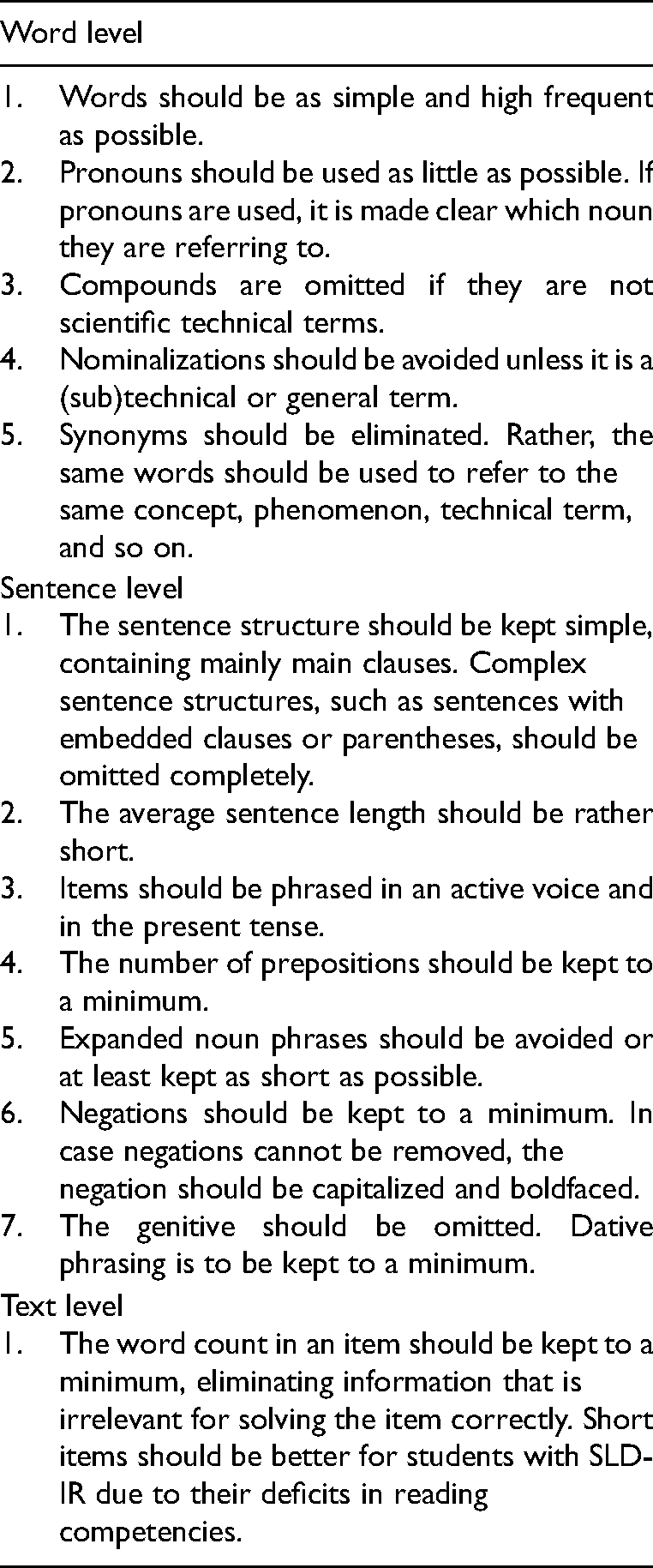
Simplified version. The original items were systematically simplified following recommendations of several guidelines (e.g., Kopriva, 2000) and taking into account various results of different studies and secondary analyses (e.g., Haag et al., 2013), but the technical content remained the same. For the simplification of science items and their response choices, we established the criteria stated in Table 1.
Guidelines for Generating the Linguistically Simplified Version of Science Items.
Randomization
All students worked on the four measures: reading comprehension, the subtest of the cognitive abilities measure, the science items, and the short questionnaire. The order of the first three measures was randomized. All students completed the short questionnaire last.
For the study, we prepared two different science test versions containing the same technical content in each test version. We made sure that the word count in both test versions was similar (version A, 923 words; version B, 930 words). To further ensure equivalence between both test versions, we allocated science items taking their difficulty based on the pilot-testing into account (see Text S3 and Figure S1 in the supplementary material). Drawing on the probabilities of correct responses in the pilot study, test versions A (M = .31, SD = .12) and B (M = .32, SD = .13) were comparable. The order of science items was randomized.
Ethical Approval
The study design was approved by the responsible ministries and authorities of the federal states we collected our data in. The study was approved by the ethics committee of the University of Hamburg. It was conducted in compliance with the ethical guidelines of the American Psychological Association, and all subjects gave written informed consent.
Statistical Analyses
To test our hypotheses, we analyzed the interaction effect of students’ (nonexisting) SLD-IR and the science items’ version on students’ performance by applying a multilevel logistic regression model using the software Mplus 8.7 (Muthén & Muthén, 1998–2017). We conducted a multilevel regression model due to the hierarchy of our data: We consider science items as being nested in students. Moreover, we apply logit regressions due to the binary nature of our dependent variable, which is the science performance on item level (0 = false response, 1 = correct response). In our model, the item version (original items vs. simplified version) served as a within-subjects variable, and students’ (nonexisting) SLD-IR served as a between-subjects variable (0 = student without SLD-IR, 1 = student with SLD-IR).
To test the interaction effect of both these variables, we included a cross-level interaction on science performance. We further controlled for two dummy-coded variables: gender (0 = male, 1 = female) and migratory background (0 = native speaker, 1 = non-native speaker). The odds ratios were calculated.
Results
Descriptive Statistics, Reliabilities, and Correlations
Overall, students reported relatively high efforts in completing the study (M = 7.89, SD = 1.80). The descriptive statistics and Cronbach's alphas of students’ reading comprehension, cognitive abilities, and science performance are depicted in Table 2. Table 3 further includes the correlations of both assessment and demographic variables.
Descriptive Statistics and Cronbach's Alpha of the Variables in the Main Study.
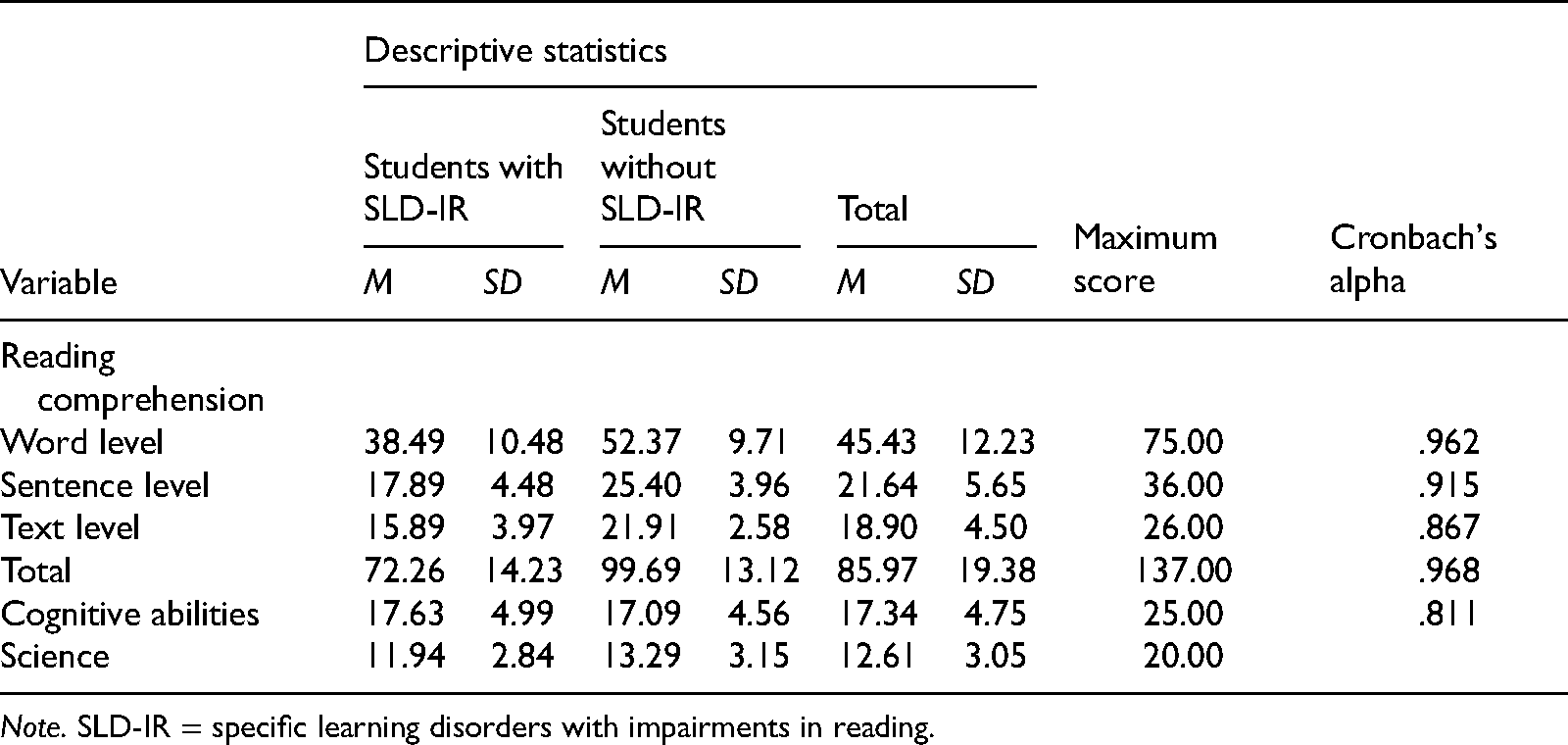
Note. SLD-IR = specific learning disorders with impairments in reading.
Correlations Between the Variables in the Main Study.
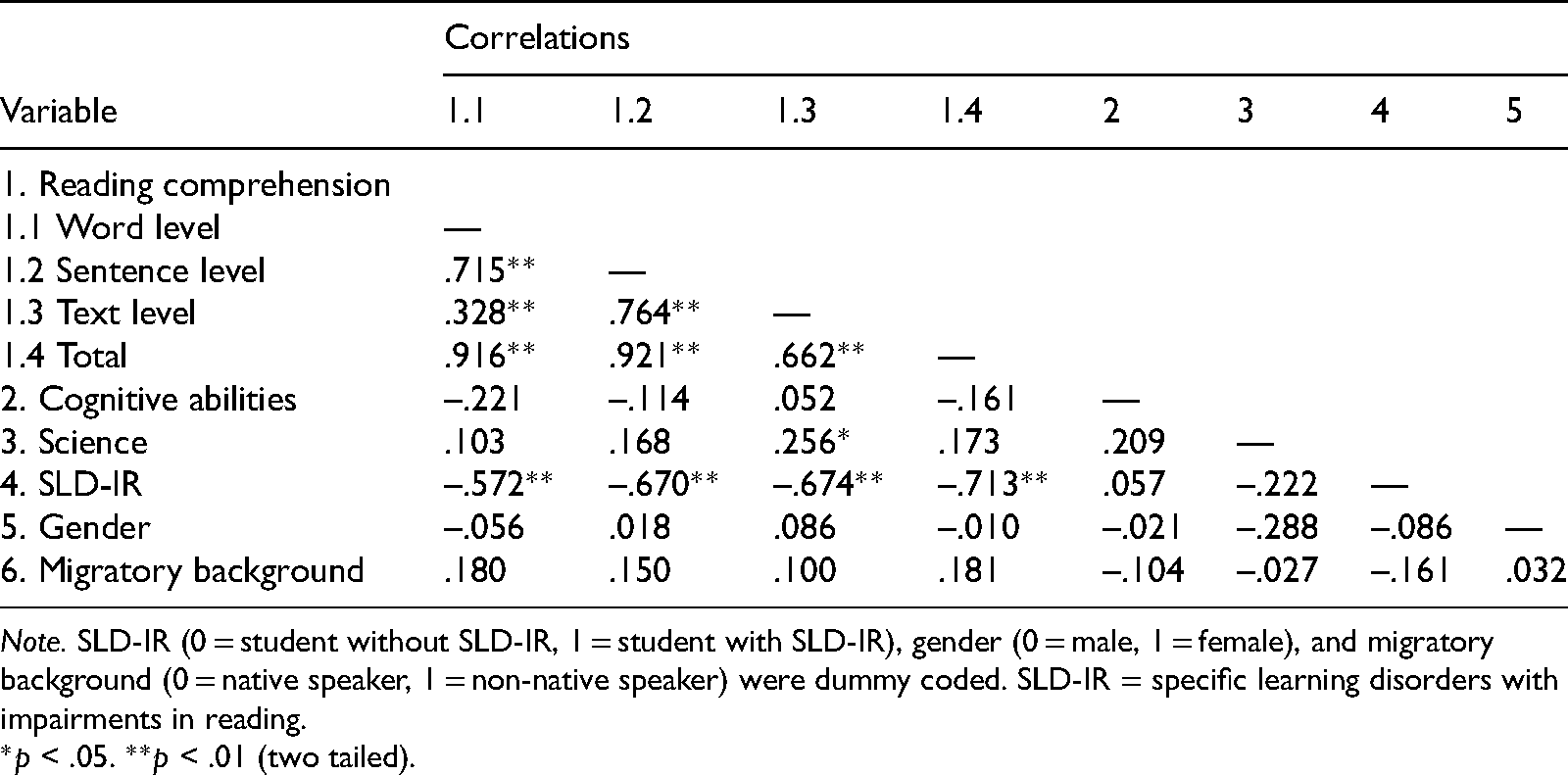
Note. SLD-IR (0 = student without SLD-IR, 1 = student with SLD-IR), gender (0 = male, 1 = female), and migratory background (0 = native speaker, 1 = non-native speaker) were dummy coded. SLD-IR = specific learning disorders with impairments in reading.
*p < .05. **p < .01 (two tailed).
The probability of a correct response was M = .62 (SD = .18) for the original science items and M = .67 (SD = .21) for the simplified science items. This corresponds to a small effect (d = 0.26), according to Cohen (1988). The differences between the probability of a correct response ranged from –.20 to .40 (M = .05, SD = .15), a negative difference meaning that the original item was solved correctly more often. The probabilities of a correct response of the science items are depicted in Figure 1.
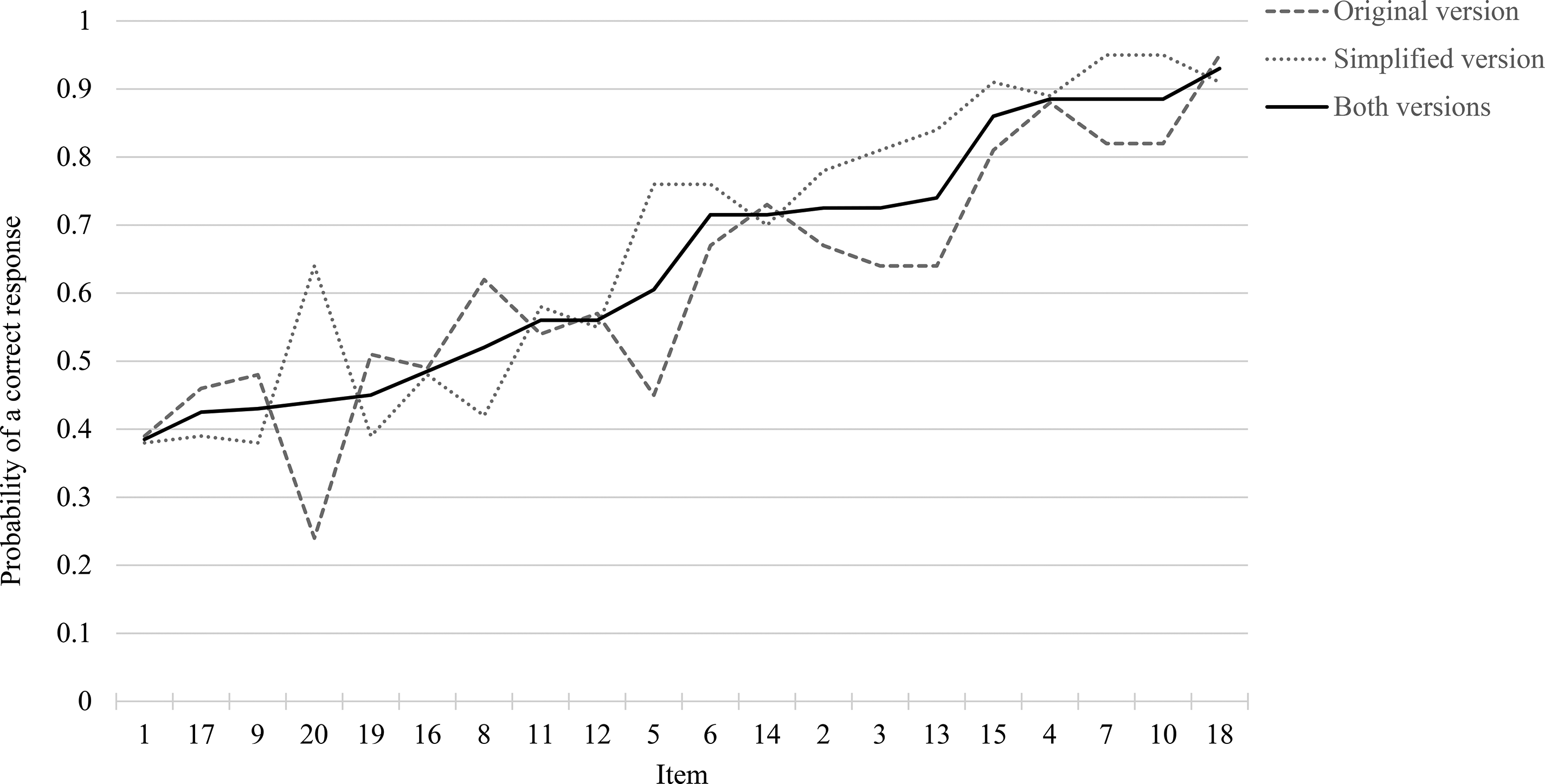
Probabilities of correct responses of the original and the simplified items (main study). Note: The continuous line depicts the averaged probability of a correct response of both item versions.
Multilevel Analysis
The results of the multilevel analysis are presented in Table 4. Corroborating our first hypothesis, students with SLD-IR performed significantly lower than their peers without SLD-IR. Their chance of solving a science item correctly was 34.4% lower compared with their peers without SLD-IR. Our second and third hypotheses, however, were not corroborated. The overall sample did not perform better on the simplified version of items (main effect), nor did students with SLD-IR benefit significantly more from the simplified version than students without SLD-IR (interaction effect).
Results of the Multilevel Analyses Predicting Science Performance (Unstandardized Parameters).
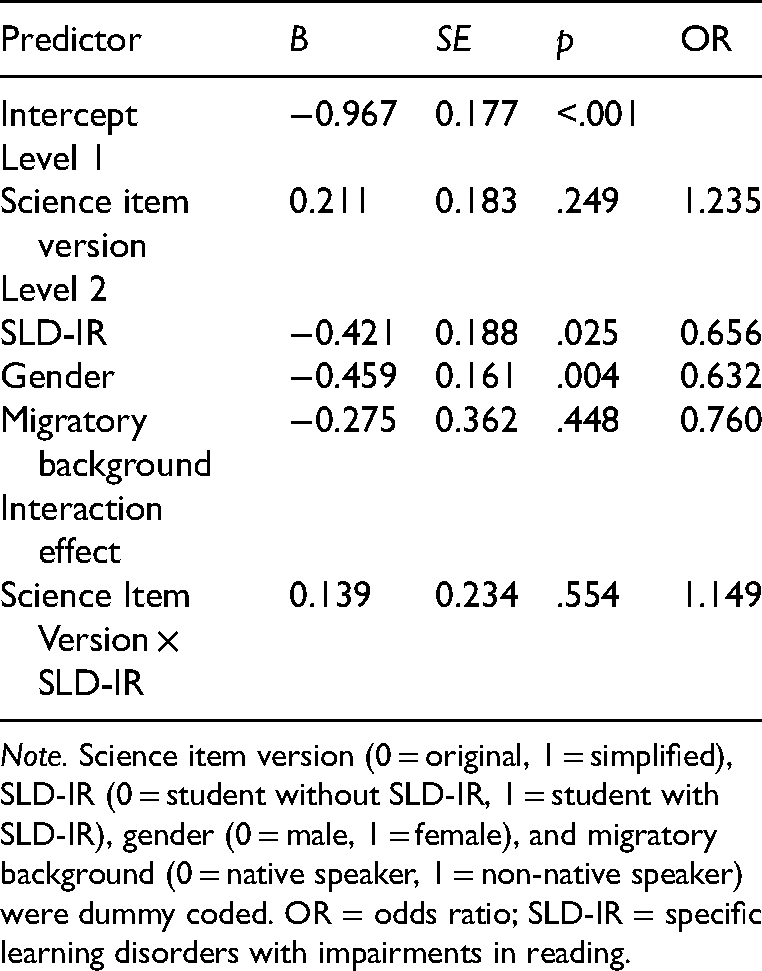
Note. Science item version (0 = original, 1 = simplified), SLD-IR (0 = student without SLD-IR, 1 = student with SLD-IR), gender (0 = male, 1 = female), and migratory background (0 = native speaker, 1 = non-native speaker) were dummy coded. OR = odds ratio; SLD-IR = specific learning disorders with impairments in reading.
Discussion
The aim of this study was to investigate whether the LS of science items provides adequate support for students with SLD-IR, resulting in a differential boost. For this, we generated two versions of science items: science items inspired by academic and school science language (e.g., Fang, 2006) and (linguistically) simplified items. Although our results showed a higher probability of a correct response in the simplified science items, these results did not reach significance. A differential boost was also not found.
The Effect of Students’ SLD-IR on Science Performance
The results illustrated that students without SLD-IR significantly outperformed their peers with SLD-IR in the science assessment, corroborating our first hypothesis. Other students’ characteristics, such as cognitive abilities, do not seem to diminish this effect of students’ SLD-IR status (we tested a model including cognitive abilities as a further covariate; see Table S5 of the supplementary material). As noted earlier, this result seems plausible given that science is a highly communicative domain (Yore et al., 2003) and items are usually presented in written text. In our study, we presented students with science items that were heavily text based without illustrations that might help students understanding the technical content of the items. Hence, proficient reading was needed to solve the science items. Students with SLD-IR might have performed worse than their peers without SLD-IR due to a mismatch between their reading comprehension and the reading requirements presupposed by the science items (see Seifert & Espin, 2012). Drawing on cognitive load theory (Sweller, 1988), one might infer that students with SLD-IR needed more cognitive resources to read and process the science items compared with their peers without SLD-IR due to their impairments in reading. As proposed by the construction-integration model (e.g., Kintsch, 1998), this seems plausible: As reading processes on the surface structure (i.e., the linguistic presentation in terms of linguistic complexity) consume a lot of resources for students with SLD-IR, only a limited capacity remains to build an adequate situational model. As a result, students with SLD-IR might have only a limited capacity left to process the technical content of the item.
The assumption that students with SLD-IR have a higher cognitive load due to the reading demands of the science items should be investigated in future research. Although it is still unclear how cognitive load is best measurable (e.g., DeLeeuw & Mayer, 2008), a subjective measure of cognitive load from students’ perspective could bring more insight into where exactly difficulties in solving science items arise for students with SLD-IR. Drawing on Paas (1992), students with SLD-IR could be directly asked how much mental effort they needed to invest (a) to read and comprehend the presented item (extraneous load) as well as (b) to process the technical content of the science items (intrinsic load).
The Missing Effect of LS
Whereas students’ status of SLD-IR affected their science performance significantly, the LS did not. Although all students performed slightly better on the simplified science items, contrary to our expectations, this difference was not significant. The LS also did not result in a differential boost, again, not corroborating our hypothesis. Thus, although it seems as if students with SLD-IR needed additional cognitive resources to process the science items compared with their peers without SLD-IR, the LS did not reduce the cognitive load of science items (sufficiently) to support the students with SLD-IR significantly.
Looking into the probabilities of a correct response, some items were easier to solve in the original version. This is somewhat surprising given the results of our pilot study (Figure S1 in the supplementary material). One must note, however, that the pilot sample had an overall lower probability of correct responses on the science items than the analytic sample of the main study did: Their probability of correct responses was less than half the probability of correct responses of their peers in the main study. It cannot be ruled out that the different science proficiency levels might explain the differences in the probabilities of correct responses of the pilot and main study samples.
On the one hand, our finding that LS might not be significantly helpful for a general population is in line with prior research (e.g., Bird & Welford, 1995; Rivera & Stansfield, 2004). On the other hand, the results not corroborating our hypothesis of a differential boost are more difficult to interpret. Because our study is—to the best of our knowledge—the first one to investigate LS particularly for students with SLD-IR, we can only propose assumptions as to why LS failed to significantly provide support for students with SLD-IR. First, students with SLD-IR might struggle with the science items in both versions due to their deficits in reading.
Second, when simplifying the science items, we looked into empirical results for a general student population and specific subgroups, such as non-native speakers (e.g., Haag et al., 2013). We also followed several guidelines (e.g., Kopriva, 2000). However, there is little empirical evidence to corroborate the recommendations stated in these guidelines. Hence, there is a chance that we modified linguistic features that might not even generate difficulties for students with SLD-IR in the first place. For instance, although there is evidence that noun phrases generate difficulties in comprehension and performance for non-native speakers (e.g., Martiniello, 2008), there is no evidence that native speakers or other groups of students face the same difficulties. Nevertheless, we chose to consider noun phrases in our simplification approach due to the lack of research regarding students with SLD-IR.
In simplifying the items the way we did, some simplified science items might differ from the items the students usually are confronted with in school, and hence, they might not be used to the approaches we followed. In this respect, one item stands out: It was solved 20% more often in the original than in the simplified version (Item 8, Moriginal = .62, Msimplified = .42). In hindsight, we noticed that the original version was heavily contextualized, which is common in science testing (Ruiz-Primo & Li, 2016). Contextualized items provide students with a context facilitating solving a task due to the items being more realistic and less abstract (Haladyna, 1997). The fact that the eighth science item was contextualized in the original version, but not in the simplified version, might explain why students were better able to solve the item in the original version. Thus, it is necessary for future research not only to identify linguistic features that might facilitate or impede the performance of students with SLD-IR but also to identify further item characteristics that go beyond the linguistic presentation.
Third, prior research provides evidence that LS in science items might be helpful for specific subgroups, such as students with academic difficulties (e.g., Elliott et al., 2010) and non-native speakers (e.g., Bird & Welford, 1995). However, students with SLD-IR might need additional support alongside LS. In a study by Kettler et al. (2012) investigating LS for students with and without disorders, all students benefited from LS and performed better on the simplified science items. However, the researchers not only modified science items in terms of linguistic complexity but also, for instance, added illustrations. Hence, it might be possible that LS alone is not sufficient to provide adequate support for students with SLD-IR in science. In providing illustrations for students with disorders, Kettler et al. made use of the multimedia effect (Mayer, 2005). This effect refers to the phenomenon that more information can be acquired when learning information is presented both verbally and visually because these two types of information are processed independently. Studies indicate that the combination of both LS and the multimedia effect positively affects science performance for a general student population (e.g., Siegel, 2007), non-native students (e.g., Noble et al., 2020), and students with learning disorders (Kettler et al., 2012). Hence, combining LS and the multimedia effect to reduce linguistic complexity in support of students with SLD-IR might be a promising project to pursue in future research.
Theoretical and Practical Implications
Although our hypotheses regarding the effect of LS were not corroborated, there are still theoretical and practical implications than can be derived. We want to particularly focus on implications (a) for future research on LS and (b) for adequately supporting students with SLD-IR in science education.
As to future research, we consider it important to further investigate LS. At this point, we still need to examine (a) whether LS is not an adequate accommodation for students with SLD-IR at all or (b) whether LS works only under specific circumstances. We still assume that LS as an accommodation has potential to adequately (and significantly) support students with SLD-IR.
First, LS might be especially helpful for a specific subgroup of students with SLD-IR, such as students with specific impairments in their reading comprehension. Second, other item characteristics that might facilitate or impede science performance need to be examined. For instance, contextualizing science items is assumed to facilitate science performance (Haladyna, 1997). In our study, we focused only on simplifying science items linguistically but did not take other item characteristics, such as the contextualization, into account, which might have affected the effects of LS. Finally, we would encourage research investigating the combination of LS with other ways of supporting students. Especially the combination of LS and the multimedia effect (Mayer, 2005) seems to be a promising method, with some studies providing first evidence for students with learning disorders (e.g., Kettler et al., 2012).
As a second implication, it is important to find ways of supporting students with SLD-IR in their science performance because their status of SLD-IR affected science performance significantly. Although little research has focused on students with SLD-IR in science education, much more is known about students with all types of learning disorders. In two meta-analyses, it has been illustrated that the science performance of students with learning disorders can significantly improve, first, when they are provided with supplemental instructions, such as mnemonics (Therrien et al., 2011), and, second, when being taught the science curriculum through the usage of graphic organizers (Dexter et al., 2011). It is further known that students with learning disorders benefit from structured and direct instruction by their teachers in science education (Therrien et al., 2011). For instance, Seifert and Espin (2012) found that students with SLD significantly benefited from word recognition activities guided by a teacher prior to reading a science text; their vocabulary learning and reading fluency increased significantly. Thus, there seems to be promising accommodations for the overall group of students with SLD. However, further research is needed to investigate whether these instructional strategies also support students with SLD-IR in science.
Ultimately, it would be desirable to support students with SLD-IR in improving their reading skills in general to address their deficits at their root. In a recent study, M. Lovett et al. (2021) examined a long-term, multicomponent reading intervention for students in Grades 6 to 8: Students with SLD-IR participating in the intervention significantly outperformed their peers in the control group (receiving reading instructions by special education teachers) in multiple measures, such as text comprehension. Considering the high correlations of reading and science performance (e.g., Cromley, 2009), it can be assumed that the positive effects on reading comprehension might also affect science performance positively.
Limitations
Despite having considerable strengths, this study has limitations that need to be addressed. First, due to the ongoing COVID-19 pandemic at the time, the study was conducted online rather than—as originally planned—in face-to-face settings. Therefore it could not be ensured that participants worked on the assessments by themselves and did not receive any help by significant others. This might be especially true for the science items, given that we repeatedly got the feedback that students finished the items way before the time limit of 25 min was over. Hence, we cannot guarantee that students did not look for answers online or asked others for help. As mentioned in Text S2 in the supplementary material, multiple approaches were taken in order to mitigate the risk of students not working on their own (e.g., Olt, 2002). Still, there is no guarantee that students were unassisted.
Second, we cannot rule out that the main effect of SLD-IR can be traced back to students’ ability to guess the correct answers. Scruggs and Lifson (1984) illustrated that students with learning disorders are significantly better at guessing at random than their peers without learning disorders. The authors assume that this effect might partly be explained by their lower reading comprehension and other factors, such as attention deficits or test anxiety.
Third, the students in the main study did quite well on the science items on average, especially compared with the students of the pilot study. Hence, the missing effect of LS might possibly be traced back to the main study students’ higher performance in science.
Finally, the missing (main and interaction) effects of LS on science performance might be due to our approach in simplifying the science items. As noted earlier, we noticed that in simplifying the science items, we sometimes removed the context, which might impede comprehension and performance instead of facilitating it. Furthermore, we needed to follow guidelines and empirical results of other student populations, such as non-native speakers (e.g., Kopriva, 2000), due to the lack of research regarding students with SLD-IR. Future research is needed to investigate which linguistic features and other item characteristics, such as the contextualization of science items, facilitate or impede science performance of students with SLD-IR.
Conclusion
The present study showed that students without SLD-IR significantly outperform their peers with SLD-IR in science assessments. The attempt to linguistically simplify the science items to support students with SLD-IR was not successful: We did not find a main effect of LS nor an interaction effect of students’ SLD-IR status and LS (differential boost) on science performance. Thus, LS does not seem to provide significant support for students with SLD-IR in their science performance. Still, we are confident that LS has potential, and hence, we encourage future research to investigate LS further. Identifying specific (linguistic) item characteristics that might boost or impede science performance and investigating the combination of LS with other approaches (such as the multimedia effect) might be promising strategies to support students with SLD-IR adequately in the future.
Supplemental Material
sj-docx-1-ecx-10.1177_00144029221094049 - Supplemental material for Do Students With Specific Learning Disorders With Impairments in Reading Benefit From Linguistic Simplification of Test Items in Science?
Supplemental material, sj-docx-1-ecx-10.1177_00144029221094049 for Do Students With Specific Learning Disorders With Impairments in Reading Benefit From Linguistic Simplification of Test Items in Science? by Nadine Cruz Neri and Jan Retelsdorf in Exceptional Children
Supplemental Material
sj-sav-2-ecx-10.1177_00144029221094049 - Supplemental material for Do Students With Specific Learning Disorders With Impairments in Reading Benefit From Linguistic Simplification of Test Items in Science?
Supplemental material, sj-sav-2-ecx-10.1177_00144029221094049 for Do Students With Specific Learning Disorders With Impairments in Reading Benefit From Linguistic Simplification of Test Items in Science? by Nadine Cruz Neri and Jan Retelsdorf in Exceptional Children
Supplemental Material
sj-sav-3-ecx-10.1177_00144029221094049 - Supplemental material for Do Students With Specific Learning Disorders With Impairments in Reading Benefit From Linguistic Simplification of Test Items in Science?
Supplemental material, sj-sav-3-ecx-10.1177_00144029221094049 for Do Students With Specific Learning Disorders With Impairments in Reading Benefit From Linguistic Simplification of Test Items in Science? by Nadine Cruz Neri and Jan Retelsdorf in Exceptional Children
Footnotes
Authors’ Note
We would like to thank Judith Keinath for her editorial support.

Open Science Badge
References
Supplementary Material
Please find the following supplemental material available below.
For Open Access articles published under a Creative Commons License, all supplemental material carries the same license as the article it is associated with.
For non-Open Access articles published, all supplemental material carries a non-exclusive license, and permission requests for re-use of supplemental material or any part of supplemental material shall be sent directly to the copyright owner as specified in the copyright notice associated with the article.
