



Abstract
Adopting a vegetarian diet represents a meaningful daily contribution to climate change mitigation. This makes vegetarians a relevant group for studying the cognitive mechanisms underlying pro-environmental decision-making. In this study, vegetarians and non-vegetarians completed a decision-making task involving real trade-offs between financial rewards and carbon emissions, with information acquisition tracked using MouselabWEB. We found that vegetarians exhibited a greater propensity to select the pro-environmental option than non-vegetarians. This group difference was particularly found when decisions entailed high personal costs, low environmental benefits, or uncertain outcomes. Process-tracing data further revealed that vegetarians consistently prioritized environmental information, and this attentional focus significantly predicted pro-environmental choices. Decision-level and process-tracing effects were attenuated when controlling for environmental attitudes, highlighting the role of vegetarians’ strong environmental commitment. Overall, the findings suggest that vegetarians may rely on a principled decision-making style that transcends cost–benefit considerations, offering new insights into the cognitive basis of pro-environmental engagement.
Highlights
Vegetarians act more pro-environmentally than others in abstract decision contexts
Group differences increase for high-cost, low-benefit pro-environmental choices
Vegetarians pay more attention to environmental information during decision-making
Vegetarians show principled choices with lower cost-benefit trade-off consideration
Introduction
Global climate change poses a significant challenge to humanity and biodiversity, with human behavior playing a critical role in its progression (Ivanova et al., 2020). Food consumption is a major component of our individual ecological footprint, with one-third of global anthropogenic greenhouse gas (GHG) emissions coming from our food system (Crippa et al., 2021; Poore & Nemecek, 2018). Within this dietary impact, meat and dairy products are particularly influential, accounting for approximately 83% of food-related GHG emissions (Ritchie et al., 2020). Unsurprisingly, adopting a vegetarian diet (i.e., refraining from meat consumption) results in a median reduction of 31% in GHG emissions, 51% in land use and 37% in water use (Aleksandrowicz et al., 2016). Switching to a vegetarian diet is therefore a pro-environmental behavior that contributes significantly to mitigating climate change (Clark et al., 2020; Rippin et al., 2021; Willett et al., 2019).
In contrast to other high-impact pro-environmental behaviors that require sporadic decision-making (e.g., opting for train travel instead of flying, insulating one’s home), adopting a vegetarian diet entails repeated and consistent decision-making that is beneficial to the environment. Consequently, individuals who follow a vegetarian diet may be considered to possess a certain degree of routine when it comes to making environmentally friendly decisions. Investigating how vegetarians make decisions, especially those with environmental consequences, can therefore yield valuable insights into the cognitive processes underlying pro-environmental decision-making, while also revealing strategies to facilitate and promote such behaviors. In line with recent calls to focus more explicitly on the mechanisms driving pro-environmental choices (e.g., Doell et al., 2023; Nielsen et al., 2021; Sawe & Chawla, 2021), this study seeks to contribute to a more predictive and nuanced understanding of these behaviors by examining how vegetarians and non-vegetarians acquire information when engaged in a consequential environmental decision-making task.
Psychological and Cognitive Profile of Vegetarians
Despite growing awareness of the environmental, ethical and health benefits of vegetarian diets, vegetarians remain a minority in Western countries, representing only about 7% of the population in the UK and US nowadays (Sullivan et al., 2024; Wunsch, 2024). Research has investigated how vegetarians differ from non-vegetarians in broad psychological and sociopolitical characteristics, generally finding that they tend to be less politically conservative, embrace less conformist worldviews and endorse more social justice and universalism values (Hayley et al., 2015; Holler et al., 2021; Milfont et al., 2021). However, these distinctions have not yet been extended to the domain of decision-making, leaving a notable gap in the literature. To date, two studies have explored differences in cognitive thinking between those populations (Bègue & Vezirian, 2023, 2025). Using the Cognitive Reflection Test (CRT), the authors found that vegetarians had a higher disposition to resist intuitive response and rather relied on slower, more thoroughly reflection (i.e., analytic cognitive style). Since individuals with higher CRT scores were shown to engage in more extensive information search on product packages (Kim et al., 2020), these findings raise the possibility that vegetarians and non-vegetarians may differ in their cognitive engagement during decision-making. Yet empirical research directly comparing these groups in actual decision-making tasks is still lacking.
Scientific knowledge also remains scarce regarding how vegetarians differ from non-vegetarians in their engagement in pro-environmental behaviors beyond dietary choices. Although adopting a vegetarian diet is widely recognized as an effective way to reduce one’s ecological footprint (Aleksandrowicz et al., 2016), and environmental concern is frequently cited as a major motivation for this dietary choice alongside animal welfare and health considerations (Hopwood et al., 2020; Rosenfeld & Burrow, 2017), it remains unclear whether this environmental concern among vegetarians extends to other domains of behavior (e.g., reducing air travel, donating to environmental organizations). Preliminary evidence suggests that this may be the case. First, Kaiser and Byrka (2014) demonstrated that vegetarians showed a greater propensity to adopt costly pro-environmental behaviors in their everyday lives than non-vegetarians, as indexed by their higher environmental attitudes scores grounded in the Campbell paradigm. Second, Kaiser et al. (2020) found that Campbellian environmental attitudes scores significantly predicted the proportion of vegetarian meals consumed during a week by omnivores. Third, self-reported engagement in pro-environmental behaviors has been shown to predict both short-term and intended long-term adherence to a vegetarian diet (Krizanova et al., 2021). Taken together, these findings suggest that commitment to vegetarian practices is positively associated with broader pro-environmental engagement in daily life. Nevertheless, the opposite pattern can also be expected, as vegetarians may disengage from other pro-environmental behaviors if they perceive their dietary commitment as sufficient to align with their environmental values. This phenomenon, known as the negative spillover effect (Maki et al., 2019; Truelove et al., 2014), refers here to the tendency for engagement in one pro-environmental behavior to reduce the likelihood of engagement in others. This can occur when individuals feel that their initial behavior has already contributed enough to a cause, thereby justifying inaction or less effort in other areas (Carrico, 2021; Truelove et al., 2016).
Unravelling the Black Box of Environmental Decision-Making
While identifying individual factors (such as dietary practices) that predict pro-environmental choices is essential, scientists have recently called for a deeper understanding of the cognitive processes underlying pro-environmental decision-making (e.g., Doell et al., 2023; Eyring et al., 2021; Leeuwis et al., 2022; Sawe & Chawla, 2021). Moving beyond the question of why individuals act sustainably to explore how these decisions unfold allows researchers to gain more nuanced insights into the mechanisms underpinning pro-environmental behavior. Specifically, investigating how individuals gather, process, and prioritize information during decision-making can contribute to the development of more accurate models of pro-environmental behavior and help explain why certain interventions are more effective across different populations and contexts (Konovalov & Ruff, 2022; Schulte-Mecklenbeck et al., 2011, 2019). Such an approach ultimately supports the design of more targeted and impactful strategies to promote pro-environmental actions.
In this context, extensive evidence highlights the pivotal role of attention in shaping decision outcomes (Gwinn & Krajbich, 2020; Krajbich, 2019; Milosavljevic et al., 2012). Understanding how attentional processes operate in the moments leading up to a choice is particularly valuable for predicting complex, multi-attribute decisions made under varying informational and contextual conditions, and by individuals with diverse motivations (Konovalov & Ruff, 2022). In such cases, individuals must evaluate competing attributes, navigate trade-offs, and prioritize specific pieces of information (e.g., weighing the carbon footprint against the price of an electronic product). These choices produce observable behavioral patterns, such as how individuals move their attention and what information they choose to inspect (Schulte-Mecklenbeck et al., 2017). Tracing these information acquisition behaviors offers rich insights into how pro-environmental decisions are constructed. Recently, Bollen et al. (2025) used eye-tracking alongside an environmental decision-making task to explore how environmental attitudes shape attention, and how these attentional patterns, in turn, drive pro-environmental choices. Individuals with high Campbellian environmental attitudes scores were found to allocate more attention to the carbon impact of their decisions. Importantly, this selective focus predicted not only low-cost but also high-impact pro-environmental decisions. These results highlighted the value of process-tracing methods for uncovering how and when attention guides pro-environmental behavior.
Another established and viable method for tracking information acquisition during decision-making is the use of Mouselab paradigms (Franco-Watkins & Johnson, 2011; Franco-Watkins et al., 2019). These computer-based tools are particularly well-suited for online studies, making them a cost-effective and scalable option for studying large and diverse samples, including minority groups such as vegetarians. They track the duration, frequency and sequence of each information visit (contained inside boxes), allowing researchers to derive a rich set of process measures and infer mechanisms of information prioritization and processing depth (Willemsen & Johnson, 2019). Among these measures, the proportion of attention allocated to a given attribute reflects its subjective weight, with more important information receiving longer visiting times (Glöckner & Herbold, 2011; Hu et al., 2020; Tanida & Yamagishi, 2010). The time sequence of attribute visits is also informative, as the first attribute visited may capture early attention shaped by prior preferences, while the last attribute visited may indicate the decisive factor in the final choice (Gwinn et al., 2019; Rahal & Fiedler, 2019; Todd et al., 2016). Additionally, the total time spent acquiring information within a trial offers an index of the processing depth, as longer decision times are generally associated with more extensive information gathering (Horstmann et al., 2009). Finally, the Payne index characterizes whether a participants’ search strategy is dominated by within-option transitions (comparing different attributes of the same option; integrative search) or between-option transitions (comparing the same attribute across different options, comparative search). A positive Payne Index indicates a tendency toward integrative search, whereas a negative value reflects comparative processing (He et al., 2023; Kwak et al., 2015).
Aims of the Current Study
To date, little is known about how pro-environmental decisions and their underlying cognitive processes may differ between individuals who adopt environmentally friendly lifestyles in their daily lives and those who do not. To fill this gap, the present study investigates how vegetarians and non-vegetarians search for and process reward and climate-relevant information when making decisions with real-world environmental consequences. Specifically, we address two research questions. First, do vegetarians differ from non-vegetarians in the proportion of pro-environmental choices they make in abstract contexts unrelated to food? This first question examines whether the propensity to act sustainably in food-related domains transfers or not to other decision-making contexts. Second, do vegetarians differ from non-vegetarians in how they search for and prioritize information about personal benefits and environmental costs when making pro-environmental decisions? This second question focuses on whether vegetarianism relates to the attentional processes underlying pro-environmental decision-making.
To answer these questions, we employ a process-tracing approach by embedding a novel variant of the Carbon Emission Task (CET; Berger & Wyss, 2021; Wyss et al., 2025) into a MouselabWEB paradigm. The task asks participants to repeatedly choose between two options that vary in monetary reward and carbon emissions. During the task, participants can freely inspect the bonus payment and carbon emissions associated with each option by hovering their mouse over boxes occluding this information. Importantly, the emissions are real and implemented through the purchase and retirement of CO2 certificates in a cap-and-trade system. The task thus simulates real-world trade-offs between short-term personal benefits and long-term environmental costs, such as choosing between a cheap, carbon-intensive flight or an expensive climate-friendly train journey for a vacation. This study thus moves beyond self-reports and hypothetical scenarios (Lange et al., 2023) by offering a fully controlled yet ecologically valid window into the mechanisms underlying pro-environmental decisions. The procedure, research questions and analyses were preregistered (https://osf.io/pr83v).
Material and Methods
Participants
To determine our sample size, we conducted a simulation-based power analysis using simulated data. We aimed for 95% statistical power to detect the smallest effect size of interest (SESOI) for the main effect of vegetarianism on the proportion of attention allocated to environmental versus financial information. In mouselabWEB studies, information acquisitions shorter than 200ms are typically excluded because they are unlikely to reflect conscious processing (Willemsen & Johnson, 2019). Based on this rationale, we defined our SESOI as the smallest between-group difference corresponding to at least 200ms of additional attention to environmental compared to financial information. When translated into our proportion-based metric, this yielded a SESOI of 0.1143. Power analysis with 1,000 simulations indicated that a sample of 400 participants would yield >95% power at α = 0.05 (see Supplementary Figure 1). To allow for exclusions and exploratory analyses, we targeted a final sample of N = 500, as preregistered.
Participants were recruited via the online panel provider Prolific. Eligibility criteria included being 18 to 70 years old, residing in the United Kingdom (UK) or United States (US), and being fluent in English. Participants were also selected based on dietary preferences provided through Prolific pre-screeners, ensuring a balanced distribution of self-identified vegetarians and non-vegetarians, as well as an equal distribution of gender. Participants were not informed about this preselection, ensuring they remained naïve to our research questions.
Procedure
Participants were first directed to a Qualtrics survey. The first page detected device compatibility, prompting mobile users to switch to a desktop and touchscreen users to use a mouse or trackpad. After providing informed consent, participants were asked to close other windows to ensure a distraction-free environment, and complete attention checks (e.g., providing year of birth and age, answering a trivial question). To ensure high quality data, failure to pass attentional checks led to exclusion, as pre-registered.
Participants then reported their country of residence (UK or US) and were then redirected to the relevant version of the decision-making task, which was hosted on a local server and opened in a new window. After reading instructions on the task and completing three practice rounds, they completed comprehension checks about the task and the real-world consequences of their decisions. They then proceeded to the 25 experimental trials. After the final trial, one round was randomly selected for real implementation, and feedback on bonus payment and carbon emissions from participant’s decision on that round was provided. Participants then returned to the Qualtrics survey to complete final questions on experiment experience, demographics, diet, and environmental attitudes.
Participants received 6£/hour for participating in the study, along with the performance-based bonus (from 0.23£ to 0.74£). The experiment lasted around 15 minutes. The study was approved by the local ethics committee (no. 2025-03-02) and conducted in accordance with the declaration of Helsinki.
Measures
Environmental Decision-Making Task
We used a novel variant of the validated CET (Berger & Wyss, 2021; Wyss et al., 2025) to optimize for the simultaneous tracking of participants' mouse movements. Across 25 trials, participants were presented with two options (A and B) differing in terms of bonus payments (in USD cents or GBP pence) and carbon emissions (in lbs CO2). Information was initially concealed in boxes and revealed by hovering the mouse (see Figure 1). To make information about carbon emissions more tangible, the instructions provided real-world equivalents in terms of car journey distances.
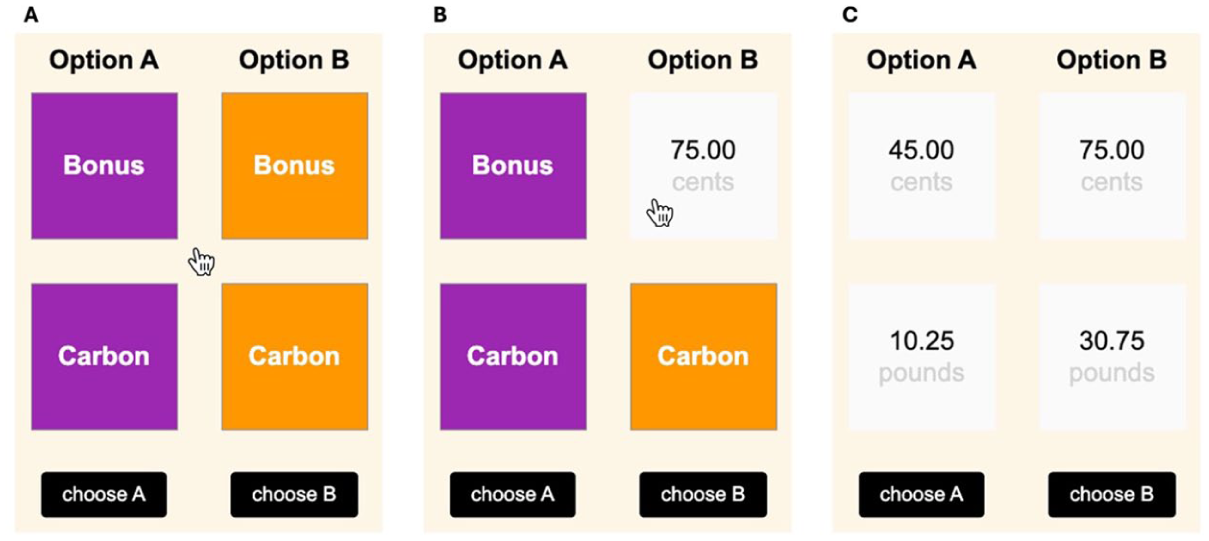
Illustration of a trial of the CET variant: (A) bonus and carbon information is initially hidden behind boxes; (B) hovering over a box reveals its content; (C) all boxes opened simultaneously for demonstration purposes.
Participants were informed that, at the end of the experiment, one of their decisions would be randomly selected for real-world implementation. They would receive the monetary bonus associated with their chosen option, and if they had chosen the low-carbon option, carbon certificates would be purchased and retired via the non-governmental organization compensators.org. The volume of carbon offset would match the difference in carbon emissions between the two options, effectively neutralizing the avoided emissions. The certificates were sourced from the European Union Emissions Trading System (EU-ETS), a cap-and-trade system in which retiring certificates reduces the total emissions allowed for regulated polluters within the EU (e.g., airlines or energy companies), thereby creating tangible climate impact. This approach has been used in previous experimental studies to allocate real environmental consequences to participant behavior in stylized laboratory decision tasks (Ockenfels et al., 2020; Wyss et al., 2022).
Making pro-environmentally behavior costly in all trials presented to participants, the lower-emission option always carried a lower bonus. Average bonus levels were 60 USD cents (reflecting the mean bonus in the traditional CET) and average carbon emissions were 19.85 lbs CO2 (the highest carbon level in the traditional CET, chosen to increase climate-relevant stakes). The relative differences in bonus and carbon levels between options systematically varied across five levels (10%, 15%, 20%, 50%, and 100%). These variations notably help identify the decision threshold at which participants shift preferences between options. By overrepresenting smaller differences, the task enhances sensitivity to individual differences in cost-benefit trade-offs and information processing strategies (Figner et al., 2010; Reeck et al., 2017). Small random deviations to average levels were introduced to avoid perfect predictability between options and promote active information search.
Each trial began with participants clicking a central fixation cross, ensuring an equal starting distance to all information boxes. The side displaying the high-emission option was randomized within participants and trials to minimize potential position effects on information search. The vertical position of attributes (top vs. bottom) was randomized between participants but kept constant within each participant to allow familiarity with attribute positions. Trial order was fully randomized.
Process-Tracing with MouselabWEB
We recorded participants' information acquisition in the CET using MouselabWEB, an open-source process-tracing tool that captures how individuals gather information in standard web browsers by tracking their mouse movements (Willemsen & Johnson, 2019). In MouselabWEB, each piece of information is initially hidden behind boxes (Figure 1A) and is revealed only when participants hover their mouse over them (Figure 1B). Information is hidden again once the mouse moves away. From this data, we derived several process-tracing measures:
Δ Duration on attributes captures the relative time spent inspecting carbon vs. bonus attributes within a trial. This measure is normalized for total inspection time and ranges from −1 (exclusive focus on bonus information) to +1 (exclusive focus on carbon information), with 0 indicating equal distribution of attention. We computed it as follows, with t representing the visiting time on a specific attribute (Carbon or Bonus) of options (Env or Self):

Δ Duration on options captures the relative time spent on the pro-environmental vs. pro-self option within a trial. It ranges from −1 (exclusive focus on the pro-self option) to +1 (exclusive focus on the pro-environmental option), with 0 indicating equal attention to both options.

The first acquisition captures the first attribute visited within each trial, coded as 1 (first visit on a carbon box) and 0 (first visit on a bonus box). This reflects the initial focus of attention and is computed based on the order of box openings.
The last acquisition captures the final attribute visited before a decision is made, similarly coded as 1 for carbon and 0 for bonus. This measure reflects the final piece of information considered.
The Payne Index captures search strategies by comparing transitions within options (switching between attributes of the same option) vs. between options (switching between the same attribute across options). It ranges from −1 to +1, with negative values indicating a comparative search, and positive values indicating an integrative search.

We also assessed the total visiting time spent on gathering information in a trial (in milliseconds) and the actual decision (coded 1 if the pro-environmental option was chosen, 0 if the pro-self option was chosen).
Questionnaires
After the experimental part of the study, participants were asked to answer questions about their experience during the experiment. They were asked to indicate their belief in the effectiveness of buying and destroying carbon emission certificates from the EU-ETS for reducing emissions using a 5-point Likert scale. Participants then provided demographic information, including gender, age, educational level, household income. They were then asked whether they were currently following a vegetarian diet (i.e., refraining from eating meat), a vegan diet (i.e., refraining from eating any animal products), another type of diet (open-ended) or no specific diet. This question was identical to the one used in the Prolific pre-screener for participant recruitment based on their diet. Vegetarian and vegan participants were further asked about the pivotal role of the environment in their decision to refrain from eating meat. Finally, we assessed participants’ environmental attitudes using the 15-item New Ecological Paradigm scale (NEP-R; Dunlap et al., 2000).
Data Analysis
Data Pre-Processing
A pre-registered data reduction procedure was performed to ensure good data quality. First, we discarded, within trial, all box openings shorter than 200ms. We then employed a 3-out-of-4 outlier detection procedure: a trial was classified as a participant-specific outlier if its total box opening time was flagged by at least three of four methods. These included the 1.5xIQR (outside 1.5 times the Interquartile Range), the Z-score (outside mean ± 1.96 standard deviation), the robust Z-score (outside median ± 1.96 median absolute deviation) and the 95% Confidence Interval (outside the interval) methods. Participants with more than 5 trials that were missing, invalid or had no box openings were excluded. This led to the removal of 37 participants (7.4% of the recruited sample), and 382 trials (3.3% of all trials).
An unexpectedly high number of participants (N = 95) provided inconsistent responses regarding their dietary habits when comparing the Prolific pre-screener and the follow-up questionnaire administered via Qualtrics. To ensure data integrity, primary analyses were conducted on participants who responded consistently across both assessments, resulting in a final sample of 368 participants (73.6% of those initially recruited) 1 . Vegetarians who identified as vegans in the follow-up questionnaire were retained in the sample, as veganism represents a stricter form of vegetarianism that aligns with our operational definition. This sample size remained sufficient to detect the SESOI with an estimated power between 90% and 95% at α = .05 (see Supplementary Figure 1). For transparency, all analyses were also repeated using the full sample (N = 463), irrespective of consistency in diet reports, and are fully reported in Appendix A. All process-tracing measures were aggregated per trial. The data was prepared, aggregated, and analysed using R (R Core Team, 2017).
Data Analyses
Analyses were pre-registered, and exploratory analyses are labelled as such. To compare vegetarians and non-vegetarians in the proportion of pro-environmental decisions made in the CET, we ran generalized linear mixed-effects models (GLMMs) with decision as the dependent variable and random intercepts for participants and trials (see Table 1 for model overview). In the first model (M1.1), we included vegetarianism (coded as 1 for vegetarians, 0 for non-vegetarians) as the main predictor of interest. Additionally, attribute position (coded as 1 if carbon emissions were displayed at the top of the matrix, 0 if at the bottom) and option position (coded as 1 if the pro-environmental option was on the left, 0 if on the right) were also included as fixed effects to account for potential display effects. In the second model (M1.2), we tested the sensitivity of results of M1.1 to the addition of control variables related to the task by adding fixed effects for percentage difference in carbon emissions (ranging from 1 [10%] to 5 [100%]), percentage difference in bonus payment (ranging from 1 [10%] to 5 [100%]) and sequential position of the trial (ranging from 1 to 25). In the third model (M1.3), we tested the sensitivity of results of M1.1 to the addition of individual control variables by adding fixed effects for gender (coded 1 for woman, 0 for man), age, education level (ranging from 1 to 6), household income level (ranging from 1 to 7), environmental attitudes score, and perceived CO2 certificates efficacy (ranging from 1 to 5).
Overview of the Primary Mixed-Effect Models.
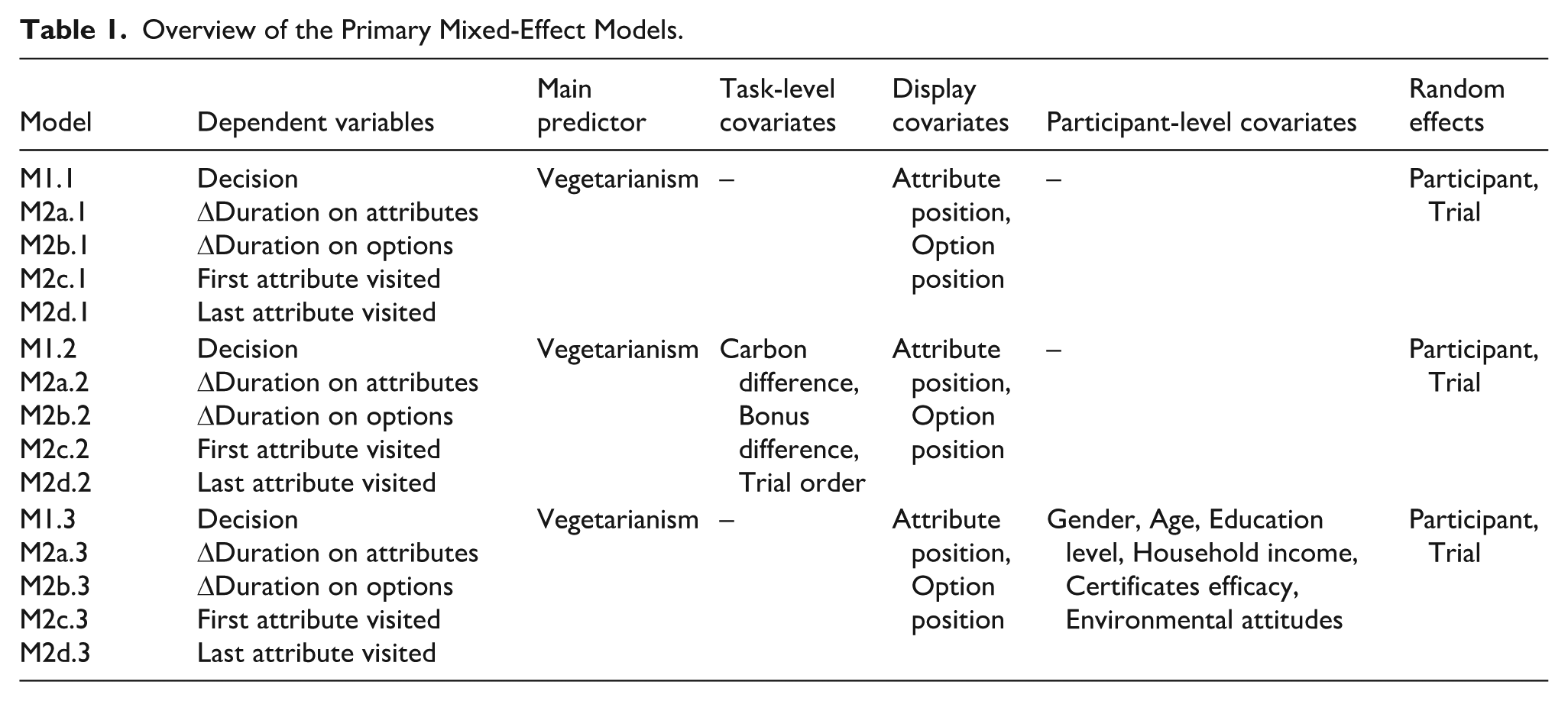
To compare vegetarians and non-vegetarians in their information acquisition during environmental decision-making, we ran linear mixed-effects models (LMMs; for continuous outcomes) and GLMMs (for binary outcomes) that replicate the model structure of M1.1 to M1.3 and replace decision with a process tracing measure (i.e., ΔDuration on attributes, ΔDuration on options, first acquisition, last acquisition) as the dependent variable. If any control variables showed significant effects in our models, we examined potential interactions with vegetarianism. Post-hoc simple slopes analyses and graphs were created to interpret the significant interactions.
Next, we conducted exploratory analyses to explore whether vegetarians and non-vegetarians differ on other process-tracing measures. We replicated the model structure of M1.1, replacing decision with total visiting time or the Payne Index as the dependent variable. As some vegetarians may have adopted their diet primarily for health or animal welfare reasons, we also conducted supplementary analyses by restricting the vegetarian subsample to those who reported environmental motivations as their pivotal reason for being vegetarian (N = 122, 62% of the vegetarian sample). The same statistical models were rerun for all our measures, except that the predictor variable vegetarianism was changed to environmental vegetarianism (coded 1 if the participant is vegetarian for environmental reasons, 0 if non-vegetarian). The results are briefly described in the manuscript together with those on our full sample and thoroughly reported in Appendix B. Finally, we additionally ran exploratory models testing whether each process tracing measure individually predicted pro-environmental choice to support the interpretation of group-level differences in information acquisition. Although not pre-registered, these analyses help establish the relevance of attentional processes in the context of decision-making. All continuous predictors were mean-centered to improve model convergence and interpretability, except for variables already scaled between −1 and 1, which were left untransformed.
Results
Descriptive Statistics
Our final sample consisted of 196 vegetarians and 172 non-vegetarians. The groups did not differ in terms of gender balance, age, household income or environmental attitude score (see Table 2). However, vegetarians had a significantly higher level of education and perceived the destruction of CO2 certificates as more efficient than non-vegetarians did. Vegetarians tended to favor the pro-environmental option, choosing it in 57% of the trials. Among them, 45 participants always chose the pro-environmental option, while 32 participants always chose the pro-self option. Non-vegetarians showed less preference for either option (51% of pro-environmental decisions). Of these, 23 participants chose all the low-carbon options, while 30 participants consistently chose the high-bonus options.
Descriptive Statistics Per Diet.
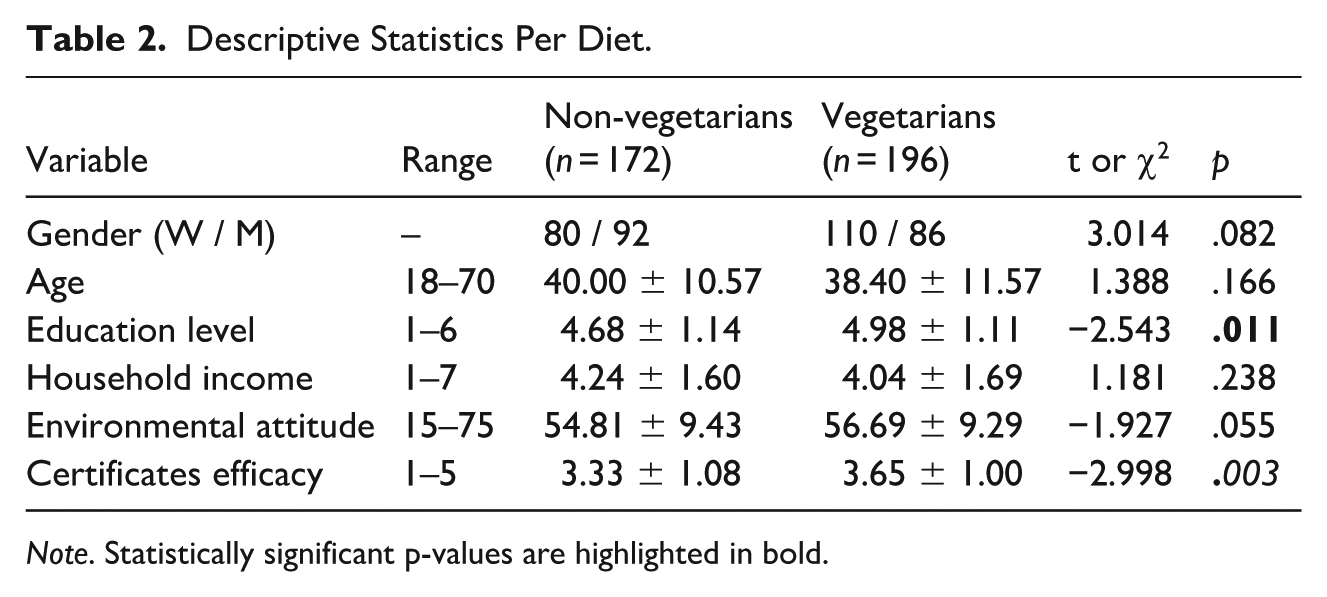
Note. Statistically significant p-values are highlighted in bold.
Main Analyses
Vegetarianism as a Predictor of Pro-Environmental Decision
To investigate whether vegetarianism predicts pro-environmental decisions, we fitted GLMMs with decision as the dependent variable, including random intercepts for participants and trials, and controlling for attributes and options position. Task-level covariates were added to M1.2, and participant-level covariates to M1.3.
Vegetarianism was found to significantly predict pro-environmental decision-making in both M1.1 (OR = 3.36, p = .015, 95% CI [1.26, 8.96]) and M1.2 (OR = 3.35, p = .016, 95% CI [1.26, 8.93]), indicating that vegetarians were more likely than non-vegetarians to select the pro-environmental option in the CET (see Table 3). However, this effect weakened in M1.3 (OR = 1.83, p = .234, 95% CI [0.68, 4.98]), suggesting that perceived efficacy of CO2 certificates and environmental attitudes, which were stronger among vegetarians than non-vegetarians (t(351) = −2.998, p = .003, and t(358) = −1.927, p = .055, respectively), may have partially accounted for the observed effect. Nevertheless, M1.2 demonstrated a better model fit, outperforming M1.1 and M1.3 by 32 BIC points.
Generalized Linear Mixed-Effects Models Testing the Effect of Vegetarianism on Pro-Environmental Decisions, Accounting for Variations Between Participants and Trials, and Controlling for Attribute and Option Position (M1.1), and for Task-Level Covariates (M1.2) or Participant-Level Covariates (M1.3).
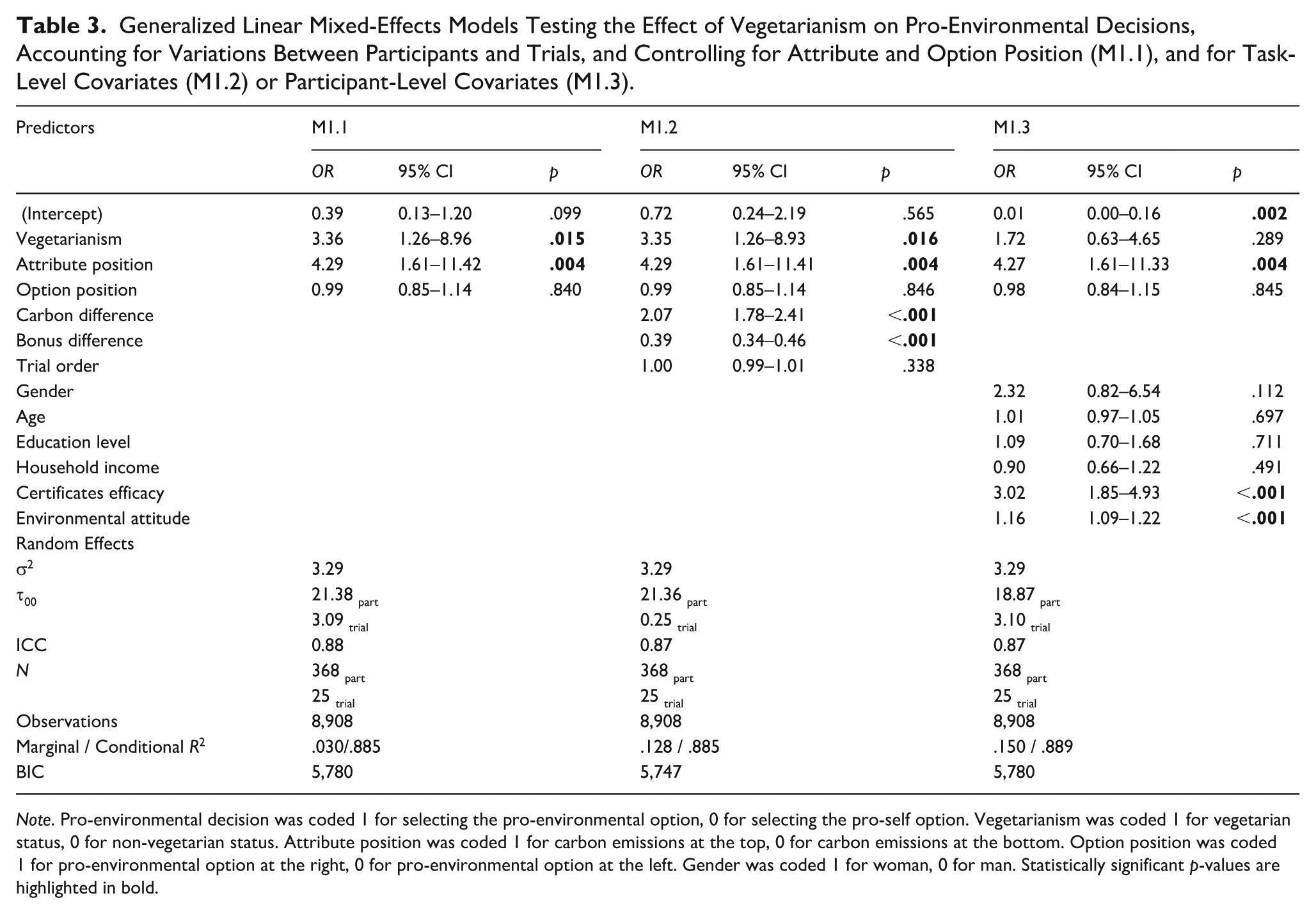
Note. Pro-environmental decision was coded 1 for selecting the pro-environmental option, 0 for selecting the pro-self option. Vegetarianism was coded 1 for vegetarian status, 0 for non-vegetarian status. Attribute position was coded 1 for carbon emissions at the top, 0 for carbon emissions at the bottom. Option position was coded 1 for pro-environmental option at the right, 0 for pro-environmental option at the left. Gender was coded 1 for woman, 0 for man. Statistically significant p-values are highlighted in bold.
Post hoc analyses on significant covariates revealed several interactions with vegetarianism. Firstly, the percentage difference in carbon emissions between the options moderated the effect (OR = 0.85, p = .004, 95% CI [0.77, 0.95]). Vegetarians were more inclined than non-vegetarians to make pro-environmental choices when environmental impact differences were low (10%: OR = 0.24, p = .006, 95% CI [0.09, 0.66]) to moderate (50%: OR = 0.33, p = .028, 95% CI [0.12, 0.88]). However, this inclination was not observed when environmental impact differences were high (100%: OR = 0.45, p = .125, 95% CI [0.16, 1.25]), where both groups were equally likely to select the pro-environmental option (see Figure 2A and Supplementary Table 1).
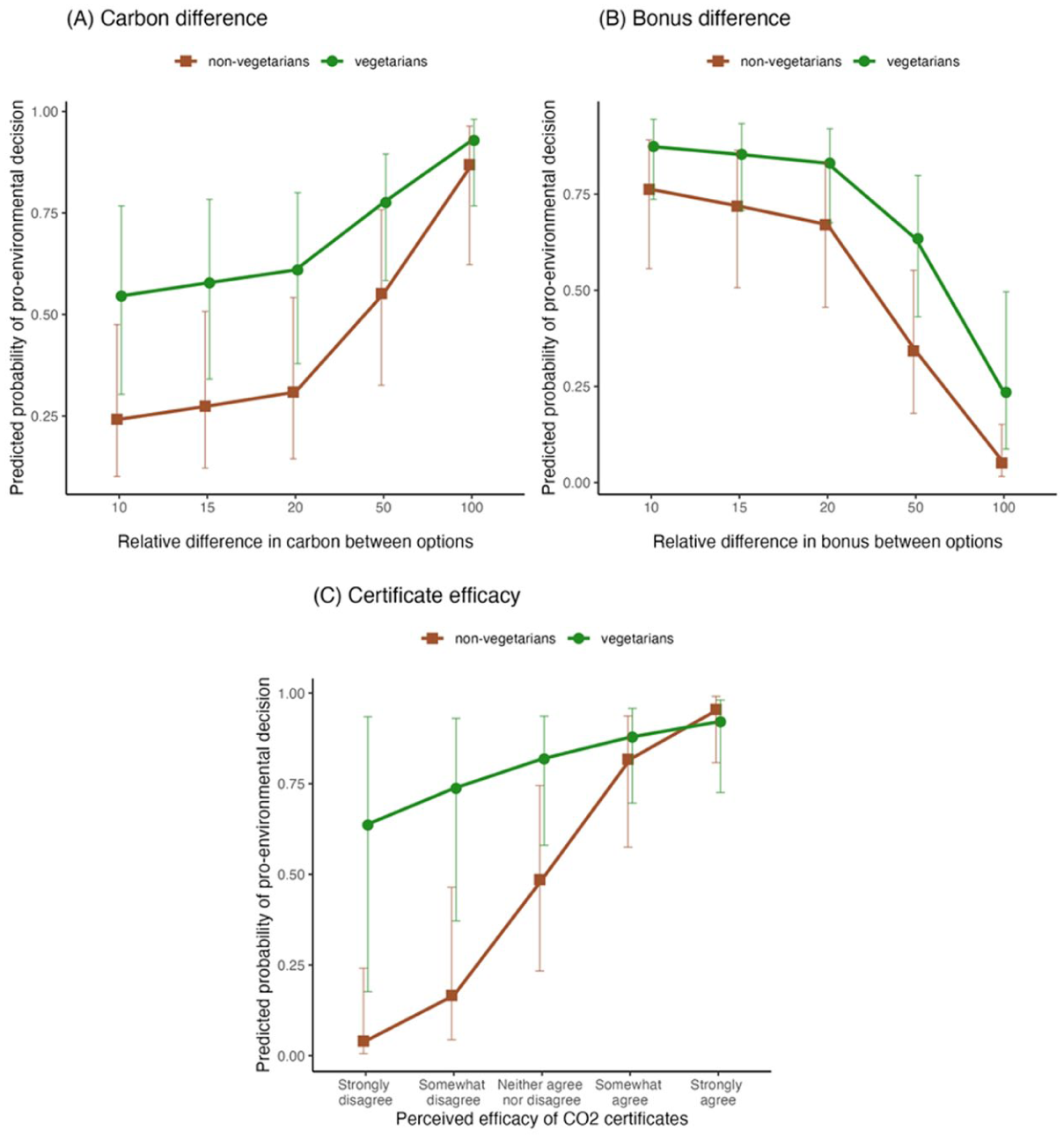
Adjusted marginal effects predicting the probability of making a pro-environmental decision among vegetarians and non-vegetarians, depending on (A) the relative difference in carbon emissions between options, (B) the relative difference in bonus payment between options or (C) the perceived efficacy of CO2 certificates to reduce carbon emissions.
Secondly, the difference in the bonuses offered by the two options also moderated the effect (OR = 1.25, p < .001, 95% CI [1.12, 1.41]). Vegetarians demonstrated a greater propensity than non-vegetarians to opt for the pro-environmental alternative when the financial cost was moderate (50%: OR = 0.34, p = .030, 95% CI [0.12, 0.90]) to high (100%: OR = 0.21, p = .003, 95% CI [0.08, 0.59]), whereas both groups exhibited a similar tendency when costs were low (10%: OR = 0.53, p = .218, 95% CI [0.19, 1.46]; see Figure 2B). Collectively, these findings imply that non-vegetarians demonstrated heightened sensitivity to cost-benefit trade-offs, while vegetarians exhibited more consistent propensity for pro-environmental choices.
Thirdly, an interaction with perceived efficacy of CO2 certificates emerged (OR = 0.33, p = .030, 95% CI [0.12, 0.90]). When the implementation of the pro-environmental option (through the purchase of CO2 certificates) was perceived as ineffective in reducing carbon emissions, vegetarians were more likely than non-vegetarians to select it (lowest score: OR = 0.03, p = .009, 95% CI [0.00, 0.40]; see Figure 2C). This finding suggests that their pro-environmental decisions were not solely driven by perceived impact but may have reflected a broader value-based or principled stance. When the certificates were perceived as effective, the two groups did not differ in their choices (highest score: OR = 2.25, p = .381, 95% CI [0.37, 13.74]). Finally, no significant interactions were found between vegetarianism and attribute position (OR = 1.77, p = .569, 95% CI [0.25, 12.53]) or environmental attitudes (OR = 1.04, p = .493, 95% CI [0.93, 1.16]).
Vegetarianism as a Predictor of Information Acquisition
To examine whether vegetarianism predicts information acquisition, a series of GLMMs and LMMs were fitted using the following process tracing measures as the dependent variable: a) ΔDuration on attributes, b) ΔDuration on options, c) first visit, and d) last visit. The models incorporated random intercepts for participants 2 and controlled for attribute and option position. Task-level covariates were added to Models 2.2, and participant-level covariates to Models 2.3.
ΔDuration on Attributes
The fixed effect of vegetarianism was significantly positive in both M2a.1 (b = 0.10, p = .038, 95% CI [0.01, 0.19]) and M2a.2 (b = 0.10, p = .038, 95% CI [0.01, 0.19]), indicating that vegetarians paid more attention to the carbon emissions of options than non-vegetarians (see Table 4). However, this effect was attenuated and no longer significant in M2a.3 (b = 0.05, p = .246, 95% CI [−0.04, 0.15]), again suggesting an important role of environmental attitudes and/or perceived efficacy of certificates on the observed effect. The model with the best fit was M2a.1, with BIC values improving by 11 and 22 points over M2a.2 and M2a.3, respectively.
Linear Mixed-Effects Models Testing the Effect of Vegetarianism on ΔDuration on Attributes, Accounting for Variations Between Participants and Trials, and Controlling for Attribute and Option Position (M2a.1), and for Task-Level Covariates (M2a.2) or Participant-Level Covariates (M2a.3).
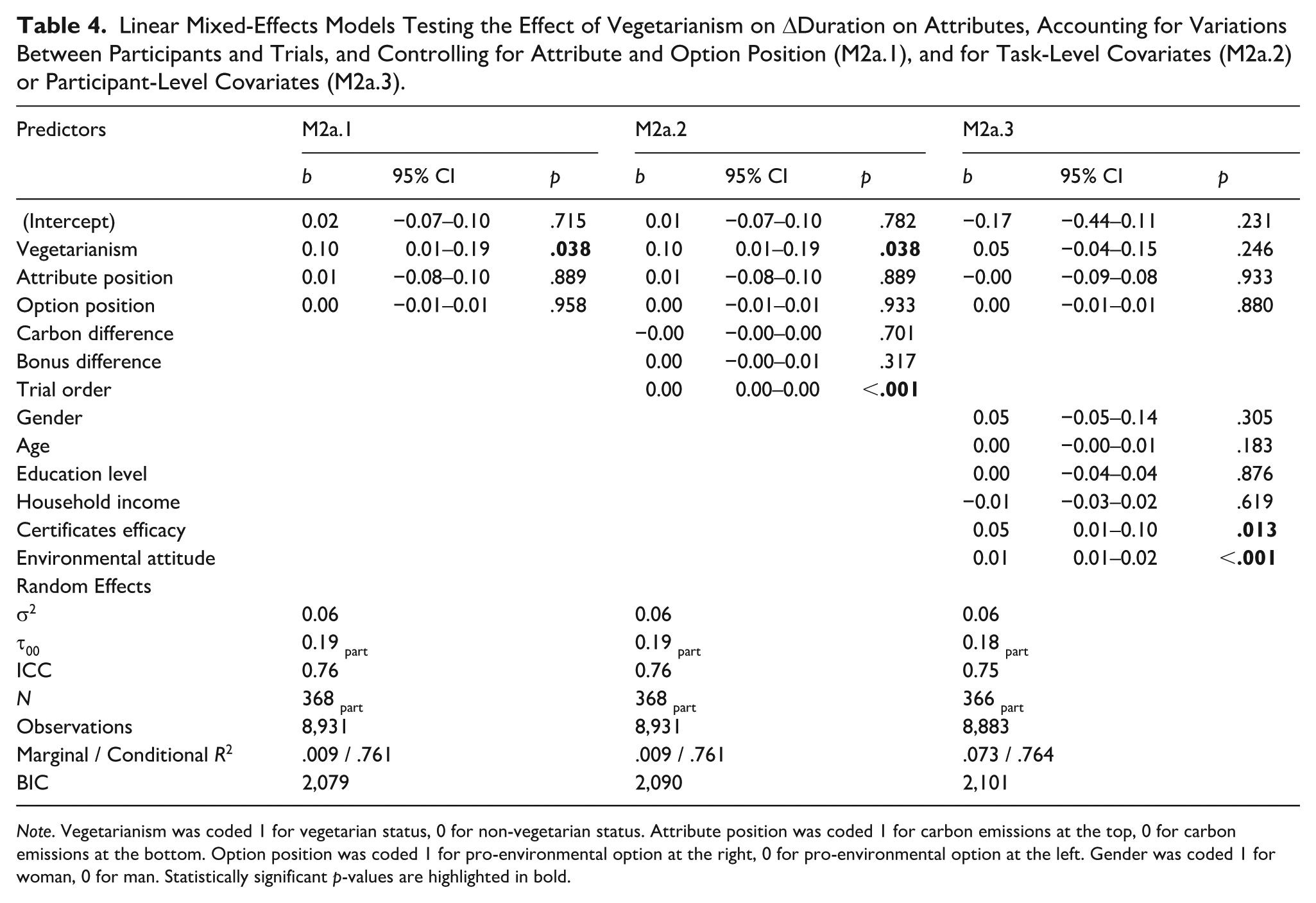
Note. Vegetarianism was coded 1 for vegetarian status, 0 for non-vegetarian status. Attribute position was coded 1 for carbon emissions at the top, 0 for carbon emissions at the bottom. Option position was coded 1 for pro-environmental option at the right, 0 for pro-environmental option at the left. Gender was coded 1 for woman, 0 for man. Statistically significant p-values are highlighted in bold.
Post hoc analyses revealed a significant interaction between vegetarianism and trial order (b = 0.00, p = .009, 95% CI [0.00, 0.00]). As participants progressed through the task and became more familiar with the decision environment, vegetarians increasingly prioritized environmental information, whereas non-vegetarians maintained balanced attention to both environmental impact and financial incentives (trial 1: b = 0.07, p = .123, 95% CI [−0.02, 0.16]; trial 25: b = 0.12, p = .012, 95% CI [0.03, 0.21]; see Figure 3A). No significant interactions were observed for the perceived efficacy of CO2 certificates (b = −0.08, p = .057, 95% CI [−0.17, 0.00]) or environmental attitudes (b = 0.00, p = .869, 95% CI [−0.01, 0.01]).
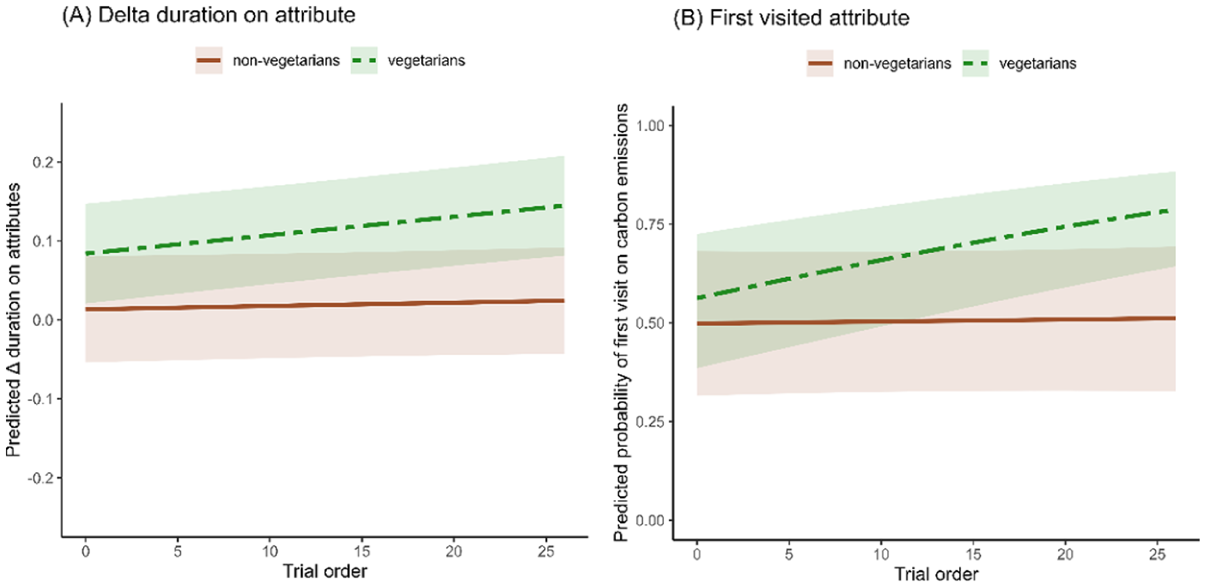
Adjusted marginal effects predicting (A) the ΔDuration on the carbon emissions (vs. monetary bonus) attributes or (B) the probability of first visiting carbon emissions (vs. monetary bonus) attributes among vegetarians and non-vegetarians, depending on the trial order.
ΔDuration on Options
Vegetarianism did not significantly predict the proportion of time spent visiting the pro-environmental option compared to the pro-self option in any of the models (M2b.1: b = 0.02, p = .071, 95% CI [−0.00, 0.04]; M2b.2: b = 0.02, p = .073, 95% CI [−0.00, 0.04]; M2b.3: b = 0.01, p = .299, 95% CI [−0.01, 0.03]; see Supplementary Table 2).
First Attribute Visited
The fixed effect of vegetarianism was significantly positive in both M2c.1 (OR = 3.06, p = .008, 95% CI [1.34, 6.98]) and M2c.2 (OR = 2.37, p = .024, 95% CI [1.12, 5.02]), indicating that being vegetarian was associated with higher likelihood of first visiting the carbon emissions of options (see Table 5). However, this effect was attenuated in M2c.3 (OR = 2.17, p = .068, 95% CI [0.94, 4.97]), again suggesting a potential confounding effect of environmental attitudes on vegetarianism. Model fit was better for M2c.2, with BIC values improving by 10 and 26 points over M2c.1 and M2c.3, respectively.
Generalized Linear Mixed-Effects Models Testing the Effect of Vegetarianism on First Attribute Visited, Accounting for Variations Between Participants and Trials, and Controlling for Attribute and Option Position (M2c.1), and for Task-Level Covariates (M2c.2) or Participant-Level Covariates (M2c.3).
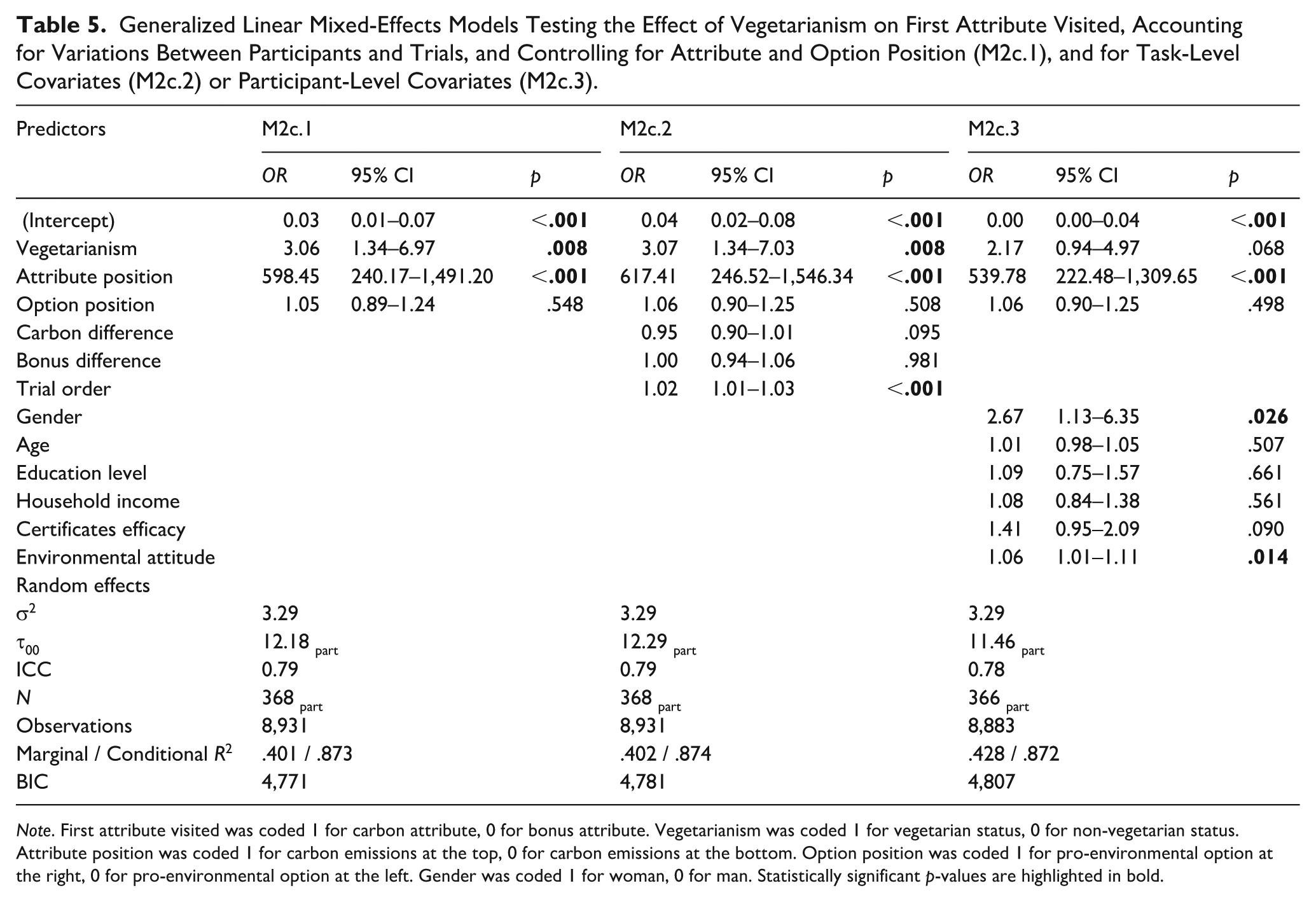
Note. First attribute visited was coded 1 for carbon attribute, 0 for bonus attribute. Vegetarianism was coded 1 for vegetarian status, 0 for non-vegetarian status. Attribute position was coded 1 for carbon emissions at the top, 0 for carbon emissions at the bottom. Option position was coded 1 for pro-environmental option at the right, 0 for pro-environmental option at the left. Gender was coded 1 for woman, 0 for man. Statistically significant p-values are highlighted in bold.
Post hoc analyses again revealed a significant interaction between vegetarianism and trial order (OR = 1.04, p < .001, 95% CI [1.02, 1.06]). As trials progressed, vegetarians increasingly made their first visit on the environmental information, whereas non-vegetarians consistently distributed their initial attention equally between environmental impact and financial incentives (trial 1: OR = 1.35, p = .578, 95% CI [0.47, 3.82]; trial 25: OR = 3.40, p = .022, 95% CI [1.20, 9.66]; see Figure 3B). No significant interactions were observed for attribute position (OR = 0.24, p = .093, 95% CI [0.05, 1.27]), gender (OR = 2.17, p = .451, 95% CI [0.29, 16.16]) or environmental attitudes (OR = 1.04, p = .483, 95% CI [0.93, 1.17]).
Last Attribute Visited
Vegetarianism did not significantly predict the last attribute visited before making the decision in any of the models (M2d.1: OR = 1.40, p = .075, 95% CI [0.97, 2.02]; Model 2d.2: OR = 1.40, p = .076, 95% CI [0.97, 2.02]; M2d.3: OR = 1.26, p = .226, 95% CI [0.87, 1.84]; see Supplementary Table 3).
Exploratory Analyses
Vegetarianism as a Predictor of Search Strategy and Visit Duration
We further explored whether vegetarianism predicted attentional search strategies and visit duration by fitting LMMs with either the Payne index or total visiting time as the dependent variable. Models included random intercepts for participants and controlled for attribute and option position.
While both groups showed a negative Payne index on average (vegetarians: −0.44±0.44, non-vegetarians: −0.53±0.34), indicating that participants generally compared the same attribute across different options (e.g., comparing the carbon emissions of Option A and Option B), vegetarians displayed slightly more integrative search patterns than non-vegetarians (e.g., comparing the carbon emissions and bonus within the same option; b = 0.09, p = .034, 95% CI [0.01, 0.17]). Vegetarianism did not predict the total visiting time per trial in the CET (b = 0.01, p = .886, 95% CI [−0.08, 0.09]).
Attentional Measures as Predictors of Pro-Environmental Decision
To determine how attentional patterns influence choice, we fitted GLMMs predicting the likelihood of selecting the pro-environmental option. Each model included one process-tracing measure as a predictor and random intercepts for participants and trials.
Greater attentional allocation to the pro-environmental option (i.e., a more positive ΔDuration on options; OR = 36.98, p < .001, 95% CI [26.41, 51.80]) and increased focus on the environmental attribute across options (i.e., a more positive ΔDuration on attributes; OR = 5.26, p < .001, 95% CI [4.06, 6.80]) were both strong predictors of pro-environmental choice. Similarly, initiating attention with the environmental information (OR = 1.75, p < .001, 95% CI [1.37, 2.22]) or ending the visual inspection with that attribute (OR = 1.53, p < .001, 95% CI [1.30, 1.80]) also significantly increased the likelihood of selecting the pro-environmental option. By contrast, neither the Payne Index (OR = 0.91, p = .069, 95% CI [0.81, 1.01]) nor total visiting time (OR = 1.00, p = .999, 95% CI [0.84, 1.19]) significantly predicted choice.
Supplementary Analyses on Inconsistent Sample and Environmental Vegetarians
When including participants with inconsistent diet reports, we found similar or weaker effects of vegetarianism. In this sample, vegetarianism significantly predicted only the decision and the first attribute visited. As in our main analyses, the effects on decision and first attribute visited became non-significant once environmental attitudes were controlled for (see Appendix A). In contrast, stronger effects emerged when focusing exclusively on vegetarians who reported pivotal environmental motivations. Moreover, environmental vegetarianism remained a significant predictor of decision and first attribute visited after controlling for environmental attitudes and became a significant predictor of ΔDuration on options in M2b.1 and M2b.2 (see Appendix B).
Discussion
The present study aimed to respond to recent calls for a more predictive and nuanced understanding of the processes underlying pro-environmental decision-making (Doell et al., 2023; Nielsen et al., 2024; Sawe & Chawla, 2021). To this end, we examined how individuals who adhere to a dietary practice of high environmental significance (i.e. vegetarians) make pro-environmental decisions beyond the domain of food. Specifically, the study investigated not only the decisions made by vegetarians within the abstract context of the CET, but also how they searched for and processed information relevant to their subsequent decision, in comparison to non-vegetarians.
Our findings provide evidence that, in a non-dietary context, vegetarians were more likely than non-vegetarians to make pro-environmental choices. However, this tendency was not consistent across all vegetarians, as descriptive statistics revealed that 32 participants (16% of the vegetarian sample) systematically chose the pro-self, environmentally detrimental option in every trial, illustrating individual variability within the group. One possible explanation for this heterogeneity is that vegetarianism can arise from motivations unrelated to environmental concern, such as health or animal welfare. In line with this idea, environmental attitudes also predicted pro-environmental choices and reduced the unique contribution of vegetarianism when included in the model, suggesting that the explanatory value of vegetarianism partly overlaps with individuals’ broader environmental commitment. This interpretation is reinforced by our supplementary analyses of environmental vegetarians, i.e. vegetarians who declared the environment played a pivotal role in their dietary choice. Representing most of our vegetarian sample (62%), this subgroup demonstrated an even stronger tendency to select the pro-environmental option, and this effect remained significant across all models. These results are consistent with Henn et al. (2020), who notably support that environmental attitudes, identity and values are critical for positive behavioral spillover to occur. Nonetheless, vegetarianism itself may still serve as a meaningful behavioral marker of broader environmental commitment. This interpretation aligns with previous findings by Kaiser and Byrka (2014), who reported higher Campbellian attitude scores among vegetarians, indicating a greater propensity to engage in costly pro-environmental behaviors in everyday life.
Importantly, our results reveal that vegetarians were more likely than non-vegetarians to select the pro-environmental option particularly when such decisions entailed high personal costs, low perceived effectiveness and/or yielded low environmental benefits. This pattern suggests a more principled and less strategic decision-making style, whereby vegetarians appear to act for the environment “at all costs” and despite anecdotal effects. Such behavior aligns with a value-driven orientation rather than a cost–benefit calculation and may reflect their environmental commitment in their daily life. Indeed, it is highly probable that vegetarians recognize the negligible influence their dietary practices have on climate change, yet they persist in those behaviors that may entail substantial practical and social costs, in an effort to play their part in a collective cause. Our supplementary analyses demonstrate even greater differences between environmental vegetarians and non-vegetarians in cases involving high financial costs or low environmental impact, further supporting this interpretation.
Beyond final choices, vegetarians also differed from non-vegetarians in how they processed information during decision-making. In our best fitted models, vegetarians were more likely to initially attend to the environmental impact of the options and spent more time processing this information relative to financial incentives. However, vegetarianism did not significantly predict the last attribute visited or the proportion of time spent on each option, notably suggesting that group differences were more pronounced at the attribute level (bonus vs. carbon boxes) than the option level (pro-self vs. pro-environmental option). Post hoc analyses revealed that these attentional differences became more pronounced as participants gained familiarity with the task structure, since vegetarians increasingly prioritized environmental information as trials progressed, whereas non-vegetarians distributed their attention equally to both attributes. These findings are consistent with previous work showing that individuals with stronger Campbellian environmental attitudes allocated more (initial) attention to environmental information, particularly once they learned where it was located (Bollen et al., 2025). When examining environmental vegetarians specifically, group differences in attention became more pronounced. These participants were significantly more likely to begin each trial by visiting environmental attributes than non-vegetarians, and allocated more attention to the pro-environmental option. Moreover, the moderating effect of trial order disappeared when predicting ΔDuration on attributes, suggesting that environmental vegetarians prioritized environmental information from the outset. Interestingly, the increased attention to carbon emissions among environmental vegetarians compared to non-vegetarians was most pronounced when both groups doubted the effectiveness of carbon certificates, echoing the interaction effect previously observed on decision.
Our exploratory analysis of attentional strategies revealed additional groups differences. Although both groups spent similar amounts of time acquiring information, vegetarians adopted a more integrative search style, as indicated by a higher Payne index. Non-vegetarians were found to engage more in attribute-based comparisons, a search strategy reliant upon the calculation of discrepancies in bonuses relative to those in carbon emissions (Reeck et al., 2017) and consistent with their tendency to select pro-environmental options only when the difference in carbon emission was substantial and/or the difference in bonus was low. While the tendency for comparative search across all participants likely reflects the spatial layout of the task (Khaw et al., 2018) and participants’ low familiarity with carbon emission units compared to monetary units, the more integrative pattern observed in vegetarians aligns with previous findings showing that vegetarians tend to engage in more analytic cognitive thinking (Bègue & Vezirian, 2023, 2025), and that a more rationale, analytic information processing (as opposed to intuitive, heuristic-based processing) is notably indexed by a higher Payne index (Kwak et al., 2015; Reeck et al., 2017).
The observed differences in information acquisition patterns are crucial, given the results of exploratory analyses demonstrating that attention allocation (through visiting time, first visit, or last visit) is meaningfully tied to pro-environmental decision-making. Because (un)attended information is (un)likely to influence choice (Orquin & Mueller Loose, 2013), directing more and earlier attention to environmental impact may increase its weight in the decision process and, ultimately, the likelihood of pro-environmental outcomes. Hence, our findings suggest that sustainable dietary practices are associated with differences in the early stages of decision-making – namely, in attention allocation. Nevertheless, since our study was cross-sectional, we cannot conclude that vegetarianism causes these attentional differences; they may instead reflect a broader pattern of environmental engagement. In the same vein, although spillover is typically conceptualized as the adoption of one (pro-environmental) behavior following another, our design does not capture this temporal sequence and therefore cannot test longitudinal spillover from dietary choices to subsequent changes in behavior. Future studies could investigate this temporal dimension more directly and also examine how decision-making processes evolve from new to long-term vegetarians. Moreover, given the variability in behavioral consistency observed in our task, it would be valuable to assess whether consistency in vegetarian dietary adherence aligns with consistency in other pro-environmental behaviors, for instance using ecological momentary assessment.
Conclusion
This study sheds new light on the cognitive mechanisms of pro-environmental behavior by focusing on a group whose daily practices significantly help mitigating climate change. Vegetarians showed a greater tendency than non-vegetarians to select the pro-environmental option in a domain unrelated to diet, and process-tracing data revealed that they allocated more and earlier attention to environmental information. This attentional focus, in turn, predicted pro-environmental choices. Together, these findings suggest that vegetarians may rely on a more value-driven decision-making style that places particular weight on environmental considerations and support the view that vegetarianism can serve as a behavioral proxy for environmental commitment. Considering the rising trend of individuals opting for vegetarian diet (Sullivan et al., 2024), such patterns may signal a broader shift toward deeper environmental engagement.
Supplemental Material
sj-docx-1-eab-10.1177_00139165261419611 – Supplemental material for How Do Vegetarians Make Pro-Environmental Decisions Unrelated to Food Choice? A MouselabWEB Study
Supplemental material, sj-docx-1-eab-10.1177_00139165261419611 for How Do Vegetarians Make Pro-Environmental Decisions Unrelated to Food Choice? A MouselabWEB Study by Zoé Bollen, Daria Knoch and Sebastian Berger in Environment and Behavior
Footnotes
Acknowledgements
We would like to thank Emmanuel Guizar-Rosales for his support with the power analysis and for developing the task used in this study. We would also like to thank Mirjam Matile for her help with designing the survey.
Ethical Considerations
The study was approved by the Ethics Committee of the University of Bern (no. 2025-03-02) and conducted in accordance with the declaration of Helsinki.
Consent to Participate
Participants provided written informed consent to participate in the study.
Authors Contribution
Conceptualization: DK, SB, ZB; Data curation: ZB; Formal analysis: ZB; Funding acquisition: DK; Investigation: ZB; Methodology: ZB; Project administration: DK, SB, ZB; Resources: DK; Software: ZB; Supervision: DK, SB; Validation: DK, SB, ZB; Visualization: ZB; Writing - original draft: ZB; and Writing - review & editing: DK, SB.
Funding
The authors disclosed receipt of the following financial support for the research, authorship, and/or publication of this article: This work was supported by a grant from the Typhaine Foundation awarded to Daria Knoch.
Declaration of Conflicting Interests
The authors declared no potential conflicts of interest with respect to the research, authorship, and/or publication of this article.
Data Availability Statement
The data, material and code are made publicly available on Open Science Framework (https://osf.io/v6xwk) platform. All tables and graphs are available online for analyses on consistent sample (https://rpubs.com/veggie/main_analyses_consistent_sample), full sample (Appendix A: https://rpubs.com/veggie/full-sample) and environmental vegetarian sample (Appendix B:  ).
).
Supplemental Material
Supplemental material for this article is available online.
Notes
Author Biographies
References
Supplementary Material
Please find the following supplemental material available below.
For Open Access articles published under a Creative Commons License, all supplemental material carries the same license as the article it is associated with.
For non-Open Access articles published, all supplemental material carries a non-exclusive license, and permission requests for re-use of supplemental material or any part of supplemental material shall be sent directly to the copyright owner as specified in the copyright notice associated with the article.
