



Abstract
With the help of various smart energy technologies, consumers are envisioned to become active participants in the energy systems of the future. However, the lack of knowledge and confidence among the public pose significant barriers to the widespread adoption of many smart grid technologies. This study investigates the relationships between technological knowledge, self-efficacy and consumer adoption of smart grid technologies. We conducted an online survey of Finnish households and analyzed the data using structural equation modeling. We examined the direct effects of knowledge and self-efficacy, the mediating role of self-efficacy and the extent to which sociodemographic factors of age, gender and level of education may influence these study variables. Our results show that both technological knowledge and self-efficacy positively influence the adoption of smart grid technologies and that the effect of knowledge is partially mediated by self-efficacy. We also found significant relationships between sociodemographic factors and the main study variables.
Introduction
The European Union aims to become climate-neutral by 2050 (European Commission, 2024). As a part of the 2030 Climate Target Plan, the European Commission has proposed to reduce greenhouse-gas emissions within the European Union by at least 90% below 1990 levels by 2040 (European Commission, 2024). In addition to these ambitious climate goals, Europe’s clean energy transition is also driven by high fossil fuel prices and concerns of energy independence brought about by the war in Ukraine (European Commission, 2022). Replacing fossil fuels with renewable energy sources is a key component in the clean energy transition, both in Europe and globally. The International Energy Agency (IEA) projects that electricity generated by renewable energy sources will surpass that of coal by the end of 2025 (IEA, 2023). Wind and solar power are expected to account for 95% of the increase in renewable energy generation during 2023–2028 (IEA, 2023). As the share of renewable energy sources in Europe’s energy portfolio increases, so does the need to transform and upgrade European energy systems to accommodate these changes (Koolen et al., 2023; Kreifels et al., 2014). The intermittent availability of renewable energy sources such as wind and solar power is going place additional demands on energy systems’ capability to maintain the balance between generation and consumption (Riesz & Milligan, 2015).
Traditional fossil fuel-fired flexibility resources are increasingly being replaced by more environmentally friendly alternatives, such as new energy storage solutions and demand response (Fernandez-Marchante et al., 2020; Koolen et al., 2023). The European Commission expects the flexibility of consumers to be an important demand-side resource in the smart energy systems of the future (European Commission, 2021). In smart grids (SGs), consumers are envisioned to play a role more active than that of mere passive consumption. These active consumers, who not only actively manage their energy consumption but also may produce energy, have also been termed prosumers (Parag & Sovacool, 2016; Teotia et al., 2020). Residential consumers and prosumers can help reduce the dependency on fossil fuel-fired generating capacity and lessen the need for network investments by generating and storing energy and by adjusting their energy consumption at strategic times (Camilo et al., 2016; Consumer Electronics Association, 2011; Masihabadi et al., 2023). Active consumer involvement in SGs is made possible by various smart technologies, such as smart meters, in-home displays (IHDs), smart appliances and microgeneration technologies, as well as by the services that are enabled by these technologies, such as demand response (Avancini et al., 2019; Dileep, 2020; Schappert & von Hauff, 2020; Yang et al., 2014). Widespread adoption and use of domestic SG technologies are one of the key requirements for active consumer engagement, and consequently, the successful development of SGs.
Previous research has shown that there are still numerous barriers limiting the widespread acceptance and adoption of SG technologies, among which is the limited public knowledge and awareness of these technologies (Li et al., 2021; Marikyan et al., 2019; Sadat-Razavi et al., 2024). As a consequence of this lack of consumer knowledge, increasing the public scientific literacy through the provision of information and education has been suggested as a way to improve the adoption new energy technologies (Boudet, 2019). However, as will be discussed in more detail in the following section, research investigating the relationship between consumer knowledge and technology adoption has produced mixed results. At the same time, it has been shown that consumers often lack the necessary skills and confidence to use and benefit from various SG technologies (Balta-Ozkan et al., 2014; Christensen et al., 2020; Siitonen et al., 2023). Knowledge and confidence are closely related (Bearden et al., 2001), yet no previous research has investigated the interplay between technological knowledge and confidence-related factors, such as self-efficacy, in influencing consumer adoption of SG technologies. Self-efficacy, that is, “people’s beliefs about their capabilities to exercise control over their own level of functioning and over events that affect their daily lives” (Bandura, 1991) is an important component of personal agency, and may thus play a role in mediating the effects of technological knowledge on technology adoption. Moreover, much of the previous research has measured technology acceptance or adoption using behavioural intention. Although behavioural intention is widely used in research as a proxy for behaviour, it does have some potential limitations – namely, its limited ability to account for potential impediments outside of the respondent’s control and the decline in its predictive ability over time (Warshaw & Davis, 1985). To overcome these limitations, Warshaw and Davis (1985) recommended using behavioural expectation, which, instead of measuring a conscious plan like behavioural intention does, measures the perceived likelihood of performing a behaviour. Behavioural expectation may provide more accurate and temporally stable estimations of behaviour (Mahardika et al., 2019), but thus far, it has been scarcely used in the field of energy research.
This study investigates the relationships between consumers’ technological knowledge, self-efficacy and the adoption of SG technologies. In addition, we examine whether these variables are influenced by sociodemographic factors. This study contributes to the literature in three important ways. Firstly, by examining both the direct and indirect effects of knowledge, we seek to elucidate the mechanisms by which consumers’ technological knowledge may contribute to their decision to adopt SG technologies. Secondly, by including sociodemographic variables in our model, we aim to uncover potential disparities between different groups of people. And thirdly, by measuring the adoption of SG technologies using behavioural expectation, we attempt to account for any potential barriers hindering adoption, and in doing so, seek to produce more reliable results. This study aims to facilitate the development of SGs and demand response programs by providing insights that will help develop more effective interventions to promote the adoption of SG technologies.
Theoretical Background and Hypotheses
Technological Knowledge
Public awareness and knowledge of industrial and domestic energy technologies is often limited. This lack of knowledge and familiarity has been identified as one of the key barriers limiting public acceptance and adoption of various different technologies, including renewable energy technologies (Wiersma & Devine-Wright, 2014), carbon capture technologies (Whitmarsh et al., 2015), battery storage systems (Baur et al., 2023) and various smart home technologies (Li et al., 2021). Accordingly, it has been proposed that providing the public with more information about novel technologies will improve scientific literacy and thus lead to greater acceptance of these technologies (Bidwell, 2016; Stedman et al., 2016; Stoutenborough & Vedlitz, 2016). However, it is unclear to what extent raising awareness can improve public technology adoption, as research investigating the relationships between various measures of knowledge and technology adoption have produced mixed results. While many studies investigating direct measures of technology acceptance have found significant relationships – both positive and negative – between knowledge and technology acceptance, other studies have found no significant relationship between the two. For example, a meta-analysis by Neves et al. (2022) found a positive relationship between knowledge and adoption of sustainable technologies, such as renewable energy technologies, electric vehicles and energy efficient appliances. On the other hand, a meta-analysis by Ho et al. (2019) found that knowledge was negatively associated with public acceptance of nuclear energy. Importantly though, the findings of these studies were based on zero-order correlations, which means that the effects of other potentially relevant variables were not controlled for. Indeed, many studies using structural equation modeling have found that even when measures of knowledge are correlated with intentions to adopt sustainable technologies, knowledge is not necessarily a significant predictor of adoption intention in the tested causal model (Jabeen et al., 2019; E. Park, 2019; Tan et al., 2017). This suggests that there are confounding, mediating or moderating factors influencing the relationship between knowledge and technology acceptance and adoption. Identifying these factors and the mechanisms by which they act is imperative to understanding the role of knowledge.
Another factor complicating the interpretation of the relationship between technological knowledge and technology acceptance is the use of different definitions of knowledge in the literature. Many studies investigating the effect of knowledge of technology acceptance have used more general measures of scientific knowledge (Jabeen et al., 2019; Stoutenborough et al., 2013; Tan et al., 2017), whereas others have used measures knowledge specific to the type of technology in question (E. Park, 2019; Raimi & Carrico, 2016). It has been argued that domain-specific knowledge is a better predictor of acceptance and adoption of specific types of technologies and products, since it better captures the knowledge relevant to the context (Ho et al., 2019). Furthermore, studies also differ in terms of whether they measure objective knowledge (Raimi & Carrico, 2016; Stedman et al., 2016; Stoutenborough & Vedlitz, 2016; Tan et al., 2017) or subjective knowledge (Hamzah & Tanwir, 2021; E. Park, 2019; Sovacool et al., 2021; Van Rijnsoever & Farla, 2014). Objective knowledge can be defined as what is stored in and what can be recalled from memory, whereas subjective knowledge can be described as what individuals perceive that they know (Brucks, 1985). These two measures of knowledge have been shown to influence consumer perceptions and aspects of their decision-making in different ways. For instance, measures of subjective and objective knowledge exhibit differences in how they predict information seeking, product evaluation and assessment of decision outcomes (Brucks, 1985; Raju et al., 1995).
It has been argued that subjective knowledge may have advantages over objective knowledge in predicting consumers’ decision-making strategies (Brucks, 1985; Flynn & Goldsmith, 1999; Raju et al., 1995). Perhaps the most important advantage of subjective knowledge is its close relatedness to self-confidence (C. W. Park & Lessig, 1981), which plays an important role in decision-making by influencing the willingness to act on the basis of beliefs and attitudes (Bearden et al., 2001; Berger & Mitchell, 1989). It has been shown that individuals with higher subjective knowledge tend to be less reliant on outside sources of information (Brucks, 1985; C. W. Park et al., 1988) and less confused about their product choices (Raju et al., 1995). Furthermore, a meta-analysis by Sitzmann et al. (2010) found that self-assessments of knowledge were more correlated with motivation and self-efficacy than with actual cognitive learning. As such, it is possible that subjective technological knowledge influences technology acceptance and adoption at least partially through confidence-related factors such as self-efficacy, which will discussed in more detail in the following subsection. Due to the potential advantages of subjective knowledge, in this study, we chose to measure technological knowledge using subjective measures of knowledge. Accordingly, we hypothesize that technological knowledge is positively associated with both self-efficacy and the adoption of smart grid technologies.
H1: Technological knowledge is significantly and positively associated with self-efficacy.
H2: Technological knowledge is significantly and positively associated with adoption of smart grid technologies.
Self-Efficacy
Bandura (1991) defines self-efficacy as ”people’s beliefs about their capabilities to exercise control over their own level of functioning and over events that affect their daily lives” and argues that self-efficacy is the most important mechanism of personal agency. Self-efficacy is not a mere passive expectation of outcome but affects human motivation and behaviour in various ways. Indeed, beliefs of self-efficacy are more closely related to control over behaviour itself rather than control over the outcome of the behaviour (Ajzen, 2002). High sense of self-efficacy makes people anticipate and visualize success scenarios which provides positive reinforcement for behaviour and performance (Bandura, 1989). As a result, individuals with high self-efficacy are more likely to take on challenging goals compared to those with low self-efficacy (Latham & Locke, 1991; Locke et al., 1984). In addition to influencing goal setting, self-efficacy also affects how people pursue their goals. Individuals with high self-efficacy expend greater effort in the pursuit of their goals (Bandura, 1989) and remain more committed to those goals (Latham & Locke, 1991). People display enduring interest and perseverance in the face of failure in activities in which they see themselves as self-efficacious (Bandura & Schunk, 1981). When faced with challenges, those with self-doubts are more easily dissuaded, whereas those who see themselves as capable quickly recover their self-assurance and remain determined (Bandura, 1989). In fact, Bandura and Cervone (1986) showed that when performing the same task multiple times, highly self-efficacious individuals increase their efforts on subsequent attempts regardless of the outcome of their previous attempts. As such, individuals’ self-efficacy plays a key role in influencing their choices, including those related to the adoption of technologies.
Previous research has shown that self-efficacy plays a role in influencing many important determinants of consumer acceptance and adoption of different technologies. Self-efficacy has been associated with positive perceptions and attitudes towards technology, such as higher enjoyment (Compeau & Higgins, 1995; Venkatesh, 2000), perceived playfulness (Venkatesh, 2000; Webster & Martocchio, 1992) and lower technological anxiety (Compeau & Higgins, 1995; Czaja et al., 2006; Venkatesh, 2000). Self-efficacy has also been found to directly influence acceptance and adoption of various technologies, such as renewable energy technologies (Irfan, Elavarasan, et al., 2021; Irfan, Hao, et al., 2021), education technologies (Moran et al., 2010; Nam et al., 2013; Tarhini et al., 2014; Teo, 2009) and mobile banking (Al-Saedi et al., 2020; Luarn & Lin, 2005). Furthermore, it has been shown that highly self-efficacious individuals are more likely to engage in environmentally friendly behaviours, such as recycling (Meinhold & Malkus, 2005; Schutte & Bhullar, 2017; Tabernero & Hernández, 2011) and reducing food waste (van der Werf et al., 2021). A meta-analysis by Hines et al. (1987) found that environmental behaviours were more strongly associated with efficacy beliefs than with attitudes or sociodemographic variables. Though no studies have investigated self-efficacy’s role in mediating the effect of technological knowledge on technology adoption, self-efficacy has been shown to mediate the effect of knowledge on various other outcomes such as intention to purchase customized products (Tang et al., 2011), perceived ease of use of computer software (Mullins & Cronan, 2021), deep learning (J. Zhao & Liu, 2022) and entrepreneurial intentions (H. Zhao et al., 2005).
The substantial body of evidence demonstrating the influence of self-efficacy on technology acceptance and adoption of various technologies as well as on environmental behaviour suggests that self-efficacy likely is a predictor of technology adoption in most contexts. Due to self-efficacy’s strong influence on goal setting and goal pursuit, it is also likely that self-efficacy has a particularly important role influencing technology adoption in contexts where technology adoption is a goal. Furthermore, given the role of self-efficacy on mediating the effect knowledge on various outcomes, the influence of knowledge – and especially that of subjective knowledge – on technology adoption is probably at least partially mediated by self-efficacy. Therefore, we hypothesize that self-efficacy is positively associated with consumer adoption of smart grid technologies and that self-efficacy mediates the effect of technological knowledge on consumer adoption of smart grid technologies.
H3: Self-efficacy is significantly and positively associated with adoption of smart grid technologies.
H4: Self-efficacy mediates the effect of technological knowledge on the adoption of smart grid technologies.
Behavioural Expectation
Behavioural intention (BI), which is an indicator of a person’s conscious plan to perform some behaviour in the future, has been widely used by researchers to predict behaviour in various contexts (Warshaw & Davis, 1985). BI is often regarded as the most proximal determinant of behaviour, and consequently, BI plays a central role in different behavioural models such as the Theory of Reasoned Action (Fishbein & Ajzen, 2009), the Theory of Planned Behaviour (Fishbein & Ajzen, 2009), the Technology Acceptance Model (Venkatesh & Davis, 2000) and the Unified Theory of Acceptance and Use of Technology (Venkatesh et al., 2003). On the other hand, behavioural expectation (BE) can be defined as a person’s perceived likelihood that they will perform some behaviour in the future (Warshaw & Davis, 1985). As a psychological measure, BE is similar to but distinct from BI. Whereas BI measures the degree to which a person has formulated a plan to perform a behaviour, BE measures the perceived likelihood of that behaviour actually occurring, regardless of the person’s intentions (Warshaw & Davis, 1985). It has been proposed that when a person forms BI judgements about a behaviour, they expect said behaviour to be under their volitional control (Bagozzi et al., 1992). On the other hand, BE judgements take into account the potential impediments to the behaviour, such as limitations in ability, external constraints, or unconscious habits (Bagozzi et al., 1992).
It has been argued that BE’s ability to account for factors outside of respondents’ control should make BE a better predictor of behaviour than BI (Warshaw et al., 1991; Warshaw & Davis, 1984, 1985). However, many of the studies comparing the predictive abilities of BE and BI have found the difference between the two measures to be either small or insignificant (e.g. Armitage and Conner, 2001; Randall and Wolff, 1994; Sheeran and Orbell, 1998). Importantly though, these studies did not differentiate between reasoned behaviours and goals. A reasoned behaviour represents an action that is not subject to performance impediments, whereas in the case of goals, additional factors may interfere with the performance of a behaviour (Bagozzi, 1993; Bagozzi & Warshaw, 1990). The distinction between reasoned behaviours and goals is an important one because a person may have an intent to perform an action even if they consider success unlikely (Sheppard et al., 1988). For example, a person may intend to exercise more, but due to other commitments, consider it unlikely that they will find the time to do so. Indeed, meta-analyses by Sheppard et al. (1988) and more recently by Mahardika et al. (2019) have shown that BE and BI have equal predictive ability for reasoned actions, but that BE is significantly more predictive for goals compared to BI. As a behaviour, technology adoption can be regarded as goal for example when a potential adopter lacks the necessary financial means, skills or confidence, or when they expect external factors, such as social ones, to impede their use of the technology (Bagozzi et al., 1992). Such factors have been widely recognized as impediments to the adoption of various smart grid technologies (Balta-Ozkan et al., 2013; Christensen et al., 2020; Li et al., 2021; Siitonen et al., 2023; Strengers, 2014). Therefore, in many cases, the adoption of smart grid technologies may be characterized as a goal rather than a reasoned behaviour.
Another key difference between BI and BE measurements is their stability over time. It has been proposed that as the time from the measurement of intention increases, so does the number of events that may cause intentions to change (Ajzen & Fisbein, 1974). This decline in BIs predictive ability was further confirmed by a meta-analysis by Sheeran and Orbell (1998), which showed that longer delays between assessments of intention and the assessment of behaviour were associated with lower correlations between BI and behaviour. To mitigate this potential limitation, Fishbein and Ajzen have recommended that BI should be measured as close as possible to the moment the intended behaviour is to be performed (Ajzen & Fisbein, 1974; Fishbein & Ajzen, 2009). However, often it may not be practical or even possible to measure intentions close to the intended behaviour. Furthermore, in some cases, it may be of interest to estimate long-term goals or continuous behaviours. There is evidence to suggest that BE is more stable over time than BI, and as such, BE can provide more accurate behaviour estimates for temporally distant behaviours. Venkatesh et al. (2006) asked study participants to indicate their BI and BE in regards to purchasing a computer during the next 1, 3 and 6 months. They found that while BI and BE were similarly predictive of purchase behaviour during the 1-month period, BIs predictive ability significantly decreased during the subsequent periods, whereas BEs predictive ability slightly increased. Furthermore, Mahardika et al. (2020) took BI and BE measurements at three time points and found that correlations between measurements at different time points were significantly higher for BE than for BI. Furthermore, similarly to Venkatesh et al. (2006), they found that BE was more predictive of temporally distant behaviour than BI. Realizing the wider societal and environmental benefits of many smart grid technologies requires continuous engagement from consumers, and consequently, it may be prudent to use more temporally stable measures when estimating consumer adoption and use of smart grid technologies. Due to its superior predictive ability in the context of goals and its potentially greater temporal stability, it this study, we chose BE as the main dependent variable to estimate smart grid technology adoption.
Method
Procedure and Participants
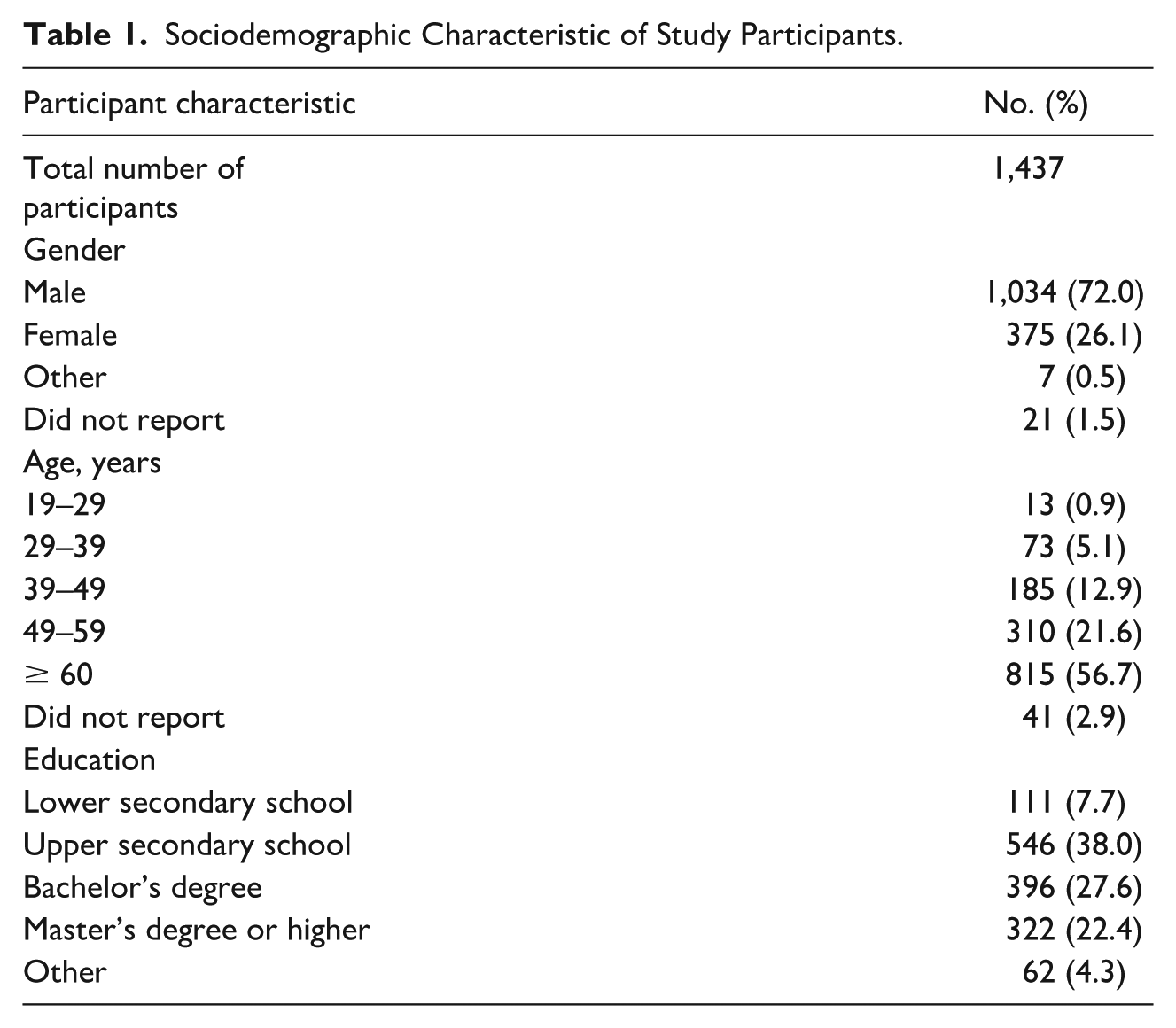
The research was conducted as a cross-sectional, anonymous online questionnaire using an online survey software (Webropol). This research complies with the Declaration of Helsinki, the Finnish National Board on Research Integrity (TENK) ethical principles for research with human participants (TENK, 2019), the European Union’s General Data Protection Regulation as well as the Finnish Data Protection Act (Office of the Data Protection Ombudsman, 2023). According to TENK, ethics approval is not required for conventional survey research conducted on adults (TENK, 2019). Informed consent was obtained from all participants by providing them with an informed consent form along with the recruitment email and on the first page of the survey. The form consisted of information regarding the voluntary and anonymous nature of the survey, a description of the purpose and contents of the questionnaire and an explanation of how the data would be used. The questionnaire was created in English, after which the questionnaire was translated into Finnish by one researcher. Four researchers independently analyzed the translated questionnaire and agreed on the final version of the survey. The questionnaire was then translated back into English to ensure translation equivalence. The survey was pilot tested for comprehension on a convenience sample of 10 Finnish speaking adults. Based on the results of pilot test and the feedback received from the participants, the survey was deemed clear and comprehensible. The survey was conducted in Finland in 2022 in cooperation with a Finnish electricity retailer. Survey participants were recruited by distributing the survey link via email to the customers of the company. The survey ran from 24th of February 2022 through 6th of March 2022. Upon completing the survey, participants were offered an entry to a raffle to win one of ten smart plugs. The questionnaire was available in Finnish and in English. A total of 2489 participants started the survey, of whom 1468 completed the survey, yielding a completion rate of 59%. 31 participants were excluded due to missing data in one or more of the survey constructs. As a result, responses from 1437 participants were included in the analysis. The number of participants greatly exceeds the minimum required sample size, which, following Kline’s (2016) recommendation of at least 20 participants per estimated parameter, was determined to be 420 for our model. Participant demographics are reported in Table 1.
Sociodemographic Characteristic of Study Participants.
Measures
BE, technological knowledge and self-efficacy were measured using a 5-point Likert scale (1 = Fully disagree, 2 = Disagree, 3 = Neither agree nor disagree, 4 = Agree, 5 = Fully agree). The Appendix shows the full measurement items used in the study.
Behavioural Expectation (BE)
BE, that is, participants’ perceived likelihood that they will use smart grid technologies in the future, was measured using 3 a total of items. Attitudinal measures are more reliable in predicting behaviour in a specific domain when an aggregate measure consisting of multiple related actions is used instead of a measure of a single action (Fishbein and Ajzen, 2009). Accordingly, in this study BE was measured by asking participants to estimate the likelihood of them using three different domestic energy technologies: IHDs, smart appliances and microgeneration technologies. We sought to select SG technologies that the participants would be at least somewhat familiar with, and consequently, these specific technologies were selected based on their widespread availability on the market. A brief description of each technology was provided to the participants. For each technology, participants were asked to indicate their level of agreement to the following statement: “All things considered, it is likely that I will use this technology in the future.” The format for the BE measurement was adapted from Warshaw and Davis (1985) by converting their BE scale into a 5-point Likert scale.
Techological Knowledge
Participants’ subjective technological knowledge about smart grid technologies was measured with a total of 3 items. These items were selected to measure participants’ self-assessments of their knowledge about smart grid technologies and their perceptions of their knowledge relative to other people. Participants were asked to indicate their level of agreement with each of the 3 statements. The 3 items included in the measurement scale of subjective knowledge were adapted from the 5-item scale of Flynn and Goldsmith (1999), as similarly adapted scales have been shown to have high reliability (Aertsens et al., 2011; Nuttavuthisit and Thøgersen, 2017). We opted to use positive wording for all items due concerns related to the clarity of the items.
Self-Efficacy
Participants’ self-efficacy to use smart grid technologies was measured with a total of 3 items. These items were selected to address participants' views about their own ability and readiness to use technologies that are new to them. Participants were asked to indicate their level of agreement with each of the 3 statements. The 3 items included in the measurement scale of self-efficacy were adapted from Taylor and Todd (1995).
Reliability
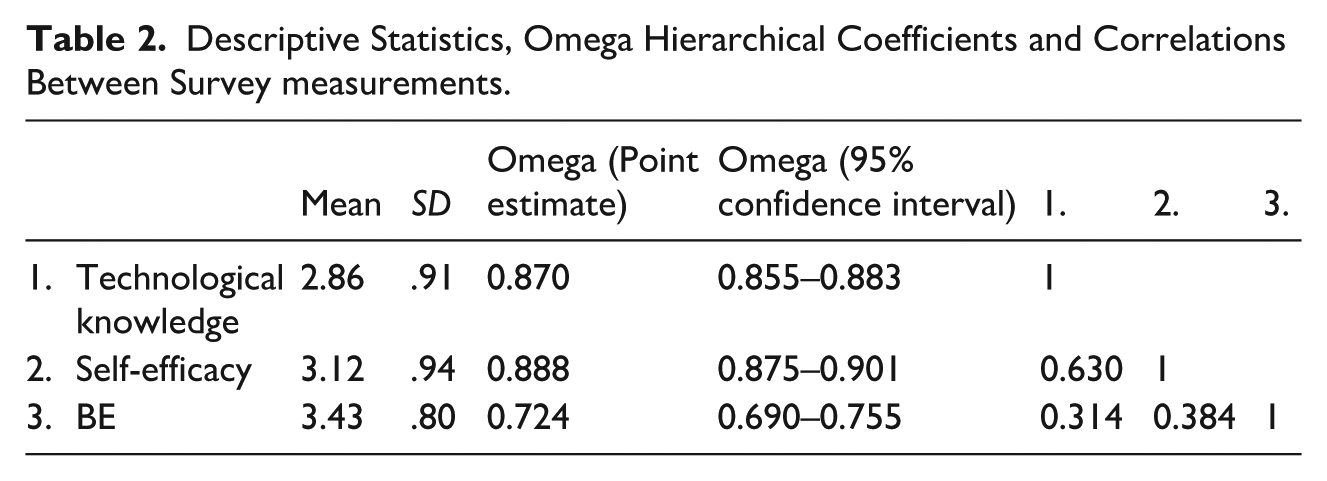
The reliability of the measurement scales was assessed through internal consistency using the omega hierarchical coefficient, which estimates the general factor saturation of a test (McDonald, 1999; Zinbarg et al., 2005). The omega coefficient is more accurate and less prone to bias than the commonly reported Cronbach’s alpha, and as such, it generally yields better reliability estimates (Dunn et al., 2014; Revelle & Zinbarg, 2009; Zinbarg et al., 2007). Point estimates and confidence intervals for the omega coefficients (see Table 2) were calculated using a bias-corrected and accelerated bootstrap method with 1000 bootstrap samples, as recommended by Kelley and Pornprasertmanit (2016). There exists no commonly accepted cut-off value for the hierarchical omega coefficient, but some researchers have suggested a minimum benchmark of 0.5 (Reise et al., 2013; Zinbarg et al., 2007). As can be seen from Table 2, the omega coefficient of all measurement scales used in this study significantly exceed this minimum benchmark value. Therefore, all measurement scales used in this study can be deemed to be reliable.
Descriptive Statistics, Omega Hierarchical Coefficients and Correlations Between Survey measurements.
Statistical Analysis
R version 4.2.2 was used for all statistical analyses in this study. Path analysis was carried out using the R package lavaan (Rosseel, 2012). Descriptive statistics for all measurement constructs and Pearson correlations between them were calculated (see Table 2). To test for hypotheses H1-H4, a path analysis was conducted. Path analysis is a special case of structural equation modelling that extends regression analysis and provides a framework for testing whether a set of data fits a proposed causal model (Fairchild & McDaniel, 2017). Unweighted composite variables were used for the path analysis. Path analysis was carried out by calculating bias-corrected bootstrap confidence intervals using 10000 bootstrap samples, as recommended by Hayes and Scharkow (2013). Maximum likelihood estimation was used for estimating model parameters. The bias-corrected bootstrap confidence interval test was chosen because it is the most trustworthy test for detecting a nonzero indirect effect (Hayes & Scharkow, 2013). Effects in the path analysis model are considered to be statistically significant at the 95% level if the 95% confidence interval does not contain zero.
Omitting important variables from a statistical model may lead to biased estimates and as such it is important to take measures to limit this bias (Tomarken & Waller, 2005). With path analysis, all model parameters are estimated simultaneously, which reduces the risk of omitted variable bias (Preacher & Hayes, 2008). Furthermore, we added participant gender, age and level of education to the model as control variables to eliminate any confounding effects of these sociodemographic factors. For statistical analysis, age, gender and level of education were treated as dummy-coded categorical variables. Paths from these demographic variables to all other model variables were estimated, and consequently, the tested model is saturated (that is, it has zero degrees of freedom) and the model fit is therefore necessarily perfect. Additionally, to test whether differences exist in how the study variables influence the different SG technologies included in the BE scale, effects of all variables on the individual items of the BE scale were estimated, along with pairwise differences between these effects.
To test for the presence of common factor variance (CMV), defined as variance in responses that is caused by the measurement method rather than by the constructs (Podsakoff et al., 2003), we conducted two tests using R package lavaan. Firstly, we conducted Harman’s one-factor test, as recommended by Fuller et al. (2016). According to this test, levels of CMV can be considered problematic if exploratory factor analysis including all main study variables shows that a one-factor solution explains more than 50% of variance among the study variables (Fuller et al, 2016). The results of the Harman’s one-factor test show that the one-factor solution accounted for 42.7% of the variance. Secondly, we carried out the commonly recommended unmeasured latent method construct (ULMC) technique in which the proposed model is compared to a model that also includes a method construct measured by all study items (Kock et al., 2021; Podsakoff et al., 2003). According to this test, CMV can be considered to be present if the inclusion of the method construct improves the model fit, and the level of CMV can be considered problematic if the relationships between study variables differ substantially between the models (Bozionelos and Simmering, 2022). Confirmatory factor analysis revealed that when the method construct was added to the model including all main study variables, the confirmatory fit index (CFI) changed from 0.991 to 0.997 and the root mean square error of approximation (RMSEA) changed from 0.041 to 0.033. Following the guidelines of Chen (2007), these changes indicate that the model fit did not improve to a significant degree. Moreover, comparison between the two estimated models demonstrated that there were no changes in statistical significance of relationships between study variables and that all changes in effect point estimates were below 0.011, indicating no significant differences between the two models. The results of these tests indicate that the level of CMV in our data is unlikely to be problematic.
Furthermore, to test for the presence of nonlinear effects between the survey measures, we conducted the Ramsey regression equation specification error test (RESET), as recommended by Nestler (2015). R package lmtest (Zeileis & Hothorn, 2002) was used for conducting the RESET test. We tested for both quadratic and cubic effects. The results of the RESET indicate that neither the effects of technological knowledge and self-efficacy on BE (F = 2.2975, p = .1009) nor the effect of technological knowledge on self-efficacy (F = 2.0124, p = .1340) are subject to nonlinearities.
Results
The tested path analysis model is shown in Figure 1. Point estimates and 95% confidence intervals for the unstandardized path coefficients of the tested path analysis model are shown in Table 3. In accordance with hypotheses H1 and H2, technological knowledge was significantly and positively associated with self-efficacy and with BE. There was also a significant positive effect of self-efficacy on BE, confirming hypothesis H3. Consequently, in accordance with hypothesis H4, self-efficacy partially mediates the effect of technological knowledge on BE. Because self-efficacy did not fully mediate the effect of subjective knowledge, there was also a significant direct effect of technological knowledge on BE. As can been seen in Table 4, the point estimates of the indirect and total effects of technological knowledge on BE are 0.158 and 0.279, respectively. As such, self-efficacy mediates approximately 57% of the effect of technological knowledge on BE.
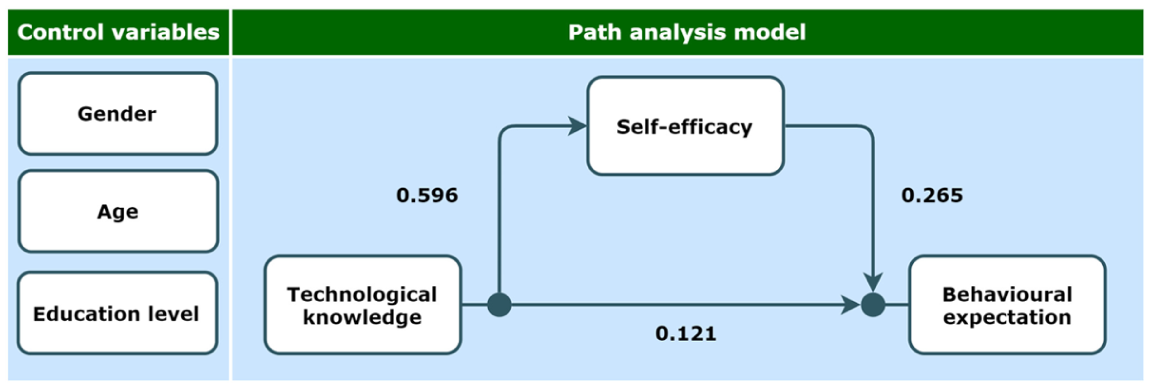
Path analysis model depicting the effects of technological knowledge and self-efficacy on behavioural expectation toward SG technology use.
Point Estimates and Confidence Intervals for the Unstandardized Model Path Coefficients.
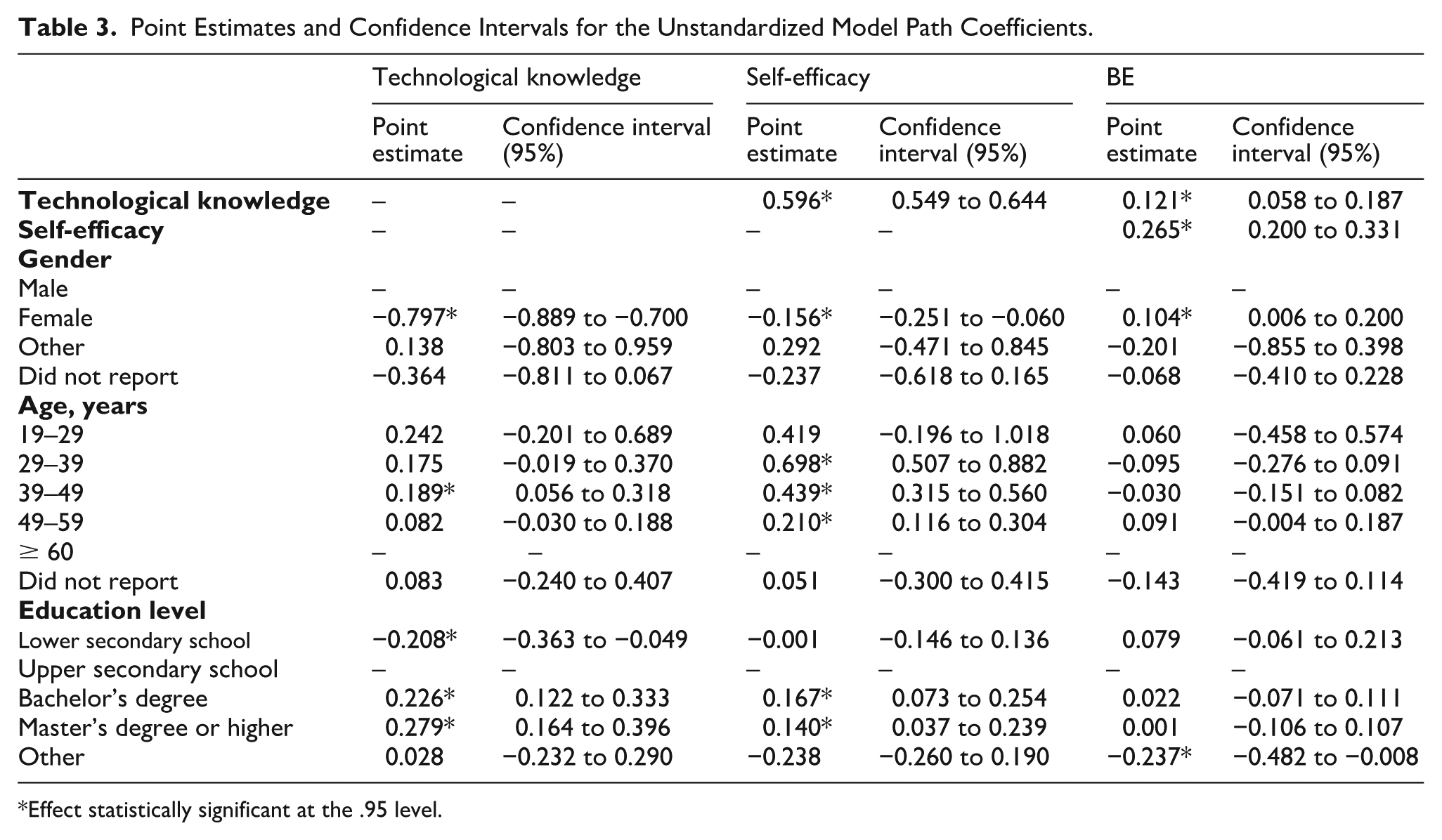
Effect statistically significant at the .95 level.
Point Estimates and Confidence Intervals for the Indirect and Total Effects of Other Variables on BE.
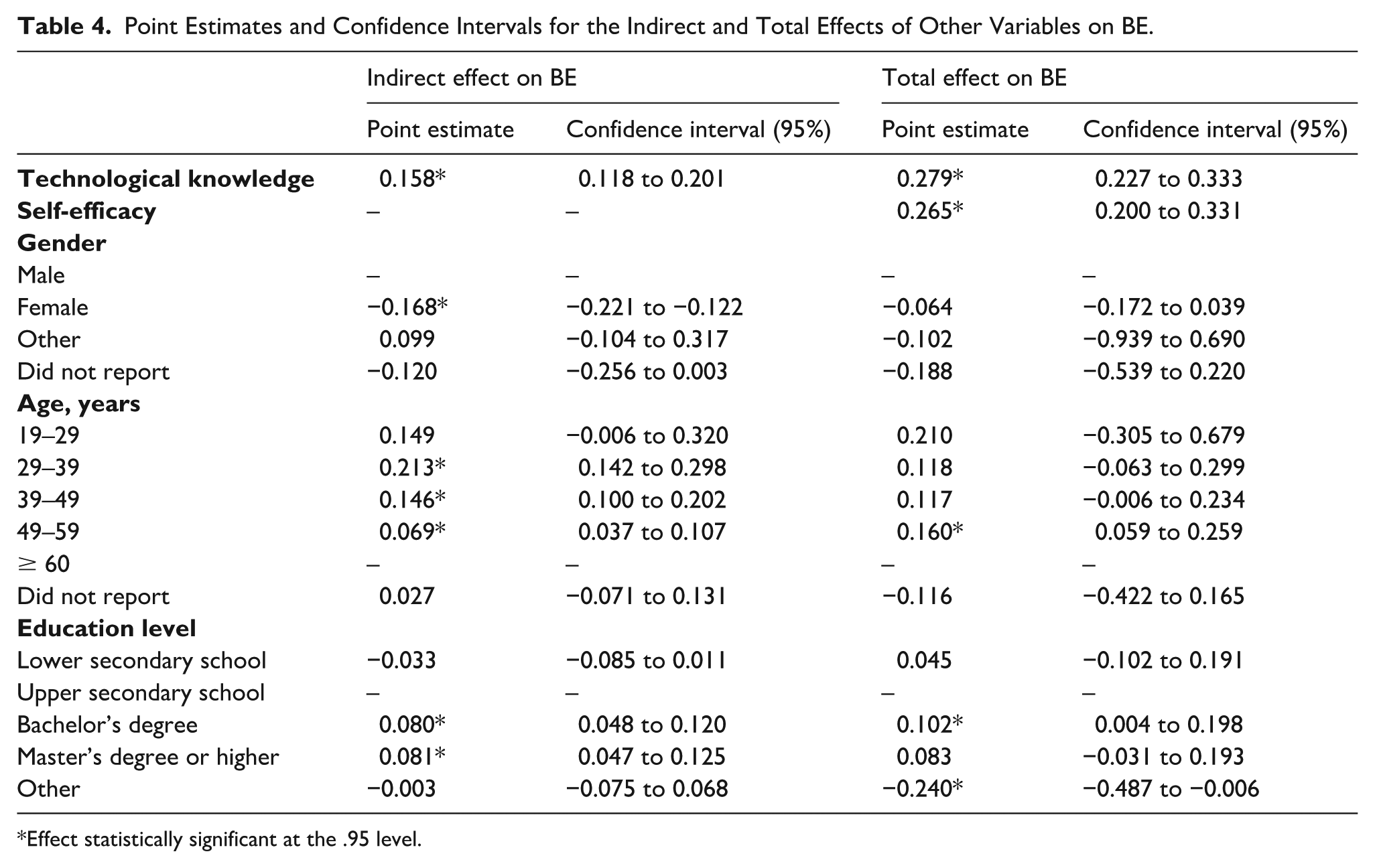
Effect statistically significant at the .95 level.
Gender was significantly associated with technological knowledge in that women reported significantly lower levels of subjective technological knowledge compared to men. Gender also had a small but statistically significant effect on self-efficacy in that women reported lower levels of self-efficacy compared to men. Lastly, gender had small but statistically significant direct and indirect effects on BE. The direct effect of gender was such that, when controlling for other variables, BE was higher among women. However, the indirect effect of gender was the opposite: since women reported both lower technological knowledge and self-efficacy, the indirect effect of gender through these variables resulted in reduction in BE among women. Consequently, the direct effect of gender on BE were cancelled out by the indirect effects, resulting in no significant total effect.
Age had no consistent effect on technological knowledge, though participants between 39 and 49 years of age reported higher technological knowledge than participants of 60 years of age or older. Age did however have a significant effect on self-efficacy in that younger participant reported higher levels of self-efficacy compared to older participants. Aside from the youngest age group, the effect of age on self-efficacy was consistent in that the difference from the reference age group (60 years old or older) increased almost linearly for each subsequent younger age group. There was no direct effect of age on BE, but due to its effect on self-efficacy, age was indirectly associated with BE. However, regardless of age’s statistically significant indirect effect and the non-significant direct effect, the resulting total effect on BE was not consistently significant.
Education had a consistent effect on technological knowledge: those whose highest level of education was lower secondary school reported significantly lower technological knowledge than those with upper secondary education who in turn reported lower technological knowledge than those with a bachelor’s degree. Though those with a master’s degree reported levels of knowledge higher still than those with bachelor’s degree, the difference between these two groups was markedly smaller than between the preceding groups. Furthermore, those with bachelor’s or master’s degree reported higher self-efficacy than those with upper secondary education. However, those with master’s degree did not report higher levels of self-efficacy than those with bachelor's degree – in fact, the effect size for the master’s degree group was slightly smaller. Moreover, there was no difference in self-efficacy between those with upper secondary education and those with lower secondary education. In terms of direct effect on BE, aside from the “Other” category, none of other education level categories differed significantly from the reference category. Due to its association with technological knowledge and self-efficacy, there were some indications that higher education levels may have positive indirect and total effects on BE. However, given the small effect size and inconsistent nature of these effects, it is difficult to draw definite conclusions about the total effect of education on BE.
As can be seen from Table 5, comparing the direct effects of the study variables on the different SG technologies included in the BE scale revealed only slight differences. Most notably, technological knowledge was found to have a slightly larger direct effect on the adoption of IHDs compared to smart appliances, while an opposite effect of similar magnitude was observed for self-efficacy. Although differences between the effects of sociodemographic variables on different SG technologies were mostly not statistically significant, some potential differences were identified. For example, relative to the reference age group, the two youngest age groups reported higher expectation to adopt smart appliances compared to IHDs, while participants between the ages of 39 and 49 had higher expectation to adopt microgeneration technologies compared to both other technologies. However, given that the differences between SG were inconsistent, it cannot be concluded from our data that there exist sociodemographic differences in preference for different SG technologies.
Point Estimates of Unstandardized Path Coefficients Between Individual BE Scale Items and Other Study Variables, and Pairwise Comparisons.
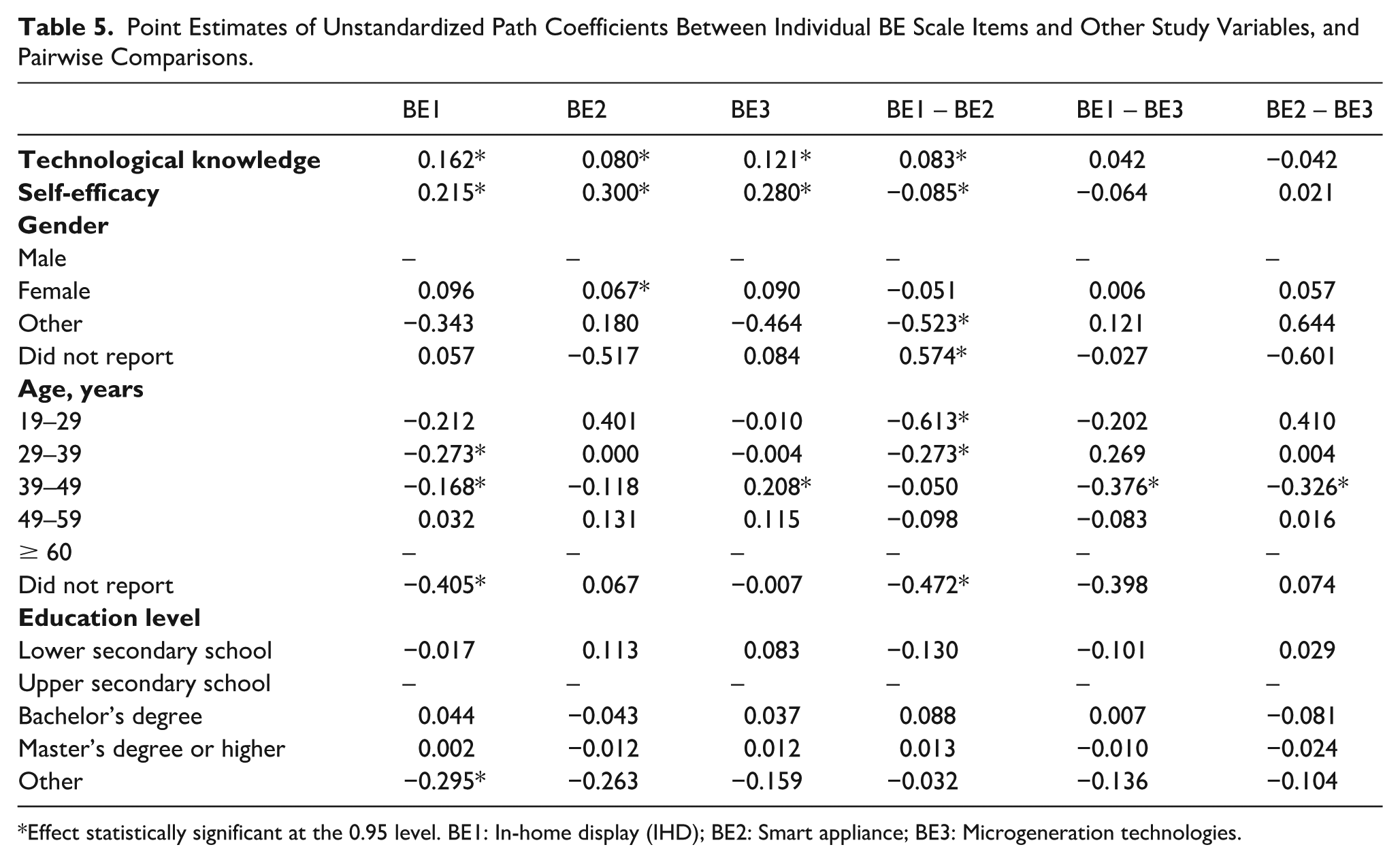
Effect statistically significant at the 0.95 level. BE1: In-home display (IHD); BE2: Smart appliance; BE3: Microgeneration technologies.
Discussion
Due to the relationship between subjective knowledge and self-confidence, we hypothesized that subjective technological knowledge would be significantly associated with self-efficacy. This hypothesis was supported, and consequently, our results indicate that increased technological knowledge can indirectly lead to greater adoption of smart grid technologies. However, subjective knowledge was also directly associated with BE, meaning that technological knowledge has an effect on technology adoption independent of self-efficacy. According to Kraiger et al. (1993) learning produces both cognitive and affective outcomes. Furthermore, Kraiger et al. posit that outcomes related to objective knowledge can be classified as cognitive and outcomes related to self-efficacy as affective. As such, it is possible that the portion mediated by self-efficacy represents the affective component of subjective technological knowledge whereas the direct effect represents the cognitive component. Therefore, in agreement with previous research (Brucks, 1985; Flynn & Goldsmith, 1999; Raju et al., 1995), our findings support the idea that by encompassing both cognitive and affective dimensions of knowledge, subjective knowledge may have advantages over objective knowledge as a variable predicting technology adoption.
We also hypothesized that self-efficacy would be significantly associated with consumer adoption of smart grid technologies. Previous research has demonstrated self-efficacy’s importance in influencing how individuals set and pursue goals. Due to BEs superior predictive ability in the context of behaviours that can be defined as goals, we chose to measure smart grid technology adoption with BE. Mahardika et al. (2019) postulated that self-efficacy should influence BE judgements, but noted that there had been no previous research investigating this hypothesis. Indeed, at the time of writing, we were unable to find any previous studies investigating the relationship between self-efficacy and BE. As such, to our knowledge, this is the first study to directly investigate this relationship. The results confirmed our hypothesis that self-efficacy is significantly associated with adoption of smart grid technologies as measured by BE. Noteworthily, the point estimate of the path coefficient between self-efficacy and technology adoption was larger than what has been typically reported in previous studies. Our results show a point estimate of 0.265, with the 95% confidence interval from 0.227 to 0.333. In contrast, values reported in previous research include: 0.086 (Al-Saedi et al., 2020), 0.11 (Irfan, Elavarasan, et al., 2021), 0.12 (Tarhini et al., 2014), 0.124 (Moran et al., 2010) and 0.25 (Nam et al., 2013). The relatively larger effect size reported here may be because we measured technology adoption using BE, a measure that better captures potential barriers to performing the behaviour in question. This finding suggests that consumers may not view adoption of smart grid technologies as a something that they have complete control over. In this regard, our research is in agreement with previous research demonstrating that there are a multitude of barriers to the adoption of different energy technologies (see for example Balta-Ozkan et al., 2013; Li et al., 2021; Strengers, 2014). Therefore, adoption of such technologies may be more akin to a goal than a reasoned action. Consequently, for researchers investigating technology acceptance and adoption, choosing whether to frame the behaviour of interest as either a goal or a reasoned action may be an important consideration, as that choice can determine how influential different independent variables are.
We included sociodemographic variables of gender, age and education level as control variables in our model to mitigate the risk of omitted variable bias. Although we did not propose any specific hypotheses related to the sociodemographic variables, there were nevertheless significant findings related to these variables. Our results show that technological knowledge is significantly influenced by gender such that men reported higher levels of subjective technological knowledge compared to women. Furthermore, due to the relationship between subjective knowledge and self-efficacy, gender indirectly influences self-efficacy such that the higher levels of technological knowledge reported by men also leads to higher levels of self-efficacy. It is unclear whether these gender differences are due to gender itself or other factors, such as stereotypic beliefs related to gender. Men and women tend to report greater confidence in domains that are regarded as typical for their gender, such as mathematics for men and writing for women (Eccles, 1987; Eccles et al., 1989; Pajares & Valiante, 2001). Accordingly, it is possible that men reported higher levels of subjective technological knowledge due to the fact that technology and energy have been traditionally regarded as male domains. Indeed, previous research has shown that men tend to have more positive attitudes towards and higher acceptance of technology (Cai et al., 2017; Sundström & McCright, 2016), are more likely to own and use of various technologies (Moghaddam, 2010; Whitley, 1997) and are more likely to participate in technology-related citizen programs (Fraune, 2015). However, previous research has also demonstrated that when gender-stereotypic beliefs are controlled for, differences between genders tend to decrease or completely disappear (Brosnan, 1998; Brosnan & Davidson, 1996; Pajares & Valiante, 2001). Consequently, finding ways to reduce the prevalence of such stereotypes may be helpful in increasing the adoption of different technologies. This may especially be helpful in the context of SG technologies, considering that our results show that if technological knowledge and self-efficacy are held constant, women actually tend to report slightly higher levels of BE.
Interestingly, our findings show that age is negatively association with self-efficacy but not with technological knowledge. With the exception of one age group (between 39 and 49 years old), the differences in knowledge between the reference group and younger age groups were not statistically significant. Therefore, our results suggest that there is no consistent relationship between age and subjective knowledge of SG technologies. This finding indicates that there is little difference in self-assessed familiarity with SG technologies between younger and older age groups. In contrast, we did find a significant association between age and self-efficacy such that younger participants reported significantly higher levels of self-efficacy than older participants. This effect was consistent in that self-efficacy increased almost linearly for each subsequent younger age group (excluding the youngest age group which was not statistically significantly different from the reference group, likely due to the low number of participants in that group). Although no previous studies have investigated the relationship between self-efficacy and age in the context of smart energy technologies, age has been found to be negatively associated with self-efficacy related to the use of other technologies, such as computers (Czaja et al., 2006; Ulfert-Blank & Schmidt, 2022). It is possible that this negative relationship between age and self-efficacy is due to cognitive decline associated with aging. Indeed, it has been shown that age-related cognitive impairments can negatively influence the use of a wide range of new technologies (van der Wardt et al., 2012) and that cognitive abilities may mediate the relationship between age and self-efficacy (Czaja et al., 2006). However, the direction of causality in this relationship is unclear as there is evidence to suggest that cognitive abilities can improved through technology use (van der Wardt et al., 2012). Nevertheless, it is becoming increasingly important to find ways to foster technological self-efficacy among the elderly population and more research is required to determine the most effective ways to do this. Due to low birth rates and rising life expectancy, the share of the population aged 65 years and older is increasing in every EU member state (Eurostat, 2023) and consequently, older adults constitute a growing portion of potential SG technology adopters.
Lastly, higher levels of education were associated with higher levels of technological knowledge, but its relationship with self-efficacy was less clear. This result indicates that formal education is unlikely to directly influence self-efficacy to a significant degree but may do so indirectly by influencing knowledge. Interestingly, education beyond bachelor’s degree increased technological knowledge only marginally, indicating that there exists a point of diminishing returns. This finding may be explained by the fact that higher levels of education typically focus more on domain-specific knowledge rather than on generic knowledge (Tuononen et al., 2023).
Our results found there to be little difference in how the study variables influenced consumer adoption of different SG technologies. It is however possible that selection of the technologies included in the BE scale may have influenced this finding, given that the scale contained three SG technologies that participants were likely to be similarly familiar with. The influences of knowledge and self-efficacy on technology adoption may be context dependent such that their effects vary based on, for example, customers’ familiarity with the technology in question. Indeed, we found there to be small but statistically significant difference in how BE to adopt IHDs and smart appliances were influenced by technological knowledge and self-efficacy. However, the reason for this difference is unclear and research investigating the effects of knowledge and self-efficacy on wider range of SG technologies is needed before conclusions about the context-dependency of these variables can be drawn. Moreover, it is also worth noting that the sample of participants in this study was biased towards men and older adults. Therefore, to better determine whether different customer groups show preference towards specific technologies, future studies may benefit from a more even distribution of participants across different sociodemographic groups.
By generating and storing energy and by participating in demand response, consumers are expected to play an increasingly important and active role in the future of SGs. Active consumer involvement is facilitated by various smart technologies, and therefore, more widespread adoption of these technologies is imperative to the development of SGs. Consumer adoption of SG technologies has typically been viewed as a reasoned action driven predominantly by rationality. However, this idea of a hypothetical ideal consumer who makes rational decisions based on the best available evidence has received its fair share of criticism (Strengers, 2014; Verkade & Höffken, 2017). Our results mirror these previous criticisms by highlighting the importance of self-efficacy in influencing the adoption of SG technologies. Considering Bandura’s (1991) definition of self-efficacy – people’s beliefs about their capabilities to exercise control over their own level of functioning and over events that affect their daily lives – there are limitations to viewing technology adoption as a behaviour that consumers have complete volitional control over. Consequently, finding ways to increase consumer self-efficacy may prove an effective way to promote the adoption of SG technologies, and ultimately, facilitate the development of SGs and demand response programs.
Previous research investigating the relationship between technological knowledge and technology adoption has produced mixed results, but our results indicate that technological knowledge can influence adoption of SG technologies both directly and indirectly through self-efficacy. Due to the relatedness between knowledge and self-efficacy, addressing both factors together may improve the effectiveness interventions or campaigns directed at improving SG technology adoption. One such example is community-based energy programs, including community microgrids, low-carbon communities and eco-villages. Such community-based energy interventions can promote knowledge sharing between participants and facilitate the learning of practical technological skills (Braunholtz-Speight et al., 2021; Broska, 2021). It has been shown that individuals can derive a personal sense of pro-environmental efficacy from the efficacy of a collective, which in turn can translate into personal pro-environmental action (Jugert et al., 2016). Furthermore, previous research has demonstrated that interventions such as competitions (Dixon et al., 2015) and games (Reeves et al., 2015) can be effective ways to improve technological knowledge and foster self-efficacy through the learning of practical skills. However, as evidenced by the differences in technological knowledge and self-efficacy between sociodemographic groups, it is likely that also exist differences in how different sociodemographic groups respond to different interventions. Therefore, it important to emphasize that there likely exists no single optimal intervention for improving these competencies. As a result, interventions may need to be tailored to the needs different target groups (J. Zhao et al., 2024)
There are some potential limitations to our study. Although the path model tested in this study is a causal one, results based on questionnaire data are correlational in nature, and as such, causal inferences cannot be drawn from our findings. Furthermore, we took measures to reduce the risk of estimation bias caused by omitted variables by choosing the model variables based on existing theory, by estimating all model variables simultaneously and by including sociodemographic variables of age, gender and education level as control variables. Lastly, we conducted Harman’s one-factor test and the ULMC technique, which showed that the level of CMV in our data was not problematic. However, the possibility of estimation bias arising from omitted variables or CMV cannot be completely eliminated. Notwithstanding these limitations, we believe that the results presented here offer valuable and novel insights into how technological knowledge and self-efficacy can influence the adoption of SG technologies and into how different demographic groups may differ in terms of these variables.
Conclusion
This study investigated the relationships between consumers’ subjective technological knowledge, self-efficacy and the adoption of SG technologies as measured by BE. We conducted a survey of Finnish households and received over 1,400 responses. The data were analyzed using path analysis which is special case of structural equation modelling that allows for evaluating whether a data set fits a proposed causal model. We investigated both the direct effect of technological knowledge on BE as well as its indirect effect through self-efficacy. Furthermore, we examined how these three variables are influenced by the sociodemographic variables of age, gender and education level. Our results show that both technological knowledge and self-efficacy are significantly and positively associated with each other as well as BE. In addition, knowledge has both direct and indirect effects on SG technology adoption: around 57% of technological knowledge’s effect is mediated by self-efficacy. For sociodemographic variables, we found various statistically significant effects on technological knowledge and self-efficacy. Women reported lower levels of both subjective technological knowledge and self-efficacy compared to men, resulting in a negative indirect effect on BE for women. Interestingly however, when controlling for other variables, the direct effect of gender was such that women reported higher BE. We found that age was significantly and negatively association with self-efficacy but not with technological knowledge. Higher levels of education were associated with higher levels of technological knowledge, but education beyond bachelor’s degree increased knowledge only marginally. Lastly, the evidence supporting the association education level and self-efficacy was found to be weak. Overall, the total effects of these sociodemographic variables on the adoption of SG technologies were largely inconsistent.
This study contributes to the SG literature in several ways. We investigated the interplay between technological knowledge, self-efficacy and BE and in doing so, elucidate the mechanisms by which knowledge may influence consumers’ decision to adopt SG technologies. Our results also demonstrate that differences in technological knowledge and self-efficacy exist between sociodemographic groups, indicating that sociodemographic factors should be considered in the design of campaigns and interventions promoting the adoption of SG technologies. To our knowledge, no previous studies have used BE in measuring the adoption of SG technologies. As such, we believe that by using this potentially more accurate and temporally stable measure, our study complements previous research on the topic. Lastly, by highlighting the importance of self-efficacy, our results demonstrate the potential limitations of viewing the adoption of SG technologies as a reasoned action that consumers have complete control over. Knowledge and self-efficacy are closely related, and consequently, efforts to improve the adoption of SG technologies may be more successful is they address these factors together.
Footnotes
Appendix
Questionnaire items.

1. I know a lot about novel energy technologies 2. In general, I know more about novel energy technologies than the average person 3. People who know me consider me an expert in novel energy technologies |
1 = Strongly disagree 2 = Disagree 3 = Neither agree nor disagree 4 = Agree 5 = Strongly agree |
1. If I wanted to, I could easily operate new technologies on my own 2. I would be able to use new technologies even if there was no one around to show me how to use them 3. I would feel comfortable using new technologies |
1 = Strongly disagree 2 = Disagree 3 = Neither agree nor disagree 4 = Agree 5 = Strongly agree |
For each of the following technologies, please select the option that best represents your feelings about the following statement: "All things considered, it is likely that I will use this technology in the future." 1. In-home display 2. Smart appliances 3. Technologies for self-production of energy |
1 = Strongly disagree 2 = Disagree 3 = Neither agree nor disagree 4 = Agree 5 = Strongly agree |
|
|
1 = 18 years or younger 2 = 19 – 29 years 3 = 30 – 39 years 4 = 40 – 49 years 5 = 50 – 59 years 6 = 60 years or older 7 = I do not want to report |
|
|
1 = Male 2 = Female 3 = Other 4 = I do not want to report |
|
|
1 = Lower secondary school 2 = Upper secondary school 3 = Bachelor’s degree 4 = Master’s degree or higher 4 = Other |
Acknowledgements
The authors thank Koneen Säätiö for funding this research. The authors also want to thank Pohjois-Karjalan Sähkö for distributing the survey.

Ethical Considerations
This research complies with the Declaration of Helsinki, the ethical principles for research with human participants of the Finnish National Board on Research Integrity (TENK), the European Union’s General Data Protection Regulation as well as the Finnish Data Protection Act. According to TENK, ethics approval is not required for conventional survey research conducted on adults. Informed consent was obtained from all participants.
Consent to Participate
Informed consent was obtained from all participants by providing them with an informed consent form along with the recruitment email and on the first page of the survey. The form consisted of information regarding the voluntary and anonymous nature of the survey, a description of the purpose and contents of the questionnaire and an explanation of how the data would be used.
Consent for Publication
Not applicable.
Author Contributions
Funding
The authors disclosed receipt of the following financial support for the research, authorship, and/or publication of this article: This work was supported by Koneen Säätiö [grant number 202201616].
Declaration of Conflicting Interests
The authors declared no potential conflicts of interest with respect to the research, authorship, and/or publication of this article.
Data Availability Statement
The authors do not have permission to share data.