



Abstract
Civil society is often depicted as playing a central role in the transition to a more environmentally sustainable society, for example by contributing to more fair and efficient environmental governance. Evidence for such claims is though limited and has not considered the full variety of motives in civic participation. In this paper, the often over optimistic assumptions about the possibility of civil society to generate environmental cooperation within the public is questioned. By studying attitudes toward environmental policies across members of sport and outdoor organizations, results show that membership is associated with both higher and lower policy support, depending on type of policy. It is furthermore shown that membership simultaneously is linked to policy support through its association with trust and reciprocity in civil society. The results indicate that any efforts to involve civil society in environmental governance carefully must consider the specific motives and circumstances of each organization.
Introduction
A thriving civil society is commonly seen as a prerequisite for a healthy democracy, and the activities of civil society organizations (CSO:s), such as labor unions, sports clubs, religious organizations, and charitable associations, are often argued to be key to the creation of the social capital, trust, reciprocal norms, and shared values, that helps societies overcome collective action problems and produce public goods (Coleman, 1994; Putnam, 2000; Putnam et al., 1993). Due to these positive traits, these organizations have also been argued to be a fundamental part in an effective and legitimate response to many of the most pressing environmental challenges of today (Adger, 2003; Bernauer et al., 2016; Bernauer & Gampfer, 2013; Jones et al., 2009; Pretty & Ward, 2001). CSO:s have, for example, been suggested to participate in policy design and implementation (Schrama & Zhelyazkova, 2018) and to have a positive influence on environmental cooperation by increasing levels of trust and reciprocal behaviors in the population (Adger, 2003; Jones et al., 2009). Membership in CSO:s have also been found to be positively associated with pro-environmental attitudes and behaviors (e.g., Bühren & Wicker, 2024; Duit, 2011; Gelissen, 2007; Marbuah, 2019; Polyzou et al., 2011).
However, as most civil society organizations are organized around other issues than environmental protection (such as leisure, competition, economic security, health, etc.), it is not given that the positive traits of civil society can be effectively transposed to the environmental domain (Pretty & Ward, 2001). That is, it is far from certain that the networks and norms of these organizations can be used to mobilize their members in support of environmental protection. This is perhaps especially likely when the activities of a CSO might come in conflict with environmental sustainability goals, such in the case of labor unions, sports teams, or a motor enthusiasts club. As most previous research that has discovered a positive association between CSO-membership and pro-environmental attitudes and behaviors have focused on membership in environmental organizations specifically (e.g., Duit, 2011; Gelissen, 2007; Torgler & García-Valiñas, 2007), 1 very little is know about how membership in other types of organizations affect environmental attitudes (but see Bühren & Wicker, 2024). There is, as such, a gap in the understanding of how civic participation is associated with environmental protection attitudes and activities.
The ambition of this paper is therefore to attempt to nuance the commonly held wisdom that all forms of civic participation, independently of its type and context, always is beneficial to cooperation around environmental degradation (Duit, 2011; Gelissen, 2007; Polyzou et al., 2011). Instead, it is argued that civic participation is likely to have both constructive and destructive consequences when it comes to environmental cooperation, and that the relationship between civic participation and environmental cooperation is dependent on both organizational and individual priorities. It is also argued that it is important for governments to understand these nuances to effectively harness the resources of civil society for the benefit of the environment. To study this, focus is put on a case where this conflict has been found to be especially likely to arise; the sport and outdoor recreation domains. In many countries, sport clubs are one of the largest parts of civil society, and organizes millions of citizens on a daily basis (Statistics Sweden, 2023). As a result of its unique standing in many societies, sport clubs have been suggested to be especially well placed to influence public environmental attitudes (Inoue & Kent, 2012), 2 and some have even suggested that governments could increase economic support to these organizations to further support for environmental protection among the public (Bühren & Wicker, 2024). Sports and outdoor recreation does, however, also produce a considerable environmental impact, for example in the form of CO2 emissions from traveling and the purchase of equipment (Aritza, 2023; Wicker, 2019; Wilby et al., 2023), the consumption of large amounts of resources and the resulting amounts of waste at big sport events (Collins et al., 2007; Triantafyllidis et al., 2018), as well as through the construction and upkeep of sport facilities (e.g., soccer courts and golf courses; Thibault, 2009). There is, as such, an inbuilt conflict between the promotion of environmental protection and the possibilities for maintaining current modes of operation within these sectors.
In this study, the aim is to investigate how membership in sport and outdoor organizations is related to support for environmental policies. Specifically, the study focuses on attitudes toward environmental policies that are directed at reducing the environmental impact of the sport and outdoor sectors. Furthermore, the study also investigates how sport and outdoor organizations indirectly can affect policy support, by increasing levels of trust and reciprocity among its members. As the number of studies focusing on specific types of CSO:s where conflicts between club activities and environmental sustainability could arise, such as sports clubs, are few (but see Bühren & Wicker, 2024), the results of this study can provide new important insights into the role of civil society in environmental protection. In the next section, CSO-membership is discussed as a form of social capital, and the link between membership in sport and outdoor organizations, and support for environmental policies is elaborated on. Based on the theoretical discussion, a number of hypotheses are developed. In section three, the data collection process, which consisted of a survey sent to a random sample of the Swedish public during spring 2023, is described and the operationalization of the variables is discussed. In section four the results are presented, and finally, in section five, we conclude the paper by discussing the findings in light of previous research.
Linking Civil Society Participation to Environmental Policy Attitudes
Overall, the inclusion of civil society in environmental governance is by many seen as something positive that will increase the likelihood of a fair, efficient, and effective transitioning into a more environmentally sustainable society (Bernauer et al., 2016; Bernauer & Gampfer, 2013). While such gains in legitimacy to some extent are believed to accrue from the participation of CSO:s in the process of policy design, implementation and monitoring (see e.g., Schrama & Zhelyazkova, 2018), others have also emphasized how individuals’ participation in civil society is closely connected to the generation of social capital. Studies focusing on the role of social capital in the maintenance of environmental public goods have, for example, emphasized the important role civil society has in generating trustful and reciprocal relationships between individuals and the state that in turn generate higher levels of environmental cooperation (Adger, 2003; Jones et al., 2009). Social capital in general, but also participation in CSO:s, is as such commonly argued to be an important driver of pro-environmental attitudes and behaviors. Some have even suggested that governments could increase economic support in civil society organizations, to increase public participation in these organizations, which in turn could be expected to increase pro-environmental attitudes (see e.g., Bühren & Wicker, 2024). Still, the empirical evidence supporting the claim that CSO:s can increase environmental cooperation is limited, and there are also good reasons to question the validity of these claims from a theoretical standpoint (see e.g., Dahl & Abdelzadeh, 2017; van Ingen & Bekkers, 2015). In this theoretical section, we elaborate on the connection between participation in civil society organizations on the one hand and the inclination to contribute to environmental protection via policy support or direct action on the other.
Social Capital, Participation in Civil Society and Pro-environmental Protection
As a theoretical concept, social capital has many definitions, but is often referred to as “the structure of relations between actors and among actors” (Coleman, 1988, p. 98) or as “features of social organizations, such as networks, norms and trust that facilitate action and cooperation for mutual benefit” (Putnam et al., 1993, p. 35). Centrally, the concept thus centers on the characteristics of the social environment that enables effective cooperation around the production of common goods, and societies characterized by high levels of social capital have been found to have stronger and more vital democracies (Putnam, 2000; Putnam et al., 1993) as well as more well developed economies (Knack & Keefer, 1997).
Social capital is, furthermore, not a singular concept, but is commonly seen as comprised of a number of central features. While these features tend to vary somewhat between different studies, they often include: social networks, civic participation, social, and political trust, reciprocity, social norms, as well as rules and sanctions (Coleman, 1994; Jones et al., 2009; Putnam et al., 1993). Overall, a society with high stocks of social capital, is characterized by dense social networks between community members and high levels of participation in voluntary organizations; high levels of trust both between individuals and between individuals and public institutions; relationships characterized by reciprocal exchange; as well as by both informal and formal rules, norms and sanctions that encourage cooperative behaviors (Putnam, 2000; Putnam et al., 1993). Together, these features are argued to facilitate collective action among citizens by reducing the perceived risks and uncertainty associated with cooperative behaviors, by enabling information flows about effective strategies, and by spreading norms of pro-social behavior.
Given these positive traits, social capital have also rendered interest among scholars studying the governance of environmental goods and the collective action problems surrounding these (see e.g., Cho & Kang, 2017; Duit, 2011; Gelissen, 2007; Grafton & Knowles, 2004; Halkos & Jones, 2012; Macias & Williams, 2016; Marbuah, 2019; Polyzou et al., 2011; Pretty & Ward, 2001). Within this line of research, social capital has been argued to affect pro-environmental behaviors in mainly two ways. First, citizens in societies with high levels of social capital are expected to more easily self-organize around the governance of environmental goods or the mitigation of environmental problems, compared to individuals in societies with less social capital (Duit, 2011; Jones et al., 2009). Such cooperation could, for example, occur around the management of a common pasture or the construction and upkeep of an irrigation system (Adger, 2003; Bowles & Gintis, 2002; Ostrom, 1990; Ostrom et al., 1994). Second, and more relevant for our purposes, higher levels of social capital are also expected to increase citizens’ compliance with pro-social norms (such as environmental protection) and strengthen their support for environmental policies introduced by governments (Duit, 2011; Gelissen, 2007; Grafton & Knowles, 2004). Participation in the organizations of civil society is thus expected to increase cooperation around environmental issues (e.g., by supporting environmental policies), not necessarily as a result of heightened concern for environmental degradation, but as a consequence of a general increase in the inclination to cooperate with others.
As similar line of reasoning can also be found in studies focusing on the development of pro-environmental norms, that acting in defense of environmental values not necessarily have to be based on a concern for nature itself, but can be driven by both environmental and altruistic motives (e.g., Steg & Vlek, 2009; Stern, 2000). Previous research has also shown that altruistic values are stronger among people who engage in different forms of pro-environmental actions, including support for environmental policy (e.g., Dietz et al., 1998; Karp, 1996; Stern et al., 1995; Stern & Dietz, 1994) and that environmental concern is more closely associated with pro-social value orientations compared to competitive or individualistic ones (e.g., Joireman et al., 2001; van Vugt & Samuelson, 1999). Individuals’ engagement in civil society organizations are thus expected to be associated with higher levels of pro-social behavior, which eventually will lead to pro-environmental behavior as a form of bi-product (Bühren & Wicker, 2024).
However, the fundamental assumption in many studies, that social capital always will have a beneficial impact on environmental performance, is not very well substantiated by empirical evidence. This is perhaps especially so concerning the effect of CSO-membership. While studies of local resource management regimes seems to indicate the beneficial nature of social capital for local collective action (Bowles & Gintis, 2002; Ostrom, 1990; Ostrom et al., 1994), evidence from studies of large-scale collective action are more mixed. Although several previous studies have shown that different aspects of social capital are positively associated with a range of pro-environmental attitudes and behaviors (e.g., Duit, 2011; Gelissen, 2007; Halkos & Jones, 2012; Macias & Williams, 2016; Marbuah, 2019; Polyzou et al., 2011), the variety of measures, selected cases and the patterns of effects found, makes it difficult to draw generalizable conclusions. Some studies have also failed to find the expected positive association between social capital and individual pro-environmental behaviors (Cho & Kang, 2017; Grafton & Knowles, 2004). 3
The often assumed positive effect of CSO-membership on trust, which in turn is expected to generate cooperation, has, furthermore, been questioned. Specifically, civic organizations have been argued to mainly function as reservoirs of social capital, rather than as generators of the same, indicating that the association between CSO-membership and social capital more likely is the result of self-selection rather than socialization (Dahl & Abdelzadeh, 2017; van Ingen & Bekkers, 2015). That is, that individuals who are more trusting and more inclined to cooperate also are more likely to join CSO:s, and that membership itself only has a minor impact on these variables (Dahl & Abdelzadeh, 2017; van Ingen & Bekkers, 2015; Wollebaek & Selle, 2002; Wollebæk & Strømsnes, 2008). From this perspective, the expected role of CSO:s in general, and sport and outdoor organizations specifically, to function as a vehicle for environmental transformation is highly limited, at least to the extent that they can increase trust and cooperative intentions among their members.
There are also good reasons to question the assumption that all forms of social capital necessarily should be associated with more cooperation around environmental issues. Specifically, whether participation in any type of civic activity always will render more environmental collective action. Previous research has, for example, indicated that the degree of social capital (trust, networks, civic participation) differs across members of different types of political, non-political (e.g., sports clubs), and religious, voluntary associations (Wollebaek & Selle, 2002). For example, while it seems likely that membership in an environmental organization or participation in an environmental protest could be associated with an individual adopting more pro-environmental behaviors (see e.g., Duit, 2011; Marbuah, 2019), it seems less likely that membership in Hell’s Angels or partaking in the planning of a riot would have the same effect. Although such activities undoubtedly could be seen as a form of social capital (Putnam, 2000; Putnam et al., 1993), their association with pro-environmental strivings would, at best, be insignificant. That is, while all forms of civic participation are likely to increase the cooperative capacity of the concerned group, it will only lead to more environmental cooperation if that is in line with the organizations goals. As the engagement in CSO, such as sport clubs, often are driven by other motives than environmental concern (e.g., Zhou et al., 2020) and can be linked to the fulfillment of many other value priorities—such as social connection and inclusion, physical and mental well-being, competition, and leisure—the introduction of new environmental policies restricting these activities can instead be seen as a threat to the fulfillment of these core value priorities (Cunningham et al., 2020). Individuals can thus, out of self-interest, intentionally or unintentionally, oppose any form of change that threatens the possibilities to keep their current lifestyle (Moser, 2010). Thus, in contrast to research emphasizing the positive environmental effects of membership in CSO:s and other voluntary organizations, we could alternatively expect participation in these organizations to have a dampening effect on pro-environmental attitudes and behaviors.
Following these lines of reasoning, we could on the one hand expect individuals who are members in civil society organizations and who engaged in activities arranged by these organizations, to be more pro-socially oriented and to have developed stronger norms of cooperative behavior. As a result, they should also be more inclined to participate in environmental protection. However, along the alternative line of reasoning, we would expect the introduction of environmental policies to be seen as a threat to members of sport and outdoor organizations, which in turn would lead to lower levels of support. To investigate this, we pose the below hypothesis, which is formulated according to the common expectation that civic participation will increase environmental cooperation. A rejection of this hypothesis would thus be an indication that our alternative line of reasoning is true.
Hypothesis 1: CSO-membership is associated with higher levels of environmental policy support
Organizational Membership, Reciprocity and Trust
Social capital is, however, not only expected to increase cooperative attitudes and behaviors directly, but also to indirectly influence cooperation through increasing levels of generalized and political trust, as well as through higher levels of expected reciprocity. By associating and cooperating with other individuals in informal and formal networks (e.g., sport clubs), individuals’ trust in the capacity and intentions of other members of society is argued to grow (Putnam et al., 1993). These beneficial effects have also been argued to not only be isolated to face-to-face interaction, but also accrue due to more passive participation (Wollebaek & Selle, 2002; Wollebæk & Strømsnes, 2008). Several previous studies have also found that higher levels of generalized trust are associated with a higher tendency to cooperate around environmental protection, both within smaller and larger groups (Harring, 2013; Harring & Jagers, 2013; Mannemar Sønderskov, 2011; Sønderskov & Dinesen, 2016; Thøgersen, 2008).
In case of support for environmental policies, the reasoning is to a large extent the same. With higher levels of trust in government agencies’ capacity to implement and enforce environmental policies in an efficient and equitable way, individuals are less concerned about the risks of other individuals free-riding. Centrally, this issue also relates to the degree to which individuals trust government’s past, current and future actions in the environmental domain, and also relates to the extent to which individuals perceive government as bearing the responsibility to handle these issues (Drews & van Den Bergh, 2016; Koletsou & Mancy, 2011). The extent to which individuals have a high level of trust in the political system and its central institutions tend to be closely related to increased support for different types of environmental policies (Drews & van Den Bergh, 2016; Hammar & Jagers, 2006; Harring & Jagers, 2013; Taniguchi & Marshall, 2018). As such, we expect higher levels of generalized and political trust to be positively associated with policy support. We should therefore also expect CSO-membership to be connected to higher levels of trust, both in government and civil society.
Hypothesis 2: CSO-membership is associated with higher levels of trust in government and civil society
Besides affecting levels of trust, social capital is also expected to influence the degree of expected reciprocity—that is, the degree to which an individual expect others (individuals, organizations, institutions) to reciprocate their cooperative actions. Such expectations not only concerns relevant in-group members, but also extends to unknown others. Reciprocity is thus at its core closely related to the expectation that a given group or organization will be able to produce a desired outcome (Bonniface & Henley, 2008; Chu & Yang, 2020; Gregersen et al., 2021; Kerr, 1996; Koletsou & Mancy, 2011; Lochner et al., 1999). Overall, previous research focusing on these types of factors tend to indicate that individuals are more supportive of government policies when they consider the actions of government to be effective in reaching a desired outcome (e.g., Gregersen et al., 2021) and how individuals tend to be more supportive of policies which they consider to be effective (Drews & van Den Bergh, 2016; Eriksson et al., 2008; Huber et al., 2020; Jagers et al., 2018). As civic participation in general, and CSO-membership specifically, is expected to generate higher levels of expected reciprocity (e.g., Putnam, 2000; Putnam et al., 1993), we pose the following hypothesis:
Hypothesis 3: CSO-membership is associated with higher levels of perceived reciprocity from government and civil society
Data and Methods
Data Collection and Sample
To investigate our hypotheses, a survey study was conducted, in which we collected data on the respondents’ activities in sport and outdoor organizations, their support for a number of environmental policies, and their trust in, and expected reciprocity from, government and civil society in matters of environmental protection. Data for this study were collected during spring 2023 in collaboration with the survey provider Indikator and the sample consisted of a simple random sample of 8,000 people of age 18 to 65 drawn from the Swedish population registry. 4 The ambition was to obtain a sample representative of the population as a whole, including both those actively engaged within the sport and outdoor sectors and those with no such connections. Focus was, furthermore, on members in CSO:s, rather than volunteers (e.g., leaders), which as group tend to have a somewhat different demographic composition compared to the general population (see e.g., Von Essen & Svedberg, 2022). Respondents were initially contacted via a mail-out invitation with a link and QR-code to the web-survey. After this initial invitation, respondents received another four reminders, one via regular mail and three through text messages. Data collection lasted between May 12th and July 3rd 2023. In the end, a total of 1,018 respondents had filled out the whole survey, resulting in a response rate of roughly 13%. 5 The respondents in the sample has an average age of 47.87 years and there is a slight over representation of women (51.67% ).
Measurements
Dependent Variable: Policy Support
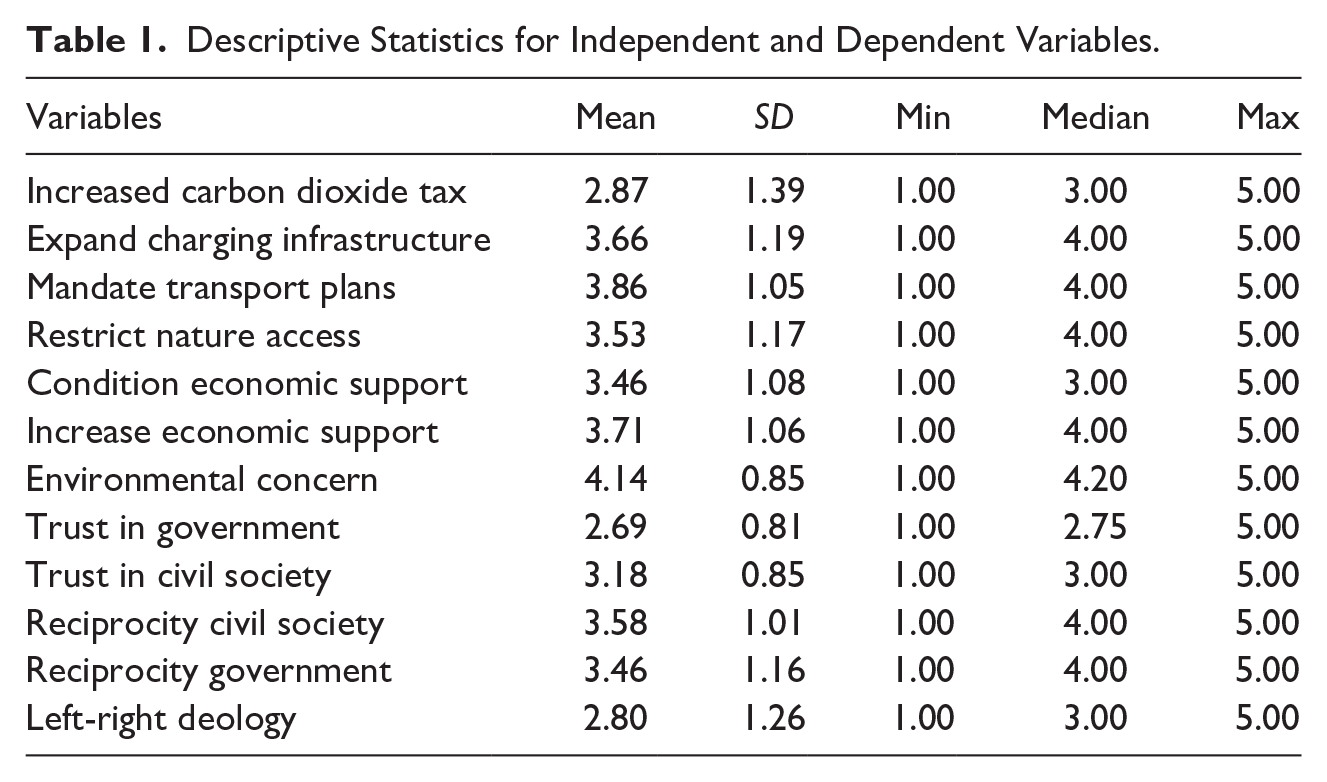
Our dependent variables focuses on measuring the extent to which the respondents were willing to support a number of government policies meant to reduce the environmental impacts of sport and outdoor activities. In line with previous research on environmental policy attitudes (e.g., Eriksson et al., 2006; Jagers et al., 2018) the respondents were asked to indicate their attitude toward a number of “political initiatives as measures to reduce the environmental impacts from the sport and outdoor sectors.” Responses were reported on a partially labeled five-point scale, ranging from “Completely against” [1] through “Neither for nor against” [3] to “Completely in favor” [5]. Respondents were asked to rate a total of six policies, including a combination of economic and regulatory policy instruments aimed either directly toward the sport and outdoor sectors, or that were more general in character. The policies were: (Policy 1) an increased tax on carbon dioxide; (Policy 2) an expansion of the network of charging stations for electric cars; (Policy 3) a directive forcing regions and municipalities to consider public recreational travel needs in transportation planning; (Policy 4) a strengthening of the mandate of municipalities and county administrative boards to limit access to areas with sensitive nature; (Policy 5) a conditioning of the economic support to sport and outdoor organization on environmental performance; and (Policy 6) a strengthening of the economic support for sustainability projects in the sports and outdoor sectors. Table 1 summarizes the levels of support for the six policies.
Descriptive Statistics for Independent and Dependent Variables.
Independent Variables
Civil Society Membership
To measure the extent of membership in civil society organizations, we simply asked the respondents to report whether they were members in any sport or outdoor organizations. In the analyzes these variables were coded as dummy variables, with non-membership (“0”) treated as the reference category. In total, 32.02% (N = 326) reported being members of a sport organization, whereas 13.75% (N = 140) reported being members of an outdoor organization.
Trust and Reciprocity
To measure trust in government and civil society, the respondents were asked to report their level of trust for six different actors and institutions: the national parliament, the cabinet, municipalities, the county administrative boards, as well as the sport, and outdoor movements respectively. A five-point partially labeled scale running from “Very low trust” [1] through “Neither high nor low trust” [3] to “Very high trust” [5] was used (see e.g., Drews & van Den Bergh, 2016; Hammar & Jagers, 2006; Harring & Jagers, 2013; Taniguchi & Marshall, 2018). The respondents’ answers to the four items relating to government actors were combined into an average index indicating their trust in government (Cronbach’s α = .83, indicating good consistency) and the two items for the sport and outdoor movements were averaged to form a scale indicating the respondents trust in civil society organizations (Cronbach’s α = .68, indicating a bit lower, but acceptable, consistency). In order to measure the respondents’ perceived level of reciprocity, they were asked to report how likely they though it were that “a clearer involvement of the state” and “a change in the activities of sport and outdoor organizations,” could lead to “a reduced environmental impact of the sport and outdoor sectors.” A partially labeled five-point scale ranging from “Not at all likely” [1] to “Very likely” [5] was used to measure the respondents’ perceptions. These measures were used as two individual indicators of expected civil society and government reciprocity.
Environmental Concern
Public attitudes toward environmental policies are commonly stronger among individuals that are more aware of environmental degradation (Bamberg & Möser, 2007; Eriksson et al., 2006; Kollmuss & Agyeman, 2002; Nordlund & Garvill, 2002), and feel personally concerned about these impacts (Gerber & Neeley, 2005; Leiserowitz, 2006; O’Connor et al., 1999). To control for this effect, the respondents were asked to report the degree to which they felt concern about the future impacts of five different environmental threats: climate change, environmental degradation, reductions in biodiversity, an increased number of extreme weather events, and depletion of natural resources (measured on a five-point partially labeled scale, running from “Not at all concerning” [1] to “Very concerning” [5]). These scores were averaged into an index (Cronbach’s α = .9, indicating very good internal consistency).
Ideology and Political Preferences
Environmental policy attitudes are also closely associated with ideology and party preferences, with individuals on the right side of the traditional left-right ideological spectrum being less supportive of environmental policies, whereas support is stronger on the left-hand side (Dunlap et al., 2016; Harring & Sohlberg, 2017; Lewis et al., 2019; Linde, 2018; McCright, 2011; McCright et al., 2016; Tesler, 2018; Tranter, 2013). To control for this, ideological preferences were measured by asking the respondents to place themselves on the common left-right ideological scale (from “Clearly to the left” [1], through “Neither left nor right” [3], to “Clearly to the right” [5]). Two dummy variables indicating whether the respondents were supporters of either the Green Party (6.68% of the sample ) or the right wing populist Sweden Democrats (5.8% of the sample) were furthermore included.
Control Variables
A number of common control variables, including the respondents’ age, gender (dummy variable, 1 = woman, 0 = man), income (low, medium, high), and education (low, medium, high) were also included. As reported above, the respondents in the sample had an average age of 47.87 years (SD = 13.17 ) and there was a slight over representation of women (51.67% ). The income categories represents an average monthly income before taxes of below 21 000 SEK (low), between 21 000 and 48 999 SEK (medium), or at 49 000 SEK or more (high). The median income reported by the respondents was between 35 000 and 41 999 SEK. 6 The education categories represents below 12 years of schooling (low), between 12 and 13 years of schooling (medium), or 14 years or more of schooling (high). The median respondent in our sample reported having a university or college degree of less than 3 years.
Finally, the respondents were asked to indicate how often they engaged in seven different types of sport and outdoor activities (including e.g., hunting and fishing, alpine and cross country skiing, individual sports and group sports). Respondents could indicate their degree of activity on a fully labeled five-point scale, ranging from “Every day or several times a week” to “Rarely or never.” The respondents’ scores were subsequently combined into two different measures, one indicating the degree of activity in outdoor activities (sum of four items, range 0–20) called “Active outdoor” and one the degree of activity in sports (sum of three items, range 0–15) called “Active sports.” The average scores for these two variables were 9.34 (SD = 3.26) for the outdoor measure, and 9.79 (SD = 2.16) for the sport measure.
Analytical Strategy
Given the ordinal nature of our dependent variables, ordinal logistic regression models were used to analyze the data. In all parts of the analysis below, odds ratios are reported for the independent variables. An odds ratio >1 indicates an increased odds of an outcome with every increase in an independent variables, whereas and odds ratio <1 indicates a decrease. These effects can be expressed as percentages, and an odds ratio of 1.40, for example, represents 40% greater odds of having a greater outcome. For all models, model assumptions were assessed using correlation plots (for multicollinearity) and Brant’s test (for proportional odds assumption). Overall, the regression models were considered valid. All analyses were conducted with use of the statistics program R (version 4.3.3).
Results
Table 2 shows the results of an ordinal logistic regression model, which regresses support for each of the six policy items on membership in sport and outdoor organizations. Coefficient estimates are odds ratios and the model includes controls for age, gender, income, education, and degree of activity in sports or outdoor recreation. The results in Table 2 show that membership in both sport and outdoor organizations to some extent is associated with attitudes toward environmental policies. The effects are though somewhat different across models and explanatory factors. First, we can see that membership in outdoor organizations is positively associated with two policies: a mandate on municipalities to consider recreational travel needs in planning and an increased economic support for sustainability projects in the sport and outdoor sectors. The effects for the two policies are of relatively large magnitude. For example, for the policy mandating municipalities to consider recreational travel needs, we can see that membership in an outdoor organization is associated with an 83.1% increase in the odds of being more supportive. Second, we can see that membership in sport organizations is negatively associated with two types of policies: a raised CO2-tax on petrol and giving municipalities strengthened possibilities to limit access to nature areas. The effects for the two policies are similar and both relatively sizable. For example, for the latter of the policies, we can see that being a member in a sport organization is associated with 26.2% decrease in the odds of reporting a higher level of support. These diverging effects of organizational membership on policy support is, as such, an indication that the importance of CSO-membership is different across different sectors. Also, as only a few of the policies were significantly related to the membership variables, there is an indication that civic participation only matters in some instances. Overall, this only gives partial support to Hypothesis 1.
Effect of Membership on Policy Support.
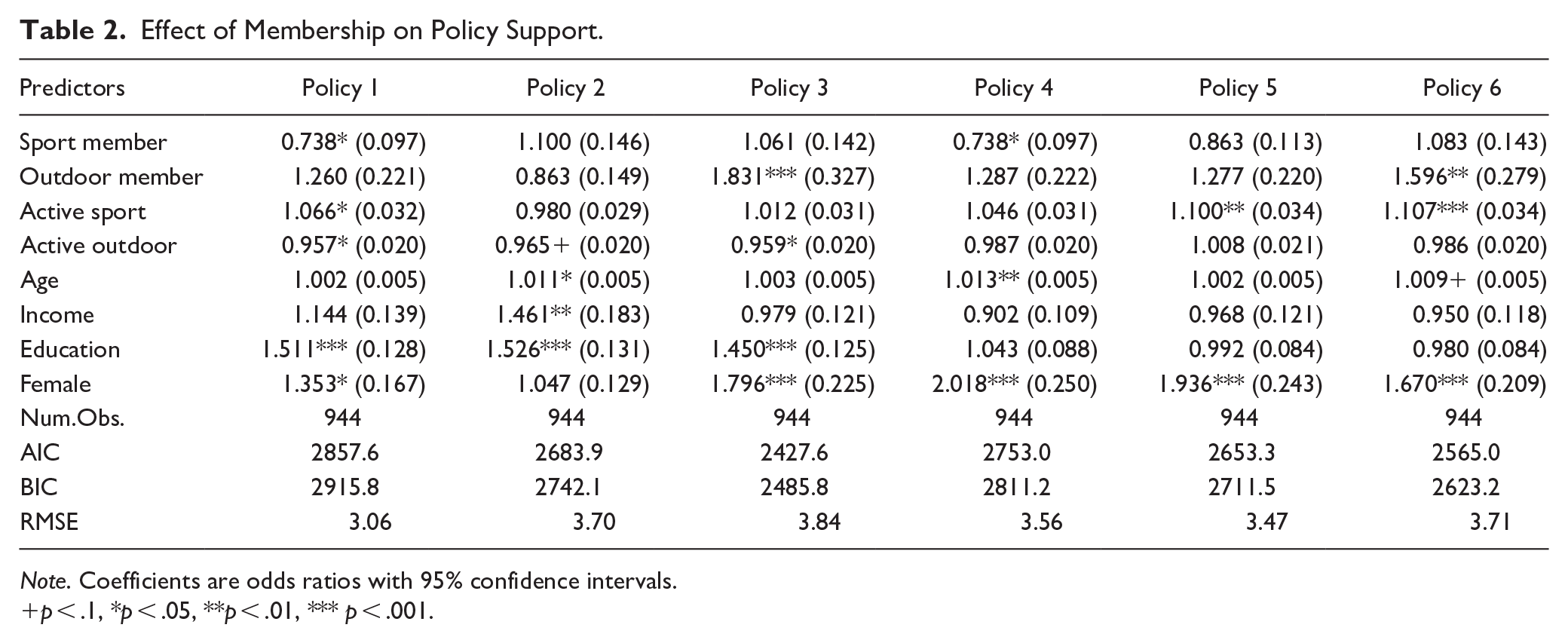
Note. Coefficients are odds ratios with 95% confidence intervals.
p < .1, *p < .05, **p < .01, *** p < .001.
In the next step of our analysis, we focused on the effect of organizational membership on trust and reciprocity. Table 3 shows the results of ordinal logistic regression model, in which the four measures of trust and reciprocity are regressed on membership in sport and outdoor organizations. These results reveal two effects that are in line with what was hypothesized. As can be seen in Table 3, membership in sport organizations is positively associated with higher levels of trust in civil society, which is in line with Hypothesis 2. A member in a sport club has a 61.8% increased odds of reporting a higher level of trust in civil society organizations. Membership in outdoor organizations is, furthermore, associated with a 32.3% increase in the odds or reporting a higher level of perceived reciprocity from civil society—in line with Hypothesis 3. However, it can also be noted, that a majority of the investigated effects were insignificant. In case of trust in, and expected reciprocity from, state actors, no predictor had a significant impact. Evidence that CSO-membership raises all forms of trust is thus modest. In sum, Hypothesis 2 and Hypothesis 3 can only be partially supported.
Effect of Membership on Trust and Perceived Reciprocity.
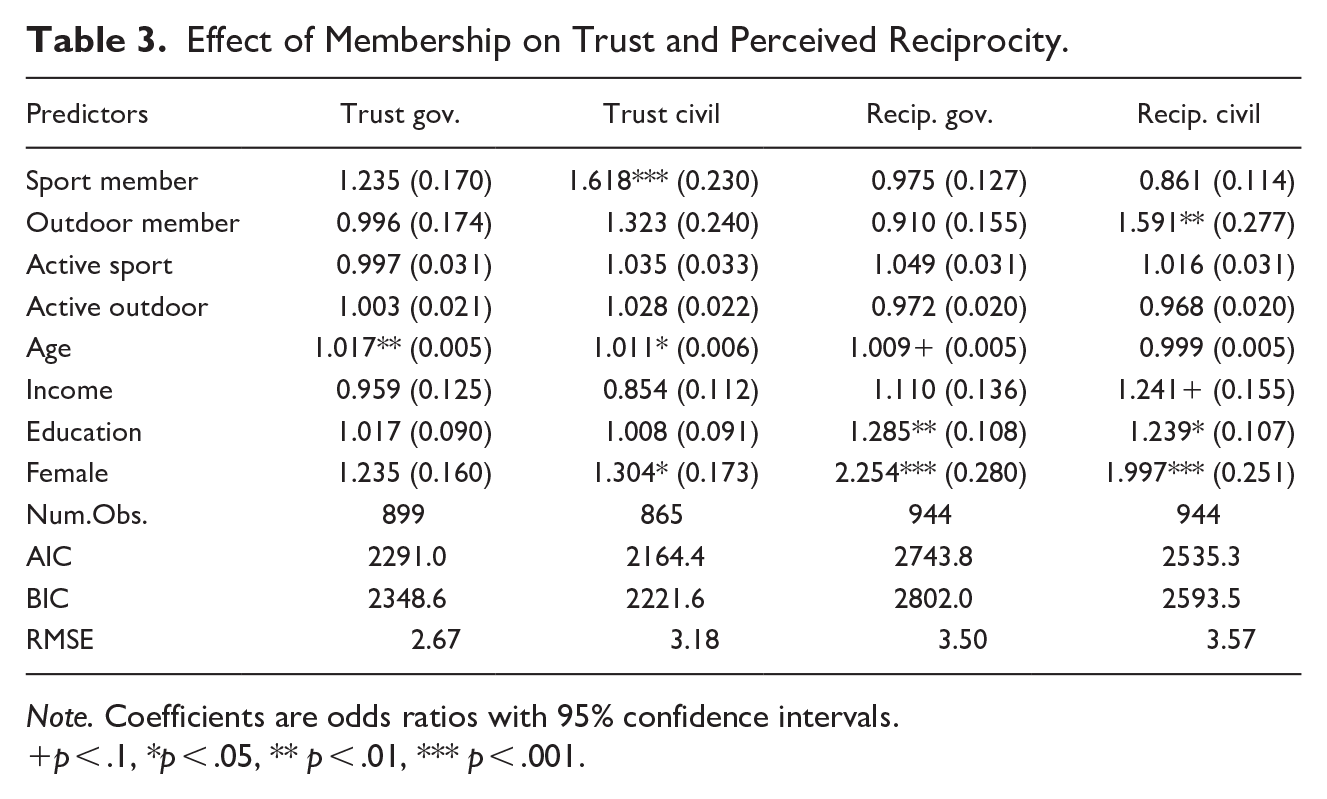
Note. Coefficients are odds ratios with 95% confidence intervals.
p < .1, *p < .05, ** p < .01, *** p < .001.
Finally, Table 4 shows the results of a number of ordinal logistic regression models, in which support for the six environmental policies is regressed on organizational membership and the full set of control variables. Compared to the results of the baseline model in Table 2, only a few of the coefficients remain significant when the controls are included. First, the results in Table 4 shows that respondents that are members in outdoor recreational organizations have a 60.5% higher odds of being more supportive of a policy forcing municipalities to consider recreational travel needs in public planning. Second, respondents that are members in some type of sport club have 32.9% lower odds of reporting a higher level of support for a policy granting municipalities a strengthened possibility to limit access to nature areas. These effects only give partial support to Hypothesis 1, while the insignificant effects for the other policy items suggests that that the hypothesis should be rejected.
Effect of Membership, Trust and Perceived Reciprocity on Policy Support.
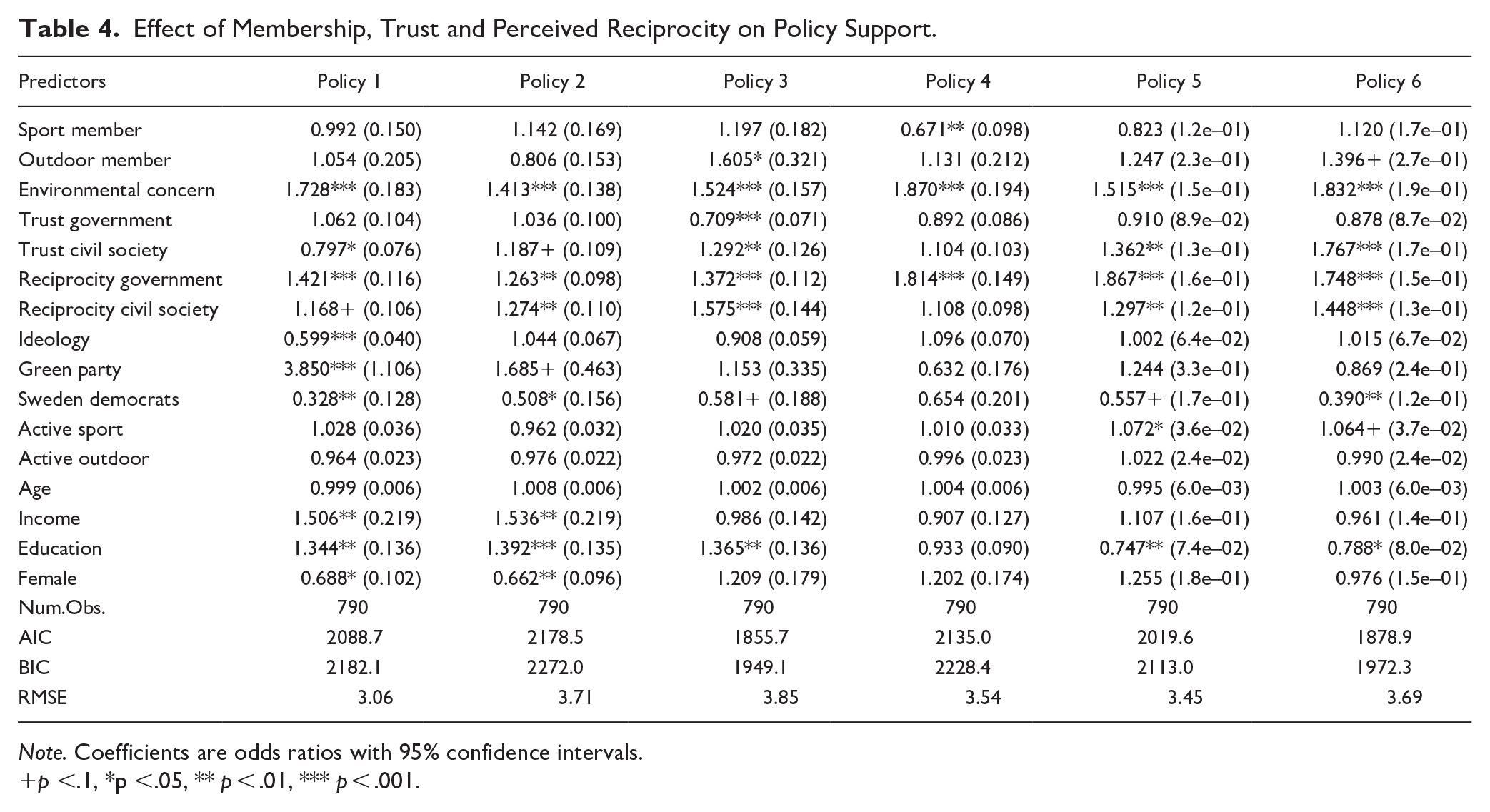
Note. Coefficients are odds ratios with 95% confidence intervals.
p <.1, *p <.05, ** p < .01, *** p < .001.
Looking instead at the other predictors, both environmental concern and perceived reciprocity among state actors has a consistently positive and significant effect across all policies. With a one-unit increase in concern for environmental degradation, the odds of reporting a higher level of support for the environmental policies increases with between 51.5% and 87%. For the perceived state reciprocity measure, the odds of reporting higher support increases with between 26.3% and 81.4% with each one-unit increase of the measure. The results in Table 4 furthermore show that left-right ideology and partisanship only are related to support of a minority of the policies. For each one unit change in left-right political ideology (e.g., changing from “neither to left nor right” to “somewhat to the right”) decreases the odds of reporting a higher level of support for an increased CO2-tax on petrol with 40.1%. The effect of ideology on the other policies is, however, statistically insignificant. In case of partisanship, we can see that the effect of supporting the Green Party also has its strongest effect on support an increased CO2-tax. Among supporters of the Green Party, the odds of reporting a higher level of support for the CO2-tax policy is on average 285% higher, compared to all other respondents. Conversely, for supporters of the populist right Sweden Democrats, the odds of reporting a higher level of support is 67.2% lower compared to the rest of the sample. Although there are a few other significant effects of political partisanship, support of an increased CO2-tax seems to be the most politically polarizing of all the policies investigated.
Discussion
The findings from this study shows that the commonly held wisdom that civil society’s role in the governance of environmental public goods in essence always is benign has to be questioned. The result presented above clearly shows that membership in the sport and outdoor sectors, which organize large portions of the population in many societies, can be both positively, and negatively associated with environmental policy support. The insignificant relationship between CSO-membership and support for several of the policies is, furthermore, an indication that the positive influence of civic participation on levels of environmental cooperation cannot be taken for granted. All this seems to indicate that many findings in previous research (e.g., Bühren & Wicker, 2024; Duit, 2011; Gelissen, 2007; Marbuah, 2019; Polyzou et al., 2011) might be too optimistic about the potential role of civil society in environmental governance (see also Cho & Kang, 2017; Grafton & Knowles, 2004).
The results also show that membership in sport and outdoor organizations can have an indirect association with environmental policy support by influencing the levels of trust and expected reciprocity individuals have toward civil society. Most clearly, the results showed that membership in sports and outdoor organizations, to some extent, is associated with higher levels of trust and expected reciprocity in civil society’s actions in the environmental domain. When included as predictor variables in the last model, the results also showed that trust, but especially expected reciprocity, is significantly related to policy support. This is also more in line with the expectation that civic participation has a role in generating trustful and reciprocal relationships, which in turn can influence environmental cooperation (Adger, 2003; Jones et al., 2009). However, the correlation between CSO-membership and trust found here, must though be interpreted cautiously. Specifically, as discussed previously, higher levels of trust among CSO-members could equally well be an indication of self-selection, rather than and effect of socialization (Dahl & Abdelzadeh, 2017; van Ingen & Bekkers, 2015). That is, that individuals with high levels of trust are more likely to join CSO:s and that being a member is unlikely to increase that trust in any substantial way. The overall impression of the results—that membership in civil society organizations simultaneously can have both a positive impact, by increasing participants confidence in civil societies abilities to manage environmental problems, while at the same time having a direct dampening effect on policy support—must thus be considered tentative. Still, the results add some new nuance to previous research on the relationship between social capital, civic participation and environmental cooperation.
To some extent, the results can be an indication that attitudes toward environmental regulations in these sectors are driven by a mix of motives, including self-interest. Specifically, the results showed that policies with direct impacts on the activities of certain group tend to be more strongly associated with policy attitudes among members in that group. For example, policies focusing on providing economic resources toward CSO:s were generally supported by group members, while policies enforcing costs or restrictions (e.g., restricting access to nature) tended to receive less support. This could, thus, be an indication that even members in sport and outdoor organizations, that often depend on a healthy environment in their activities, are unwilling to accept environmental regulations that negatively influences the current status quo (Moser, 2010). This is also in line with previous research that has shown that sport and outdoor participants often view degrading environmental quality as a threat to their activities (Cunningham et al., 2020). Another factor to consider, is threat of an increased administrative burden that some of these policies would entail—especially those directly targeted at the CSO:s. Since the activities of most Swedish CSO:s are organized by unpaid volunteers (see e.g., Von Essen & Svedberg, 2022), added administrative work is likely generally unwelcome. Our results also resonates well with findings within studies of environmental policy attitudes that shows that the likelihood of engaging in pro-environmental actions is reduced as the perceived individual costs of cooperation increases (Lubell, 2002; Lubell et al., 2006). These costs can also be of a wide range of different types, both economic (Evans et al., 2022; Levi, 2021), re-distributive (Beck et al., 2016; Evans et al., 2022; Levi, 2021; Maestre-Andrés et al., 2019; Rhodes et al., 2017) or be related to how policies limit the individual freedom to engage in different types of behaviors (Karlsson et al., 2020; Savin et al., 2020).
As always, the results must be interpreted in light of the research design and the data collection process. First, as this study is based on observational data and a cross-sectional design, possibilities to make causal claims are limited. This perhaps especially relates to possibilities of disentangling the effects of self-selection and socialization as discussed earlier (Dahl & Abdelzadeh, 2017; van Ingen & Bekkers, 2015; Wollebaek & Selle, 2002; Wollebæk & Strømsnes, 2008). Further studies are therefore needed to rule out possibilities of reversed causality or omitted variables bias. Second, while our survey was aimed at retrieving a nationally representative sample of the Swedish adult population, the modest response rate (roughly 13%) is an indication that there could be problems with biased selection among our respondents. While the sample is largely representative of the general population in terms of demographic characteristics, there might, for example, as a result of self-selection among respondents be a skeweness in other relevant dimensions, such as interest in sports, or environmental issues. The sample did, however, contain a mix of respondents being active members in sport (32.02%) and outdoor (13.75%) organizations and those with no connections to such organizations (49.12%) and does as such capture differences across levels of civic participation (which is of central concern for our study). So while generalization of our findings to the broader population should be done with some caution, we believe that the fundamental mechanisms under study are well captured in the data.
From a theoretical perspective, the findings in this study opens up for future research to more closely examine the interplay between the different elements of civil society that generates either pro-social or self-interested attitudes and behaviors. One possible avenue of research would be to look closer into the importance of social norms (Biel & Thøgersen, 2007; McDonald et al., 2013; Thøgersen, 2006) and group identities (van Zomeren et al., 2008; Whitmarsh & O’Neill, 2010), and their interaction (Fritsche et al., 2018), among members of civil society organizations, to investigate how these factors influence attitudes toward pro-environmental behaviors. Another possibility would be to look at policy specific beliefs (Drews & van Den Bergh, 2016; Eriksson et al., 2008; Jagers et al., 2018), to see whether the connection between CSO-membership and attitudes toward environmental policies is related to policy design and issues of perceived effectiveness, equitabillity and personal freedom. Either way, future research should carefully elaborate the theoretical underpinnings connecting civic participation with environmental cooperation to more fully capture the differences across civil society sectors, organizational types, and participant motives.
For policy-makers, the results indicate that efforts to increase pro-environmental behaviors within the public by cooperating with civil society actors must be carefully considered case by case. The idea that governments simply can increase funding to sports clubs in an expectation that this will increase pro-environmental behaviors within the public (Bühren & Wicker, 2024) is probably too optimistic. However, it is also important to note that the results in no way rules out the possibility that civil society has an important role to play in the transition to a more sustainable society. Rather, the findings presented here suggest that all and any actions aimed at involving civil society must be taken in light of the potentially conflicting motives underpinning each organizations activities. If done right, such involvement could ensure a more fair, effective, and efficient environmental governance, as is envisioned by some (Adger, 2003; Bernauer et al., 2016; Bernauer & Gampfer, 2013; Jones et al., 2009; Schrama & Zhelyazkova, 2018). But, if done without consideration of the specific circumstances that drives the activities within civil society, such involvement is not only likely to lead to a waste of money, but could also undermine the credibility of the system of environmental governance as such.
Footnotes
Author Contributions
Both Linde and Eriksson contributed to the study conception, design, and material preparation. Analyses were performed by Linde. The first draft of the manuscript was written by Linde, while Eriksson developed and commented on subsequent versions of the manuscript. Both authors read and approved the final manuscript.
Declaration of Conflicting Interests
The author(s) declared no potential conflicts of interest with respect to the research, authorship, and/or publication of this article.
Funding
The author(s) disclosed receipt of the following financial support for the research, authorship, and/or publication of this article: The research was funded by Mistra Sport and Outdoors (DIA 2016/36).
Ethical Considerations
The study was approved by the Swedish Ethical Review Authority (Dnr 2023-01292-01).
Consent to Participate
All participants provided written informed consent before participating in the study.
Consent for Publication
Not applicable.
