



Abstract
Despite widespread concern for environmental issues, a noticeable gap between concern and pro-environmental actions persists across countries and cultures. This study examines this gap in South Africa, analyzing the relationship between income and pro-environmental behavior using the ISSP 2020 Environment dataset. Linear regression results reveal that income positively correlates with concern-behavior gaps in recycling and green purchase behavior, however insignificant for the concern-public environmental activism gap. Lower-income individuals display smaller gaps; they have less environmental concern but engage more in recycling, possibly for economic survival. Conversely, higher-income individuals display greater environmental concern but have relatively low recycling, green purchase behaviors and tendencies for public environmental activism. These findings underscore the potential for policymakers to leverage the strong pro-environmental behavior habits of lower-income groups by supporting sustainable practices that offer both economic and environmental benefits while encouraging higher-income groups to adopt more active environmental practices.
Keywords
Introduction
In recent years, the world has witnessed an escalation in environmental challenges, encompassing a myriad of pressing issues such as deforestation, global warming, loss of biodiversity and the heightened occurrence and intensity of extreme weather events. These issues have been identified as some of the most critical global problems (Intergovernmental Panel on Climate Change [IPCC], 2021). Addressing these challenges demands substantial behavioral shifts in human activity at a global, national and individual level. Individual behavior, in particular, plays a crucial role in addressing these challenges due to its direct/indirect impact on greenhouse gas emissions (Vandenbergh & Steinemann, 2007). Moreover, public opinion on environmental issues is vital for demographic engagement, enabling governments to implement effective environmental policies with voter support (Hackmann et al., 2014). Consequently, understanding the level of individual environmental concern and the conversion into pro-environmental behavior (PEB) is crucial for national and global efforts to reduce greenhouse gas emissions.
Despite widespread environmental concern (Milfont & Schultz, 2016), pro-environmental behavior remains low in most countries (Kulin & Johansson Sevä, 2020) This is evident in the high global consumption patterns, with humanity using resources equivalent of 1.75 earths (York University, Ecological Footprint Initiative & Global Footprint Network, 2022). Empirical studies have supported a weak relationship between environmental concern and pro-environmental behavior, commonly referred to as the concern-behaviors gap (Bamberg & Moser, 2007; Tam & Chan, 2017). This concern-behavior gap has been a subject of extensive studies globally (Bamberg & Moser, 2007; Eom et al., 2016; Farjam et al., 2019; Kollmuss & Agyeman, 2002; Neumann & Mehlkop, 2023; Tam & Chan, 2017), providing vital insight into the challenges individuals face when environmental concerns does not lead to behavior change. The complexity behind the concern-behavior gap is underlined by the factors hindering pro-environmental behavior, including psychological factors like values, trust, knowledge, awareness and motivation, and external factors like institutions, economic positions, and culture (Kollmuss & Agyeman, 2002). Moreover, the relationship between income and concern-behavior gap is heavily influenced by how pro-environmental behavior is measured (Grandin et al., 2022). Various measures of pro-environmental behavior exert different influences from income (Fisher et al., 2012; Lee & Paik, 2011). In this case, three measures of PEB are used: green purchase behavior, recycling behavior and public environmental activism. These behaviors provide a keen sense of pro-environmentalism, but the role of income may vary. While some studies have found green purchase behavior positively related to income, with higher levels observed among high-income earners (Fisher et al., 2012), others have found the relationship less clear (Akehurst et al., 2012; Wang et al, 2019; Yener et al., 2023), often depending on country-level factors. The relationship between recycling behavior and income is also unclear and dependent on the contextual setting. Some studies have confirmed a positive relationship between recycling behavior and income in developed countries (Guerin et al. 2001), while others have found a negative relationship especially in developing countries, with lower-income individuals exhibiting higher recycling behaviors (Oyekale, 2017). Similarly, the relationship between income and public environmental activism is unclear (Kennedy et al., 2009). Studies show that while individuals, particularly women, express higher environment concern, external barriers, such as socioeconomic status, often hinder their active participation in activities like joining environmental organizations, giving money to organizations and signing petitions (Tindall, 2003)
The dynamics behind pro-environmental behavior and income also vary by country (Dorsch, 2014; Tam & Chan, 2017), underscoring the importance of understanding these dynamics in specific national contexts. However, existing studies often overlook the African context, where extreme levels of poverty, heightened natural disaster events, severe income inequalities and other social issues could influence environmental attitudes and behaviors. This study aims to explore the concern-behavior gap within Africa, focusing on South Africa, described as the world’s most unequal society. Inequality in South Africa is driven by stark income disparities. Those at the higher and lower end of the income distribution often exemplify the setting of what is often dubbed a country of two nations (Nattrass & Seekings, 2001). These significant differences in lifestyle, consumption and material aspirations could yield heterogeneous levels of environmental concern and pro-environmental behaviors. Therefore, it is expected that South Africa’s diverse socioeconomic landscape suggests that the concern-behavior gap may differ significantly among income groups.
The objective of this research is to contribute to the broader understanding of environmental sociology in South Africa by exploring the dynamics of the concern-behavior gap for different income groups. Decomposing the concern-behavior gap into a concern- recycling behavior gap, a concern-green purchase behavior gap and a concern-public environmental activism gap should further allow us to clearly assess the role of income on the concern-behavior for different measures of PEB. The results should provide environmental policymakers with better insight of how private and public pro-environmental behavior is shaped in South Africa and the design of future environmental policies tailored to different income groups.
The following sections are structured as follows: Section “Literature Review” provides an overview of the relevant literature, while Section “Methodology” presents the data sources and methodology. Section “Descriptive and Empirical Results” summarizes the empirical findings, and Section “Discussion and Conclusion” provides a thorough discussion followed by a conclusion.
Literature Review
Environmental Concern, PEB and the Concern-behavior Gap
In theory, people’s environmental concerns should convert into pro-environmental behavior (PEB), however this translation has not been observed in empirical studies. Numerous studies have found a weak association between environmental concern and PEB (Blake, 1999; Kennedy et al., 2009; Tam & Chan, 2017). This variation between environmental concern and PEB has been referred to as the concern-behavior gap.
The conceptual framework behind the concern-behavior gap originates from the complexity of the factors driving pro-environmental behavior (PEB). Early PEB theories based on US linear models followed a sequential pattern, where acquiring knowledge about the environment was believed to cultivate an awareness and concern for environmental issues. This progression was believed to eventually foster pro-environmental behavior. These models operated under the assumption that educating individuals about environmental matters would lead to an increase in pro-environmental behaviors. Burgess and colleagues, in 1998 referred to these theories as the “deficit” models of public understanding and action, emphasizing their focus on information insufficiency (Burgess et al., 1998). However, these models lacked the integration of the complex dynamics behind PEB. Notably Kollmuss and Agyeman (2002) developed a conceptual model that demonstrates the complexity of factors behind pro-environmental behavior. These factors can be split between internal and external factors. While internal factors include psychological factors like personality traits, value systems, attitudes and feelings, external factors include the infrastructure, political environment, social and cultural factors, and economic positions.
Concern-behavior Gap and Income
From an external factor perspective, individuals’ economic position, usually measured by income, has a multifaced impact on their concern-behavior gap. Inglehart theory on postmaterializm provides a strong link between economic position, environmental concern and behavior (Inglehart, 1995; 1997). The postmaterializm theory suggests wealthier societies or individuals may focus more on environmental issues since they have fewer worries about the basic materials of life (Inglehart, 1997). However, the development of pro-environmental attitudes and behavior in developing countries has challenged this view and others have found that this relationship is a bit more complex (Dorsch, 2014).
Moreover, the measurement of pro-environmental behavior is multifaceted, and the type of measurement can influence the way income influences the concern-behavior gap. For instance, a study by Fisher et al. (2012) found that usage of green product separating trash for recycling purposes are determined by income level, however using recyclable bags and energy-efficient light bulbs and turning off the lights while leaving the room have no relationship with income level. Similarly, Lee and Paik (2011) found, using survey data in Korea, that income is a significant and positive predictor of recycling behavior, but not for other types of PEB like food separation. For this particular paper we make use of recycling behavior, green purchase behavior and public environmental activism, three different measures of PEB that provide heterogenous insight into the role of income on the concern-behavior gap.
Green Purchase Behavior and Income
Green purchase behavior is a central measure for pro-environment behavior. Research indicates that income plays a significant role in influencing green purchase behavior, with higher-income individuals being more likely to engage in such behavior (Fisher et al., 2012). The cost associated with green purchase behavior is one of the primary reasons for the positive relationship between income and green purchase behavior (D’Souza et al., 2007; Gilg et al., 2005). The relationship between income and green purchase behavior is also heterogeneous between developed and developing countries. This is due to several reasons. Firstly, consumers in developed countries tend to have a higher share of high-income earners that can afford higher-priced green products, while those in developing countries have larger share of low income earners that could be price-sensitive toward green purchasing. Secondly, access to green products is different between countries. For instance, developed countries tend to have more extensive infrastructure for green product production and distribution (Tanner & Wölfing Kast, 2003). In developing countries, there might be a limited variety of choices that could reduce purchase of green products. Thirdly, cultural factors also play a significant role. In developed countries, consumers might feel social pressure, due to heightened sustainability and green consumption norms, to make more green purchases (Liobikienė et al., 2016). In developing countries, immediate economic and social concerns often take lead above environmental issues (Nyborg et al., 2006).
Recycling Behavior and Income
Since recycling behavior plays a vital role for environmental sustainability, a host of studies have assessed the factors driving recycling behavior (Guerin et al., 2001; Kumar, 2019; Martin et al., 2006; Pisano & Lubell, 2017; Steg & Vlek, 2009), often finding heterogeneity among developed and developing countries. The differences in recycling behaviors in developed versus developing nations can partly be attributed to access to formal services, social norms and economic benefits. A study by Guerin et al. (2001) found for a sample of 15 European Union countries, higher recycling behavior among high income households, alluding to the fact that recycling behavior is driven by environmental awareness that is positively correlated with income and education. The motive behind recycling in developed countries is strongly driven by environmental awareness, where high income households tend to recycle more due to higher education and a sense of social responsibility. Moreover, developed countries also have advanced recycling infrastructure, recycling policies, and incentives to promote recycling behavior (Dias et al., 2022; Xiao et al., 2018).
However, recycling behavior in developing countries is also prevalent, but more often driven by economic incentives. In developing countries, lower-income households often engage in recycling out of economic necessity. They collect recyclables to sell, which directly impacts their livelihood. Also, in developing countries, a notable share of recycling is conducted by the informal sector, which creates direct economic incentives (Ezeah et al., 2013). This tendency is due to economic survival and a sense of community solidarity, rather than environmental conservation motivations (Waquil, 2014). For instance, a study by Echegaray and Hansstein (2017) found a higher intention for e-waste recycling among lower income individuals in Brazil. While Nnorom et al. (2009) found a high willingness for Nigerian residents to participate in mobile phone recycling programs, driven by economic incentives and awareness campaigns. Furthermore, Xiao et al. (2021) study examined recycling behavior in high-rise residential buildings in Guangzhou, China, and found significant participation in recycling activities driven by community programs and government policies.
Public Environmental Activism and Income
Pro-environmental behaviors, such as recycling and green purchases, are typically categorized as private PEBs. In contrast, public environmental behaviors include actions like petitions, donating money or being a member of an environmental organization (Pisano & Lubell, 2017). These type of public PEBs are part of environment activism and cross country and cultural findings are mixed. For example, public environmental activism varies across gender (Hunter et al., 2004) and education (Marquart-Pyatt, 2012). Income has also been shown to influence environmental activism, although the relationship is complex and context dependent (Givens & Jorgenson, 2011; Kennedy et al., 2009; Pisano & Lubell, 2017)
Overall, the heterogeneity behind recycling behavior, green purchase behavior, public environmental activism and income drivers in developed and developing countries sheds light on the distinct cultural, economic and social conditions in countries. Yet, research on the relationship between income, green purchase behavior, recycling behavior and public environmental activism behavior in developing countries is limited compared to developed countries, especially in an African context. The aim of this study is to focus on South Africa and incorporate these two distinct measures of pro-environmental behavior (recycling and green purchase) to assess the concern-behavior gap in South Africa in relation to different income levels.
Income Disparity and the Concern Behavior Gap in a South African Context
South Africa, a middle-income country, is marked by stark social disparities. These disparities, driven by past discriminatory regimes, places South Africa among the countries with the highest levels of inequality globally (Sulla et al., 2022). Individuals at the lower end of the socioeconomic spectrum face challenging conditions, including limited social mobility, often heightened by spatial and environmental dynamics. Conversely, those in higher-income brackets possess the financial means and resources to navigate most challenges, including those related to healthcare and environmental issues.
International studies have shown that this type of disparity has significant effects on environmental attitudes and behaviors. To date, few studies have explored the dynamics behind income and environmental behavior in South Africa. A study by Oyekale (2017) analyzed the factors influencing households’ involvement in waste separation/collection for recycling in South Africa within the modified framework of the Theory of Planned Behavior, using 2014 General Household Survey data. The study found that income, marital status, race willingness to pay and the existence of waste recycling programs and facilities all influence recycling behavior among South African households. Notably household income was negatively associated with recycling behavior. This negative association contrast findings from developed country studies like Guerin et al. (2001). But as pointed out by Oyekale (2017; 2358) household heads’ incomes can influence recycling negatively through several channels. Specifically, where involvement in recycling is primarily motivated by the income gains, rich people would not participate. While others report an insignificant relationship between income and recycling behavior (Ichikowitz & Hattingh, 2020). Moreover, a recent study by Rampedi and Ifegbesan (2022) identified significant variations in pro-environmental behavior influenced by educational background, place of residence, ethnic identity, and province. While Kirsten and Biyase (2023) showed that pro-environmental behaviors, including green purchase behavior vary by sociodemographic characteristics in South Africa. However, to our knowledge, no study has yet integrated the high inequality into the discussion to examine the role of income differences in the gap between environmental concern and behavior, particularly regarding private recycling behaviors like recycling and green purchasing behavior and public environmental activism. The goal of this study is to advance the existing literature on pro-environmental behavior by investigating the impact of income on the concern-behavior gap in South Africa, specifically examining the effect of this gap when different measures of PEB are used. Given the main aim of this study is to assess the concern behavior gap for recycling behavior, green purchase behavior and public environmental activism, we construct three research hypotheses:
H1: There is a positive relationship between income and concern-recycling behavior gap in South Africa
H2: There is a negative relationship between income and the concern-green purchase behavior gap in South Africa
H3: There is a negative relationship between income and the concern- public environmental activism gap in South Africa
The following section of this paper is dedicated to the methodology and results section of the paper. Thereafter a discussion and conclusion will be based on the results.
Methodology
Data
The International Social Survey Programme (ISSP) is a collaborative effort among different countries to conduct annual surveys on diverse topics, including environmental issues. The ISSP Environment IV Dataset provides a valuable resource for understanding public attitudes and perceptions toward the environment in South Africa (ISSP Research Group, 2023). We make use of the latest ISSP Environmental IV dataset which was conducted in 2020 and includes 2844 observations for South Africa for individuals 16 years and older. The data has been weighted and nationally representative of South Africa.
Variables
We separate the pro-environmental behavior into three components, recycling behavior, green purchase behavior and public environmental activism. The ISSP includes questions that directly ask individuals about their actions to protect the environment. For recycling behavior, we use the question that reads how often do you make a special effort to sort glass or tins or plastic or newspapers and so on for recycling? For green purchase behavior we use how often do you avoid buying certain products for environmental reasons? Both these questions are answered by a selection of a four scaled Likert type response that takes the value of either 1 to 4, where 1 is answered as never and 4 is always. For public environmental activism we utilize three questions in the ISSP survey that asks individuals whether they are a part of an environmental organization, signed a petition about an environmental issue in the last five years or have taken part in a protest or demonstration based on an environmental issue. Since these questions have binary responses, we sum the responses to create a composite variable and then standardize the computed variable for comparability.
For environmental concern we make use of a five scale Likert question that reads, how concerned are you about environmental issues, with a response of 1 (not at all) to 5 (very concerned). To determine the concern-behavior gap we take the difference between environmental concern and pro-environmental behavior. Since pro-environmental behavior is split into three components, we estimate a concern- recycling behavior gap, a concern- green purchase behavior gap and concern- public environmental activism gap
Income, the variable of interest, is measured using the income rank from the ISSP survey. This income rank includes 14 ranking options and was recoded to take values from 0 to 13. To separate between low- and high-income groups we split the income rank using a household income poverty line based on the average number of household individuals and the 2019 Lower bound poverty line of R810 (Statistics South Africa, 2019). We take the sample average of number of people in the household which is 3.2 times the R810 lower pound individual poverty line, this leads to estimated household poverty line of R2592. Although it is a rough estimate of household poverty that does not allow for equivalence scaling among household members it does allow us to split the ISSP income rank variable into two groups. Those who are between 0 and R3000 fall within the lower income group and those above R3000 fall within the high-income group.
In line with the literature on PEB and environmental concerns, individual control variables are included as factors influencing the concern-behavior gap. These include race, age, sex, education, location and religion (Gifford & Nilsson, 2014; Sherkat & Ellison, 2007). Moreover, recognizing the multifaceted nature of environmental behaviors, we control for additional variables such as environmental knowledge (Kollmuss & Agyeman, 2002; Wan & Du, 2022) and trust (Tam & Chan, 2017), acknowledging their potential influence on individuals’ engagement in eco-friendly practices. These controls help to further isolate the specific impact of income on the concern-behavior gap. Table 1 provides a detailed breakdown of the variables used in the paper.
Description of Variables.

Method and Robustness Measures
In this study we make use of linear regressions to assess the impact of income on the concern-behavior gap in South Africa. The linear regression model includes significant predictors and offers insights into the strength and direction of these relationships, thereby enabling a more nuanced understanding of the dynamics at play to determine the concern-behavior gap in South Africa.
To ensure the robustness of our findings, our analysis incorporates several critical measures aimed at addressing potential econometric issues and evaluating the stability of our results. Firstly, we assess multicollinearity among our independent variables through Variance Inflation Factor (VIF) analysis, ensuring that our model does not suffer from inflated standard errors due to highly correlated predictors. Secondly, we examine the presence of heteroscedasticity by employing the Breusch-Pagan and White tests (Table A3). Beyond traditional linear regression diagnostics, we extend our analysis through the application of a Generalized Linear Model (Table A4), which accommodates the distributional characteristics of our dependent variable more flexibly, thereby providing a more nuanced understanding of the relationship between income levels, environmental concern, and pro-environmental behaviors. Finally, we also make use of a composite measure for pro-environmental behavior. By integrating these robustness measures, our analysis not only fortifies the validity of our findings but also provides a comprehensive framework for understanding the intricate dynamics between income, environmental concern, and pro-environmental behaviors in South Africa.
Descriptive and Empirical Results
The first part of the analysis presents a comparison between recycling behavior, green purchase behavior and environmental concern for South Africa against multiple other countries. Figure 1 below shows that comparing South Africa with the other 35 countries in the ISSP samples, that South Africa’s PEB ranks the lowest among the sampled countries. Out of the sample, Pro-environmental behavior, is lowest in South Africa, and significantly lower than other developing countries like Russia, China and India. The low level of PEB in South Africa could be explained by the high poverty, inequality and unemployment in the country that leaves a major share of the population unable to engage in pro-environmental behavior. The low level of pro-environmental behavior in South Africa also supports the post-materialist theory, where the relative abundance of material security in advanced industrial countries has led to post material priorities that includes high pro-environmental behavior (Inglehart, 1997). This can be observed from the high level of PEB levels in advanced societies like Germany, Switzerland and France. The low level of PEB in South Africa presents further support for a deeper analysis into the concern behavior gap in South Africa to fully understand how PEB is determined.
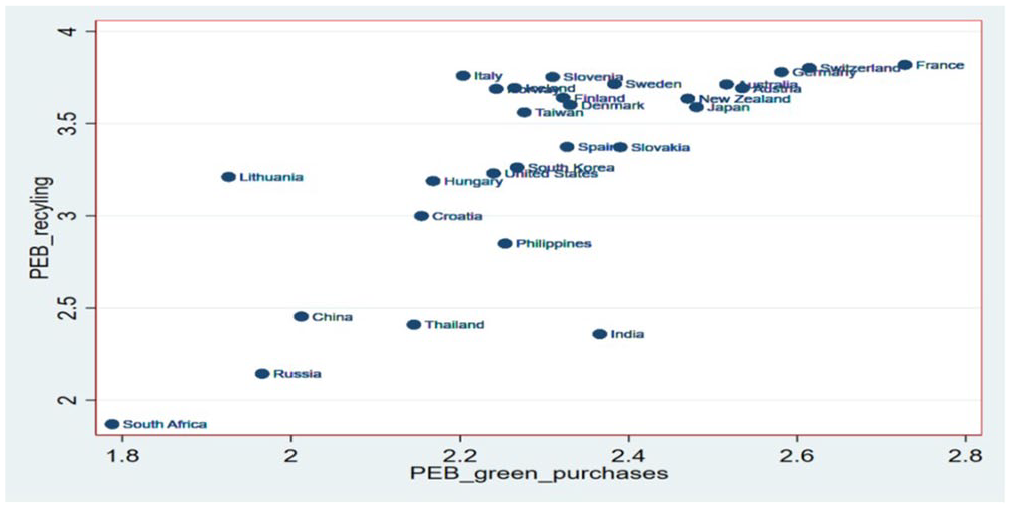
PEB recycling and PEB green purchase behavior by country.
In Figure 2 we observe the mean level of environmental concern. Here South Africa ranks third lowest with regards to environmental concern, with only Thailand and Slovakia reporting lower levels of environmental concern. The low level of environmental concern could be related to considerable number of social challenges in South Africa including, crime, poverty, corruption and unemployment that dominates people’s view of what to be concerned about. Table A1 in the appendix reports the rank of social issues in South Africa and confirms that environmental issues rank significantly lower than other issues. Environmental issues only rank 6th among the 9 social issues with healthcare (a), education (b), crime (c), poverty (d), and the economy (e) ranking higher.
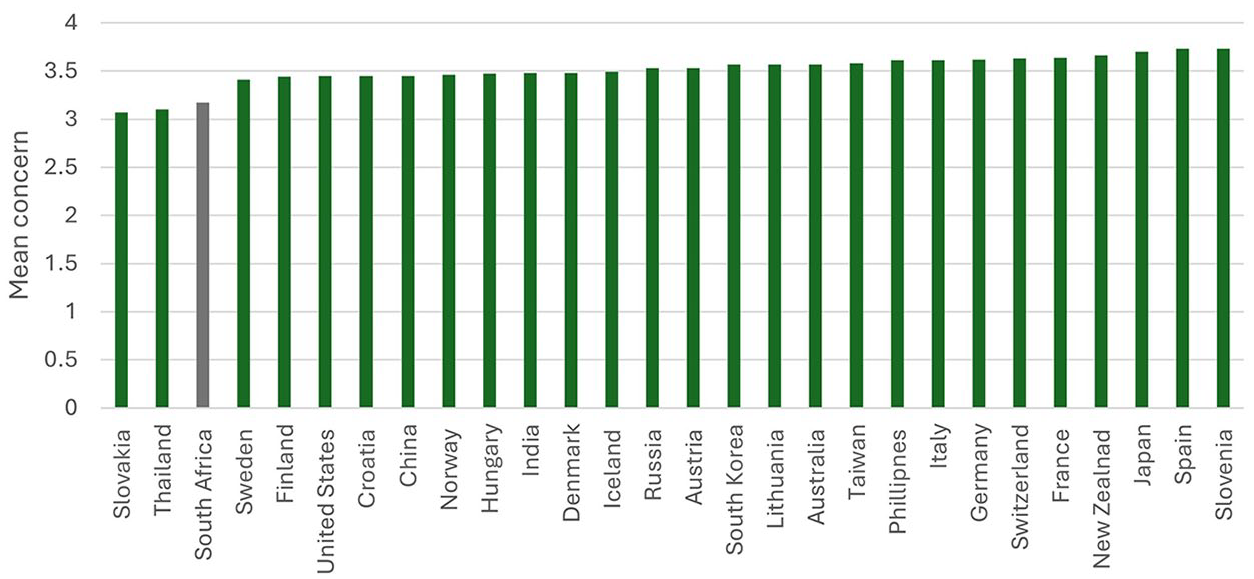
PEB (recycling) and environmental concern by country.
While South Africa has low levels of PEB and environmental concern, little is known about the within country dynamics behind environmental concern and behaviors. Figure 3 below reports the mean level of recycling behavior, green purchase behavior, public environmental activism and environmental concern among different income groups in South Africa. Comparing those in lower and higher income groups interestingly shows that those in lower income groups have stronger recycling behavior compared to the higher income group. This pattern can be supported by other studies who similarly showed that there is a strong tendency for recycling behavior among lower income individuals (Oyekale, 2017). Since poverty and inequality is severe in South Africa, those part of the lower income group experience extremely adverse economic conditions and use recycling for economic survival rather than supporting a wider call for pro-environmentalism due to climate change. But, since individuals in the lower-income group demonstrate notable positive behavior toward recycling, it suggests a pragmatic approach to environmentalism, driven perhaps by economic limitations.
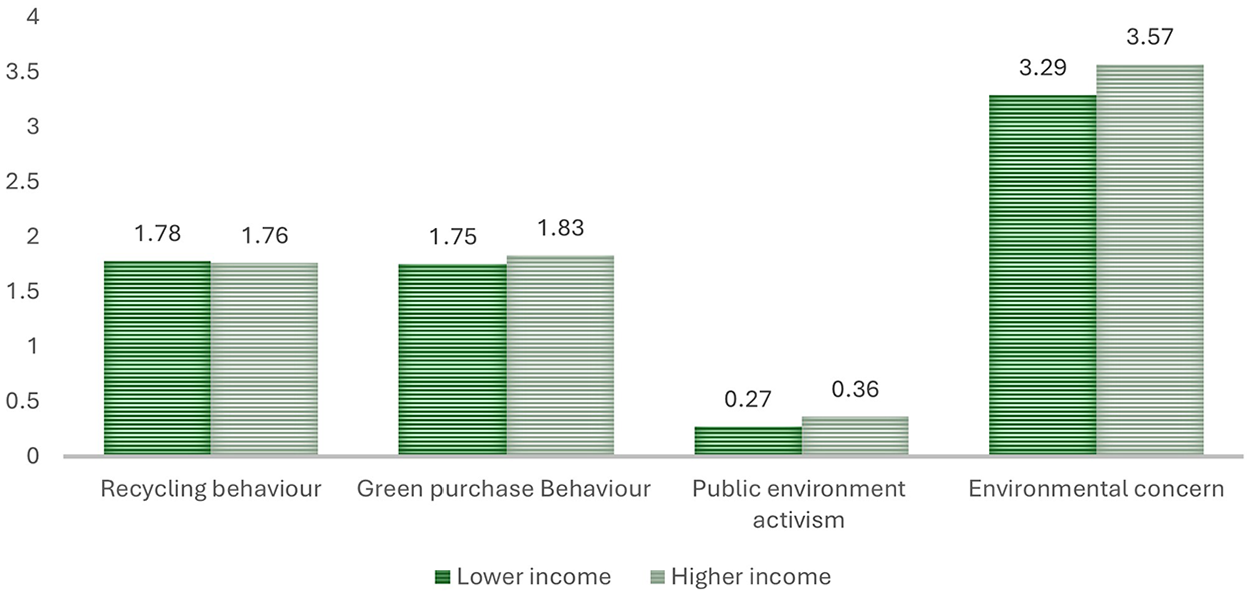
Recycling, green purchase behavior and environmental concern by income group.
In terms of green purchase behavior and public environmental activism like joining an environmental organization and giving money for such organizations, individuals in higher groups tend to exhibit slightly stronger green purchase and activism tendencies compared to the lower income group. However, this difference is minor compared to the environmental concern gap between these groups. Individuals from lower income households often demonstrate lower environmental concern, suggesting they place greater emphasis on addressing other social issues like poverty and crime. In contrast, those in higher income brackets tend to exhibit significantly higher concern for the environment. Nonetheless, it is vital to contextualize the PEB and environmental concern among both low- and high-income groups within the broader picture that South Africa remains a country with one the lowest levels of PEB and environmental concern. The modest PEB and concern among the high-income groups shows a scenery that both PEB and environmental concern is overshadowed by other social issues, as confirmed in Table A1. Yet, the relatively high level of PEB among the lower income presents a policy opportunity. Despite being driven by economic survival, these behaviors contribute to greenhouse gas reductions and could further be incentivized to promote environmental sustainability.
Following the descriptive statistics, Table 2 presents the linear regression results for the determinants behind the concern-behavior gaps, assessing the impact of income on various concern-behavior gaps provide more comprehensive insight into the concern-behavior gap association with different income groups. The variable of interest, income, is positive and significantly related to the concern-recycling behavior gap. This confirms the first hypothesis that there is a positive relationship between income and concern-recycling behavior gap in South Africa. Unpacking this result shows that those in lower income positions have a lower concern- recycling behavior gap, which is driven by their low levels of environmental concern and relatively high levels of recycling, often driven by economic survival rather than pro-environmentalism. Their lower environmental concern may result from immediate social challenges like poverty and crime. For those with higher income levels there is a larger concern-behavior gap driven by relatively low recycling despite higher levels of environmental concern. This suggests that environmental issues may be higher on their social priority list, but the low PEB highlights a potential area for policy intervention.
Linear Regression Predicting the Determinants of the Concern-behavior Gap.

Robust standard errors in parentheses.
p < .1. ** p < .05. ***p < .01.
Examining the concern-green purchase behavior gap shows a positive association between income levels and the concern-behavior gap. This finding contradicts our second hypothesis, which posited a negative relationship between income and the concern-green purchase behavior gap in South Africa. The positive relationship can be attributed to the strong level of environmental concern among those in higher income positions. While significant variation exists in environmental concerns across income groups, green purchase behavior exhibits less variation, showing minimal difference in pro-green purchase behavior between the rich and the poor. This could be due to the challenging economic conditions in the country, which prevent even higher income individuals from bearing the additional cost of green purchasing.
With regards to the third hypothesis, the impact of income on the concern- public environmental activism gap is positive but insignificant, suggesting that those with higher income tend to weaker levels of environmental activism. Although these finding led us to reject our third hypothesis, they reinforce the notion that economic challenges in South Africa hinder even those from higher income groups from fully committing to environmental activism in society that is struggling grappling with pressing social issues such as poverty, corruption and crime.
Observing the impact of control variables race and location is significant predictors of the concern-behavior gap. For instance, the White population have lower concern behavior gap compared to the reference group, Africans. While living in a rural location increases the concern-behavior gap. Other control variables like age, gender, education, marital status and religion were insignificant.
We also checked the robustness of these results by testing for multicollinearity and Heteroscedasticity. We did not find any issues of multicollinearity and even after correcting for Heteroscedasticity the results remained significant. Consistent with literature we included both individual trust and environmental knowledge to further examine the impact of income on the concern behavior. Environmental knowledge and trust do not significantly alter the impact of income on the concern- recycling behavior gap and te concern-public environmental activism gap, which reinforces the income concern-behavior gap relationship. However, these factors do influence green purchasing behavior emphasizing the complex dynamics between income, environmental actions, and underlying motivations. Lastly, we made use of a composite measure for PEB and used the Generalized Linear Model and all three models reported related results to our initial findings. The results for all robustness checks can be found in the appendix.
Discussion and Conclusion
This paper aims to examine the impact of income on the concern-behavior gap within a South African sample, utilizing data from the International Social Survey Program (ISSP). Our analysis enhances the understanding of how income disparity influences the concern-behavior gap, particularly in the context of recycling, green purchase and public environmental behavior.
Our findings contribute to this existing literature by demonstrating a positive relationship between income positions and the concern-behavior gap for recycling, green purchase and public environmental activism measures, indicating that individuals at the lower end of the income spectrum exhibit a smaller concern-behavior gap. This is attributed to the relatively low level of environmental concern yet relatively high level of PEB. The low level of environmental concern among those in lower income positions could be attributed to overshadowing nature of non-environmental socials issues affecting low-income households in South Africa, including poverty, crime, unemployment and healthcare. Nonetheless, their relatively high level of recycling behavior, although driven by economic survival than pro-environmentalism, presents a policy opportunity to further encourage recycling and green purchase behavior. Moreover, there is a positive relationship between income and the concern-behavior gap when green purchase and public environmental activism are used as a measure for PEB. This indicates that, higher income individuals exhibit relatively high environmental concern but not as high green purchase and public environmental activism behavior, again confirming the relatively low PEB among high income individuals in South Africa. Despite South Africa’s overall low PEB ranking, the low PEB observed in higher income individuals suggests a need for policy intervention aimed at this demographic as well.
There are some limitations to this study, particularly the data does not allow one to explore the reasons behind the strong recycling behavior among those in lower income positions. Moreover, a better understanding is needed of how people in different income and spatial settings define climate change, environmental concerns and PEB. For example, a small-scale cattle farmer in a rural village might be concerned about the environment due to their need to protect their livestock, without considering global climate change issues these individuals contribute to the reduced carbon emissions target, yet without any compensation or reward since they do so outside the scope of climate change awareness.
In conclusion, while the cost of engaging in PEB remains a barrier for many South Africans, our research underscores a prevailing willingness to adopt such behaviors, particularly among those at the lower end of the income distribution. Given the lower concern-behavior gap in these groups, policymakers have an opportunity to take advantage of the relatively high PEB among those at the lower end of the distribution and provide further support for pro-environmental behavior. These include financial incentives and subsidies or green products and services to make them more affordable for lower-income households, encourage and support community-led environment initiative such as communal gardens and recycling programs that do not put financial strain of lower income households but rather function as an asset toward green community development. Moreover, pro-environmentalism extends beyond green purchases, recycling and public environmental activism and deeper insight is needed to fully understand the spectrum of PEB in lower-income contexts.
Footnotes
Appendix
Controlling for Environmental Knowledge and Trust.

| Variables | Concern-behavior gap (recycling) | Concern-behavior gap (green purchase behavior) | Concern-behavior gap (public environmental activism) |
|---|---|---|---|
| Income | 0.0268* (0.0144) | 0.0191 (0.0133) | 0.00567 (0.0162) |
| Colored | −0.0497 (0.130) | −0.191* (0.108) | 0.231* (0.135) |
| Indian/Asian | −0.483*** (0.134) | −0.133 (0.118) | 0.172 (0.154) |
| White | −0.504** (0.222) | -−.660*** (0.178) | −0.465* (0.264) |
| Female | −0.0715 (0.0896) | −0.0988 (0.0870) | −0.0812 (0.102) |
| Rural | 0.106 (0.0865) | 0.150* (0.0899) | 0.00910 (0.114) |
| Age | 0.00113 (0.00286) | 0.00158 (0.00271) | -0.000419 (0.00303) |
| Education | 0.126* (0.0659) | 0.0687 (0.0578) | 0.0944 (0.0719) |
| Marital status | −0.137 (0.102) | −0.137 (0.110) | −0.148 (0.134) |
| Religion | 0.0973 (0.0975) | 0.0373 (0.0986) | 0.186 (0.119) |
| Constant | 0.00315 (0.0380) | −0.0152 (0.0397) | 0.0620 (0.0481) |
| 0.116*** (0.0419) | 0.144*** (0.0436) | 0.121** (0.0558) | |
| 0.635** (0.247) | 0.847*** (0.223) | −0.783*** (0.297) | |
| Observations | 1,661 | 1,816 | 1,816 |
| R-squared | 0.034 | 0.040 | 0.028 |
Robust standard errors in parentheses.
p < .1. **p < .05. ***p < .01
Acknowledgements
The author has no acknowledgments to declare for this publication.
Declaration of Conflicting Interests
The author(s) declared no potential conflicts of interest with respect to the research, authorship, and/or publication of this article.
Funding
The author(s) received no financial support for the research, authorship, and/or publication of this article.
