



Abstract
Environmental issues are becoming increasingly politically polarized, making common ground essential. This research investigated the political common ground of environmental motives—the reasons why nature is worth preserving. Natural language processing of liberals’ and conservatives’ open text responses (Study 1: N = 1,544) identified 12 central motives. Political common ground was shared on the most cited motives: Human survival, moral obligations to future generations, and appreciation for nature’s beauty. Political differences emerged on motives related to climate change risks and religious stewardship. Study 2 (N = 796) replicated these findings using a validated self-report questionnaire based on participant responses in Study 1. Factor analysis indicated motives belonged to four categories: Responsibility to nature, instrumental benefits, childhood experiences, and religious stewardship. These motives explained substantial variance in environmental attitudes and partially accounted for political differences in attitudes. The studies used mixed methods and direct/conceptual replication to build confidence in key findings and longstanding theoretical frameworks.
What happens when people from across the political spectrum share fundamental common ground on the preservation of nature? Perhaps it feels like this was only possible in the distant past, yet it was only 2019 when Democrat and Republican legislators stood in unity against then-president Donald Trump’s proposal to slash the funding of the Great Lakes Restoration Initiative from $300 million to $30 million (Oosting, 2019). The bipartisan pressure ultimately resulted in the complete funding of the program. In this example, Democrats and Republicans seemed to agree on the basic reason for preserving the health of the Great Lakes: It is “essential to the health of the American people” (United States Environmental Protection Agency, 2011, p. 3). Finding common ground on why people care about preserving nature is surely a crucial aspect of successful policymaking.
However, common ground is hard to come by as political polarization is one of the greatest barriers that impede our ability to address environmental issues (Van Boven et al., 2018). Liberals and conservatives disagree in their attitudes and concern for the natural environment (Dunlap et al., 2000; Milfont & Duckitt, 2010; Nawrotzki, 2012), and particularly in their beliefs about climate change and how to address it (Dunlap et al., 2016; Jenkins-Smith et al., 2020; Pew Research Center, 2016). These divisions appear to be increasing over time and emerging in more countries around the world (Birch 2020; Capstick et al., 2015; Chinn et al., 2020; Falkenberg et al., 2022; McCright et al., 2015). However, it is not clear whether these disagreements reflect fundamental differences in why liberals and conservatives believe nature is worth preserving—their environmental motives—or if these underlying motives might actually serve as the foundations for ideological common ground. The answer to this question is not only important to researchers and practitioners developing tools to address political polarization (e.g., Goldberg et al., 2019; Hurst & Stern, 2020; Kim et al., 2023; Wolsko, 2017), but also informs our understanding of psychological (a)symmetries across the political spectrum (Jost, 2017).
Environmental Motives (and Why They Matter)
Motives describe what people want and why they want it—they are the reasons people offer as an explanation or a cause of their behavior (American Psychological Association, 2018; Wicker et al., 1984). Motives are contextually relevant transformations of what people value or what desirable goals people pursue (Schwartz, 2016; Winter et al., 1998). For example, people for whom justice is an important value will be motivated to pursue behavioral goals that align with this value and will cite “the pursuit of justice” as a reason for their behavior (Schwartz, 2016). While psychologists make theoretical distinctions between motives, values, goals, and reasons for behavior, these constructs are often used interchangeably in natural language.
Motives have consequences for environmental concern when considered at a basic level across domains and with greater specificity within the environmental domain. At a basic level, for example, people differ in their motivation to care for others versus enhance their own power and social status (Schwartz, 2016). People with a greater motivation towards self-transcendent care tend to report greater concern for the environment, while the opposite is true of those who value self-enhancement (Boer & Fischer, 2013; Schultz et al., 2005; Schultz & Zelezny, 1999). Within the environmental domain, motives describe the reasons why people care about preserving the natural environment, including to enjoy its recreational use, benefit the health of one’s community, or satisfy a moral obligation (Gkargkavouzi et al., 2019; Milfont et al., 2006). Two major taxonomies are helpful in organizing the numerous reasons people care about nature into broader environmental motive categories. The value-basis framework (Stern & Dietz, 1994; Schultz, 2001) offers three kinds of motives for preserving nature: For the sake of others (altruistic), oneself (egoistic), and nature itself (biospheric). Self-determination theory (Deci & Ryan, 2000; Pelletier et al., 1998) offers two kinds of motives (in addition to amotivation): For personal interest, pleasure, and satisfaction (intrinsic motives), and to satisfy external pressures such as social norms (extrinsic motives).
Besides underpinning preservation behavior by reflecting what people value and are motivated to preserve (Klöckner, 2013; Stern, 2000), motives also serve an important role in the design and communication of environmental policy. This is because disagreements on policy can result from disagreements about the specific goals that the policy aims to achieve—or the “motive behind the policy” (Dearborn & Kark, 2009). For example, a policy aimed to increase local biodiversity may not achieve the goal of providing more accessible green space for local residents. Designing policy communication that appeals to the shared motives of political opponents may be a key mechanism to foster bipartisan cooperation on environmental policy (Deutsch, 1973; Sherif, 1988). As such, it is imperative to understand exactly what environmental motives appeal to liberals and conservatives.
Motives Across the Political Divide
Why might liberals and conservatives differ in their reasons for caring about the preservation of nature? Research suggests that liberals and conservatives differ across a variety of psychological dimensions, some of which may shape their environmental motives (Jost, 2017). Across 20 nationally representative samples of European countries, liberals tended to report greater motivation for self-transcendent care, a key predictor of environmental concern (Piurko et al., 2011). Further, an analysis of 134 distinct samples across 16 countries provided reliable evidence that conservatives exhibit greater existential motivation, such that they perceive the world to be more dangerous (Jost et al., 2017). This heightened threat perception may contribute to the attractiveness of conservative ideologies that maintain tradition and social conformity, and oppose progressive environmental policy (Piurko et al., 2011; Schwartz, 2016).
Do these broader intergroup differences produce more specific differences in environmental motives? To our knowledge, only one study has focused on the differences in environmental motives across the political spectrum (Gustafson et al., 2020). In a sample of registered US voters (N = 966), Gustafson et al. (2020) had participants rate the importance of 16 reasons for transitioning to renewable energy. These reasons included, to reduce global warming, weaken the influence of the fossil fuel industry, and save species from extinction. Mean differences showed that Democrats rated 15 of the 16 motives as more important compared to Republicans (the exception was Republicans rating “protect God’s creation” as more important than Democrats). There were also disagreements on the prioritization of motives, which is perhaps more important “because what affects behavior and attitudes is the tradeoff among relevant values, not the importance of any one value” (Schwartz, 2012, p. 12). Democrats and Republicans only shared one top motive priority: Providing a better life for their children.
These results suggest a high degree of disagreement between liberals and conservatives, but the Gustafson et al. (2020) study is limited in two ways that are worth addressing. First, the motives concerned a particular environmental issue—transitioning to renewable energy—which might have particular cultural associations that do not generalize across environmental issues. Second, participants could only rate the motives provided by the researchers, which may not fully reflect the reasons people care about preserving nature.
In a follow up study, Gustafson et al. (2022) addressed those limitations in a cross-cultural sample. Participants in 11 countries (N = 12,000) were asked to state the most important reason we should protect nature, and then hand-coded a subset of the responses to identify 12 distinct motives. Participants expressed motives not captured in previous studies—like maintaining the harmony and balance of a connected system—and results suggested there is substantial cultural variation in environmental motives. These results demonstrate the utility of a bottom-up approach—having people state in their own words why they care about nature.
However, this study did not assess political differences in motives. Further, the bottom-up method, while clearly useful, was not cross-validated against the self-report method, which typifies the literature. This limits the inferences one can draw about motive prioritization, since there are multiple reasons why people might mention a motive beyond being the most important (perhaps it was the most salient or cognitively available). Gustafson et al. (2022, p. 4) also note a further limitation: We do not know how people’s environmental motives empirically relate to other important environmental constructs, like attitudes (a limitation also not well addressed in the literature). The present research will address these limitations.
Overview of Studies
We report two studies that use mixed methods to address four research questions: (1) What motives do people cite for caring about preserving nature, (2) how might liberals and conservatives differ in these motives (and how might they be similar), (3) how do these motives empirically relate to other important environmental attitudes, and (4) do political differences in these motives help explain broader political differences in environmental attitudes?
In Study 1, we use bottom-up natural language processing methods to identify the reasons why people believe nature is worth preserving, in their own words. In Study 2, we administer self-report items based on participant responses in Study 1. We report on the replicability of results across measurement methods, investigate the latent factor structure of participants’ motives, and examine their relationships with environmental attitudes, including whether political differences in attitudes can be explained by political differences in motives.
All relevant manipulations, measures, and exclusions are reported in text. Full materials, data, and analysis scripts, as well as Supplemental Material are available on the Open Science Framework (https://osf.io/p23ky).
Study 1: Text Analysis of Liberals’ and Conservatives’ Environmental Motives
This study uses participants’ open text responses to answer our first two research questions: What motives do people have for preserving nature, and what motives constitute common ground between liberals and conservatives? Here, we build on Gustafson et al.’s (2022) work by investigating within-country political differences and by using natural language processing methods (specifically, structural topic modeling), rather than manual thematic analysis.
In thematic analysis, the researcher identifies themes in the text that are relevant to the research question, typically in an iterative process (Maguire & Delahunt, 2017). This method allows researchers to provide rich descriptions of participants’ thoughts, feelings, and experiences, but is time-consuming and open to personal and disciplinary biases that reduce the replicability of results. Topic modeling uses statistical algorithms to summarize large corpora into topics (i.e., themes) based on word co-occurrence. The analysis describes the probability of each word representing a topic, and the probability of each topic representing a participant response. Topic modeling has been used to extract themes in climate change discourse on social media (Dahal et al., 2019) and has been shown to be reliable on short open-ended survey responses (Roberts et al., 2014). Comparing results from thematic analysis to natural language processing, Leeson et al. (2019) have argued that topic modeling is a complimentary tool to thematic analysis, reliably producing conceptually similar results. Unlike thematic analysis, topic modeling is completely bottom-up, can handle large corpora (rather than subsets manageable by hand-coders), and is fully reproducible.
Methods
Participants
As part of an unrelated project, 1 we preregistered a plan to recruit 1,600 adults from the USA (800 Democrats and 800 Republicans). The more liberal Democratic party and the more conservative Republican party dominate electoral politics in the USA. Much of the action of political polarization occurs between individuals that affiliate with one party identity or the other, rather than by individuals who identify as Independent (Pew Research Center, 2019). Participants were recruited via the Prolific recruitment platform, which maintains a large pool of participants who complete studies for monetary compensation. Participants choose which studies to complete, so this is a convenience sample. A total of 1,605 participants entered the survey and, according to our preregistration, 11 participants were excluded for indicating they did not wish for their data to be analyzed. For the purposes of these analyses, we excluded 50 participants who did not identify as Democrat or Republican in the survey. Data from a final sample of 1,544 participants were analyzed (n = 781 Democrats; n = 763 Republicans). Participants were 50% female, ages 18-84 (M = 39.73, SD = 13.95), predominantly white (78%; 7% Asian; 6% Black; 6% Hispanic) and identified mostly as Christian (55%) or nonreligious (38% atheist, agnostic, nonreligious). The sample was recruited on August 13, 2022.
Materials
When participants entered the survey, they first responded to the following writing prompt before completing the rest of the survey.
Many people feel strongly about preserving the natural environment. And people have all sorts of reasons why they might feel this way. Some people care about nature because they spent a lot of time outdoors as a child, others care about nature because it aligns with their values.
They were given 2 minutes on a text entry page to type their response before the page allowed them to advance to the rest of the survey.
Political Orientation and Affiliation
Participants rated their political positions on social issues, economic issues, and in general on three sliders (0 = extremely liberal to 100 = extremely conservative; Kroh, 2007). They also indicated their political party affiliation as either Democrat, Republican, Independent, Other, or None. The three-item political orientation composite (α = .97) correlated highly with a party affiliation variable (Democrat/Republican), r = 0.86 [0.84, 0.87], which lends support to using political affiliation as a proxy for political orientation. Furthermore, meta-analyses in the USA have shown party affiliation and political ideology share similar relationships with environmental concern (Cruz, 2017).
Demographics
Participants indicated their gender, age, ethnicity, religiosity (standardized composite of religious affiliation, religiosity, spirituality, and importance of living a religious lifestyle), and socioeconomic status (standardized composite of household income, education level, and subjective socioeconomic status).
Topic Model Selection
To analyze the text responses, we first lemmatized the text (grouping inflections of the same word) using the textstem package in R (Rinker, 2018), and we then cleaned the text by removing stopwords, numbers, punctuation, and setting all characters to lowercase. We modeled the text as a structural topic model (stm; Roberts et al., 2019), which is similar to a correlated topic model but allows the user to input the true structure of the data (i.e., the known grouping of participants as Democrats and Republicans) to improve estimation precision (Roberts et al., 2014). To determine the number of topics, we assessed the diagnostic values of 5-, 10-, 20-, 40-, 60-, 80-, and 100-topic structural topic models. We proceeded with a 20-topic model, which performed well on all diagnostic measures and appeared to best balance the trade-off between topic exclusivity and semantic coherence (see Figure S2 in Supplemental Material).
The model produced largely coherent and substantive topics. On the basis of the most frequent and exclusive words (FREX) and a reading of the most representative texts for each topic, we determined that from the 20 empirical topics recovered from the model there were 12 qualitatively distinct environmental motives. Five motives were represented by multiple empirical topics and two topics were evaluated to be uninterpretable. The model is summarized in Table 1, which shows two representative quotes for each topic, as well as the average proportion of each response dedicated to each topic. Further diagnostic information is provided in the Supplemental Material.
Summary of the Structural Topic Model (Study 1: N = 1,544).
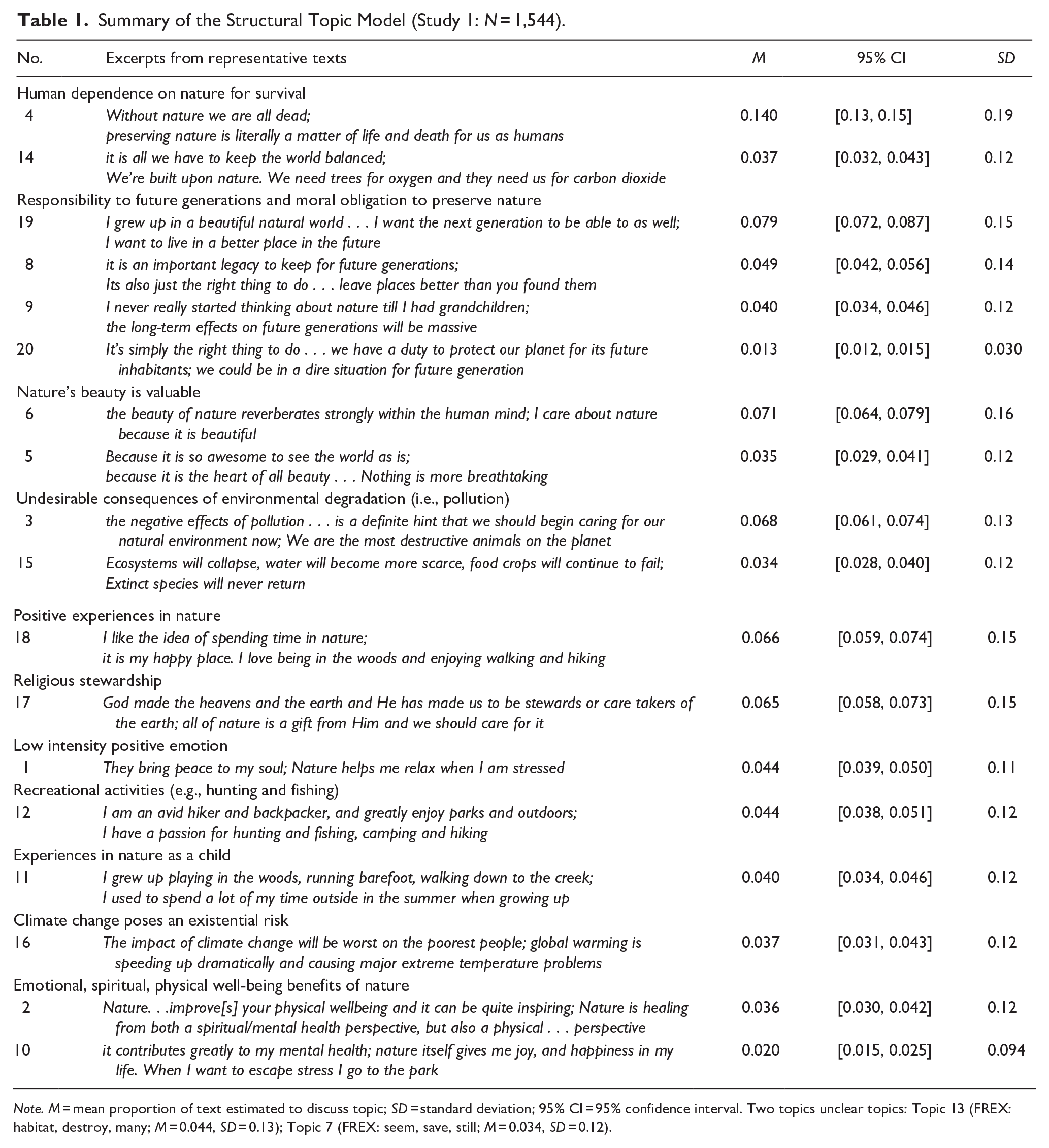
Note. M = mean proportion of text estimated to discuss topic; SD = standard deviation; 95% CI = 95% confidence interval. Two topics unclear topics: Topic 13 (FREX: habitat, destroy, many; M = 0.044, SD = 0.13); Topic 7 (FREX: seem, save, still; M = 0.034, SD = 0.12).
Results
The Reasons People Say Nature Is Worth Preserving
Every participant provided a response (as was required to advance to the next survey page). Many participants provided thoughtful responses, exemplified by the high average number of words per response (M = 63.44, SD = 29.03). Only one participant expressed an anti-preservationist sentiment (“I don’t really care about preserving it. It’s just not something I’m interested in nor do I think climate change is happening. I’m definitely not an eco friendly person”). Four other participants expressed some indifference about preserving nature (e.g., “Personally, I don’t care too much about the environment compared to a lot of other economic issues today, but I do think it should be taken care of”).
Most prevalent were motives expressing people’s concern for others and humanity at large—a concept broadly described as altruistic values in the value-basis framework (Schultz, 2000; Stern, 2000). Participants mentioned preserving nature for the survival of humanity (Topics 4, and 14); for future generations (Topics 8, 9, 19, and 20); and to avoid the existential risks posed by climate change (Topic 16). Combined, these topics accounted for an average of 39.5% of the responses.
Also highly prevalent were motives linked to positive experiences in nature—otherwise described as egoistic values (Schultz, 2000; Stern, 2000) or hedonic goals (Steg et al., 2014). Participants mentioned enjoying the beauty of nature (Topics 5 and 6); low intensity positive emotions engendered by time in nature (Topic 1); outdoor recreational activities like hunting and fishing (Topic 12); experiences they had outdoors as a child (Topic 11); physical, emotional, and spiritual well-being benefits they get from time in nature (Topics 2 and 10); and just generally having positive experiences in nature (Topic 18). Combined, these topics accounted for an average of 31.2% of the participants’ responses.
Motives related to preserving nature for nature’s sake (i.e., biospheric values) were expressed as a desire to avoid undesirable consequences of environmental degradation (Topics 3 and 15). These topics accounted for 10.2% of responses. Finally, religious stewardship, which does not neatly fit the tripartite value-basis framework but has been noted as a relevant motive in US samples (Gustafson et al., 2020), accounted for 6.5% of the responses (Topic 17).
The Motives That Serve as Political Common (and Uncommon) Ground
We examined the mean differences in topic proportion scores between Democrats and Republicans using independent linear regression models regressing each topic onto political affiliation. Figure 1 presents mean values by political affiliation with conventional 95% confidence intervals. Since we conducted multiple comparisons without a priori hypotheses, we conservatively interpret significant effects with respect to a Bonferroni correction (20 comparisons, α = .0025). Given Bonferroni correction, the majority of topics were mentioned equally by Democrats and Republicans. These “common ground” motives included the motives that were most discussed: Dependence on nature, nature’s beauty, preserving nature for future generations, and enjoying nature in various ways.
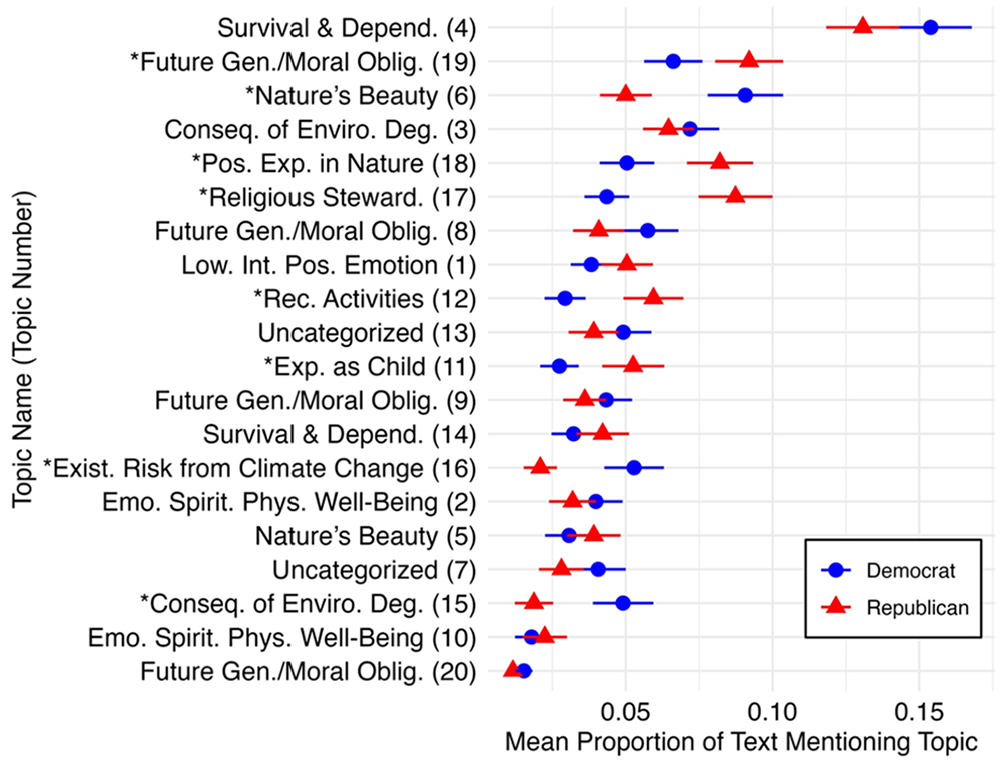
Differences in topic proportion by political affiliation (Study 1: N = 1,544).
At the same time, two motives showed clear intergroup differences. Democrats’ responses included 3.2% more words associated with avoiding the existential risks of climate change (Topic 16: β = −0.27 [−0.37, −0.17]), while Republicans responses included 4.4% more words associated with religious environmental stewardship (Topic 17: β = 0.30 [0.20, 0.39]). It is difficult to compare effect sizes in topic models across studies because the magnitude of mean differences will depend, to some extent, on how many topics are in the topic model (since all topics share a proportion of 100% of each response). For reference, in a three-topic model (in which one would expect effect sizes to be much larger than those from our model), a 9% difference was considered a substantial difference, and a 33% difference was considered “very large” by the group of researchers who created the structural topic model technique (Roberts et al., 2014). Given this benchmark, a 3 to 4% difference in this context might be interpreted as small to medium in magnitude, which is consistent with the magnitudes of the standardized beta coefficients provided in text throughout this section.
Other mean differences were observed for some, but not all, of the topics associated with certain motives. For example, while Democrats showed a preference for some ways of speaking about nature’s beauty (Topic 6: β = −0.26 [−0.36, −0.16]) and environmental degradation (Topic 15: β = −0.25 [−0.35, −0.15]), Republicans showed a preference for some ways of speaking about the enjoyment of nature (Topic 12: β = 0.24 [0.14, 0.34] and Topic 18: β = 0.22 [0.12, 0.32]), responsibility to future generations (Topic 19: β = 0.17 [0.07, 0.27]), and experiences as children (Topic 11: β = 0.20 [0.10, 0.30]). Differences in topic proportion between Democrats and Republicans largely held controlling for age, gender, socioeconomic status, and religiosity (at α = .0025), with three exceptions that became non-statistically-significant with controls: Experiences as a child (Topic 11), religious stewardship (Topic 17), and positive experiences (Topic 18)—all topics preferred by Republicans.
To empirically quantify the overall magnitude of political common ground, we used a linear mixed-effects model predicting topic proportion with political affiliation as a fixed-effect and as a random-effect nested within topic domain (N = 20 topics). We used Rights and Sterba’s (2019) variance decomposition equations via the r2mlm R package (Shaw et al., 2023) to assess the variance in topic proportion explained by political affiliation versus topic domain. Results showed that the variance explained by identifying as a Democrat or a Republican was only 16.7% of that explained by topic domain. In other words, the differences between motives were 6 times that of the differences between political opponents, suggesting that Democrats and Republicans largely agree on what environmental motives are important and unimportant. These findings were largely replicated in a sample of 1,122 Canadian university students (see Study 1b in the Supplemental Material).
Study 2: Analysis of Liberals’ and Conservatives’ Self-Reported Environmental Motives
Study 1 used bottom-up text analysis to identify a set of motives that reflect the natural language of liberals and conservatives, which was also replicated in a sample of Canadians (Study 1b in Supplemental Material). Notwithstanding the fact the findings are informative and replicated, the bottom-up text analysis method employed in Study 1 has some limitations.
First, people vary in how they approach writing prompts, which reduces our certainty that the motives mentioned in greatest proportion are necessarily the “most important” motives. For example, at any given point in time, due to random variability or contextual cues, different motives may be more salient or accessible. While self-report measures are still limited to cross-sectional observations of participants’ motive preferences, it reduces the risk of accessibility bias compared to open text methods.
Second, the nature of the data prevents an examination of the latent factor structure of the motives mentioned in Study 1. Since topic proportions sum to 100% and are thus linearly dependent, the data cannot be factor analyzed to determine the latent factor structure. Therefore, it is impossible to quantitatively determine whether, for example, the “low intensity positive emotions” motive and the “emotional, spiritual, physical well-being benefits of nature” motive are empirically distinct constructs. One can use a hierarchical cluster model to describe topics as related clusters (we provide one such model in the Supplemental Material), but other issues abound. For example, conceptually similar topics can be uncorrelated if groups of participants use different vocabularies to describe the same motive. A self-report questionnaire method avoids these issues.
This study also extends our investigation by addressing research questions three and four: How do these motives empirically relate to other important environmental attitudes and do political differences in these motives help explain broader political differences in environmental attitudes? As Gustafson et al. (2022, p. 4) noted, we do not know how people’s environmental motives empirically relate to their attitudes about environmental issues. This is particularly important to understand given the political differences in environmental attitudes (Birch, 2020). If political differences in attitudes are empirically dependent on differences in motives, then it would suggest that either the same processes polarizing attitudes are also polarizing motives (e.g., news media) or that differences in motives are responsible for political differences in attitudes. If political differences in attitudes are distinct from differences in motives, it would be more likely that distinct processes are polarizing attitudes versus motives (e.g., news media segments do not speak to motives, only to attitudes). To these ends, we developed a self-report measure of environmental motives based on participant responses observed in Study 1 and administered the measure to a distinct sample from the same population, along with measures of environmental attitudes.
Methods
Participants
We aimed to recruit 800 adults from the USA using the Prolific system, which conforms to the 10:1 participant-to-item rule-of-thumb for factor analysis (MacCallum et al., 1999). The sample was set to be equal parts Democrat/Republican, Christian/nonreligious, and male/female to ensure we could disentangle the effects of political ideology and religiosity, which are tightly connected in the USA (Brint & Abrutyn, 2010). 2 A total of 818 participants entered the survey, and 22 participants were excluded for indicating they did not wish for their data to be analyzed. Data from a final sample of N = 796 participants were analyzed (n = 391 Democrats; n = 386 Republicans). Participants were 49% female, ages 19 to 84 (M = 40.98, SD = 14.45), largely white (77%; 7% Hispanic; 7% Asian; 6% Black) and were 49% nonreligious (48% Christian). The sample was recruited on January 20, 2023.
Materials
Environmental Motives
We generated a pool of 48 draft items assessing the 12 environmental motives identified in Study 1. The items were based on the responses participants provided for each motive in Study 1. Participants rated their agreement with each item on a 7-point rating scale anchored at 1 (strongly disagree) and 7 (strongly agree). Pages of 8 items were presented to participants, and the order of the pages and the items within each page were randomized for each participant. We used an exploratory factor analysis to assess the factor structure of the items in a sample of Canadian undergraduates (Study 2b in the Supplemental Material), and then used confirmatory factor analysis to confirm the structure in the present sample of US participants. This resulted in a final 18-item questionnaire assessing four latent factors. Responsibility to nature described a sense of obligation to the natural world, instrumental benefits from nature described the benefits that nature provides humanity, childhood experiences in nature described the experiences participants had as children in nature, and religious environmental stewardship described a responsibility to care for God’s creation. The factors were made into simple composite variables for the analyses described here (mean α = .92). Table 2 presents the final questionnaire with relevant descriptive and psychometric data. The full 48 items and the complete validation process can be found in the Supplemental Material.
Environmental Motives Questionnaire (Study 2: N = 796).
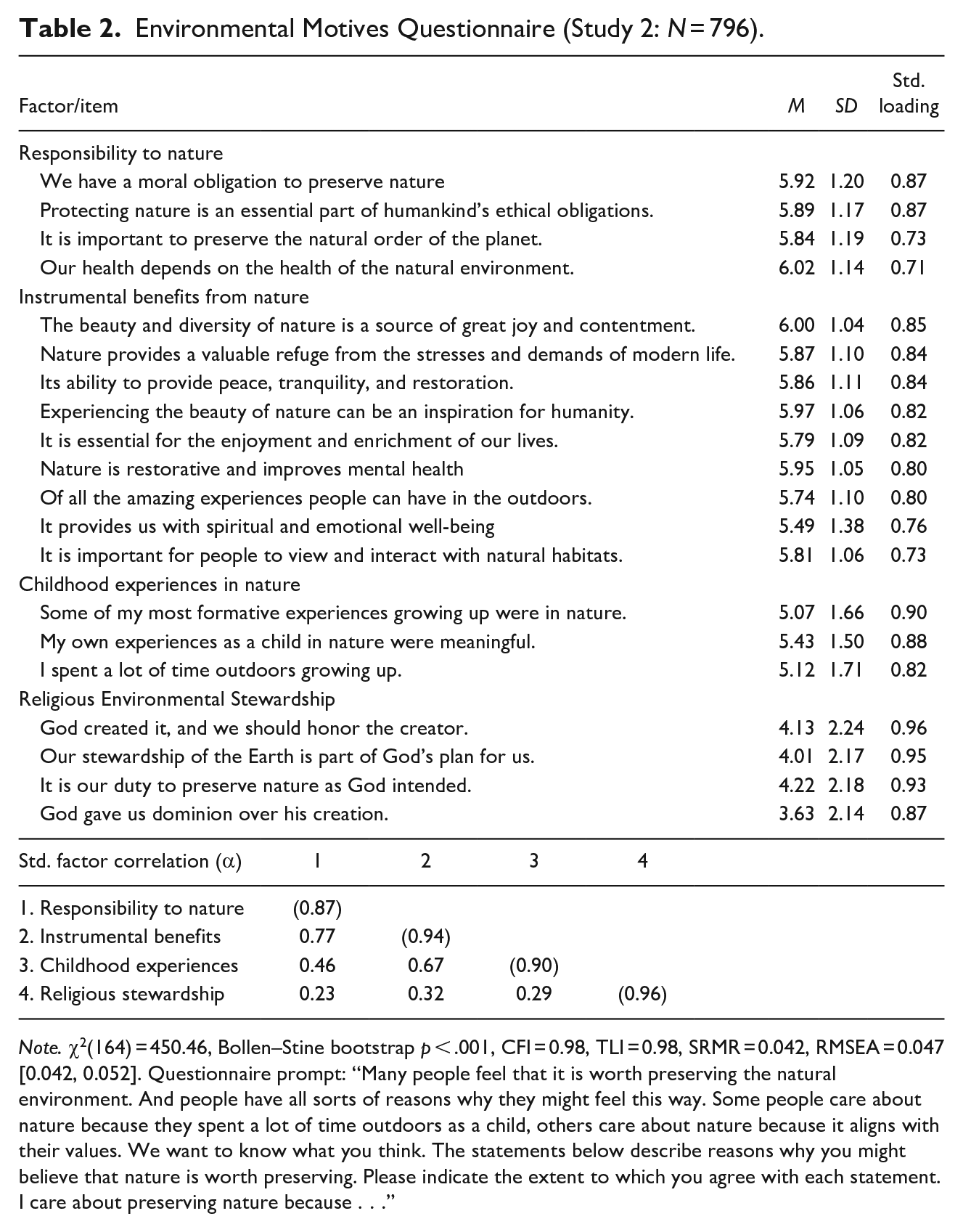
Note. χ2(164) = 450.46, Bollen–Stine bootstrap p < .001, CFI = 0.98, TLI = 0.98, SRMR = 0.042, RMSEA = 0.047 [0.042, 0.052]. Questionnaire prompt: “Many people feel that it is worth preserving the natural environment. And people have all sorts of reasons why they might feel this way. Some people care about nature because they spent a lot of time outdoors as a child, others care about nature because it aligns with their values. We want to know what you think. The statements below describe reasons why you might believe that nature is worth preserving. Please indicate the extent to which you agree with each statement. I care about preserving nature because . . .”
Environmental Attitudes
We assessed environmental attitudes using Milfont and Duckitt’s (2010) 24-item version of the Environmental Attitudes Inventory (EAI). The EAI assesses two higher-order factors—Preservation and Utilization—that capture 12 lower-order attitudes. The Preservation attitudes include “enjoyment of nature,” “support for interventionist conservation policies,” “environmental movement activism,” “environmental fragility,” “personal conservation behavior,” “ecocentric concern,” and “support for population growth policies.” The Utilization attitudes include “anthropocentric concern,” “confidence in science and technology,” “altering nature,” “human dominance over nature,” and “human utilization of nature.” Each attitude was measured with two balanced statements (7-point scale of agreement). The Preservation (α = .87) and Utilization (α = .76) scores were computed as simple composites.
Ecospirituality
We also assessed participants’ spiritual beliefs about nature using Billet et al.’s (2023) 8-item Ecospirituality Scale. The measure assesses spiritual appraisal of nature and spiritual experiences in nature and can be used as a unidimensional scale. Participants indicated their agreement with statements like “Nature is a spiritual resource” and “When I am in nature, I feel a sense of awe” on the same 7-point agreement scale. An ecospirituality score was computed as an average of the 8 items (α = .93).
Demographics
Participants responded to the same demographic items as Study 1. In this sample too, the 3-item political orientation composite (α = .97) highly correlated with a party affiliation variable (Democrat/Republican), r = .86 [0.84, 0.87].
Results
Replicating Findings From Study 1
In Study 1, we found that liberals and conservatives prioritized the same motives and differed primarily in their endorsement of motives related to climate change and religious stewardship. We developed a psychometrically sound measure of environmental motives using a subset of the original 48 items generated based on the responses of Study 1. The final measure does not include any items assessing climate change motives because, in line with recommended practices (e.g., Costello & Osborne, 2005; Kline, 2023), we removed items that were very highly skewed (one item: “climate change is a serious risk for life on our planet”) and did not load strongly enough (>0.7) onto any latent factors (the other 3 items). Still, we briefly mention results from the full 12-motive 48-item measure (prior to validation) that directly speak to the replicability of findings in Study 1.
In line with the results of Study 1, both liberals and conservatives indicated that many of the same values were most important. In both groups, the highest ratings were given to survival and dependence (Democrats, M = 6.36 [6.30, 6.43]; Republicans, M = 5.98 [5.88, 6.07]), future generations (Democrats, M = 6.39 [6.31, 6.46]; Republicans, M = 5.82 [5.71, 5.91]), and moral obligation (Democrats, M = 6.27 [6.20, 6.35]; Republicans, M = 5.80 [5.68, 5.91] 3 ). In line with Study 1, the greatest mean differences in motive endorsement were observed for climate change (MDiff = −1.65 [−1.84, −1.47], p < .001) and religious stewardship (MDiff = 0.91 [0.63, 1.20], p < .001). Finally, variance decomposition analysis replicated the finding that political differences in motives were only a fraction of the magnitude of differences observed between motives. Specifically, the variance explained by political affiliation was only 11.65% of that explained by motive domain using the validated four-motive measure. 4 These results suggest that the main findings from Study 1 are robust to different measurement methods, further supporting the conclusion that Democrats and Republicans share a good deal of common ground on the reasons they care about preserving nature.
Prioritization and Political Common Ground of Self-Reported Environmental Motives
Figure 2 shows mean endorsement of the four environmental motives assessed by the final environmental motives questionnaire for liberals and conservatives. In line with results from Study 1, liberals and conservatives largely overlapped in their motive priorities. Both groups most strongly prioritized responsibility and instrumental motives, followed by childhood experiences, and finally religious stewardship. Liberals appeared to prioritize responsibility over instrumental motives, while conservatives prioritized them equally. The measure demonstrated strict measurement invariance between liberals and conservatives (see details in the Supplemental Material), so we could compare group means directly. We regressed each motive separately onto political affiliation using linear regression models. Like Study 1, conservatives endorsed religious stewardship motives to a higher degree than liberals (β = 0.44 [0.31, 0.58], p < .001). Novel to this study, liberals were found to endorse reasons denoting a responsibility to nature to a greater extent compared to conservatives (β = −0.48 [−0.62, −0.34], p < .001).
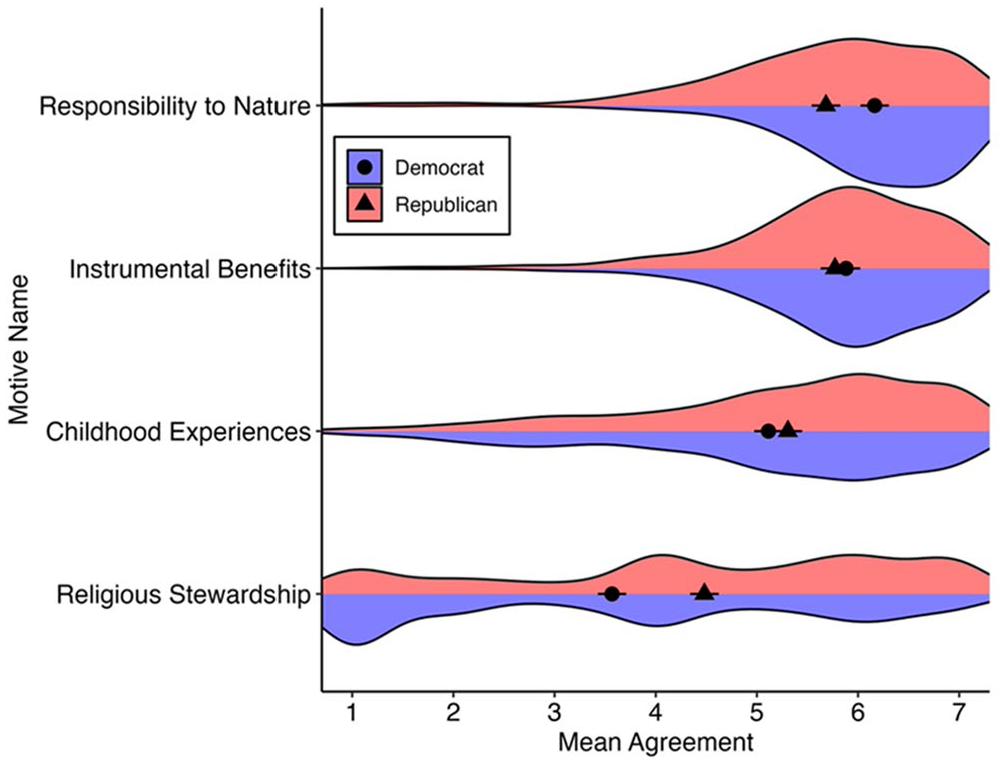
Differences in motive endorsement by political affiliation (Study 2: N = 776).
To test the reliability of these results, we conducted follow up robustness checks that controlled for responding style and potential third variables. Two pieces of evidence suggested that liberals and conservatives may be using different responding styles on the motive questionnaire. First, in a model testing the interaction between the four motive domains and political affiliation, there was a main effect such that Republicans responded lower on average across domains (β = −0.30 [−0.42, −0.17], p < .001). Second, we counted the frequency of extreme responses (1 s and 7 s) across the final set of items and observed that Republicans reported marginally fewer extreme responses (β = −0.15 [−0.29, −0.01], p = .041). A mixed-effects model regressing responses onto an interaction between motive domain and political affiliation with a random intercept for participant indicated that individual responding styles did not account for the results reported above, even though responding style displayed moderate variability (τ00 = 0.67, ICC = 0.33).
It is also possible that broader demographic differences, like gender, age, religiosity, and socioeconomic status can explain differences in environmental motives between liberals and conservatives. As a result of our sampling procedures, both groups had similar numbers of each gender (i.e., 49% female); however, conservatives tended to be older (r = .08 [0.0076, 0.15], p = .03), more religious (r = .12 [0.048, 0.19], p < .001), and have greater socioeconomic status (r = .09 [0.021, 0.16], p = .01). We also found these variables to correlate in varying degrees with environmental motives, making them candidates for third variables. Controlling for these variables in the mixed-effects model specified above explained significantly more variance in motive endorsement (R2Marginal = 0.37 vs. 0.24; χ2(3, N = 776) = 329, p < .001) and retained the political differences in responsibility motives and religious stewardship. The covariate model also revealed a group difference for instrumental motives, such that liberals showed greater endorsement of instrumental motives (MDiff = −0.26 [−0.44, −0.079], p = .005). Overall, these results demonstrated a fair degree of robustness.
Relationships Between Environmental Motives and Environmental Attitudes
Few studies have investigated the links between environmental motives and attitudes, and the ones that have relied largely on the theoretically derived value-basis framework (altruistic, egoistic, and biospheric values, e.g., Bruni et al., 2012; Schultz et al., 2004). We assessed three categories of environmental attitudes that captured broad conceptual ground: Preservation of nature attitudes, utilization of nature attitudes, and spiritual beliefs about nature.
On the whole, environmental attitudes showed greater intergroup differences than environmental motives, with the exception of ecospirituality, which showed no political differences (β = 0.02 [−0.13, 0.16], p = .83). Liberals showed a preference for preservation attitudes (β = −0.96 [−1.08, −0.83], p < .001), while conservatives showed a preference for utilization attitudes, β = 0.65 [0.52, 0.78], p < 0.001. These differences were not accounted for by gender, age, religiosity, or socioeconomic status.
We first examined bivariate correlations between motives and attitudes (Table 3). Bivariate correlations indicated that all motives correlated with all attitudes to varying degrees. Preservation attitudes primarily positively correlated with responsibility to nature (r = .64, p < .001), utilization primarily negatively correlated with responsibility to nature (r = −.44, p < .001), and ecospirituality primarily positively correlated with instrumental motives (r = .74, p < .001). However, multiple regression is needed to disentangle these relationships, since all motives are intercorrelated.
Correlations Between Environmental Motives and Attitudes (Study 2: N = 796).
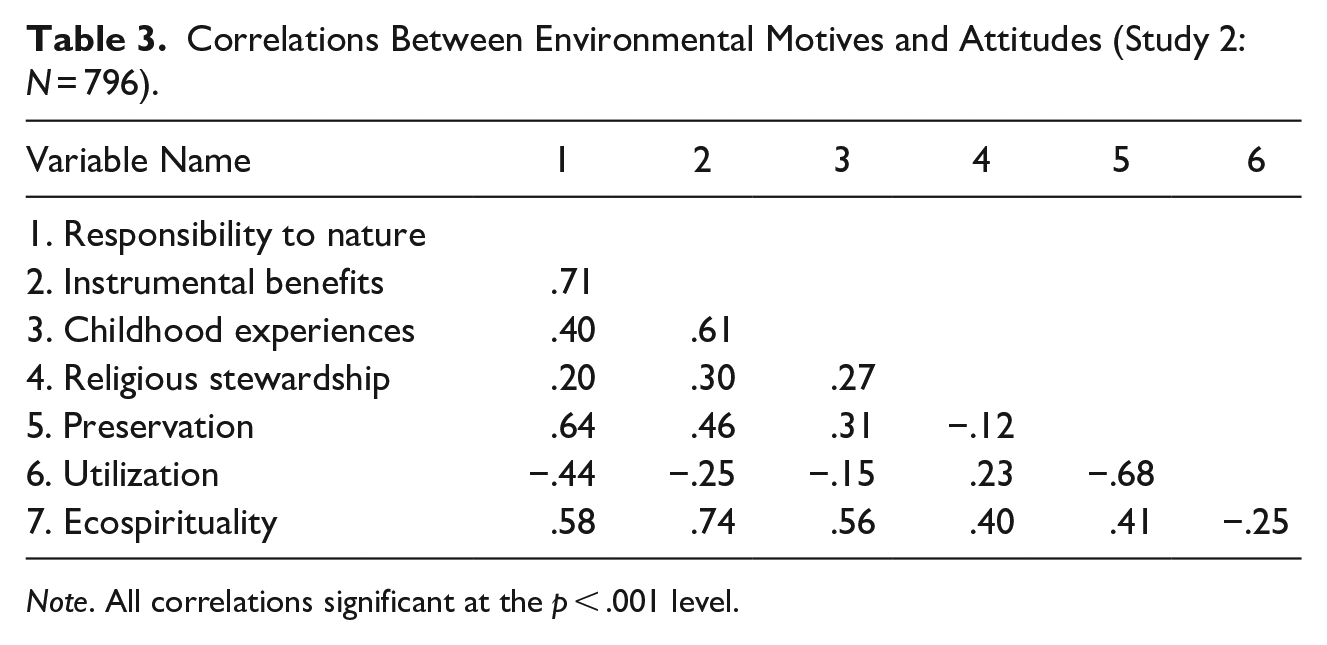
Note. All correlations significant at the p < .001 level.
Regression models, in which attitudes were regressed onto all four motives, reinforced the interpretation of the bivariate correlations (Table 4). Responsibility motives strongly positively predicted preservation attitudes (β = 0.62, p < .001) and strongly negatively predicted utilization attitudes (β = −0.53, p < .001), while the main driver of ecospirituality was instrumental motives (β = 0.49, p < .001). It is perhaps surprising that utilization did not primarily positively correlate with instrumental benefits—the conceptually more similar motive—suggesting that it is not the presence of instrumental motives that drive utilization attitudes, but the lack of responsibility motives. It is also worth noting that all four motives were independently positively related to ecospirituality, but not the other attitude measures, suggesting multiple pathways to a spiritual view of nature or multiple motivational consequences resulting from a spiritual view of nature.
Regression Models Assessing Link Between Motives and Attitudes (Study 2).
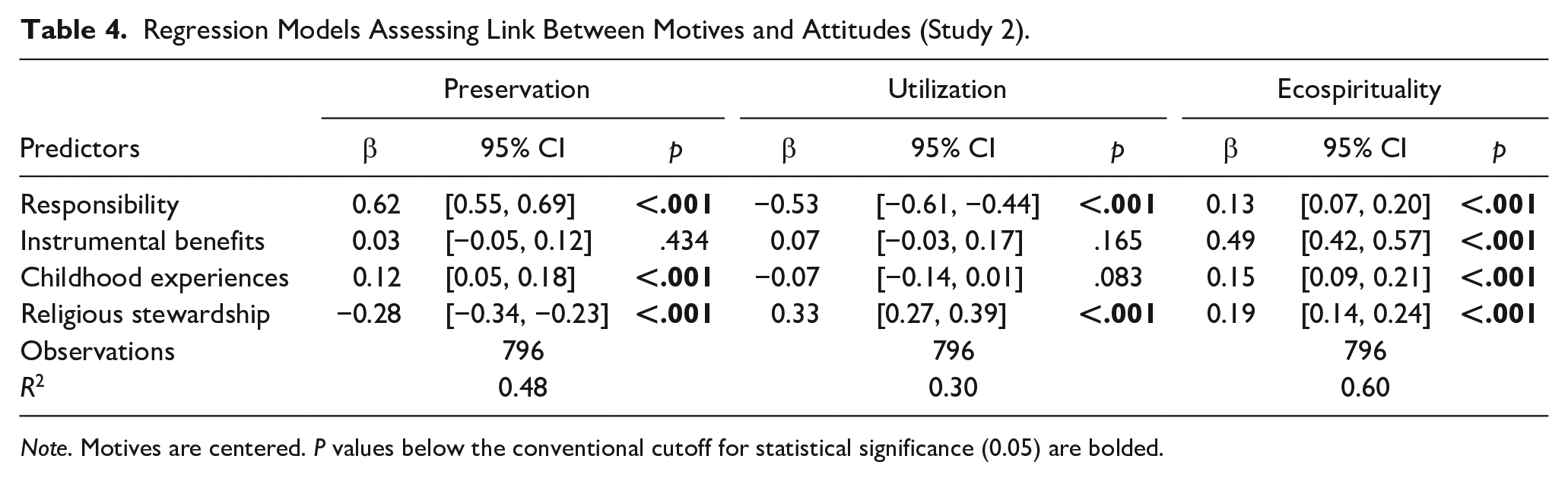
Note. Motives are centered. P values below the conventional cutoff for statistical significance (0.05) are bolded.
These results largely held controlling for potential demographic third variables (gender, age, socioeconomic status, religiosity, political affiliation), except childhood experiences became a significant predictor of utilization (β = −0.09, p = .022) and religious stewardship no longer predicted ecospirituality (β = 0.05, p = .14). And these results could not be explained by overlapping item content across the measures of motives and attitudes (we reran the analyses after removing three attitude items that loaded onto motive factors in an exploratory factor analysis—this approach only revealed a marginal association between instrumental motives and utilization attitudes, β = 0.10, p = .045).
Are Political Differences in Environmental Attitudes Dependent on Differences in Motives?
Finally, we investigated if political differences in attitudes were dependent on political differences in motives. To do so, we first estimated the relationship between political affiliation and attitudes. As reported above, preservation attitudes were endorsed more by liberals (β = −0.96), utilization attitudes were endorsed more by conservatives (β = 0.65), and ecospirituality was equally endorsed by both parties (β = 0.02).
Next, we added the four motives as covariates in the models (Table 5). The models indicated that political differences in attitudes were only partly explained by individual differences in motives. Specifically, motives explained about half of the effect of political affiliation on environmental attitudes: The effect of political orientation on preservation attitudes decreased from β = −0.96 to −0.64, while the effect for utilization decreased from β = 0.65 to 0.32. This pattern of results was also observed using subscales of the environmental attitudes measure that more closely map onto environmental politics, like the policy support subscale (β = −1.02 to −0.78) and the support for environmental activism subscale (β = −0.91 to −0.78).
Regression Models Assessing Motives, Attitudes, and Politics (Study 2).
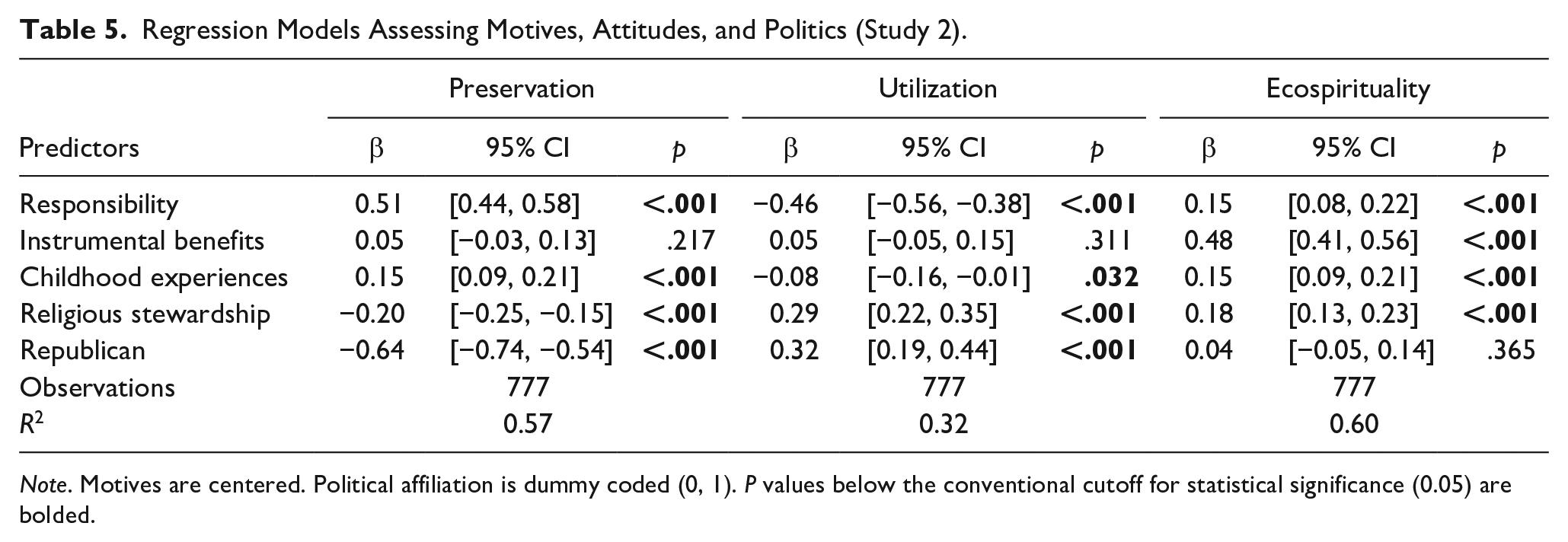
Note. Motives are centered. Political affiliation is dummy coded (0, 1). P values below the conventional cutoff for statistical significance (0.05) are bolded.
Recall that two possible worlds could explain political differences in environmental attitudes. In one world, differences in attitudes are connected to differences in motives, either by direct causation or by an outside process causing political divergences in both. In a second world, differences in attitudes are independent of differences in motives and distinct processes are responsible for political differences in attitudes versus motives. Our results suggest that we are living in both worlds—political differences in motives account for some of the political differences in attitudes, but other processes are likely specifically targeting people’s attitudes independently of their motives. Broader work on political polarization and extremism suggest that these processes might involve partisan media (Levendusky, 2013) and economic anxiety (Van Prooijen & Krouwel, 2019).
General Discussion
This article sought to answer four questions: (1) What motives do people cite for caring about preserving nature, (2) how might liberals and conservatives differ in these motives (and how might they be similar), (3) how do these motives empirically relate to other important environmental attitudes, and (4) do political differences in these motives help explain broader political differences in environmental attitudes?
Study 1 addressed research questions (1) and (2). In their own words, people reported that the most important or salient motives related to humanity’s dependence on nature for survival, responsibility to future generations, a moral obligation to preserve nature, and to preserve nature’s beauty. These results are in line with previous findings (Gustafson et al., 2020, 2022). Over and above previous work, we found evidence that these motives were equally highly prioritized by liberals and conservatives. In other words, the most important reasons people cite for preserving nature are also the ones that liberals and conservatives find common ground on. In contrast, the motives that displayed the greatest political group differences were motives related to avoiding the existential risks of climate change and an ethic of religious environmental stewardship. Study 2 conceptually replicated these results using a self-report questionnaire method based on the written responses of participants observed in Study 1.
Study 2 was also designed to address research questions (3) and (4) by assessing self-reported environmental attitudes in addition to environmental motives. We found that motives related to having a responsibility to preserve nature were most strongly positively associated with attitudes about preserving nature and most strongly negatively associated with attitudes about utilizing nature. Meanwhile, motives related to enjoying benefits from nature were most strongly positively associated with viewing nature as a spiritual resource. Preservation and utilization attitudes showed large political group differences. Individual differences in motives partly explained political differences in these attitudes, suggesting that motives may be implicated in the multiple processes determining political differences in environmental attitudes.
Political (A)Symmetry and Bridging the Political Divide
This work supports a growing understanding of political asymmetries in the environmental domain (e.g., Hochschild, 2018; Hoffarth & Hodson, 2016; Stanley et al., 2024). One of the largest intergroup differences observed in Study 1 concerned perceptions of existential threat from climate change. Why are liberals in our study motivated by climate threat, when other studies have found conservatives to be more sensitive to threat (Jost, 2017)? One explanation could be that conservatives in our study are highly sensitive to threats associated with environmental preservation, except they perceive environmental reform, rather than climate change itself, as the source of those threats (Hoffarth & Hodson, 2016; Stanley et al., 2024). A similar phenomenon was observed in response to the COVID-19 pandemic: Conservatives appeared to perceive pandemic mitigation policies, like mask-wearing and locking down, rather than the pandemic itself, as the source of threat. Fischer et al. (2023) argue that this response could be better understood by considering the two dimensions of political ideology (i.e., social dominance and authoritarianism) independently; perhaps such a distinction would better illuminate attitudes towards climate change as well (see Stanley et al., 2024).
Effective political discourse on environmental issues requires political opponents to share beliefs about why environmental issues are worth addressing in the first place. A discourse framed around avoiding climate-related threats is unlikely to lead to action. A recent study of 63 countries suggests that climate-threat messages are more likely to be shared on social media but are not effective at promoting belief in climate change, policy support, or personal action (Vlasceanu et al., 2024). Likewise, threat-based messaging has been found to promote social conflict and political polarization (Van Prooijen, 2021) and denial of environmental issues (Feinberg & Willer, 2011). Our studies further suggest that climate-threat messaging may be less effective at motivating conservatives who simply have other motives for caring about the environment. Instead, our results suggest that discourse framed around humanity’s dependence on nature, responsibility to future generations, and the value of nature’s beauty may be more effective for motivating individuals across political orientations. Future research can investigate the effectiveness of these motives in framing educational messages, political appeals, and facilitating political discourse.
The Motives People Speak About and the Motives We Theoretically Postulate
Previous research on environmental motives has almost invariably relied on assessing theoretically derived motives using self-report measures. As mentioned in the introduction, two frameworks have been popularly used to organize these motives: The value-basis framework (Schultz, 2001; Stern & Dietz, 1994) and self-determination theory (Deci & Ryan, 2000; Pelletier et al., 1998). We found that the value-basis framework sufficiently explained 11 of 12 motives that people reported in their own words (religious stewardship being the exception). Our results provide strong support for this longstanding framework, which was developed during a different time in environmental politics using different methodological tools (Stern & Dietz, 1994). The categories offered by self-determination theory may also explain many of the motives we observed but this prospect is unclear because people may have intrinsic and/or extrinsic motivations for each observed motive (e.g., I may get satisfaction making the world better for future generations or I may be conforming to the societal norm that this is a virtuous aim). Essay prompts asking what personally motivates you to preserve nature or a semi-structured interview method may have encouraged responses more in line with self-determination theory. For our data, the value-basis framework was more instructive.
The picture became more complicated when we subjected our self-report measure to latent factor analysis, which suggested that these motives mapped onto four latent factors: Responsibility to nature (related to biospheric values), instrumental benefits from nature (related to altruistic and egoistic values), childhood experiences in nature, and religious stewardship. These four factors apparently describe more than one level of conceptual abstraction, with responsibility and instrumental motives being more abstract than childhood experiences and religious stewardship. Empirically speaking, however, four correlated factors presented the best fit (see Supplemental Material for comparisons to one- and two-factor models). This suggests that while these factors share conceptual similarities, they may indicate psychologically relevant differences in environmental motives.
For example, participants’ responses distinguished items about their childhood experiences in nature from items about other experiences in nature, which instead loaded onto the instrumental motive factor. No research to our knowledge has investigated people’s childhood experiences as a distinct motive for preserving nature. While it is not the primary motive for most people, it may have a unique affective profile and interpersonal properties that make it useful in the context of sustainability behavior or easing political polarization. Future research should investigate these prospects.
Conceptual Similarities and Empirical Differences Between Motives and Attitudes
A key aim of this research was to understand how people’s self-reported motives related to their attitudes about the natural environment. We found motives accounted for substantial variance in attitudes (30–60%), but the relationships among them were somewhat surprising. Following Milfont and Duckitt’s (2010) distinctions, our responsibility factor conceptually overlaps with preservation attitudes, while our instrumental motives factor overlaps with utilization attitudes. However, we observed responsibility motives independently predicted both sets of attitudes (positively for preservation attitudes and negatively for utilization attitudes), while instrumental motives did not independently predict either. In other words, it was the lack of responsibility motives that best predicted utilization attitudes, not the presence of instrumental motives. This finding may have the practical implication that interventions aimed at reducing utilization attitudes may find success bolstering people’s sense of responsibility to nature.
Notably, instrumental motives best predicted spiritual beliefs about nature. This was true for both dimensions of the ecospirituality scale: The perception of nature’s spiritual qualities (β = 0.42 [0.34, 0.51], p < .001) and the experience of nature’s spiritual qualities (β = 0.47 [0.40, 0.55], p < .001). 5 Unlike preservation and utilization attitudes, ecospirituality was independently predicted by all four motives and did not show differences between liberals and conservatives. These results are consistent with the idea that people arrive at a spiritual view of nature via multiple pathways, including enjoying the benefits of nature, having had powerful childhood experiences in nature, and having a strong religious ethic to care for nature. (These results are also consistent with the idea that a spiritual view of nature fosters diverse motives for preserving nature.) If true, ecospirituality may also be usefully employed as common ground in environmental discourse.
The Inferential Benefits of a Mixed-Methods Approach
The present research used a mixed-method approach that combined bottom-up analysis of rich text data in Study 1 with the use of top-down-generated self-report questionnaires in Study 2. What inferential benefits did this approach have?
The main benefit was the ability to validate results across measurement methods (i.e., conceptual replication; Crandall & Sherman, 2016), which has not been done in this context. Conceptual replication increases confidence in the specific pattern of empirical results observed in our studies and in the broader theoretical framework that helped explain our findings (Schultz, 2001; Stern & Dietz, 1994). Another benefit is that the two data types enriched each other. For example, the open text data showed the ways people naturally combined conceptually distinct motives into coherent narratives about the environment (e.g., “. . . because I have children and grandchildren who will be enjoying nature long after I'm gone. The balance of nature is being destroyed by global warming . . .”). This increased our confidence that correlations between motives are not just due to construct overlap or shared method variance but reflect the real ways people think and speak about motives.
Limitations
We sampled Democrats and Republicans from the United States to investigate the similarities and differences between them. Therefore, our results are specific to the cultural context of the United States (and perhaps to Canada given the replicability of these results in the Canadian samples—see the Supplemental Material). Studies suggest that political polarization is stronger in the USA than in other countries (Hornsey et al., 2018). However, political polarization on environmental issues appears to be on the rise globally (Birch, 2020; McCright et al., 2015). Yet, each country has a potentially unique political dynamic. It is unclear whether the same topics divide/unite political opponents in different countries. Indeed, important topics in some countries may not even appear in the United States discourse (Gustafson et al., 2022). It is further unclear whether political party affiliation and political ideology share distinct relations with environmental motives in other cultural contexts. Needless to say, future research should look beyond the United States.
Our survey methods focused on assessing the reasons why people care about nature, which limits our ability to assess the proportion of individuals who are truly indifferent to environmental preservation. This limitation is compounded by the framing of our survey items, which may suggest to participants that a pro-environmental response is socially desirable (i.e., “Many people feel that it is worth preserving the natural environment. And people have all sorts of reasons why they might feel this way”). Results from Study 2 showed mean responses for Democrats and Republicans were above the scale’s midpoint, suggesting that the proportion of environmentally indifferent individuals is indeed quite low. These results are in line with prior research that found environmentally indifferent individuals make up only a small proportion of the total population of the USA, perhaps only 7% of the population (Kennedy, 2022).
A third limitation worth commenting on is that these studies were not preregistered (at least not for the research that concerns this article). We take steps to present a conservative analysis of the data, using direct replication (see Supplemental Material) and conceptual replication, as well as a series of robustness checks for key findings. For the more exploratory analyses, we use a conservative alpha threshold correction (Bonferroni correction). And most importantly, we make our data and analysis scripts publicly available.
Conclusion
Creating a sustainable society will require a transformation of the status-quo. It will require collective agreement on the goals that are worth striving for and how those goals are attained. This is no easy task and depends heavily on productive dialogue between political opponents, within the public arena and on the political stage (Levendusky & Stecula, 2021). Rising political polarization suggests that this dialogue can be made more productive than it currently is. One place to start is the common ground people share. Our results suggest that the average individual in the USA may be surprised with just how much they share with those across the political aisle. We hope these insights contribute to building empathy and mutual perspective-taking on the important ecological issues of our times.
Supplemental Material
sj-docx-1-eab-10.1177_00139165241303315 – Supplemental material for Political Common Ground on Preserving Nature: Environmental Motives Across the Political Spectrum
Supplemental material, sj-docx-1-eab-10.1177_00139165241303315 for Political Common Ground on Preserving Nature: Environmental Motives Across the Political Spectrum by Matthew I. Billet, Adam Baimel, Taciano L. Milfont and Ara Norenzayan in Environment and Behavior
Footnotes
Declaration of Conflicting Interests
The author(s) declared no potential conflicts of interest with respect to the research, authorship, and/or publication of this article.
Funding
The author(s) disclosed receipt of the following financial support for the research, authorship, and/or publication of this article: This research was funded by the Social Sciences and Humanities Research Council of Canada [grant number: 435-2019-0359].

Supplemental Material
Supplemental material for this article is available online.
Notes
Author Biographies
References
Supplementary Material
Please find the following supplemental material available below.
For Open Access articles published under a Creative Commons License, all supplemental material carries the same license as the article it is associated with.
For non-Open Access articles published, all supplemental material carries a non-exclusive license, and permission requests for re-use of supplemental material or any part of supplemental material shall be sent directly to the copyright owner as specified in the copyright notice associated with the article.
