



Abstract
This paper provides the first experimental test of whether two social identity model of traumatic identity change processes—(i) group membership gain, and (ii) group membership continuity—predict post-traumatic growth (PTG) and post-traumatic stress (PTS) via social identity revitalization. Participants (N = 210, Mage = 49.59 years) were adult flood survivors who were randomly allocated to one of three conditions: group membership gain, group membership continuity, or a weather control. Participants then completed measures of PTG, PTS, and social identity revitalization. Participants in the group membership gain condition reported greater social identity revitalization, compared to the group membership continuity and control conditions. Social identity revitalization, in turn, predicted PTG, and the indirect effect of group membership gain on PTG was significant. We concluded that gaining new group memberships play a role in supporting natural disaster recovery by fostering positive reappraisals of the disaster via social identity revitalization.
Introduction
Natural disasters are increasing in frequency and intensity (World Health Organization [WHO], 2023). Disasters occur daily across the globe, resulting in damage costs of $202M USD in the past 50 years (World Meteorological Organization, 2021), and displacing on average 25.3 million people each year since 2008 (Internal Displacement Monitoring Centre, 2023). There are profound consequences of disasters for survivors, including homelessness, forced displacement, loss of income, and of relevance here, mental ill-health.
Research investigating mental health consequences of disasters has identified numerous factors affecting post-trauma trajectories of recovery, including the provision of psychological resources during periods of change by the number and quality of survivors’ social group memberships (Craig et al., 2022; C. Haslam et al., 2018; Muldoon et al., 2019). In this paper, we examine causal relationships between social group memberships and post-trauma trajectories of recovery, drawing our predictions from the social identity model of traumatic identity change (SIMTIC, Craig et al., 2022; Muldoon et al., 2019). Specifically, in this study we assess the effect of SIMTIC pathways relating to group membership continuity and group membership gain on post-trauma trajectories, and whether social identity revitalization is implicated in this relationship.
Natural Disasters and Mental Health
Natural disasters have long-lasting and pervasive mental health consequences for survivors (Norris et al., 2002). Given their devastating and often unpredictable impact on individuals and their communities, most survivors experience some form of post-traumatic stress (PTS) in the aftermath. PTS is often considered a precursor to the development of post-traumatic stress disorder (PTSD) due to overlapping symptomology—such as avoidance, altered mood, and reactivity—and typically subsides within weeks. Where symptoms persist for more than a month, a diagnosis of PTSD can be made (American Psychiatric Association [APA], 2013).
PTS and PTSD are common following disaster, with PTSD reported to affect between 5% and 40% of survivors (Goldman & Galea, 2014). Nevertheless, more positive responses to trauma, called post-traumatic growth (PTG), are also common. Defined by five general domains—an increase in personal strength, appreciation for life, spiritual change, new possibilities, and relating to others—PTG is experienced by almost half of all trauma survivors (Tedeschi & Calhoun, 2004; Xiaoli et al., 2019). Such growth is believed to result from a psychological reappraisal of one’s self, worldviews, and relationships—an adaptation to the distress caused by PTS—suggesting that PTG is a corollary of PTS, rather than its opposite (Muldoon et al., 2019). This is because extreme distress arising from PTS may necessitate a re-evaluation of the self in light of the traumatic event. It is during this re-appraisal process that opportunities for growth can occur. Thus, PTG is inherently linked to, and arises from, the psychological difficulties survivors experience when dealing with the consequences and aftermath of a traumatic event (Muldoon et al., 2019).
Numerous theories have been developed to explain post-trauma trajectories. Many focus on cognitive contributors to PTS and PTSD (Cognitive Appraisal Model [Folkman & Lazarus, 1985], Adaptive Information Processing Theory [Roger & Shapiro, 2008], and Autobiographical Memory models [Rubin, 1982]), whilst others consider social factors. Here we focus on broader, socially-enabled resources that support recovery (e.g., neighborhood support, and perceived control), which research shows emerges from group membership (Fong et al., 2021; Greenaway et al., 2015). A sense of connectedness and identification with others who have experienced a similar fate seems particularly important for disaster recovery (Drury, 2012; Muldoon et al., 2019); therefore, reconciling these personal and social perspectives on recovery is key to optimizing post-trauma adjustment—this requires an analysis of the social predictors of trauma recovery.
Social Group Memberships: A Pathway Toward Recovery
Research has demonstrated the health benefits of social group belonging (S. A. Haslam et al., 2018; Jetten et al., 2009; Kellezi & Reicher, 2012; Muldoon et al., 2019). This is because group memberships (e.g., with local community groups) can provide access to valuable psychological and physical resources (Abrams & Hogg, 1990) that help people overcome the challenges of adversity (Dingle et al., 2012; Jones et al., 2012). These psychological resources can include a sense of purpose, meaning, support, and an enhanced sense of control, which together provide a platform for connection, health, and recovery. Traumatic events, however, can be a major disruptor to a person’s access to, and how they relate to, their social groups, and thus, the resources these groups provide (C. Haslam et al., 2018). This has implications for recovery because such resources are critical for helping survivors respond to trauma.
The social identity model of traumatic identity change (SIMTIC) seeks to explain these relationships (Muldoon et al., 2019). This model extends on the more general model of life change informed by the social identity approach (the Social Identity Model of Identity Change [SIMIC]; see C. Haslam et al., 2021 for a discussion and theoretical origins) to consider post-trauma recovery specifically. Both models suggest two key pathways are crucial to managing a life change (including trauma): group membership continuity and group membership gain.
Group membership continuity refers to the degree to which the group memberships a person belonged to prior to a life change persist following a traumatic event. The more group memberships that are maintained after change, the more psychological resources these groups will be able to provide. Such continuity leaves intact meaningful sources of support, and greater meaning and connection to others to reduce PTS risk. Evidence of the importance of group membership continuity has been found in various trauma populations, including survivors of natural disaster, stroke, and conflict (Craig et al., 2022; C. Haslam et al., 2008; Smeekes et al., 2017). However, group membership continuity can be threatened in the aftermath of natural disasters when survivors may be forced to re-locate, increasing the risk of PTS and PTSD (Muldoon et al., 2019). In such cases when there is a threat that valued group memberships may be lost, diminished, or even stigmatized, continuity despite change protects people’s ability to connect with, and draw on, resources required to support recovery (Kellezi et al., 2009; Kellezi & Reicher, 2012; Muldoon et al., 2019).
The second pathway, group membership gain, refers to the acquisition of new group memberships following a life change. Since belonging to multiple groups—group memberships which are beneficial for health and well-being (C. Haslam et al., 2021; Jetten et al., 2009)—are threatened by trauma, gaining new group memberships can be a crucial route to health-enhancing social identities that can improve post-trauma adjustment trajectories (C. Haslam et al., 2018; Muldoon et al., 2019). 1 However, there is currently mixed evidence regarding the impact of group membership gain on post-trauma recovery. Cross-sectional studies have found it to be either positively or negatively associated with psychological distress (Craig et al., 2022; Cruwys et al., 2024), but it has been more consistently positively associated with PTG (Craig et al., 2022; Jones et al., 2012). Notwithstanding these mixed findings, new post-trauma group memberships might enable a pathway toward PTG under certain circumstances.
While the continuity and gain pathways are common to both models, SIMTIC extends upon SIMIC by suggesting that positive post-trauma trajectories of recovery are also dependent upon a third process—social identity revitalization (See Figure 1). This theoretical development introduces the concept of social identity revitalization to describe the qualitative changes in the meaning and meaningfulness of our social relationships following a trauma, which, in turn, produce a shift in survivors’ worldviews. Indeed, social identity revitalization is argued to be the process that leads to PTG. That is, we propose that a necessary precondition to experience PTG is a psychological shift in how the (social) self is appraised. It is this socio-cognitive process that arguably helps survivors redefine their trauma experience, thus promoting resilience and growth.
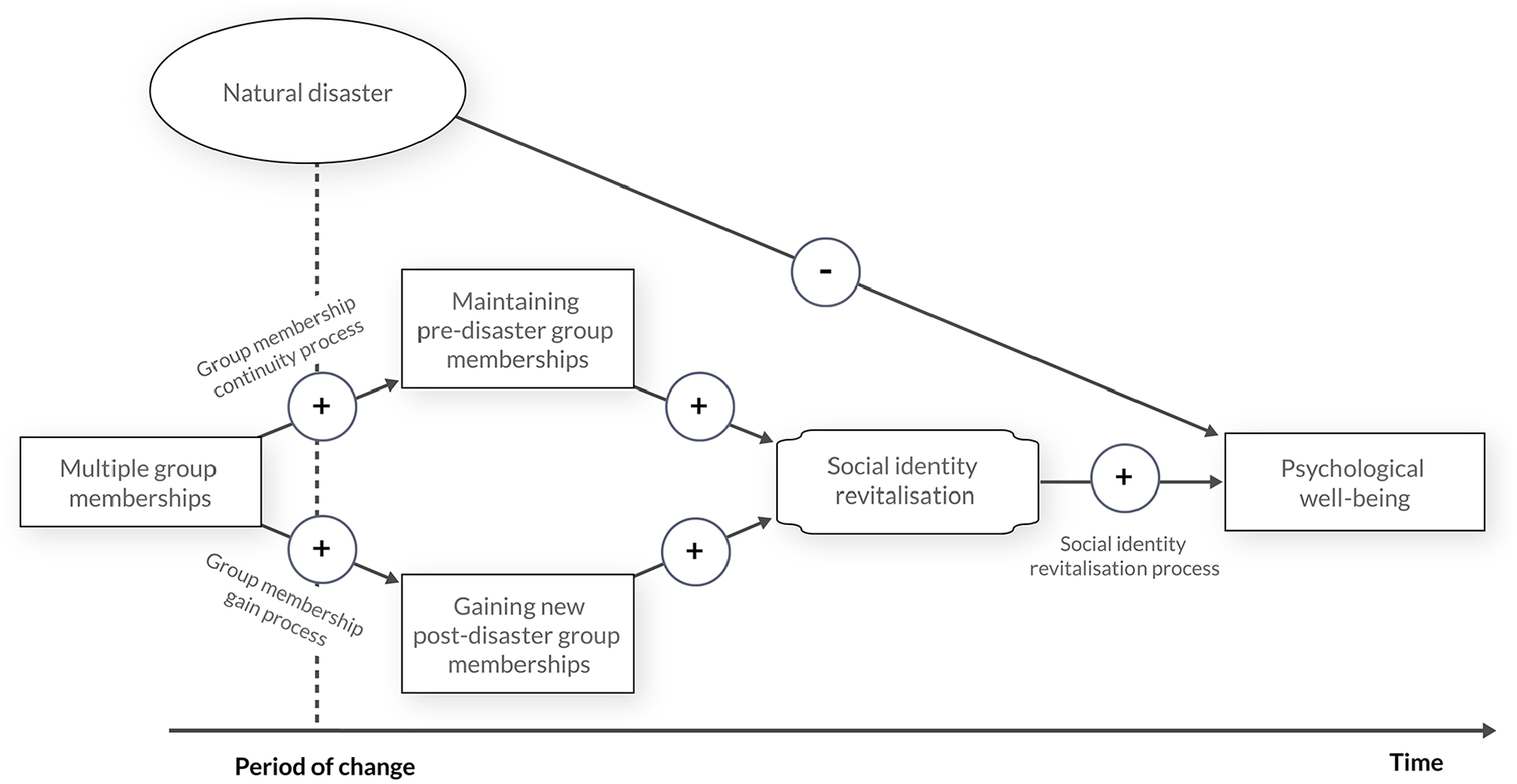
Social identity model of traumatic identity change.
As a relatively new construct, there are limited data on social identity revitalization and its role in post-trauma trajectories of recovery. However, several studies point to its possible role. For example, a study of 2015 Nepal earthquake survivors found that, despite severity of earthquake exposure predicting higher levels of PTS, it was simultaneously associated with increased levels of community identification and collective efficacy (Muldoon et al., 2017). This enhanced survivors’ ability to connect with their communities in ways that allowed them to draw strength, meaning, and resources from these social relationships. Only one cross-sectional study has sought to explicitly measure social identity revitalization. In a sample of Australian fire disaster survivors, group membership gain and continuity were found to be associated with higher PTG, and group membership gain was associated with lower PTS, with both mediated via social identity revitalization (Craig et al., 2022). This study’s cross-sectional design did not allow investigation of causality in these relationships. In the present study, we extend on these previous findings to apply an experimental research design to (a) further establish the construct of social identity revitalization, (b) test whether group membership gain and continuity cause social identity revitalization, and (c) understand its role in post-trauma trajectories of recovery.
The Present Research
The present research replicates and extends on earlier cross-sectional work (Craig et al., 2022) to test SIMTIC pathways in an experimental study with survivors of the 2022 Eastern Australia floods. This climate-related event killed 23 people, damaged more than 25,000 homes and businesses, and resulted in insurance claims costing more than $1.83 billion USD.
As a first step in analysis, a series of exploratory factor analyses (EFAs) were conducted to confirm the factor structure and integrity of our social identity revitalization scale. This was done before undertaking the main analyses to test the study’s hypotheses. An experimental design was then used with three conditions—group membership gain, group membership continuity, and a weather control condition—to assess their effect on social identity revitalization, PTG, and PTS. We hypothesised 2 that participants in the group membership gain and continuity conditions would report significantly higher levels of social identity revitalization and PTG, and lower PTS, compared to those in the control condition (H1). Extending on this hypothesis, we also drew upon on Craig et al.’s (2022) earlier findings to further test the mediating role of social identity revitalization. Specifically, we predicted that social identity revitalization would mediate the positive relationships between group membership gain (vs. control), and group membership continuity (vs. control) on PTG, and the negative relationships between group membership gain and group membership continuity (vs. control) on PTS (H2).
Method
Participants
Participants comprised 210 adults (85.2% women, 11.4% men, 2.9% non-binary, and 0.5% other; Mage = 49.59 years, range 18–91 years, SD = 13.53) affected by the 2022 Eastern Australia floods. Recruitment took place between August 2022 and March 2023 via Facebook advertisements geo-targeted (based on postcodes) to reach residents of flood-affected communities.
Demographic details of the sample are summarized in Supplemental Materials (see Supplemental Table A). Most participants spoke English as their first language (92.8%), were born in Australia (79.4%), had some university-level education (71.9%), were married or in a defacto relationship (55.8%), and about half were full-time or part-time employed (46.4%). Most were exposed to severe flooding (57.2%), and half met the criteria for a provisional PTSD diagnosis (50%), which is higher than the 5% to 40% typically reported in survivor populations (Goldman & Galea, 2014).
Design and Procedure
A between-subjects experimental design was used. After providing informed consent, participants entered their postcode at the time of the 2022 floods before completing an initial question to determine whether they met study eligibility of being directly affected by the floods. Eligible respondents (n = 215) 3 were then randomly allocated to one of three conditions—group membership gain, group membership continuity, or weather control conditions. The manipulation for the two experimental group conditions were designed to increase the salience of either group membership gain or continuity. This was achieved through an adaptation of S. A. Haslam et al.’s (1999) “3-things” paradigm. This paradigm encourages participants to reflect on key social group memberships, using social identity salience to facilitate perspective and judgment, and has been utilized in previous research to effectively manipulate the salience of specific groups (Western et al., 2022).
The “3-things” adaptation for this study required participants in the group membership continuity condition to identify up to eleven groups that they belonged to before the floods and maintained membership of after the floods. The gain condition required participants to identify up to eleven new groups that they had joined after the floods. Participants in both of these conditions were then required to select one group from their list and provide responses to three questions. The questions for the group membership continuity and group membership gain conditions differed slightly as a function of condition: (i) why is this group important to you; (ii) how did this group support you through the floods (group membership continuity condition), or how did this group support you after the floods (group membership gain condition); and (iii) why did you stay connected to this chosen group after the floods (group membership continuity condition), or what new things are you able to do now with this new group that you were not able to do prior to the floods (group membership gain condition).
The control condition was adapted from Western et al. (2022) as an active and relevant control that emotionally engaged participants to reflect on weather events (including, potentially, the flood disaster), as opposed to their group memberships. In this condition, participants were asked to identify up to eleven ways that weather affected their feelings and actions, and to indicate (i) three ways a sunny day impacts your feelings and actions, (ii) three ways a rainy day impacts your feelings and actions, and (iii) three types of weather events that most strongly impact your feelings and actions.
Following this manipulation, participants completed a survey, of about 20 minutes in length, tapping into key constructs for this study. Upon completion, participants were entered into a prize where they could win one of five $50 gift card vouchers. Ethics approval was provided (Identification Number: 2021/HE001638). The study was also re-registered on the Open Sciences Framework (https://doi.org/10.17605/OSF.IO/9B4H5).
Measures
The following measures were completed in the order they are reported. 4
Severity of Exposure
An adapted version of the Bushfire Exposure Severity Scale (BESS; Heffernan et al., 2022) was used to assess the extent to which people felt they were affected by the 2022 floods. The adaptation simply involved replacing all references to “bushfires” with “floods.” Participants responded to individual items across four exposure categories (e.g., low = involved in service provision or flood response, loss of community buildings, emergency alert levels; medium (indirect) = loss of income due to the floods; medium (flood experience) = injury to others, moved home, loss of property /pets/ animals, evacuated; high = felt life was in danger, severely injured, currently displaced, death of a loved one, loss of home). Whilst multiple options could be chosen, the highest exposure category selected was used to categorize participants’ severity of exposure.
Social Identity Revitalization
We used the three items from Craig et al. (2022) adapted for the flood context (e.g., “Because of the floods, I have a renewed appreciation for the value of my community”). Five new provisional items were added to assess the qualitative enhancement in (i) the value of social relationships and identities in one’s community (as argued by Muldoon et al., 2019), (ii) community identification (Postmes et al., 2013), and (iii) enhanced efficacy and benefit-finding through growth (as argued by Cann et al., 2010; McMillen & Fisher, 1998). These focused on the extent to which community group relationships facilitated or renewed the meaning, purpose, value, and efficacy of existing and emergent group memberships and identities in response to the floods (e.g., “Since the floods, I now believe my community has the capacity to overcome any challenge it faces”; see Supplemental Materials). Participants indicated their agreement on a seven-point Likert-type scale (1 = do not agree at all, to 7 = agree completely; see Appendix A). Items were summed, with higher scores indicating greater social identity revitalization (α = .85).
Post-Traumatic Growth
This was measured with 10 items comprising the Post-traumatic Growth Inventory Short-Form (PTGI-SF; Cann et al., 2010) adapted for the flood context (i.e., replacing all mention of “my crisis” with “the floods”). Participants responded to questions (e.g., “I changed my priorities about what is important in life”) on a six-point Likert-type scale (e.g., 0 = I did not experience this at all as a result of the floods, 5 = I experienced this change to a very great degree as a result of the floods). All items were summed, with higher total scores indicating higher reported PTG (α = .89; Cann et al., 2010).
Post-Traumatic Stress
PTS was assessed using the Post-traumatic Stress Disorder (PTSD) Checklist for DSM-5 (PCL-5, civilian version) with Criteria A assessment (Weathers et al., 2013). The Criterion A assessment screened for trauma exposure in relation to the 2022 floods. The 20-item scale measures the DSM-5 diagnostic criteria for PTSD (APA, 2013): avoidance (e.g., “Avoiding external reminders of the stressful experience”), re-experiencing, negative changes in mood and cognition, and hyperarousal over the past month. Participants responded using a five-point Likert-type scale (0 = not at all, to 4 = extremely). Items were summed, with higher global scores suggesting higher levels of PTS.
Manipulation Check
The effectiveness of the manipulation was assessed using a single-item question: “To what extent has this study made you think about the following,” with three response options corresponding to each condition; “New social groups I gained after the 2022 floods,” “Social groups I was part of both before and after the 2022 floods,” or “How weather affects feelings and actions.”
Demographic Information
Participants reported their age, gender, educational attainment, employment status, marital status, income, country of birth, first language, and Australian Indigenous heritage status.
Data Analysis Strategy
Exploratory factor analyses (EFAs) assessed the factor structures of the PTGI-SF and social identity revitalization items. Pre-registered hypotheses were tested using a series of one-way Analysis of Variance (ANOVA) tests with planned contrasts comparing each pair of conditions (H1). Exploratory hypotheses testing the role of social identity revitalization as a mediator of the relationships between group membership gain and group continuity on outcomes used PROCESS 4.1 Model 4 (H2; Hayes, 2022).
Results
Preliminary Analysis
Prior to performing any analyses, a Missing Values Analysis (MVA; Little, 1988) was conducted. Missing data were identified for the following variables: social identity revitalization (n = 1, 0.5%), PTG (n = 4, 1.9%), and PTS (n = 1, 0.5%). The MVA showed no clear pattern of missing data (MCAR; χ2(9) = 8.12, p = .522), suggesting data were likely to be missing at random. No imputations were conducted, and missing data were excluded listwise in analyses.
Manipulation Check
A chi-square test determined differences across conditions in response to the manipulation check question. The proportions differed significantly, χ2(4, N = 211) = 19.96, p < .001. As expected, more participants in the group membership gain condition indicated that the study made them think about new groups gained after the floods (25.5%), whilst those in the group continuity condition were more likely to report that the study made them think about groups they were a part of both before and after the floods (28.8%). Participants across all conditions, however, were equally likely to report that the study made them think about how weather affected their feelings and actions (which was logical, given that the flood-related context would have primed weather for all participants; see Supplemental Table B).
Exploratory Factor Analysis
Three exploratory factor analyses (EFAs) were conducted. The first two explored the factor structures of (i) the PTGI-SF and (ii) social identity revitalization scales, separately. The third tested (iii) the PTG-SF and social identity revitalization scales for overlapping items to validate our social identity revitalization construct. The Kaiser-Meyer-Olkin (KMO) measure of sampling adequacy and Bartlett’s Test of Sphericity for all three EFAs indicated the data were appropriate for factor analysis (EFA (i): χ2(45) = 1,087.96, p < .001, .851; EFA (ii): χ2(28) = 848.03, p < .001, .815; EFA (iii): χ2(153) = 2,121.37, p < .001, .880).
For the first EFA (i), communalities revealed strong associations between 6 of the 10 items (>.5initial). The 10-items yielded only two factors with eigenvalues greater than one (Kaiser, 1960, 1970, as cited in Field, 2018), explaining 61.48% of the variance. This indicated that, contrary to scale validation data for the PTGI-SF—which suggests that there are five distinct sub-scales—the two factors in this sample were sufficient to capture the underlying factor structure of PTG (see Supplemental Table C).
The second EFA (ii) revealed strong associations between five of the eight items (>.5initial). The eight items yielded two factors with eigenvalues greater than one (Kaiser, 1960, 1970, as cited in Field, 2018), explaining 67.60% of the variance. This suggested that the factor structure of our social identity revitalization items formed two distinct constructs (See Supplemental Table D).
The third EFA indicated strong associations between 13 of the 18 items (>.5initial) and yielded three factors with eigenvalues greater than one (Kaiser, 1960, 1970, as cited in Field, 2018), collectively explaining 61.36% of the variance. Seven PTGI-SF items loaded onto the first factor, and two loaded onto the second factor. Five social identity revitalization items loaded onto the second factor, and two loaded onto the third factor (see Supplemental Table E). The two PTGI-SF items overlapping with our five identity revitalization items in the second factor were derived from the relating to others PTGI-SF subscale, suggesting all seven items formed one distinct social identity-related construct. Since this study focused on social identity revitalization’s role in supporting PTG outcomes, these two PTGI-SF items loading >.5 on the second factor were omitted when calculating the total PTGI-SF scale, and were excluded from subsequent analyses. We did this to reduce overlap in measuring our constructs of interest. 5 However, the social identity revitalization scale was retained in its full form.
Main Analyses
Pre-registered Hypotheses (H1)
Three one-way ANOVAs tested the effect of condition on three outcomes: social identity revitalization, PTG, and PTS.
The effect of condition on social identity revitalization (N = 214) was marginal, F(2, 211) = 2.54, p = .082, η2 = .02. Nevertheless, in line with our a priori predictions, planned contrasts showed significant differences in social identity revitalization scores between the control condition (M = 36.98, SD = 9.35) and the group membership gain condition (M = 40.10, SD = 7.72)—F(1, 211) = 4.18, p = .042, η2 = .02—and between the group continuity condition (M = 36.85, SD = 8.71) and the group membership gain condition, F(1, 211) = 3.98, p = .047, η2 = .02. However, there was no significant difference in identity revitalization between the group continuity and control conditions, F(1, 211) = .01, p = .928, η2 < .01 (see Figure 2). Overall, these results indicate that those in the group membership gain condition experienced greater social identity revitalization than those in the group continuity and control conditions.
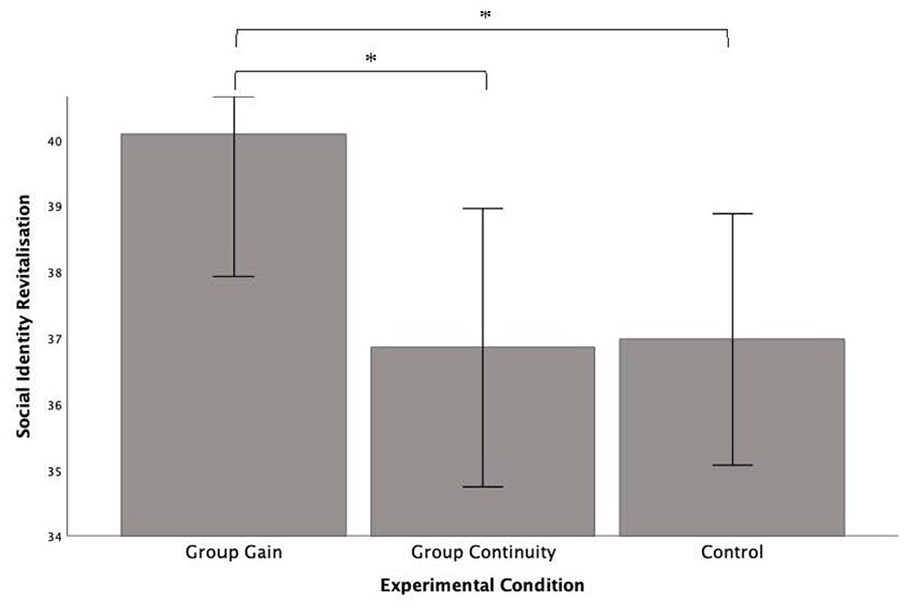
Effect of experimental condition on social identity revitalization.
One-way ANOVAs showed no main effect of condition on PTG (N = 211), F(2, 208) = 1.84, p = .161, η2 = .02, or PTS (N = 214), F(2, 211) = 1.89, p = .154, η2 = .02. Planned contrasts conducted using the same comparisons above found no differences for either PTG or PTS (see Table 1).
Planned Contrasts Comparing Experimental Condition on Outcomes of Post-Traumatic Growth and Post-Traumatic Stress.
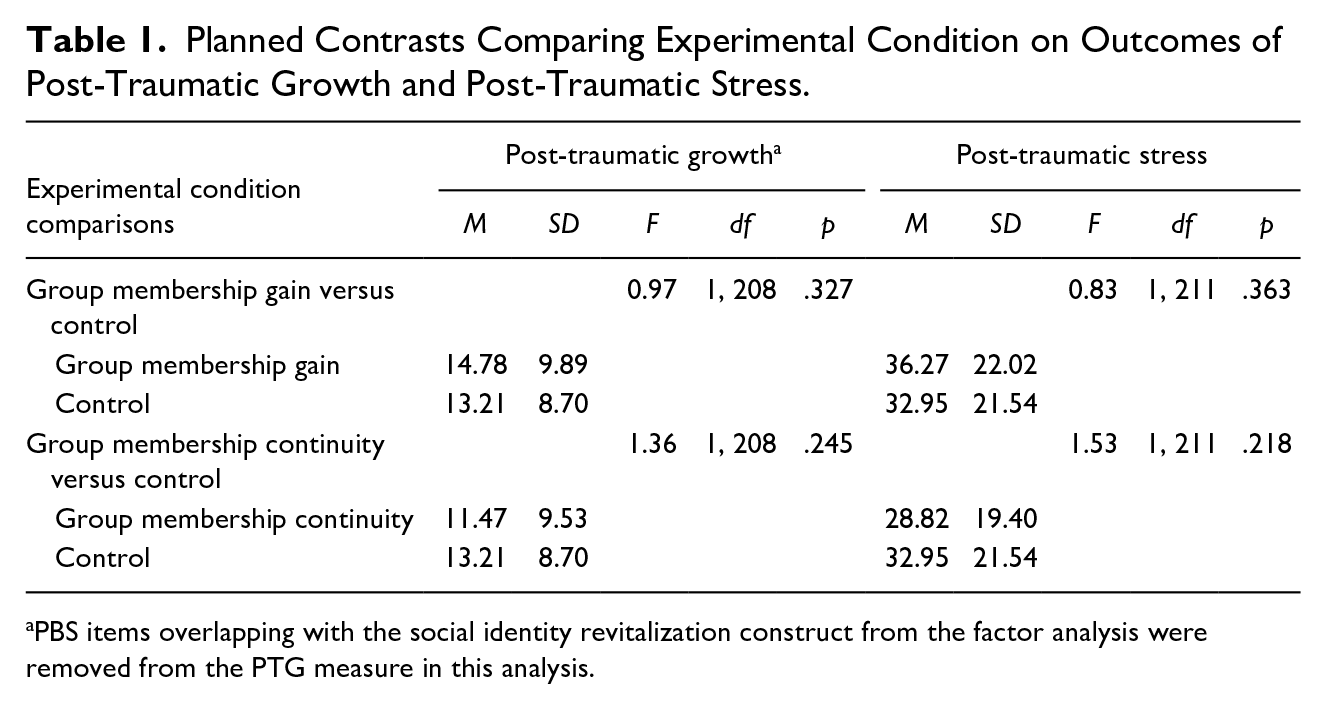
PBS items overlapping with the social identity revitalization construct from the factor analysis were removed from the PTG measure in this analysis.
Exploratory Mediation Analyses (H2)
Four mediation analyses with 10,000 bootstrap samples using PROCESS 4.1 Model 4 (Hayes, 2022) were conducted. For each model, the predictor variable was “condition”—coded to compare (i) group membership gain versus control, or (ii) group continuity versus control—and the outcome variable was either PTG or PTS. In each case, social identity revitalization was the mediator.
PTG
The group membership gain versus control analysis (N = 146) found the direct effect on PTG was not significant (b = .01, SE = .70, p = .984), nor was the total effect (b = −0.80, SE = .80, p = .314). However, the indirect effect (IE) was negative and significant (IE = −0.82, SE = .41, CI [−1.70, −0.05]), suggesting that group membership gain supported PTG to the extent that it facilitated social identity revitalization (see Figure 3).
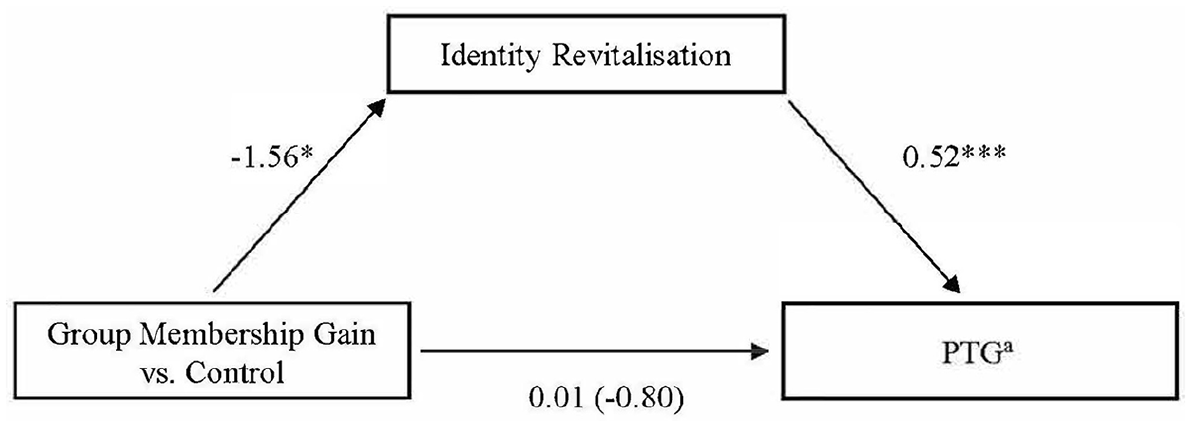
Mediation model looking at social identity revitalization’s role on the relationship between condition (Group membership gain versus control) and PTG.
Since there were no significant differences in identity revitalization scores across the group membership continuity versus control conditions in the ANOVA, no mediation was expected for group membership continuity versus control on PTG (N = 159). This was confirmed in the analysis, with no significant direct effect to PTG (b = 1.54, SE = 1.33, p = .248), total effect (b = 1.71, SE = 1.47, p = .245), or indirect effect (IE = .17, SE = .63, CI [−1.04, 1.43; See Figure 4).
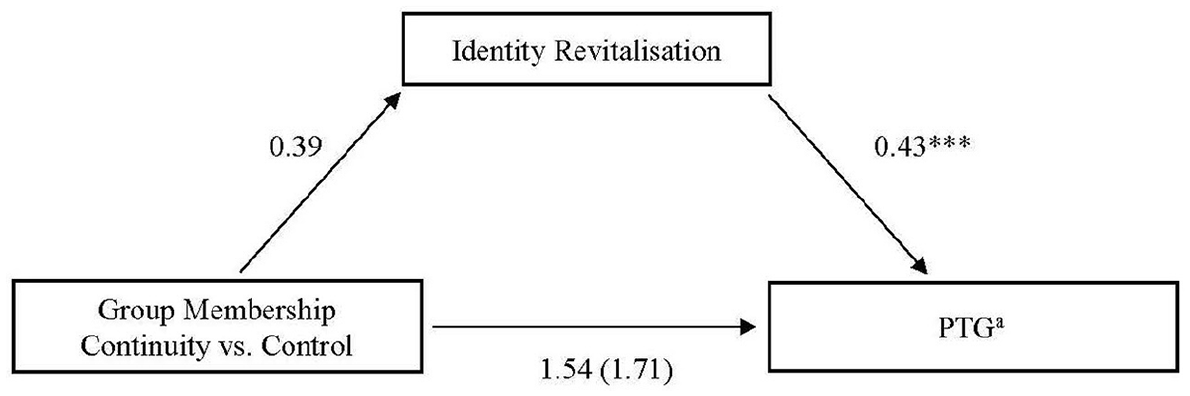
Mediation model looking at social identity revitalization’s role on the relationship between condition (Group membership continuity versus control) and PTG.
PTS
The direct effect for group membership gain versus control on PTS (N = 145) was also not significant (b = −2.01, SE = 1.92, p = .297), nor was the total effect (b = −1.70, SE = 1.89, p = .371) or the indirect effect (IE = .31, SE = .40, CI [−.31, 1.27]; see Figure 5).
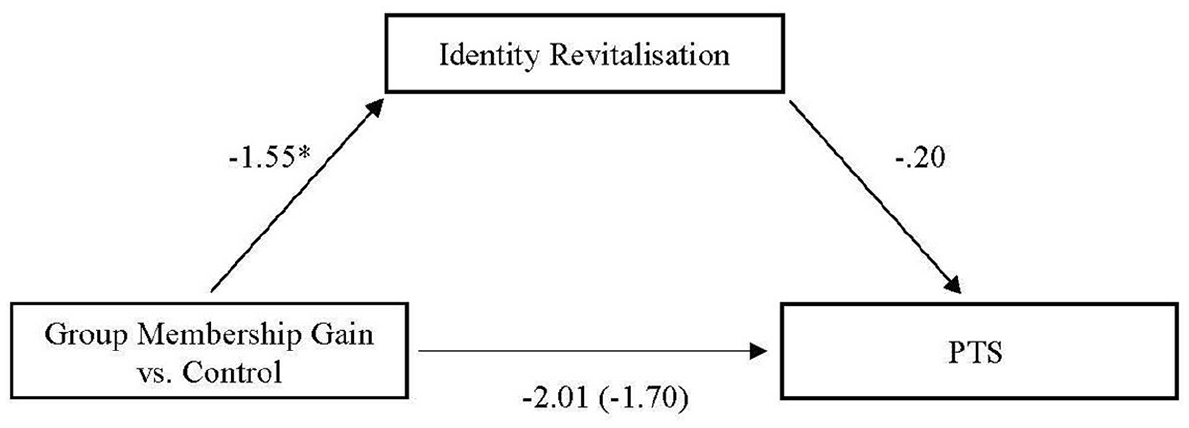
Mediation model looking at social identity revitalization’s role on the relationship between condition (group membership gain versus control) and PTS.
Again, no mediation was expected for the group membership continuity versus control analysis on PTS (N = 162), given the failure to find significant differences in social identity revitalization across conditions. This was confirmed: the direct effect to PTS was not significant (b = 4.08, SE = 3.30, p = .219), nor the total effect (b = 4.05, SE = 3.30, p = .222), or the indirect effect (IE = −.03, SE = .38, CI [−.97, .69]; see Figure 6).
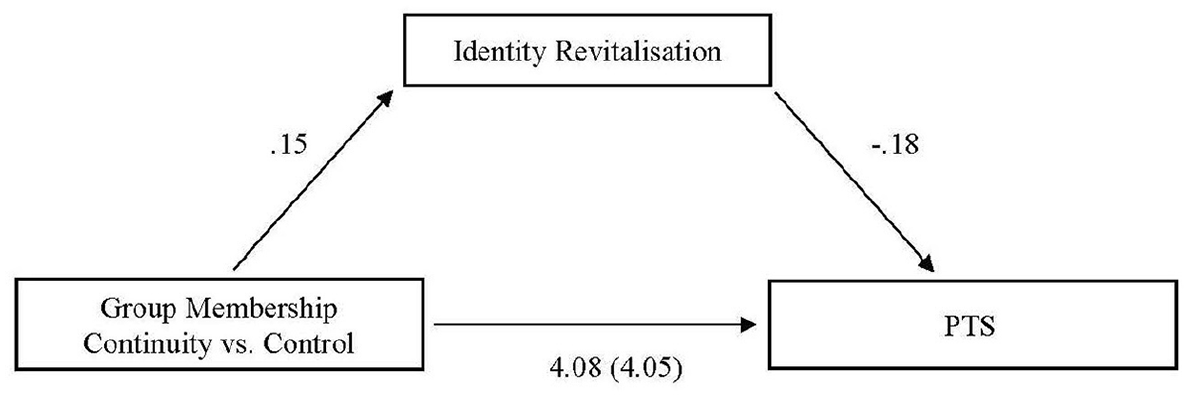
Mediation model looking at social identity revitalization’s role on the relationship between condition (Group membership continuity versus control) and PTS.
Discussion
The purpose of this study was to test experimentally the role of SIMTIC constructs of group membership gain, group membership continuity, and revitalization on trauma outcomes among 2022 Eastern Australia flood survivors. Providing partial support for H1, we demonstrated that participants in the group membership gain condition reported significantly higher social identity revitalization compared to the control condition. This was not the case for group membership continuity. There were also no significant differences between conditions in PTG or PTS scores. Exploratory analyses found an indirect effect of group membership gain on PTG via social identity revitalization, lending partial support for H2.
The absence of any significant differences and associations between group membership continuity and social identity revitalization contradicts previous research, which found that revitalization was a means through which group membership continuity promotes growth (Craig et al., 2022). Nonetheless, the key finding in this study converged with Craig et al. (2022): the critical role of group membership gain on PTG via social identity revitalization. When group membership gain was salient, it promoted social identity revitalization, in turn, enhancing perceptions of growth. Previous empirical and theoretical work suggests that the ability to maintain pre-trauma group memberships following a disaster encourages a sense of continuity, which promotes resilience and PTG (C. Haslam et al., 2018; C. Haslam et al., 2021; Muldoon et al., 2019). However, our data suggest that the development of new group memberships support PTG via a process of revitalization. This is because natural disasters can disrupt survivors’ access to existing social networks—particularly when displaced from their communities—however, those who can find opportunities to connect with new groups in the aftermath of a disaster are more likely to appraise the event in more meaningful ways, thereby reporting positive post-trauma trajectories of recovery.
A secondary goal of the research was to also determine the integrity of our social identity revitalization scale for use in the study’s main analyses. The third EFA confirmed that our social identity revitalization scale overlapped with key social identity-based constructs from within the PTG-SF; however, the lack of a unidimensional social identity revitalization construct (as indicated by the second EFA) suggests that continued development of the revitalization measure is required. As noted earlier, the first measure of social identity revitalization, as developed by Craig et al. (2022), comprised three items representative of the qualitative change in the meaningfulness of social identities (as defined by Muldoon et al., 2019). The present study attempted to refine and extend this definition to include five additional items. These were considered necessary to capture additional possible dimensions of revitalization (e.g., enhanced community efficacy and community identification) that emerge following natural disaster (Cann et al., 2010; McMillen & Fisher, 1998). The finding that two items relating to enhanced community efficacy comprised a separate factor suggests responses to these items may tap into a construct distinct from social identity revitalization. However, this finding may also be a consequence of the timing of our study. Data was collected approximately one year after the natural disaster event when many communities were still recovering. Given the two items focused on the community’s capacity to rebuild itself and overcome associated challenges, responses to these items may reflect the post-disaster state of the communities recruited at the time of this study, which was still developing. Nevertheless, strong unidimensional correlations between remaining social identity revitalization items, together with Craig et al.’s (2022) evidence that all items load onto one factor, lends empirical support for its use as a unitary theoretical construct, and a critical vehicle that promotes PTG.
Implications
Our study is the first to test SIMTIC processes experimentally, building on existing literature demonstrating the role of social identity processes in recovery from trauma, particularly natural disaster (Craig et al., 2022; C. Haslam et al., 2018; Muldoon et al., 2019). Furthermore, this study provides additional validation for social identity revitalization as a distinct theoretical construct and pathway toward PTG. Together, these findings contribute to theoretical and empirical conceptualizations of growth, suggesting that social identity-based revitalization may have the capacity to galvanize such growth. Indeed, we found that when new post-trauma group memberships are able to create revitalization, it establishes a pathway to PTG. Re-conceptualizing the pathways to achieving growth may further enhance our empirical understanding of post-trauma responses, and how best to improve trajectories of recovery.
More practically, these findings have utility in natural disaster contexts, laying the groundwork for the development of SIMTIC-based resources that can aid communities in the aftermath of a natural disaster. Considering the devastation that natural disasters can enact on entire communities, creating post-disaster programs and resources that foster new group memberships—to facilitate social identity revitalization—may become an important means to overcoming resource loss and community depletion in the aftermath of a disaster.
Post-disaster recovery principles often acknowledge existing community engagement as critical for post-disaster recovery (Australian Institute for Disaster Resilience, 2023; Emergency Management Victoria, 2023), but there has been little recognition of the importance that new social resources may play in affected communities. Since natural disasters can compromise or diminish valued social relationships—through displacement, job loss, and limited community resources—the development of new group memberships that enhance survivors’ self-esteem, self-efficacy, and worldview are crucial to improving post-trauma trajectories of recovery (C. Haslam et al., 2018; Muldoon et al., 2019). Social prescribing frameworks—a resource used by health professionals to link patients with support in their communities (WHO, 2024)—might focus on program and intervention referrals to promote new group memberships amongst natural disaster survivors. Doing so may promote PTG, and alleviate strained psychological healthcare services in the aftermath of a natural disaster.
Strengths and Limitations
A key strength of this study relates to its experimental design. Rigorous causal inference research is required to empirically test theoretical assertions and provide empirically sound interpretations of the evidence. While SIMTIC builds upon existing theory and models (C. Haslam et al., 2018; C. Haslam et al., 2021; Jetten et al., 2009), it is a recently developed model that requires empirical validation. The experimental design of this research is the first to allow for causal assessment of SIMTIC, for the first time pointing to a pathway toward PTG through the development of new post-disaster group memberships. This provides a critical step toward informing intervention development for disaster-affected communities to facilitate growth.
A limitation of this study, however, relates to the recency of the natural disaster event during data collection, which occurred 6 to 13 months following the 2022 Eastern Australia floods. Data collected during the critical post-disaster restoration period may not have suitably measured, or represented, the potential for group membership continuity to support positive post-trauma trajectories because many communities’ resources were likely still depleted. The distinct temporal and practical roles these processes play on trajectories of recovery following trauma should be investigated with further research. It may be the case that group membership gain provides resources to promote growth in the more immediate aftermath of a natural disaster as communities continue to recover, while group membership continuity may play a role in longer-term trajectories of recovery. Although group membership continuity was not a significant predictor of trauma outcomes in this study, it is too early to conclude that it is irrelevant given conflicting evidence from the disaster recovery context (Craig et al., 2022; Cruwys et al., 2024). Nonetheless, it would be beneficial to longitudinally study these relationships, and consider the pre- and post-disaster state of communities prior to data collection.
Another limitation of this research relates to the use of a weather control condition. This was intended as a neutral non-group condition that was relevant to weather event contexts. However, this condition was likely not as neutral as intended, as this population comprised natural disaster survivors, a context that likely sensitized participants to the impact of weather on mood and activity. Future experimental research with similar populations should consider control conditions unrelated to participants’ experiences of weather events.
It is also important to recognize that the study’s effect sizes were small, which limits the strength of conclusions that can be drawn. However, the primary aim of this study was to rigorously test causality through a controlled experiment, which the study achieved. This lays the groundwork for future research to further establish these relationships and examine their impact in interventions. Therefore, follow-up experimental research that actively manipulates SIMTIC processes amongst natural disaster survivors would be beneficial for advancing the theory. This could include the development of interventions that facilitate the acquisition of new group memberships and/or the retention of existing ones amongst natural disaster survivor populations. This would allow us to more comprehensively test our hypotheses, and derive more precise conclusions regarding the role of SIMTIC processes on post-trauma outcomes.
Conclusion
In testing key SIMTIC processes in 2022 Eastern Australia flood survivors, this study provides the first evidence that group membership gain following disaster leads to social identity revitalization, which in turn predicts PTG. Whilst further research is needed to refine measures of social identity revitalization, these findings speak to the need for organizations that deliver post-disaster aid and support in the wake of a natural disaster to consider the identity and resource loss affecting individuals and entire communities, and work toward fostering the development of new group memberships that may serve to mitigate some of these consequences and encourage more positive re-appraisals of the event.
Supplemental Material
sj-docx-1-eab-10.1177_00139165241286840 – Supplemental material for New Groups and Post-Traumatic Growth: Experimental Evidence That Gaining Group Memberships Supports Recovery From Natural Disaster
Supplemental material, sj-docx-1-eab-10.1177_00139165241286840 for New Groups and Post-Traumatic Growth: Experimental Evidence That Gaining Group Memberships Supports Recovery From Natural Disaster by Natalie Craig, Catherine Haslam, Tegan Cruwys and Jolanda Jetten in Environment and Behavior
Supplemental Material
sj-docx-2-eab-10.1177_00139165241286840 – Supplemental material for New Groups and Post-Traumatic Growth: Experimental Evidence That Gaining Group Memberships Supports Recovery From Natural Disaster
Supplemental material, sj-docx-2-eab-10.1177_00139165241286840 for New Groups and Post-Traumatic Growth: Experimental Evidence That Gaining Group Memberships Supports Recovery From Natural Disaster by Natalie Craig, Catherine Haslam, Tegan Cruwys and Jolanda Jetten in Environment and Behavior
Footnotes
Appendix A
Declaration of Conflicting Interests
The author(s) declared no potential conflicts of interest with respect to the research, authorship, and/or publication of this article.
Funding
The author(s) disclosed receipt of the following financial support for the research, authorship, and/or publication of this article: This work was supported by the School of Psychology at the University of Queensland; the Australian Research Council (ARC) Laureate Fellowship awarded to Professor Jolanda Jetten (FL180100094); and the National Health and Medical Research Council (NHMRC) Fellowship awarded to Professor Tegan Cruwys (APP1173270).
Ethics Approval and Data Availability
Ethics approval (2021/HE001638) was obtained from The University of Queensland Low & Negligible Risk Ethics Sub-Committee on August 16, 2022, and consent was sought from all participants prior to commencing the study. Data supporting the study findings are available through the Open Science Framework ( ).
).
Supplemental Material
Supplemental material for this article is available online.
Notes
Author Biographies
References
Supplementary Material
Please find the following supplemental material available below.
For Open Access articles published under a Creative Commons License, all supplemental material carries the same license as the article it is associated with.
For non-Open Access articles published, all supplemental material carries a non-exclusive license, and permission requests for re-use of supplemental material or any part of supplemental material shall be sent directly to the copyright owner as specified in the copyright notice associated with the article.
