



Abstract
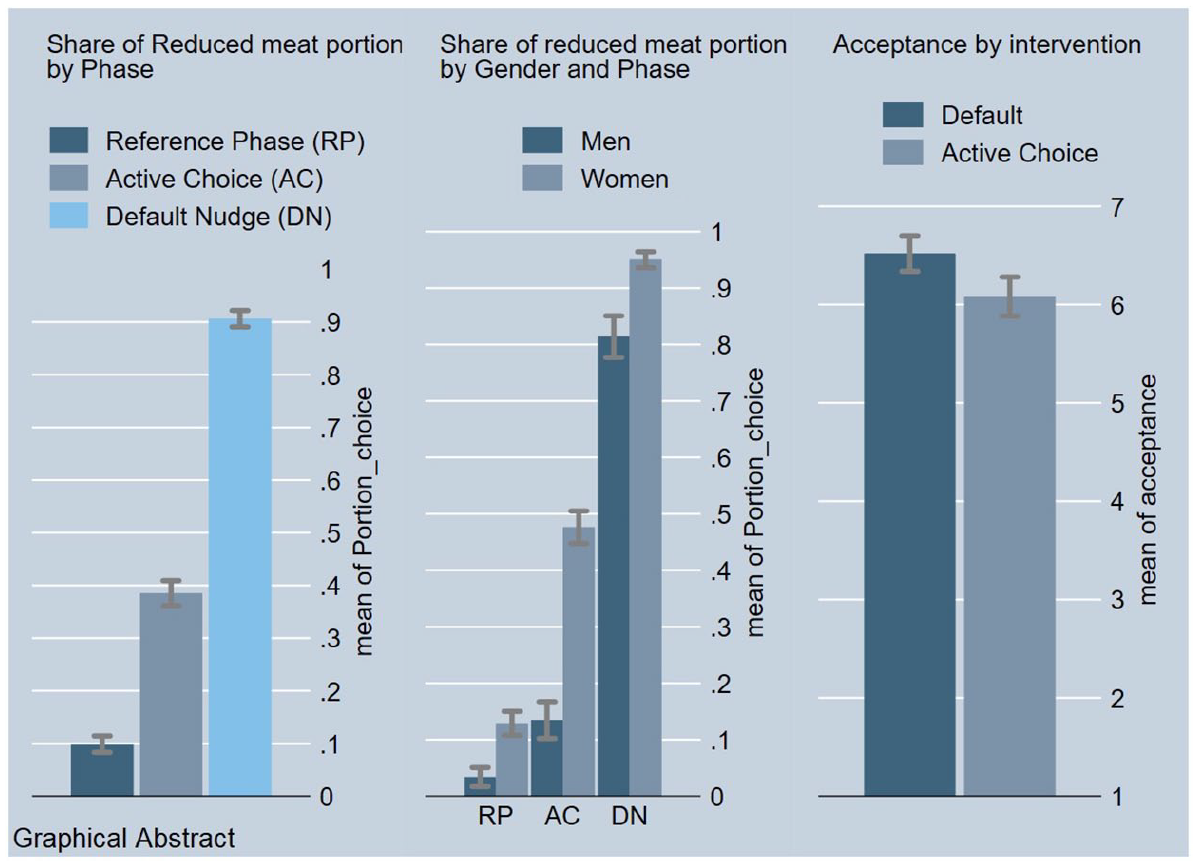
Overconsumption of meat remains common in Western diets. In a cafeteria setting, we assessed the impact of two interventions on reducing meat consumption: forced active choice (explicitly choosing meat portion size) and default nudge (offering a reduced meat portion with an opt-out option). Our field study, involving 5,966 food choices and feedback from 125 cafeteria users, revealed both interventions were effective and perceived as ethical. Across 11 meat dishes, both interventions increased the selection of reduced meat portions. Notably, the default nudge had a more substantial impact, with 90.6% opting for reduced portions compared to 38.5% for active choice. Interestingly, gender differences are most pronounced during the active choice phase and reduced through a default condition. We predict that in biased food choice environments where one option is clearly favored, differences in food choices influenced by socio-demographic factors are likely to diminish.
Keywords
Get full access to this article
View all access options for this article.
References
Supplementary Material
Please find the following supplemental material available below.
For Open Access articles published under a Creative Commons License, all supplemental material carries the same license as the article it is associated with.
For non-Open Access articles published, all supplemental material carries a non-exclusive license, and permission requests for re-use of supplemental material or any part of supplemental material shall be sent directly to the copyright owner as specified in the copyright notice associated with the article.
