



Abstract
Numerous movements protest for more restrictive climate policies, sometimes with radical actions, such as road blockades or paint attacks. A German study with 1,132 participants investigated the impact of government responses on public support for such movements using the Last Generation as a case study. Contrary to expectations, highlighting strict government responses did not increase support, particularly among those who felt existing climate policies were inadequate. This may be explained by widespread resentment against the Last Generation; further analyses showed that donations were indeed high when participants perceived the government response as strict and inappropriate but that this perception was rare. The results suggest that radical protests are less suitable for driving policy change when public support for the movement is low, as they may trigger harsh government responses that damage the movement while not contributing to its mobilization.
In many countries, social movements aim to fight climate change by demanding restrictive policies that limit greenhouse gas emissions (Marris, 2019). These movements often differ in their specific goals and tactics. For instance, in recent years, two movements have dominated the public space and media coverage in Germany. Since 2018, Fridays for Future has been calling on politicians to comply with the climate targets declared in the Paris Agreement (Sommer et al., 2019). By organizing nonviolent recurring protests in many cities, the movement triggered a broad societal debate about climate protection. While Fridays for Future successfully influenced legislation, for instance, by contributing to an accelerated coal phase-out (Markard et al., 2021), other activist groups claim that the movement’s achievements are insufficient. Hoping for more impact, the Last Generation has been relying on more radical tactics, such as road blockades or spraying orange color on monuments, requesting that the government phases out all fossil fuels by 2030 (Rucht, 2023). However, previous research suggests that radical tactics come with a dilemma; while they are increasing the pressure on institutions, they are also perceived as less moral, resulting in decreased identification with and less public support for the movement (Feinberg et al., 2020). Fisher et al. (2023) argued that the unpopularity of confrontational protest also stems from the disconnection between a movement’s means and ends (e.g., throwing color to accelerate coal phase-out). Importantly, a vignette study conducted in the US suggests that the effects of different forms of protest on public support depend on pre-existing beliefs; while both peaceful marches and civil disobedience increased support among Democrats believing in anthropogenic climate change, the support by Republicans was not affected by either tactic, and for independent voters only peaceful actions had a positive impact (Bugden, 2020).
While public support for climate movements has been attributed to their goals and tactics (as well as other characteristics such as movement composition; Wouters, 2019), previous research did not take into account the response of the government (in here understood as the system creating and enforcing rules, including politicians, police, and courts). This response can range from inaction over verbal attacks to more severe forms of repression, such as increased police checks and imprisonment (Honari, 2018). For example, the Last Generation has been bashed by many politicians (Rucht, 2023). At the end of 2023, an activist was sentenced to 6 months in prison for spraying a university building (Soldt, 2023), and in some cases, members of the movement were taken into preventive custody to prevent road blockades (Alkousaa & Jabkhiro, 2023). The repression of the movement seems to exceed that of other activist groups. For instance, comparative media reports claimed that the police took tougher actions against members of the Last Generation than against farmers who used the same forms of protest (Maurin, 2024). Evidence from other social movements suggests that political repression can deter but also encourage protests (Opp & Roehl, 1990; Rozenas & Zhukov, 2019). For instance, studies focusing on protests in the former states of West Germany (Francisco, 1996) and East Germany (Steinert & Dworschak, 2022) have shown that coercion increased protest, while research on the Black Panther Party did find opposite effects (Jeffries, 2002). The inconsistent findings have been attributed to different time dimensions (suggesting short-term negative and long-term positive impacts of repression on mobilization; Rasler, 1996), histories (showing that a memory for violence facilitates mobilization; Bell & Murdie, 2018), regime types (with democracies being most likely to accommodate opposition; Carey, 2006), forms of repression (with imprisonment being linked to stronger grievances than other physical integrity rights violations; Bell et al., 2013), and protest perceptions (with individuals being more likely to accept repression when they fear being harmed by the movement; Edwards & Arnon, 2021). The effect of government responses on support for a climate movement may also be moderated by public attitudes toward the goals and tactics of the movement. In fact, previous research shows that people form groups based on their climate policy opinions; that is, those who believe that current climate policies go too far (do-less group), those who believe that policies do not go far enough (do-more group), those who believe that policies are exactly right (alright group), and those who do not care about the topic at all (don’t-care group). In line with social identity theory (Tajfel & Turner, 1979) and self-categorization theory (Turner & Reynolds, 2012), identification with these groups has been shown to relate to the support of extreme behaviors of opinion-congruent activists (Sprengholz et al., 2023). Thus, individuals for whom current climate policies are insufficient (do-more group) may feel connected to climate movements, such as the Last Generation. When these movements are repressed by the government (e.g., by verbal attacks of politicians or the imprisonment of activists), sympathizing individuals may feel attacked and increase their support for the movement to sustain a positive social identity. This effect could also be explained by vicarious reactance as previous research indicates that people can feel restricted in their own freedom when they observe the discrimination of others, and, as a result, intend to fight against that discrimination (Sittenthaler et al., 2015). Increased support from pro-environmental individuals following government repression may also be explained by moral outrage (Shim et al., 2023) and pragmatic considerations (fighting repression requires additional resources and individuals may increase support to counterbalance powers; Martin et al., 1984). Furthermore, governmental actions against a movement may signal that it has been successful in driving change and thereby increase public support to sustain societal transformation. Of course, for other opinion groups, different effects may be observed. When individuals think that current climate policies go too far (do-less group), their support for climate movements, such as the Last Generation, may already be low. As the repression of such movements may be in their interests, strict government responses are unlikely to facilitate their support.
Based on the above considerations, we conducted a preregistered experiment (https://aspredicted.org/ug9iq.pdf) to investigate the effects of different government responses on support for radical climate movements in various climate policy opinion groups. The participants were informed about the goals and tactics of the Last Generation before reading about past government responses that were either strict (emphasizing verbal attacks by politicians and imprisonments) or lenient (emphasizing understanding by politicians and non-punishment). Afterward, support for the Last Generation was measured by asking the participants to split a raffle between themselves and a donation to the movement. Two hypotheses were developed. As the goals of the movement (do not) align with the preferences of those who demand more (less) restrictive climate policies, we assumed that
(H1) People for whom the climate policy does not go far enough (do-more group) are more willing to support the Last Generation than people for whom the climate policy goes too far (do-less group).
As strict government responses can limit the success of social movements, we further assumed that
(H2) People for whom the climate policy does not go far enough (do-more group) are more willing to support the Last Generation if government responses are strict compared to when they are lenient.
For the other climate policy opinion groups, no hypotheses about the effects of strict versus lenient government responses were preregistered. However, exploratory analyses have investigated how these responses were perceived and how they affected movement support in the different groups.
Method
Participants and Design
The participants were surveyed in November 2023 as part of the Planetary Health Action Survey (PACE; Jenny et al., 2022). The sample (N = 1,132) was non-probabilistic but quota-representative for age × gender and federal state with regard to the German adult population. This allowed for the detection of small-to-medium effects (d = 0.3) for both hypotheses (see preregistration for details). The participants were 18 to 74 years old (M = 46.08, SD = 14.43), and 50% were male (49% were female). The experiment employed a one-factorial design; the participants were randomly assigned to a strict (n = 566) or lenient government condition (n = 566).
Materials and Measures
The participants’ climate policy opinions were captured before presenting vignettes about the Last Generation and a varying government response. Afterward, perceptions of the response and support for the movement were assessed.
Opinion on Climate Policy
The participants were asked to state their position on the German federal government’s climate policy by selecting whether it was (i) going too far (do-less group), (ii) not going far enough (do-more group), (iii) exactly right (alright group), or (iv) not of interest to the participant (don’t-care group).
Introduction to the Last Generation and Manipulation of Government Response
The participants were asked to read two short texts (Table 1). The first text informed about the Last Generation, its goals, and tactics. It was adapted from news reports and press releases issued by the movement. The second text differed between the randomly assigned experimental conditions. In the strict government response condition, the participants read that politicians from governing as well as opposition parties condemned the movement and that members of the Last Generation had been sentenced to long prison terms. In the lenient government response condition, they read that politicians (from the same parties) showed an understanding of the movement and that the courts ruled in favor of its members. The texts in both conditions were based on real social media posts and news reports. In the end, they summarized that the government acts strictly (leniently) and frequently (rarely) takes action against protesters. Overall, the texts tried to increase (decrease) strictness perceptions among readers.
Perceptions of Government Response
The participants were asked to rate the strictness of the government response on a 7-point scale from very lenient to very strict. They were further asked about the appropriateness of the government response using a 7-point scale ranging from very inappropriate to very appropriate.
Approval of Protests and Support for the Last Generation
The participants were asked about their approval of the Last Generation protests on a 7-point scale, ranging from disapprove very much to approve very much. Behavioral support for the movement was measured with an incentivized dictator game. The participants were asked how they would distribute 100 euros between themselves and a donation for the Last Generation when winning the amount. They were told that the decision of one participant was randomly chosen and realized at the end of the study, so they could win and donate real money. Participants may be more generous in such a game than in the field (as donating a windfall may be easier than giving hard-earned cash) and thus absolute giving may be overestimated. However, previous research indicates that the assessed donations are still informative for answering relative questions (Cartwright & Thompson, 2023) and the measure should allow more valid conclusions about individual movement support than merely asking participants about their moral or sympathetic backing. To reduce study costs, only one participant’s decision was realized. However, Ahles et al. (2024) recently showed that using such a lottery approach yields results comparable to the realization of all participants’ decisions.
Experimental Vignettes.
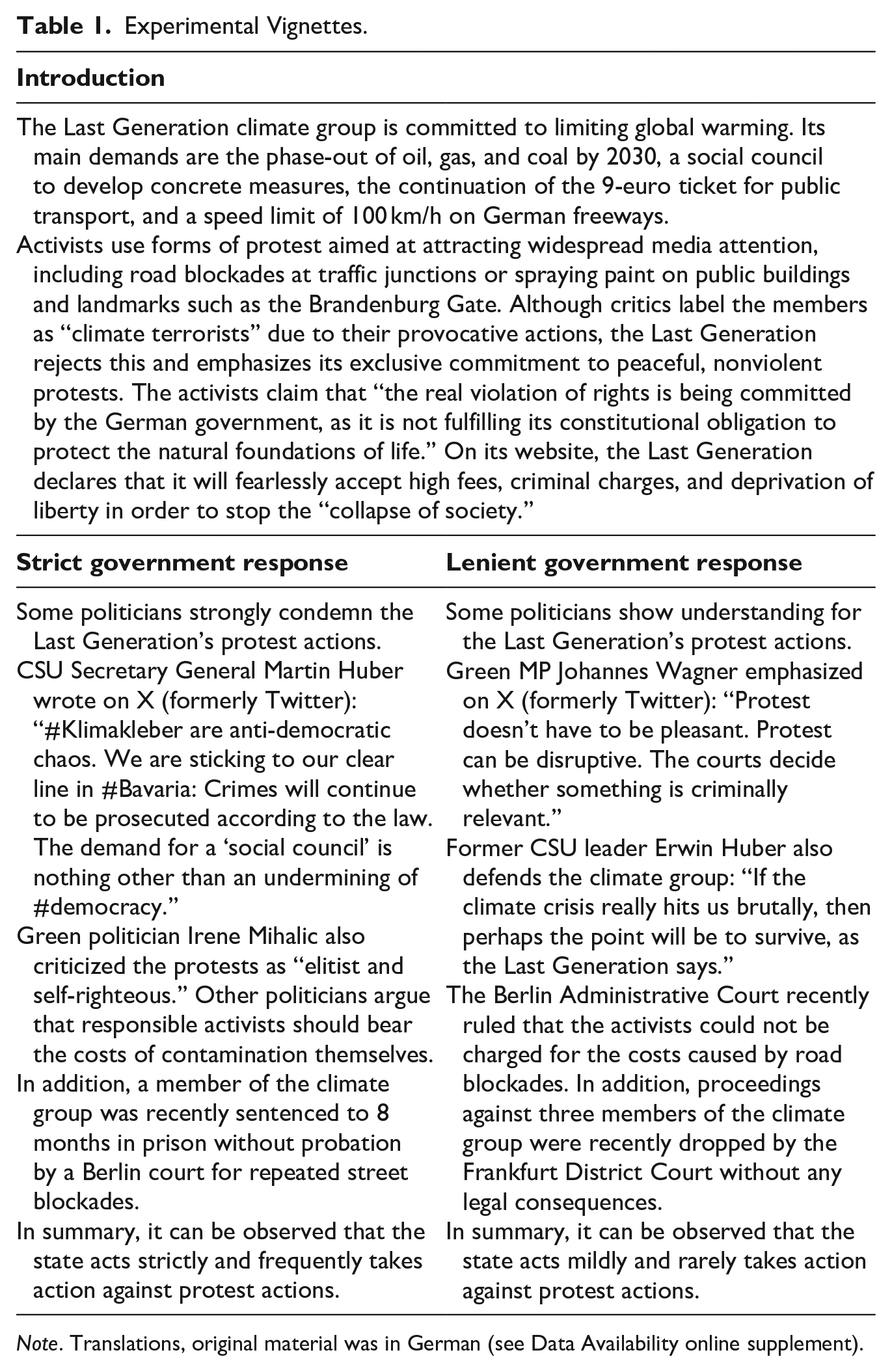
Note. Translations, original material was in German (see Data Availability online supplement).
Ethics
The study was conducted in accordance with German Psychological Association guidelines. Ethical clearance was obtained from the University of Erfurt’s institutional review board (#20220525), and all the participants provided informed consent to use and share their data for scientific purposes without disclosure of their identities. The panel provider compensated the participants for their participation.
Results
Climate Policy Opinion Groups
In line with earlier research (Sprengholz et al., 2023), the majority of the participants self-assigned to one of two large oppositional groups: those who believe current climate policies go too far (36%, do-less group) and those who believe such policies do not go far enough (39%, do-more group). Only 14% believed that the current climate policies were exactly right (alright group), while 11% indicated that they did not care about the topic at all (don’t-care group). Participants’ climate policy opinion related to their voting preferences as the majority (52%) of those voting for conservative or right-wing parties (CDU/CSU and AfD) were in the do-less group while the majority (55%) of those voting parties that form the center-left, liberal and green federal government (SPD, FDP, and the Greens) self-assigned to the do-more group.
Perceptions of Government Response
Across all climate policy opinion groups, the participants perceived the government response to be stricter when framed in this way, t(1091.50) = 9.41, p < .001, d = 0.56, indicating a successful experimental manipulation (Figure 1A). While strictness ratings were higher in the do-more group than in the do-less group, t(845.55) = 9.61, p < .001, d = 0.66, only 47% of participants in the do-more group perceived the government response as rather strict when framed as such (answering with values of 5 or higher on the 7-point strictness scale). The participants in all opinion groups perceived a strict government response as more appropriate than a lenient government response, t(1119.90) = 7.40, p < .001, d = 0.44 (Figure 1B). Interestingly, while members of the do-more group perceived the lenient response to be more appropriate than members of the do-less group, t(413.09) = 5.02, p < .001, d = 0.49, the two groups did not significantly differ in their appropriateness ratings for the strict government response, |t| < 1. Strictness and appropriateness were positively correlated, with r = 0.20 (p < .001) in the do-more group and r = 0.51 to 0.59 (p < .001) in the other groups (Figure 2).
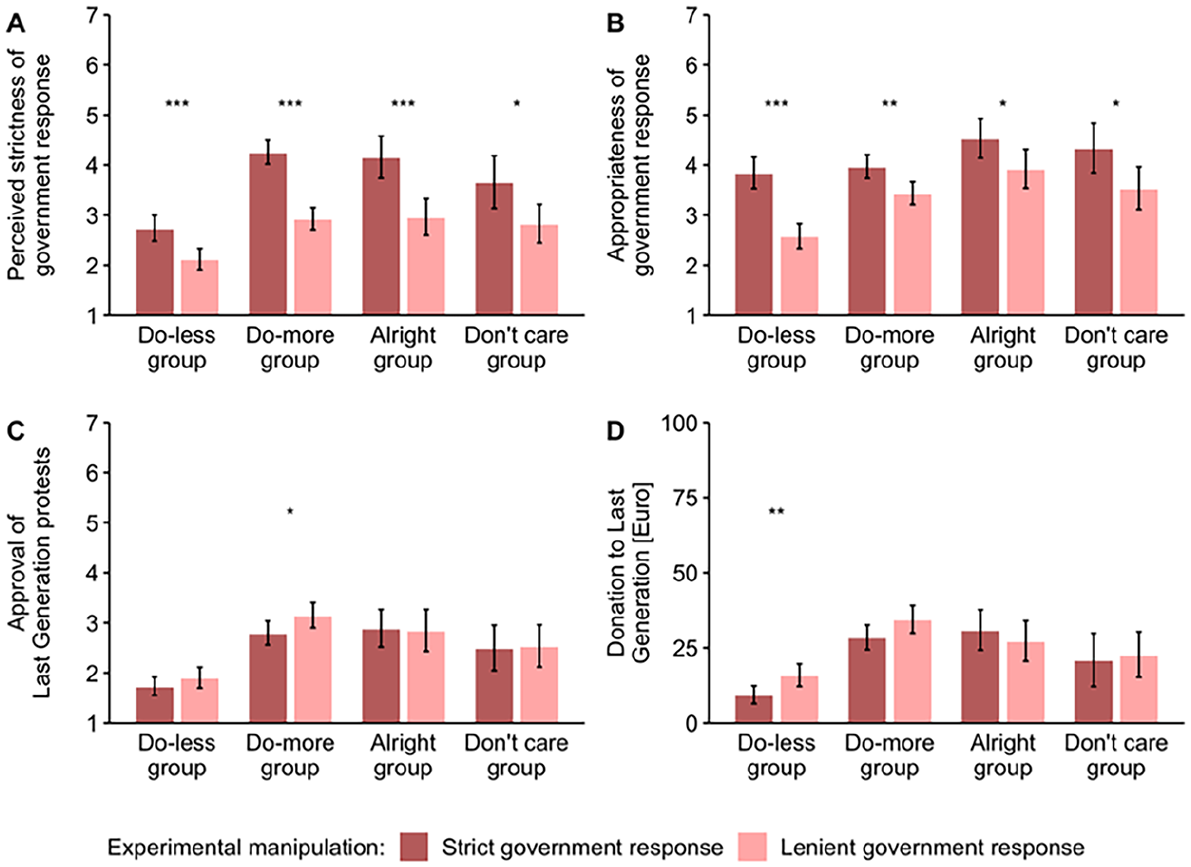
Effects of strict versus lenient government response. Note. In a German survey with 1,132 participants, most perceived the government’s climate policy as going too far (do-less group, n = 404) or not going far enough (do-more group, n = 444), while smaller shares perceived it as just right (alright group, n = 163) or did not care about climate policy at all (don’t-care group, n = 121). After reading short texts about the radical climate movement Last Generation and a strict (n = 566) versus lenient (n = 566) government response, the participants were asked (A) how strict and (B) how appropriate they perceived the response. They were further asked (C) how much they approved the protests of the movement and (D) how much money they would like to donate to the movement from 100 euros they could win in a raffle. Bars visualize means; error bars denote 95% confidence intervals. Stars mark significant differences between the two experimental conditions (t-tests with p = .05 > * > .01 > ** > .001 > ***).
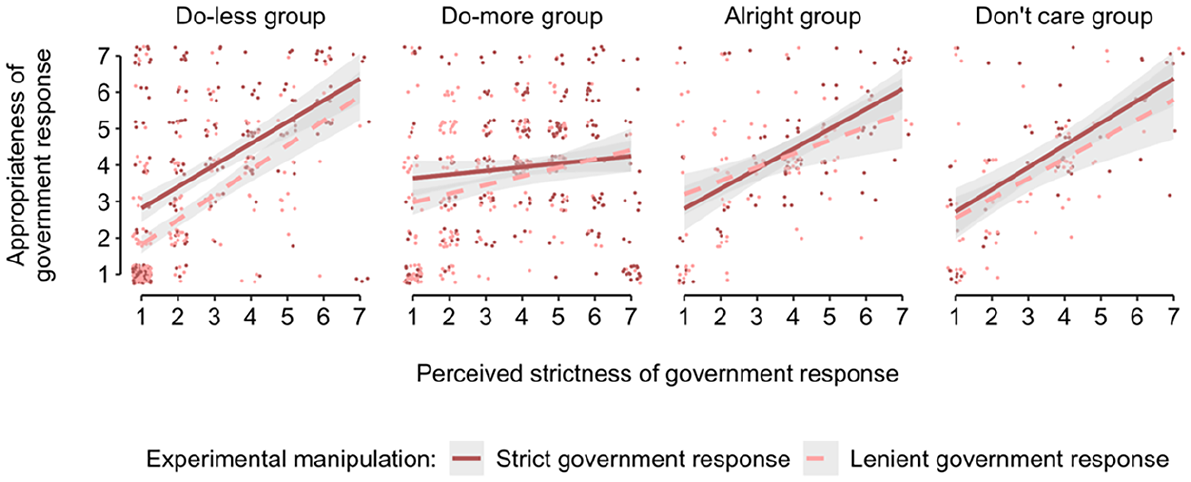
Association between perceived strictness and appropriateness of government response.
Approval of Protests and Support for the Last Generation
The participants disapproved of the protests of the Last Generation, especially in the do-less group, while no substantial differences between the experimental conditions were found (see Figure 1C). For donation decisions, similar patterns were observed (Figure 1D). On average, the participants in the do-more group donated higher amounts than the participants in the do-less group, confirming H1, t(813.88) = 9.44, p < .001, d = 0.64. For the do-less group, reading about a strict government response slightly decreased donations, t(383.25) = 2.70, p = .007, d = 0.27. A comparable but not statistically significant difference was observed for the do-more group, t(434.26) = 1.92, p = .056, d = 0.18. Therefore, emphasizing a strict government response did not facilitate support for the Last Generation among participants demanding more climate policies, thus falsifying H2. However, this result may be attributed to widespread resentment of the movement. Even among members of the do-more group, only 39% of those who perceived the government response as strict also viewed it as inappropriate (answering with values of 5 or higher on the 7-point strictness scale and values of 3 or lower on the 7-point appropriateness scale; see Figure 2), and only 24% approved the protests (answering with values of 5 or higher on the 7-point approval scale). The hypothesized mobilizing effect of a strict government response may have only occurred in these minorities. To follow up on this idea, an exploratory linear regression of donations on the perceived strictness and appropriateness of the government response, as well as their interaction, was calculated, including data from all the participants (Figure 3). When participants perceived the government response as lenient, donations were low and further decreased the more inappropriate it was found. However, when participants perceived the government response as strict, donations increased the more inappropriate this strict response was perceived.
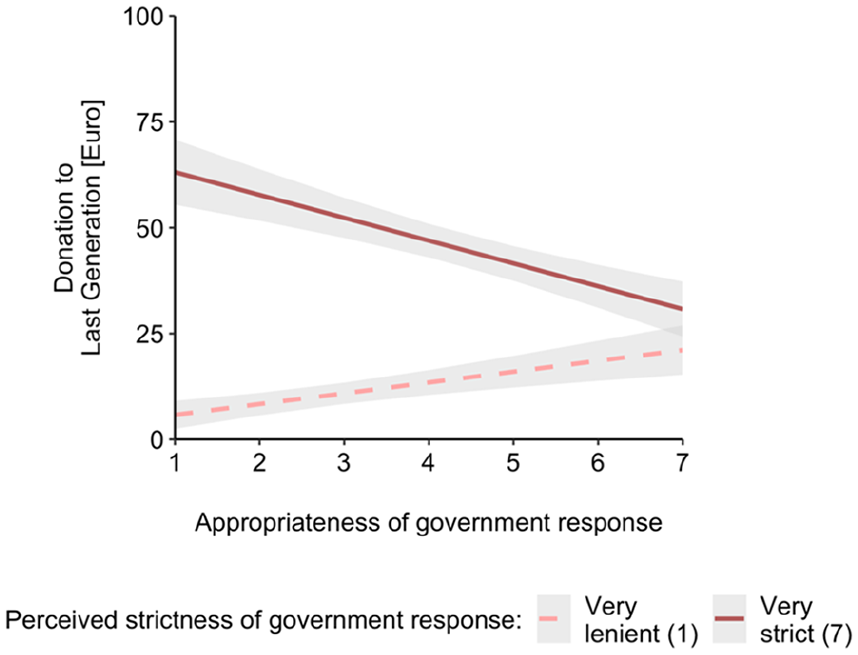
Donation to the Last Generation by perceptions of the government response.
Discussion
In recent years, climate movements have grown in many countries. Some of these movements restrain more radical tactics, such as road blockades, to pressure governments toward stricter climate policies. While previous research suggests that radical actions can decrease public support for climate movements (Feinberg et al., 2020), the role of government response has rarely been examined. Here, we investigated whether strict, compared to lenient, responses increased support for the German climate movement Last Generation. Based on previous research on repression and identification, we hypothesized that individuals for whom current climate policies do not go far enough would be more willing to donate money to the Last Generation (compared to people for whom the policies already go too far) and that their donations would further increase if they learned about strict government responses, including verbal attacks from politicians and imprisonments (compared to lenient responses). Experimental data showed that donations depended on the participants’ climate policy opinions. However, reading about a strict government response did not increase the average donations among individuals for whom climate policies did not go far enough. Only a minority within this group perceived strict government responses as inappropriate and approved of the Last Generation’s protests. Thus, even if people demanded stricter climate policies, most seemed to resent the Last Generation, possibly because of its use of radical protest forms (Feinberg et al., 2020). While strict government responses did not result in expected mobilization within this group, further analyses showed that donations to the movement were high when individuals perceived the government response as strict and inappropriate. While only a minority shared this view, the results indicate a facilitating effect of apparently unjust strictness on movement support.
This study has some limitations. While the experimental manipulation affected strictness perceptions, participants’ support for the movement was likely to have depended mainly on pre-existing beliefs and attitudes. However, framing the government response as much stricter, for instance, by further emphasizing the increasing count of imprisonments, may have resulted in stronger mobilization effects. Recent research on the abstraction of experimental designs (Brutger et al., 2023) indicates that providing less contextual details may also help to increase treatment effects. Future replications of this study should also consider including a control group with a placebo vignette. This may help to better understand if the experimental manipulations have no effect or shift support for the movement in the same direction (for instance, by making pre-existing beliefs salient). The results refer to the German context. Demonstrations in the country are usually moderate and peaceful, and contentious forms of protest are widely disapproved (Cristancho et al., 2019), possibly explaining the resentment against the Last Generation observed in this study. The effects of strict government responses may differ in countries where people are used to more radical protests, such as in France (Rivat & Stauer, 2012), or when climate movements employ different tactics. Furthermore, support for the movement was assessed by the amount participants intended to donate if they were winning 100 euros. This measure did not account for typical barriers to the mobilization process, such as everyday distraction or social pressure (Klandermans & Oegema, 1987). Because donating in an experiment is much easier than supporting a climate movement in reality, the effects of an apparently strict government response on mobilization may be more negative than observed in this study.
Overall, the study shows that support for the Last Generation is rather low in Germany, and it does not increase when the public is confronted with strict government responses. In line with other research (Bugden, 2020), support for activist groups seems to be mainly shaped by robust pre-existing beliefs. Support could not be changed by the experimental vignettes, and this may be explained by the pre-experimental influence of media and politics on individuals’ attitudes toward the Last Generation. As most news reports about the movement were framed in a negative way (for instance, by describing the protests as a security issue; Bundtzen, 2023) and many politicians from various parties condemned its actions, strong resentment spread among the public.
At first sight, the results suggest that the movement’s radical actions are not very suitable for achieving its important goals. First, because radical actions reduce public support for the movement (Feinberg et al., 2020), resulting in the widespread resentment observed in this study. Second, because radical actions likely trigger harsher government responses, such as preventive custody and imprisonment, that hinder future actions of the movement but—as shown in this study—do not increase public support. The combination of low public support and a strong backlash from law and order may reduce the impact of radical actions and thus renders it unlikely for the government to make concessions. However, previous research also highlights that tactical diversity and civil disobedience may still be important to facilitate change as disruptive protest events are more likely to be covered in media reports (Andrews & Caren, 2010; McCarthy et al., 1996). Fisher (2024) also argued that the importance of popularity has often been exaggerated as unpopular actions do not necessarily turn people away from a movement’s cause. It has been suggested that civil disobedience and peaceful protest are complementary rather than contradictory (Bugden, 2020). The challenge may be to find the right balance between different tactics.
To be more effective in driving a change toward more restrictive climate policies, the Last Generation should increase its backing by the public. This may be achieved by adapting protest tactics or improving communication about the movement’s goals and actions. For instance, the Last Generation could become more successful if people better understand why it differs from more moderate movements and that its actions aim to protect life and well-being for future generations. Interestingly, while revising this article, the movement announced that their members will no longer glue themselves to roads to block traffic (Meier, 2024), thereby adapting the mix of peaceful and disobedient tactics.
Footnotes
Author Contributions
PS and VM designed and performed the research, planned and performed the data analyses. PS wrote the initial draft, which was revised and approved by both authors.
Declaration of Conflicting Interests
The author(s) declared no potential conflicts of interest with respect to the research, authorship, and/or publication of this article.
Funding
The author(s) disclosed receipt of the following financial support for the research, authorship, and/or publication of this article: This work was supported by the University of Bamberg and the PACE project which was funded by Federal Ministry of Health, Federal Centre for Health Education, Robert Koch Institute, Leibniz Institute for Psychology, Klaus Tschira Foundation, and University of Erfurt (no award/grant numbers).
Ethics and Consent
The study was conducted in accordance with German Psychological Association guidelines. Ethical clearance was obtained from the University of Erfurt’s institutional review board (#20220525), and all the participants provided informed consent to use and share their data for scientific purposes without disclosure of their identities.
