



Abstract
How do people behave in the seconds after they become aware they have been caught up in a real-life transport emergency? This paper presents the first micro-behavioral, video-based analysis of the behavior of passengers during a small explosion and subsequent fire on a subway train. We analyzed the behavior of 40 passengers present in the same carriage as the explosion. We documented the first action of the passengers following the onset of the emergency and described evidence of pro- and anti-social behavior. Passengers’ first actions varied widely. Moreover, anti-social behavior was rare and displays of pro-sociality were more common. In a quantitative analysis, we examined spatial clustering of running behavior and patterns in passenger exit choices. We found both homogeneity and heterogeneity in the running behavior and exiting choices of passengers. We discuss the implications of these findings for the mass emergency literature and for evacuation modeling.
Keywords
The study of mass emergency behavior is notoriously difficult. These events are thankfully rare, meaning that most scholarly knowledge is obtained from secondhand witness accounts or from experimental setups that cannot stimulate real threats or danger. The proliferation of public CCTV cameras provides an alternative data source for analyzing actual public responses to real-life emergencies as they unfold in their here-and-now contexts. In this article, we utilize CCTV footage of a small explosion on a subway train to analyze how individuals behave during a spontaneous transport evacuation. We find both similarity and diversity in the actions and exiting strategies of passengers. This behavioral assessment compliments existing knowledge and provides implications for evacuation modelers.
Understanding the behavior of individuals in mass emergencies is critical for emergency preparedness, evacuation modeling and collective and personal resilience. Traditionally, the behavior of individuals in public emergencies has been described as a collective, irrational “panic” (Quarantelli, 2001). This concept of “panic,” in which evacuees flee danger, everyday social norms and even loved ones to save themselves, is unhelpful in several respects. First, by assuming an absence of self-control or available mental faculty, it makes efforts to bolster emergency preparedness seem futile. Second, the implicit homogeneity of panicked action ignores the diversity and complexity of human psychology and behavior. Recent scholarship on behavior during public emergencies has largely discredited this “myth of panic” (for review, see Drury, 2018). For example, in a seminal study, Johnson (1988) analyzed interview transcripts of survivors from the 1977 Beverly Hills Supper Club fire, which killed 165 people. Rather than finding evidence of irrational panic, he found that behavior remained orderly and cooperative (see also Drury et al., 2009a, 2009b; Dynes, 2003). Sime (1990) further challenged the concept of “panic” and suggested that while the behavior of evacuees may be perceived by an outside observer as blurred confusion, the same behaviors may be interpreted as rational from the evacuee’s own perspective. This shift away from mass panic, towards a focus on meaning and behavioral complexity, offers new avenues of investigation into prevalence and consequences of different evacuee actions.
Pietrantoni and Prati (2009) review four prevalent human reactions to dangerous emergencies: fight, flight, freeze, and affiliation. The “fight-flight” response is described as a physiological reaction to danger in which individuals either confront the danger head-on or move away to a safe distance (Cannon, 1929). This “fight-flight” instinct has been applied to explain cases in which individuals challenge a direct source of danger (e.g., combat an active shooter [Briggs & Kennedy, 2016]) or flee from a danger zone to safer ground (e.g., Alexander, 1990). More recently it is advocated that the fight-flight dichotomy be extended to encompass “freezing” reactions. Specifically, Leach (2004) examined witness testimonies and historical documents across a range of disasters and found evidence that the immense stressors in these life-threatening situations led some evacuees to cognitive paralysis. This freezing was positively associated with evacuation delays and fatal outcomes. Individuals less able to recover their decision-making capabilities may also be more prone to relying on mental schema, resulting in usual routine actions, such as continuing with work, retrieving left items, or following a familiar route, despite the immediate danger (Donald & Canter, 1992; Graham & Roberts, 2000; Leach, 2012). In contrast to a cognitive-paralysis explanation for this kind of lack of action, Robinson and Bridges (2011) suggest that hesitance to evacuate may instead be attributed to risk denial.
A fourth reaction to dangerous emergencies is “affiliation” (Mawson, 2005; Sime, 1985). This phenomenon covers actions in which an evacuee heads not directly towards or away from danger, but instead towards familiar people and places. A review by Mawson (2005) suggests that separation from familiar people and places proves a greater stressor than the immediate presence of danger. He further concludes that affiliation is the predominant response to an emergency—when fight or flight does occur, it is most likely not an act of self-preservation, but an affiliative response to return to situations and individuals perceived as familiar. The affiliation model provides explanation to the well-established finding of evacuees risking their own safety to protect loved ones. For example, during the 1973 Summerland Leisure Centre fire, rather than fleeing to save themselves, some individuals died whilst remaining with slower family members (Drury & Reicher, 2010). However, this theory is less well placed to explain widely reported accounts of individuals risking their lives to facilitate the evacuations of unknown others. Interviews with survivors of the London 7/7 bombings found that strangers offered comfort, water, and makeshift bandages to unknown others (Drury et al., 2009a). In a similar fashion, an analysis of the 9/11 World Trade Center evacuation recorded multiple accounts of strangers helping less able-bodied individuals down stairwells and towards safety – even at detriment to themselves (Averill et al., 2013). Drury, Reicher and colleagues (Drury, 2018; Drury et al., 2009a, 2009b) provide an identity-based explanation for this willingness to help the “unknown other.” They suggest that emergencies, rather than making individuals competitive and self-directed, create a sense of solidarity between evacuees, which promotes care and concern for others.
Beyond providing care and concern, other evacuees may also be a vital source of information during the uncertain event. Evacuees frequently look to others for cues on how to respond. This is evident in two road-tunnel fire evacuation experiments, in which between 66% and 94% of participants reported being influenced by the actions of others when making the decision to leave their own vehicles (Burns et al., 2013; Nilsson et al., 2009). Evacuees may also directly engage with others to seek or share information. An interview study with survivors of the 9/11 World Trade Center attack showed that almost 30% of the sampled survivors actively sought information from others (Averill et al., 2013). This study also found that evacuees would freely pass on information to those around them, including strangers. The extent to which information was disseminated among survivors was positively associated with the speed at which individuals evacuated the building. Information-sharing and evacuation directions are most likely to be accepted when the source is deemed credible or when coming from a legitimate authority (Rød et al., 2012; Yeo & He, 2009).
In sum, evacuees may respond to an emergency in a number of ways. Individuals may flee the area, fight the source of danger, freeze, or continue to carry out everyday routines. Individuals also seek out familiar places and people, share information, self-organize, and help others, even at great risk to themselves. In a clear example of this behavioral diversity in the face of an emergency, interview respondents to earthquake tremors in Italy reported fleeing, investigating, freezing, continuing activities, recovering belongings, searching for and protecting others, and seeking information (Prati et al., 2012). This increasing recognition of behavioral diversity has prompted the development of formal “behavioral glossaries” of crowd dynamics, which advocate the application of consistent terminologies across disciplines (e.g., Adrian et al., 2019; Haghani et al., 2019).
Video Data and the Study of Emergency Behavior
Despite the breadth of empirical findings to date, researching the behavior of emergency survivors remains particularly challenging. As researchers are almost never present in-situ during an emergency event, most knowledge obtained is from retrospective self-report accounts, which ask respondents to describe their perceptions and behavioral responses to past events. Although self-reports provide rich descriptive detail on the experiences, motivations, and recalled behavior of emergency survivors, these retrospective accounts may be inaccurate owing to social desirability biases, memory failure, and cognitive constraints—phenomena assumed to increase in times of stress (Saunders, 1991; Vrij et al., 2014). Video footage is increasingly described as the most complete data source for systematically evaluating human behavior (Gilmore & Adolph, 2017; Lindegaard & Bernasco, 2018). A chief reason for this assertion is that video cameras capture actual behavior as it unfolds in its here-and-now context (see Philpot et al., 2019). In addition to capturing the real-life action, videos may also be replayed and slowed down to frame-by-frame instances. This allows for chronological measurement of the micro-interactions of multiple individuals, a feat impossible to reliably assess with retrospective self-report accounts or through human onsite observation (Morrison et al., 2016; Simons & Chabris, 1999).
Video data is increasing applied to the study of crowd movements. Unobtrusive surveillance of everyday pedestrian locomotion at crosswalks, malls, and transport terminals is used to validate models of human crowding (Johansson et al., 2007; Zhong et al., 2015). Furthermore, field and laboratory video-recorded experiments capture the evacuating behavior of informed participants in varied controlled conditions. For example, in a filmed experiment, Cao et al. (2018) instructed participants to vacate a supermarket in good and limited visibility conditions. Across both conditions, evacuees were recorded to leave by the closest exit and wait patiently when congestion occurred. Limited visibility was associated with a higher likelihood that evacuees followed one another and provided help to those in need. In a separate video-recorded field study, Benthorn and Frantzich (1999) observed the actions of participants whilst vacating a warehouse during a staged fire drill. They found that although participants typically exited via a familiar door, this effect nullified when a closer emergency door was open and the outside visible.
While video recordings of everyday pedestrian movements and experimental behaviors are widely applied to verify and inform simulations of emergency evacuations, these methods have been criticized for concerns over reliability and validity. Specifically, although video tracking of individuals is accurate with a clear bird’s-eye view and with pre-specified outlay dimensions, these algorithms tend to achieve low reliability in highly dense or chaotic scenes (Bisagno et al., 2018), as typical in high danger emergencies. The experimental method remains the gold standard for establishing causation, however for ethical and practical reasons, it is almost impossible to stage public emergencies or to expose participants to actual danger (Philpot et al., 2019—though see Nilsson et al., 2009; Shields & Boyce, 2000 for rare exceptions). Therefore, for greater experimental control, researchers often decontextualize the emergencies and reduce the complexity of the scenarios under study. Even with these pared-down conditions, the most rigorous experiment is unable to precisely predict the complex behavior of evacuating participants. For instance, a series of recent video-based machine learning studies on pedestrian movements in a highly controlled gymnasium evacuation reached its highest predictive accuracy of 81.50% (Wang et al., 2019). With this in mind, scholars have called for more work examining the real-life behavior of crowds in actual, threatening evacuation scenarios (e.g., Johansson et al., 2008; Qin & Gao, 2019).
One way to study real-life emergencies is through the use of CCTV footage. While real-life CCTV data has been fruitfully applied to the study of bystander reactions in public assaults and commercial robberies (e.g., Levine et al., 2011; Lindegaard et al., 2017; Philpot et al., 2020), only a handful of studies to date have utilized public surveillance video clips to understand human behavior in crowd emergencies and evacuation scenarios. Johansson Helbing and colleagues used video data of the Hajj Pilgrimage 2006 to understand how extreme person densities may result in crowd disasters (Helbing et al., 2007; Johansson et al., 2008). This work found that even in high-crowd densities of 10 persons per square meter, the average individual’s speed did not fall to zero. Mounting congestion, reduced movement flows and building pressure resulted in “crowd turbulence,” a newly recorded phenomenon in which individuals may become displaced and at risk of trampling. More recently, researchers have combined video footage of the fatal 2010 Loveparade stampede and computer vision techniques to automatically detect critical congestion situations (Huang et al., 2015; Krausz & Bauckhage, 2012). While these recent video advancements provide important insights into the dangers of overcrowding, by analyzing videos on the macro-aggregate crowd level, this work says little about the varying behaviors of individuals. In other words, in interpreting this work it is important to avoid the “ecological fallacy” (Morgenstern, 1982) where we are tempted to make claims about how individuals might act, based on data which is collected and analyzed at the aggregate level.
Those video studies which have examined the behavior of evacuating individuals in actual threatening scenarios report notable inconsistencies between the findings of participant experiments and the real-scenario CCTV evidence. Yang et al. (2011) compared the evacuation times of individuals in earthquake emergency drills with the evacuation times of individuals in real-life earthquakes, captured on security cameras. They noted that while the arrival times and exiting order of persons in the drills appeared to be linearly dependent, actual emergencies showed an accelerating trend in which those further from the exit moved at a faster pace than those closer. Following this work, Gu et al. (2016) used CCTV footage to compare student classroom exiting times under normal conditions versus during real-life earthquake evacuations. They also found that non-emergency exiting times were appropriately modeled with a linear function. Exiting times in actual earthquakes, however, were best modeled with a curvilinear function capturing four stages—reaction (approximately 4 seconds in which individuals perceive the event), acceleration (an initial surge towards the exit), linearity (individuals leave one-by-one with a slight slowing due to congestion), and saturation (the final few evacuees exit).
Aside from discrepancies in predictive exiting patterns, the above two studies also found inconsistencies between the real-life behavior captured by surveillance cameras and the behavior modeled in evacuation simulations. Specifically, while simulations tend to model evacuees walking freely to an exit, the CCTV captured individuals tended to hold onto walls or other objects when exiting from dark areas (Yang et al., 2011). In addition, while simulation models assume competitive evacuation behavior resulting in a “faster is slower” effect, this behavior and its resultant effect were absent in the real-life emergency video data (Gu et al., 2016). Taken together, these few video studies of real-life emergencies, captured by CCTV, provide valuable insights into the actual behavior of evacuees. These studies may both confirm and challenge the behavioral assumptions derived from self-report accounts, experiments, and simulations. To our knowledge, however, there exists no video study that examines evacuee behavior in close proximity to an actual explosion/fire emergency event.
The Present Study
In the present study, we utilize surveillance camera footage of a real-life public transport emergency to examine how individuals behave and evacuate when in close proximity to an actual threatening event. The emergency incident under examination is a small explosion on a city subway train in London, UK, in 2017. The cause of the explosion was a spontaneous ignition of a faulty, homemade smartphone battery pack. It has been documented that poor quality battery chargers can have tentative voltage regulation that can result in excessive hydrogren generation, which when combined with heat can cause spontaneous combustion. In practice there was little material threat to life from this explosion. However, this incident happened during a time of hypervigilance after several terrorist incidents in the capital—including one incident only days before in which an improvised explosive device was detonated on a congested subway train. The UK’s terror threat level at the time of the incident was severe, meaning the likelihood of a hostile attack was highly likely. Given this context, there is good reason to believe that passengers may have felt that the spontaneous explosion presented a material threat to life. The same can be said for the staff of the transport services, who respond in a very professional way. Our analysis focusses on the perceived threat caused by the explosion, and the subsequent actions of passengers, rather than on the efficacy of the overall emergency evacuation plan.
The explosion occurs around midday, as the train draws into its scheduled station. The train is moving, slowing to a halt, when the explosion occurs. The initial explosion generates a shower of sparks that reaches half the width of the carriage. These sparks are accompanied by plumes of white smoke. The explosion appears to occur without warning, with all passengers seemingly relaxed and unaware of any impending emergency prior to the visual sparks—note, the CCTV data offers no audio information. After the initial explosion, a small device, approximately the size of a handheld phone, can be seen in flames on the floor. This device produces black smoke as it burns the floor of the subway train. The train appears to stop at its destination platform as usual, and the carriage doors open allowing passengers to disembark. The device continues to smoulder before again exploding, sending several burning fragments across approximately one-third the length of the carriage.
In this analysis, we describe the immediate actions and exiting behavior of 40 passengers, who are present in the same carriage as the explosion. Our analysis is constrained to footage from the carriage only, as no footage of the adjacent carriages and platform was available. In this assessment process, we begin by establishing the prevalence of the emergency behaviors previously described within the literature. These behaviors include fleeing, investigating, freezing, continuing activities, recovering belongings, competitive and anti-social behavior, searching for or helping others, and seeking information. Next, in a quantitative analysis, we examine evidence of spatial clustering of running and exiting behavior. Note, data were recorded before the Covid-19 pandemic, prior to widespread changes in physical distancing social norms.
Methods
Ethics Information
We confirm that this research complies with the American Psychological Association’s ethical standards. The current research is approved by the FST Research Ethics Committee (FSTREC), Lancaster University. In addition, we carried out a Data Protection Impact Assessment (DPIA) with the Information Governance and Data Protection Manager of Lancaster University, to further mitigate important ethical and privacy considerations of working with public video footage.
Data
Data comprised of two CCTV video clips captured by two separate transport surveillance cameras inside a single train carriage. The videos have an aspect ratio of 16:9 with a video resolution of 1280 × 720 pixels (0.9 MP). The frame rate is 25 frames per second, with a video bitrate of 11,421 kbs. Camera 1 was located approximately between the middle and the front-end of the car (i.e., the end of the carriage facing the direction of travel) (see Camera 1, Figure 1). This camera faced towards the back-end of the car (i.e., the end of the carriage facing away from the direction of travel) and overlooked approximately two-thirds of the carriage. Camera 1 captured the explosion (see orange star, Figure 1), which was located between Camera 1 and the back-end of the carriage. Camera 2 was located at approximately two-thirds the length of the car, between the center and the back-end of the carriage (see Camera 2, Figure 1). This camera faced towards the front-end of the car and thus overlooked a number of the same passengers captured by Camera 1, but from the opposite angle. Camera 2 also captured a number of additional passengers located under and behind Camera 1, who were outside of Camera 1’s field of view. This second camera captured the smoke from the explosion, but did not capture the explosion itself, which is assumed to have occurred below and behind this camera and thus out of its field of view.
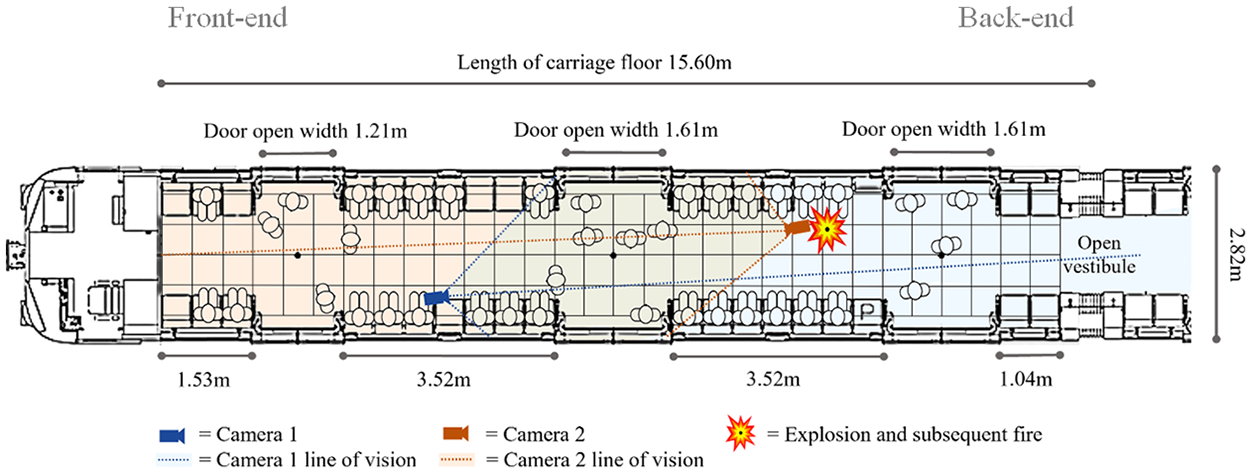
Position of cameras and passengers at the onset of the explosion with spatial grid overlay.
Both clips captured a short duration of time before the explosion (26 seconds and 79 seconds, for Camera 1 and Camera 2, respectively), the train evacuation period (26 seconds and 30 seconds, respectively), and a period of the aftermath after all captured passengers had exited the car (266 seconds and 242 seconds, respectively).
Video Coding Procedure
Coding began by identifying all passengers present in the carriage when the explosion occurred. The majority of these individuals were identified prior to the explosion, as they stood or sat in the traveling carriage. Those individuals concealed prior to the onset of the emergency were identified in the immediate time succeeding the explosion, as they left their starting positions towards an exit. Note, although Camera 1 also showed passenger presence in the adjoining carriage, beyond the back-end vestibule, these individuals were too distant to reliably code (see “optimal capture,” Nassauer & Legewie, 2018).
A total of 40 individuals were identified as present in the carriage of analysis at the time of the explosion. Each passenger was assigned a unique ID number and description in order to differentiate them from others. To allow us to assess how individuals behaved immediately following the explosion, we recorded the first action of each passenger upon recognition of the emergency. This first action was recorded in the first five seconds following the explosion. The first action excluded the initial head/body turn towards the direction of the explosion—i.e., the recognition phase itself (Gu et al., 2016). We also excluded the action of seated individuals rising to their feet, as this was deemed a necessary behavior.
To assess how individuals evacuated the train, we also recorded whether each passenger ran during their evacuation or not. Running was defined as fast, self-propelled locomotion in which the individual takes strides and jumps to accelerate forward. This is in contrast with brisk walking, in which steps are taken and whereby one foot remains in contact with the ground. We also recorded the exit each passenger took and whether this was their closest available exit. To allow spatial analyses, we overlaid the carriage technical drawing with a spatial grid (see Figure 1). This grid was made up of 120 square cells, each square with the approximate width of a seat (around 0.50 m). Each passenger’s physical location at the time of the explosion was recorded (see Figure 1) as well as whether the individual was in a standing or seated position.
For descriptive purposes, we recorded the estimated sex and approximate age of each passenger. These measurements were based on the visual appearance of the individual (see Liebst et al., 2020). We further recorded whether the passenger held an item in their hand (e.g., bag, suitcase, phone, laptop) at the onset of the emergency, picked up an item during the evacuation and whether they dropped any item during the emergency. We also recorded instances of anti-social and pro-social behavior. Anti-social behavior was defined as any uncoincidental action that directly disadvantaged or harmed another individual, or that hindered another’s evacuation. In contrast, pro-social behavior was defined as any uncoincidental action that directly helped, aided or assisted another. Finally, we noted whether the individual appeared to have a pre-existing interpersonal tie with any other passenger prior to the emergency event—that is, whether the person was traveling alone or in company (e.g., with a friend, colleague, acquaintance, family member). This was inferred through social behavioral cues (see Murphy, 2016), such as shared focus and attention and bodily contact prior to the onset of the emergency (Ge et al., 2012; Goffman, 1971; Liebst et al., 2019).
To assess the reliability of these codes, two raters independently coded the behavior and individual properties of each of the 40 evacuees. We calculated Krippendorff’s Alpha coefficients to assess the degree of and interrater agreement (Krippendorff, 2004). All agreement coefficients were between .64 (agreement percentage = 95%) and 1.0 (agreement percentage = 100%), indicating substantial to near perfect reliability (Landis & Koch, 1977).
Results
Descriptive Statistics
The majority of the individuals (34 out of 40, 85.0%) were located in the largest space between the explosion and the front-end of the car (see Figure 1). A further six individuals (15.0% of the total) were located between the explosion and the back-end of the car. When the explosion occurred, 26 individuals (65.0%) were seated and 14 were standing (35.0%). In total there were 24 (60.0%) males and 16 (40.0%) females. The mean age of a passenger was estimated at 37.0 years-old (SD = 13.15, Min = 9, Max = 68). Prior to the explosion, we observed whether individuals appeared to be traveling alone or in company. We identified four traveling pairs and 32 individual travelers. Although this small number of pairs did not allow us to do any in-depth analysis on the effect of interpersonal relations on behavior, it may be noted anecdotally that all pair members behaved the same as their partners in terms of locomotion (run or walk) and their exit selection choice.
First Behavior of Evacuees
We observed large variations in the first behavior of passengers immediately following the onset of the emergency (see Figure 2). The most common first responses were to run or walk away from the explosion (8 out of 37 codable cases, 1 21.6%, and 7 out of 37 codable cases, 18.9%, respectively). Six individuals’ first movements (16.2%) were to pick up an item that was not already on their persons or already in their hand, typically from the ground at their feet. 2 Five individuals (13.5%) spent a prolonged amount of time observing the area of the explosion from their starting position. The first response of five other individuals (13.5%) was to either stand to the side and allow others through or to remain seated until others had passed. Four individuals’ first reaction was to hide (10.8%), three in doorwells and one, a child, against her carer. One individual’s (2.7%) first reaction, the carer of the child, was to offer protection. Here, the carer physically shielded her child, helped the child to her feet, placing her own body between the child and the fire. Another individual’s (2.7%) first response, after turning towards the direction of the explosion, was to stand rooted to the spot, arm extended, seemingly frozen.
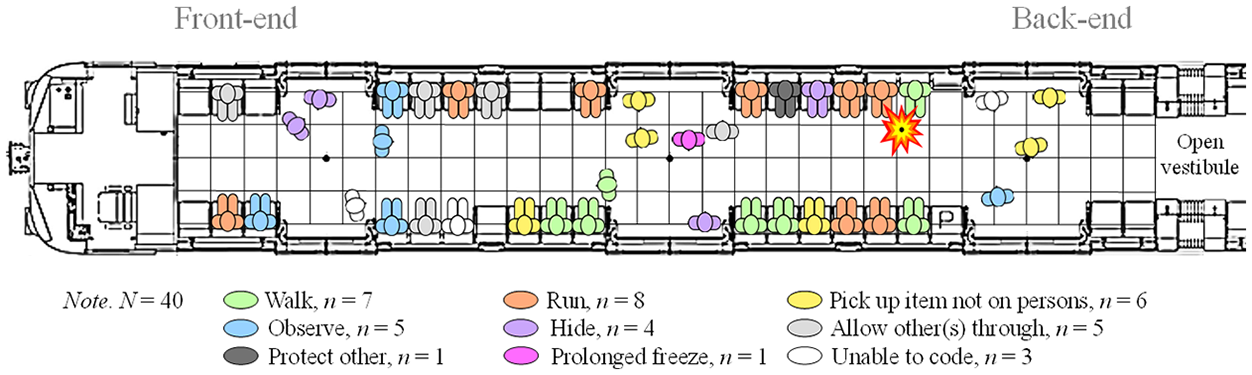
First actions of the evacuees succeeding the explosion.
Anti-social and Pro-social Behavior
Throughout the evacuation, we also looked for evidence of anti-social behavior and identified two cases. 3 Here, anti-social behavior was defined as any uncoincidental action that directly disadvantaged or harmed another individual, or that hindered another’s evacuation. In the first case, a seated young female rises quickly after the explosion and runs through the carriage, pushing into another female who is caught off balance and falls. Although this behavior is dangerous, it may be partially explained by a situational set of circumstances. First, the runner’s view is likely obscured by another passenger, who is stood between the two parties prior to the collision. Secondly, the harmed passenger had inadvertently created an elongated physical barrier for others. Specifically, she is observed holding onto one of the central handrails of the carriage when the explosion occurs. She then turns her body sideways to face the explosion, takes a slight step back, with her handrail-holding arm horizontally extended. Her outstretched gait subsequently creates a wide physical barrier, blocking almost half the width of the carriage. While another runner is able to adjust his body to squeeze through the small gap left, the young female runner is unable to avoid a direct collision. We can contrast the harmed individual with two nearby passengers, who are also holding onto separate central handrails at the time of the explosion, yet remain unharmed. Rather than extending out their bodies, these two individuals vacate the space they occupy—one, by stepping into a doorwell and avoiding the oncoming traffic; the other by walking forward and joining the traffic flow. In contrast to the anti-social runner, other runners tended to maintain a distance to those in front of them. Those runners who did overtake other evacuees tended to minimize their bodies to squeeze past others, as opposed to pushing through.
The second case of anti-social behavior involved a passenger sat towards the front-end of the carriage. When the explosion occurs, she rises to her feet and observes the main area of the fire. Upon recognition of the emergency, she runs from her position towards a door. Although she does not push, she persistently tries to find a way through the mass of already waiting passengers, thus prioritizing herself before others. We can contrast this self-interested example, however, against multiple accounts of individuals waiting patiently by doors. Rather than disorder, we find that passengers tended to queue and exit in an orderly fashion.
We also looked for examples of pro-sociality during the evacuations—defined as any uncoincidental action that directly helped, aided, or assisted another. We found that individuals would frequently move aside to let others through. In one example, an adult male is seen holding onto a central handrail close to the explosion. A young passenger rises to his feet and walks hastily towards the adult male. As the young passenger approaches, the adult male retracts his arm allowing the young passenger through and away from the fire. Once the young passenger has passed, the adult male returns his arm to its previous position, once again holding the handrail. In a second example, a male can be seen rising to his feet from a seated position close to the exit. He sees evacuees approaching the exit and instead of rushing ahead of them, sits back down and waits until the individuals have passed before rising to his feet again. In a similar example, we observe another passenger sat waiting patiently for other evacuees to pass before standing and taking leave.
The clearest examples of pro-sociality are the actions of the carer towards her child. The carer’s first actions, immediately following the explosion, are to shield her young child and to help her to her feet. She places her own body between the child and the fire, before getting her feet tangled in an abandoned bag and tripping. Once risen, the carer does not select the nearest door to vacate through, even though it is open and immediately proximate (<1 m away). Instead, the carer continues on up the train to re-join the child and guide her safely through the exit. These examples of facilitating space for others and of help provision, counter the established idea of typical selfish, individualistic behavior in the face of danger.
Running and Walking Behavior
Next, we examined evidence of spatial clustering in running and walking behavior. Of the 38 individuals whose movements were visible, 17 (42.50%) were observed to run while evacuating the carriage. A visual inspection examining the physical location of the runners and non-runners at the moment of the explosion suggested spatial clustering of behavior (see Figure 3).
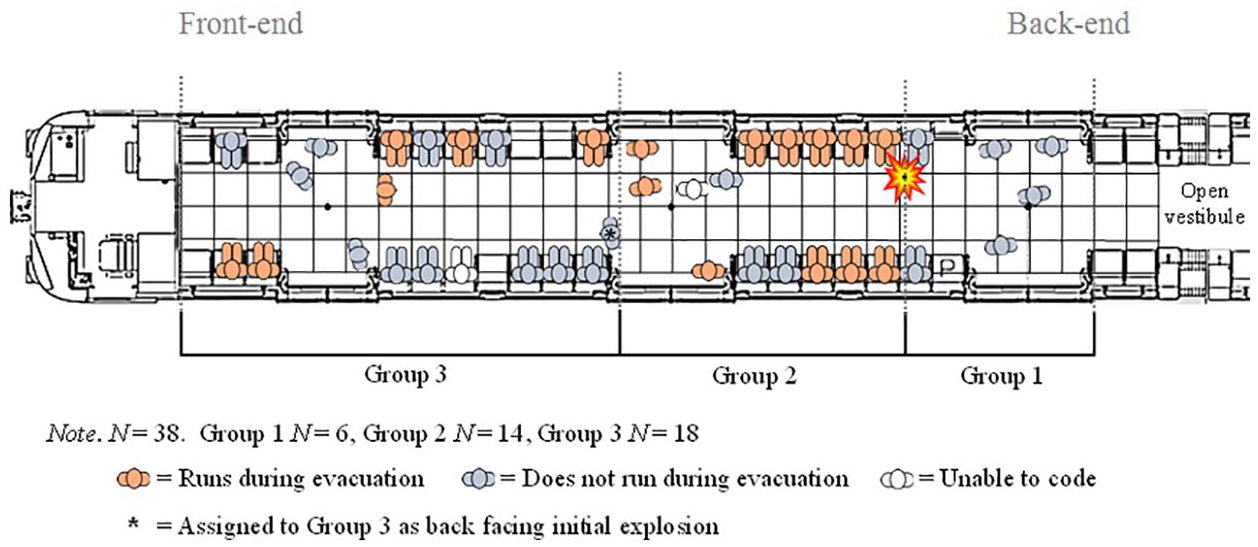
Presence of running behavior between individuals and spatial groups.
To assess whether there is an association between the physical area of the carriage in which an individual is situated when the explosion occurs and running behavior, we subdivided all individuals into three spatial groups (see Figure 3). Group 1 (n = 6) comprised of individuals close enough to see initial explosion (i.e., the physical cue of danger—Qin & Gao, 2019), situated between the explosion and the
None of the six individuals (0%) in Group 1 were observed to run (see Table 1). Eleven out of 14 individuals (78.57%) in Group 2 and six out of 18 individuals (33.33%) in Group 3 were observed to run. A two-tailed Fischer’s Exact Test, suitable for small sample sizes (Agresti, 2002), found the association between spatial group and running to be statistically significant (12.15, p < .001, Cramer’s φ = .57), with a strong effect size (Cohen, 1992). This indicates that the relative proportion of running individuals differs between the different spatial groups. Put simply, runners and non-runners tended to cluster in separate areas of the carriage.
Association between spatial groups and running behavior.
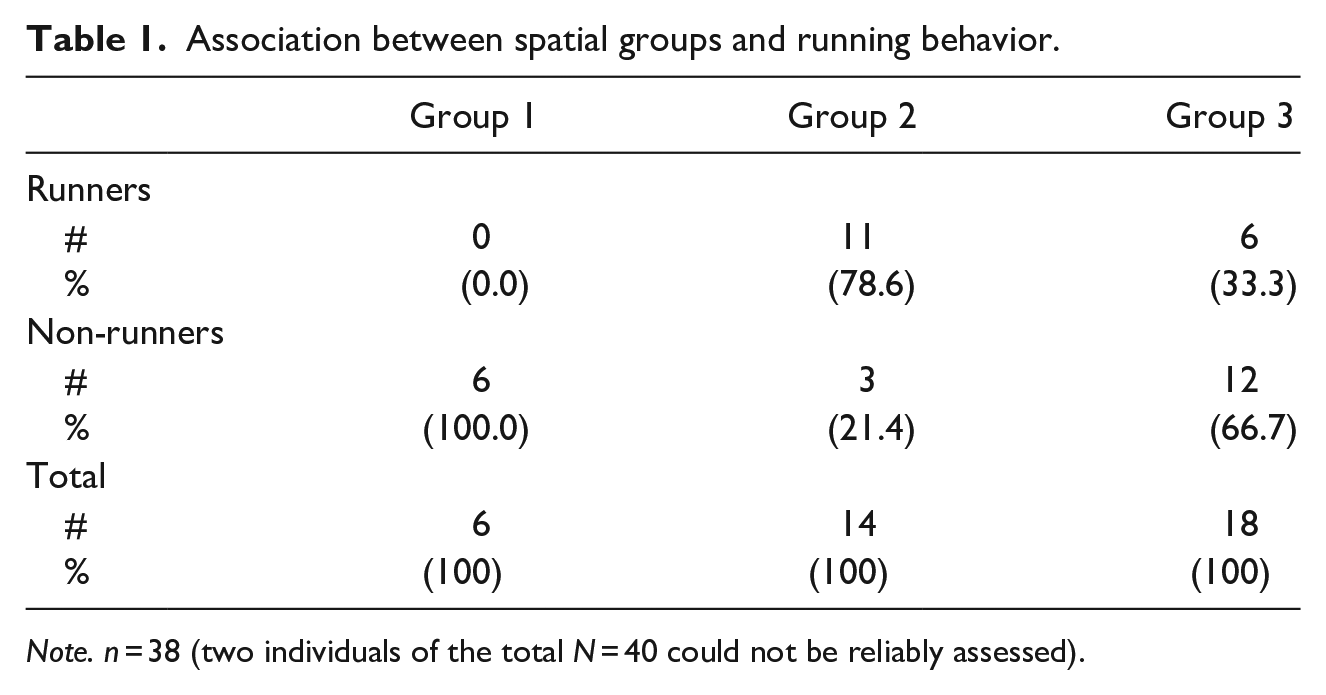
Note. n = 38 (two individuals of the total N = 40 could not be reliably assessed).
We then evaluated the extent to which evacuee running behavior may be attributed to one’s starting location (i.e., to one of the three assigned spatial groups). To this end, we calculated a median odds ratio (MOR) for data, capturing the extent to which running behavior concentrates within the three starting areas of the carriage (Merlo et al., 2006). A MOR value of 5.1 indicated very large variation in running behavior between the three areas. Specifically, an individual was five times more likely (in median) to run if placed in a highly concentrated cluster of runners than if placed in a low concentrated cluster.
Next, we examined whether individuals behaved similarly to their immediately spatially proximate neighbors (as opposed to all individuals within the same broader area of the carriage). For this purpose, we used the spatial grid overlay to systematically derive a local neighborhood context for each individual. As we were only interested in immediate neighbors, we assigned each individual their own 3 × 3 neighborhood radius (area approx. 2.25 m), with themselves placed in the center (see Figure 4 for example of one passenger’s neighborhood).
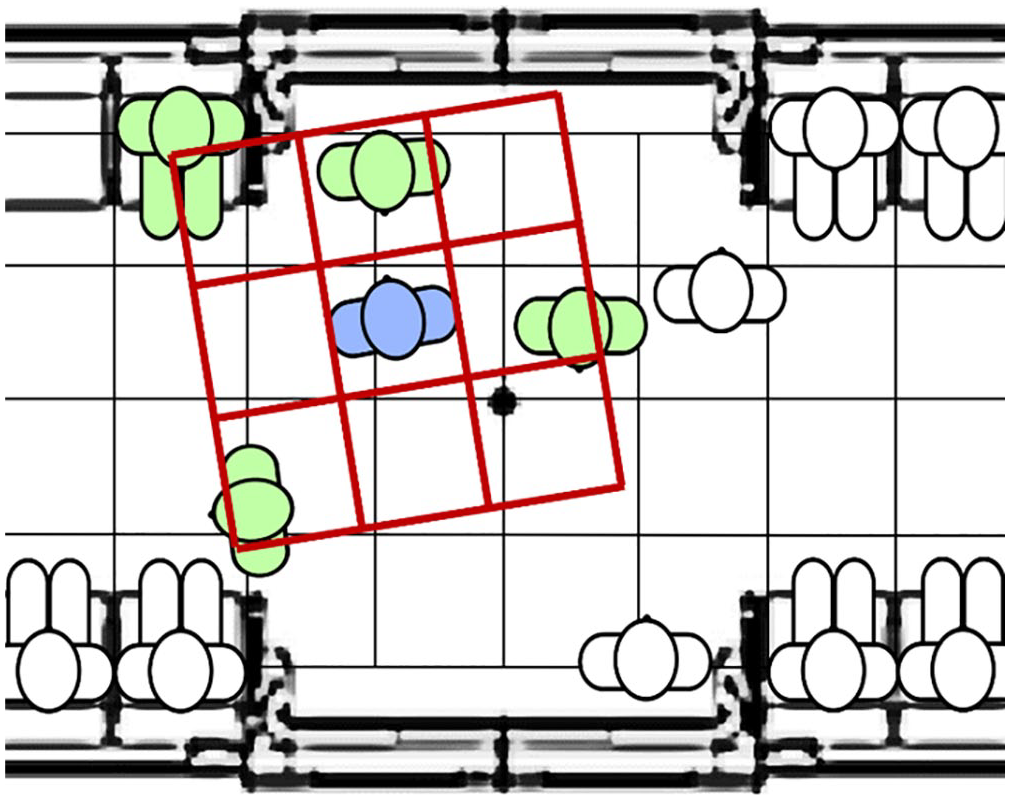
Example of a passenger’s local neighborhood context.
Local neighbors were any other individual(s) situated within that individual’s restricted neighborhood (depicted in green in Figure 4). We recorded the behavior (walk = 0/run = 1) for each local neighbor—all other individuals not located within the neighborhood were ignored (depicted in white in Figure 4). We then divided the total number of running neighbors by the total number of neighbors. This proportion of runners (between 0 and 1) represented a spatial lag predictor that could be used to estimate the influence of proximate individuals while accounting for autocorrelation in data (Ward & Gleditsch, 2018). A statistical association between the spatial lag predictor (i.e., the proportion of local running individuals) and the individual’s own behavior would provide evidence that passengers behave similarly to those immediately proximate. To examine if this is the case, we ran a generalized linear model with spatial lag predicting behavior, specified with a maximum likelihood estimation and conservative robust standard errors. 4 Further, to account for the possibility that the proximity to the explosion itself may influence running behavior, we included distance to the explosion/fire (a count of spatial grid steps) as a control variable in the model. Finally, prior to analysis, the spatial lag predictor was standardized by subtracting the mean and dividing by two standard deviations, making its estimate comparable to a binary predictor and its effect size thus interpretable (see Gelman, 2008).
The regression model was statistically significant (χ2(2, N = 38) = 6.71, p < .05). The behavior of the other local passengers was positively associated with the behavior of the individual (χ2(2, N = 38) = 7.20, B = .39, 95% CI [0.11, 0.68], p = .007). Individuals with more runners around them immediately following the explosion were approximately 1.5 times more likely to also run than those individuals with few runners around them (OR = 1.48, 95% CI [1.11, 1.98]). Following the criteria set by Rosenthal (1996) this represents a small effect. Interestingly, we did not find a significant association between distance from the explosion and running behavior (χ2(2, N = 38) = .12, B < .00, 95% CI [−0.03, 0.02], p = .72, OR = 1.00, 95% CI [0.98, 1.02]). Taken together these findings suggest that passengers are more likely to act similarly to their immediate neighbors than not, but there is still a wide margin of variability. One’s distance to the explosion was not statistically associated with running behavior.
Exit Choice
One consistent finding in the emergency crowd literature is that individuals typically evacuate via their closest exit (Cao et al., 2018). We recorded whether individuals chose the exit closest to them in the current data. Figure 5 shows three available carriage doors leading out to the platform. The front-end exit, denoted in yellow, is the furthest carriage exit from the explosion. Located between the front-end exit and the explosion is the Middle exit. The Middle exit, denoted in orange, is the second furthest exit from the explosion. On the adjacent side of the explosion is the back-end exit. The back-end exit, denoted in blue, is the closest exit to the explosion. At the back-end of the carriage there is also an open vestibule, which allows free access to the adjoining carriage. After the initial explosion it took approximately 10 seconds for the carriage doors to fully open, by which time 38 of the 40 passengers (95.0%) were either stood at or approaching the exit they would take. One notable exception was the carer of the small child, who despite being in front of the Middle exit doors as they opened, opted instead to advance further up the train to re-join her child who had moved-on ahead. The second exception was a seated individual who waited until a large number of individuals had left the train before finally standing up and nonchalantly walking to and through his closest exit (the front-end exit).
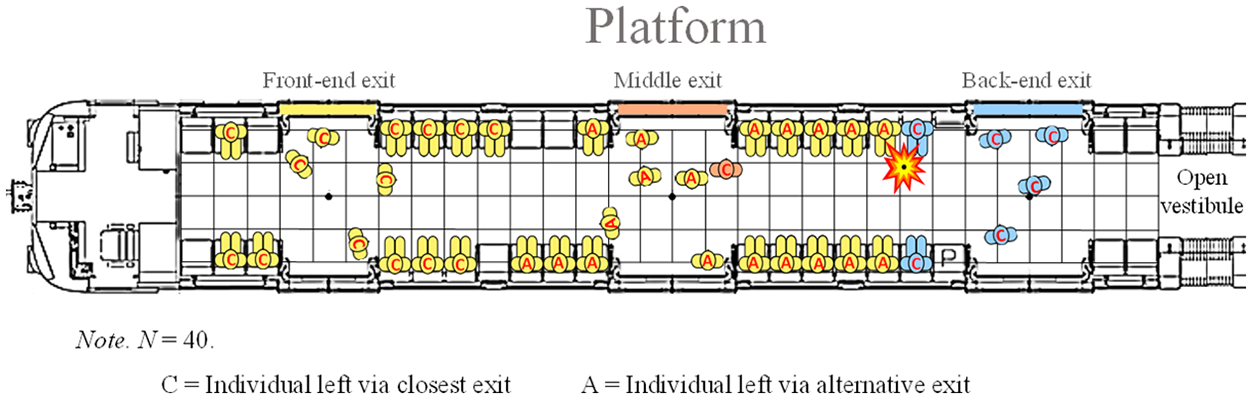
Evacuee exit choices.
Figure 5 shows the position of the 40 passengers when the explosion occurred. Each passenger’s color shading corresponds to the exit doors they vacated the carriage through. Thirty-three of the 40 passengers (82.5%, shaded in yellow) left via the front-end exit, located the furthest away from explosion. One individual (2.5%, shaded in orange) left via the Middle exit. At the onset of the explosion, she stepped forward from her original position and patiently waited for the nearby doors to open before exiting. Six individuals (15.0%, shaded in blue), all located on the opposite side of the explosion to the majority of the carriage’s passengers, left via the back-end exit closest to the explosion.
In addition to a color shading, each passenger was assigned a “C” or “A” character. This depicts whether that individual left via the closest exit (“C”) or an alternative exit (“A”) (see Figure 5). Twenty-one of the 40 passengers (52.5%) left via their closest exits. All of the 19 (47.5%) passengers who did not leave via their closest exit, were located between the explosion and the front-end of the carriage. No individuals crossed over past the fire, despite this route providing a closer exit for some. All those who did not vacate via their closest exit left through the front-end exit—that is, the exit furthest from the explosion. This may be taken as an indication that passengers tend to desire an exit as far away from an explosion as physically possible. Supporting this assertion, we find a strong negative association (Cohen, 1992) between a passenger’s distance from the explosion (measured in spatial grid steps) and the distance traveled to an exit, r = −.57, N = 40, p < .001 (see Figure 6).
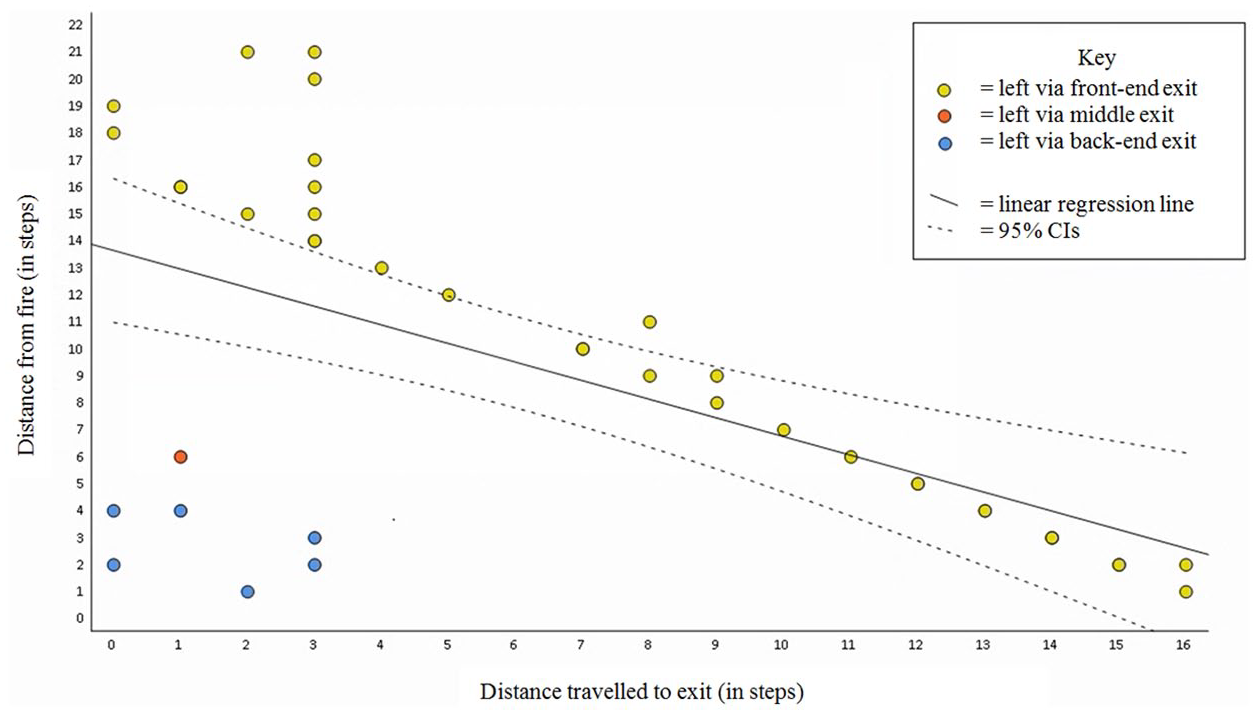
Association between each passenger’s distance from the explosion and the distance traveled to an exit.
Interesting, however, is the behavior of those six passengers (shaded in blue) on the adjacent side of the explosion (see Figures 5 and 6). All six of these individuals left via their closest exit (the back-end exit), despite this being the closest exit in physical distance to the explosion. If these individuals were also motivated to get as far away from the explosion as possible, it would have been feasible for them to move through the open vestibule at the back-end of the carriage into the adjacent carriage. However, they remained close to the explosion and did not travel far to exit. Therefore, while there is quantitative evidence that passengers closer to the explosion tend to exit as far away as possible, this effect is almost completely driven by the majority of passengers located in the largest space of the carriage (between the explosion and the front-end of the car, shaded in yellow). There is a notable qualitative difference in behavior for the cluster of six individuals (15.0% of the total) located on the opposite side of the explosion (between the explosion and the back-end of the car, shaded in blue).
Discussion
Accurate knowledge of evacuee behavior in emergency events is crucial for public safety initiatives and evacuation planning. Most of what is known regarding evacuee behavior is attained from retrospective self-report accounts or from experimental work that is unable to simulate actual danger. In what we believe to be the first video-based study of behavior in the immediate aftermath of an explosion in a subway train carriage, we utilized surveillance camera footage of a real-life public transport emergency to examine how individuals behave and evacuate when in close proximity to a real-life explosion-fire event.
Rather than a uniform and panic laden fleeing towards the exit (Quarantelli, 2001), we found large variations in the behaviors of passengers. While many individuals’ initial reactions were to run to an exit or to hide, others walked to an exit, picked up items, observed the explosion area, waited while others passed or protected another. We found two examples of anti-social behavior, one in which an evacuee attempts to get to the front of the queue and another in which an evacuee runs into another passenger, knocking her over—though this latter case may be partly explained by a visual obstruction and the victim’s rooted, elongated stance (the only example of prolonged freeze in data—Leach, 2004). We found numerous examples of individuals adjusting their gait while passing others, of facilitating space for others, and in line with two CCTV studies of earthquake evacuations (Gu et al., 2016; Yang et al., 2011), of queuing to exit (see also, Drury et al., 2009b). This diversity of behavior supports a growing body of review evidence stressing non-uniformity in evacuation behavior (Pietrantoni & Prati, 2009; Qin & Gao, 2019). The greater likelihood of the evacuees demonstrating pro-sociality over anti-sociality is in line with experimental findings (Cao et al., 2018) and analyses of survivor statements (for review, see Drury, 2018).
Past research shows that evacuees typically vacate via the closest familiar exit (Cao et al., 2018—though see Benthorn & Frantzich, 1999; Donald & Canter, 1992). However, in the current data, the majority of passengers vacated via the exit furthest from the explosion, regardless of whether this was the individuals’ closest exit or not. One explanation for this finding is social influence—specifically, the first runners made their way towards the furthest exit and this may have impacted the decisions of others (Burns et al., 2013; Nilsson et al., 2009), leading to a “follow the majority” effect (Yang et al., 2011). An alternative explanation is that these individuals each felt motivated to get as far away from the explosion as possible. A negative association between the distance from the explosion and the distance traveled to an exit supports this assumption. Interestingly, six individuals, spatially separated from this larger population by the explosion, all took the closest exit to them, regardless of the fact that this door was also the closest exit to the explosion. Given that all six of these individuals could have moved up through the open vestibule and far away from the explosion, yet all stayed in place and exited together, supports the social influence account.
We also found evidence of spatial clustering in running behavior. Specifically, those with more runners around them at the onset of the emergency were approximately 1.5 times more likely to also run than those evacuees with fewer runners in close proximity. The starting location of runners was also concentrated in separate areas of the carriage. At first glance this may also be taken as evidence of social influence among nearby passengers, however it remains difficult to untangle social influence from self-selection effects or the shared physical properties of the space (see Manski, 1993; Oakes, 2004). Interestingly, we did not find an association between the evacuees’ distance from the explosion and running behavior.
While there have been several previous studies analyzing CCTV footage of emergency behavior (e.g., Gu et al., 2016; Helbing et al., 2007; Yang et al., 2011), to our knowledge this is the first video study to examine a spontaneous emergency in a subway train carriage environment. With that in mind it is important to consider whether there are patterns of behavior in our data that reflect the specific environment of the subway train. For example, subway trains have seating configurations which are different from over-ground trains (Qiu & Fang, 2019)—and different again from other enclosed public transport mediums like buses and airplanes (Liang et al., 2018; Muir et al., 1996). Having seating along the side of the carriage (with a wider central well) as opposed to rows of parallel seats with a narrow central walkway, may make different kinds of interactions between passengers possible. Opportunities for influence by others will be shaped by who can be seen (Latané, 1981)—and this will in turn be affected by the way the seating and standing space is configured in the environment. Similarly, opportunities for movement will be constrained by the obstacles in the environment. The patterns of homogeneity of movement in local areas of the carriage—but heterogeneity across the space of the carriage—may have been facilitated by the spatial layout of the subway train. In more constrained environments—with parallel seating and narrower circulation space—this kind of outcome may be less likely to emerge. While this is just speculation, it points to the importance of a consideration of the spatial constraints in all environments—be they ships (Lee et al., 2003), airplanes (Muir et al., 1996), buses (Liang et al., 2018), or more open public spaces (Donald & Canter, 1992)—and how they shape behavioral responses to emergencies in the moments after onset.
Our analysis has also identified a number of different “first responses” by individuals in the immediate onset of the emergency. However, behavior quickly becomes more homogeneous, facilitated in part by actions which are prosocial and support a smooth exit. Our current analysis did not explore the sequential unfolding of actions over time, nor examine whether there are important features of the order of actions in response to the emergency. For example, while we find differences in walking and running behavior in different parts of the carriage—and can show this is related to the proximity of others—we aren’t able to say anything about how walking or running becomes more prevalent in area. It seems plausible that, even in these very short time periods immediately after the explosion, there might be an order effect (Nilsson & Johansson, 2009). Equally, it seems plausible to ask whether all movements are equally influencing—or whether people are more likely to follow some actions or individuals than others (Abrams et al., 1990).
Finally, we are aware of work showing the importance of social psychological concepts like “social identity” in the way people behave in emergencies (Drury, 2018; Drury et al., 2009a, 2009b). This work has been used to inform how simulation models of behavior in emergencies are developed (e.g., von Sivers et al., 2016). These researchers argue that shared identity is an emergent property of the emergency situation. Specifically, unrelated individuals within the same emergency may come to identify with one another and to share an identity as a realization of the common threat and fate they share together. This can have a profound impact on how individuals coordinate, self-organize, and offer help to one another (Drury, 2018; Neville et al., 2020). In order to better understand the emergence of shared identity we need to know more about the process. Is it simply knowledge of the shared threat, or is it related to how individuals act as the emergency begins to unfold? How long may it take for this identity to form and for individuals to coordinate together? Our analysis begins with the very first response to the threat (which shows large variation between individuals) and continues on over the course of the first minute of the response. Given the increasing homogeneity of behavior and pro-sociality observed over this period, it is likely these identity processes are beginning to form. Clearly, we cannot get rich access to this psychological process with observational data alone.
This latter point taps into a broader critique of video analysis; namely that while video data provides excellent information on overt behavior (i.e., “the hands”), without triangulation with self-report accounts it can say very little about the individuals’ motivation, emotional responses, or cognitions (i.e., the “heart” and “head”) (Philpot et al., 2019). A further limitation of working with video data is that researchers seldom have control over the field of view of the cameras and are thus restricted to working with the final visual data they receive. This means there is always the possibility that relevant behavior occurs beyond the camera’s field of view or is obscured by obstacles (Nassauer & Legewie, 2018). As a result, important insights into the wider context of the two recordings for this study may be unintentionally lost.
CCTV data of a single case provides high ecological validity, but its external validity may be limited. Specifically, public surveillance footage is relatively uncontrolled, and each emergency is distinct. Consequently, it is difficult to ascertain the extent to which the patterns of behavior identified in this study will also be evident in other train evacuations, in other spatial settings (e.g., in open as opposed to closed space), at other times (e.g., in periods with lower threat levels) or in relation to other emergencies (e.g., natural disasters).
Despite these limitations, the current study does provide valuable insights into phenomena that may occur in “natural public settings,” which when combined with the growing body of CCTV emergency studies (e.g., Gu et al., 2016; Helbing et al., 2007; Philpot et al., 2020; Yang et al., 2011) continue to highlight discrepancies between laboratory experiments and the real world. Our fine-grained analysis of the behavior in the CCTV footage confirms previous work which shows that people do not all “panic” in an emergency. Even when moving swiftly away, people tend to accommodate or cooperate with others. However, our analysis also shows that people’s responses to the same explosion can spatially cluster—but that the typical behavior of these clusters can differ between different parts of the carriage. There is both homogeneity and heterogeneity in the behavior of our 40 evacuees. This has clear implications and considerations for those seeking to model evacuation behavior in computational simulations.
Contributions to Work on Computational Models of Behavior in Emergencies
There is an increasing demand for computational models to investigate and simulate crowd behavior and evacuee movement dynamics. The effectiveness of these models, however, depends greatly on how accurately they can replicate real-life human behavior (Haghani et al., 2018). We note some key disparities between model formulations and the behaviors of the evacuees in the current study.
Evacuation models tend to assign agents a uniform walking velocity and exit choice (Qin & Gao, 2019). In the current study, however, we found large variation in the locomotion speed of evacuees and their exit selections. Contrary to the uniform distribution assigned to agents, we showed that locomotion speed and exit selection choice has spatial clustering, both within local vicinities and across different areas of the carriage.
Further, while a number of evacuees in the current study headed straight to an exit upon emergency recognition (akin with evacuee simulations), other individuals first picked up an item, hid or froze, waited for others to first pass or inspected the fire before attempting to vacate.
Most evacuation models consider each agent as a socially independent entity. In recent times a minority of researchers have challenged this assumption and stressed that models should include consideration of social ties between individuals (e.g., Liu et al., 2018; von Sivers et al., 2016). The anecdotal evidence we have of pair members behaving the same in terms of locomotion and exit choice (even if this exit is suboptimal for one member) supports this recent social consideration advocacy.
A number of simulation models assume competitive evacuee behavior, which results in a “faster is slower” effect (e.g., Helbing et al., 2002). In line with recent CCTV evacuation studies (Gu et al., 2016; Yang et al., 2011) we found limited evidence of selfish behavior and found that individuals are more likely facilitate space and patiently wait to exit.
Understanding and representing how evacuees behave in emergency situations is critical for risk reduction initiatives and evacuation planning. The gap between evacuation simulations and actual behavior negatively impacts the utility of these models and points to the importance of further video analysis work on behavior in real-life emergencies.
Footnotes
Acknowledgements
The authors would like to thank Livvi E. Taylor for her important input and assistance when coding video data. We also thank Lasse S. Liebst for the fruitful empirical and analytical discussions.
Declaration of Conflicting Interests
The author(s) declared no potential conflicts of interest with respect to the research, authorship, and/or publication of this article.
Funding
The author(s) disclosed receipt of the following financial support for the research, authorship, and/or publication of this article: This work was supported by the Defence Science and Technology Laboratory, UK (Dstl). The funders had no role in the design of the paper, analysis, decision to publish, or preparation of the manuscript.
