




Abstract
This qualitative study explored 22 principals’ perspectives from Oklahoma and Alaska regarding their experiences with education and discipline of American Indian and Alaska Native students. Utilizing Pewewardy and Hammer's culturally responsive leadership framework, the analysis identified three central themes: (1) the critical role of building strong relationships with families and communities to support students’ academic and social success, (2) the necessity of cultural competence among school leaders, and (3) the value of trauma-informed disciplinary practices. Findings suggest culturally responsive leadership combined with trauma-informed practices effectively addresses historical inequities and disciplinary disparities. The study highlights the urgent need for systematic policy changes, culturally responsive leadership training, and increased bureaucratic representation to support Indigenous students and communities. These insights provide actionable implications for P-12 educational leaders, policymakers, and researchers aiming to create inclusive and equitable school environments for American Indian/Alaska Native and other marginalized student populations.
Keywords
Can culturally responsive leadership disrupt centuries worth of disparities among American Indian and Alaska Native schoolchildren? There is a misalignment between American Indigenous cultures and the American school system as well as generational trauma from a history shaped by colonization, enslavement, genocide, and forced assimilation. For centuries, the U.S. education system has stripped American Indian and Alaska Native youth of their culture and forced them to assimilate using harsh and abusive disciplinary policies and practices (Pewewardy & Hammer, 2003; U.S. Congress, 1969). Historically, the United States has weaponized education “to assimilate tribal children, disrupt tribal economies, and take tribal land” (CTFC, 2023, p. 2). The government cut their hair, renamed them, and deployed systematic militarized and identity-alteration methodologies (CTFC, 2023). Among several consequences, there was a loss of language, government, culture, education, spirituality, dentity, and even life (Coleman, 1993; CTFC, 2023).
American Indian students are more likely to experience chronic absenteeism, dropouts, pushout, suspensions, and expulsions from school (Brown, 2014; Gion et al., 2018), and are also less likely to attend or graduate from college (CTFC, 2023). In TK-12, they lag two to three grades behind their White peers (NCNSL, 2008). These trends worsen in federal Bureau of Indian Education schools (CTFC, 2023). American Indian schoolchildren occupy a “liminal space”—a precarious position wherein their cultures are suppressed both historically (e.g., school personnel requiring them to dress according to their sex at birth) and currently (e.g., schools prohibiting American Indian boys from wearing long hair) (Brayboy, 2005; Coleman, 1993). For centuries, American Indian and Alaska Native youth have been rated among the lowest in academic outcomes and the highest in school discipline outcomes (Brown, 2014; Ko et al., 2022; Leveque, 1994). “not because of cultural inferiority or academic indifference, but because of the lack of a dignified, humane system of education” (University of Minnesota, 2024, para 4).
In order to find viable solutions that address these enduring educational injustices, we study the interconnected relationship between education, discipline, and culture to better understand the liminal space American Indian and Alaska Native youth hold in U.S. schools through in-depth interviewing of Oklahoma and Alaskan principals and textual analyses of their school websites and handbooks. We asked the following research questions: What are principals’ experiences educating and disciplining American Indian and Alaska Native youth? How do principals leverage American Indian and Alaska Native culture to improve the education and discipline of American Indian and Alaska Native youth? How do principals’ levels of cultural competence impact their approach to the education and discipline of American Indian and Alaska Native youth?
This study provides novel research on a state that educates many American Indian and Alaska Native students: Oklahoma's American Indian and Alaska Native population is approximately 14%—second only to Alaska (19.6%) (ANA, 2024). As American Indian and Alaska Native populations continue to increase across the U.S. (Rezal, 2021), we must understand how principals approach education, discipline, and culture. Beyond just the American Indian and Alaska Native population, these findings can be used to provide an impactful and meaningful educational experience to the increasingly plural student population not only in the U.S., but around the world. These findings are especially applicable to cultures that have been stereotyped as uninterested in or undervaluing of education, such as Black American students and their families (U.S. Congress, 1969; Vang, 2024). This study contributes to a nascent body of research on culturally responsive leadership and behavioral supports so that school personnel can better serve vulnerable student populations. In the following sections, we first discuss the conceptual framework guiding this inquiry, then the extant literature. We then present our findings before providing implications and recommendations for policy, practice, and research.
Culturally Responsive Leadership Theory
Culturally responsive leadership for Indigenous populations by Pewewardy and Hammer (2003) was the conceptual framework that guided our study. The landscape of Indigenous education is forever shaped by settler colonialism and cannot be understood without a greater understanding of the historical and current trauma of colonization (Brayboy, 2005). To increase the academic success of American Indian and Alaska Native schoolchildren, it is critical that we acknowledge and value their cultures.
Pewewardy and Hammer (2003) argue that culturally responsive teaching can positively impact American Indian and Alaska Native schoolchildren's academic involvement. Their framework for success—which had yet to be applied to school discipline—argues for the following five tenants: (1) cultural literacy (teachers’ knowledge of Indigenous cultures and history and awareness of Native learning styles); (2) teachers’ self-reflection and analysis of their attitudes, beliefs, and stereotypes; (3) caring, trusting, and inclusive classrooms; (4) actions of the school that model respect for diversity, Indigenous knowledge, and alternative ways of knowing; and (5) a transformative curriculum that promotes critical thinking and the advancement of society toward equality of opportunity and social justice.
While the conceptualization of culturally responsive teaching and leading may be new, the concept—as applied to American Indian and Alaska Native education—is not. The Kennedy Report by the U.S. Congress (1969) highlighted how public schools were failing American Indian and Alaska Native students because they were not valuing their Native cultures. The perpetuation of stereotypes and the biases that school staff had toward American Indian/Alaska Natives’ value of education perverted schools’ impact on students (U.S. Congress, 1969). The detrimental impacts of not incorporating cultural practices are another form of colonization (Quijada Cerecer, 2013). Despite more than 50 years of evidence on the importance of American Indian/Alaska Native culture, little has changed systemically in education. The following section reviews the literature on American Indian/Alaska Native trauma, discipline and education.
Literature Review
American Indian/Alaska Native persons have experienced historical trauma based on the oppression and alienation of their cultural and societal practices (Soto et al., 2015). American Indian/Alaska Native persons have experienced “genocidal policies, pandemics, forced relocation, removal of children from their families to boarding schools, and government bans against ceremonies” (Soto et al., 2015, p. 65). Historically, students have been expected to forsake their culture and language (Goessling, 2020; Soto et al., 2015). For many years, these parts of their identity were not accepted or allowed at school (Goessling, 2020); however, misrepresentations of them have been perpetuated (e.g., school mascots, logos, nicknames) (NIEA, 2024). While students attending schools now have not experienced as much of the historically traumatic experiences, they are still reeling from these experiences at systemic levels (NCNSL, 2008; Soto et al., 2015). The traumatic impact on their family structure, health, and communications, continues for generations (Soto et al., 2015). Having a strong cultural identity has proven to protect against the mental and physical health impacts of trauma (Soto et al., 2015).
Discipline of American Indian/Alaska Native Children
From the 1850s to today, U.S. school personnel disproportionally disciplined American Indian/Alaska Native schoolchildren compared to their White peers (Brown, 2014; Coleman, 1993). However, this discipline is not due to misbehavior, as American Indian/Alaska Native students misbehave at the same rates as their less disciplined White American peers (Huang, 2020). American Indian/Alaska Native children endure threats from all sides as they are overly disciplined in schools located both on and off reservations (Healey, 2014; Losen & Skiba, 2010). We must find effective strategies for disrupting these systemic inequities.
Research on the connection between school and family relationships and student discipline generally has been conducted, but American Indian/Alaska Native experiences have largely been ignored. For example, Rodriguez and Welsh (2024) studied middle schools in New York and the impact family-school relationships had on disciplinary practices. Schools that focused on building family-school relationships had lower incidences of exclusionary discipline (Rodriguez & Welsh, 2024). Additionally, when trust existed between the family and the principal, student office referrals also declined. When family connections and bureaucratic representation are valued and nurtured in an organization, cultural sensitivity, acceptance, and student performance increase and stereotypes decrease (Oloo & Kiramba, 2022; Rodriguez & Welsh, 2024). The impact that the principal has on creating an equitable disciplinary system in the school is significant (Rodriguez & Welsh, 2024).
The Disciplining of American Indian Schoolchildren in Oklahoma
A large percentage of American Indian youth are educated in Oklahoma compared to other states (Rezal, 2021), motivating an in-depth look at Oklahoma school leadership to understand how principals can better support American Indian youth. The Oklahoma State Advisory Committee contributed to the U.S. Commission on Civil Rights report that discussed the role exclusionary school discipline policies, implicit anti-Indigenous biases, and poverty have on funneling American Indian schoolchildren in Oklahoma to prison (Limas, 2016). The Committee found that Oklahoma schools are 1.7 times more likely to refer American Indian schoolchildren to law enforcement than students of color and 2.6 times more likely to refer them compared to their White peers (Limas, 2016). The Committee also found that school personnel pushed American Indian schoolchildren out of school with exclusionary policies and practices that were not culturally relevant and did not leverage traditional American Indian cultural supports such as formal discipline matrices (Limas, 2016). Lastly, they found a lack of coordination and relationships between tribal leaders and schools and, ultimately, higher discipline rates among American Indian youth (Limas, 2016). They recommended that “an increase in tribal involvement in native students’ education could help them feel more connected to their school and improve academic outcomes” (Limas, 2016, p. iii). Key stakeholders—such as principals—can be instrumental in leveraging American Indian culture to produce positive social change.
The Disciplining of Alaska Native Schoolchildren in Alaska
The remote and relatively primitive living conditions in Alaska make recruitment of certificated teachers difficult (North, 2021), with many school districts using international teachers on visas. Lack of electricity, running water, indoor plumbing, access to grocery and shopping create primitive living conditions that lead to many families reliant on subsistence living. The graduation rate for Alaska Native youth is 64.54% compared to the State average of 77.85% (Eagan, 2023), and 15.4% have earned a bachelor's degree or higher compared to the national rate of 36.2% (The Postsecondary National Policy Institute, 2024). Alaska Native students experience higher adverse childhood effects, psychological distress, substance abuse, domestic abuse, and lack of access to health and medical resources (Gone et al., 2019; Levinson, 2012).
Alaska's Department of Education created the Alaska Rural Systemic Initiative to incorporate Indigenous learning into the classroom in addition to the Common Core Standards (North, 2021). For 10 years, starting in 1995, Indigenous cultures of the largest cultural regions, Yup’ik, Inupiaq, Athabascan, Aleut/Alutiiq and Southeast were studied to develop a curriculum to compliment the traditional standards (Hill et al., 2006). The Alaska Department of Education holds districts accountable for both the teaching of Common Core Standards as well as the Alaskan Standards for Culturally-Responsive Schools developed by the Alaska Rural Systemic Initiative (AKRSI), or the Indigenous standards (Hill et al., 2006).
Methodology and Results
We used a thematic analysis to investigate the experiences of Oklahoman and Alaskan principals as they relate to American Indian/Alaska Native students. For more on our methodological approach and limitations, see Appendix A. School principals were selected because they have the highest authority in their organizational setting, and they approve suspensions and expulsions on their campuses (Van Wyk & Pelser, 2014). Additionally, they shape the school culture and climate and empower as well as lead teachers (Bayrak et al., 2014; Stimson & Appelbaum, 1988). Lastly, principals lead school curriculum changes (Van Wyk, 2020). Taken together, school principals are key figures of power that shape much of the school culture, educational practices and content, and school discipline in their schools.
Principals ranged in age from their thirties to over sixty-five. Eleven females and 11 males were interviewed and identified as White, American Indian, Black/African American, or bi-racial (White/ American Indian, White/Asian). Three of the participants were born and raised in Alaska but were not Alaska Natives (see Table 1). According to Taie and Lewis (2023), less than 1% of all principals in the United States (0.6%) are American Indian/Alaska Native (Taie & Lewis, 2023). In this study 13% of the respondents identified as American Indian.
Self-Identified Principal Demographics.
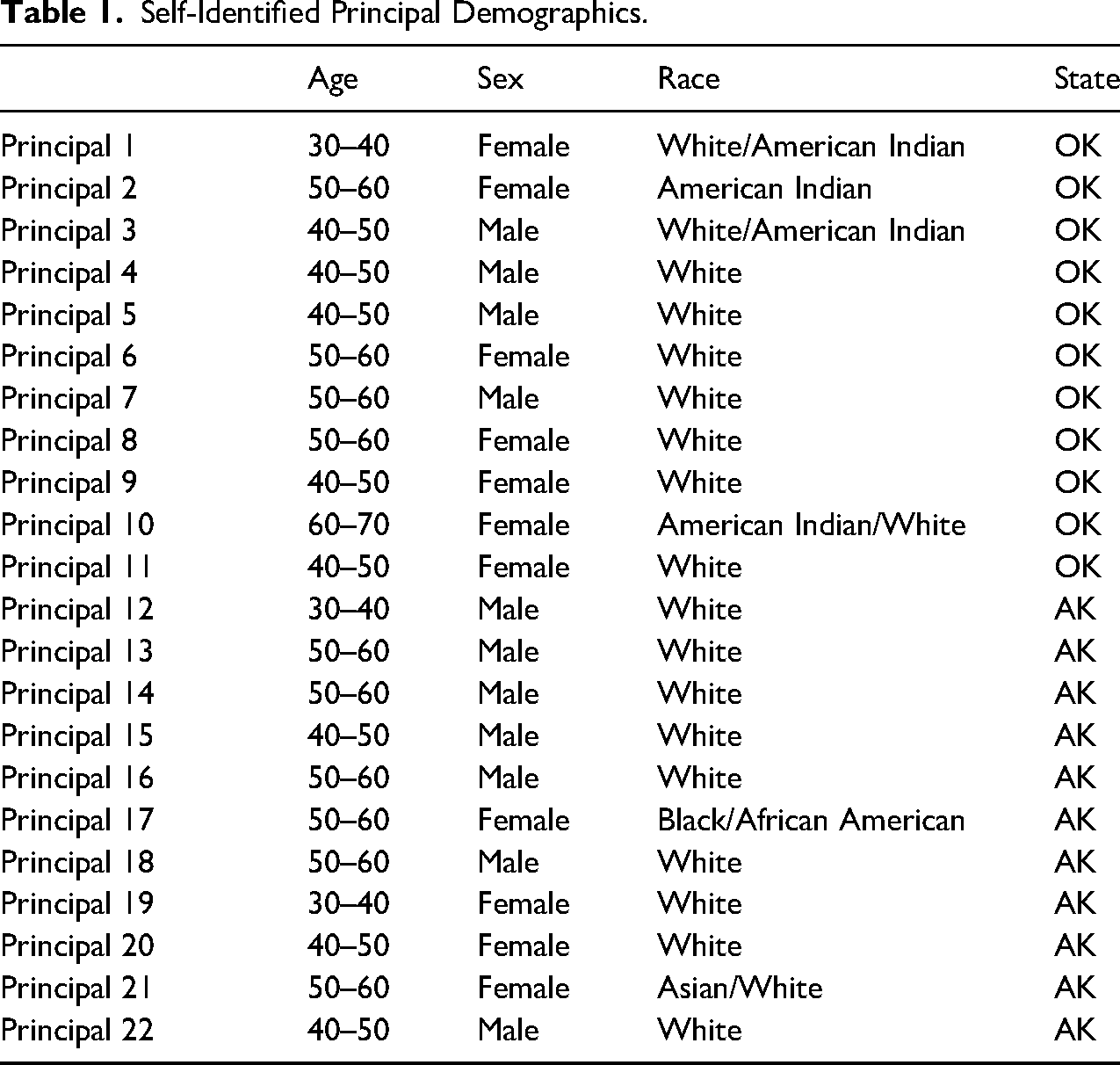
Principals were employed at early childhood centers and Title I elementary, middle, and high schools in rural and urban schools, indicating a high percentage of students with low socioeconomic status. There was variation in the demographic composition of the schools, with some being predominately American Indian/Alaska Native and others having single-digit percentages of American Indian/Alaska Native students (see Table 2).
Characteristics of Study Schools.
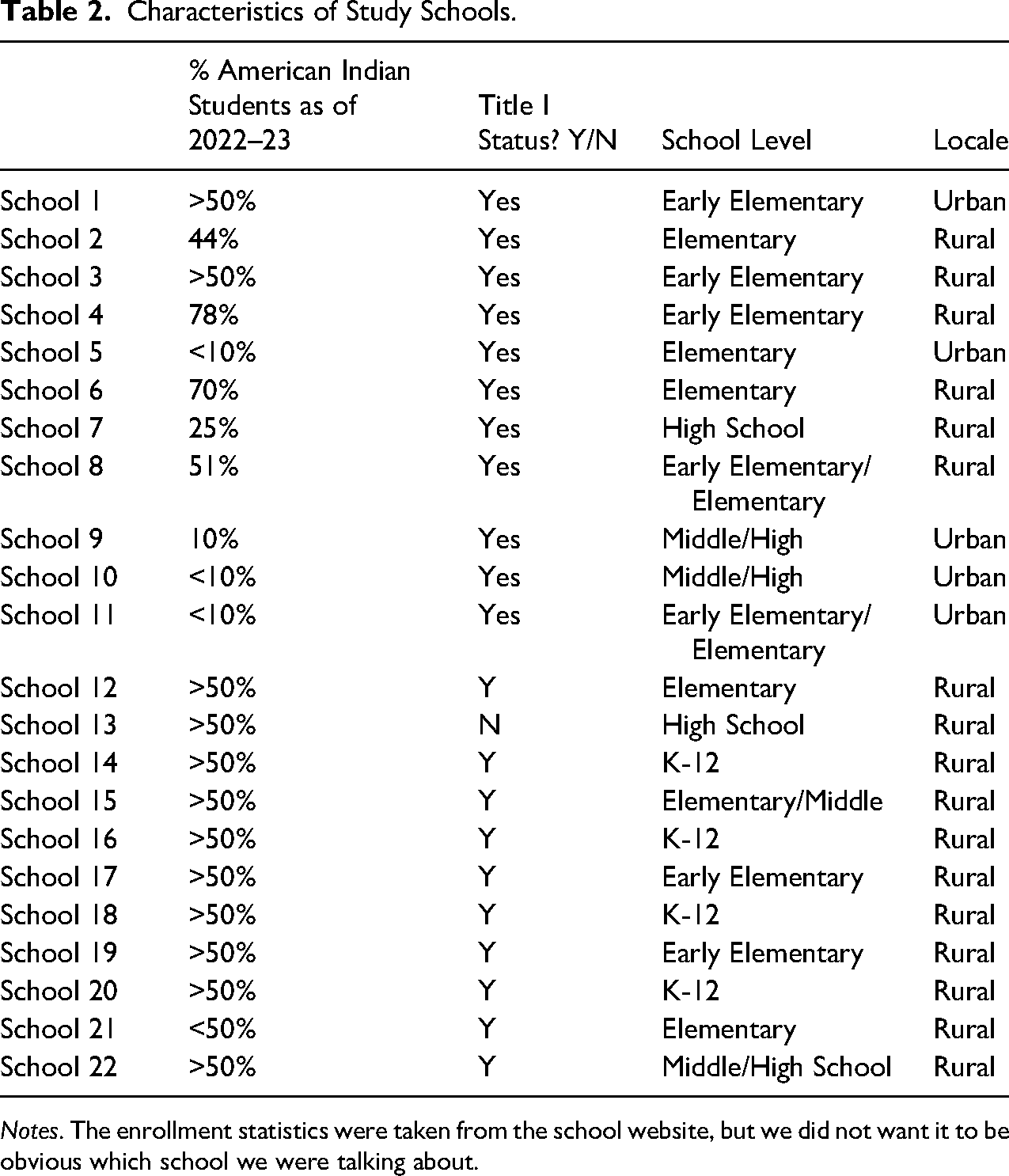
Notes. The enrollment statistics were taken from the school website, but we did not want it to be obvious which school we were talking about.
In a thematic analysis of interview transcripts, five themes emerged as having a large influence on discipline and academics in participants’ schools: relationships, cultural competence, traumatic impact, family relationship, and bureaucratic representation. After analyzing websites and handbooks, we identified a sixth theme: a lack of systemic change in the Oklahoman schools compared to systemic change in the Alaskan schools.
Building Relationships with American Indian/Alaska Native Schoolchildren
When principals were asked about discipline trends in their schools, specific to American Indian/Alaska Native students, all discussed the importance of relationships to mitigate inequitable disciplinary practices and improve academic outcomes. The principals explained that they look for the underlying reason for the behaviors rather than just exacting discipline. A rural early elementary/elementary principal explained discipline this way, “You can discipline a student. It's not going to change their behavior. What must we do to change the behavior in the long run? That's the ultimate goal for discipline.”
All the principals agreed that discipline is a short-term fix. If they do not take the time to discover the underlying reason for the misbehavior, they will see the student in their office frequently for the same offense. Relationships allowed them to get to know each child and helped retain them in school. As one urban middle/high school Oklahoman principal explained, “Suspension does not work, and my question would be, why are you sending them to the environment that created the product that you’re fighting with every day?” When students are at school, the principals expressed the ability to better control the environment more so than when the child is at home. They can also use their resources, such as school counselors and other staff, to build relationships to understand what each child needs to be successful and provide them the academic, behavioral, emotional, and mental supports required to change the behavior long-term. A rural high school principal in Oklahoma shared: Having that information, man, that's invaluable as far as being able to work with those kids and relationship building, understanding about their culture and that sort of deal, and then trying to make those relationships. That is what has helped me. Sometimes it takes a long time to get words out of them [students], but I always want to have that conversation because I want them to know that you’re not just here to be in trouble. We’re here to figure out what's going on, so you don’t have to come back [to the principals’ office]. And I was able to develop good relationships with those kids. And so, our student body right now is really, really good. They work hard, they're respectful. I don't have any discipline issues. I've had two people in my office this entire year. One of them was my kid. But I mean just the relationships. And having such a small student body at the moment being able to develop those relationships. It's been. It's made my life easy.
When asked about adjustments to disciplinary approaches, almost all principals mentioned adjusting their approach once they had developed relationships to meet the students’ unique needs. A female Alaskan principal shared, “once you have the relationships, it won't always be smooth, but if you have them and really work towards building the best environment, I think that having the connections is the very beginning of it [understanding student's unique needs].” While most principals modified their approach based on what they learned during conversations with students, only one principal used a formal matrix to approach disciplining students in which types of misbehaviors correspond with certain infractions regardless of the individual situation. Crucial to the child's well-being, all principals reported having counselors on staff who also facilitated building relationships and supporting students’ mental and emotional well-being. By working as a team with their support staff, principals were better able to ensure that each student had an adult that they could turn to for support, helping to mitigate acting out.
One of the barriers to building relationships, that was unique to Alaskan principals, was the impact of continuous staff turnover. An elementary school principal explained, “We started like we had about a 70% turnover of staff.” A principal of a K-12 school lamented, there is a lack of structure because of teacher, turnover, staff, turnover, and district office turnover. American citizens don't apply for these jobs anymore. So like we, we can't hire teachers here because their jobs are posted, and then nobody applies. And so then we dip into the next pool of applicants, which is people wanting visas. And there's tens of thousands of Filipinos, which is wonderful, like I know nothing wrong. It's just then there's a turn. Then the next year there's a turnover. So the teacher turnover makes a huge impact because brand new teachers, especially if they're from the Philippines don't know how to handle these kids and the reason, I say, is the reason I say, especially from the Philippines, is, they have an extreme kind of hierarchy of power. Filipino teachers have a lot of status. And the kids. The kids are. Yes, ma'am, no, ma'am. They they stand up in the classroom when the teacher walks in in some schools and teacher, it's just very top down, which is completely the opposite [of here] like completely the opposite. We have an incredible amount of staff turnover and that is the hardest thing to navigate. Because there is no way to explain to somebody what they're about to experience. There's no way we ask. We asked them, do you have a hobby? Do you you like to sew? … What are you gonna do when it gets dark and cold and there is really no wrapping your mind around it until you experience that.
Cultural Competence
The relationships the principals built with the schoolchildren allowed them to learn more about their culture and customs, allowing them to develop cultural competence. Cultural competence at the most basic level is an “awareness of one's own cultural norms and sensitivity to those of other cultures” (Deardorff, 2023, p. 32). Some of the Oklahoman administrators were American Indian and, therefore, understood some Indigenous customs. However, in all the schools, multiple tribes were represented, therefore, customs also varied. As an early childhood principal in rural Oklahoma shared, It's about trying to understand the culture, and sometimes that's difficult. I mean, again, I’ve been here for nearly 20 years, and I, I still can’t tell you that I understand the Native American cultures and the different tribes. And you know the historical trauma, and I’ll never understand that. You know, especially in Alaska, because we don't have this long history with the European population that is in the lower 48. So to go back two or three generations you might have had a grandfather who didn't read. Who, who didn't have a job. who didn't have any kind of wealth that you might have in the European populations and that was just a construct of of living subsistence, and so living subsistence. They wouldn't have had the schooling necessarily, or the same level of schooling, they wouldn't have had the job experience, and they wouldn't have had built any wealth. And so now you have that complexity. Then you have the generational trauma of at having lost your culture. I wouldn't say lost. Having had it stripped from them. Having had the generation trauma begins, as you know, if you were taken into a boarding school as a child abused potentially, but certainly lost your language, I would say that's abusive. Lost your hair, I'd say that's abusive, lost all these things and found a life of alcoholism after that. And that was your grandpa, whose alcoholism impacted your father. who never really learned what it was like to parent, you know. Maybe maybe through those little happy moments he did. But he also went through a lot of stuff that wasn't stable. And then, of course, that impacts his ability to really kind of govern that family. And so then then you have that kind of that sense of hopelessness, too, like, I'm blowing this. I'm ruining family and then that drives you to alcohol, or it drives you to chase. Kind of chase away your family. You know you'd be better without me. And then we all know that that is a very traumatic end. And then the kids have to navigate that one. People who are not from the area people who were not from the community and who were not from the state and that, I think makes a big difference. The one that I'm thinking of in particular, he was just, he was just a bad person. And he, I, I'm just guessing, I don't know if you could drill down and say this was specifically to native students. But as I'm thinking about the issues that came up. They were with native students. We had some pretty challenging kids at the time this guy was here, and and you know, he told one of one of our native students, he I mean, I live in a rural area… it's really rural, so everybody has knives on them, for instance, and it's just, it's, it's part of your clothing as you come to school. But that was too much for him to to deal with, and so he had some kid empty a pack backpack, and he had a hunting knife and a folding hunting knife in the bottom of his backpack, and he ended up suspending him for weapon violation, for like 10 days out of school. He had, he had another kid. Who he told him, he couldn't act like a wild little Indian during the day, and I mean that that was the final, the final nail in his coffin.
In Oklahoma, campuses with high percentages of American Indian/Alaska Native students (over 50%) often had staff that were from the surrounding community and therefore understood the students’ cultures. However, since students were coming from various tribes, the regular interactions with the tribal leaders and hosting of events on both the school campus and the reservation also increased their awareness of cultural differences that could result in behavioral differences. In the schools with a lower percentage of American Indian/Alaska Native students, there were greater chances that students’ actions would be misinterpreted as defiant or disrespectful. To mitigate this, school leaders attempted to educate their staff about cultural differences so staff would not interpret them as behavioral problems. However, the adjustment to discipline because of cultural differences most often happened at the principal level, not the classroom level. An early childhood/elementary principal explained matter-of-factly, “This is their tradition, and this is their ways, and you [the teachers] don’t have to like it, but you have to respect it.” The principal often had to remind the school staff of the importance of respecting differences, even if they did not agree with them.
Childhood Trauma Based on Home Experiences
Each principal participating in the study stated that the greatest indicator of discipline problems was trauma. Students who had experienced trauma were more likely to get into trouble. The principals indicated that the most common forms of trauma seen in Oklahoma have to do with exposure to substance abuse, extreme poverty, addiction, and domestic violence. According to principals, students who lived in households where these forms of trauma were prevalent were more likely to get into trouble at school. Each school site that was interviewed had a school counselor on campus to help students with mental health, and even with that resource, the students that the principal most often saw were those who had experienced traumatic events. One Oklahoman principal at a rural early childhood school explained it this way: “The kids just don’t quite know how to handle those emotions. I think a lot of it's just they don’t know how to handle life, and it comes out in really weird and strange ways for little kids.” As such, a trauma-informed approach—wherein school personnel acknowledged and tried to understand while also creating a safe and caring environment—coupled with a culturally responsive approach was most effective in reducing discipline instances. An Alaskan high school principal expanded on what he has seen with students who have high adverse childhood effects. Those were the kids who would be coming through the office all the time. Because, because they're dealing with things at home. And here it's a semblance of trying to get some control back. And so you know their control is like, no, I'm not going to do it. You know, checking out. And so they they kind of end up through the office.
Relationship Building with Communities
Building relationships with the families of these students was helpful and reduced the need for discipline. Relationships with these students and their families were especially important since many of them lacked stability at home. This was not for a lack of caring; instead, the adults in the home often dealt with significant challenges and did not have the skillset or support needed to assist the child at home. A rural early childhood principal emphasized the importance of students being at school and staying at school all day as opposed to going home, “Because… with our community, that's not good. They need to be at school. I wanna try to do as much as I can do within reason to keep them here rather than send them out the door.” Still, while principals strove to keep students at the school, they also recognized the importance of building relationships with family members. Where they were able, for example, when the family members were not too busy, they cultivated relationships with them by speaking with them and inviting them to cultural events held on the school campus. An Alaskan high school principal shared how he incorporates cultural events to demonstrate that the school values Native cultures and the elders in the community. We have been putting on like cultural days one in the spring one of the fall one in the spring where we do traditional gathering where we just turn the school over to the tribe for these different activities for an entire day. And we participate in it. We do have a Native Arts program. It's called Seals. It's the south-southeast Alaska language. Something, anyway. It's a program we've had in our district for decades. They, we, teach language. We teach art carving, storytelling, we've got Haida placards with Haida words and translations and pronunciation guides all over the school. There's probably 30 of these placards in our school. We want people to be welcome. We have we have. Even though we're not a native village or a a historically native community. We try to certainly honor our native population with, you know we've got a a banner, we've artwork displayed. I displayed artwork in my office. We have an open communication with our tribe and with the tribal President. I mean, we just, we try to partner with as many people as we can to make sure that all of our stakeholders, including our native stakeholders are. Have a voice in the seat at the table.
Bureaucratic Representation
During our study, we found that bureaucratic representation was key to the American Indian/Alaska Native student's success. This is critical because research finds that American Indian/Alaska Native students do not see themselves in their school leaders because most are White and the rest are racially minoritized, but not American Indian/Alaska Native persons. The demographics of the Oklahoman principals in the study showed that many of the principals were themselves American Indian, but none of the Alaskan principals were Alaska Natives. Brown (2022) suggested that when teachers and leaders are from the same cultural background as the student, it positively impacts students’ academics and overall school performance. This proved to be true in this study. According to the principals, students who had American Indian principals or sometimes, if the principal was not American Indian, their spouse was, performed better in school and had less incidences of discipline. The principals argued that this was the case because they could better understand their students and approach discipline through a culturally responsive lens. One Alaskan principal shared that while she is actually Asian, she is often mistaken for Alaskan. “I'm married to a white guy, and that was one of the things in the bush school that made it difficult was I got to hear about how I married a white devil, and how the white devil came in and took jobs which was super frustrating.” She said she often had to act as an intermediary for her family because she was respected more because of being mistaken for Alaskan Native.
Bureaucratic representation is key, in turn, necessitating an increase in policies meant to increase American Indian/Alaska Native school leaders (see Sheley, 2014 for examples). Although, even when principals were not American Indian, but showed respect for American Indian culture, discipline was reduced, just as Pewewardy and Hammer (2003) found in their study more than 20 years ago.
A Lack of Systemic Change
School websites and handbooks were examined for evidence of parent involvement, cultural responsiveness, and cultural appreciation for American Indian/Alaska Native students. The textual analysis revealed that only four of the 11 schools specifically discussed the school's commitment to cultural appreciation. At School 3, a rural elementary school in Oklahoma with a high American Indian student enrollment, the principal discussed mandatory coursework which included cultural studies and allowing American Indian regalia at graduation. That same school had a detailed webpage that explained how the school supported American Indian/Alaska Native families and students while also providing links to outside support providers. The other three schools only mentioned how the schools supported American Indian/Alaska Native families in one location, either the handbook or the webpage. Two of these three had cultural events, dates, and details prominently displayed on their web page, demonstrating a commitment to bringing cultural awareness to the campuses. The handbook at the third campus encouraged students to participate in cultural activities outside of the school day. The remaining seven schools did not mention American Indian support, their dedication to cultural awareness, or included a small state-mandated explanation of the statewide support services offered through Title IV and the Johnson-O’Malley programs which are both programs that support American Indian students. For example, “Title IV-E of the Social Security Act provides funds for tribes and states to provide foster care, transitional independent living programs for children, guardianship assistance, and adoption assistance for children with special needs” (Deserly & Walker, 2017, p. 3). Additionally, “Johnson-O’Malley is a federal program whose main objective is to ensure Indian children receive educational opportunities that would not otherwise be provided through the public school system” (ADE, 2024, para 1). The disparity between what the principals reported and what the school websites and handbooks purport further exemplify that cultural responsiveness has not yet become systematic. Culturally responsive leadership depends on the school leader at the current time; if that leader changes, the dedication to cultural appreciation may diminish.
Discussion
In this study, we interviewed Oklahoman and Alaskan principals regarding educational approaches, discipline styles, and culturally responsive leadership. Additionally, we analyzed school websites and handbooks for evidence of parent involvement, cultural responsiveness, and cultural appreciation for American Indian/Alaska Native students. Our findings support nascent research which indicates that culturally responsive leadership may make disciplinary practices more equitable and effective for American Indian/Alaska Native students, in turn, improving academic performance indicators. By embracing the importance of relationships and cultural competency, all students are seen for who they are as individuals, even when they hold multiple identities (Banwo et al., 2021; Brown, 2022; Khalifa, 2020). The schools that did not have disparate disciplinary statistics between their American Indian/Alaska Native students and other student groups on campus, extended the relationships to the families and community, which was one way that students could tell their cultures were valued (Pewewardy & Hammer, 2003). Research suggests that if students’ cultures are not respected, student discipline increases, teacher/student relationships decline, and academics are negatively impacted (Banwo et al., 2021; Brown, 2022; Mitchell et al., 2020).
According to the principals, involving the tribe in the school as well as having activities on both the campus and reservation were ways that students could see the school valued them and their culture. One principal discussed how she had created a culturally competent campus before moving to a different position. Unfortunately, the new administrator did not practice culturally responsive leadership but followed a rigid discipline matrix. As a result, the culture of the campus and the relationships with the community changed significantly. Another shared that without understanding the community, students were disciplined for having ‘weapons,’ when they were part of their cultural dress. Therefore, while culturally responsive leadership has proven to mitigate the oppressive nature of traditional school discipline policies, it can revert quickly if the next leader does not support culturally responsive practices.
One important component missing from Pewewardy and Hammer (2003) was a trauma informed approach—which we found was critical to American Indian/Alaska Native student success. In addition to building relationships and being culturally responsive to students and the community, administrators, and school staff must also be aware of trauma's impact on students’ ability to conform to the traditional expectations of school (Joseph-McCatty et al., 2025). Prior research found that students who experience adverse childhood experiences are more likely to be disciplined in school (Sanders, 2022; Sedillo-Hamann, 2022). The principals in this study agreed that the major factor influencing student behavior is exposure to trauma. Therefore, a holistic approach to discipline must include culturally responsive leadership combined with trauma-informed practices to meet student's needs. Further research could examine schools that effectively combine these methods to determine if they can break the cycle of minoritized, traumatized students being disciplined more than those who are not.
This study demonstrated that culturally responsive leadership can close disparities often seen in disciplinary statistics between majority and minoritized cultures. The study also showed that these practices must be embedded in the system. Therefore, we recommend that all administrators receive training in culturally responsive leadership and it become part of the required coursework for administrative credentials. In addition, school boards should pass board policies or administrative regulations showing their commitment to culturally responsive leadership practices. Alaska's adoption of Standards for Culturally-Responsive Schools has created a systematic approach to incorporating culture into schools. This approach, unlike what was seen in Oklahoma, is not leader-dependent and therefore will withstand.
Overall, Oklahoman and Alaskan principals embraced three of the four tenets of culturally responsive leadership. Specifically, developing culturally responsive teachers, promoting culturally responsive/inclusive school environments, and engaging students, parents, and Indigenous communities (Khalifa et al., 2016; Pewewardy & Hammer, 2003). The fourth tenet, critically self-reflecting on their leadership practice, was present in some of the principal's leadership, but was not systematic and was often neglected due to the many demands on their time. Discipline disparities were not described by participants, we argue, because principals worked to develop a more holistic approach to discipline, building relationships, understanding their culture, providing necessary support for the children, and training staff to mitigate the once prevalent inequality.
Schools must urgently assess their approach to student discipline and American Indian/Alaska Native students and create culturally responsive, trauma informed systems. Principals are situated where they can create this system because of their influence over discipline and school culture (Bayrak et al., 2014; Stimson & Appelbaum, 1988; Van Wyk, 2020).This study provides the critical components principals need to consider in order to create a more equitable approach to school discipline that treats all cultures with respect. First, they must create a culture on campus where all staff work to build relationships with all students. By building relationships and learning about their students, they can improve their understanding of their cultures and increase their cultural competence. Principals and school staff cannot undo the trauma that students may experience at home. Still, they can create culturally sensitive school systems, reducing or eliminating any additional trauma the school system may cause.
Principals and school staff must also engage families, communities, and tribes and continue to involve them in the school system. This can help begin generational healing, allowing communities to see the changes occurring at the schools and the transformation process of becoming culturally sensitive. All staff should also participate in cultural sensitivity training to better understand their implicit biases and the ways that they could be unknowingly creating environments that cause students to ignore or hide their cultural identities. Furthermore, administrative and teacher credential programs should address the importance of cultural sensitivity to ensure that schools do not exacerbate the experiences of minoritized students and those students who have experienced trauma. If cultural sensitivity, relationships, and the importance of community involvement are taught in every teacher and administrative preparation course, the school system can slowly make cultural sensitivity the norm and expectation in the school system. Having discussed our findings, limitations, and implications, we now conclude the study.
Conclusion
Culturally responsive leadership can disrupt centuries of discipline disparities among American Indian/Alaska Native schoolchildren. Most discipline policies meant to disrupt disparities are rarely effective; for example, they may reduce discipline for White students only or for a short period of time (Cruz et al., 2021). However, our findings suggest culturally responsive leadership can help mitigate inequitable disciplinary practices long-term specifically for vulnerable students, supporting nascent literature on the topic (Banwo et al., 2021; Brown, 2022). The critical intersection of culturally responsive leadership and trauma-informed practices and the importance of embracing both to meet students’ cultural and socio-emotional needs can combat the inequities in discipline. Principals must use both approaches to provide a holistic approach to addressing student behaviors. This research emphasizes the importance of understanding the “why” behind student actions and using student behavior as an opportunity to educate them, rather than punish them.
Culturally responsive, trauma informed campuses will allow students to embrace their identities and feel part of their school community (Joseph-McCatty et al., 2025). Efforts must be made to ensure school leaders understand the importance of culturally responsive leadership to their students’ academic, emotional, and social success. Cultural responsiveness and trauma informed approaches must be a part of teacher credentialing and leadership credentialing programs. Those schools that have embraced cultural responsiveness and trauma informed approaches have created systems that, in five to six years, replaced historically oppressive approaches that had been entrenched for generations, as was the case with school 3. The power of culturally responsive leadership is promising, but underdeveloped and, as evidenced here, can benefit students, families, personnel, schools, and local communities.
Footnotes

Funding
The authors disclosed receipt of the following financial support for the research, authorship, and/or publication of this article: This research was generously funded by Helping Hands Social Justice Award.
Declaration of Conflicting Interests
The authors declared no potential conflicts of interest with respect to the research, authorship, and/or publication of this article.