



Abstract
Considering the importance of social climate for teacher motivation, this study, grounded in self-determination theory, examines the longitudinal links between teacher trust in colleagues and the satisfaction and frustration of their basic psychological needs: relatedness, competence, and autonomy. The study was conducted among 666 Canadian vocational teachers. Results of the structural equation modelling analyses reveal that: trust in colleagues at T1 positively predicts the satisfaction of the three basic psychological needs (relatedness, competence, and autonomy) at T2; and trust in colleagues at T1 negatively predicts the frustration of the three needs (relatedness, competence, and autonomy) at T2. The results of this study contribute to a better understanding of the key role of trust in colleagues in teacher motivation, from a longitudinal perspective. In fact, when vocational teachers perceive the presence of relational trust in their colleagues, their motivational resources are more enhanced, which ultimately contributes to quality work motivation. In light of these findings, principals would do well to look at ways of cultivating teacher trust in colleagues when they want to motivate their teaching staff.
Education systems, faced with a real, significant, and growing shortage of teaching staff (García & Weiss, 2019a), must juggle early departures from the teaching profession and high staff turnover between educational establishments. It has been documented that this instability in the teaching workforce has negative consequences, particularly for existing teachers and students (García & Weiss, 2019a; Ronfeldt et al., 2013; Sorensen & Ladd, 2018), but also that “working environments clearly play a role in the teacher shortage” (García & Weiss, 2019b, p. 2).
Indeed, the desire to pursue a career in the teaching profession not only goes hand in hand with teacher satisfaction and motivation rates (García & Weiss, 2019b), but also with educational establishments’ social climate (Katz, 2018). Moreover, fewer than 40% of American teachers mention there being a great deal of cooperative effort among staff members (García & Weiss, 2019b). In this study, teacher trust is conceptualized in terms of characteristics and practices on the part of others (referents: administration, colleagues, and students) which, when perceived by teachers, lay the foundations for establishing trust (Bryk & Schneider, 2002; Colquitt et al., 2007; Sitkin & Roth, 1993; Weinstein et al., 2020).
Teacher trust, with its proven influence on motivational variables (Adams, 2020; Blömeke & Klein, 2013; Choong et al., 2020; Clément et al., 2020; Kilinç et al., 2021; Lee et al., 2011; Li et al., 2019; Xin, 2017; Yin et al., 2013; Zheng et al., 2019), can be seen as a promising avenue for engaging and retaining teachers.
Review of Relevant Scholarship
Trust
Relationships between teachers and school referents largely shape a school's working environment and climate, with repercussions for teachers and students alike (Bryk et al., 2010). In a school setting, it is often through teachers that the presence or absence of trust can be assessed (Niedlich et al., 2021). Furthermore, teachers perceive their colleagues as trustworthy when they demonstrate behaviors consistent with their own expectations of the job description (Bryk & Schneider, 2002; Sitkin & Roth, 1993). The concept of trust is linked to risk-taking and accepting vulnerability in relation to another person (Hoy & Tschannen-Moran, 2003; Van Maele et al., 2014).
Teacher trust in colleagues is thus defined as “a teacher's willingness to be vulnerable to [a colleague] based on the confidence that the latter is benevolent, reliable, competent, honest, and open” (Hoy & Tschannen-Moran, 1999, p. 189). It implies that a teacher perceives that a colleague will act in ways to maintain this trust relationship by demonstrating benevolence (when a colleague shows goodwill in wanting to act in the teacher's interest and protect the teacher's well-being), reliability (when a colleague responds consistently to the teacher's needs in a positive way), competence (when a colleague tries to live up to expectations and standards), honesty (when a colleague expresses truthful statements and keeps commitments), and openness (when a colleague agrees to share relevant information and to be vulnerable to others in return; Hoy & Tschannen-Moran, 1999, 2003; Van Maele et al., 2014).
Teacher relational trust has been shown to correlate with dimensions of work engagement (Bird et al., 2009; Clément et al., 2020; Gülbahar, 2017). Also, specifically, teacher trust in colleagues has been shown to play a role in teacher professionalism (Cheng et al., 2021), teacher psychological empowerment (Yin et al., 2013; Zhang et al., 2021), teacher commitment to students (Lee et al., 2011), and teacher absenteeism and job satisfaction (Da’as, 2021).
Basic Psychological Needs
Furthermore, a crucial element to consider is that the dominant causes of people's behavior stem primarily from how people interpret events and the perceived relationships of these events to people's psychological needs (for relatedness, competence, and autonomy; Deci & Ryan, 2004). Self-determination theory proposes that, within the interpersonal context, individuals must satisfy three basic psychological needs that represent essential nutrients for promoting growth, integrity, and well-being (Ryan, 1995; Ryan & Deci, 2000, 2008, 2017; Vansteenkiste et al., 2020). These three psychological needs are universal: they manifest themselves consistently in different fields of activity and in different cultural contexts, making it crucial to examine the factors that promote their satisfaction and reduce their frustration (Ryan & Deci, 2017). The three needs proposed by Deci and Ryan (2000) are still used in current research (Vansteenkiste et al., 2020).
The first of them is the need for relatedness (the feeling of warmth, bonding, and care relative to other employees; Baumeister & Leary, 1995). “Relatedness refers to both experiencing others as responsive and sensitive and being able to be responsive and sensitive to them—that is, feeling connected and involved with others and having a sense of belonging” (Baumeister & Leary, 1995; Deci & Ryan, 2000; Ryan, 1993; cited in Ryan & Deci, 2017, p. 86). The second is the need for competence (the feeling of effectiveness and mastery; White, 1959). Satisfying the need for competence corresponds to having the opportunities and resources to use one's skills for the good of their social environment while feeling a sense of efficacy, understanding, and mastery (Ryan & Deci, 2017). Finally, the third need is the one for autonomy (the ability to perform an intentional act, consciously, and to experience willingness; De Charms, 1968). It describes one's need to perform actions that originate from oneself and with free will.
“Psychological need” thus refers to self-regulation, as well as to a sense of will and volition with regard to one's behaviors, which are carried out in the absence of controlling forces (Ryan & Deci, 2017). Being considered as a central mini-theory within the broader framework of self-determination theory (Deci et al., 2017; Ryan & Deci, 2017; Vansteenkiste et al., 2020), these three basic psychological needs can be satisfied or frustrated, where their frustration represents “a stronger and more threatening experience than the mere absence of [their satisfaction]” (Vansteenkiste et al., 2020, p. 3).
Basic psychological need satisfaction and frustration are sometimes studied as two sides of the same coin; however, the absence of basic psychological need satisfaction does not necessarily imply frustration (Vansteenkiste et al., 2020). Indeed, basic psychological need satisfaction mainly leads to favorable impacts, while the opposite is observed for basic psychological need frustration (Gillet et al., 2015; Ryan & Deci, 2008, 2017). In this regard, Ebersold et al. (2019) have demonstrated the contribution of basic psychological needs, their satisfaction leading in part to well-being, and their frustration to ill-being, while illustrating the unique contribution of the needs for relatedness, competence, and autonomy. Thus, the three needs should be studied separately (Van den Broeck et al., 2016), as they have distinct and complementary roles (Corbin et al., 2023; Vansteenkiste et al., 2020) with regard to teacher motivation (Abós et al., 2018), burnout (Ranđelović & Stojiljković, 2015), well-being (Collie et al., 2016; Ebersold et al., 2019), and flow at work and life satisfaction (Olčar et al., 2019).
Finally, self-determination theory describes basic psychological needs as motivational resources and recognizes the prominent place of social context as a determinant of the satisfaction of these basic psychological needs (Ryan & Deci, 2017).
Trust in Colleagues and Basic Psychological Needs
On this subject, concerning the link between trust and motivational resources, quality interpersonal relationships and harmonious, respectful, and cordial exchanges promote the satisfaction of basic psychological needs (Clément, 2017) and empirical cross-sectional studies have shown that the relational climate impacts motivational resources, namely basic psychological needs (see Clément & Poirel, 2021; Levasseur et al., 2022). Furthermore, three recent studies have examined the specific role of trust with regard to teachers’ basic psychological needs. First, Adams (2020) examines the influence of teacher trust in three referents on the satisfaction of motivational resources. Results showed that the satisfaction of basic psychological needs (without any distinction of the three needs) is significantly associated with teachers’ trust in colleagues (β = .32, p < .001). Second, Clément et al. (2020) found that teacher trust in colleagues positively influences the need for relatedness (β = .736, p < .01) and the need for autonomy (β = .283, p < .05). Third, Clément (2017) examined the longitudinal links between teachers’ perception of trust in colleagues and three outcomes (well-being [vigor], attitudes [organizational commitment], and behaviors [in-role performance]) through the mediating role of basic psychological need satisfaction (Clément, 2017). The structural equation analysis revealed that: (1) teachers’ perception of trust in colleagues at T1 predicts their basic psychological need satisfaction at T2; (2) teachers’ basic psychological need satisfaction at T1 predicts their vigor, their organizational commitment, and their in-role performance at T2; (3) basic psychological need satisfaction at T2 plays a mediating role between teachers’ perception of trust at T1 and the three outcomes (well-being, organizational commitment, and in-role performance) at T2. This justification offers unidirectional direction of effects between the variables of interests (i.e., trust predicts needs). Thus, the study highlighted the directionality of the effect of trust in colleagues on the satisfaction of basic psychological needs without, however, distinguishing the effect with the three needs separately, and without addressing their frustration.
Although teacher trust in colleagues represents an important social binder that is established through repeated interactions (Rousseau et al., 1998), both Adams (2020) and Clément et al. (2020) examine these relationships cross-sectionally, like the majority of empirical studies in this field (e.g., Blömeke & Klein, 2013; Choong et al., 2020; Li et al., 2019; Xin, 2017; Yin et al., 2013; Zheng et al., 2019), despite the recommendations of researchers (e.g., Clément et al., 2020; Dirks & De Jong, 2022; Tschannen-Moran & Gareis, 2015; Van Maele et al., 2014). Moreover, very few studies simultaneously investigate the satisfaction and frustration of teachers’ basic psychological needs (e.g., Trépanier et al., 2016), even though this simultaneous study is preferable in order to better understand motivational resources in the workplace (Deci et al., 2017; Olafsen et al., 2021b; Van den Broeck et al., 2016). In addition, as the systematic review of Levasseur and Clément (2025a) points out, although teacher relational trust in colleagues is greatly influenced by independent variables, further studies concerning this referent would complement the current limited knowledge about trustful interpersonal relationships between teacher colleagues in the school environment.
Based on self-determination theory, which attaches great importance to the primacy of relational climate over the satisfaction of basic psychological needs, and on the findings of the study presented above, the direction of the link uniting teachers’ trust in colleagues with the satisfaction and frustration of their basic psychological needs can be inferred. Although Clément's (2017) study sheds valuable light on the direction of the relationship between the variables of interest, it does not offer fine nuances as to the distinct and complementary contribution of satisfaction and frustration of basic psychological needs. Thus, a study with a longitudinal design clarifying this relationship is essential.
Knowing whether teachers’ trust in their colleagues is in fact a determinant of the motivational levers represented by basic psychological needs would enable system-level and school-level leadership to implement tailor-made interventions designed specifically to increase the satisfaction of one of their basic psychological needs, or specifically to reduce one of these in a context of frustration. The relevance of such interventions is particularly supported by the context of the teacher shortage, where the aim is to attract teachers to the profession and retain qualified individuals who are motivated to perform this function.
In light of this, using a longitudinal two-measurement time design, this study aims to gain further insight into the nature of the relationships between teacher trust in colleagues and basic psychological needs as motivational resources.
Hypothesis, Aims, and Objectives
This study examines the longitudinal relationships between teachers’ perceived trust in colleagues and their basic psychological needs (both satisfaction and frustration thereof; see Figure 1). Specifically, we propose the following hypotheses:
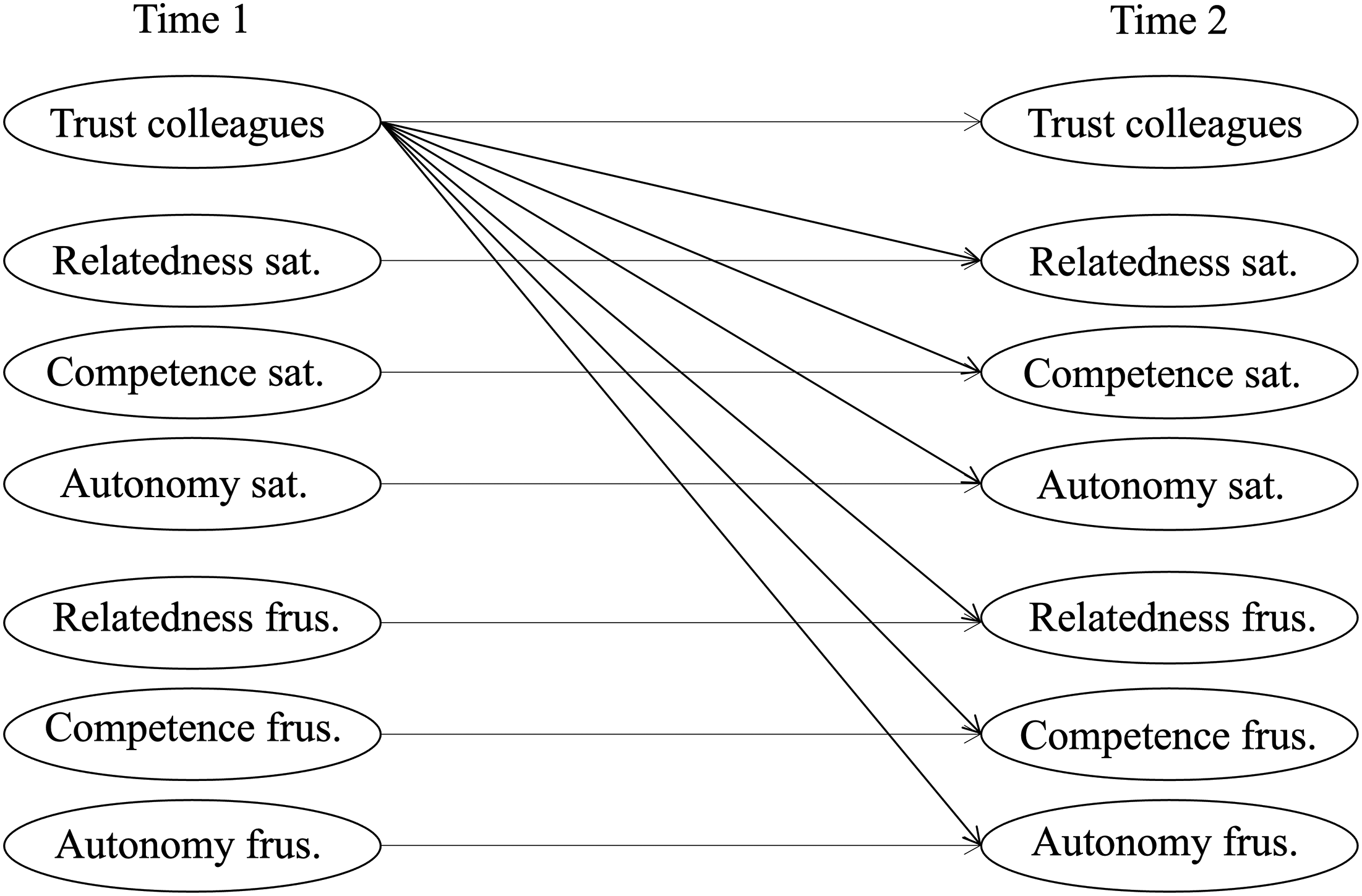
The Proposed Model. Note. Sat.: Satisfaction. Frus.: Frustration.
Methods
Research Design
This study presents a longitudinal, observational design in which the influence of teachers’ trust in their colleagues is examined in relation to the satisfaction and frustration of their basic psychological needs, using structural equation models and comparisons by the Satorra–Bentler scaled chi-square difference test. The population at the heart of this research comprises vocational education teachers in Quebec (Canada), a specific population due to the uniqueness of vocational training centers compared to Canadian educational institutions. The province of Quebec boasts some 190 centers offering programs that enable students to acquire the knowledge and competencies needed to practice a specialized trade or profession (Government of Quebec, 2024).
In these centers, the population of vocational education teachers (N = 9,531) is over 60% male, and the average age is over 40 (Quebec Ministry of Education and Higher Education, 2020), as this is often a second career (Deschenaux & Tardif, 2016). Teachers with precarious status are overrepresented (35% regular full-time teachers; Quebec Ministry of Education and Higher Education, 2020) and often collaborate little with one another for fear of being judged on their pedagogical skills (Barrère, 2002; Riel et al., 2016).
Although vocational education teachers have a relatively high rate of job insecurity, statistical analyses comparing the means of two samples were carried out to assess the impact of employment status on perceptions of relational trust towards colleagues, and on the satisfaction and frustration of basic psychological needs. These variables of interest showed no statistically significant differences between permanent and non-permanent teachers, except for satisfaction of the need for relatedness, which showed a small difference in means (Cohen, 1988). Thus, teachers’ employment status has very little impact on their perceptions of their colleagues’ trust attributes and their own motivational resources.
It is also important to consider that the context of this data collection is characterized by the specific measures put in place by Quebec's public health officials during the COVID-19 pandemic. The first data collection took place in spring 2020, when the first wave of spread was taking place in Quebec. Most primary and secondary schools, including vocational education centers, were closed, and given the practical nature of vocational education, it was difficult to offer distance learning (Institut national de santé publique du Québec [INSPQ], 2020). The second collection was also affected by special measures arising from the COVID-19 pandemic, as it took place during the third wave of the virus's spread. This period was characterized by a gradual, part-time return of students to vocational education centers and by the requirement for students and staff to wear face coverings (INSPQ, 2020). These two collection periods may have influenced the perceptions of the teachers participating in the study, due to the limited interpersonal relations between colleagues during these two measurement periods and the social work context that was transformed during the pandemic.
Data Collection
Data were collected in 2020 and 2021 in 22 Canadian vocational centers, representing approximately 12% of the total number of such centers in Quebec. The surveyed participants all received a link to access the online questionnaire. One year later, participants were invited to participate in a second measurement by completing a questionnaire with the same measures. A total of 927 teachers were invited to participate in the study at the first measurement time, and 480 teachers participated, for a response rate of 52%. One year later, 706 teachers received the same invitation, and 366 teachers took part in the second measurement, for a response rate of 52%. In total, 666 teachers agreed to participate in one of the study's measurements or the other, and 180 participated in both. Their sociodemographic characteristics are presented in Table 1, as well as those of the population (Quebec Ministry of Education and Higher Education, 2020), where the sociodemographic characteristics of the study sample are relatively comparable to those of the general population. The sample for the second measurement time contains slightly more women than the population as a whole and a slightly higher proportion of permanent teachers. We will consider these slight distinctions later in the article.
Sociodemographic Characteristics of Participants at Time 1 and Time 2.
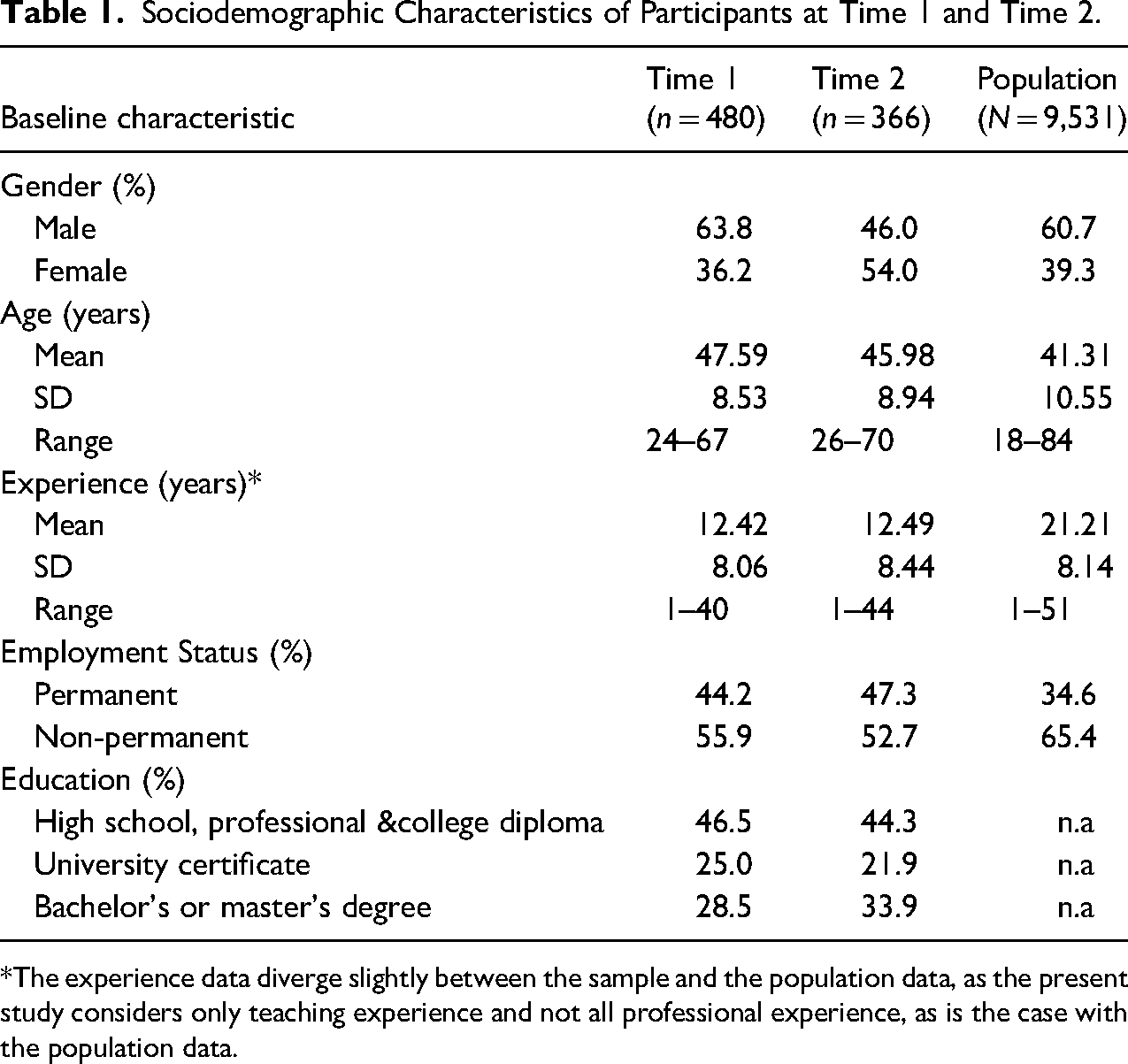
*The experience data diverge slightly between the sample and the population data, as the present study considers only teaching experience and not all professional experience, as is the case with the population data.
To validate that the results obtained from participants who responded for both measurements did not differ significantly from those obtained from participants who took part in only one phase of the research or the other, we conducted an analysis of variance (ANOVA). The results show no statistically significant differences in sociodemographic characteristics, so groups were combined for analysis.
Instrumentation
Trust in Colleagues
Trust in colleagues was measured using five items, each representing a facet of trust, selected from high-performing items in Hoy and Tschannen-Moran (2003), and Levasseur and Clément (2025b). These items are: “Teachers in this school typically look out for each other” [benevolence], “Teachers in this school can depend on each other even in difficult situations” [reliability], “Teachers in this school do their jobs well” [competence], “Teachers in this school have faith in the integrity of their colleagues” [honesty], and “Teachers in this school openly share information with others” [openness]. The items were presented on a scale of responses ranging from 1 (strongly disagree) to 5 (strongly agree). The reliability (internal consistency) of this reduced scale has not been determined yet, but the scales from which the items were selected have demonstrated excellent reliability (George & Mallery, 2003) in previous studies, for example: Hoy and Tschannen-Moran (2003; α = .93); Levasseur et Clément (2025b; ω = .87).
Basic Psychological Need Satisfaction
The scale used to measure participants’ basic psychological need satisfaction was a validated questionnaire by Chevrier and Lannegrand (2021) which was translated and adapted from Chen et al. (2015). This twelve-item version assessed teachers’ satisfaction with regard to the three basic psychological needs, where the satisfaction of each need was measured using four items (relatedness: e.g., “I feel that the people I care about also care about me”; competence: e.g., “I feel confident that I can do things well”; and autonomy: e.g., “I feel I have choice and freedom in what I do”). Participants were asked to indicate their level of agreement with each statement on a scale ranging from 1 (totally disagree) to 5 (totally agree). The reliability (internal consistency) of this scale has been demonstrated by previous studies, for example: Olafsen et al. (2021a; .86 < ω < .87), Chen et al. (2015; .65 < α < .88), Costa et al. (2018; .79 < α < .82), and Chevrier and Lannegrand (2021; .84 < ω < .93).
Basic Psychological Need Frustration
The scale used to measure teachers’ basic psychological need frustration was a validated questionnaire by Gillet et al. (2012) which was translated and adapted from Bartholomew et al. (2011). This nine-item version assessed participants’ frustration with regard to the three basic psychological needs, where the frustration of each need was measured using three items (relatedness: e.g., “I feel rejected by those around me”; competence: e.g., “There are times when I’m told things that make me feel incompetent”; and autonomy: e.g., “I feel obliged to follow decisions that are made for me”). Participants were asked to indicate their level of agreement with each statement on a scale ranging from 1 (totally disagree) to 5 (totally agree). The reliability of this scale has been demonstrated by previous studies, for example: Bartholomew et al. (2011; .67 < α < .79), Cuevas et al. (2015; .81 < α < .88), Gunnell et al. (2013; .89 < composite reliability < .93), Martinent et al. (2015; .78 < α < .85 and .78 < composite reliability < .85), and Gillet et al. (2012; .73 < α < .80).
Analytic Strategy
First, the reliability of the measurement scales was checked using the omega coefficient (ω; McDonald, 1970) as a value of internal consistency. In educational research, it is true that alpha is the coefficient most commonly used to assess the internal consistency of test scores (Cho, 2016; Sijtsma, 2009). However, this coefficient does not appear to be the best estimator of reliability (Bourque et al., 2019; McNeish, 2018; Sijtsma, 2009). Several studies justify the use of McDonald's omega as an alternative fidelity index to Cronbach's alpha (Bourque et al., 2019; Kelley & Pornprasertmanit, 2015; McNeish, 2018; Trizano-Hermosilla & Alvarado, 2016).
With regard to missing data, the maximum likelihood method is generally preferred when analyzing models using structural equations (Allison, 2003; Peugh & Enders, 2004). The use of this estimator does not replace missing data. Instead, the sample parameters are calculated by the software (in this case, Mplus), which then estimates, through an iterative process, the data with maximum likelihood for the variables of interest.
Next, various models were tested using structural equation modelling (SEM), where analyses were carried out with the maximum likelihood with robust errors (MLR) estimator using Mplus 7.3 (Muthén & Muthén, 2017). Four indices and their acceptance thresholds have been taken into consideration to account for the different models under study: the comparative fit index (CFI), the Tucker–Lewis index (TLI), the standardized root mean square residual (SRMR), and the root mean square error of approximation (RMSEA). For CFI and TLI, values above .90 and .95 indicate a satisfactory and excellent fit, respectively (Byrne, 1994; Hu & Bentler, 1999), whereas, for SRMR and RMSEA, values of .08 or less indicate a reasonable model fit (Browne & Cudeck, 1993).
The first model tested was the measurement model (M1), where latent factors are created from the relevant items and their contribution and fit indices are examined in a first step (Anderson & Gerbing, 1988). This measurement model defines the relations between all observed and unobserved study variables, and as a confirmatory factor analysis, specifies the pattern by which each measure is loaded on a particular factor (Byrne, 2001; Hakanen et al., 2008). Then, to test the proposed associations, cross-sectional and cross-lagged correlation analyses were performed with the established latent factors (Table 2), and the associations with control variables were assessed (age, gender, employment status, education, and experience).
Means, Standard Deviations, Internal Consistency, Cross-Sectional and Cross-Lagged Latent Correlations Between Study Variables.
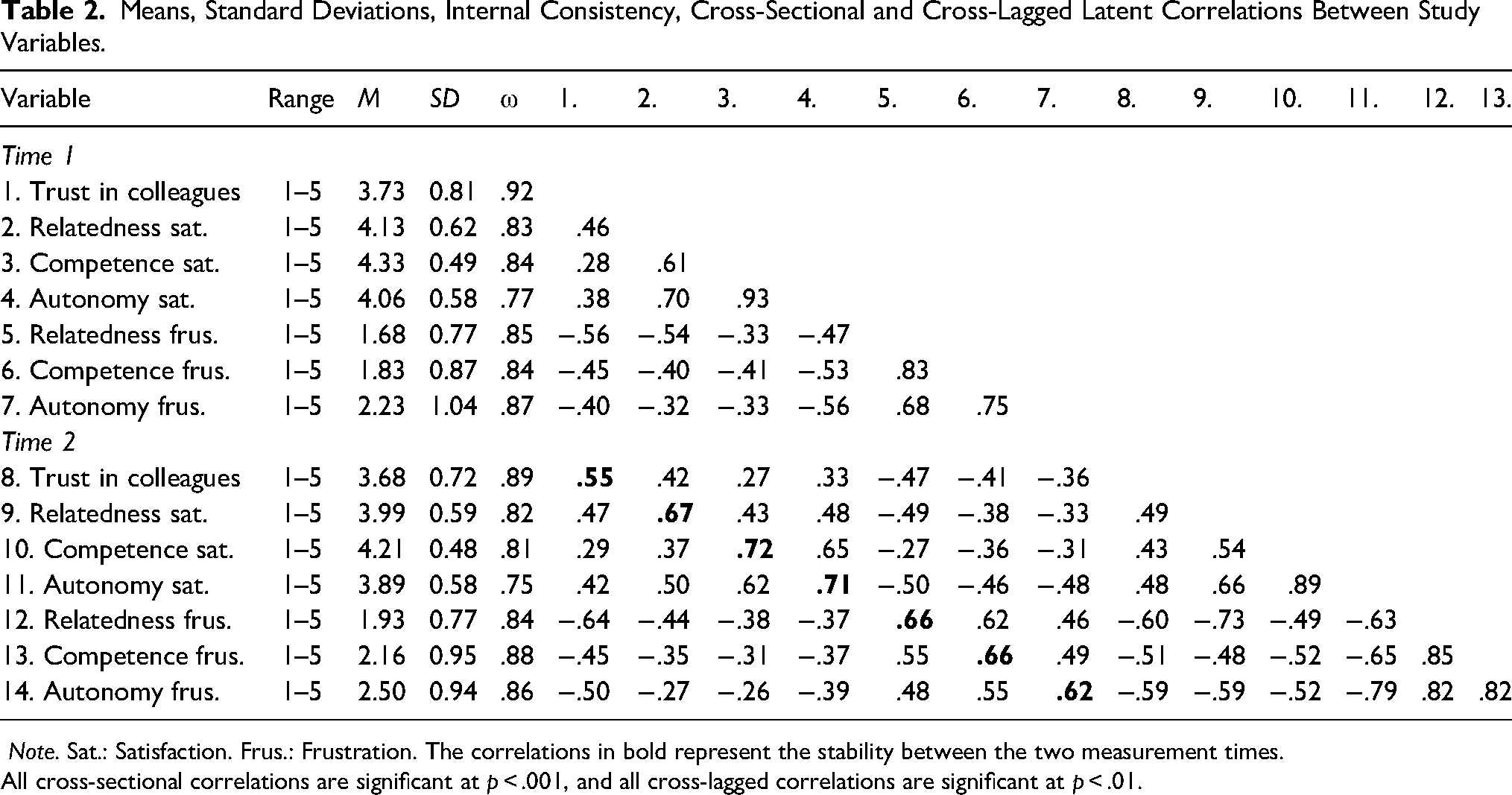
Note. Sat.: Satisfaction. Frus.: Frustration. The correlations in bold represent the stability between the two measurement times.
All cross-sectional correlations are significant at p < .001, and all cross-lagged correlations are significant at p < .01.
The next model tested was a stability model (M2) that includes only autoregressive effects, i.e., the effect of a variable on itself one year later (e.g., trust in colleagues at T1 to trust in colleagues at T2). These effects are also called stability effects, to represent the stability of each variable over time. To control for baseline levels of each latent factor, autoregressive effects were included in all models tested subsequently (Gollob & Reichardt, 1991). Then the proposed model (M3, see Figure 1) was tested, including the stability links as well as those of interest to this study: the effect of trust in colleagues at T1 on basic psychological need satisfaction and frustration at T2. So, when we consider the influence of trust in colleagues at T1 on relatedness satisfaction at T2, for example, we take into account the initial level of relatedness satisfaction and how this level has remained stable over time to contribute to relatedness satisfaction at T2.
Next, the reversed causation model (M4) was tested. This is a model with the opposite links to those hypothesized: from basic psychological need satisfaction and frustration at T1 to trust in colleagues at T2. In estimating this model, statistical relationships opposite to those proposed are tested to verify the existence of an inverse relationship to the one put forward.
Finally, the reciprocal model (M5) includes all the links from the previous models: autoregressive effects (M2), proposed cross-lagged effects (M3), and inverse cross-lagged effects (M4). Thus, we simultaneously test the effect of trust in colleagues at T1 on satisfaction and frustration of the three basic psychological needs at T2, and the effect of satisfaction and frustration of the three basic psychological needs at T1 on trust in colleagues at T2, in addition to controlling the relationships according to the initial levels of each latent factor by incorporating stability effects (e.g., trust at T1 on trust at T2). This model thus presents a bidirectional model of the statistical relationship between the variables under study.
The proposed model (M3) was compared with the competing models (De Jonge et al., 2001; see Trépanier et al., 2016, for a recent example of this method) using the Satorra–Bentler scaled chi-square difference test (Satorra & Bentler, 2010) to determine the direction of the relationships linking trust in colleagues and basic psychological need satisfaction and frustration. This test, which is used to compare nested models of structural equations, is a corrected version of the chi-square test that takes into account the effect of kurtosis and thus provides a more robust assessment than the latter (Satorra & Bentler, 2010).
Results
Preliminary Analyses
The response range, the mean score, the standard deviation, and the reliability of each scale are presented in Table 2. Cross-sectional and cross-lagged correlations among variables are also presented in Table 2, where the variables are significantly correlated according to the hypotheses (trust in colleagues at T1 and basic psychological need satisfaction at T2: .28 < r < .46, p < .01; trust in colleagues at T1 and basic psychological need frustration at T2: -.41 < r < -.57, p < .01). Also, the latent correlations indicating autoregressive effects are between r = .55 and r = .72. They are thus qualified as moderate to large according to Cohen's (1988) markers, and therefore show moderate to high stability between the two measurement times. Given the presence of a few statistically significant correlation coefficients (all of small magnitude, however; Cohen, 1988) between the key study variables and the control variables, the latter were included in subsequent analyses (i.e., age, gender, employment status, education, and experience).
Before testing the SEM models, a measurement model (M1; see Figure 2) was tested, and the results show a satisfactory fit to the data (χ2 = 2280.799 (df = 1255); CFI = .914; TLI = .901; SRMR = .061; RMSEA = .035 [CI = .033–.037]; see Table 3), with all factor loadings significant (T1: .620 < λ < .883; T2: .557 < λ < .748, p < .001).
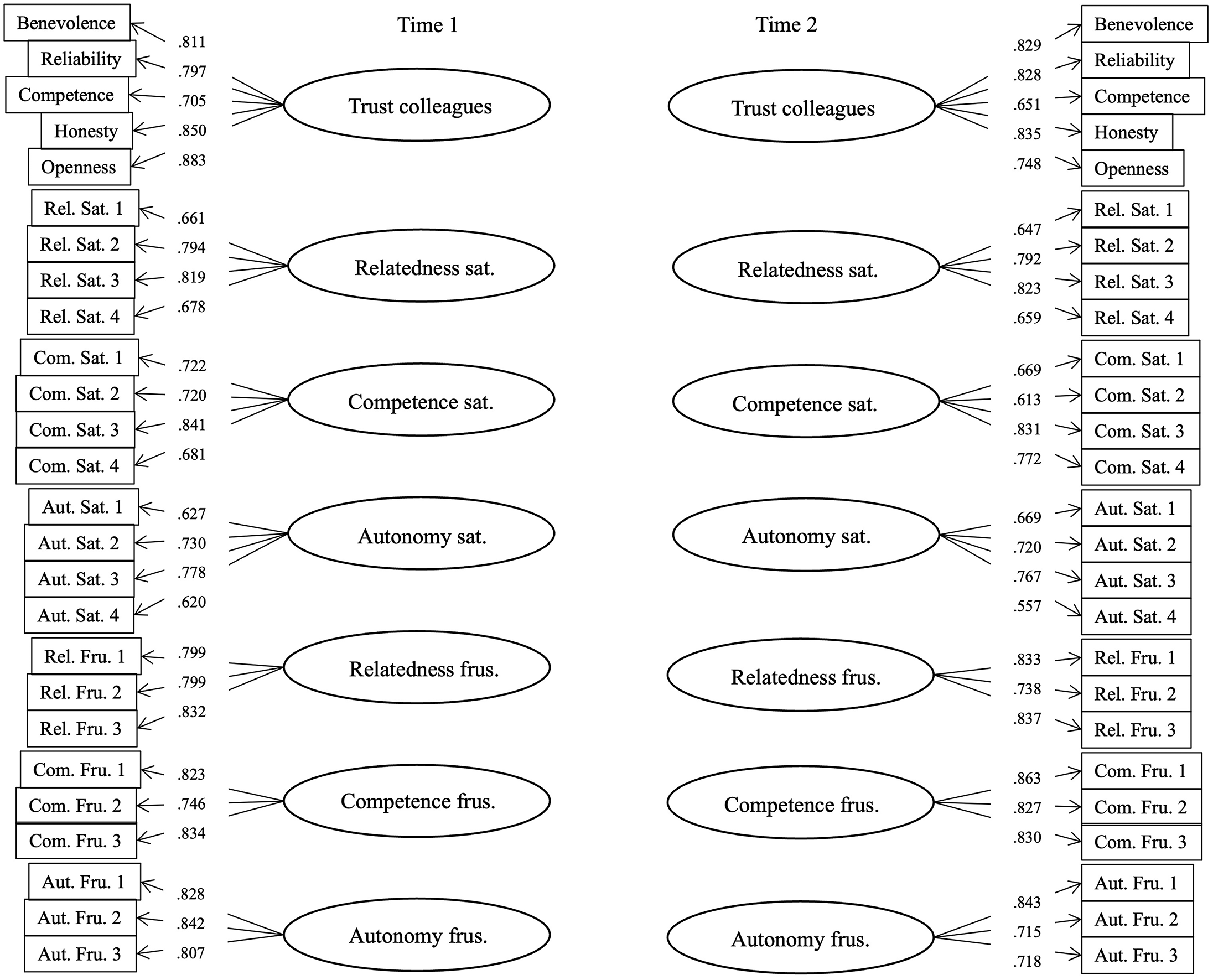
Measurement Model (M1). Note. Sat.: Satisfaction. Frus.: Frustration. Standardized coefficients significant at p < .001.
Goodness-of-Fit Indices and Model Comparisons.
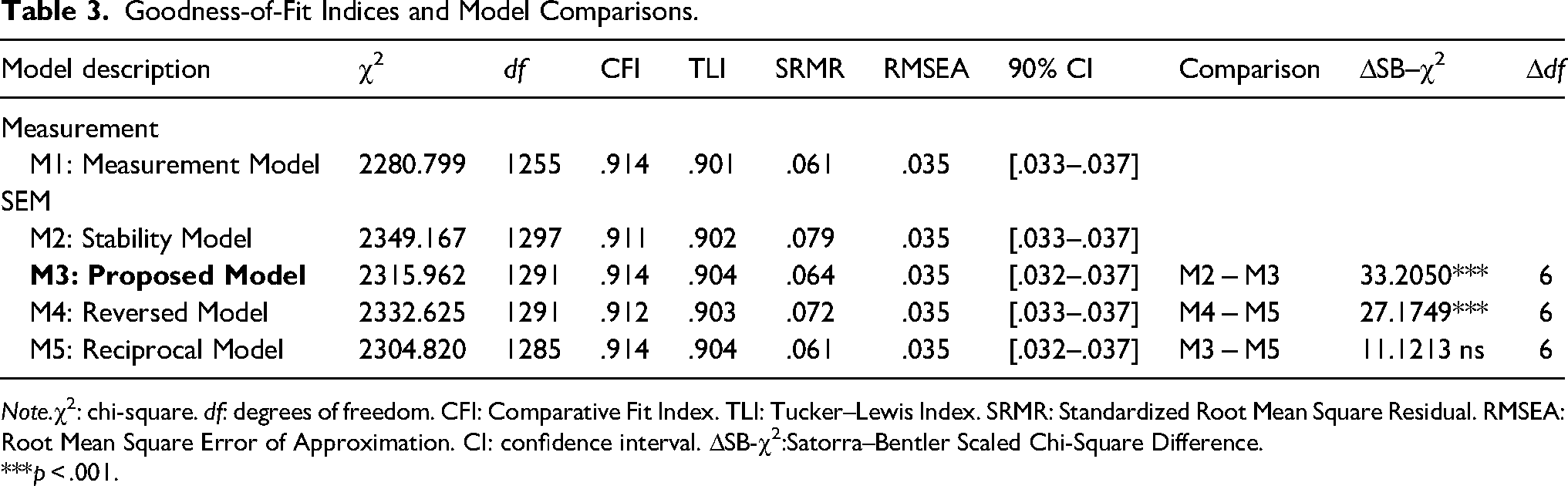
Note.χ2: chi-square. df: degrees of freedom. CFI: Comparative Fit Index. TLI: Tucker–Lewis Index. SRMR: Standardized Root Mean Square Residual. RMSEA: Root Mean Square Error of Approximation. CI: confidence interval. ΔSB-χ2:Satorra–Bentler Scaled Chi-Square Difference.
***p < .001.
Structural Models
In addition to the measurement model (M1), four longitudinal SEM models between teacher trust in colleagues and basic psychological need satisfaction and frustration were generated and compared using their fit indices and the Satorra–Bentler scaled chi-square difference test (ΔSB-χ2; Table 3). As such, the proposed model (M3; M3 vs. M2: ΔSB–χ2 = 33.205, p < .001), the reversed model (M4; M4 vs. M2: ΔSB–χ2 = 16.434, p < .05), and the reciprocal model (M5; M5 vs. M2: ΔSB–χ2 = 44.130, p < .001) are statistically significantly different from the stability model (M2), and all have satisfactory fit indices. In concrete terms, these results mean that considering both cross-lagged and autoregressive effects offers a significantly better fit to the data than considering autoregressive effects alone. These results mean that the variables influence each other beyond their own influence over time.
Furthermore, the comparison of the reciprocal model (M5) with the reversed model (M4) reveals a significant difference (ΔSB–χ2 = 27.175, p < .001) implying that the reciprocal model provides a significantly better fit to the data than the reversed model. In effect, this suggests that it is preferable to consider both proposed and reversed links rather than only reversed links, demonstrating the added value of links ranging from trust in colleagues at T1 to need satisfaction and frustration at T2.
On the other hand, the comparison of the reciprocal model (M5) with the proposed model is nonsignificant (M3; ΔSB–χ2 = 11.121, p > .05). This means that adding the statistical links linking psychological need satisfaction and frustration at T1 to trust in colleagues at T2 does not offer a better statistical fit to the data than considering only the links from trust in colleagues at T1 to need satisfaction and frustration at T2. It is in the light of this information that the proposed model (M3) is the one retained for this study.
Therefore, to examine the differences between the models in finer detail, standardized regression coefficients (β) were taken into consideration in addition to the fit indices and the Satorra–Bentler scaled chi-square difference test. The standardized regression coefficients of the stability model (M2; see Figure 3) are satisfactory, ranging from β = .481 (p < .001) to β = .683 (p < .001). The variables thus show moderate (trust in colleagues) to high (basic psychological need satisfaction and frustration) stability over time. Examination of models M3, M4, and M5 reveals that, for some models, cross-lagged effects are significant, while others are not. Indeed, M3 (see Figure 4) presents significant cross-lagged effects for the contribution of teacher trust in colleagues at T1 to the satisfaction of all three basic psychological needs at T2 (.120 < β < .214; p < .001) and to the frustration of all three basic psychological needs at T2 (-.267 < β < -.427; p < .001). The lowest regression coefficients, from trust in colleagues at T1 to the satisfaction of psychological needs at T2, are also those with the greatest stability (autoregressive effects).
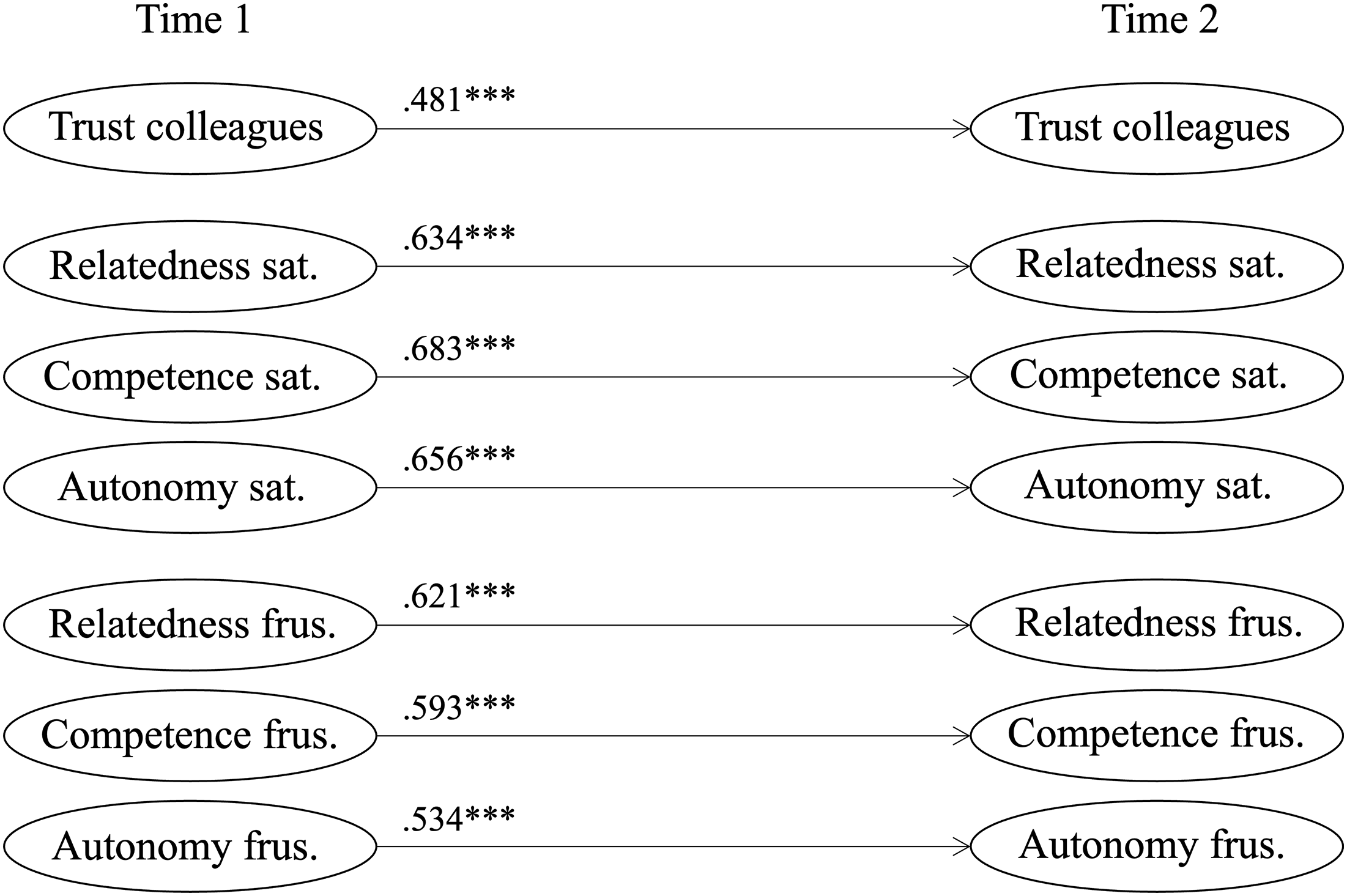
Stability model (M2). Note. Sat.: Satisfaction. Frus.: Frustration. ***p < .001.
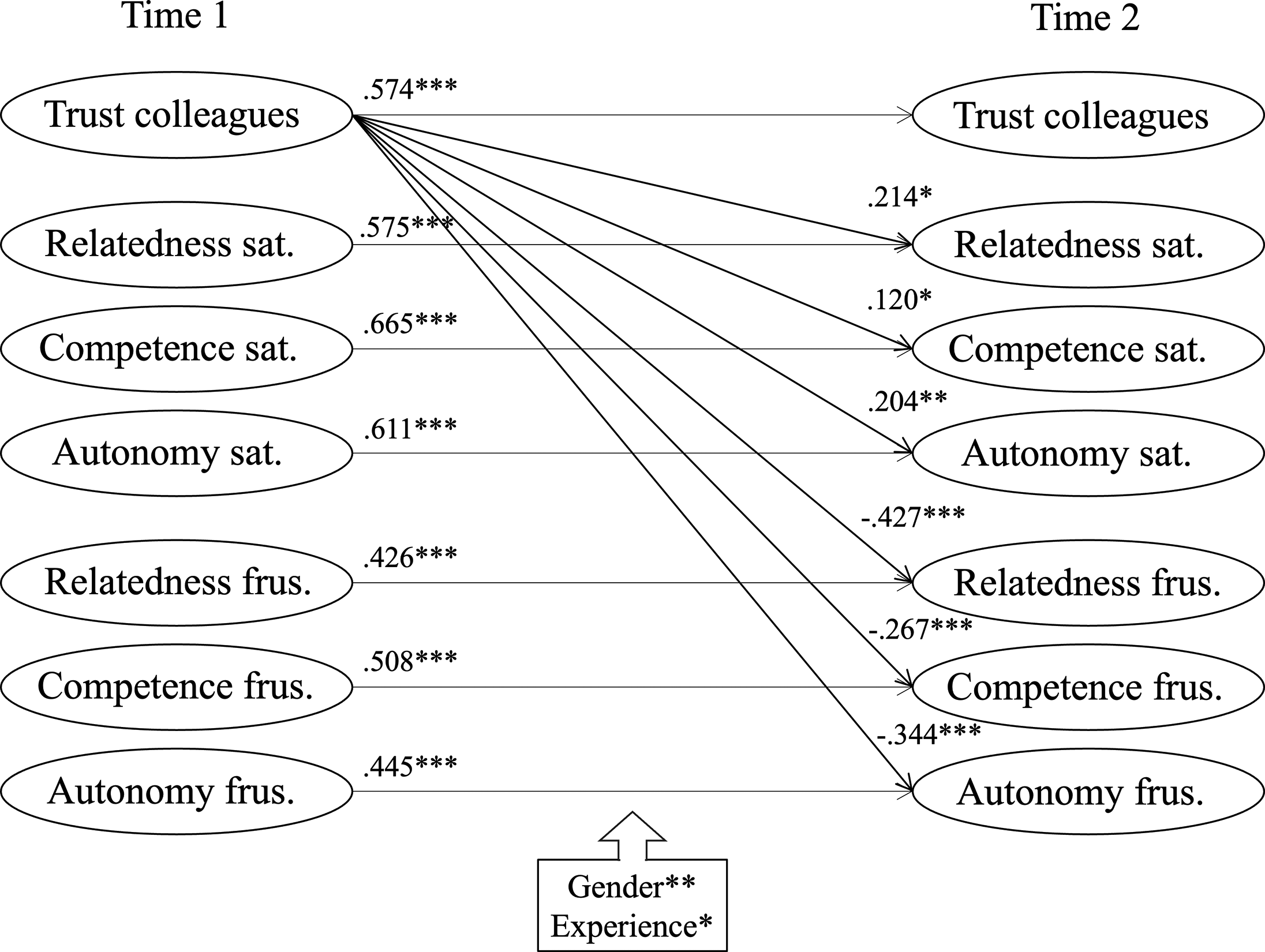
Proposed Model (M3). Note. Sat.: Satisfaction. Frus.: Frustration. *p < .05. **p < .01. ***p < .001.
Moreover, M4 (see Figure 5) shows nonsignificant cross-lagged effects for the contribution of basic psychological need satisfaction (all three needs) and frustration (all three needs) at T1 to teacher trust in colleagues at T2. Finally, M5 (see Figure 6) presents some significant cross-lagged effects, such as the influence of trust in colleagues at T1 on the satisfaction of the needs at T2 for relatedness (β = .201, p < .05) and autonomy (β = .195, p < .05), and on the frustration of the needs for relatedness (β = −.404, p < .001), competence (β = −.251, p < .01), and autonomy (β = −.330, p < .001). Nevertheless, none of the links from basic psychological need satisfaction and frustration at T1 to trust in colleagues at T2 are statistically significant, and neither is the hypothesized effect of teacher trust in colleagues at T1 on the satisfaction of the need for competence at T2 (β = .106, p = .087).
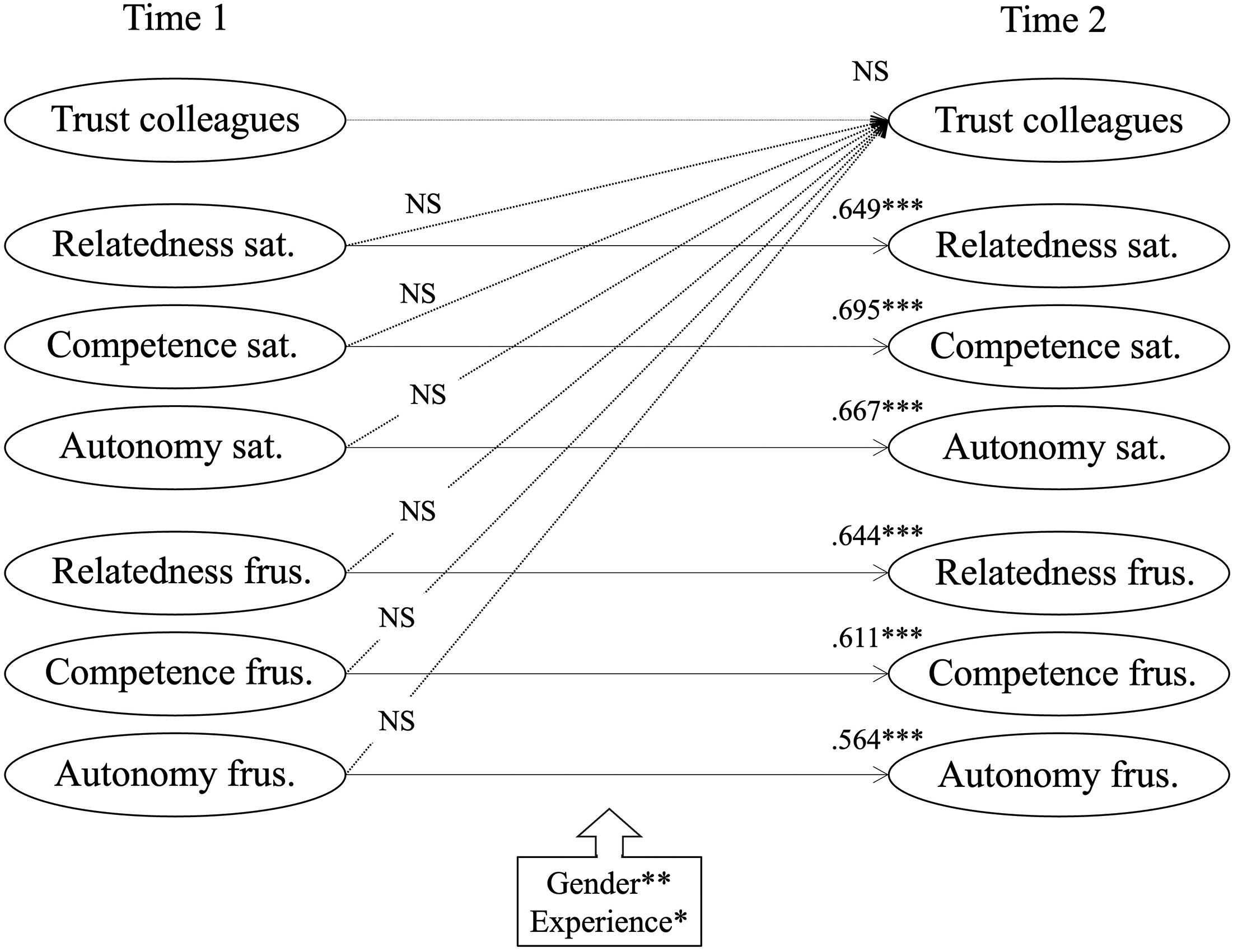
Reversed Model (M4). Note. Sat.: Satisfaction. Frus.: Frustration. *p < .05. **p < .01. ***p < .001.
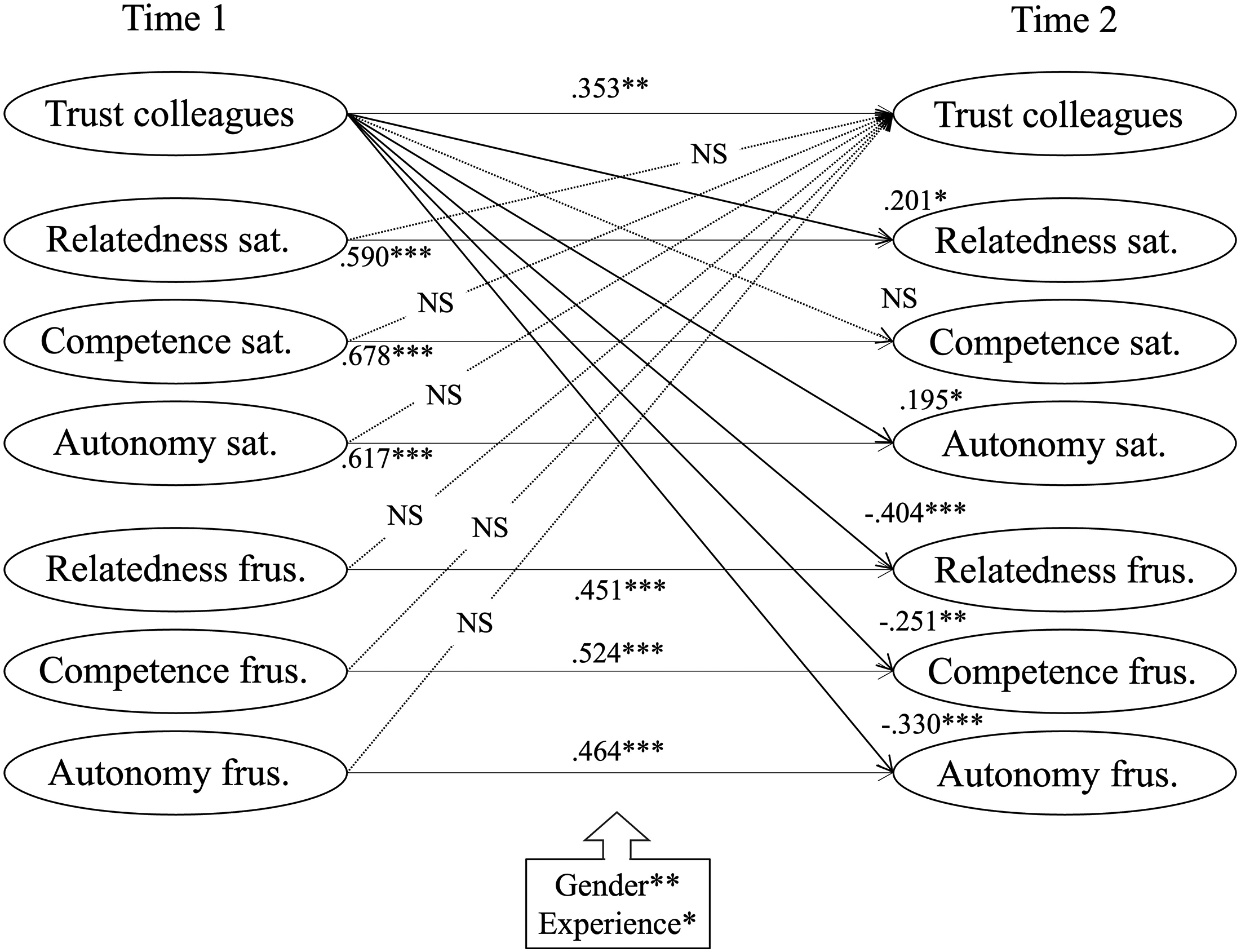
Reciprocal Model (M5). Note. Sat.: Satisfaction. Frus.: Frustration. *p < .05. **p < .01. ***p < .001.
In view of these results, and because the causal relationships proposed in M3 are all statistically significant, unlike those proposed in M4 and M5, the proposed model (M3) is the model selected for this study, providing a better fit to the data and significant cross-lagged effects. The control variables (age, gender, employment status, education, and experience) were considered in the evaluation of the SEM models, and only those with a significant association (gender and experience) are represented in simplified form in Figures 4, 5, and 6. Particularly, within the final model (M3), gender is associated with the satisfaction of the need for relatedness (r = −.13, p < .001) and frustration of the need for competence (r = −.11, p < .01). These results mean that male teachers have a lower perception of the satisfaction of their need for relatedness than female teachers, but they nevertheless have a perception of frustration of their need for competence that is also lower than female teachers. At the same time, teaching experience is associated with trust in colleagues (r = −.09, p < .05), satisfaction of the need for relatedness (r = −.22, p < .01), and frustration of the need for autonomy (r = .08, p < .05), meaning that more experienced teachers generally have lower perceived trust in colleagues, lower satisfaction of the need for relatedness, and greater frustration of the need for autonomy. However, these correlations are small (Cohen, 1988), and their impact on the model variables is therefore adequately controlled by including these two control variables (gender and experience) in the analyses.
The final model (M3) is shown in Figure 4. Specifically, all hypotheses are confirmed where trust in colleagues has a positive cross-lagged effect on the satisfaction of the basic psychological need for relatedness (H1a: β = .214, p < .05), for competence (H1b: β = .120, p < .05), and for autonomy (H1c: β = .204, p < .01), and a negative cross-lagged effect on the frustration of the basic psychological need for relatedness (β = −.427, p < .001), for competence (β = −.267, p < .001), and for autonomy (β = −.344, p < .001). The model explains between 49% and 51% of the variance in basic psychological need satisfaction, and between 44% and 57% of the variance in basic psychological need frustration.
In sum, the comparison of the four structural equation models established (1) the relevance of considering cross-lagged effects in addition to autoregressive effects when examining relationships; (2) the added value of links from trust in colleagues at T1 to need satisfaction and frustration at T2 in contrast to a model that would not consider them; and (3) that the addition of links from motivational resources at T1 to trust in colleagues at T2 makes no statistically relevant contribution to the proposed model.
Discussion
The aim of this research was to gain a better understanding of teacher trust in colleagues from a longitudinal perspective, making it possible to identify the temporal direction of the effects linking it to motivational resources according to self-determination theory.
Longitudinal analyses comparing four structural equation models highlighted the direction of the relationship uniting the variables of interest in this study: over time, trust in colleagues influences satisfaction and frustration of each of the basic psychological needs, and not vice versa. In this respect, considering the relationships between psychological needs at T1 and trust in colleagues at T2 does not provide a better fit to the data, and the regression coefficients associated with these relationships are all statistically insignificant. It is therefore possible to conclude that teachers’ trust in colleagues, as an element of social climate, contributes significantly to the three basic psychological needs, as motivational resources, while the reverse is not the case.
It is important to bear in mind that the context of this study is linked to the COVID-19 pandemic, since data were collected in winter and spring 2020, as well as a year later, in 2021. During this period, workplaces experienced disruptions related to psychosocial risk factors, for example (INSPQ, 2020). These elements may have contributed to a reduction in perceived levels of trust in colleagues, as well as in perceived levels of satisfaction of the basic psychological needs self-reported in both questionnaires, or to an increase in levels of frustration of these three needs due to the prevention and protection measures put in place during this period (INSPQ, 2020).
Also, when interpreting these results, it is important to consider that data from the teacher sample may sometimes diverge from that of the population. For example, the T2 sample has slightly more women than the population, and a slightly higher rate of permanent teachers. These slight differences in sample composition could affect the external validity of our results, as they are not entirely representative of the reference population. Indeed, the final model (M3) indicates that gender is associated with some of the latent variables, with male teachers having a lower perceived satisfaction of their need for relatedness than female teachers while also having a lower perceived frustration of their need for competence than female teachers. Regarding employment status, it was not significantly related to the latent variables in the final model (M3), so despite the fact that the proportion of permanent teachers was slightly higher in our sample than in the population, it did not seem to interfere with the relationships examined in our model.
Thus, within the final model (M3), while controlling for gender and experience variables, teachers’ trust in their colleagues at T1 contributes significantly to the satisfaction of their three basic psychological needs and to their frustration in small and moderate proportions respectively. This interpretation of the effect sizes of the regression coefficients must, however, be contextualized according to the design of this present study. “Indeed, controlling for stability effects is the gold standard of longitudinal designs as it enables researchers to examine whether the variable(s) of interest predicts the outcome over time, controlling for previous levels (the inter-individual differences in change) of the outcome” (Adachi & Willoughby, 2015, p. 118). The best predictor of behavioral or psychological outcomes is often the prior level of these outcomes (Adachi & Willoughby, 2015), and the drawback of autoregressive models is that a large part of the variance of the dependent variable is removed by controlling for prior scores (Adachi & Willoughby, 2015). It is in the light of these findings that the regression coefficients of the final model must be interpreted, particularly the lowest regression coefficients, i.e., those going from trust in colleagues at T1 to satisfaction of psychological needs at T2, as these are also the ones presenting the greatest stability (autoregressive effects).
The final model (M3) presents nuances regarding the role of teacher trust in the satisfaction and frustration of each basic psychological need. Specifically, trust has a small effect size (Cohen, 1988) on the satisfaction of the needs for relatedness, competence, and autonomy, as well as on the frustration of the need for competence. In contrast, the influence of trust in colleagues on the frustration of two of these needs is even greater: these are the needs for relationship and autonomy, for which trust has a medium-sized effect (Cohen, 1988). In a way, this pattern replicates the findings of Clément (2017) and Clément et al. (2020), who found that teacher trust in colleagues played a key role in the need for relatedness and autonomy, whereas the need for competence was influenced by trust in students. As teacher trust in students was not considered in this study, the results show that trust in colleagues has less influence on the satisfaction of the need for competence, and that this need for competence is therefore influenced by other variables, for example, variables related to their work in the classroom. This element will be further discussed in the limitations section.
Scientific Contribution
To the best of our knowledge, no scientific study before this one had evaluated the statistical relationship between teacher trust and the satisfaction and frustration of each three basic psychological needs simultaneously. Thus, the scientific contribution of this study is important in two respects: the importance of teacher trust in motivational resources at work, and the separate study of satisfaction and frustration of the three basic psychological needs. Firstly, the present results clarify the major impact of teacher trust in colleagues on motivational resources in the workplace. This study provides a response to Levasseur and Clément (2025a) call to determine the direction of the statistical relationship between trust and motivational variables. Indeed, it was determined through the analyses carried out in this study that trust in colleagues influences teacher motivational resources rather than the reverse. Secondly, this study highlights the distinct role of trust on the three basic psychological needs, and therefore enriches the self-determination theory scientific corpus on basic psychological need satisfaction and frustration by specifying one of their important determinants: teacher trust in colleagues. These results confirm that the three needs are not uniformly influenced by social climate, a key element of this theory (Slemp et al., 2020), and that it is necessary to capitalize on trust as a proven determinant in order to foster teacher motivational resources in educational institutions.
Managerial Implications
In light of this scientific contribution, several managerial practices could be favored by system-level and school-level leaders in vocational centers. In particular, the findings of this study show that increased relational trust in colleagues contributes, to some extent, to increased perceived satisfaction of the three basic psychological needs of relatedness, competence, and autonomy and, to a greater extent, to reduced perceived frustration of these same three needs among vocational teachers in Quebec. And since the social climate helps foster motivational resources, it would be wise to contribute to the establishment of a work environment that emphasizes the development of healthy interpersonal relationships among stakeholders. For example, to promote the satisfaction and reduce the frustration of basic psychological needs, new vocational teachers would benefit from support from their experienced colleagues through a mentoring system or an integration committee. In this way, the dimensions of relational trust aimed at benevolence (“Teachers in this school typically look out for each other”), reliability (“Teachers in this school can depend on each other even in difficult situations”) and openness (“Teachers in this school openly share information with others”) would be enhanced by the establishment of such a self-help network, due to the benefits of mentoring-type support (Riel et al., 2016).
Also, setting aside time for frequent meetings between staff members would create a setting where teachers feel comfortable sharing certain difficulties encountered in the course of their duties with their peers and promoting successful practices in their day-to-day work. These collegial exchanges on professional practices would help involve the dimensions of competence (“Teachers in this school do their jobs well”) and honesty (“Teachers in this school have faith in the integrity of their colleagues”) that teachers perceive in their colleagues during discussions involving vulnerable elements of their practice or, on the contrary, informed advice related to their professional skills.
Thus, as the three basic psychological needs (of relatedness, competence, and autonomy) have a demonstrated influence on the quality of teachers’ motivation (Abós et al., 2018), their burnout symptoms (Ranđelović & Stojiljković, 2015), their perceived well-being (Collie et al., 2016; Ebersold et al., 2019), and flow at work and life satisfaction (Olčar et al., 2019), they constitute an interesting lever to counter the teacher shortage. Thus, satisfying the three basic psychological needs through perceived high trustworthiness among colleagues is a promising avenue towards attracting and retaining teachers, as is counteracting the frustration of these needs through these same perceptions of trustworthiness among colleagues.
Limitations and Avenues of Research
There are some limitations to this study that represent interesting avenues of research to explore. Firstly, in addition to the current results regarding the influence of teacher trust in colleagues on basic psychological need satisfaction and frustration, it would be interesting to analyze vocational teacher trust in other referents, such as in school administrators and in students, to deepen our understanding of these motivational processes in a vocational center context from a broader perspective. In addition to having different antecedents and outcomes than trust in students, teacher trust in management and in colleagues may also differ in its factor structure from trust in students, and therefore may not be measured in the same way (Levasseur & Clément, 2025b). It would be wise to replicate this longitudinal study, this time considering teacher trust in system-level and school-level management or teacher trust in students and their parents.
Secondly, it would be relevant to compare the trust perceptions of several referents (teachers, students, principal) with one another in order to study the reciprocal mechanisms present within trust relationships in vocational centers. Variables such as gender similarity between teacher and principal (Berkovich, 2017) and ethnicity concordance between them (Brezicha & Fuller, 2019) have been shown to have an impact on teacher trust, reinforcing the importance of considering the reciprocity of trust relationships between stakeholders in the school environment.
Thirdly, this study focused on the effect of teacher trust on the satisfaction and frustration of teachers’ motivational resources, but the scientific community would also benefit from considering the concept of teacher distrust when it comes to the frustration of basic psychological needs, since this is likely to be part of a negative motivational process (Schaufeli, 2021). As such, Levasseur et al. (2023) demonstrated the negative motivational process involving interpersonal relationships, relational distrust and the satisfaction and frustration of the basic psychological needs of students in vocational training centers.
Fourthly, this study has certain methodological limitations linked to attrition and the risk of selection bias. The decrease in the proportion of male teachers between the two measurement times (and the greater proportion of female teachers at T2) may raise questions about the representativeness of the sample. However, an analysis of variance (ANOVA) was carried out to compare teachers who responded only at T1, only at T2, and at both measurement times. The results revealed no statistically significant differences between these groups, suggesting relative stability in respondents’ sociodemographic characteristics over time. Despite this, we recognize that external validity remains a concern, and we interpret our results with caution in this regard.
Fifthly, as mentioned above, the social context in which this study was conducted was affected by the particular concerns and actions related to the spread of COVID-19. Teachers’ self-reported perceptions of their colleagues’ trust attributes and motivational resources were closely linked to the situation they were experiencing, and it will be important to replicate this study in a post-pandemic context to ensure the external validity of the results obtained.
Conclusion
In an environment where resources are limited and the task of teaching is daunting, vocational teachers have a significant advantage in cultivating trusting relationships with their colleagues to foster their work motivation. This study reinforces the importance for the academic community and educational leaders to better understand a key factor of relational climate such as trust in order to significantly contribute to teacher motivational resources in Quebec's vocational centers, which face a rather high rate of teacher precariousness.
Footnotes
Declaration of Conflicting Interests
The authors declared no potential conflicts of interest with respect to the research, authorship, and/or publication of this article.
Ethics Declarations
The research project has been approved by the Université Laval Research Ethics Committee [Approval No. 2018-314 A-3 R-2/11-01-2021] and all participants gave written consent.
Funding
The authors disclosed receipt of the following financial support for the research, authorship, and/or publication of this article: This work was supported by the Social Sciences and Humanities Research Council (SSHRC) under scholarship number 767-2021-1500 awarded to the first author; and by Fonds de recherche du Québec (FRQ – Societé et culture] under Grant number 2019-NP-252722 awarded to the second author.
