




Abstract
Keywords
Introduction
The issue of school leader autonomy (hereafter SLA) has gained increased attention in prominent journals focusing on school leadership and administration from the 2000s onwards, including Educational Administration Quarterly. This can be seen in relation to several education governance dynamics. For instance, school systems worldwide have transformed from centralized to decentralized and deregulated systems, which has changed the framework for school leaders’ work and their autonomy (OECD, 2015; Pont et al., 2008; Preedy et al., 2002). The introduction of neo-liberal policies and marketization, witnessed globally in recent decades, also affects school leaders’ work and capacity for local discretion (Ball, 2009; Hargreaves & Shirley, 2009; Whitty, 2010). These international trends have also been accompanied by an increasing number of mechanisms for external inspection and accountability (Gustafsson et al., 2015; Paufler & Sloat, 2020; Penninckx et al., 2016; Rosenblatt & Wubbels, 2021). Together, these changes generate interesting but also complex conditions for school leaders’ work in many contexts. Additionally, the issue of SLA becomes no less relevant in school systems which, at least formally, still have a rather centralized design. Despite school systems being formally centralized school leaders can have a comparatively high degree of autonomy in their everyday practice, because laws and regulations provided by the government must still be adjustable to regional and local particularities and cultural contexts, and to schools’ demographic characteristics, performances, ownership, and so forth (e.g., Agasisti et al., 2012; Bush & Ng, 2019). This can open up considerable discretion for school leaders’ decision making. Also, vice versa, a decentralized school system does not necessarily lead to extended autonomy for education professionals, but to more subtle forms of governance such as steering by external expectations (Ingersoll, 2003; Salokangas & Ainscow, 2018; Wermke & Salokangas, 2021). In other words, there is scholarly evidence that the relation between decentralization-centralization and SLA might be more complicated than first assumed. Against this backdrop and the complexity of the phenomenon, SLA becomes a significant issue to explore in a systematic manner. Thus, it is suitable for review and synthesis from several viewpoints.
Previous debates also go beyond the influential journals on leadership and administration research, adding important perspectives and nuances to the current body of work on SLA. For instance, research conducted in the Scandinavian context offers insight, given its tradition of decentralized school governance which leaves a considerable degree of autonomy to local professionals (Ärlestig & Johansson, 2023; Moos et al., 2016). The Swedish school system, in particular, is frequently described as a striking example, and even as a “pilot project” of decentralization and marketization, as it provides school leaders with opportunities—but also essential challenges—for navigating local freedom (Blossing et al., 2014; Lundahl, 2002). In another context, Australian research has highlighted the risk that students from poorer backgrounds might be even further disadvantaged, if schools were to become more autonomous and thus bear more responsibility for their own development (Keddie, 2017). These and other works expand the understanding of the complex phenomenon of SLA and how it could be explored in a wider range of contexts.
Thus, there are profound arguments for systematically and critically reviewing the literature on SLA, both to map the dominant strands of current research and to identify particularities from various contexts and contributions. Given the policy trends described above, and the limited understanding of the impact of increased SLA on school leaders’ work across various national, regional and local contexts, the issue of SLA becomes a vitally important subject to examine. Although the phenomenon of autonomy has a well-established history in educational sciences, this is mainly from a teacher perspective (e.g., Ingersoll, 2003; Sahlberg, 2011; Wermke & Salokangas, 2021). Until now, no attempts have been made to systematically review the literature on SLA, and therefore we still lack a comprehensive and even critical image of SLA (cf. Cheng et al., 2016). We argue that an investigation of different school leader positions’ autonomy can expand the understanding of the concept of SLA generally without overlooking the fact that different governance regimes interact differently with potential professional action (Wermke et al., 2022).
Building on the conceptual literature, we recognize the multidimensional nature of SLA. That is why this article's systematic review demands a broad and inclusive design (see, e.g., Cheng et al., 2016; Wermke et al., 2022). Aside from its complex nature, SLA must be depicted and explored from national, regional, and organizational contexts (Hallinger, 2018). Further, leadership is nested within and between different levels of school systems (Henriksen & Paulsen, 2021; Xia et al., 2020) and therefore this article understands SLA as an interrelated phenomenon which should be explored in an inclusive design (see also Mayer et al., 2013). Such a design will also be sensitive to country differences in the formal position and role of school leaders. In some contexts, for example Germany and Spain, administrative tasks such as budgeting, facilities, teacher recruitment and wage-setting are primarily operated from the state/district/municipal level, while in South Africa, and some US states, these tasks are largely managed at local school level. Thus, an important point of departure is that the formal leadership of schools can involve various professions and actors 1 and, further, that national, regional, and organizational contexts also have an important impact.
The study on which the article is based is part of a larger research project funded by the Swedish Research Council. By mapping and synthesizing the breadth of existing SLA literature, the article aims to address and extend former results and debates in this journal. In total, 14 of the 113 articles included in our review were published in the Educational Administration Quarterly, illustrating the importance of SLA for the field of education administration and leadership research internationally. The research questions which guide our systematic review work are of a descriptive nature, addressing the what, who, where, and so what of the collected research corpus on SLA. In analogy with the larger research project's aspirations, we ask the following research questions (RQs). We then summarize the work with a definition and discussion of what SLA is, drawing on international research.
RQ1. What types of leadership decisions and decision processes are included in SLA? RQ2. Which actors and their relations are included in SLA? RQ3. Which impacts do contextual particularities have on SLA? RQ4. What are the impacts of extended SLA?
This review includes all research in the English language in peer-reviewed scientific journals, available to the international research community, and distinguishes itself first and foremost by its contribution to an elaborated understanding of SLA. Books, theses, and research in other languages are not included. Focusing only on work available in the English language assists our aim of contributing to international research, in that we draw on work widely accessible to the international scientific community. Including only peer-reviewed articles ensures that only valid and reliable research is included in our synthesis.
The article proceeds as follows: First, the scope and parameters of the systematic review are presented. Second, the review methodology is discussed, detailing identification of relevant research and how it was synthesized. Third, we present the results from our analysis. This starts by presenting descriptive data from the sampled articles, and then describes the main findings from the four research questions. In the final discussion we critically discuss key findings and avenues for future research.
Scope and Parameters of the Review
The scope of this review is purposely broad, as a key initial aim is to map the breadth of the existing literature on SLA. We pay particular attention to the formal leadership position of superintendents, school principals and their equivalents. In the case of superintendents, these equivalents could be administrators or other managers at district or central municipal level, who have an explicit responsibility for schooling. In the case of principals, we pay specific attention to the formal leadership position in one or more schools and the person(s) with the executive mandate to take decisions in the local school organization.
There are no geographical or disciplinary restrictions on our searches, which also consider various grade levels and forms of compulsory schooling (public and private). A time limit was set to the years 2000–2023 because this period covers extensive decentralization and deregulation reforms in many countries, which enables us to explore SLA within and between different contexts. Breadth of scope is similarly reflected in the broad definition of autonomy. More specifically, we found a wide (but nevertheless rewarding) description of what autonomy encapsulates in a school leadership context in the work of Wermke and Salokangas (2015): Autonomy is a widely used concept in education policy and practice. The etymology of the concept derives from the Greek autonomos ‘having its own laws’ (Oxford Dictionaries, 2015). As such, the debates around the concept circulate around individuals’ or groups’ ability and capacity for self-rule, and the governance and/or constraints which limit such a capacity (p.1).
This inclusive description provides a lens to depict and analyze SLA within and across national, regional, and local contexts and different types of governance systems (see also Woods et al., 2021). For instance, SLA research measures school leaders’ experienced autonomy, but it also addresses constraining factors that frame and control autonomy (cf. Ingersoll, 2003). It further focuses on the foundation of autonomy, i.e., which capacity is necessary and desirable for school leaders to be able to self-rule. The description also incorporates different school forms and both public and private school providers, regardless of national, regional, and local contexts (Salokangas & Ainscow, 2018). Furthermore, the definition avoids a normative “trap,” i.e., whether autonomy is preferable, and control is not (Cribb & Gewirtz, 2007). From research on teacher autonomy, it is apparent that autonomy is often understood in terms of a dichotomy of constraint vs. freedom (see e.g., Schulte, 2023). This article views autonomy as a matter of understanding the relationship between autonomy and control and how that relationship is framed.
Methodology
The analytical work followed the four-step PRISMA process for conducting and reporting systematic reviews, comprising identification, screening, eligibility, and inclusion (Moher et al., 2010). Each step is discussed and summarized in Figure 1. The analysis was also inspired by the work of Greaves et al. (2023), in which they apply and adapt the PRISMA process.
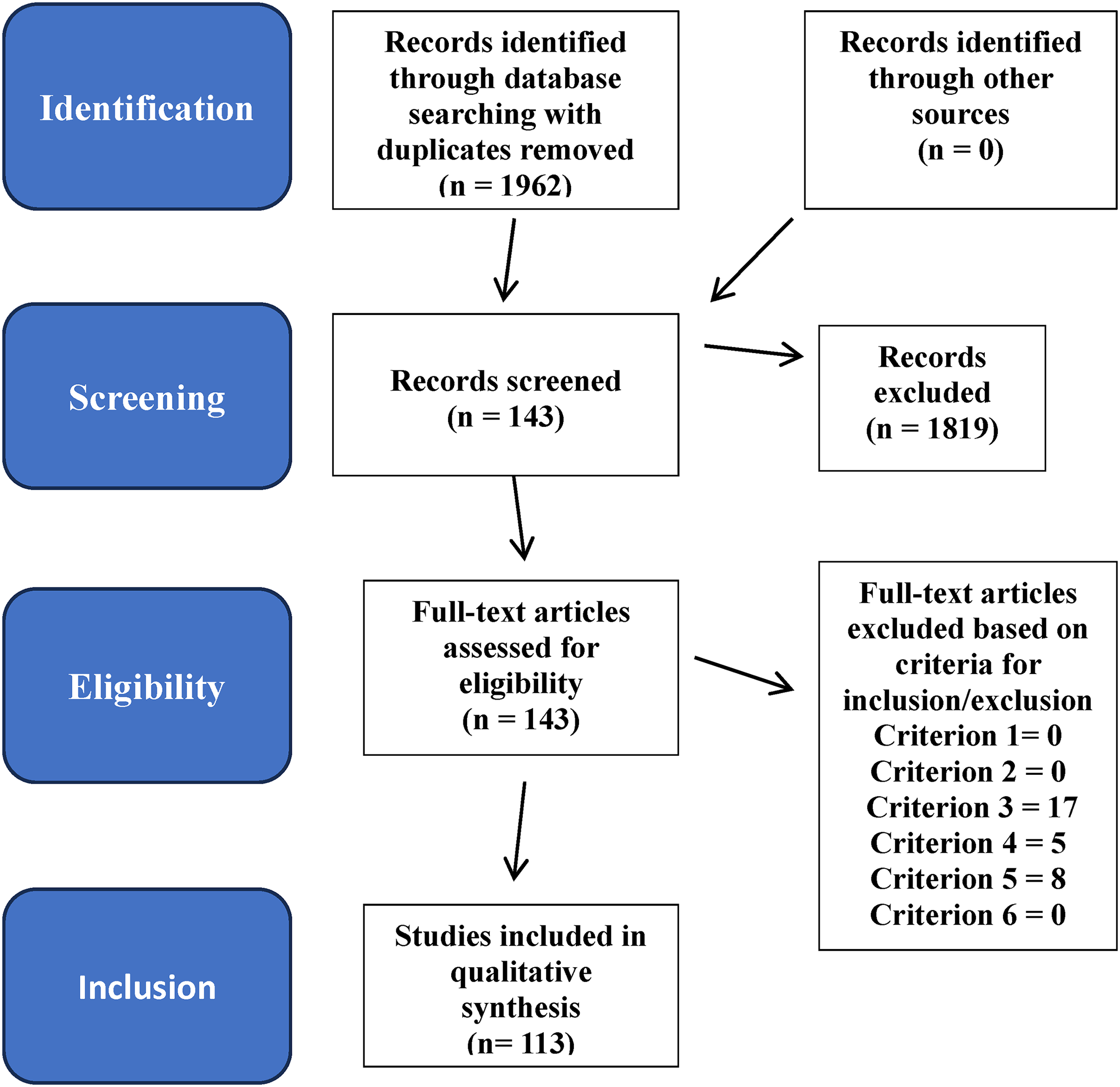
Screening process based on the PRISMA model.
Identification
The search process was designed in collaboration between the researchers and a university librarian with expertise in electronic searches. Given this review's broad scope, databases were strategically selected to cover not only education, but other disciplines such as public administration and management, business economics, sociology and psychology, and history. Consequently, the specialized databases Education Resources Information Center (ERIC), Business Source Complete (BSP) and Educational Research were searched, as were the interdisciplinary databases Scopus and Web of Science.
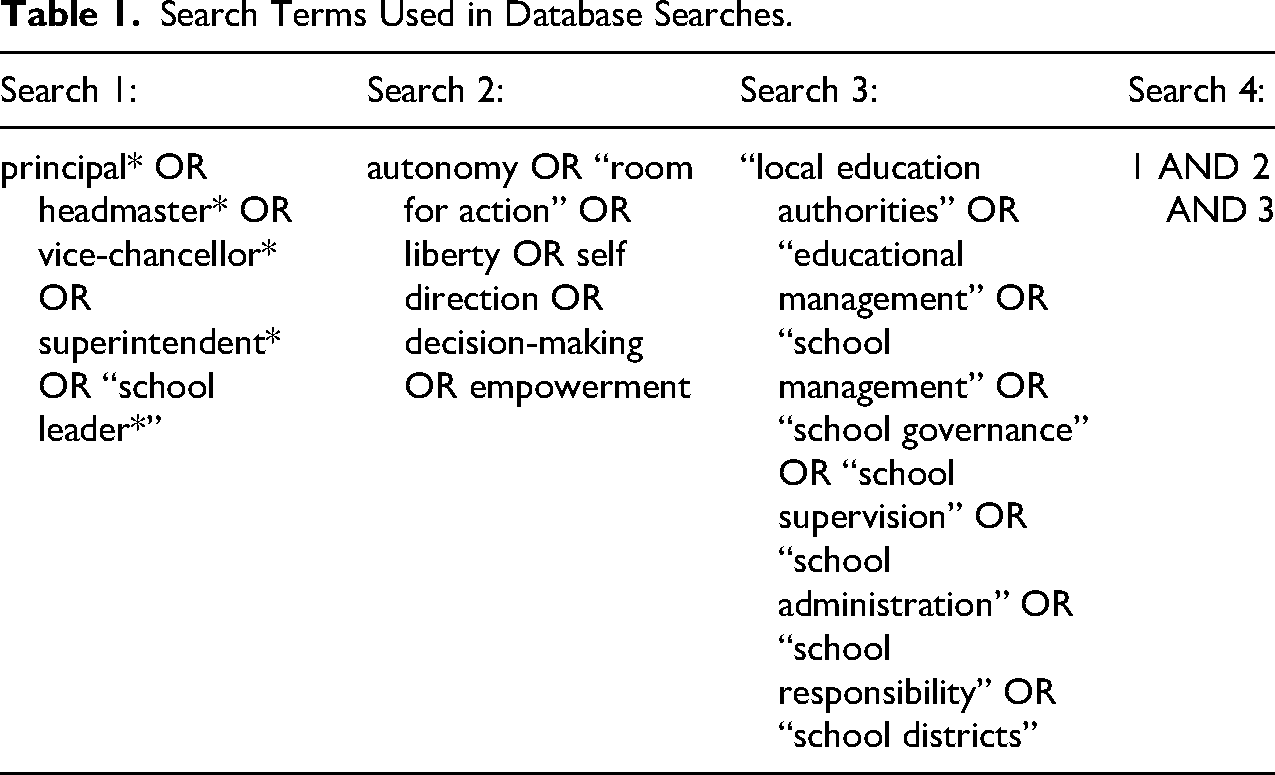
The search strategy was based on three main elements of the research questions. It operationalized our focus on the autonomy of various types of school leaders in different contexts, concentrating on the phenomenon's potential impact. From this focus, “school leader autonomy” evolves as an umbrella term synthesizing our findings. Accordingly, and building on extensive discussion in our experienced research team (see below), we created search blocks and combined them to form the basis of the search. As shown in Table 1, we applied several search terms for each element, to ensure inclusion of divergent terms applied in various contexts, and in accordance with the conceptual positioning of the article, detailed above. This first database search with time limitations generated 1,962 (n = 1962) records (see also Figure 1).
Search Terms Used in Database Searches.
Screening
All records were imported into software for systematic research reviews (Rayyan 2 ). Rayyan is a web tool for conducting systematic reviews and other knowledge synthesis projects. More specifically, its digital interface is designed to organize, categorize and analyze extensive data sets or research studies. We started with the initial inspection of 1,962 records (titles and abstracts). Records were included/excluded based on the criteria detailed below. To identify potential themes and patterns as well as key works, we also took memo notes in Rayyan relating to the research questions. The work process in Rayyan consisted of 117 sessions, comprising 3,462 min in total.
Inclusion and Exclusion Criteria
To delimit and define the search, and to work with the results in a structured way, inclusion and exclusion criteria were defined in advance:
Compulsory education—i.e., primary or secondary schools or international equivalents. Public or private schools (and the interaction between the two). Discussion or description of superintendents’ and principals’ and their equivalents’ autonomy and possibilities (not) to take decisions (in the broadest sense). Theoretical and/or empirical studies including policy analysis.
In the initial screening based on abstracts and titles, the first criterion (compulsory education) excluded a considerable number of studies concerning high school, higher education, or preschool. The decision to include solely compulsory education was based on the evident heterogeneity in other school forms internationally (e.g., preschool and upper secondary school) which would limit the possibilities of providing a coherent and relevant review in terms of SLA. In contrast, few records were excluded based on the second criterion because almost all studies focused on public or private schools. The third criterion was significant, as it excluded records focused on other levels and/or professionals in the school system, i.e., deputy or vice principals, aspiring principals, teachers, teacher leaders, middle-leaders, and teacher unions. As indicated above, the main argument for excluding these other categories of staff was to solely include school leaders who have formal decision-making responsibility and mandate in a school organization. The fourth criterion also disqualified a large number of records such as summaries, digests, researchers’ and/or practitioners’ reflections, opinion papers, bibliographies, guides and guidelines, strategies, and recommendations (see e.g., Jones, 2015; Klein, 2018; Walker, 2007). Examples of records that met the inclusion criterion of empirical studies include the work of Bottery (2007) and Neeleman (2019), integrating empirical data into their analysis and publications. Examples of records that met the inclusion criteria of theoretical studies are the work of Wildy et al. (2004) and Somech (2010), which elaborated theoretical frameworks and concepts of autonomy and/or control by superintendents and/or principals.
We additionally set the following exclusion criteria:
Wrong type of publication (reports, dissertations, student theses). Non-English language texts.
The initial screening of records from the database searches yielded 143 (n = 143) outputs.
Eligibility and Inclusion
In the second phase of the screening process, all records (n = 143) were inspected separately by Author 1 and Author 2 (full-text review) against the inclusion criteria. Studies that did not fit the criteria were excluded, and reasons for exclusion were noted individually and then compared jointly (detailed in Figure 1). The screening process had a comprehensive and inclusive design, so backtracking of further references was not considered necessary. This second phase yielded 113 papers (n = 113), constituting the final sample. The full list of these papers, with their specific numeric identifiers, is given in Appendix 1.
Categorization of the Data
Inspired by the work of Greaves et al. (2023) and their approach for organizing data, realist synthesis protocols were developed to ensure rigor in the analytical work. The protocols were jointly developed by the research group, comprising three researchers with extensive experience in educational leadership and administration, and the university librarian expert on electronic searches. We identified three types of data which we judged most useful for our initial analysis. Table 2 shows these types and the categories we applied to organize the data. Data was extracted in detail by two doctoral students in educational administration in close dialogue with the research group.
Categories for Organizing Data.

The dimensions (a) and (b) provide the data necessary for a comprehensive description of the dataset. Dimension c) relates mostly to the research questions, methodology, findings and implications for our research corpus. The aspects documented from the articles are indeed more wide-ranging than our research questions. This is due to our ambition to make it possible for other interested researchers to use the data for further analyses. Briefly, our analyses looked in particular at theory and findings in relation to RQ1 (What is SLA?), RQ 2 (Who are involved in SLA?). RQ3 (How does SLA interact with contextual particularities?) and RQ4 (What are the impacts of SLA?), drawing on the aspects implication and contribution.
As the first step in the analysis, the three researchers individually and inductively inspected all the protocols concerning different dimensions of SLA. Each researcher identified recurring themes related to the dimension(s) of SLA for which they were responsible. In step two, the researchers jointly analyzed the themes emerging in relation to each dimension. They also inspected all relevant publications in each dimension by fully reading each publication again to obtain sufficient details to draw synthesizing and summarizing conclusions about what characterizes the research on SLA.
Results
The result section comprises two parts. In the first, we present descriptive observations of the dataset. These observations provide a relevant starting-point for the analysis in relation to RQ1-RQ4, which we present in the second part.
Descriptive Statistics of the Dataset
Figure 2 below provides an overview of the distribution of countries in which research on SLA has been conducted.
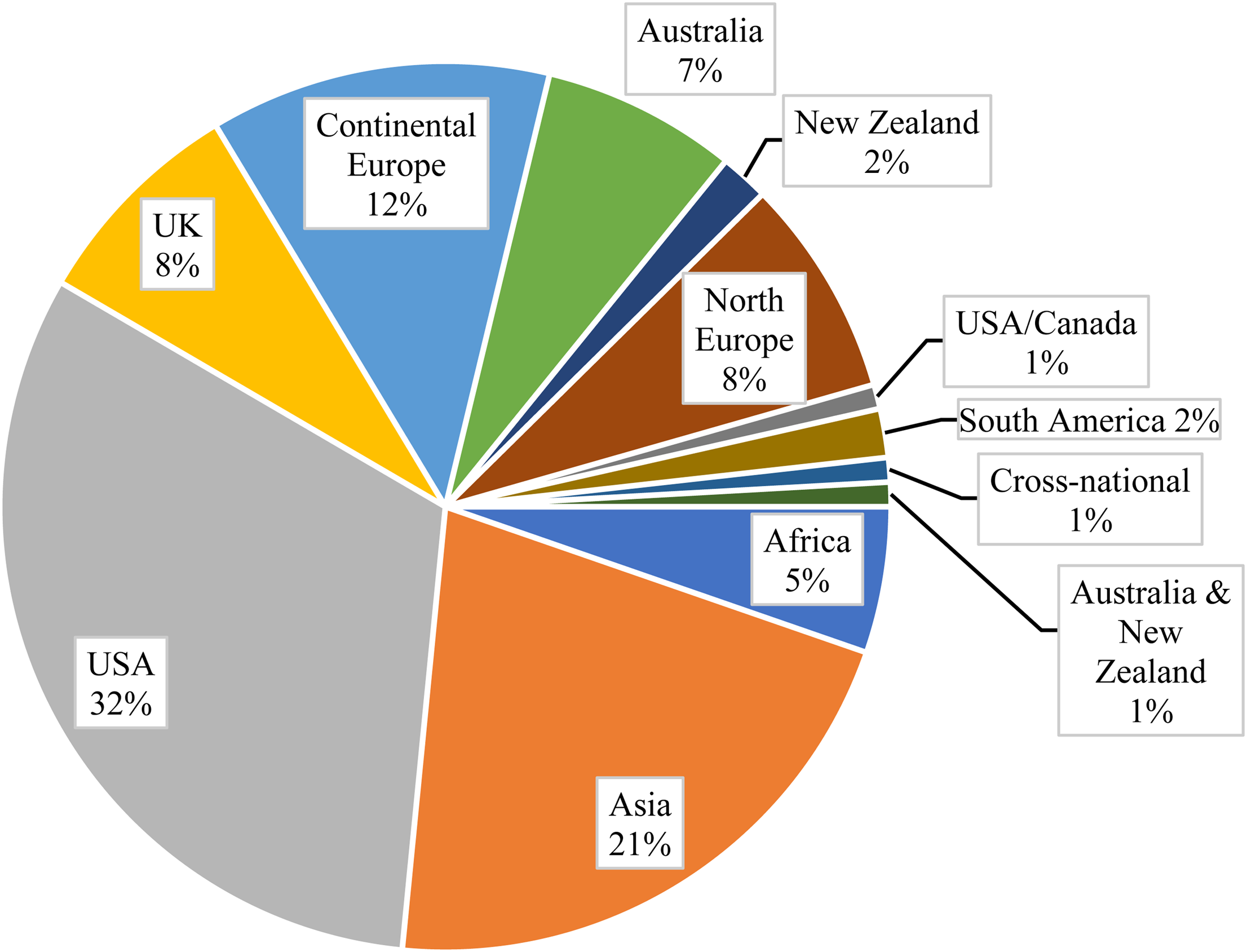
Distribution of publications based on country.
Figure 2 shows that a large amount of the research in our corpus has been conducted in the US, followed by Asia, Continental and Northern Europe, Australia, and the UK. It also becomes clear that many countries are sparsely represented, such as the African and South American continents and Eastern Europe. It is also notable that few studies have been carried out in German, Spanish, or French speaking countries. This, however, might also be linked to the exclusion of non-English texts, which is problematized in more depth below.
Another way to examine the existing body of research is to look at how the number of publications has been distributed over time. Figure 3 presents the distribution of publications over the period studied.
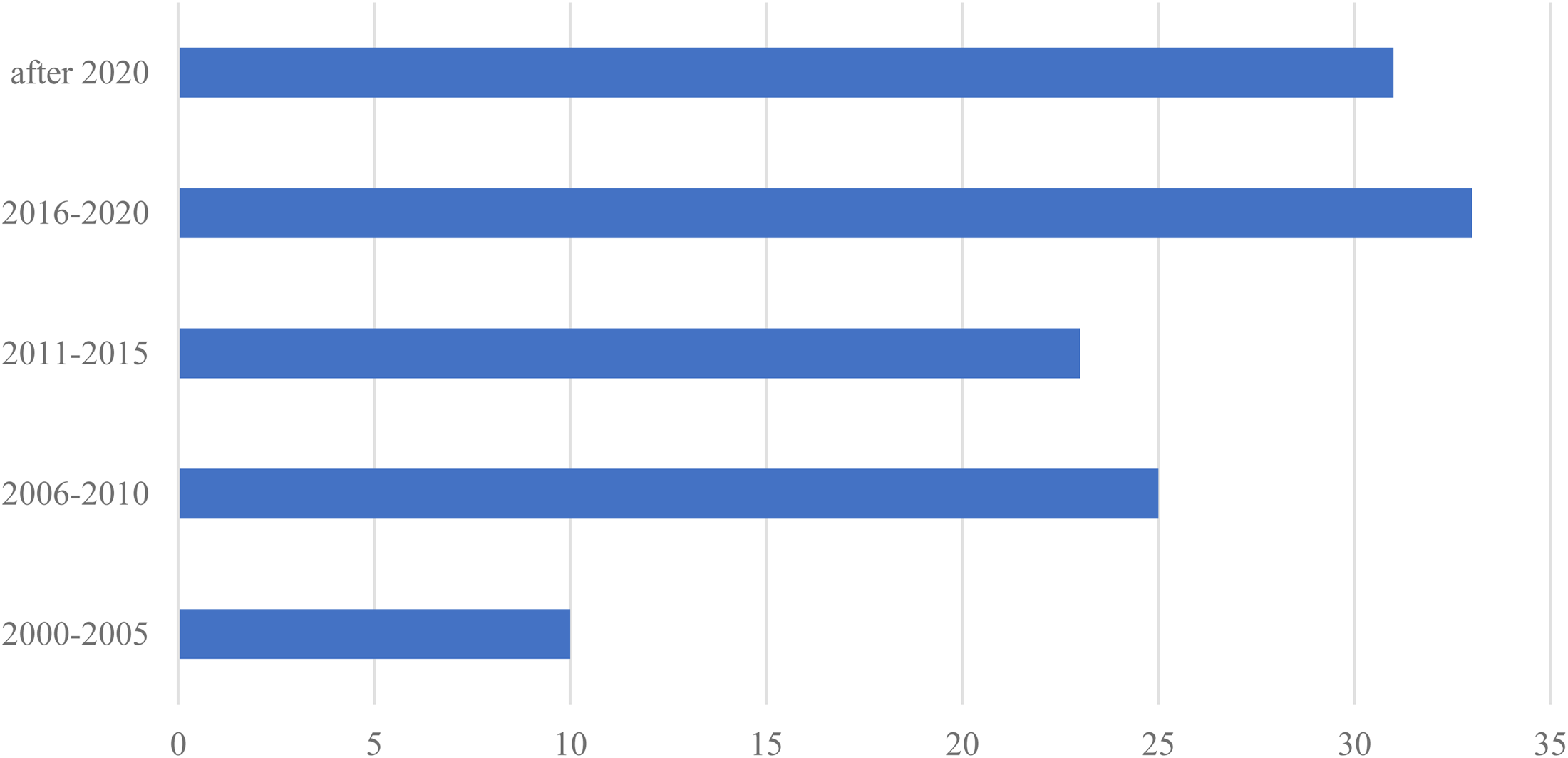
Distribution of publications over time.
Figure 3 presents journals with more than five published articles and indicates a significant increase in the number of studies over the period 2000–2023. This becomes particularly clear in 2016–2020, in which over 30 articles were published. While few were published between 2000 and 2005, overall there is a clear growth in the number of published articles.
Another relevant aspect concerns the methodological approaches found. Figure 4 offers further details in this regard.
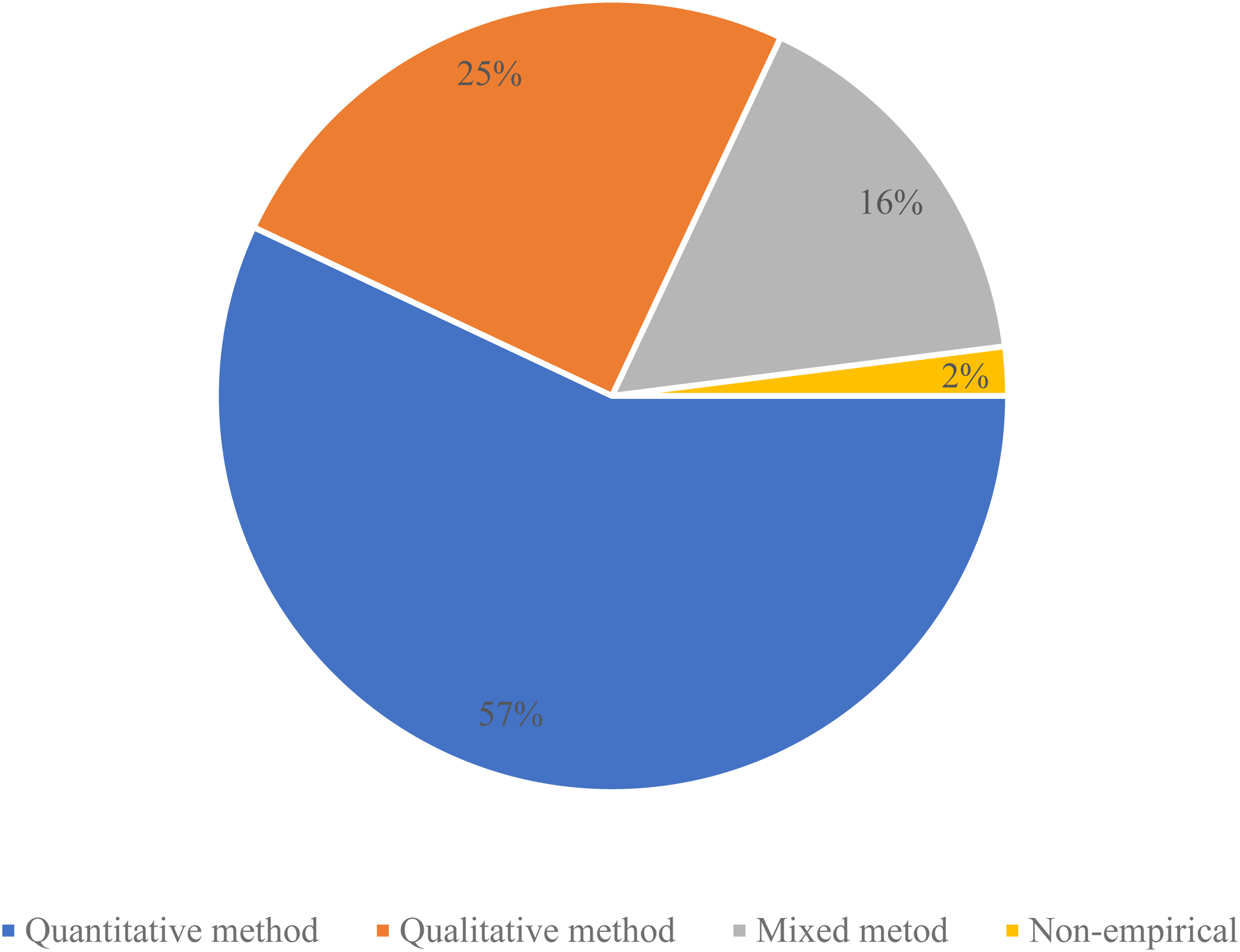
Methodological approaches.
As shown by Figure 4, a majority of the studies had quantitative approaches, although there is a good representation of studies that applied qualitative and mixed-method designs. It is worth noting that only a few studies are “non-empirical,” for example theoretical contributions and/or critical analyses.
A fifth aspect of the studies concerns the journals in which the research was published. Figure 5 provides such details.
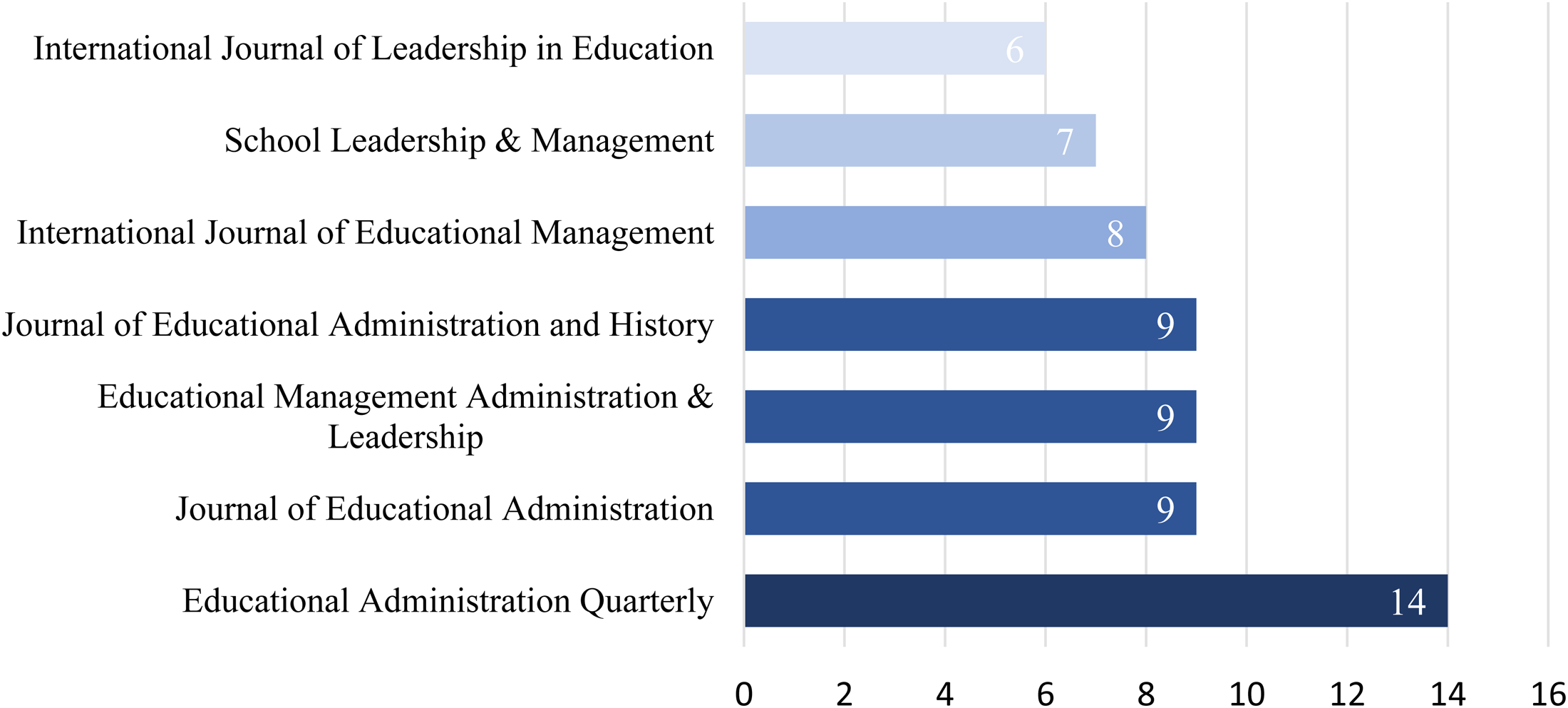
Journals and number of publications.
Figure 5 indicates, unsurprisingly, that a significant amount of the research was published in established leadership and administration journals based in the US or UK. A corollary of this observation is that no general educational sciences journals, or ones belonging to other (but still adjacent) disciplines, or those with interdisciplinary approaches, were among the journals in which most articles were published.
The various Dimensions of SLA
This section addresses each RQ in order. Figure 6 illustrates the various dimensions of SLA and how they relate to the RQs, and aims to guide the reader through the forthcoming analysis. To clarify, the first dimension of our definition of SLA refers to how international peer-reviewed research has defined the phenomenon, paying particular attention to decisions and decision-making, as operationalized in RQ1. The second dimension, addressing RQ2, focuses on the main actors (see also footnote on p. 5) involved in SLA, and their relations, in current research. In addressing RQ3, the third dimension demonstrates how current research reveals contextual particularities and how that might impact SLA. Finally, and linked to RQ4, the fourth dimension targets what research tells us regarding the impact of extended and restricted SLA.
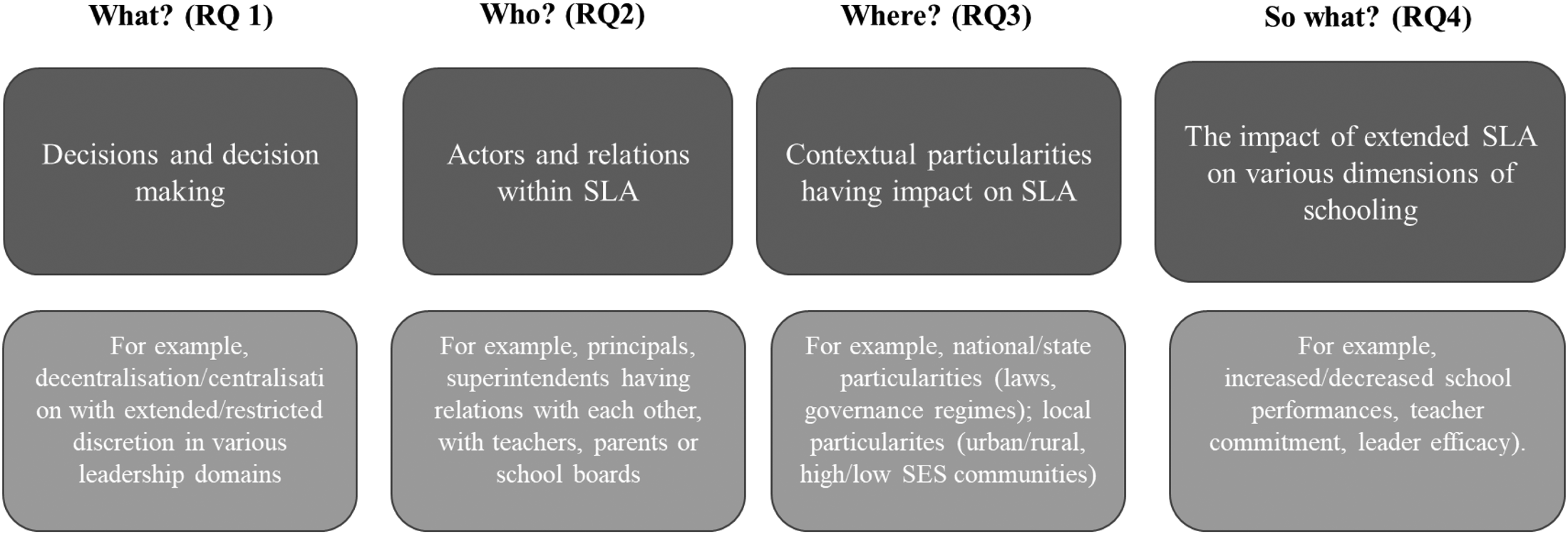
The various dimensions of SLA.
To facilitate reading, and due to limitations of space, the analysis applies a system where articles are cited by a number in brackets. Each number corresponds to a particular publication, which is referenced fully in Appendix 1. The examples included aim to represent dominant strands and interesting variations in the literature. They also reflect the literature in terms of number of studies. Therefore, examples from a US setting are most frequent.
I. Decisions and Decision-Making in the Literature on SLA
In accordance with influential research (see e.g., Cribb & Gewirtz, 2007; Ingersoll, 2003; Ingersoll & Collins, 2017), the right to take important decisions in (school) organizations, and also who or what controls these decisions, are essential elements of autonomy. In this regard, a significant number of papers address the possibilities and constraints for school leaders and administrators, individually or together with other educational professionals, to take decisions in various national, regional and local contexts, frequently linked to recent decades of decentralization and deregulation reforms. The focus on school leaders’ degrees of freedom and challenges to take important decisions also resonates with the inclusive definition and epistemological starting point of this article. Accordingly, in this first section we pay attention to how the current body of research on SLA has delved deeper into the issue of decisions and decision-making.
Regarding RQ1, the capacity to take decisions on an individual or collective basis and the control of these decisions are essential themes of SLA. One theme in the research represented in 19 (n = 19) papers focuses on decisions on curriculum and instructions/pedagogical methods [1, 10, 12, 15, 20, 21, 28, 33, 34, 47, 48, 58, 61, 71, 77, 93, 103, 104, 110]. The arguments as to why this area is important are reflected in the literature from various contexts. For example, in a US context, paper 28 showed that SLA could be vital to address key issues such as dismantling an ineffective instructional program and promoting teacher accountability. However, having the mandate to take decisions in this area is not obvious in all contexts. In a Spanish setting, papers 77 and 110 revealed that principals need greater autonomy in relation to teachers and teaching practice and to develop pedagogy. From another context, a Kuwaiti paper [103] also showed the importance of SLA connected to instructional programs and school improvement.
Another theme revealed in the literature is the possibility to take decisions on administration, budgeting and organization [10, 12, 18, 20, 47, 48, 50, 53, 54, 55, 71, 82, 83, 94, 103, 104, 106, 108, 110]. In total, 19 (n = 19) papers present this theme. For example, in a study of how US principals’ working conditions influence the probability of different types of turnover, paper 94 showed that increased influence on budgeting was associated with lower odds of principals leaving the profession or their schools. This strand of autonomy and being able to take decisions is also shown in paper 9, conducted in the Australian and New Zealand context. This showed that school leaders experienced a high degree of autonomy in key areas such as budget and organization which, nevertheless, also entailed a balancing act between autonomy and accountability. Additionally, even though the general observation held that this theme is an important dimension of SLA, essential challenges are also reflected.
Within this broader theme one recurrent and particularly important issue concerns decisions on staffing and hiring/firing, highlighted in a total of 10 papers [10, 12, 18, 20, 29, 55, 60, 65, 67, 93]. Here, as well, the possibility to take such decisions is generally shown to have a positive impact on school leaders’ work and schools’ development. In paper 29, from a Norwegian context, results indicated that decentralized hiring by principals led to greater efficiency than centralized practices, and also to a better match between teachers and schools, which increased the efficiency of education. However, the positive effects of decentralized hiring possibilities were stronger in districts with a higher supply of qualified teachers, which allows for better selection. Put another way, in districts with fewer qualified teachers, e.g., in rural regions, the possibility of taking decisions on teacher hiring becomes more complex, according to our results.
Another emerging theme is linked to specific issues such as discipline policies and performance standards [20, 58, 61, 93, 94]. For instance, by comparing the autonomy between district central offices and school principals in the US, paper 93 revealed that school principals had greater influence compared to district central offices in some decision areas examined, such as performance standards, teacher evaluation, and discipline policies. Paper 20 examined the degree of autonomy experienced by principals in both charter and traditional public schools, by employing data from the 1999–2000 School and Staffing Survey (SASS) in the US. The results showed that charter school principals experienced more decision-making power over performance standards and discipline policies, compared to their public colleagues. These results are confirmed in paper 61, which indicated that private school principals have an advantage over their public counterparts by being significantly more influential on almost all school-related activities.
To sum up, and in terms of decision and decision-making, there are certain strands in the literature examining areas such as curriculum, instructions/pedagogical methods and organization and budgeting, and whether school leaders have capacity to take decisions within these strands. In that sense, the review reveals evident differences between different countries and contexts. Aside from these influential strands and the ability to take important decisions, there are, obviously, also areas that call for further inquiry, to which we will return in the discussion and conclusions section.
II. Actors and Relations of SLA
This second section addresses which actors the current body of research considers as having something to say in relation to SLA (RQ2). Analyzing whose voices are included in the studies, e.g., from which actors the empirical data is collected, we found that numerous studies draw on empirical data from one sole actor (n = 50). Among these studies the voice of principals recurs most frequently [2, 7, 9, 15, 19, 20, 28, 32, 38, 39, 44, 45, 49, 50, 51, 58, 59, 61, 63, 65, 66, 69, 75, 78, 79, 80, 83, 85, 86, 90, 93, 94, 101, 103, 105, 107, 108, 111, 113]. For example, paper 19 focuses on two principals’ experiences of a dual-leadership model in international schools in China, while paper 69 uses a sample of 6,630 US principals to explore how they perceive their own and other stakeholders’ influence in various school decisions. Such studies exemplify the varying sample size used in studies that draw on principals’ voices. These also include paper 50, using a sample of 153 principals from six federal states in Germany to explore principals’ workload and priorities in the light of autonomy reforms. Another example is paper 51, studying how a sample of 1,501 US principals experience their autonomy and school district support. To a significantly lower degree (n = 5), superintendents [1, 4, 5, 14, 64] also do have a say in relation to SLA. These studies also vary in sample size and focus: paper 14 follows one rural superintendent's day-to-day work, and paper 4 explores 2,262 US principals’ perceived relations to their school board and communities. The literature also considers teachers (n = 6) as having a say on SLA [25, 30, 31, 46, 71, 82]
Another finding is that SLA is investigated from the perspectives of multiple actors in numerous studies (n = 38). Among these, most include the voices of actors at individual school, district or central administrative levels [3, 8, 11, 12, 13, 16, 27, 33, 35, 41, 53, 56, 67, 73, 76, 81, 87, 95, 96, 97, 98, 102, 106, 112]. For example, paper 81 investigated the interplay between Swedish local educational authorities’ (LEAs) governing of education and principals’ responses, using interviews with principals and various LEA officials; paper 96 included charter and district administrators as well as teachers, principals, and teacher leaders in their study on SLA in relation to various governance models in a US school district. Others drew on the voices of actors at the individual school level only [6, 18, 23, 36, 37, 40, 42, 48, 57, 62, 68, 72, 110]. Principals (secondary schools), headteachers (primary schools), and senior and middle leaders were interviewed in paper 72, focusing on distributed leadership in schools in Malaysia. Paper 23 explored the role of principals in relation to mandatory school governance bodies (SGBs) in South African schools, based on interviews with various SGB governors including teachers, learners, and parents.
To sum up, we found two major strands in the current body of SLA literature in relation to the actors involved. First, and perhaps not surprisingly, principals do have a say in relation to SLA across many contexts. Second, the literature often portrays SLA as a multi-relational phenomenon, as it includes the voices of actors primarily at both school and district level. However, there were very few studies on SLA particularly centered on superintendents and/or other administrators at district or central municipal level, and therefore their voices are virtually silent in the current literature.
Next, still addressing RQ2, we delve into questions concerning relations among the various actors involved in SLA. What relations exist among actors shown by the previous section to be involved in SLA? Examining the main unit of analysis in the studies, we found that principals are the main focus of most (n = 51) [8, 9, 11, 12, 16, 19, 20, 23, 24, 26, 28, 29, 39, 43, 44, 45, 46, 48, 50, 51, 57, 58, 59, 60, 61, 65, 66, 67, 70, 71, 75, 77, 79, 80, 82, 83, 85, 86, 90, 94, 96, 97, 99, 100, 101, 103, 104, 105, 108, 111, 113]. These address various themes, such as principals’ roles, leadership, and capacity to make decisions. For example, conceptual paper 26 explored principals’ roles according to theories of distributed leadership, while paper 70 conceptually explored their role from a New Public Management (NPM) perspective. Principals’ perceptions and experiences of autonomy [20, 58] and of governance arrangements [99] are recurring themes in this literature.
A slightly less common but still significant focus is that principals have relations with a variety of actors (n = 40). The most common of these are teachers [3, 7, 15, 17, 18, 22, 25, 30, 31, 33, 34, 35, 36, 37, 38, 41, 54, 62, 68, 69, 76, 106, 107]. Principals’ relations with teachers is, for example, addressed in paper 7, which focused on participatory management and the extent to which principals involved teachers in decision-making in various domains. This is also addressed in paper 15, exploring how principals perceived their autonomy in different domains. The influence of principals on instructional decisions is generally perceived as positive, with the involvement of teachers enhancing this influence. In another example, drawing on theories of street-level bureaucracy and studying how principals negotiate autonomy in their day-to-day work, paper 107 found that “bridging with teachers” could help principals “extend the boundaries of institutional autonomy.”
The second and third most common actors with whom principals relate in SLA are at the district or central administration level [2, 21, 32, 40, 41, 49, 54, 63, 69, 81, 88, 91, 102]. Among studies that address principals’ relations with the district or central administration level, paper 21 studied the processes and effects of state policy on local education systems in three US states. It examined how the states’ political culture, policy instruments, and leadership roles were related to principals’ experiences of autonomy and control in their day-to-day work. In a similar way, paper 88 explored the parallel processes of centralization and decentralization in Malaysia, and how the agency and autonomy of macro- and micro-level actors were related. Principals’ relations to parents are also a recurrent theme [2, 3, 33, 35, 36, 37, 38, 54, 62, 68, 76, 112], where, for instance, principals’ interaction with parent representatives was highlighted in various forms of school boards and councils at the level of individual schools [36, 68, 112].
As discussed in the introduction, this article understands SLA as an interrelated phenomenon. However, this understanding does not seem to be fully mirrored in the current SLA literature. The previous section revealed that only a handful of studies draw solely on the voice of superintendents. Analyzing relations among actors of SLA, this section shows that superintendents’ work and role is the main focus of only a small share of studies [5, 14, 64], as are superintendents’ relations to other actors from various perspectives [1, 4, 6, 13, 27, 93, 98]. However, paper 93 explored district-principal power relationships, and paper 27 examined superintendents’ collaborative decision-making strategies, both in the North American context, proving that such topics do at least figure in the literature.
Summing up, this section has focused on the actors studied in the literature and also on their relationships. Principals are the key figures examined in the research, even if multiple actors are also often included. Linked to this finding, the most studied relation is consequently between principals and teachers, followed by principals and district or central administration. Principals’ relation to parents is also a recurrent strand.
III. The Impact of Contextual Particularities on SLA
This section examines how various context-specific particularities can impact SLA (RQ3). Overall, the number of articles that systematically consider the interaction between context particularities, such as education structures and cultures, and leaders’ autonomy is limited. We only found five studies which investigated SLA in at least two federal states: three studies in the context of the USA [21, 41, 54] one in Germany [50], and one which compared two countries, Portugal and Spain [109]. In a few other studies, nation-specific particularities were offered to explain findings, but context investigation was not part of the research design. Most of the studies put forward both structural and cultural aspects, which can affect SLA in various ways. For example, paper 22 showed that Westernized concepts of teamwork or leadership distribution might not always work in Indigenous societies, such as that of Bedouins in Israel. Papers 17 and 103 both showed that the ambitions of school leaders for more autonomy are not strong in somewhat authoritarian education regimes, such as in the Middle East. These findings indicate that proximity of education cultures (concerning what to expect from schools and the professions in them in a particular education system) leads to similar governance structures and self-perceptions by professionals.
Other studies demonstrate how local contexts can impact SLA or its perception, showing that education governance configurations can also affect leaders’ autonomy. For example, it was shown that if school leaders in Malaysia are state employees, their autonomy is heavily restricted by default [72]. For the UK, particular governance traditions have always granted secondary school leaders extended autonomy [84]. Aligned with the Malaysian experience, studies focusing on Greece [44] and Spain [110] argued that traditional centralization education regimes manifest in lower expectations for leadership autonomy in school leaders. Leadership autonomy reforms in such contexts have other, restricted ambitions for any decentralization of decision-making. The local capacity for SLA might also be restricted, as shown in paper 10 from Hong Kong. In 2005, Hong Kong had quite extended autonomy for school leaders and reforms in favor of extended SLA provided a more fertile foundation and prepared principals for local decision-making. However, almost 20 years later, this configuration might have changed significantly, due to the political dynamics in Hong Kong, which is now part of China.
In relation to these results, and connected to the extensive decentralization movement in recent decades described in the introduction, one strand of the literature has also examined relationships between local autonomy and discretion on one hand, and prevailing bureaucracy and/or new forms of accountability on the other, addressed in 25 (n = 25) papers [2, 3, 5, 9, 15, 20, 24, 29, 33, 40, 53, 55, 61, 63, 66, 73, 80, 81, 87, 89, 101, 103, 105, 107, 109]. For instance, papers 20, 25 and 30 all showed that increased autonomy often also added complexity for US school leaders, thus emphasizing the importance of understanding the relationship between such components. Another related strand has paid attention to how SLA is conditioned by ideas from neo-liberal policies and NPM [20, 24, 26, 43, 57, 70, 73, 75, 76, 84, 87]. For example, paper 57, from a Chilean context still strongly influenced by NPM, revealed that in response to market pressures and their specific positions within local markets, school leaders built a market-competitive agenda, preparing detailed strategies and undertaking decision-making practices accordingly. From another context, paper 75 revealed that there are creative ways in which schools have embraced their autonomy, while relying on market solutions to acquire the resources they deem necessary for their students and their communities. As revealed in paper 24, from Denmark, school leaders with extended autonomy also felt more accountable to both external standards and market forces.
Other contextual dimensions also have potential impact on SLA. Studies 20, 23, 51, 65 and 68 have systematically investigated SLA in both rural and (sub)urban schools. These revealed that in US contexts, school leaders in rural schools experience more autonomy than their colleagues in urban schools [20, 51, 65], while in two studies from the African continent [23, 68], the situation was the opposite. Another contextual aspect is that SLA tends to be more extended in private (or equivalent terms) than in public schools [48, 61, 89, 108], these findings coming from three different national contexts. From the Spanish context, paper 89 confirmed the previously mentioned findings of the public education system in Spain as very centralized and authoritarian, while private schools leave more discretion to school leaders. In addition, papers 40 and 61 both revealed that SLA was also related to whether a school leader worked in a larger or smaller school. In the former, SLA was extended due to more resources, which allowed for greater self-organizational capacity. Finally, one study compared SLA in high- and low-achieving schools [47]. In high-achieving schools, leaders acted more conservatively and used fewer autonomy options than those at low-achieving schools.
Finally, few studies have paid specific attention to how contextual dimensions linked to certain groups (e.g., gender, race, age, time in profession) might influence SLA. In fact, SLA linked to gender was the only clear focus identified, indicating that female school leaders can experience extended autonomy, albeit with some challenges. In this regard, papers 5 and 16 found that, in their autonomous role, female school leaders must meet and navigate various gender stereotypes concerning their leadership practices.
Summing up, context has a significant impact on SLA. The research confirms our earlier assertion of SLA as a nested phenomenon. Simply put, decisions can have different effects on school leaders depending on the context. Significant contextual factors can be found at national or state level, in various governance regimes, or in various laws. Moreover, various local dimensions are also apparently are relevant, such as rural and urban particularities. We also find that the interaction of SLA with contextual aspects is under-researched. National context, in particular, has been shown to be important, and needs more focus. Finally, there is also an evident need for further research into different groups of leaders and on how different variables can impact SLA.
IV. The Impact of Extended SLA
This fourth section focuses on the impact of extended SLA according to the current body of literature. In 58 of 113 studies [1,3, 4, 5, 6, 9, 12, 16, 18, 20, 21, 23, 24, 28, 29, 30, 32, 33, 35, 36, 39, 40, 42, 44, 48, 50, 51, 53, 54, 57, 61, 62, 66, 69, 72, 74, 76, 81, 85, 86, 88, 89, 91, 93, 94, 96, 97, 99, 101, 102, 103, 104, 106, 107, 108, 109, 110, 113], we found at least some elaborations on what kind of impact the degree of SLA has, or has had. But very few studies employing statistical modeling provide knowledge of direct effects in the relationship between schools’ performances and SLA. The review only identified three (n = 3) such studies, and therefore we cannot report any summarizing measures on a statistical meta-level. In one of these studies, paper 62, it was shown that in Indonesia effective implementation of School Based Management policy is associated with a healthier teaching/learning environment and better student academic achievements. Another example, paper 47, demonstrated that, in a US context, increasing reading proficiency was related to extended SLA. However, using cross-national PISA data, a later study in paper 59 did not show any significant relation between student performances and SLA.
Based on these overall observations and the limited number of studies, we see a fragmented and rather vague picture regarding the impact of increased SLA. Several studies with this focus build on school leaders’ perceptions. As shown in papers 96, 97 and 104, there can also be variation in how autonomous school leaders feel about this dynamic, even in similar systems. They can experience a stronger and more positive impact on their teachers’ quality and the organizational commitment of their teaching staff [28, 29], which indirectly can impact schools’ results. Moreover, school leaders can perceive an increased consistency with other stakeholders in the local school organization, through increased clarity in their roles [91, 93]. Autonomous school leaders can also experience more space for innovation, which may impact the quality of teaching and of student outcomes [22, 30].
Perhaps not surprisingly, school leaders with extended autonomy perceive more discretion and responsiveness in adjusting education plans to their organization's and their students’ needs, explicitly reported in seven (n = 7) studies [1,6, 28, 53, 66, 69, 108]. Based on these works, we can perhaps address the impact of SLA and the quality of teaching and student outcomes. A more reliable finding is that extended SLA can increase principals’ perceived discretion in budget and recruitment issues [9, 12, 54, 59, 69, 89, 108]. Thus, extended SLA may primarily increase school leaders’ experienced discretion in organizational and managerial dimensions of their work.
This, however, leads us to the fact that some studies indicated negative effects from increased SLA. As shown above, extended SLA can be an ambivalent and complex challenge for school leaders to navigate. For example, autonomy in administrative issues can also lead to an increase in administrative workload, thus reducing time spent on instructional leadership [50]. This leads to a perception by school leaders that autonomy in some dimensions of their work can lead to limitations in other important work dimensions [57, 110], such as education leadership, staff development and instructional leadership. As shown in paper 7, extended SLA can in fact lead to decreased teacher engagement because school leaders with extended autonomy involve teachers less in decision-making.
In conclusion, extended SLA has an impact on several dimensions of schooling. Surprisingly, however, the picture of this impact is scattered and ambivalent. Extended SLA can lead to a range of results, both positive or negative: School leader efficacy and work satisfaction increases for some, while for others it creates pressure so that readiness for innovation decreases. Also, very few studies have systematically examined the relation between extended SLA and school performance. Even in those few reports, uniform conclusions are not in evidence. All we can say is that a range of context-impact interactions exist, which calls for further inquiry.
Discussion
Starting from a systematic review, this article has mapped and explored the breadth of existing literature on SLA. In doing so, it resonates with and extends previous debates in Educational Administration Quarterly and other influential journals with particular focus on administration and school leadership. Additionally, with its broad and inclusive design, it discloses particularities from a range of contexts and scientific journals. In this final discussion, we will synthesize and reflect upon the findings by addressing dominant strands in the literature and potential avenues for future inquiry. To do so, we start by proposing a definition of SLA based on our findings. This definition also constitutes a reference point for the following discussion:
School leader autonomy (SLA) involves school leaders’ scope for action in making significant decisions in their local context. The decisions can cover all domains of schooling, but in practice revolve most often around issues of organization and administration, such as budget, staff recruitment and student admission, or instructional issues such as adjustments of educational plans for the whole school, or for individual classes or students. SLA refers most often to the relations of principals and superintendents to other stakeholders in schooling, such as teachers, parents and school boards. When exploring SLA, the context in which it is nested must be thematized. This is also important for understanding the impact of extended or restricted SLA on various dimensions of schooling, since SLA interacts with various contextual particularities.
The Nature of Research on SLA
Starting with the descriptive statistics, it is worth noting the geographical distribution across different continents and countries. We can see a clear emphasis on studies conducted in US or Anglo-Saxon contexts, although important research has also been conducted in other parts of the world, for example in Asia. In that sense, while we have wider understandings of SLA in some contexts, other areas still appear to be “blind spots,” demanding further inquiry. It is important to underline, however, that the systematic review only included publications in English, which evidently can contribute to the fact that there are few studies not only from the South American and African continents, but also from many European countries, e.g., France and Germany. Despite the robust design and the influential PRISMA-model, this is a limitation of the current study, and underlines the need to supplement it with further reviews.
Regarding methodological approaches, there is a blend in our corpus of studies between qualitative, quantitative, and mixed-method designs. However, only a few employ statistical modeling allowing robust knowledge about the relation between SLA and school performance. We argue that this is an evident shortcoming in the literature, and thus an avenue for further study as many countries redesign their education systems towards further decentralization which, at least theoretically, raises the prospects of increased SLA. Importantly, the review also discloses a lack of theoretical and/or critical papers, another weak point. Given the multidimensional nature of SLA, there is an evident need for further theoretical inquiries to expand understanding of the complexity that surrounds SLA.
Albeit in different ways, a number of influential conceptualizations expand our understanding of SLA. A strength in these conceptualizations is that they increase the understanding of how school leadership is operated in decentralized reform, which provides school leaders and other local professionals expanded autonomy and local discretion. At the same time, there is a need for further research to provide deeper theoretical understandings and also critical perspectives. As highlighted in the research, increased autonomy is frequently combined with increased complexity in local decision-making, which call for both a specific capacity and a supportive infrastructure. Another observation is that there are some studies showing how these conceptualizations, mostly elaborated upon in the Anglo-Saxon contexts, need to be adapted and translated when they are introduced in other contexts, for example on the African continent or in Asia. Put another way, these concepts become “something else” when they are introduced in other contexts, which raises important questions about how applicable they are, and whether there is a need in future studies to develop the concepts in a direction that enables them to contribute to an understanding of SLA globally. Thus, it is also worthy of reflection whether there are potential power-relations to consider concerning which concepts and ideas are, or are not, given priority in current research.
(Un)noticed Actors and Their Decision-Making
In the research on SLA, our analysis reveals that principals are by far the most researched actors. This clearly shows how the research understands and explores the phenomenon of SLA. There are also studies that analyzed principals’ autonomy from a teacher's perspective. More problematic, however, we notice that only a few studies have approached SLA explicitly from the perspective of superintendents. More specifically, SLA research tends to look at the leadership autonomy of principals and superintendents in the same way. This might confuse understanding of the potential effects of increased or decreased autonomy, because principals and superintendents often have different tasks and identities. Considering the significance of district-level superintendents in schools’ results, often managing complex decisions between local politics and school level principals (Jarl et al., 2024; Leithwood et al., 2019; Rorrer et al., 2008), this must become an area for further inquiry. It is, however, also worth noting that there is a significant amount of research that has explored SLA as a relational phenomenon which takes place between principals and other actors, not only teachers, the district office and its administrators, but also parents and others in the local community. In that sense, the literature often understands SLA as a multi-relational phenomenon that includes the voices of several actors at both school and district level. Thus, superintendents and principals are often analyzed jointly when it comes to SLA, which also contributes to the lack of studies with specific focus on superintendents. Given the number of articles addressing SLA as a relational phenomenon, this, however, is considered to be a strength of the existing literature.
As shown above, decision-making and the autonomy (not) to take decisions is an important part of the literature on SLA. One area properly explored focuses on decisions on curriculum and instructions/pedagogical methods. Another area of high relevance for SLA according to the literature is decision-making linked to administration, budgeting and organization. Within these broader areas, studies also offer important details in particular areas, for example on staffing and hiring/firing, and about discipline policies and performance standards. Given the breadth and depth of this research, we consider this to be a strength of the existing literature on SLA.
At the same time, and without disregarding these results, there are reasons to reflect upon areas that have not been investigated to the same extent. For example, it is worth noting that few studies have directed specific focus on decision-making and autonomy linked to areas such as democracy, to racism or to issues related to student well-being and/or social competencies. In that sense, we argue that there could be a risk, given prevailing trends of NPM, that the research community also downgrades areas of decision-making that may be more difficult to measure. Based on our review, we believe there is a need for further research across continents on administrators’ and school leaders’ decision-making and autonomy in areas more connected to the school's “softer” assignment and mission.
Contextual Particularities and Their Impact
When it comes to particularities of context and their impact on SLA, it is of great importance to remind ourselves from the start of the limited geographical spread of research and the numerous contexts that are not represented in these results. This highlights the importance of further studies in various contexts, particularly beyond the Anglo-Saxon world.
Although the current body of research has addressed contextual particularities, the number of articles that systematically consider the relation between them and leaders’ autonomy is limited. In slightly more studies, nation-specific particularities are put forward to explain findings, but investigation of the context was not an explicit part of the research design. In addition, there is only one study that applies a comparative approach investigating similarities and differences between countries. Our corpus offers interesting examples from various national contexts, both recentralized and decentralized ones. Altogether, however, we suggest that future research should address contextual particularities more comprehensively, and that there is a need for comparative studies to attain more in-depth knowledge on national similarities and particularities.
Aside from these overall findings, the literature offers findings on the relationships of local autonomy and discretion with prevailing bureaucracy and/or new forms for accountability. Another important strand has investigated and compared SLA in both rural and (sub)urban schools, although mainly in the US context. But as also noted above, very few studies have paid specific attention to certain groups and how such contextual dimensions could impact SLA. Based on the results attained, for example on female and/or Black school leaders, we believe there is an evident need for further studies that explicitly address specific groups and how such contextual aspects might impact the autonomy attained and/or negotiated. This is currently missing in the literature.
The Impact of SLA – Does it Matter?
As mentioned earlier, few studies employ statistical modeling which produces robust knowledge on the effects of increased SLA. Most studies instead build on school leaders’ perceptions. Generally, the literature paints a positive image of increased SLA, for example, linked to organizational commitment, quality of teaching, and student outcomes. A more reliable finding is that extended SLA can lead to more perceived discretion by principals in, first of all, budget and recruitment issues. However, and importantly, in some cases the current literature also indicates negative effects of extended SLA. Extended SLA can, for instance, be an ambivalent and complex course for school leaders to navigate, and the administrative workload can increase significantly, which reduces the possibility of work on instructional leadership and school improvement. As shown, extended SLA can also lead to decreased teacher engagement, because school leaders with extended autonomy involve teachers less in decision-making.
With support in the analysis, this also becomes a key finding in this article. More specifically, given the fact that currently there is only a vague image of the effects of increased SLA, the need for further inquiries is pivotal, not least in the light of international trends of decentralization and deregulation, as discussed in the introduction. In that sense, there is a clear need for studies that thoroughly explore the impact (positive and negative) of increased SLA, and do not solely rely on previous studies based only on perceived effects. Furthermore, and as also touched upon above, there is a need for critical and theoretical studies that problematize and expand our understanding of SLA and how administrators and school leaders are affected in different contexts. As we point out above, such a discussion needs to go beyond normative assumptions regarding the relationship between autonomy and control, and that autonomy is always more beneficial and is what educational professionals strive for and want.
Final Remarks and Conclusions
From a broader viewpoint, and related to the policy trends of decentralization, deregulation, neo-liberalism, and marketization, the results of this review raise questions concerning how researchers, policymakers, school leader educators and school professionals should understand and approach the complex phenomenon of autonomy in general and SLA in particular. For instance, it becomes relevant to discuss which questions, based on national, regional and local specificities, can and cannot be solved by an increased level of SLA. On a national policy level, it becomes essential to consider how decentralized or centralized a school system ought to be to optimize local professionals’ work, e.g., the work of superintendents and principals. From a traditional view, schools need to be structured and coordinated to reach higher levels of achievement (Ingersoll, 1996). From that perspective, desirable school reforms therefore often include detailed policy directives, standardization and accountability procedures (Ingersoll, 2003). The opposite position, which has gained increased recent attention, argues that school systems are not decentralized enough. A higher degree of local autonomy, for example, is expected to increase job satisfaction and motivation among education staff and thus to lead to improved school performance. Although these two discourses are around 30 years old, they still describe a policy divide between the centralization and decentralization camps (see also Ingersoll & Collins, 2017; Wermke et al., 2022; Wermke & Salokangas, 2015). As shown above, the results of this article reveal a clear policy shift in contexts across the globe towards the decentralization camp, but the effects of these shifts still demand further inquiry. Accordingly, the results demonstrate a need to further examine the actual effects of SLA across contexts, in order to move beyond these normative positions. From a policy perspective, such results might also inform ongoing and future conversations on educational reform, adding valuable perspectives on how, why, and whether school reform tends to fail or succeed due to ideas of centralization and decentralization (cf. Cuban, 1990; Fullan, 2000; Harris & Jones, 2017).
This article's results also demonstrate the need to approach the issue of SLA from an organizational perspective. School organizations, like every workplace, face similar challenges in how to define, supervise and reward the tasks undertaken by its employees to enhance performance and productivity. A certain amount of coordination and control is therefore necessary to achieve organizational goals, and, according to Ingersoll (1996, 2003), the challenge of finding the optimal degree of control and consent is a cornerstone in every organization. As Weick (1976) put it, schools can also be seen as “loosely coupled systems,” i.e., complex organizations which, on the one hand, require bureaucracy in the form of coordination and control, but also, on the other hand, involve human relations and tasks which are not easily bureaucratized (see also Ingersoll, 2003). In such a system, the need for bureaucracy conflicts with the employees’ need for flexibility and autonomy, which might create more tension between control and consent than in other organizations. School organizations in various contexts must therefore search for the ideal balance between decentralization and centralization, bureaucracy and flexibility, and autonomy and control. The more complex the organization, the harder it is to find such a balance. Indeed, it is not always considered that increased SLA might in turn increase such complexity, as demonstrated in the work of Brauckmann and Schwarz (2015).
Consequently, the issue of SLA becomes a relational and individual quest in organizations, involving superintendents, principals, teachers, and other stakeholders. In fact, previous work indicates that the degree of autonomy experienced is often second to “sense-making activities” (see Weick, 1995) that take place (or should) between district or municipal superintendents and local school principals (Nordholm et al., 2022). Therefore the issue of SLA also pertains at an individual level and to personal experiences, which ought to be considered when analyzing whether school leaders are pleased with their experience of autonomy and how it affects their leadership. Put simply, some school leaders might prefer clear routines and directives (i.e., less autonomy), while others might be more comfortable with looser frames, making decisions based on their expertise and personal experience. We argue that there is a need to learn more about these sense-making activities, and the everyday work and practices of transformed school landscapes, to expand understanding of how school leaders in various contexts experience the autonomy they do or do not receive.
The results of this article also provide insights from a practice perspective, particularly when it comes to school leader preparation and in-service training. For instance, as numerous school systems require school leaders to navigate and make sense of an increased degree of autonomy and therefore complexity in their everyday life, it becomes important to foster an understanding among school leaders of what this increased autonomy can and cannot solve. In a similar vein, it becomes essential to emphasize the need for trustful dialogues between superintendents, administrators, and school principals and also other stakeholders, to increase the prospects of capitalizing on this local freedom.
To summarize, and to set directions for future research, this systematic review has exposed a need for additional studies on the effects of increased SLA. It has also revealed a necessity for increased theoretical and/or critical studies that could shed new light on the complexity surrounding the phenomena of SLA. A third path for further inquiry is to explore the sense-making activities between various stakeholders and how they constitute a framework for SLA, especially involving superintendents who, as noted, are less visible in the current body of research. We hope that this article can function as a starting point for future studies across the globe to fuel conversations addressing the critical issue of SLA. We also encourage colleagues to pay serious attention to research beyond the English-language literature (e.g., in German, Spanish, French, etc.) and to delve deeper into other types of academic publication, such as scientific reports and Ph.D. dissertations.
Supplemental Material
sj-odt-1-eaq-10.1177_0013161X251349562 - Supplemental material for School Leader Autonomy – a Systematic Review
Supplemental material, sj-odt-1-eaq-10.1177_0013161X251349562 for School Leader Autonomy – a Systematic Review by Daniel Nordholm, Maria Jarl and Wieland Wermke in Educational Administration Quarterly
Footnotes
Acknowledgments
The authors would like to thank librarian Emma Kristina Carlsson at Uppsala University Library for expert assistance with developing the search strategy and performing the literature search. The authors would also like to express their gratitude to PhD-students Joana Debelt and Inken Beck for their work with the analytical protocols and their significant contribution to paper.
Declaration of Conflicting Interests
The authors declared no potential conflicts of interest with respect to the research, authorship, and/or publication of this article.
Funding
The authors disclosed receipt of the following financial support for the research, authorship, and/or publication of this article: This work was supported by the Swedish Research Council [grant number 2022-03017].
Ethical Approval and Informed Consent Statements
Due to the study's design and aspirations, no ethical approval was requested.
Data Availability Statement
All included articles upon which the analysis is based upon are presented and available in Appendix 1.

Supplemental Material
Supplemental material for this article is available online.
Notes
Author Biographies
References
Supplementary Material
Please find the following supplemental material available below.
For Open Access articles published under a Creative Commons License, all supplemental material carries the same license as the article it is associated with.
For non-Open Access articles published, all supplemental material carries a non-exclusive license, and permission requests for re-use of supplemental material or any part of supplemental material shall be sent directly to the copyright owner as specified in the copyright notice associated with the article.
