



Abstract
Keywords
In a political climate where legal protections for transgender youth are simultaneously being recognized by federal courts and the executive branch but being dismantled by conservative state legislatures and governors, school leaders and educators may waver in their commitment to support all students. While recent years have seen some reduction in bullying reported by LGBTQ+ students in schools (Kosciw et al., 2020), 2023 has marked a historic increase in discriminatory, anti-LGBTQ+ state educational bills with more bills proposed this year than the last ten years combined (American Civil Liberties Union, 2023; Human Rights Campaign, 2023). Socially-conservative national, state, and local politicians have responded to calls by anti-LGBTQ+ special interest groups, such as the Heritage Foundation (The Heritage Foundation, n.d.-a, n.d.-b), Alliance Defending Freedom (Alliance Defending Freedom, 2017), and the Conservative Political Action Conference (Parker, n.d.; Weigel, 2021), with hundreds of anti-LGBTQ state bills since 2021. By April of 2023, over 540 bills had been proposed and more than 45 have been enacted, with most of these bills seeking to restrict the rights of transgender people (American Civil Liberties Union, 2023; Human Rights Campaign, 2023). Only legislators in four states have not proposed anti-LGBTQ bills: California, Oregon, Nevada, and New York.
Attacks on transgender students have continued to intensify as political rhetoric has escalated and become more extreme. At the 2021 Conservative Political Action Conference, several politicians cited the renewed activity targeting LGBTQ+ students as a wedge issue to gain an electoral advantage and as a backlash to the advancement LGBTQ+ rights through recent legal victories. For instance, the U.S. Supreme Court decision Bostock v. Clayton County (2020) protected the rights of LGBTQ+ people from employment discrimination and Seventh Circuit Court of Appeals decision in Whitaker v. Kenosha Unified School District (2017) supported the Title IX-based practices of equal access to school facilities matching students’ gender. At the same time, the Biden Administration's executive branch has returned to an Obama era stance towards gender protections through the Executive Order on Preventing and Combating Discrimination Based on Gender Identity or Sexual Orientation and the U.S. Department of Education's Office for Civil Rights’ Notice of Interpretation, which both indicate transgender students’ rights should be protected in K12 schools. While, in 2021 politicians laid out a strategy to use transgender youth as a “wedge issue,” by the 2023 CPAC Michael Knowles went even further and asserted that, “for the good of society … transgenderism [sic] must be eradicated from public life entirely” (Gamibino, 2023). Anti-trans educational policies have since become a key talking point for conservative politicians making 2024 presidential runs, signaling the escalation of political rhetoric will not abate in the near future. The Biden Administration has also tempered its proactive approach to trans rights in 2023. While limiting total athletic bans of trans student-athletes, the Biden Administration's draft Title IX regulations released in April of 2023 took a significantly more cautious approach to gender diversity reforms by leaving space for targeted state athletic bans of trans student-athletes. The increasingly vitriolic and conservative backlash to legal gains made by the trans rights movement continues to have an effect on school policy and practice.
In the midst of this heightened, complicated policy environment, one of the main roles of PK12 administrators is to implement policies. Yet, district educational leaders have not been prepared for this complexity in leadership education programs or other professional development activities (O’Malley & Capper, 2015). While few laws have occurred on the federal level, state legislators continue to pass both anti-LGBTQ+ and pro-LGBTQ+ reforms. This state legislative activity pushes district leaders to negotiate their personal and professional beliefs about gender diversity as they navigate a tense social context. PK-12 administrators can contribute to the structural stigmatization of transgender and other gender-expansive, and gender diverse students by supporting anti-trans policies, procedures, and practices that reinforce stigmatizing gender-expansive students (Hatzenbuehler, 2016; Tebbe et al., 2022; Hughto et al., 2015). In other words, leaders (and other school staff) routinely mischaracterize, shame, and punish students who do not conform to a narrow definition of binary gender. Students who do not strictly adhere to dress, behavior, identities, and relationships associated with so-called traditional male and female roles may experience harassment, exclusion, and even more violent forms of bias. Yet, administrators and other school professionals are not always aware of the diverse forms of gender-creativity and expansiveness. They also may not realize the extent to which educational institutions center cisgender and straight identities to the exclusion of all other possible identities. Further, educational leaders have demonstrated they are often unaware of the struggles for self and community determination shared by transgender, intersex, lesbian, gay, and bisexual people in schools (Lewis & Eckes, 2020). Based on limited knowledge and understanding, then, leaders only recognize and respect students and staff who conform to gender norms. This limited understanding influences transgender and cisgender students alike. For instance, sex education has been targeted to straight, cisgender boys and girls, who are sometimes separated for different sex education courses, rather than providing an inclusive curriculum to meet the needs of all students. Educators regularly use nicknames for cisgender students but struggle to call transgender students by their name if it does not align with their legal name. School rituals, such as Homecoming and Prom, often center straight relationships. Gendered beliefs about mathematics still contribute to the exclusion of cisgender girls, queer, and trans students from STEM courses. The exclusive centering of cisnormativity forms the basis for transphobic and other gender identity-related bullying by individual actors as well as broader forms of institutional bias related to gender norms. This institutional stigmatization and discrimination contribute to the disproportionate mental and physical health risks LGBTQ+, and especially transgender and gender-expansive, students encounter (Johns et al., 2019).
Our hope in this article is to underscore the power schools have to regulate gender identity and the damage they do when they neglect to understand the diversity and creativity of gender possibilities. Like much work in queer theory and trans theory, especially in education, we are concerned with analyzing how schools administer and restrict gender and sexuality-related diversity. Such restrictions are often disproportionately aimed at students who are minoritized by racism, ethnocentrism, ableism, classism, homophobia, and sexism, in addition to transphobia. Over the last several decades as more LGBTQ+ people have come out earlier or begun to consider gender identity and sexuality-related possibilities, school districts have become sites of renewed focus for gender and sexuality conservatism. While there is no doubt that LGBTQ+ youth and, increasingly, adults are subject to intensified political repression in the last few years, the school-based attempts to limit recognition and respect for LGBTQ+ people have a long history. Such histories are complicated by queer instabilities (Lugg, 2016), shifts in what might be meant by gender identity (including intersex, gender nonconforming, transgender, and each of those always intersecting with raced and classed meanings) (Gill-Peterson, 2018; Mayo, 2022; Meadow, 2018; Travers, 2018), and diverse strategies for the administration of gender (Currah, 2022). We intend here to advocate that schools ought to be attentive to gender possibilities and gender diversity while also advocating that school leaders and other school professionals look closely at how their practices diminish the potential for gender diversities, including cisgender diversities (that is, gender that is consistent from assignment at birth to the development of gender identity along the life course). While our focus is on attitudes toward and practices that impact the school experiences of transgender youth, respect for gender and sexual diversities also has a broad impact on all students.
The Centers for Disease Control (2021) defines bullying as targeted, repeated, and aggressive behaviors that harm one or more people with less power than the perpetrator. When administrators and policymakers fail to disrupt gender normativity embedded within policies, administrative routines, tools, structures, and practices, they directly and indirectly contribute to bullying. This includes policies and practices intended to prevent bullying. Despite their important role in supporting gender normativity, school administrators have often been left out of the school bullying discourse. Part of the reason for this omission may be a lack of understanding that bullying, generally considered to be the act of an individual, is closely related to bias, generally considered to be a practice either actively or tacitly supported by institutional norms (Charmaraman et al., 2013).
We begin our analysis of administrators’ role in bullying with a brief overview of the lack of educational leadership preparation about how to interrupt bullying, and more specifically gender-based bullying, in PK12 schools. Anagnostopoulos et al. (2009) define gender-based bullying as “threatening and harassing behaviors based on gender or the enforcement of gender-role expectations’’ (p. 520). Agnagnostopoulos and colleagues include sexual harassment in gender-based bullying but bullying students because of their gender identity falls under this type of bullying, too. This discussion includes several useful leadership models for interrupting bullying, but models that often exclude specific mentions of bullying based on gender and sexuality. After discussing the lack of training in gender-based bias and bullying for administrators, we then introduce four different scales to understand administrators’ role in bullying: direct, facilitative, accommodative, and resistant (Mayo & McQuillan, In Press).
Understanding direct and indirect bullying perpetuated by PK-12 administrators will be crucial to address all levels of what is called “bullying.” Our empirical discussion of this conceptual model combines details from court cases from across the United States in the past decade and research conducted by the first author with district superintendents, principals, and LGBTQ+ educational policy consultants in the Midwest (McQuillan et al., 2023a) We contend practitioners and scholars alike may need these more expansive definitions of PK-12 administrative bullying in order to identify the role of leaders in perpetuating gender-based violence and school bias. Finally, we conclude with three different strategies that seem to work best for administrators when combined: 1) a strong commitment and action by administrators to expand their understanding of gender diversity and their professional role in bias-based bullying (McQuillan et al., 2023a), 2) a sustained commitment to interrupting bullying by partnering with students, parents, and LGBTQ+ community organizations in their development of anti-bias strategies, and 3) establishing policy protections and guidance for leaders to support leaders who resist transphobia (McQuillan, 2023, 2022).
A Lack of Leadership Training to Address Bullying or Gender and Sexual Diversity
In order to effectively address gender-based bullying, educational leaders need to commit to the long-term process of expanding gender reforms across and building “the capacity to seek, critically assess, and selectively incorporate new ideas and practices” (p. 7, Fullan, 2002). However, leaders often don’t effectively identify the resources they need to do this and therefore continue to reinforce the structural and social inequality that exists for gender-expansive people in schools (Martino et al., 2020; Payne & Smith, 2018). Dillon (2012) suggests this may be true even among leaders who are otherwise very effective at implementing educational reforms and maintaining otherwise successful schools. Without help to improve their response to bullying, educators literally do not see the poor social interactions and bullying that occurs in their school. Additionally general, holistic bullying prevention programs can contribute race- and gender-neutral administrative responses to bullying. These responses reinforce the status quo and allow leaders to refrain from taking responsibility for their own role in bullying.
Because of the deeply-entrenched nature of gendered school facilities, rituals, policies, and norms in U.S. schools, efforts to decrease bullying based on gender and sexuality (issues the authors and most policymakers see as interrelated) should also be connected to changing the social hierarchies within the American school system. While there are good reasons to disentangle gender, gender identity, and sexuality, there are also good reasons to see these issues as necessarily connected. Sexism in organizations and leadership structures has yet to be fully addressed, gender norms overlap with homophobia, and transphobia, too, is related to expectations about normative gender. However, few leaders receive gender- or sexuality-inclusivity training in their preservice teaching (Airton & Koecher, 2019; Meyer et al., 2016; Meyer & Leonardi, 2018), in-service professional development (Payne & Smith, 2012, 2018; McQuillan & Leininger, 2021), or educational leadership programs (O’Malley & Capper, 2015) that would help them build the capacity for broader gender and sexual diversity reforms (Mayo, 2022; McQuillan et al., 2023b).
The demographic makeup of American PK12 administrators could partially explain the lack of engagement around gender diversity. The current generation of American administrators have been socialized during a period when legal and social sanctions reinforced strict gender policing (Blount, 2000, 2006; Lugg, 2003, 2016). The vast majority of local district leaders identify as white (90%) and male (almost 70%; Modan, 2020). As most educational leaders seek guidance from their peer networks when faced with new problems of practice (Penuel et al., 2017; Prado Tuma & Spillane, 2019), this lack of gender and cultural diversity can be a weakness for leaders who do not hold marginalized identities. Leaders might be unwittingly perpetuating the behaviors and norms bullying prevention programs intend to disrupt.
Jervis’ (2010) argues leaders need more reflection and training in order to lead critical conversations around race. We similarly propose that leaders do not have the appropriate training and time to reflect on how their identities contribute to maintaining systems of gender oppression. This support will be critical to leaders’ understanding of how their words and actions perpetuate bias. Because too little information to counter existing social beliefs can lead to greater resistance to educational reforms (McQuillan, 2022; Spillane et al., 2002), support for leaders attempting to change the structural forces that result in gender-based bullying needs to be sustained and reach multiple kinds of educational stakeholders (e.g., parents, teachers, staff, school board members; Desimone, 2009; McQuillan et al., 2023a). Professional development should introduce foundational gender concepts, strategies to identify bullying, time for reflection, and opportunities for active learning (Desimone, 2009; McQuillan et al., 2023b; McQuillan & Leininger, 2021). Further, leaders need to work with the larger school community to establish coherence across organizational structures in how leaders should effectively intervene and interrupt bullying behaviors: from protective policies to daily student interactions. Without this commitment, leaders give tacit approval and perpetuate the problem of gender-based bullying.
Leaders face pressure for gender and sexual diversity reforms from internal and external forces. Internally, teachers express concern over their ability to navigate difficult conversations with leaders (Meyer & Leonardi, 2018; Payne & Smith, 2012) and want more training on LGBTQ-related issues (McQuillan & Leininger, 2021). In a study examining the uptake of an LGBTQ+-inclusivity professional development program, Payne and Smith (2018) indicate many leaders did not believe LGBTQ+-inclusivity training was warranted. Leaders consistently cited the nonexistence or low incidence of LGBTQ+ students and families in their districts and leaders who knew of LGBTQ+ students in their district did not believe they experienced bullying.
Externally, LGBTQ+ advocacy groups, educational researchers advancing research with LGBTQ+ people, parents/guardians of LGBTQ+ students, and policymakers mandating protections, all have recommended greater structural reforms in the U.S. education system. Inadequate and unfunded policy mandates contribute to a lack of effective interventions on the part of administrators. In 2011, only about 19% of districts in the United States had policies requiring schools to provide anti-bullying training to staff (GLSEN, 2015); and some districts – mainly those in urban areas and districts with larger student populations, higher poverty, and higher student-to-teacher ratios – were more likely to mandate professional development to educate staff. It is unknown whether this has changed as more states adopted inclusive bullying policies in the last decade.
A new generation of students has pushed back against gender norms and continued advocating for reforms (Frohard-Dourlent, 2018), but both students and educators are wary of negative responses from administration (Minero, 2018). The lack of training for administrators about the intersection of structural oppression and the bullying of LGBTQ+ youth undermines leaders’ ability to work with these groups to establish meaningful reforms. As Payne and Smith (2018) noted, this cycle continues when leaders reject training that could provide educators in their school resources on the very issues administrators lack training on. Similar to other kinds of educational reforms (Cuban, 1988; Fullan, 2002, 2007), administrators need to identify the appropriate resources to learn about gender oppression and reflect on their personal and professional responsibility in upholding these systems. Only then, can leaders establish a culture of change and build capacity for others to evaluate existing practices, understand why changes in practices may be needed, and selectively incorporate new strategies and information.
Leadership That Interrupts Gender-Based Bullying
Leadership programs have begun to explore American systems of oppression in the educational system through culturally-relevant teaching and social justice leadership courses. Yet, scholars lack consensus on what qualifies a social justice leader (Hawley & James, 2010). Many scholars cite the importance of maintaining and celebrating diversity in order to build safe and productive learning environments (Hawley & James, 2010). In Theoharis’ (2007) social justice leadership framework, social justice leaders focus on changing school structures, improving staff capacity, and improving the school culture and community in an effort to raise student achievement. These processes center historically marginalized student groups according to race, ethnicity, class, immigration status, gender, sexuality, and other social statuses or identities. Additionally, Theoharis and Scanlan (2015) emphasize that changing academic practices and skills that oppress students should be the focus of building leadership skills (the ability to do something) and practices (what leaders do through their actions, strategies, processes, and structures).
Educational leadership scholars, such as Capper (2018; Capper et al., 2006), Mangin (2020, 2021), O'Malley (2013), Hernandez and Fraynd, (2014), and Hernandez et al. (2020), have described some of the leadership skills and practices that facilitate greater recognition of LGBTQ+ students and staff. For example, Mangin (2020, 2021) details the child-centered approach of PK12 principals and educators who support transgender students. O’Malley (2013) similarly highlights taking an assets-based approach to LGBTQ+ students and intersectional perspective in educational leadership. Both Mangin and O’Malley discuss the importance of access to LGBTQ+-affirming resources to facilitate learning about systems of gender oppression. Capper et al. (2006) has provided guidance for educational leadership programs that seek to build comprehensive curriculum, pedagogy, and assessment that explore systems of oppression. Still, 2021 diversity, inclusion, and equity reports from the American Educational Research Association Division A (Rodela & Ramlackhan, 2021) and the University Council for Educational Administration (Black & Byrne-Jimenez, 2021) noted a lack of educational leadership scholarship concerning gender and sexual diversity.
Building a Conceptual Framework: Leaders’ Roles in Gender-Based Bullying
If PK12 administrators are to become better advocates for LGBTQ+ students, especially transgender, nonbinary, intersex, and other gender-diverse students, administrators need to be able to identify gender-based bullying, how to interrupt it, and commit to enact their knowledge. Thus, the conceptual framework we created to illustrate PK12 leaders’ roles in gender-based bullying includes: 1) the awareness that bullying occurs in the school or local educational agency, 2) the intent to interrupt bullying through administrative action, and 3) following through on this intent with meaningful administrative reforms to interrupt gender-based bullying.
The conceptual framework shown in Figure 1 incorporates leaders’ ability to identify gender-based bullying in their schools, administrators’ intent to disrupt gender-based bullying, and taking consistent action to disrupt gender-based bullying. State legislative and local policy protections may help leaders withstand pressure to cave to local conservative forces (Mayo, 2021, 2022; McQuillan, 2023), but local district leaders also need to reckon with their personal complicity in allowing certain kinds of bias to exist in their schools without scrutinizing or challenging these biases. School administrators directly and indirectly reproduce the prevailing social hierarchies, including the submission of trans and gender-expansive children. Refusing to learn about gender and sexual diversity leads to active, tacit, or passive support for bullying. Even when administrators may want to support students, an unfamiliarity about gender and systems of oppression can make it difficult to support students, parents, and staff and withstand pressure to further marginalize students. Leaders resisting new learning and retreating to the status quo when faced with contrary information can have dire consequences for all students. In addition to the mental and physical harm, school districts stand to waste thousands of dollars because leaders directly and indirectly bully students.
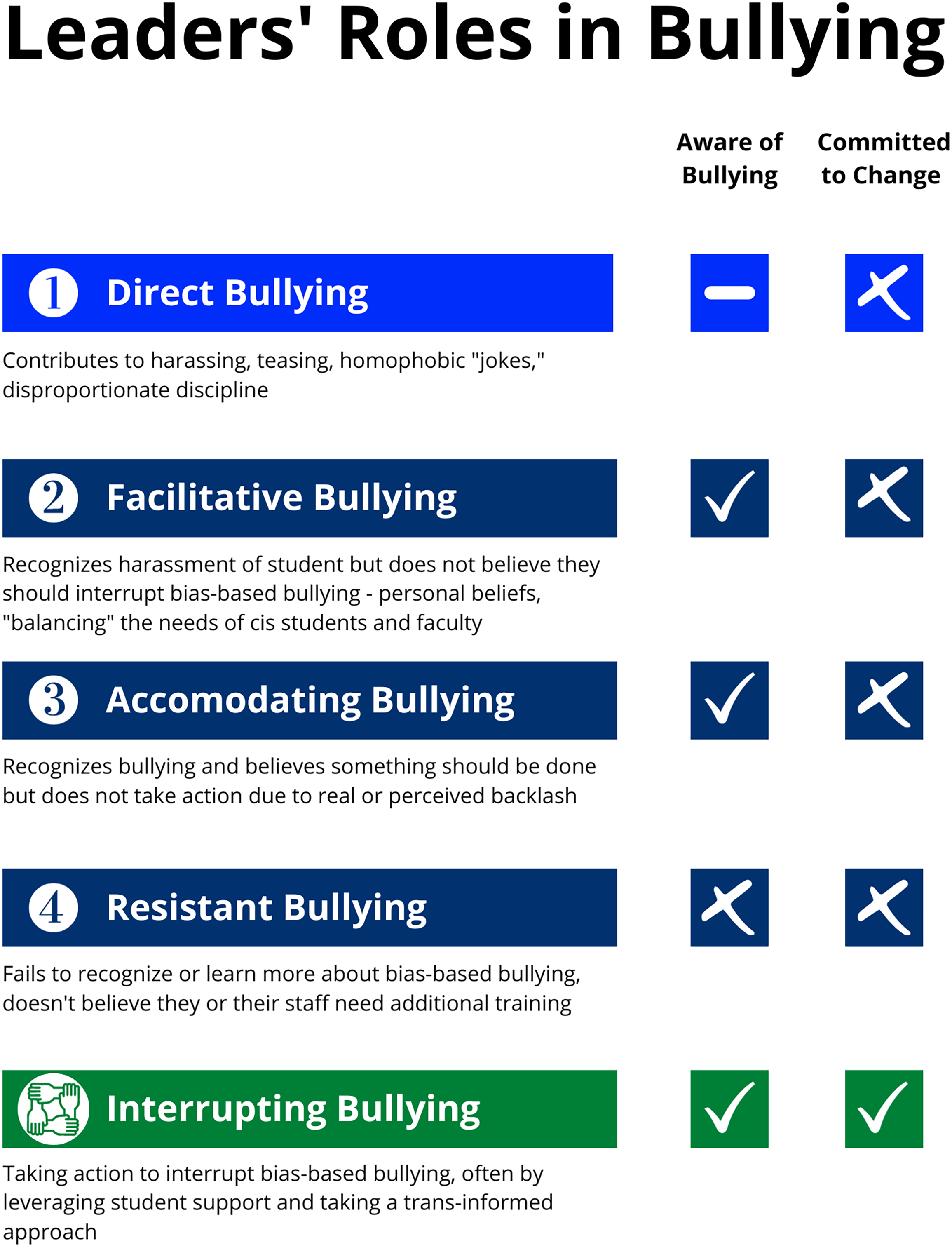
PK-12 administrative leaders’ role in gender-based bullying.
In Figure 1, we outline the four forms of bullying according to the active involvement of the administrator in the bullying behavior: direct, facilitative, accommodating, and resistant. We begin our description of how leaders contribute to bullying with the most obvious, direct form of bullying in blue: direct harassment committed by school leaders (i.e., district superintendents, school principals, student services coordinators, and other school administrators). In direct bullying, the immediate source of the problem is administrators’ verbal and physical actions towards students. More than half of LGBTQ+ students report direct bullying from peers and adults in school (Gordon et al., 2018; Johns et al., 2019; Kosciw et al., 2020; Poteat et al., 2019; Todd et al., 2019). Additionally, a school climate survey distributed by GLSEN suggests almost a quarter of LGBTQ+ students believe their school leaders were very or somewhat unsupportive of LGBTQ+ students. Leaders’ aggressive behavior may derive from implicit bias or explicit bias supported by other adults. Yet, school leaders might not be able to identify their actions as bullying or bias.
Next, we aim to establish a more expansive understanding of administrators’ role in sustaining bullying in schools by describing the three forms of indirect bullying indicated by the three navy rows below direct bullying in Figure 1. Leaders may have difficulty identifying their role in the three indirect forms of bullying because administrators may see their involvement as less active. According to Kosciw et al. (2020), 35.1% of LBGTQ+ students report their administration takes a neutral stance to LGBTQ+ students, but the existing literature has been unclear about what a “neutral” stance means for leaders’ role in perpetuating bullying in cisnormative and heteronormative school systems. We propose that when PK-12 administrative take a “neutral” stance and refuse to interrupt bullying, they indirectly contribute to bullying.
First, facilitated bullying occurs when administrative action directly enables the continuation or exacerbation of bullying by students, teachers, and school staff. Administrators identify gender-based bullying or discriminatory practices in the school; yet, in facilitative bullying, administrators do not use their authority to interrupt biased behaviors. Facilitative bullying often occurs because the leader does not believe it is their professional duty to do so or their personal beliefs about gender outweigh professional obligations to students.
Second, accommodative bullying occurs when administrators acknowledge gender-based bullying has occurred and the leader identifies the need to interrupt bullying as an administrator. However, the administrator capitulates to perceived or actual forces working to perpetuate bias-based bullying. These forces could be pressure from legal counsel to remain uncommitted to reform, socially-conservative parents, or external, socially-conservative advocacy groups.
The third kind of indirect bullying administrators participate in is called resistant bullying. Resistant bullying occurs when leaders refuse to engage or learn more about LGBTQ+ school-based issues. Leaders engaged in resistant leaders often do not recognize bias-based bullying is taking place in their organization. Payne and Smith (2018) name such justifications to not engage with LGBTQ+ resources as “the discourse of irrelevancy” (p. 183). Resistant bullying stops leaders from advocating for more training for themselves and staff. Whether purposely or by simply emphasizing other priorities, PK-12 administrators use their power to maintain a harmful system where bullying based on gender and sexuality remains prevalent.
By limiting the knowledge about queer ways of living and queer possibilities for safe and inclusive schools, administrators threaten the education and well-being of individual students through facilitative, accommodative, and resistant bullying. Administrators model support for bullying through each of these four types of bullying – by direct action, facilitating support for bullying, accommodating external stakeholders to the detriment of student safety, or passivity. All of these direct and indirect approaches allow bias and bullying to continue.
After discussing practices of leaders who perpetuate gender-based bullying, we end with a discussion of leaders committed to disrupting gender-based bullying, shown in Figure 1 in green. Interrupting gender-based bullying requires engaging with structural oppression that moves beyond including LGBTQ+ students and accommodating some students’ needs on an individual basis. We provide evidence that leaders can tackle structural oppression through meaningful steps to engage stakeholders across the district. Importantly, these leaders educate themselves and staff, often by collaborating with students, parents, and LGBTQ+ community organizations, and make substantive, long-term, structural reforms to prevent gender-based bullying.
Methods
The current study explored administrators’ role in bullying by using a national sample of court cases concerning the bullying of transgender students across the U.S. and in-depth interviews with PK12 school leaders in Illinois. More specifically, we describe administrators’ awareness of gender-based bullying in their district, their initial intentions to address gender-based bullying behaviors, and whether they actually acted to change or disrupt gender-based bullying. By examining these aspects of administrators’ decision-making process, we could provide first-person accounts of gender-based bullying across districts operating under the same state anti-bullying law and the national pervasiveness of these perspectives represented in well-publicized court cases that clearly tied school practices to bias.
First, the first author conducted and analyzed semi-structured interviews from a purposeful sample of 36 Illinois superintendents, heads of schools, asst. superintendents, principals, and policy consultants. Initial recruitment focused on administrators drawn from a random sample of districts, part of a related document analysis study. Administrators were recruited by sampling for range after initial recruitment from the random sample (Small, 2009). Six legal and policy consultants who had worked with districts in our sample were also interviewed. Second, the second author examined a purposeful sample of court cases brought against local districts by transgender students and their families where administrators were responsible for the bullying and bias experienced by transgender youth. The court cases from Maine, West Virginia, Kentucky, Maryland, Pennsylvania, and Wisconsin contribute to a more complete snapshot of the district-level decisions that enable bias against transgender youth. These cases indicate bias continued unimpeded by school leaders and, in some cases, how that bias emanates from school leaders themselves. Such interviews and court cases are instructive for a number of reasons. First, they show the significant power that administrators have in shaping the school experiences of transgender youth. Second, our evidence indicates that, in some districts, local leaders did understand how to be respectful of transgender youth but under pressure from other parents or with intervention from unsupportive administrators, that support was withdrawn. Third, the interviews with policy consultants and court cases provide evidence for overt behaviors and statements that administrators, especially leaders who have been censured by the court, might not otherwise reveal in administrators' interviews within a state with relatively strong legal protections for transgender students. Fourth, the court cases also show some of the consequences to districts where administrators do not act in the best interests of transgender youth. While costly settlements should not be the sole determinate in transgender-inclusive school practices, the potential consequences of the enforcement of anti-discrimination and bullying laws may help district-level leaders more effectively challenge bullying and bias. Triangulation of all sources provided a more comprehensive snapshot of leaders’ role in perpetuating transphobia.
The authors combine inductive and deductive analysis from the two sources of data to build the conceptual model in Figure 1. We initially coded the interviews using a conceptual framework of direct, facilitative, and resistant bullying (Mayo & McQuillan, In press). Through on-going coding of the interview data, the additional themes of accommodative and interrupting bullying emerged. The combined interviews and court cases allowed the authors to identify themes in administrators’ rationales not only in a state where trans rights have a strong record of legislative and judicial protections (e.g., Illinois), but in states with virtually no state legislative mandates to protect trans students (e.g., Wisconsin).
Findings
We found leaders differed in their willingness to identify gender-based bullying, their intent to change policies and practices concerning gender-based bullying, and their commitment to follow through to interrupt gender-based bullying (Figure 1). Based on these three main differences, we categorized a range of administrative responses to bullying across the five approaches to gender-based bullying: (1) direct bullying, (2), facilitative bullying, (3) accommodative bullying (4) resistant bullying, and (5) interrupting gender-based bullying. In the following five sections, we use evidence from interviews and court cases to illustrate how leaders demonstrated varying levels of acknowledgement about whether gender-based bullying occurred in their local district, intent to change practices, and their commitment to interrupting bullying in the face of real or perceived resistance.
Direct Bullying: When Administrators Cause Harm
Leaders’ perpetuating recurring, targeted, aggressive behavior that harms LGBTQ+ students fall under the definition of direct bullying (Figure 1, #1). Direct bullying behaviors are forms of explicit gender-based bias that include harassing words, intentionally exclusionary policies, or other gendered school-based practices that negatively impact students based on their real or perceived gender identity, sexuality, or gender expression. Despite national polls indicating most Americans support LGBTQ+ people and inclusive policy protections for LGBTQ+ youth, 1 surveys of adolescent Americans, such as the Youth Risk Behavior Survey and the National School Climate Survey, indicate a majority of American LGBT students report experiencing direct bullying from peers and adults in school (Gallup, Inc, n.d.; Pew Research Center, 2013; PRRI, 2021). Because this kind of bullying is so pervasive, many administrators might not know they are bullying LGBTQ+ students. Leaders’ aggressive behavior can come from implicit biases or from explicit bias within their community or their peer network.
In this study's interviews with PK-12 administrators, most of the examples of direct bullying mainly came in the form of misgendering students and preventing students from accessing facilities. The leaders participating in direct bullying did not understand that these administrative actions and use of language constitutes harassment of transgender and gender-expansive people. They also did not express an intent to learn more about gender issues or make structural reforms in their institution. For instance, one head of school stated: I have a student who wants, a clearly a female student, who wants me to call her Brian. Can I do that? Should I do that? When Brian goes to the bathroom, which bathroom is it OK for him to go to? I mean her. Because they're confused, they're [teachers] not sure what, kind of, what to say. What if I use the wrong pronoun? Will I get in trouble? Is that going to be in my evaluation if the parent complains that I made a mistake and then what will, can lead to?
This administrator consistently misgendered the student he discussed and did not indicate he was looking for resources to learn about the questions he posed regarding administrative actions. Rather, he expressed concerns about the lack of clarity around the consequences of misgendering students for the educators, but not concern about the students’ identity development, access to facilities, or overall well-being. A superintendent in a rural school district described a student in the LGBTQ student group as a child “who kind of almost forces it down your throat about gay and lesbian lifestyle, transgender [sic], and stuff like that. And she doesn’t realize - and we’ve talked to her - but she doesn’t realize how that has an opposite effect on people.” To be clear, the above administrators did not describe doing anything to communicate dislike or distrust of LGBTQ+ students to them directly. However, they made several marginalizing comments and did not know about or want to learn about a growing literature about the impact of labeling LGBTQ+ identities as “lifestyle” choices as well as questioning whether students should have agency of how they identify.
While leaders were careful not to describe more overt forms of direct bullying in their district, almost all of the policy consultants working with districts to interrupt gender-based bullying had numerous examples of direct bullying of transgender and gender-expansive students by peers, teachers, and administrators. As one community educator and policy consultant for suburban and rural districts explained the academic consequences of direct bullying by an administrator: We've had kids be told [by school administrators] that it's not in my job description to help you with that. . .with being bullied about their gender identity. You don't have a right to use the bathroom that you're asking. You don't have a right to use the locker room that you're asking for. I think it was the last kid. This was a kid out in [county], was required to meet with the school attorney. They asked him to sign something saying he would not change his mind about being trans if they gave him access to a particular bathroom. This kid was like 14 at the time. That's a power play when you're grown up - to have to sit down and talk with a school attorney about where you want to pee during the course of your schooling and why. This kid ended up dropping out of school. He is now finishing his degree through [a regional alternative learning center].
In these examples, school administrators participate in marginalizing, bullying practices directed towards trans students. They also don’t indicate they are willing to change discriminatory practices.
Several court cases similarly describe direct bullying on the part of administrators. For example, in a 2018 West Virginia case, Vice Principal Lee Livengood repeatedly harassed a student, Michael Critchfield, for using the boys’ bathroom and physically blocked Critchfield from exiting the facilities. In addition, the vice principal indicated that if Michael really was a boy, he should exit the stall and use the urinal. Livengood continued to harass the student in front of other students and parents despite an agreement with the school district that Critchfield would be able to access the boys’ facilities. This case is still making its way through West Virginia courts, having been returned to the Harrison County Circuit Court (ACLU, 2021). In the 2017 Whitaker v. Kenosha case, Wisconsin district administrators refused to allow Ash Whitaker to use the bathroom facilities matching his gender identity. Instead, Ash was told to use the principal's restroom. To keep him from accessing the boys’ room, school leaders threatened to make him wear a bright green wristband that would disclose his identity to school resource officers tasked with making sure students used restrooms that conformed to their sex assigned at birth. One school board member claimed that Ash's use of the restroom that matched his gender identity would harm other students, but Ash's classmates were supportive of his gender affirmation. The Seventh Circuit Court of Appeals ruling indicated that the school district failed to show other students had been harmed while it was shown that Ash did suffer medical harm. Forced to share a restroom with hostile administrators, Ash simply did not use the restroom at school. His physician documented the subsequent urinary tract and kidney infections that resulted. The district opted to settle the discrimination case for $800,000 (Lombardo, 2017). In both of the above cases, administrators’ lack of support for transgender students created a climate of bias and bullying. In general, this kind of direct bullying by administrators gives young people no option for school-based redress—they cannot report to adults because the ones in charge are actively involved in bullying against them. Without understanding a better understanding of a more expansive understanding of gender and what constitutes bullying, including their how their own biased actions negatively impact school communities, leaders are unable to encourage the development of gender inclusive school community, provide support to gender diverse students, and, further, leave their districts open to liability.
Facilitated Bullying: Identifying Bullying but Not Disrupting It
All the indirect forms of bullying involve a lack of administrative action to interrupt direct bullying. Facilitative bullying is one step away from direct bullying (Figure 1, #2). While the administrator may not be the person hurling insults or assaulting the child, the administrators know about bias-based bullying in their organization and actively use their power to allow bias-based bullying to continue. Administrators and other school staff participate in facilitative bullying when they can identify examples of gender-based bullying and a lack of support for trans students, but do not commit to changing the school environment. Rather, school leaders allow bullying to continue by their dismissal of bullying concerns and inaction. Like direct bullying, leaders rationalized facilitative bullying with false equivalence arguments about balancing the needs of students that were not being similarly bullied or marginalized. Evincing a concern that publicity would help no one and no solution would make everyone happy, Administrator 14 indicated affirming policies and plans that would run afoul of Title IX protections for transgender youth: You’re threading a needle here because you have an issue that could - you don’t want it to go to the paper. You really don’t. That's not going to help that student and that's not going to help your school. What would be good is we can hit that middle ground where you know what the student is, feels like the school is where they want to be, and all the other students say, you know what, this has really worked out well, I’m glad I got to know this student and this student's not somebody to be scared of or that's going to infringe on my rights. So, you hit that perfect thing. Is it possible? I don’t know, but that's what you’re going to shoot for and maybe you’re going to make everybody mad sometimes. I’ve always said, um, when I’ve done my job correctly, I’ve got everybody mad. I’ve got that parent mad because they didn’t get everything they wanted, and I’ve got those other parents mad because they didn’t get everything they wanted.
Policymakers write discrimination policy protections with the explicit goal of protecting the rights of marginalized students. Yet, the superintendent above describes an approach that runs counter to these aims. The leader rationalizes not addressing harmful behaviors because he believes finding a “middle ground” preferable.
A number of administrators recounted stories of when they told, or planned to tell, parents advocating for the needs of their transgender student that the trans students’ needs would come into conflict with other students’ needs. A private school head, for instance, related that “the biggest policy issue that we’re trying to look at right now is the bathroom. Again, you know, I’m disagreeing completely with that parent. No, it's your child, but we also have 319 other children to be concerned about too. So, you know, how do you find that balance? … We have a couple teachers who are a little uncomfortable with it.” While the administrator did not specifically indicate he had prevented or harassed a transgender student from using the restroom like the Critchfield case, the underlying discomfort with the idea indicates at least a lack of advocacy. This leader further explained that even “more liberal” teachers “don’t feel comfortable washing my hands next to a guy if we’re having gender-neutral bathrooms. I just don’t, you know, I just prefer not to. I don’t feel comfortable with that.” Like Ash Whitaker, the leader prioritizes the needs of adults and students who have not been marginalized in schools and asserts some possible discomfort from cisgender adults and students will be prioritized over access to bathrooms that meet the needs of every student.
Another theme in the interview data implicates the role of lawyers in justifying facilitative bullying. We found leaders cited educational law lawyers in Illinois as playing an important role in leaders’ justification of facilitative bullying. Leaders in the current study used information from their district lawyers as an excuse to not disrupt bullying. One policy consultant explains: I think a lot of attorneys are being cautious. They're being conservative. I might say a little more obstructionist. They think it makes more sense to play both sides. If you adopt an Alliance Defending Freedom policy, then a parent or a trans kid probably will sue you because it violates their civil rights. But they're also worried that a parent of a cis kid will be mad if they have a formal policy that says that they can let a trans kid use the bathroom. So, I think because there's no clear state guidance, because there's no federal guidance, especially since the rescinding of the Dear Colleague letter [by the Trump Administration], they just want to be neutral. But being neutral is being transphobic, in my opinion, and in what I've shared with schools. Yeah, I think it's legal, I think it depends though because I think if the superintendent doesn't get it or is transphobic - if there's not buy in from the top - that can be really challenging.
It is important to note again that the interviews took place in Illinois, a state with clear policy protections for trans students in state anti-bullying and anti-discrimination laws and where most public schools have inclusive policies (McQuillan, 2023). Yet, Illinois lawyers with an expertise in educational law continued to counsel district leaders to maintain the status quo. Further, this policy consultant describes administrators who have been coached by legal counsel to “remain neutral” even when leaders have identified the status quo as a harmful school environment for trans students. The consultant interprets this lack of action as transphobic because it signals implicit support of problematic policies, procedures, and practices. Regardless of the reason for a lack of commitment to disrupt bullying, the inaction on the part of the leaders perpetuates gender-based bullying.
A case in Talbot County, Maryland similarly exemplifies how school leaders that only allow trans students to access some accommodations, but not a full social transition, participate in facilitative bullying. School administrators initially supported Max Brennan, a trans student, to change his name and pronouns. Leaders also provided gender-inclusivity training for school staff to establish a more expansive understanding of gender. Yet, school leaders did not allow Max to access school facilities that matched his gender. In this case, school administrators identified Max as trans, but did not fully support his social transition with appropriate access to facilities. They insisted Max use separate changing facilities for physical education, which further “othered” him from peers. The distance from the P.E. classroom caused Max to routinely come to class late. Max's P. E. teachers understood that it was administrators’ half-hearted acceptance of Max's gender affirmation that caused his lateness to class and worked to ensure his experience in their classes was supportive. But this informal accommodation created problems caused by administrators when this affirming understanding did not extend to substitute teachers. A substitute teacher humiliated Max by very publicly insisting Max explain his lateness to the class, requiring him to publicly explain to this teacher that he was transgender and that he was not allowed access to facilities that matched his gender. While Max's classmates were not unsupportive of his gender, the act of being challenged and humiliated by an adult underscored the degree to which Max was not allowed to pass as male in school without comment and interruption. By only partially accommodating him, administrators created an institutional environment that undermined Max's ability to socially transition while intensifying Max's experiences of hostility and isolation. A federal judge ordered the district to allow Max to use facilities matching his gender identity, citing that both Max's federal and state rights were being violated by the district (Marimow, 2018).
Accommodative Bullying: Caving to the “Heckler's Veto” and Reversing Course
Leaders who support transgender students when there is no opposition, but then immediately capitulate to internal or external pressure - caving to the “heckler's” veto - are also complicit in the bullying of LGBTQ+ students. 2 Accommodating bullying involves identifying the conditions for bullying and creating a plan to change those conditions (Figure 1, #3). However, when leaders accommodate bullying, they fail to follow through on these plans because of real or perceived backlash. Unlike direct and facilitative bullying, these administrators acknowledge changes should be made to interrupt bullying. Like direct and facilitative bullying, administrators do not commit to change. Transgender students and their families rely on K12 leaders to take responsibility for their role in implementing protective policies, distributing the resources needed to ensure student learning, and keeping students safe. Yet, leaders sometimes fold to external and community pressure when they know the course reversals fail to uphold each of these responsibilities. While accommodative bullying may appear less harmful than direct bullying, accommodating the bullying behavior of individuals or groups, often from outside the district, does little to change the structural forces that enable direct bullying to persist.
We found evidence that some administrators and school board members allow adults in anti-trans groups to bully students in addition to enabling bullying behaviors within the school. As a community educator and policy consultant describes below: All of these outside groups have been weird. I've just heard from board members who identify that they're not from within the community, or you'll see them at a bunch of different board meetings, like the same players … [A leader in one of the state anti-trans groups] hosted a lot of meetings. She was a part of the lawsuit that the [an anti-LGBTQ+ advocacy group] did in [district]. It's really horrible and it got thrown out, but it really misgenders student A, keeps calling her a boy. You know, just like really transphobic, really hurtful. I think at the end of the day, sometimes folks forget that she is a person. She's a student, and she's a kid. She wouldn't like me calling her a kid, but she is. What that must feel like to have adults so fixated on your genitals – so fixated on how you use your genitals, so fixated on where you change, what you do with your body, and also continuously calling you a predator, when at the end of the day, you’re the one who's actually at a huge risk for bullying and are bullied on a really consistent basis. [A trans right lawyer] wrote a pretty scathing op ed about in all of his years of civil service working for the judicial system, working for [civil rights organization], he's never seen this kind of like systemic adult bullying a kid – targeting and bullying one specific student in a district – in any of his work he's ever done. He described how horrifying and inappropriate that is no matter what your view is.
By inviting anti-trans advocacy groups to participate in the policy-making conversation, rather than condoning the targeted attacks on a district student, the leaders in this suburban district perpetuated harm and unintentionally augmented the hostility trans students experienced.
The heckler's veto may be especially challenging for administrators who don’t have the language to discuss gender-creativity and can’t muster enough evidence-based justifications to counter gender-based bullying effectively. Another suburban policy consultant explains how the fear of lawsuits plays into administrators’ decision-making but can backfire when leaders accommodate bullying: “School districts don't want to go through a lawsuit. That's awful. It brings awful recognition. It brings awful attention. [Suburban school district] is a great example of that in that this school district didn't want any of this brought down on their heads. Interestingly enough, if they hadn't pushed back so far, if they just allowed the student to access the bathrooms or the locker rooms that corresponded with her gender identity, a lawsuit never would have been filed. Parents for Privacy [an anti-trans advocacy group] never would have formed.” This consultant describes the product of accommodative bullying that administrators may not consider with the same weight as their fear of suits from anti-trans groups – that trans students are likely to win cases when the district's lack of action perpetuates bullying (Eckes & Lewis, 2020; Lewis & Eckes, 2020). The interview data from policy consultants supports Eckes (2023) analysis of recent US court cases found that the U.S. courts have overwhelmingly sided with trans students’ right to access appropriate facilities and other social supports from schools over cisgender students’ claims of privacy violations. This is in large part because trans students have been able to prove the harm inflicted by bullying and discrimination; whereas, administrators did not substantiate fears about safety or privacy concerns with evidence.
The case of Nicole Maines, a trans student in Maine, provides another example of Eckes’ findings concerning the viability of trans students’ right to a school environment free of bullying. Similar to the Talbot County case, district administrators initially offered Maines a supporting approach to her social transition in elementary and middle school. The district entered a legal agreement with Nicole's family using a 504 plan that established Nicole would be able to continue using the girls’ restroom and be recognized as a girl by teachers and administrators. The issue that arose for Maines came from adult discomfort, rather than problems stemming from other students. In Maines’ 504 transition meeting to prepare for high school, the school district administration rescinded gender-related accommodations because another student's grandparent objected to them. The grandfather prompted his grandson to follow Maines into the girls’ bathroom to challenge the existing bathroom accommodations. The grandson repeatedly followed his family's demands to enter the girls’ bathrooms in order to push the district to address his behavior. District administrators then changed their stance of Maines’ medically-necessary accommodation and refused to allow her to use the bathroom.
The administrators refused Maines’ accommodations even though they had received gender-inclusivity training and information from medical professionals documenting the potential harm denying access to the bathroom would cause Maines. In other words, they knew that Maines needed to access the girls’ bathroom while the cisgender student in this situation did not experience similar gender-based bias embedded in school structures. While their approach may have fallen into the resistant or facilitative bullying categories prior to accommodating her gender identity, changing course with the knowledge of the damaging effects of denying bathroom access to Maines equates to facilitative bullying. Maines subsequently had to move to a new school district and filed a lawsuit under Maine's nondiscrimination law. The Maine Superior Court ruled in favor of Maines indicating the district administrators “exhibited tremendous sensitivity and insight over the years” (p. 7; John Doe et al. V. Regional School Unit 26, Decision 2014 ME 11, 2014)), but that administrators were swayed by “public scrutiny” rather than the equitable accommodations outlined in the 504 plan (p. 7). Rather than listening to the experiences of Maines and other trans students in the decision-making process, the district administrators capitulated to adults who expressed discomfort with gender-creativity.
Resistant Bullying: Refusing to Learn or to Improve
Leaders who refuse to learn more about gender-creativity or refuse to educate their staff participate in resistant bullying (Figure 1, #4). Administrators may see themselves as passive actors in resistant bullying, but their refusal to use their professional role to acknowledge or act to interrupt bullying allows bullying to continue. While less overt than other forms of indirect bullying, administrative inaction stemming from resistance to learn about gender-creativity and gender-based bullying similarly contributes to a hostile learning environment for students. However, administrators are nonetheless complicit in perpetuating bullying when they refuse to educate themselves or their staff about gender diversity. Without a foundational understanding of gender, school leaders may have difficulty leading the necessary reforms and taking the appropriate action to support individual students (McQuillan et al., 2023a). In this section, we provide examples of how administrators can perpetuate bullying by limiting the knowledge about how to identify gender-based bullying, descriptions of queer experiences, and ways to create more inclusive, safe, learning environments.
Administrators often couch a resistant approach in cautious or reactive language rather than proactive language. One private school leader expressed this sentiment when she notes, “We haven't had to deal with any of these issues quite yet, minus the child that we have who is in kindergarten right now [who plays with gender expression]. The kids don't care. We haven't really had to really bring the faculty together and say, ‘listen, this is happening right now.’ Because it's new, we don't have the answers.” Yet, this administrator did not believe she or her staff would benefit from training despite identifying gender-diverse students in the school. The leader also characterizes gender-creativity as “new,” but transgender and gender-diverse students have always existed in schools. Another superintendent justified not having policies or individual accommodations for trans students, because he believed that adding policy protections for trans students would ignite a communitywide discussion about gender, He stated, “The big thing is everything gets blown out of proportion. I don't think it's a good policy to start creating issues for your district and over administrate and have people get, well, ‘we're not going to do this’ and ‘we're not going to do that.’ … I don't think that we should create anything that's going to cause any animosity before you know we get an issue.” This leader does not acknowledge that maintaining the status quo could be creating an issue and animosity among students that don’t conform to gender norms in this district.
Indeed, few superintendents or principals in our statewide sample openly admitted bullying based on gender or sexuality occurred in their schools. When probed, administrators often indicated they did not need or want additional inclusivity professional development. For example, one district leader discussed an emotional conversation with a member of the school LGBTQ+ Task Force and school nurse who tearfully requested guidance on how to appropriately support students who were coming out, but did not see the administrator did not see the need for such guidance. Another leader expressed their inability to effectively support staff that espoused personal political or religious views that countered their professional responsibility to support all students. Administrators in several districts without training around gender or sexuality topics recounted conversations with teachers, parents, and school board members indicating these adults did not understand why gendered practices in schools needed to be reformed or what those reforms should look like.
In addition to not seeing the need for any professional development, district administrators contribute to inconsistent availability of trainings across schools within their district, which effectively creates a two-tiered system for students in schools with leaders committed to disrupting gender normativity and those participating in direct or indirect bullying. One of the policy consultants discussed the challenges of misalignment in administrators’ approach to learning about gender-inclusivity across the different levels of the school system and across districts when school-level leaders don’t want to learn about the needs of individual students: Another community educator and I were recruited to put together a program for a trans first grader who showed up the first week of school and identified male. He was dressed in male clothing and immediately went to the boys bathroom. The teachers looked at each other and said how are we going to protect this kid for five years? Because they were looking at the name that did not match the kid's identity. [Name] and the principal called us in and asked if we could put together a group to assist this kid. We did that and we ran it for 10 weeks. It went very well. The kids were responsive to it and the teachers were responsive to it. We were asked to come back for a second year when the kid was shifted to a different school when the family moved. And the principal [at the new school] said, ‘No way, you're not coming into my building. We got it. We've got everything he needs.' There was no recognition of the kid as the kid identified and we were banned from the school property.
Despite the student's positive experiences that were supported by gender-inclusivity training in one school, the new school administrator refused to learn about the student's needs by taking advantage of the inclusivity training. The policy consultant and trainer expressed frustration with not being able facilitate support for the student because the school principal rebuffed any attempts for collaboration. According to the consultant, the school leader in the child's new school then did not acknowledge the child's identity despite being offered the opportunity to learn more.
Payne and Smith (2018) describe similar resistance among school principals that refused participating in a New York inclusivity professional development (PD) program. The administrators in their study claimed they had more pressing concerns or that they believed the community would think issues concerning LGBTQ+ students would be too controversial. Many administrators indicated that they either didn’t have LGBTQ+ students or families in their school and did not believe gender or sexual diversity fit into their existing equity and inclusion goals. Like the administrators in our interview study, administrators in New York shifted the responsibility for gender reforms to other stakeholders, such as the school board, parents, teachers, or other community members. However, Payne and Smith (2018) propose LGBTQ+-inclusivity training can increase leaders’ ability to understand LGBTQ+ students and improve the academic success of all students.
Like Theoharis (2007) and several other social justice leadership scholars, Payne and Smith (2018) suggest leaders can transform marginalizing policies and practices when they engage with and take responsibility for both the academic and social lives of students. One policy consultant working with rural and urban districts elaborated on the connection between facilities access and learning: “the stuff that I hear from our kids is that kids that are assigned to the one gender-neutral bathroom that is, in one kid's case, up three floors and across the building in another wing that took ten minutes to get there and back. He was consistently late for whatever class he was getting to which then set them up for disciplinary action and affected his classwork. Dealing with the bathroom issues, we need to do this. They're not asking for anything special. Let them use the bathroom.” While we agree with education scholars that have argued that the policy conversations need to move beyond a primary focus on bathroom accommodations for trans youth to other areas of individual support (Farley & Leonardi, 2021), policy consultants in our study reiterated the need to teach administrators and other school staff about the basic health needs of trans youth and the consequences of inappropriate facilities access on student learning. Similarly, in Lewis and Eckes’ (2020) review of amicus briefs, trans students consistently discussed the academic, mental, and physical health consequences of direct and indirect administrative bullying.
The administrators in our study also revealed that thinking about gender in more expansive ways could lead to improvements in how administrators understood social dynamics for cisgender and transgender students alike. In an interview a middle school principal, the administrator repeatedly indicated that girls were more trouble than boys when asked directly about gender-related bullying: Girl fights - oh my god, they’re the worst. Ask all our female principals, too, and our assistants, they’re like, ‘yeah, I’ll take the guys any day of the week.' But I don’t, honestly, I don’t think it's any different than it was 20 years ago, I don’t think it's anything to do with transgender stuff. So, we haven’t had one - here's a good thing - we haven’t had one bullying instance of any transgender student this year that I ever, that's been reported or last year that's been reported, so that's good.
This principal's discussion of normative gender continued to indicate a need to think more about institutional sexism: “some of the girls, um, uh, and, I’m sorry, I’m a guy, so if you as a girl come to school with your butt hanging out of your shorts - and this is a discussion we’ve had with administration.” He then continued expressing the opinion that gender expression may be related to socio-economic class, while also suggesting that transgender youth also may feel constrained by school: I feel like they [transgender students] probably feel less freedom, right? Even just thinking about dress, right? Feminine – I don’t even know what that really means – but, you know, like, who's wearing more makeup. That might be that higher SES group as opposed to you see more of the tom boys or girls that are coming to school and could care less about what they look like, which is totally fine, as the lower SES.
This principal repeatedly conflated sexism, that is, bias against women, and cisgenderism, that is, the belief that it is better when people identify as the same gender as they were assigned at birth, when asked directly about bullying targeting LGBTQ+ students and structural inequities. His comments also reflected stereotypes about the intersection of class and identity in his comments about structural inequality. Moreover, he suggests that because he hasn’t seen an incident report concerning direct bullying of trans students, that there is not a gender-based bullying problem at the school even as he makes gendered and sexist comments about middle school students.
Whereas administrators participating in facilitative and accommodative bullying often have had an opportunity to learn about gender-creativity and can identify gender-related bullying, leaders who fall into the resistant category exhibit an unwillingness to know more about gender-expansive students and related gender-based bullying. Doing so enables leaders to avoid taking responsibility for the individual and institutional harms they may inflict on students.
Interrupting Bullying and Gender Oppression by Collaborating with Youth Parents, and Community Organizations
How do PK12 administrators disrupt bullying in schools? The first step is to identify the need to take action about the gender-based bullying problem and committing to learning more about gender and specific strategies to disrupt gender-based bullying. One administrator in our study suggested that education for adults is necessary because of generational differences: “Kids are much more open to this and much more accepting in general than a lot of the adult population. I'm not saying that our board as a whole is like, ‘Oh, my gosh! We have students that are transgender students?’ I think part of it is just a generational thing that it's harder for myself, being 50 years old and, you know, people of my generation. I think it's harder for them to get their mind around. I think it's more of a generational thing than it is anything else.” District leaders consistently discussed the adults in schools or the community as creating new policy and training concerns rather than concerns emanating from students. Leaders who took responsibility for interrupting bullying – often by focusing on educating adults - built relationships with community organizations to train educators and conduct outreach to parents. As a policy consultant in the suburbs of a large, urban city noted: Most schools have identified an out student. It's trickling down to the middle schools and the elementary schools. The ones [administrators] who have trans kids, most of them have done trainings. Then some of them are trying to be proactive and prepare and just give their teachers some more information. Typically, in some of the more conservative schools they wait till the kids are at their door and they're, like, ‘Oh crap! What do I do now? Um, we should probably help or have someone help us.'
Identifying appropriate external and internal sources of information to fill gaps in the administrators’ training and existing understanding of gender was foundational in the leaders’ ability to interrupt bullying and build structural reforms. But, as another policy consultant in a large city stated, “Simply offering trainings is not enough to significantly change school cultures – no more than one lesson on long division helps students learn mathematics.” As this seasoned consultant suggested, leaders who successfully disrupt gender norms must commit to a sustained effort across multiple domains of the organization. A suburban assistant superintendent discussed what that could look like for her district of elementary and middle school students: We talked about pronouns. We talked about bathrooms. We changed our policy, too. It was the first time we had even thought about it before. Like, for our eighth-grade graduation, we would have the boys in maroon and the girls in white. After that [an assessment of gender-based bullying and meetings concerning a transgender student], we just went to all maroon gowns. We started to examine it as a staff. Like, what are we doing? We moved to lines. Before, we would have a boys’ line and a girls’ line. Now, again, to protect students and how comfortable they are with identifying or not identifying, we have a line A and we have a line B. We put other things in place to help support that schoolwide and at a younger level.
These administrators identified gender-based bullying, committed to some coherence in their gender equity reforms across multiple school structures, and followed through with the structural changes based on external advice from a community organization and the needs of students in the school.
A commitment to reform school structures even in the face of resistance sets administrators who interrupt bullying apart from those that acknowledge changes would improve conditions or fold to pressure. A superintendent in a regional center over an hour outside of Chicago explains: For one of our transgender students, the parents aren't nearly as accepting of this process. You know, that creates a whole other dynamic when you're sitting down having the conversations about what it is that the student needs. I kind of advised the building principal and a couple of others to go into this meeting and they said, 'the parents really aren't very happy about this.' I said, ‘Well, our job is to work with the student first. If the parents are resisting this, then that just tells us how much more difficult and how much more stress that this young person has in their life because you can't be rejected by your parents and your family. And if there's, if there's a struggle over this at home, then that just means we have to be that much more supportive of this student when they're with us.’
Despite resistance from parents, community, and alumni, some leaders make structural changes to interrupt gender oppression and commit to continuing to advocate for structural reforms.
Additionally, parents can be important collaborators in the district leader's effort to disrupt bullying. A policy consultant describes the role of parent advocates in working with administrators as they persist in their attempts to interrupt bullying despite pressure from other parents who wanted to shut down inclusivity reforms. She explained, “Parents for Privacy formed [in the district in response to gender-inclusivity reforms]. Then all of this backlash came down on their [district administrators in a large, suburban district] heads. Then they had to pay a group of us to come in and train their parents. It was awkward though because like five parents showed up at every one. It really was actually a fairly nonissue.” The consultant goes on to describe that once the district attempted to reach out to parents who disagreed with their efforts to interrupt gender-based bullying, administrators realized that the majority of the parents supported the reforms. Only a small number of vocal parents did not support the district's efforts, and parents turned out to rally and vote against this vocal minority's attempts to oust the school board members who supported efforts to disrupt bullying. Leaders in our study who successfully resisted pressure to cut back on efforts to interrupt bullying often did so by collaborating with students, supportive parents, and supportive community organizations.
Discussion and Conclusion
Administrators model support for bullying through each of these four types of bullying – by direct action, facilitated support, accommodating external stakeholders, and resistance. All these approaches allow bias and bullying to continue, but we found differences across leaders’ ability to identify gender-based bullying. We also differentiate between the commitment to intervene and taking an active, consistent role to disrupt bullying. While leaders may need different levels of support depending upon personal beliefs, their approach to the profession, and the political context of the school (Spillane et al., 2002), gender-inclusivity training and guidance directed at administrators can be initial steps towards the structural reforms underpinning gender equity in schools (Mayo, 2022; McQuillan, 2022; Meyer & Leonardi, 2018). Training can provide leaders with time for personal reflection, content knowledge, and active learning opportunities, needed to learn about gender-creativity and why it matters to student learning (McQuillan et al., 2023b; Payne & Smith, 2018). However, like any other educational reform, limited professional development alone will not change the entrenched gendered nation of U.S. schooling any more than a single math, civics, or English lesson would achieve all the learning goals of the content area curriculum.
Still, this foundational learning can help leaders use a common language that can be useful in building shared equity goals across stakeholders – a key component for administrators when implementing any educational policy. Ensuring that multiple stakeholders understand the goals of gender diversity reforms build the ability of leaders to collaboratively engage other administrators, parents, counselors, teachers, and other school staff. Trans students who report feeling supported in school also recount collaboration and being able to share their needs in gender support meetings (Orr & Baum, 2015). These meetings include dialogue around how students should approach their social transition, timelines that work for the student. Meetings like these have been increasingly difficult to have with students in states that bar conversations about gender and sexuality, such as Florida. Laws and policies in these states encourage an active form of ignorance (Sedgwick, 1989). However, learning and reflecting on the structural, social, and individual gender oppression embedded in US school systems may lead to administrators building the capacity to build more inclusive learning environments for trans students.
Administrators comprise a small but mighty part of school systems. Using a more expansive definition of administrative bullying underscores administrators’ personal complicity in allowing bullying to continue in their district. Again, while some leaders can identify direct bullying, many leaders might not recognize their own role in maintaining a harmful status quo through their inaction without more direct instruction. When leaders don’t acknowledge their role and actively engage in learning about gender diversity, they may have difficulty fulfilling their professional responsibilities, such as implementing protective policies and leading instructional practices. Direct and indirect bullying occurs when leaders misunderstand their role in perpetuating harmful school climates or do not acknowledge their professional responsibility to establish productive learning environments for all students. In these cases, the leader may serve as a conduit for institutional oppression.
Conversely, identifying leaders’ roles in bullying could motivate a broader, more sustained understanding of gender equity reforms. Still, both structural and individual factors have contributed to the institutionalization of gender oppression. Changing laws and policies without changing how administrators enact them will not be enough to change the experiences of trans students. Therefore, reforms must go beyond adopting protective policies or changing attitudes and educators’ behaviors or attitudes alone. Engaging leaders in disrupting bullying should be one of several strategies that range from the individual to structural reforms.
The need for PK-12 administrators who understand their role in perpetuating transphobia has heightened in the midst of well-coordinated, international campaigns targeting transgender people in schools. As far-right groups advocate for the erasure of trans students and staff from schools, PK-12 educational leaders stand on the frontline of confronting ideologies that center the belief that transgender people should not be able to learn or work in U.S. schools. Within this political environment, the urgency for leaders to take responsibility for their role in perpetuating discriminatory, bullying climates becomes all the more necessary. As attacks on transgender youth intensify in legislatures and classrooms alike, district leaders stand on the frontline of protecting students from continued bias-based bullying. Transgender and other gender expansive students need well-informed and dedicated leaders who will help students sustain their education and safety in these difficult times.
Footnotes
Declaration of Conflicting Interests
The authors declared no potential conflicts of interest with respect to the research, authorship, and/or publication of this article.
Funding
The authors disclosed receipt of the following financial support for the research, authorship, and/or publication of this article: This work was supported by the Northwestern University Institute for Policy Research, Wisconsin Alumni Research Foundation, University of Wisconsin - Madison Office of the Vice Chancellor for Research and Graduate Education's Pandemic Affected Research Continuation Initiative (PARCI) Grant, William F. Vilas Trust Estate - Life Cycle Professorship, and National Academy of Education (grant number National Academy of Education/Spencer Dissertation).
