




Abstract
Keywords
Introduction
Over the last decade, a growing body of literature has identified the importance of student teaching experiences to the employment, performance, and retention of early-career teachers. Student teaching predicts where teachers secure their first jobs (Krieg et al., 2016), and student teaching in a high-quality learning environment and with a highly effective cooperating teacher predicts early-career teacher performance and retention (Bastian et al., 2022; Goldhaber et al., 2020a; Ronfeldt, 2015; Ronfeldt et al., 2018). Studies also show that student teaching is an opportunity to acquire job-specific knowledge and skills (e.g., knowing the grade-level/subject-area curriculum, knowing K-12 students, and school leadership) that benefit the performance of early-career teachers (Krieg et al., 2022; Ronfeldt et al., 2020).
Given the importance of student teaching to the outcomes of early-career teachers, a natural research extension is to consider the role of principal internships in school leader preparation and workforce outcomes. Like student teaching, principal internships are widely considered to be the most important component of principal preparation (Anderson & Reynolds, 2015; Darling-Hammond et al., 2007), and internship quality has been found to be positively associated with a range of outcomes for program graduates (Davis & Darling-Hammond, 2012; Orr, 2011; Orr & Orphanos, 2011). Nonetheless, principal candidates’ internship experiences vary widely across states (Anderson & Reynolds, 2015) and between programs (Campbell & Parker, 2016; Hafner et al., 2012), including variation in the number of hours required; the support interns receive from principal supervisors, coaches, and mentors; and the types of activities in which interns engage (Drake, 2022; Drake et al., 2023). Internships are important to leadership development; however, they are only one component of principal preparation that engages candidates in clinical practices designed to take their knowledge, skills, and dispositions and apply them in a real-life environment (Reyes-Guerra & Barnett, 2016).
While principal internships may be an evidence-based approach to improve school leader preparation and performance, research has not yet explored the principal internship at scale—that is, research beyond that of a single preparation program or a small set of exemplary preparation programs. There is little scholarship on the characteristics of principal interns, the schools in which they intern, and the school leaders who mentor them during their internship. We begin to address this gap in the principal internship literature by using a unique database of interns covering 12 principal preparation programs in North Carolina over a 4-year period (2015–2016 to 2018–2019). With these data identifying principal interns and their internship schools, we ask the following research questions:
What are the characteristics of principal interns? What are the characteristics of internship schools and mentor principals?
Our work connects the literature on student teaching to principal internships and begins to elicit further questions about internship placement processes and quality and what internship experiences may be valuable for preservice school leaders. Furthermore, our work adds to studies on the diversity of the school leader pipeline by considering how internship schools and mentor principals vary by intern demographics. By providing data and evidence on the principal internship to practitioners and policymakers, we hope to inspire continued research in this area and to provide a more comprehensive understanding of the principal internship. The ultimate goal is to improve the quality of school leader internships and preparation programs.
Background
The Path to the Principalship
Decades of research have found that principals are among the most important in-school factors influencing student achievement (e.g., Leithwood et al., 2004). For example, a recent second-order meta-analysis found that school leadership matters for students, teachers, and schools, with larger associations for organizational and teacher outcomes as compared with student outcomes (Tan et al., 2022). Similarly, in an update of Leithwood et al.’s (2004) seminal review of principal effects, Grissom et al. (2021) concluded that “the importance of school principals may not have been stated strongly enough in prior work … Indeed, it is difficult to envision an investment in K-12 education with a higher ceiling on its potential return than improving school leadership” (p. xiv). The systematic review by Grissom et al. (2021) suggests that a one standard deviation increase in principal effectiveness increases student achievement by 0.13 standard deviations in math and 0.09 standard deviations in reading. This is equivalent to nearly 3 months of learning in both subject areas.
These findings on principal effects have generated an interest in examining the principal pipeline, especially given research indicating that districts that initiate comprehensive principal pipelines have positive effects on a wide range of outcomes (Gates et al., 2019). Regarding their career history, most principals start as teachers and spend time in other leadership roles. For example, a longitudinal study of the principal pipeline in North Carolina found that nearly all the pathways included time as a teacher and assistant principal (Osborne-Lampkin & Folsom, 2017). In terms of prior effectiveness, longitudinal research in Washington found a positive correlation between teacher and principal value-added estimates (especially in reading). However, there was no evidence that teachers with higher value-added estimates become principals at higher rates than peers with lower value-added estimates (Goldhaber et al., 2019). We extend this literature by assessing whether those in the principal pipeline (i.e., interns) are more effective—based on evaluation ratings and value-added estimates—than colleagues who are not in the principal pipeline.
In terms of demographic composition, the principal workforce is not representative of either the national workforce or K-12 student populations (Perrone, 2022). Specifically, evidence from state longitudinal databases finds that the principal pathway disfavors women and Black and Latinx educators (Davis et al., 2017; Fuller et al., 2019; Gates et al., 2006). Both quantitative and qualitative research studies highlight the ways in which educators of color face inequities and racial discrimination along multiple points of the pathway, from their own experiences in K-12 settings through their preparation, hiring, induction, promotion, and retention in the field (Agosto et al., 2015; Bailes & Guthery, 2020; Crawford & Fuller, 2017; Karanxha et al., 2014).
Principal preparation programs play a critical role in the principal pipeline. A large body of literature indicates that high-quality principal preparation programs are associated with positive principal, teacher, and student outcomes, ranging from principals’ feelings of preparedness and their engagement in more effective practices to stronger teacher retention and improved student achievement (Darling-Hammond et al., 2022). Principal preparation programs can also play a critical role in recruiting candidates of color. Fuller and Young (2022) found that most preparation programs have between 5 and 30% of Black, Indigenous, and People of Color (BIPOC) who graduate from their programs, with wide variation between geographical location (i.e., urbanicity and states) and program delivery (i.e., online and in-person). These differences also point to systemic bias against candidates of color that may be occurring within preparation programs (Perrone, 2022). In particular, Black female candidates face issues of race and racism within their programs that impact preparation quality (Boske, 2010; Weiner et al., 2021). We extend this literature by examining the characteristics of internship schools and principal mentors for interns of color compared with their White peers both across and within programs.
Research on Principal Internships and Student Teaching
Internships, or field-based experiences carried out during preservice principal preparation, have been a cornerstone of school leadership development since the 1960s (Reyes-Guerra & Barnett, 2016). Internships are not only widely considered to be the most important component of principal preparation but also one of the most challenging to implement (Cordeiro & Smith-Sloan, 1995; Darling-Hammond et al., 2009; Orr, 2011). Part of the challenge can be attributed to variation in principal preparation programs’ capacity to implement high-quality internship experiences (Anderson & Reynolds, 2015; Campbell & Parker, 2016). For example, research has found that high-quality internships are defined by a close alignment to and integration with coursework (Barakat et al., 2019), hands-on experience with the real work of school leaders (Campbell & Parker, 2016; Clayton & Thessin, 2017; Drake, 2022), exposure to a variety of school contexts and student populations (Hackmann et al., 1999; Reyes-Guerra & Barnett, 2016), and support from expert mentor principals and coaches (Clayton & Myran, 2013; Cordeiro & Smith-Sloan, 1995). High-quality internships require strong partnerships between universities and K-12 districts (Mendels, 2016; Newcomb, 2011). Another challenge in implementing high-quality internships may be attributed to differences in state-level internship requirements. Only 30 states require elements of a clinically rich principal internship (Anderson & Reynolds, 2015). In addition, only 14 states require at least 300 hours of field-based experiences; by comparison, exemplary programs require over 600 hours (Anderson & Reynolds, 2015).
Despite difficulties in implementation, there are many benefits of a high-quality internship for prospective school leaders. Specifically, participation in a high-quality internship is positively associated with principal preparation graduates’ leadership skills, knowledge, and dispositions; their intentions of becoming a principal; their teachers’ level of satisfaction and collaboration in schools where they lead; and student performance in schools where they lead (Davis & Darling-Hammond, 2012; Drake et al., 2023; Orr & Barber, 2007; Orr, 2011; Orr & Orphanos, 2011). For example, Orr (2011) found that broader, more intensive internships were associated with gains in graduates’ knowledge and skills, leadership career intentions, and advancement into leadership positions. Furthermore, mentorship plays a critical role in leadership preparation, as expert, site-based principal mentors can help candidates successfully navigate the difficult role transition from teacher to leader (Browne-Ferrigno & Muth, 2004; Daresh, 2001). Unlike principal supervisors who often serve in an evaluative capacity, principal mentors can engage in a mutually beneficial relationship that can help leaders both develop and grow (Browne-Ferrigno & Muth, 2004). While there are benefits to a high-quality internship, it is difficult to generalize from the current scholarship in this area since many of the studies are limited to a single or a small set of exemplary programs (Reyes-Guerra & Barnett, 2016).
In comparison to the research on principal internships, a series of large-scale, empirical studies on student teaching have started to identify the features of student teaching placements that predict subsequent outcomes for teacher candidates. One important strand of this research examines what types of K-12 school environments make for the best student teaching sites. For example, using survey and administrative data from nearly 3,000 beginning teachers in New York City, Ronfeldt (2012) found that early-career teachers who conducted their student teaching in easier-to-staff schools (i.e., schools with less teacher turnover) were more likely to stay in the profession during their first 5 years of teaching and were more effective at raising student achievement. This was true even if their first job was in a harder-to-staff or historically underserved school setting. In a similar vein, Ronfeldt (2015) used longitudinal data from one large urban school district and found that student teachers in schools with stronger teacher collaboration and higher levels of student achievement growth were subsequently more effective at raising student achievement as teachers of record. Recent research in North Carolina has also found that teachers who conducted their student teaching in higher value-added schools have higher value-added estimates as early-career teachers (Bastian et al., 2022). These results were even more pronounced among teacher candidates with lower GPAs (Bastian et al., 2022). Overall, this work speaks to the value of learning to teach (student teaching) in environments where teachers collaborate, teachers stay, and students make significant achievement gains.
In addition to the school environment, the cooperating teacher plays an important role in teacher candidates’ student teaching experience and later effectiveness. Using data from 14 preparation programs in Washington, Krieg et al. (2020) found that student teachers are more likely to be placed with a teacher of the same gender and race/ethnicity and teachers with more experience, higher degree levels, and higher value-added estimates in math. Regarding the relationship between cooperating teachers and student teachers, Matsko et al. (2020) found that candidates matched to a cooperating teacher who models effective instruction, provides instructional support and frequent feedback, and engages in collaborative activities report feeling better prepared to teach than candidates paired with a less engaged cooperating teacher. Additionally, multiple studies find that student teachers placed with more effective cooperating teachers go on to become more effective themselves (Bastian et al., 2022; Goldhaber et al., 2020a; Ronfeldt et al., 2018). For example, in Washington, a one standard deviation increase in the value-added estimates of the cooperating teacher is associated with an 18% of a standard deviation increase in the value-added estimates of the candidate as an in-service teacher (Goldhaber et al., 2020a). Lastly, although some teachers worry that hosting a student teacher might negatively impact their performance, Goldhaber et al. (2020b) found that the impact of hosting a student teacher on K-12 student test scores is indistinguishable from zero in the student teaching year, with positive impacts on the cooperating teacher's effectiveness in subsequent years.
Of course, student teaching is different from principal internships in several important respects. Relative to student teaching, there are often many fewer principal interns to place and the principal internship is often less regulated (St. John et al., 2021). Moreover, not all principal interns are placed in new school settings; instead, they can complete their internship hours in their current employment school while also fulfilling other job responsibilities (Anderson & Reynolds, 2015; Reyes-Guerra & Barnett, 2016). Nonetheless, from the perspective of the preparation program, principal internships are like student teaching in that placements are dependent on the willingness of the principal to serve as a mentor; mentor principals often lack training and incentives to mentor; some programs may not have formal processes for making internship placements; and information asymmetries exist between preparation programs and school districts (St. John et al., 2021). Like student teaching, characteristics of internship schools and mentor principals may also impact the future outcomes of principal interns.
In addition, student teaching and principal internships are rooted in experiential learning theory (Kolb, 1984). In a systematic review, Morris (2020) identified several key elements of experiential learning theory, including (a) concrete experience, where participants are actively involved in real-world, uncontrived experience that is situated in context (i.e., K-12 schools); (b) reflective observation, where participants critically reflect on their experiences and the problems they encounter; (c) abstract conceptualization, where participants work to solve real-world problems; and (d) active experimentation, where participants are challenged to work outside their comfort zone and confront the unpredictable nature of the experience. Though experiential learning theory is not without its detractors (e.g., Bergsteiner et al., 2010), it provides a theory for understanding why student teaching and principal internship experiences are among the most important experiences in which teacher and school leader candidates can participate. Furthermore, experiential learning highlights how vicarious and mastery experiences during an internship may influence interns’ self-efficacy and performance (Bandura, 1977).
In summary, the research literature on student teaching highlights some important areas to investigate with respect to principal internships. This includes characteristics of the principal interns; the school context in which they are placed; and the background, education, and work history of the principal mentor. We envision the current study as the first in a series of studies to better understand the characteristics of interns and internship placements; the geography of principal internships, in relation to the preparation program and interns’ employment locations; and the associations between internship placements and outcomes for principal interns.
Study Context: Principal Internships in North Carolina
States vary widely in their requirements for clinical practice and internships (Anderson & Reynolds, 2015). North Carolina state law requires that all candidates enrolled in a principal preparation program complete a yearlong internship (NC Gen. Stat. §115C-284). However, “yearlong” was never defined in the law or by the North Carolina State Board of Education. As a result, programs differ in their definition of yearlong, including the number of internship hours they require candidates to complete. For example, programs offering a full-time Masters of School Administration (MSA) degree require between 200 and 1,500 hours, whereas programs offering an add-on principal licensure require between 200 and 475 hours. Furthermore, programs can choose whether these internships are carried out in the same school in which the principal candidate works or whether the candidate is required to intern at a new school site. Finally, there are no North Carolina requirements regarding the characteristics of placement schools or mentor principals. Programs may vary regarding the extent to which they prioritize placements in certain types of schools (e.g., schools with more marginalized students) or with certain mentor principals (e.g., principals earning higher performance ratings). Overall, these differences in implementation help to motivate our study, as we provide the first empirical examination of principal internships across a range of preparation programs.
Method
Data Sources
To examine the characteristics of principal interns, internship schools, and mentor principals, we leverage the following administrative data: (a) principal internship records from 12 preparation programs in North Carolina 1 and (b) K-12 administrative records on schools and school personnel from the North Carolina Department of Public Instruction (NCDPI). Our principal internship data include 1,135 individuals serving as a principal intern in the 2015–2016, 2016–2017, 2017–2018, and 2018–2019 school years. Principal candidates in these programs remained in a single school throughout their internship. Programs often supplement internship experiences with site visits and other practicum-based experiences in schools. These activities are unobserved in our study. Internship data include fields identifying the intern, the academic year in which the internship occurred, and the district and school in which the internship occurred. By knowing who the principal interns are, we can link them to personnel records from NCDPI to know their demographics, employment history, credentials held, and measures of teaching performance (i.e., value-added and evaluation ratings) prior to starting their internship. With data on when and where internships occurred, we can link individuals to characteristics of the schools in which they interned. Likewise, by knowing when and where an individual served as a principal intern, we can identify their mentor principal and link that mentor principal to their personnel records.
For this study, our K-12 administrative data come from the 2011–2012 to 2018–2019 school years 2 and include information on all school personnel and public schools across North Carolina. In particular, the personnel-level data include fields for demographics (e.g., gender, race/ethnicity, and date of birth), employment history (e.g., districts/schools of employment and roles worked), credentials (e.g., National Board Certification [NBC], licensure exam scores, and teacher and principal experience), and measures of job performance (e.g., teacher evaluation ratings, teacher value-added estimates, and school administrator evaluation ratings). Evaluation ratings for teachers and school administrators (principals/assistant principals) come from the North Carolina Educator Evaluation System (NCEES). With NCEES, teachers are rated on up to five standards at the end of the school year; school administrators are rated on seven standards annually. These administrator standards were developed by McREL and are aligned with national school leader standards. For each standard, ratings are either (a) not demonstrated, (b) developing, (c) proficient, (d) accomplished, or (e) distinguished. 3 Teacher value-added to student achievement is estimated by the SAS Institute and their Educator Value-Added Assessment System (EVAAS) model. 4 With this range of personnel data, we assess the characteristics of principal interns relative to those who have not completed an internship experience. Furthermore, with personnel-level data, we compare the characteristics of principals serving as a mentor versus the characteristics of principals who are not serving in a mentor role in a given year.
The school-level data include information on the school grade configuration, urbanicity, the percentage of low-income students and students of color, test proficiency rates, and whether the school did not meet, met, or exceeded expected achievement growth in a given year. 5 With employment records, we calculate teacher retention rates at each school. 6 Finally, with responses to North Carolina's biennial Teacher Working Conditions (TWC) survey, we examine teachers’ perceptions of leadership at schools and teachers’ overall perceptions of whether their school is a good place to work and learn. 7 With these school-level data, we assess the characteristics of internship schools relative to schools that are not hosting a principal intern in a given year.
Characteristics of Interns, Internship Schools, and Mentor Principals
Table 1 displays characteristics of the principal interns in our analytical sample. This includes demographic information and data on teacher credentials and teacher instructional performance. 8 These teaching data are from the most recent available year prior to serving as a principal intern. For instance, if an individual taught in 2016–2017 and then served as a principal intern in 2017–2018, these teaching data would be from the 2016–2017 academic year. Overall, approximately 72% of the interns are female, 61% are White, and their average age at internship is 37.25. They average 9 years of teaching experience, over 12% hold NBC, and their licensure exam scores are 12% of a standard deviation above the statewide mean. 9 Regarding instructional performance, they have average evaluation (NCEES) ratings of 4 (accomplished) and value-added estimates 12% of a standard deviation above the statewide mean. 10 The middle and right columns of Table 1 show that there are meaningful differences in credentials and performance data for White interns versus interns of color. Specifically, a higher percentage of White interns hold NBC and White interns have higher licensure exam scores, evaluation ratings, and value-added estimates. These descriptive findings are consistent with the literature on the potential for racial bias in both teacher licensure exams (Goldhaber & Hansen, 2010; Nettles et al., 2011) and high-stakes teacher evaluation (Grissom & Bartanen, 2022).
Characteristics of Principal Interns.
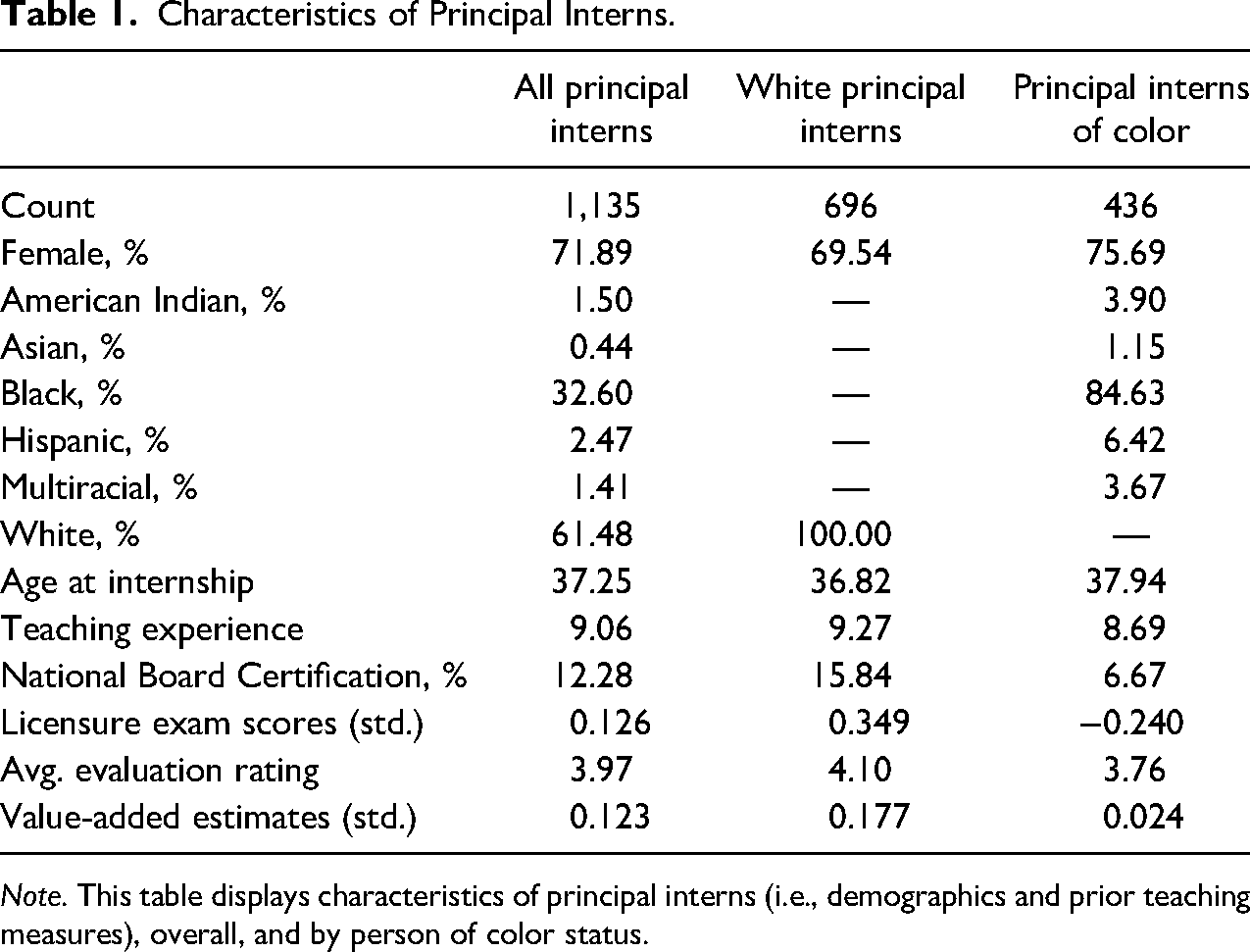
Note. This table displays characteristics of principal interns (i.e., demographics and prior teaching measures), overall, and by person of color status.
The top panel of Table 2 presents characteristics of principal internship schools. Overall, internships are in schools where approximately 57% of students are low-income and 60% are students of color. Data from the TWC survey indicate that internship sites are below the statewide mean—by 13% of a standard deviation—on the school leadership construct and the survey item regarding whether the school is a good place to work and learn. Students pass 54.5% of end-of-grade/end-of-course exams at internship schools, and nearly 73% of internship schools meet or exceed expected achievement growth. As with the intern characteristics, there are differences in internship sites between White interns and interns of color. Especially noteworthy are the differences in school working condition measures, test proficiency rates, and the percentage of low-income students and students of color. Individuals of color are also more likely to intern at a school located in an urban area.
Characteristics of Internship Schools and Mentor Principals.
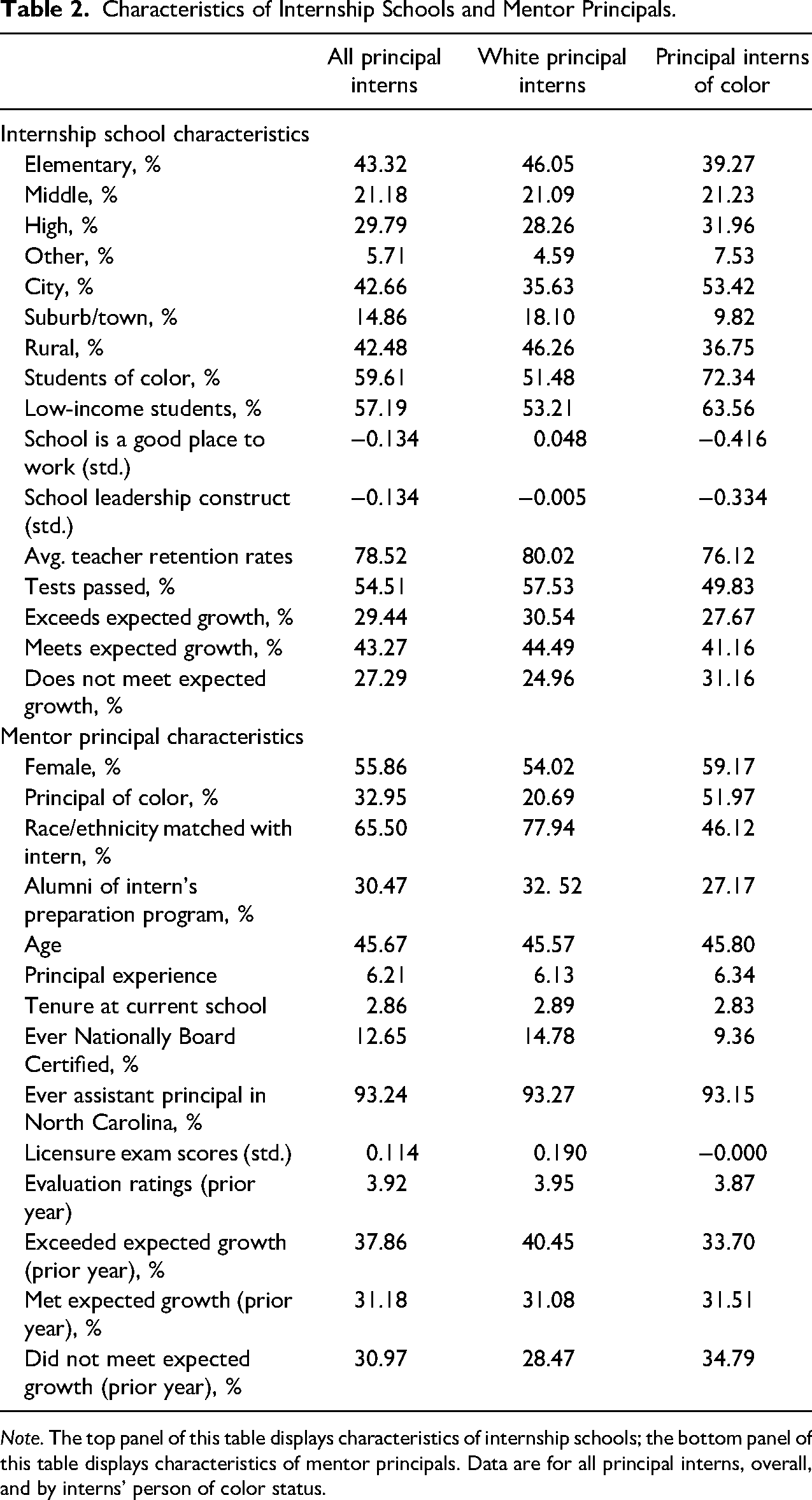
Note. The top panel of this table displays characteristics of internship schools; the bottom panel of this table displays characteristics of mentor principals. Data are for all principal interns, overall, and by interns’ person of color status.
Finally, the bottom panel of Table 2 presents characteristics of mentor principals. Regarding demographics, 56% of mentor principals are female, 33% are a person of color, and their average age is 45.67. Nearly 66% of mentor principals are of the same race/ethnicity as their intern—this percentage is much higher for White mentors/interns—and approximately 30% are alumni of the same principal preparation program that their intern is attending. On average, mentors have over 6 years of principal experience but have been a principal at the internship school for less than 3 years. This relatively short tenure at internship schools may have implications for mentors’ ability to fully shape the working conditions and achievement of placement schools. Mentors are very likely to have previously served as an assistant principal in North Carolina and have licensure exam scores 11% of a standard deviation above the mean. Data from the year prior to serving as a mentor show that these principals had average evaluation ratings of 3.92, and 38% led a school that exceeded expected growth. Once again, we find meaningful differences by interns’ person of color status. Interns of color are much more likely to have a mentor principal of color. Mentors for interns of color are less likely to have ever held NBC and have lower licensure exam scores and prior-year measures of performance (e.g., evaluation ratings and exceeding expected achievement growth).
Analysis Plan
To address our first research question—assessing the characteristics of principal interns—we estimate a series of linear regression models comparing the demographic, teacher credential, and teacher performance measures of principal interns to those of teachers who are eligible for but have not yet served as a principal intern. Specifically, the comparison group for these analyses consists of teachers with at least 3 years of teaching experience (a minimum for entering principal preparation) who do not already hold a principal license. In these analyses (as with the descriptive characteristics in Table 1), the data for principal interns come from the most recent year before their internship.
Equation (1) presents our linear regression model. Here, 


Given the descriptive differences shown in Table 2, we estimate an additional set of models that generate separate estimates for White interns and for interns of color. That is, we compare (a) the characteristics of internship schools and mentor principals for White interns relative to schools and principals not hosting an intern and (b) the characteristics of internship schools and mentor principals for interns of color relative to schools and principals not hosting an intern. We do this by replacing the
Overall, we assess whether those who will become interns are more diverse, better credentialed, and/or more effective than their teacher peers; whether internship schools have better reported working conditions, higher teacher retention rates, and higher levels of academic achievement than nonhost sites; whether mentor principals are more diverse, better credentialed, and more effective than nonmentors; and the extent to which White interns and interns of color have different internship schools and mentor principals than nonhost sites.
Results
What Are the Characteristics of Principal Interns?
Table 3 presents results from regression models comparing the characteristics of principal interns to noninterns—both statewide (top panel) and within schools and years (bottom panel). Regarding demographics, we find that principal interns are 19.2 percentage points more likely to be a person of color than other teachers across North Carolina; interns are 12.8 percentage points more likely to be a person of color than other teachers within their schools. These estimates suggest that preparation programs are working to diversify the school leader pipeline. To put this difference into perspective, we note that in 2018–2019, 21% of North Carolina's teachers and 28% of North Carolina's principals were people of color. Regarding teacher credentials, we find that interns are no more or less likely than noninterns to hold NBC and have licensure exam scores that are comparable to those for noninterns.
Regression Analyses Comparing the Characteristics of Principal Interns to Noninterns.
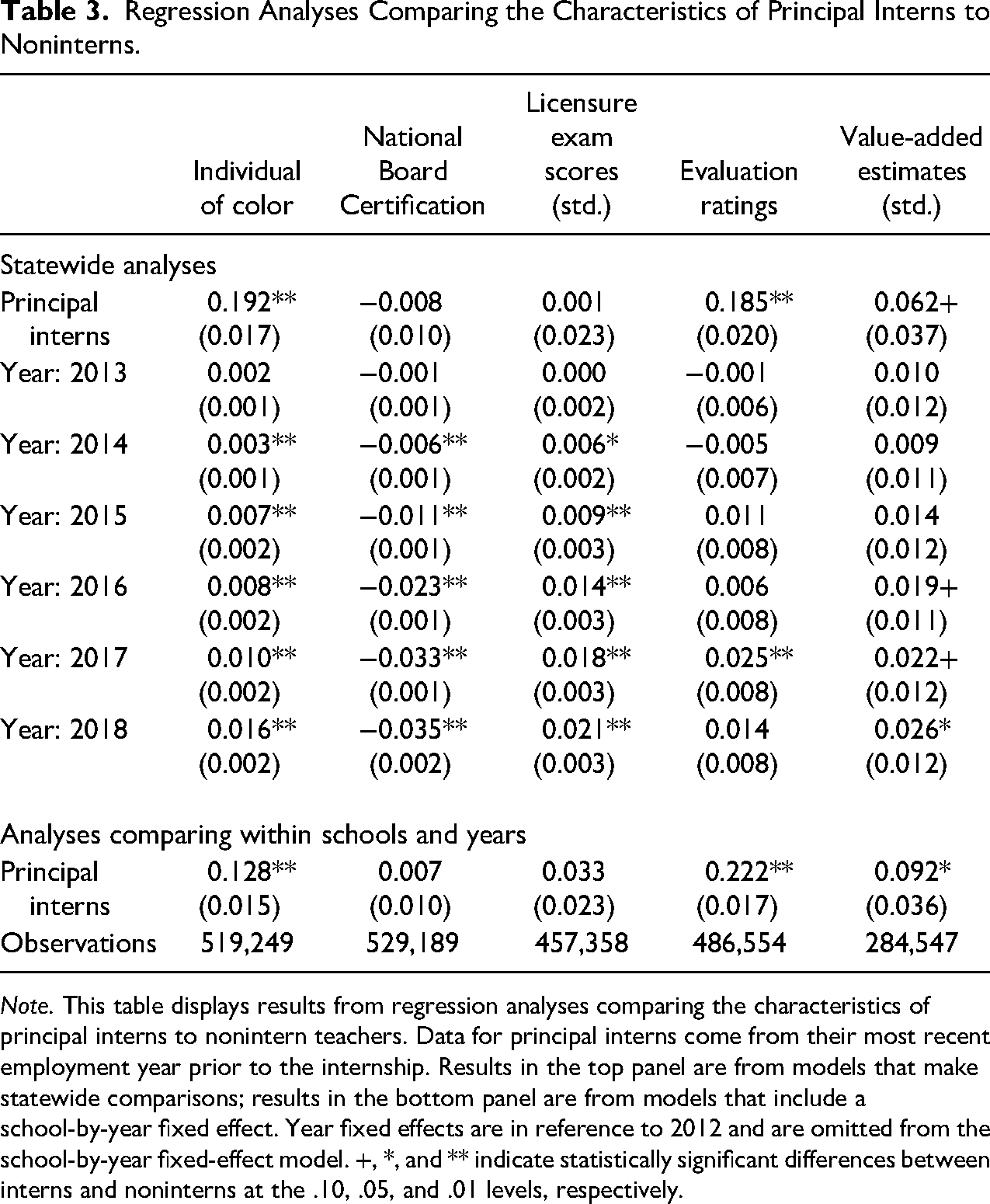
Note. This table displays results from regression analyses comparing the characteristics of principal interns to nonintern teachers. Data for principal interns come from their most recent employment year prior to the internship. Results in the top panel are from models that make statewide comparisons; results in the bottom panel are from models that include a school-by-year fixed effect. Year fixed effects are in reference to 2012 and are omitted from the school-by-year fixed-effect model. +, *, and ** indicate statistically significant differences between interns and noninterns at the .10, .05, and .01 levels, respectively.
In terms of teacher performance, we find that principal interns earn significantly higher evaluation ratings than other teachers both across North Carolina and within their schools. Specifically, interns earn evaluation ratings that are approximately 0.18–0.22 points higher than their nonintern peers. This difference is equivalent in magnitude to the average difference in evaluation ratings between first- and second-year teachers in North Carolina. When we add in controls for teacher experience—estimates not included in Table 3—we find that these evaluation rating differences are slightly larger in magnitude. A potential explanation for these evaluation rating differences is “tapping” (i.e., principals have already identified these teachers as promising school leader candidates and then rate them higher accordingly) (Myung et al., 2011; Young & McLeod, 2001). One way to address this concern is by examining teacher value-added estimates, a performance measure that may be more objective than evaluation ratings. On average, our estimates show that principal interns have value-added estimates approximately 6% of a standard deviation higher than teachers statewide and 9% of a standard deviation higher than teachers within their schools. 13 These differences in value-added estimates are modest in magnitude—less than the average value-added difference between first- and second-year teachers in North Carolina—but, when combined with the evaluation rating results, suggest that teachers who enroll in principal preparation programs and complete an internship are more effective than their peers who are not pursuing school leadership.
What Are the Characteristics of Internship Schools and Mentor Principals?
Table 4 displays estimates from regression models comparing the characteristics of schools hosting an intern to the characteristics of nonintern sites. Focusing first on our overall models, we find that internship schools have lower values on the TWC school leadership construct and on the survey item regarding whether the school is a good place to work and learn. For example, comparing within districts and years, internship sites have values on the school leadership construct 9% of a standard deviation lower than schools not hosting an intern in the respective year. Internship schools also have teacher retention rates that are significantly lower—by nearly 13% of a standard deviation—than noninternship schools, statewide. This difference in teacher retention rates dramatically reduces in magnitude and is no longer statistically significant when comparing within districts and years. Regarding school academic performance, we find significant differences in test proficiency rates but not in student achievement growth. Specifically, internship schools have lower test proficiency rates—by 2.4% statewide and 1.4% within districts and years—but are no more or less likely than noninternship sites to exceed expected growth in the internship year.
Regression Analyses Comparing the Characteristics of Internship Schools to Noninternship Schools.
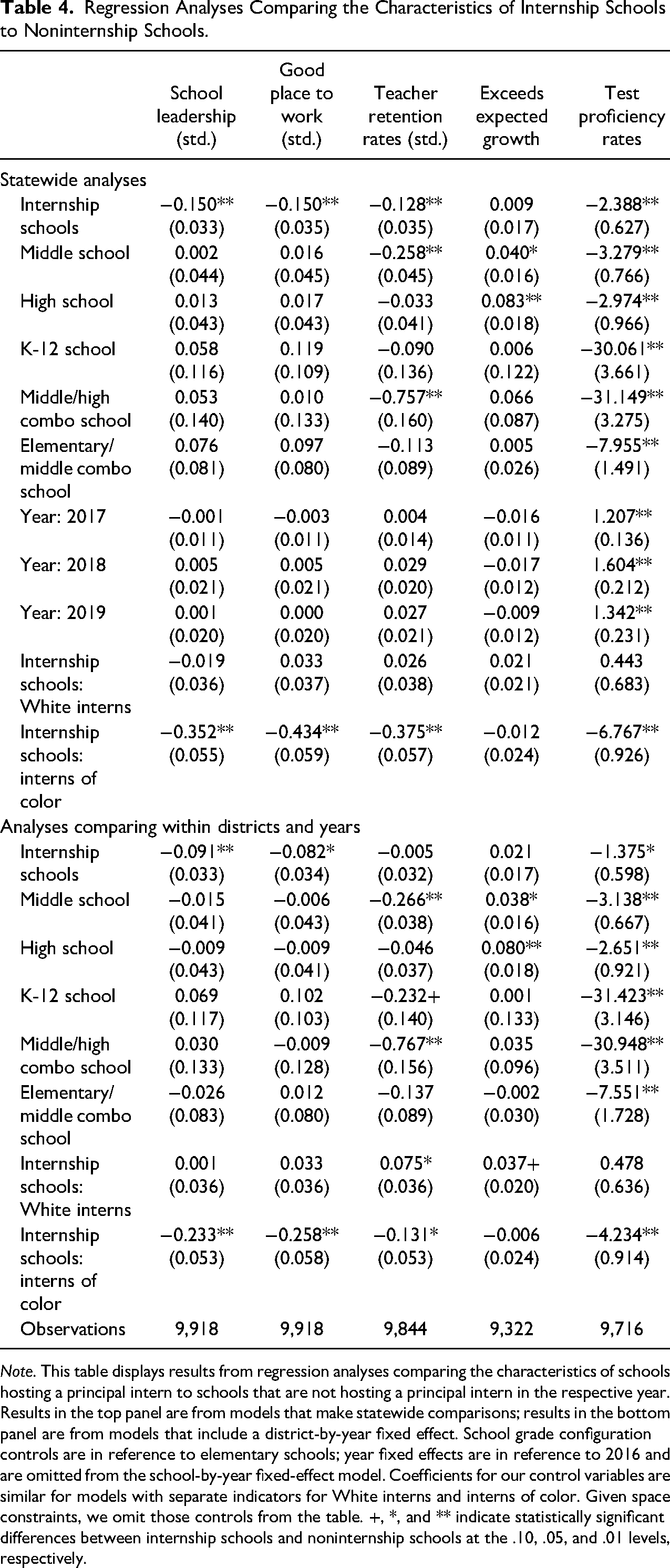
Note. This table displays results from regression analyses comparing the characteristics of schools hosting a principal intern to schools that are not hosting a principal intern in the respective year. Results in the top panel are from models that make statewide comparisons; results in the bottom panel are from models that include a district-by-year fixed effect. School grade configuration controls are in reference to elementary schools; year fixed effects are in reference to 2016 and are omitted from the school-by-year fixed-effect model. Coefficients for our control variables are similar for models with separate indicators for White interns and interns of color. Given space constraints, we omit those controls from the table. +, *, and ** indicate statistically significant differences between internship schools and noninternship schools at the .10, .05, and .01 levels, respectively.
In model extensions, we find that these overall differences in internship sites are strongly driven by the placement school characteristics for interns of color. Examining results from our preferred district-by-year fixed-effect models, we find that the internship schools for White interns are generally comparable to schools that are not hosting an intern, with some evidence that White interns are placed in schools with higher teacher retention rates and schools that are slightly more likely to exceed expected growth. Conversely, interns of color have placements in schools with significantly lower TWC survey values, teacher retention rates, and test proficiency rates. For example, relative to noninternship schools within the same district, interns of color are placed in schools where the school leadership construct value is 23% of a standard deviation lower and teacher retention rates are 13% of a standard deviation lower.
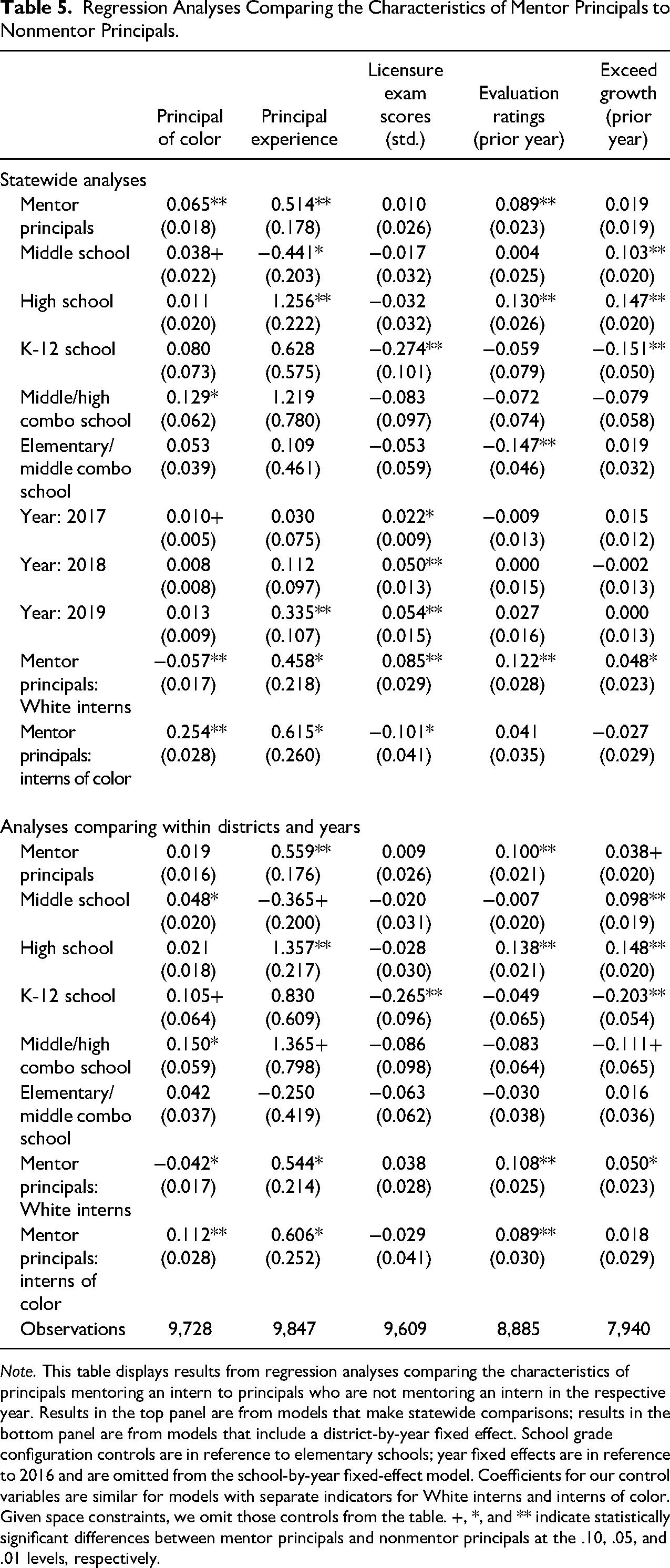
Shifting to mentor principals, Table 5 presents estimates from regression models comparing the characteristics of principals serving as a mentor to the characteristics of nonmentor principals. Starting with our overall models, we find that mentor principals are 6.5 percentage points more likely to be a person of color than principals not hosting an intern. This difference reduces in magnitude and is no longer statistically significant when comparing within districts and years. Relative to nonmentors, mentor principals average a half year more principal experience. This result is consistent when comparing statewide or within districts. While both groups scored similarly on licensure exams, there is some evidence that mentor principals perform better than nonmentors. Comparing within districts and years, mentor principals have prior-year evaluation ratings approximately 0.10 points higher than principals who are not mentoring an intern. This difference is approximately half of the difference in evaluation ratings between first- and second-year principals in North Carolina. Likewise, compared to other principals in the same district, mentor principals are nearly 4 percentage points more likely to have led a school in the prior year that exceeded expected growth.
Regression Analyses Comparing the Characteristics of Mentor Principals to Nonmentor Principals.
Note. This table displays results from regression analyses comparing the characteristics of principals mentoring an intern to principals who are not mentoring an intern in the respective year. Results in the top panel are from models that make statewide comparisons; results in the bottom panel are from models that include a district-by-year fixed effect. School grade configuration controls are in reference to elementary schools; year fixed effects are in reference to 2016 and are omitted from the school-by-year fixed-effect model. Coefficients for our control variables are similar for models with separate indicators for White interns and interns of color. Given space constraints, we omit those controls from the table. +, *, and ** indicate statistically significant differences between mentor principals and nonmentor principals at the .10, .05, and .01 levels, respectively.
As with the estimates on internship schools, Table 5 indicates that there are some differences in mentor principal characteristics by intern of color status. Mentors for White interns are less likely to be a person of color than nonmentor principals. Conversely, mentors for interns of color are much more likely to be a person of color. For example, comparing with districts and years, the mentors for interns of color are 11 percentage points more likely than nonmentor principals to be a person of color. Statewide analyses show some differences in principals’ licensure exam scores, with White interns having mentors with higher scores and interns of color having mentors with lower scores than nonmentor principals. These licensure exam score estimates are reduced in magnitude and nonsignificant when comparing within districts and years. Lastly, our estimates show that the mentor principals for White interns are significantly more likely than nonmentors to have led a school that exceeded growth in the previous year. The estimates for interns of color are smaller in magnitude and statistically insignificant.
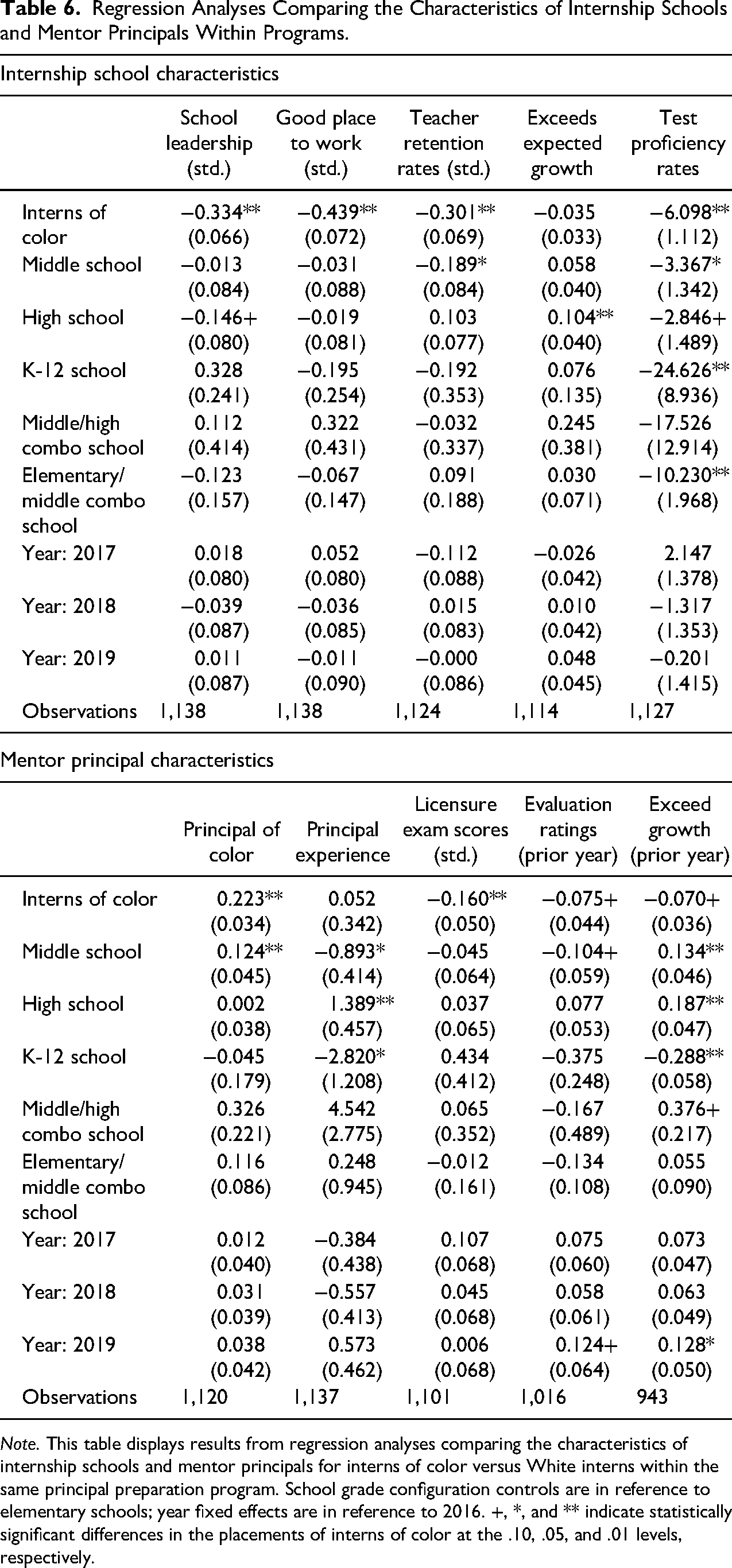
Our results indicate that there are meaningful differences in placement school and mentor principal characteristics by interns’ person of color status. These differences may be attributed to mechanisms between and within preparation programs. That is, there may be (a) sorting across principal preparation programs such that certain programs enroll more candidates of color and these candidates are placed into different internship environments than White peers at other programs and/or (b) sorting within principal preparation programs such that candidates of color at a given program are placed into different internship environments than their White peers at the same program. To investigate this further, we limited our analytical sample to principal interns and their placement schools/mentor principals and estimated a series of regression models with the same internship school and mentor principal outcomes as in Tables 4 and 5. In these models, our focal variable is interns of color relative to White interns, and we control for the same covariates—grade configuration and year fixed effects—as in Equations (2) and (3). We omit the district-by-year fixed effect from this model and replace it with a principal preparation program fixed effect. With this approach, we test whether the characteristics of internship schools and mentor principals differ between White interns and interns of color in the same program.
Results in the top panel of Table 6 show that the internship schools for interns of color significantly differ from those for White interns in the same program. Specifically, interns of color have placement schools with lower leadership construct values, lower values on whether the school is a good place to work and learn, lower teacher retention rates, and lower test proficiency rates. These differences are all large in magnitude. Estimates in the bottom panel of Table 6 indicate that there are also differences in mentor principal characteristics. Comparing within preparation programs, interns of color are significantly more likely to have a mentor principal of color. The mentors for interns of color have lower licensure exam scores, have slightly lower prior-year evaluation ratings, and were less likely to have led a school in the prior year that exceeded expected growth. Taken together, the estimates in Table 6 highlight how internship placements differ greatly for interns of color and their White peers in the same program.
Regression Analyses Comparing the Characteristics of Internship Schools and Mentor Principals Within Programs.
Note. This table displays results from regression analyses comparing the characteristics of internship schools and mentor principals for interns of color versus White interns within the same principal preparation program. School grade configuration controls are in reference to elementary schools; year fixed effects are in reference to 2016. +, *, and ** indicate statistically significant differences in the placements of interns of color at the .10, .05, and .01 levels, respectively.
Discussion and Conclusion
Our work on the principal internship is motivated by a range of factors, including recent scholarship highlighting the importance of student teaching placements and cooperating teachers to teacher outcomes (Bastian et al., 2022; Goldhaber et al., 2020a; Ronfeldt, 2012, 2015; Ronfeldt et al., 2018) and the lack of large-scale, quantitative studies on principal interns, their internship schools, and their mentor principals. From this initial study of principal internships, there are four key takeaways.
First, as with other research exploring the decisions of teachers of color to seek principal certification (Fuller & Young, 2022; Williams & Loeb, 2012), we find that interns are far more likely to be an individual of color than their teaching peers. This result likely reflects the efforts of principal preparation programs and K-12 districts to diversify leadership pipelines, which is an important focus area given the sizable racial and ethnic gaps between principals and K-12 students (Grissom et al., 2021; Perrone, 2022) and research showing that students of all races benefit from school leaders of color (Grissom et al., 2017a; Jang & Alexander, 2022). Beyond program efforts to inculcate cultural competence in their candidates (Barakat et al., 2019), strong university–district partnerships that recruit, select, and retain prospective school leaders of color are a critical component in helping diversify the school leadership pipeline (Reyes-Guerra et al., 2022). In fact, superintendents across the country see room for improvement in the diversity and cultural competency of their school leaders (Gates et al., 2020), with partnerships with principal preparation programs being a key lever to address this gap (Reyes-Guerra et al., 2022).
Second, we find that teachers who will become interns have higher evaluation ratings and value-added estimates than teachers in their buildings. To the extent that teacher quality predicts future school leader quality, this is important. The practice of tapping—that is, the informal recruitment of teachers into the leadership pipeline by someone, usually a principal—is an important part of the leadership pipeline (Young & McLeod, 2001). For instance, Myung et al. (2011) found that roughly 90% of principals and assistant principals reported being encouraged by at least one individual to become a principal. They also found that principals were far more likely to tap teachers of the same gender and race (Myung et al., 2011). It stands to reason that principals could be tapping teachers who they view and rate as more effective teachers. These performance results are consistent with prior work that more effective teachers may get tapped/enter principal preparation (Grissom et al., 2020); however, the evidence is mixed on this point (Goldhaber et al., 2019; Liebowitz & Porter, 2020).
Third, we find that there may be opportunities to further evaluate decisions regarding the placements for principal interns. Our results show that internship schools have lower values on two different school working condition measures (leadership and overall environment), have higher teacher attrition rates (in statewide models), have lower test proficiency rates, and are no more effective, based on student achievement growth, than schools that are not hosting an intern. Importantly, we find that these differences between internship schools and noninternship schools are driven by the placements for interns of color, even when comparing within a preparation program. We find this difference to be particularly important to highlight, as the research literature on the placement of school principals finds that principals of color are more likely to serve low-income students and students of color—school environments often associated with insufficient funding and other leadership challenges (Grissom et al., 2021). Yet, these spaces may also be environments where interns of color receive a different set of opportunities for leadership growth. For example, Drake et al. (2023) found that interns in settings with higher student poverty conducted far more instructional leadership activities than their peers in more affluent schools, where interns reported conducting more administrative duties.
Of course, we do not yet know whether characteristics of internship schools predict the performance and retention of principals; however, the student teaching literature suggests that placements in high-quality learning environments (i.e., schools where teachers collaborate and stay and students make larger achievement gains) predict increased performance and retention for early-career teachers (Bastian et al., 2022; Ronfeldt, 2012, 2015). Additional work shows that early-career principals are more effective if they served as an assistant principal in a high-value-added school (Bastian & Henry, 2015). As such, evaluating the selection of internship schools may be a low-cost approach that benefits principal preparation and outcomes for school leaders.
Finally, although we find that mentor principals have some desired characteristics, there still may be opportunities to think strategically about placements with mentor principals. Once again, this interpretation is influenced by the student teaching literature and the robust results linking cooperating teacher effectiveness to the performance of early-career teachers (Bastian et al., 2022; Goldhaber et al., 2020a; Ronfeldt et al., 2018). In our study, we show that mentor principals are more diverse than nonmentors (in statewide models only), have more principal experience, earn slightly higher prior-year evaluation ratings, and are somewhat more likely to have led a school that exceeded growth in the previous year. Although our mentor results are suggestive of some selectivity in identifying mentor principals, there are also many more principals (prospective mentors) with higher measures of school leader quality. For example, among districts in our analytical sample where at least one principal intern was placed, there are approximately 825 principals, each year, who earned evaluation ratings of accomplished (level 4) or higher in the prior year. Likewise, there are approximately 560 principals, each year, who led a school in the prior year that exceeded expected growth.
We also find that there are differences in the mentor principal characteristics between interns of color and their White peers. Specifically, interns of color are disproportionately placed with mentor principals of color, even within principal preparation programs. Perhaps it is for this reason that we find that interns of color have mentors with lower licensure exam scores and lower measures of prior-year performance, as research finds that licensure exams have been shown to be biased against non-White test takers (Grissom et al., 2017b) and principals of color are often tapped to serve in lower-performing schools (Dixon et al., 2022). Of course, there may be important benefits to assigning interns of color to a mentor principal of color. For example, teachers report higher job satisfaction and have lower turnover rates when supervised by an own-race principal (Grissom & Keiser, 2011). Research on school leaders of color has also found mentorship by an own-race principal to be a key lever for leadership development and growth (Enomoto et al., 2000; Méndez-Morse, 2004). These findings highlight that there may be other unmeasured characteristics of mentor principals that predict the quality of their support.
There are several important limitations to our study, which have implications for future research. We acknowledge that the internship is only one part of the principal pipeline—which also includes assistant principal experiences, induction programs, and in-service professional development—in which leaders have a chance to grow and develop (Darling-Hammond et al., 2022). Other limitations include missing data, an inability to fully identify the quality of the internship, and questions about the internship placement process. While we have data on a large majority of principal interns in North Carolina—from 12 of the 13 public institutions with a preparation program—we do not possess data from preparation programs at private institutions in the state. Though the number of graduates from these programs is relatively small, we acknowledge that our findings do not capture these interns. This is less of a concern for our first research question, where we compare interns to over 120,000 unique fellow teachers (noninterns). This may be more of a concern for our second research question, where a limited number of schools and principals in our comparison group (i.e., noninternship sites) are actually hosting an intern. Despite this limitation, we believe that our work examining the characteristics of internship sites and mentor principals is vitally important and we join with others in calling for more robust data systems on the principal pipeline (Perrone et al., 2022).
Our research makes an important contribution by assessing the characteristics of interns, internship schools, and mentor principals. However, we do not more directly consider the quality of the internship experience. In particular, we do not examine the number of internship hours, the types of activities in which interns engage, or the quality of support/coaching from the mentor principal and university field supervisor. Furthermore, unlike student teaching, there is not yet work assessing whether characteristics of the internship school and mentor principal predict subsequent intern outcomes (e.g., employment as a school administrator and performance as a school administrator). Lastly, we acknowledge that the internship assignment process is unclear and varies by program, with some university programs working with districts to place interns (Fusarelli et al., 2019) and others leaving that choice up to the student. Geographic proximity between the intern and the internship school/mentor principal may be a strong predictor of placement (Orr, 2011; Reyes-Guerra & Barnett, 2016). This geographic proximity matters because the communities and schools in which prospective interns work vary widely across the state (e.g., there are more students of color in central and eastern North Carolina) in ways that may influence the characteristics of their placement schools and mentor principals.
Taken together, our findings may have implications for the placement processes of preparation programs and for the policies that regulate such placements. In particular, our findings suggest that programs and K-12 districts could be working in closer partnership to evaluate placement decisions based on the characteristics of prospective internship schools and mentor principals. This may be especially true for interns of color, who need more attention in the leadership pipeline (Fuller & Young, 2022). Given our study limitations, we call for a range of continued research studies. This includes work to better understand the geography of internship placements—in relation to previous and subsequent employment locations for the intern—and how that geography varies by characteristics of interns and programs. Future work will also benefit from qualitative studies that closely examine the role of programs, K-12 districts, and interns in the internship placement process. Finally, continued work must follow principal interns into the school leader workforce and assess how variation in their placements—from the characteristics of internship schools and mentor principals to the amount of program oversight in placement—predicts outcomes as school administrators.
Footnotes
Acknowledgments
The authors would like to acknowledge the University of North Carolina System Office and the North Carolina Department of Public Instruction for providing the administrative data for this research.
Declaration of Conflicting Interests
The authors declared no potential conflicts of interest with respect to the research, authorship, and/or publication of this article.
Funding
The authors received no financial support for the research, authorship, and/or publication of this article.
